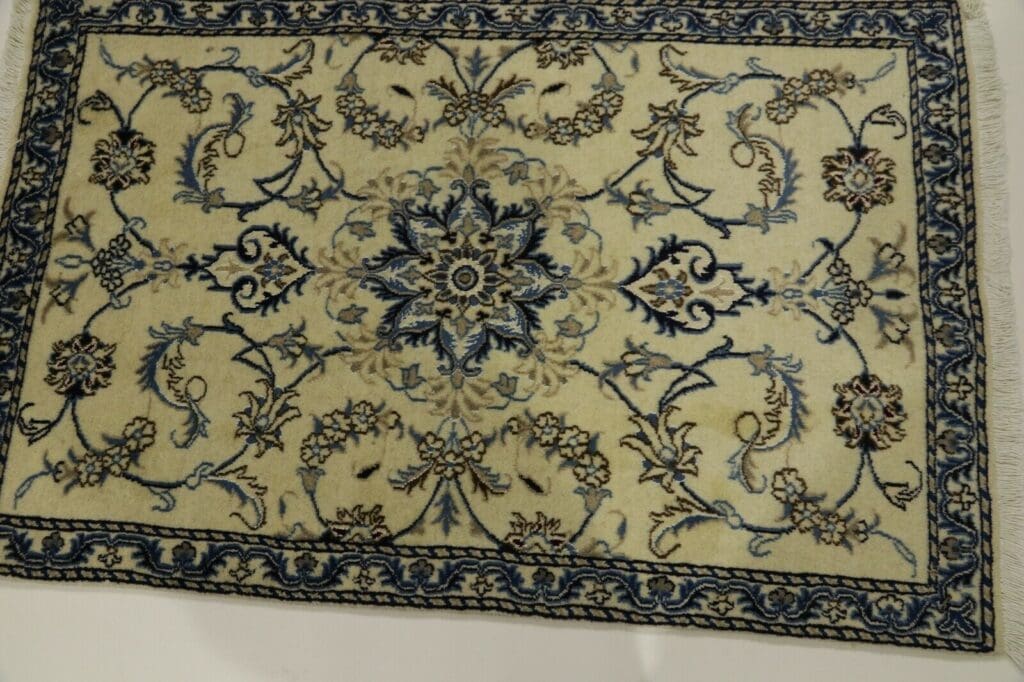
This Nain Persian rug is hand-knotted. Its pile is made from 100% virgin wool, while the warp is specified as 100% cotton. These materials have different functions within a rug: wool forms the visible surface and cotton belongs to the supporting foundation into which the knots are placed. Virgin wool is a natural fibre with a soft, tactile surface. It is breathable and helps insulate against cold. Wool has long been used for rug piles because its fibres provide both comfort and resistance in everyday use.
Hand-knotting is a gradual process. Individual knots are tied into a prepared warp, row after row, and held in place by weft threads. The design is created as the work advances across the foundation. Once the knotting is complete, the pile is brought to an even surface. This method requires control over tension, spacing and the outline of each motif. Unlike a machine-produced floor covering, a hand-knotted rug is assembled through repeated manual decisions and is offered as an individual piece.
The listed density of approximately 300,000 knots per square metre describes a fine, closely constructed knotting. In general, a dense construction allows small ornaments, narrow outlines and gradual transitions to be rendered with greater control. The pile height is specified as 8 mm. These details form part of the technical description of this rug and complement the information about its hand-knotted production.
Traditional rug making begins by stretching and arranging the warp on a loom. Knots are then inserted in successive rows, with weft threads stabilising the structure. The pile is regularly compacted and later trimmed to create an even face. When a design contains fine detail, the spacing of the knots and the progression of the rows must be carefully coordinated. The technique therefore links the rug’s construction directly to its pattern and surface.
This piece is described as a unique and distinctive item. A certificate of authenticity is included. Its condition is stated as new and unused. The combination of wool pile, cotton warp, hand-knotting and fine construction gives the rug the technical profile described for the offering.
Origin and Tradition
Nain is a town in Iran and a recognised centre of Persian rug production. It is located in central Iran, in a dry region shaped by broad open landscapes and a long history of settlement and trade. A distinct rug tradition developed in this setting. Nain rugs became associated with careful execution, refined drawing and controlled colour relationships. The tradition reaches back to the seventeenth century and forms part of the wider history of Iranian textile and rug making.
Iran contains many regional weaving traditions, each with its own approach to proportion, ornament, colour and construction. Nain is one of these clearly defined regional schools. The name therefore indicates more than a general Oriental appearance. It refers to a specific place and to a body of inherited knowledge connected with that place. A Nain Persian rug belongs to Iranian rug culture and is understood through the working methods and design vocabulary developed in the region.
Persian rug making combines practical construction with artistic planning. Knowledge of yarns, loom preparation, knotting, colour arrangement and finishing is passed on through long-established practices. A pattern is not applied to a completed surface. It is built from individual knots whose placement creates colour fields, lines and ornaments. The final image depends on the coordinated execution of many small steps, from the first arrangement of the warp to the finishing of the pile.
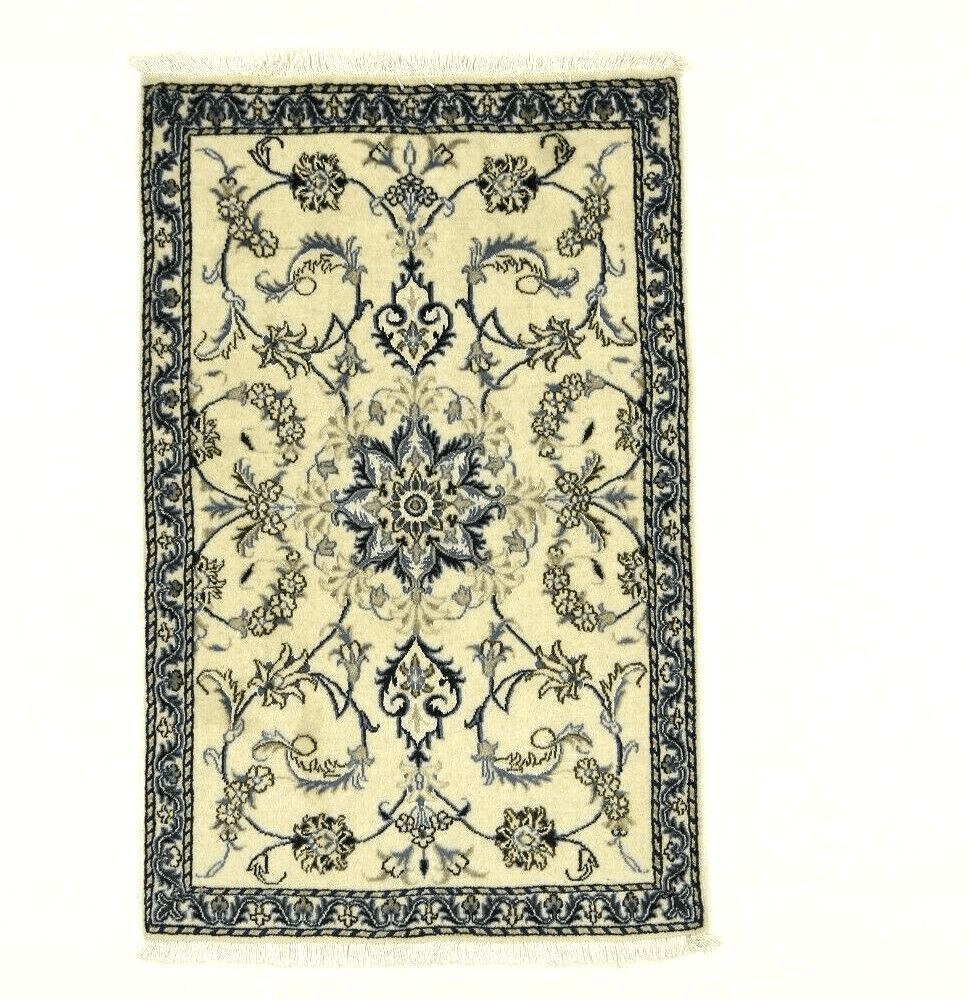
Nain rugs are often associated with balanced compositions and fine patterning. Their designs may organise the field around a central element, surrounding borders and smaller repeated ornaments. Different rugs can vary in structure, but a sense of order, precision and restrained elegance is frequently connected with the tradition. Pile and ground colours are brought into relation so that details remain visible while the composition retains a unified appearance.
The history of Iranian rugs is connected with domestic life, architecture, trade and the decorative arts. Rugs have served as practical textiles and as carefully designed furnishings. They were made within communities where technical and visual knowledge could be preserved across generations. Over time, Persian rugs also became important objects of regional and international trade. Their identity is shaped by the meeting of usefulness, craftsmanship and a rich ornamental heritage.
The term Persian rug refers to the long rug-making tradition of Iran. The historical name Persia is still used when discussing the country’s cultural and textile heritage. Nain provides the specific regional reference within that larger tradition. The classification as traditional Oriental and Persian therefore links the Iranian origin with a design language that developed through the history of Persian weaving.
The technical relationship between warp, weft and pile is central to the making of a knotted rug. The warp establishes the lengthwise framework, the weft helps secure the rows, and the knots form the visible surface and drawing. The finer the planned design, the more carefully these components must be coordinated. Handwork is therefore both structural and decorative: each section contributes to the durability of the foundation and to the clarity of the finished pattern.
Nain rugs are often connected with soft, light and restrained colour schemes. Such a palette can give detailed ornament a calm framework and help different motifs remain visually related. This is a general feature of the regional tradition and does not prescribe the exact arrangement of every Nain rug. Together with precise drawing and orderly composition, however, it is one of the features used to understand the character of Nain weaving.
Design and Pattern
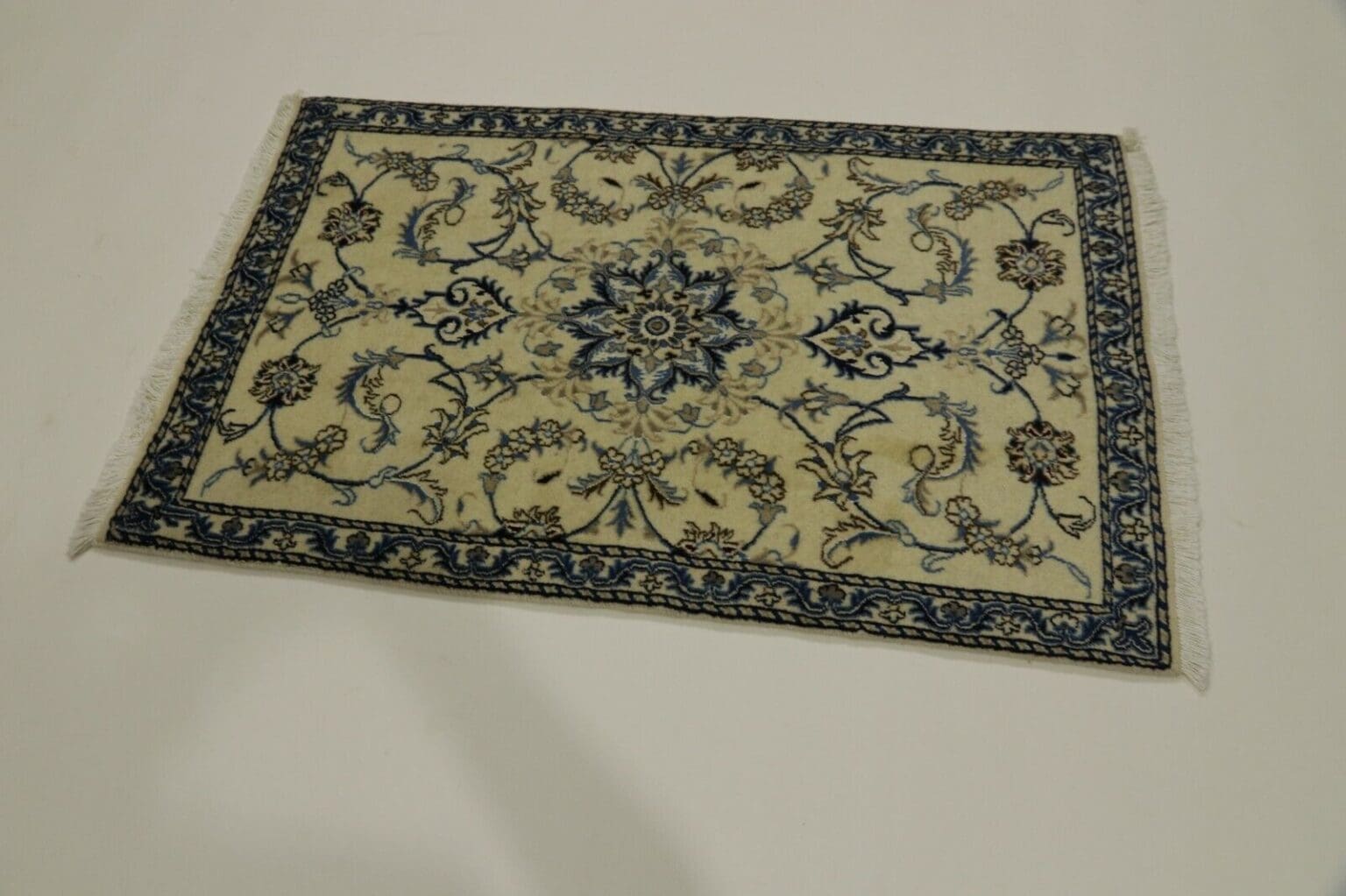
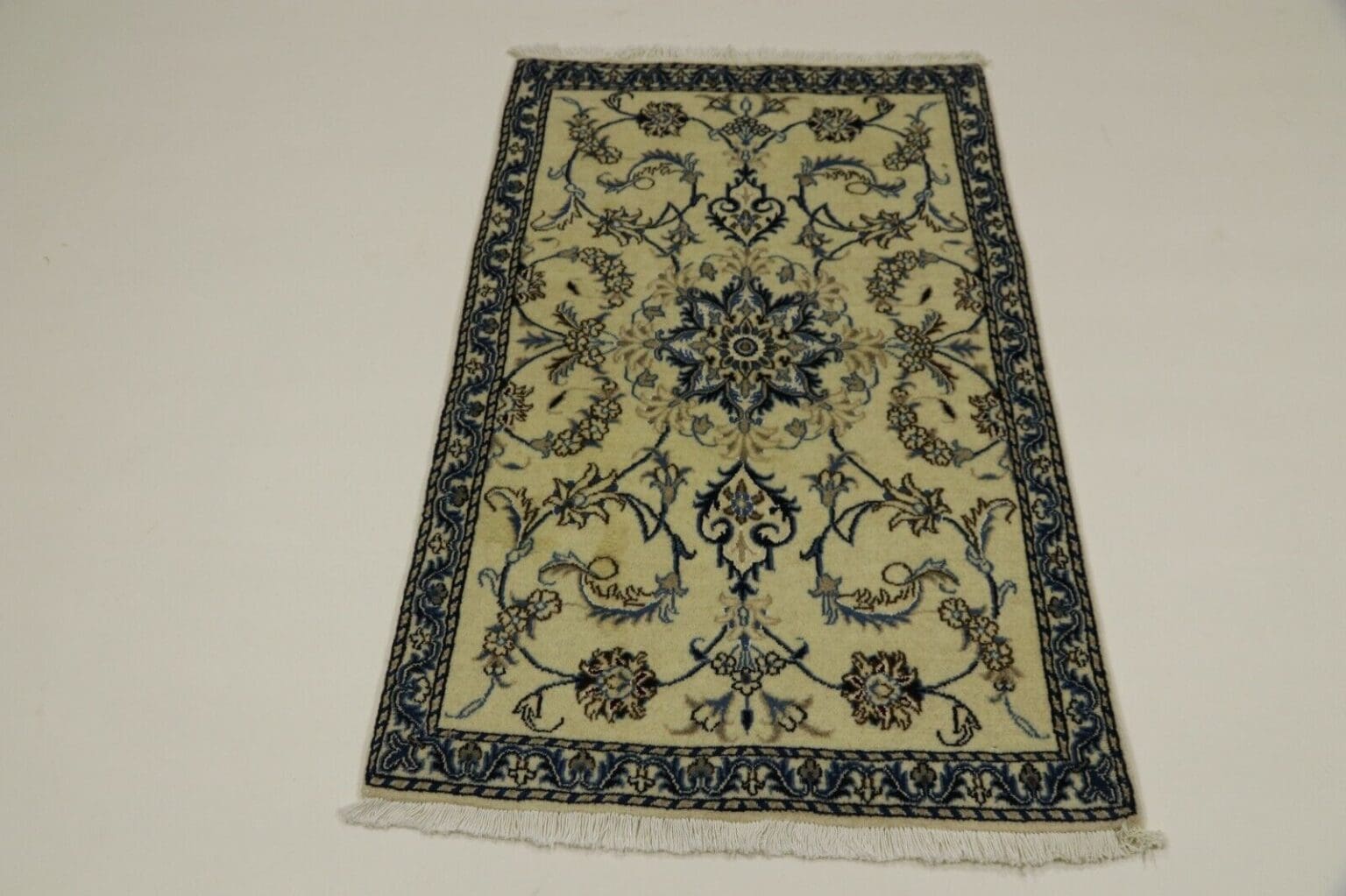
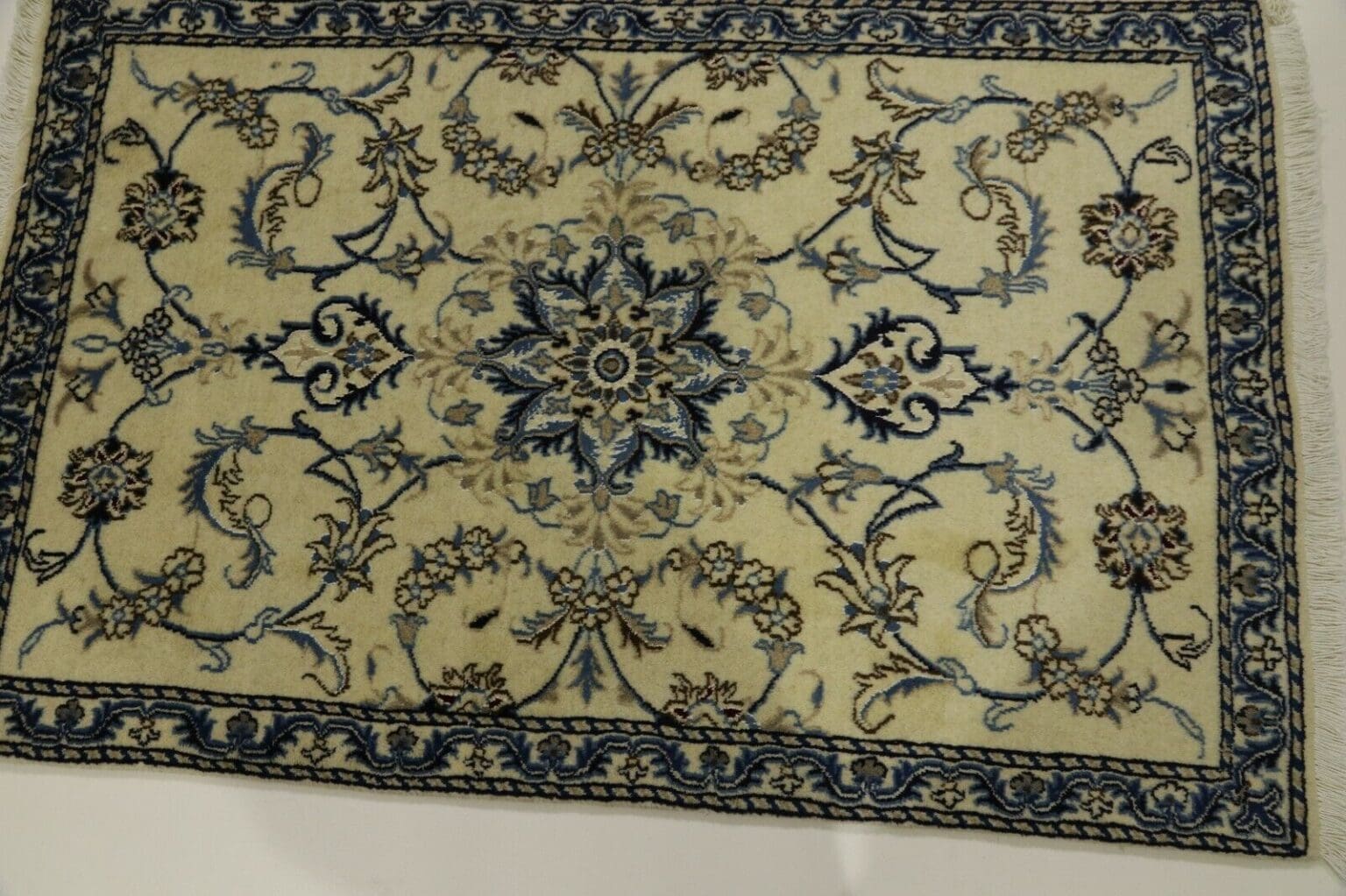
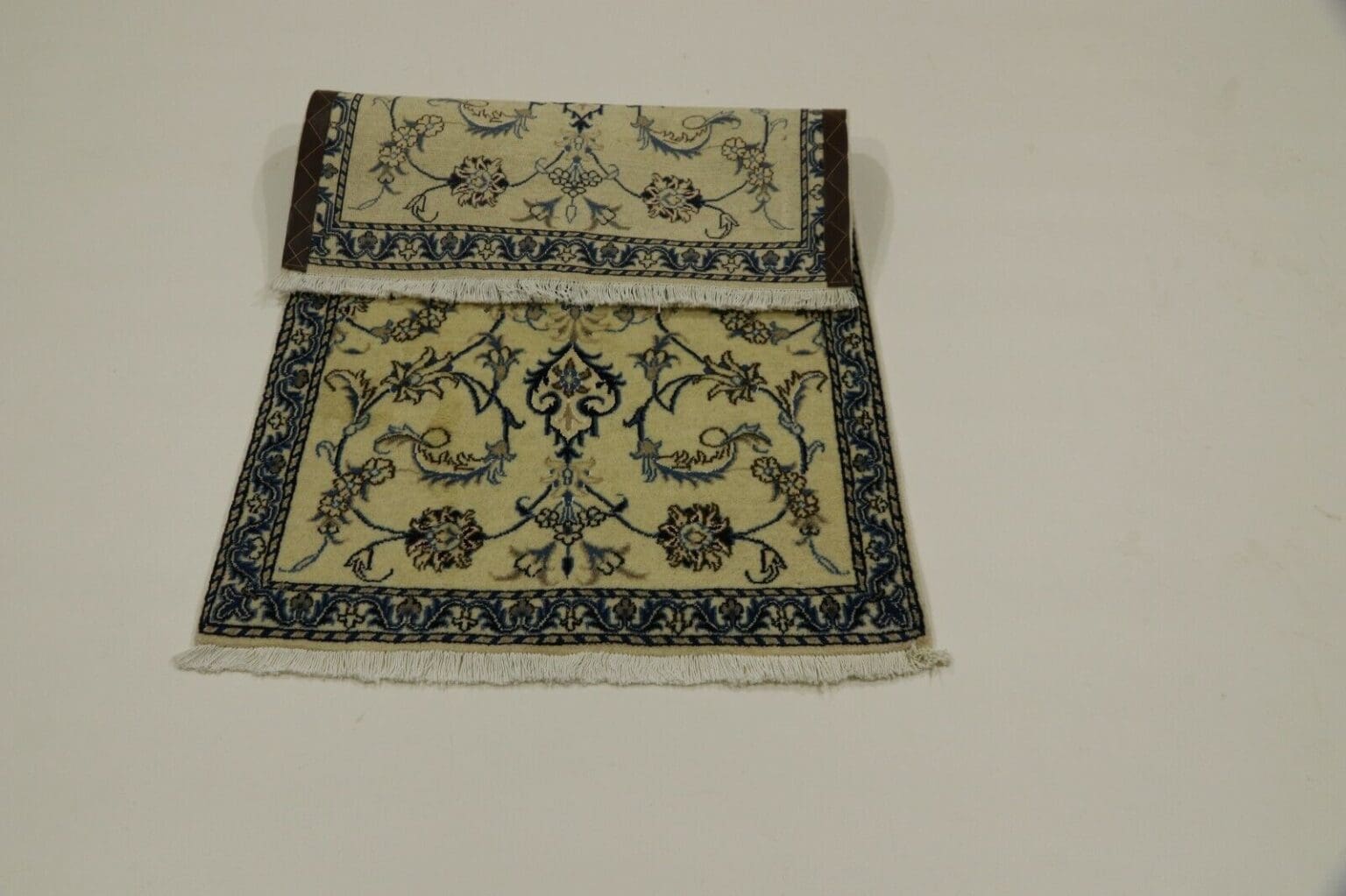
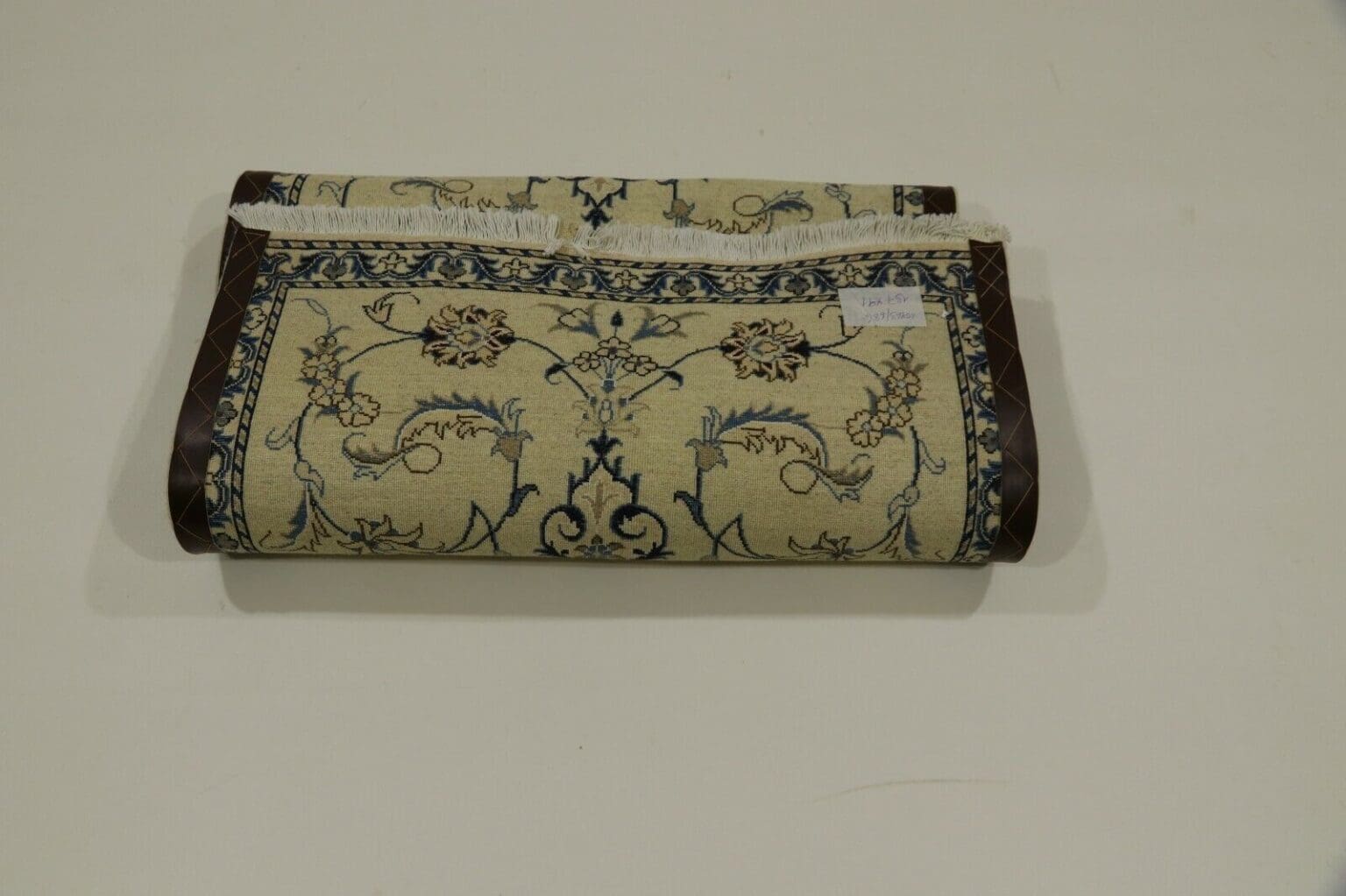
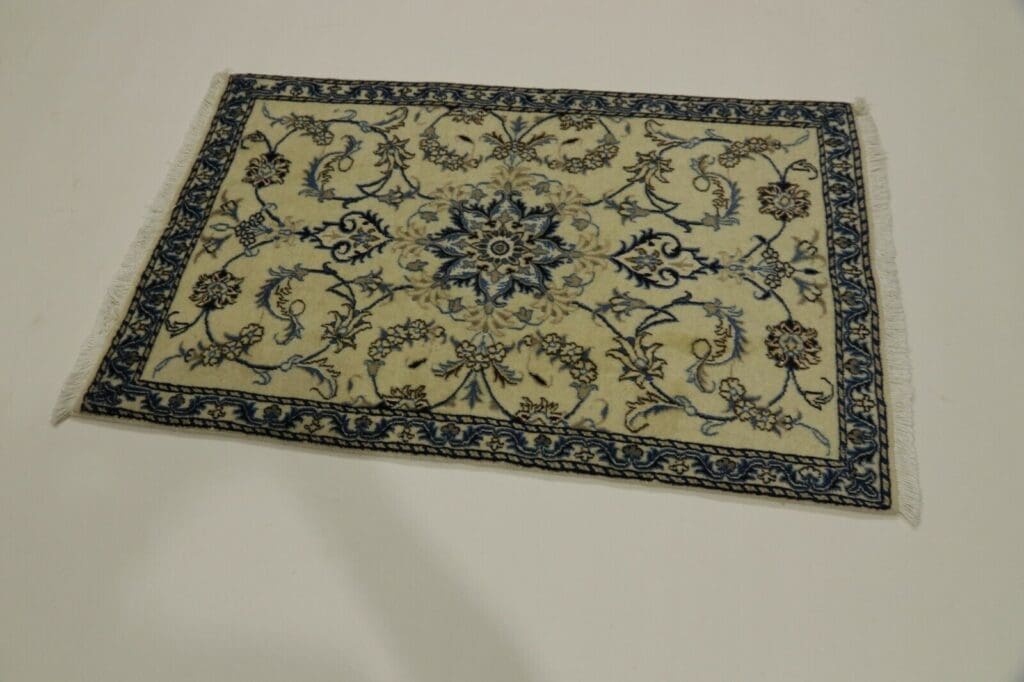
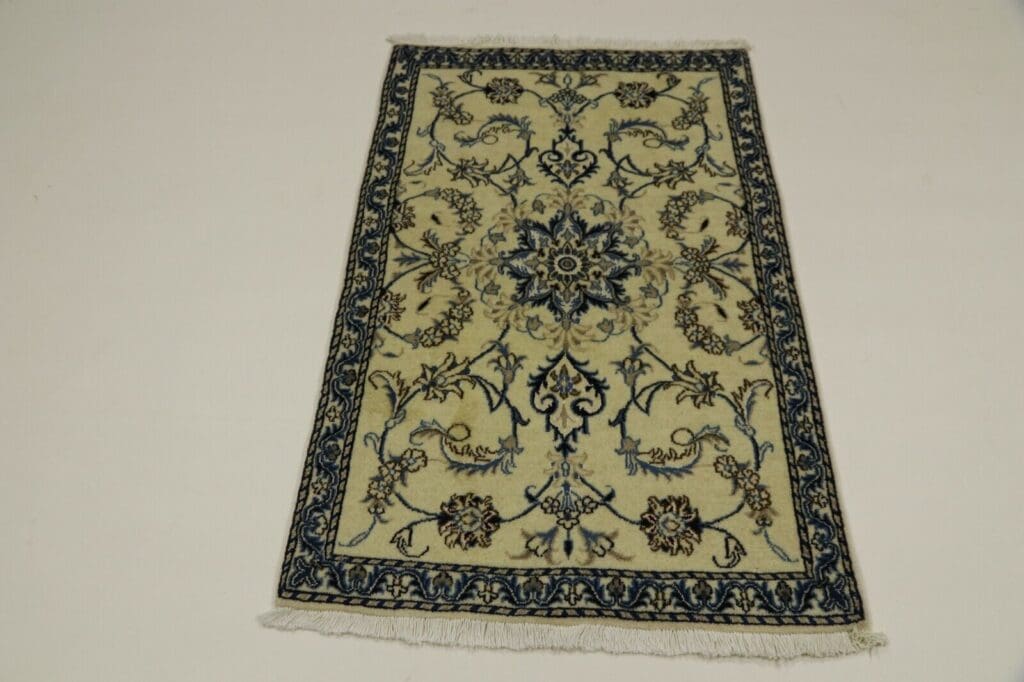
The pattern of this rug is described as traditional Oriental and Persian. Floral motifs and geometric elements are named as part of its design. In Persian ornament, floral forms may appear as blossoms, leaves, vines or stylised plant shapes. Geometric elements contribute lines, axes, repetitions and clearly bounded areas. The two visual languages can be combined so that the composition is organic in its imagery while remaining precise in its structure.
A Persian rug design is defined by the relationship between its parts as well as by individual motifs. The main field, a possible central arrangement, border bands and smaller fillers work together to create visual order. A central motif can focus the composition, while repeated details connect one area to another. Borders frame the field and form a transition toward the outer edge. This structure allows a detailed design to be read as a coherent whole.
Floral ornament in Persian rugs is generally stylised rather than copied as a literal botanical image. Leaves, flowers and scrolling stems may be repeated, mirrored or arranged around an axis. A vine can act as a connecting line, while blossoms and leaves provide rhythm and variation. Stylisation makes it possible to combine natural references with the geometry of the rug field and to adapt plant forms to a carefully measured decorative layout.
Geometric motifs depend on repetition, balance and proportion. Symmetry, diagonal relationships and defined shapes can give a pattern a stable framework. In Persian design, geometric structures are often interwoven with floral details instead of being used alone. The result can combine crisp lines with the movement of vines and leaves. This balance between structure and ornament is an important part of the traditional design vocabulary associated with Persian rugs.
Fine knotting supports the rendering of detailed designs. Small knots can form narrow outlines, short lines and carefully separated colour areas. The visual effect is not created by one isolated symbol but by the interaction of knot placement, colour, pile and the overall plan of the composition. In a hand-knotted rug, the pattern is physically built into the surface, so the technical process and the decorative image remain closely connected.
Nain rugs are commonly associated with gentle, calming colours and a restrained overall effect. A quiet palette can allow floral details and geometric organisation to remain balanced. Differences between pile and ground colours help the drawing stay legible without making the field appear unnecessarily busy. This design approach can work with both traditional and contemporary interiors while retaining the regional character of Nain weaving.
Persian ornaments are often discussed in relation to nature, the seasons or spiritual ideas. These interpretations belong to the wider cultural history of rug design and should not be treated as a fixed meaning for every individual shape. For this rug, the relevant description is the stated combination of floral and geometric elements within a traditional Oriental and Persian design. Its pattern is understood through its arrangement, regional vocabulary and fine hand-knotted execution.
The Nain tradition demonstrates how a design can be refined through small-scale drawing, coordinated colours and an ordered field. The pattern does not exist separately from the making process. Wool creates the visible pile, the warp provides the foundation and the knots translate the planned ornament into a textile surface. The regional design language becomes tangible through this connection between material, technique and composition.
Special Features
The listed features include hand-knotted construction, a pile of 100% virgin wool, a warp of 100% cotton and a fine knot density. The pile height is specified as 8 mm. The rug is offered as a unique and distinctive piece, and a certificate of authenticity is included. Together, these details describe its material, construction, origin-related classification and presentation without confusing the Nain reference with a merely generic Oriental style.
The condition is new and unused. It is therefore offered without a history of use in the condition stated for the piece. Its high knot density and virgin wool pile are described as durable, allowing use in areas with frequent foot traffic. Gentle care and protection from direct sunlight help preserve the pile and colours. The combination of Iranian origin, Nain tradition, hand craftsmanship and classical pattern language gives the rug a clear technical and cultural profile.
FAQ
How should I care for my Nain Persian rug?
Vacuum regularly without using a brush so that loose dirt can be removed gently from the wool pile. Avoid direct sunlight, as prolonged exposure can cause colours to change unevenly. Occasional airing or careful beating can refresh the rug. Professional rug cleaning is recommended when a deeper treatment is required. The method should be suitable for virgin wool and for a hand-knotted construction. Harsh cleaning agents, excessive moisture and strong rubbing should be avoided because they can place unnecessary stress on the pile and foundation.
Can I use the rug in a high-traffic area?
Yes. The rug is described as durable because of its high knot density and high-quality virgin wool pile, so it can also be used in an area with frequent foot traffic. Regular gentle vacuuming helps remove loose particles and supports the care of the surface. The rug should lie flat on a clean, level floor and should be protected from continuous direct sunlight. A suitable underlay can also help distribute pressure evenly across the hand-knotted structure.
Why are Persian rugs considered valuable?
Persian rugs are valued for their hand craftsmanship, the quality of their materials and Iran’s long tradition of rug making. A hand-knotted piece is created through many individual stages, making each rug unique. In a Nain rug, the regional origin, fine construction, virgin wool pile and established pattern tradition contribute to its cultural and technical identity. Persian rugs are deeply rooted in Iranian history and can be of interest to collectors and people who appreciate finely made home furnishings. Future appreciation in value cannot be promised in general.
To provide the best experiences, we use technologies like cookies to store and/or access device information. Consenting to these technologies will allow us to process data such as browsing behavior or unique IDs on this site. Not consenting or withdrawing consent, may adversely affect certain features and functions.
Functional Always active
The technical storage or access is strictly necessary for the legitimate purpose of enabling the use of a specific service explicitly requested by the subscriber or user, or for the sole purpose of carrying out the transmission of a communication over an electronic communications network.
Preferences
The technical storage or access is necessary for the legitimate purpose of storing preferences that are not requested by the subscriber or user.
Statistics
The technical storage or access that is used exclusively for statistical purposes.The technical storage or access that is used exclusively for anonymous statistical purposes. Without a subpoena, voluntary compliance on the part of your Internet Service Provider, or additional records from a third party, information stored or retrieved for this purpose alone cannot usually be used to identify you.
Marketing
The technical storage or access is required to create user profiles to send advertising, or to track the user on a website or across several websites for similar marketing purposes.
 SECURE PAYMENT
 SHIPPING PARTNERS


