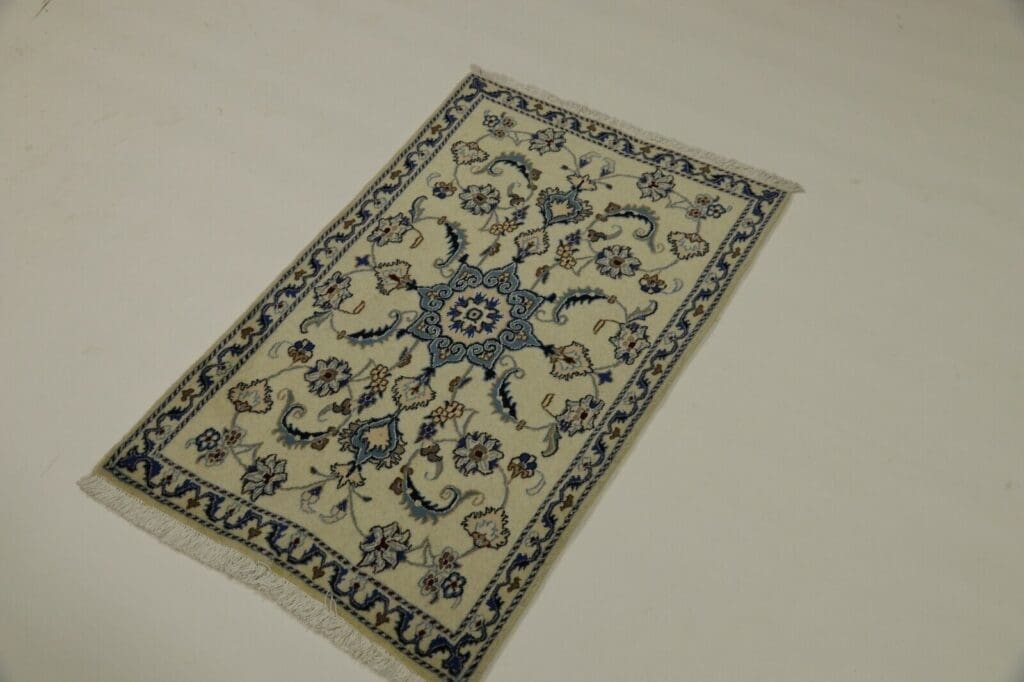
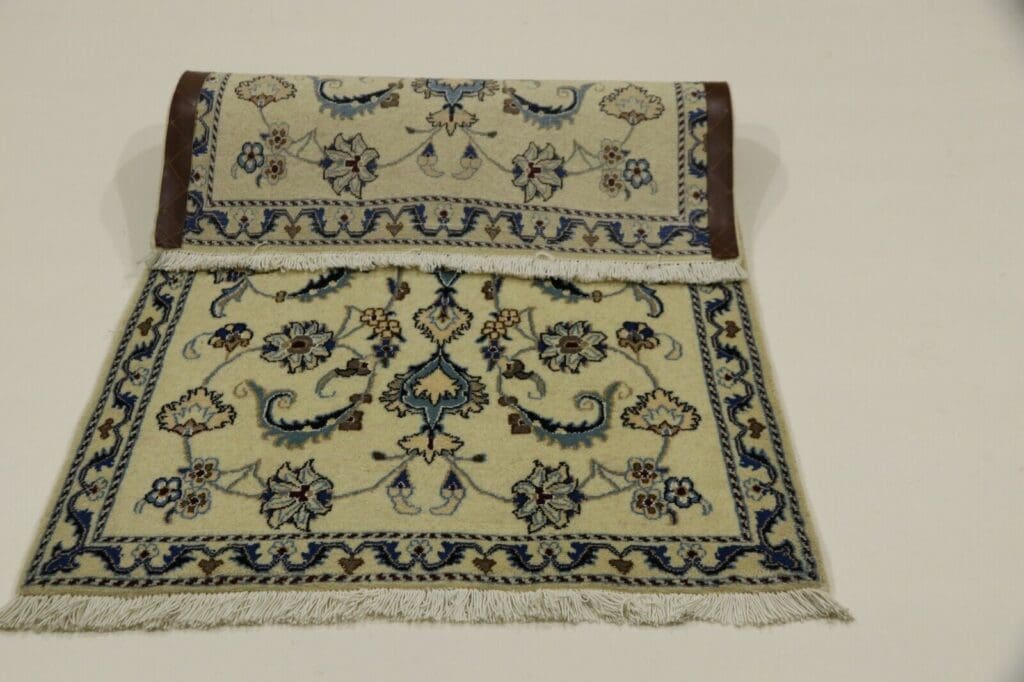
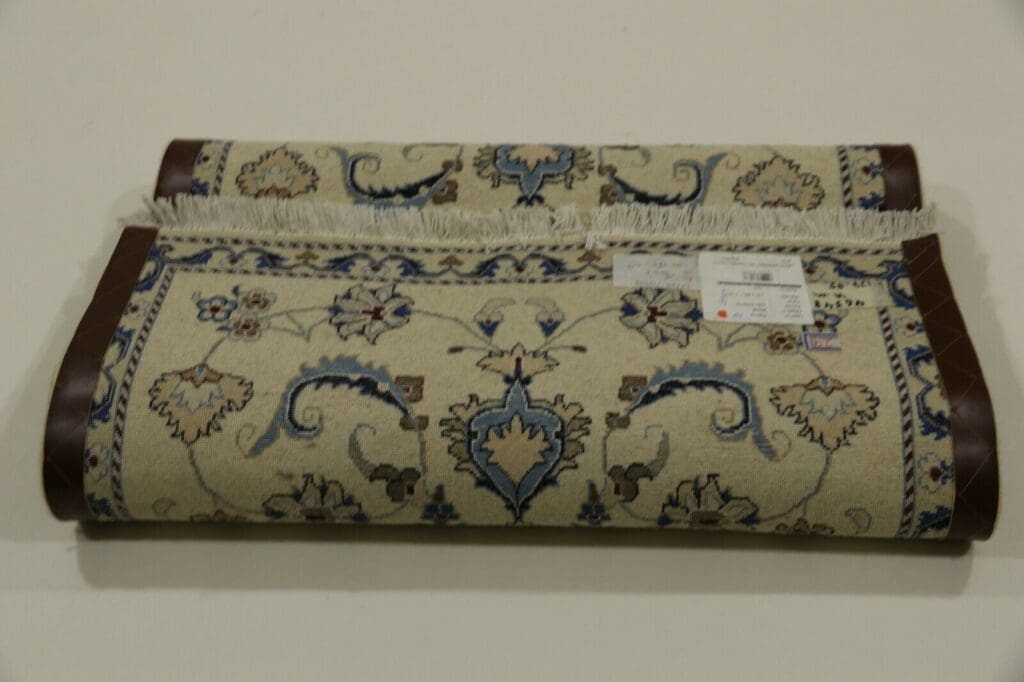
This Nain Persian rug is hand-knotted, with a pile made from 100% virgin wool. Its warp is made from 100% cotton. The piece therefore combines a wool pile with a cotton foundation, a construction commonly associated with carefully made oriental rugs. Virgin wool has a natural lustre and a pleasant feel under the hand. It is also a robust fibre suited to use as a floor covering.
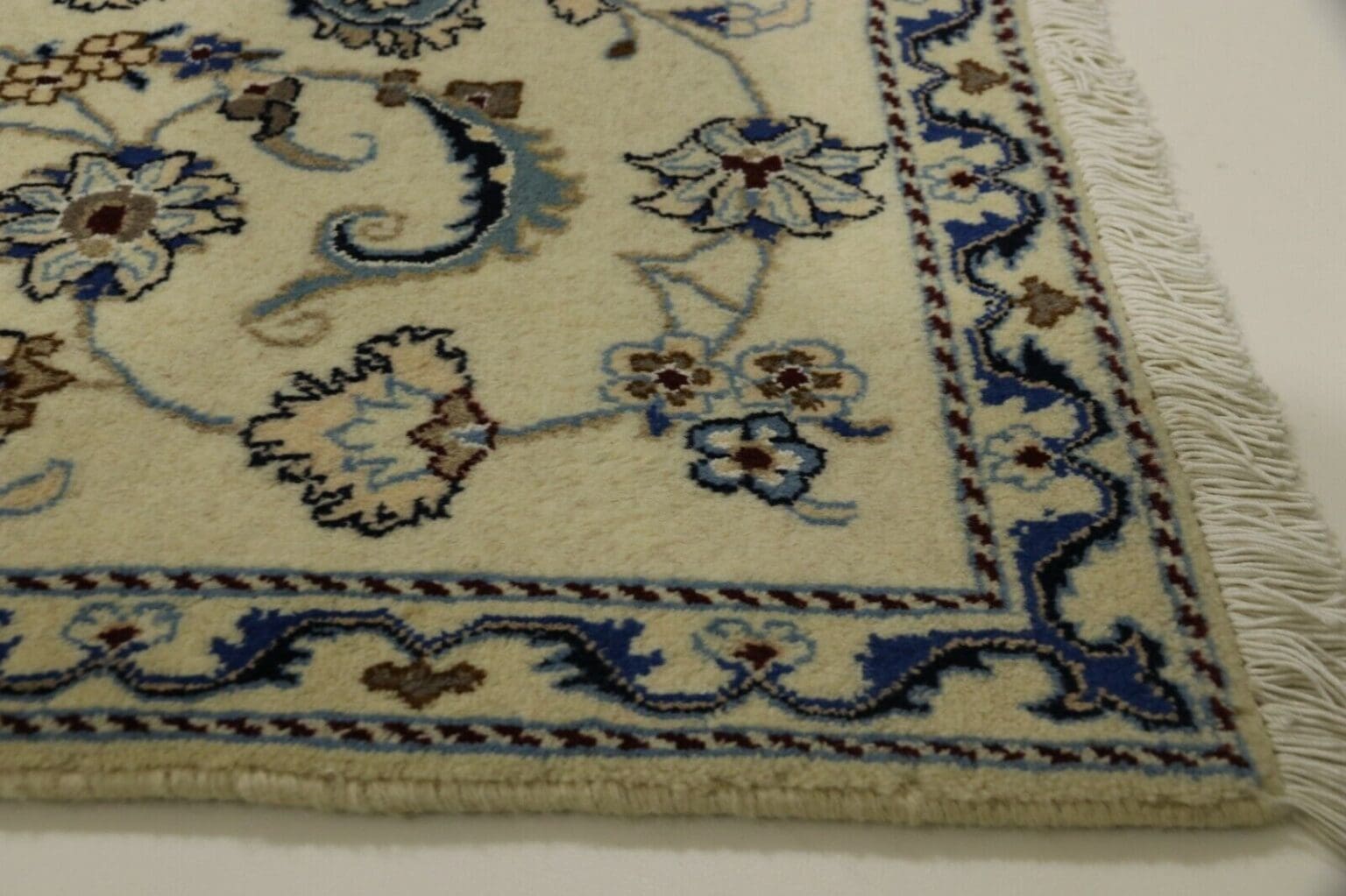
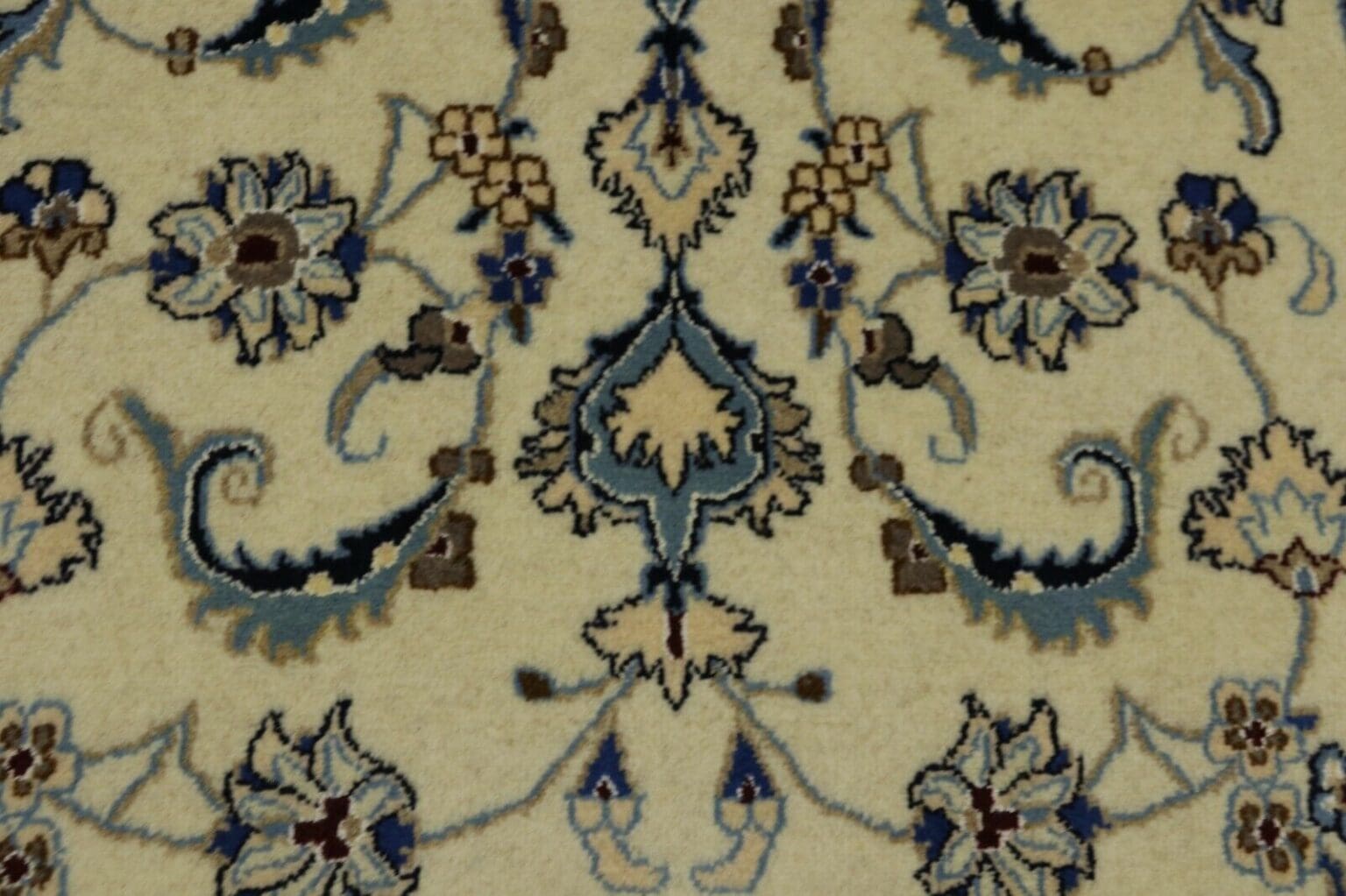
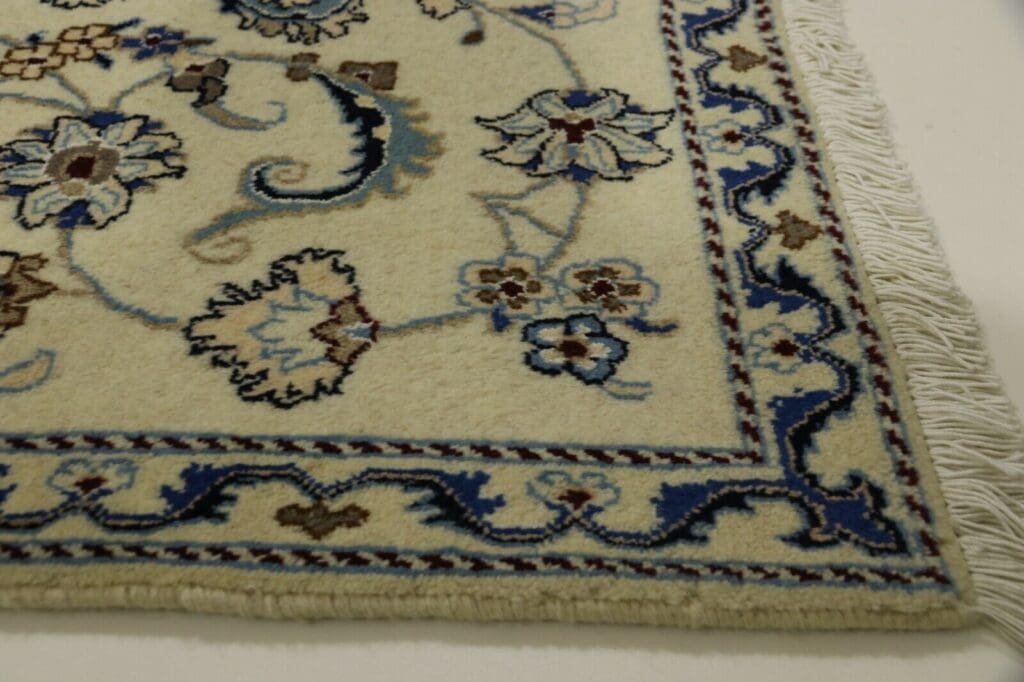
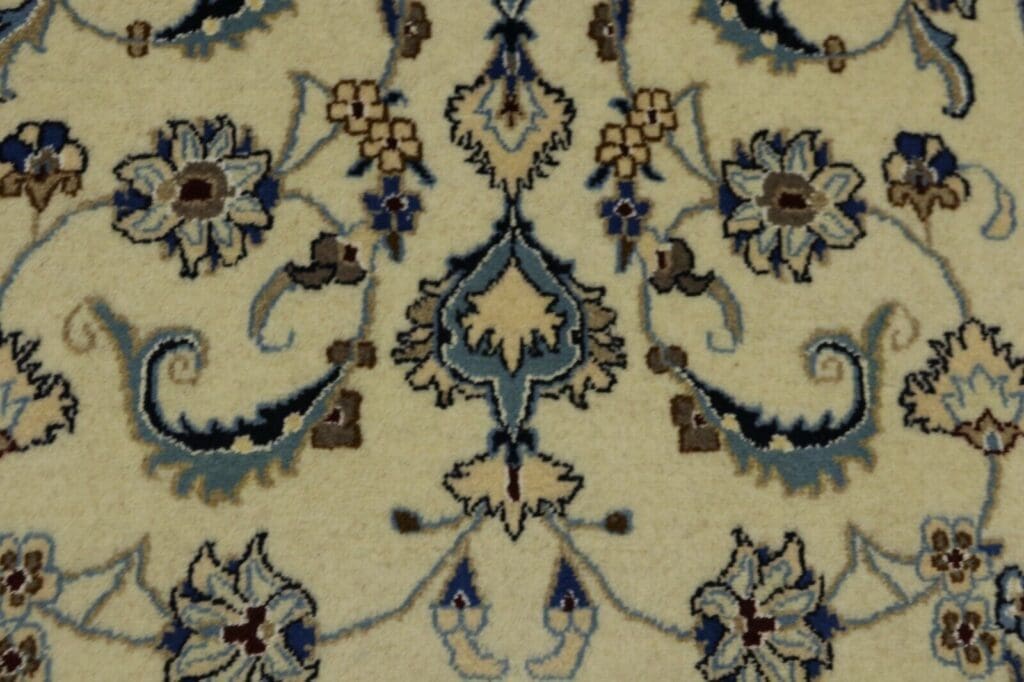
Hand-knotting makes every rug an individual piece. Each knot is worked into the foundation by hand, so the appearance of the finished surface remains closely connected to the craft process. This rug has a knot density of approximately 300,000 knots per square metre. Such a density allows fine motifs and small decorative details to be rendered with clarity and gives the surface a compact, carefully executed character.
The pile is entirely virgin wool and has a pile height of 8 mm. The fibre gives the colours a clear appearance and creates a comfortable surface. The cotton warp provides the basis for the knotting process. Together, pile and warp form the textile structure of this hand-knotted one-off piece.
The rug is described as new and in very good condition. Its construction, materials and fine knotting are central features of its character. As a unique, one-off rug, it cannot be reproduced in exactly the same form. The term one-off refers to the individual execution of this particular piece.
Origin and Tradition
This rug comes from Nain in Iran and belongs to the Persian rug tradition. Nain is known as a region of finely made hand-knotted rugs. Its weaving tradition brings together careful technical work and ornamental design. A Nain rug is not defined by industrial repetition, but by work at the loom and the precise execution of individual knots.
Rug making in Nain has a long history. Nain rugs have been produced since the nineteenth century and are known for fine patterns and precise craftsmanship. The region developed a distinctive visual language in which clear compositions, balanced fields and decorative details work together. The experience of the weavers becomes especially visible when small ornaments are executed cleanly and placed in balance with the composition as a whole.
Persian rugs are closely connected with the regional circumstances of their making. Origin therefore describes more than a place name; it also points to an established way of working. In Nain, knowledge of knotting techniques, the choice of suitable materials and the controlled execution of a design are fundamental parts of rug making. This relationship between technique and design is also what places this piece within the Nain Persian rug tradition.
The region is also associated with Islamic art and its ornamental heritage. Geometric order, repeated vines and floral references may be brought together in Persian rug designs to form a coherent field. These motifs are not only methods of filling space; they also demonstrate the relationship between symmetry, rhythm and open areas. In Nain, the careful development of these elements is particularly important to the character of the weaving tradition.
The Nain origin explains the rug’s place in Persian weaving, but it does not replace attention to the individual object. Every hand-knotted rug is shaped by its particular execution. Material, knot density, pile height, pattern and condition are specified for this offering and form the basis of its description. The regional tradition remains visible without treating this one-off piece as a standardised product.
Design and Pattern
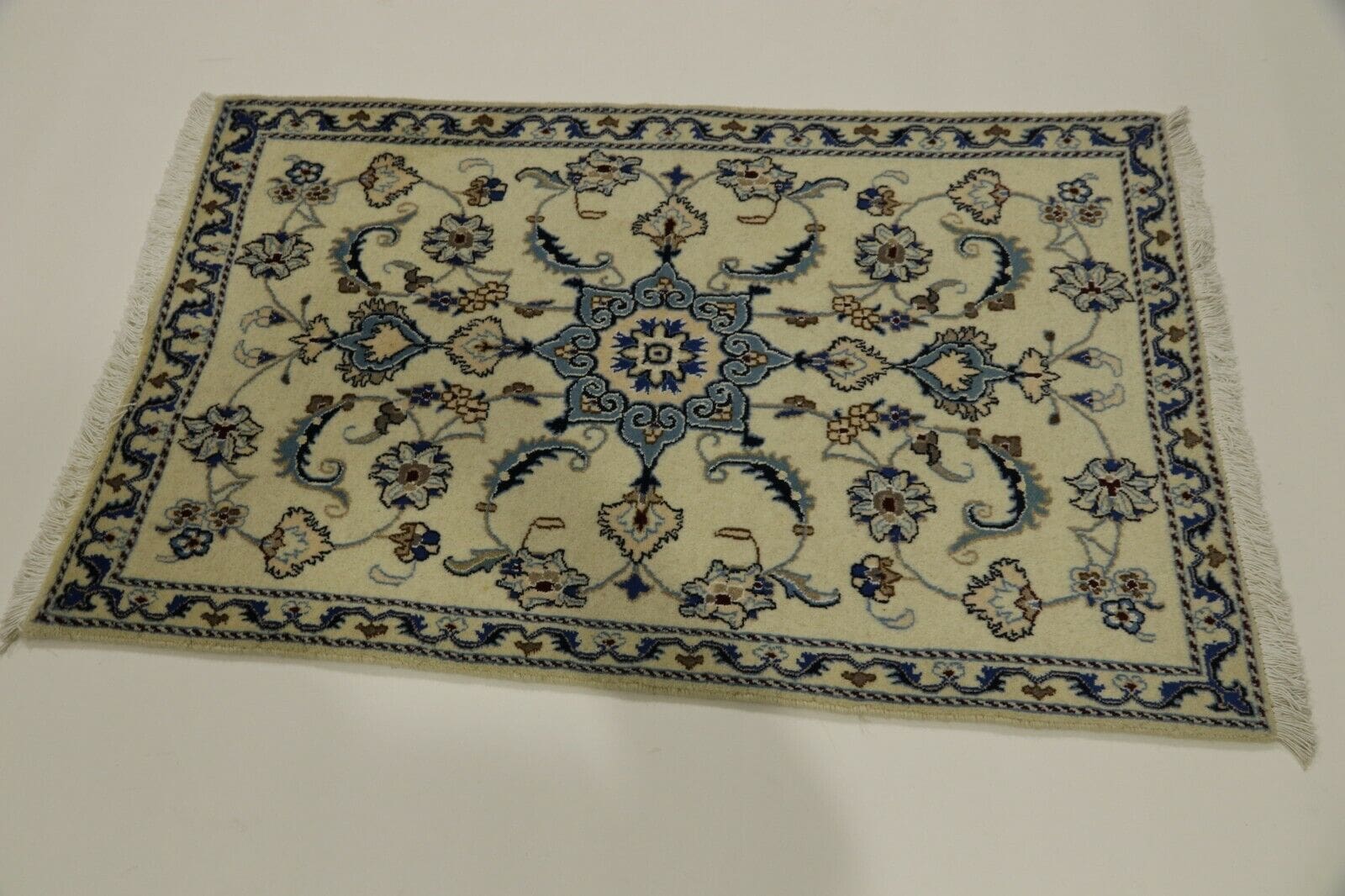
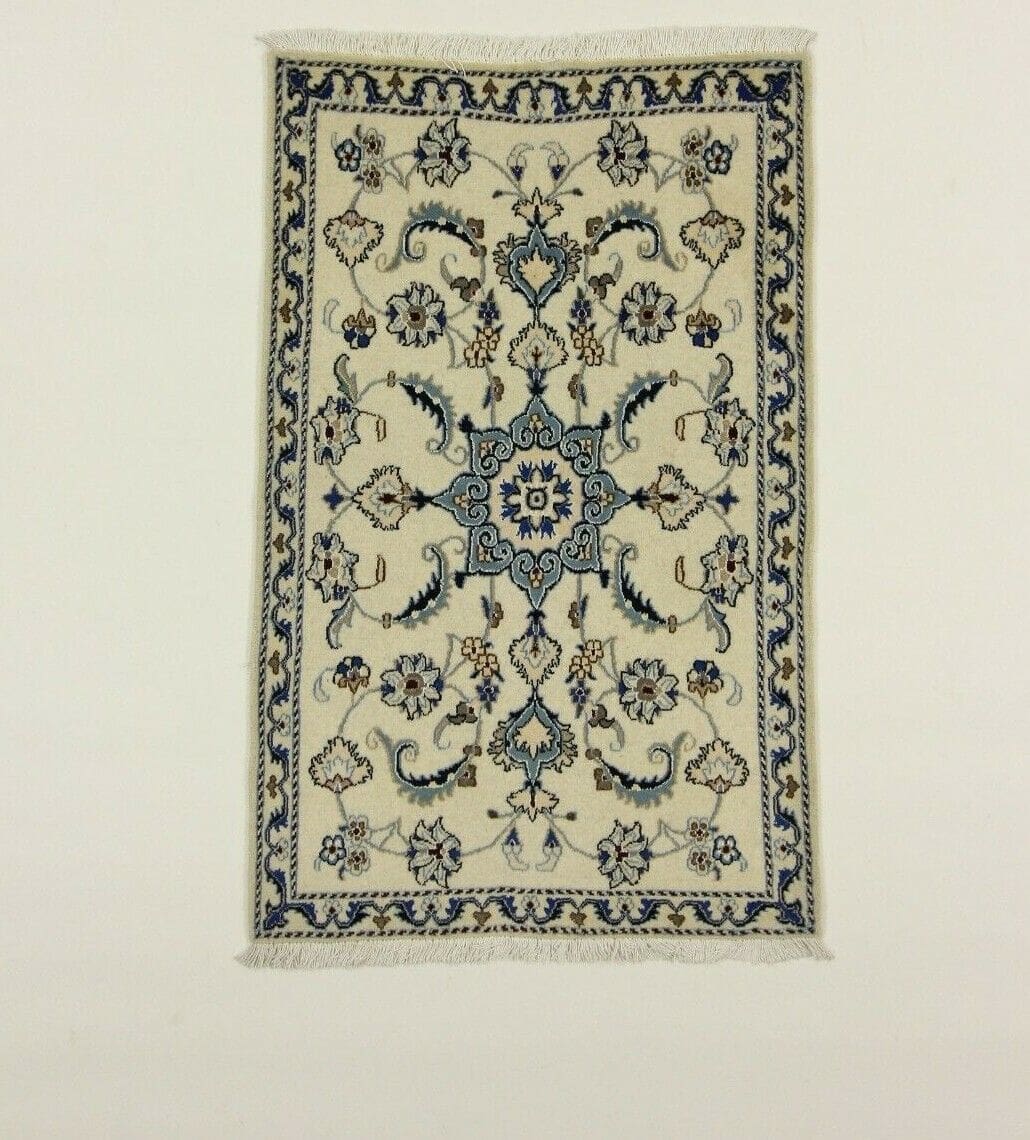
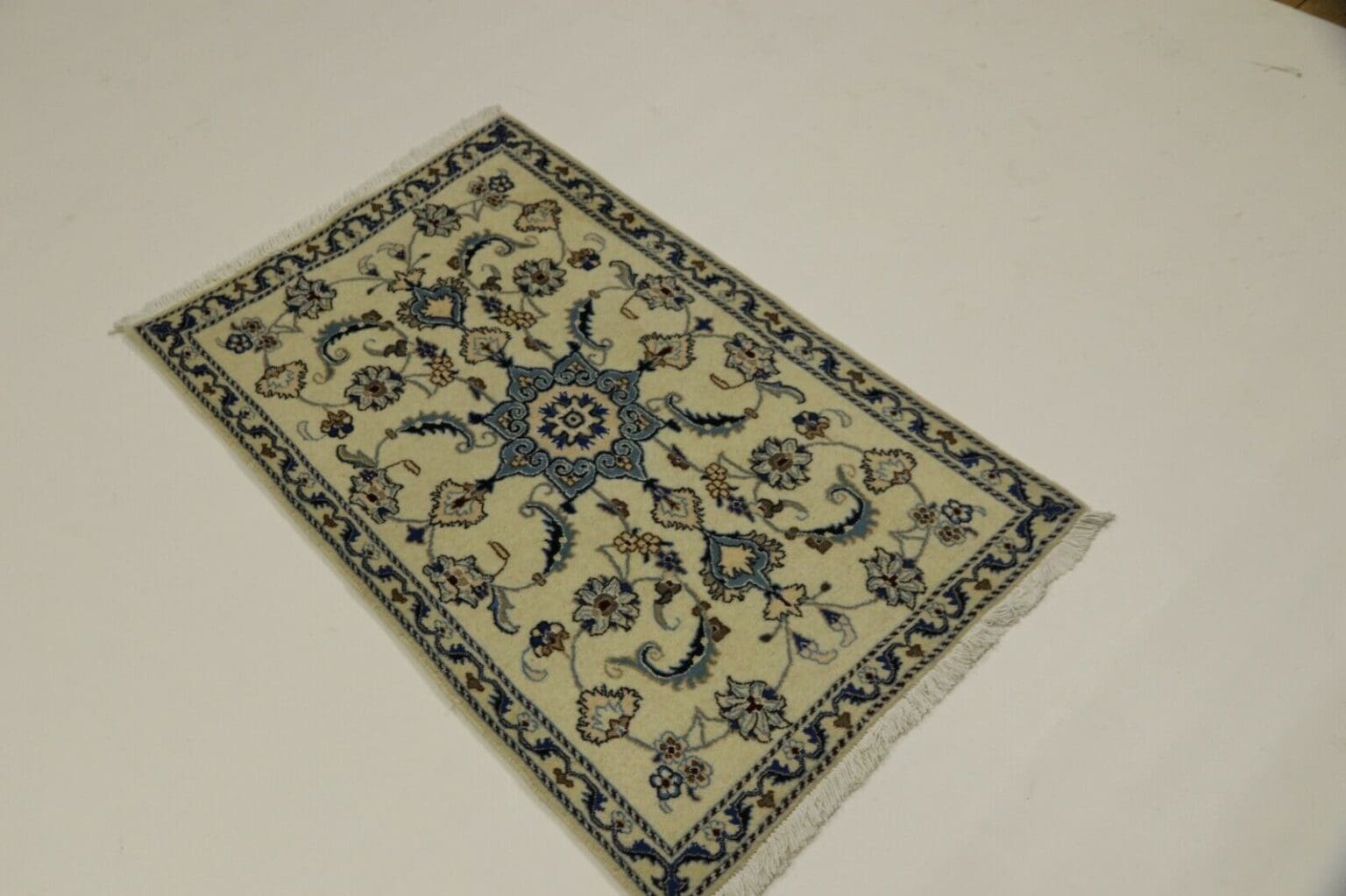
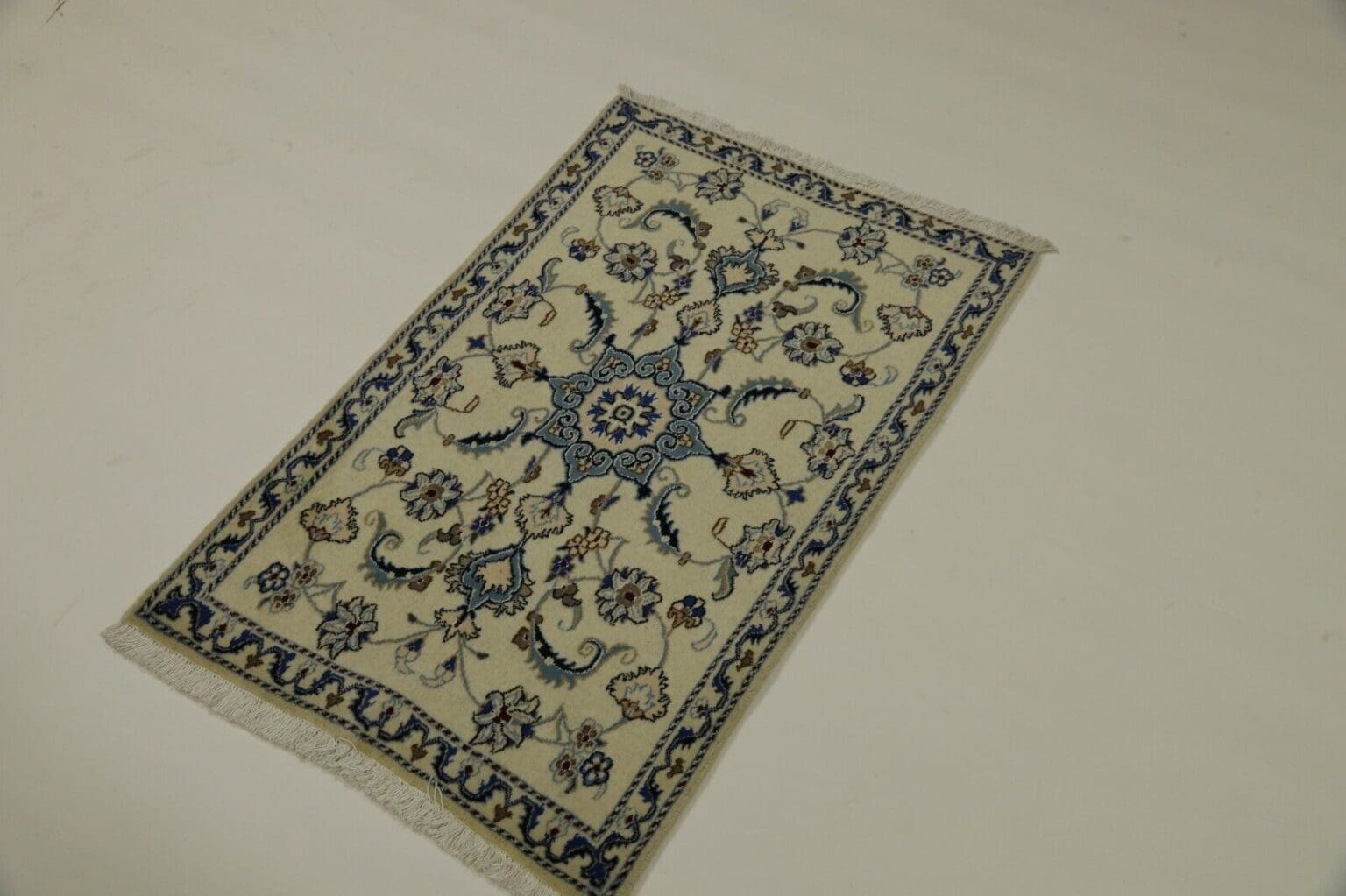
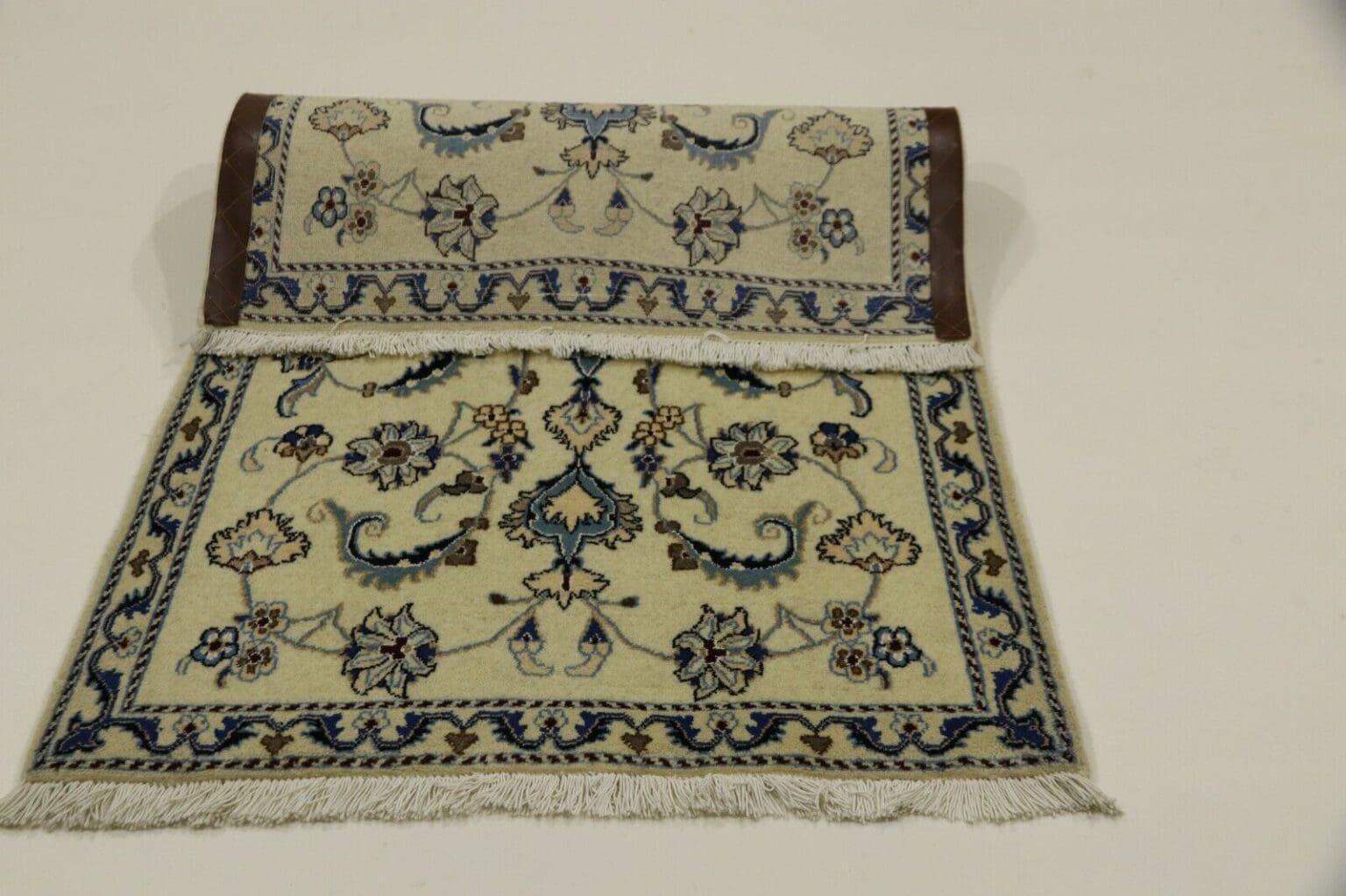
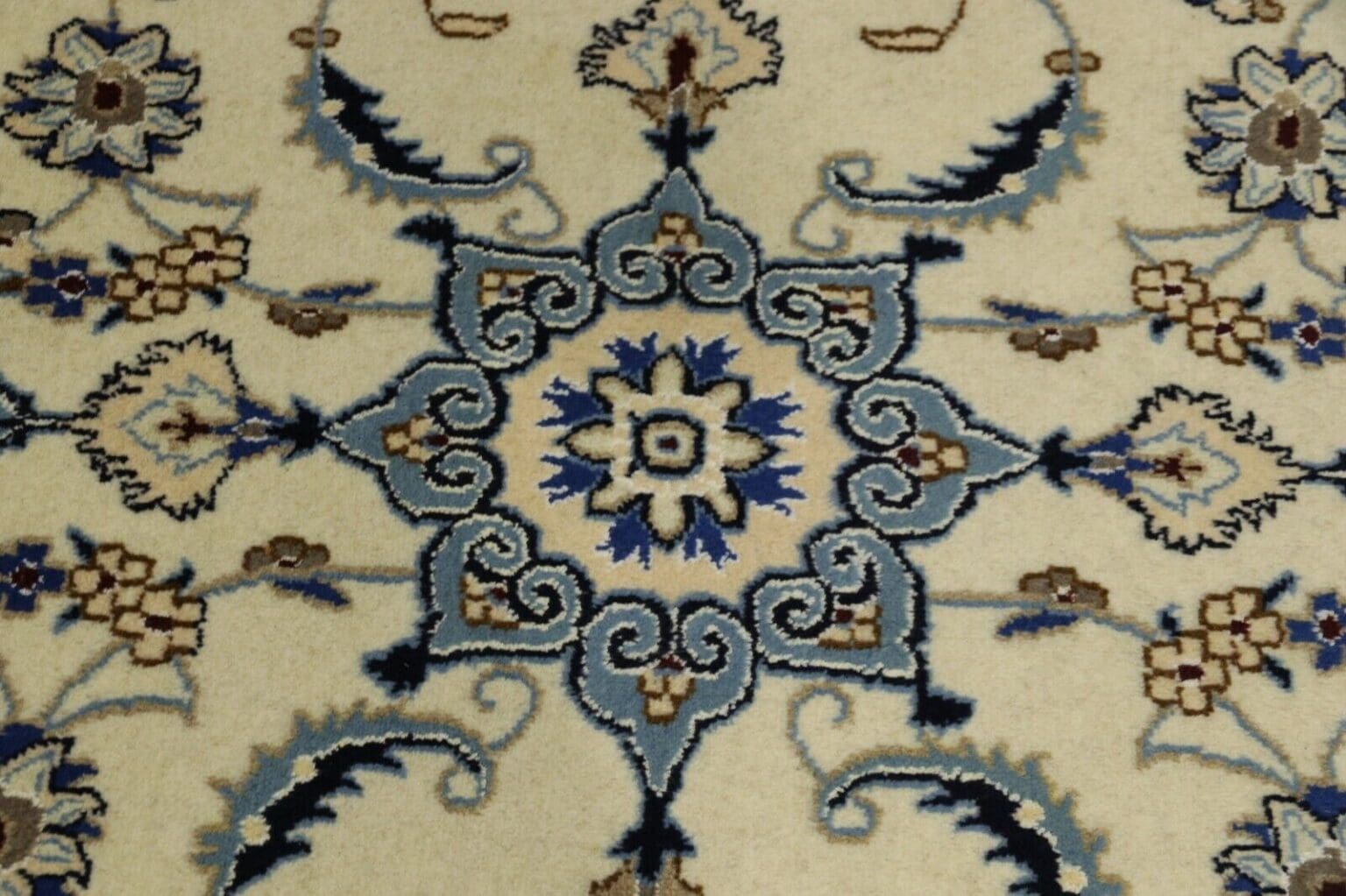
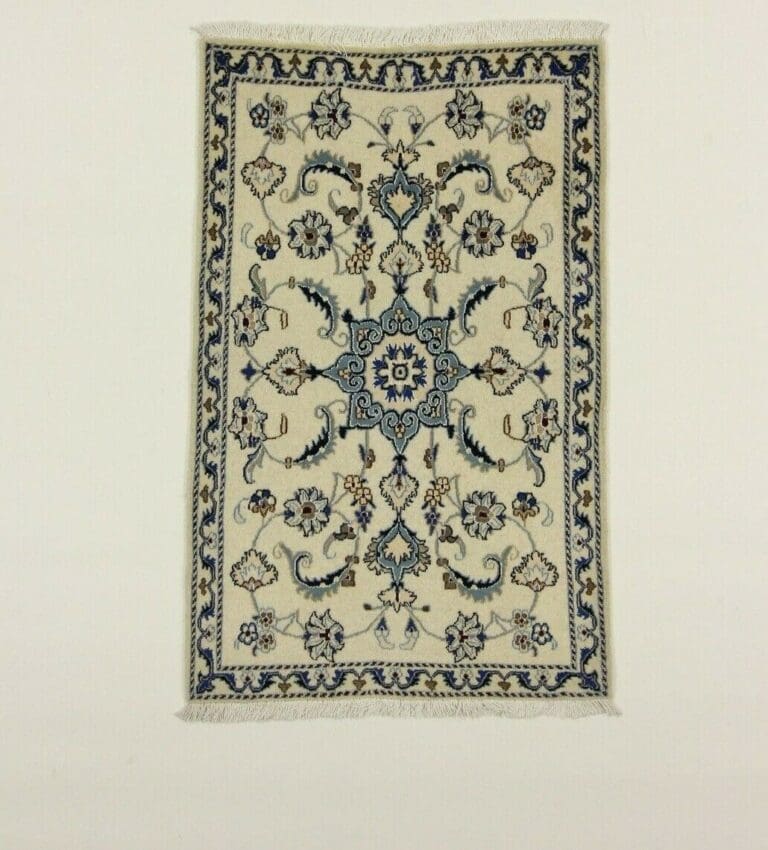
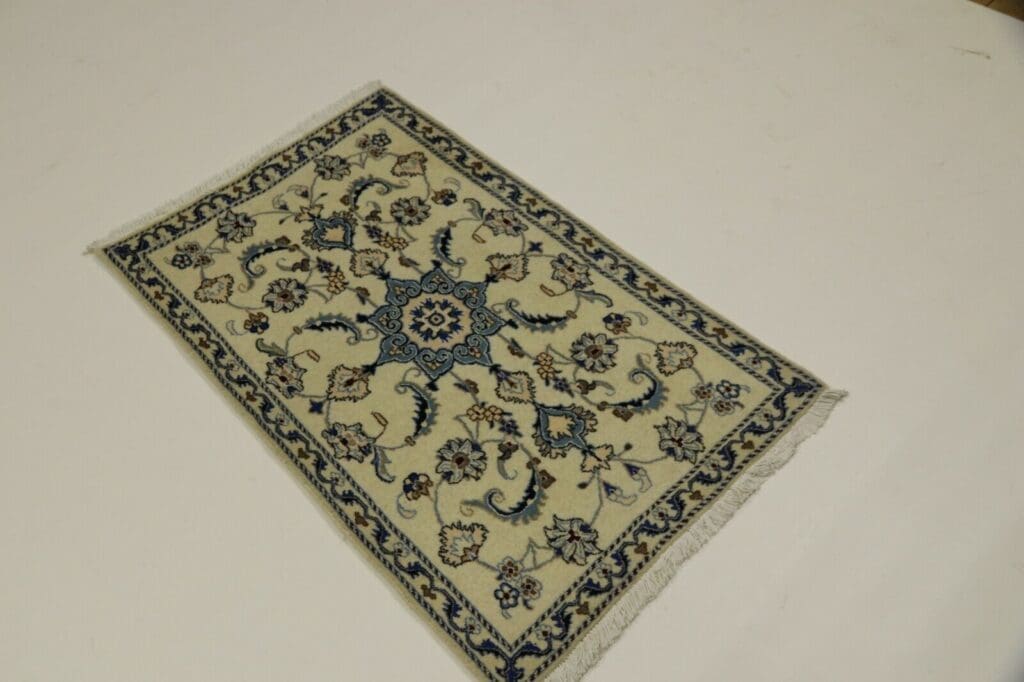
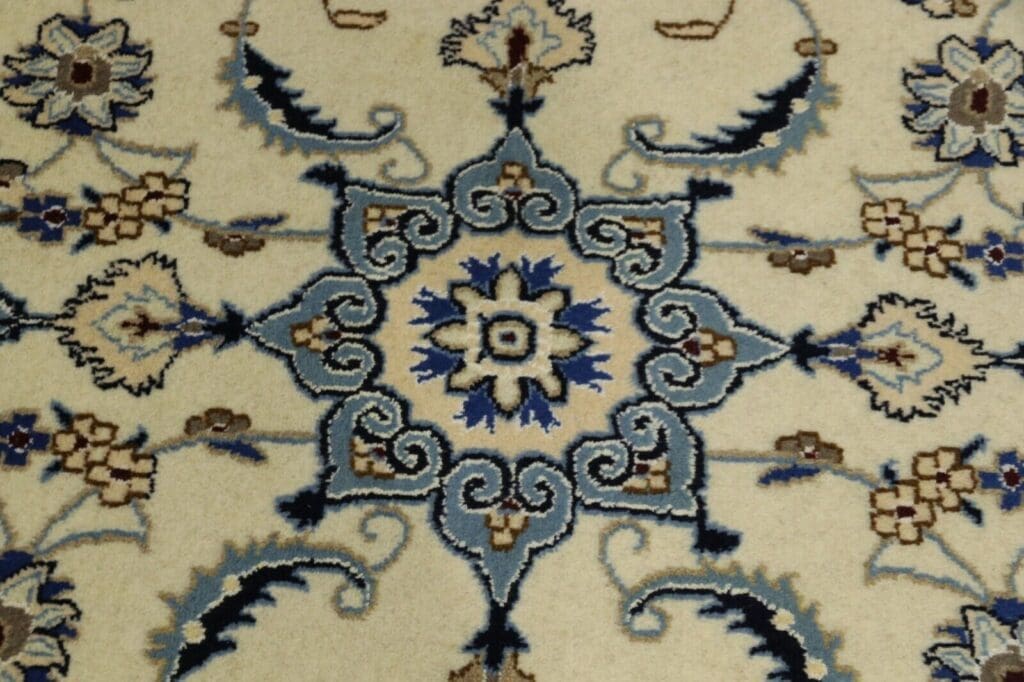
The pattern of this rug is described as oriental. Nain rugs are often associated with floral motifs and medallion-like arrangements. Floral ornaments draw on stylised forms from nature, while a medallion can organise the field and establish a visual centre. These design devices may be combined in different ways and accompanied by vines, blossoms and smaller ornamental units.
The character of an oriental rug pattern comes from the relationship between the principal motif, secondary forms and the ground. A central design may be supported by scrolling vines, flowers or repeated decorative elements. Repetition creates rhythm, while details of different scales divide the field into connected areas. Fine knotting allows such details to remain distinct while preserving the unity of the overall design.
Traditional Persian ornament often relies on symmetry and balanced proportions. A design may be mirrored, repeated in rows or developed around a central point. This arrangement creates order while leaving room for the individual interpretation of the person who knots the rug. A hand-knotted piece consequently retains traces of its making in the drawing of its lines and in the treatment of its smaller details.
Oriental motifs are often associated with ideas of harmony and prosperity. These interpretations belong to the cultural reading of rug art and complement the formal description. In this Nain, ornamental design and careful handwork are considered together. The visual effect does not depend on one isolated motif, but on the relationship between floral references, medallion-like forms and the organisation of the field.
The colours are described as soft shades of blue and cream. Such a palette can set off floral ornaments quietly and keep the contrast within the composition balanced. Blue and cream create a restrained colour effect in which the drawing remains visible without one tone dominating the entire design. This allows the oriental pattern to be placed within a range of interior settings.
The design demonstrates how regional vocabulary and individual handwork can meet in a single rug. The pattern is oriental, the origin is Nain in Iran, and the construction is hand-knotted. These facts describe different aspects of the same object: its cultural classification, its regional tradition and its specific textile manufacture.
Special Features
A defining feature of this rug is its status as a unique one-off piece. It cannot be found again in precisely the same form. The combination of Nain origin, hand-knotted construction, virgin-wool pile and oriental pattern gives this individual rug its specific identity.
The rug is described as new and in very good condition. It is therefore presented for use both as a decorative element and as a functional floor covering. Its virgin wool is described as hard-wearing, making it suitable for rooms that are used regularly. This condition is a characteristic of the particular rug offered here and is not a general statement about every Nain rug.
Fine knotting, natural wool and ornamental design bring technical and decorative qualities together. A hand-knotted rug of this kind may also be regarded as a collectible piece. Its one-off status and connection with Persian rug art give it a significance that goes beyond the simple function of covering a floor.
FAQ
How should I clean a Nain Persian rug?
For routine care, gentle vacuuming without a beater-brush attachment is recommended. This removes loose dust without subjecting the wool pile to unnecessary mechanical stress. For heavier soiling, a professional cleaner with experience in hand-knotted oriental rugs should be consulted. Proper treatment takes account of the virgin wool, the hand-knotted construction and the fine surface. Strong cleaning agents or an intensive do-it-yourself wet wash are not the appropriate first choice for this type of rug.
Can I use the rug outdoors?
No. Nain Persian rugs are intended for indoor use. Outdoors, the rug would be exposed to moisture and ultraviolet radiation. Moisture may affect the materials and textile structure, while direct sunlight can cause the colours to fade. Outdoor conditions are also difficult to control consistently. A dry indoor environment therefore offers better protection for the virgin wool, the colours and the hand-knotted construction.
How can I make sure the rug is genuine?
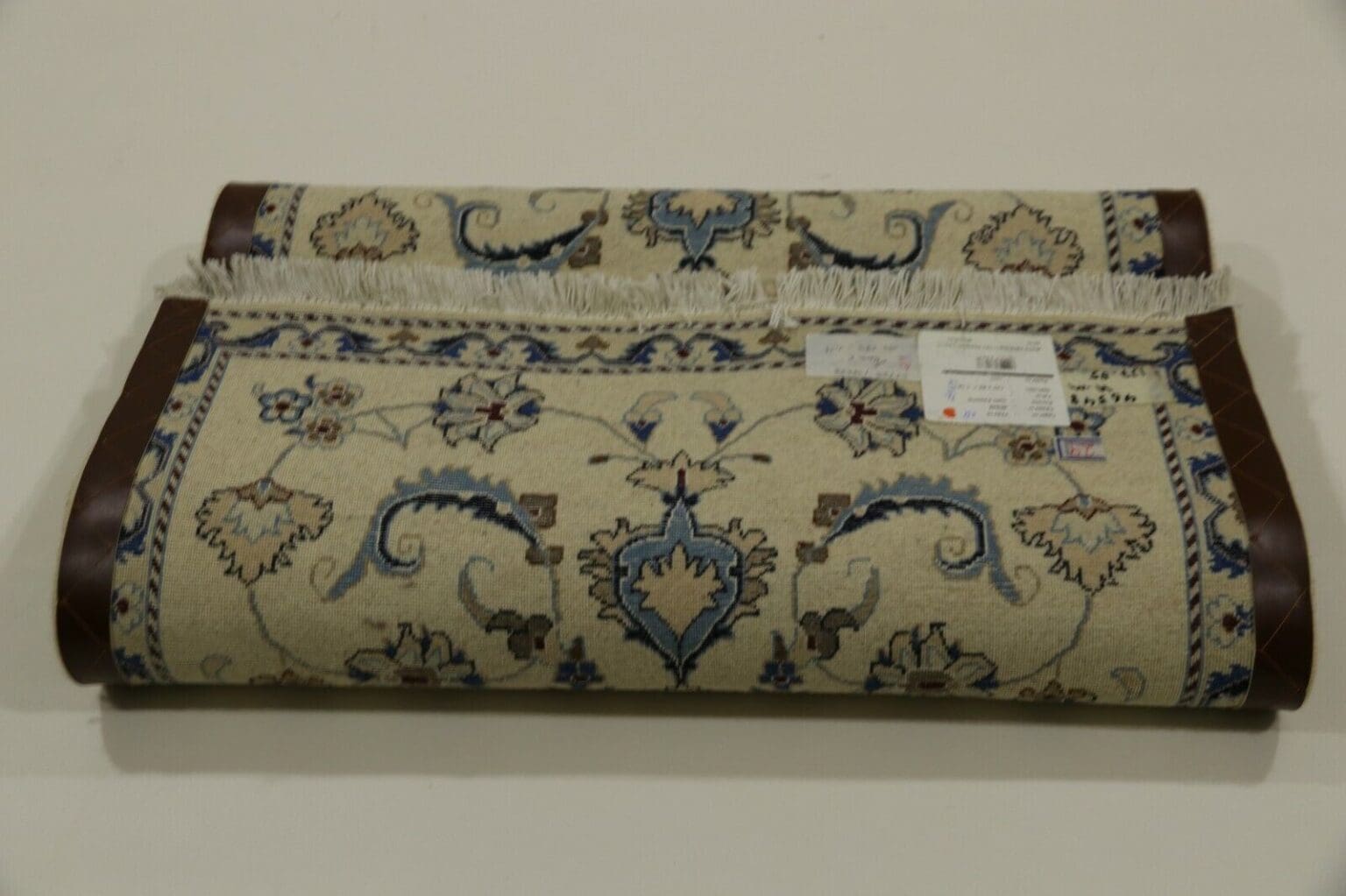
Several characteristics should be considered together when examining a genuine Nain rug. These include high knot density, careful handwork and authentic materials. A certificate or purchase through a specialist dealer can provide additional evidence of authenticity. The back of the rug is also informative: on a hand-knotted rug, the knots are clearly visible there and are executed evenly. An assessment should consider the origin, construction and material description as a whole rather than relying on one feature alone.
To provide the best experiences, we use technologies like cookies to store and/or access device information. Consenting to these technologies will allow us to process data such as browsing behavior or unique IDs on this site. Not consenting or withdrawing consent, may adversely affect certain features and functions.
Functional Always active
The technical storage or access is strictly necessary for the legitimate purpose of enabling the use of a specific service explicitly requested by the subscriber or user, or for the sole purpose of carrying out the transmission of a communication over an electronic communications network.
Preferences
The technical storage or access is necessary for the legitimate purpose of storing preferences that are not requested by the subscriber or user.
Statistics
The technical storage or access that is used exclusively for statistical purposes.The technical storage or access that is used exclusively for anonymous statistical purposes. Without a subpoena, voluntary compliance on the part of your Internet Service Provider, or additional records from a third party, information stored or retrieved for this purpose alone cannot usually be used to identify you.
Marketing
The technical storage or access is required to create user profiles to send advertising, or to track the user on a website or across several websites for similar marketing purposes.
 SECURE PAYMENT
 SHIPPING PARTNERS


