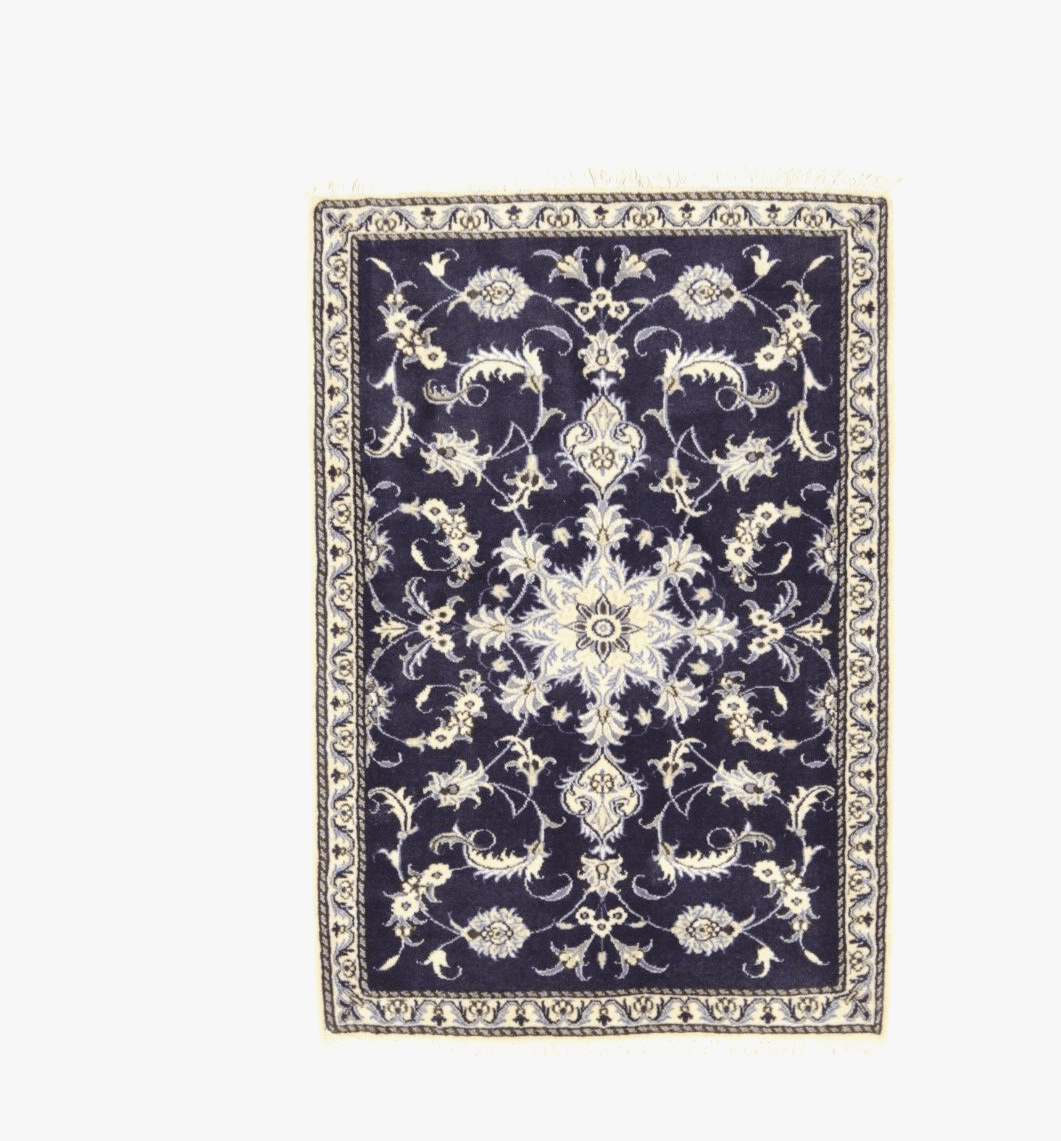
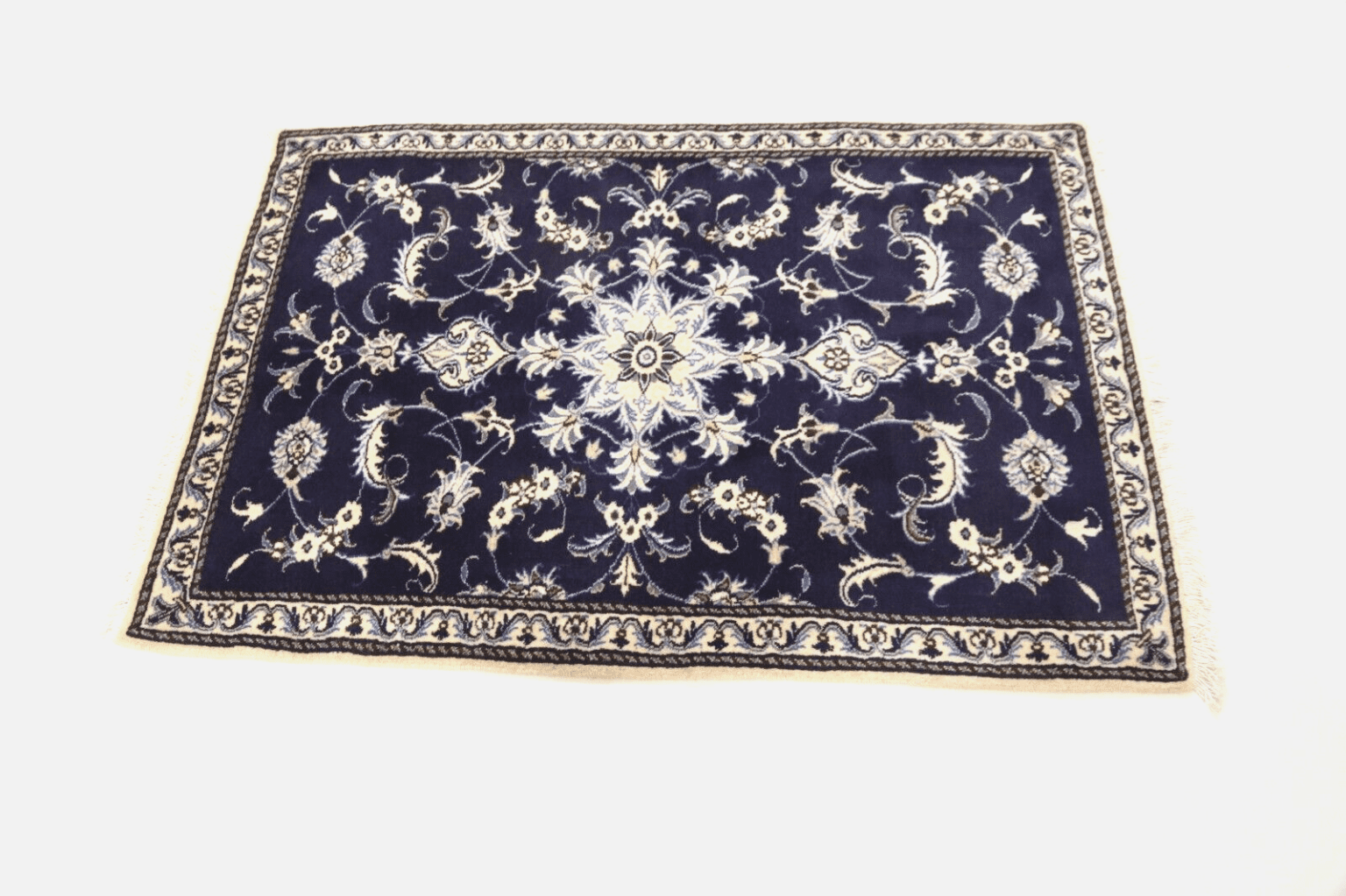
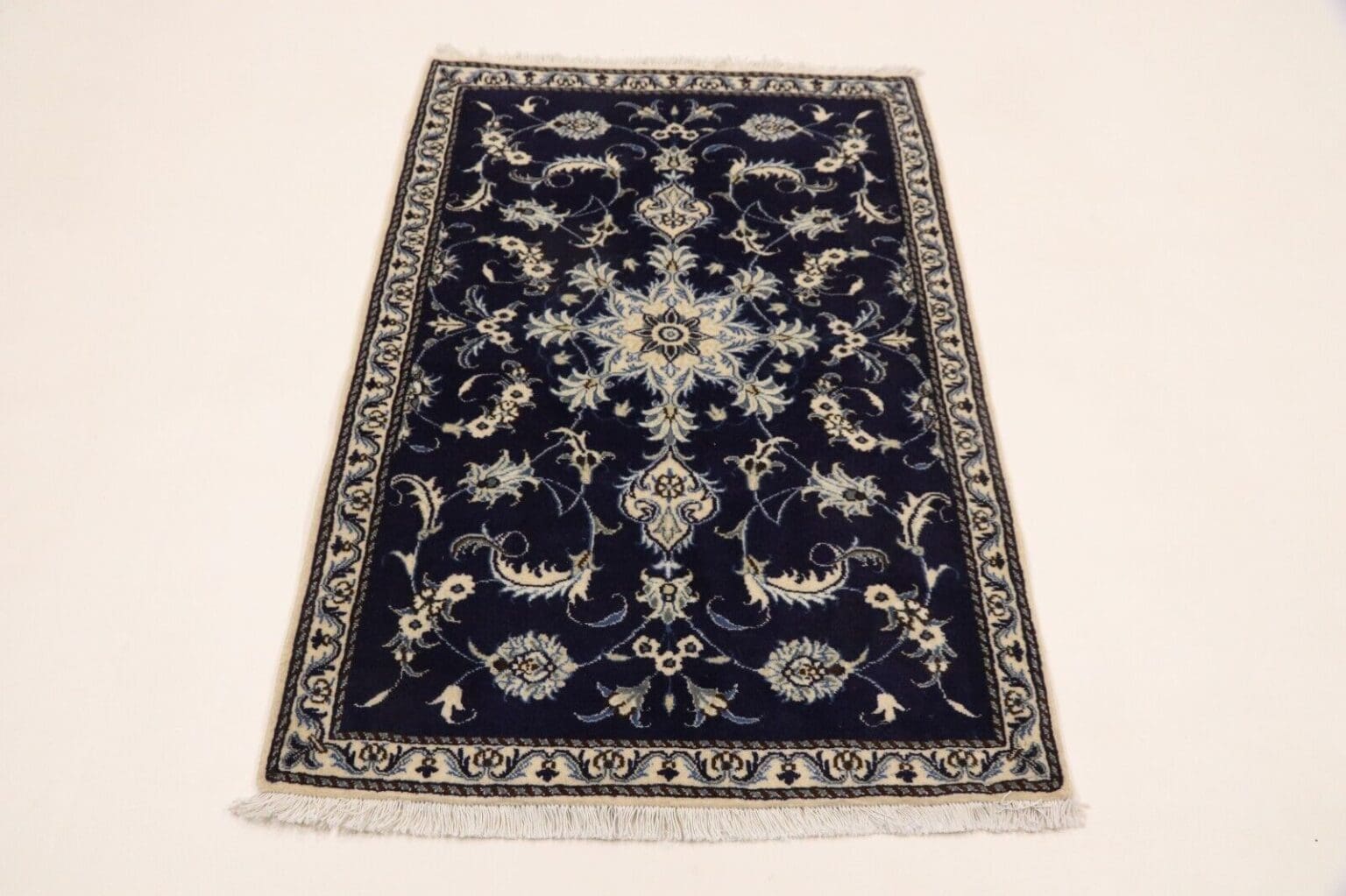
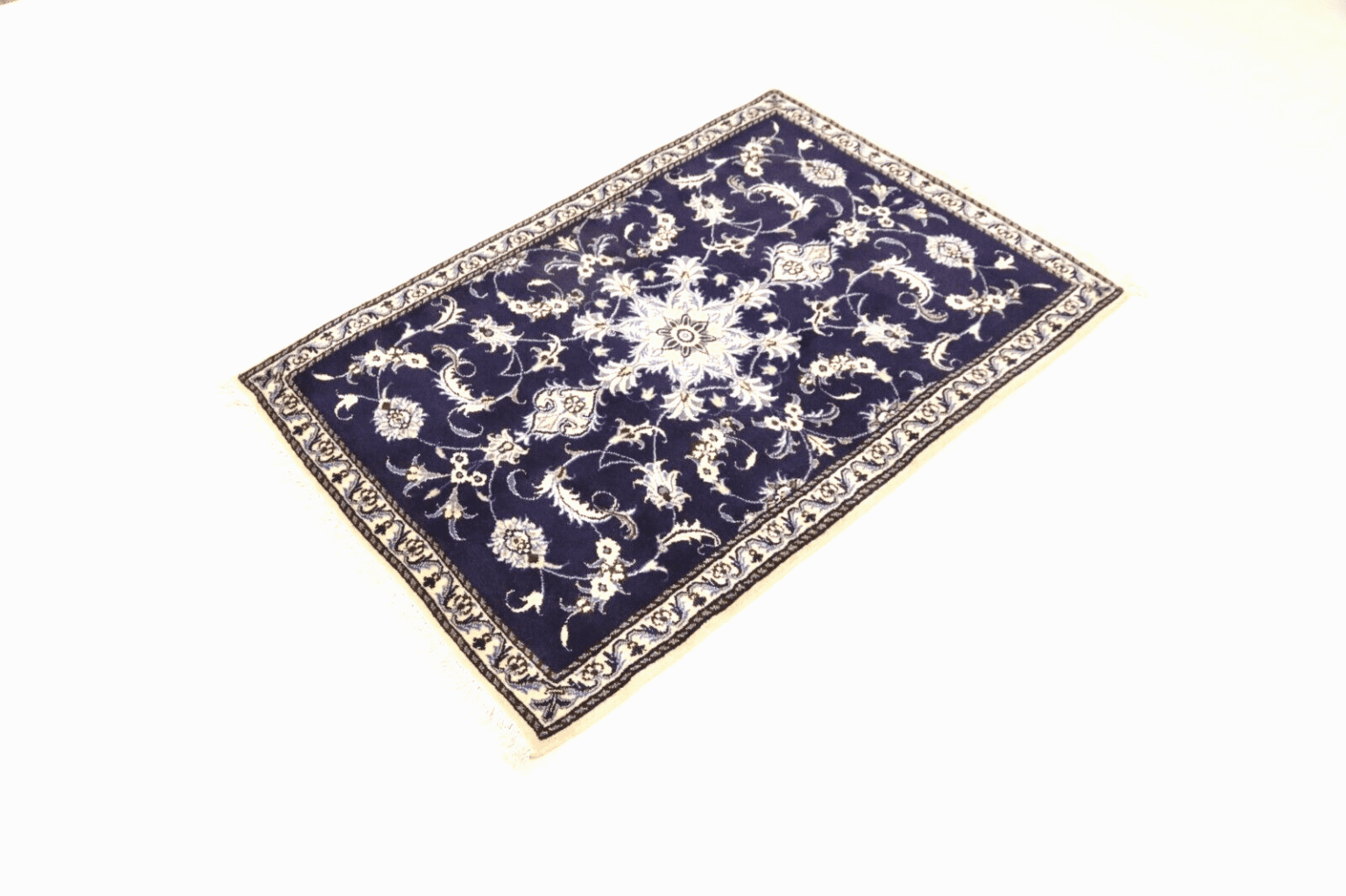
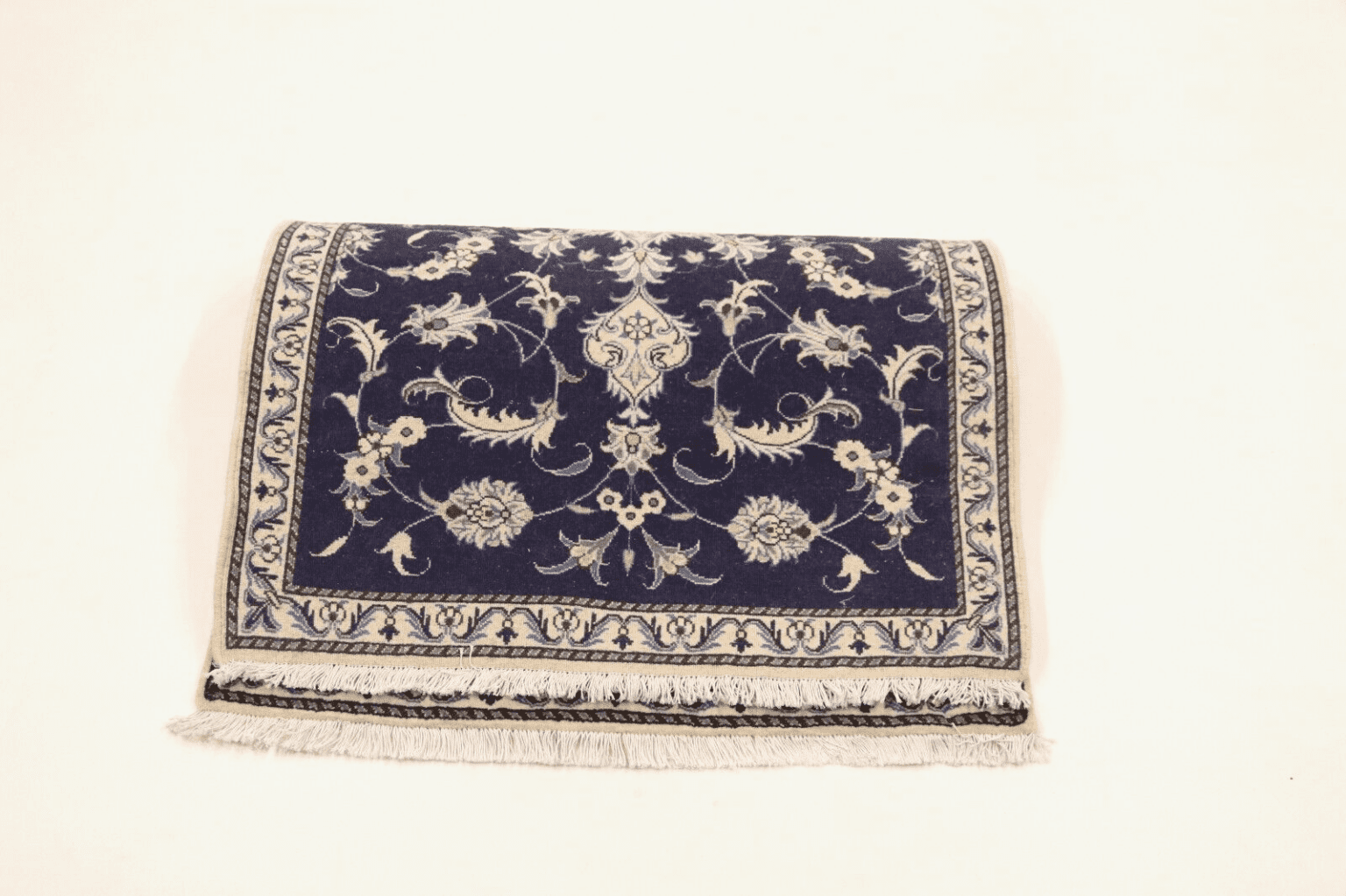
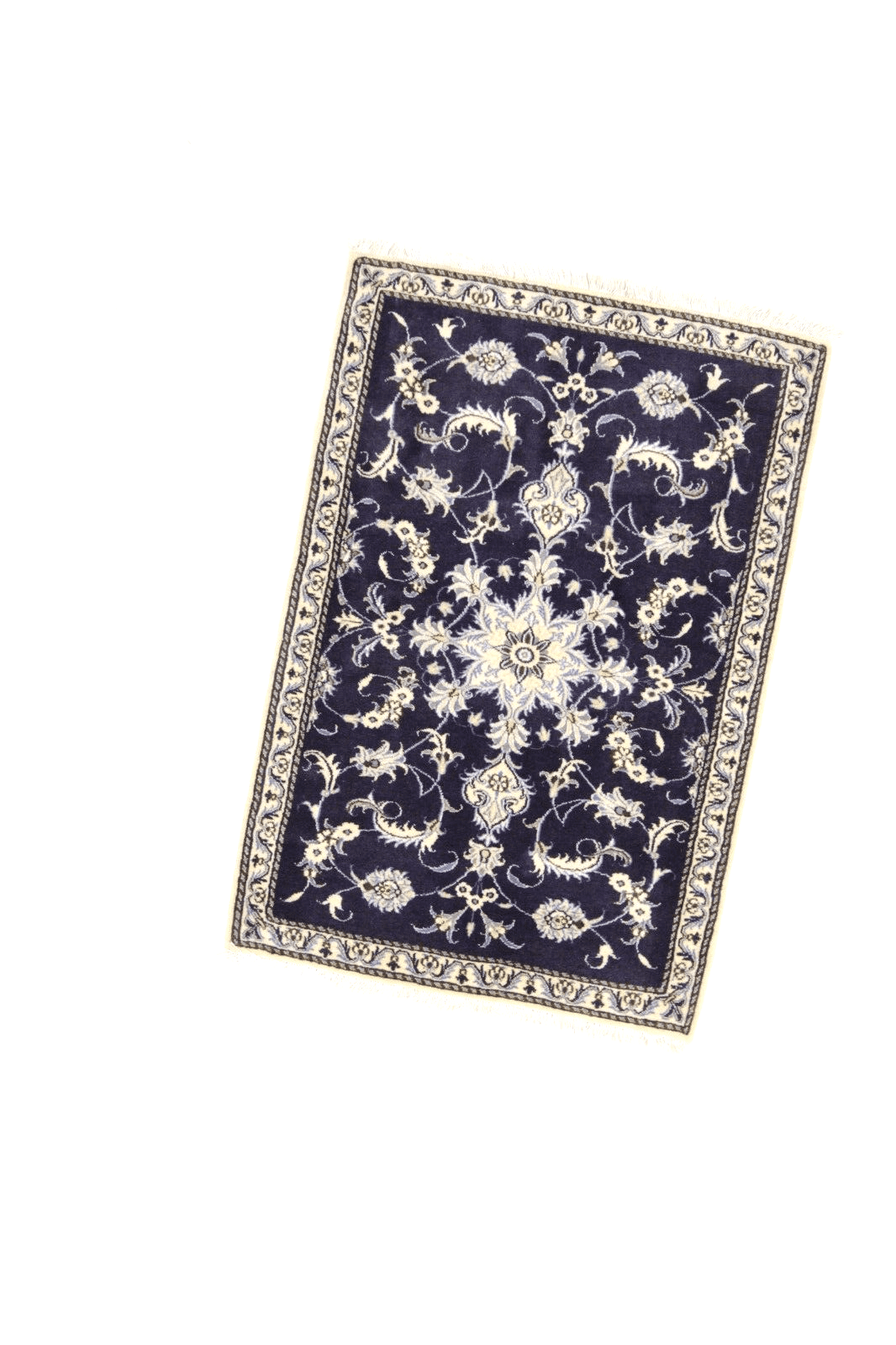
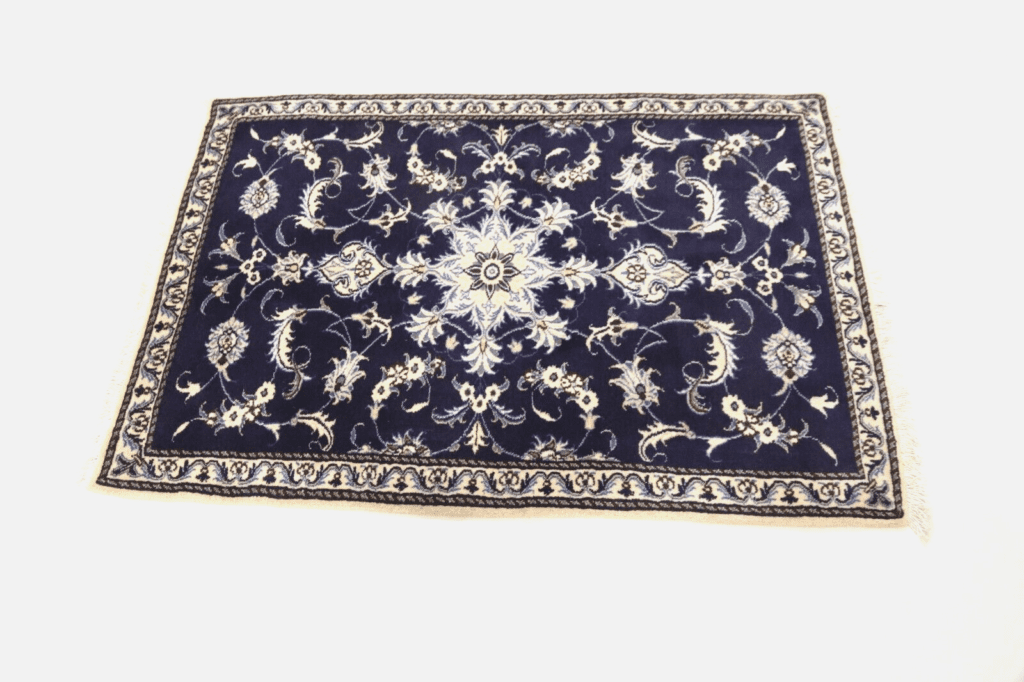
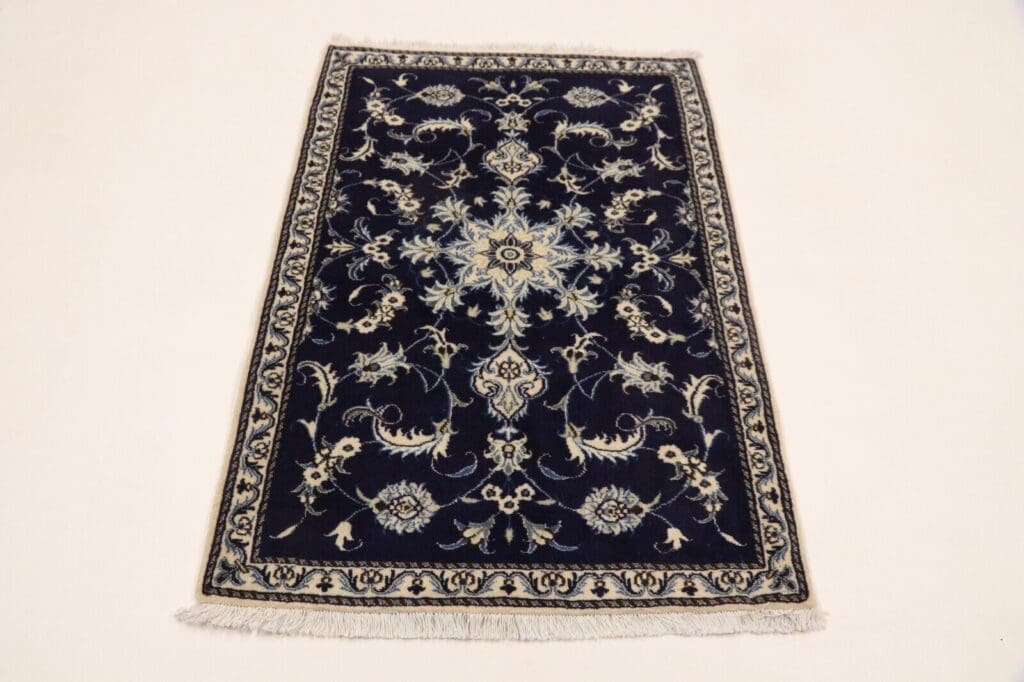
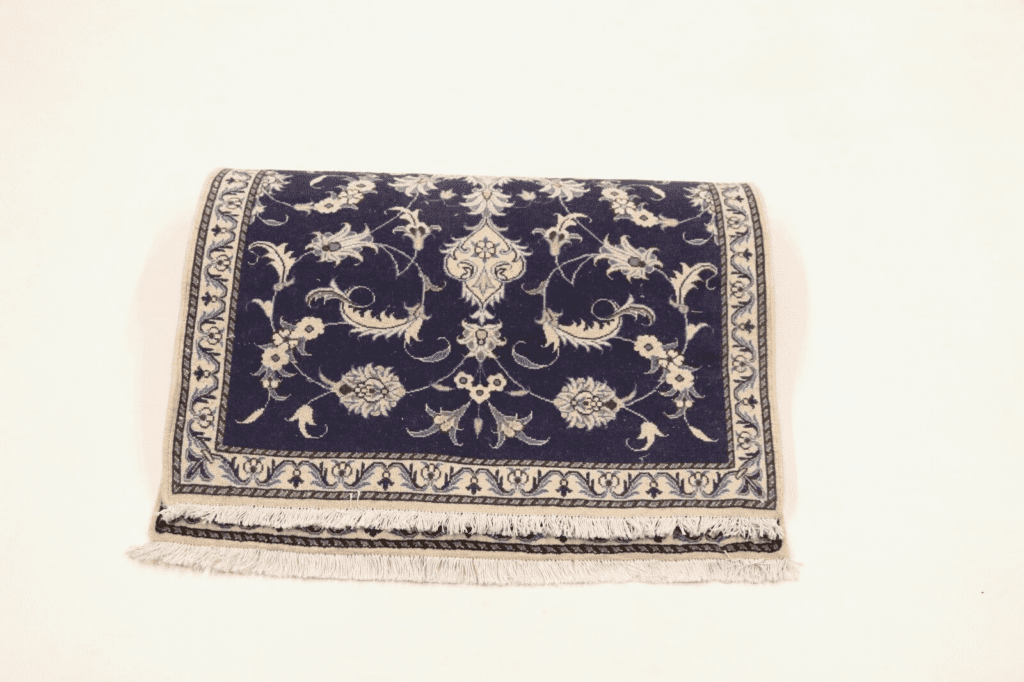
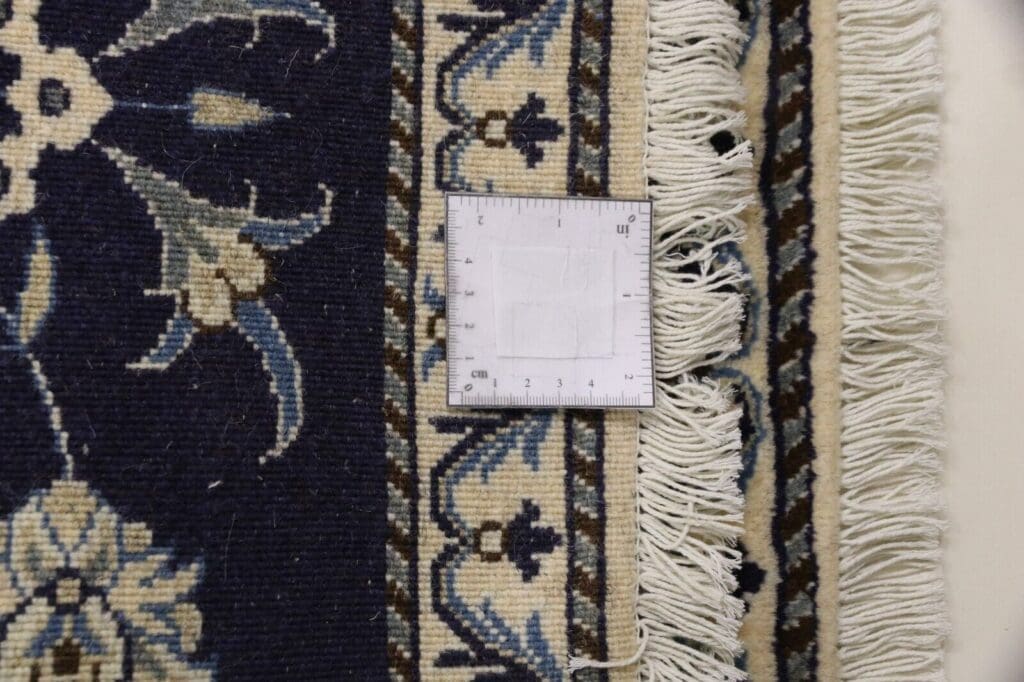
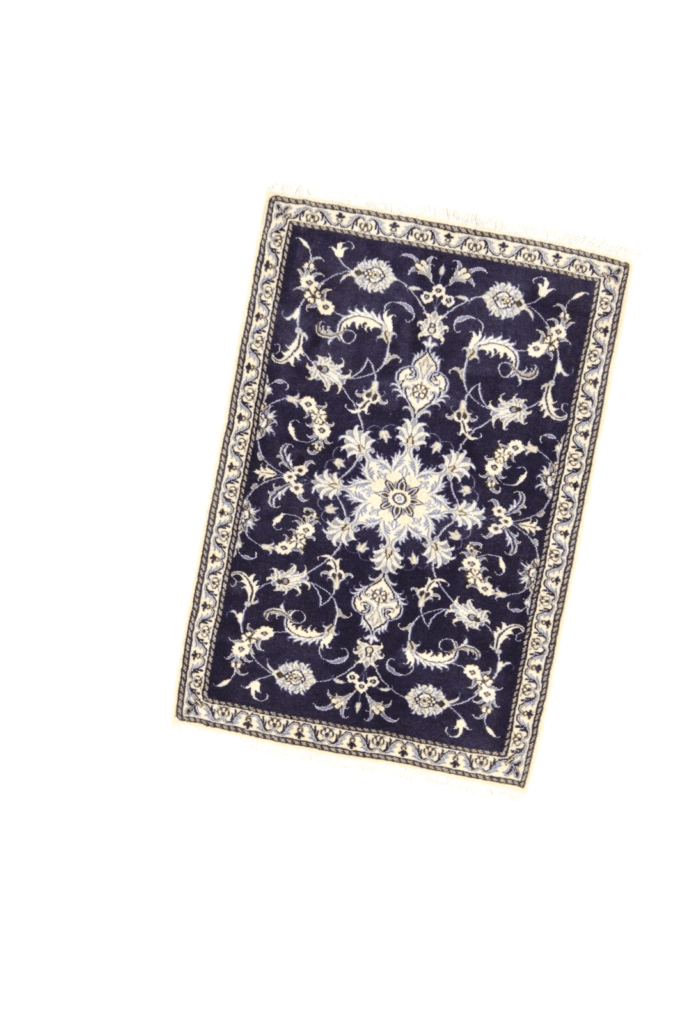
Hand-knotted Nain Persian rug | Knot density: approx. 300,000 knots/m² | Material: pile 90% virgin wool, 10% silk | Size: 135 x 92 cm | Pattern: Traditional Oriental design, dark blue | Condition: New, very good
This Nain Persian rug is hand-knotted and made from 90% virgin wool and 10% silk. The two fibres contribute different qualities to the pile. Wool provides most of the body of the surface and gives it a soft, resilient feel. Silk adds a smoother touch and a characteristic sheen. Depending on the light, silk areas may appear brighter and more sharply defined than the woollen sections.
Hand-knotting is a gradual process in which each knot is placed individually by hand and joined to the surrounding rows. The knotter works through the design section by section, following a planned structure of colours, outlines and ornaments. Unlike a machine-made surface, the finished rug is not produced through an entirely uniform repetition. Small variations in tension, colour distribution and line movement are part of handmade construction.
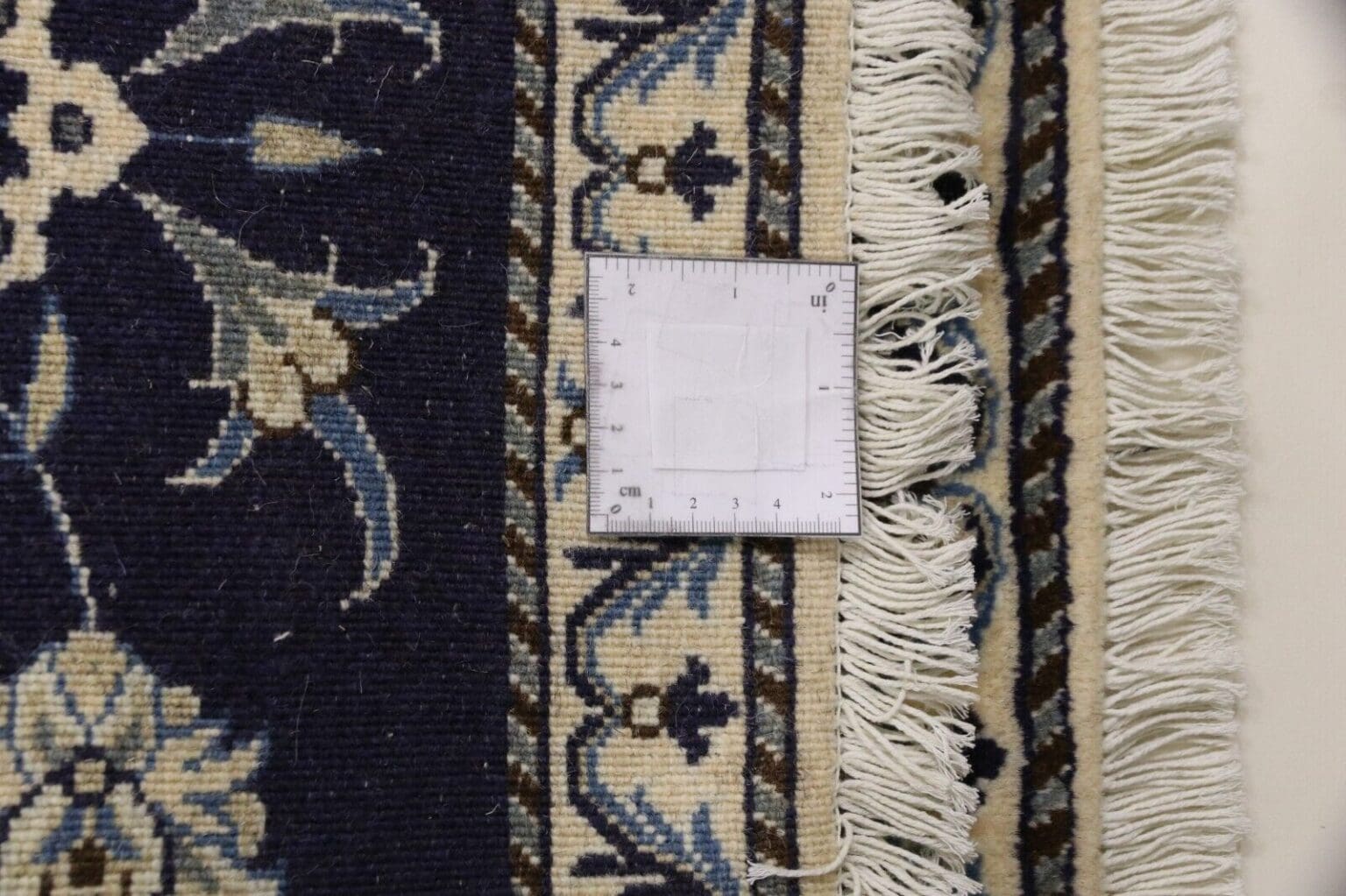
The knot density of this rug is approximately 300,000 knots per square metre. A fine knot structure generally allows narrow outlines and small ornamental details to be rendered with greater precision. Knot density is not the only factor that determines the character of a rug, however. Evenness of the knots, the quality of the fibres, the accuracy of the drawing and the finishing of the surface are also important. In Nain weaving, these elements work together.
Virgin wool is widely used in carpet making because of its natural elasticity and resistance. Its surface tends to absorb light more softly and gives the pile a subdued textile appearance. Silk has a smoother fibre structure and can reflect light more clearly. When both materials are combined, the surface can show a measured contrast between softer woollen areas and more luminous silk details.
The rug is new and in very good condition. It has a thickness of approximately 8 mm. It is suitable for underfloor heating and is described as pet-friendly. These details concern its use in the home and complement the information about its materials and construction. The hand-knotted technique remains the central technical feature of this individual rug.
Origin and Tradition
This Persian rug comes from Nain in Iran. Nain is located in central Iran and is known for hand-knotted carpets with precise drawing. The local carpet tradition reaches back to the eighteenth century. Across its development, regional workshops preserved and refined knowledge of knotting, pattern planning, colour arrangement and the handling of textile materials.
The carpet tradition of Nain developed through contact with its wider cultural surroundings. Trade routes, available materials, workshop practices and exchanges with other artistic traditions influenced the ways in which designs were drawn and executed. Individual artists and workshops also contributed to the development of particular forms. For this reason, Nain describes an established regional tradition rather than one rigid pattern that never changes.
Nain rugs are often recognised through clear line work and an ordered composition. A design may be divided into a central field, supporting ornaments and one or more borders. These areas are carefully related to one another. The border frames the field, while secondary motifs create transitions and connect the surface through a measured rhythm. A composition may be symmetrical without every example having the same drawing.
In Persian carpet making, a design is not normally understood as a loose collection of individual motifs. It is based on a deliberate distribution of lines, spaces and ornaments. The knotter translates that arrangement into the rug row by row. The proportions of the design, the changes in colour and the outlines of the motifs must remain coherent across the surface. Craftsmanship therefore appears both in the individual knots and in their relationship to the whole composition.
Nain carpets are commonly associated with controlled execution and fine drawing. Floral forms are stylised and placed within a regular framework. Geometric elements can reinforce that framework through axes, repeated shapes or clearly defined boundaries. Floral and geometric principles are not necessarily opposites. Geometric order can determine the placement of botanical motifs, while leaves, blossoms and vines can give the structure a more flowing appearance.
The designation Persian rug identifies this piece with the Iranian tradition of carpet making. Persian carpets are traditionally described through their place of origin, workshop lineage, technical construction and pattern vocabulary. The name Nain points to the city and to the regional practice connected with it. It is therefore an origin designation, not simply a colour description or the name of one isolated ornament.
Knowledge of the craft was historically passed on through workshops and families. Apprentices learned how to read a design, start a row correctly and continue a motif over a larger field. They also learned to manage tension, knot direction and finishing procedures. The resulting rug combines an established design language with manual execution. Each hand-knotted piece remains individual even when it follows recognisable regional principles.
The history of Nain weaving is therefore a history of both forms and working methods. Tradition does not mean that every generation repeats exactly the same drawing. Rather, fundamental principles such as clarity, proportion and detailed execution are carried into new compositions. This combination explains why Nain carpets have a recognisable position within Iranian carpet culture while still allowing variation between individual rugs.
Design and Pattern
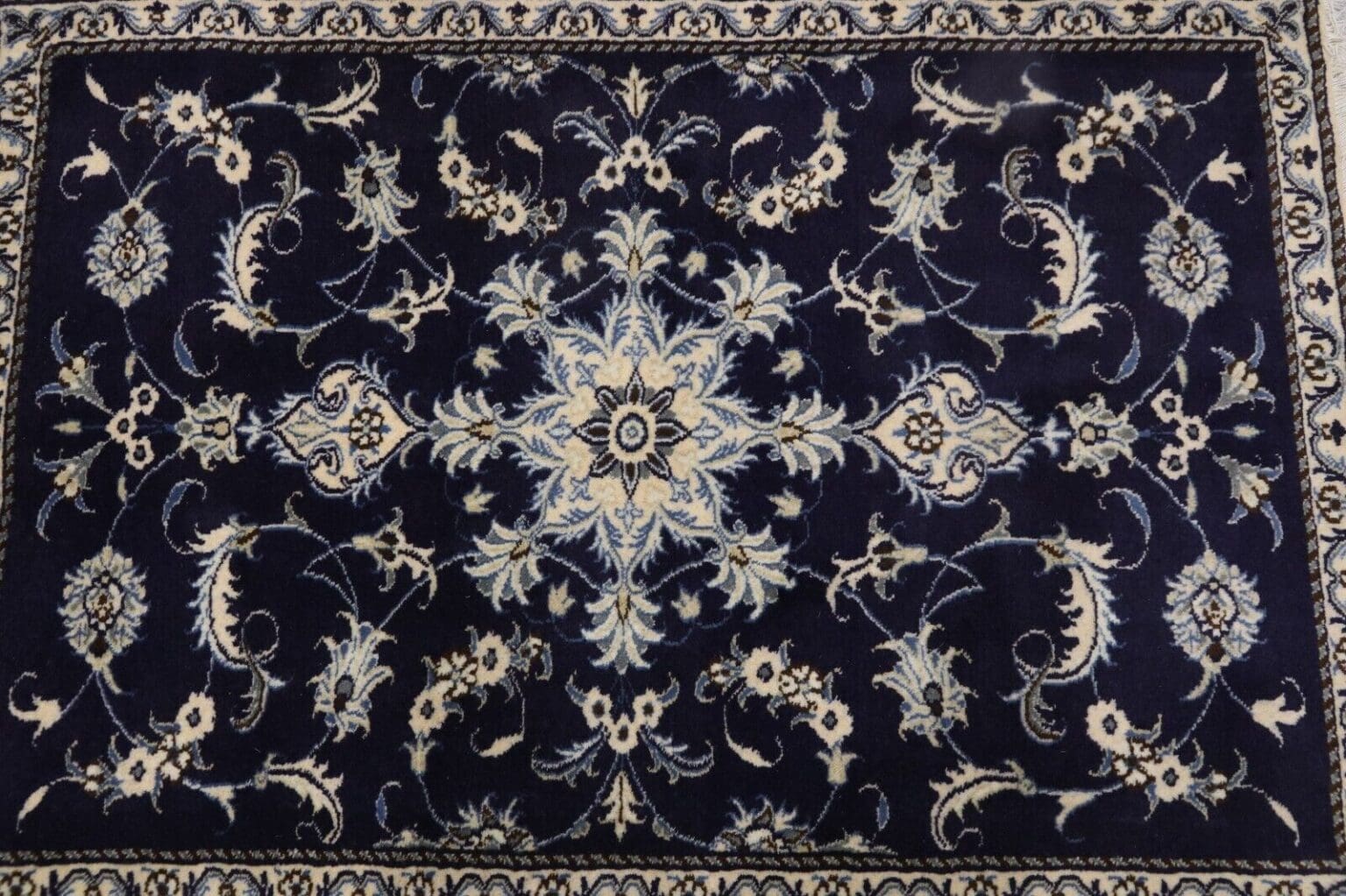
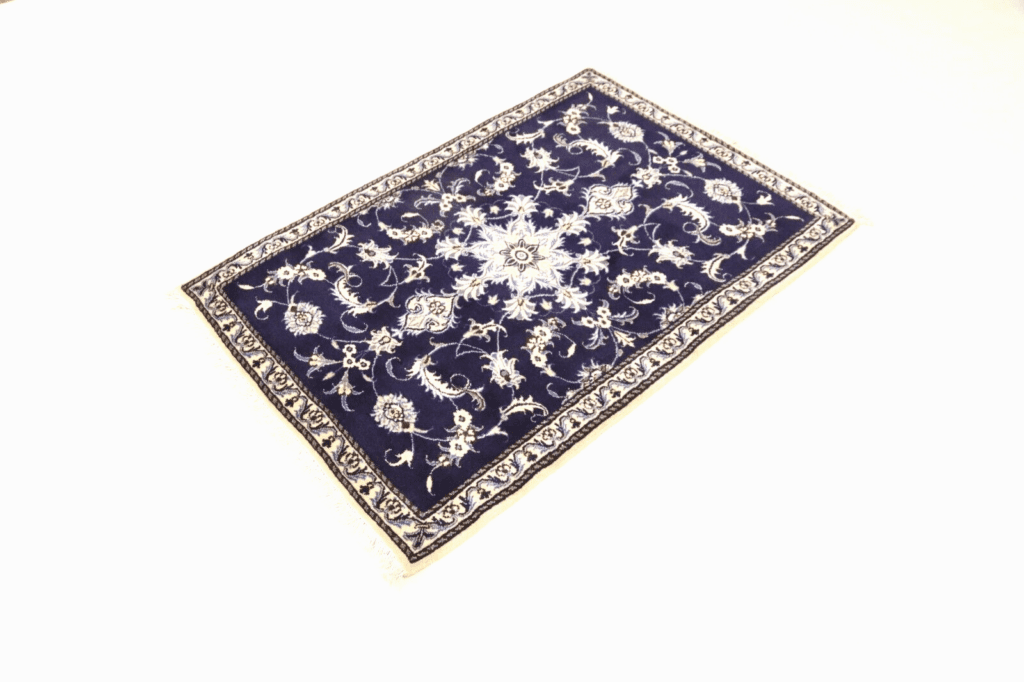
The design of this rug is described as traditional Oriental, and its colour is dark blue. This dark ground establishes the first visual impression of the surface and provides the setting for the ornamentation. In a Nain composition, colours are considered in relation to the central field, the borders and the motifs placed within them. The colour is therefore part of the overall structure rather than an isolated surface attribute.
Regional designs often include floral elements reminiscent of leaves, blossoms and scrolling vines. In Persian ornament, these botanical forms are usually stylised. A flower is not necessarily copied as a literal image of one plant; instead, it is transformed into a repeatable decorative form. Vines may link parts of a field, while smaller leaves or blossoms fill the surrounding spaces. Repetition and symmetry turn separate motifs into a continuous pattern.
Geometric forms give the composition an additional sense of order. They may appear as axes, frames, medallion structures or clearly bounded fields. Geometry and floral ornament can operate together. The geometric framework can determine where botanical motifs are placed, while the plant forms soften the lines and introduce movement. This combination is an established principle in many areas of Persian carpet design.
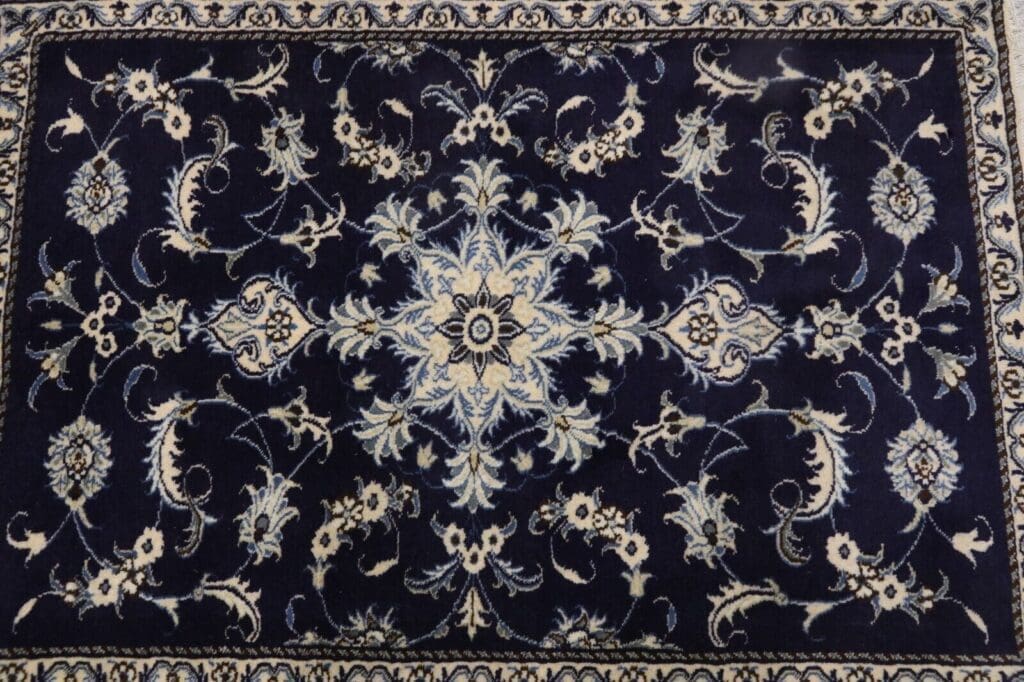
Clear line work is an important feature of the Nain design vocabulary. Outlines separate adjoining colour areas and make small ornaments readable. A fine knot structure supports the rendering of narrow lines, repeated details and small changes in shape. The high knot density therefore helps the pattern retain definition. It does not, by itself, identify one particular drawing, but it is technically suited to detailed regional ornament.
Dark blue can function as a calm, coherent ground in a carpet composition. Lighter or more reflective areas create contrast against it. The silk content of the pile may emphasise selected details through its sheen, while wool produces a softer and more diffuse reflection. The design can consequently look slightly different under changing illumination or from different viewing angles. This optical variation is a property of the materials and surface, not a change in the underlying pattern.
A balanced carpet design needs both ornamented areas and quieter spaces. If every section is filled equally, individual motifs can become difficult to distinguish. If open areas are too large, the relationship between separate parts of the design may weaken. Nain compositions address this through the planned division of field, secondary motifs and borders. The surface can contain many details while retaining a clear visual order.
Floral and geometric ornaments also carry a broader symbolic history in Persian art. Flowers, vines and leaves may be associated with nature, growth and renewal, while ordered geometry can suggest balance and continuity. These meanings belong to the general cultural background of the motifs. They should not be read as a specific documented message about the making or ownership of this individual rug.
The combination of a dark blue ground, traditional Oriental ornament, fine knotting, wool and silk gives this piece its visible character. Its design remains connected to the Nain tradition, while the particular colour effect and manual execution distinguish the individual rug. From a distance, larger fields and borders establish the composition; closer inspection reveals finer outlines and the changing reflection of the mixed pile.
Special Features
The special features of this rug are its hand-knotted construction, its knot density of approximately 300,000 knots per square metre and its composition of 90% virgin wool and 10% silk. The fine knotting supports detailed rendering of the traditional Oriental design. The individually placed knots also make the rug a one-off rather than a uniform industrial product. The mixed pile combines a predominantly woollen surface with the sheen associated with silk.
The rug is new and in very good condition. It is approximately 8 mm thick, suitable for underfloor heating and described as pet-friendly. Together with its Nain origin, dark blue colour and hand-made construction, these details define the particular textile object offered here.
FAQ
How should I care for this Nain Persian rug?
For regular care, vacuum the rug carefully with a gentle brush. This removes loose dirt without putting unnecessary strain on the pile. Spills should be dabbed promptly with a damp cloth rather than rubbed, since rubbing may roughen the fibres or disturb the surface. Because the rug contains both virgin wool and silk, professional cleaning should take the different properties of the two materials into account. Cleaning at suitable intervals helps preserve the pile, colour and overall surface appearance.
Where is the best place to use the rug?
The rug is suitable for living rooms and dining rooms. It may be placed beneath furniture or in an open area where its pattern remains visible. A study is another possible setting and can gain a warm textile element from the rug. Prolonged direct sunlight should be avoided so that the dark blue colour remains as even as possible. Since the rug is suitable for underfloor heating and described as pet-friendly, it can be used in appropriately equipped domestic rooms.
What makes this Nain rug a unique work of art?
Its individual character begins with the hand-knotted technique. Each knot is placed by hand, so the surface is not a completely uniform series product. The high knot density allows the pattern to be rendered with fine detail. The composition of virgin wool and silk, the dark blue colour and the traditional Nain design add further specific characteristics. Together, Iranian origin, manual technique, materials and pattern make this rug an individual example of Persian carpet craftsmanship.
To provide the best experiences, we use technologies like cookies to store and/or access device information. Consenting to these technologies will allow us to process data such as browsing behavior or unique IDs on this site. Not consenting or withdrawing consent, may adversely affect certain features and functions.
Functional Always active
The technical storage or access is strictly necessary for the legitimate purpose of enabling the use of a specific service explicitly requested by the subscriber or user, or for the sole purpose of carrying out the transmission of a communication over an electronic communications network.
Preferences
The technical storage or access is necessary for the legitimate purpose of storing preferences that are not requested by the subscriber or user.
Statistics
The technical storage or access that is used exclusively for statistical purposes.The technical storage or access that is used exclusively for anonymous statistical purposes. Without a subpoena, voluntary compliance on the part of your Internet Service Provider, or additional records from a third party, information stored or retrieved for this purpose alone cannot usually be used to identify you.
Marketing
The technical storage or access is required to create user profiles to send advertising, or to track the user on a website or across several websites for similar marketing purposes.
 SECURE PAYMENT
 SHIPPING PARTNERS


