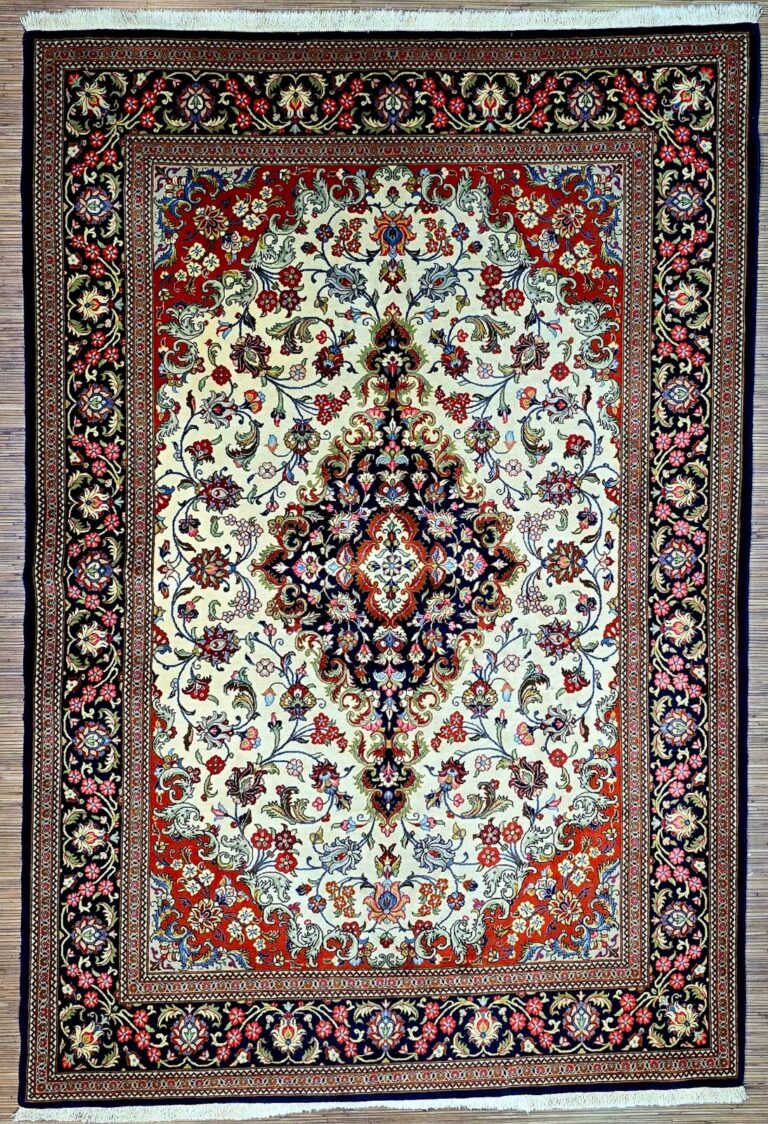
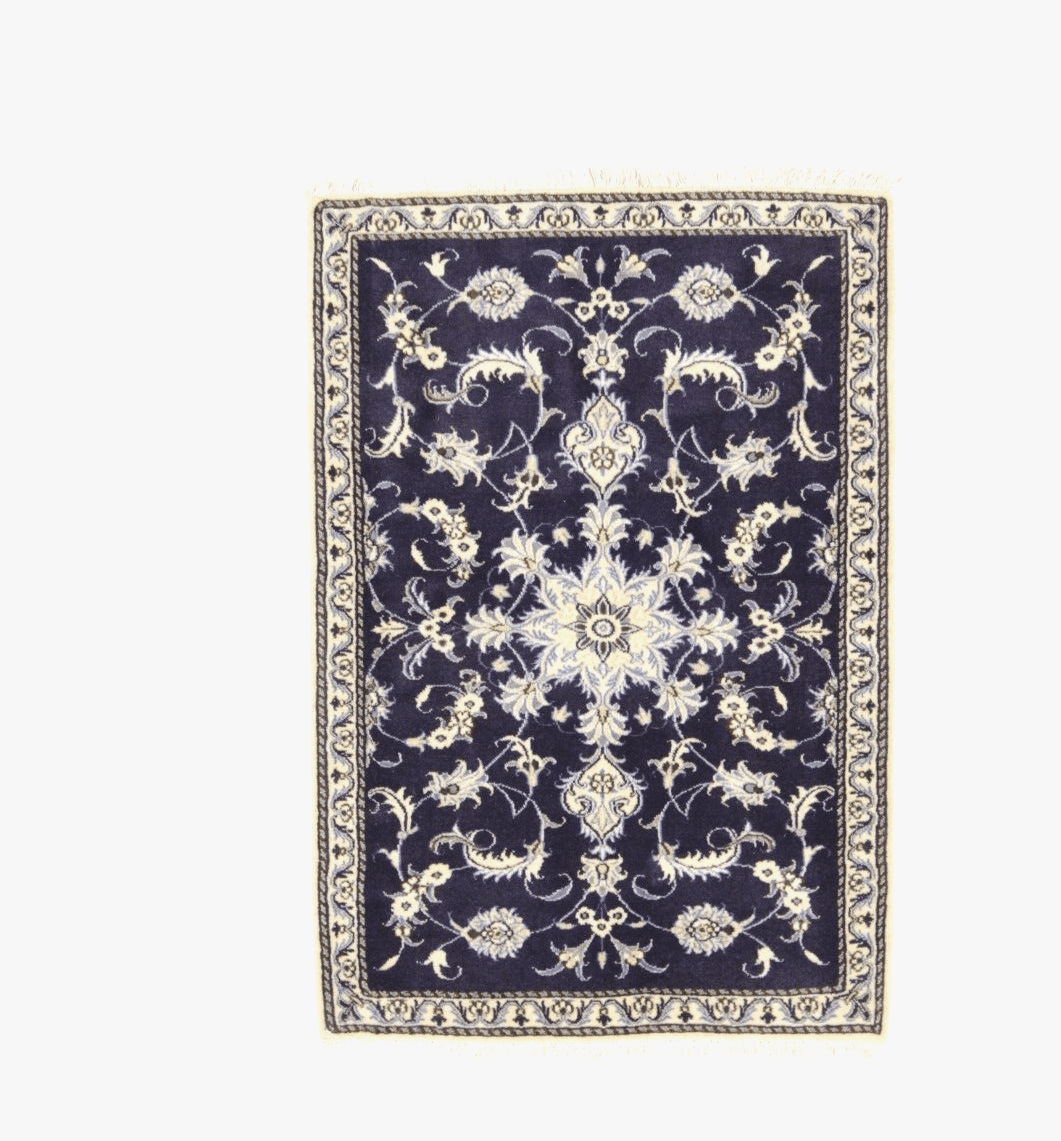
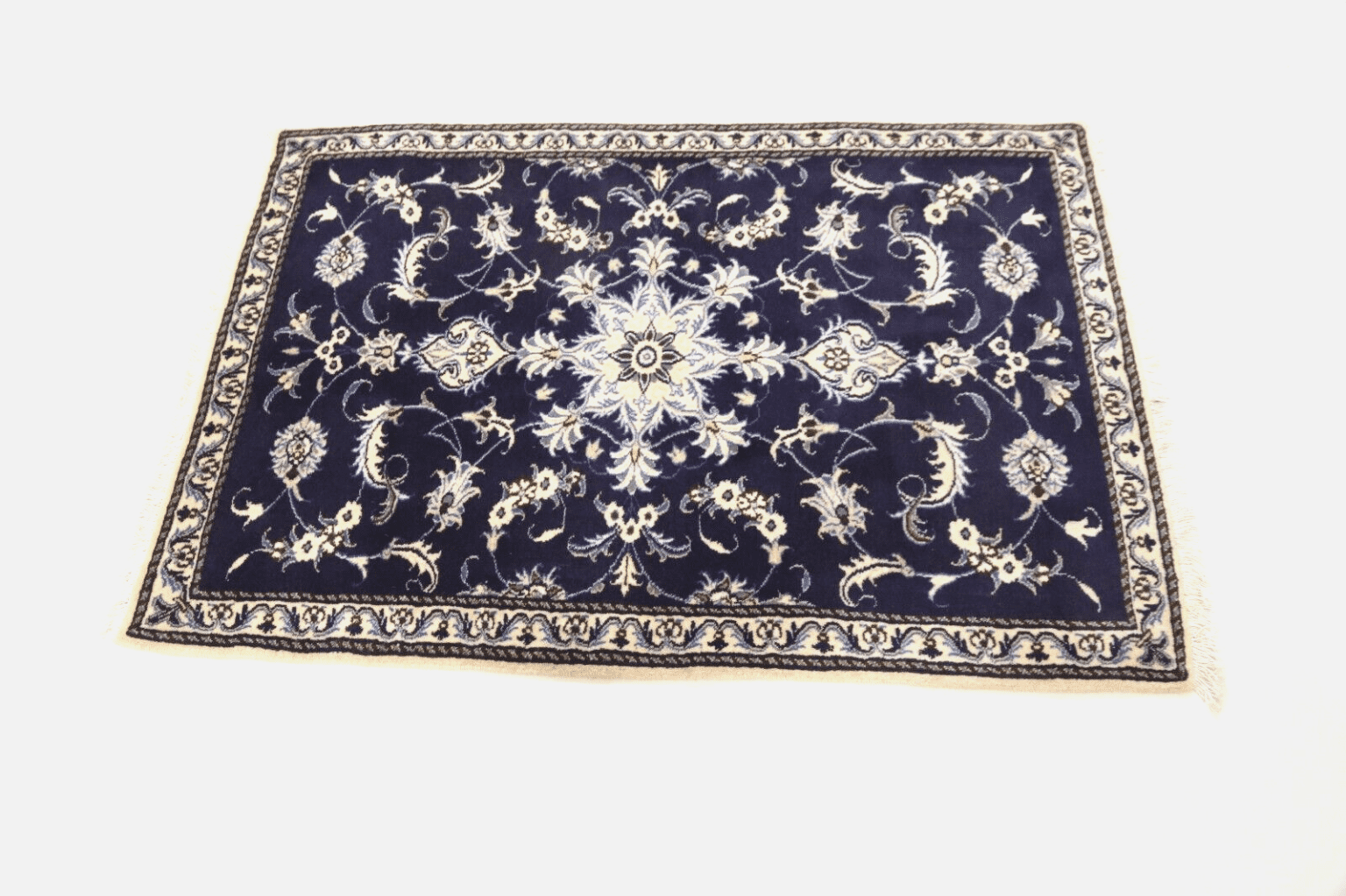
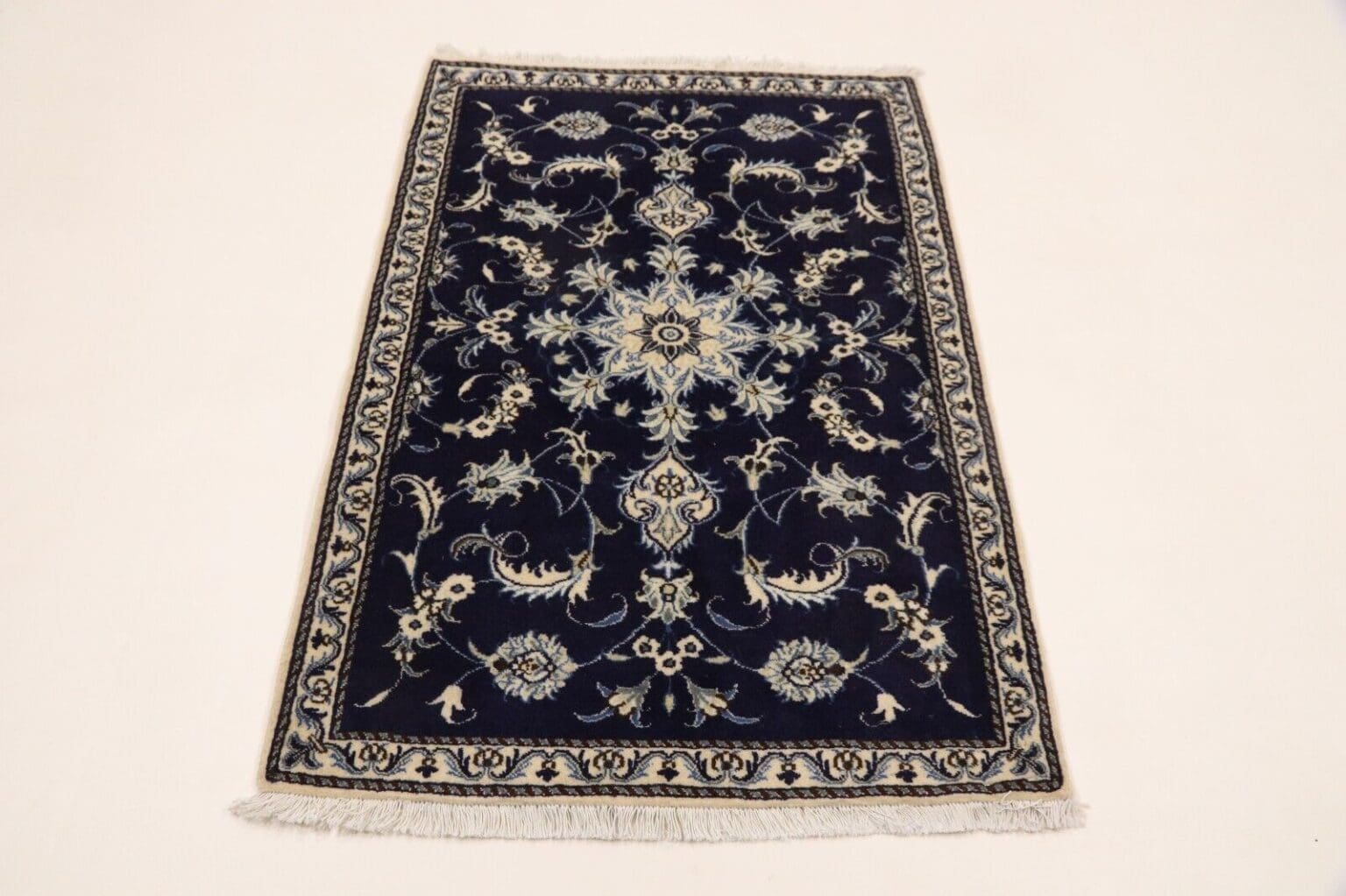
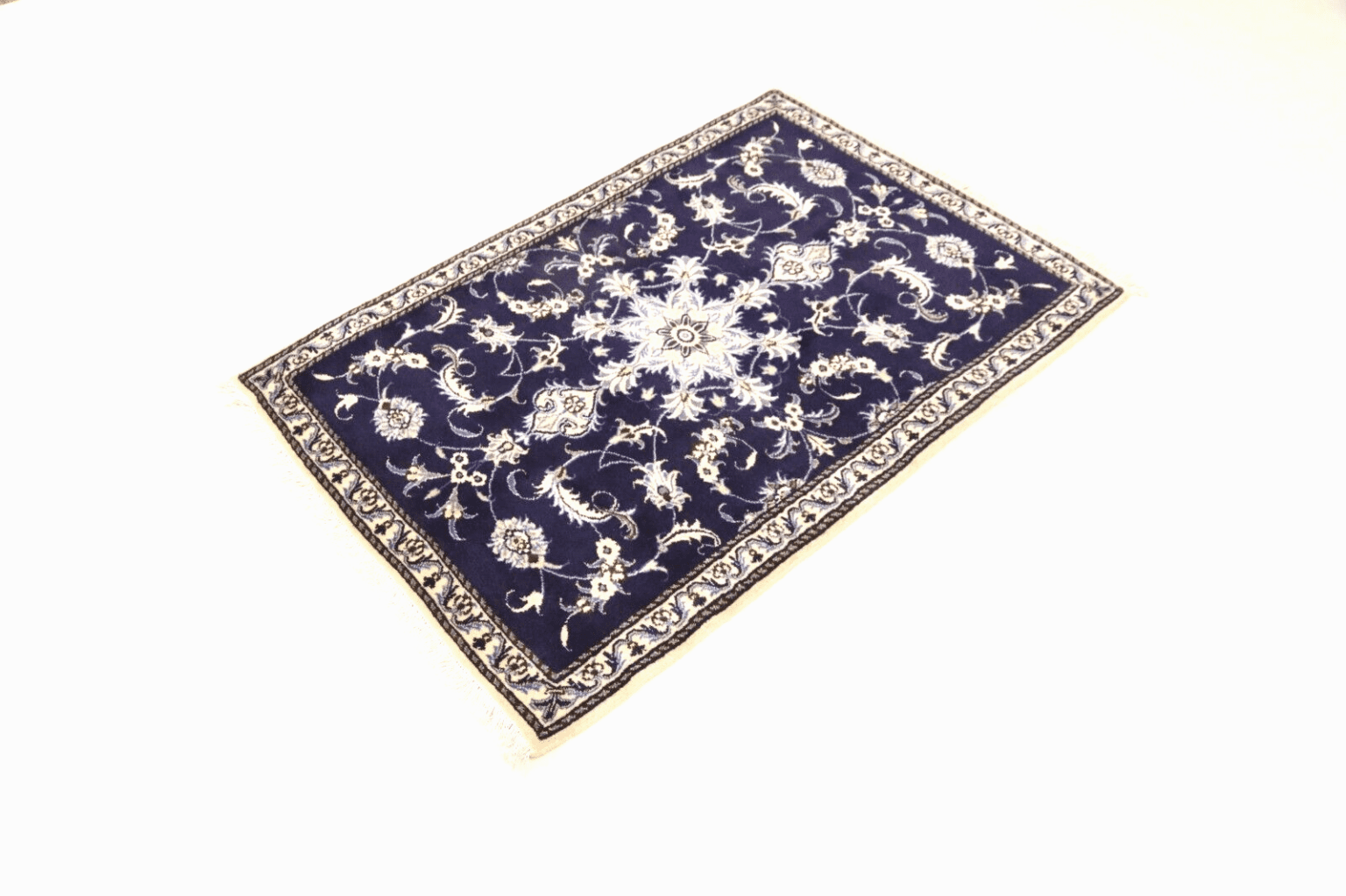
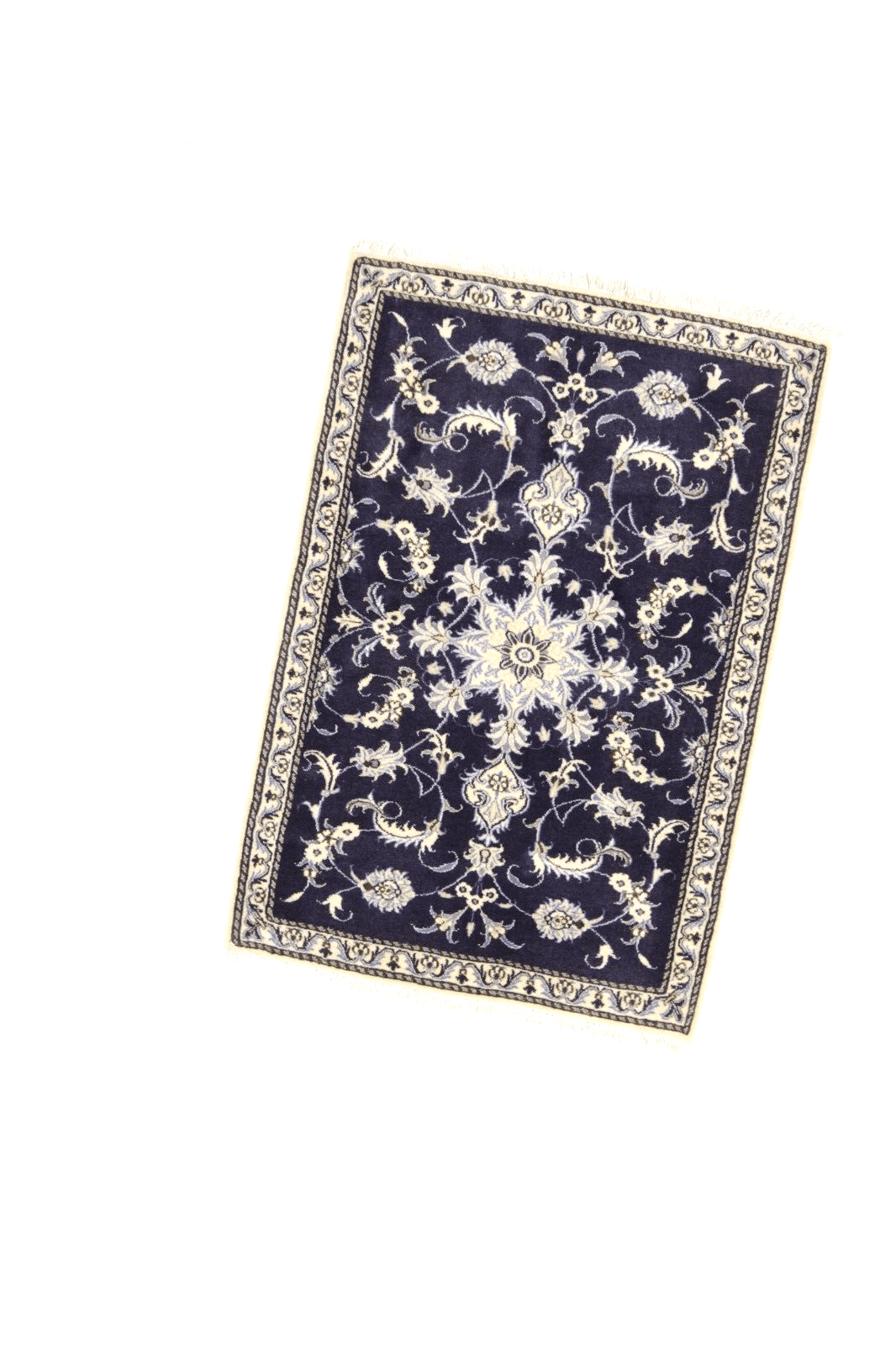
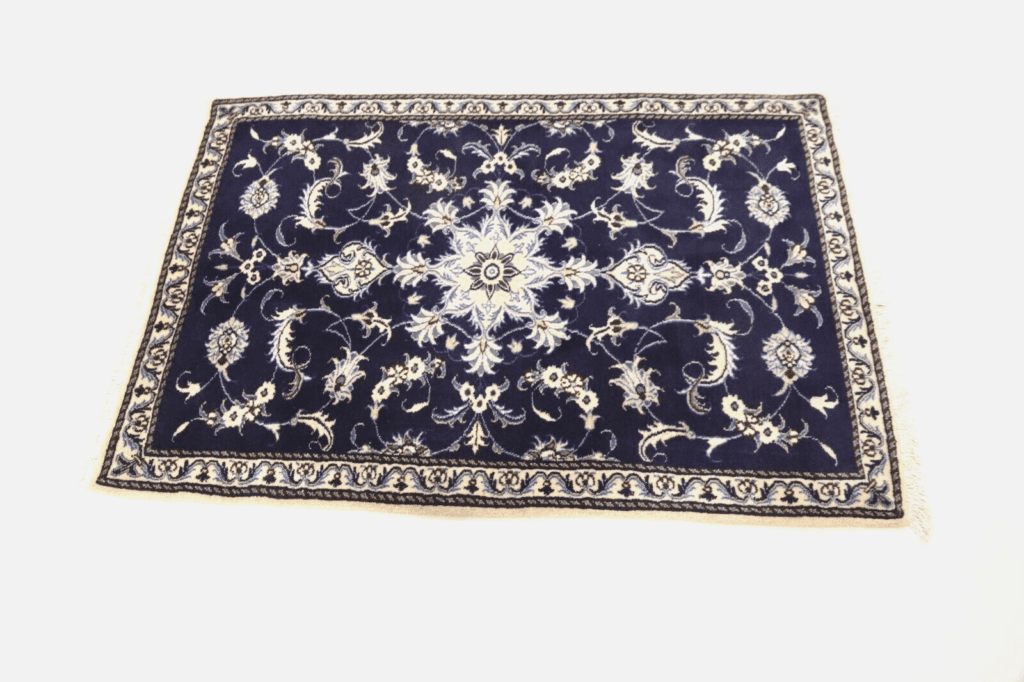
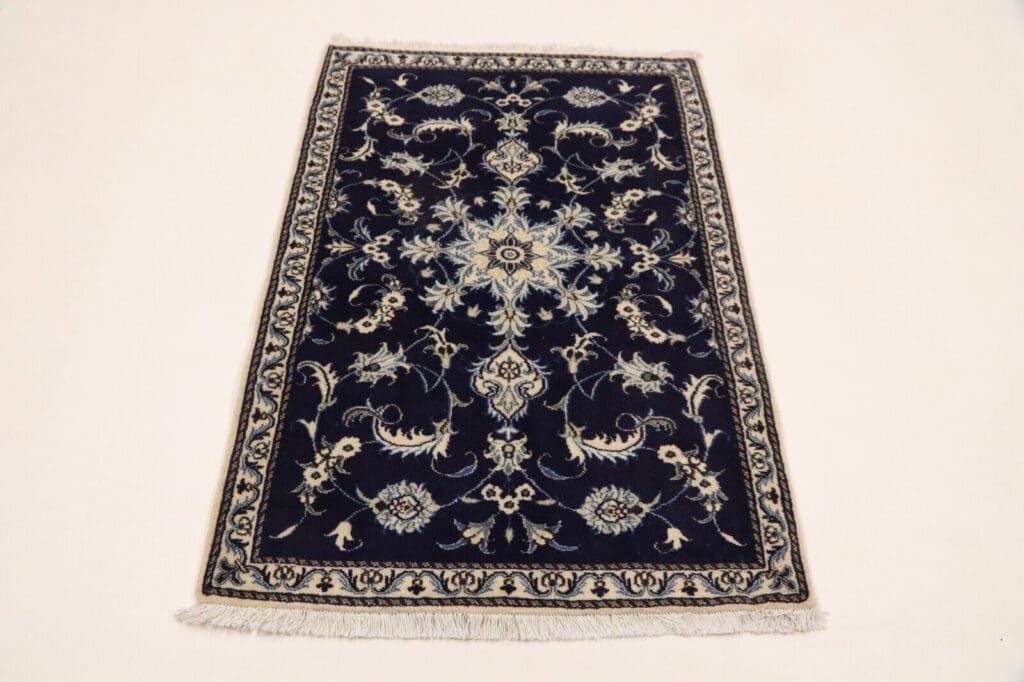
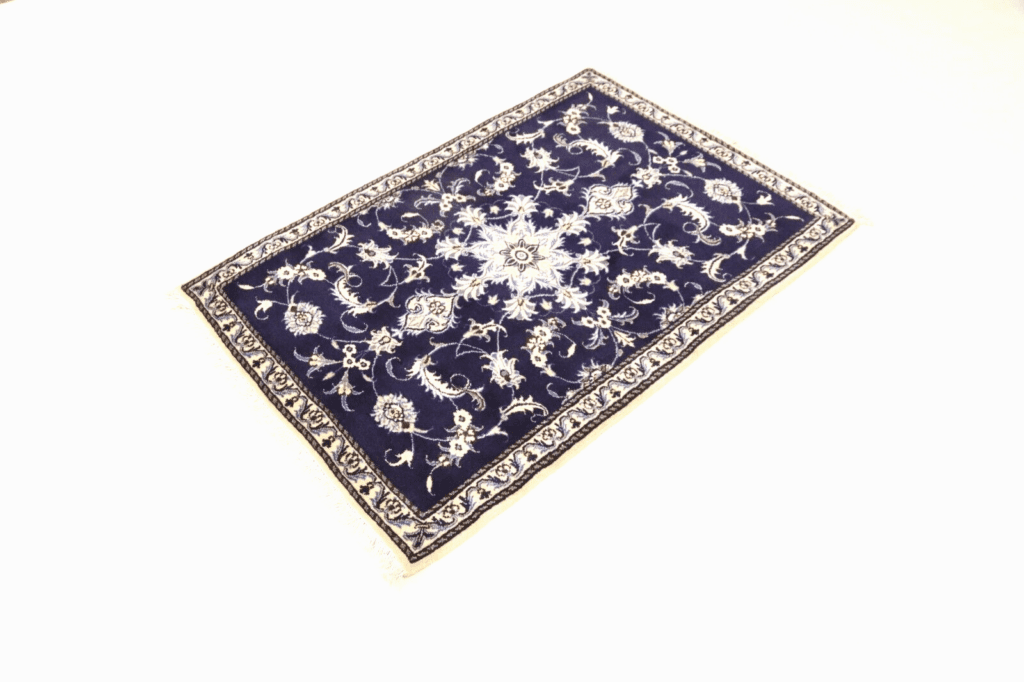
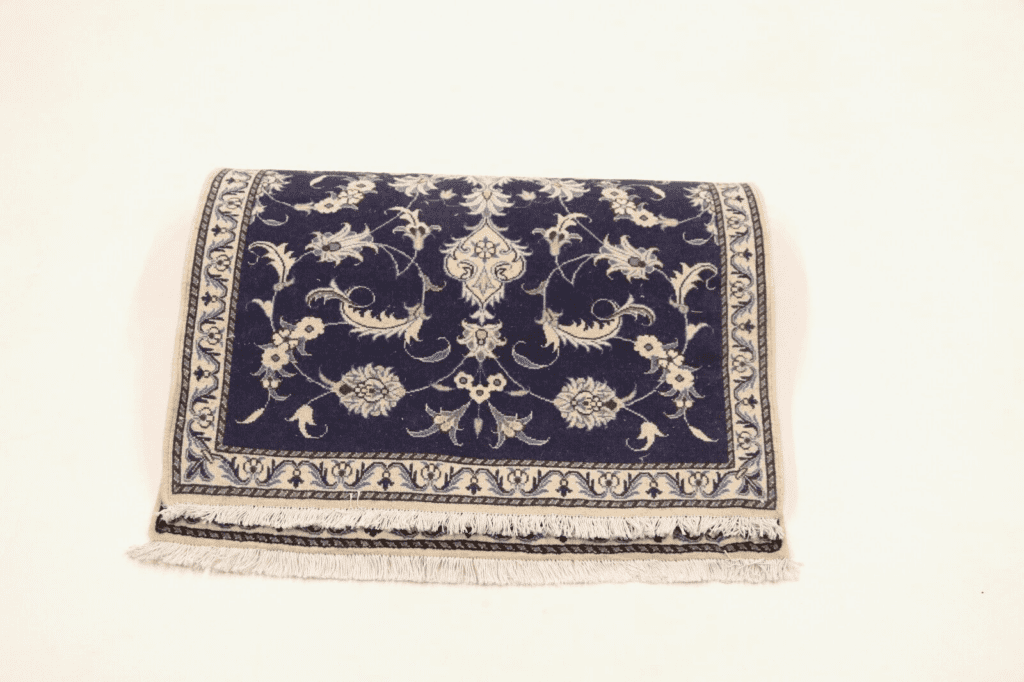
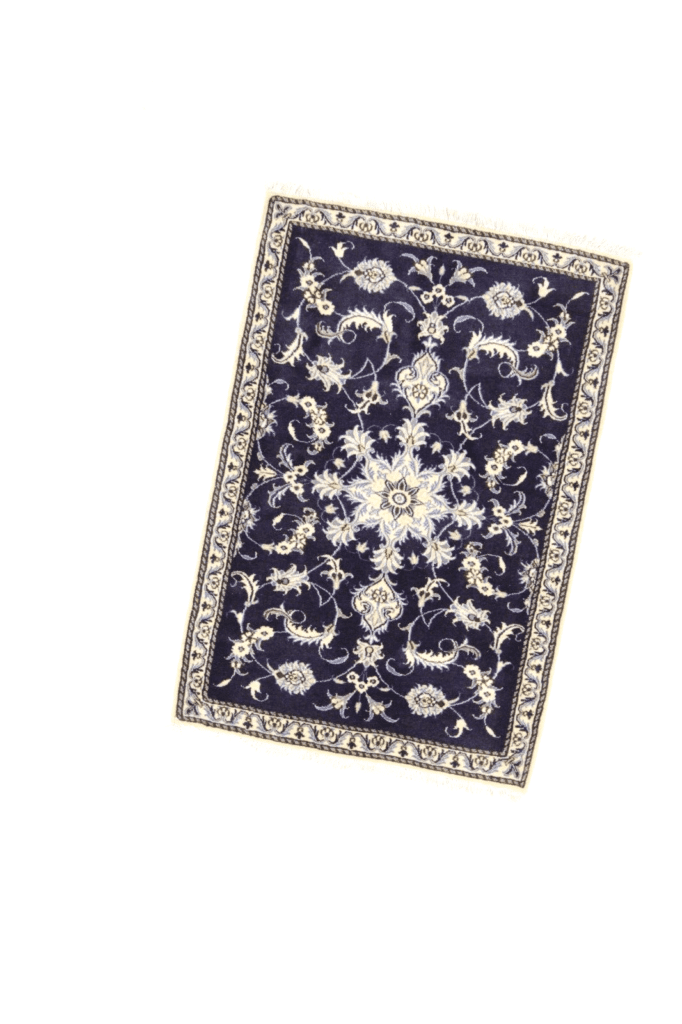
Hand-knotted Nain Persian Rug | Knot density: approx. 300,000 knots/m² | Material: pile 90% virgin wool, 10% silk | Size: 135 x 92 cm | Pattern: traditional Oriental and Persian | Condition: New, very good
This hand-knotted Nain Persian rug is made from 90% virgin wool and 10% silk. The two materials contribute different qualities to the pile. Wool has long been used in rug making for its warmth, resilient structure and comfortable surface. Silk adds a smoother touch and a subtle sheen. In this rug, the stated pile composition brings the tactile character of wool together with the finer reflective quality associated with silk.
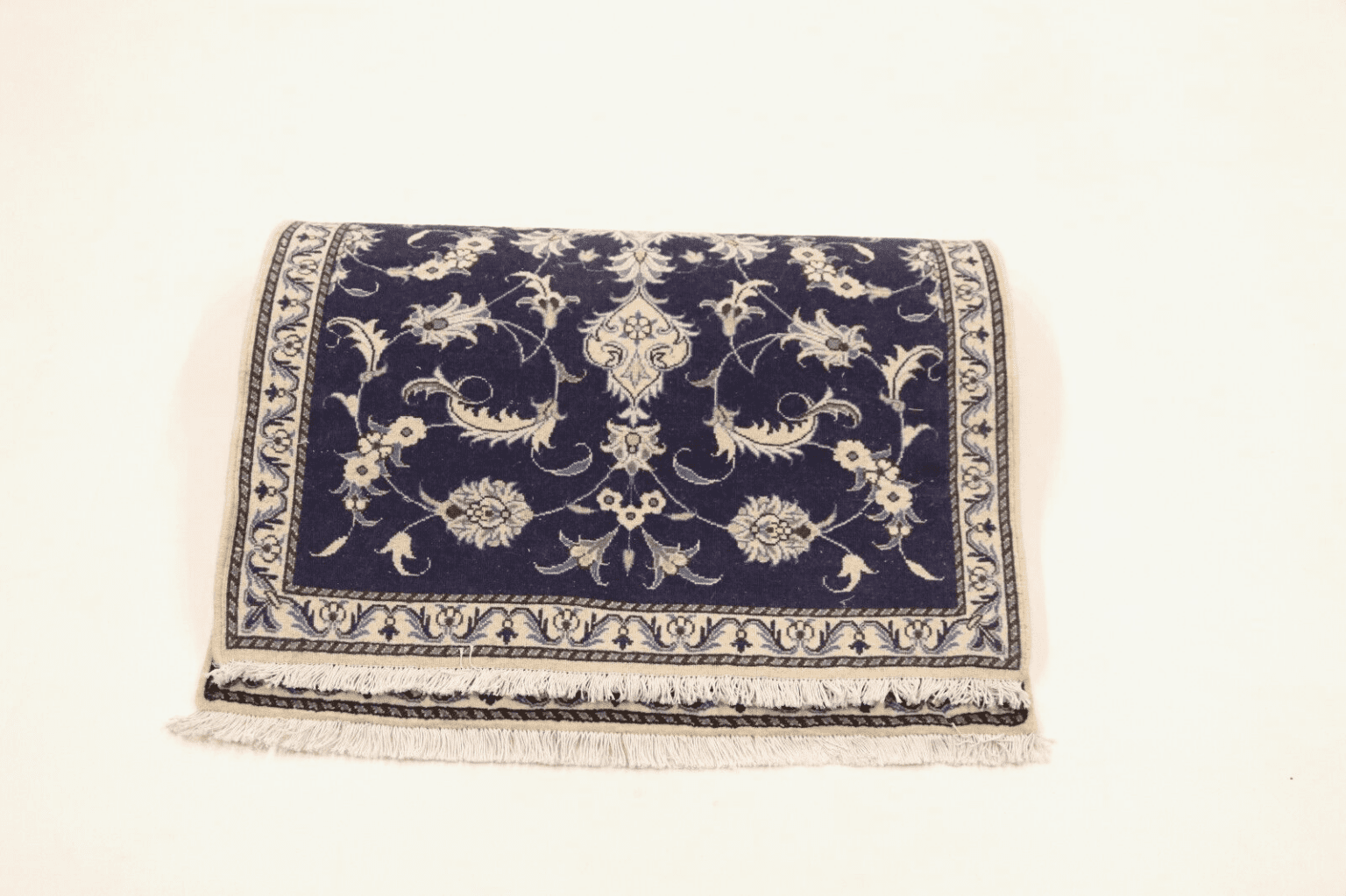
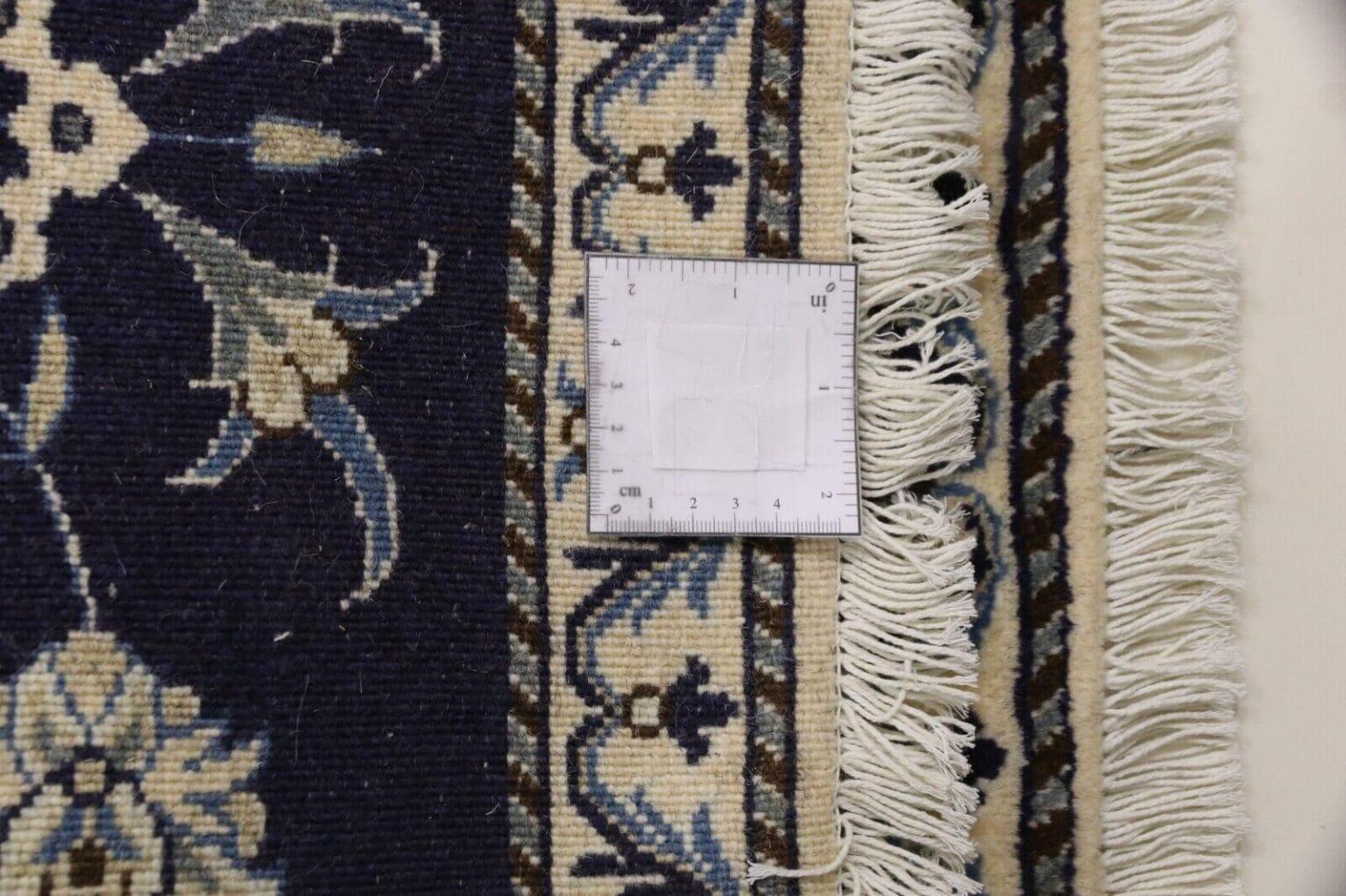
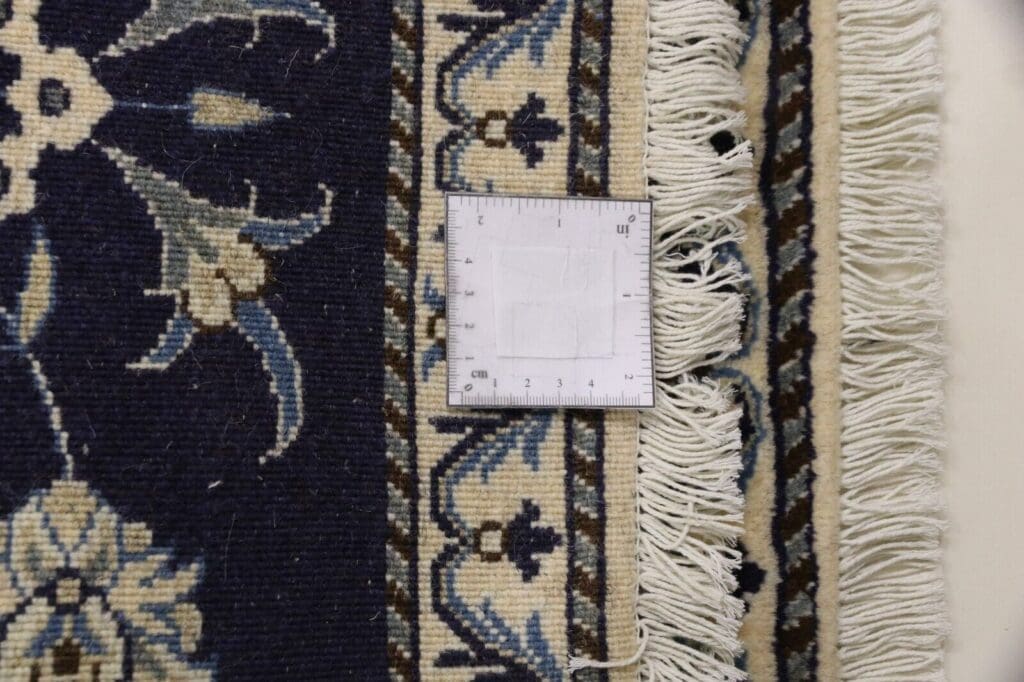
The rug was made by hand. In hand-knotting, individual knots are inserted one by one into the prepared foundation. This is distinct from machine production and means that every hand-knotted rug is an individual textile work. Its knot density is approximately 300,000 knots per square metre. A density of this kind allows contours, fine lines and smaller ornaments to be rendered closely. It also reflects the careful, precise nature of the knotting process.
The mixture of virgin wool and silk gives the surface both a warm textile presence and a restrained lustre. Hand-knotting belongs to the established craft tradition of Oriental rugs, where the choice of fibre, knotting method and drawn design are closely connected. This rug is new and in very good condition.
Origin and Tradition
The rug is identified as Nain from Persia, or Iran. Nain is a city in central Iran known for finely made rugs. Its rug-making tradition reaches back to the nineteenth century. During that period, weaving and knotting became an important part of the local craft culture. Nain rugs are associated with careful execution, fine drawing and a clearly organised decorative language.
The name Nain therefore refers both to a place and to a particular regional tradition. In workshops in the area, knowledge of spinning, dyeing, stretching and knotting has been passed from one generation to the next. Production starts with preparing the foundation and continues with the ordered placement of the knots. The finished surface is then worked so that the design becomes distinct. Each stage requires concentration, since small changes can affect the balance of the complete composition.
Persian rugs developed through many regional traditions, each with its own technical and visual vocabulary. Nain occupies a place within this wider Iranian history through its refined ornament and controlled workmanship. The city is part of a landscape where textile crafts have been developed over a long period. Knowledge of proportion, repeating borders and the relationship between field and frame forms part of the background to Nain rug making. These rugs are consequently more than practical floor coverings: they are textile works shaped by regional forms and inherited methods.
Persian rug motifs may draw on nature, architecture and systems of geometric order. Their meanings are not fixed for every design; they depend on the composition and the tradition in which a motif is used. Nain designs are often linked with balance, measured spacing and precise drawing. The term Persian rug here reflects the Persian origin given in the source. At the same time, its making belongs to the broader history of Iranian carpet craft, in which regional practices developed alongside one another.
The history of Nain rug making also illustrates how established forms can be refined through technical control. A design has to be transferred to the woven surface with attention to scale and alignment. The knotter follows the planned structure while maintaining an even sequence across the field. This relationship between a drawn pattern and manual execution is central to the tradition. It explains why a Nain rug is discussed in terms of both its place of origin and the discipline of its workmanship.
Design and Pattern
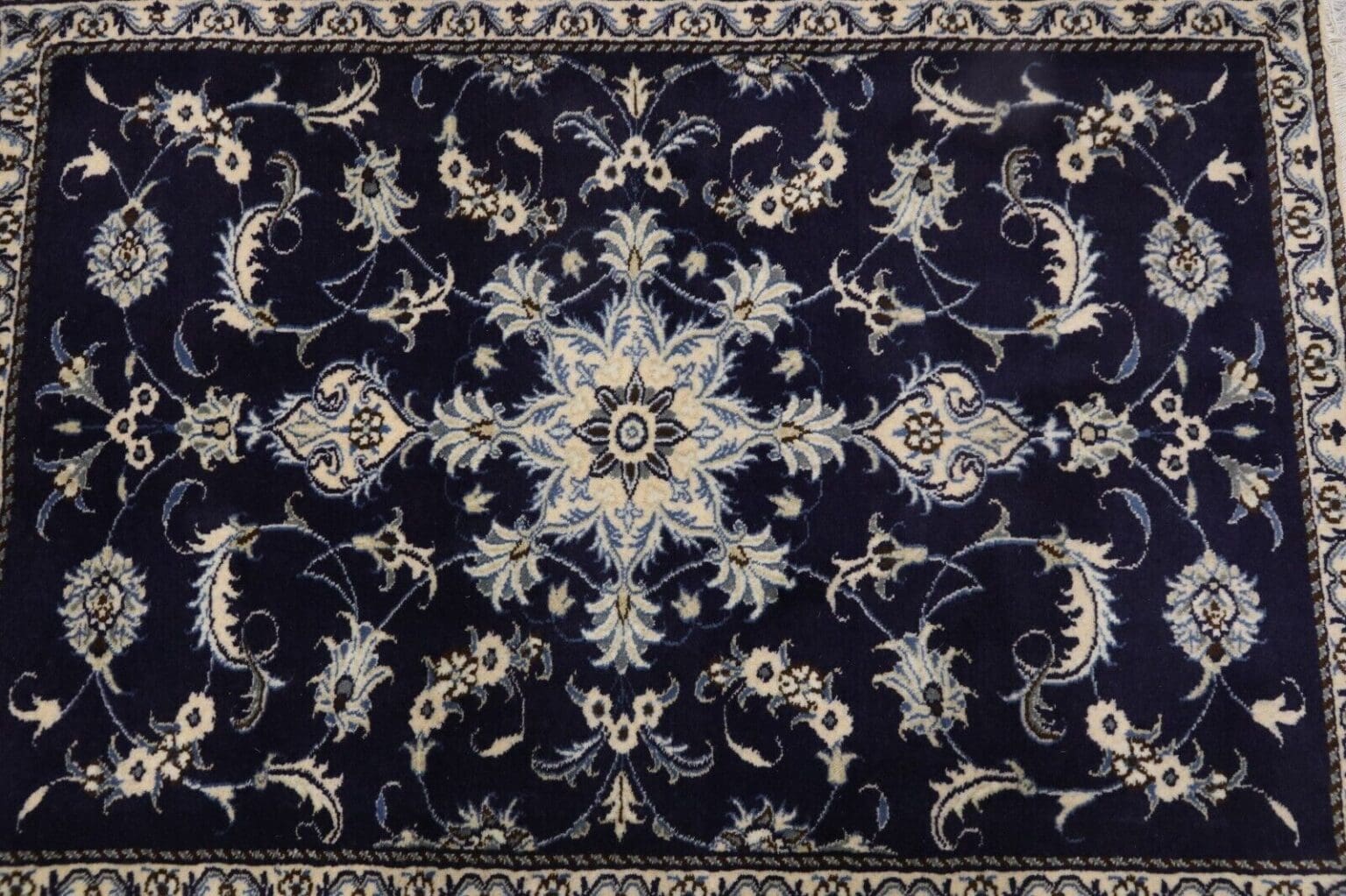
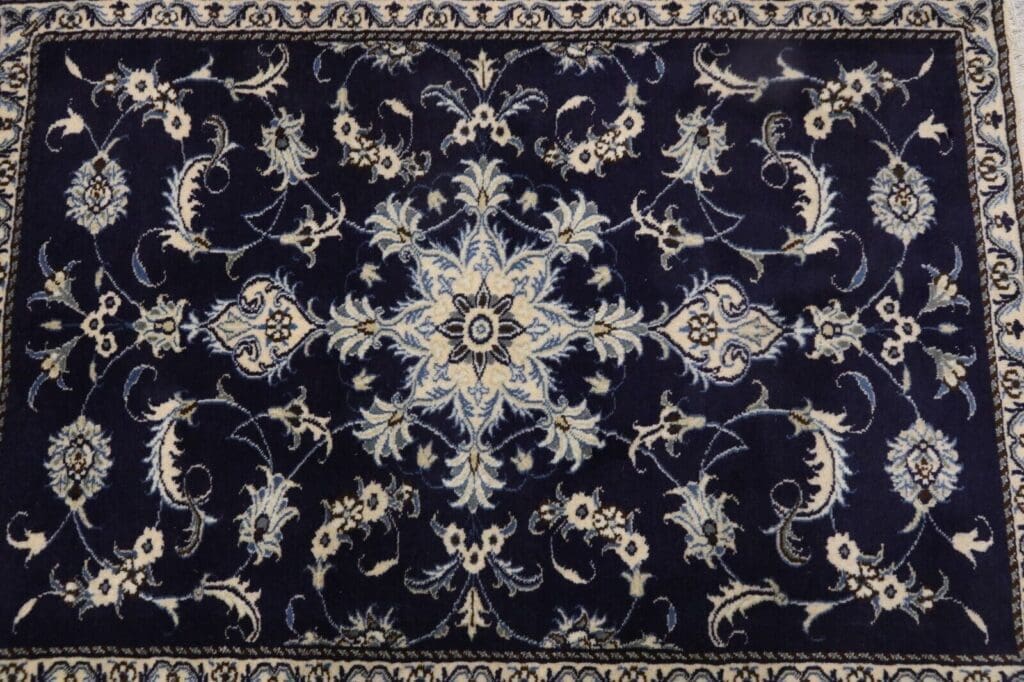
The style of this rug is described as traditional Oriental and Persian. Nain rugs can combine floral elements, geometric shapes and established Iranian motifs. Floral ornaments may appear as stylised leaves, blossoms or scrolling vines. They are often arranged in a continuous repeat or in a balanced overall composition. Geometric lines give structure to the design and can separate a central field, corner sections and borders.
A traditional rug composition is usually organised into visual zones. A connected field may occupy the centre, surrounded by one or more borders. The border creates a transition between the inner ornament and the outer edge. Repeated forms establish rhythm, while smaller details give the surface variation. A high knot density supports precise transitions between these elements, allowing the contours of an ornament to remain legible without making a claim about a particular medallion or layout not specified for this rug.
In Nain and other Persian traditions, decorative elements are often discussed in relation to order, balance and the relationship between people and the natural world. Vines can suggest growth and movement, while blossoms connect the design with the imagery of gardens and nature. Geometric forms organise the field and provide a counterpoint to curved plant shapes. These interpretations describe the cultural background of Persian rug design; they are not an assertion that one specific, unnamed motif appears in this individual piece.
Colour is another structural part of an Oriental rug. Shades are selected and combined so that the ornament remains readable and the overall arrangement stays calm and coherent. Natural dyes have traditionally been used in Persian rug production. They may come from plants or other natural sources, with the resulting nuances influenced by the dye, the fibre and the treatment of the yarn. The wool and silk in the pile also affect the way colour is seen: wool tends to give a softer, fuller appearance, while silk reflects light more finely.
The Nain designation and the traditional Persian-Oriental style place the rug within this established visual language. They do not supply a detailed description of individual motifs that the source does not name. What can be stated is that floral patterns, geometric forms and traditional Iranian motifs are part of the broader Nain vocabulary. Hand-knotting and the fine knot density support detailed drawing and controlled lines, while the exact arrangement of this one-off rug remains the design presented on its surface.
Special Features
The rug is new and in very good condition. Its listed special features are suitability for underfloor heating and a pet-friendly character. Suitability for underfloor heating makes it appropriate for rooms where a textile floor covering is used above such a system. The pet-friendly description indicates intended everyday use in homes with pets. It is also described as easy to care for and robust.
The traditional design allows the Nain Persian rug to be used in different living areas. The possible settings named for it are the living room, dining room, hallway and bedroom. In each case it functions as both a textile floor covering and a decorative interior element. Its stated underfloor-heating suitability and pet-friendly character are practical attributes specifically associated with this offering.
FAQ
How should I care for the Nain Persian rug?
Regular vacuuming helps remove loose dust and dirt from the pile. Spills should be dabbed promptly with a damp cloth rather than rubbed firmly into the surface. If a cleaning agent is needed, a mild product is recommended. Strong chemical cleaners should be avoided in order to protect the fibres and colours. Professional cleaning once a year is recommended. Because the pile combines virgin wool and silk, cleaning should take account of the different surface properties of these two fibres.
Where can I place the rug?
The rug is suitable for living rooms and dining rooms, and it can also be used as a decorative accent in a hallway or bedroom. Its stated suitability for underfloor heating allows use in rooms fitted with that system. A position where the traditional pattern can be seen clearly allows the design to remain part of the interior. It is also intended for homes with pets, as it is described as pet-friendly.
Why are hand-knotted rugs different from machine-made rugs?
In a hand-knotted rug, each knot is placed individually by a craftsperson. The result is an individual textile work whose production can require many hours of manual labour. This method allows a high knot density and detailed rendering of ornaments. Machine-made rugs, by contrast, are produced through an industrial process. Hand-knotting, quality materials and the associated labour are given as reasons why hand-knotted rugs are generally considered more durable and more likely to retain value.
To provide the best experiences, we use technologies like cookies to store and/or access device information. Consenting to these technologies will allow us to process data such as browsing behavior or unique IDs on this site. Not consenting or withdrawing consent, may adversely affect certain features and functions.
Functional Always active
The technical storage or access is strictly necessary for the legitimate purpose of enabling the use of a specific service explicitly requested by the subscriber or user, or for the sole purpose of carrying out the transmission of a communication over an electronic communications network.
Preferences
The technical storage or access is necessary for the legitimate purpose of storing preferences that are not requested by the subscriber or user.
Statistics
The technical storage or access that is used exclusively for statistical purposes.The technical storage or access that is used exclusively for anonymous statistical purposes. Without a subpoena, voluntary compliance on the part of your Internet Service Provider, or additional records from a third party, information stored or retrieved for this purpose alone cannot usually be used to identify you.
Marketing
The technical storage or access is required to create user profiles to send advertising, or to track the user on a website or across several websites for similar marketing purposes.
 SECURE PAYMENT
 SHIPPING PARTNERS