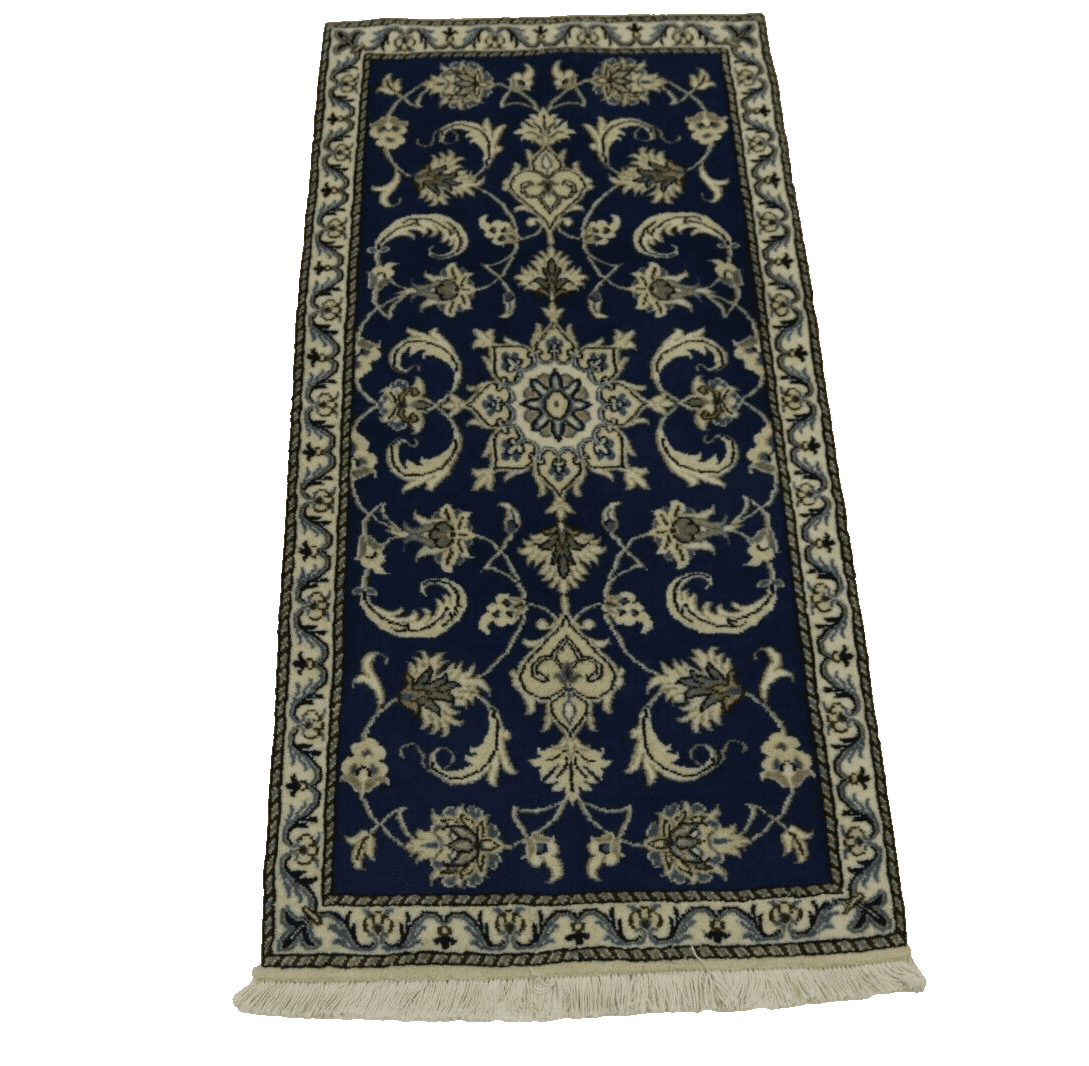
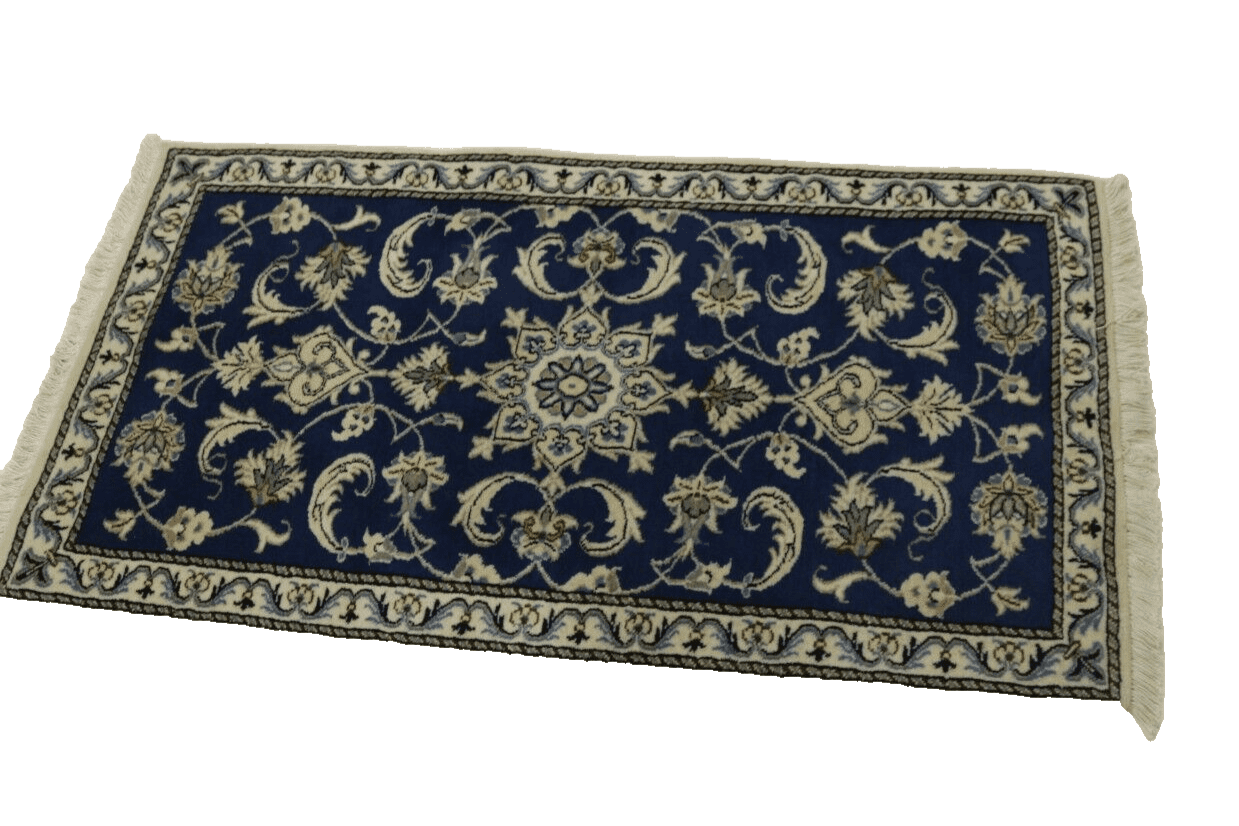
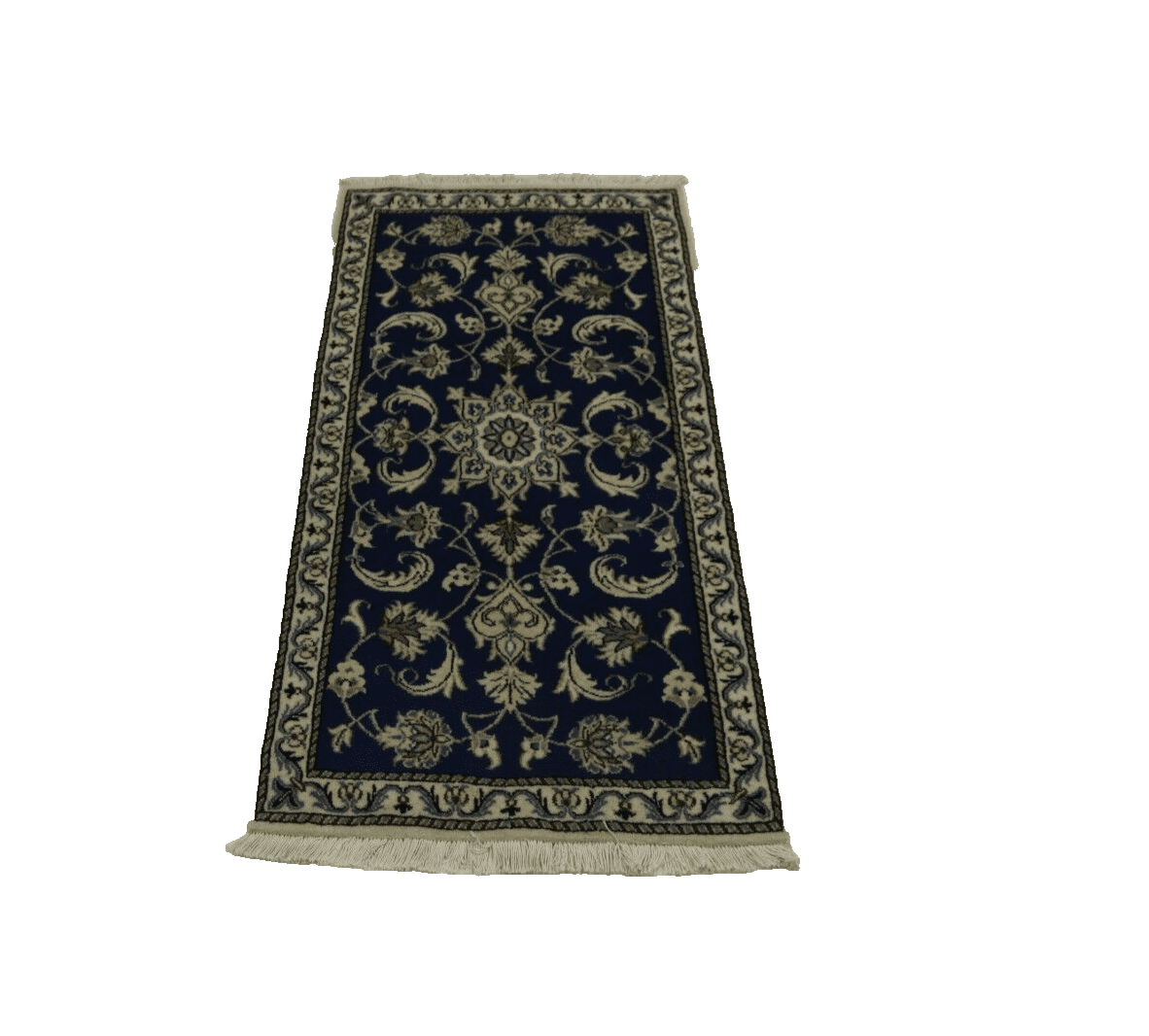
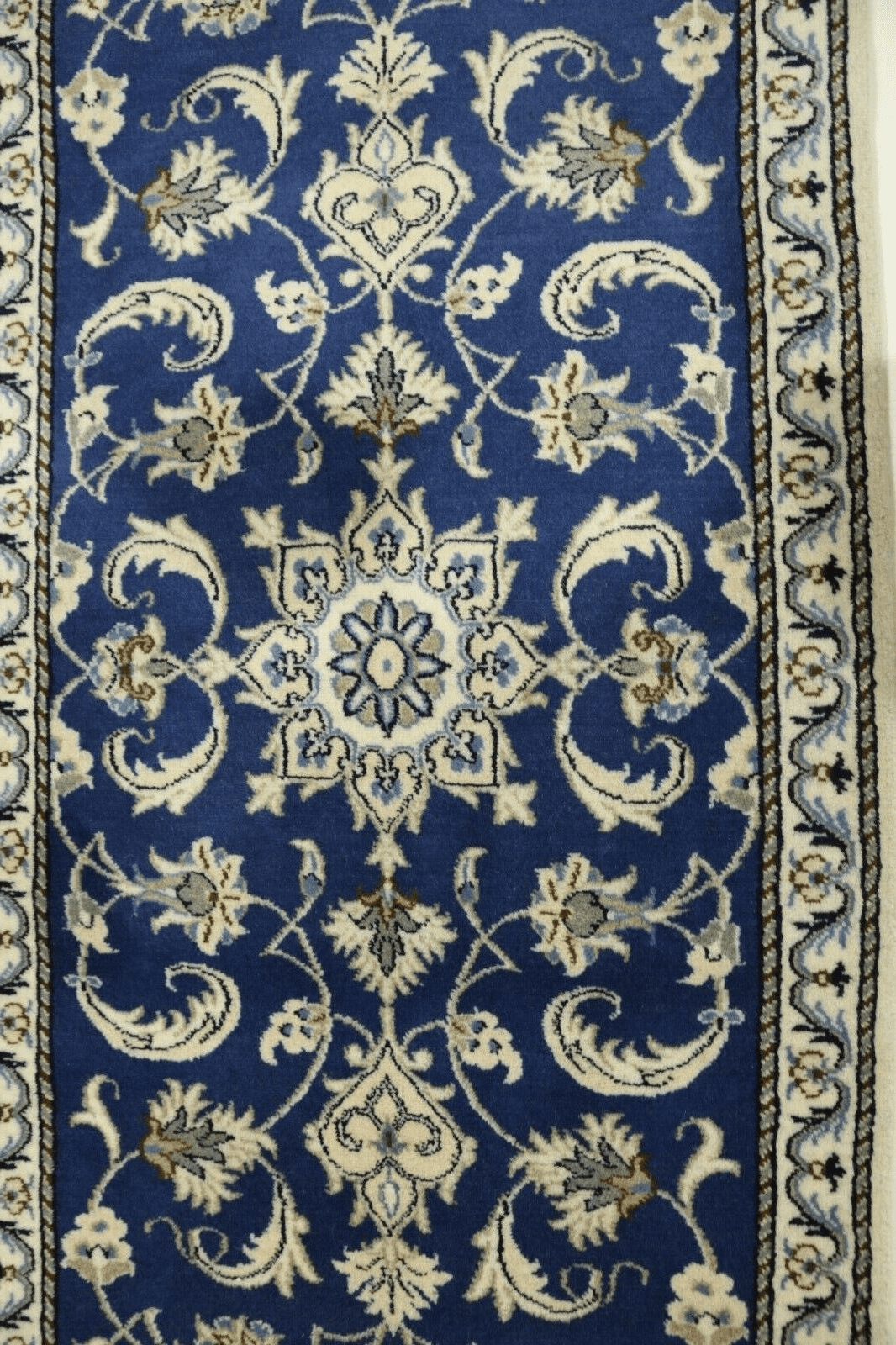
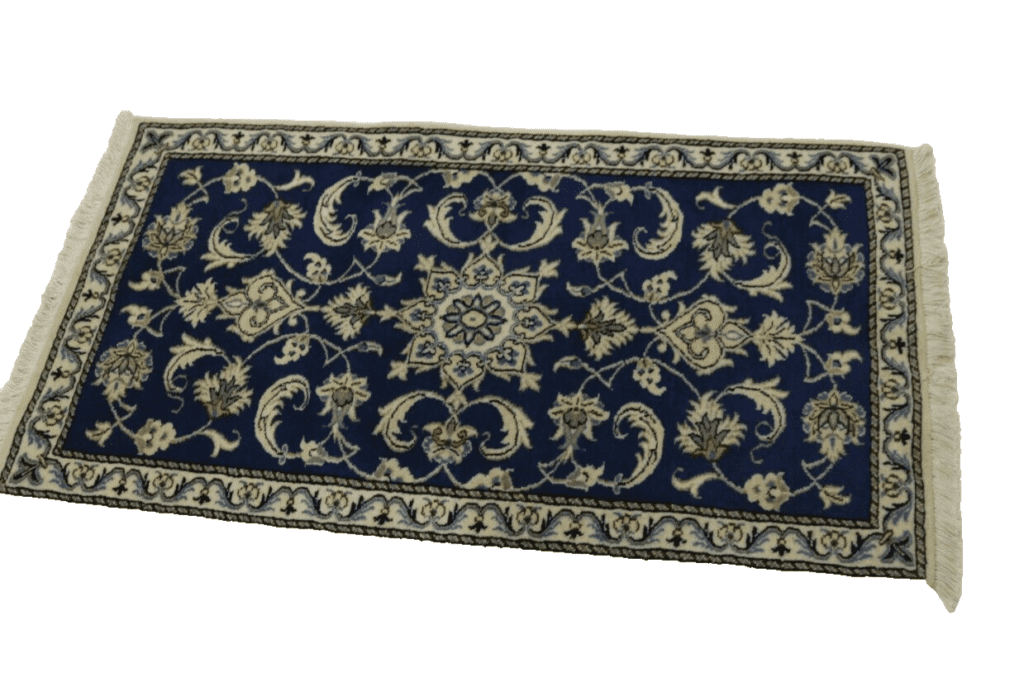
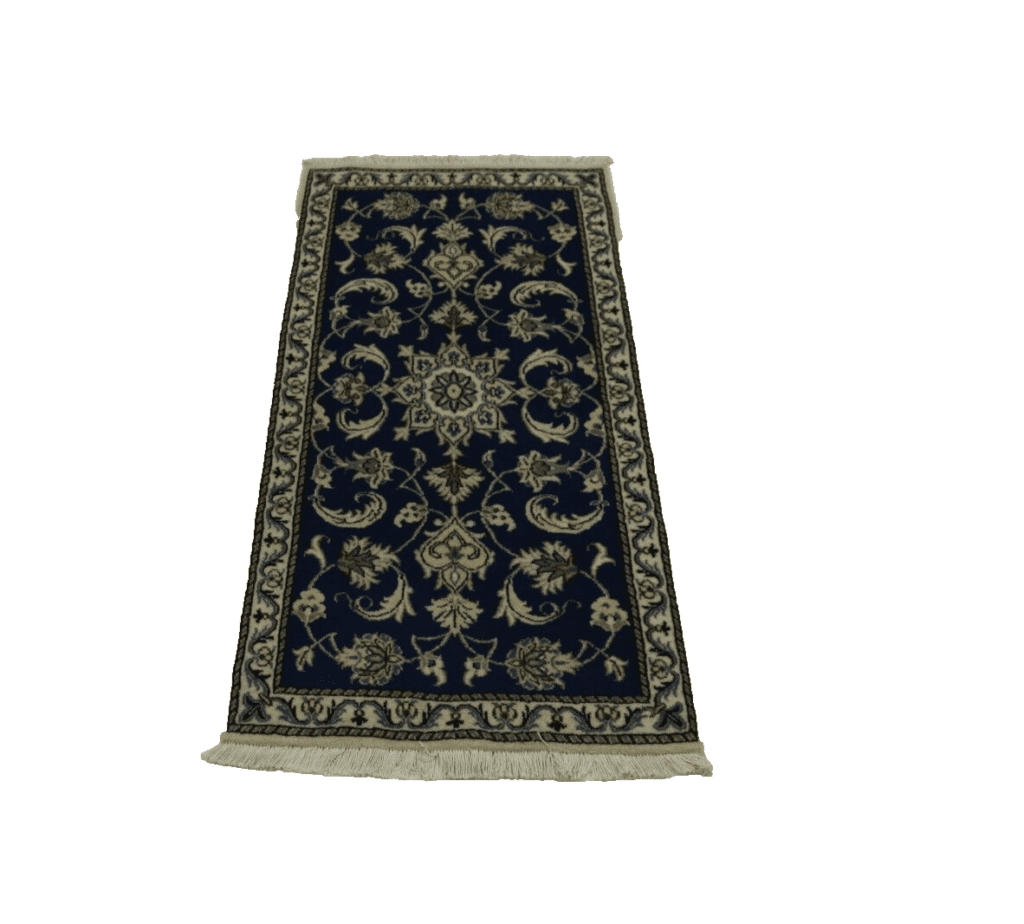
Hand-knotted Nain Persian Rug | Knot density: approx. 300,000 knots/m² | Material: pile virgin wool, warp cotton | Size: 135 x 70 cm | Condition: New | Pattern: traditional Oriental and Persian
This Nain Persian rug is described as 100% hand-knotted. The pile is made from 100% virgin wool, while 100% cotton is also specified as a material. Together, the wool pile, cotton foundation and manual knotting define the basic construction of this one-off piece. Wool has long been used in rug making because its fibres combine a soft surface with natural resilience. It can retain warmth and gives the pile a comfortable, yielding handle. Cotton is commonly used in rug construction for structural elements such as the warp, providing a regular foundation on which the knots are built.
The listed knot density is approximately 300,000 knots per square metre. This density is produced by placing a large number of individual knots in a closely organised process. In hand knotting, each row is built progressively on the loom, with the knots aligned to the intended drawing. Unlike a machine-made surface, the pile is formed through repeated manual actions. A dense structure generally allows outlines, small ornaments and changes in direction to be rendered with greater precision.
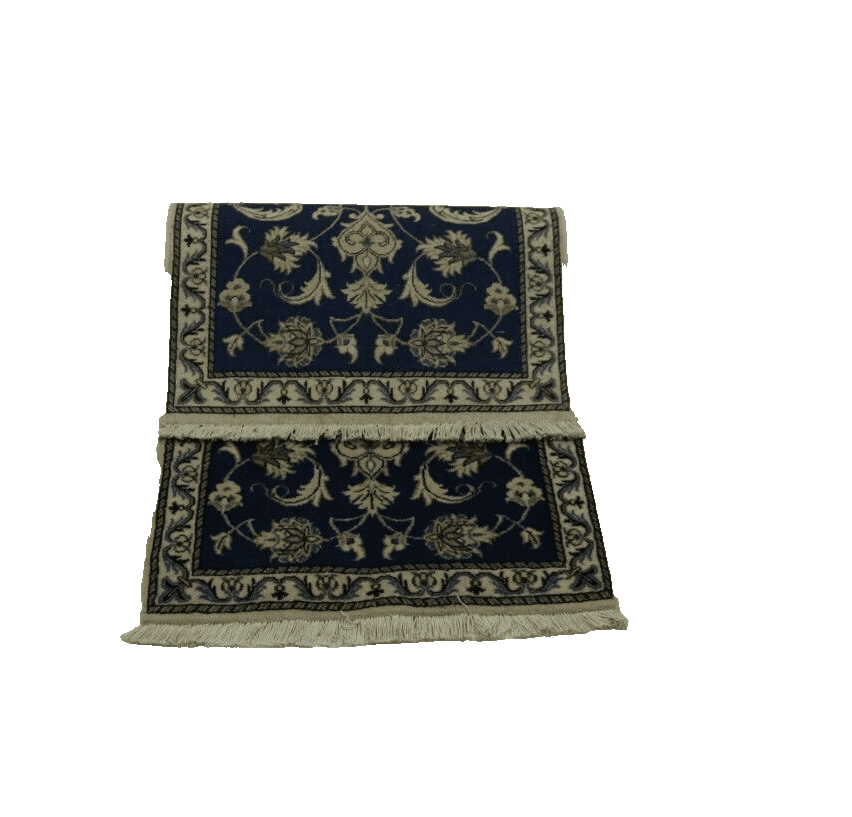
Hand-knotted production makes each rug a one-off. Minor variations in tension, row progression and the execution of individual details are part of manual weaving. They reflect the making process rather than an industrially repeated surface. The combination of virgin wool, cotton and dense knotting is suited to everyday use. The condition of this rug is stated as new.
Origin and Tradition
Nain is a city in Iran and an established name within the Persian rug tradition. Its weaving developed into a recognised regional form, with a history reaching back to the nineteenth century. Nain lies in Isfahan Province, an area associated for centuries with artistic work, design and the production of refined textiles. The name Nain therefore identifies more than a decorative vocabulary: it points to a developed Iranian tradition of rug making.
Weaving in Nain brings inherited craft knowledge together with careful control of surface and outline. In a workshop, a design is transferred to the loom and the knots are placed in a planned sequence. The process calls for patience, a strong sense of proportion and the ability to carry repeated forms consistently across the field. With a fine knot structure, accurate placement becomes especially important, since a small deviation can alter the course of a line or the balance of an ornament.
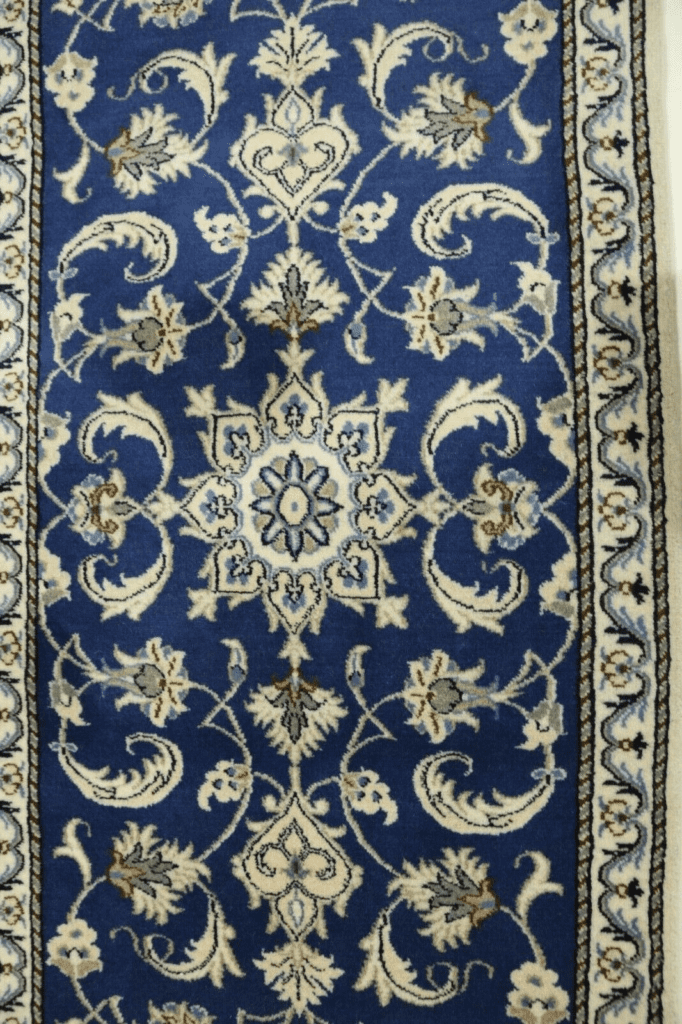
Nain rugs are traditionally associated with fine wool qualities and clearly organised compositions. Regional designs often combine floral components, curling vines and geometrically framed areas. Colour schemes may range from pale, restrained grounds to designs with stronger contrasts. Beige and blue are frequently connected with the Nain tradition and often give its compositions a calm, ordered appearance. These are general characteristics of the origin and tradition; they do not constitute a claim about a particular motif that is not described here.
Persian rug production is closely connected with knowledge passed through workshops and families. This knowledge includes preparing wool, setting up the warp, following a design, maintaining knot density and completing the surface after knotting. Finishing tasks also demand experience: the pile must be brought to an even level, and the woven structure must be prepared for use. In this context, Nain represents an Iranian origin with a long-developed understanding of fine knotting and balanced ornament.
The classification as a Persian rug follows the stated origin of Persia or Iran and the Nain designation. It is not a machine-made series product. Its surface is created by building a textile field from many individual hand knots. The regional tradition therefore joins practical floor covering with an intentionally developed arrangement of materials, structure and ornament.
Design and Pattern
Nain design is often recognised through classical floral forms and an orderly geometric structure. Floral elements may appear as blossoms, leaves, vines or connected arabesques. Geometric details can frame these forms and divide the field into clearly related sections. In many regional compositions, the central field, borders and transitions are coordinated so that the pattern develops a continuous rhythm. A high knot density is technically suited to fine outlines and small-scale ornament.
A familiar Nain colour vocabulary includes soft beige and blue tones. A light ground can make drawn lines visible, while blue accents help organise the composition. Depending on the design, additional shades may separate blossoms, vines, medallions or border elements. Colour is not merely an added decoration. It divides the surface, guides the eye through the ornament and establishes the relationship between ground and pattern.
Plant forms and repeated lines have a long symbolic background in Persian ornament. Blossoms and vines are often associated with growth, fertility and a connection with nature. Geometric repetition may suggest order, balance and continuity. These interpretations belong to the wider cultural history of the patterns and should not be treated as a specific statement about every individual design. The visual identity of a Nain composition ultimately depends on the relationship between line, proportion, colour and the distribution of ornament.
The classical vocabulary can be placed in different interiors because it is not restricted to one historical furnishing style. Traditional rooms may echo the ornamental language, while a more restrained setting can emphasise the ordered field and quieter colour relationships. An eclectic interior may also use a regional design when its materials and colour values are coordinated. The general Nain tradition should nevertheless be kept distinct from the specific pattern of this rug, which is not described in further detail.
In a hand-knotted rug, the pattern is not printed onto a finished surface. It is built into the pile through the placement of coloured knots, row after row. This is why regional design and technical execution are closely related. Dense knotting can support precise contours and gradual changes, while repeated vines, blossoms or geometric forms make the tradition recognisable. For this piece, the stated classification is Nain, with a traditional Oriental and Persian style and hand-knotted construction.
Special Features
The specifically named features are an approximate density of 300,000 knots per square metre, hand-knotted construction, 100% virgin wool, 100% cotton as the other specified material, new condition and classification as a one-off or single piece. An authenticity certificate is also included in the description. These details summarise the rug’s material and documentary features without adding an unstated provenance or claiming a pattern that has not been identified.
The dense knotting supports detailed textile work and relates to the established Nain method of production. Virgin wool provides a soft, warm and resilient pile. Regular vacuuming at low suction is recommended for care. Direct sunlight should be avoided to help prevent the colours from fading. A professional rug-cleaning service can be used when a thorough cleaning is required.
FAQ
How should I care for my Nain Persian rug?
Vacuum the rug regularly using low suction. This removes loose dirt while placing less strain on the pile. Direct sunlight should be avoided, as prolonged exposure can contribute to colour fading. If dirt is more deeply embedded or a more thorough cleaning is needed, a professional rug-cleaning service is appropriate. Cleaning products should not be applied to the wool pile without first checking their suitability. Gentle maintenance respects both the hand-knotted structure and the virgin wool used in the rug.
Can the Nain Persian rug be used over underfloor heating?
Yes. The rug can be used in rooms with underfloor heating. Wool is suitable for this application because it retains warmth and can provide a comfortable feeling underfoot. The heating should be kept at a moderate temperature. Even, moderate heat helps protect the material and the hand-knotted structure from unnecessary stress. The rug should also be laid correctly and flat, so that it remains stable and heat can be distributed through the room in an appropriate way.
Why does a hand-knotted Persian rug cost more than a machine-made rug?
Hand knotting requires substantially more time and manual work than machine production. Each knot is placed individually, and the design is built gradually across the entire rug. The listed high knot density adds to the work because a large number of knots must be positioned accurately. The result is a one-off or single piece rather than an identical mass-produced item. Machines can repeat uniform operations efficiently, but they do not replace the individual stages and manual skill involved in creating a densely knotted rug by hand.
To provide the best experiences, we use technologies like cookies to store and/or access device information. Consenting to these technologies will allow us to process data such as browsing behavior or unique IDs on this site. Not consenting or withdrawing consent, may adversely affect certain features and functions.
Functional Always active
The technical storage or access is strictly necessary for the legitimate purpose of enabling the use of a specific service explicitly requested by the subscriber or user, or for the sole purpose of carrying out the transmission of a communication over an electronic communications network.
Preferences
The technical storage or access is necessary for the legitimate purpose of storing preferences that are not requested by the subscriber or user.
Statistics
The technical storage or access that is used exclusively for statistical purposes.The technical storage or access that is used exclusively for anonymous statistical purposes. Without a subpoena, voluntary compliance on the part of your Internet Service Provider, or additional records from a third party, information stored or retrieved for this purpose alone cannot usually be used to identify you.
Marketing
The technical storage or access is required to create user profiles to send advertising, or to track the user on a website or across several websites for similar marketing purposes.
 SECURE PAYMENT
 SHIPPING PARTNERS


