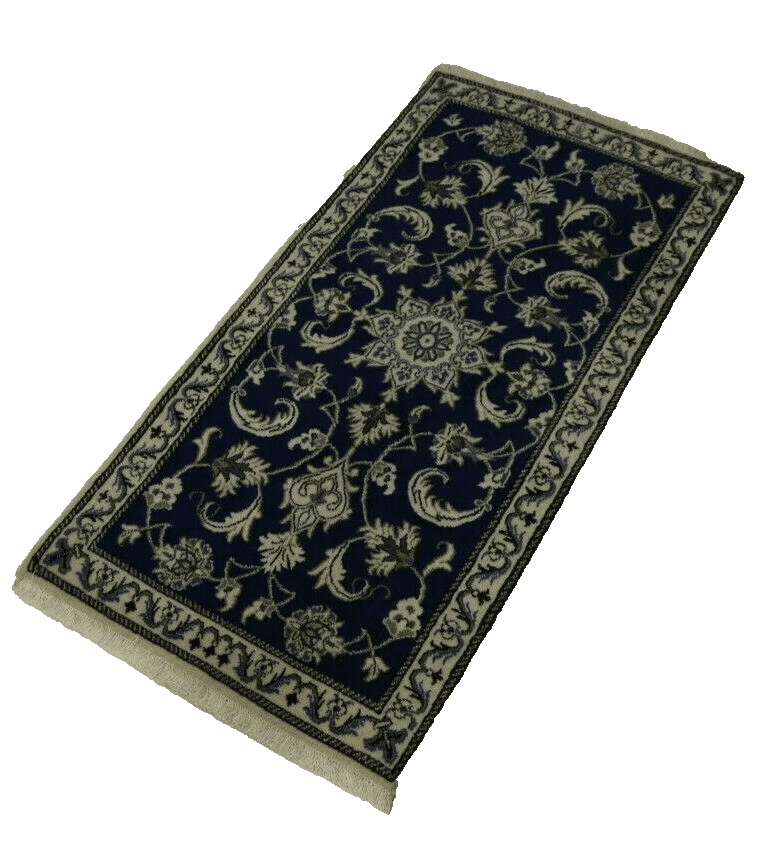
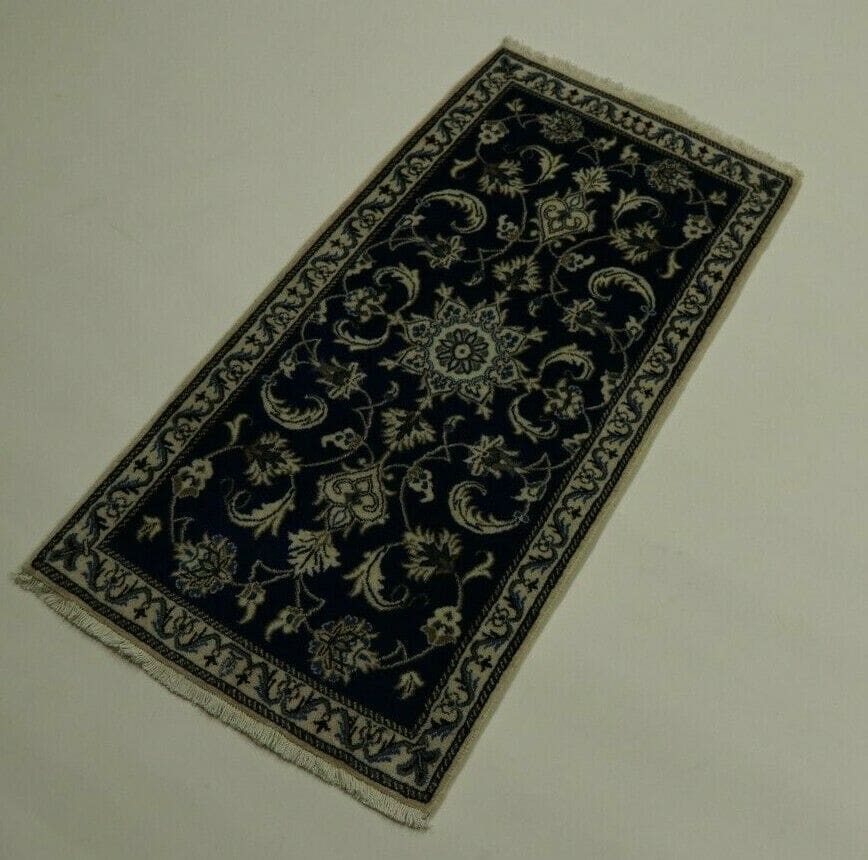
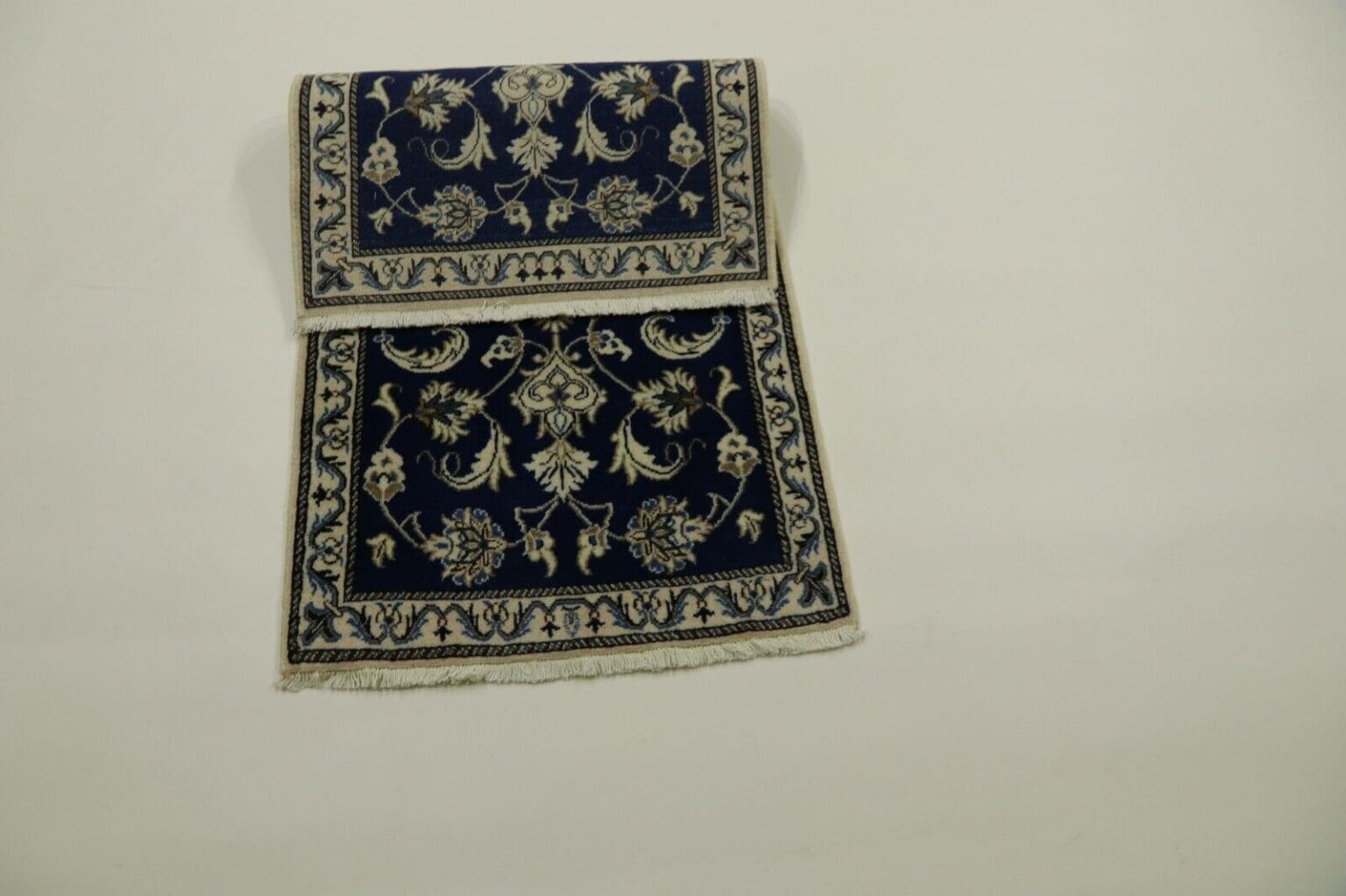
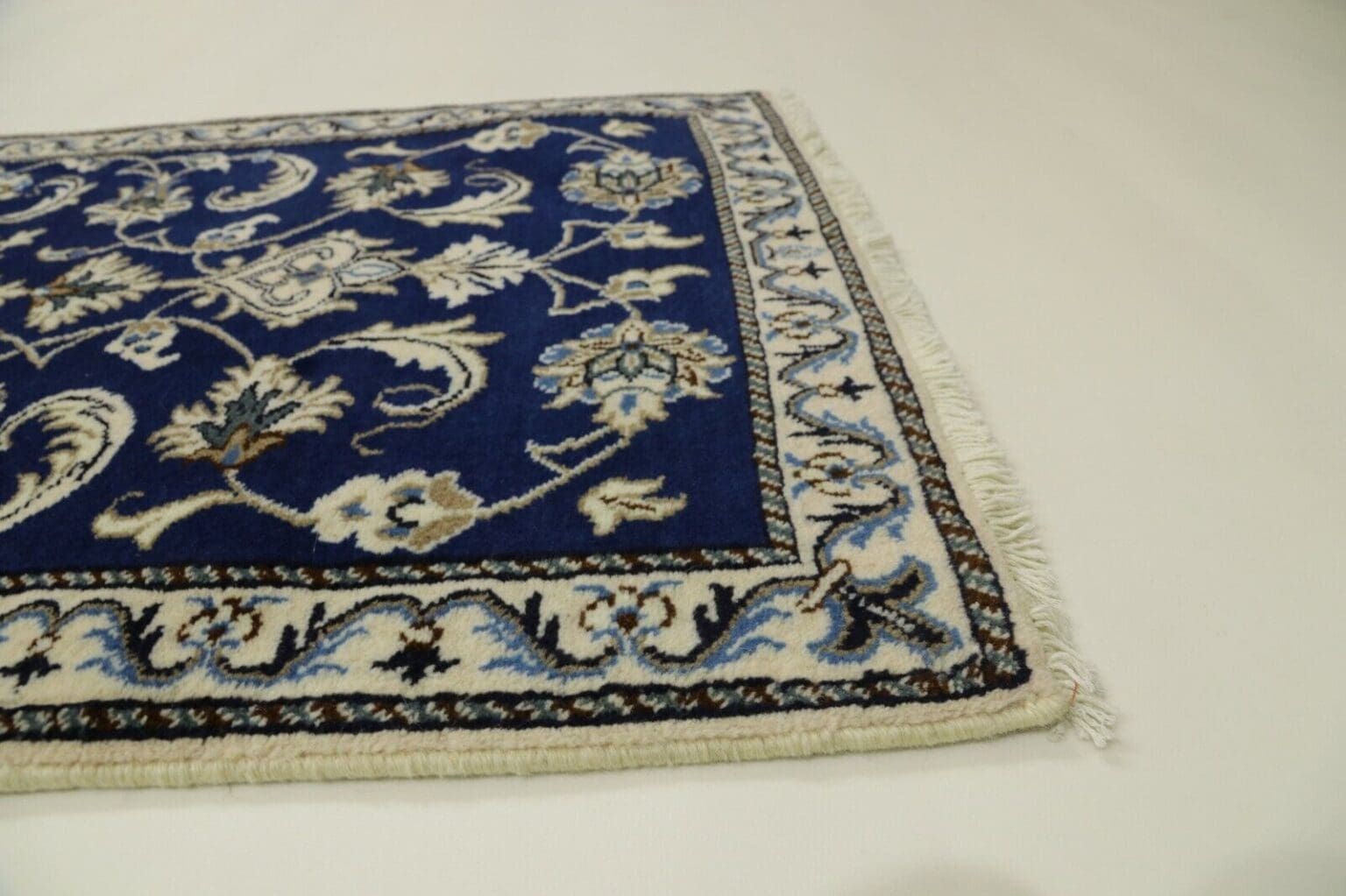
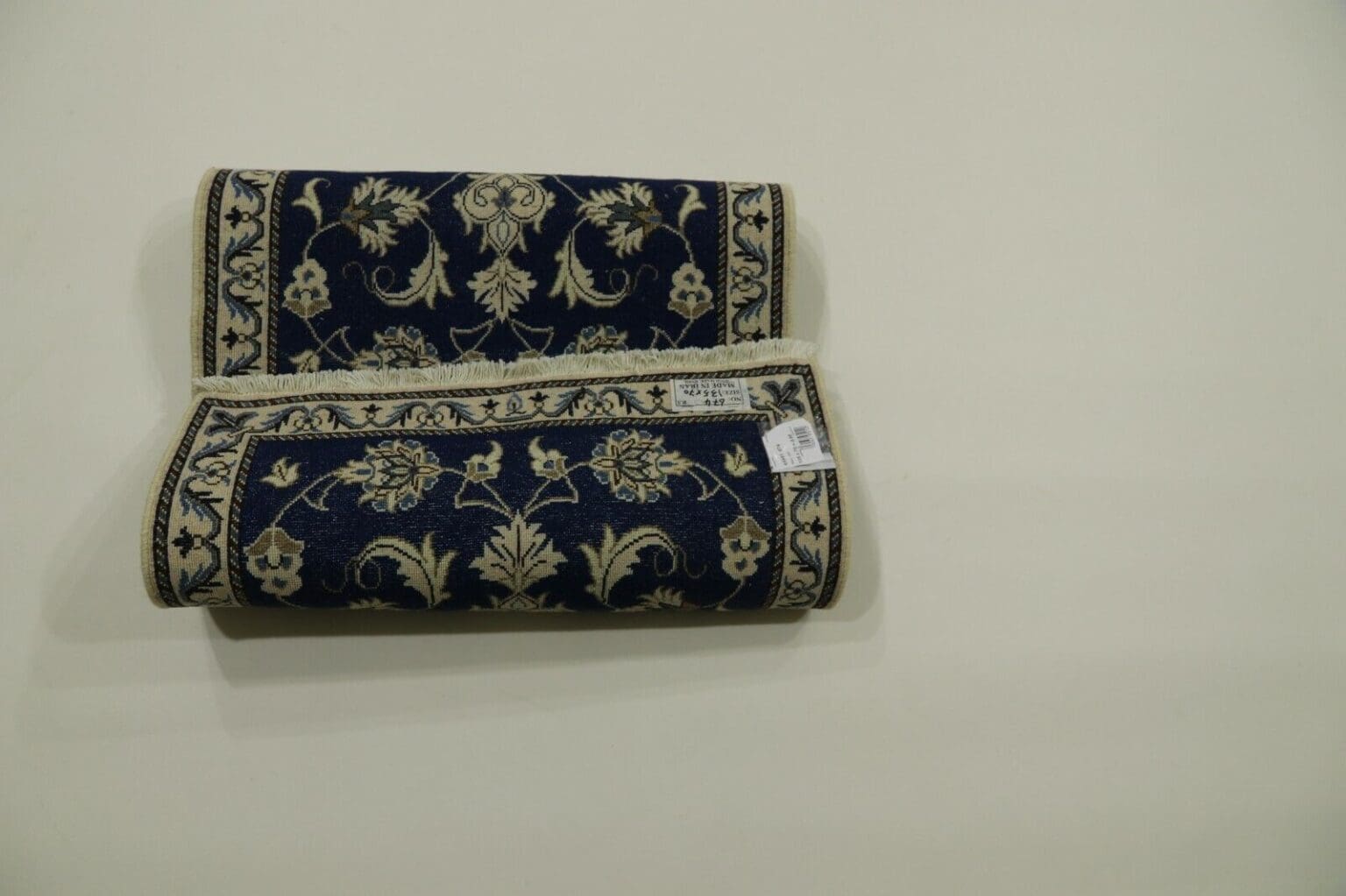
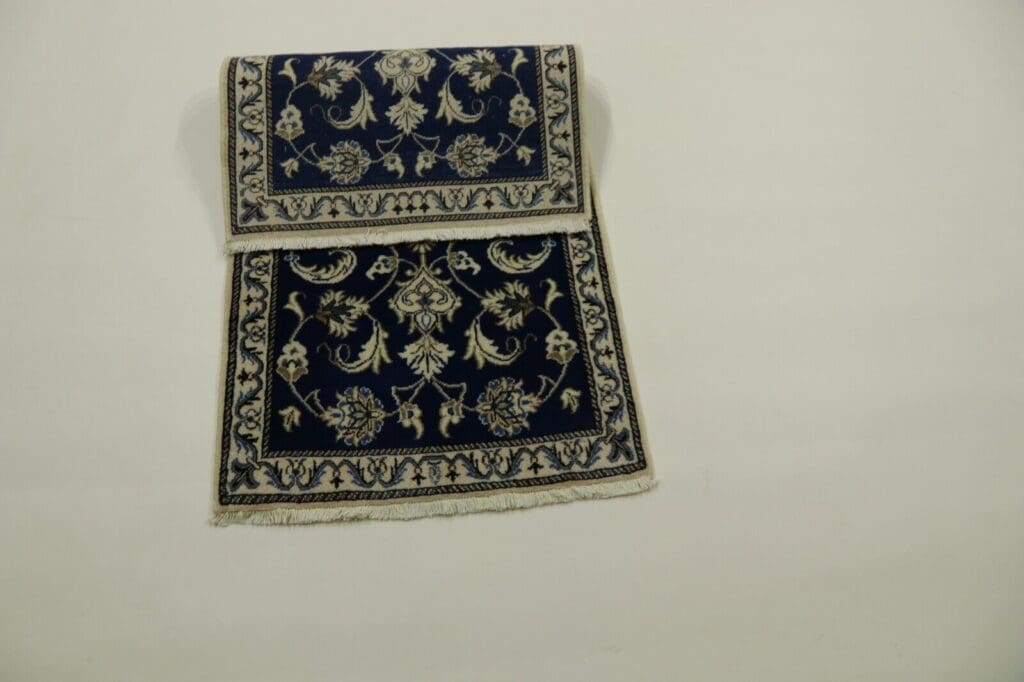
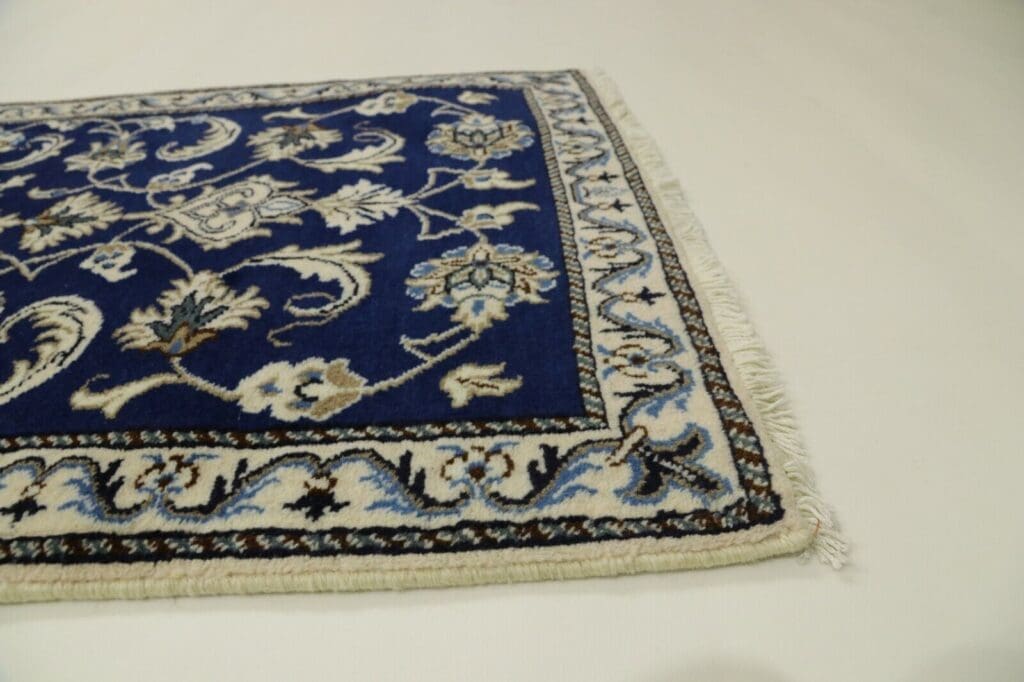
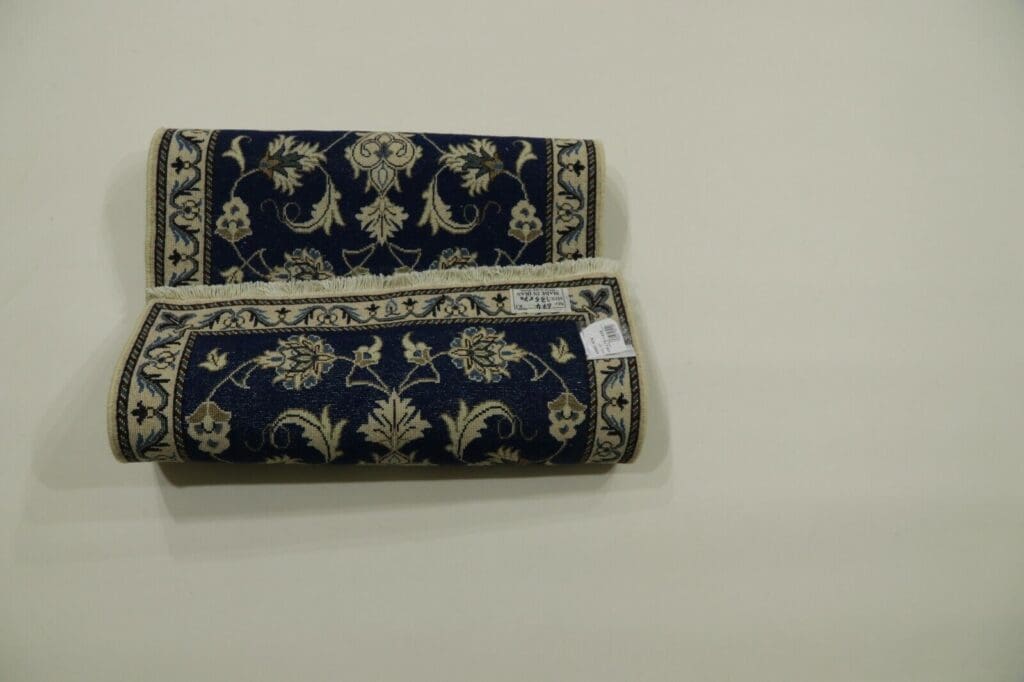
Hand-knotted Nain Persian rug | Knot density: approx. 300,000 knots/m² | Material: pile 100% virgin wool | Size: 135 x 70 cm | Pattern: floral design with traditional Persian elements and harmonious colours | Condition: very good to perfect
This Super Nain rug is hand-knotted and has a pile made from 100% virgin wool. Hand knotting is a time-intensive process in which individual knots are tied by hand and then compacted into the structure of the rug. The result is a textile with a distinct, carefully formed surface rather than a mechanically repeated construction. Wool is traditionally valued in rug making because it provides a soft feel while also offering the resilience required for regular use.
The rug has a knot density of approximately 300,000 knots per square metre. A fine knot structure allows a weaver to place colour and line with considerable precision. Small floral details, balanced outlines and changes within a motif can therefore be represented more clearly than in a coarser construction. Knot density is one element of a rug’s workmanship; it is considered together with the quality of the wool, the regularity of the knots and the clarity of the finished design.
Silk is a stated feature of this Super Nain. In Nain rug traditions, silk is used for its smooth surface and its ability to catch and reflect light. Here it is presented together with a 100% virgin-wool pile, giving the rug the material combination described for this piece. Silk can make selected details appear especially fine and can add a subtle sense of sheen to the overall appearance. The hand-knotted construction and the carefully worked pattern are central aspects of its manufacture.
The condition is described as very good to perfect. It is therefore suitable for decorative as well as practical use. As with any hand-knotted rug, its appearance depends on appropriate care and on the way it is used. The combination of a fine knot structure, wool pile and silk detail reflects the form of craftsmanship associated with Super Nain rugs.
Origin and Tradition
This rug is identified as a Super Nain from Nain in Iran. Nain is one of the recognised centres of Persian rug weaving and is associated with finely drawn designs, disciplined compositions and refined materials. The city lies in central Iran, in a region shaped by a dry climate and a long tradition of textile production. Nain rugs became particularly known for their precise workmanship and their restrained, carefully coordinated appearance.
The weaving tradition of Nain reaches back to the sixteenth century and has been passed from one generation to the next. Persian carpet making is not limited to a single technique or visual formula. It includes knowledge of preparing fibres, selecting colours, planning a field and border, tying knots, trimming the pile and finishing the edges. This knowledge is learned through practice and is preserved within weaving communities. A rug from Nain belongs to that wider history of Persian textile craftsmanship.
Nain rugs are often associated with a light, orderly visual language and with detailed floral ornament. Their designs developed within Persian artistic traditions, where a central field, framing borders and repeated botanical forms are arranged in a coherent whole. The careful balance of these elements is part of the identity commonly connected with Nain weaving. The name Super Nain is used in the source for this rug and points to the particularly fine character traditionally associated with this group.
Persian rugs have served several purposes over the centuries. They can be practical floor coverings, works of domestic textile art and objects that preserve regional knowledge. Their patterns, materials and methods connect an individual textile to the place where its weaving tradition developed. Nain carpets are valued in this context for the combination of technical control and an elegant design vocabulary. The use of silk in Nain weaving is especially associated with fine visual accents and a gentle play of light across the surface.
The cultural significance of oriental rugs is also found in their continuity. A hand-knotted carpet carries the marks of a process in which a design is transferred into material knot by knot. This differs from an industrially printed surface, because the pattern is built into the structure of the textile. For many owners, such rugs represent a connection with the history and traditions of the regions in which they were made. Nain rugs therefore occupy a place within both Persian craft history and the broader tradition of oriental carpet weaving.
Design and Pattern
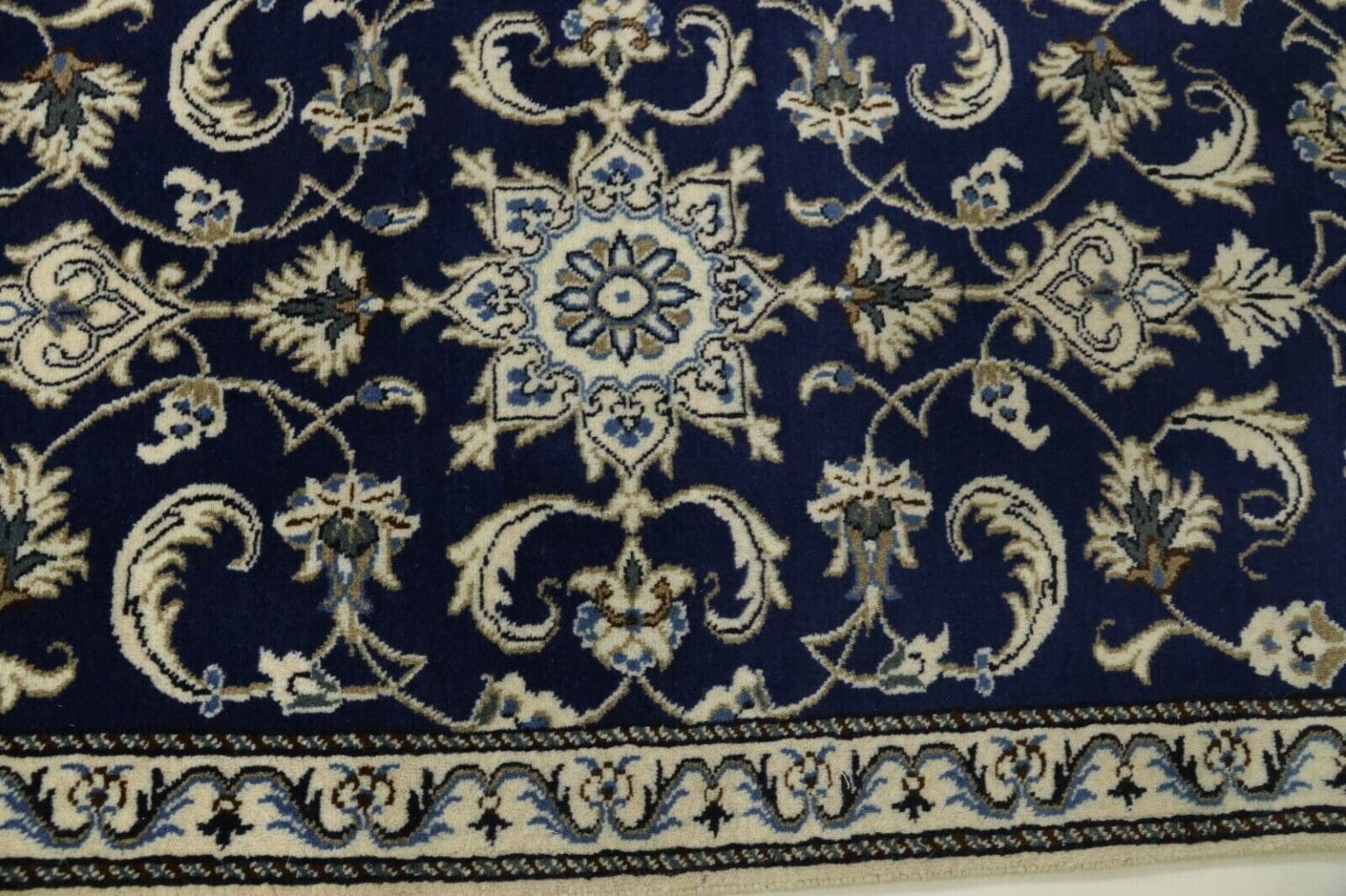
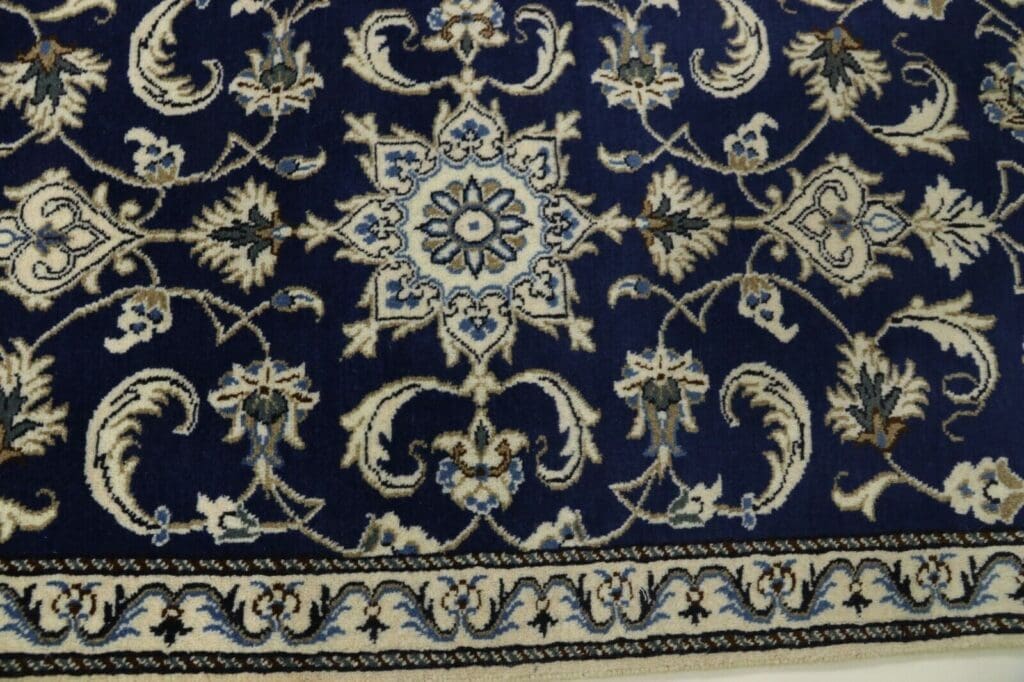
The design of this Super Nain is described as elegant, with harmonious colours and a floral pattern. Floral ornament is a characteristic element of Nain rugs and is often developed from established Persian design traditions. Flowers, leaves, vines and related botanical forms may be arranged around a central composition or repeated in a controlled rhythm. The source identifies the pattern as floral and inspired by traditional Persian elements; it does not assign a more specific named medallion or field layout to this particular rug.
In Persian carpet design, botanical motifs are not simply casual decoration. They are part of a visual vocabulary that has been refined over generations. A stem can guide the eye through a field, while leaves and blossoms provide rhythm and variation. Repetition creates cohesion, and carefully placed departures from repetition give the composition movement. Geometric forms may also appear alongside plant motifs, providing structure and helping the design remain balanced. These principles explain why floral Persian patterns can appear detailed without becoming visually disordered.
The high knot density supports the fine rendering of such ornament. Where a design contains narrow outlines, small blossoms or closely spaced details, a dense knot structure gives the weaver more control over the transition from one shape to the next. It also allows colour areas to be placed with greater definition. The technical quality of the pattern is thus connected to the method of construction rather than being applied only after the rug has been made.
Nain designs are frequently associated with soft, coordinated colours rather than abrupt contrasts. The source describes this rug’s colour scheme as harmonious and its details as exquisite. Such an arrangement can give the floral field a calm and ordered presence. Silk is traditionally appreciated in this setting because it responds to changing light differently from wool. A silk detail may appear more luminous when viewed from one direction and more subdued from another, creating variation without requiring a change in the design itself.
Persian ornament often carries symbolic associations connected with gardens, vegetation and the natural world. The source refers to the wider symbolism of oriental patterns, in which plants and geometric shapes can have deeper meanings. These associations belong to the cultural background of the design tradition and should not be read as a specific coded message assigned to every individual motif in this rug. In this piece, the clearly stated characteristics are the floral pattern, the traditional Persian influence, the harmonious colour treatment and the precise detail made possible by its fine construction.
Special Features
The defining features of this rug are its Super Nain designation, hand-knotted construction, 100% virgin-wool pile, stated use of silk and fine knot density. The silk contributes a smooth appearance, additional softness and a subtle sheen. The wool pile provides the material basis of the rug and is described as soft and durable. Together, these details explain the material character presented for this piece without requiring any additional assumptions about its construction.
The rug is described as being in very good to perfect condition. It can therefore be used as a decorative textile or as a practical floor covering. Its floral design and coordinated colouring allow it to function within an interior as a patterned accent, while the fine workmanship connects it to the craft tradition of Nain. The rug is a one-off hand-knotted piece, so its exact arrangement of knots and details belongs to this individual textile.
Hand-knotted oriental rugs are often kept for long periods and passed between generations. Their continued use depends on suitable care, protection from avoidable damage and appropriate cleaning. The source presents this rug as capable of serving both decorative and practical purposes and as an object that can retain its beauty over time when properly maintained.
FAQ
How should a Nain rug be cared for?
Regular, gentle cleaning helps preserve the appearance of the rug. A vacuum cleaner with a soft attachment is recommended so that the surface can be cleaned without unnecessarily stressing the pile. If a spill or stain occurs, it should be treated promptly and carefully with a mild cleaning product and a damp cloth. Rubbing aggressively can affect the fibres and the appearance of the surface, so a cautious approach is appropriate. Professional rug cleaning is also recommended as part of long-term care. This is particularly relevant for a hand-knotted rug with a fine construction and silk as a stated feature, since suitable treatment helps maintain its material character.
Can this rug be used in a room with underfloor heating?
Yes, the Super Nain rug can be used in a room with underfloor heating. The temperature should not be set too high, as excessive heat may affect the rug. Regular care helps maintain its quality when it is placed in a heated room. It is sensible to keep the heating at a moderate level and to continue with gentle routine cleaning. The rug’s suitability for such a room does not remove the need for normal care; avoiding excessive temperatures remains the key consideration identified for this use.
What makes a hand-knotted rug special?
A hand-knotted rug is made through extensive manual work. Individual knots are tied by hand, allowing the weaver to build complex patterns and fine details directly into the textile. This method gives each rug its own character because no two pieces have exactly the same knot arrangement. Hand knotting is also associated with durability and lasting value when the rug is properly cared for. In this Super Nain, the hand-knotted technique works together with a fine knot density, a 100% virgin-wool pile, silk and a detailed floral design. These elements connect the individual rug with the broader history of oriental carpet craftsmanship.
To provide the best experiences, we use technologies like cookies to store and/or access device information. Consenting to these technologies will allow us to process data such as browsing behavior or unique IDs on this site. Not consenting or withdrawing consent, may adversely affect certain features and functions.
Functional Always active
The technical storage or access is strictly necessary for the legitimate purpose of enabling the use of a specific service explicitly requested by the subscriber or user, or for the sole purpose of carrying out the transmission of a communication over an electronic communications network.
Preferences
The technical storage or access is necessary for the legitimate purpose of storing preferences that are not requested by the subscriber or user.
Statistics
The technical storage or access that is used exclusively for statistical purposes.The technical storage or access that is used exclusively for anonymous statistical purposes. Without a subpoena, voluntary compliance on the part of your Internet Service Provider, or additional records from a third party, information stored or retrieved for this purpose alone cannot usually be used to identify you.
Marketing
The technical storage or access is required to create user profiles to send advertising, or to track the user on a website or across several websites for similar marketing purposes.
 SECURE PAYMENT
 SHIPPING PARTNERS


