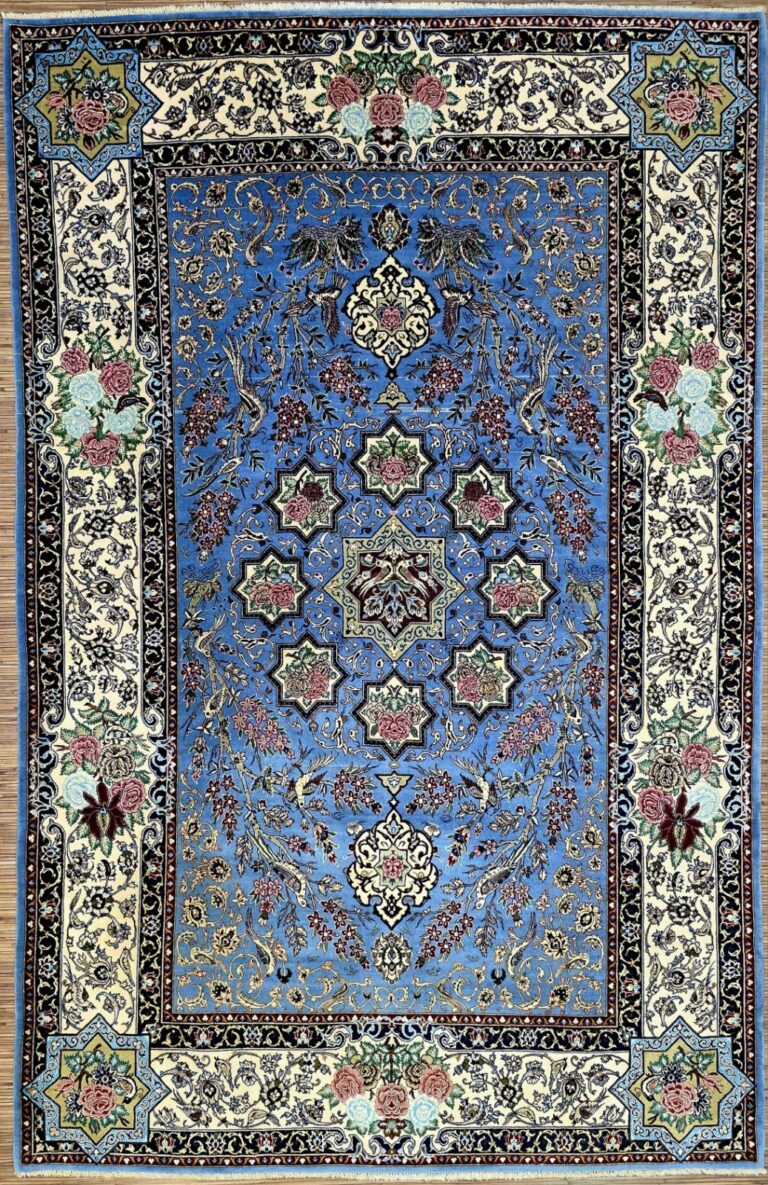
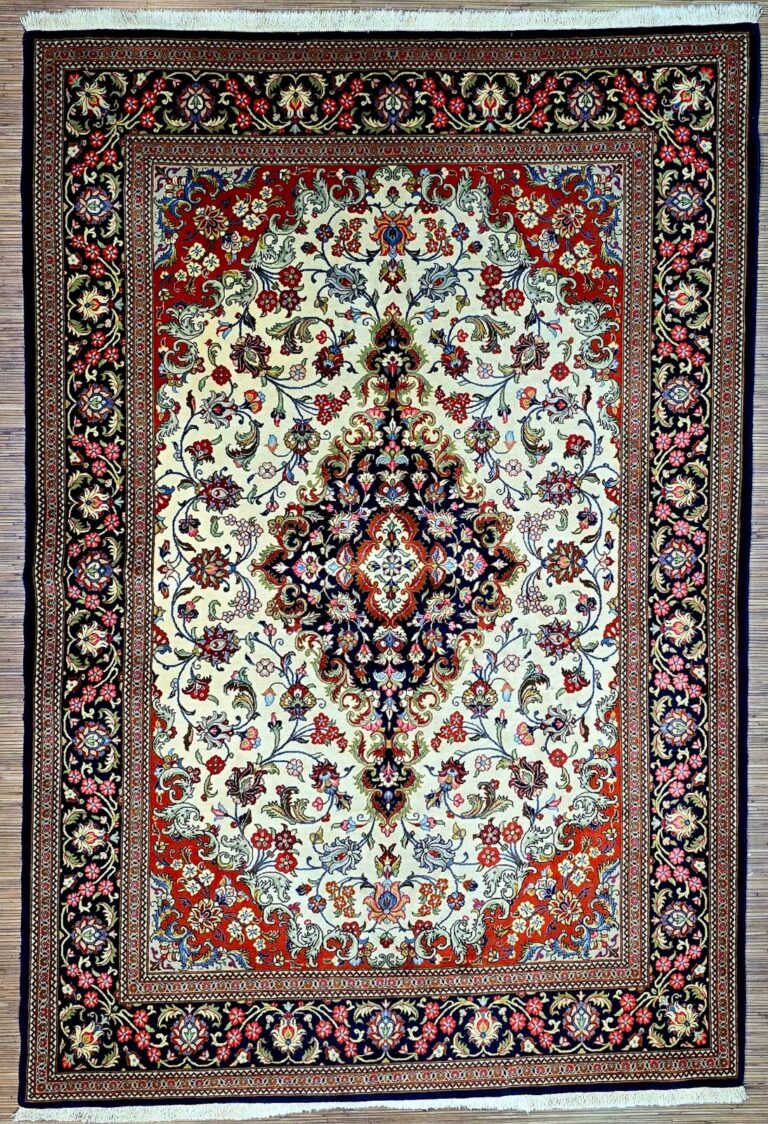
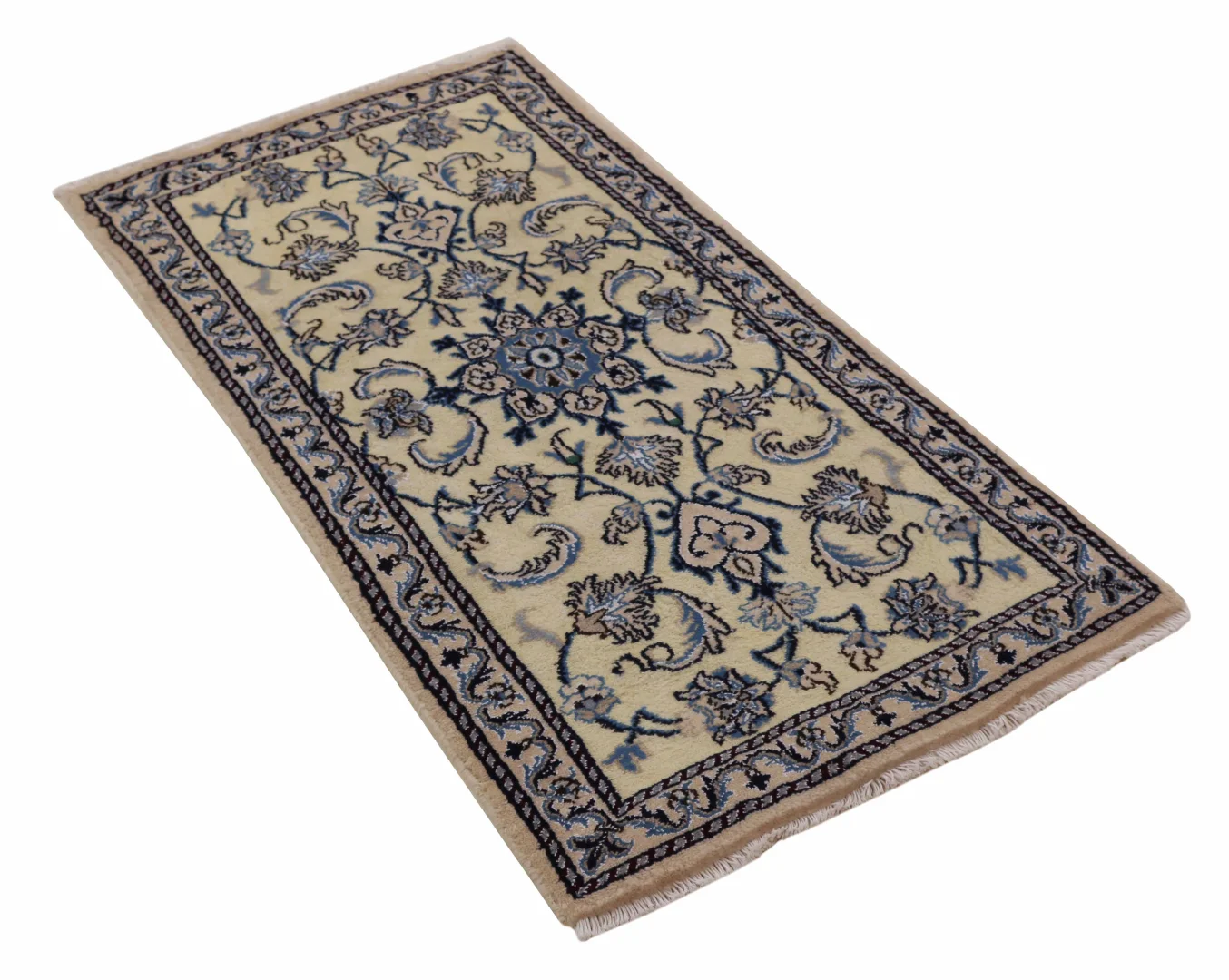
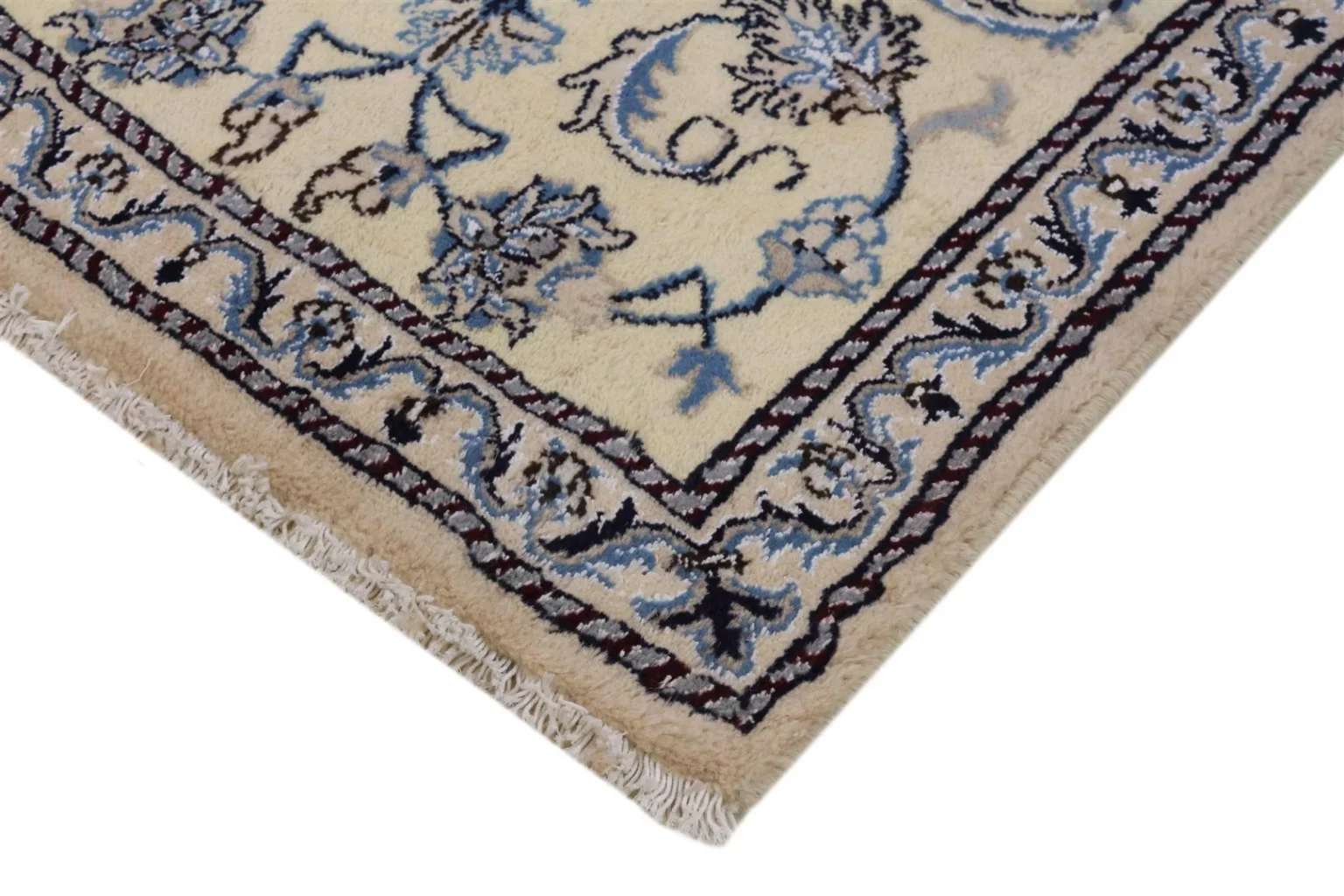
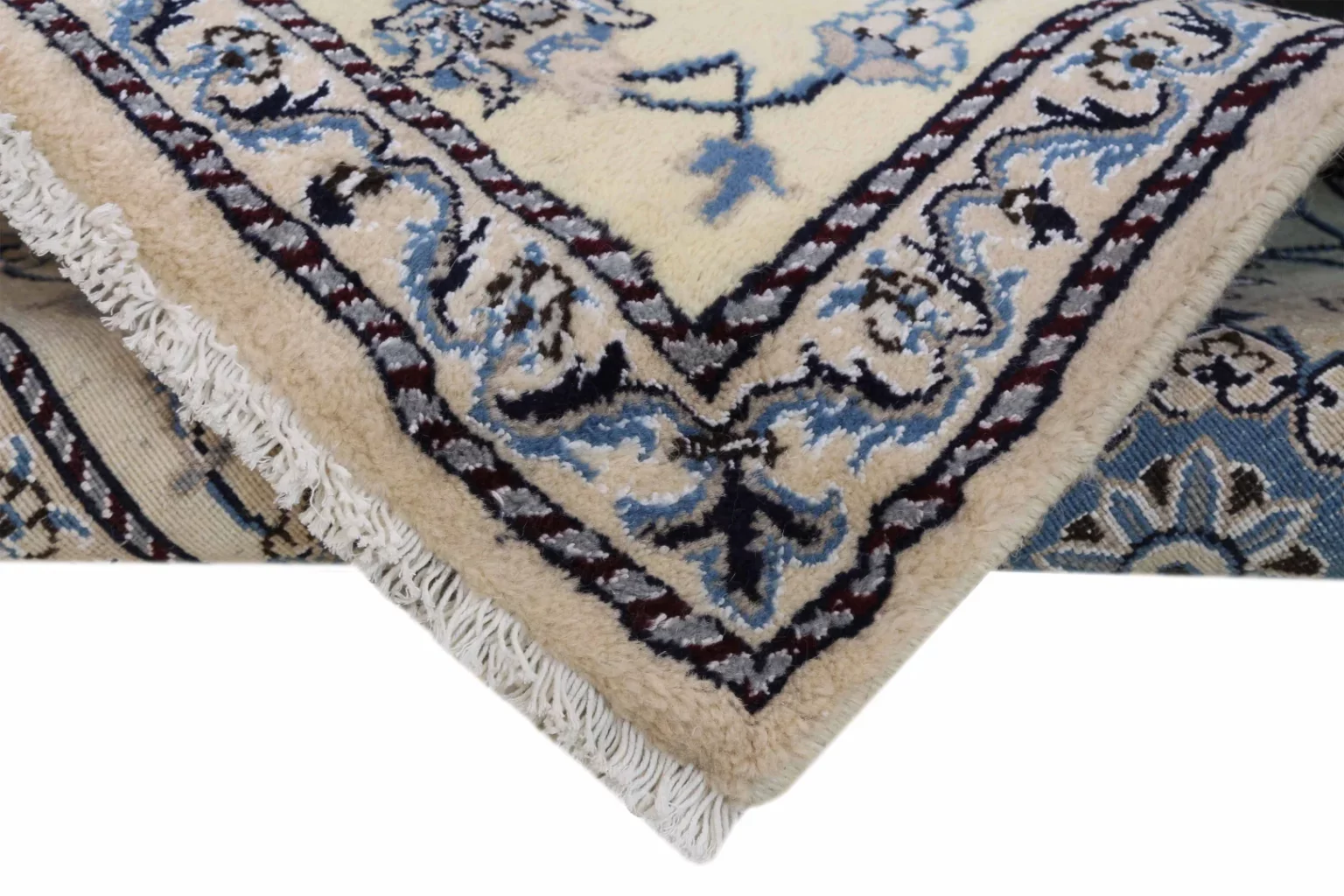
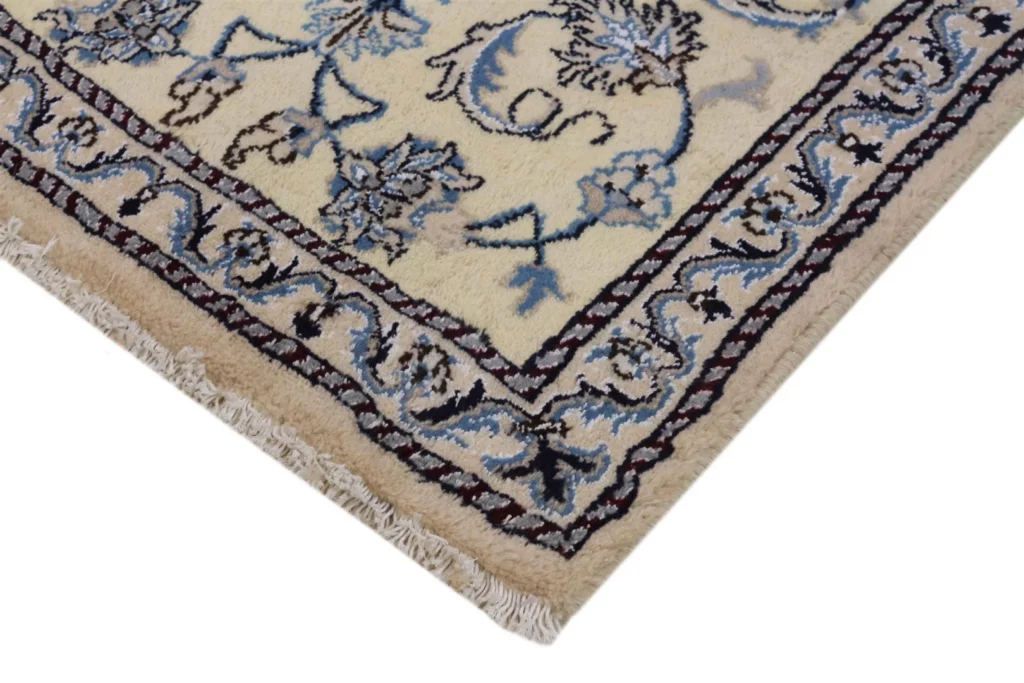
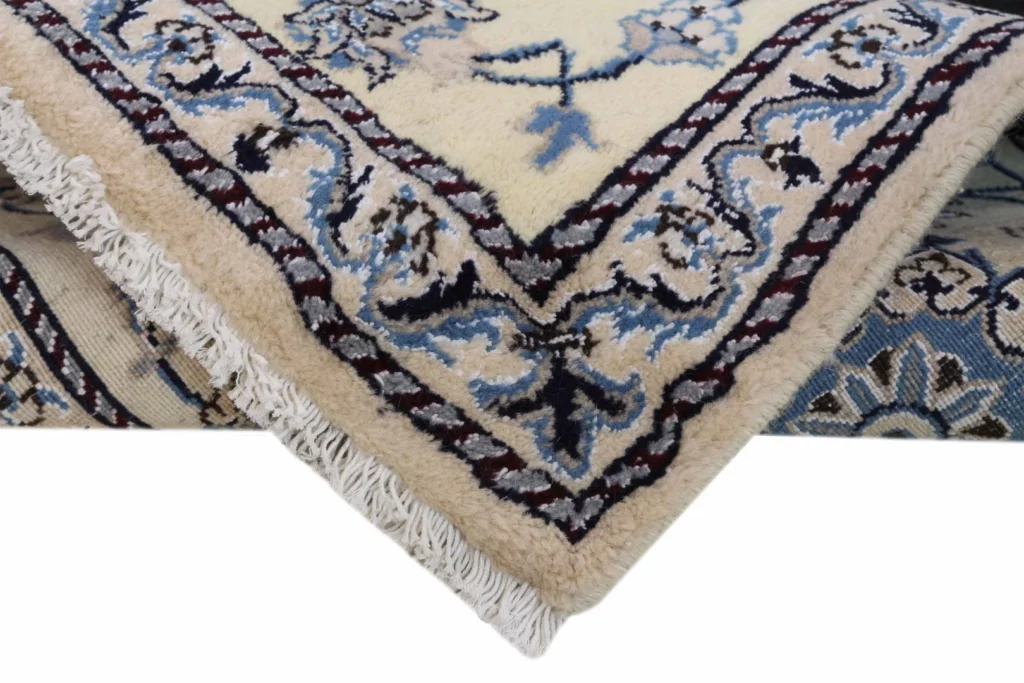
This Nain Persian rug is hand-knotted and made of wool with silk content. The combination belongs to the established material tradition of finely made Nain rugs: wool provides a resilient textile foundation, while silk content can give selected parts of the design a finer surface and a more distinct change of light. In hand-knotting, each knot is inserted individually into the prepared warp structure. The row is then compacted and the pile is built up gradually. This process sets a hand-knotted rug apart from a machine-made floor covering, whose knots are not formed through the same sequence of manual work.
The rug is identified as 9-Lah and has a knot density of approximately 250,000 knots per square metre. In Nain rugs, Lah is used as a quality and density classification. It therefore describes the fineness of the knotting rather than the rug’s dimensions. A high knot count allows flowers, leaves and connecting lines to be rendered with greater differentiation. In a floral composition, close knotting supports controlled outlines and a clearly readable internal drawing.
Wool has traditionally been used in oriental rugs because of its durability and its naturally tactile surface. It accepts colour evenly and gives the pile a distinct textile character. Silk, by contrast, has a smoother fibre surface and can create a finer reflection of light when used selectively. A rug containing both materials can therefore combine more subdued wool areas with highlighted details. The description of this one-off piece confirms silk content, but gives no further information about how the materials are distributed within the design.
Hand production requires steady tension, controlled placement of each knot and patience throughout the process. Once the knotting is complete, the pile is secured and prepared for use. Manual work gives every individual rug its own sequence of knots and its own surface character. This rug is very well preserved. No additional details are provided about restoration, repairs or particular signs of wear.
Origin and Tradition
Nain is a city in central Iran and is recognised as a place of carpet production. Nain rugs belong to the Iranian tradition of hand-knotted Persian rugs. Their cultural history is traced back to the Sassanid dynasty in the established account of the region. This long background helps explain why Nain is regarded as a distinct carpet origin and why the name refers not only to a location, but also to a particular technical and decorative tradition.
Nain weaving is especially associated with finely executed designs. The work is carried out by hand, and quality is determined not only by the material but also by density, precision and the treatment of the drawing. The Lah system forms part of this classification. The named levels are 4-Lah, 6-Lah, 9-Lah and 12-Lah. These figures refer to knot density, with a higher number indicating a coarser density. A 4-Lah rug can have more than one million knots per square metre, while a 12-Lah rug has approximately 250,000 knots per square metre.
The 9-Lah designation of this one-off rug places it within that Nain system of density classification. Its stated knot density is approximately 250,000 knots per square metre. Lah should not be treated as a universal statement about every design or every material used in Nain weaving. Nain rugs are made in different forms; what connects them is the relationship between regional origin, hand-knotting and carefully developed ornament.
Iranian carpet origins have distinct regional vocabularies, even though their traditions may influence one another. Isfahan rugs are known for detailed designs and lively colours. Tabriz rugs are often associated with complex compositions and a particular knotting technique. Ghom is known for rugs that are frequently made with fine silk. Makers such as Mehrab and Zanjan also represent varied patterns and styles within Iranian carpet art. These comparisons place Nain within the wider context of Iranian weaving, but they do not alter this rug’s origin: it is from Nain, Iran.
The weaving tradition depends on the transmission of motifs, working methods and ideas about quality. A Nain rug is therefore not identified by its design alone. Regional origin, knotting method and Lah classification are equally relevant. In this piece, the origin of Nain, the hand-knotted construction and the stated 9-Lah density appear together with a classic floral design.
Hand-knotted Iranian rugs also preserve a link between a regional workshop tradition and the practical discipline of textile making. The design is transferred into the rug as the work progresses, rather than being applied as a finished surface after manufacture. Density and material influence how precisely the ornament can be expressed, while the origin places the work within a recognisable regional framework. These principles provide the background for understanding this rug without adding a provenance that has not been given.
Design and Pattern
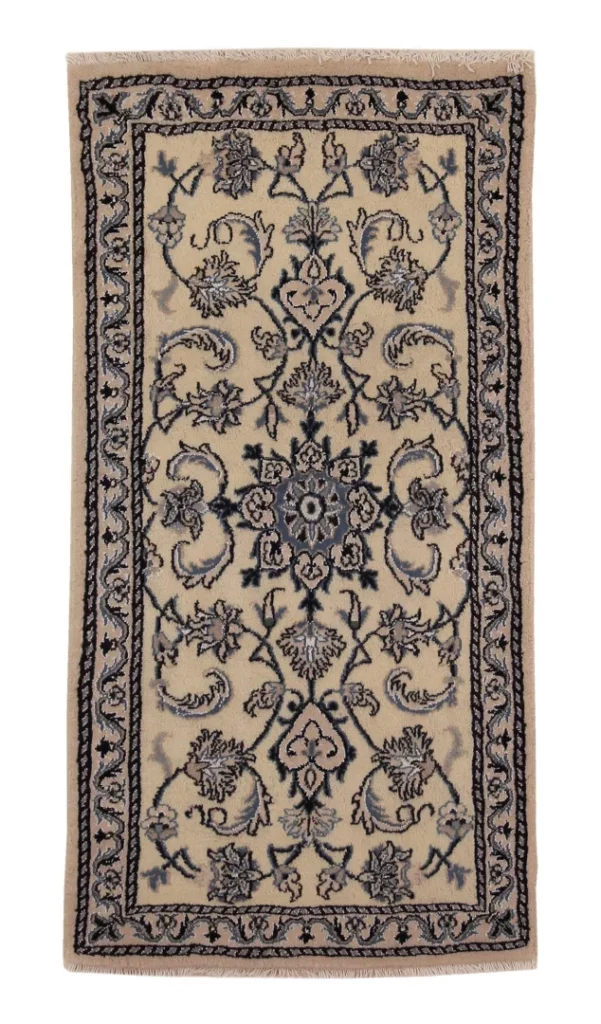
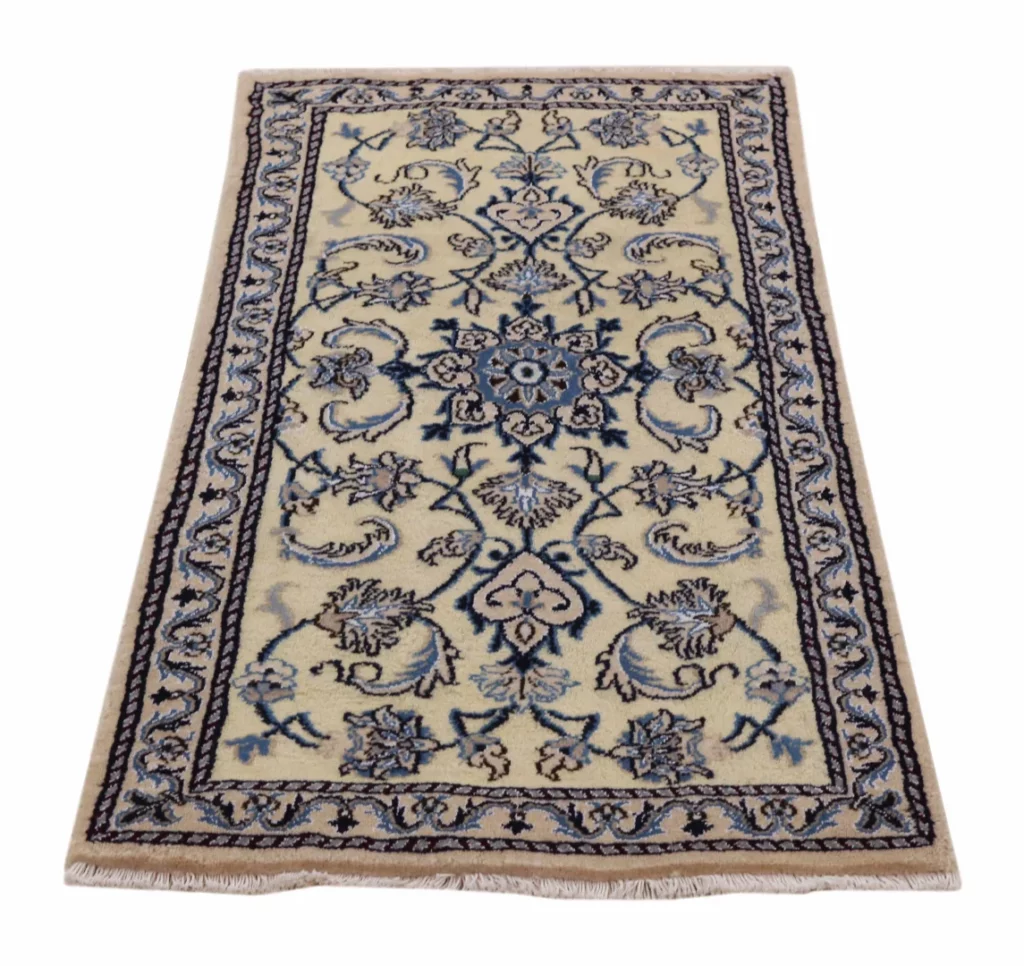
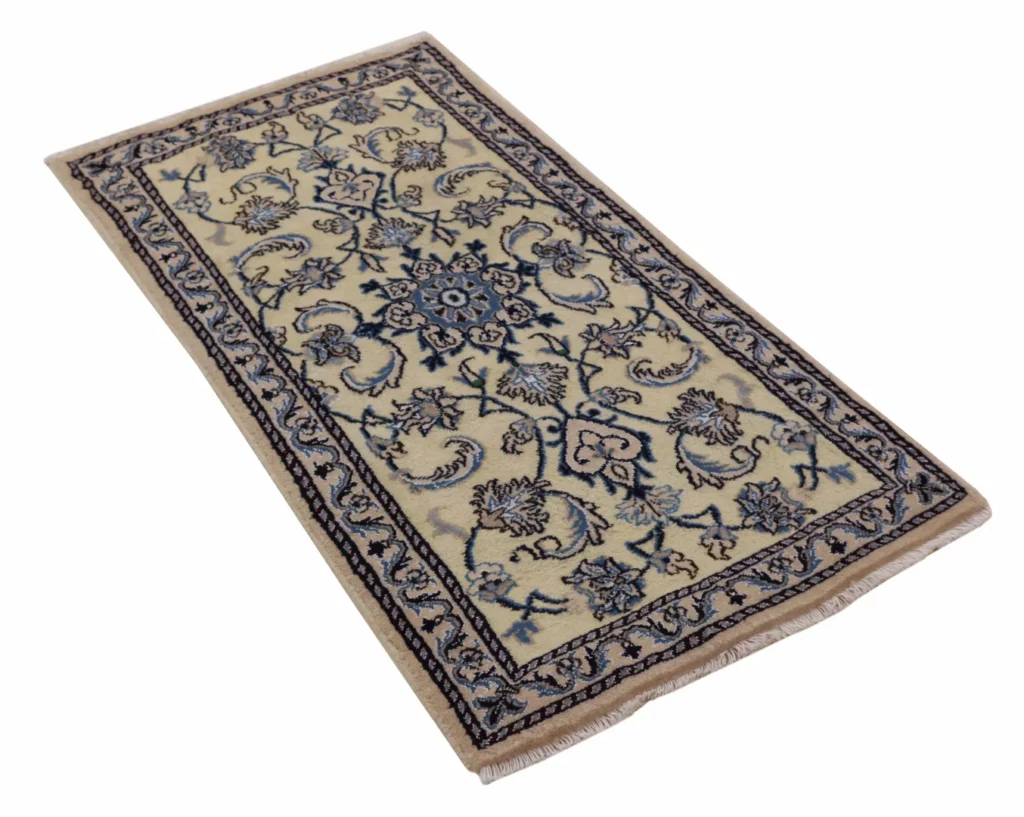
The design of this rug consists of classic floral motifs. Traditional Nain floral compositions may use flowers, leaves, vines and a balanced arrangement of ornaments. Such elements can be organised as an all-over pattern or placed around a central medallion. The source identifies this individual rug as classically floral, but does not specify a central medallion or an all-over layout. Its description therefore remains with the documented floral character rather than assigning an unconfirmed structural detail.
In a floral composition, the relationship between principal motifs and connecting lines creates the visual order. Flowers establish points of emphasis, while vines and leaves guide the eye between them. Dense knotting helps maintain clean contours in this type of drawing. Finer Nain variants may use silk woven into or around the motifs, allowing selected elements to respond differently to light. Silk content is recorded for this rug, but the exact placement of those silk fibres within its pattern is not described.
Nain rugs can be designed with a central arrangement or with ornament carried across the field. In either case, the organisation of the motifs is important. Repeated floral forms create rhythm, while finer lines articulate the spaces between them. The colour range associated with Nain rugs can extend from soft, earthy shades to brighter, more vivid colours. For this one-off rug, only a classic floral pattern is documented; its specific colours, medallion and individual borders are not stated.
Floral carpet design also involves the relationship between the field and the border. A border can contain the composition and create a transition between the main field and the outer edge. Depending on the design, narrow guard borders may accompany a wider principal border. This is a general principle of floral rug construction, not a further description of the unspecified borders on this particular rug.
The drawing of a hand-knotted rug is built knot by knot. Unlike a printed pattern, the ornament is transferred from a design into the textile surface while the rug is being made. Small variations in manual work are part of the production of a one-off piece. With a dense Nain construction, fine flower and leaf forms can be rendered with considerable differentiation. The documented pattern of this rug remains precise in its essential description: classic floral motifs from the Nain tradition.
The relationship between floral order, hand-knotted construction and wool with silk content belongs to the design environment for which Nain rugs are known. Silk can give lines and motifs a finer visual gradation, while wool contributes the more tactile foundation of the pile. The result is not merely a decorative surface, but an ornamental language connected with Iranian carpet traditions. Specific colours, a number of borders or a particular medallion are not added because they are not documented for this piece.
Special Features
The defining features of this one-off rug are its clearly identified origin, hand-knotted construction and stated 9-Lah density. Nain, Iran, is given as its place of origin. The knot density is approximately 250,000 knots per square metre. The material is described as wool with silk content, and the pattern as classic floral motifs. Together, these details connect technical classification with a traditional ornamental vocabulary without assigning an unsupported additional provenance.
The rug is very well preserved. This states its recorded condition; no specific information is given about individual wear marks, previous restoration or age. As a hand-knotted one-off, it has an individually formed knot structure. The quality of such work is considered through the care of the manual construction, the density and the clarity of the design. A Nain rug can remain usable for a long time with appropriate care, but no specific lifespan for this individual piece is claimed.
The Nain tradition brings regional origin together with fine, often floral design. In this rug, those characteristics occur in the documented form: Nain, Iran, hand-knotted construction, 9-Lah, wool with silk content and classic floral motifs.
FAQ
How should I care for my Nain rug?
Regular vacuuming helps remove loose dirt from the pile. A brush should not be used, so that the surface is not subjected to unnecessary mechanical stress. If a stain appears, dab the area promptly with a damp cloth. Do not rub, since rubbing can push dirt further into the fibres or put strain on the textile surface. A careful, local treatment is the appropriate first response. For more extensive cleaning, a professional service experienced with hand-knotted rugs is advisable.
What size should I choose for my room?
The right size depends on the dimensions of the room, the furniture arrangement and the intended visual effect. Larger rugs are often used in living rooms or dining rooms, while smaller examples can suit entrance areas or bedrooms. The rug should complement the existing furnishings without being awkwardly restricted by furniture or doors. Before choosing, measure the intended area and consider where the furniture will stand. This makes it easier to decide whether the rug should form a clearly defined textile zone or connect several elements within the room.
How can I tell whether my Nain rug is authentic?
An authentic Nain rug is hand-knotted and often carries an origin mark. When examining one, pay attention to the detail of the design and to the knotting technique. A dense construction, a soft handle and carefully executed details are useful points of reference. They do not replace expert assessment when a binding opinion is needed. The regional classification should also correspond with the rug’s characteristics. For this piece, Nain, Iran, hand-knotted construction and the 9-Lah designation are the central identifying details.
To provide the best experiences, we use technologies like cookies to store and/or access device information. Consenting to these technologies will allow us to process data such as browsing behavior or unique IDs on this site. Not consenting or withdrawing consent, may adversely affect certain features and functions.
Functional Always active
The technical storage or access is strictly necessary for the legitimate purpose of enabling the use of a specific service explicitly requested by the subscriber or user, or for the sole purpose of carrying out the transmission of a communication over an electronic communications network.
Preferences
The technical storage or access is necessary for the legitimate purpose of storing preferences that are not requested by the subscriber or user.
Statistics
The technical storage or access that is used exclusively for statistical purposes.The technical storage or access that is used exclusively for anonymous statistical purposes. Without a subpoena, voluntary compliance on the part of your Internet Service Provider, or additional records from a third party, information stored or retrieved for this purpose alone cannot usually be used to identify you.
Marketing
The technical storage or access is required to create user profiles to send advertising, or to track the user on a website or across several websites for similar marketing purposes.
 SECURE PAYMENT
 SHIPPING PARTNERS