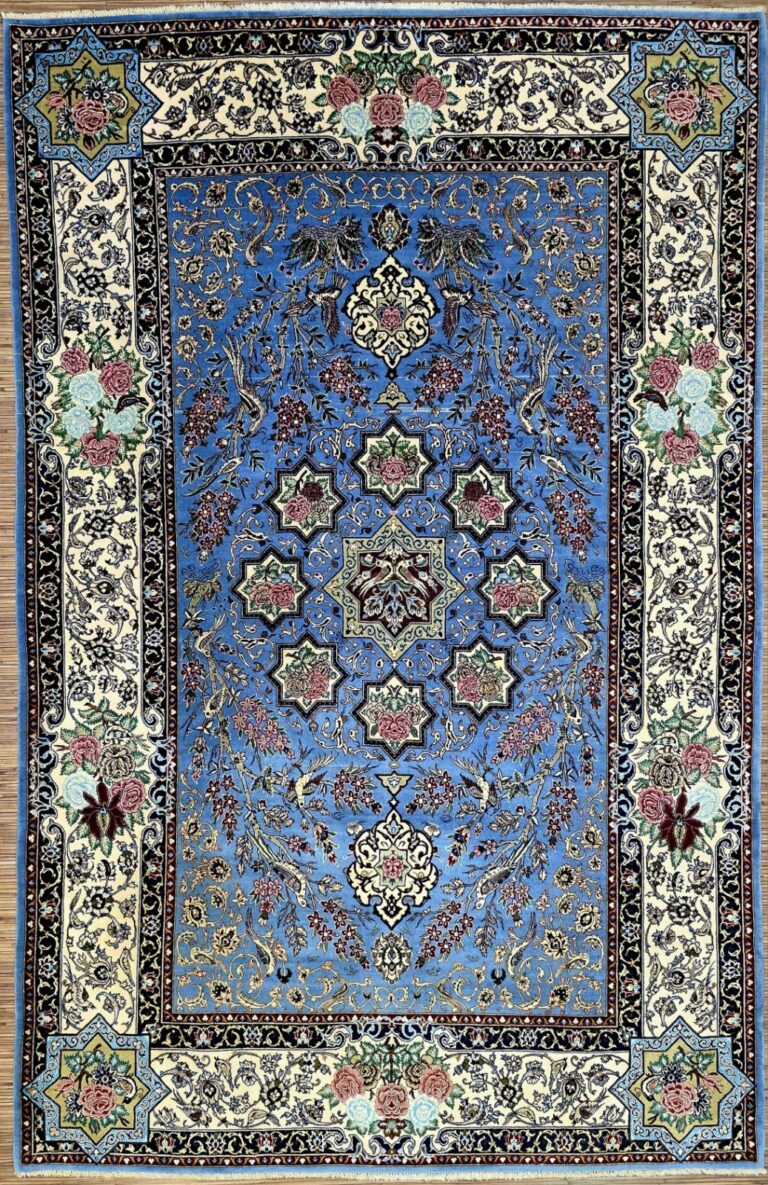
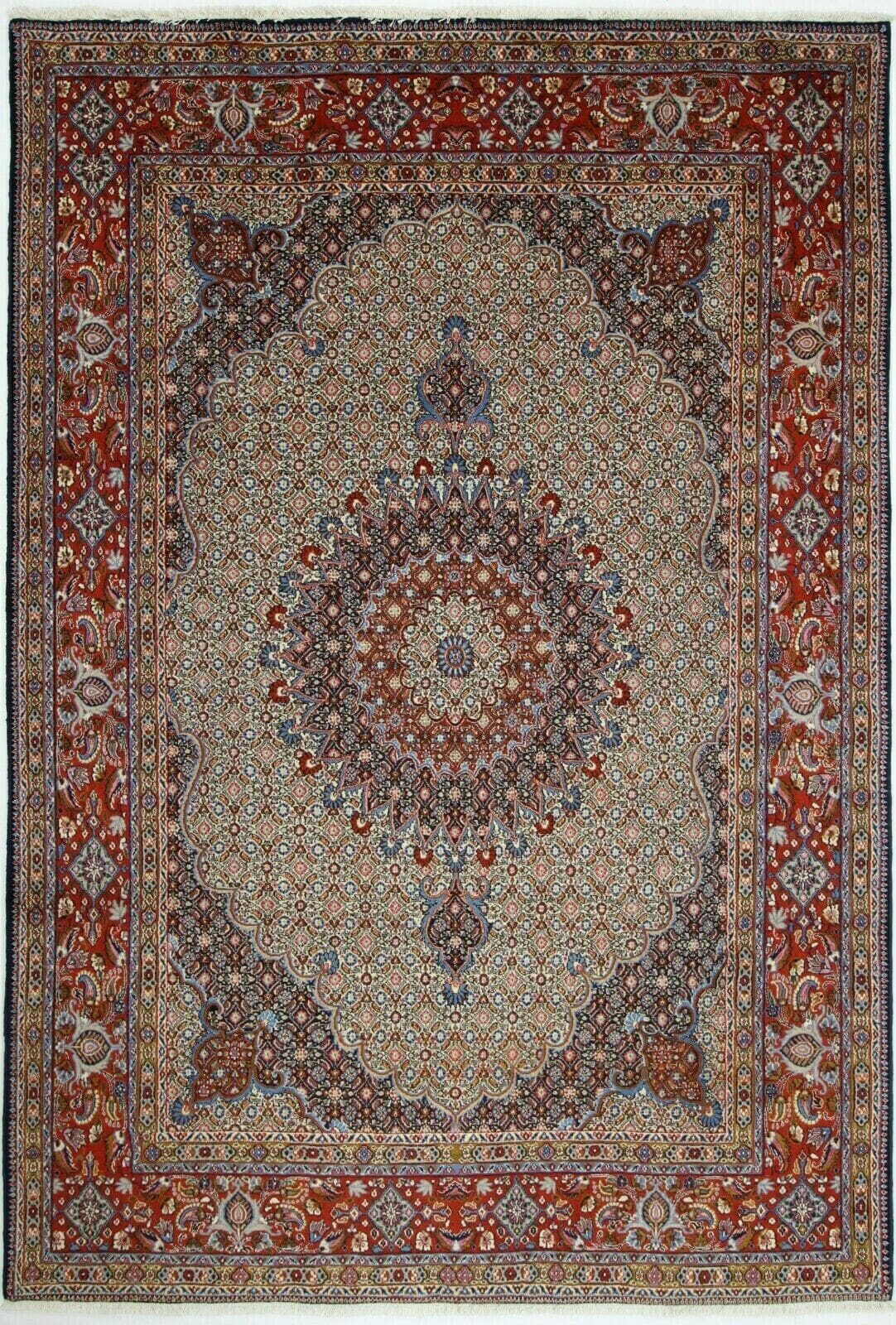
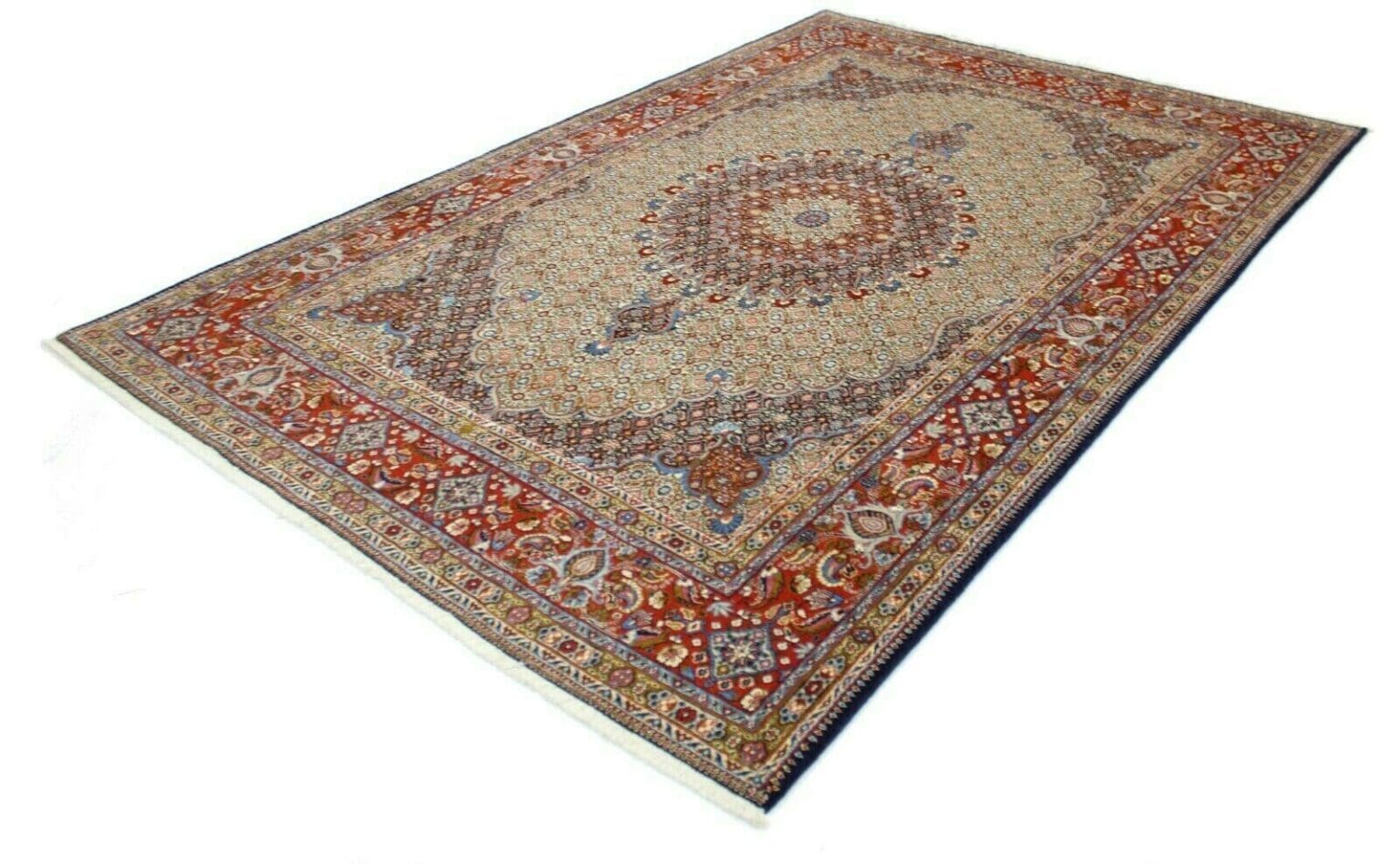
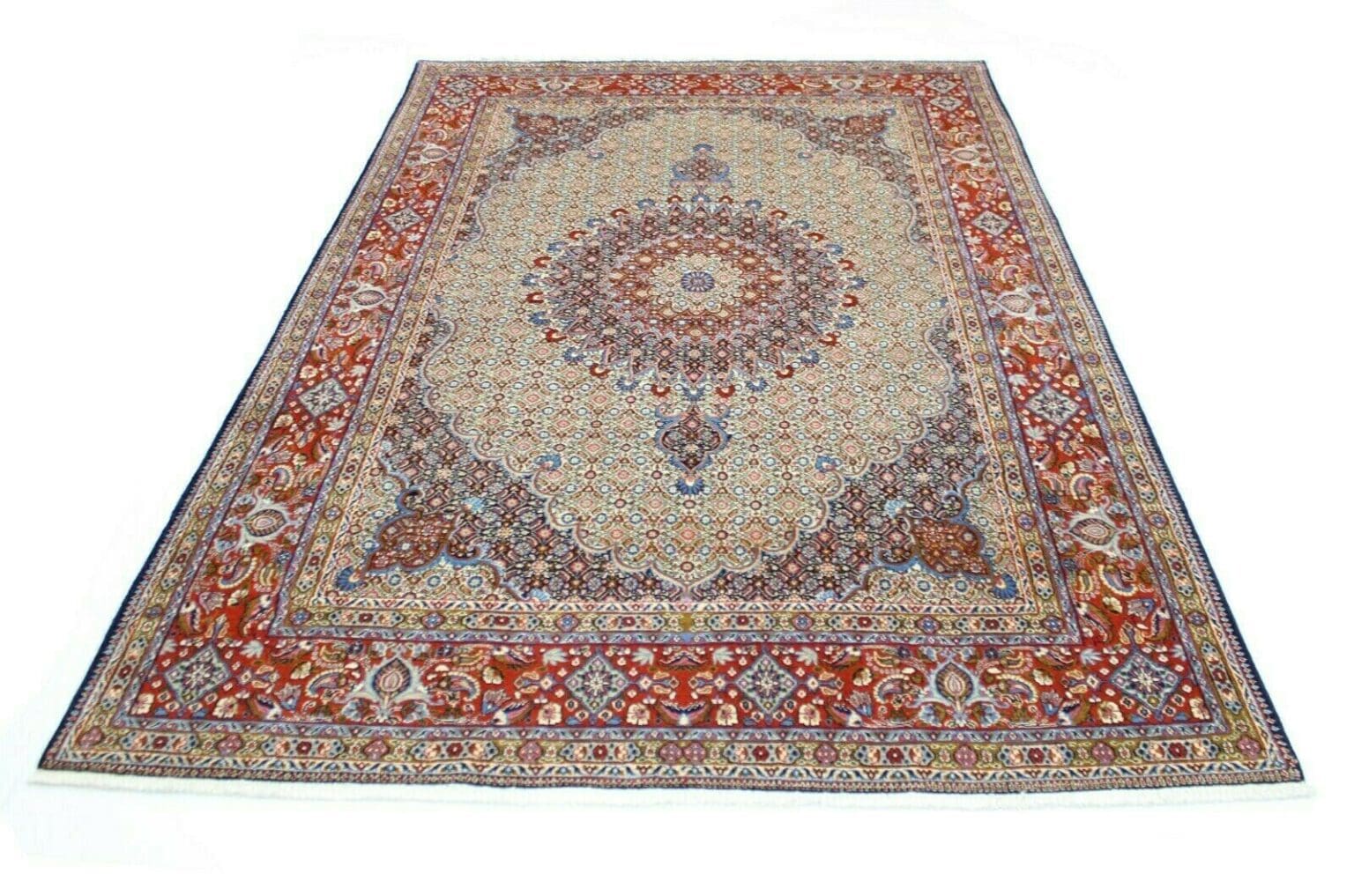
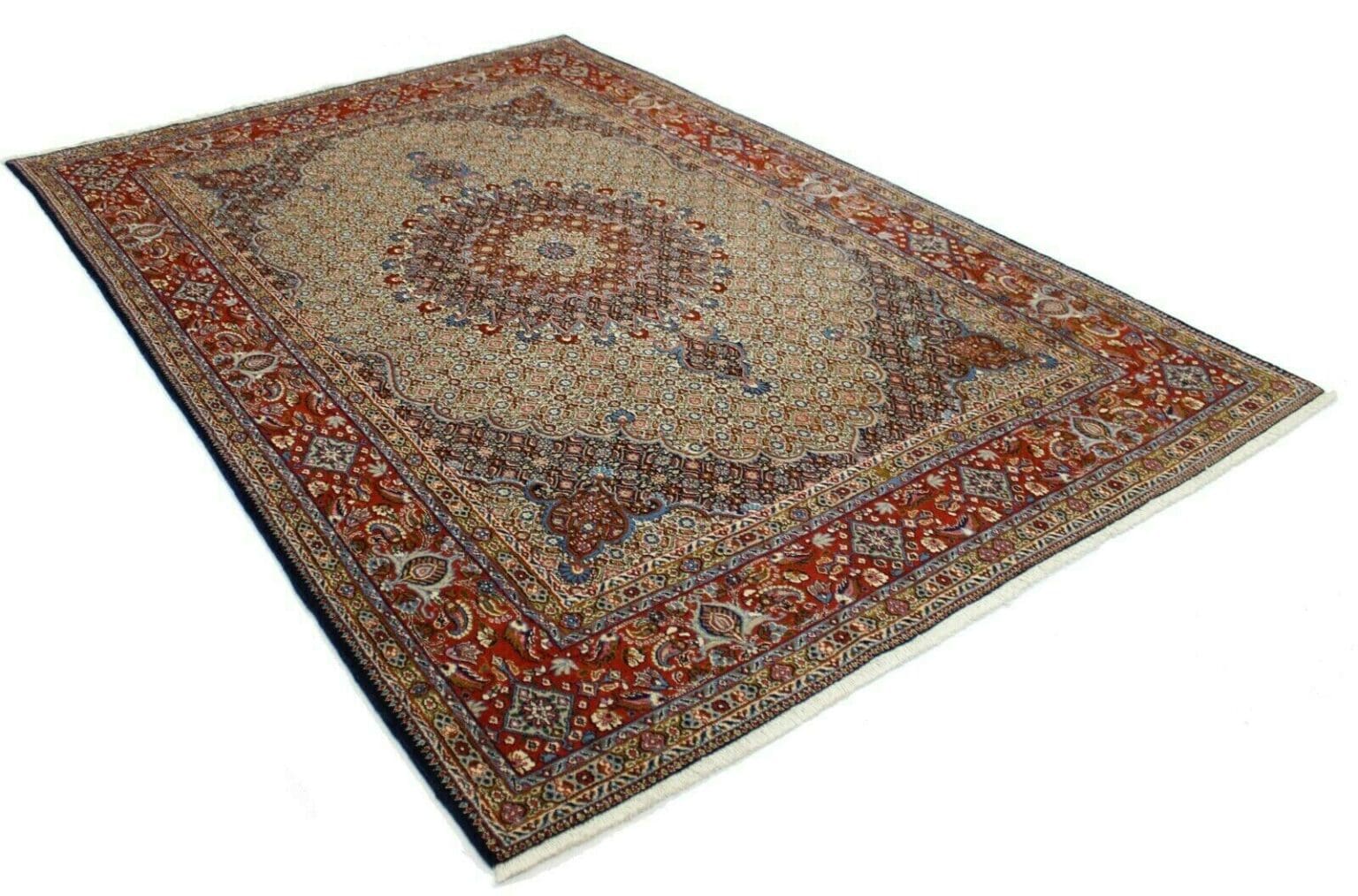
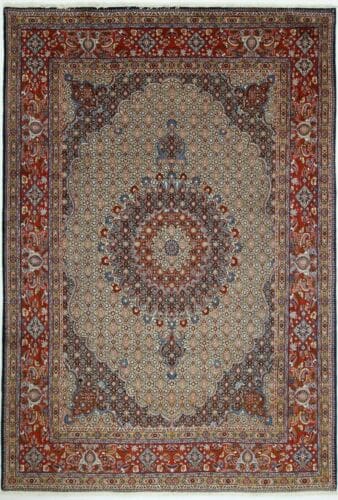
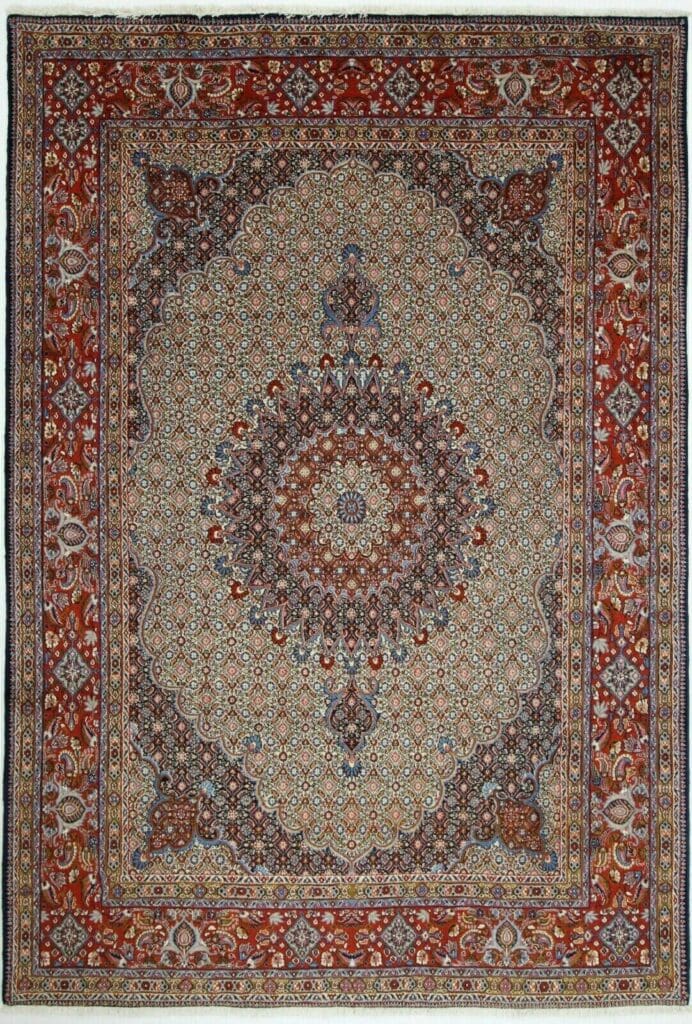
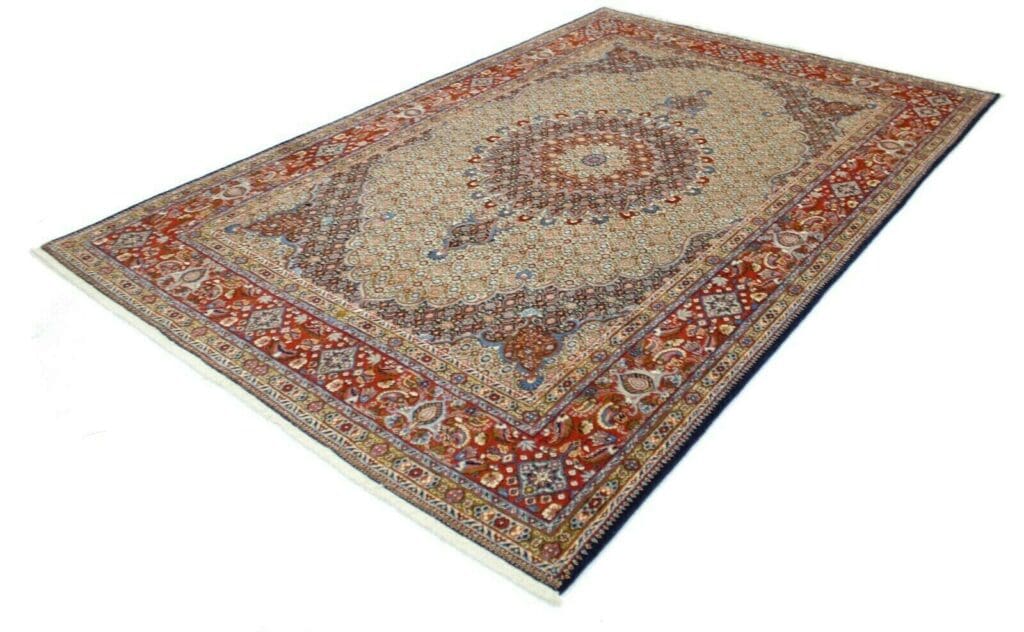
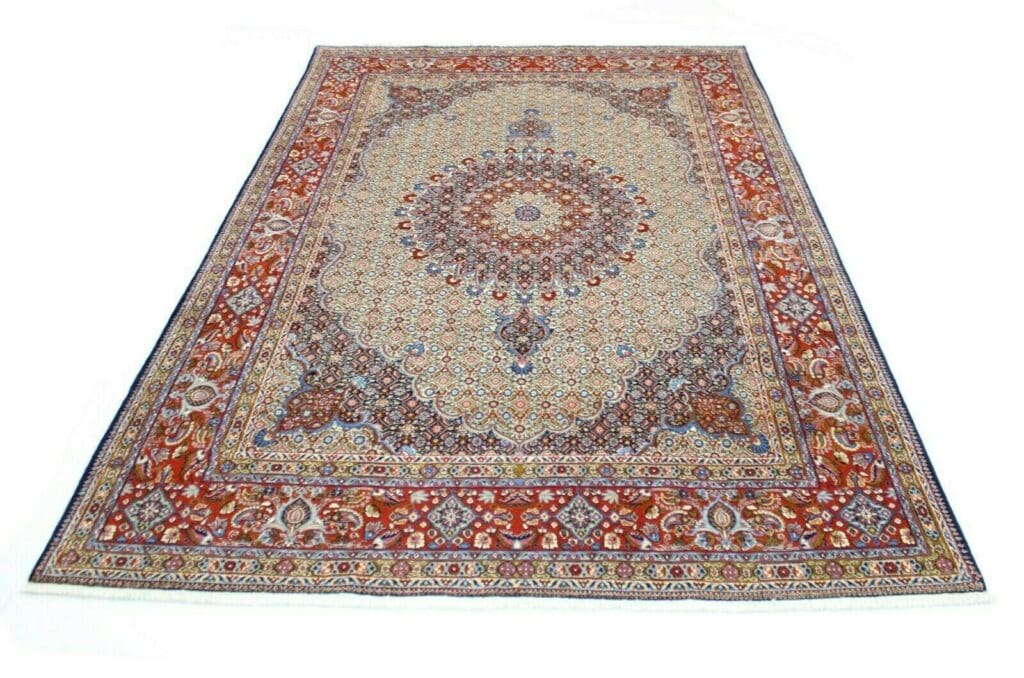
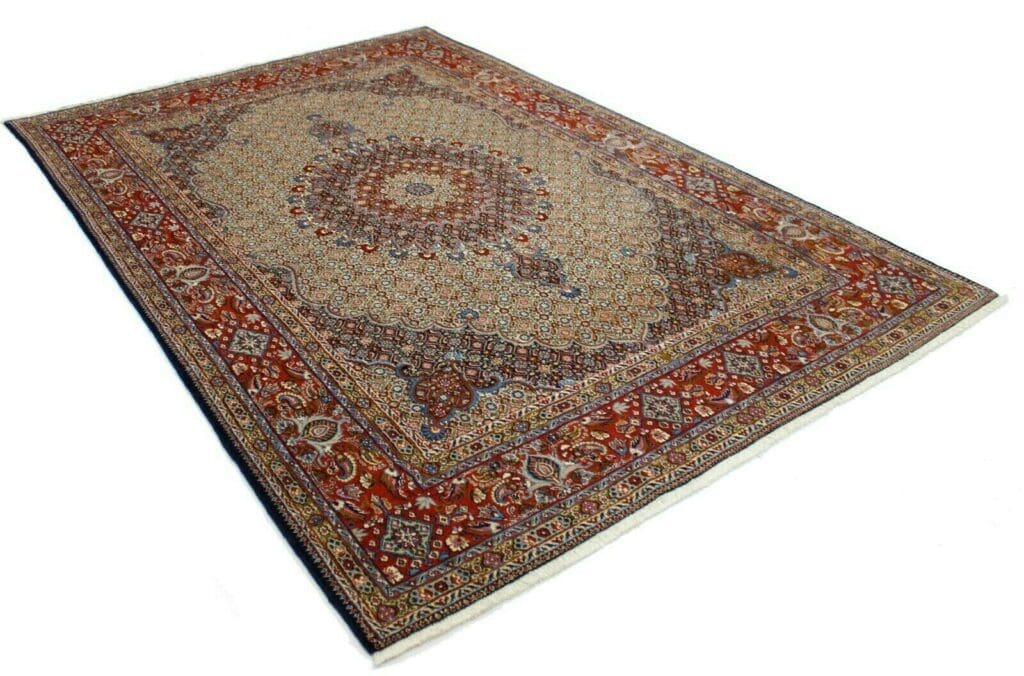
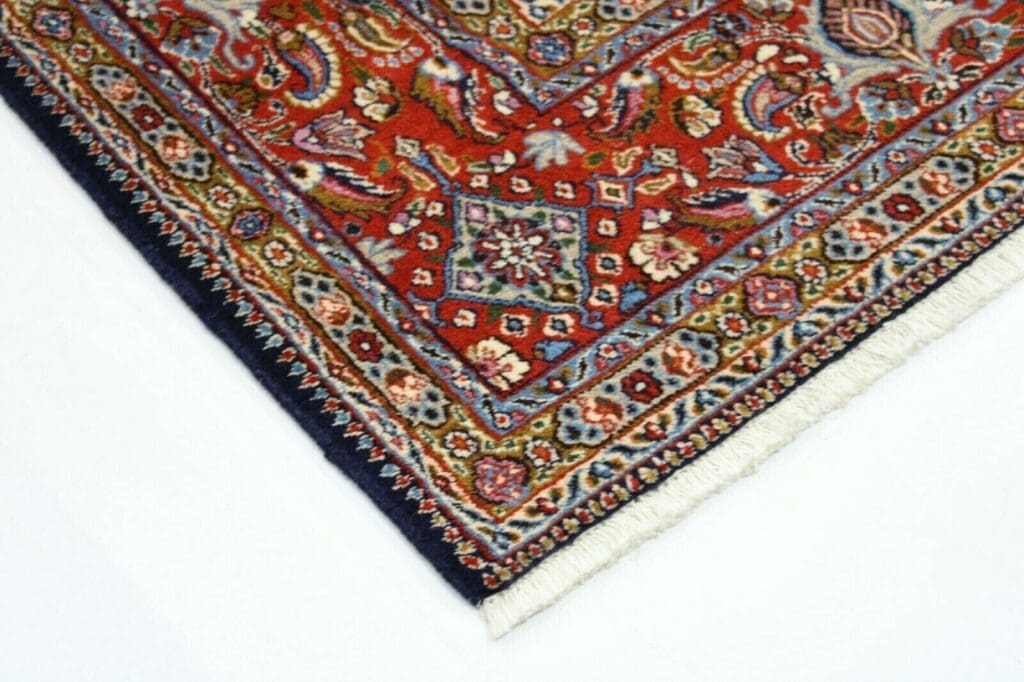
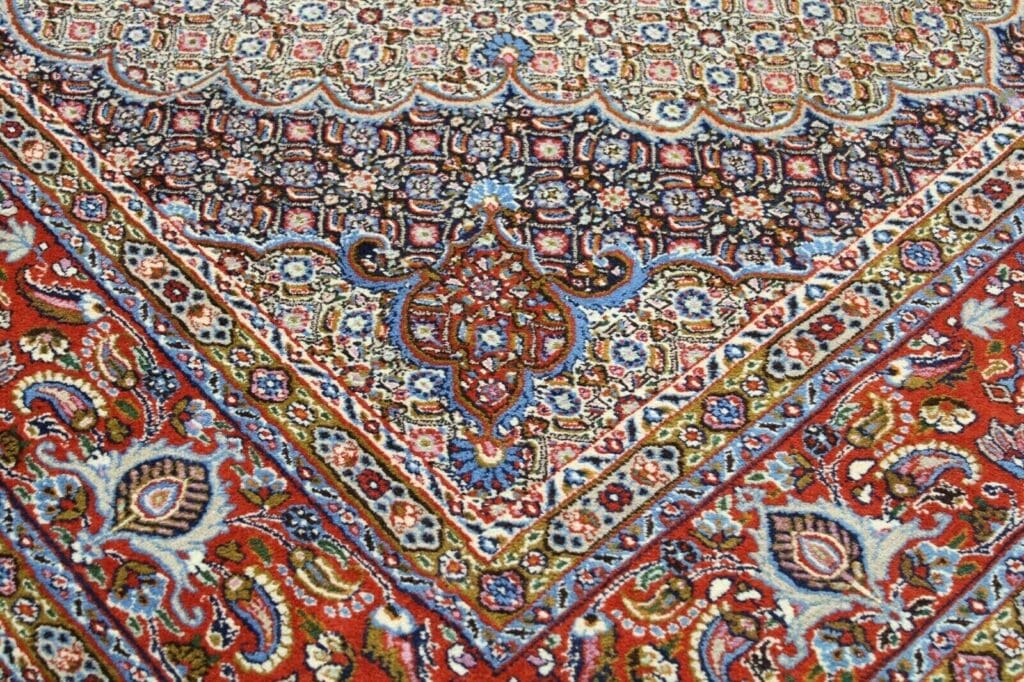
Hand-knotted Moud Persian rug | Knot density: Hand-knotted | Material: 100% wool, 100% cotton | Size: 295 x 200 cm | Pattern: Geometric | Condition: New without label, top condition
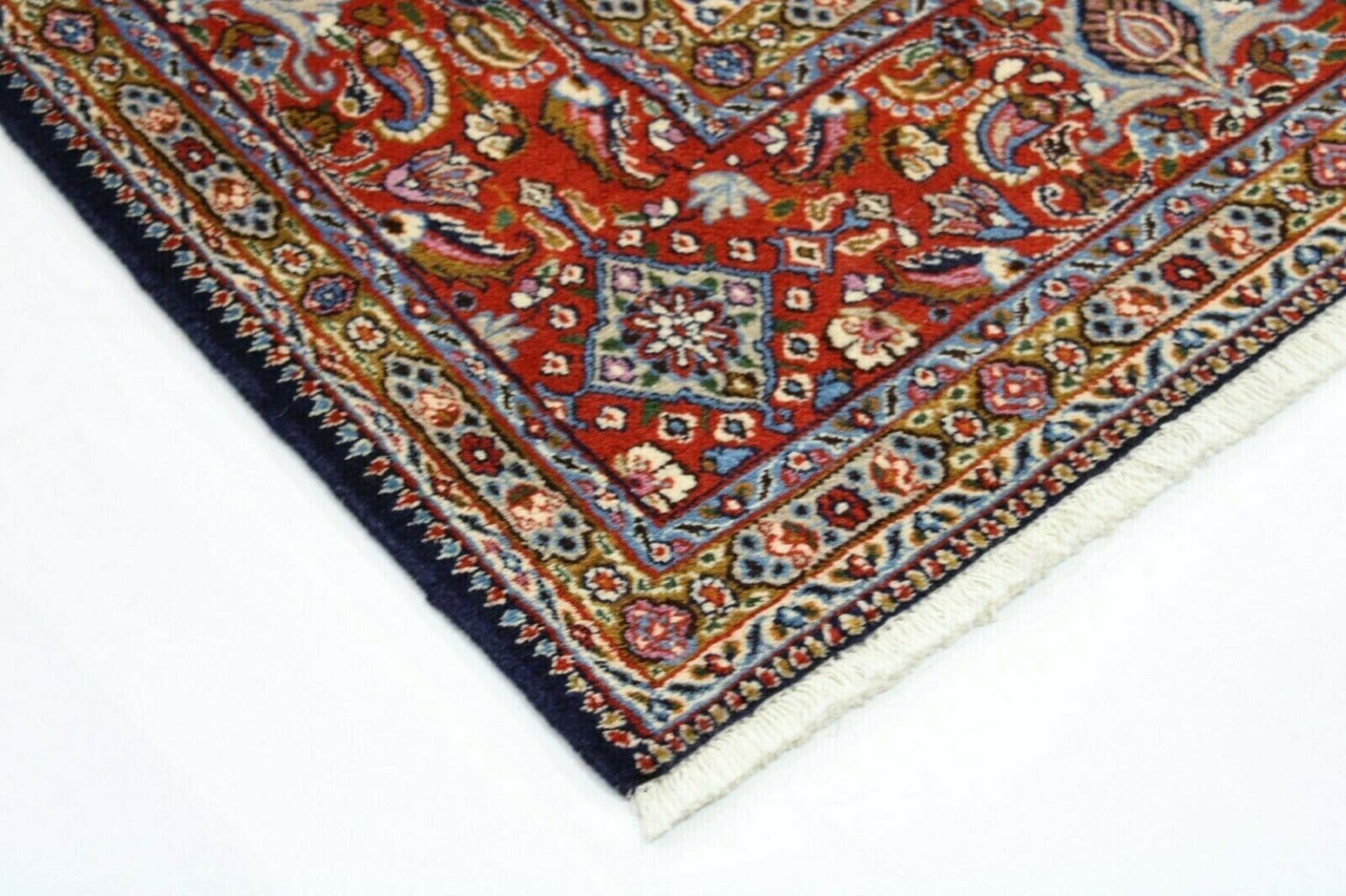
This Persian rug is hand-knotted. In hand-knotting, individual knots are tied around the warp threads one row at a time. The resulting surface is not printed; its design is built into the textile through the arrangement of knots, yarns and colours. Each stage requires the pattern to be followed while the woven structure is formed by hand.
Silk is identified as the material in the product title. The material information in the short description identifies 100% wool and 100% cotton. These statements are presented together without altering them. Wool has a long tradition in Persian rug making, while cotton is also a familiar textile fibre in rug construction. The two fibres have different characteristics and can serve different structural purposes in a rug.
Hand-knotted production makes each rug a one-off textile object. The knotting proceeds row by row, with the design checked as the work advances. Geometric forms can be laid out in an ordered way through this process. Unlike an industrially printed floor covering, the pattern effect is created by the physical relationship between the knots, the yarn and the colour areas.
Origin and Tradition
This rug comes from Iran and is therefore a Persian rug. Iranian rug making is one of the established traditions of Oriental weaving. Skills in preparing the loom, controlling the pattern, placing the knots and finishing the surface have been passed on through practical knowledge over generations. A rug is consequently both a useful textile and a form of visual composition.
Moud is an Iranian rug region associated with hand-knotted production in the eastern part of the country. Its tradition belongs to a wider environment in which controlled drawing and carefully organised fields are important. As with many Iranian rugs, designs may be developed from patterns or working plans before being translated into knots. The name Moud is therefore a regional designation, not simply a description of a decorative style.
Traditional Persian rug making begins with a loom on which the warp threads are stretched. Weft threads pass across them, while the pile is secured through the knots. Once the knotting is complete, the surface can be sheared to an even height. Washing, drying and final finishing may follow. Every step calls for experience, since a small change in tension or knot placement can affect the continuity of a line.
Iran contains many distinct rug traditions. Isfahan is associated with finely organised compositions and pronounced symmetry, Tabriz with varied designs and detailed drawing, and Kashan with established floral carpet patterns. These places represent separate traditions and are not alternative origins for this Moud rug. Their shared foundation is the combination of a planned design, skilled handwork and a pattern vocabulary shaped over time.
Rug making also carries social and economic knowledge. The methods for setting the warp, inserting knots, changing colours and finishing the pile are learned through practice. Pattern choices likewise reflect local habits and inherited visual languages. Iranian weaving can therefore develop new designs while retaining a connection with traditional methods and regional identity.
Design and Pattern
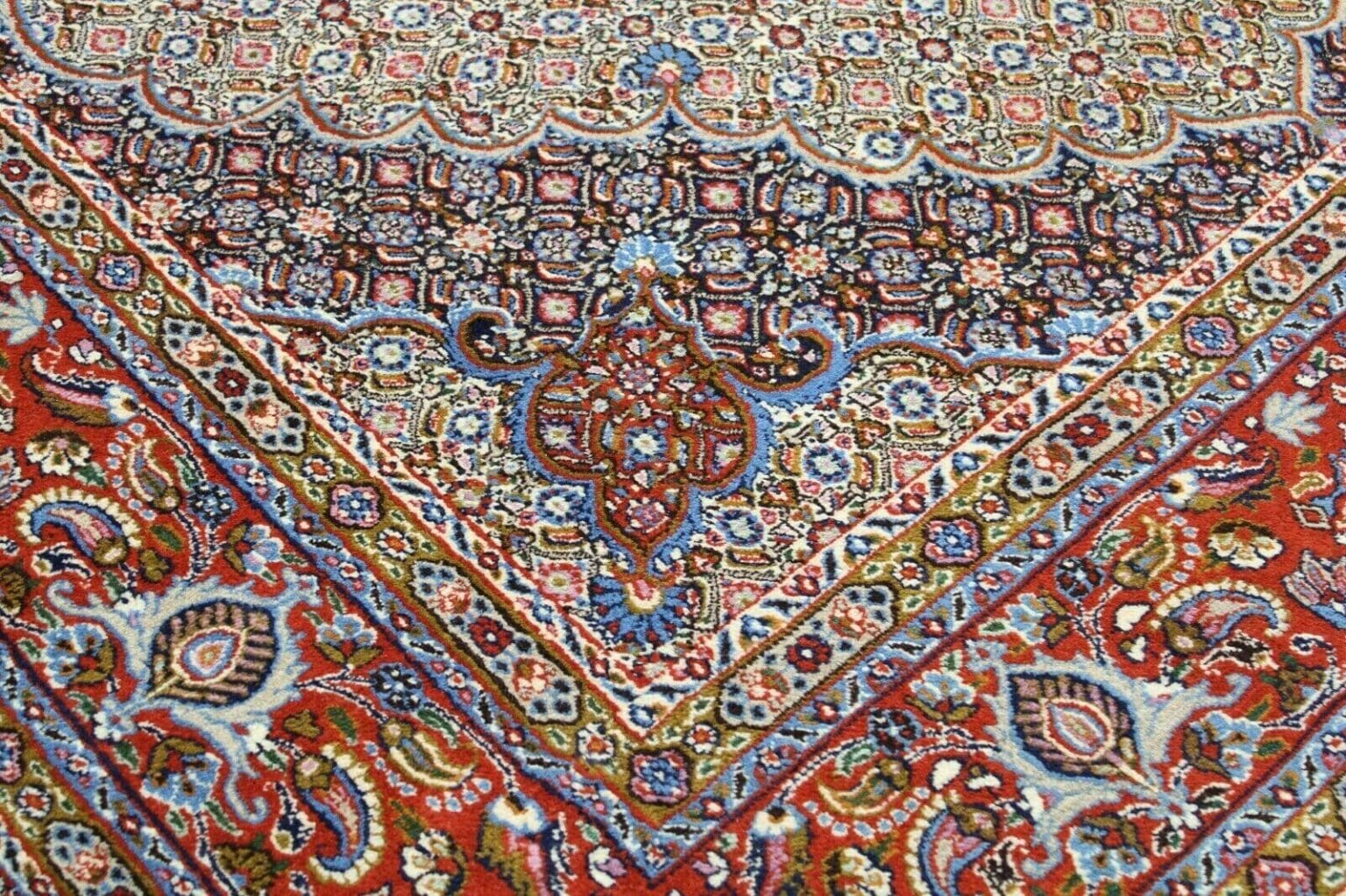
The pattern of this rug is geometric. Geometric rug designs use lines, angles, repeated units, mirrored forms and clearly separated areas. They may create a regular all-over repeat or combine individual shapes into a larger composition. When translated into hand-knotting, even straight-edged ornaments acquire a textile depth because every part is made from a sequence of individual knots.
Geometric design is one of the longstanding forms of expression in rug making. Diamonds, stepped lines, stars, hooks and triangles can appear as separate ornaments or be joined into larger units. In traditional compositions, such forms may be arranged in borders, central fields and intervening areas. The border frames the design, while the central field carries the main visual organisation.
The character of a geometric pattern depends on rhythm and repetition. A motif may continue across the field, be reflected, or return in a modified form. This creates an order that can be read both close up and from farther away. The knotting method reinforces the effect because the lines and colour fields are permanently integrated into the rug rather than added as a surface image.
Persian rug designs can include floral, figurative, symbolic and geometric elements. In a geometric composition, however, the aim is not a naturalistic rendering of a leaf or flower. Instead, forms are reduced to lines, angles and colour blocks. This abstraction can make a design appear compact, disciplined or dynamic. The exact appearance of each motif depends on the individual design and its regional tradition.
The short description identifies the style as Art Deco. Art Deco is commonly associated with strong contours, geometric base shapes, balanced symmetry and carefully arranged fields. These characteristics can be combined with the traditional Persian method of hand-knotting. The result is a relationship between an established Iranian craft process and a more modern decorative language based on geometry.
A rug’s decorative effect is created not only by individual motifs. The relationship between the field, the border, repetition and colour distribution is equally important. A geometric rug can organise a room, define an area or function as a continuous textile image. This Moud rug brings that geometric design together with Iranian origin and hand-knotted construction.
Special Features
The condition is described as new without a label and as top condition. This identifies the item as new even though it has no label. The rug is also described as washable. Cleaning a hand-knotted rug should be carried out carefully so that the pile, colours and shape are protected.
The rug is suitable for underfloor heating. It can therefore be used in rooms where heat is supplied through the floor. It is also identified as environmentally friendly. The rug is suitable for all rooms, allowing it to be used in different areas of a home. Its manufacturing period is given as 1980 to 1989.
Art Deco is specified as the furnishing style. The geometric pattern corresponds with an approach based on clear lines and ordered forms, while the surface remains a hand-knotted textile from an Iranian tradition. This combination allows the rug to function as a floor covering as well as a decorative textile element.
FAQ
How should I care for a hand-knotted Persian rug?
Regular vacuuming without a brush attachment removes loose dirt while avoiding unnecessary stress on the fibres. Professional cleaning is recommended for more thorough care and can help preserve the colours and structure. This rug is described as washable, but washing should still be performed properly and in a way suited to its hand-knotted construction.
Where do Persian rug patterns come from?
Persian rug patterns vary according to region and inherited design tradition. They may draw on nature, historical events or cultural symbols. This rug is described as geometric, so its design is based on lines, angles, repetition and organised forms. Its specified style is Art Deco, which is also associated with clear geometry and balanced decorative arrangements.
How long does a hand-knotted Persian rug last?
With proper care and regular maintenance, a hand-knotted Persian rug can remain usable for many decades and, under suitable conditions, for longer. Its service life depends on use, cleaning and the way the pile is treated. Hand-knotted workmanship and the textile materials provide the basis for a long period of use.
To provide the best experiences, we use technologies like cookies to store and/or access device information. Consenting to these technologies will allow us to process data such as browsing behavior or unique IDs on this site. Not consenting or withdrawing consent, may adversely affect certain features and functions.
Functional Always active
The technical storage or access is strictly necessary for the legitimate purpose of enabling the use of a specific service explicitly requested by the subscriber or user, or for the sole purpose of carrying out the transmission of a communication over an electronic communications network.
Preferences
The technical storage or access is necessary for the legitimate purpose of storing preferences that are not requested by the subscriber or user.
Statistics
The technical storage or access that is used exclusively for statistical purposes.The technical storage or access that is used exclusively for anonymous statistical purposes. Without a subpoena, voluntary compliance on the part of your Internet Service Provider, or additional records from a third party, information stored or retrieved for this purpose alone cannot usually be used to identify you.
Marketing
The technical storage or access is required to create user profiles to send advertising, or to track the user on a website or across several websites for similar marketing purposes.
 SECURE PAYMENT
 SHIPPING PARTNERS