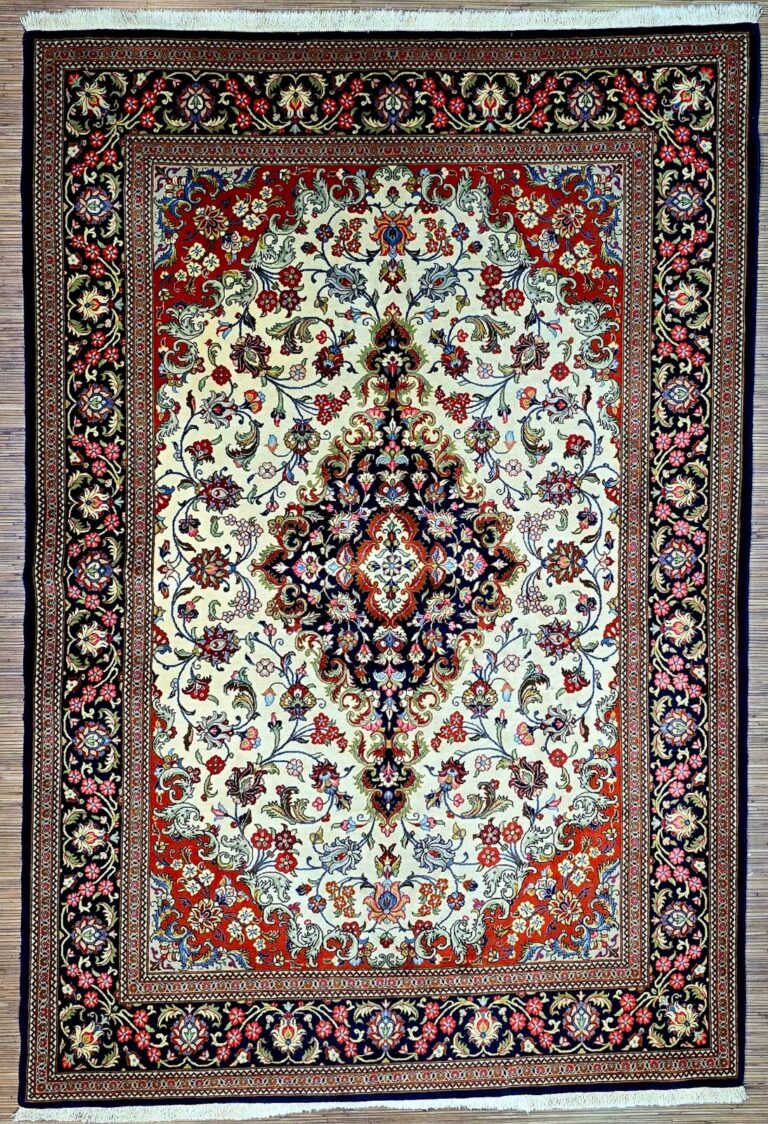
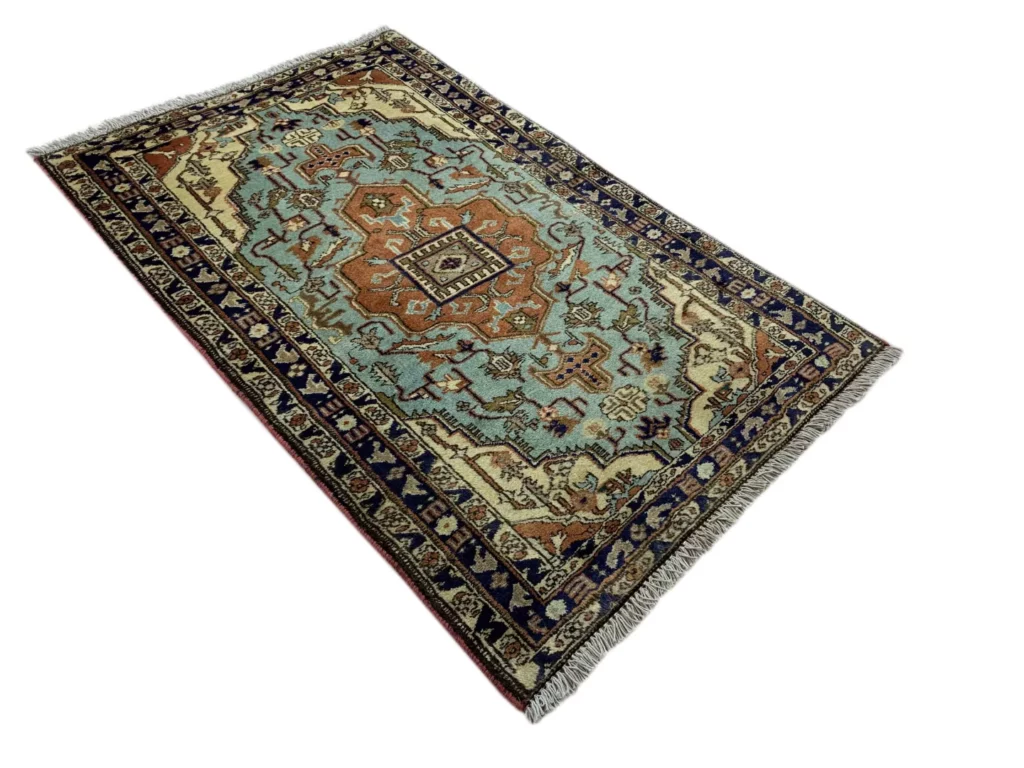
This Meshkin Persian rug is hand-knotted and has a pile made from high-quality sheep wool. Sheep wool is one of the characteristic natural materials associated with rugs from north-western Iran. It gives the pile a tactile surface and a pleasant feel under the hand. The source identifies sheep wool as the pile material of this rug; no information about the warp material is provided.
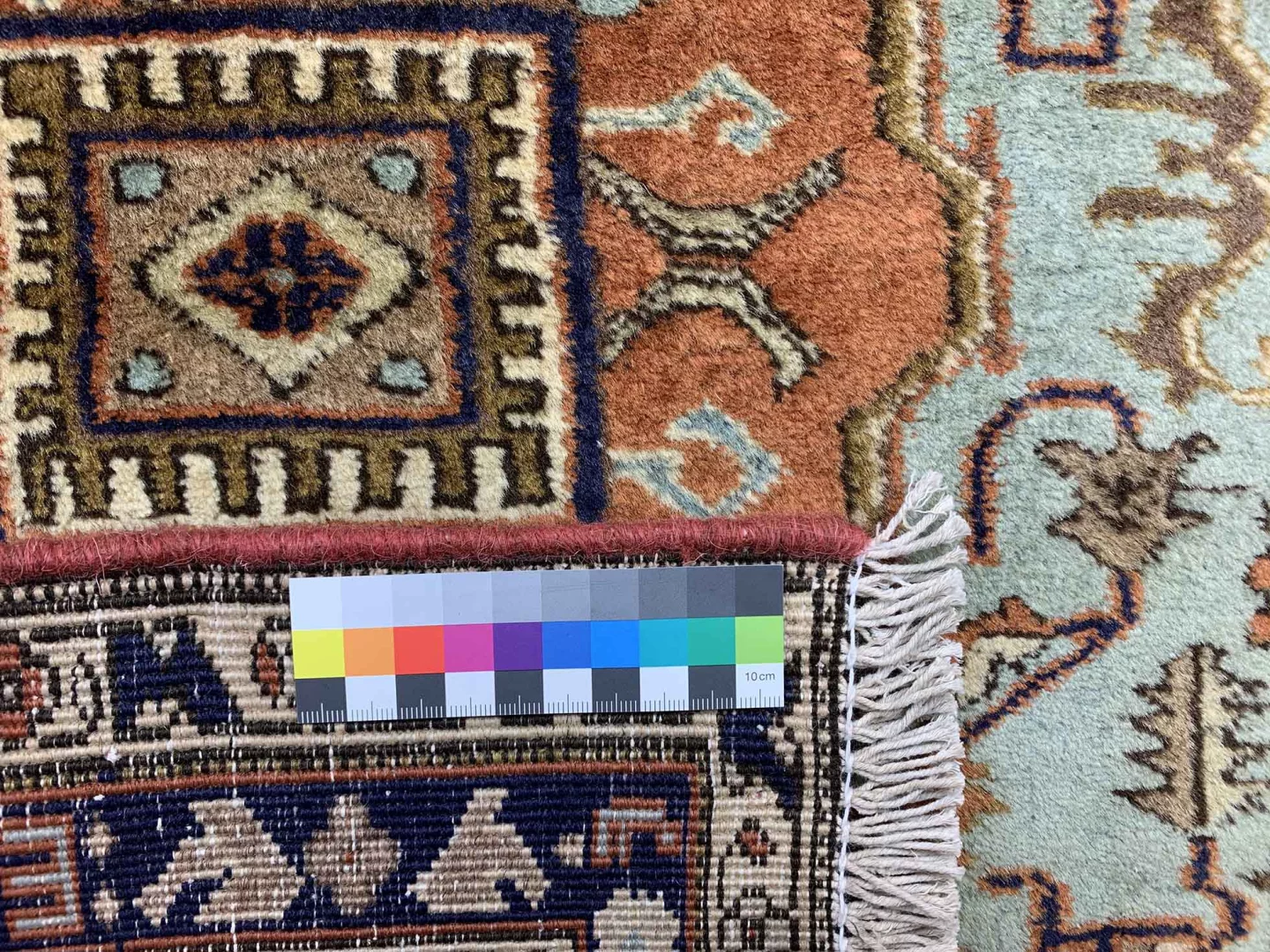
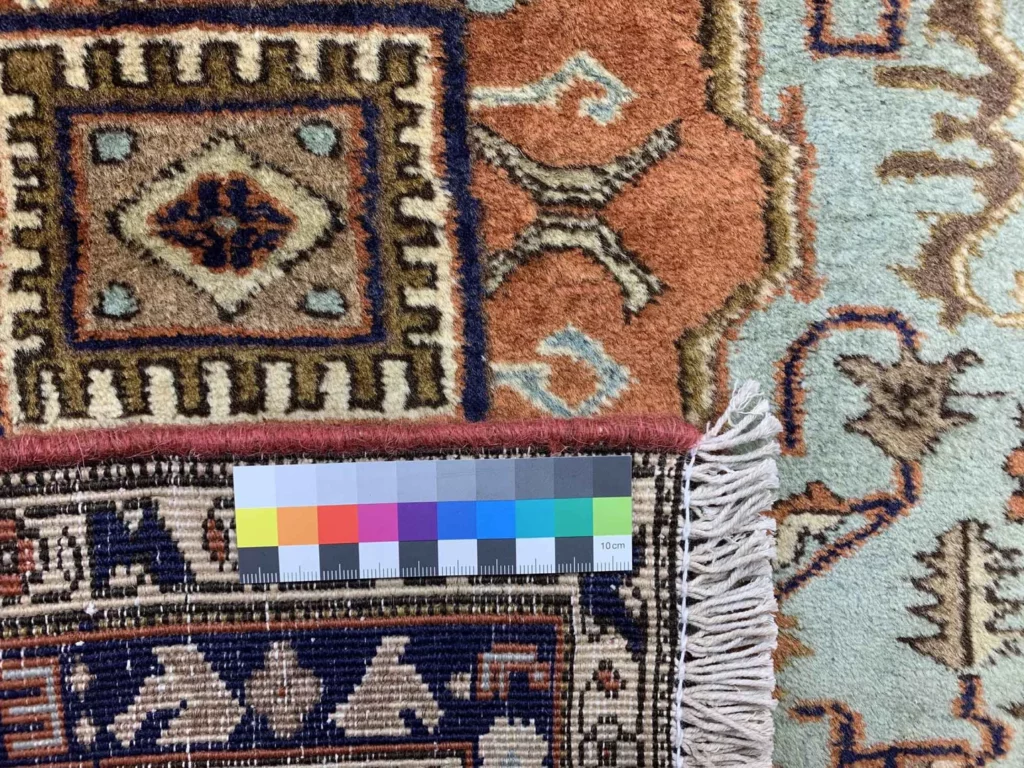
The knot density is given as 120.000 to 200.000 knots per square metre. In a hand-knotted rug, this density allows lines, fields and geometric shapes to be worked out with considerable differentiation. At the same time, the surface retains the character of an individually made textile. Each knot is inserted into the foundation during the weaving process, so the design is built progressively rather than printed onto a finished surface.
Meshkin rugs are traditionally associated with materials available in their local environment. The sheep wool described for Meshkin rugs comes mainly from the area around Meshgin Shahr and is obtained from local sheep. Its durability and quality are recognised characteristics of this regional wool. The combination of natural fibre and manual knotting accounts for the distinct texture of the rug, without requiring any additional claim about the particular construction of this example.
Origin and Tradition
This rug comes from Meshkin, also known as Meshgin Shahr, in Ardabil Province in north-western Iran. The area belongs to the historic rug-producing landscape of north-west Iran. Its position between Iranian and Caucasian cultural regions has influenced the designs made there over time. Local craftsmanship, regional fibres and patterns associated with the neighbouring Caucasus meet in a tradition that is often direct, structured and strongly outlined.
Ardabil Province is known for carpet production. In the region, rug making is more than a technical process: it is part of a cultural practice transmitted across generations. Knowledge of preparing wool, setting out a design and maintaining an even sequence of knots is passed through families and workshops. A hand-knotted rug therefore develops gradually, with the progress of the design depending on the work of the individual maker or makers rather than on an industrial production line.
Meshkin rugs are commonly linked with an immediate geometric vocabulary. Some courtly or city-rug traditions are recognised for finely divided floral compositions, whereas Meshkin is often understood through the clarity of its lines, medallions, diamonds and repeated forms. This is background to the regional tradition, not an additional assertion about this particular rug beyond the stated geometric pattern.
The Caucasian connection is important when considering Meshkin weaving. The Caucasus is a diverse rug-producing area with many local styles. Strong contours, angular drawing and rhythmically repeated ornaments are among the features often associated with its geometric traditions. Meshkin weavers incorporate such influences while working within an Iranian setting and using materials available in their region.
Iranian rug history as a whole includes many distinct centres with their own visual languages. Tabriz and Isfahan, for example, represent other well-known traditions. Tabriz rugs are often associated with detailed floral designs, while Isfahan rugs frequently feature complex compositions and refined materials. Nain and Kerman are also established Iranian rug names. These comparisons place Meshkin in the wider market without changing this rug’s stated origin in Meshkin, Ardabil Province, north-western Iran.
A Meshkin rug is therefore part of a regional history in which natural materials, inherited skill and Caucasian influences are brought together. The name Meshkin identifies a place of origin rather than merely describing a decorative theme. For this piece, the location and method are specifically identified by the references to north-western Iran, Ardabil Province and hand-knotting.
Design and Pattern
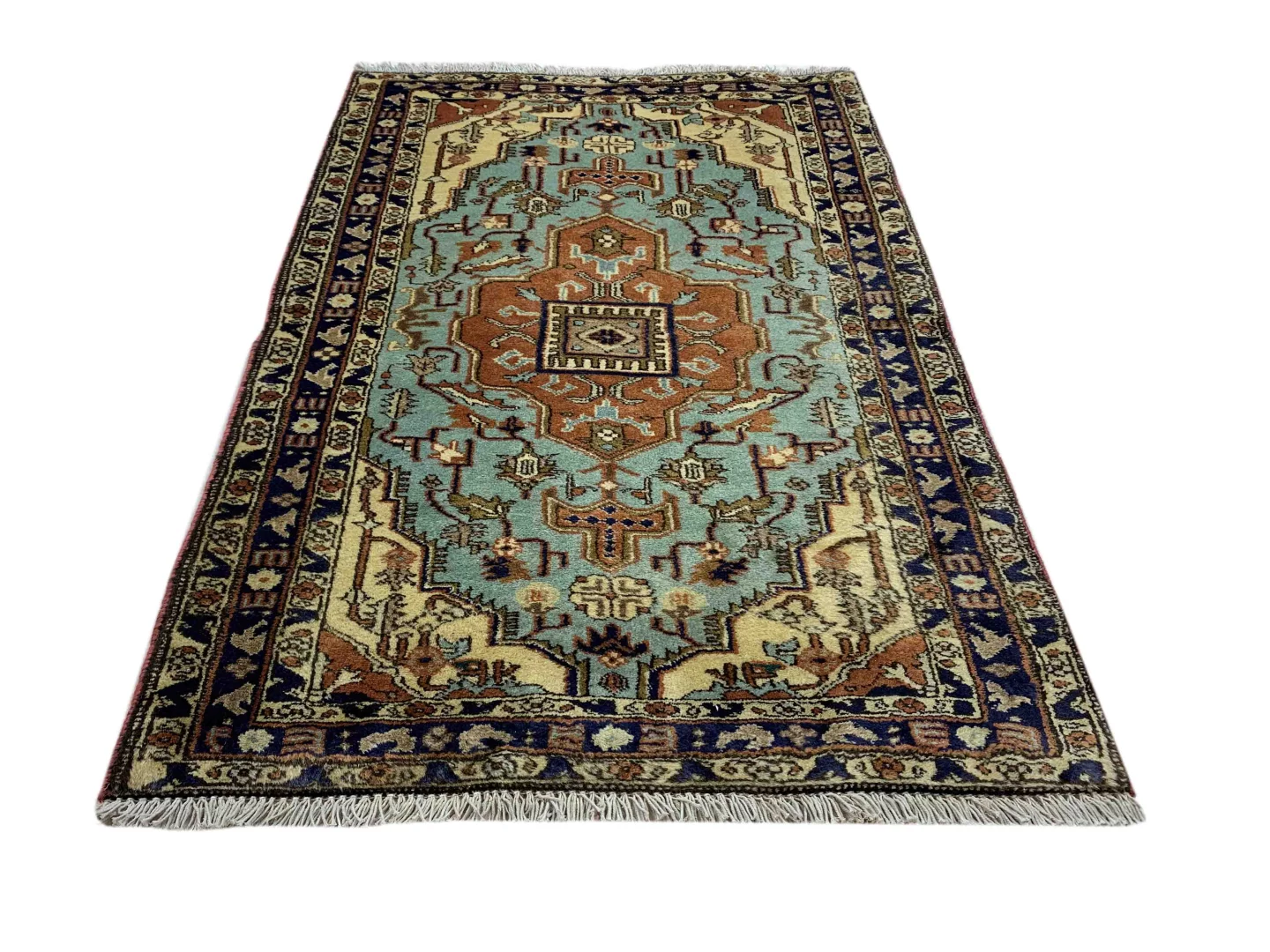
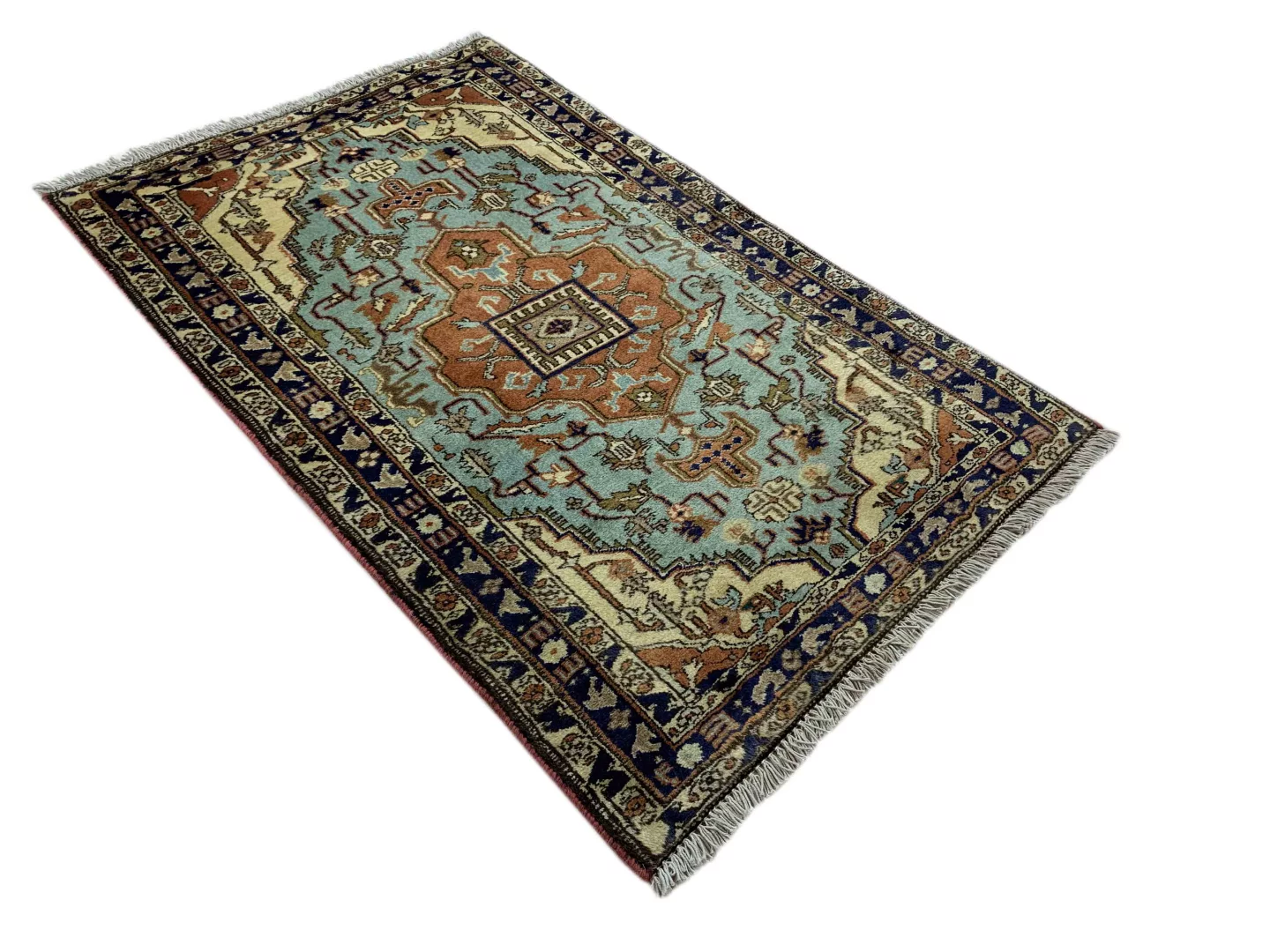
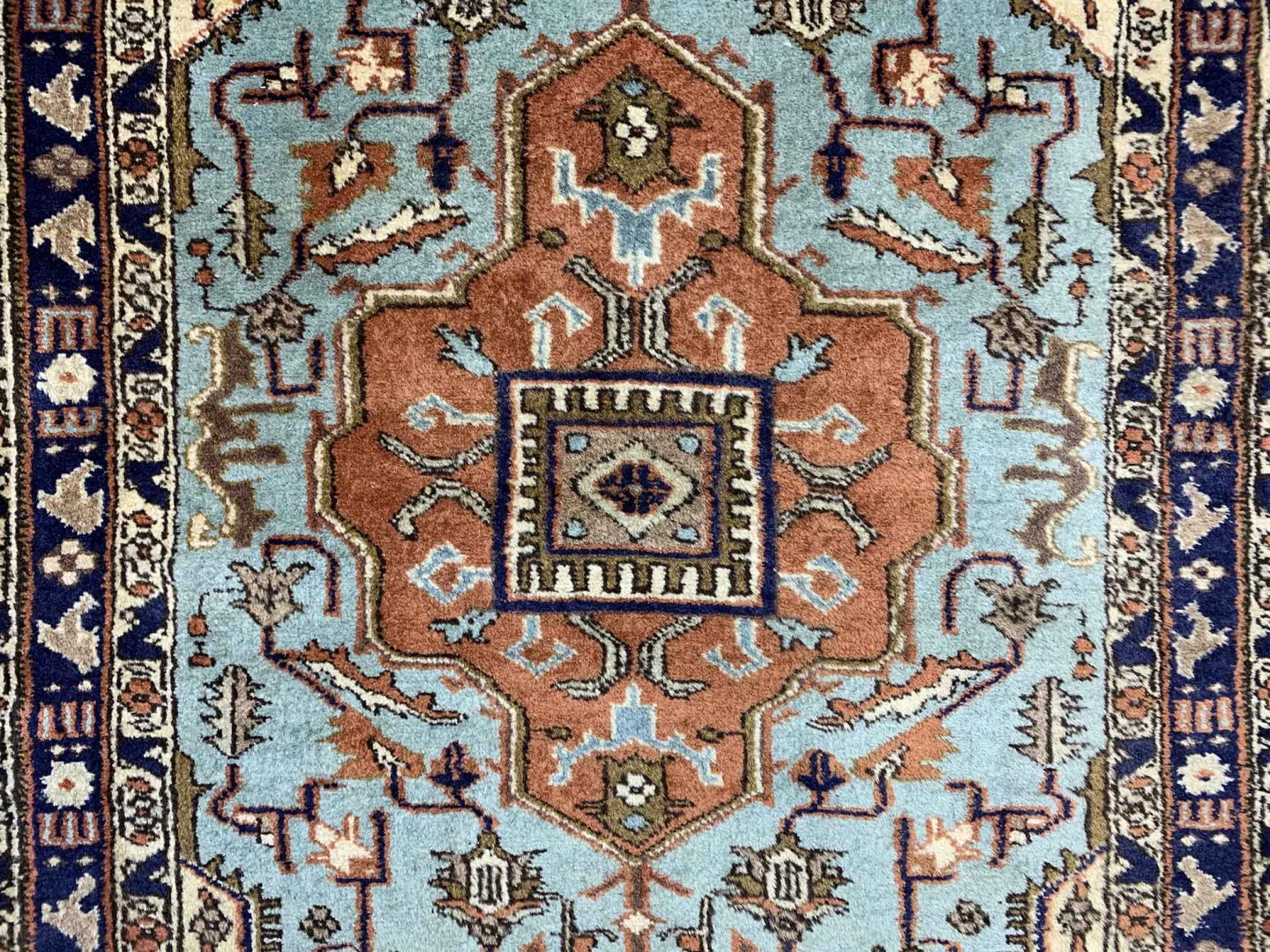
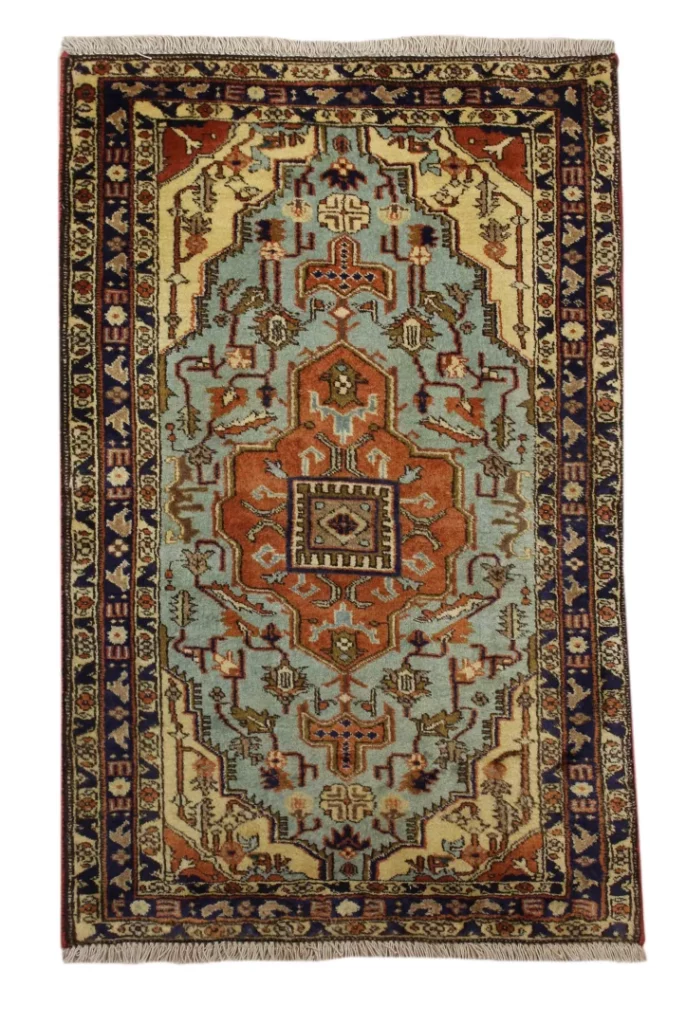
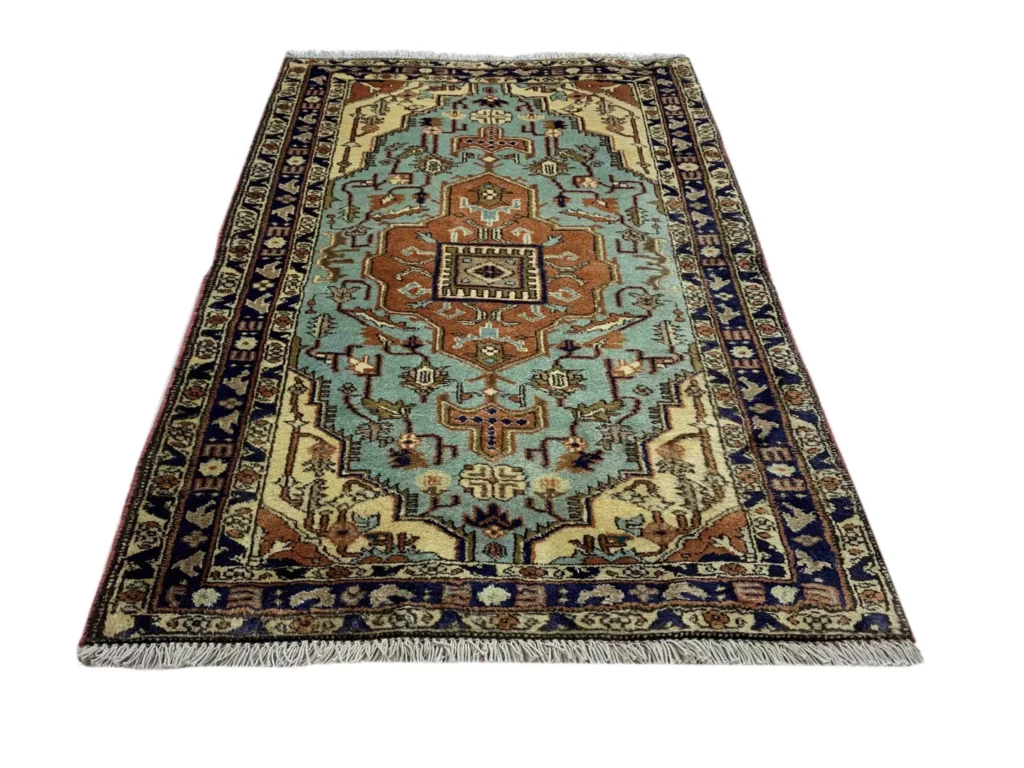
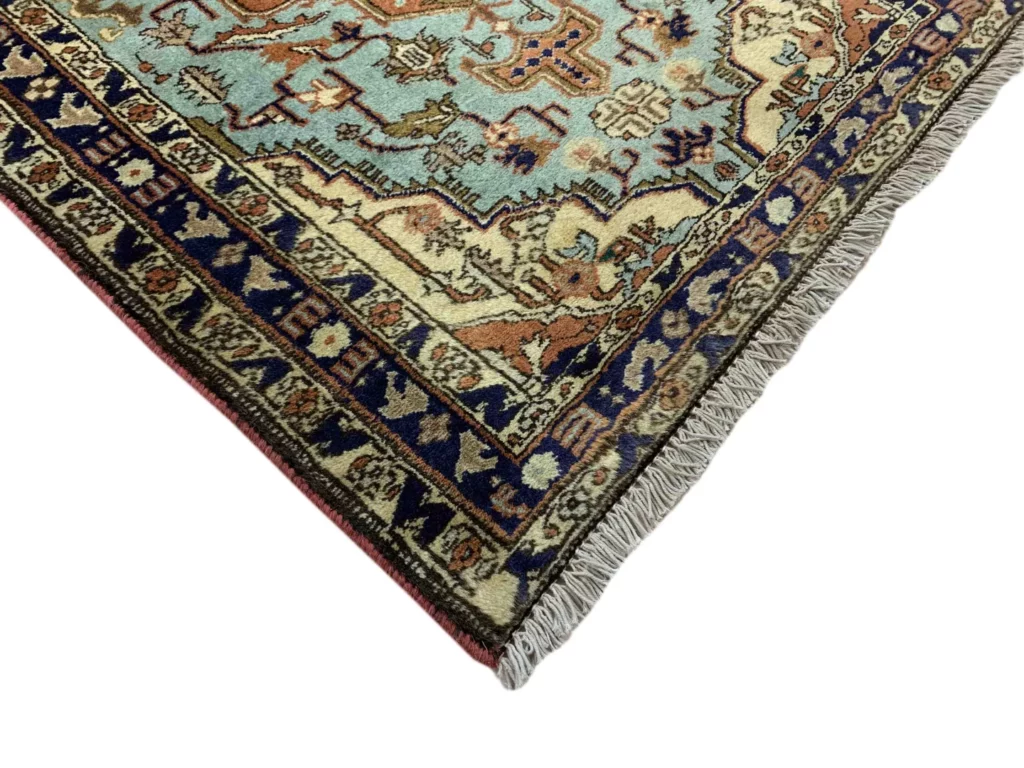
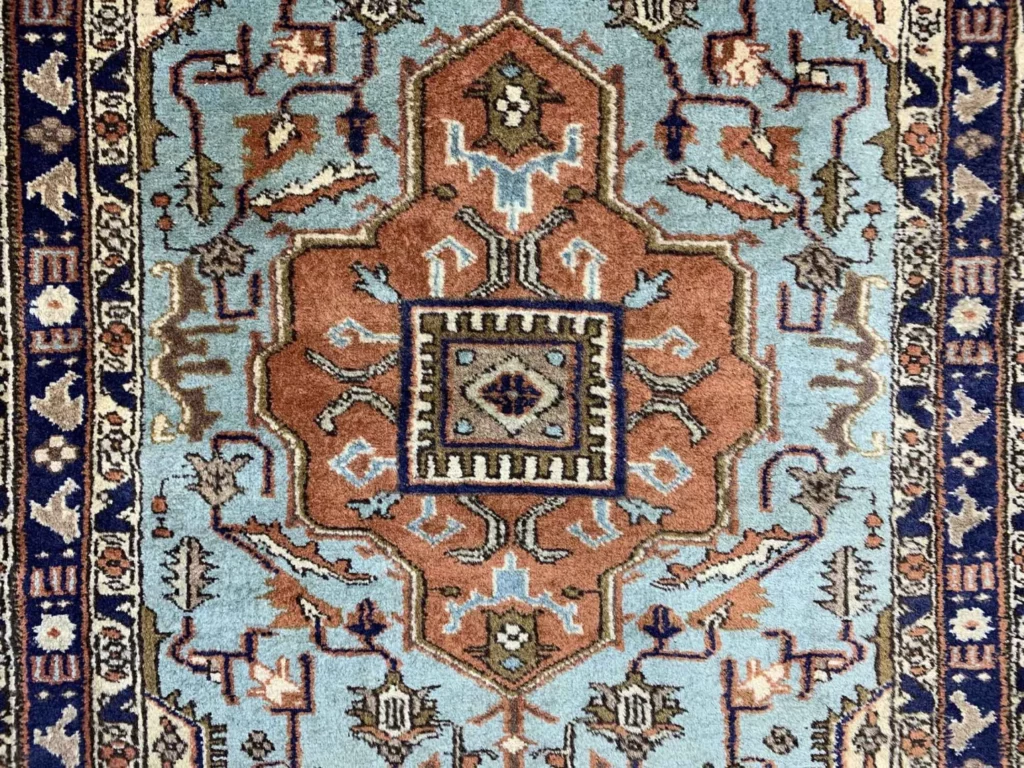
The pattern of this rug is geometric and follows a Caucasian design. Geometric rug design relies on clearly separated areas, straight or broken lines and forms that recur across the field. The composition can consequently be read through its arrangement and rhythm. Its effect does not depend on a naturalistic scene, but on the relationship between outline, colour field and repetition.
In rug terminology, Caucasian influence is often expressed through emphatic drawing and clearly legible ornament. Diamonds, hooked shapes, stepped lines and stylised vegetal elements may occur in such designs. Not every form appears in every rug, so these are examples of the wider design language rather than claims about motifs not named for this piece. The specific description here is the stated combination of a geometric pattern and Caucasian design.
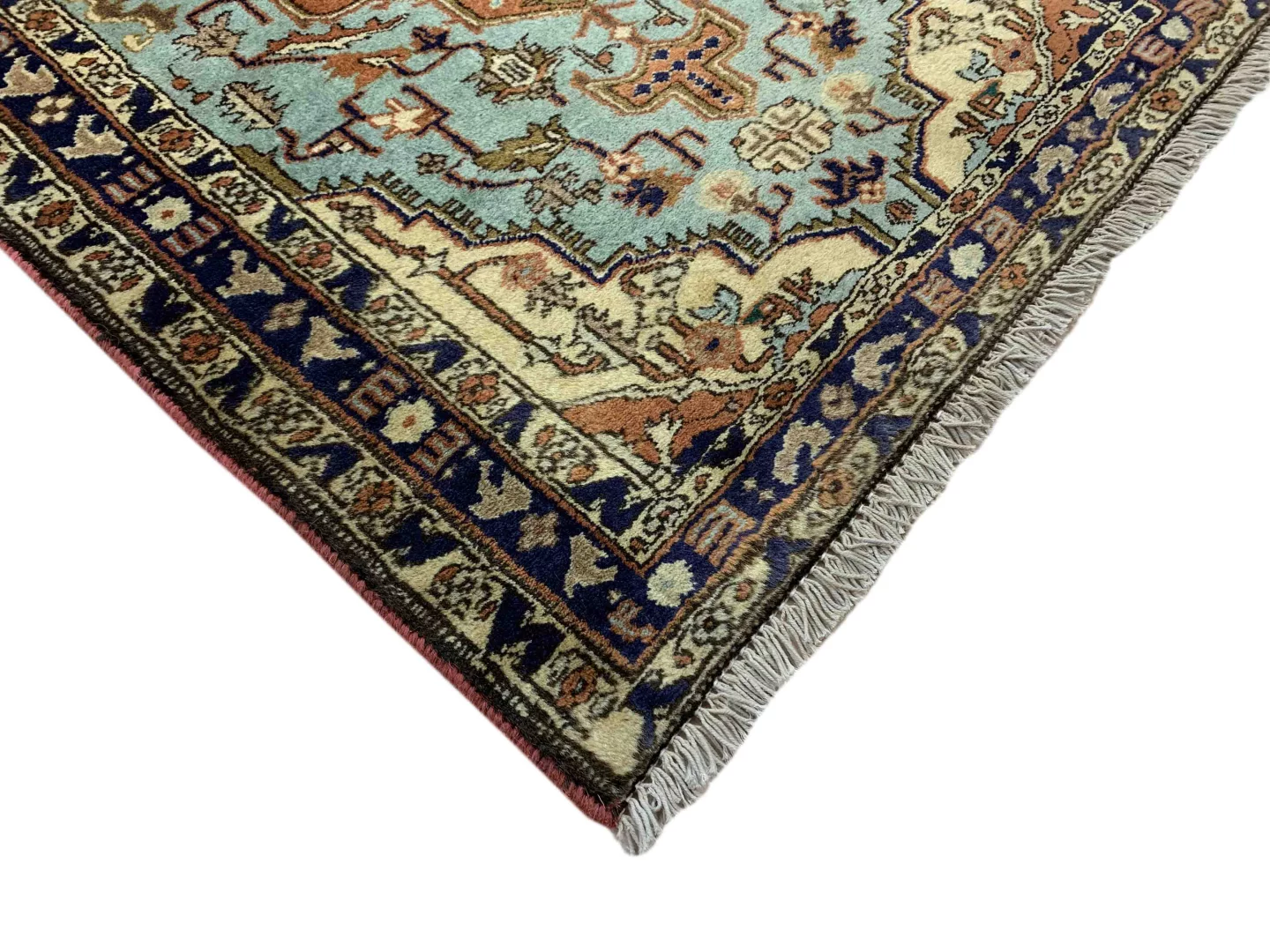
With a hand-knotted rug, the pattern is formed as the rug is made rather than applied afterwards. The sequence of coloured knots creates each line and defines the borders between fields. Small variations can contribute to the individual character of a handmade textile. The stated density of 120.000 to 200.000 knots per square metre indicates a finely articulated level of handwork, while it does not assign an unmentioned individual motif or formal layout to this rug.
Meshkin rugs are described with warm colour palettes. Red, brown and beige are named as colours that work together harmoniously. Red may serve as a principal field or an accent in a geometric composition, while brown and beige can balance the contrast between adjacent forms. These are the colours supplied in the description; no additional colours are introduced here.
Geometric designs can be perceived as an ordered whole from a distance, while closer viewing reveals the sequence of knots, the contour work and the transitions between coloured areas. Hand production therefore combines a coherent overall structure with visible detail. The design remains clearly organised without requiring a floral or figurative subject.
The pattern can also be understood within the broader diversity of Persian rugs. Tabriz and Isfahan are associated with different regional approaches, while Meshkin is particularly connected with geometric forms and Caucasian influence. Such distinctions explain why the individual centre names matter in a product description. They are also why this rug is described specifically as Meshkin with a geometric Caucasian design.
Special Features
The concrete features of this one-off rug are its hand-knotted manufacture, its pile of high-quality sheep wool, its knot density of 120.000 to 200.000 knots per square metre and its geometric Caucasian design. Its condition is stated as very good. The rug is also described as unique. No information is supplied about its age, signature or warp, so those details are not added to the description.
Its regional origin, natural wool and geometric drawing make the Meshkin designation clear. The rug combines a north-western Iranian place of origin with a visual language influenced by the Caucasus. Its compact format can be used in different interior settings, but no particular room or intended use is specified in the product information.
FAQ
How should I care for my Meshkin Persian rug?
Regular, gentle vacuuming helps remove loose dust and dirt from the pile. Cleaning should be carried out without placing unnecessary stress on the hand-knotted surface. If the rug becomes heavily soiled, professional cleaning is advisable. Direct sunlight should be avoided to help prevent the colours from fading. For stains or a full cleaning treatment, specialist care is appropriate because sheep wool and hand-knotted construction require a method suited to the material and textile structure.
Where do the materials for Meshkin rugs come from?
The materials used for Meshkin rugs come mainly from the area around Meshgin Shahr. The sheep wool used in the pile is obtained from local sheep. It is known for durability and good quality. The Meshkin tradition thus combines locally available natural wool with skilled manual production. For this particular rug, sheep wool is identified as the pile material; no statement is made about the material used for the warp.
What are the advantages of a hand-knotted Persian rug?
A hand-knotted Persian rug is made knot by knot, giving it an individual surface rather than the uniform appearance of an industrially manufactured product. The stated density of 120.000 to 200.000 knots per square metre supports detailed rendering of the design. Hand-knotted Persian rugs are also associated with durability and an individual visual character. In this case, the use of natural sheep wool is another characteristic of the traditional method of manufacture.
To provide the best experiences, we use technologies like cookies to store and/or access device information. Consenting to these technologies will allow us to process data such as browsing behavior or unique IDs on this site. Not consenting or withdrawing consent, may adversely affect certain features and functions.
Functional Always active
The technical storage or access is strictly necessary for the legitimate purpose of enabling the use of a specific service explicitly requested by the subscriber or user, or for the sole purpose of carrying out the transmission of a communication over an electronic communications network.
Preferences
The technical storage or access is necessary for the legitimate purpose of storing preferences that are not requested by the subscriber or user.
Statistics
The technical storage or access that is used exclusively for statistical purposes.The technical storage or access that is used exclusively for anonymous statistical purposes. Without a subpoena, voluntary compliance on the part of your Internet Service Provider, or additional records from a third party, information stored or retrieved for this purpose alone cannot usually be used to identify you.
Marketing
The technical storage or access is required to create user profiles to send advertising, or to track the user on a website or across several websites for similar marketing purposes.

 SECURE PAYMENT
 SHIPPING PARTNERS