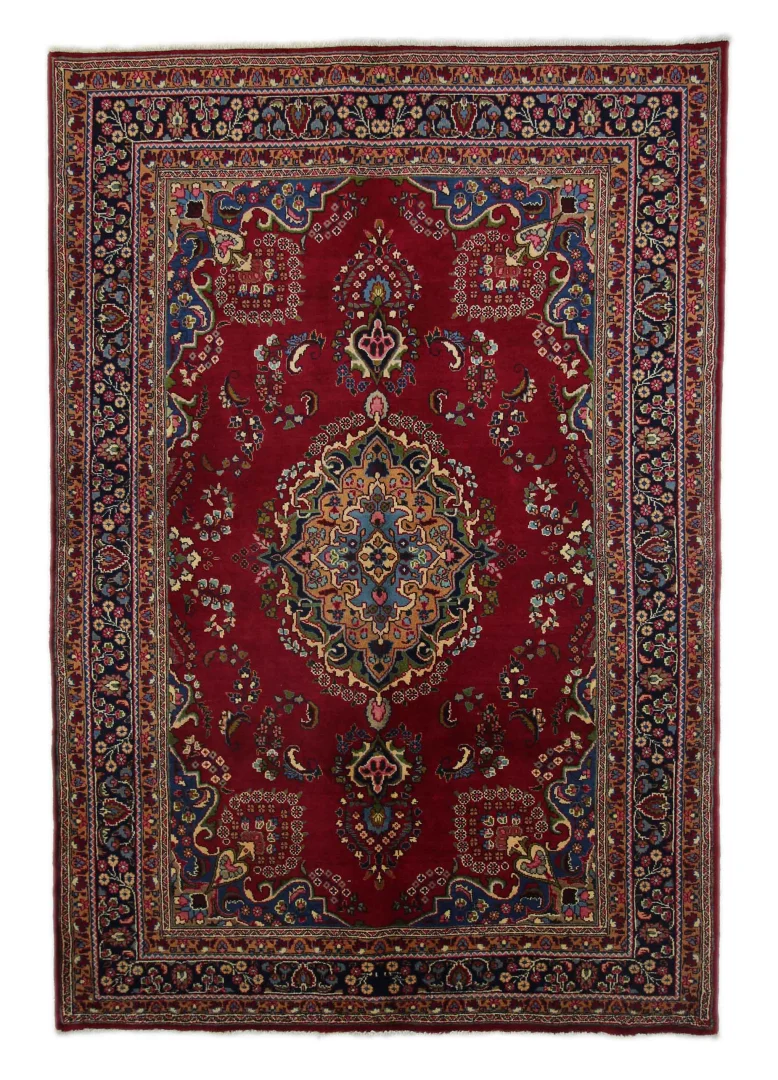
This Mashhad Persian rug is hand-knotted and has a pile made from high-quality wool. Wool defines the visible surface and gives it a naturally textured textile character. A hand-knotted rug is not produced by printing or by a purely industrial weaving process. Individual knots are placed into a prepared foundation, allowing the design to be built gradually across the field. The result is a handmade construction in which the pattern and the structure of the pile are closely connected.
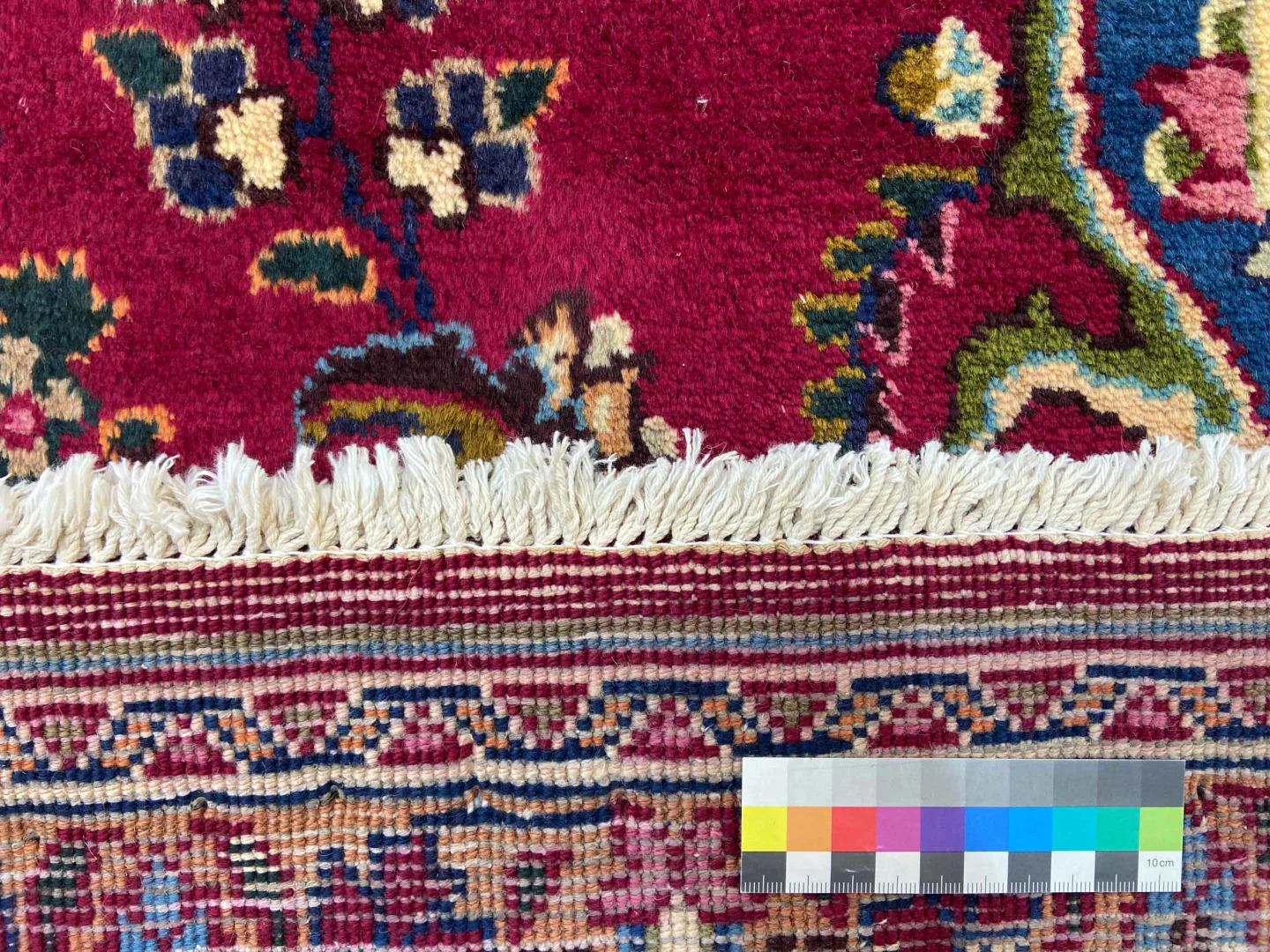
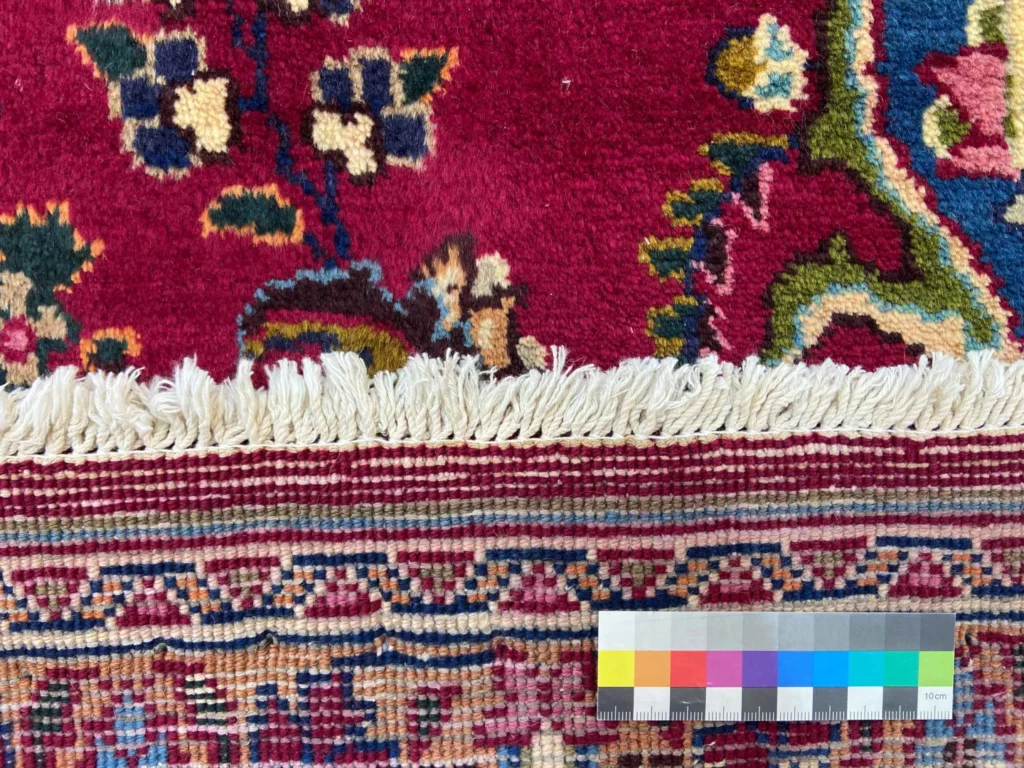
The rug has a knot density of 180,000 to 250,000 knots per square metre. A dense knot structure supports the precise rendering of floral details and helps the central medallion retain a clearly defined outline. Knot density is one of the technical features used to describe the fineness of a hand-knotted rug. It does not establish an age or add an origin that has not been stated, but it does explain how closely the individual elements of the design can be set within the field.
Wool is traditionally used for rug pile because it combines a resilient surface with a comfortable feel. As the pile material, it carries the colours and ornaments that make up the design. It can also provide a warm, substantial handle typical of a wool rug. No additional material is assigned to this particular piece. Its stated material is high-quality wool, and its technique is hand-knotting.
The condition is described as very well preserved. This is part of the specific description of the rug, alongside its material, construction and design. No details are given about a signature, an exact age, restoration work or particular areas of wear, so those points are not added here. The rug remains a one-off example of a hand-knotted Mashhad design.
Origin and Tradition
Mashhad is located in eastern Iran and is one of the important centres of Persian carpet culture. It is also a major historical and cultural city in the wider Khorasan region. Rugs associated with Mashhad are named after this place of origin. Their tradition links the long history of Persian ornament with regional workshop practices, particularly the use of carefully organised floral compositions and designs arranged around a central focus.
Carpet making in Mashhad belongs to the broader textile heritage of Iran. In a traditional workshop, a design plan guides the arrangement of colours, outlines and knots. The weaver then transfers that plan row by row into the foundation. Finer knotting allows leaves, flowers, stems and borders to be rendered with greater definition. The quality of the final structure depends on several practical steps, including the preparation of the wool, the handling of the foundation and the maintenance of an even tension while the work progresses.
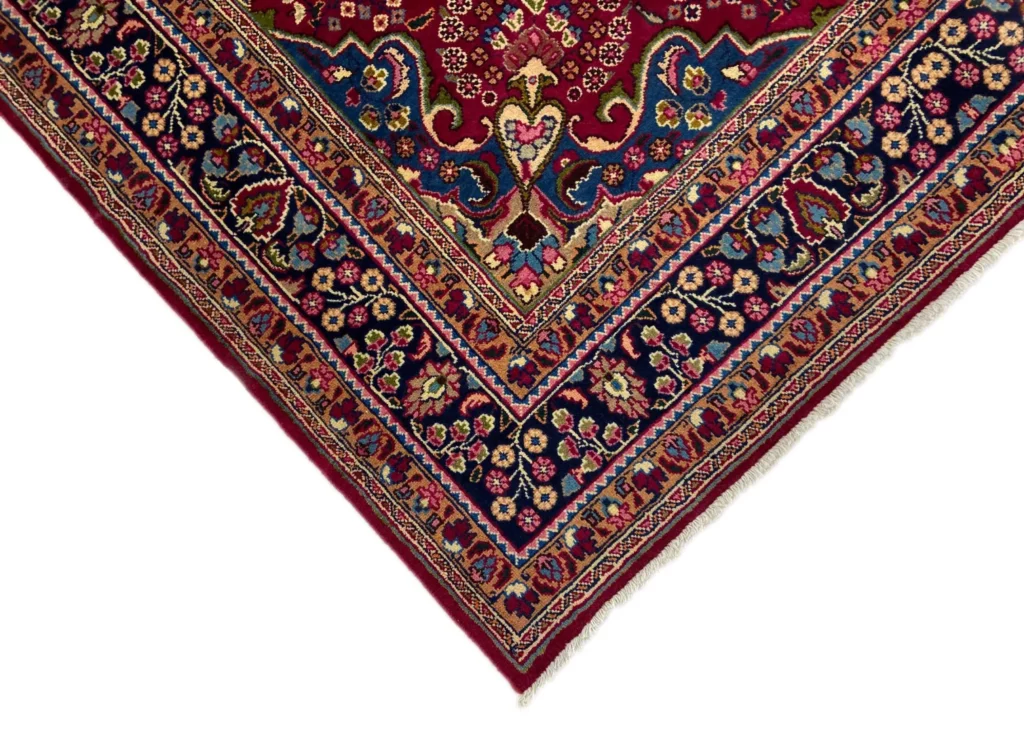
Mashhad rugs are often associated with a red-dominant ground. Red can serve as the principal field colour in Persian carpet design, giving the surrounding ornaments a strong and coherent background. Blue and purple may be used to create contrast, separate individual forms or continue the colour rhythm through secondary motifs and borders. Red, blue and purple are the colours specified for this rug. That palette is a description of the piece and does not imply a particular dye recipe or production date.
Persian carpet tradition is made up of many regional approaches rather than one uniform visual language. Workshops in different cities developed their own preferences for field organisation, border treatment, floral forms and medallion design. Mashhad is associated with a style in which floral patterning and careful, dense knotting are closely related. Here, Mashhad identifies the rug’s regional origin; it is not simply the name of the pattern.
Other Persian centres illustrate the breadth of this tradition. Kerman is known for varied floral compositions and designs that may include geometric organisation. Tabriz is associated with a broad repertoire that can include floral, figurative, landscape and hunting subjects. Isfahan is recognised for finely articulated compositions made in wool and, in some examples, silk. Nain and Kashan are also established names in Persian rug production. These references provide cultural context only. They do not alter the Mashhad origin of this particular rug.
Design and Pattern
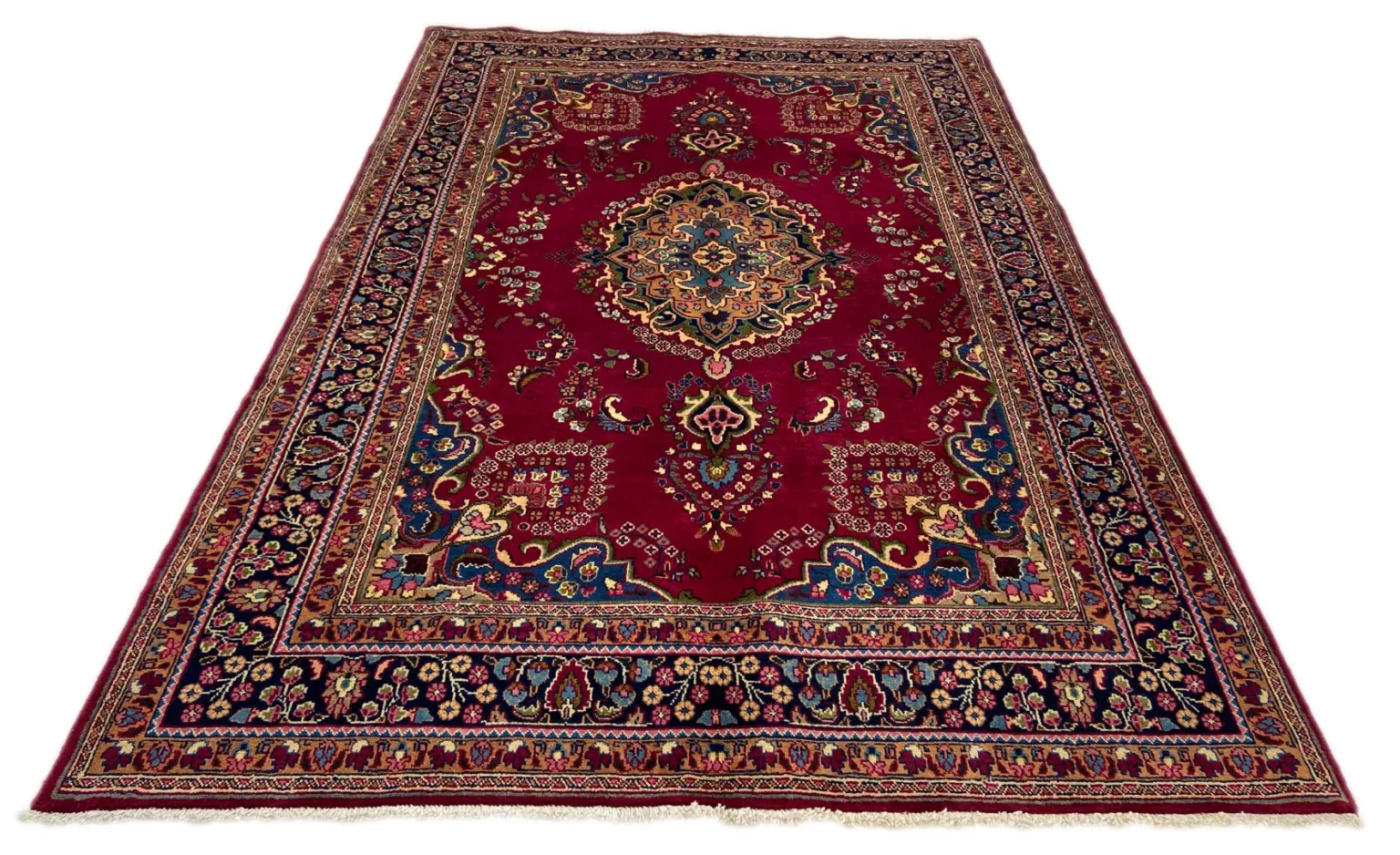
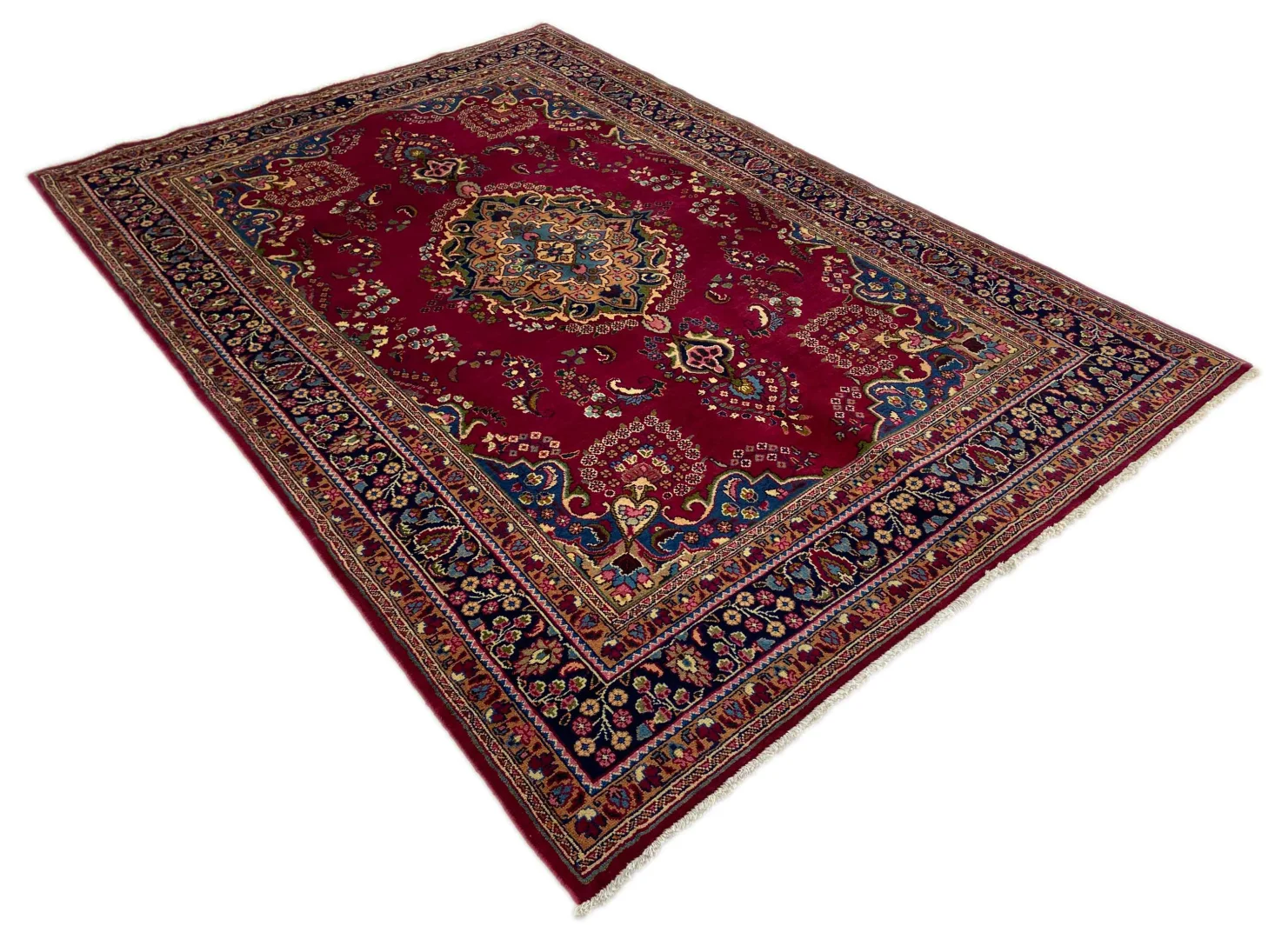
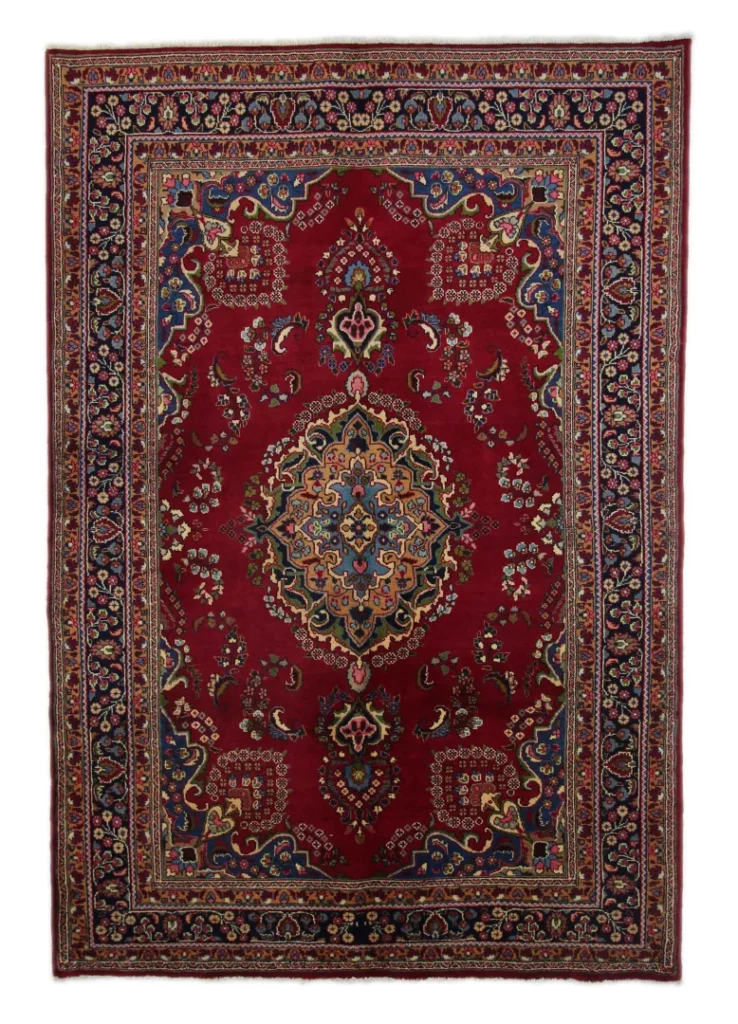
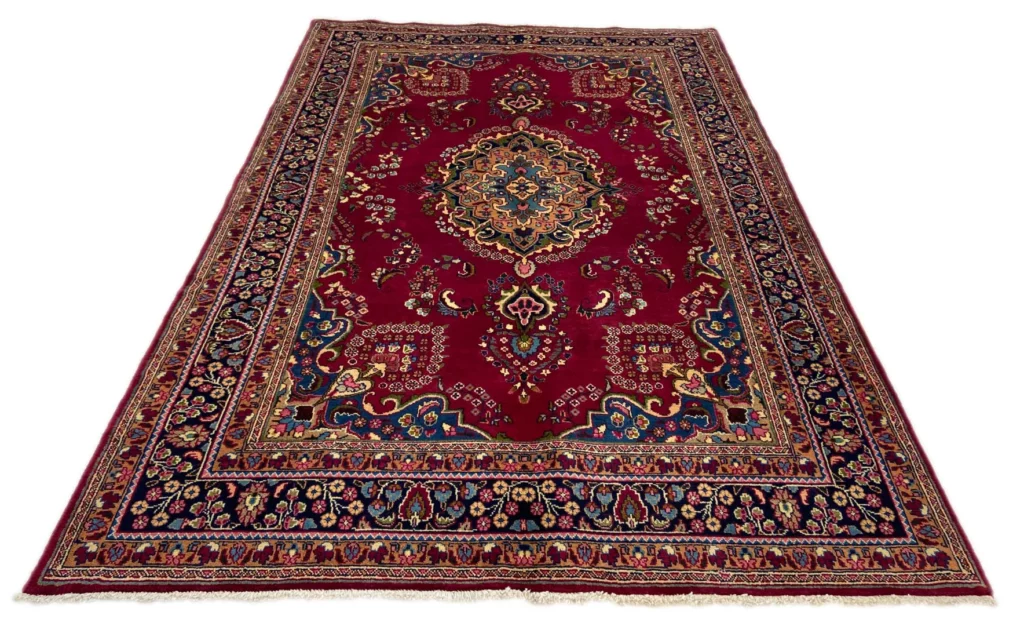
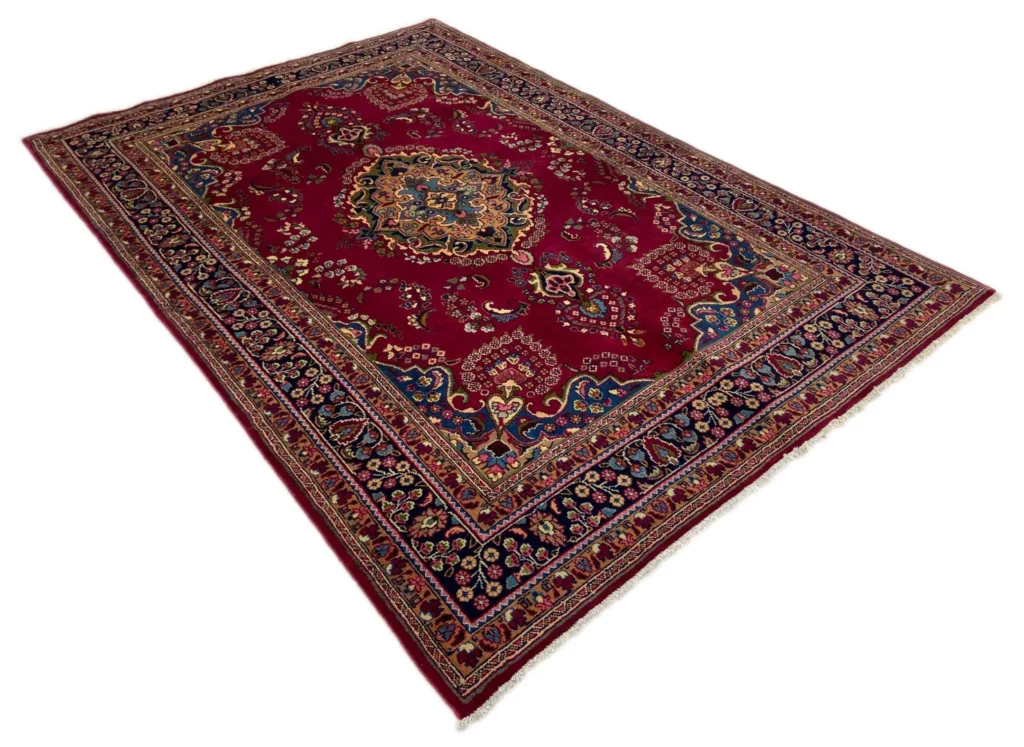
The design of this rug is floral and centred on a classic medallion. In carpet design, a medallion acts as the visual centre of the field. It may be circular, oval, polygonal or composed of several interlocking outlines, and it organises the motifs around it. A classic arrangement often uses balanced elements on either side of the centre, creating a stable structure while the surrounding floral details give the composition movement.
Floral ornament does not necessarily reproduce plants realistically. Persian weavers transform flowers, leaves, vines and branches into stylised units that can be repeated, mirrored or connected. These elements may surround a medallion, extend across the field or appear within the borders. Hand-knotting makes it possible to build such motifs from many small changes in colour and outline. The pattern is therefore read as a connected ornamental system rather than as a collection of isolated flowers.
The palette of red, blue and purple shapes the character of the design. Red provides the dominant visual foundation, while blue and purple introduce contrast and accents within the floral arrangement. Darker passages can reinforce the outlines of the medallion or individual leaves, while adjoining tones can separate flowers and scrolling stems. The colours are stated for this rug as a whole; no further claim is made about a special dyeing method, colour age or source of the pigments.
A medallion design can be organised around a strong central axis. Motifs may relate to one another across the length and width of the field, while the floral details prevent the composition from appearing rigid. Borders commonly frame the central area and create a transition toward the outer edge. The available description confirms the floral design with a classic medallion, but does not specify the number or detailed arrangement of individual borders. Those unprovided details are intentionally left open.
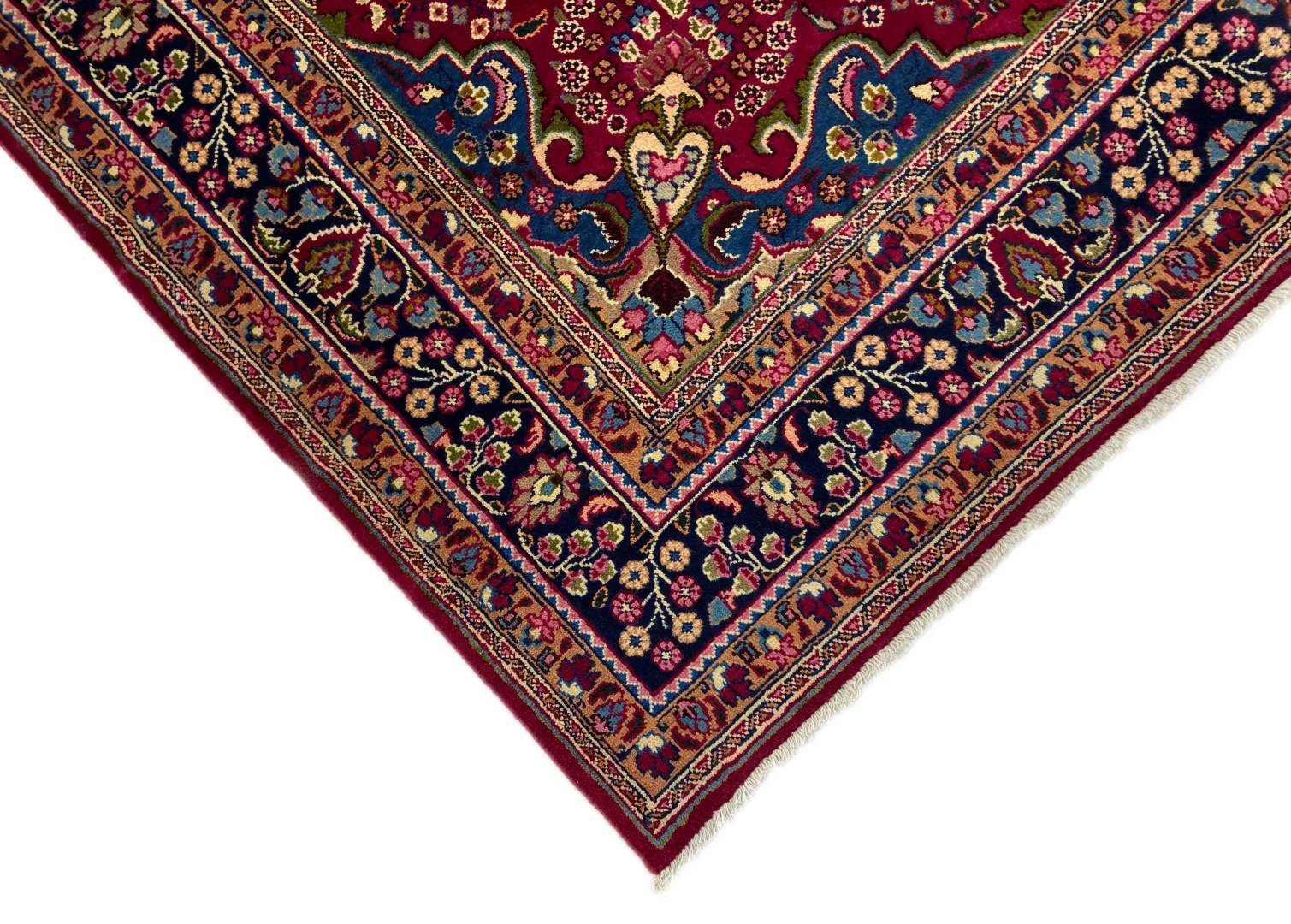
The relatively dense knotting supports the rendering of small ornamental features. When viewed closely, a finely knotted rug reveals the repeated structure from which the contours of flowers, leaves and medallion forms are built. From farther away, these individual parts merge into a unified field with a clear centre. This combination of technical precision and ordered floral design helps explain the visual language associated with Mashhad rugs without adding unrecorded details to this one-off piece.
Special Features
The specific features of this rug are its hand-knotted construction, high-quality wool pile, knot density of 180,000 to 250,000 knots per square metre, and floral pattern with a classic medallion. Its listed colours are red, blue and purple. The rug is very well preserved. These details describe the offered piece itself. No additional claim is made about its age, signature, restoration history or a more specific provenance.
The combination of dense knotting and a central floral design makes both the technical and visual structure easy to identify. The medallion gives the field a centre, while flowers and plant forms develop the surrounding composition. The wool pile preserves the tactile character associated with a hand-knotted rug. As an individual piece, this particular combination of format, colour palette, material, design and condition belongs to this rug alone.
Careful handling helps preserve the surface and colour balance of a wool rug. Regular gentle vacuuming can remove loose dust before it settles into the pile. If more intensive cleaning is necessary, professional rug cleaning is appropriate for a hand-knotted wool construction. Strong direct sunlight should be avoided because continued exposure can fade colours over time. No other special treatment is specified for this rug.
FAQ
How should I care for my Mashhad Persian rug?
A Mashhad Persian rug with a wool pile should be vacuumed regularly and gently so that loose dust does not become embedded in the surface. The vacuum should be used without an aggressive rotating brush. For heavier soiling, professional cleaning suited to hand-knotted wool rugs is recommended. Prolonged direct sunlight should be avoided, since it may gradually affect the intensity of red, blue and purple. Stains should not be treated with unsuitable household products, as an incorrect treatment can affect both the pile and the colours.
Where do Mashhad Persian rugs come from?
Mashhad Persian rugs come from Mashhad in eastern Iran. The city is an important centre of Persian carpet making and has a long regional textile tradition. The name therefore refers to the rug’s place of origin rather than merely to a floral pattern. The type is associated with the combination of floral ornament, a classic medallion and careful hand-knotted workmanship. Other recognised centres, such as Kerman, Tabriz or Isfahan, may use related design ideas, but they do not change the Mashhad origin of this particular rug.
What sizes are available for Mashhad Persian rugs?
Mashhad Persian rugs are made in a range of formats, from smaller runners to larger rugs intended for living rooms, bedrooms or dining rooms. The individual piece is described with its own specific size and should not be treated as a general size statement for all Mashhad rugs. When choosing a format, room proportions, furniture placement and the desired visibility of the medallion are useful considerations. These practical points help place a particular rug within the wider variety of Mashhad production without assigning an unreported format to any other piece.
To provide the best experiences, we use technologies like cookies to store and/or access device information. Consenting to these technologies will allow us to process data such as browsing behavior or unique IDs on this site. Not consenting or withdrawing consent, may adversely affect certain features and functions.
Functional Always active
The technical storage or access is strictly necessary for the legitimate purpose of enabling the use of a specific service explicitly requested by the subscriber or user, or for the sole purpose of carrying out the transmission of a communication over an electronic communications network.
Preferences
The technical storage or access is necessary for the legitimate purpose of storing preferences that are not requested by the subscriber or user.
Statistics
The technical storage or access that is used exclusively for statistical purposes.The technical storage or access that is used exclusively for anonymous statistical purposes. Without a subpoena, voluntary compliance on the part of your Internet Service Provider, or additional records from a third party, information stored or retrieved for this purpose alone cannot usually be used to identify you.
Marketing
The technical storage or access is required to create user profiles to send advertising, or to track the user on a website or across several websites for similar marketing purposes.
 SECURE PAYMENT
 SHIPPING PARTNERS


