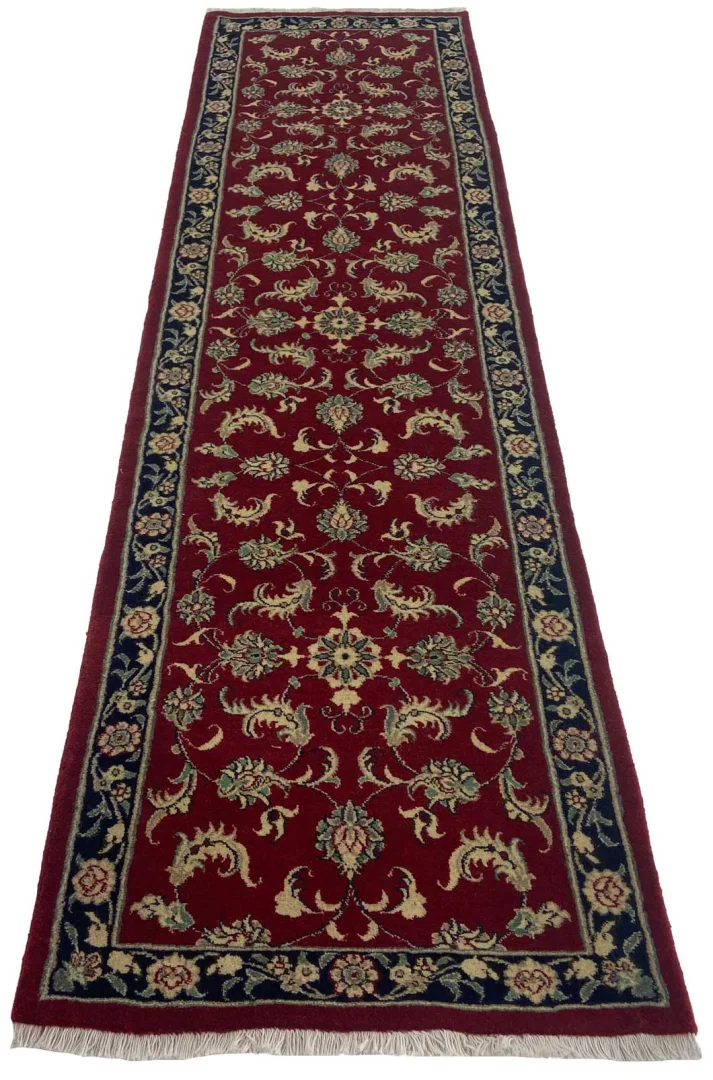
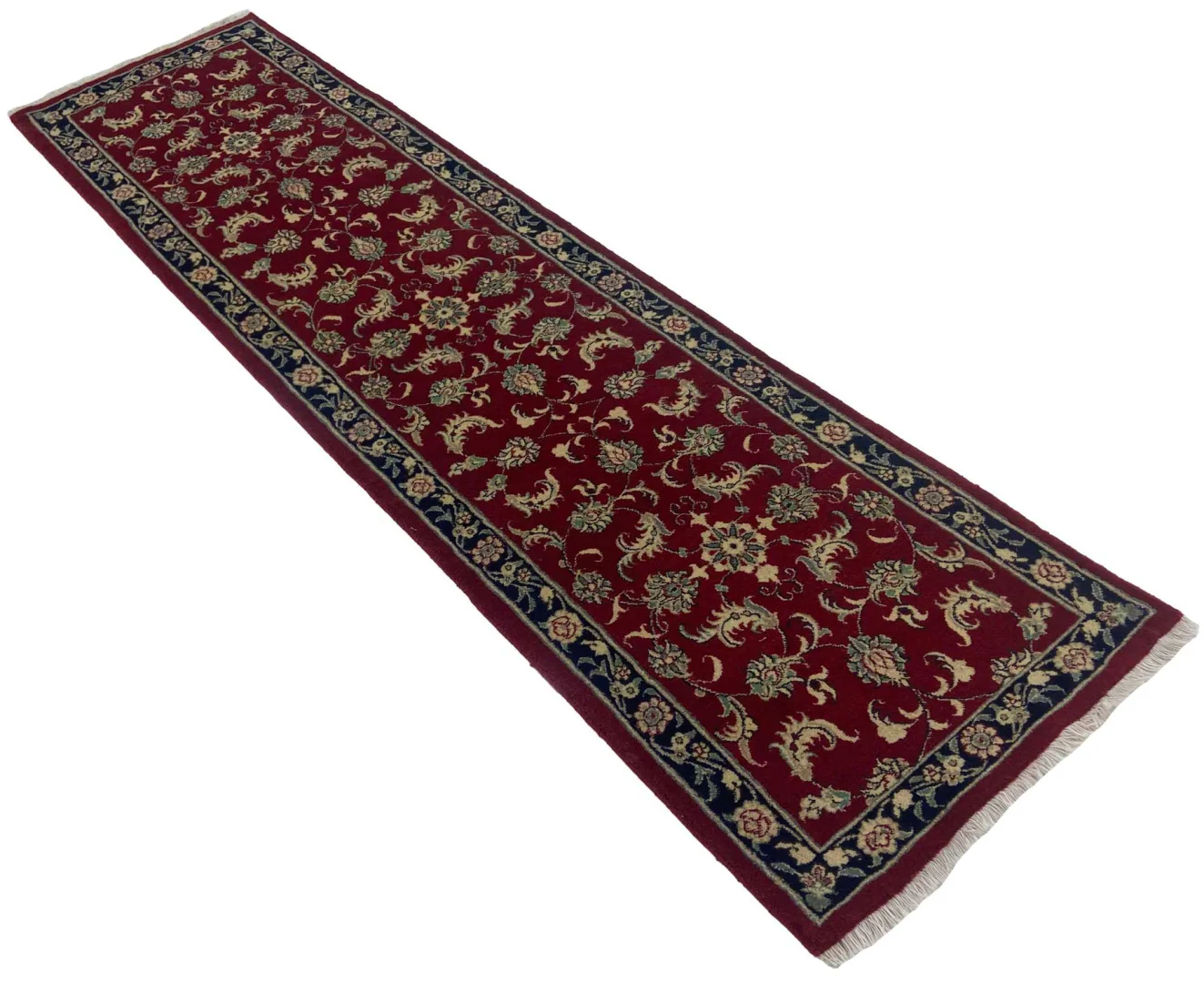
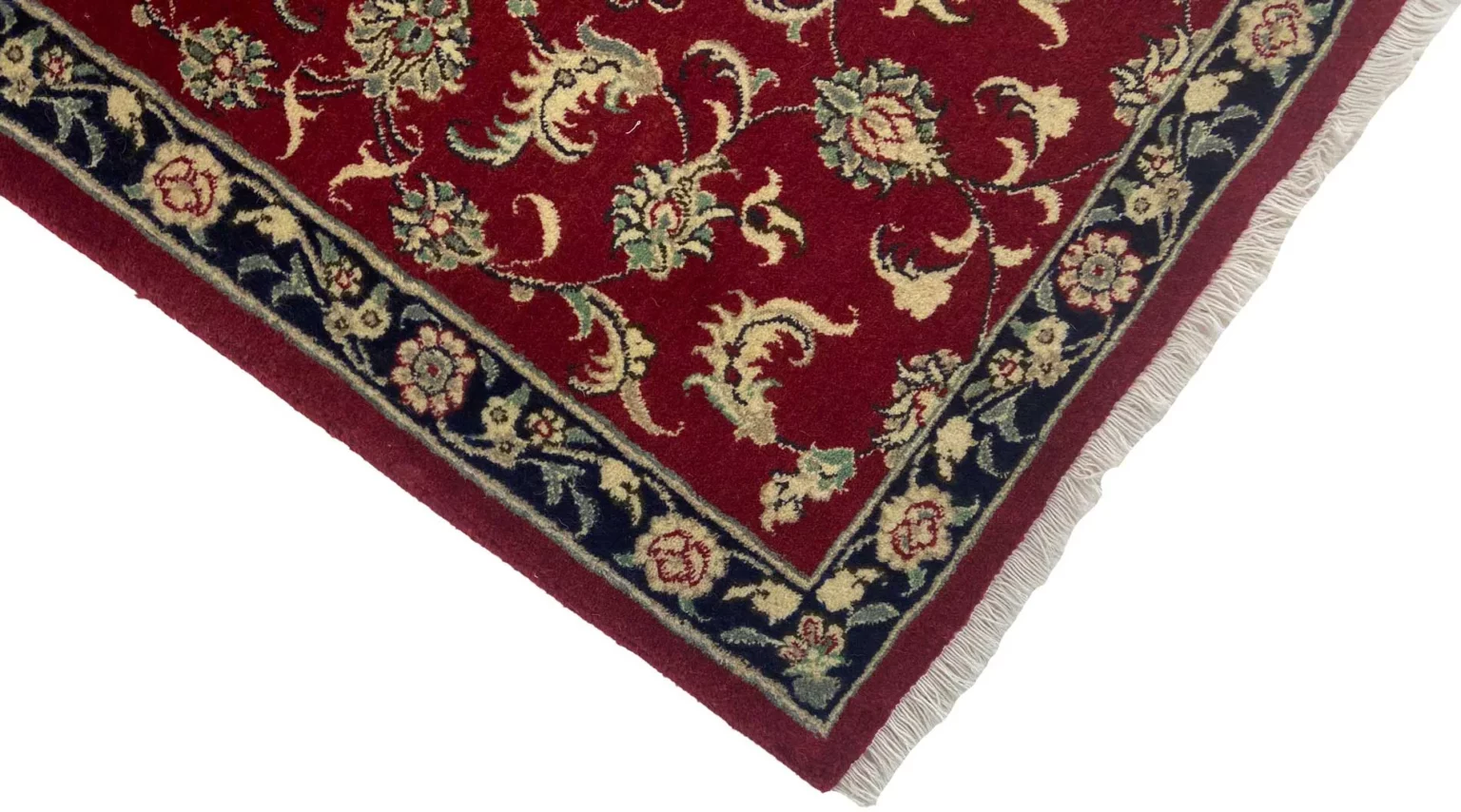
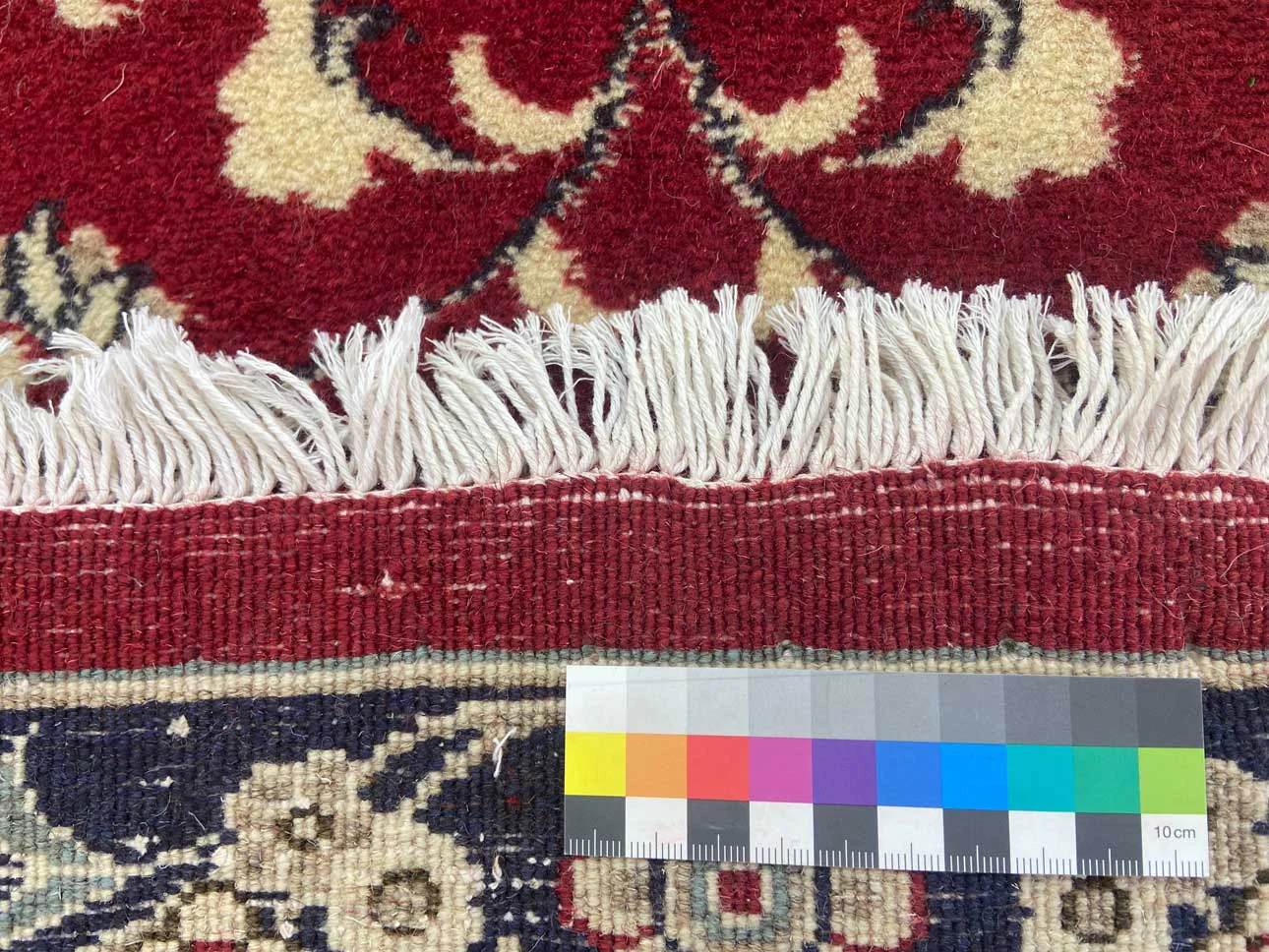
This Maschhad Persian rug is hand-knotted with a pile made from high-quality wool. The work is built knot by knot, with each knot contributing to the woven structure and to the visible drawing of the design. A hand-knotted rug is not printed or painted after completion: its pattern is created through the placement and colour of the individual knots. Once the knotting is finished, the pile is generally trimmed and levelled so that the outlines of the medallion and floral details can be read clearly. Careful handling is required to keep the lines and colour areas consistent throughout the composition.
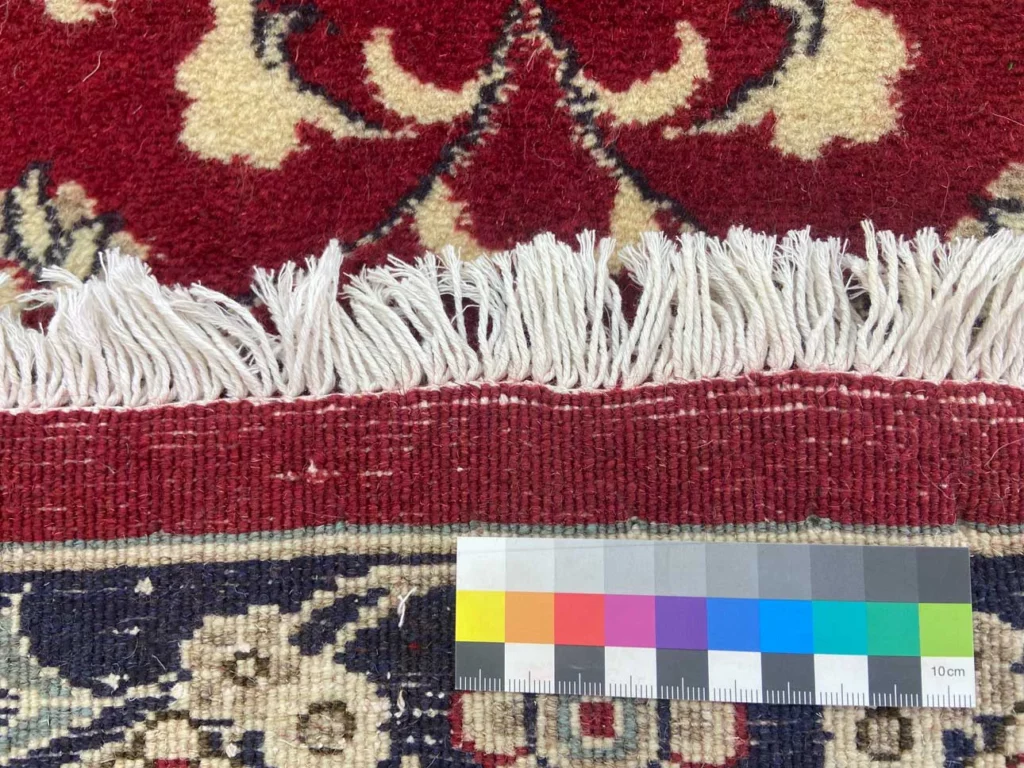
The recorded knot density is 180.000 to 250.000 knots per square metre. This density gives a weaver room to render curved vines, leaves and blossoms with differentiated outlines. Wool provides a natural, pleasantly tactile pile and is a long-established material in rug making. It can absorb colour well and gives the surface a distinct handle. For this particular rug, high-quality wool is specified as the pile material.
Hand knotting and wool work together in the finished surface. The knots provide the technical framework, while the wool determines much of the touch and appearance of the pile. A floral drawing with a central medallion requires control over small changes in line and colour. Variations in knot placement can define the edge of a leaf, the curve of a vine or the separation between a flower and its surrounding field. The stated density therefore relates directly to the level of detail that can be expressed in the design.
Maschhad rugs can also be made with wool, silk or a combination of the two. These materials create different effects in handle, surface sheen and softness. That wider tradition does not alter the material specification of this piece: its pile is described as high-quality wool. The rug’s construction is hand-knotted, and its condition is described as very well preserved.
Origin and Tradition
Maschhad is one of the major cities of Persia and an important centre of Persian rug making. Maschhad rugs are associated with carefully worked compositions, strong colour, and a rich vocabulary of floral ornament. The city lies in northeastern Iran, where a long weaving tradition brought together workshop practice, inherited design knowledge and detailed hand craftsmanship. The name Maschhad therefore refers to a distinct regional tradition rather than simply to a decorative style.
Rug making in Maschhad belongs to a culture in which textiles served both practical and representative purposes. Knowledge of preparing the foundation, setting the knots, trimming the pile and finishing the edges was transmitted through workshops and families. Repeated design structures made it possible to maintain a recognisable regional character while still allowing individual compositions to vary. The work demanded patience because a large number of small decisions had to remain coherent across the whole field.
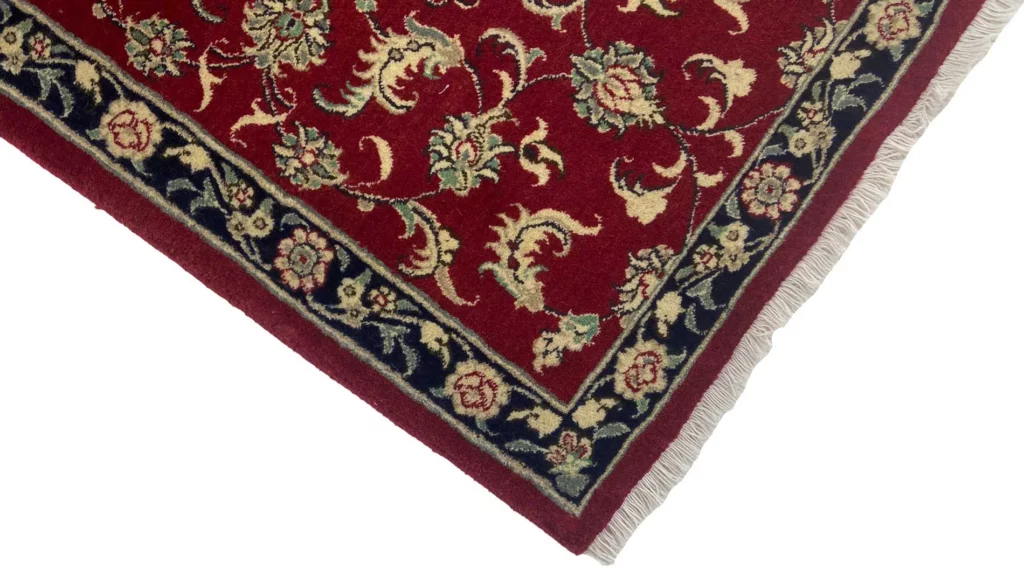
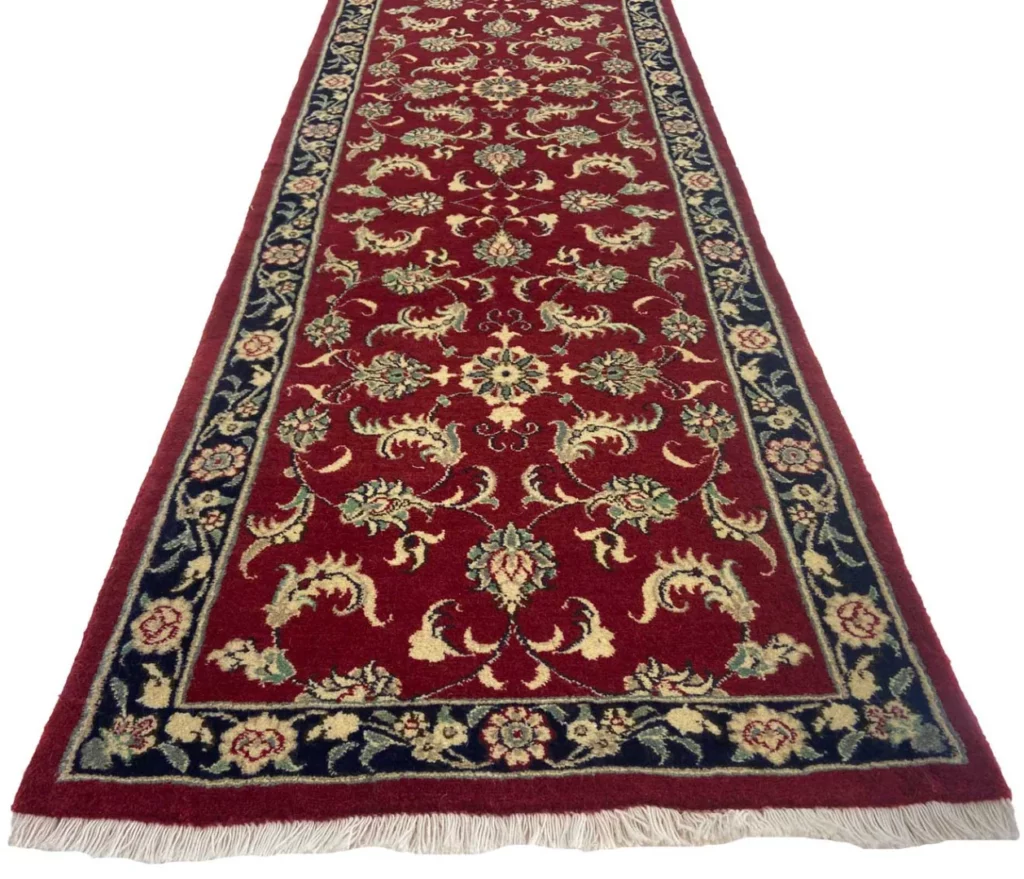
Strong colour is an important part of the visual language often associated with Maschhad rugs. Deep red is a frequently encountered ground colour, combined with shades such as blue and purple. These colours may establish contrasts between the field, the border and the ornament. They also give floral motifs a clear presence without separating them from the overall composition. The palette recorded for this rug is red, blue and purple, a combination that reflects this characteristic relationship between warm ground tones and cooler accents.
Regional rug traditions are often discussed alongside one another. Tabriz rugs are known for detailed designs and high knot densities, Nain rugs are often associated with fine patterns and the use of wool and silk, and Kerman rugs offer a broad range of floral compositions. Each centre has its own history and working vocabulary. Such comparisons help explain the diversity of Persian weaving, but they do not change the origin of an individual piece. This rug is a Maschhad Persian rug.
The hand-knotted tradition also connects the rug with a wider history of Persian textile production. Designs could be developed from established patterns, adapted in workshops and refined through repeated use. A central medallion, organised borders and floral filling motifs provided a dependable framework for balancing a composition. Within that framework, differences in scale, line, colour and knot density produced distinct results. The rug’s floral medallion design belongs to this broader tradition of ordered yet detailed Persian ornament.
Design and Pattern
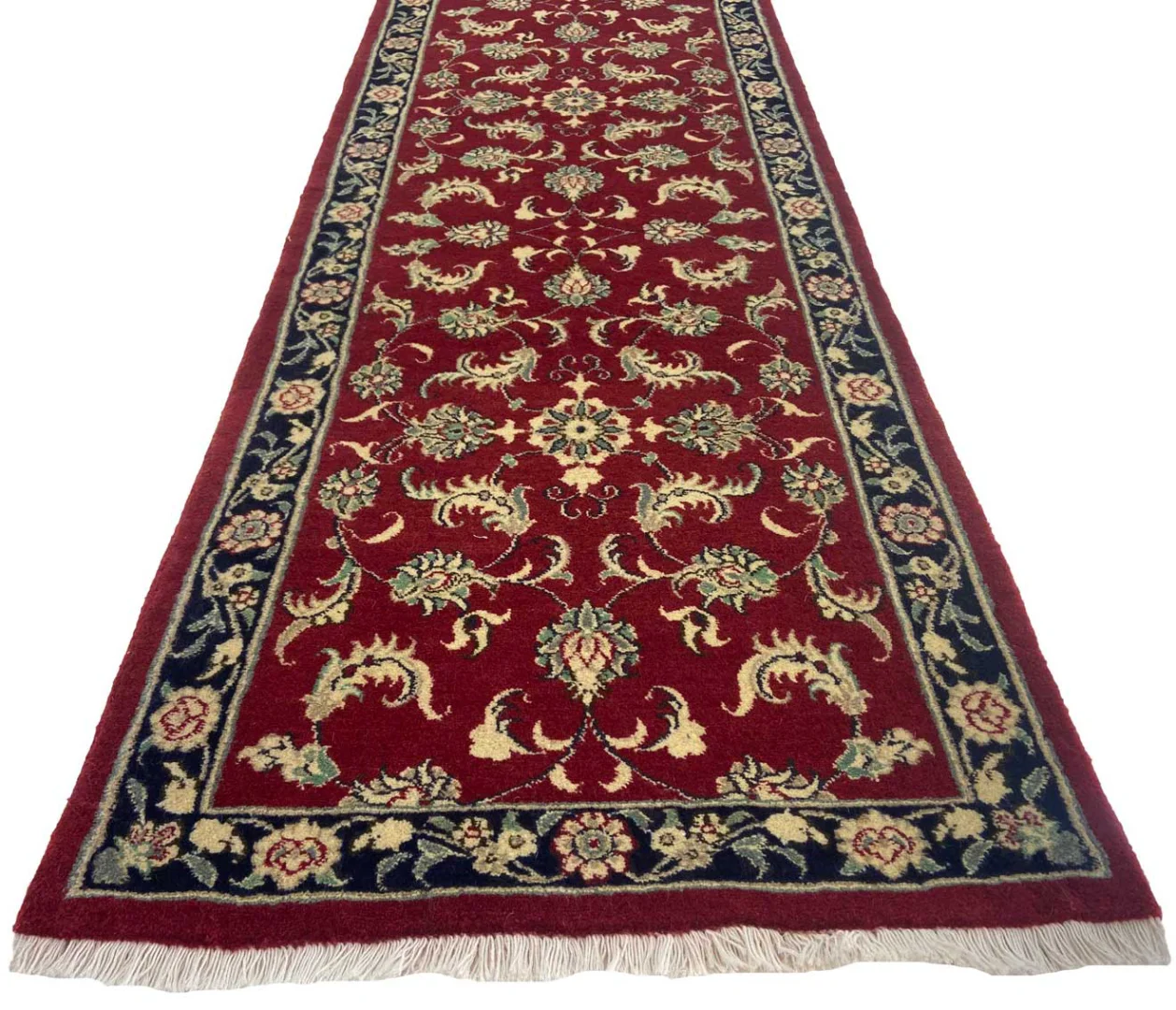
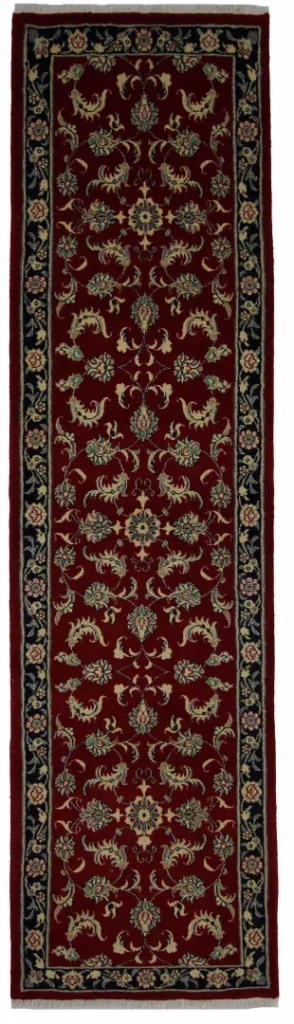
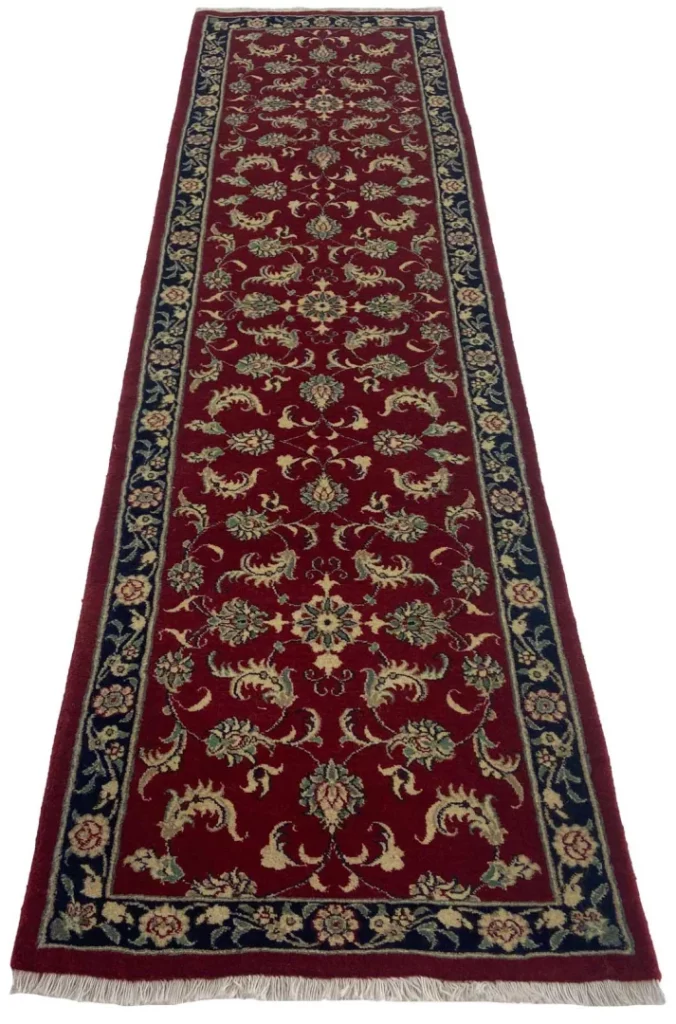
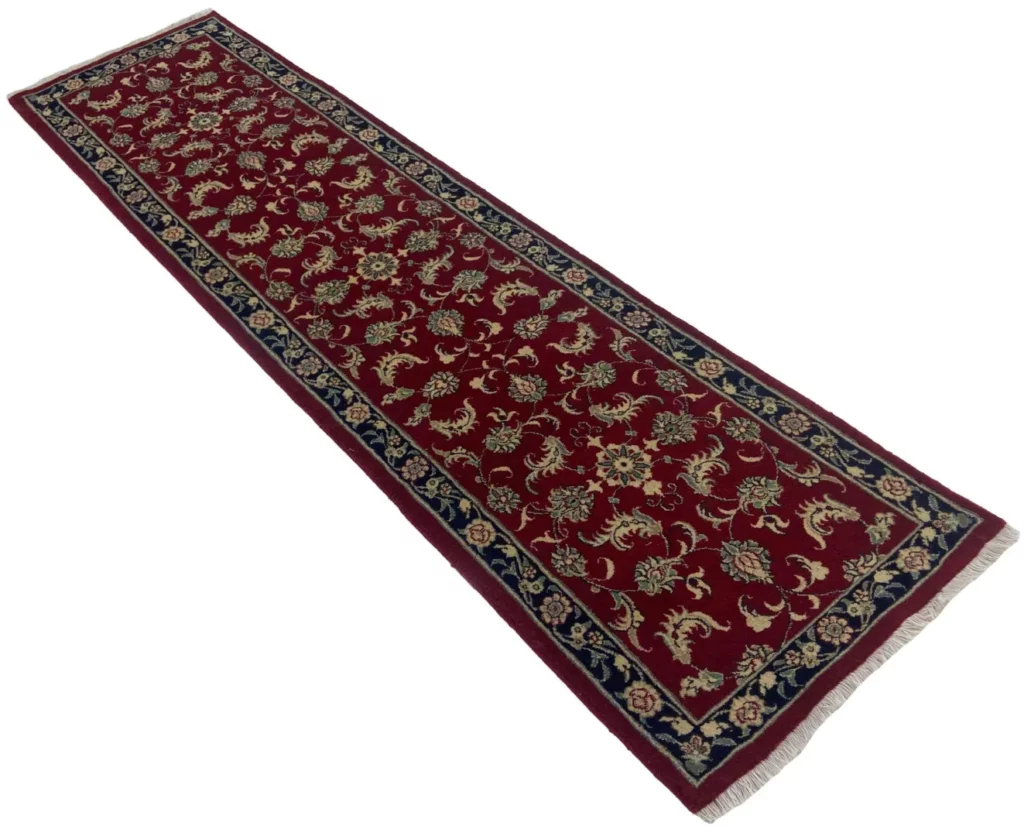
The design of this rug is floral and includes a classic medallion. A medallion establishes a visual centre and gives the field a clear internal order. Floral elements can then be arranged around it, with blossoms, leaves and curling vines leading the eye from the centre towards the surrounding field. The result is a composition in which the central form and the surrounding ornament support one another rather than appearing as separate motifs.
Floral designs are among the defining elements of Persian rugs. They may suggest plants and flowers while remaining deliberately stylised. A blossom becomes a repeatable ornamental sign, a leaf gives direction to a line, and a vine links individual motifs across the field. This approach allows the design to appear detailed without depending on a literal botanical image. Repetition creates rhythm, while changes in scale prevent the pattern from becoming visually uniform.
The classic medallion changes the structure of a floral design by creating a distinct focal point. In an all-over pattern, the eye can travel evenly across the surface; a medallion introduces a hierarchy between centre, field and border. The border frames the interior and gives the composition a defined outer edge. Additional narrow bands may accompany a principal border, creating transitions between the central field and the final edge. These structural devices are common ways of organising a Persian rug design.
The colours specified for this piece are red, blue and purple. Red can provide a warm foundation for the composition, while blue introduces a cooler counterpoint. Purple adds another deep tone between and alongside these colour families. Together, the three colours can distinguish the medallion, floral details and surrounding field while maintaining a coherent overall palette. Colour repetition across the ornament helps connect the central design to the border.
Knot density supports the drawing of a pattern by allowing lines and colour changes to be placed at a smaller scale. In a medallion design, carefully controlled contours help the central form remain balanced. In a floral field, repeated knots define the edges of leaves, petals and vines. The density recorded for this rug is 180.000 to 250.000 knots per square metre, and the design is described as a floral composition with a classic medallion.
Maschhad patterns are not limited to one arrangement. Alongside central medallions, the tradition includes floral fields with different degrees of repetition and emphasis. What links many of these designs is the combination of a recognisable structure with numerous ornamental details. This rug presents that relationship through a classic central medallion, floral decoration, and a red, blue and purple palette.
Special Features
The documented features of this one-off rug are its hand-knotted construction, high-quality wool pile, knot density of 180.000 to 250.000 knots per square metre, and floral design with a classic medallion. Its colours are red, blue and purple. The rug is very well preserved. These details describe the material, technique, pattern, colours and condition of this individual piece.
For care, regular vacuuming without a brush is recommended. Direct sunlight should be avoided to help preserve the colours. Occasional professional cleaning can support the preservation of the colours and structure. These measures are appropriate for the care of a hand-knotted wool rug and are separate from the design characteristics of the piece.
FAQ
How should I care for a Maschhad Persian rug?
A Maschhad Persian rug should be vacuumed regularly and gently, preferably without a brush attachment. This removes loose dust while placing less strain on the wool pile. Direct sunlight should be avoided because prolonged strong exposure may affect the appearance of the colours. Occasional professional cleaning is also recommended. Specialist cleaning can help maintain the colours and the structure of a hand-knotted rug. If a spill occurs, vigorous rubbing should be avoided; careful professional treatment is the safer option for preserving the pile and the visible pattern.
Which materials are used for Maschhad Persian rugs?
Maschhad Persian rugs are made primarily from high-quality wool, silk, or a combination of both. Wool gives the pile a pleasant handle and is a well-established material for durable hand-knotted surfaces. Silk can contribute a finer sheen and an especially soft feel. The effect depends on the particular material combination and the way the rug is made. High-quality wool is specified for the pile of this rug, so its surface and touch are determined by the qualities of wool. The broader use of silk in Maschhad weaving does not change this piece’s stated material.
How do Maschhad rugs differ from other Persian rugs?
Maschhad rugs are known for deep colours, floral designs and high knot densities. Classic medallions are often used to give the field a pronounced centre. Compared with Tabriz or Nain rugs, Maschhad rugs may feature a more emphatic medallion design and are valued for their robustness. Tabriz is especially associated with detailed designs and high knot densities, while Nain is often connected with fine patterns and a combination of wool and silk. These are distinctions between regional traditions; the rug described here belongs to the Maschhad tradition.
To provide the best experiences, we use technologies like cookies to store and/or access device information. Consenting to these technologies will allow us to process data such as browsing behavior or unique IDs on this site. Not consenting or withdrawing consent, may adversely affect certain features and functions.
Functional Always active
The technical storage or access is strictly necessary for the legitimate purpose of enabling the use of a specific service explicitly requested by the subscriber or user, or for the sole purpose of carrying out the transmission of a communication over an electronic communications network.
Preferences
The technical storage or access is necessary for the legitimate purpose of storing preferences that are not requested by the subscriber or user.
Statistics
The technical storage or access that is used exclusively for statistical purposes.The technical storage or access that is used exclusively for anonymous statistical purposes. Without a subpoena, voluntary compliance on the part of your Internet Service Provider, or additional records from a third party, information stored or retrieved for this purpose alone cannot usually be used to identify you.
Marketing
The technical storage or access is required to create user profiles to send advertising, or to track the user on a website or across several websites for similar marketing purposes.

 SECURE PAYMENT
 SHIPPING PARTNERS


