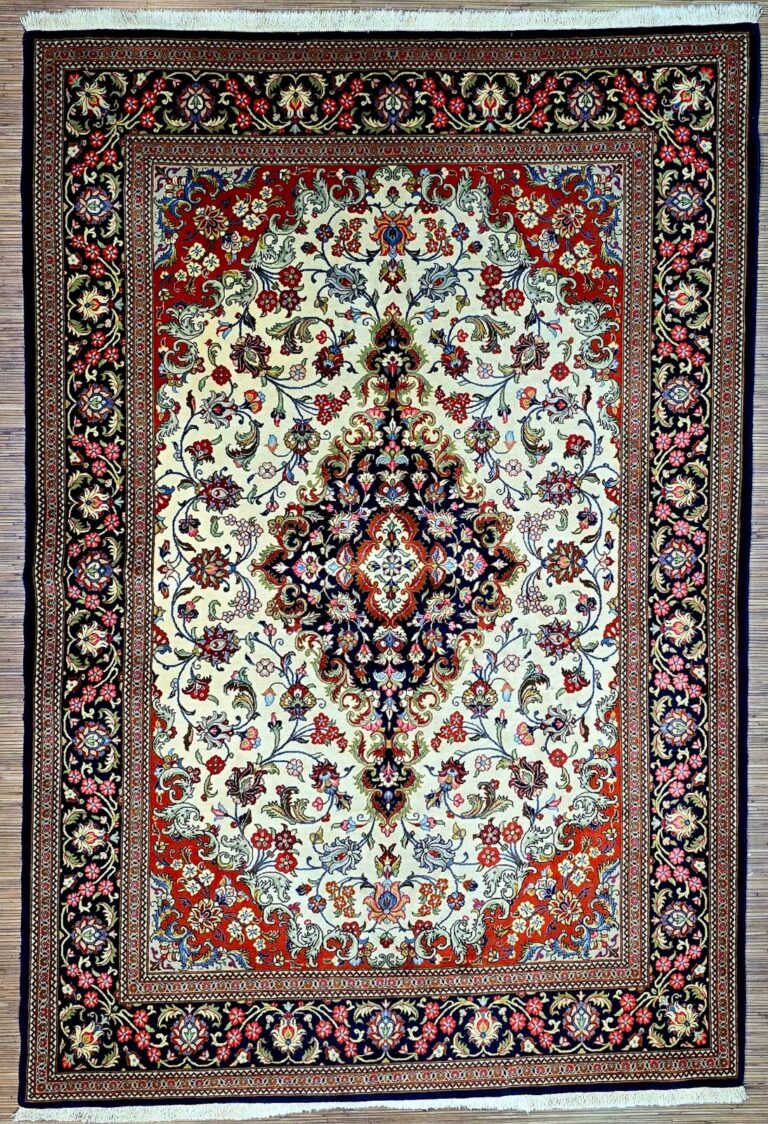
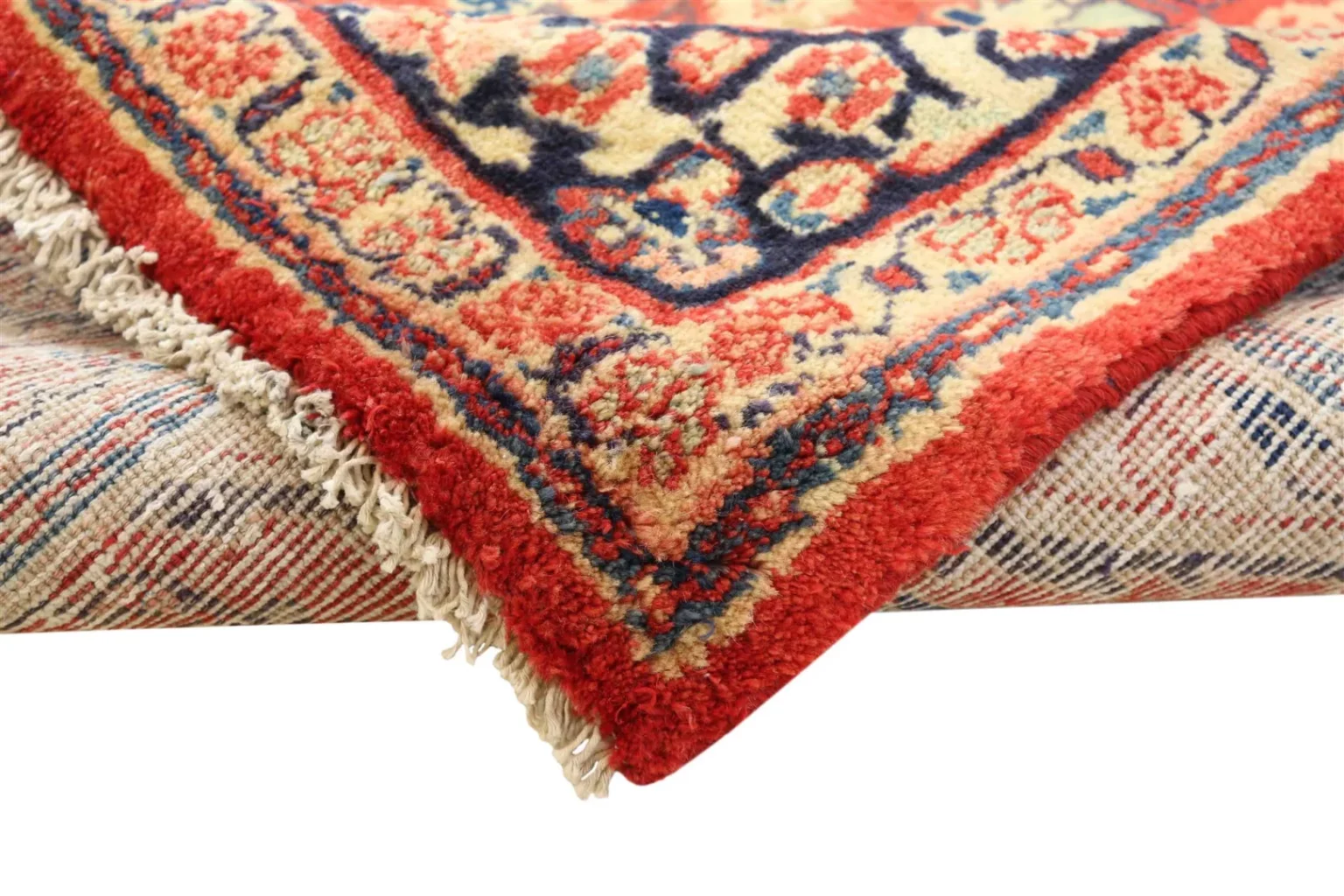
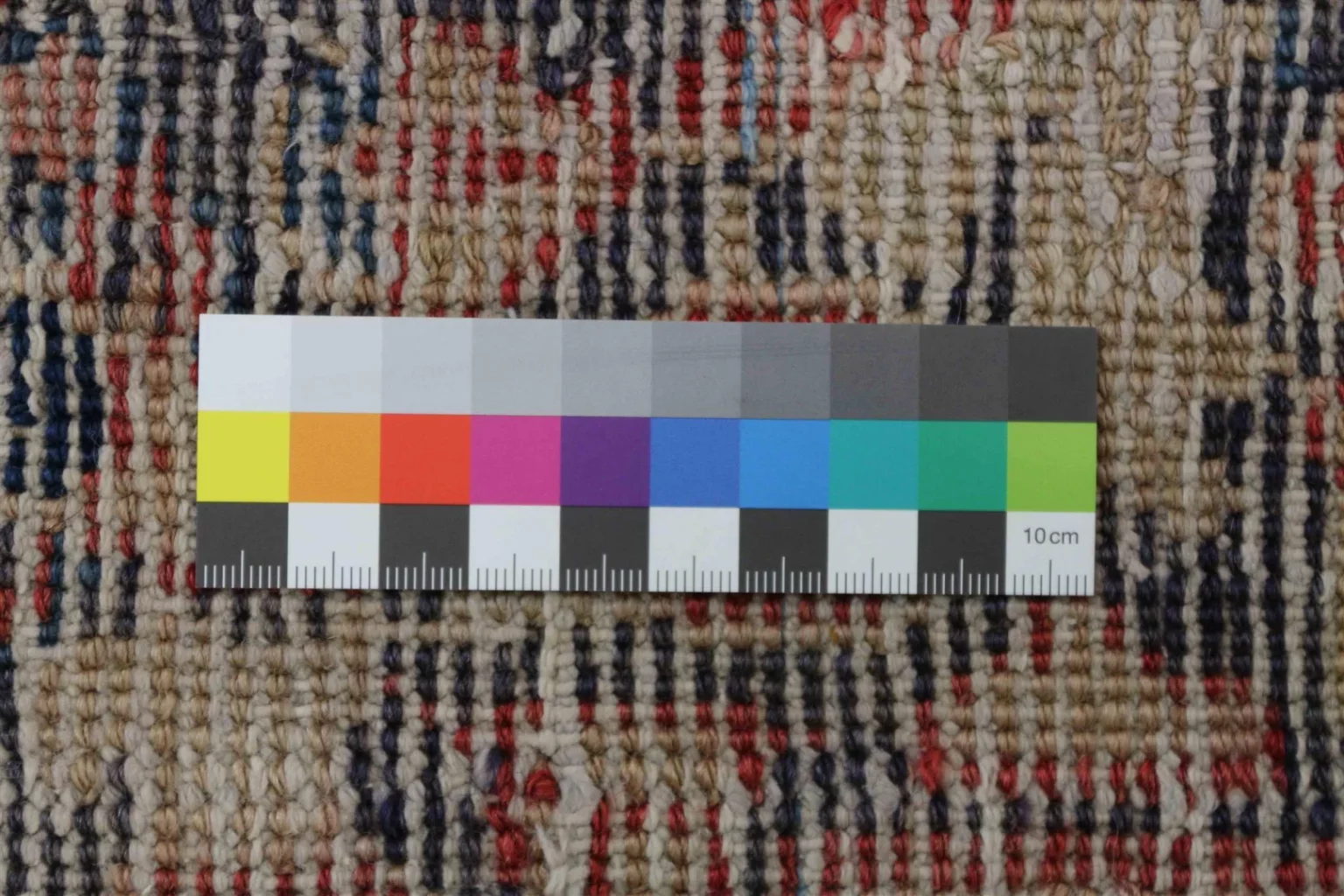
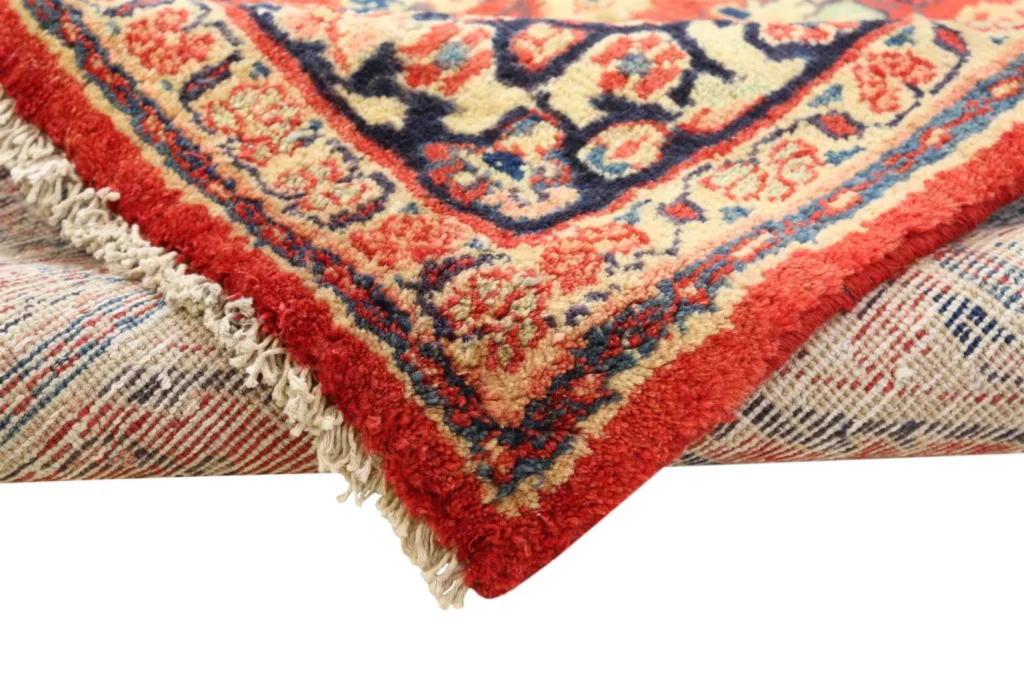
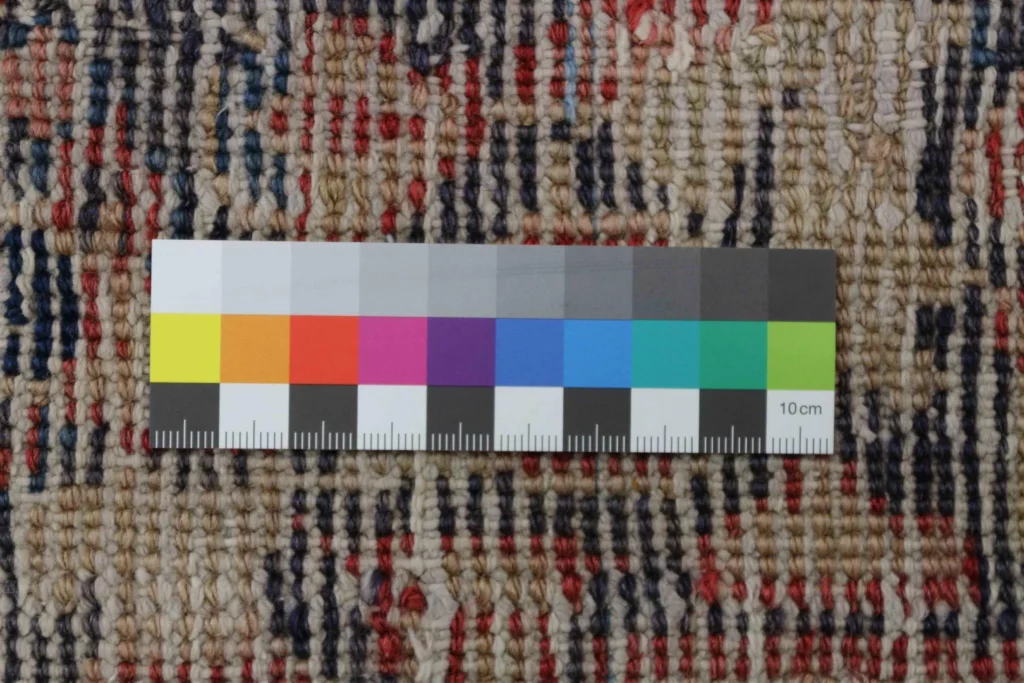
This Mahal Persian rug is hand-knotted. In a hand-knotted rug, the pattern is built knot by knot across the foundation. The design is therefore directly connected with the making process: each part of the field develops through individual knots before the surface is finished. Hand knotting is the traditional construction method identified for this piece.
The stated knot density ranges from 100.000 to 350.000 knots per square metre. Within the Mahal tradition, rustically knotted examples are distinguished from finer works by their more open technical character. This rug is described as rustically knotted, while the full knot-density range is given in the product information. No pile or warp material is specified for this rug, so no fibre claim is made here.
Hand knotting involves the placement and binding of individual knots in rows, with the design developing as the work progresses. Knot density is a technical description of how many knots are arranged within a defined area. It relates to the potential fineness of the drawing, but it does not by itself describe the colour scheme or the subject of the design. In a rustically knotted Mahal, larger motifs can remain clearly legible and form a direct, structured composition.
The craftsmanship of this one-off piece is defined by the terms hand-knotted and rustically knotted, together with the stated knot-density range. The source does not provide details about the fibres, the foundation, the age, or any restoration. Those details are therefore not added to the description. What can be stated is the combination of a hand-made knotting technique, a rustic execution, and the floral design described below.
Origin and Tradition
This rug comes from Mahallat in western Iran. Mahallat is described as a city and as an important centre for the trade in Persian export rugs. Its role in that trade has developed since the late eighteenth century. The name Mahal places this piece within a regional Iranian rug tradition associated with Mahallat and its surrounding weaving culture.
A regional rug name refers to more than a place on a map. It also points to a group of inherited working methods, colour preferences and pattern conventions. In the Mahal tradition, these elements are brought together by weavers and workshops in a range of individual compositions. The regional identity remains recognisable even though every hand-knotted rug is a one-off and does not reproduce one universal layout.
Iranian rug production includes many centres with distinct visual languages. Mahallat is presented as a place whose rugs are known for strong floral designs and lively colour effects. The combination of a warm red emphasis, large blossoms and a rustic knotting style gives the Mahal type a different character from finer, more tightly drawn regional traditions. This distinction concerns the tradition, while the specific facts about this rug remain its Mahallat origin, its colours and its motifs.
Persian carpet design often transforms garden and plant forms into stylised ornament. Flowers, leaves and stems may be arranged around a central medallion or extended across the field in a continuous pattern. The Mahal description includes both medallion compositions and all-over designs. This range explains why Mahal rugs can share a regional identity while differing in the way their floral elements are organised.
Mahallat also belongs to the wider network of Iranian carpet centres. Tabriz and Isfahan are named as related Persian rug traditions. Tabriz rugs are associated with a wide variety of designs and colours, while Isfahan rugs are often linked with elaborate arabesque patterns and vivid colours. These comparisons provide context for the Mahal tradition, but they do not alter this rug’s origin. It remains a Mahal from Mahallat, Iran.
Ziegler & Co. is also mentioned in the source as a maker or house associated with quality and traditional designs. References of this kind show the breadth of the Persian rug trade, where regional workshops and established producers can be discussed alongside one another. They should not be confused with the origin of this piece. The rug described here is not a Tabriz, Isfahan or Ziegler rug; its stated origin is Mahallat in Iran.
Design and Pattern
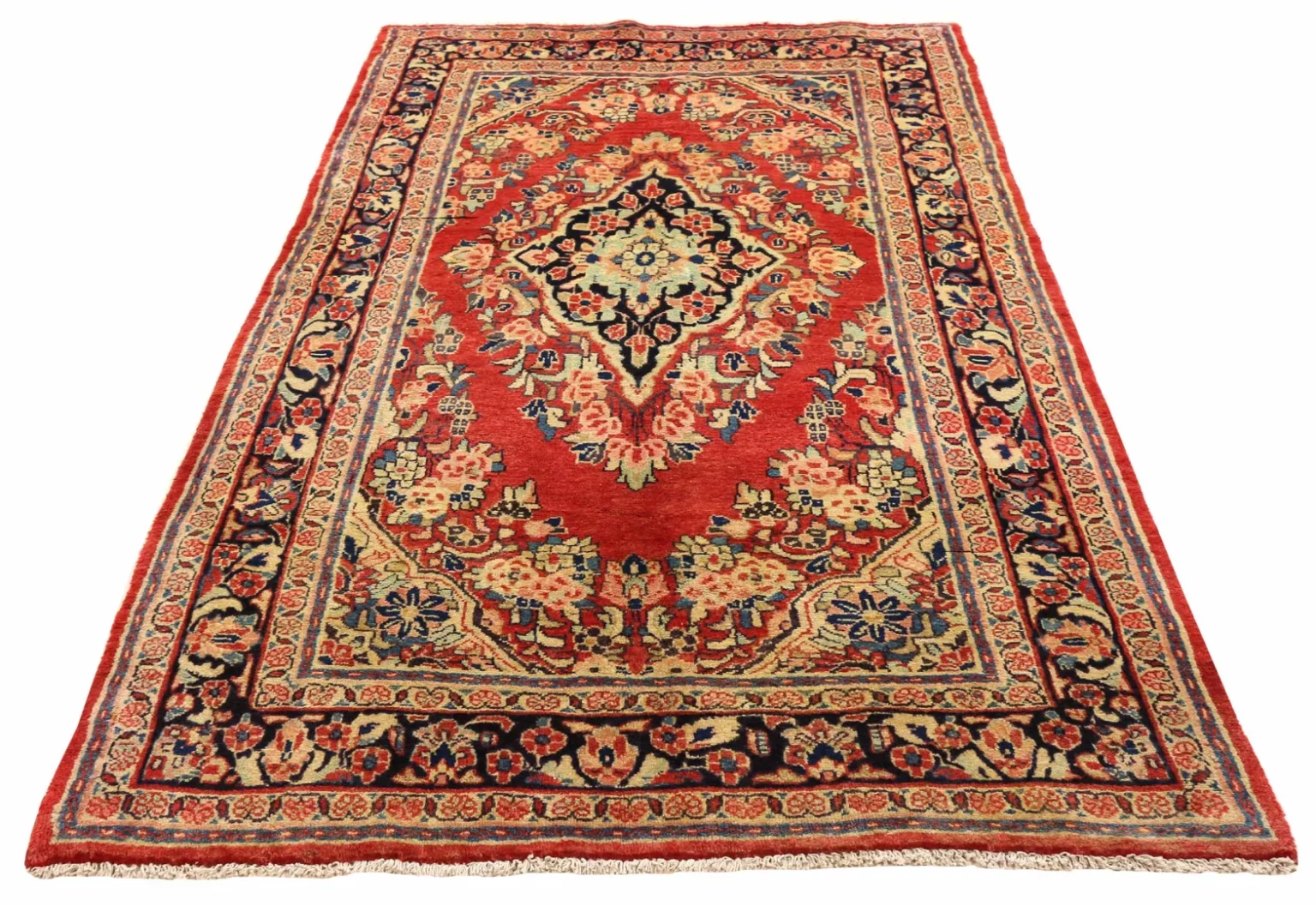
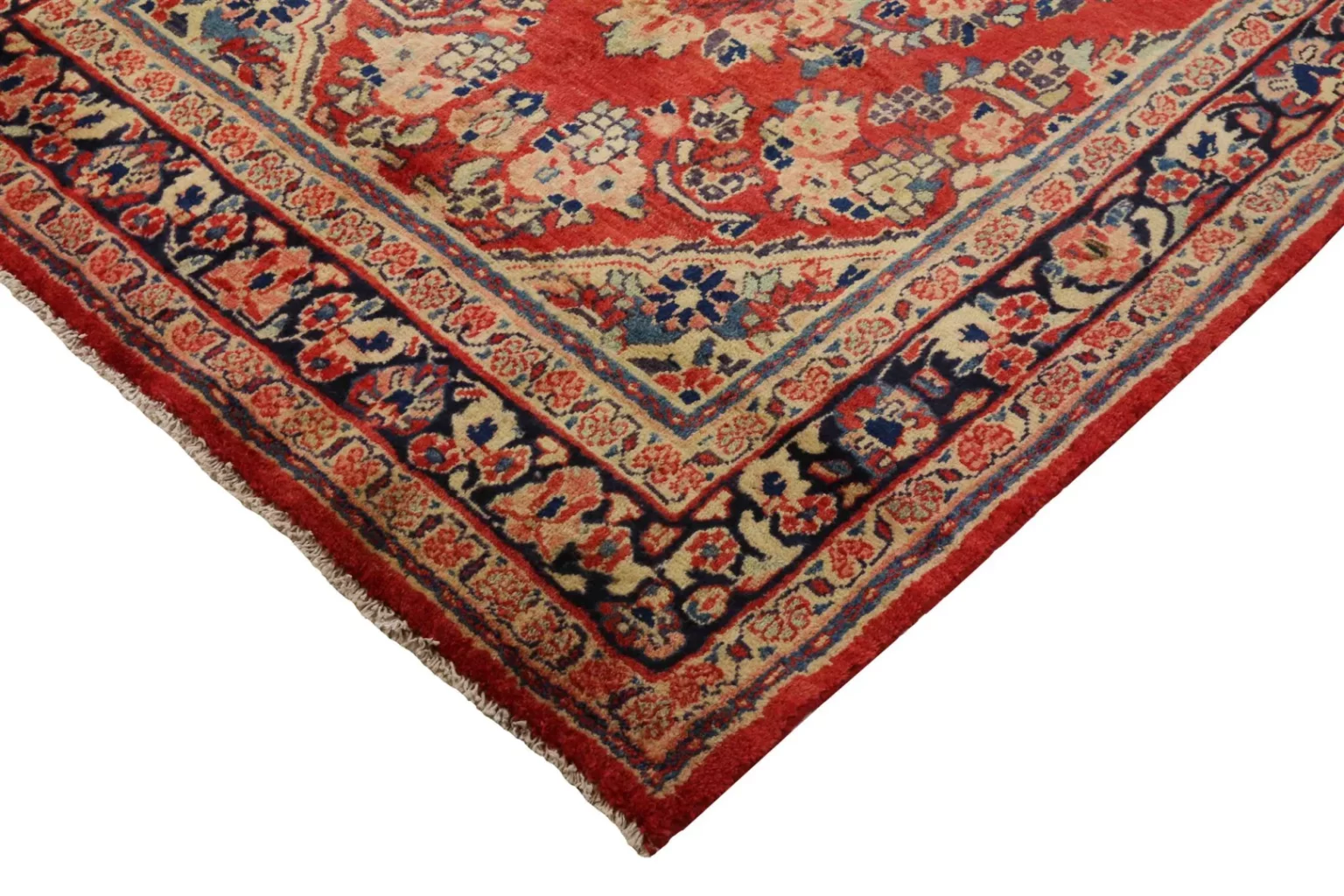
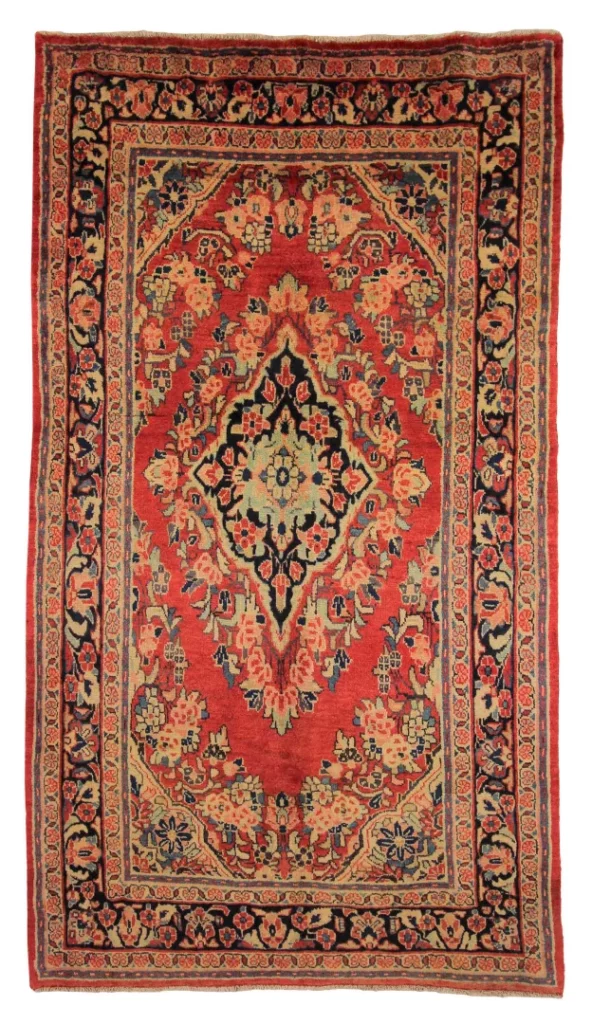
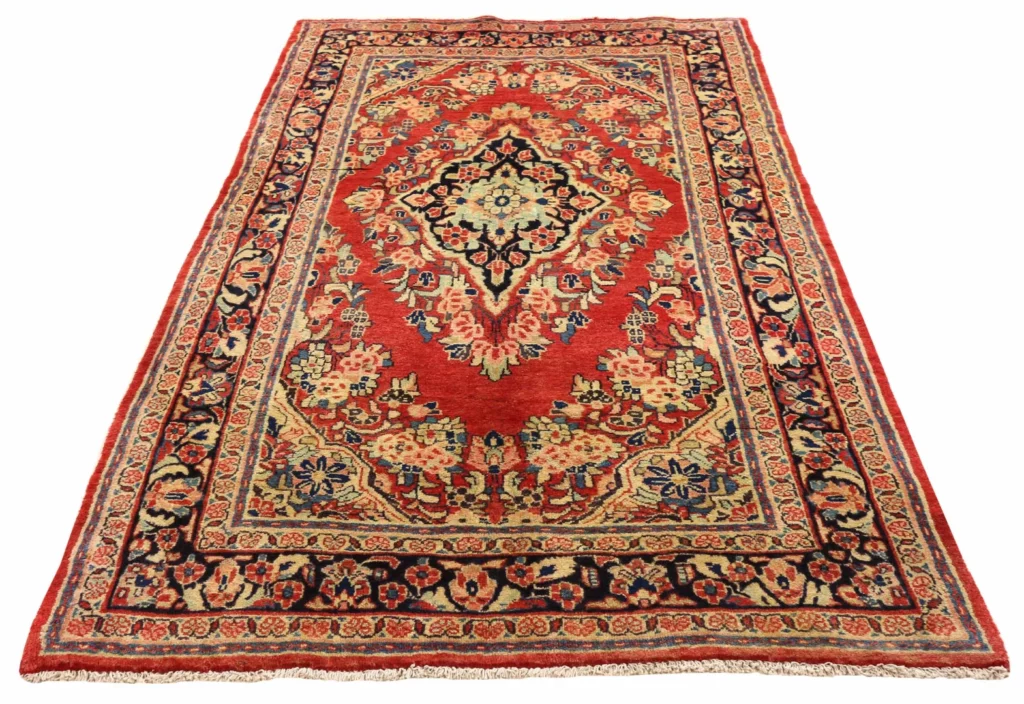
The central visual theme of this rug is formed by large roses and tulips. Both are established floral elements in Persian rug design. A woven flower is not simply a naturalistic copy of a plant. It is translated into lines, petals, leaves and repeated forms that can work together as a decorative field. The large scale of the roses and tulips gives the pattern a clear presence and keeps the main motifs easy to recognise.
Mahal rugs may organise their floral vocabulary in different ways. The description refers to both medallion layouts and continuous patterns. In a medallion composition, the centre provides an organising point for the surrounding flowers and ornaments. In an all-over composition, the floral forms are distributed across the field so that no single central element controls the entire design. Both approaches belong to the described Mahal design tradition.
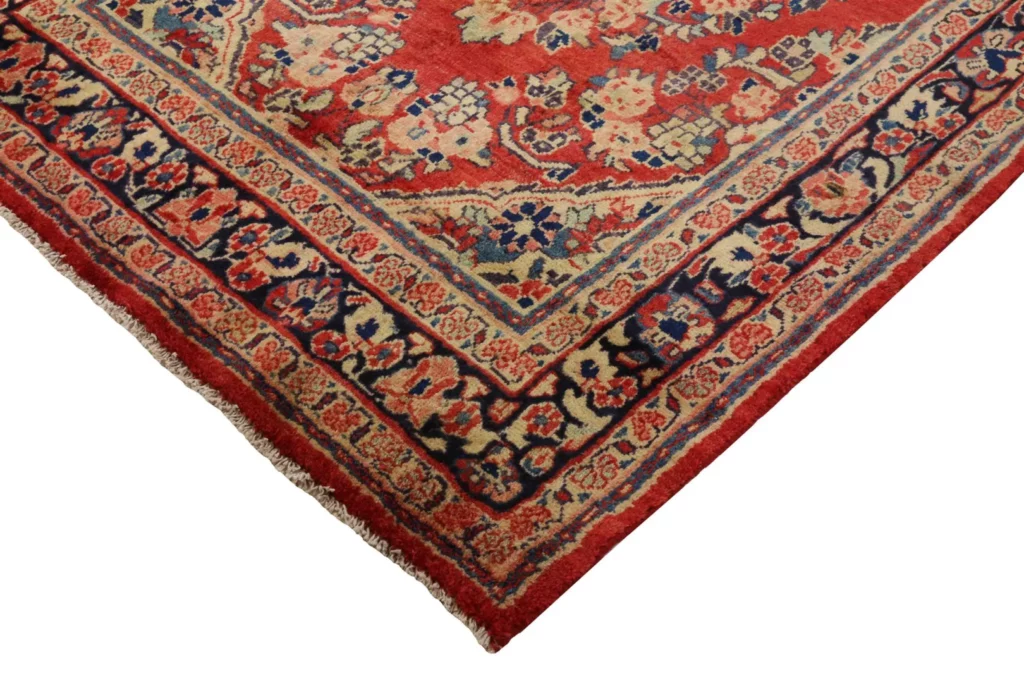
Red is the dominant colour of this particular rug. Beige is also identified, and red is repeated in the colour description. The resulting palette is led by warm red tones, with beige providing lighter areas within the composition. In Persian rugs, red can serve as the ground of a field, as a colour for blossoms, or as a connecting tone between separate motifs. Beige can create visual spacing and help distinguish the floral drawing.
Roses and tulips contribute different shapes to a floral composition. A rose can be expressed through a rounded blossom with layered petals, while a tulip often introduces a more upright or contained flower form. In a woven pattern, both motifs may be repeated, balanced and stylised rather than rendered as botanical illustrations. Here, the description identifies the large roses and tulips as the principal pattern, making them the defining subject of the field.
The floral emphasis and the red-led palette are part of the broader character associated with Mahal rugs. Other examples from the region may also appear in beige or deep blue, but those alternatives do not describe this piece. For this rug, the relevant colour statement is that it is predominantly red, with beige and red also named. The pattern statement is equally specific: large roses and tulips, rather than a generic floral pattern.
The rustic knotting style provides a suitable technical context for a design based on large blossoms. A more open drawing can allow major forms to read plainly, while finer knotting can support smaller details and more intricate outlines. Mahal rugs are described across a range from rustic to finer executions, reflected in the stated knot-density span. The individual character of this rug is identified by its rustic construction and its large-scale floral motifs.
Special Features
This one-off rug combines a predominantly red palette with large floral motifs of roses and tulips. Beige is also present in the colour description. It is hand-knotted and rustically knotted, with a knot-density range of 100.000 to 350.000 knots per square metre. These are the specific technical and visual characteristics given for the piece.
Its origin in Mahallat, western Iran, places it within the Mahal Persian rug tradition. The source describes Mahallat as a historic centre for Persian export-rug trade and connects the regional type with floral designs and lively colours. No information is provided about a signature, age, pile material, warp material or restoration, so those points are not claimed.
FAQ
How should I care for my Mahal Persian rug?
Regular vacuuming is recommended to remove loose dust and everyday dirt from the rug. Occasional professional cleaning can help preserve its appearance and continued usability. Direct sunlight should be avoided because it can encourage the colours to fade. Care should take the hand-knotted, rustic construction and the floral surface into account. When a more thorough treatment is needed, professional cleaning is the appropriate option rather than adding unverified methods to the care routine.
Where does the Mahal Persian rug come from?
This Mahal Persian rug comes from Mahallat in western Iran. Mahallat is described as a city known for its importance in the trade of Persian export rugs, a role that developed from the late eighteenth century onward. The region is also associated with floral motifs and lively colours. The predominantly red palette and the large roses and tulips fit that description of the Mahal tradition. Its Mahallat origin identifies it as an Iranian Persian rug, not as a rug from another region with a similar pattern.
What sizes are available for Mahal Persian rugs?
Mahal Persian rugs are available in a variety of sizes. The general range extends from small runners to large rugs intended for living areas. This variety allows the type to be used in rooms and spaces with different requirements. The range of sizes describes Mahal rugs as a category; individual pieces naturally differ from one another. The rug described here has the size given in the listing, while other Mahal rugs may be made in other formats.
To provide the best experiences, we use technologies like cookies to store and/or access device information. Consenting to these technologies will allow us to process data such as browsing behavior or unique IDs on this site. Not consenting or withdrawing consent, may adversely affect certain features and functions.
Functional Always active
The technical storage or access is strictly necessary for the legitimate purpose of enabling the use of a specific service explicitly requested by the subscriber or user, or for the sole purpose of carrying out the transmission of a communication over an electronic communications network.
Preferences
The technical storage or access is necessary for the legitimate purpose of storing preferences that are not requested by the subscriber or user.
Statistics
The technical storage or access that is used exclusively for statistical purposes.The technical storage or access that is used exclusively for anonymous statistical purposes. Without a subpoena, voluntary compliance on the part of your Internet Service Provider, or additional records from a third party, information stored or retrieved for this purpose alone cannot usually be used to identify you.
Marketing
The technical storage or access is required to create user profiles to send advertising, or to track the user on a website or across several websites for similar marketing purposes.

 SECURE PAYMENT
 SHIPPING PARTNERS