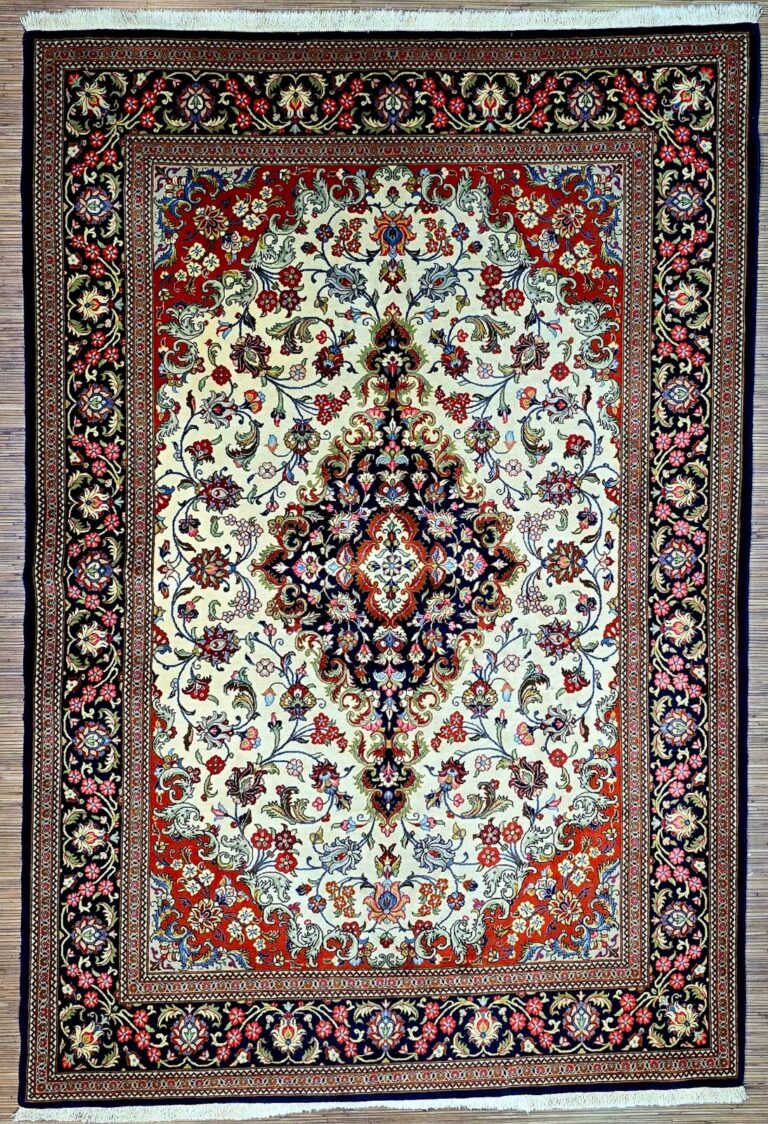
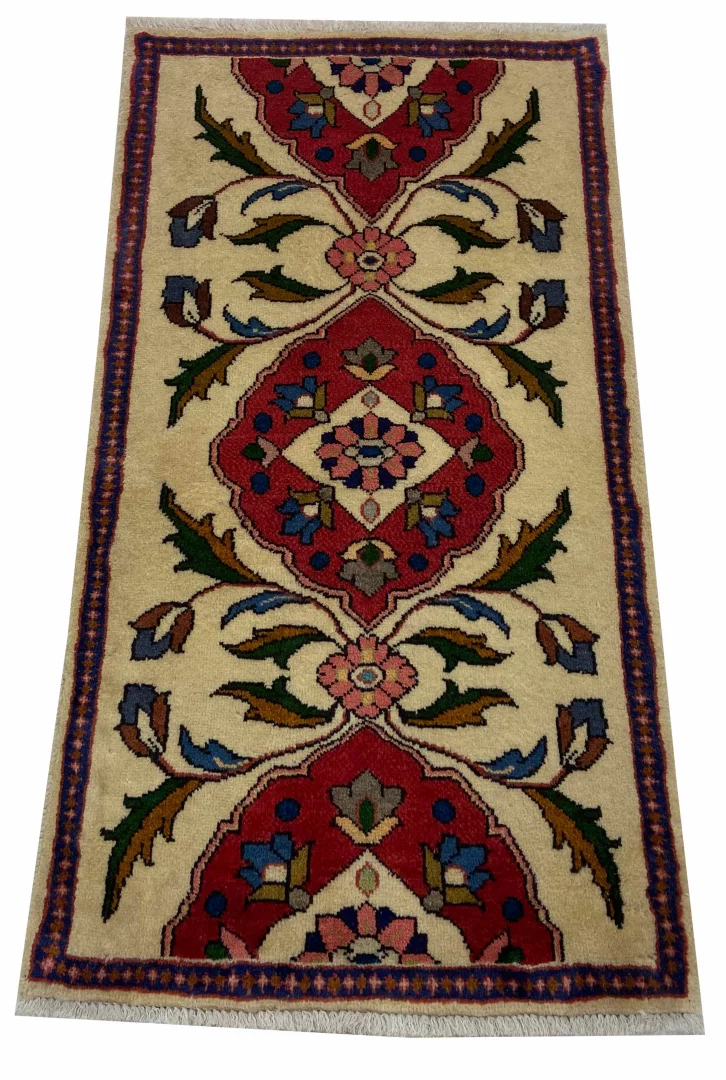
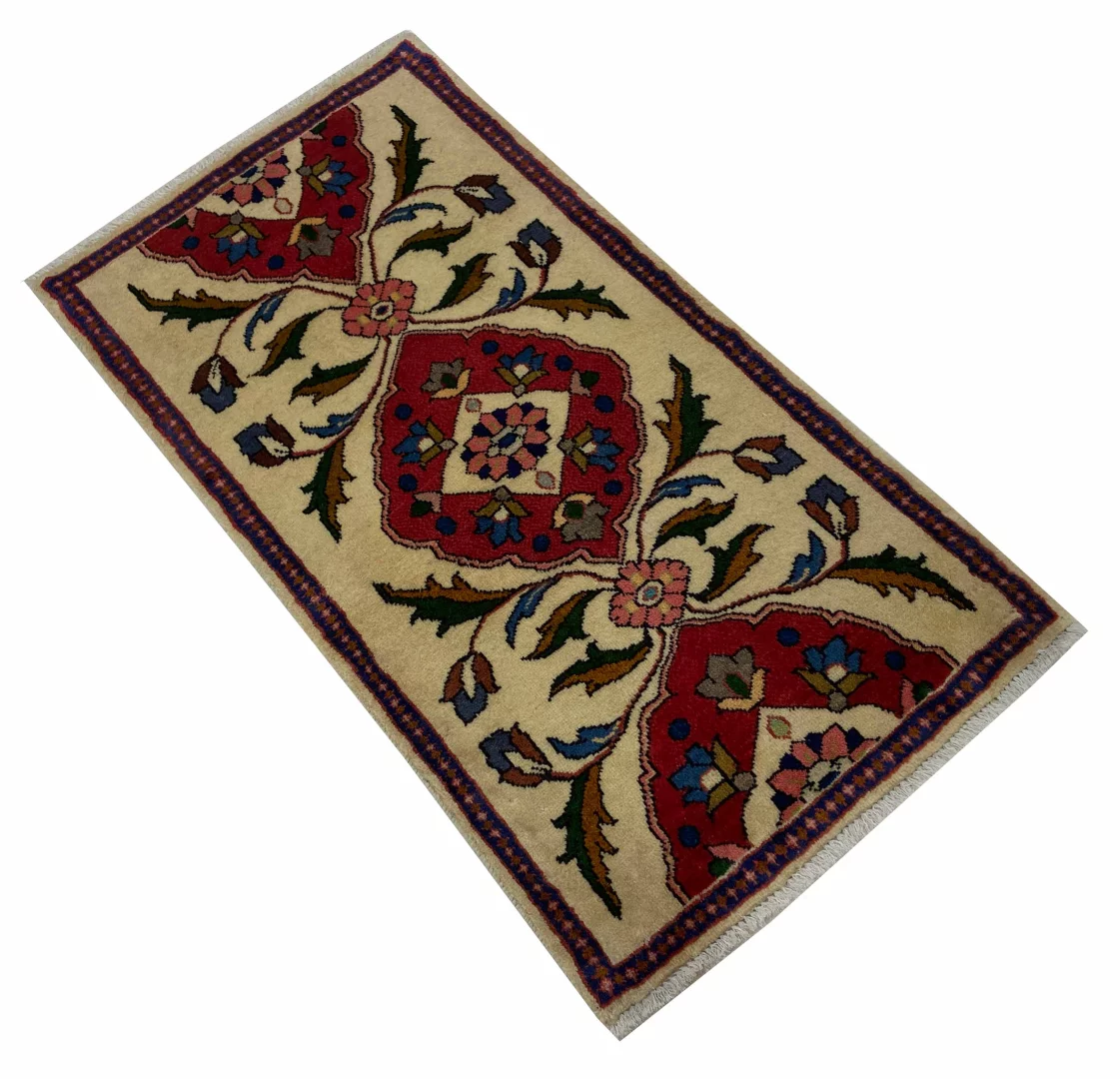
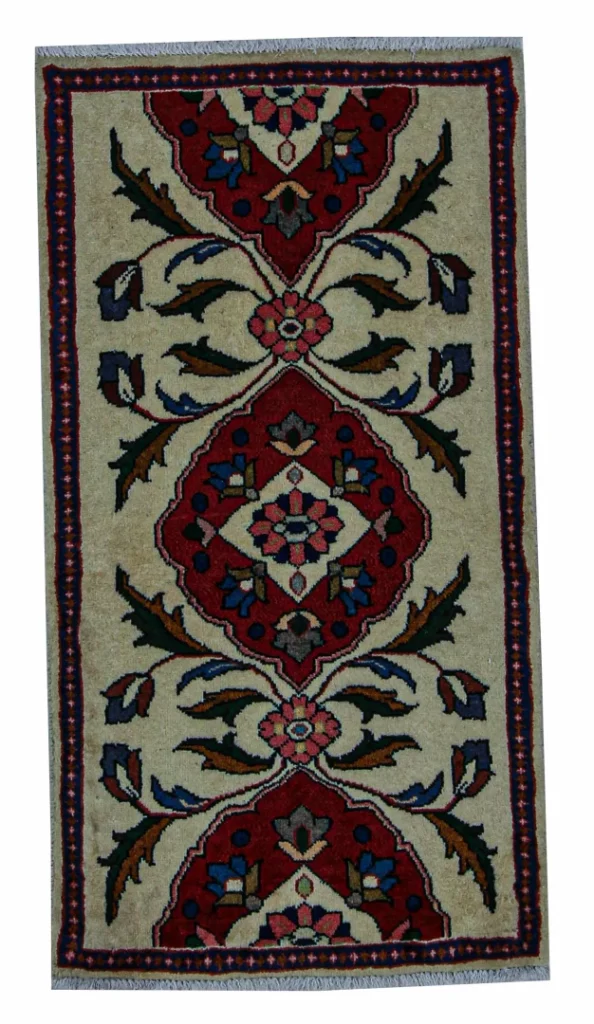
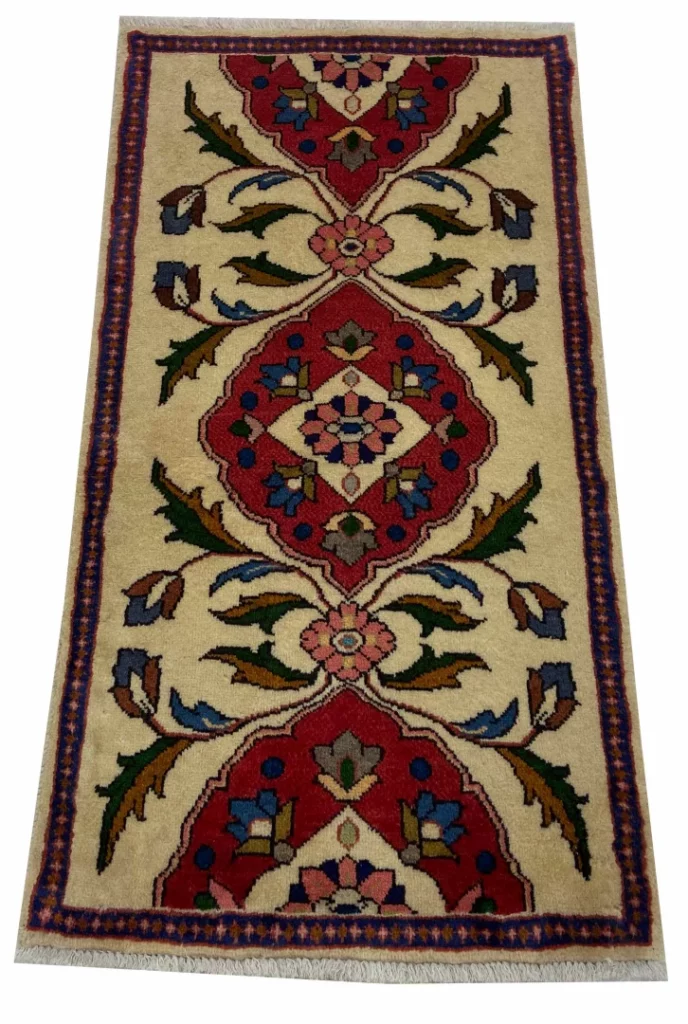
Hand-knotted Mahal Persian Rug | Knot density: 200,000 – 350,000 knots/m² | Size: 125 x 67 cm | Pattern: Large roses and tulips | Colour: Predominantly red, with rare beige or dark blue | Condition: Rustically knotted
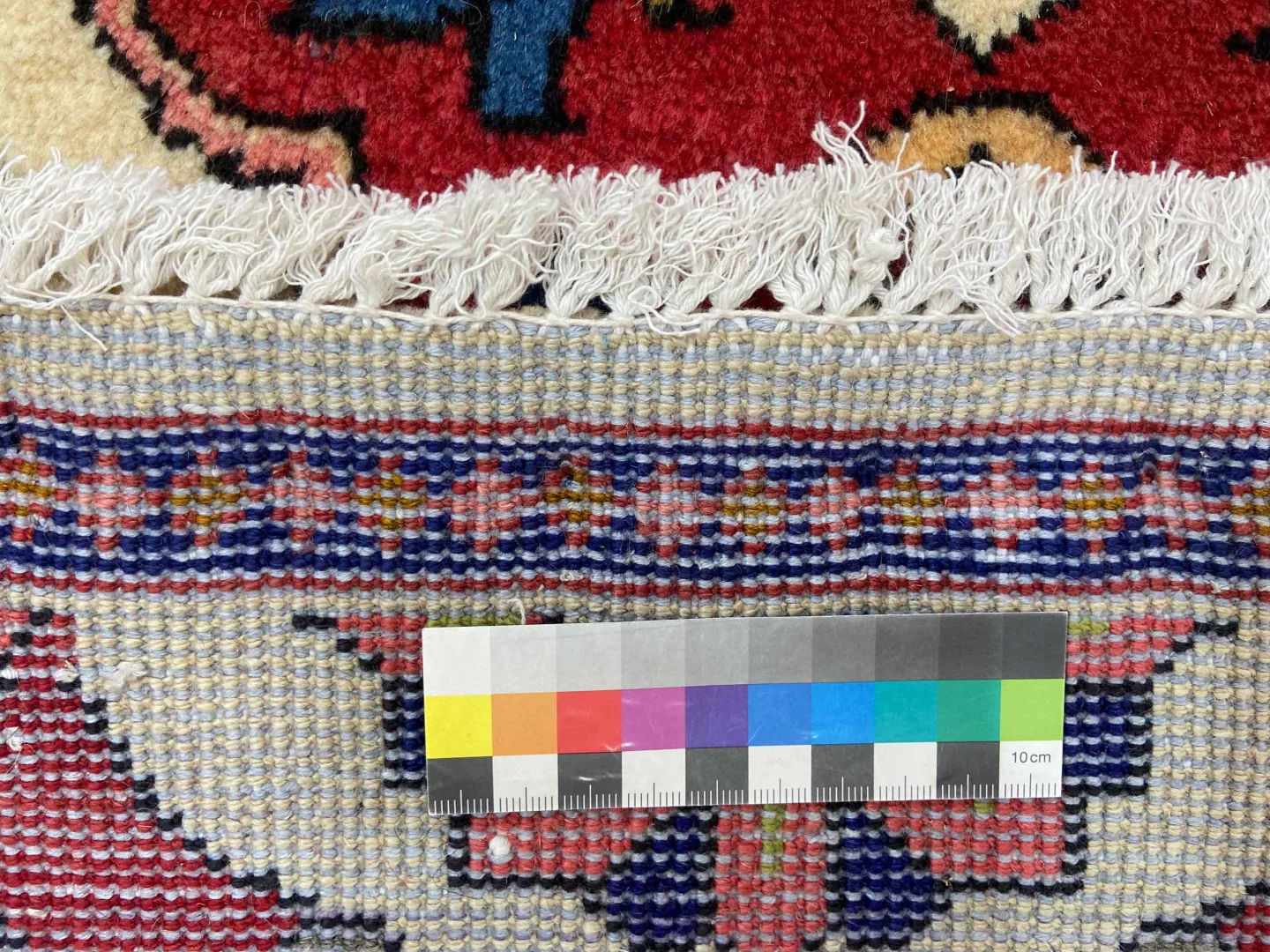
This Mahal Persian rug is hand-knotted, a traditional textile process in which individual knots are made by hand and secured within the foundation. The surface is built row by row rather than produced as a uniform machine-made fabric. Each knot contributes to the structure, and the design is developed directly through the sequence of colours and forms used by the weaver. The workmanship of this rug is described as rustic knotting. That description points to a visibly handcrafted character rather than an industrially regular finish.
Wool is traditionally the primary material used for Mahal rugs. In rug making, wool is valued for its soft feel as well as its durability. It can retain warmth and help absorb sound, which are among the reasons woollen rugs have long been used in living environments. A wool-based textile surface combines practical resilience with a comfortable touch. These are general material characteristics associated with the traditional production of Mahal rugs.
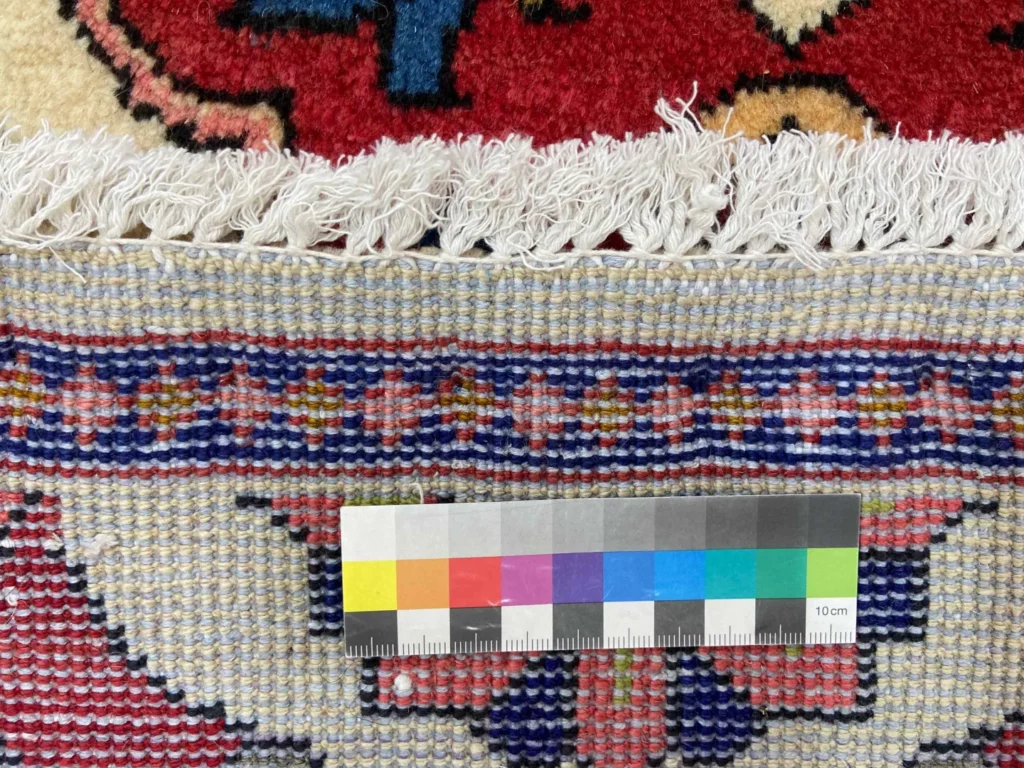
Knot density is one of the standard ways to describe a hand-knotted rug. In general, a denser construction allows outlines and ornamental details to be rendered with greater precision. Mahal rugs exist in both rustic and more closely knotted qualities, reflecting the range of workshop practice associated with the type. This rug is specified with a density of 200,000 to 350,000 knots per square metre. Its stated construction therefore combines a traditional handmade technique with a relatively dense knot structure.
Origin and Tradition
The name Mahal is associated with the historic city of Mahallat in western Persia. Mahallat developed as an important trading centre for Persian rugs and is connected with a distinct regional weaving tradition. Mahal therefore refers not only to a decorative vocabulary but also to an origin and a craft environment. This rug belongs to the wider culture of Iranian carpet making, in which different regions and workshops developed their own approaches to colour, composition and production.
In Mahallat, weaving knowledge was passed from one generation to the next. Such knowledge includes the preparation of materials, the arrangement of the foundation, the interpretation of a design and the finishing of the completed textile. The craft is therefore more than the act of tying knots. Every stage affects the appearance and handling of the finished rug. In a hand-knotted example, the connection between a planned pattern and its manual execution remains part of the object’s character.
Persian rugs have traditionally served both practical and decorative purposes. Their designs can communicate regional preferences through colour choices, floral elements and the way a field is organised. Mahal rugs are associated with a lively floral direction and strong colour effects. Hand production does not seek the perfectly repetitive surface of an industrial product; it creates a woven and knotted structure in which the work of the maker remains legible. The term rustic knotting describes this direct, craft-based quality.
The history of Persian rug making has been shaped by regional markets, trade routes and the continued circulation of motifs. As a trading centre, Mahallat contributed to the distribution of rugs beyond the immediate weaving area. Persian rugs subsequently entered different countries and interior traditions while retaining links to their regional forms. A Mahal rug can therefore be understood in two ways: as a textile connected with Mahallat and as part of the larger Persian tradition of transferring designs and techniques through generations.
Gabbeh and Nain are among the rug types often discussed alongside other Persian traditions. Gabbeh rugs are associated with simple geometric designs, strong colours and a rustic appearance. Nain rugs are known for fine, detailed patterns and the use of silk. These names describe separate design and production traditions and do not change the origin of this Mahal rug. Ziegler & Co. is also named as a notable maker with a long history in rug production. Such comparisons illustrate the breadth of Persian rug culture while leaving the Mahal identity of this piece distinct.
Design and Pattern
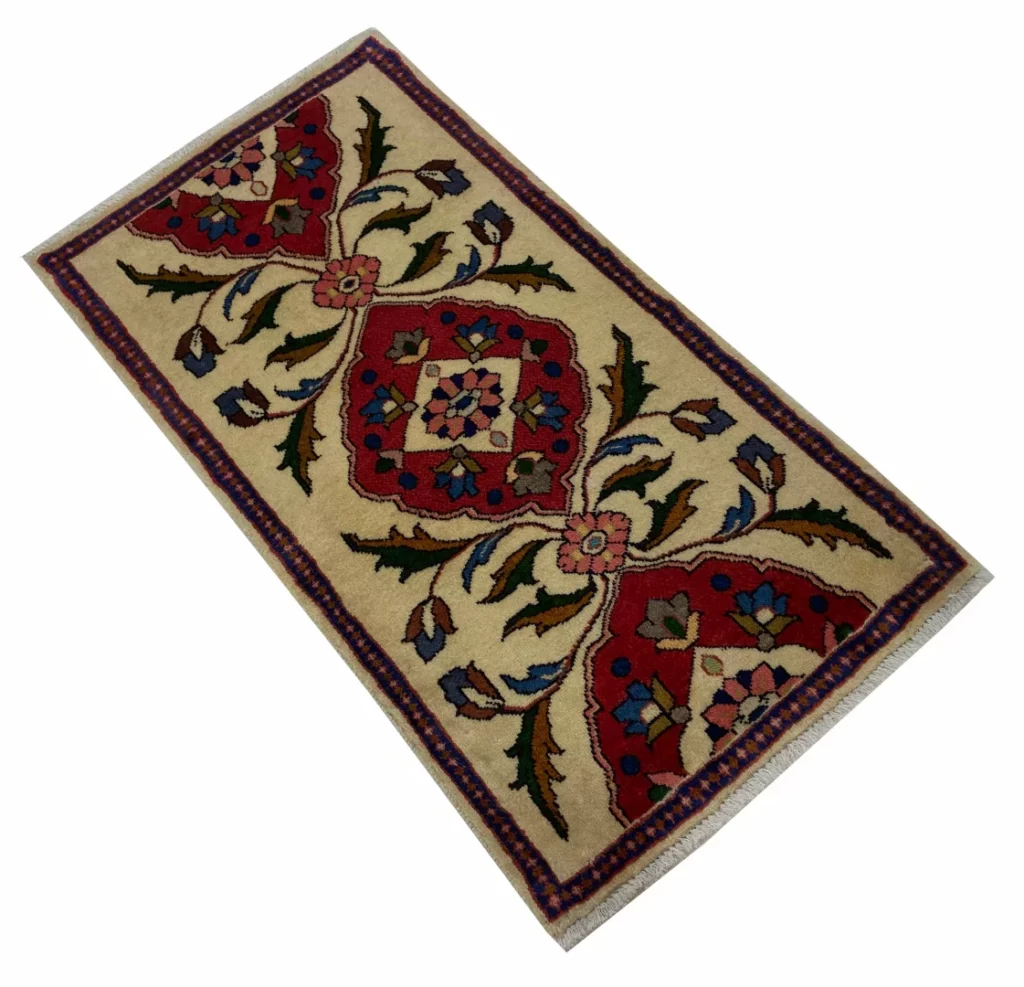
The design of this Mahal rug is defined by large roses and tulips. Floral ornament is one of the recurring languages of Persian carpet design. Flowers may be represented as isolated forms, grouped elements or parts of a larger organised field. In a composition centred on large roses and tulips, the flowers occupy a clearly recognisable role within the main field. Their scale gives the pattern its floral focus and structures the visual reading of the surface.
Roses in Persian ornament are commonly treated as stylised motifs rather than botanical studies. Petals, outlines and repeated arrangements are adapted to the requirements of a woven design. Tulips introduce another floral shape, with a different silhouette and rhythm. Placing the two motifs together creates variation while preserving the overall botanical theme. The character of the pattern comes from the relationship between the large blossoms, their spacing and the surrounding ornamental order.
The colour scheme is predominantly red. Red is one of the strong colours traditionally found in Persian rug design and can give a field a unified, clearly defined presence. Beige and dark blue occur more rarely in this rug. These less frequent tones provide points of contrast within the dominant red composition. Beige can create lighter passages, while dark blue can reinforce selected outlines or details. Red nevertheless remains the principal colour and provides the visual basis for the floral arrangement.
A floral rug pattern is created through the relationship of all its elements, not only through the depiction of individual blossoms. Repetition, spacing and direction allow the eye to read the design as a coherent field. Large roses and tulips can guide the view across the surface and divide it into related areas. The hand-knotted technique translates that planned order into a textile one knot at a time. Traditional ornament and visible manual workmanship therefore operate together in the design of this rug.
Persian rug design includes both floral and geometric approaches. A Mahal rug with roses and tulips belongs to the floral side of that spectrum. Gabbeh provides a contrasting example through simpler geometric forms and forceful colours, while Nain is associated with finer detailed arrangements and silk. These comparisons show the variety of Persian pattern traditions without reducing the specific character of Mahal design. Here, the large blossoms and the predominantly red palette are the defining visual features.
Special Features
The distinctive features of this rug are its hand-knotted construction, its rustic knotting, and its stated density of 200,000 to 350,000 knots per square metre. Its pattern consists of large roses and tulips. Red is the predominant colour, while beige and dark blue appear rarely. The origin is given as Mahallat in Persia. Together, origin, technique, colour and floral ornament identify this as a Mahal Persian rug with a clearly described regional and handmade character.
Traditional wool use forms part of the material background of Mahal rugs. Wool is valued for softness, durability, warmth retention and sound absorption. The rustic knotting also keeps the handmade nature of the textile visible. The special character of the rug therefore lies in the combination of an established craft tradition, a dense hand-knotted structure and a floral design led by large roses and tulips.
FAQ
How should a Mahal Persian rug be cared for?
A Mahal Persian rug should be vacuumed regularly to remove dust and loose dirt from its textile surface. Routine care is best carried out gently and without harsh treatment. If a spill occurs, the area can be treated softly with a damp cloth and a specialised rug cleaner. Vigorous rubbing should be avoided, since it can place unnecessary stress on the surface and disturb the way colour or dirt is distributed. Consistent, careful cleaning helps preserve the appearance and structure of a hand-knotted rug over time.
How can the quality of a Mahal rug be assessed?
The quality of a Mahal rug can be considered through several characteristics, including knot density, the materials used and the precision of the pattern. A greater number of knots can support finer outlines and more differentiated ornamental detail. The quality of the wool or any other material is also relevant; fine wool or silk are associated with higher-quality examples in the general description of Mahal rugs. In addition, the clarity of the roses, tulips and surrounding motifs should be observed, together with the consistency of the handmade structure across the field.
Where can a Mahal Persian rug be used?
Mahal rugs can be used in a range of living and working areas. Living rooms, dining rooms, studies and hallways are named as suitable settings. In a living room, a floral Mahal rug can act as a textile focal point within the furnishings. In a dining room or study, its colour palette gives the room a defined decorative element. A hallway can also accommodate this type of rug when the available space and use are suitable for a hand-knotted textile. The combination of predominantly red colour, large roses and tulips and rustic knotting can work with a variety of interior styles.
To provide the best experiences, we use technologies like cookies to store and/or access device information. Consenting to these technologies will allow us to process data such as browsing behavior or unique IDs on this site. Not consenting or withdrawing consent, may adversely affect certain features and functions.
Functional Always active
The technical storage or access is strictly necessary for the legitimate purpose of enabling the use of a specific service explicitly requested by the subscriber or user, or for the sole purpose of carrying out the transmission of a communication over an electronic communications network.
Preferences
The technical storage or access is necessary for the legitimate purpose of storing preferences that are not requested by the subscriber or user.
Statistics
The technical storage or access that is used exclusively for statistical purposes.The technical storage or access that is used exclusively for anonymous statistical purposes. Without a subpoena, voluntary compliance on the part of your Internet Service Provider, or additional records from a third party, information stored or retrieved for this purpose alone cannot usually be used to identify you.
Marketing
The technical storage or access is required to create user profiles to send advertising, or to track the user on a website or across several websites for similar marketing purposes.

 SECURE PAYMENT
 SHIPPING PARTNERS