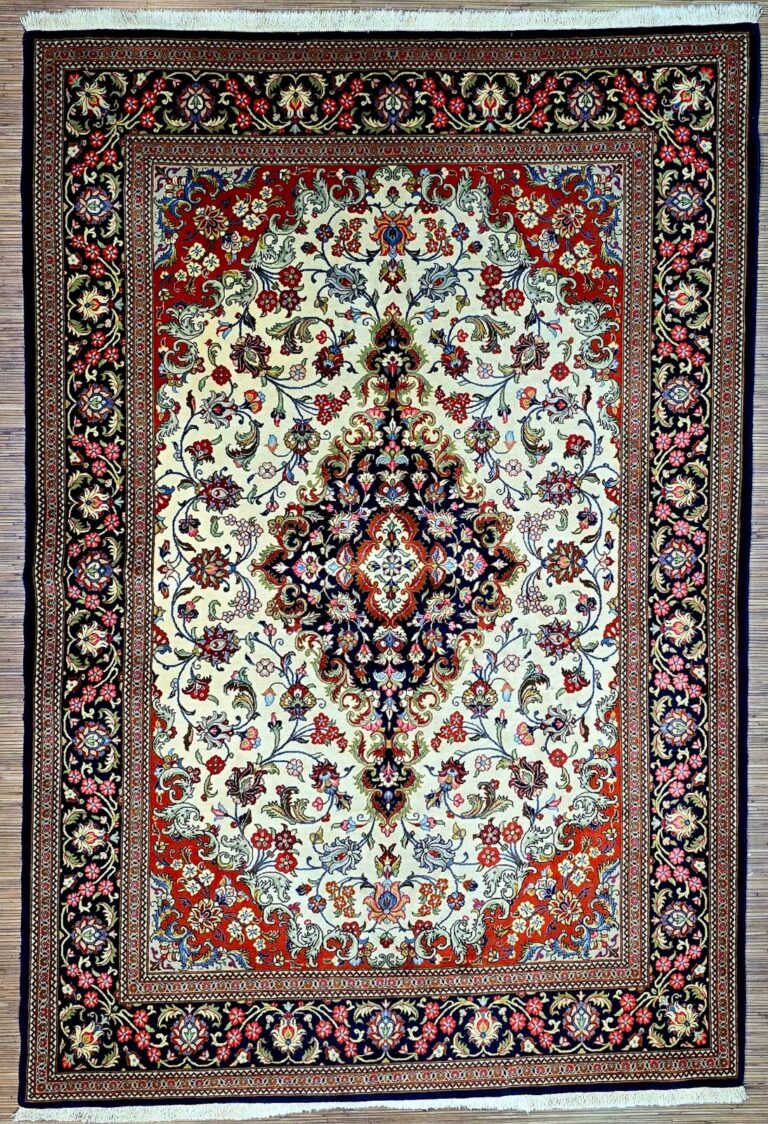
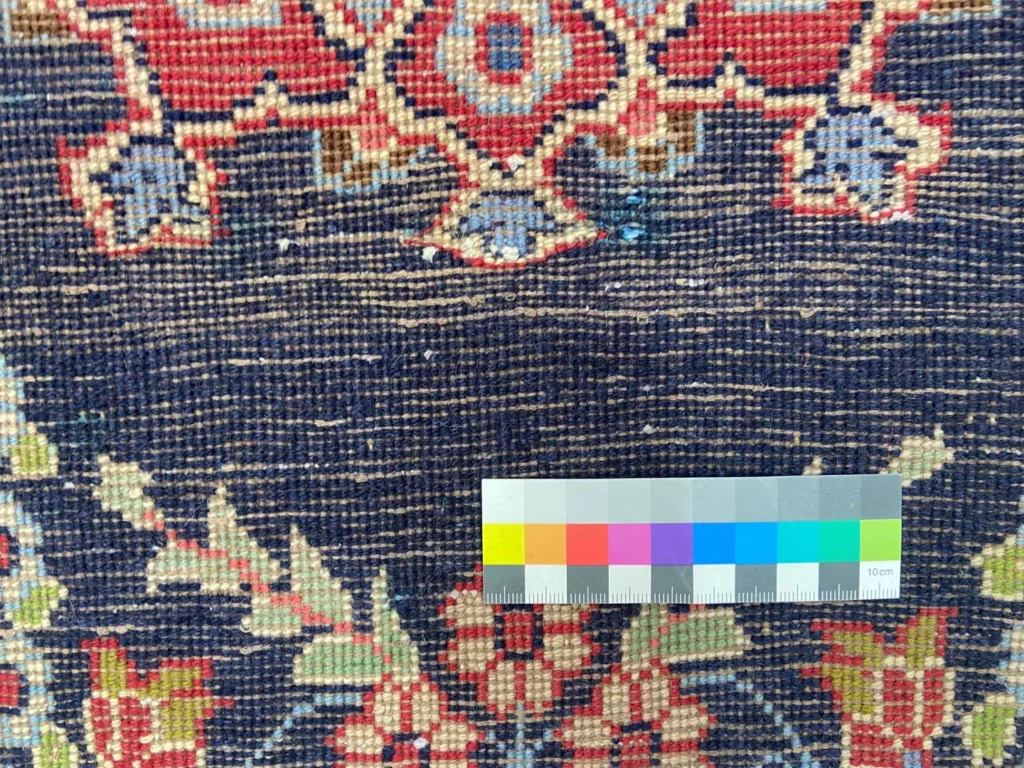
This Keshan Persian rug is hand-knotted. Its construction follows a traditional method in which the design is built knot by knot. Hand-knotting makes it possible to render fine lines, floral forms, and geometric details with considerable precision. A knot density of 150,000 to 300,000 knots per square metre is given for this rug. The dense structure is closely connected with the detailed appearance associated with Keshan rugs.
The pile is made from high-quality sheep wool. Wool provides a tactile surface and forms the visible working layer of the rug. The use of sheep wool is one of the defining craft features of Keshan rugs. The fibre accepts colour well and supports a clear presentation of intricate motifs. Its natural texture also gives the surface a textile depth rather than an artificial smoothness.
Cotton is used for the warp and weft. These elements create the textile foundation on which the pile is constructed. In this rug, cotton is combined with the wool pile and provides a durable structural basis. The combination of sheep wool in the pile with cotton in the warp and weft is expressly described as high-quality and hard-wearing.
The relationship between handwork, dense knotting, sheep wool, and cotton accounts for the rug’s substantial character. These materials are valued not only for their appearance but also for their practical qualities. Keshan rugs are described as notably durable and resistant to wear when made with such materials. This particular rug is listed as being in very well-preserved condition.
Origin and Tradition
Keshan, also written as Kashan, is a city in Iran and the namesake of an important Persian rug tradition. Keshan Persian rugs come from a region known for its long history of carpet making. The name therefore refers not merely to a decorative style, but to an established centre of craftsmanship. Workshops in Keshan developed a form of rug making in which careful drawing, balanced composition, and refined execution are brought together.
Persian carpet making is closely connected with the transmission of designs, colour knowledge, and knotting techniques. Motifs are not treated as isolated decorations; they form part of an ordered composition. In this context, Keshan is associated with rugs whose designs are often marked by a clearly organised field, structured areas, and carefully worked details. Craftsmanship emerges through repeated, precise work at the loom, as many individual knots gradually become one coherent image.
Keshan lies in a region where carpets have long formed part of cultural and economic life. The local vocabulary of rug making became known beyond the surrounding area. Keshan rugs are valued for their technical refinement, detailed drawing, and rich use of colour. The tradition combines practical requirements with a strong sense of visual order. A rug is expected to function as a durable household object while also presenting a carefully composed surface.
The Iranian origin makes this rug a Persian rug. That distinguishes it from Oriental rugs produced in other countries, even when they use related floral or geometric ideas. In Persian traditions, motifs, borders, and colour fields are often arranged in relation to one another so that the composition reads as a unified whole. The effect depends less on one isolated ornament than on the balance between centre, border, line movement, and colour distribution.
Within the wider Persian rug world, Keshan stands alongside other recognised centres. Tabriz is known for detailed patterns and lively colours. Nain is associated with fine wool and a high knot count. Isfahan and Sarough are also recognised for varied designs and skilled craftsmanship. These places nevertheless represent their own traditions. A Keshan remains identifiable through its origin, characteristic design language, and particular craft heritage.
This tradition also explains why Keshan rugs are considered by rug enthusiasts and are used in classically styled interiors. They unite an inherited technique with a design based on order and detail. The rug presented here is identified as a Keshan Persian rug from Persia, or Iran. Its origin and method of manufacture are therefore clearly defined, without assigning it to another Persian region.
Design and Pattern
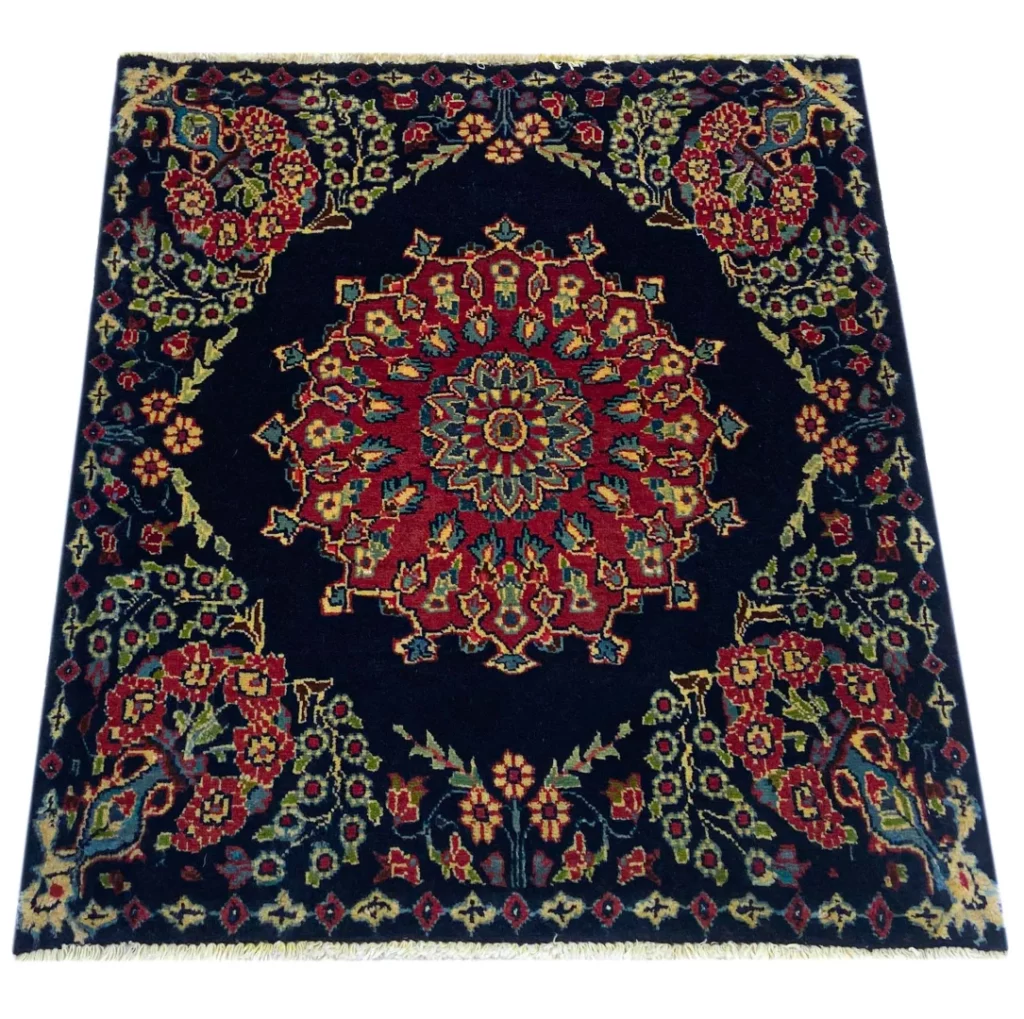
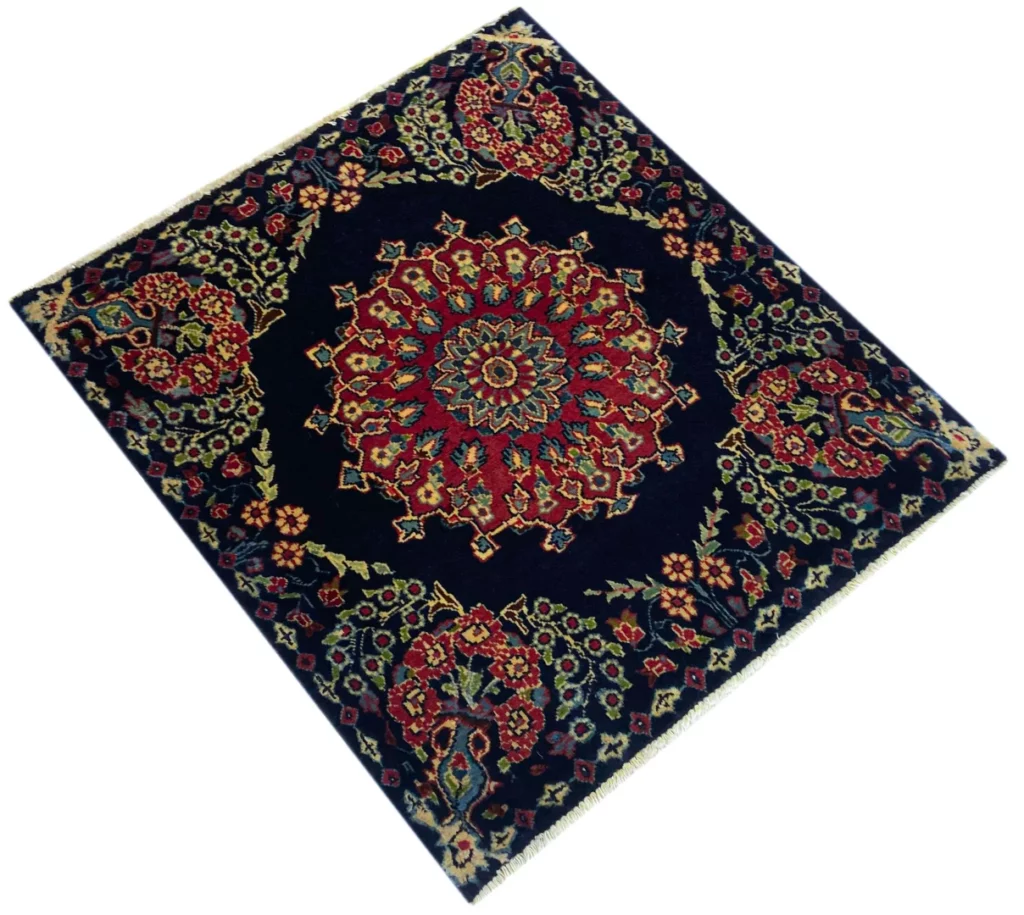
The pattern of this rug is described as classical and detailed. These two qualities define its design classification. In a Keshan context, classical refers to an orientation towards established Persian compositional forms, in which ornaments are arranged within a recognisable order rather than scattered at random. Detailed points to the fine treatment of individual shapes and the visual density of the surface.
Keshan rugs often combine floral and geometric elements. Floral forms may recall leaves, blossoms, vines, and stylised plants. Geometric elements provide clear axes, boundaries, and repetitions within the drawing. The two vocabularies complement one another. Floral movement introduces an organic quality, while geometry organises the composition. Their combination creates a characteristic balance between flowing contours and defined structure.
In a finely drawn Persian rug, the eye moves through a network of related details. Smaller ornaments may appear within larger forms, while lines connect separate areas of the composition. A high knot density supports the clean execution of such details. It is therefore not merely a technical specification; it is also related to the visual precision of the pattern and to the way the design can be rendered across the surface.
The colour range described for Keshan rugs extends from deep red and blue to softer earth tones. Within a classical composition, these colour groups can perform different roles. Stronger shades create accents and depth, while earthy tones provide transitions and balance. The final effect depends on the relationship between the colours and on their interaction with floral and geometric shapes.
A detailed pattern requires careful preparation and controlled execution. With hand-knotting, the design is implemented gradually. Repetitions must remain consistent, lines must retain their direction, and small ornaments must fit the larger composition. This process gives the surface its characteristic density. Designing a Keshan rug is therefore both a matter of visual language and of technical command of the knotting process.
The classical orientation allows the pattern to work with a range of traditional interior styles. It is not tied to a short-lived fashion, but follows an established Persian ornamental vocabulary. At the same time, the individual rug retains its own identity. No hand-knotted piece is exactly the same as another, because its final appearance is shaped by work at a particular loom and by the manual execution of the design.
The description classical and detailed summarises this Keshan’s decorative character. Floral and geometric elements, differentiated line work, and the stated colour tradition belong to the general appearance of Keshan patterns. The rug is therefore not assigned to a Tabriz, Nain, or Sarough design. Its pattern tradition remains that of Keshan.
Special Features
A notable feature of this rug is the combination of Persian origin, hand-knotted manufacture, and high knot density. It also uses high-quality sheep wool in the pile and cotton for the warp and weft. Together, these elements shape both the tactile quality and the structural basis of the rug. Its detailed classical pattern is another clearly stated part of its description.
The rug is listed as being in very well-preserved condition. Alongside the hard-wearing materials, this provides a factual description of a carefully preserved, hand-crafted piece. The information does not name an individual signature or a particular year of manufacture. For that reason, no weaver and no exact age are attributed to it. The relevant features are its origin, technique, materials, pattern, and condition.
As a Keshan Persian rug, this piece represents an Iranian tradition in which ornament, knotting technique, and material are considered together. Its special features therefore lie in the properties expressly described: sheep wool, cotton, hand-knotting, a dense structure, a classical and detailed pattern, and very well-preserved condition.
FAQ
What makes a Keshan Persian rug distinctive?
A Keshan Persian rug combines Iranian origin with hand-knotted construction and a high knot density. This rug has a pile of high-quality sheep wool, while cotton is used for the warp and weft. Its classical, detailed pattern brings together floral and geometric elements. The combination of careful handwork, dense construction, selected materials, and an established Keshan design tradition defines its character. The rug is also described as being in very well-preserved condition.
Which materials are used for Keshan rugs?
This Keshan uses high-quality sheep wool for the pile. The wool forms the visible surface and contributes to the durability described for the rug. Cotton is used for the warp and weft. This textile foundation complements the wool pile and supports the stability of the hand-knotted construction. The combination of sheep wool and cotton is one of the expressly stated material features of this rug.
How should I care for my Keshan Persian rug?
Care instructions for the Keshan include regular vacuuming, avoiding direct sunlight, and arranging professional cleaning when needed. Gentle, regular vacuuming helps remove loose dust and dirt from the pile. Protecting the rug from direct sunlight helps preserve the textile surface and its colour effect. Professional cleaning is appropriate when a more thorough treatment is required. These measures help maintain the rug’s very well-preserved condition for as long as possible.
To provide the best experiences, we use technologies like cookies to store and/or access device information. Consenting to these technologies will allow us to process data such as browsing behavior or unique IDs on this site. Not consenting or withdrawing consent, may adversely affect certain features and functions.
Functional Always active
The technical storage or access is strictly necessary for the legitimate purpose of enabling the use of a specific service explicitly requested by the subscriber or user, or for the sole purpose of carrying out the transmission of a communication over an electronic communications network.
Preferences
The technical storage or access is necessary for the legitimate purpose of storing preferences that are not requested by the subscriber or user.
Statistics
The technical storage or access that is used exclusively for statistical purposes.The technical storage or access that is used exclusively for anonymous statistical purposes. Without a subpoena, voluntary compliance on the part of your Internet Service Provider, or additional records from a third party, information stored or retrieved for this purpose alone cannot usually be used to identify you.
Marketing
The technical storage or access is required to create user profiles to send advertising, or to track the user on a website or across several websites for similar marketing purposes.
 SECURE PAYMENT
 SHIPPING PARTNERS