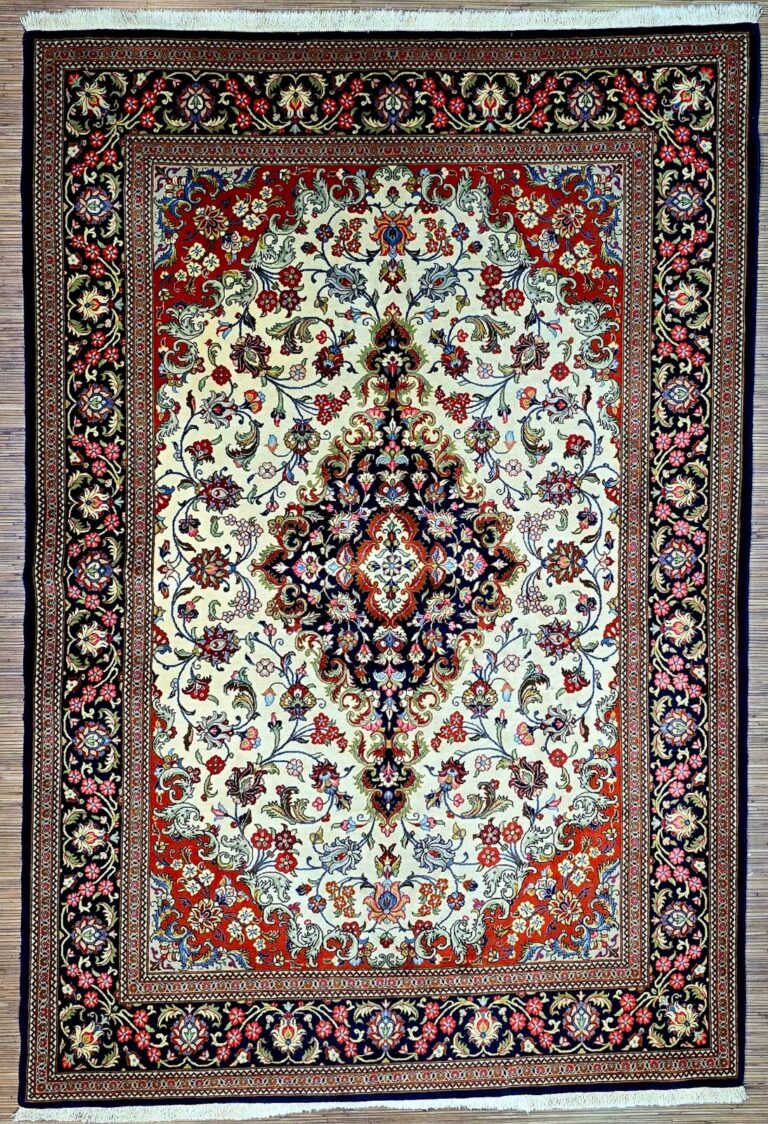
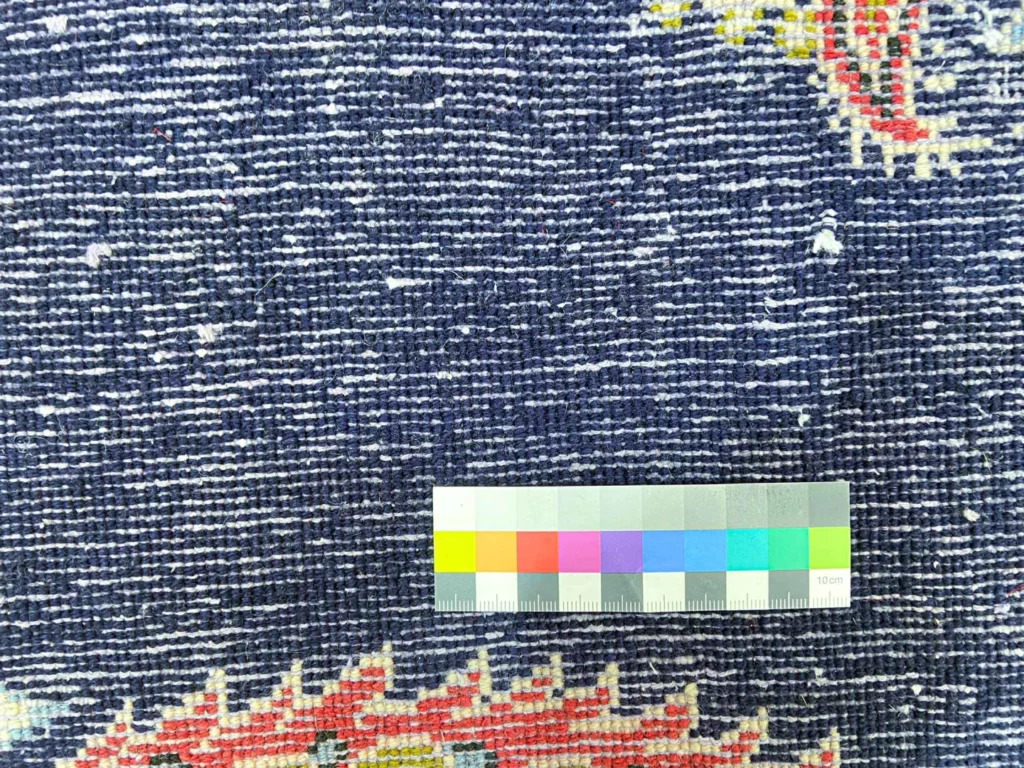
This Keshan Persian rug is hand-knotted, using a traditional textile process in which the visible surface is built knot by knot. Hand knotting is a deliberate form of production that requires repeated manual work at the loom. Rather than applying a design to a completed textile, the maker creates the structure and pattern together through the placement of individual knots.
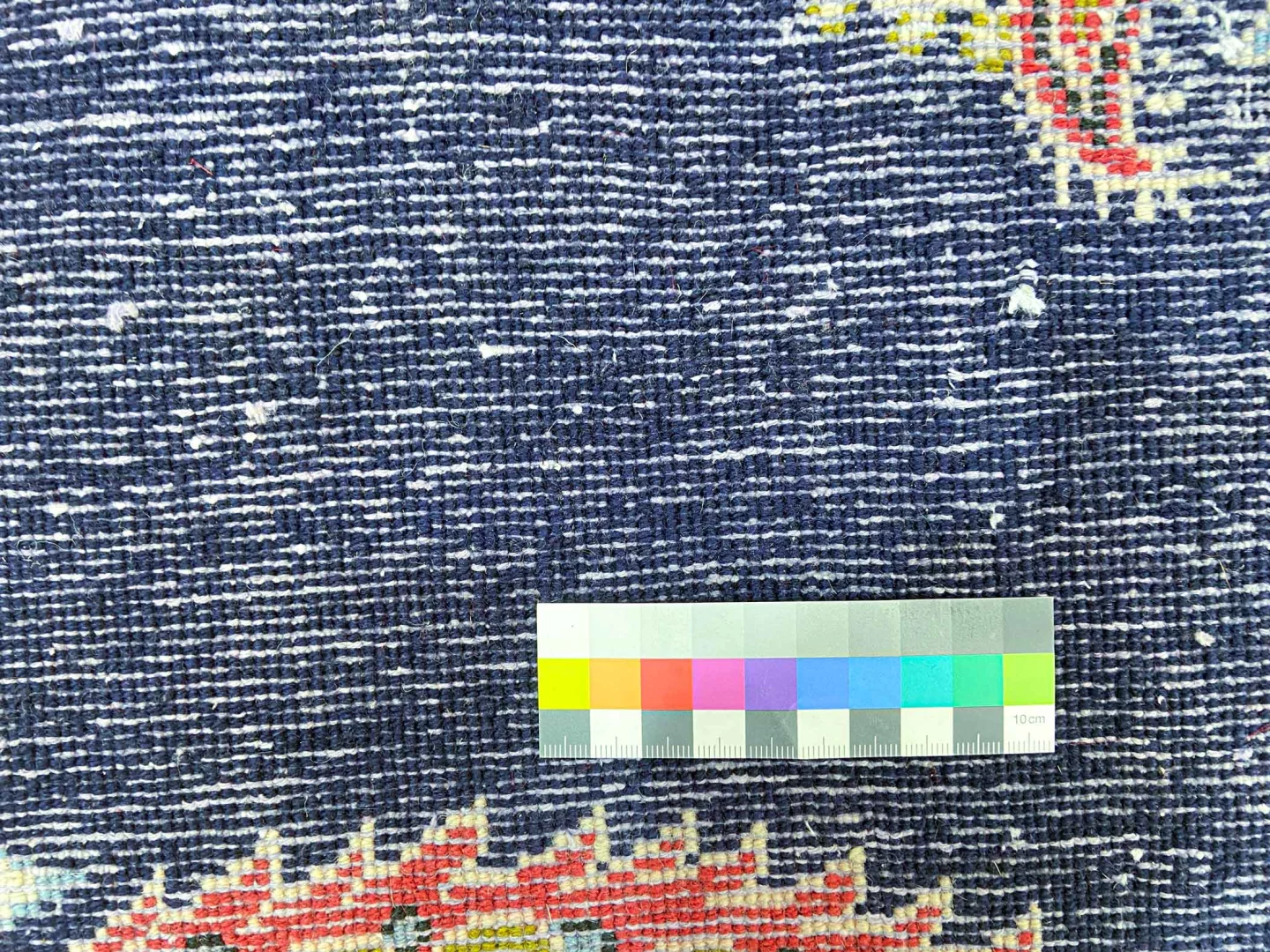
The pile is made from high-quality sheep wool. Wool is a traditional choice for Keshan rugs because it provides a tactile pile and is suitable for detailed handwork. The pile on this rug is short, giving its surface a compact character and allowing the drawn motifs to remain clearly defined. Cotton is used for the warp and weft. The materials therefore have distinct roles: the sheep wool forms the visible pile, while cotton forms the woven foundation in which the knotted surface is held.
The recorded knot density is between 150,000 and 300,000 knots per square metre. In Keshan weaving, a dense knot structure supports the careful rendering of lines, floral details, and geometric elements. The detail comes from sustained manual work rather than from a machine-made process. Knot density is one part of the technical character of a rug and is considered together with the materials, the precision of the drawing, and the condition of the finished piece.
This rug is in very good condition. Its material and construction are defined by the sheep-wool pile, cotton warp and weft, short pile, and hand-knotted technique. The description does not provide information about restoration, age, or a signature, so those points are not assigned to this individual rug.
Origin and Tradition
Keshan rugs come from Keshan in Iran and belong to the Persian rug tradition. Keshan has a long association with carpet making and is recognised for a city-based weaving culture in which technical control and ordered ornament are closely related. The name identifies a regional tradition of Iranian craftsmanship. It does not simply describe a decorative style detached from its place of production.
Persian rug making developed through the transmission of practical knowledge across generations. This knowledge includes preparing the foundation, selecting and working wool, tying the knots, following a drawn design, and finishing the pile. In Keshan, these skills are linked to designs that can combine controlled symmetry with detailed botanical ornament. The result is a tradition in which the construction of the rug and its visual language are considered together.
The Iranian origin places this rug within the culture of Persian hand-knotted textiles. Other Iranian centres have their own identities, even where they share familiar elements such as medallions, borders, plant forms, or repeated geometry. Isfahan is associated with detailed and complex designs. Tabriz is often linked with large medallions and vivid colour arrangements. Nain is known for finely worked, lighter compositions, while Kashan is also recognised for refined designs and durable rugs. These regional names refer to distinct traditions; they do not change this rug’s Keshan origin.
The history of Persian carpets is connected with domestic interiors, courtly arts, trade, and the preservation of design vocabulary. A rug could serve a practical purpose while also carrying a carefully organised visual program. Weaving centres developed characteristic approaches to drawing, colour, and structure, and those approaches could be adapted to different formats. Keshan rugs therefore appear in a range of sizes and settings, while retaining the hand-knotted basis that defines their tradition.
Keshan craftsmanship is also part of a wider Iranian network of textile knowledge. Materials, tools, patterns, and working methods have circulated between regions, allowing related motifs to appear in different local interpretations. This does not make the traditions interchangeable. The balance between pile, foundation, knotting, and design remains part of the identity of each weaving centre. Keshan is distinguished by the combination of Persian city weaving, careful knotting, and a formal decorative language.
The history of the Keshan rug reaches back into the broader heritage of the Persian Empire and the centuries of Persian artistic development that followed. Its reputation rests on the expertise of weavers and on the use of selected materials. At the same time, every hand-knotted rug is an individual textile object. Traditional knowledge provides the framework, while the particular sequence of knots and the precise arrangement of motifs give each finished piece its own appearance.
Design and Pattern
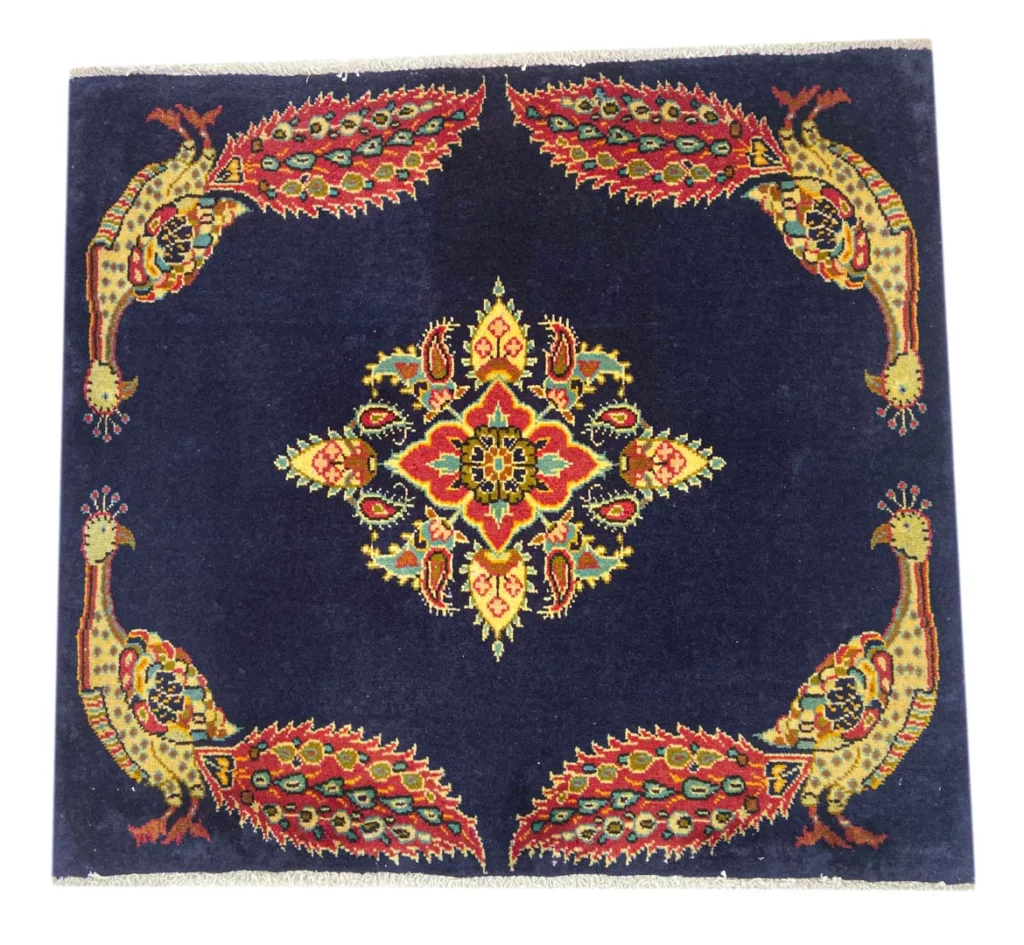
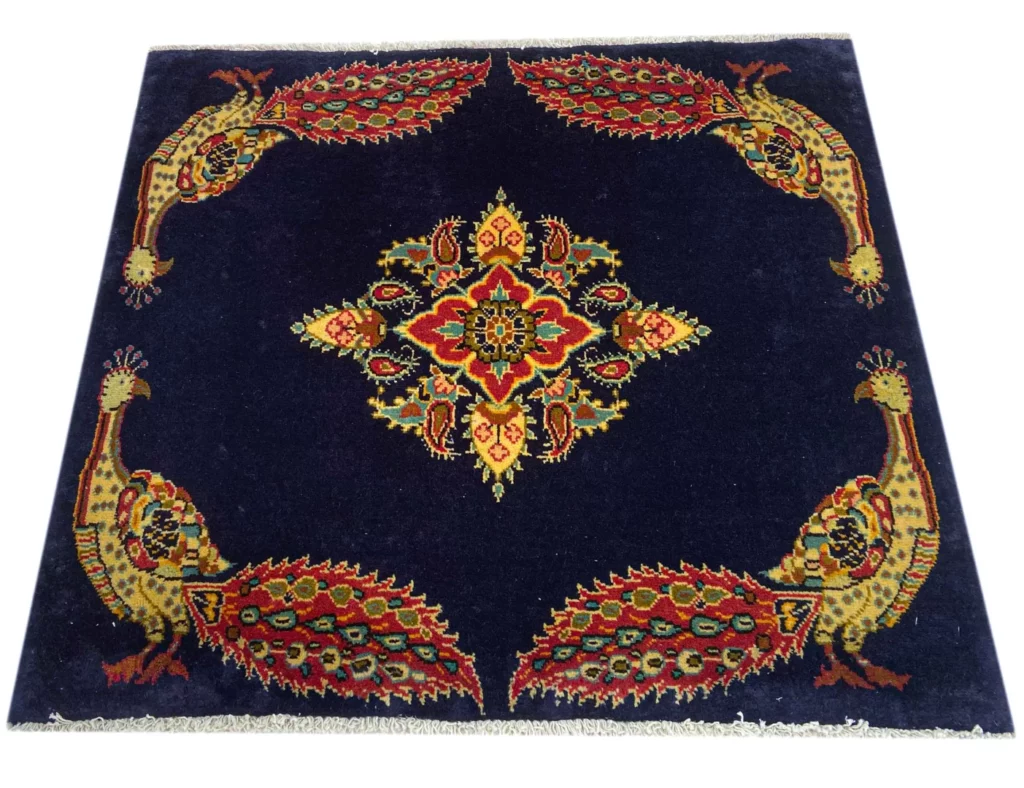
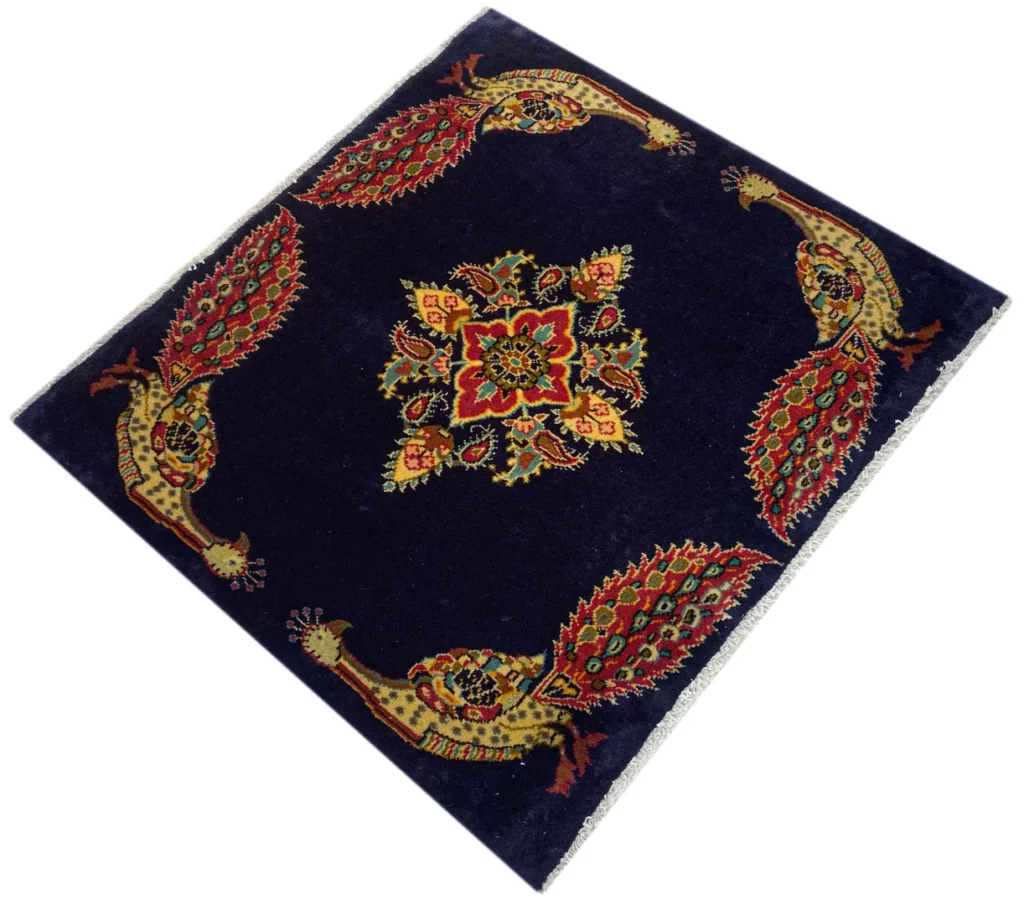
The pattern of this Keshan rug is described as floral and geometric. These two categories cover complementary forms of ornament. Floral motifs introduce flowers, leaves, vines, and curved lines, while geometric motifs use straight lines, angles, repeated units, and structured symmetry. Their combination creates a design language that can be read both as an arrangement of natural forms and as a carefully ordered field.
Floral ornament is central to many Persian rug traditions. Plant forms are usually stylised rather than copied as literal botanical illustrations. A flower may be reduced to a rosette, a leaf may become a repeated outline, and a vine may connect separate elements across the field. This stylisation makes the motif suitable for repetition and allows the design to remain coherent across a complete rug surface.
Geometric ornament provides another means of organising the composition. Borders, stepped outlines, angular leaves, medallion structures, and repeated devices can divide the surface into recognisable areas. Geometry gives the eye a sense of rhythm and establishes relationships between the centre, surrounding field, and border. When combined with floral drawing, it can bring firmness to curved forms and make the overall pattern easier to follow.
Keshan rugs are known for elaborate patterns and lively colour effects. Colour in a Persian design can distinguish a principal motif from secondary ornament, clarify the relationship between field and border, and make small details legible. In floral compositions, tonal differences can separate petals, leaves, and connecting stems. In geometric compositions, contrast can emphasise edges and repeated forms. The description of this particular rug identifies floral and geometric motifs but does not specify individual colours or a particular central medallion.
A Persian rug design often depends on repetition and balance. A border may contain the central field, while smaller ornaments fill spaces between larger forms. Symmetry can be exact, approximate, or created through a recurring rhythm. The design is not printed after the textile is made; it is translated into the rug during knotting. The knot density associated with Keshan supports the controlled rendering of fine lines and smaller pattern components.
Motifs also carry the history of the tradition in which they are used. Floral forms, vines, rosettes, and geometric devices have been handed down, adjusted, and recombined by different workshops and generations. Familiar elements can therefore appear in many variations. This rug has its own concrete arrangement because it is a one-off hand-knotted piece, while its floral and geometric vocabulary places it within the broader Keshan design tradition.
The design can be understood on two levels. From a distance, the viewer encounters the balance of the full field and its borders. Closer inspection reveals the relationship between individual knots, outlines, repeated ornaments, and changes in colour. That movement between overall order and small-scale detail is characteristic of hand-knotted Persian rugs. It gives the pattern a material presence without requiring claims about a motif that has not been specifically named.
Special Features
This individual rug combines Iranian Keshan origin with hand-knotted construction and a pile made from high-quality sheep wool. Cotton is used in the warp and weft, and the pile is short. The pattern contains floral and geometric motifs, while the recorded knot density indicates a finely worked textile structure.
The very good condition is another stated feature of the piece. Together, the condition, materials, construction, and dense knotting describe its particular character. No age, signature, restoration history, or additional provenance is specified for this rug, so no such detail is added here.
FAQ
How should I care for my Keshan Persian rug?
Regular vacuuming helps remove dust and loose dirt from the short wool pile. Use a suitable setting and avoid treating the surface harshly. If a spill occurs, blot it promptly with a damp cloth rather than rubbing the area vigorously. Professional rug cleaning is recommended when a deeper cleaning is needed, since specialist treatment helps protect the colours and structure of a hand-knotted textile. Strong household detergents, excessive water, and aggressive brushing should be avoided because they can affect the wool pile and the cotton foundation.
How can I assess the quality of a Keshan Persian rug?
Knot density and materials are useful points of reference. This Keshan rug has a recorded density between 150,000 and 300,000 knots per square metre. A higher density can support more detailed handwork, but it should not be treated as the only measure of quality. The feel and appearance of the wool, the clarity of the pattern, the regularity of the construction, and the condition all matter as well. The wool should feel soft and appear lustrous, while the cotton used for warp and weft should provide a sound foundation. These elements are best considered together.
Where can I buy an authentic Keshan Persian rug?
Authentic Keshan Persian rugs can be found through specialist rug dealers, art fairs, and established antique dealers. Ask for information that documents the rug’s origin and classification. Certificates or other provenance records can help when verifying that a piece is an original example of the stated tradition. The seller should also be able to describe the materials, knotting method, condition, and pattern clearly. Expert advice is useful when comparing regional traditions or evaluating the workmanship and documentation of an individual hand-knotted rug.
To provide the best experiences, we use technologies like cookies to store and/or access device information. Consenting to these technologies will allow us to process data such as browsing behavior or unique IDs on this site. Not consenting or withdrawing consent, may adversely affect certain features and functions.
Functional Always active
The technical storage or access is strictly necessary for the legitimate purpose of enabling the use of a specific service explicitly requested by the subscriber or user, or for the sole purpose of carrying out the transmission of a communication over an electronic communications network.
Preferences
The technical storage or access is necessary for the legitimate purpose of storing preferences that are not requested by the subscriber or user.
Statistics
The technical storage or access that is used exclusively for statistical purposes.The technical storage or access that is used exclusively for anonymous statistical purposes. Without a subpoena, voluntary compliance on the part of your Internet Service Provider, or additional records from a third party, information stored or retrieved for this purpose alone cannot usually be used to identify you.
Marketing
The technical storage or access is required to create user profiles to send advertising, or to track the user on a website or across several websites for similar marketing purposes.
 SECURE PAYMENT
 SHIPPING PARTNERS