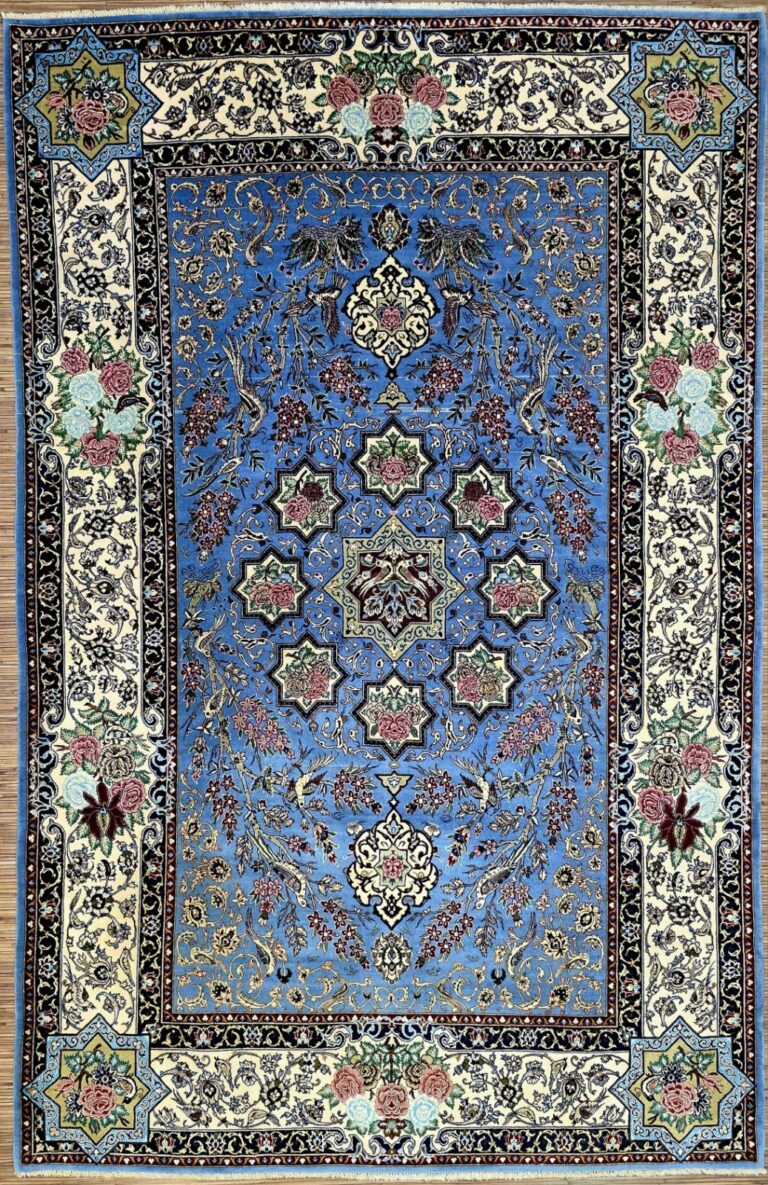
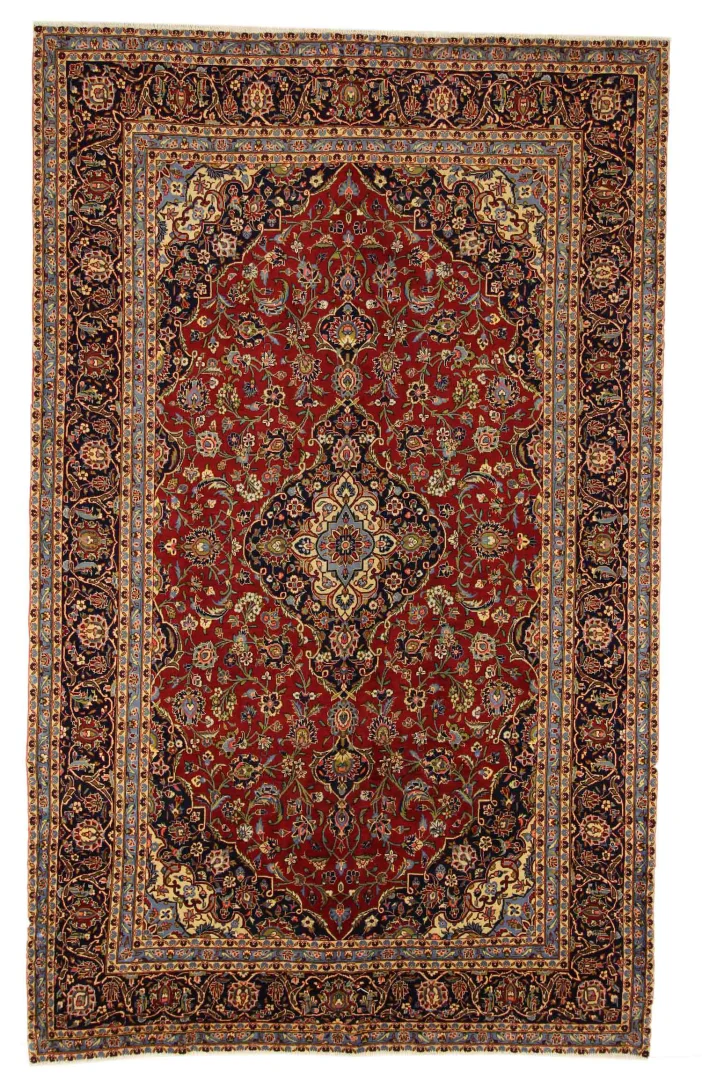
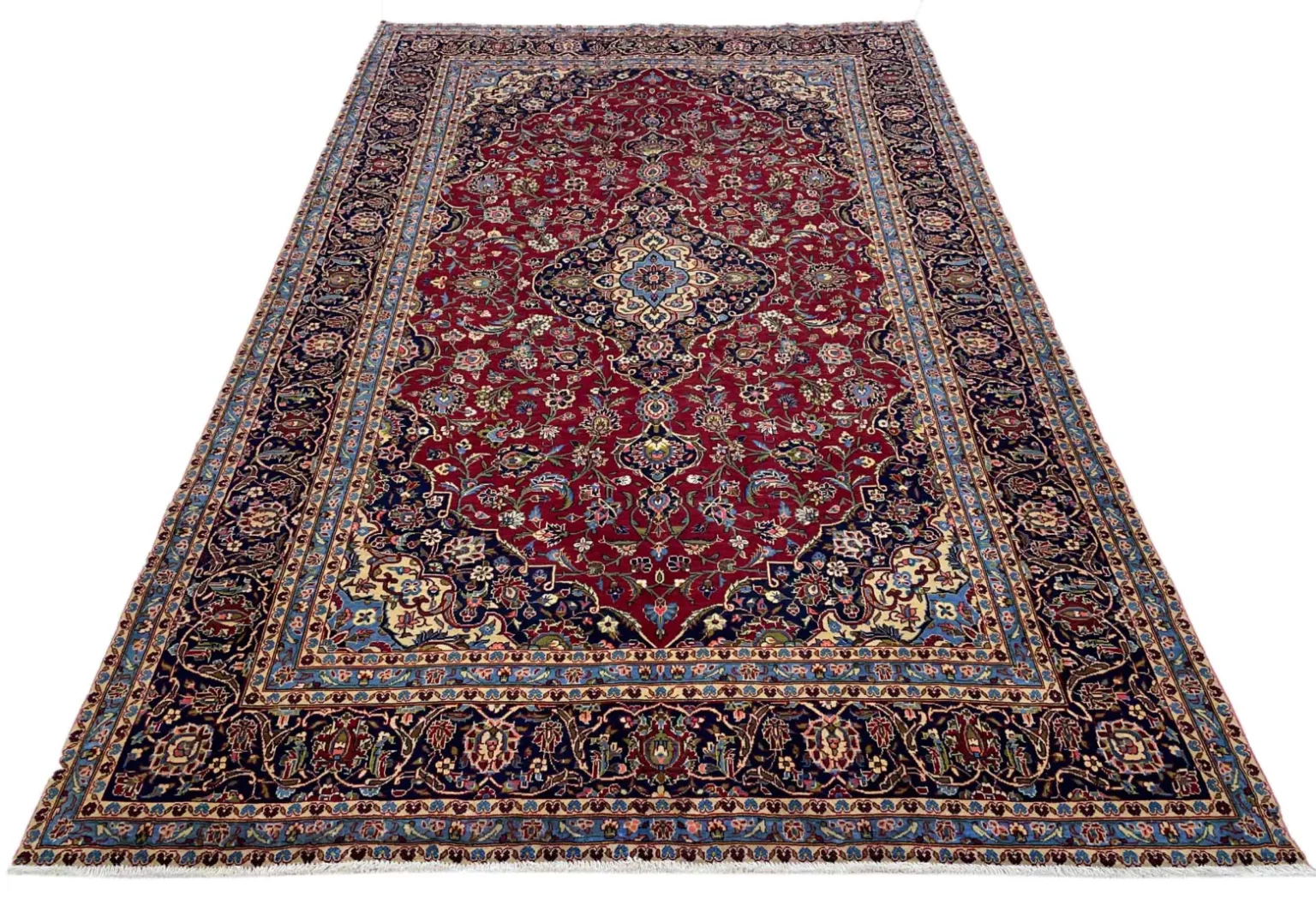
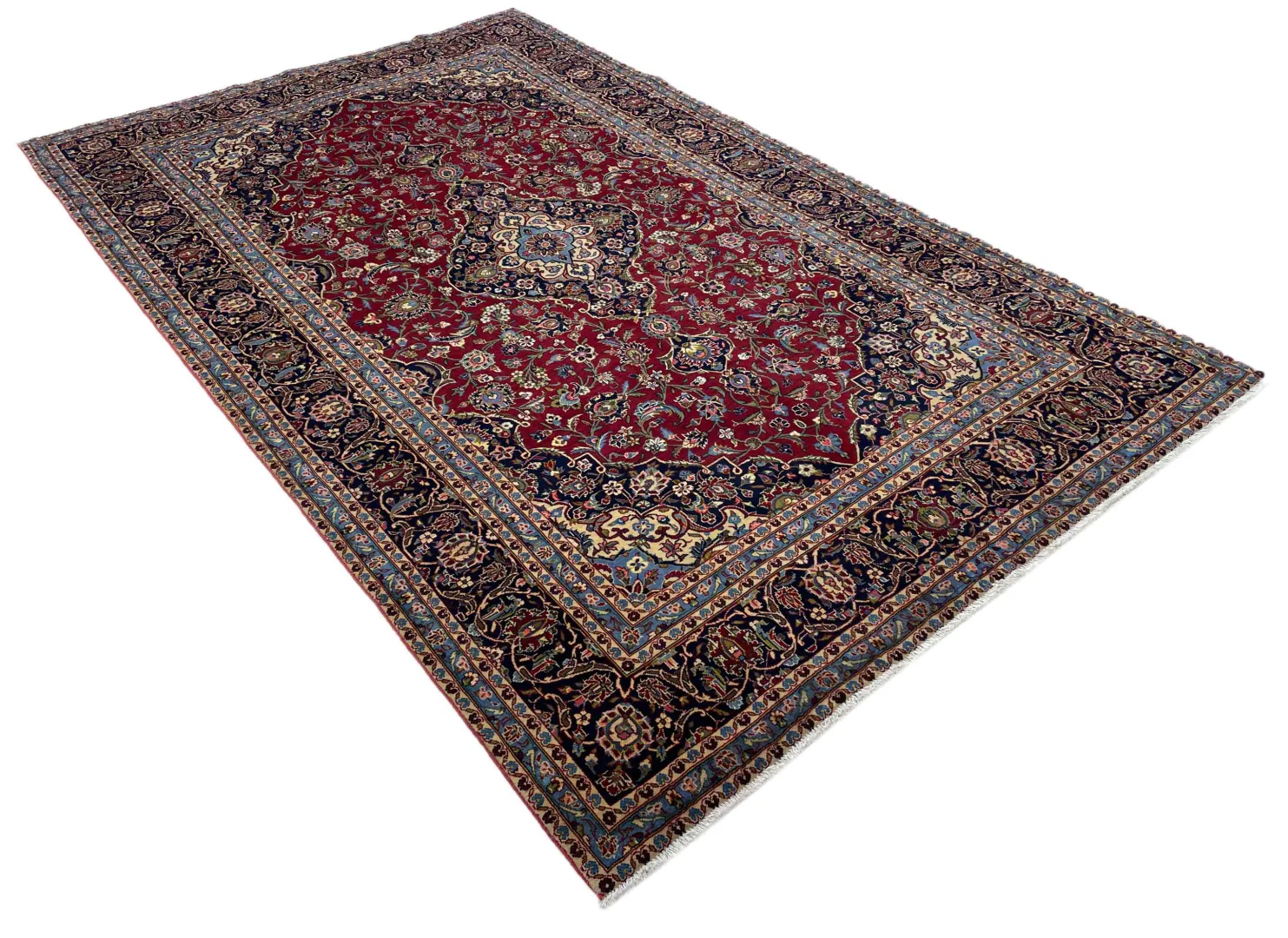
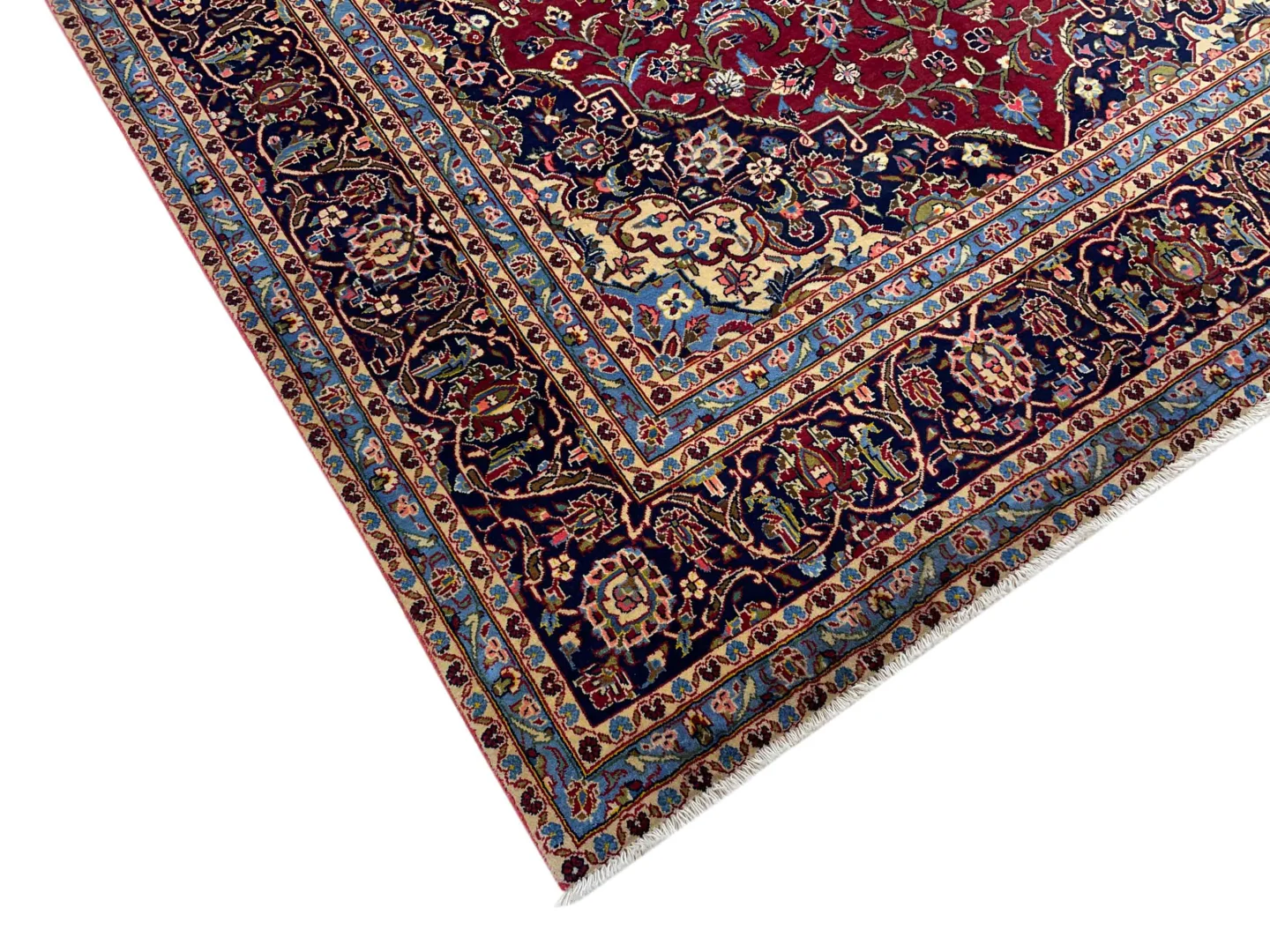
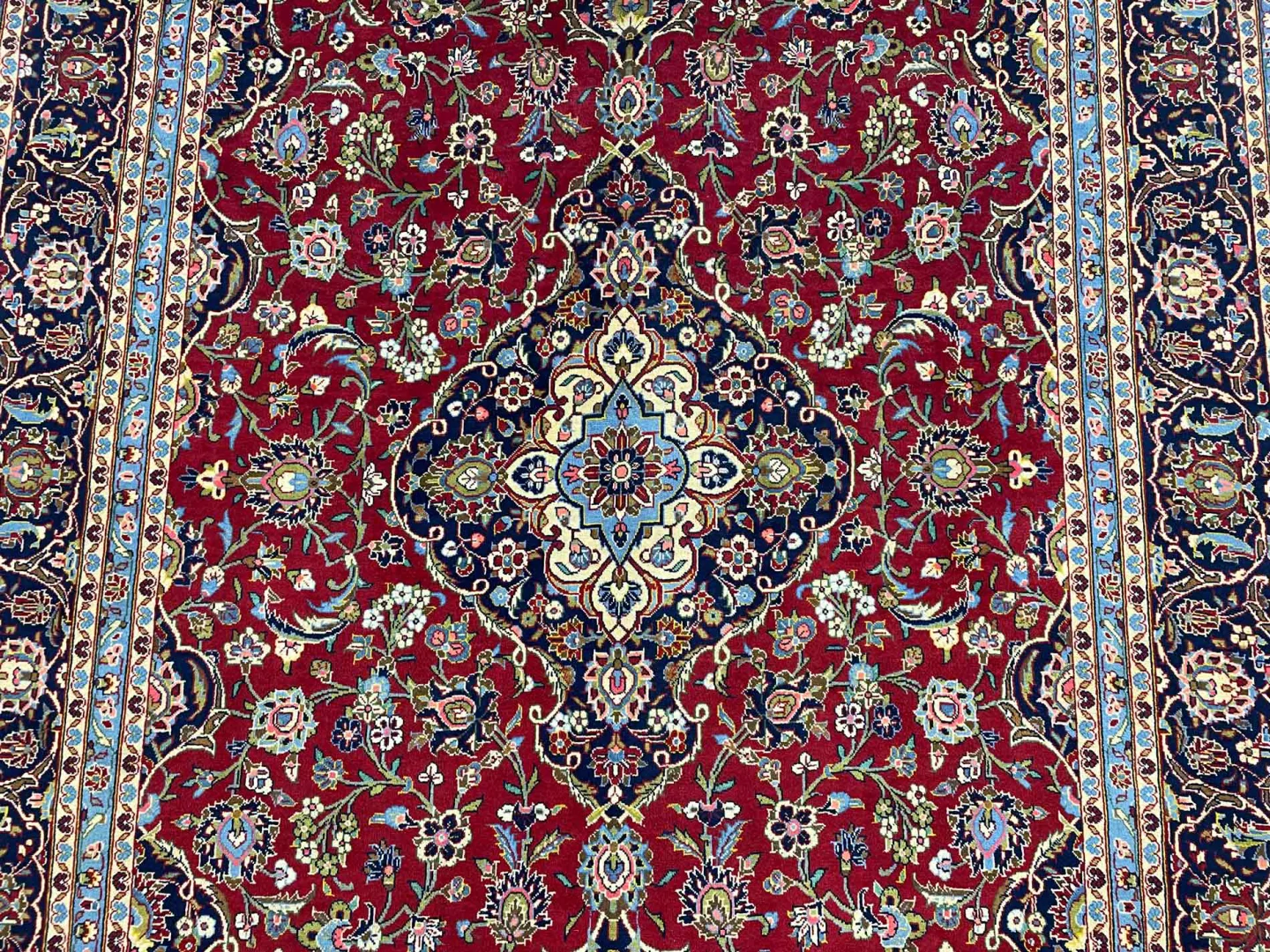
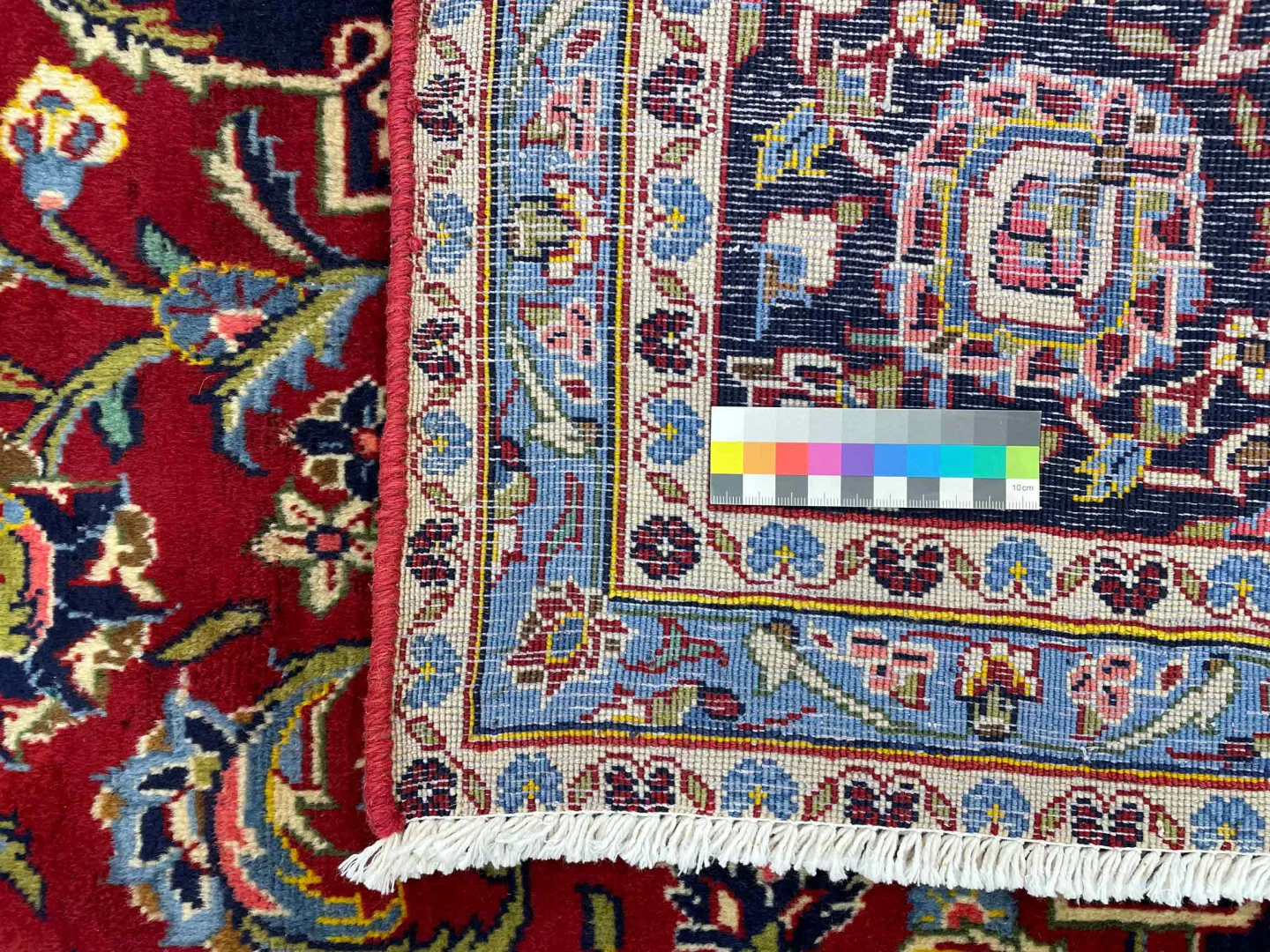
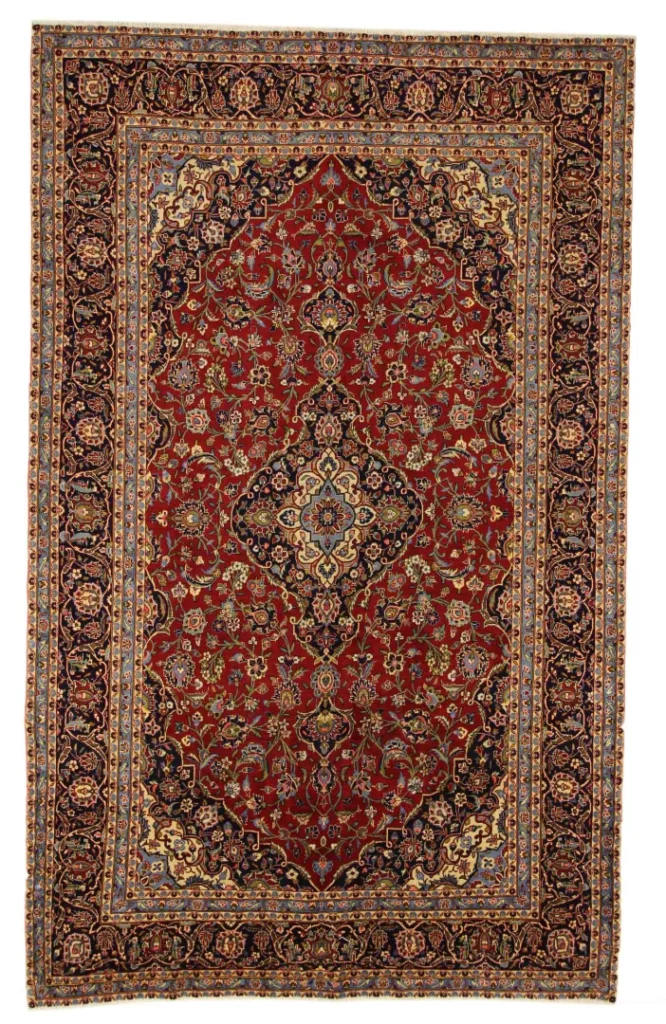
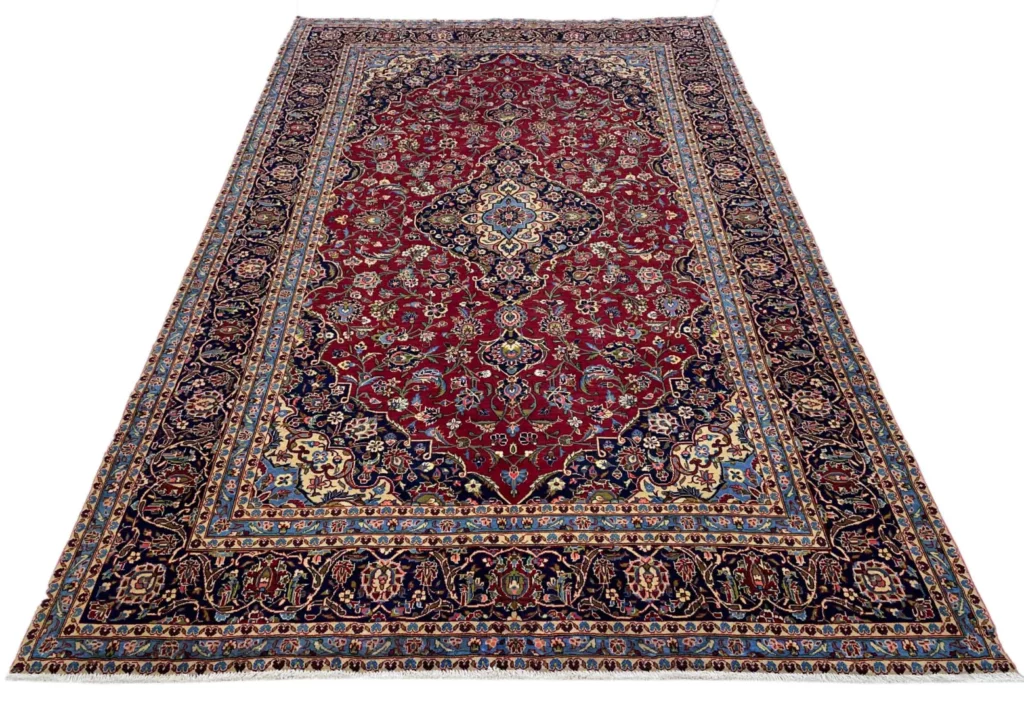
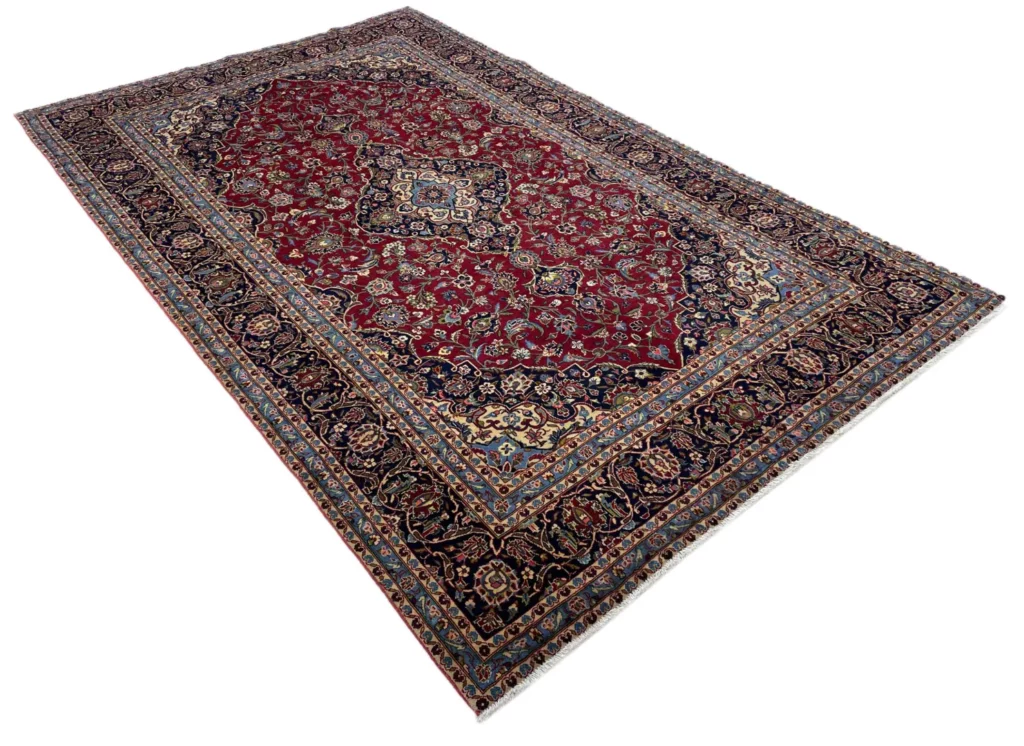
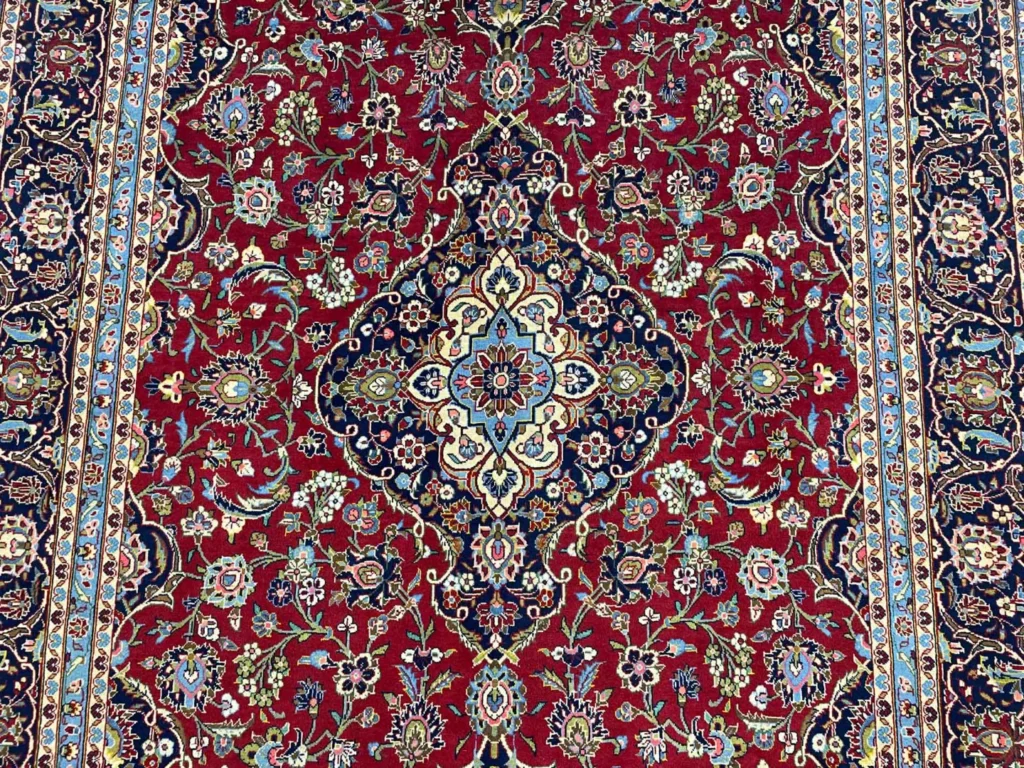
Hand-knotted Keshan Persian rug | Knot density: 150,000 knots | Material: wool pile, usually cotton warp and weft | Size: 322 x 200 cm | Pattern: floral and geometric motifs in red, blue and gold
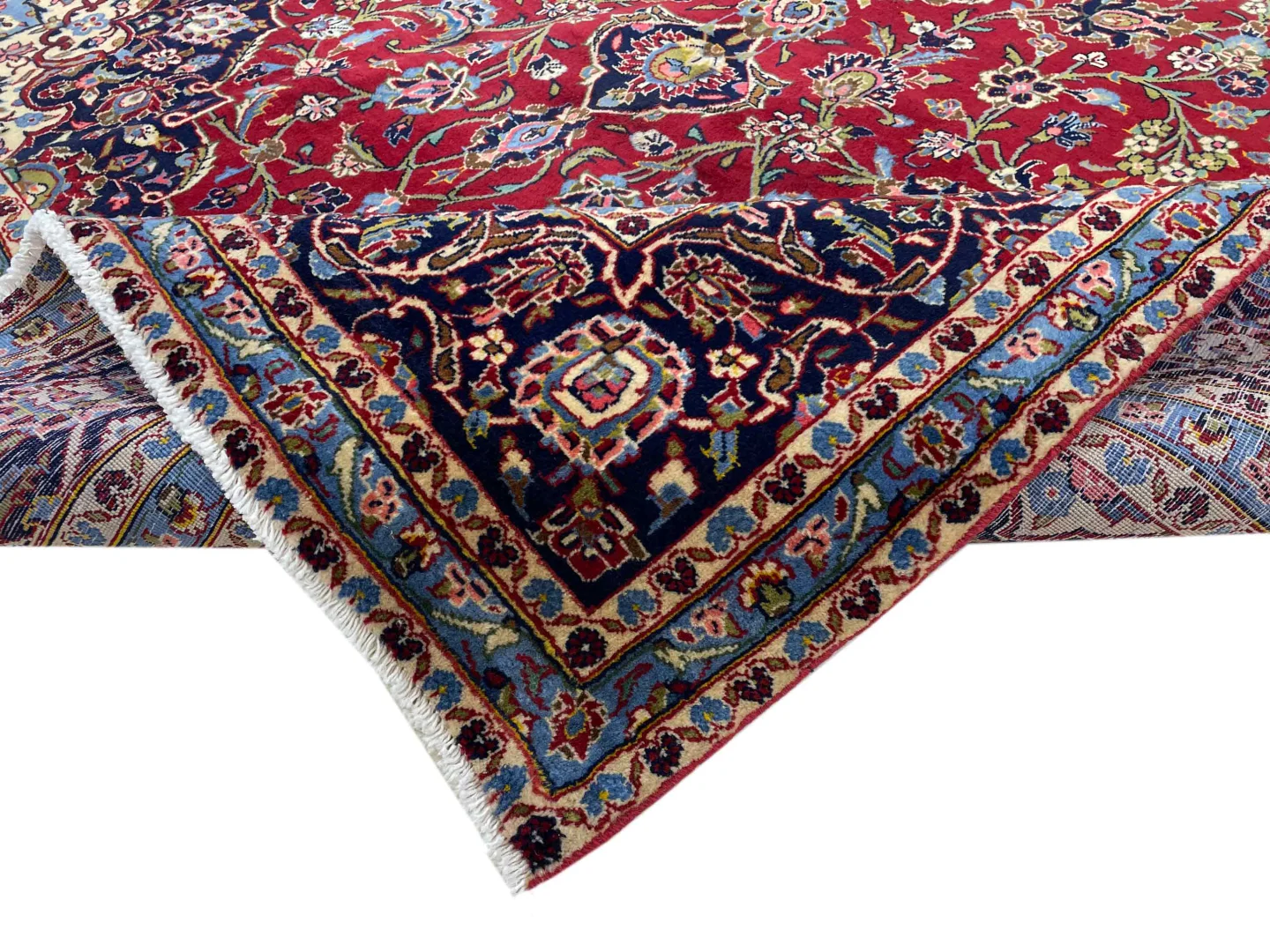
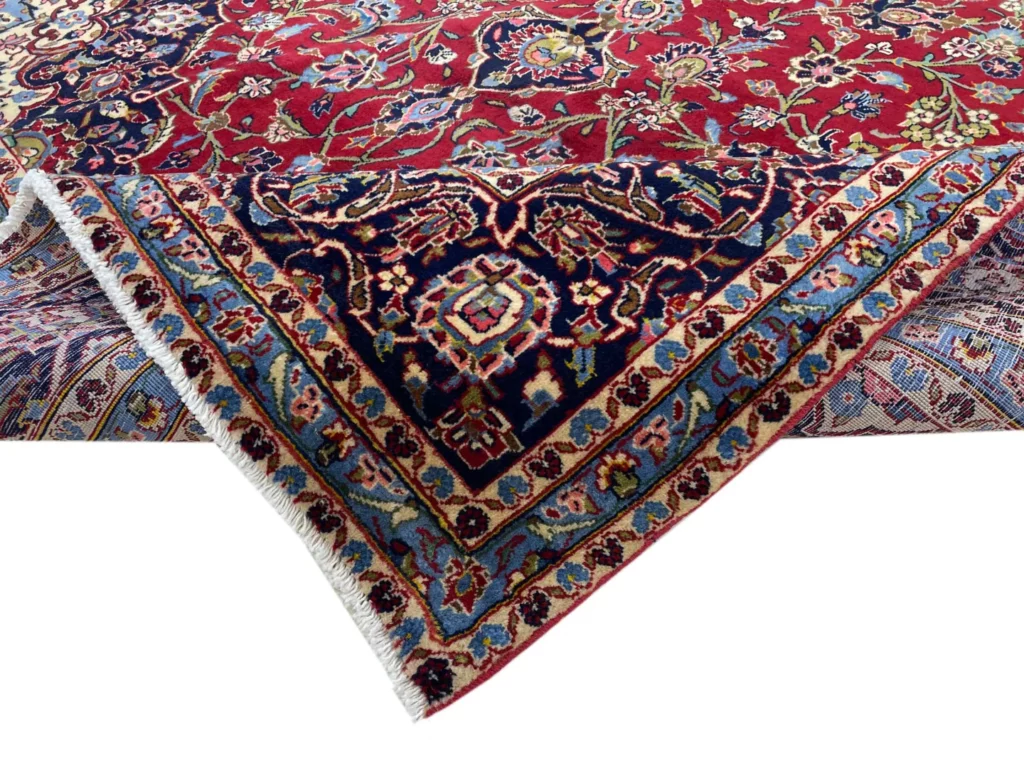
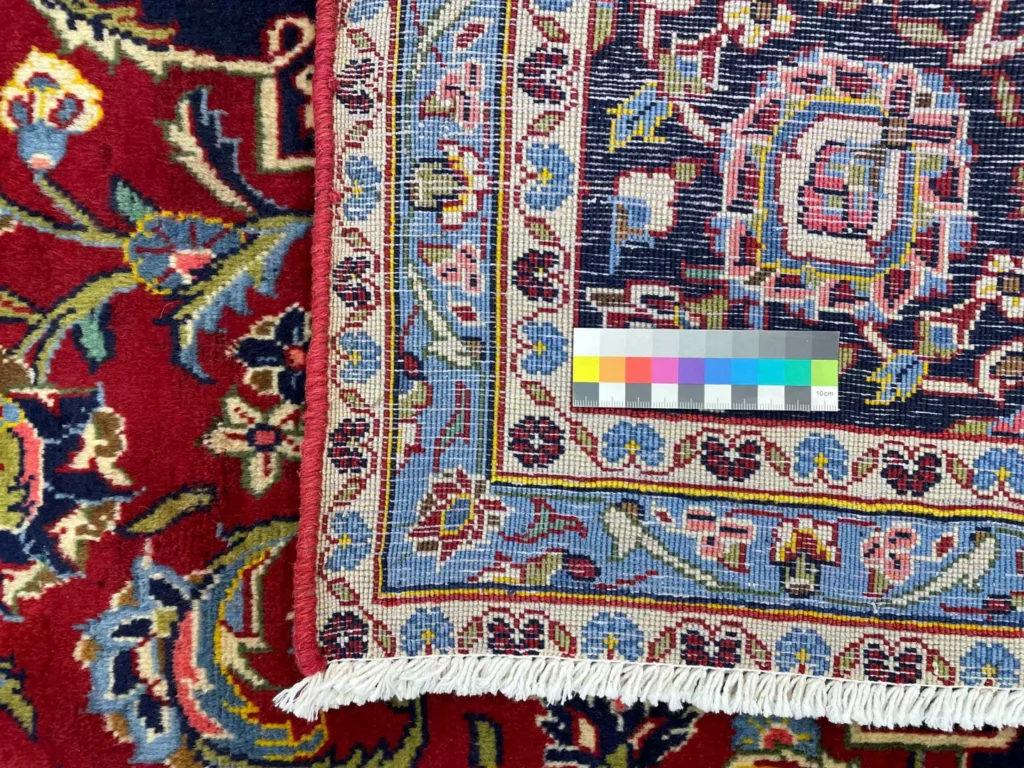
This Keshan carpet is hand-knotted, a method in which individual knots are tied by hand around the foundation threads. Row by row, the knots form the pile and give the design its structure. Hand-knotting allows a weaver to render both curved floral details and clearly defined geometric elements within the same composition.
Keshan carpets are associated with a fine knot density. A closely worked surface supports precise drawing and allows small details in the pattern to remain legible. It also contributes to the firm construction for which these carpets are known. The pile is traditionally made from wool. Wool from regional sheep is valued in Keshan weaving for its combination of softness and resilience.
The foundation of Keshan carpets is generally made with cotton. Cotton is used for the warp and weft because it provides a stable base for the tied pile. Together, the wool pile and cotton foundation create a structure suited to regular use. The hand-knotted construction also means that the surface is built through a time-intensive process rather than through an industrial production method.
Origin and Tradition
Keshan, also written Kashan in many English references, is a city in Iran with a long tradition of carpet weaving. Keshan carpets belong to the Persian tradition and are recognised as products of a region where weaving has been practised by hand for centuries. The name refers to the established weaving centre and its characteristic approach to materials, structure and design.
The carpets of Keshan developed within the wider culture of Persian textile production. In this tradition, a carpet is planned as a complete field of colour, line and ornament. The drawing is transferred into a knotted surface, with the arrangement of the motifs determining the rhythm of the finished piece. The result is a form of textile art that combines practical floor covering with a carefully organised decorative composition.
Regional wool has long been an important resource for Persian rug production. Its natural strength makes it suitable for a pile that must withstand use, while its texture accepts colour and holds the contours of the design. Cotton foundations are also common in Keshan weaving. They give the carpet an even framework and help the weaver maintain the proportions of the planned pattern as the work progresses.
The fine knotting associated with Keshan reflects a preference for detailed designs rather than broad, loosely drawn ornament. A higher number of knots permits a more differentiated outline and a greater variety of small elements. This does not change the fundamentally handmade character of the carpet: each part of the surface remains dependent on the weaver’s repeated work, judgement and control of tension.
Keshan carpets are part of a wider family of Persian regional styles. Isfahan carpets are also associated with fine patterns and dense knotting, while Tabriz carpets are known for detailed depictions of landscapes and figures. These regional traditions are distinct, yet they share the Persian emphasis on carefully prepared designs, durable materials and elaborate handwork. Keshan remains identifiable through its own combination of floral and geometric vocabulary and its established weaving history.
Design and Pattern
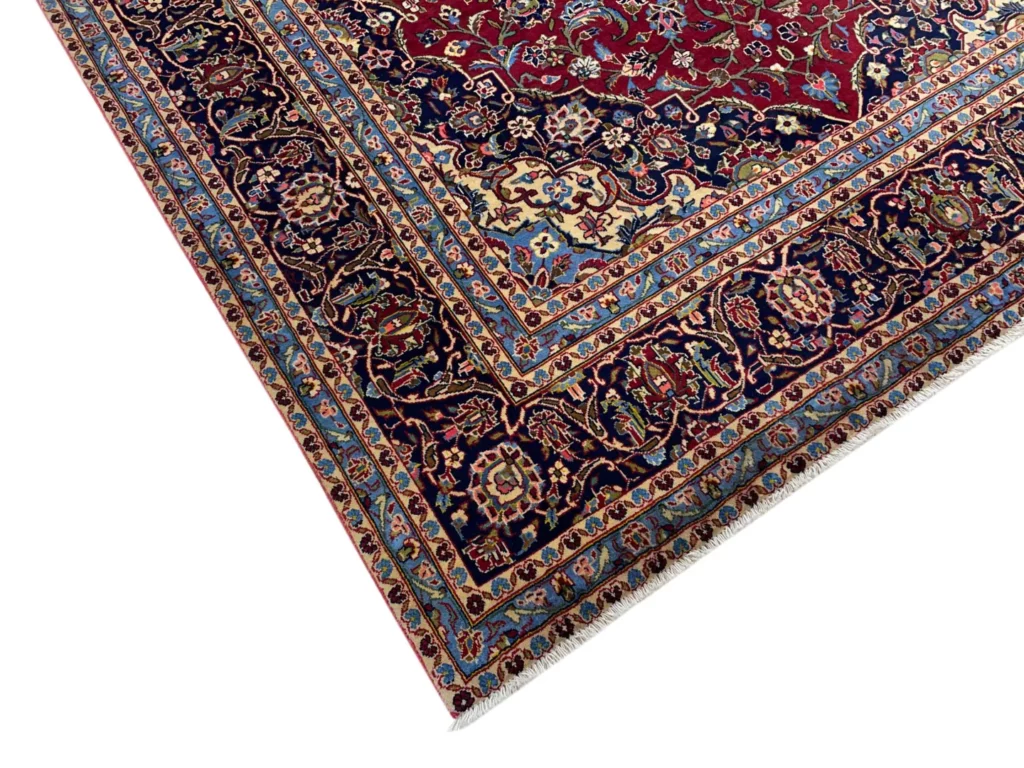
The design language of Keshan carpets commonly combines floral and geometric motifs. Floral elements may organise the field with curling stems, leaves and blossoms, while geometric forms bring order through repeated shapes, borders or balanced divisions. The two types of ornament are not opposites; they work together to create a composition in which flowing lines are held within a clear structure.
Colour is an important part of this regional design tradition. Deep red, blue and gold are typical Keshan colours and are often arranged to create a warm, clearly articulated surface. Red can give the field visual depth, blue introduces contrast and balance, and gold brings lighter accents to the ornament. The interaction of these tones helps separate the main motifs from the surrounding ground and makes the pattern readable across the carpet.
Persian carpet patterns are normally designed as coordinated systems rather than as isolated images. A central field, surrounding ornaments and border elements are planned to support one another. Repetition gives the eye a route through the composition, while variations in floral or geometric detail prevent the design from appearing mechanically uniform. In Keshan weaving, this balance between repetition and variation is part of the traditional visual character.
Floral ornament can be understood as a stylised interpretation of leaves, flowers and plant forms rather than as a literal botanical illustration. The weaver reduces and reshapes these forms so they can be repeated within the constraints of the knotting process. Geometric details provide another kind of clarity. Angular outlines, ordered intervals and measured symmetry help define the relationship between the individual motifs and the overall field.
The traditional palette also allows Keshan carpets to function in different interior settings. The deep red, blue and gold associated with the style establish a recognisably Persian atmosphere, while the organised pattern can sit alongside either classic or modern furnishings. This is a general characteristic of the design tradition and does not describe any feature beyond the floral and geometric composition and the colours identified for this carpet.
Special Features
The defining qualities of this Keshan carpet are its hand-knotted construction, its recorded fine knot density and its association with the Persian weaving tradition of Keshan in Iran. The use of wool for the pile is characteristic of the type, while cotton is generally used for the foundation. These elements explain why Keshan carpets are regarded as both decorative textiles and durable objects for everyday interiors.
Keshan carpets are known for lasting well when they are properly cared for. Many examples have the potential to remain in use for more than a century, and older pieces can be sought after by collectors. Their lasting value is connected with the strength of the materials, the density of the knotting and the continued relevance of the regional design tradition. No age or collector status is assigned here to this individual carpet.
A Keshan carpet can be used in a living area, dining room or hallway, depending on the surrounding furnishings and the available floor space. The regional style is also represented in carpets made in different sizes. The particular size of this piece is given separately in the product information and is not repeated in this description.
FAQ
How should I care for a Keshan carpet?
Regular vacuuming helps remove loose dust and everyday dirt before it can work deeper into the pile. Care should be taken not to expose the carpet to excessive direct sunlight, because prolonged light can cause colours to fade. Occasional shampooing with a cleaner intended for carpets is part of the recommended care described for Keshan carpets. Cleaning should be carried out carefully so that the wool pile and the underlying foundation are not subjected to unnecessary moisture or rough treatment. A professional rug cleaner can be considered when a deeper cleaning is required.
Where does a Keshan carpet come from?
A Keshan carpet comes from the city of Keshan in Iran, a place known for its long-standing carpet-weaving tradition. The region has been associated with handmade carpets for centuries. Its reputation rests on the combination of carefully organised patterns, fine knotting and the use of wool and cotton in the traditional construction. Keshan is therefore both a geographical name and a reference to a recognised Persian weaving tradition. It should not be confused with carpets from other Iranian centres such as Isfahan or Tabriz, even though those regions also produce finely patterned Persian rugs.
Why can a Keshan carpet be considered an investment?
Keshan carpets are valued not only for their appearance but also for their durability and their place in Persian carpet history. Many examples have the potential to last for more than 100 years when they are maintained properly. Over time, well-preserved carpets from established weaving traditions may become more desirable to collectors and can increase in value. This potential is one reason Keshan carpets are sometimes described as investments in art and history. The potential applies to the type in general; the age, condition and future value of this individual carpet are not stated here.
To provide the best experiences, we use technologies like cookies to store and/or access device information. Consenting to these technologies will allow us to process data such as browsing behavior or unique IDs on this site. Not consenting or withdrawing consent, may adversely affect certain features and functions.
Functional Always active
The technical storage or access is strictly necessary for the legitimate purpose of enabling the use of a specific service explicitly requested by the subscriber or user, or for the sole purpose of carrying out the transmission of a communication over an electronic communications network.
Preferences
The technical storage or access is necessary for the legitimate purpose of storing preferences that are not requested by the subscriber or user.
Statistics
The technical storage or access that is used exclusively for statistical purposes.The technical storage or access that is used exclusively for anonymous statistical purposes. Without a subpoena, voluntary compliance on the part of your Internet Service Provider, or additional records from a third party, information stored or retrieved for this purpose alone cannot usually be used to identify you.
Marketing
The technical storage or access is required to create user profiles to send advertising, or to track the user on a website or across several websites for similar marketing purposes.
 SECURE PAYMENT
 SHIPPING PARTNERS