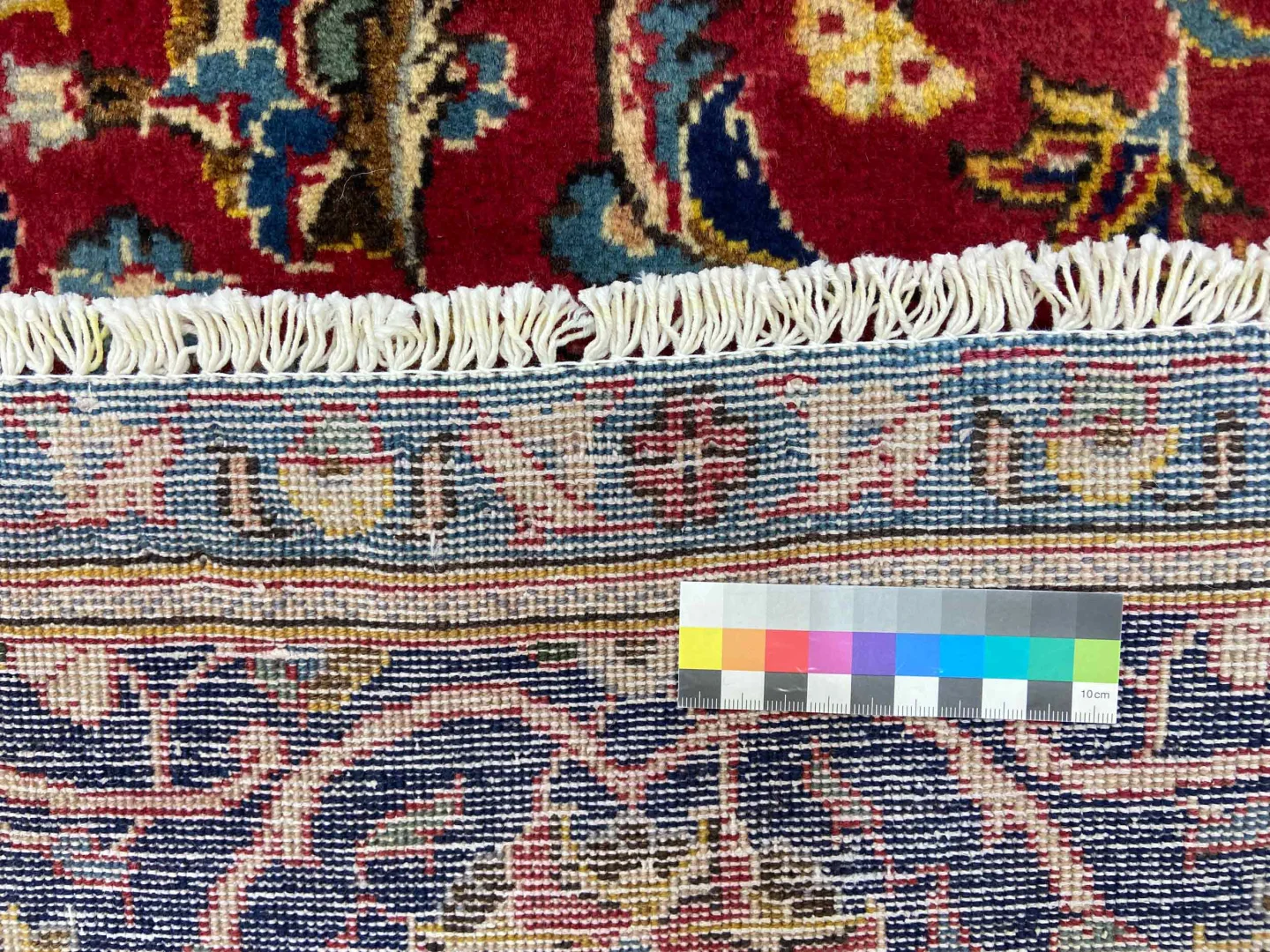
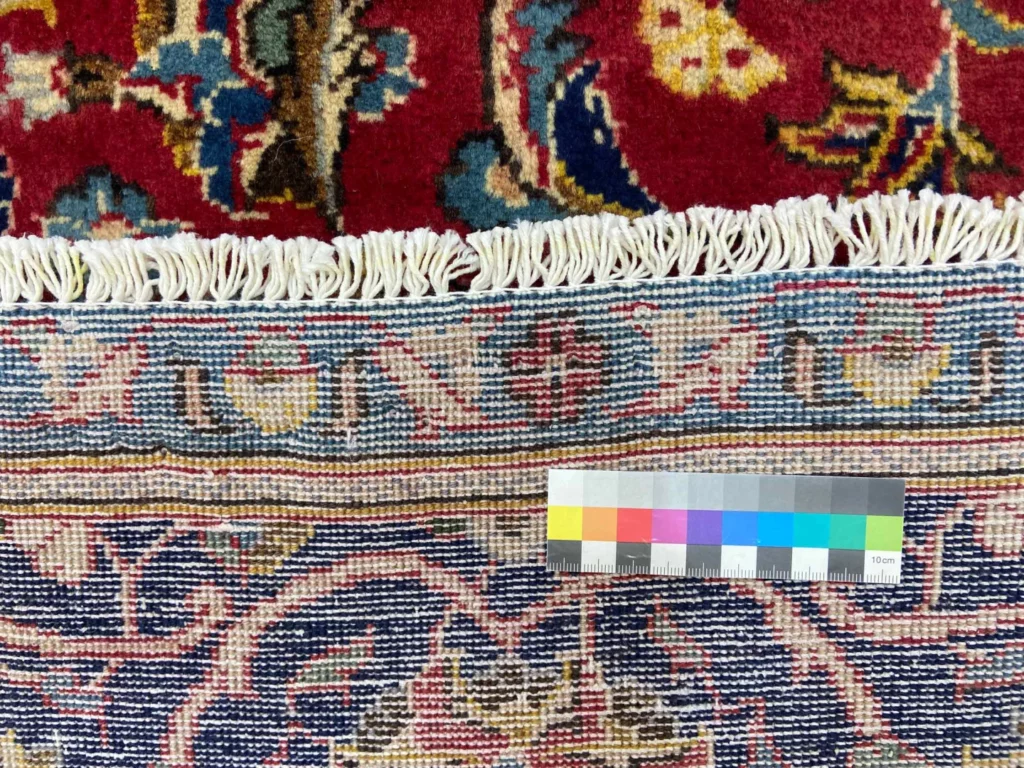
This Keshan Persian rug is hand-knotted. In hand-knotting, individual knots are placed into a prepared foundation one at a time. The pile is built row by row, while the pattern develops through the arrangement of many separate knots. This method is one of the defining techniques of Persian carpet making and gives the woven structure its particular character.
The pile of this rug is made from high-quality sheep wool. Wool has been used for carpets for centuries because it can be formed into a durable pile and provides a substantial, tactile surface. It can also take colour in a way that allows the outlines and fields of a pattern to be expressed clearly. In this Keshan rug, the sheep wool forms the visible pile and determines the feel of the surface.
The warp is made of cotton. Running through the foundation, the warp provides the lengthwise framework to which the knots are attached. Cotton is valued in carpet construction for its even and stable structure. It gives the knotting a firm base and helps the weaver develop the pile across the full design. The wool pile and cotton warp therefore perform different but connected functions within the same handmade construction.
The rug has a short pile, giving it a velvety hand. A shorter pile can make the pattern appear defined because the surface does not obscure the lines with the movement of longer fibres. At the same time, the wool remains clearly tactile. The knot density is given as 150,000 to 300,000 knots per square metre. A relatively dense knot structure provides the technical basis for differentiated drawing, small pattern elements and gradual transitions between areas of colour.
The appearance of a hand-knotted carpet results from the relationship between its materials, foundation, knot placement, pile height and design. These stages require continuous manual attention. The short wool pile, cotton warp and stated knot density are part of the construction described for this Keshan rug. Its condition is described as very good.
Origin and Tradition
Keshan, also spelled Kashan, is a city in Iran and the place whose name identifies this carpet tradition. Keshan Persian rugs belong to the wider heritage of Iranian weaving. The city developed a reputation for textile craftsmanship and carpet trade, and its name came to represent a recognisable regional approach to hand-knotted rugs. The designation therefore refers to a geographic origin as well as to a tradition of design and workshop practice.
The history of Keshan reaches back to the Persian Empire. Carpets and other handmade goods were important articles of trade, and products from the region travelled along historic routes associated with the Silk Road. These routes connected Keshan with distant markets and enabled carpets from the city to gain international recognition. Trade also encouraged an exchange of forms, colours and technical knowledge, while local workshops continued to preserve their own regional identity.
In a traditional weaving centre, production and commerce influence one another. Workshops refine their methods, prepare patterns for different uses and maintain standards that become associated with the place. At the same time, the skills of spinning, dyeing, preparing the foundation, knotting and finishing are transmitted through practical instruction. Keshan’s place in Persian carpet history is shaped by this close relationship between local craft and long-distance trade.
Persian carpet knowledge has often been passed on through families and workshops. It includes the preparation of the warp, the selection and handling of pile material, the planning of the field and borders, and the placement of knots according to a drawn or memorised design. Finishing processes are part of the same tradition. A Keshan rug consequently represents a regional form of textile craftsmanship rather than a purely decorative category.
Iran contains many established carpet centres, each with its own drawing conventions, colour preferences and workshop history. Isfahan and Tabriz are related examples within Persian carpet culture. Isfahan rugs are associated with complex designs and elaborate colour selection. Tabriz rugs are often recognised for large central medallions developed with fine detail and lively colour. These names identify separate regional traditions. They do not change the classification of this rug as a Keshan.
The history of Keshan weaving can therefore be understood through several connected elements: the city in Iran, the Persian Empire, historic trade routes, and the transmission of manual skills. Because its origin is given as Persia, this rug is a Persian rug. Its hand-knotted construction links it to a process in which the design is created during the formation of the pile rather than printed or applied after the surface has been made.
Design and Pattern
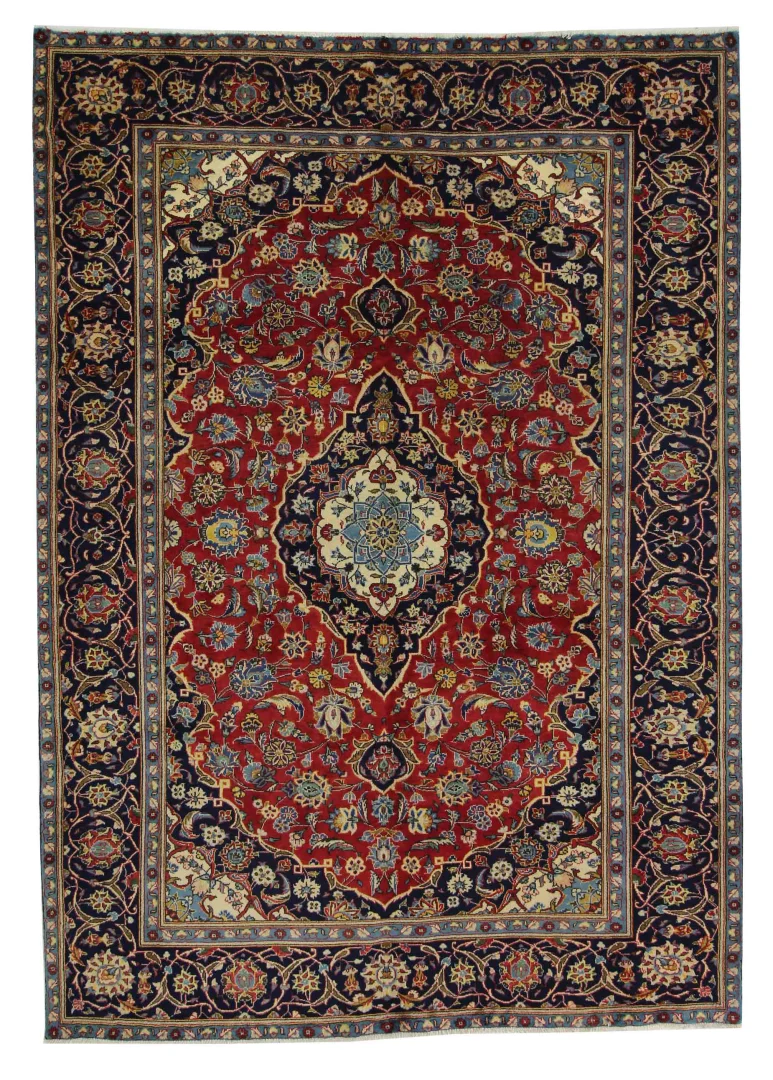
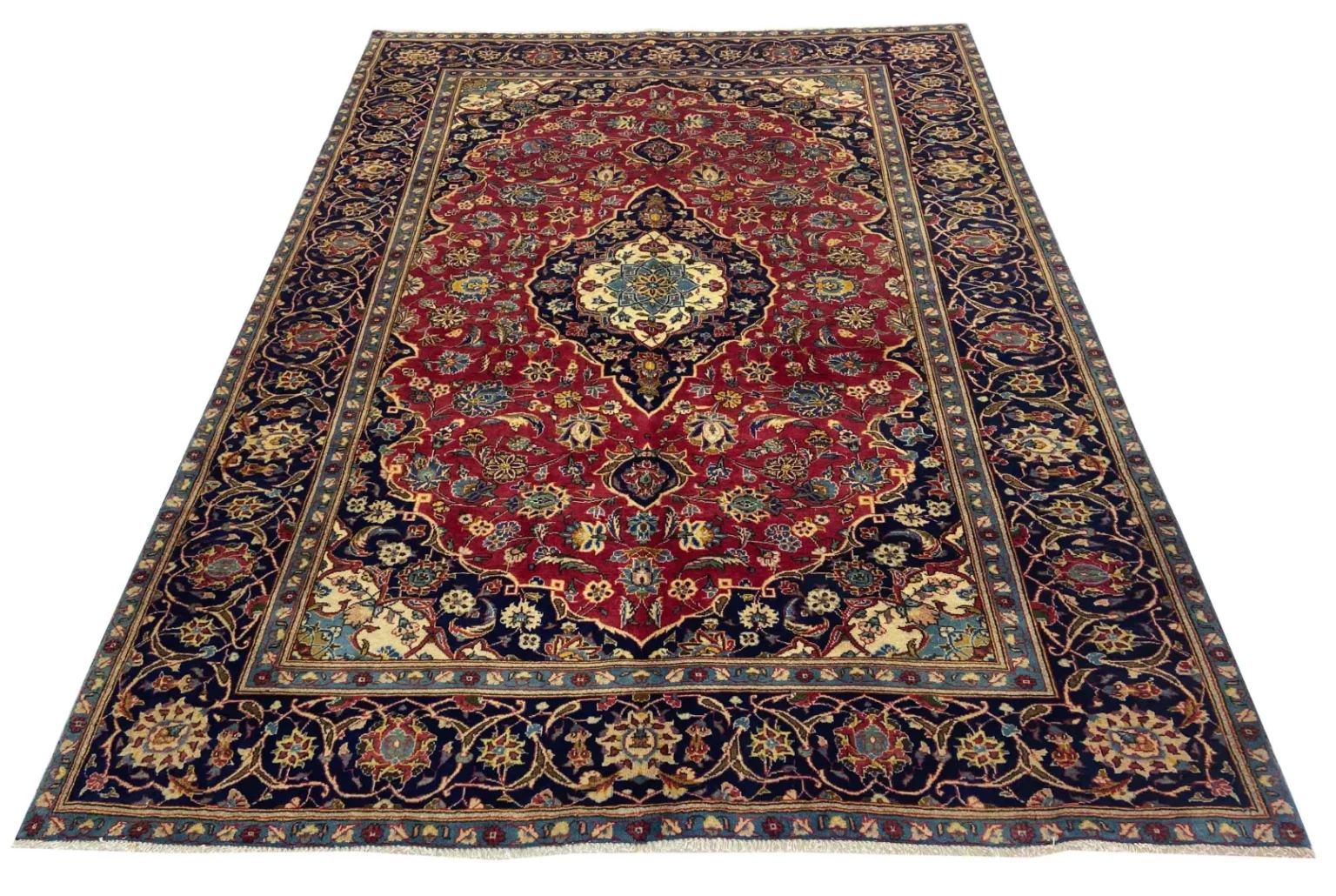
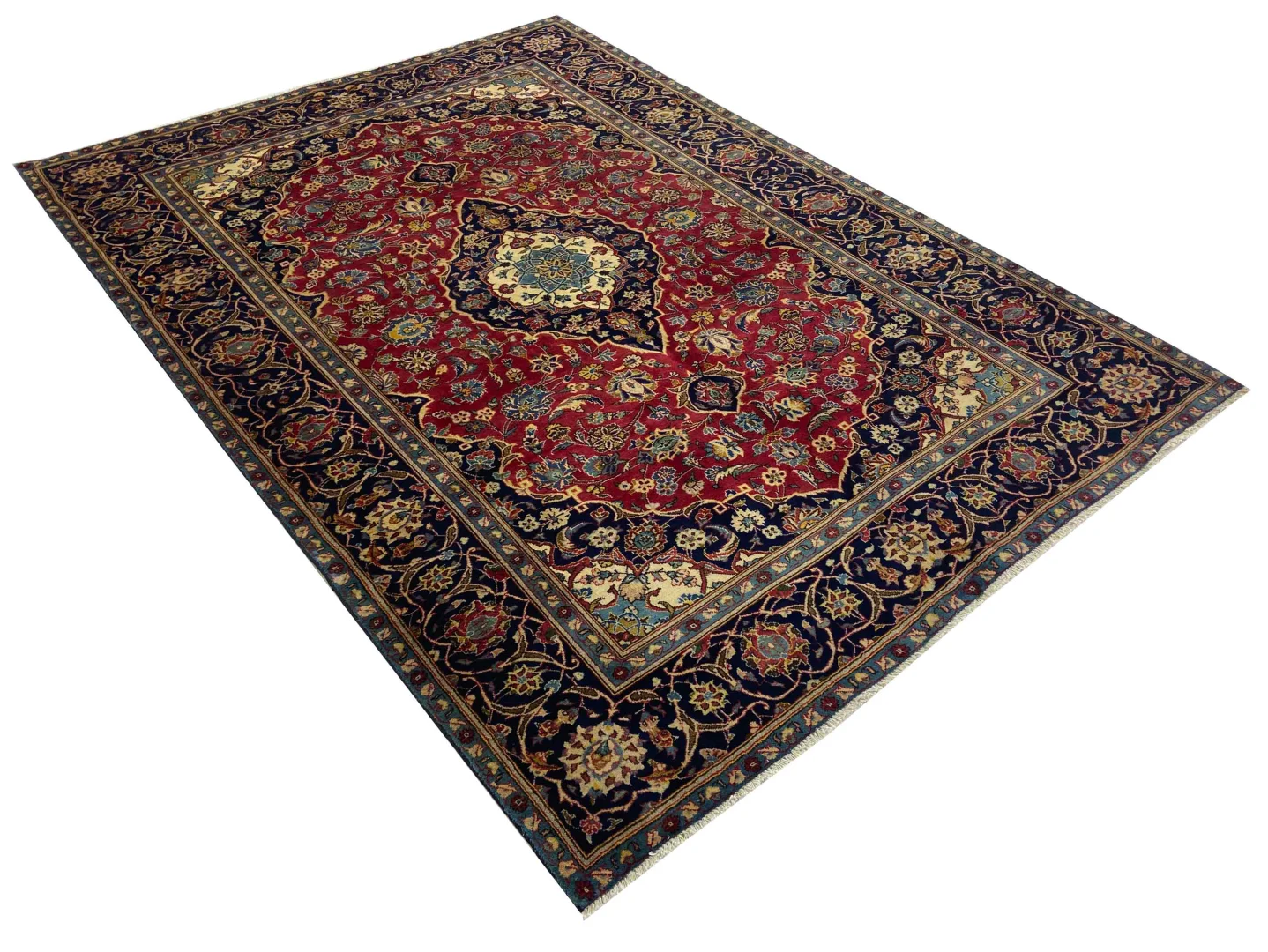
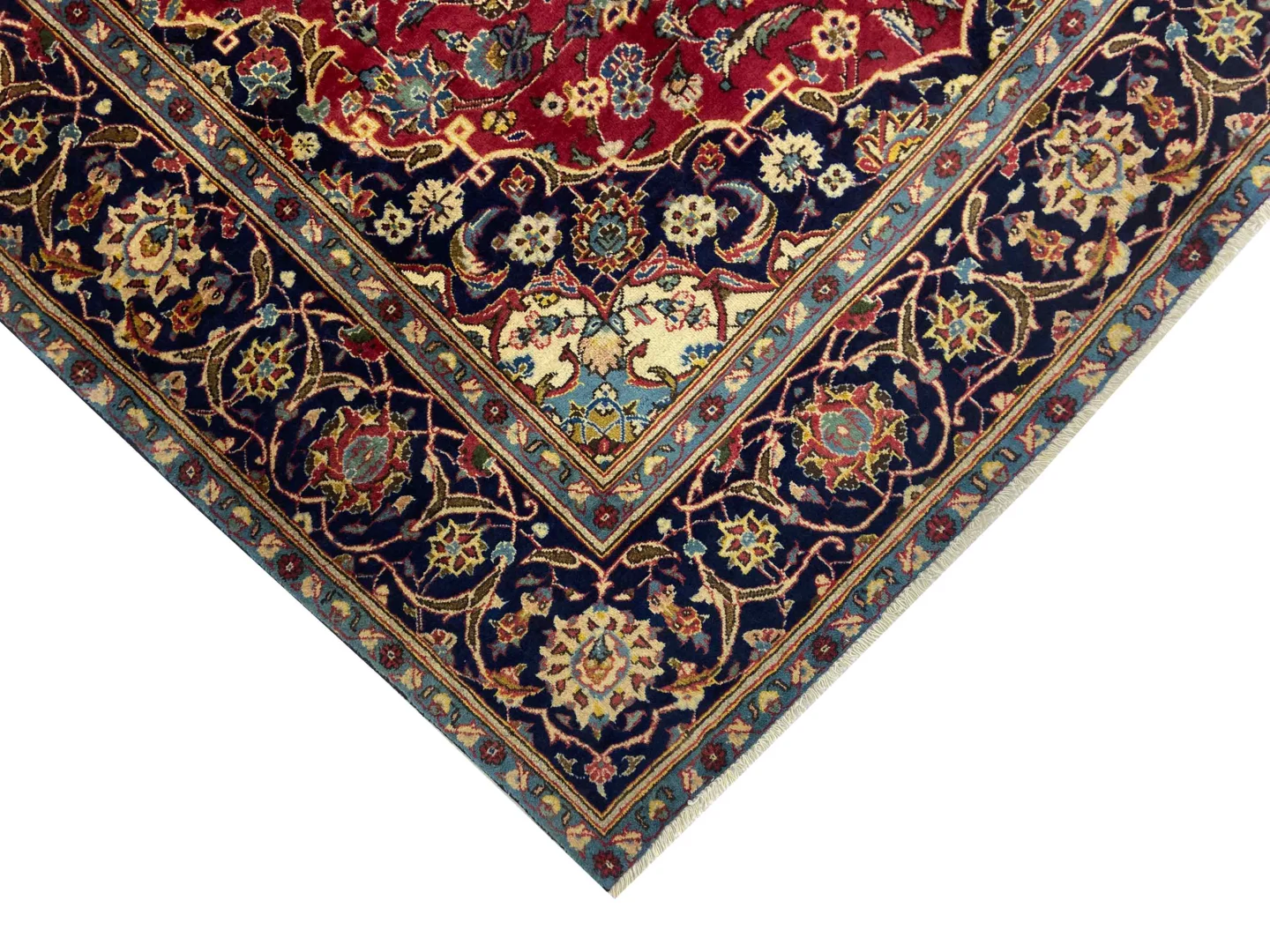
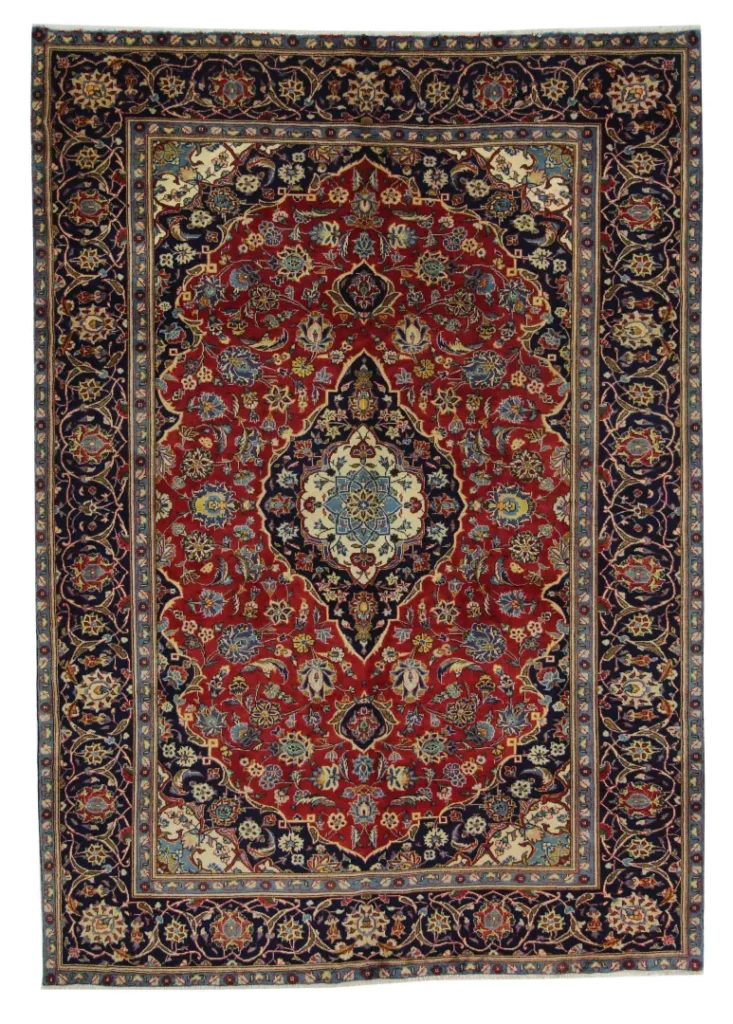
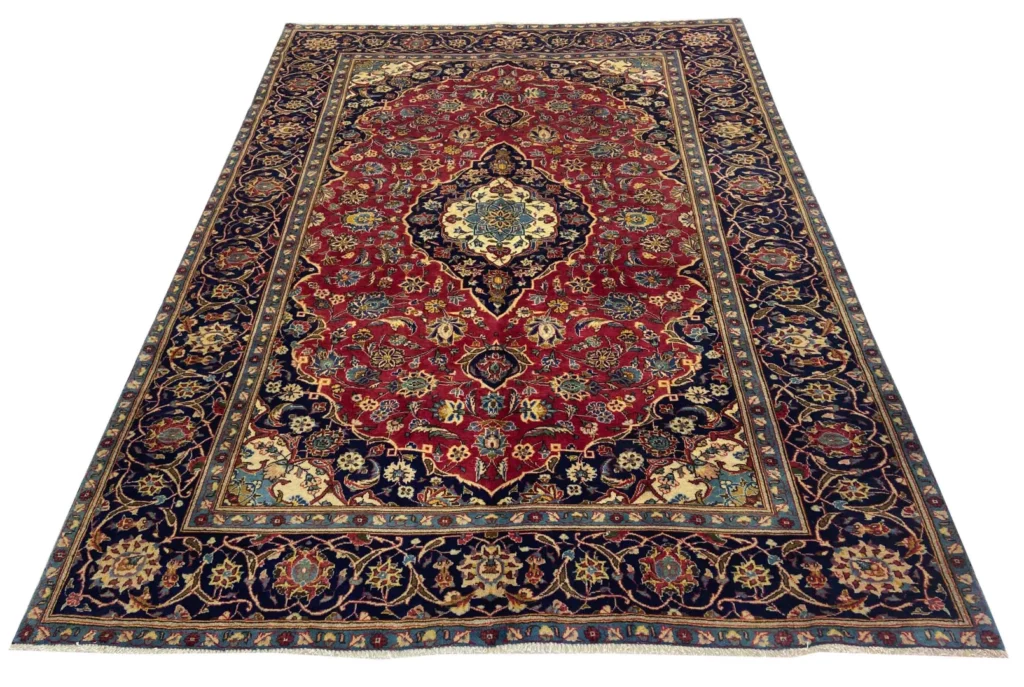
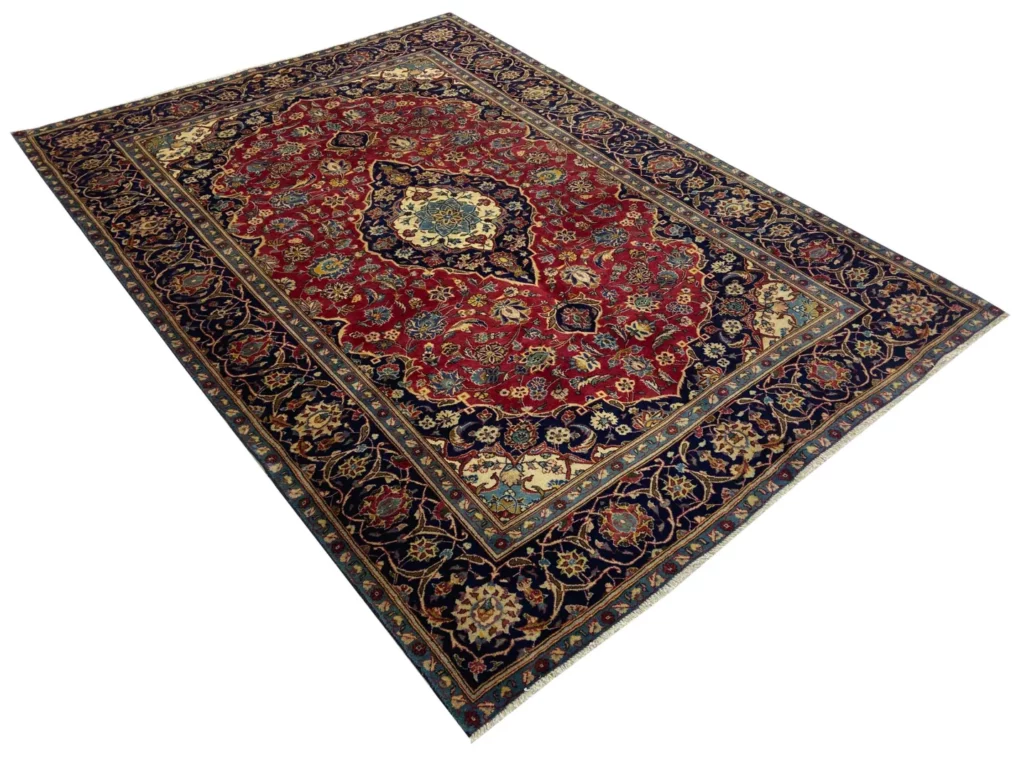
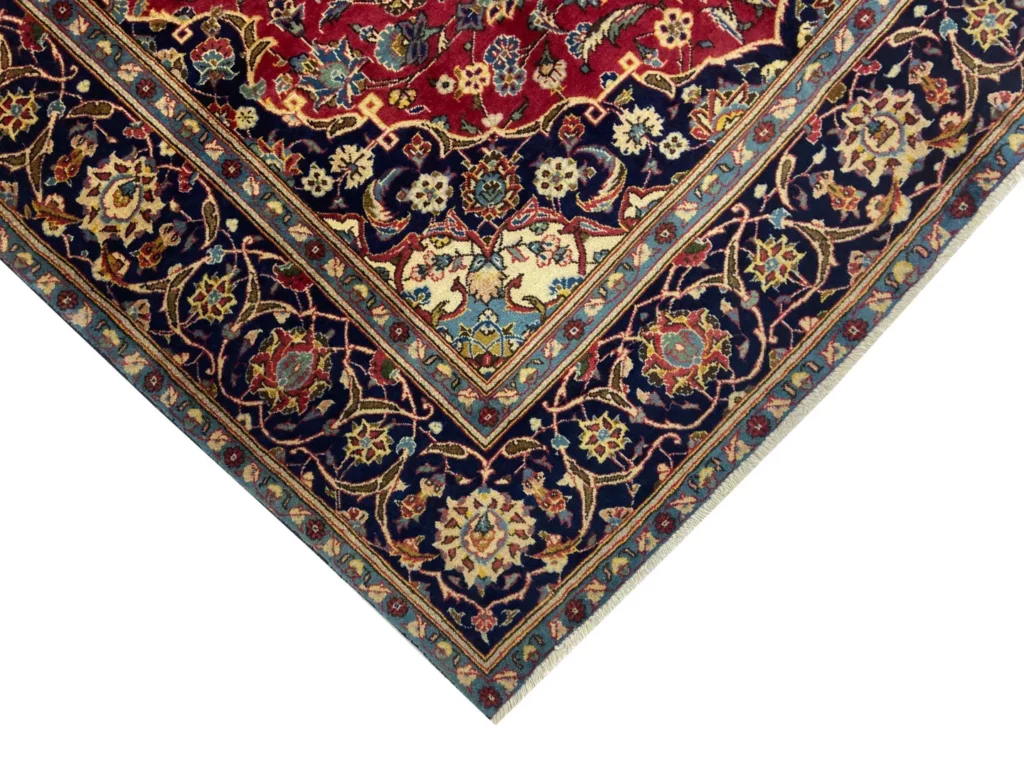
The pattern described for this Keshan rug combines floral and geometric motifs. Floral elements may take the form of blossoms, leaves, vines and scrolling lines. Geometric elements introduce repetition, balance and clearly defined relationships between parts of the composition. Persian carpet design frequently brings these two visual languages together. Organic forms give movement to the pattern, while geometry provides rhythm and a sense of order.
Many traditional carpet motifs carry symbolic associations or preserve forms that have been repeated across generations. Flowers may be linked with growth and renewal, and continuous vines can suggest connection or continuity. Repeated geometric figures can convey structure and proportion. These interpretations belong to the general symbolic language of Persian carpets; they are not an assertion that an unlisted individual symbol appears on this particular rug. The specific pattern fact for this piece is its combination of floral and geometric elements.
The colour range associated with the described design extends from deep reds through soft blues to earthy beige tones. Deep red can give a composition a firm visual foundation and bring weight to larger areas. Soft blue provides contrast or introduces quieter passages within the field. Beige and related earth tones help connect stronger colours and create transitions between motifs. Together, these colour families form a palette that can be used alongside both traditional and contemporary interiors.
A carpet’s visual effect depends on more than its individual flowers or geometric shapes. It is also determined by the relationship between field and border, the repetition of motifs, the density of the drawing and the distribution of colour. In a hand-knotted rug, each detail is built from numerous knots. This allows the weaver to define outlines, repeated forms and changes in tone within the pattern. The short pile can make these details easier to read from the surface.
Keshan rugs are often associated with floral compositions, although geometric structures may be used to frame, organise or complement them. The combination creates a balance between curved botanical forms and measured lines. Borders can establish an outer rhythm, while the interior design brings together recurring motifs and colour areas. This vocabulary belongs to the Persian tradition connected with Keshan and should not be taken as evidence of another place of origin.
The distinction between regional carpet traditions is often visible in the way motifs, colours and technical detail are combined. Isfahan is frequently connected with intricate overall designs and carefully developed colour schemes. Tabriz is often associated with large central medallions and finely rendered details. Keshan stands alongside these traditions with its own identity, in which floral decoration is particularly prominent and geometric elements can provide structure. The described design reflects that combined floral and geometric character.
Special Features
The special features stated for this rug are its hand-knotted construction, its pile of high-quality sheep wool and its cotton warp. The given knot density supports the detailed appearance of the floral and geometric pattern. The short pile gives the surface a velvety feel. The condition is described as very good.
Keshan rugs are also described as easy to care for and as capable of retaining their beauty and colour intensity over the years. Gentle, regular care helps remove dust and everyday dirt from a hand-knotted wool rug. This rug can be used in a living room, bedroom or hallway. In these settings it serves as a practical textile furnishing while also bringing the established pattern language of Persian carpet design into the room.
FAQ
How should I care for a Keshan Persian rug?
Regular vacuuming without a brush attachment helps remove dust and dirt from the rug while avoiding unnecessary agitation of the short wool pile. Any mark or spill should be blotted promptly with a damp cloth. Blotting lifts the moisture and dirt from the surface, whereas vigorous rubbing can put additional stress on the pile and the affected area. For professional cleaning, a specialist carpet cleaner is recommended. A specialist can take the hand-knotted construction and the combination of wool pile and cotton warp into account when selecting the cleaning method.
What makes Keshan rugs distinctive?
Keshan rugs bring together a long Persian tradition, hand-knotted construction, high-quality sheep wool and a cotton warp. Their knot density supports a detailed pattern, while the described design combines floral and geometric elements. The associated colour range includes deep reds, soft blues and earthy beige tones. Their connection with Keshan in Iran gives them a clear regional context, and the tradition of the city places them within the history of Persian carpet weaving. Keshan rugs are also regarded as collector’s pieces.
Where is a Keshan Persian rug best used?
A Keshan Persian rug is suitable for a living room, bedroom or hallway. Its floral and geometric design can be used in a classic interior as well as in a modern setting. The hand-knotted construction, wool pile and velvety feel make it a practical textile furnishing for rooms used every day. At the same time, the Persian pattern can serve as a visual focal point. The high-quality workmanship is described as offering durability and comfort, while the traditional design gives the room a connection to Iranian carpet culture.
To provide the best experiences, we use technologies like cookies to store and/or access device information. Consenting to these technologies will allow us to process data such as browsing behavior or unique IDs on this site. Not consenting or withdrawing consent, may adversely affect certain features and functions.
Functional Always active
The technical storage or access is strictly necessary for the legitimate purpose of enabling the use of a specific service explicitly requested by the subscriber or user, or for the sole purpose of carrying out the transmission of a communication over an electronic communications network.
Preferences
The technical storage or access is necessary for the legitimate purpose of storing preferences that are not requested by the subscriber or user.
Statistics
The technical storage or access that is used exclusively for statistical purposes.The technical storage or access that is used exclusively for anonymous statistical purposes. Without a subpoena, voluntary compliance on the part of your Internet Service Provider, or additional records from a third party, information stored or retrieved for this purpose alone cannot usually be used to identify you.
Marketing
The technical storage or access is required to create user profiles to send advertising, or to track the user on a website or across several websites for similar marketing purposes.
 SECURE PAYMENT
 SHIPPING PARTNERS