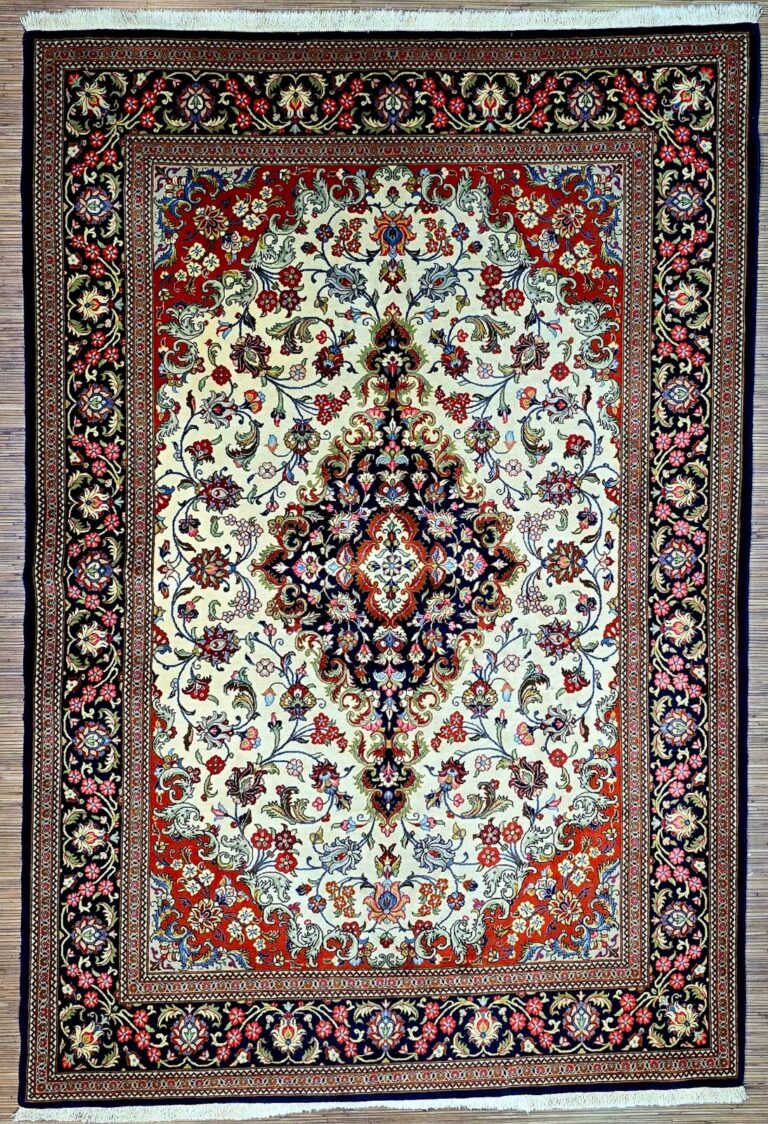
This Keshan Persian rug is made with high-quality sheep wool and cotton. Sheep wool forms the principal pile material, giving the surface a pleasant hand while also providing the hard-wearing character associated with the rug. Wool has been used in hand-knotted rugs for centuries because it combines a soft feel with practical resistance in everyday interiors. The rug is hand-knotted, meaning that each knot is placed individually within the textile structure. Its making is therefore connected with a form of work in which the finished piece is treated as an individual object.
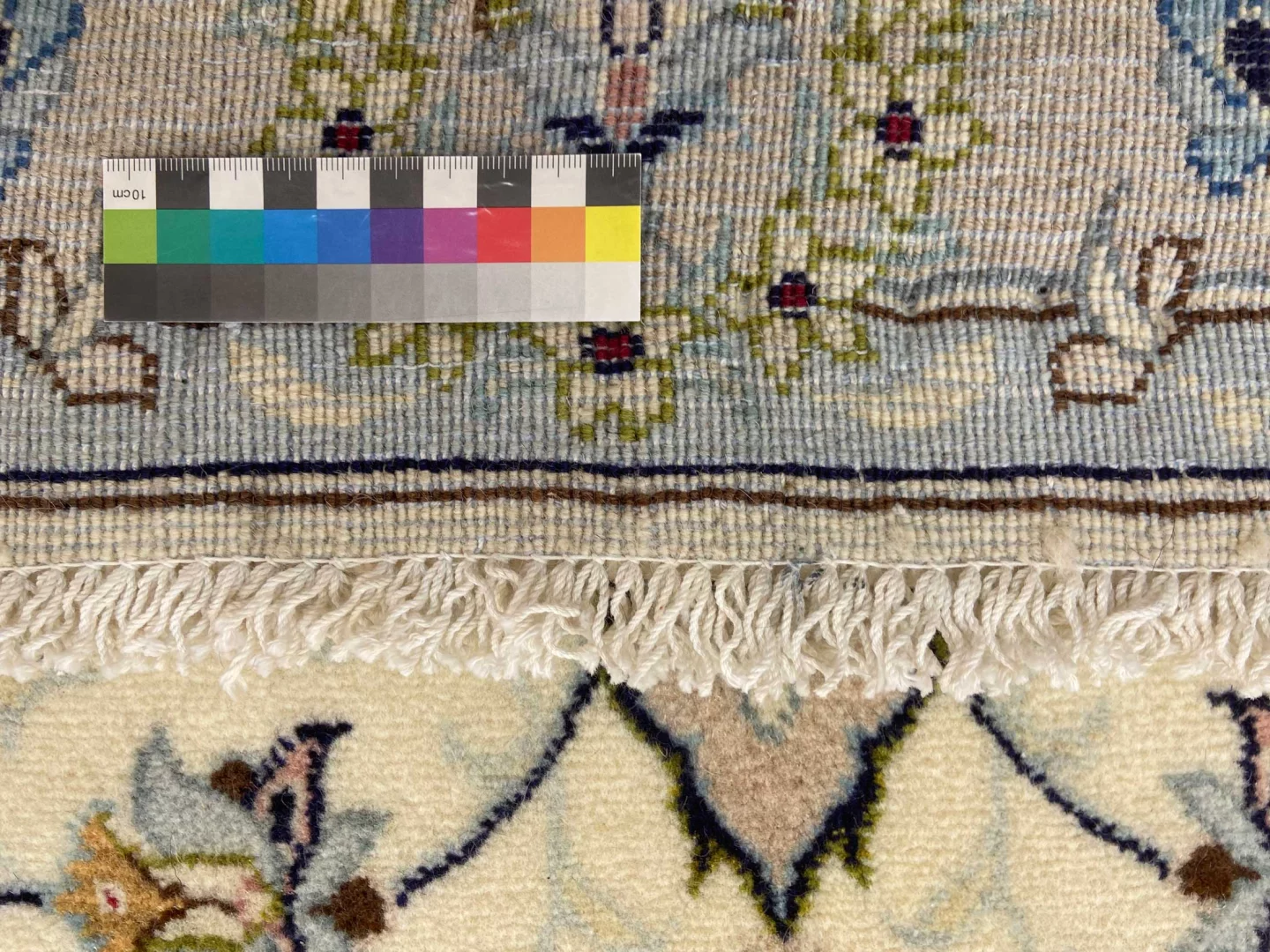
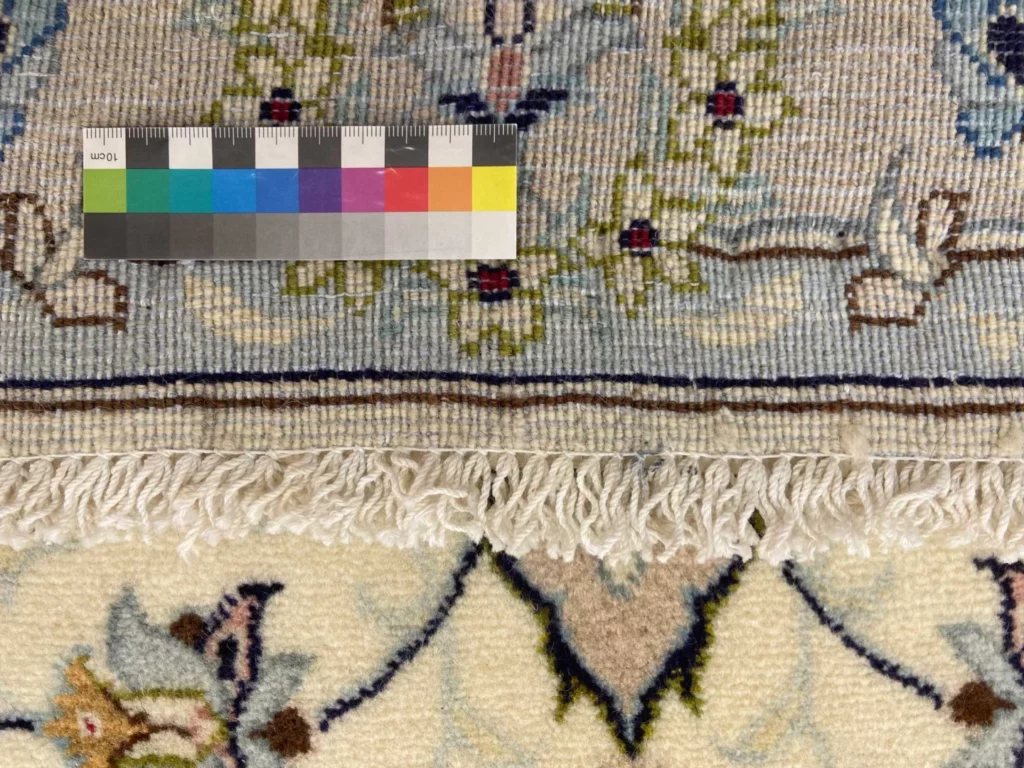
A knot density of 150.000 to 300.000 knots per square metre indicates a fine and closely worked construction. Numerous compactly arranged knots allow contours, lines and ornamental details to be rendered with precision. The dense work also contributes to the rug’s durable character. Together, sheep wool, cotton and manual knotting define the material structure and the way this piece can be used in a living space.
Sheep wool has natural properties that are useful in a rug. It can absorb moisture and is naturally resistant to dirt. These characteristics support practical care when the surface is handled properly. The hand-knotted technique requires time and accuracy. Unlike a machine-made textile, the rug is built through repeated manual steps carried out directly across the design. This gives the construction its particular relationship between material, labour and pattern.
Keshan rugs are associated with techniques passed down through generations of weaving practice. Careful workmanship can be seen in the detailed drawing of the pattern and in the close structure created by the knots. The high knot count and the selected materials provide the basis for the durability and longevity described for this rug. The result is a textile in which the method of making remains an important part of its character.
Origin and Tradition
Keshan, also known as Kashan, is a city in Iran and one of the recognised centres of Persian rug production. It lies in Isfahan Province, a central region of Iran. Keshan’s rug-weaving tradition reaches back to the 16th century. Over this long period, the city developed a distinctive design culture in which careful drawing, balanced arrangement and rich ornamentation are brought together.
The Isfahan region was once a political and cultural centre of Persia. Its architecture, decorative arts and textile traditions reflect a strong appreciation of proportion, line and ordered ornament. Persian rugs from this wider region are consequently connected with a long-established visual culture rather than with a single temporary fashion. Keshan occupies a distinct place within that tradition, with its name associated with detailed and classically organised rug designs.
The making of a hand-knotted rug combines physical work with inherited knowledge. A design is transferred into rows of individual knots, and the image develops gradually across the surface. A high knot density makes it possible to articulate smaller shapes and finer transitions. The technique is therefore closely linked to the character of regional rug art: the finished textile emerges from many deliberate operations rather than from one industrial process.
Persian weaving traditions often bring floral elements together with geometric order. Floral forms may suggest blossoms, leaves and scrolling vegetation, while geometric lines divide and stabilise the composition. Borders have an important organising role. They frame the central field, create transitions between ornamental zones and give the overall design a clear outer structure.
Colour is also an important part of Persian rug history. Keshan rugs are known for detailed drawing and vivid colour. In traditional rug making, colour is considered in relation to the pattern, since it determines how clearly the ornaments can be read and how the separate areas relate to one another. The warm reds, gentle beiges, deep blues and greens named for this design belong to a palette that can work with different interior settings.
The long Keshan tradition explains the connection between the place name and a detailed, classical visual language. Origin here refers to a historically established centre of Persian weaving, not merely to a decorative label. The continuation of techniques and design principles from one generation to the next forms the cultural setting for the careful handwork and ordered ornament associated with this type of Persian rug.
Design and Pattern
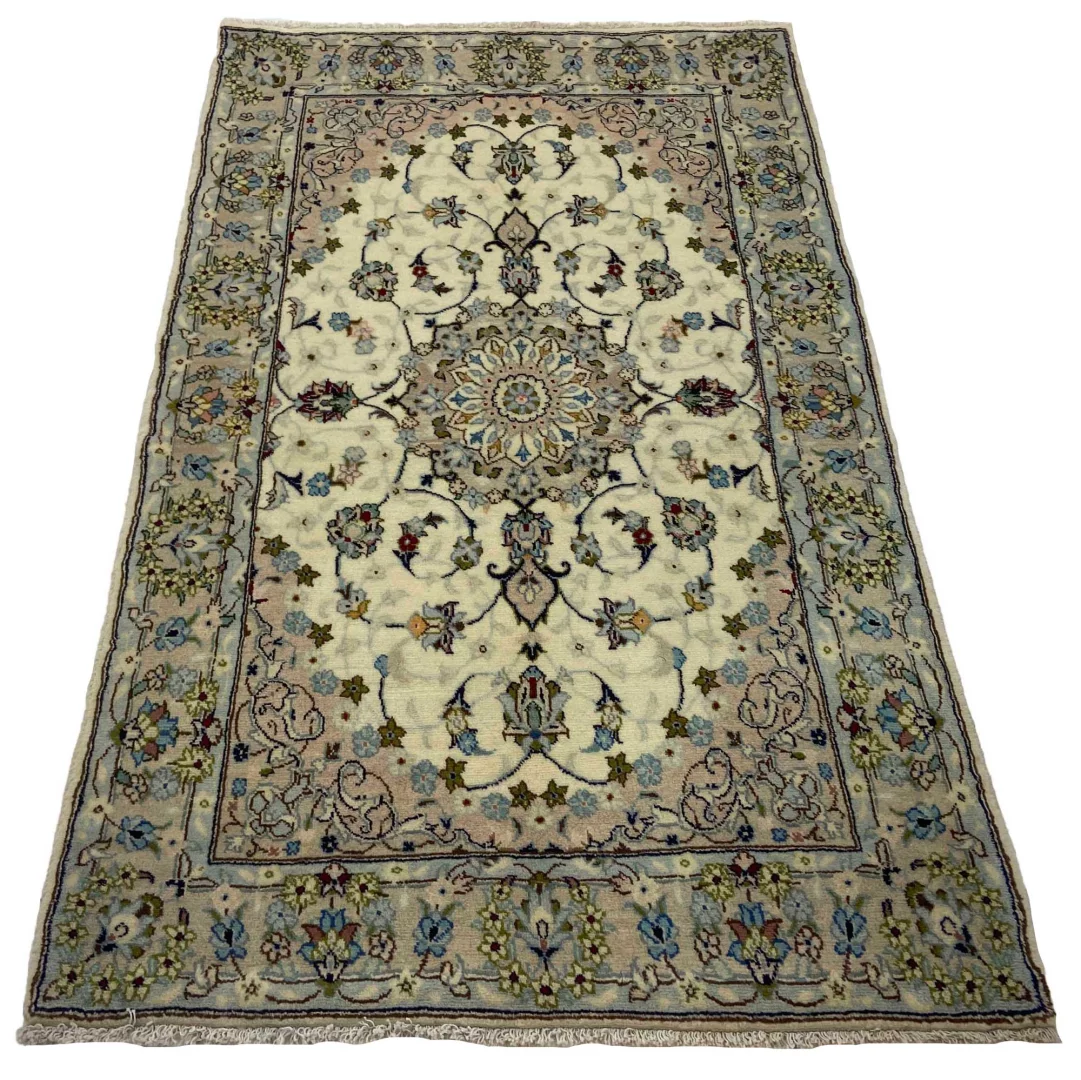
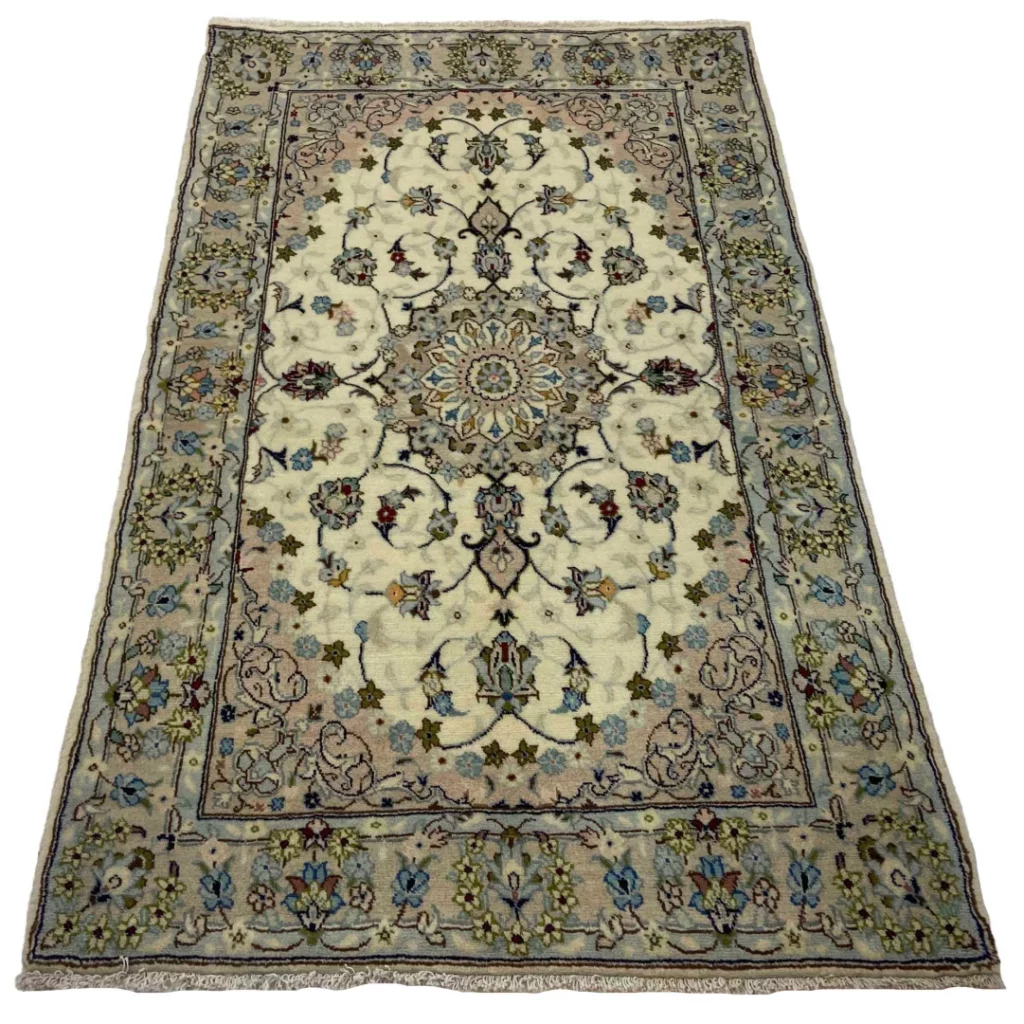
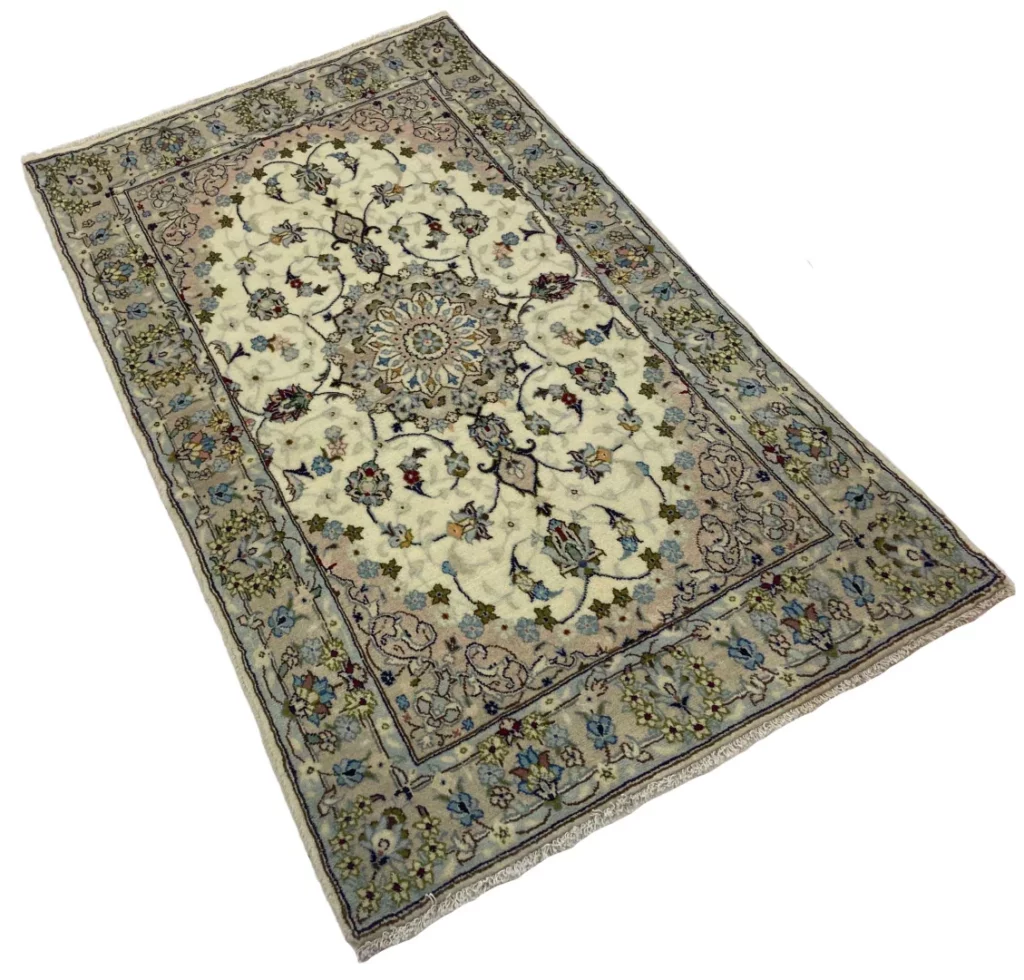
The pattern of this Keshan Persian rug is described as classic and traditional. It combines floral motifs with geometric forms and ornamental borders. Floral elements recall blossoms, vines and abundant vegetation. They give the surface an organic rhythm and create varied areas within the composition. Geometric shapes complement those softer lines with clearer contours and a stronger sense of order.
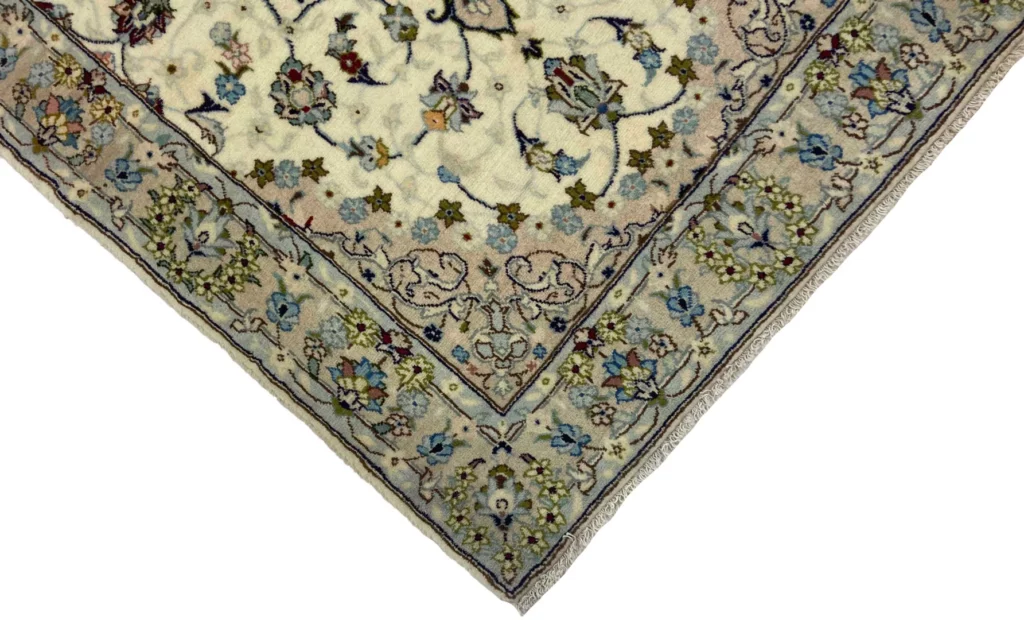
This type of arrangement is built from several connected pattern zones. The central field reads as a coherent area, while the borders provide an outer conclusion and guide the eye along the edges. The relationship between principal motifs, secondary details and framing creates a balanced composition. The dense knotting supports the precise representation of narrow lines, small ornaments and finely drawn transitions.
The colour range extends from warm reds and soft beige shades to deep blues and greens. Warm red tones can give floral drawing a strong foundation, while beige introduces quieter areas and contrast. Blue and green provide deeper accents and widen the range of tonal relationships. Together, these colours form a design that can be combined with traditional furnishings as well as more restrained modern interiors.
Floral and geometric motifs are not opposites in Persian rug design. The organic shape of a flower can be arranged through repeated symmetry, while geometric lines give the ornament structure. This creates a pattern that is decorative but also clearly ordered. The border reinforces that impression by containing the field and linking the different parts of the design.
Traditional rug patterns are often drawn so that they can be read from more than one viewing distance. Close observation reveals the individual knots, fine lines and small details. From farther away, the larger organisation of the composition becomes more apparent. This dual effect is connected with the combination of a high knot density and classical ornament. The rug can therefore be understood both as detailed handwork and as a unified surface design.
The design is not based on a short-lived decorative idea. Its foundation lies in motifs and principles of arrangement that have been used and developed within Keshan and Persian rug traditions over a long period. Floral references, geometric clarity, framing borders and graduated colour meet in one composition. The result remains recognisable as a traditional design while allowing use in a range of interior settings.
Special Features
The rug’s notable features include its high knot density, hand-knotted construction and high-quality sheep wool. The close workmanship contributes to its hard-wearing and long-lasting character. Its material properties also make it suitable for areas of the home that receive more frequent use. Sheep wool can absorb moisture and is naturally dirt resistant, qualities that support regular, careful maintenance.
The production is described as sustainable and environmentally friendly. The use of wool from sheep husbandry is connected with local traditions, while the hand-made process preserves inherited knowledge and techniques. As with hand-knotted rugs generally, this piece is valued for developing an individual character over time. At the same time, it is described as easy to care for when maintained appropriately.
The condition of the rug is very good. This condition combines with the practical qualities of a hard-wearing wool rug and with the detailed appearance of its Keshan design. Its particular features are therefore found in both its making and its visual language: dense knotting, natural wool, traditional ornament and a hand-crafted construction.
FAQ
How should I clean my Keshan Persian rug?
Regular vacuuming is recommended to remove dust and loose dirt. Cleaning should be carried out carefully, with consideration for the hand-knotted structure and the wool surface. For stubborn stains, professional rug cleaning is advisable. This helps preserve the fine colours and avoids a treatment that could damage the rug. The natural dirt resistance of sheep wool supports everyday maintenance, but it does not replace gentle and regular care.
Where is the best place to put my Keshan Persian rug?
A living room or another calm area is suitable when the classic pattern and its floral and geometric details are meant to remain visible. Because the rug is hard-wearing, it can also be used in areas with more frequent foot traffic. There it can contribute to the room’s atmosphere without being limited to one particular furnishing style. The important considerations are that the design can be appreciated and that the rug can be maintained properly in its chosen position.
How can I extend the life of my rug?
Regular vacuuming and gentle handling help support the rug’s service life. Direct sunlight should be avoided so that the colours do not fade. It is also advisable to turn the rug every few months, allowing wear to develop more evenly. Professional cleaning should be planned every few years. These measures take account of the hand-knotted construction, the wool pile and the coloured design of the Keshan Persian rug.
To provide the best experiences, we use technologies like cookies to store and/or access device information. Consenting to these technologies will allow us to process data such as browsing behavior or unique IDs on this site. Not consenting or withdrawing consent, may adversely affect certain features and functions.
Functional Always active
The technical storage or access is strictly necessary for the legitimate purpose of enabling the use of a specific service explicitly requested by the subscriber or user, or for the sole purpose of carrying out the transmission of a communication over an electronic communications network.
Preferences
The technical storage or access is necessary for the legitimate purpose of storing preferences that are not requested by the subscriber or user.
Statistics
The technical storage or access that is used exclusively for statistical purposes.The technical storage or access that is used exclusively for anonymous statistical purposes. Without a subpoena, voluntary compliance on the part of your Internet Service Provider, or additional records from a third party, information stored or retrieved for this purpose alone cannot usually be used to identify you.
Marketing
The technical storage or access is required to create user profiles to send advertising, or to track the user on a website or across several websites for similar marketing purposes.

 SECURE PAYMENT
 SHIPPING PARTNERS