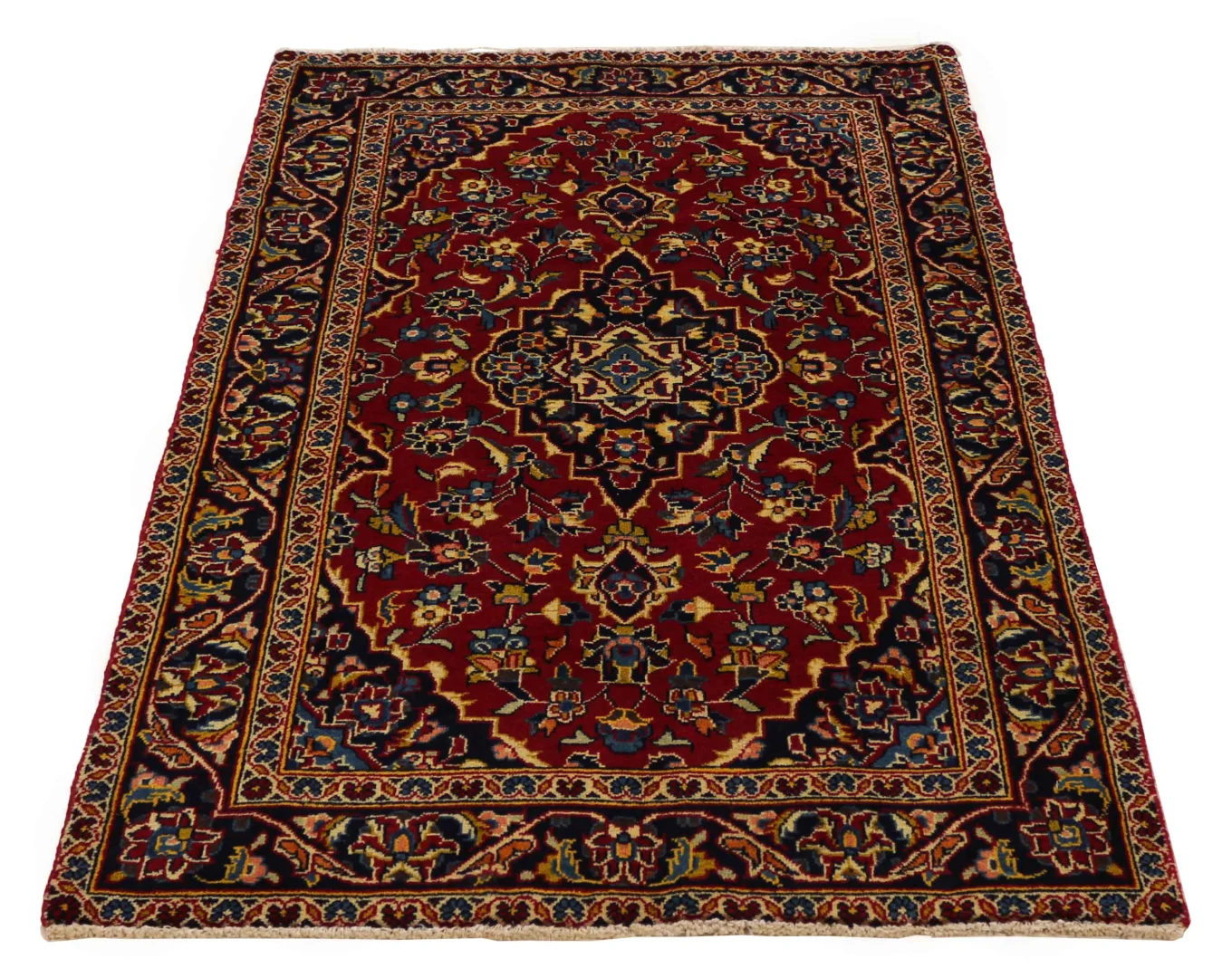
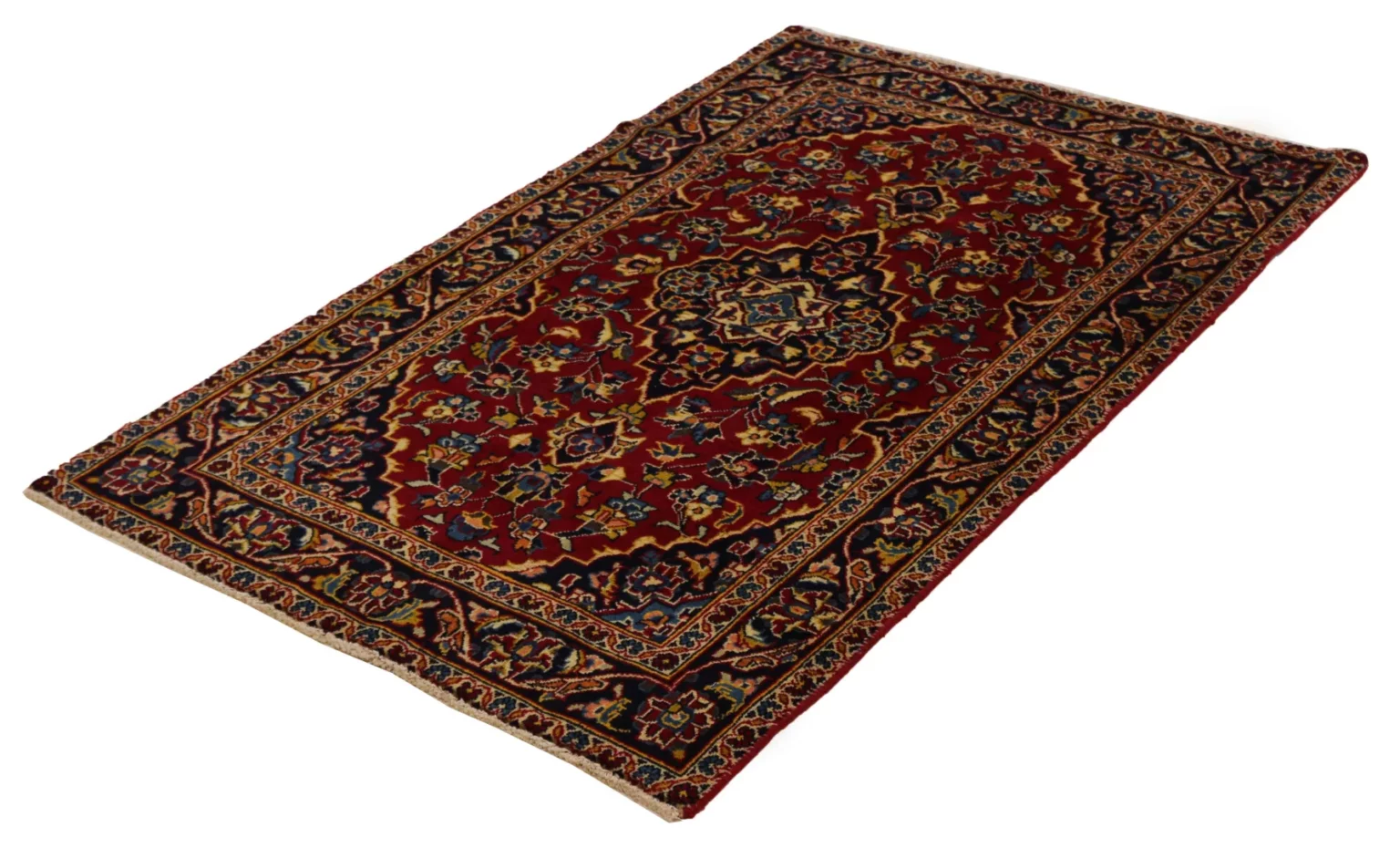
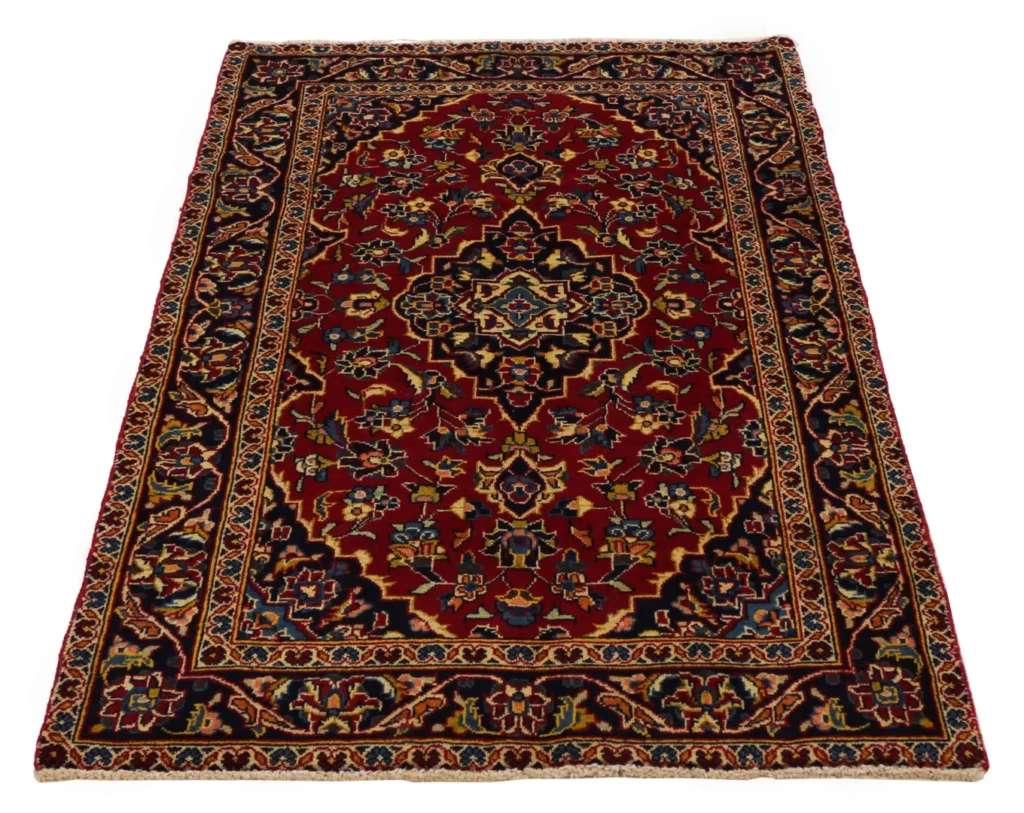
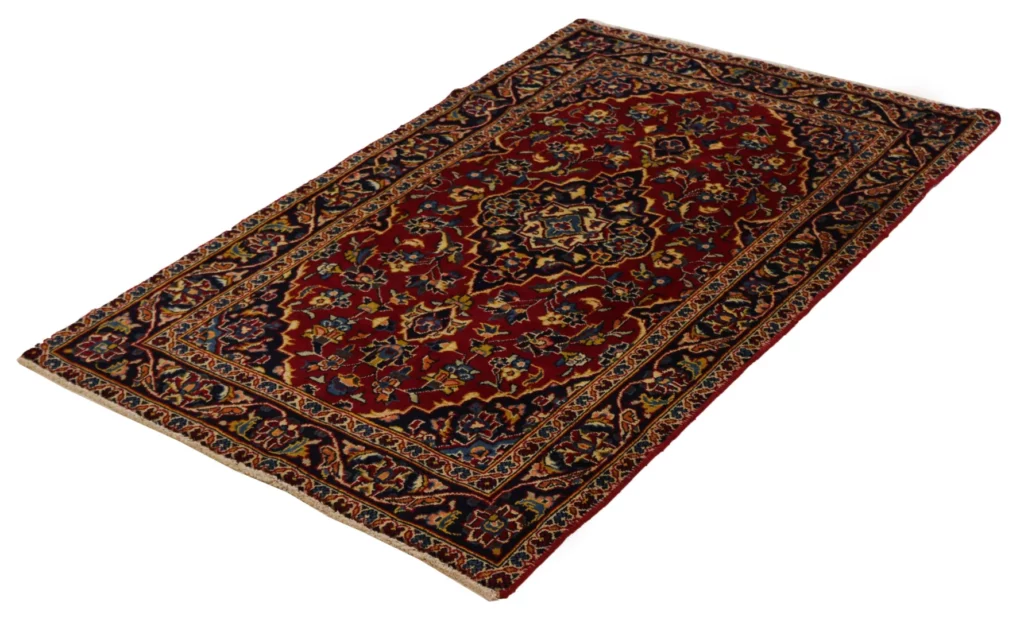
Hand-knotted Keshan Persian Rug | Knot density: 100,000 – 300,000 knots/m² | Material: Sheepswool pile, cotton warp and weft | Size: 158 x 98 cm | Pattern: Medallion design in red, blue and beige | Condition: Very good
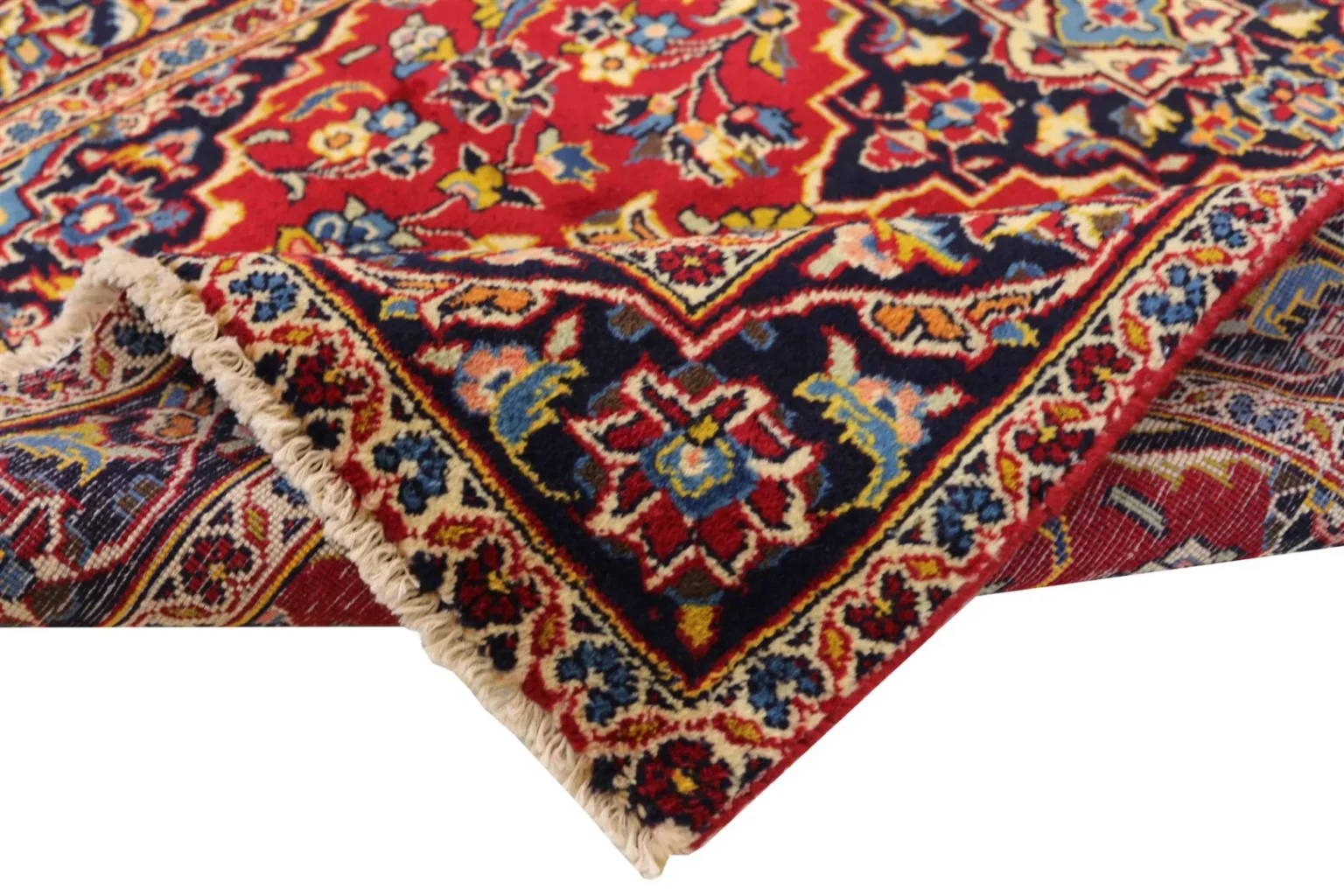
This Keshan Persian rug is hand-knotted. Its pile is made from high-quality sheepswool, while the warp and weft are made from cotton. The combination of a wool pile with a cotton foundation is a characteristic technical basis of many Keshan rugs. Wool provides a firm, resilient surface and takes colour with clarity and variation. Cotton creates a stable, even foundation on which the knots can be placed with precision. Together, these materials form a construction suited to everyday use while supporting the precise drawing of traditional designs.
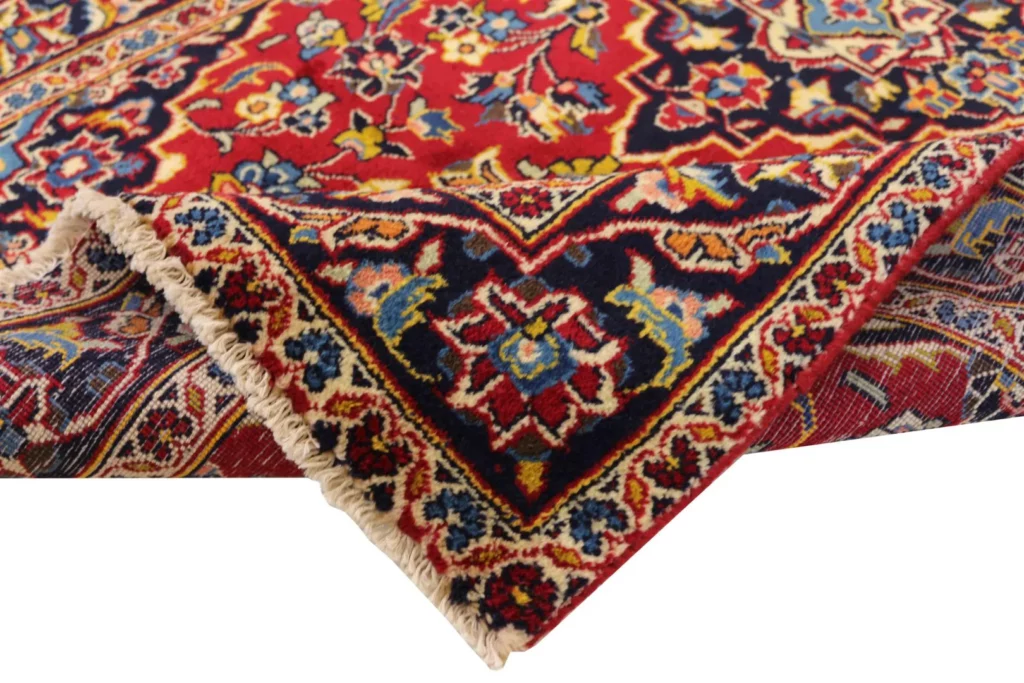
The handmade process can be seen in the individual placement of the knots and in the careful treatment of outlines, fields and ornaments. A knot density between 100,000 and 300,000 knots per square metre represents detailed work in Keshan rug making. In general, a greater number of knots allows finer lines and more differentiated small motifs, although the quality of the work also depends on knot regularity and the tension of the woven structure. The short pile described for Keshan rugs helps the design remain legible and makes routine care more straightforward.
Each material has a distinct role in the finished textile. Sheepswool forms the visible and walkable surface, giving the rug its tactile quality and hard-wearing character. Cotton in the warp and weft provides the underlying structure. In a hand-knotted rug, these components are built together over many working stages: knots are tied row by row, the structure is compacted, and the textile is stabilised as the work progresses. The pattern is therefore not printed on the surface. It is created through the arrangement of coloured knots within the woven foundation.
The technical character of a Keshan rug is also connected to the discipline required at the loom. The design must be transferred accurately into the knotting process, with attention to line, symmetry and colour placement. Wool yarn can give the surface a softly textured appearance while retaining the definition needed for a central medallion and its surrounding ornaments. Cotton supports the regular framework beneath it. These observations describe the craft tradition associated with Keshan and the materials specified for this rug.
Origin and Tradition
Keshan, also known as Kashan, is a city in Iran with a long reputation for carpets, textiles and ceramics. The local weaving tradition developed within this wider craft environment, where careful material selection, exact knotting and ordered ornamentation are brought together. Keshan rugs are consequently recognised as Persian rugs from Iran and are associated with a classically organised visual language. Their identity rests on the relationship between place, technique and design rather than on one single immutable pattern.
Keshan rug making belongs to the broader Persian tradition of woven art. Iranian weavers have preserved established systems of composition while adapting them to changing interiors and tastes. The knowledge involved includes preparing and spinning wool, producing and dyeing yarns, setting up the warp and weft, planning the design and calculating the knots. A rug emerges from the coordination of all these tasks. Because the work is hand-knotted, the structure and the image are produced together rather than added separately.
Persian rugs were historically important trade goods. Their movement along trading routes, including the Silk Road, introduced products from Iranian weaving centres to markets far beyond the places where they were made. Keshan gained a notable position in this history through the production of textiles and rugs with carefully arranged, finely worked designs. The combination of specialist craft and long-distance trade helped establish Keshan as a recognised name in the study and commerce of Persian carpets.
The Keshan tradition is not limited to one fixed arrangement. Designs may include floral and geometric elements in different proportions, while often retaining a balanced and clearly ordered composition. The classical medallion is an important point of reference. It is commonly supported by surrounding field details and border zones, allowing the eye to move from the centre towards the edges. This structure explains why Keshan rugs are regarded both as traditional Persian textiles and as adaptable pieces for contemporary rooms.
Regional weaving developed through continuity as well as change. Colours, individual floral forms and the relationship between the central field and the border could be varied without abandoning the importance of careful knotting. Other Iranian centres, including Tabriz and Isfahan, also became known for distinctive design languages and skilled workmanship. Ardekan rugs are described as regional products with similar designs. These connections illustrate the variety of Iranian carpet production, but they do not alter the origin of a rug identified as Keshan.
The historical reputation of Keshan also reflects the value placed on well-preserved Persian rugs. Rugs more than 100 years old can be sought by collectors, although the age of this individual rug is not stated. The significance of that tradition lies in the continued recognition of handwork, material quality and design discipline. A Keshan rug can therefore be understood through both its physical construction and its place within the history of Iranian textile production.
Design and Pattern
The pattern of this rug is described as a medallion design in red, blue and beige. A medallion organises the composition around a central ornament or central shape. This gives the field a clear focal point, while surrounding elements accompany and frame the main form. The colour arrangement reinforces that structure: red can give visual weight to the centre or selected ornaments, blue introduces contrast and depth, and beige links the coloured areas into a calmer overall field.
The medallion is a recurring theme in Persian carpet design. It may be circular, oval, elongated or more geometric in character, and it is often accompanied by floral details, vines or additional ornaments. In Keshan rugs, a central order is frequently combined with detailed surrounding work. The relationship between field, medallion and border is particularly important. A border gives the composition a visual edge and helps the central motif belong to the entire surface rather than appearing isolated.
Floral and geometric forms perform different functions within this type of design. Flowers, leaves and scrolling vines introduce movement and can be repeated symmetrically or rhythmically. Geometric lines give the pattern structure, divide areas and sharpen the contours of the medallion. Persian ornament often combines these two approaches, creating a design that is orderly while containing many small details. The specified knot density supports the rendering of such contours and details, without changing the rug’s stated Keshan origin.
Red, blue and beige form a traditional colour group for the design described here. Red may serve as a warm ground or an accent, blue creates a cooler counterpoint, and beige provides lightness and visual balance. The effect depends not only on the colours themselves but also on their proportions, placement and relationship to the ornament. Beige may make a coloured motif stand out, while blue can define a border or contain the central design. Red can connect separate areas and give the composition continuity.
The design can be placed within the long development of Persian carpet ornament without assigning every individual motif to a particular historical model. Keshan patterns often combine a central arrangement with floral and geometric supporting forms. That combination is sufficiently characteristic to make the regional tradition understandable, yet flexible enough to allow many individual interpretations. The pattern’s effect comes from the interaction of knotting technique, outline, colour and the repeated order of the ornaments.
A medallion rug can be used in living rooms, dining rooms or as a defined accent in another interior. This describes a common function of the format, not a special feature of a particular room. The organised centre can visually gather a furniture arrangement, while the contrasting colours provide a clear point of reference. What remains constant in the present design is the central medallion structure and the use of red, blue and beige.
Special Features
The specific features of this rug are its hand-knotted construction, high-quality sheepswool pile and cotton warp and weft. It also has a knot density of 100,000 to 300,000 knots per square metre, a medallion design and the colours red, blue and beige. Its condition is described as very good. These details bring together the technical, material and visual information that identifies this piece as a Keshan Persian rug.
The wool surface is associated with durability and a pleasant tactile quality, while the short pile described in the Keshan tradition supports uncomplicated routine care. This does not replace an individual cleaning assessment, but it explains why hand-knotted wool rugs are also used in frequently occupied living spaces. To help preserve the colours, direct sunlight should be avoided. Regular vacuuming and professional cleaning when necessary are recommended measures for maintaining the surface, pattern and very good condition.
FAQ
How should I care for my Keshan Persian rug?
Vacuum the rug regularly and gently to remove loose dirt without placing unnecessary strain on the wool pile. If more extensive cleaning is required, professional rug cleaning is recommended because a hand-knotted textile should be treated appropriately. Direct sunlight should be avoided so that the red, blue and beige colours are less likely to fade. Careful, consistent maintenance helps preserve the pile’s feel, the clarity of the medallion design and the rug’s very good condition.
Can I use a Keshan rug in a room with underfloor heating?
Yes, a Keshan rug can be used over underfloor heating when the temperature remains moderate and evenly distributed. Excessive or uneven heat should be avoided because it can place unnecessary stress on the materials and the knotted structure. The heating should therefore operate in a controlled way. A suitable underlay and occasional checks are also advisable so that the rug lies flat and air can circulate beneath it.
How can I recognise an authentic Keshan Persian rug?
Knot density, the quality of the materials and the carefully executed pattern are useful points of reference. Many authentic pieces may also have a certificate or an origin mark. A reliable assessment should consider several characteristics together: the hand-knotted construction, wool pile, cotton warp and weft, the execution of the medallion and the precision of the outlines. When certainty is important, an experienced rug specialist can examine the construction and design in greater detail.
To provide the best experiences, we use technologies like cookies to store and/or access device information. Consenting to these technologies will allow us to process data such as browsing behavior or unique IDs on this site. Not consenting or withdrawing consent, may adversely affect certain features and functions.
Functional Always active
The technical storage or access is strictly necessary for the legitimate purpose of enabling the use of a specific service explicitly requested by the subscriber or user, or for the sole purpose of carrying out the transmission of a communication over an electronic communications network.
Preferences
The technical storage or access is necessary for the legitimate purpose of storing preferences that are not requested by the subscriber or user.
Statistics
The technical storage or access that is used exclusively for statistical purposes.The technical storage or access that is used exclusively for anonymous statistical purposes. Without a subpoena, voluntary compliance on the part of your Internet Service Provider, or additional records from a third party, information stored or retrieved for this purpose alone cannot usually be used to identify you.
Marketing
The technical storage or access is required to create user profiles to send advertising, or to track the user on a website or across several websites for similar marketing purposes.

 SECURE PAYMENT
 SHIPPING PARTNERS


