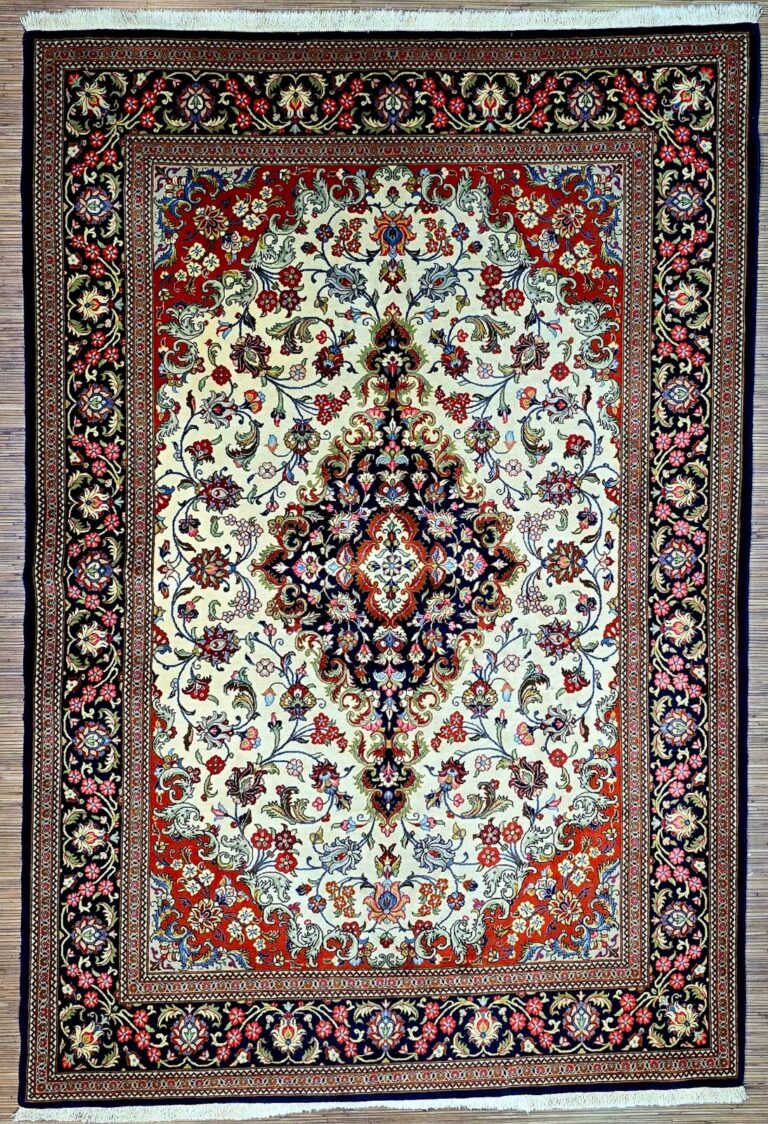
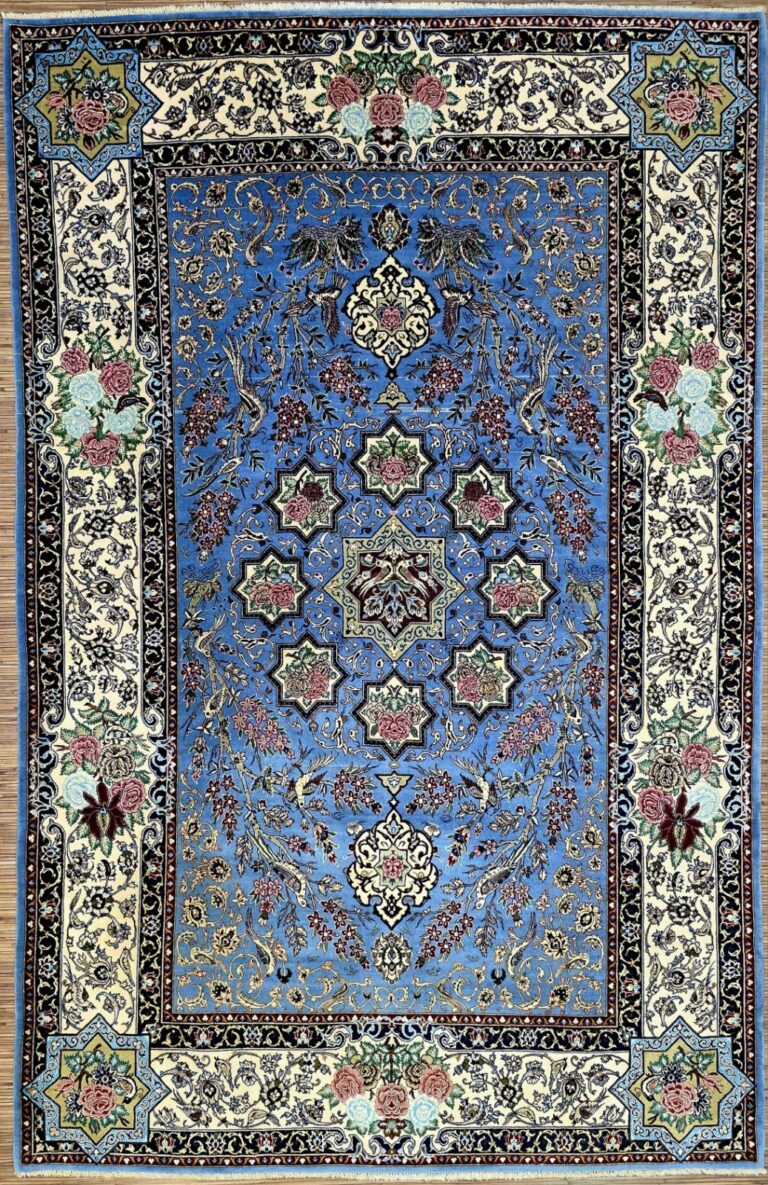
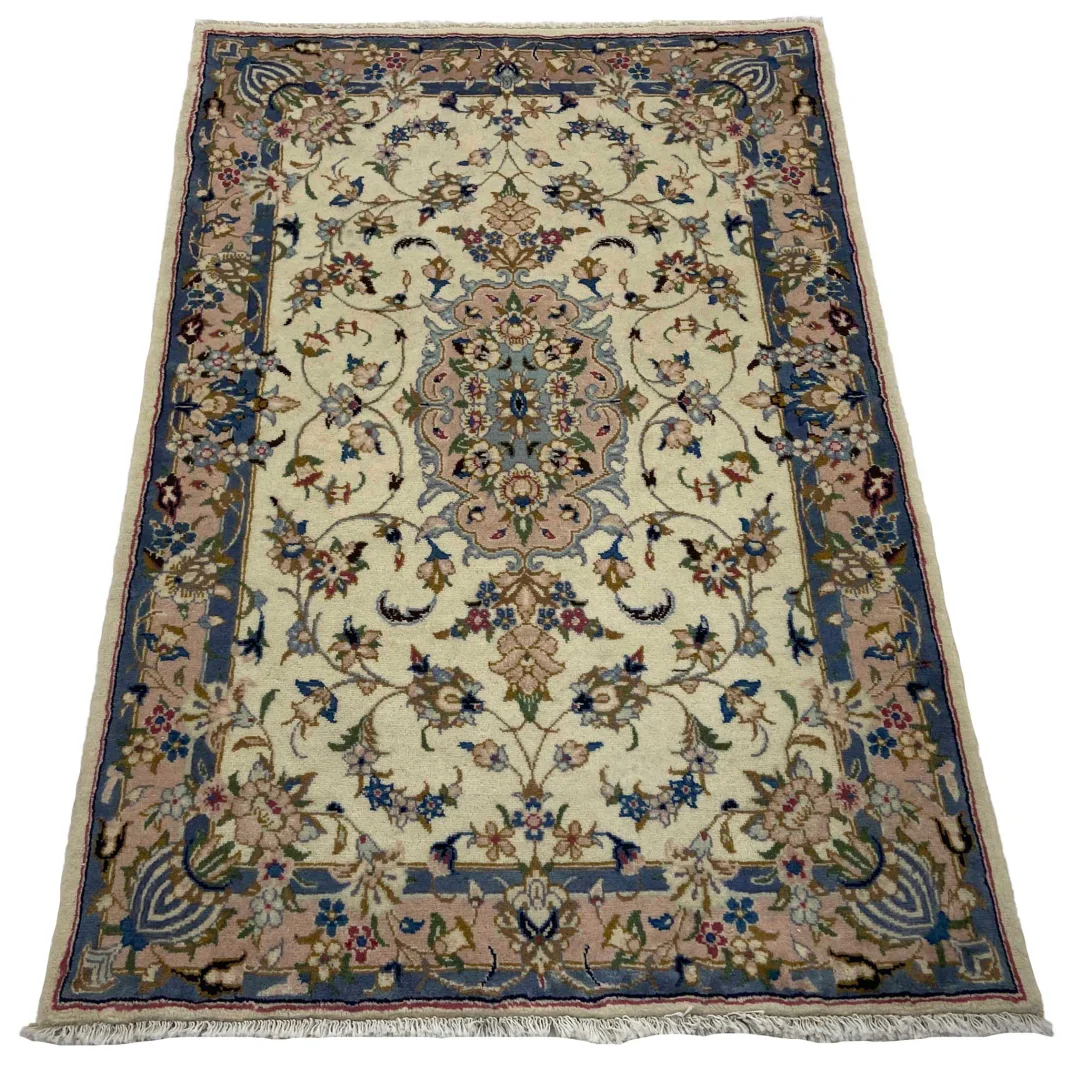
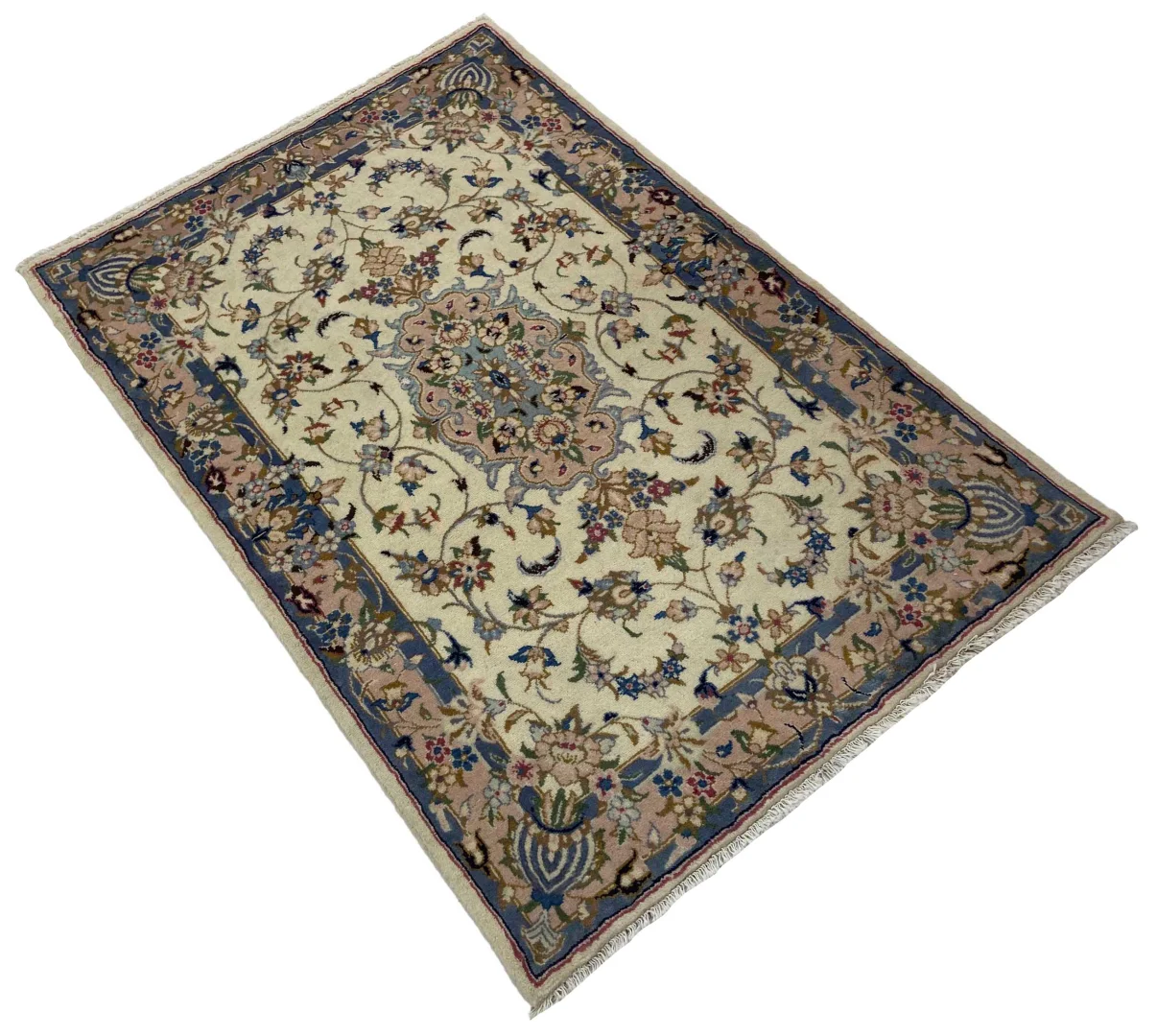
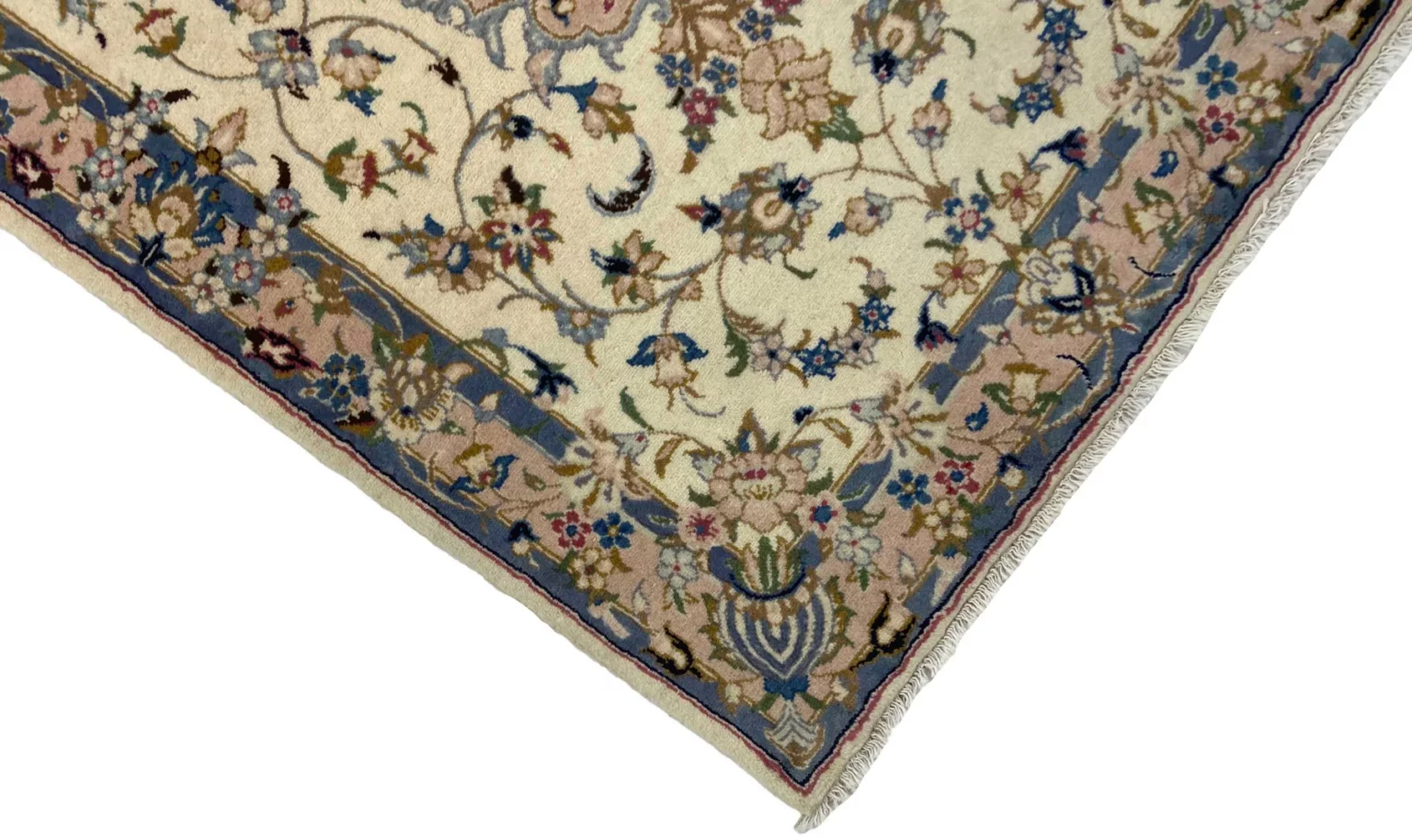
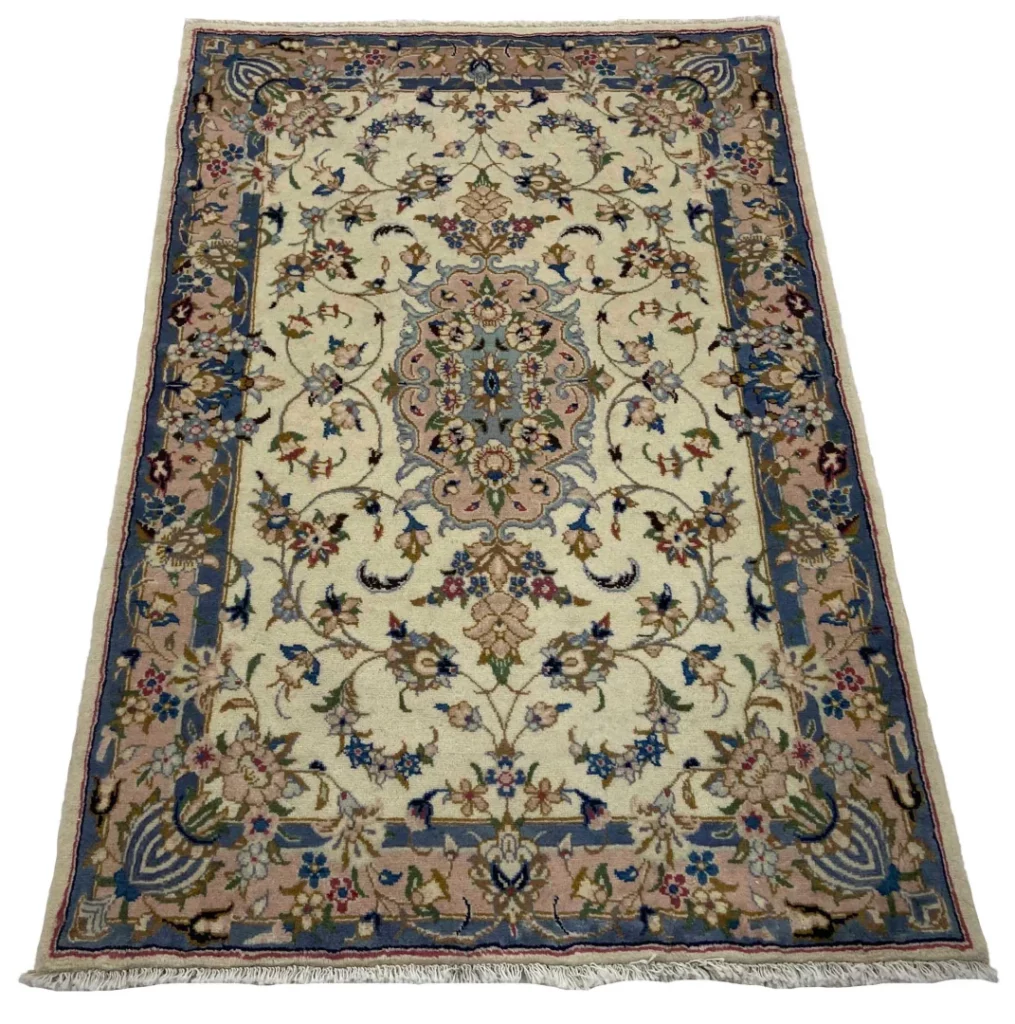
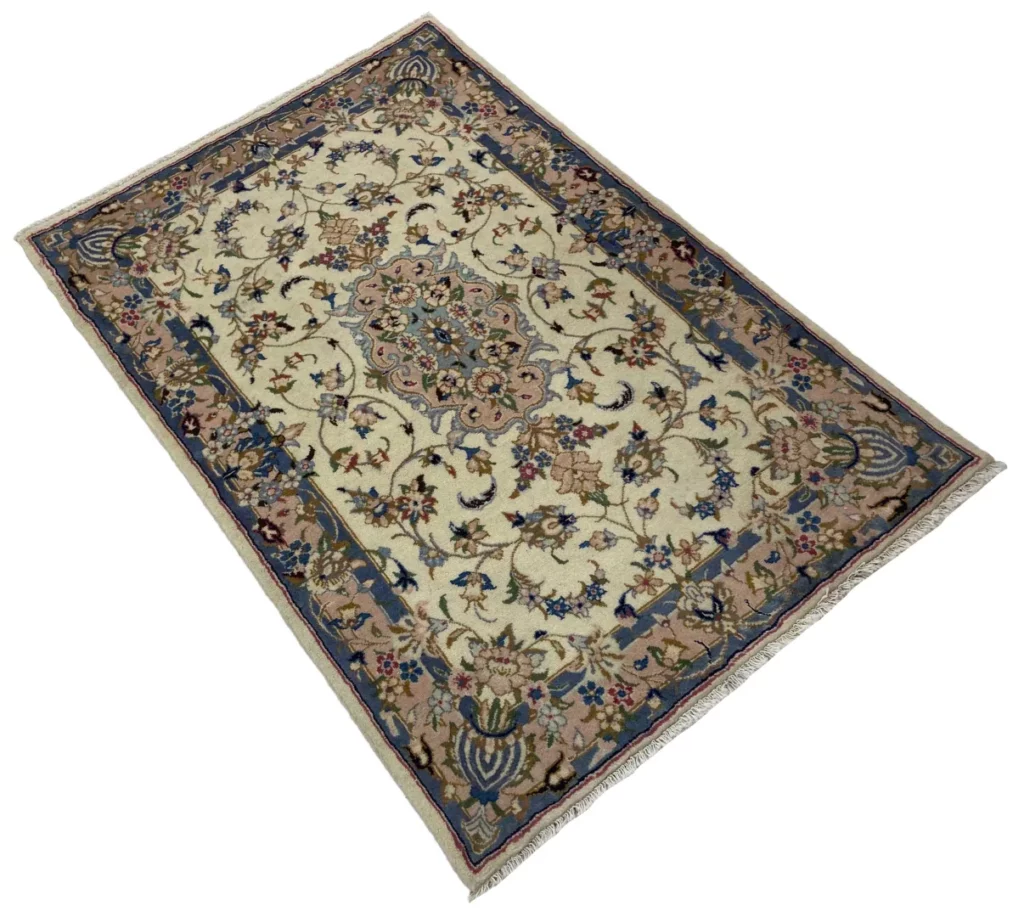
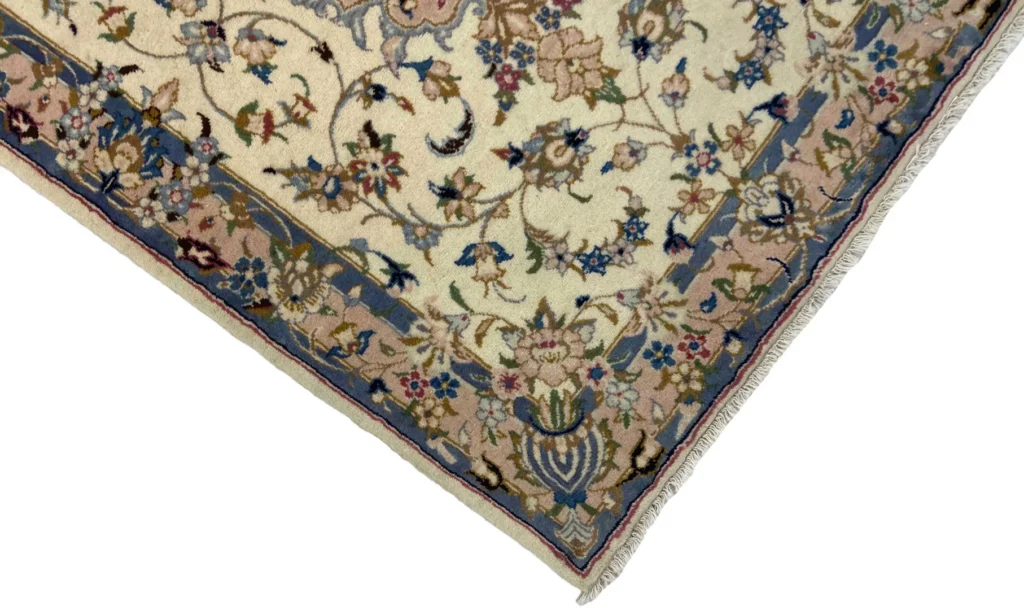
Hand-knotted Keshan Persian Rug | Knot density: 150,000 – 300,000 knots/m² | Material: pile in high-quality sheep wool, cotton warp and weft | Size: 147 x 98 cm | Pattern: floral and geometric elements | Condition: Very good
This Keshan Persian rug is hand-knotted, with a pile made from high-quality sheep wool. The wool forms the visible, tactile surface of the rug. It is a traditional material for Keshan rugs and combines a soft handle with the resilience suited to regular use. The pile on this rug is short and hard-wearing. A short pile also keeps the drawing distinct and makes routine care more manageable.
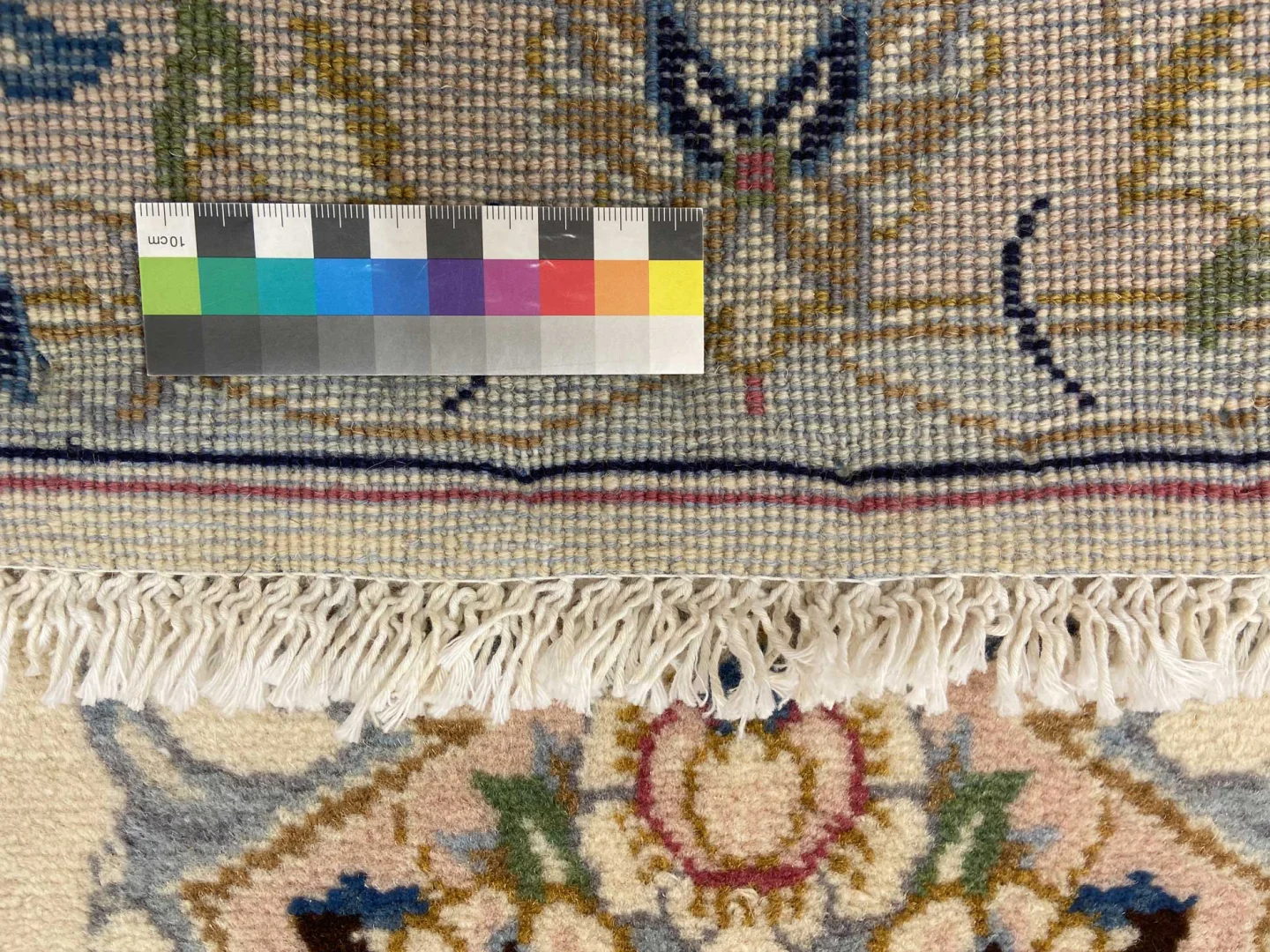
Cotton is customarily used for the warp and weft of Keshan rugs. This textile foundation supports the knotted pile and provides the structure to which the individual knots are secured. The combination of a cotton foundation with a wool pile is part of the established construction of this rug type. Sheep wool and cotton are the materials specified for this rug.
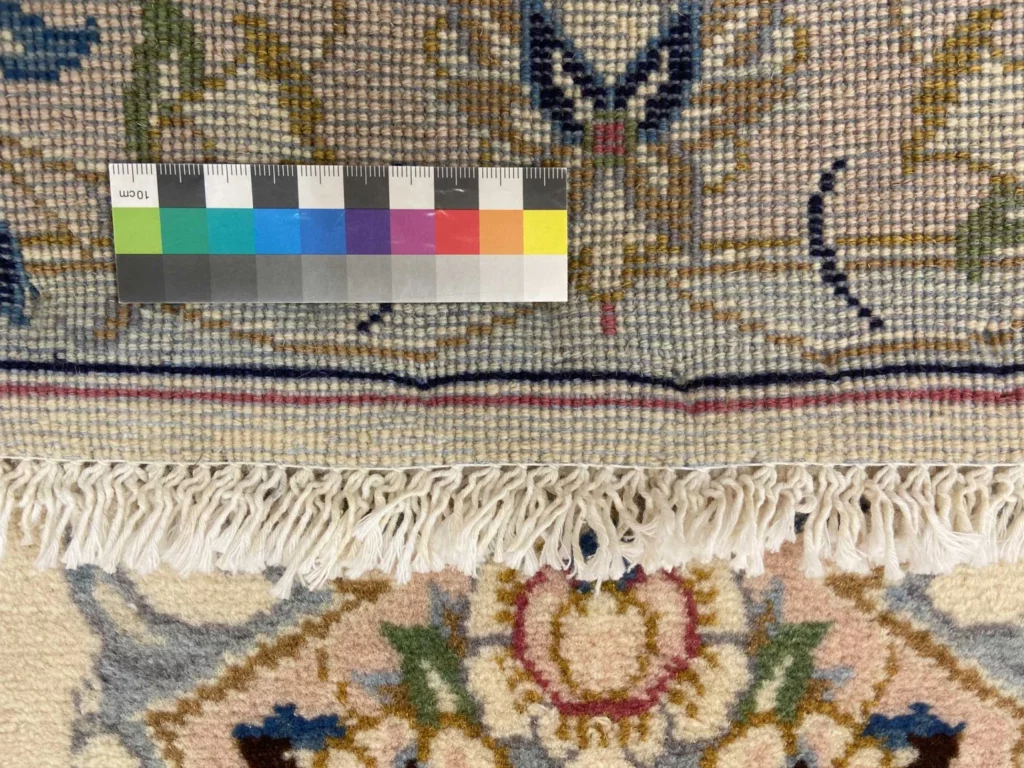
The knot density is 150,000 to 300,000 knots per square metre. Such density is produced by placing many individual knots and allows the design to be worked with considerable definition. It also reflects the precise labour involved in building a hand-knotted surface. The stated range describes this rug’s construction and is retained without replacing it with a rounded average.
Origin and Tradition
Keshan, also written Kashan, is a city and region in Iran associated with an important Persian rug tradition. Keshan Persian rugs belong to a long history of Iranian weaving in which practical knowledge, inherited designs and suitable fibres are brought together. The name Keshan refers to this regional tradition rather than merely to one colour scheme or a single ornament.
Rug making in Keshan developed across generations. Workshops passed on knowledge of stretching the warp, inserting the weft, tying the knots and trimming the pile after the knotting was complete. Each operation affects the finished textile. The warp establishes the lengthwise framework, the weft reinforces the rows, and the knots create the coloured face. After knotting, the pile is sheared so that the outlines and relationships of the pattern can be read clearly.
Keshan’s position along historic trading routes helped its textiles travel beyond the immediate region. The Silk Road connected cities and markets over long distances, allowing materials, techniques and visual influences to circulate. This exchange supported Keshan’s role as a centre of rug production and trade. The region’s history is therefore linked not only to making rugs but also to the movement of craft knowledge and design ideas.
Persian rugs from different areas vary in construction, drawing and local vocabulary. Keshan is associated with careful workmanship, balanced organisation and a developed tradition of patterned pile rugs. The making process remains manual: a weaver works row by row, follows the colour sequence and builds the design progressively. A high number of individual knots can support small details and controlled transitions, while the hand-knotting process keeps the work rooted in textile craftsmanship rather than industrial production.
In the modern rug trade, Keshan remains a useful regional designation within Persian rug culture. Tabriz and Isfahan are other Iranian centres, each with its own weaving and design traditions. Nain and Qom are also recognised for their knotting expertise. These names help distinguish several established lines of Persian production. They also show that Persian rugs do not follow one universal pattern, but emerge from multiple regional histories with their own approaches to structure, ornament and material.
Design and Pattern
Keshan rugs are known for vivid colour relationships, intricate compositions and the combination of floral and geometric elements. Floral forms may include blossoms, leaves and scrolling vines, while geometric lines, axes and repeated shapes give the composition order. The two modes can operate together: organic motifs add movement, and geometric organisation holds the field and border in balance.
A Persian rug design is not painted onto a completed surface. It is built during knotting through the sequence of coloured knots. A design plan or inherited pattern provides guidance while the weaver develops the image one knot at a time. For that reason, ornament and technique are closely connected. Knot density influences the scale of a motif and the clarity with which curves, leaves and changes of direction can be expressed.
Keshan pattern traditions often use a clearly organised overall composition. This may bring a dominant floral theme together with surrounding vines and a border running around the field. Smaller motifs can also be distributed rhythmically across the surface. Not every Keshan design uses the same arrangement, yet regional examples generally show close attention to the relationship between field, border and ornament. The result is a coherent visual structure in which centre, secondary motifs and edges support one another.
Colour serves several purposes in this type of design. It separates neighbouring motifs, defines contours and establishes links between the central field and the border. Vivid colours can emphasise the floral character, while measured transitions help preserve fine detail. In a hand-knotted rug, colour is not applied as one flat layer after the fact; it is carried by dyed fibres that become part of the knots. This gives the pattern the depth associated with a woven textile surface.
The Keshan designation therefore combines regional origin, hand-knotting and a recognisable family of compositions. It does not mean that every example has identical ornaments or the same sequence of colours. Floral and geometric features may be given different weights, and individual workshops may interpret the tradition differently. The continuing principles are the handmade construction, the ordered use of ornament and the balance between detailed work and a legible overall design.
Special Features
This rug has a short, hard-wearing pile and is in very good condition. Its construction is hand-knotted, its pile is made from high-quality sheep wool, and cotton forms part of the specified material combination. The knot density of 150,000 to 300,000 knots per square metre records the detailed construction of the surface. These points describe the particular features of this individual Keshan Persian rug.
A short wool pile is straightforward to maintain in everyday use because the surface can be vacuumed and the pattern remains easy to see. Regular, gentle vacuuming is appropriate for removing loose dust. Prolonged direct sunlight should be avoided because it can contribute to colour fading over time. If more extensive cleaning is needed, a professional service experienced with hand-knotted wool rugs is the suitable choice, allowing the pile, knots and colours to be treated according to their construction.
FAQ
How should I care for my Keshan Persian rug?
Vacuum the rug regularly and gently to remove loose particles from its short pile. Use a setting intended for rugs and treat any fringes carefully rather than pulling across them. Avoid prolonged direct sunlight, as strong exposure can cause colours to fade over time. When the rug requires more than routine maintenance, professional cleaning is recommended. A cleaner familiar with hand-knotted wool rugs can select a method appropriate to the pile, the knots and the colours. Prompt attention to spills and a dry, clean environment also help preserve the textile surface.
Where does the Keshan Persian rug come from?
The Keshan Persian rug comes from the Keshan region of Iran. Keshan has a long history of rug making and is associated with carefully worked designs that often combine floral and geometric elements. Its weaving tradition developed over many generations and was carried along historic trading routes, including the Silk Road. Keshan is therefore both an Iranian place of origin and the name of an established regional craft tradition with its own approach to hand-knotting and ornament.
What materials are used for Keshan Persian rugs?
The pile of this rug is made from high-quality sheep wool. Cotton is customarily used for the warp and weft in Keshan rugs, forming the stable foundation that supports the wool pile. Wool creates the visible surface, while the cotton structure holds the knotted rows together. Combined with hand-knotting, these materials represent the established construction associated with this type of Persian rug. The short pile and the specified wool-and-cotton combination are the relevant material features here.
To provide the best experiences, we use technologies like cookies to store and/or access device information. Consenting to these technologies will allow us to process data such as browsing behavior or unique IDs on this site. Not consenting or withdrawing consent, may adversely affect certain features and functions.
Functional Always active
The technical storage or access is strictly necessary for the legitimate purpose of enabling the use of a specific service explicitly requested by the subscriber or user, or for the sole purpose of carrying out the transmission of a communication over an electronic communications network.
Preferences
The technical storage or access is necessary for the legitimate purpose of storing preferences that are not requested by the subscriber or user.
Statistics
The technical storage or access that is used exclusively for statistical purposes.The technical storage or access that is used exclusively for anonymous statistical purposes. Without a subpoena, voluntary compliance on the part of your Internet Service Provider, or additional records from a third party, information stored or retrieved for this purpose alone cannot usually be used to identify you.
Marketing
The technical storage or access is required to create user profiles to send advertising, or to track the user on a website or across several websites for similar marketing purposes.

 SECURE PAYMENT
 SHIPPING PARTNERS