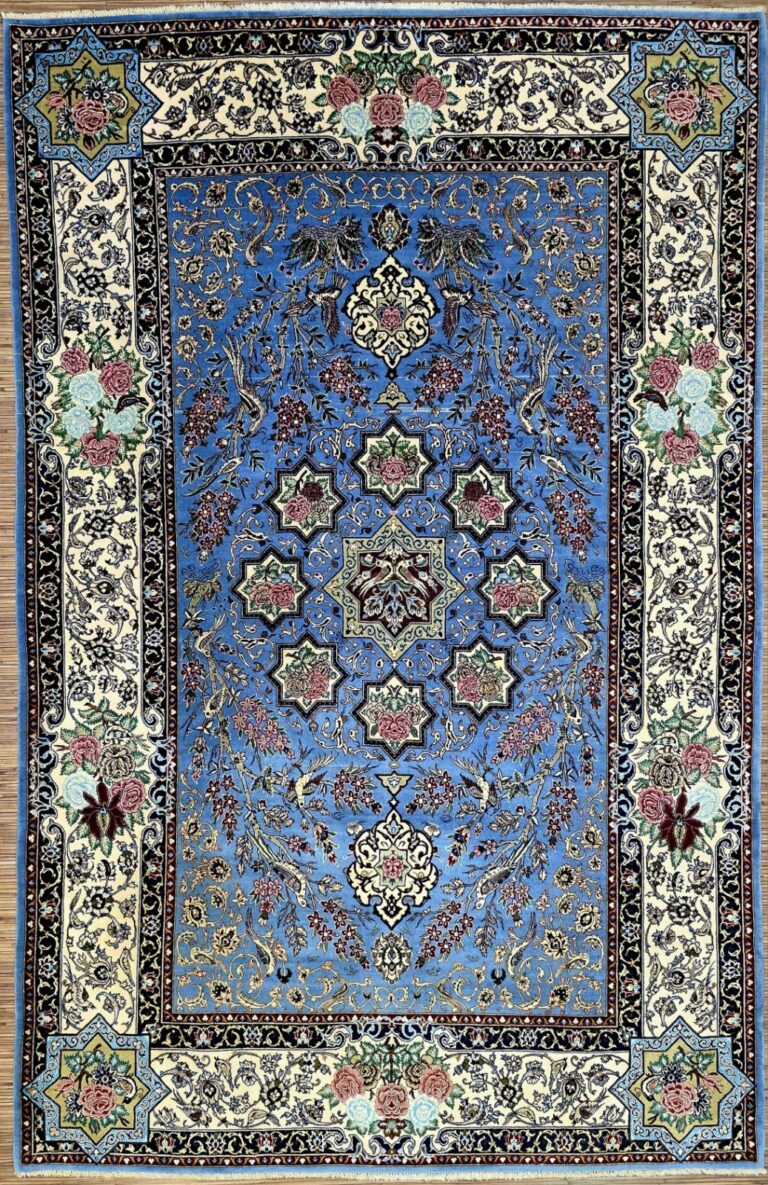
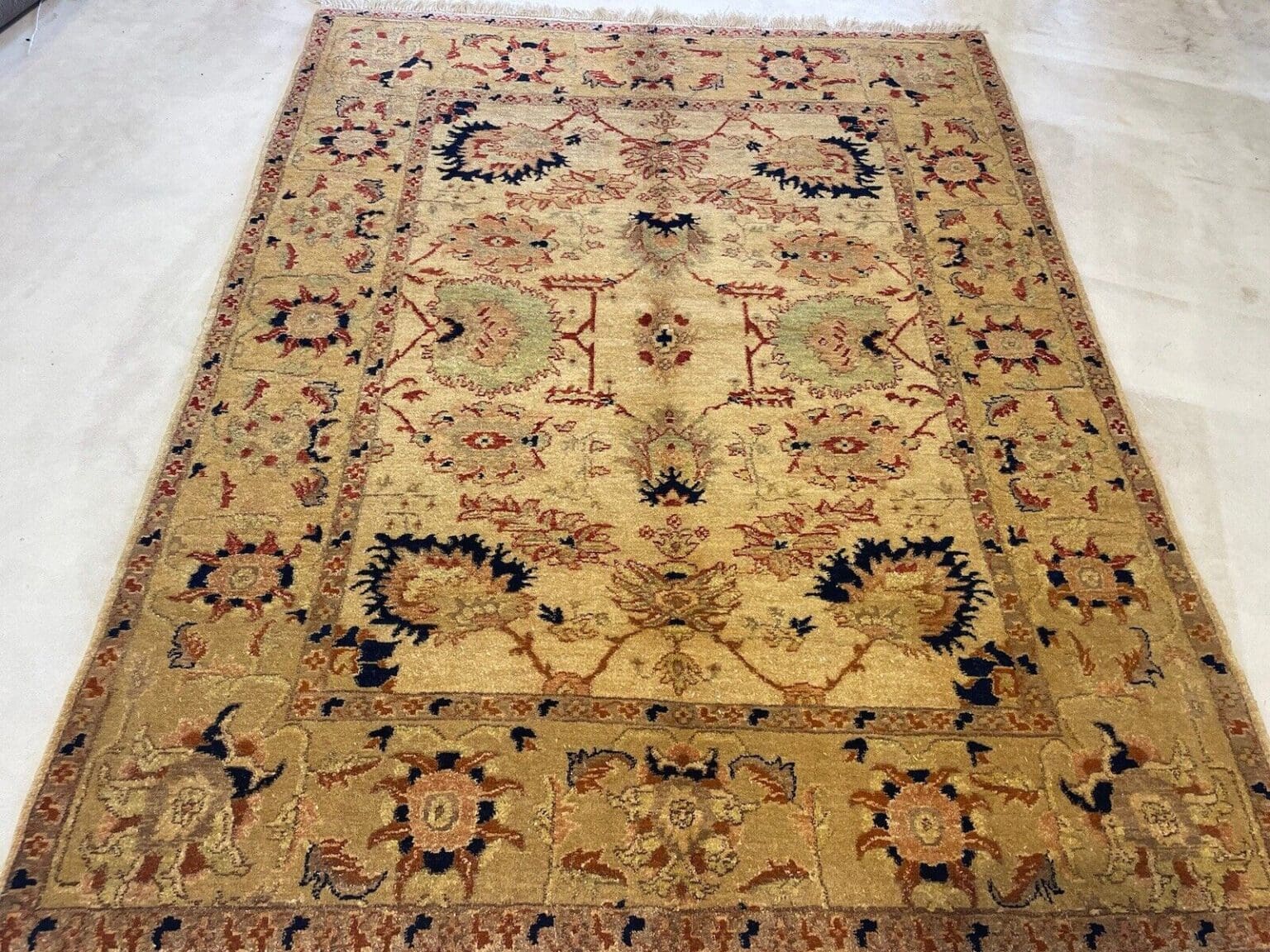
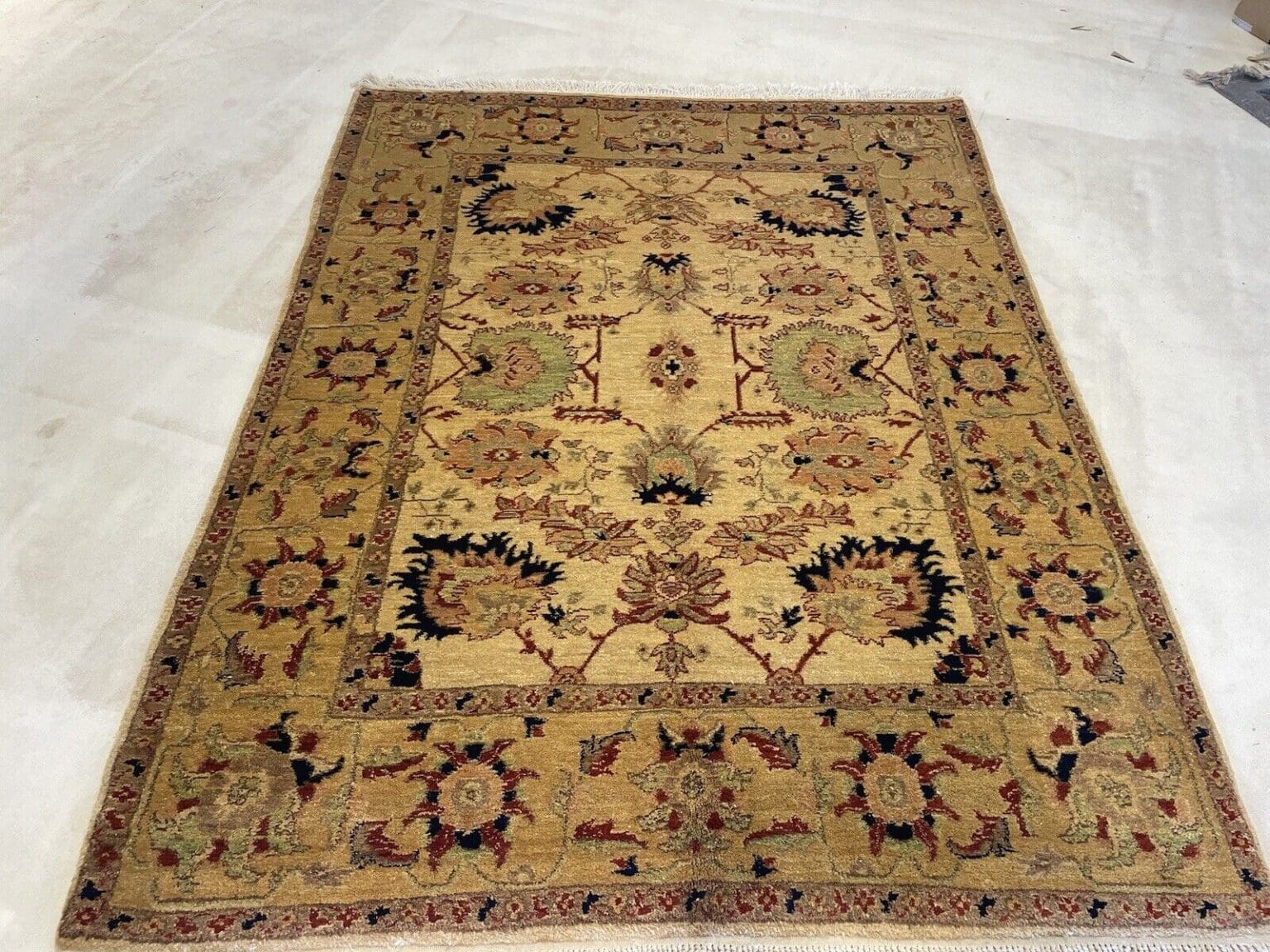
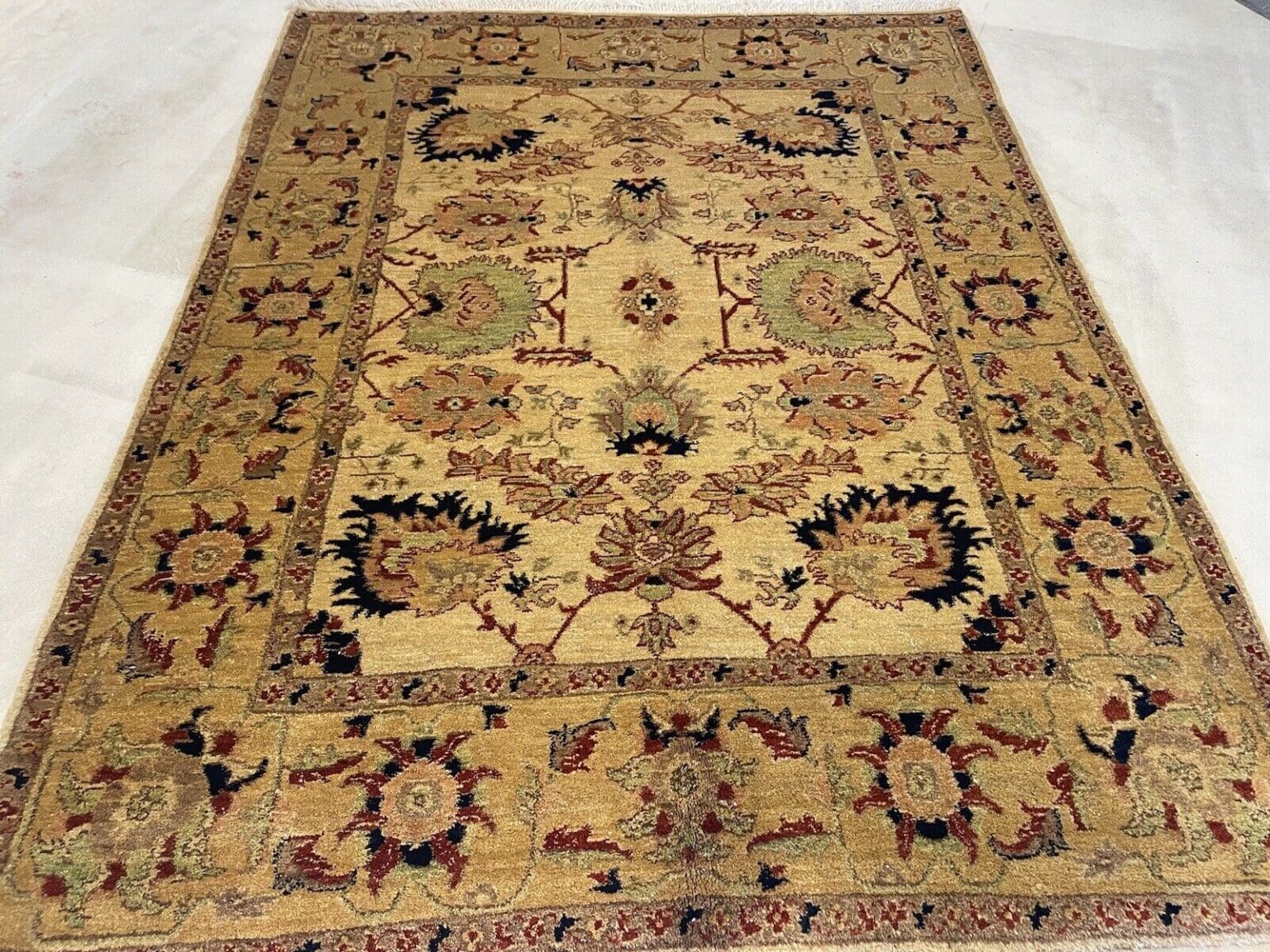
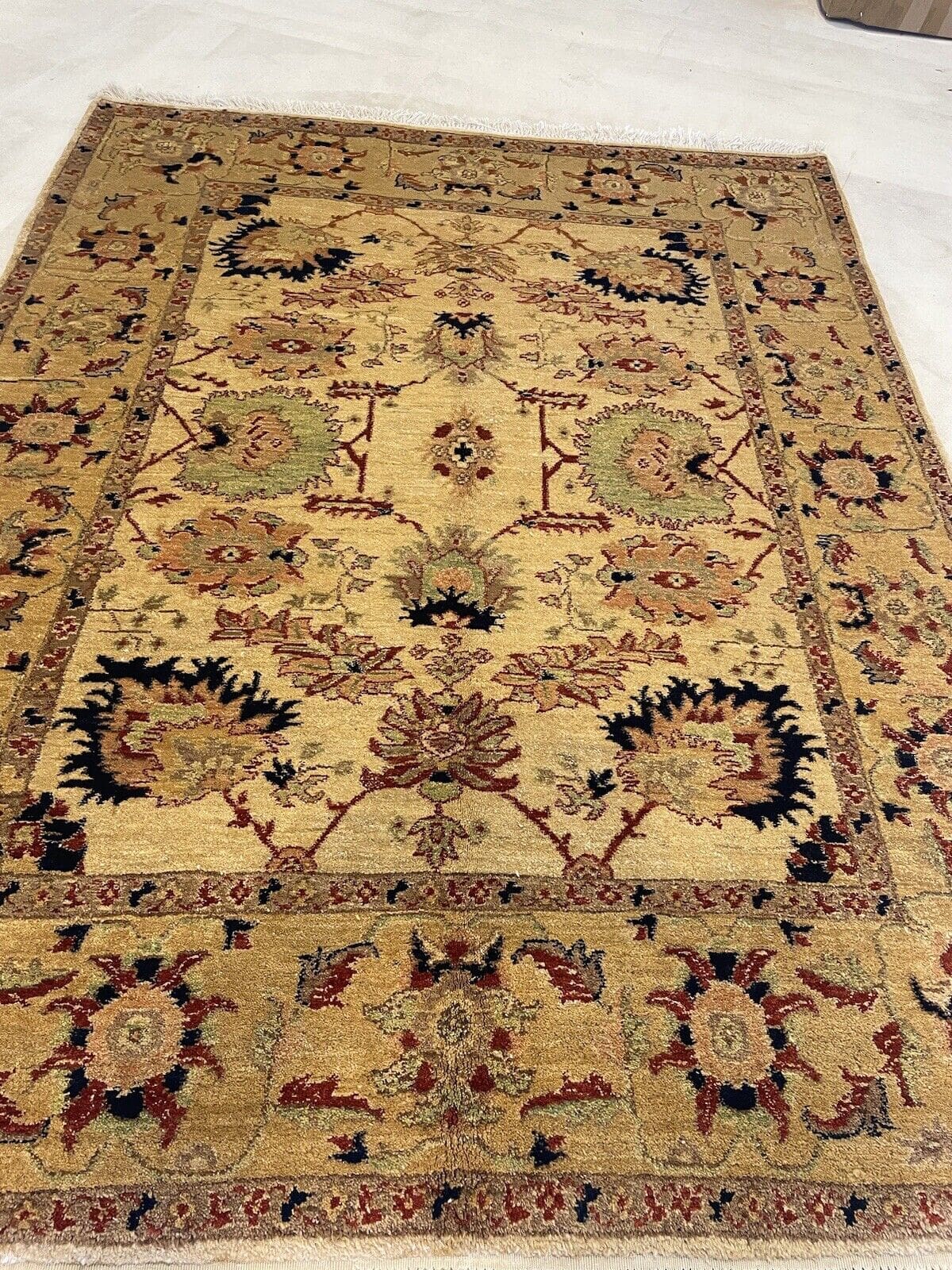
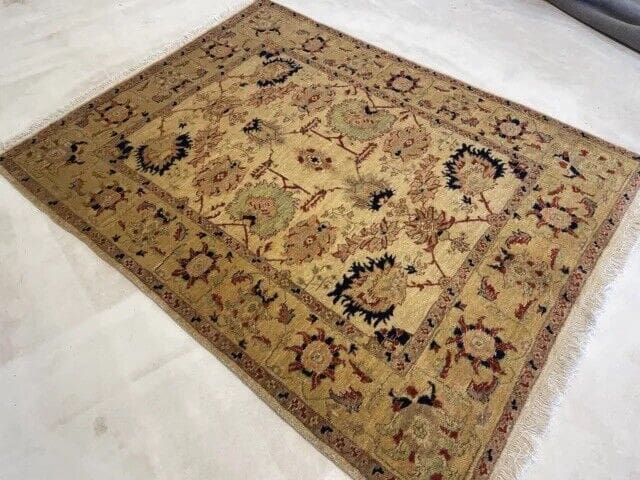
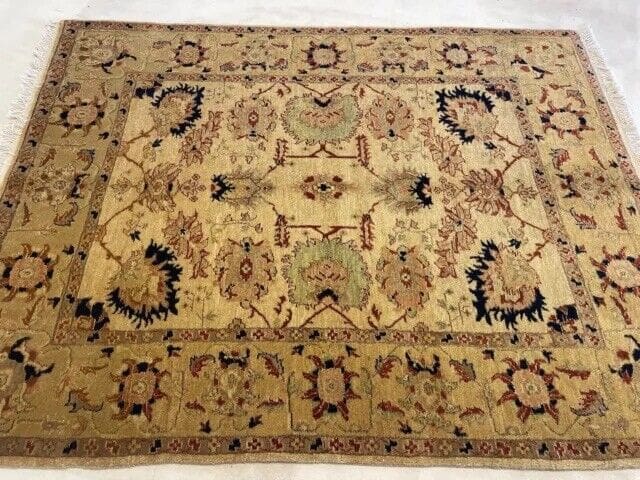
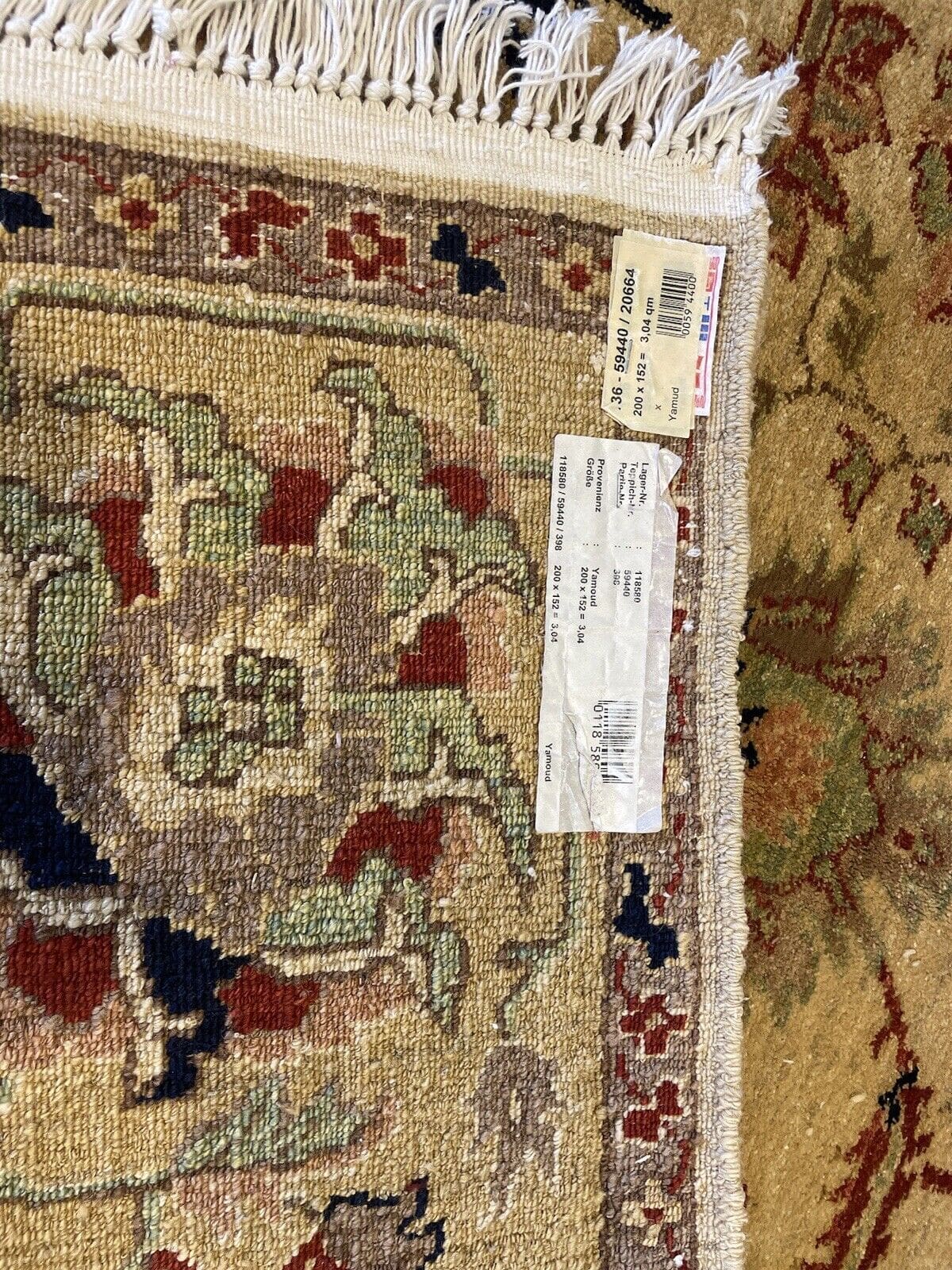
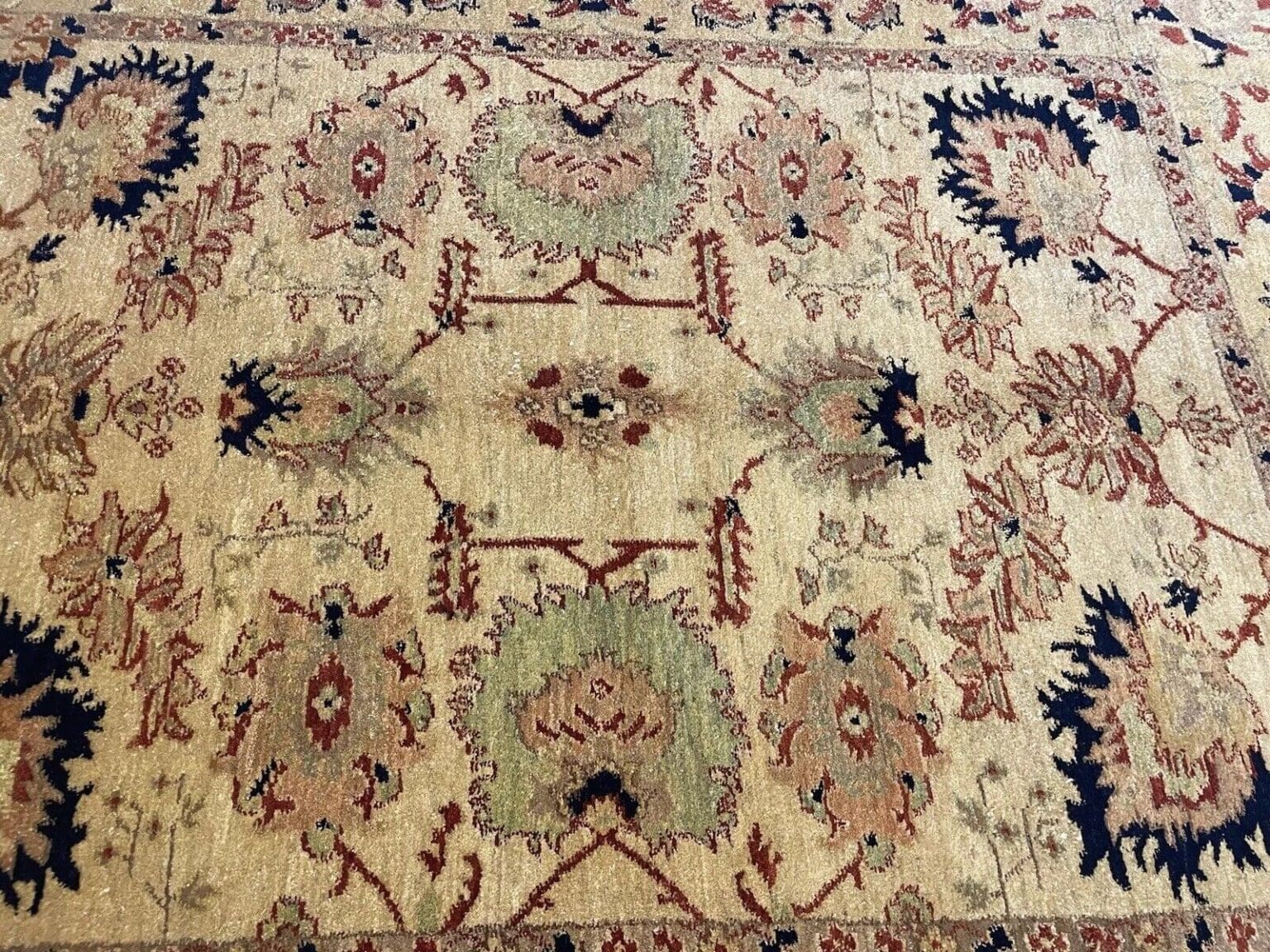
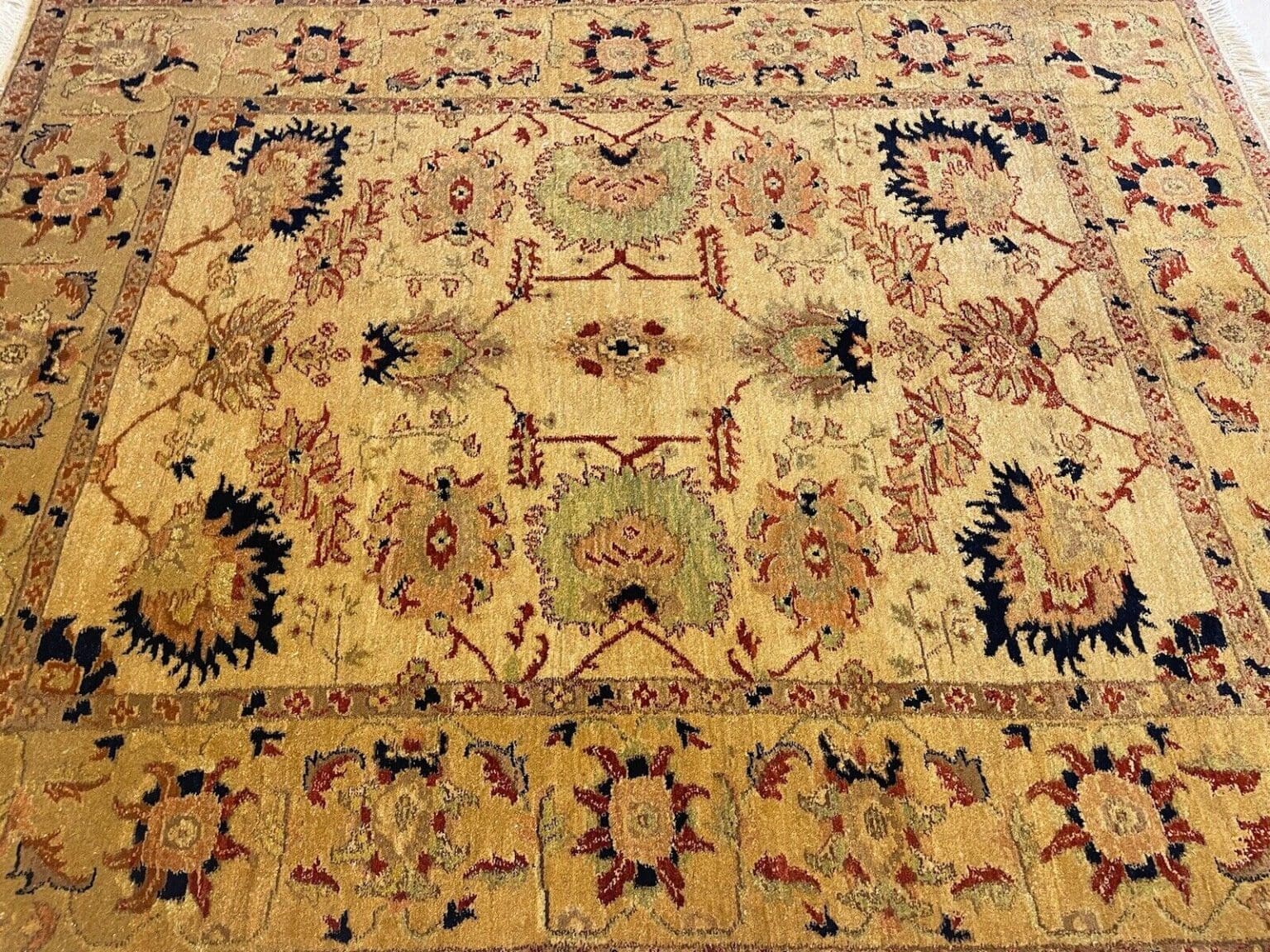
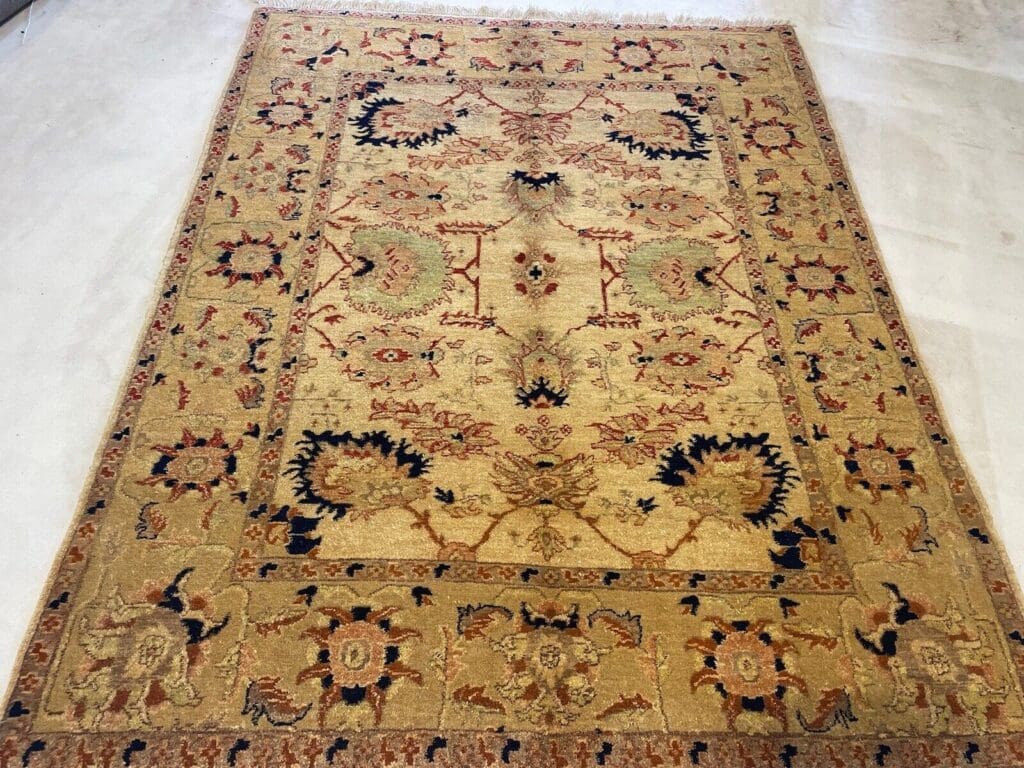
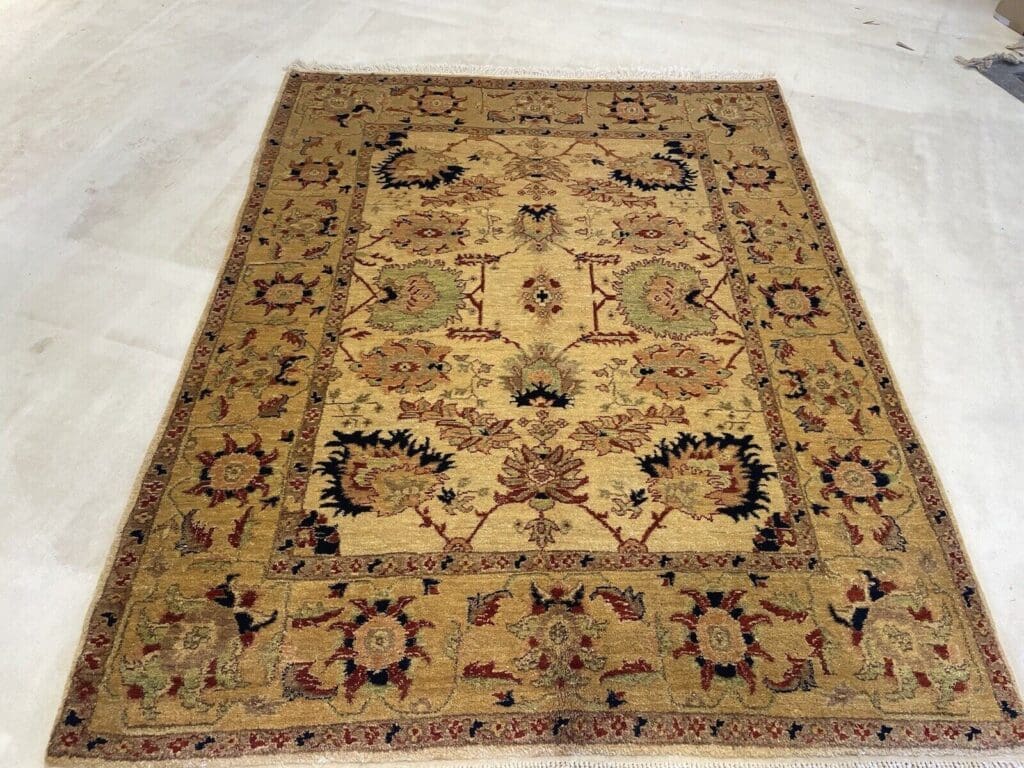
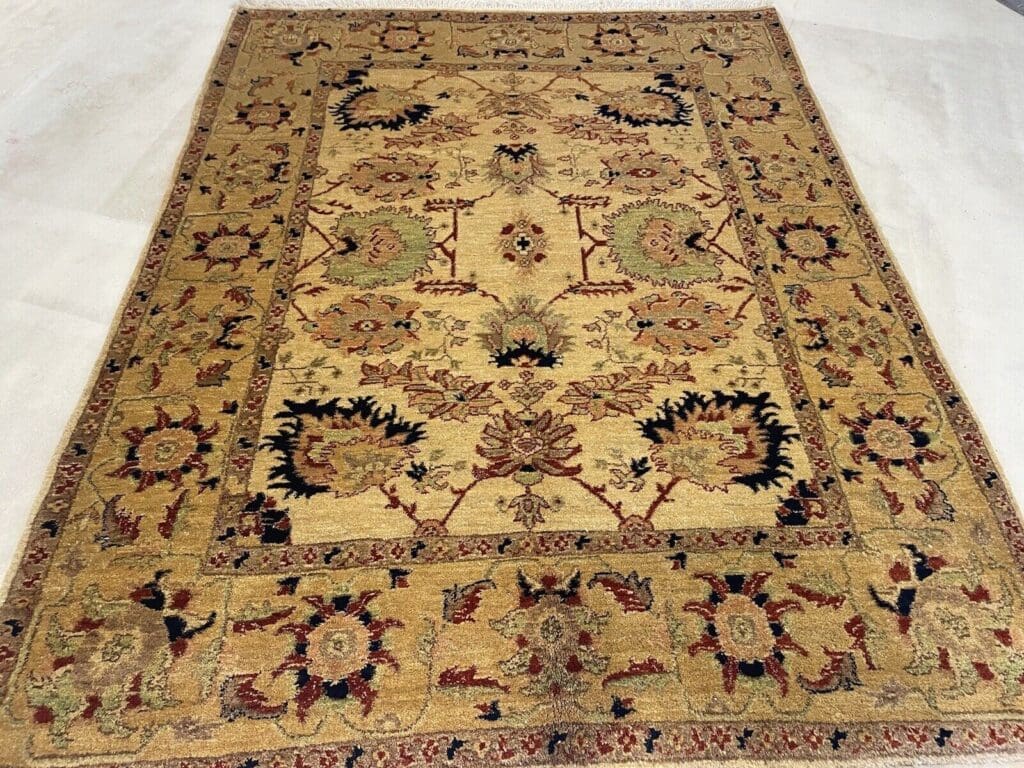
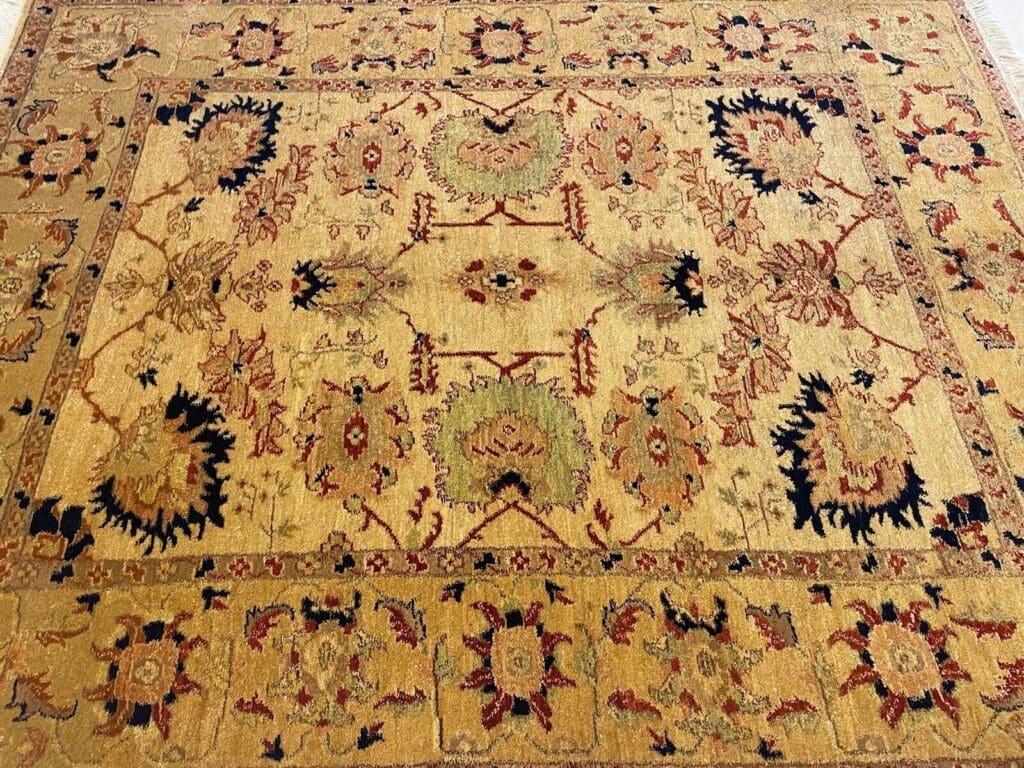
Hand-knotted Kerman Persian rug | Material: pile hand-spun wool, warp cotton | Size: 200 x 150 cm | Pattern: Floral and geometric motifs, beige | Condition: New with tag | Suitable for underfloor heating
This classic Ziegler Persian rug is hand-knotted with a pile of hand-spun wool. The wool gives the surface a natural feel and provides the comfort described for this piece. Hand-spun yarn is part of the traditional making of oriental rugs, and its use forms an important part of the rug’s character. The pile is designed for comfortable use in living spaces and offers a soft feel underfoot.
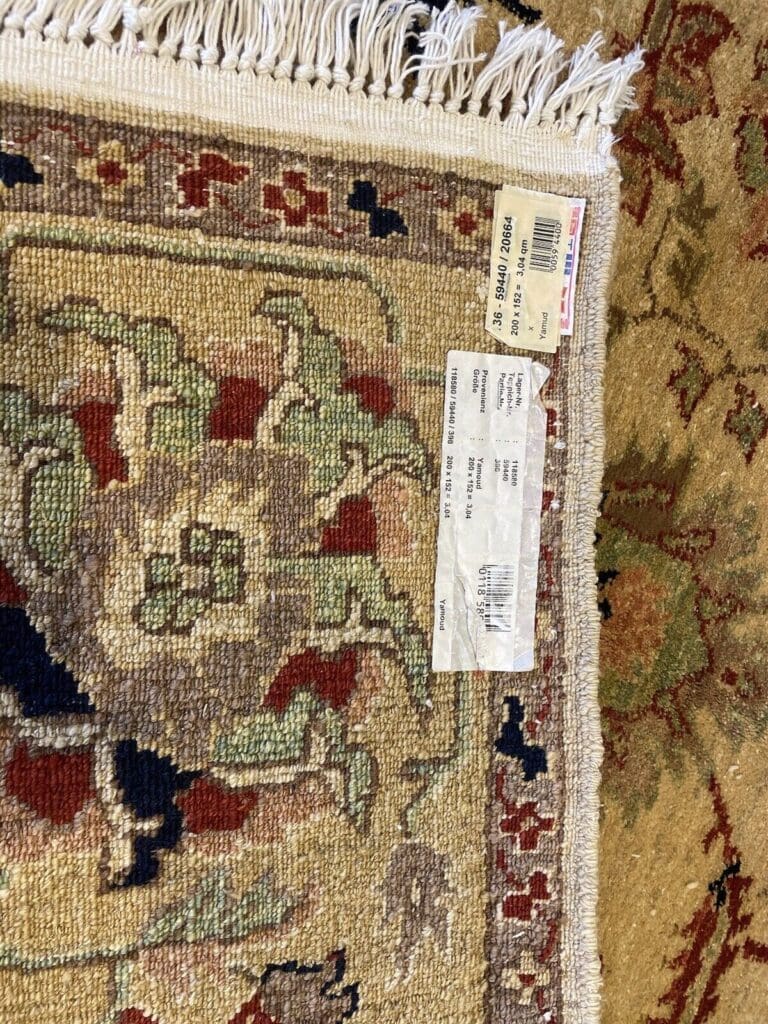
The warp is made from cotton. It forms the foundation of the hand-knotted construction, while hand-spun wool creates the visible pile. This combination of materials is part of the rug’s specified structure. Hand-knotting produces a sturdy and durable floor covering, and the product description identifies the rug as highly hard-wearing with a long service life.
In hand-knotting, each knot is placed individually into the prepared foundation. The finished surface therefore results from many separate stages of manual work. The description also characterises this rug by a high knot density. Combined with the resilient wool, this construction is intended for practical use in areas of the home that receive regular foot traffic. Traditional workmanship and everyday usability are therefore present in the same piece.
Origin and Tradition
The Ziegler Persian rug comes from the Kerman region of Persia. Kerman is one of the recognised rug-producing regions of the country and has a long tradition of making finely worked hand-knotted rugs. The Ziegler tradition reaches back to the period when European merchants looked in Persia for high-quality rugs. Ziegler workshops were established in the Kerman region in this historical setting.
Ziegler rugs combine Persian weaving traditions with design influences shaped for European taste. This produced a visual language of clear lines, balanced colour relationships and stylised ornament. The result remains rooted in Persian craftsmanship while presenting the patterns in a more restrained and broadly adaptable way. Hand-knotting, the use of wool and the relationship to established motifs remain essential features of the tradition.
Kerman has a varied carpet tradition in which floral and geometric compositions both play an important role. Rugs from the region can be organised around many different arrangements, but the regional background is associated with carefully structured ornament. In the Ziegler interpretation, these elements are often drawn with greater clarity and more open visual balance. This creates a link between classical Persian ornament and a quieter form of Western-influenced design.
The origin defines the cultural setting of this rug without requiring every Kerman rug to follow one identical pattern. Persian rugs from Kerman may differ in their colours, compositions and sequences of ornament. What they share is their connection to an established weaving culture. In this piece, that connection is expressed through the Ziegler style, hand craftsmanship and the use of hand-spun wool.
The history of Ziegler rugs also represents an exchange between Persian workshops and European clients. Designs were developed to retain the decorative language of Persian rugs while working in a range of interiors. This background helps explain the clear drawing and harmonious colour impression associated with the style. The rug therefore belongs to a tradition in which regional craftsmanship and adaptable interior design are brought together.
Design and Pattern
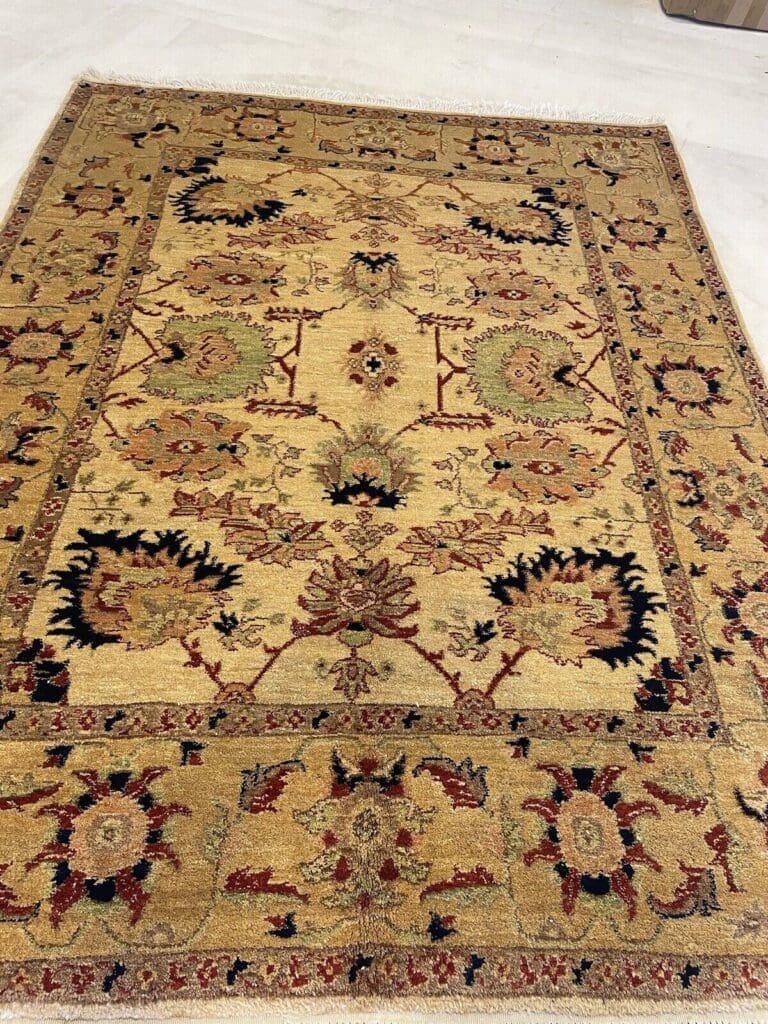
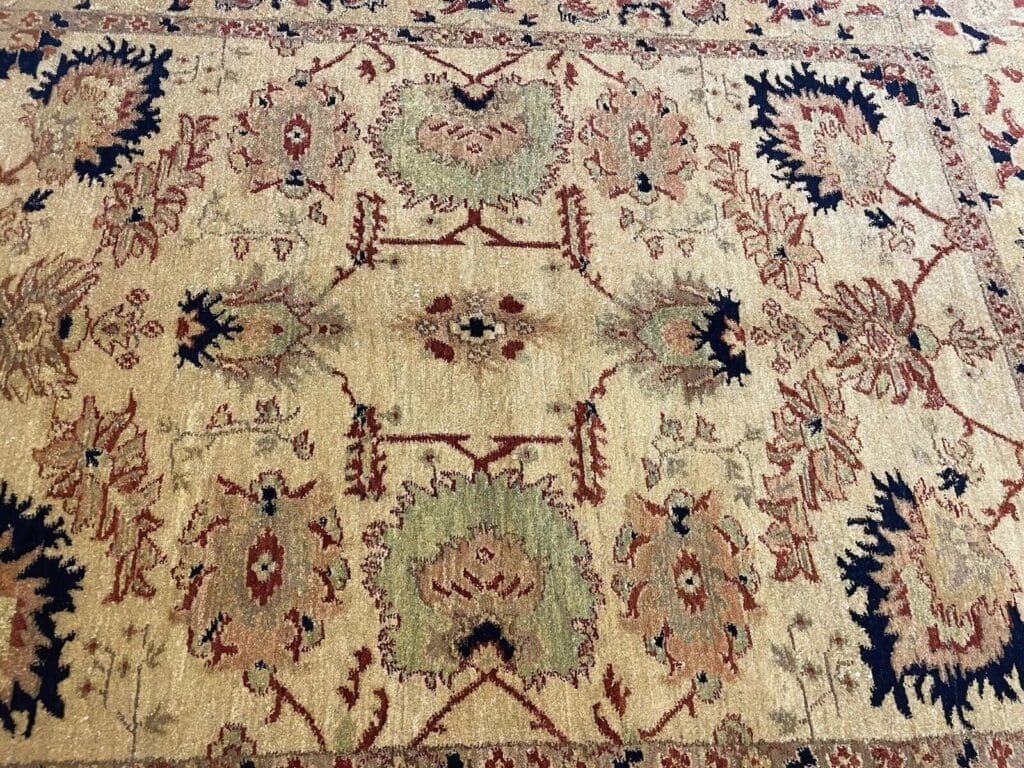
The pattern is composed of stylised floral and geometric motifs. These two visual languages have long been used together in oriental rug design. Floral elements introduce curved, plant-inspired forms, while geometric elements provide order, rhythm and a clear framework. In the Ziegler style, the two are combined into a balanced composition rather than being treated as unrelated decorative details.
Beige is the base colour of the rug. As a neutral background, it allows the pattern to remain visible without imposing a strong colour statement on the room. This makes the rug compatible with classic, contemporary or rustic interiors. The restrained colour character supports the versatile and traditionally oriented nature of the design.
Stylised motifs are not literal depictions of individual plants or objects. Instead, they transfer recognisable lines and shapes into an ornamental vocabulary. Within Persian rug art, floral forms are often associated with ideas of nature, fertility and prosperity. Geometric forms can suggest order and balance. These associations belong to the broader symbolism of oriental patterns and explain why such motifs are understood as more than simple surface decoration.
The design of this Ziegler rug is defined by clear lines and harmonious colours. The result is a calm overall appearance with enough structure for the motifs to remain distinct. The combination of floral and geometric forms gives the pattern flexibility: it can be read as classical ornament, yet it also works alongside more reduced contemporary furnishings. Tradition is expressed through selected forms and composition rather than through a rigid reproduction of one historical model.
A rug in this tradition is usually understood through its complete arrangement rather than through one dominant emblem. The beige ground, stylised ornaments and ordered line work create the described pattern as a whole. Its appearance is supported both by the hand-knotted texture and by the restrained colour scheme. The design is Persian and oriental in character while remaining suitable for different rooms and interior approaches.
Special Features
A specifically stated feature is the rug’s suitability for underfloor heating. It is intended to be used with a heated floor, allowing its hand-knotted wool construction to meet a contemporary heating system. Wool contributes to a comfortable feeling of warmth underfoot and to a pleasant room atmosphere. This makes the rug relevant for interiors where traditional textile craftsmanship is combined with current residential comfort.
The rug is described as new with a tag. Other stated properties include easy care, durability and resistance to wear. Regular vacuuming and occasional airing are recommended for maintenance. For stains, a wool-safe stain remover or professional rug cleaning is advised. Excessive wiping should be avoided so that the fibres are not unnecessarily stressed. Its rectangular form and neutral beige colour allow it to be used in a bedroom, dining room, study or living room.
FAQ
How should I care for the Ziegler Persian rug?
Regular vacuuming helps remove loose dust and everyday dirt from the pile and keeps the surface clean. The rug can also be aired from time to time. If a stain occurs, use a stain remover intended for wool, or have the rug treated by a professional cleaner. Excessive wiping should be avoided because it can place unnecessary stress on the fibres. Care should therefore be gentle and appropriate for a wool pile. These measures support the described easy-care character while respecting the material used in the rug.
Can the rug be used with underfloor heating?
Yes. The classic Ziegler Persian rug is suitable for use over underfloor heating. Its hand-knotted construction and hand-spun wool pile can be combined with warmth from a heated floor. The wool provides a comfortable warm feeling underfoot and contributes to a pleasant room climate. This allows the traditional appearance of a Persian rug to be used together with a modern heating system. The stated suitability makes it appropriate for the residential areas named for this rug.
Where does the Ziegler Persian rug come from?
The rug comes from the Kerman region of Persia. Kerman has a long tradition of producing hand-knotted rugs and is known for finely crafted carpet work. The Ziegler tradition developed in connection with European merchants who sought high-quality rugs in Persia. This led to a design language in which Persian craftsmanship was combined with clear lines, harmonious colours and Western design influences. This particular rug therefore belongs to the Persian Ziegler tradition associated with the Kerman region.
To provide the best experiences, we use technologies like cookies to store and/or access device information. Consenting to these technologies will allow us to process data such as browsing behavior or unique IDs on this site. Not consenting or withdrawing consent, may adversely affect certain features and functions.
Functional Always active
The technical storage or access is strictly necessary for the legitimate purpose of enabling the use of a specific service explicitly requested by the subscriber or user, or for the sole purpose of carrying out the transmission of a communication over an electronic communications network.
Preferences
The technical storage or access is necessary for the legitimate purpose of storing preferences that are not requested by the subscriber or user.
Statistics
The technical storage or access that is used exclusively for statistical purposes.The technical storage or access that is used exclusively for anonymous statistical purposes. Without a subpoena, voluntary compliance on the part of your Internet Service Provider, or additional records from a third party, information stored or retrieved for this purpose alone cannot usually be used to identify you.
Marketing
The technical storage or access is required to create user profiles to send advertising, or to track the user on a website or across several websites for similar marketing purposes.

 SECURE PAYMENT
 SHIPPING PARTNERS