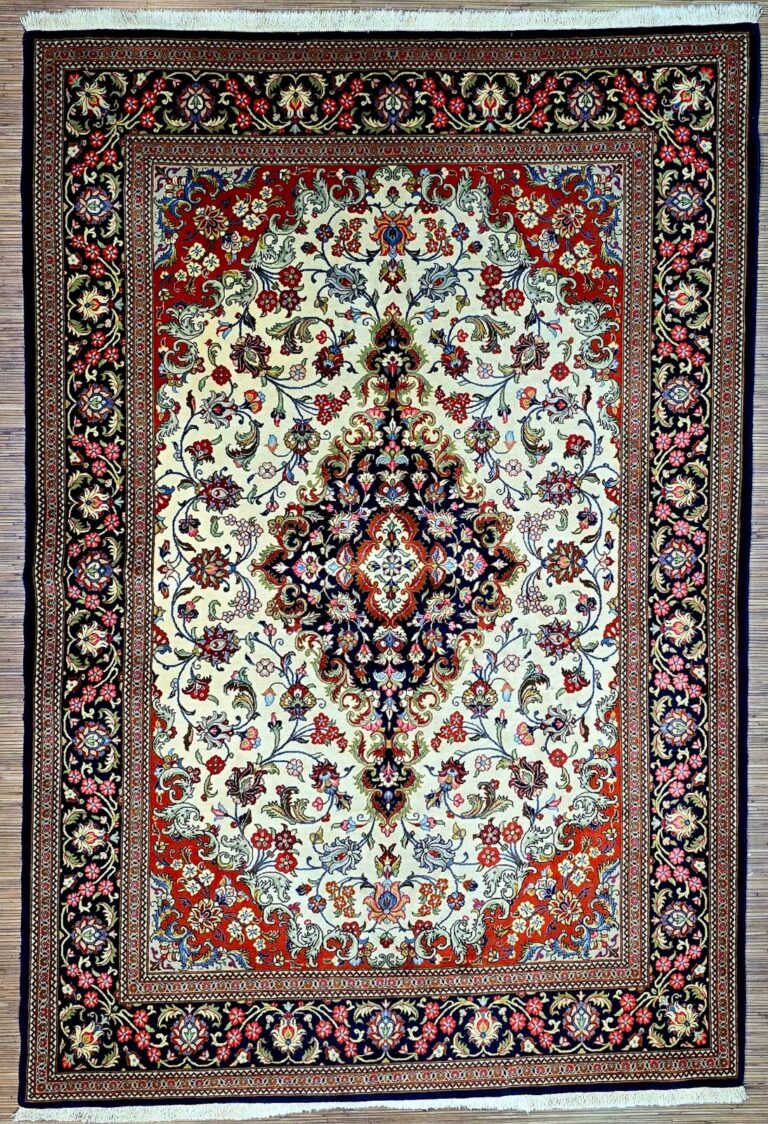
This Kashan Persian rug is hand-knotted from wool. Wool is a natural fibre valued in rug making for its durability, lasting quality, comfortable feel and ability to provide thermal insulation. In this rug, the wool pile gives the surface a soft and pleasant feel underfoot while supporting the practical qualities associated with a carefully made hand-knotted textile.
Hand-knotting is a method in which the pile is built knot by knot rather than produced as a flat, mechanically formed surface. Every knot is placed with care and precision. The source describes this rug as having high knot density, a characteristic associated with the detailed workmanship of Kashan rugs. A dense construction allows intricate motifs to be expressed clearly and contributes to the firm, durable character of the finished textile.
The making of a hand-knotted rug requires patience, concentration and repeated control of the pattern as the work progresses. The individual knots create the pile, while the arrangement of colour and motif develops gradually across the field. This traditional process explains why hand-knotted rugs have a distinct surface structure and why careful workmanship is visible in the fine details. The rug is described as being of top quality, with its wool material, precise knotting and detailed execution forming the basis of that description.
Wool also has an important role in the everyday character of a rug. It offers a comfortable surface and can help retain warmth, while its natural resilience makes it suitable for continued use. The combination of a wool pile and hand-knotting connects this individual rug with established Persian weaving practice without changing its stated material or construction.
Origin and Tradition
The Kashan Persian rug comes from Kashan in Iran. Kashan is one of the Iranian cities strongly associated with carpet weaving, and its name is linked with refined rugs featuring orderly compositions, elegant colour arrangements and detailed ornament. The city’s weaving tradition is longstanding, and the source places its development within a history reaching back to the sixteenth century.
During the Safavid dynasty, many techniques and design principles that remain important in Persian carpet culture were refined. The Safavid period was significant for the development of courtly arts, including carpet weaving, and Kashan became an important centre of production in Iran. The tradition did not consist of one unchanging pattern. Instead, workshops developed ways of combining a controlled central arrangement, repeat ornament, floral detail and carefully balanced colour.
Kashan rugs are traditionally associated with precise drawing and an ordered decorative language. Floral forms may be arranged across a central field, enclosed within a border or repeated in a structured composition. This approach reflects the importance of harmony and proportion in Persian design. The weaving tradition also shows how technical skill and visual planning work together: the knotting must support the clarity of the drawing, while the design must be organised so that it can be transferred into the woven structure.
Persian carpets from Kashan are known for lively colours and richly worked patterns. Their ornament can refer to ideas from Persian culture and history, while their overall appearance remains adaptable to changing tastes. The continuing appreciation of Kashan rugs in Iran and internationally comes from this relationship between inherited forms and later influences. Traditional motifs can be presented in a way that suits both established interiors and more contemporary settings, while the regional identity remains connected to Kashan.
The origin of this rug is therefore more than a place name. Kashan represents a particular weaving environment in which the disciplines of drawing, colour selection and hand-knotting have been practised and developed over generations. The city’s carpet tradition is part of the broader history of Persian textile arts, with the Safavid period providing an important historical reference point for the refinement of techniques and designs.
Design and Pattern
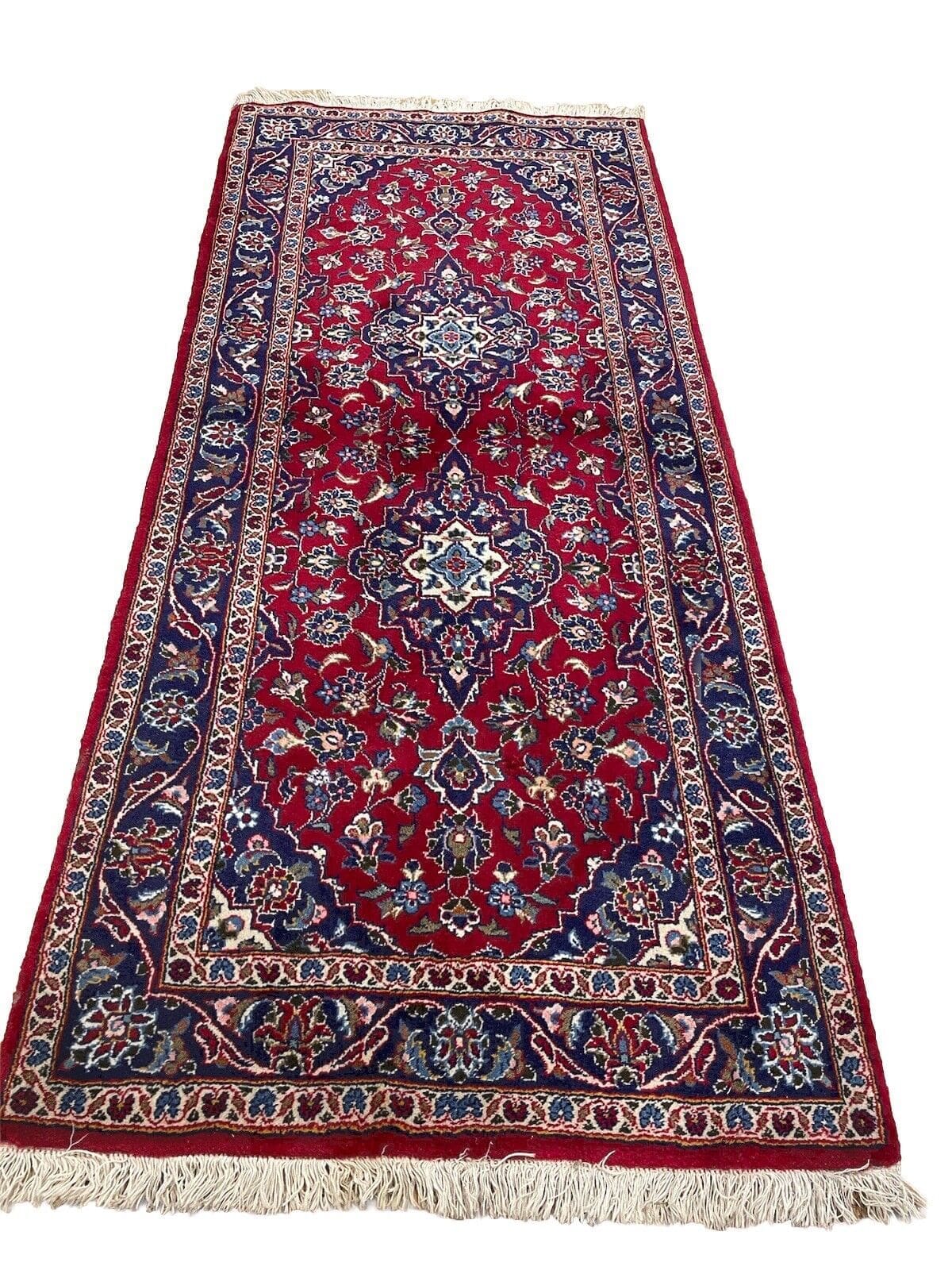
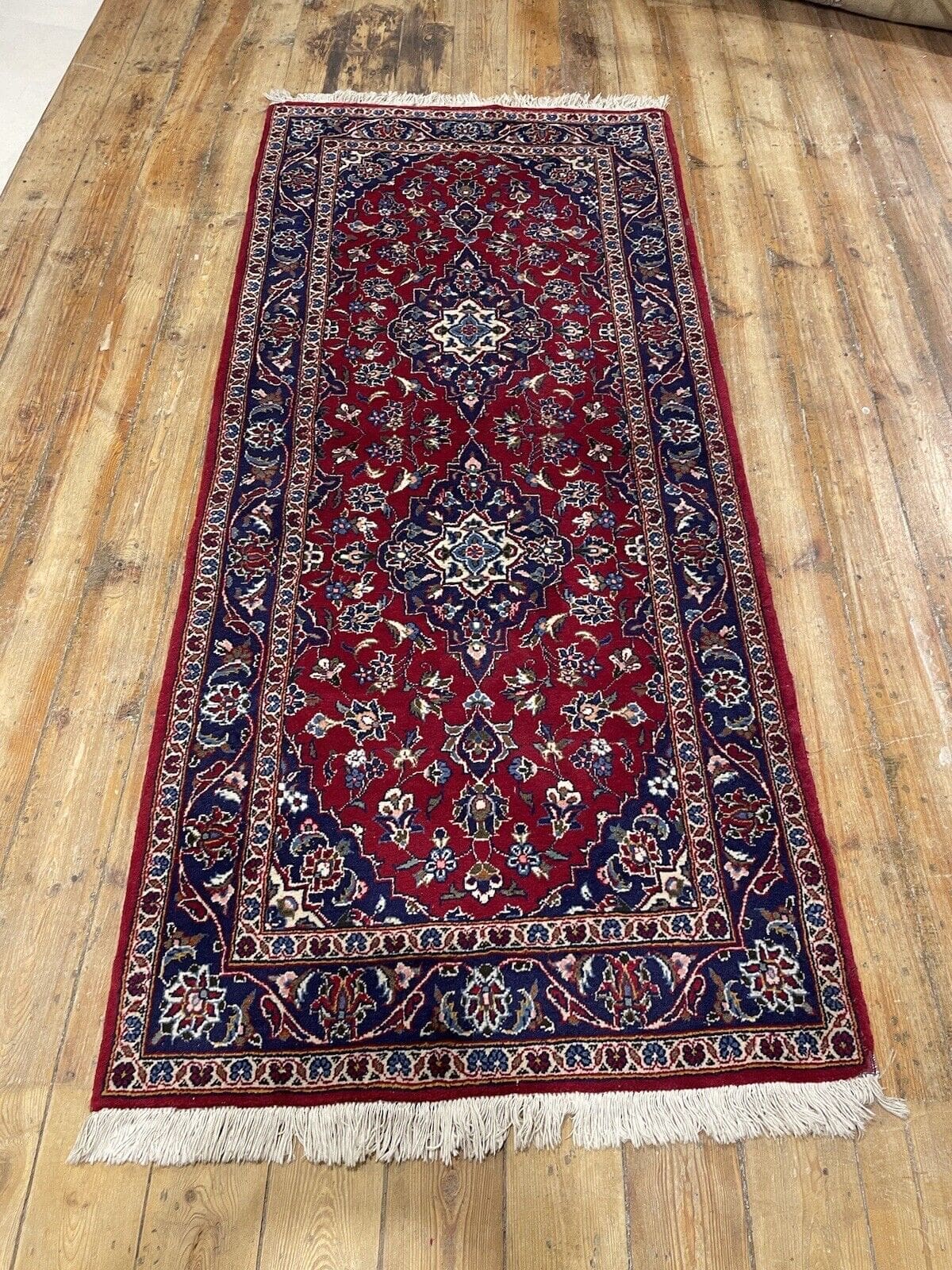
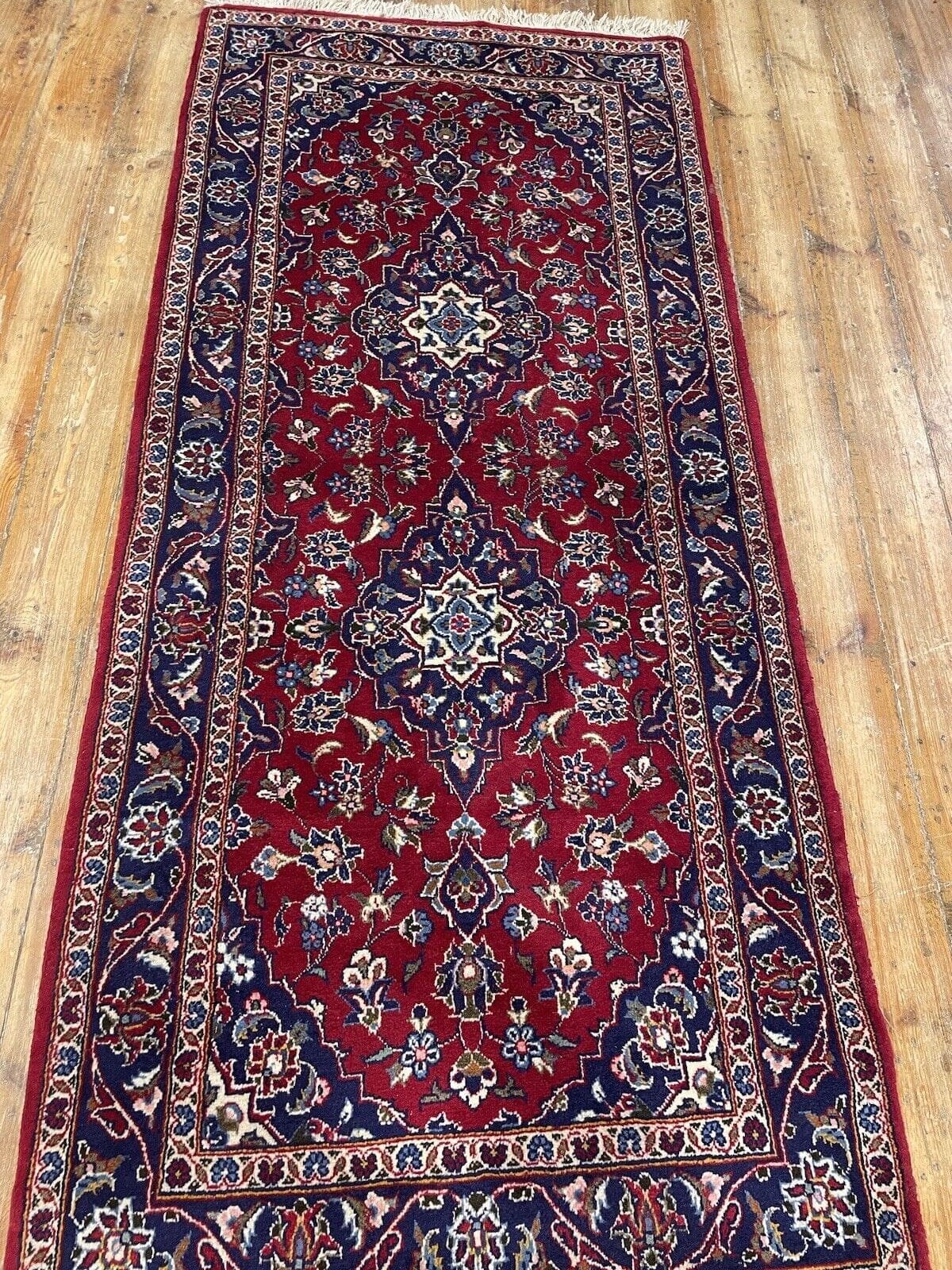
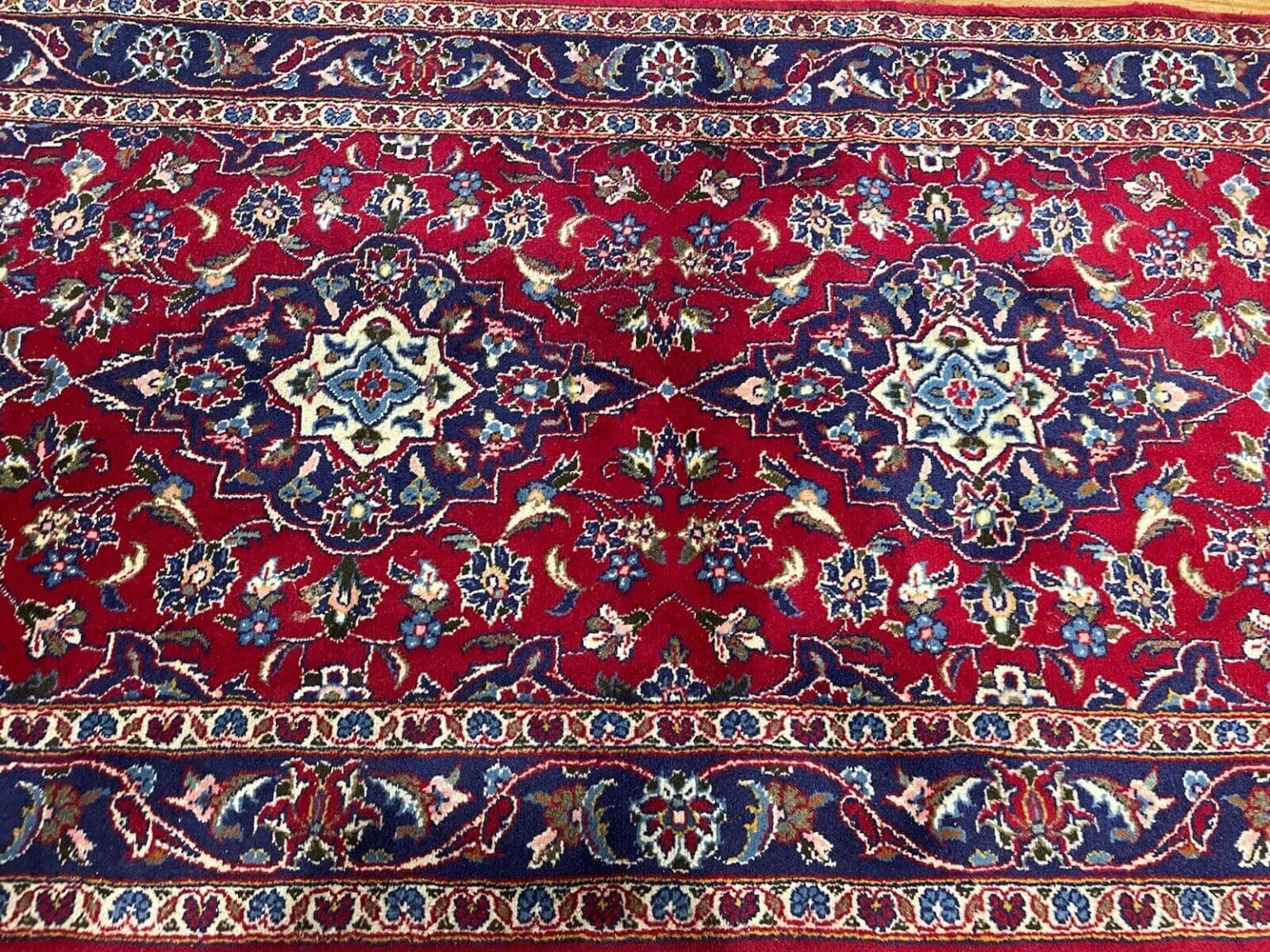
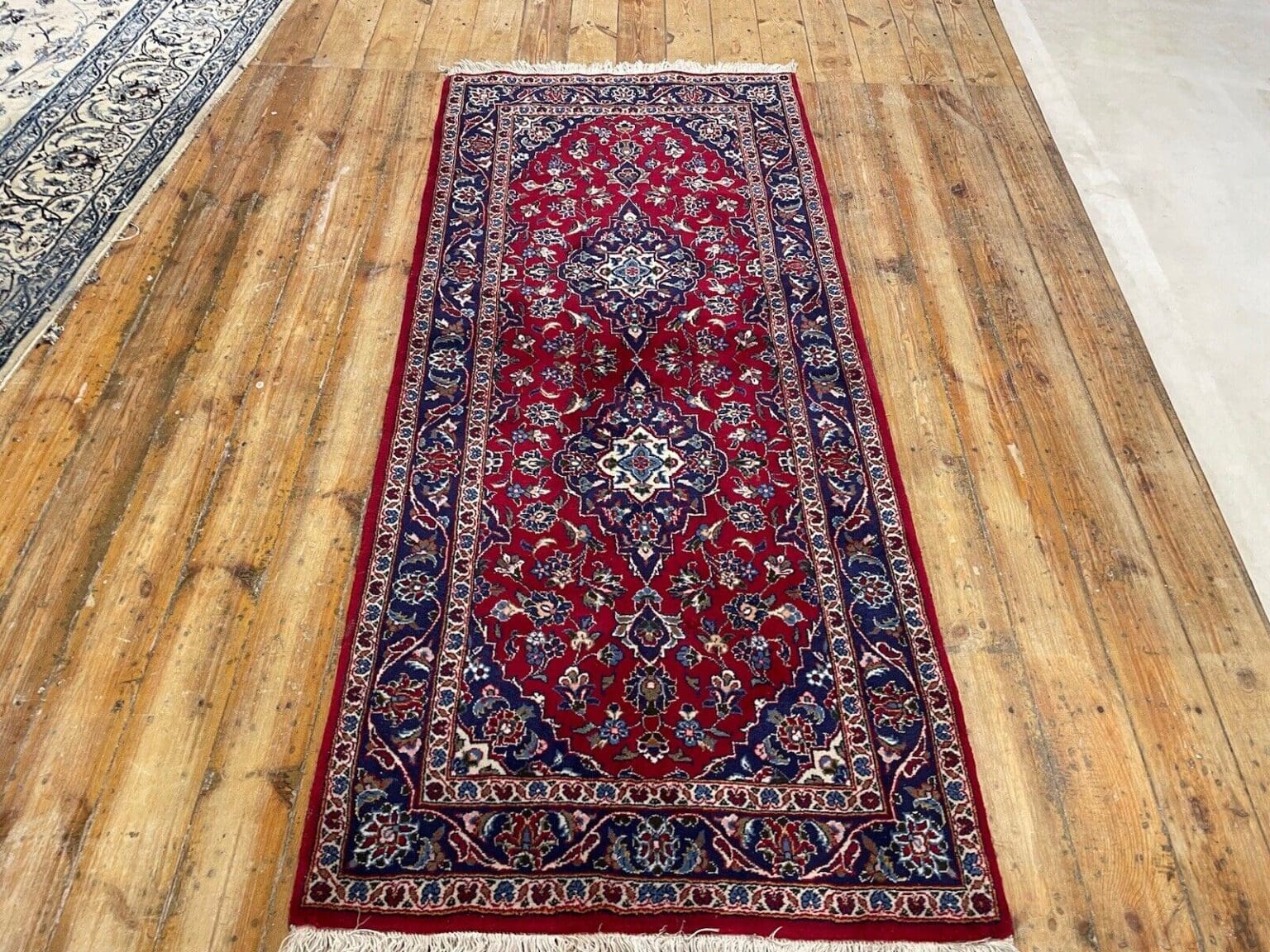
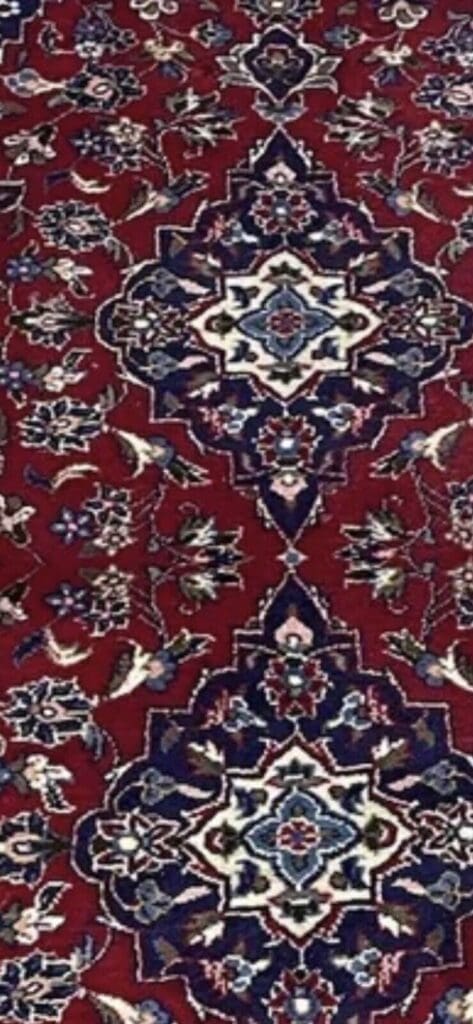
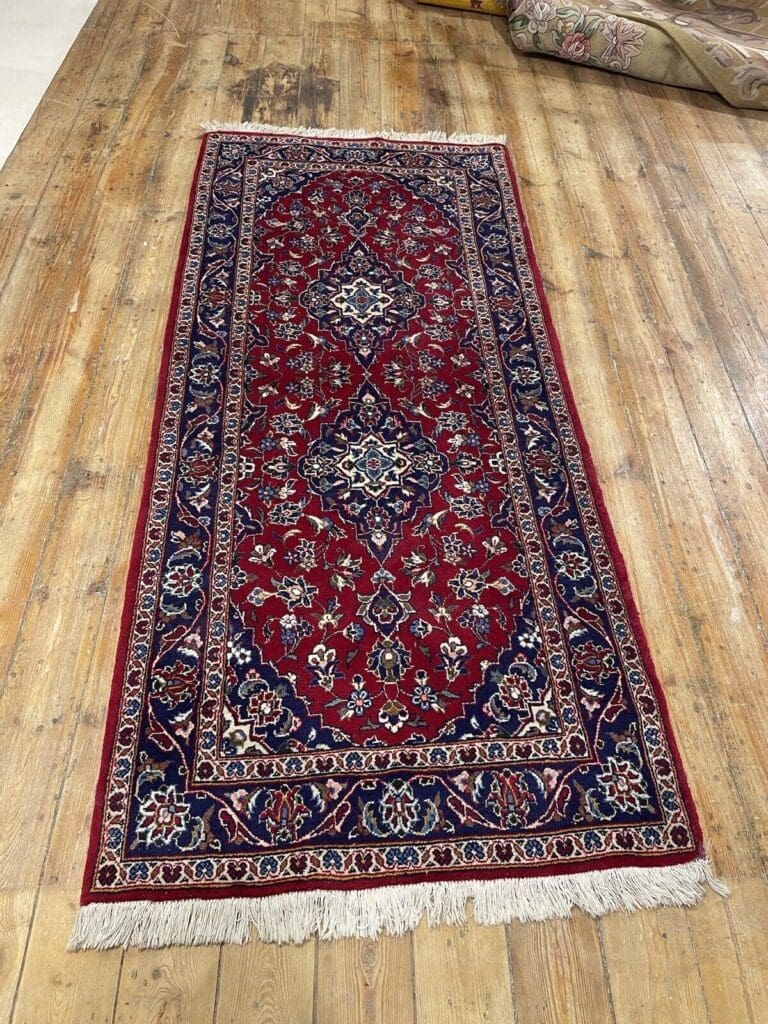
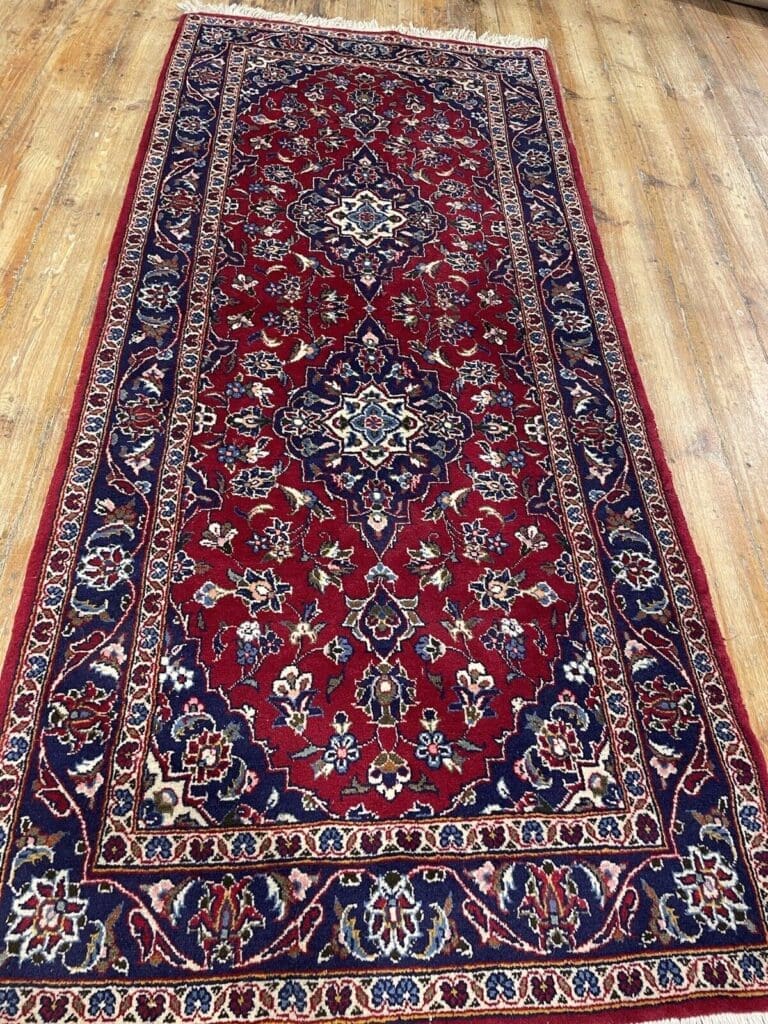
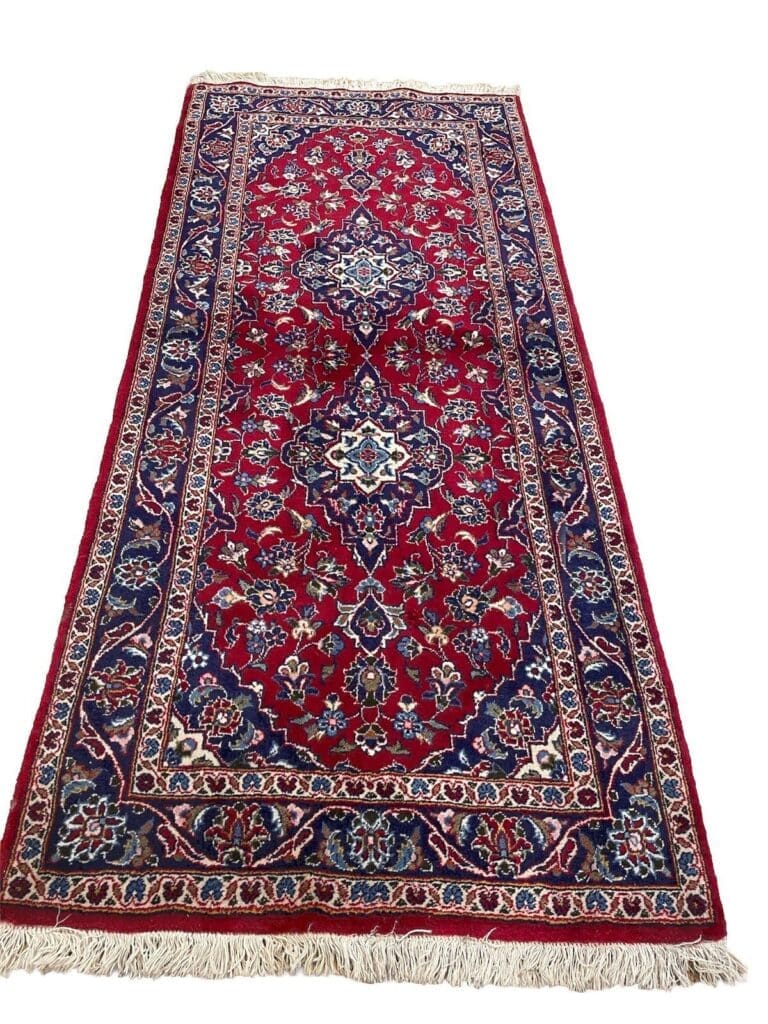
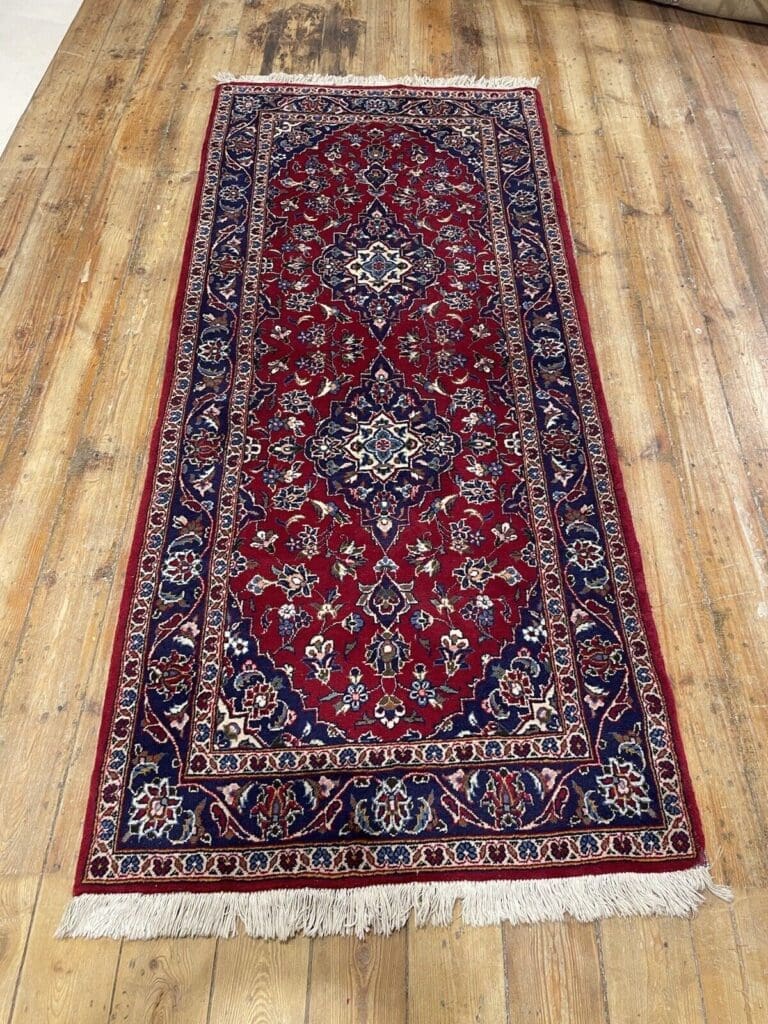
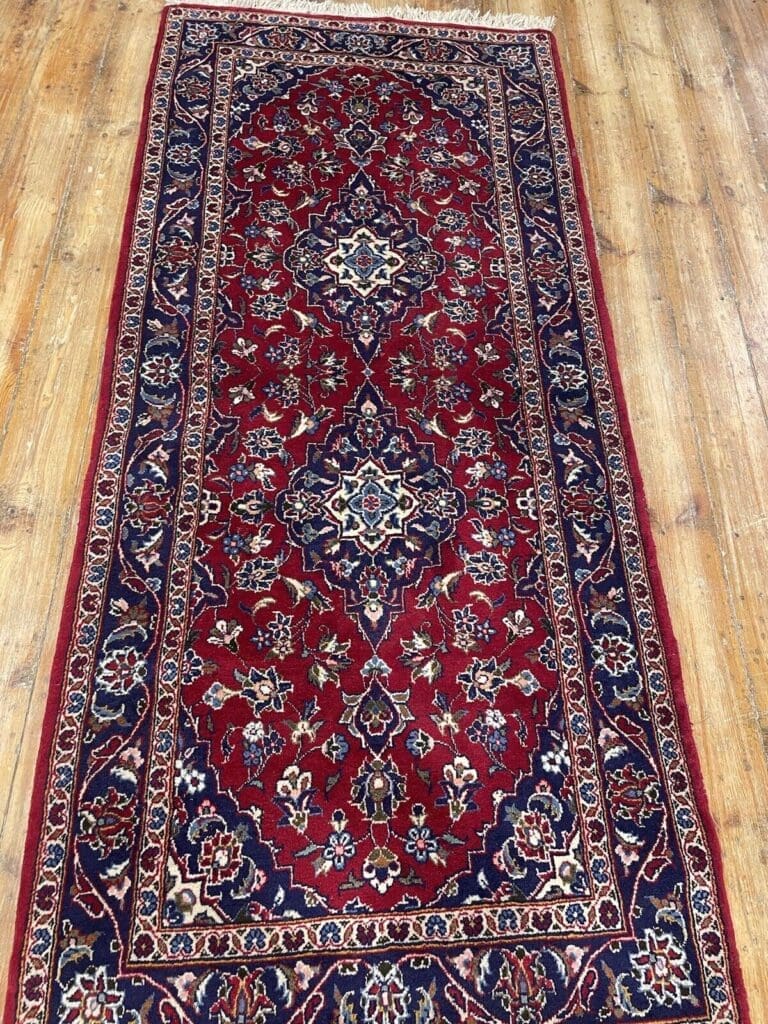
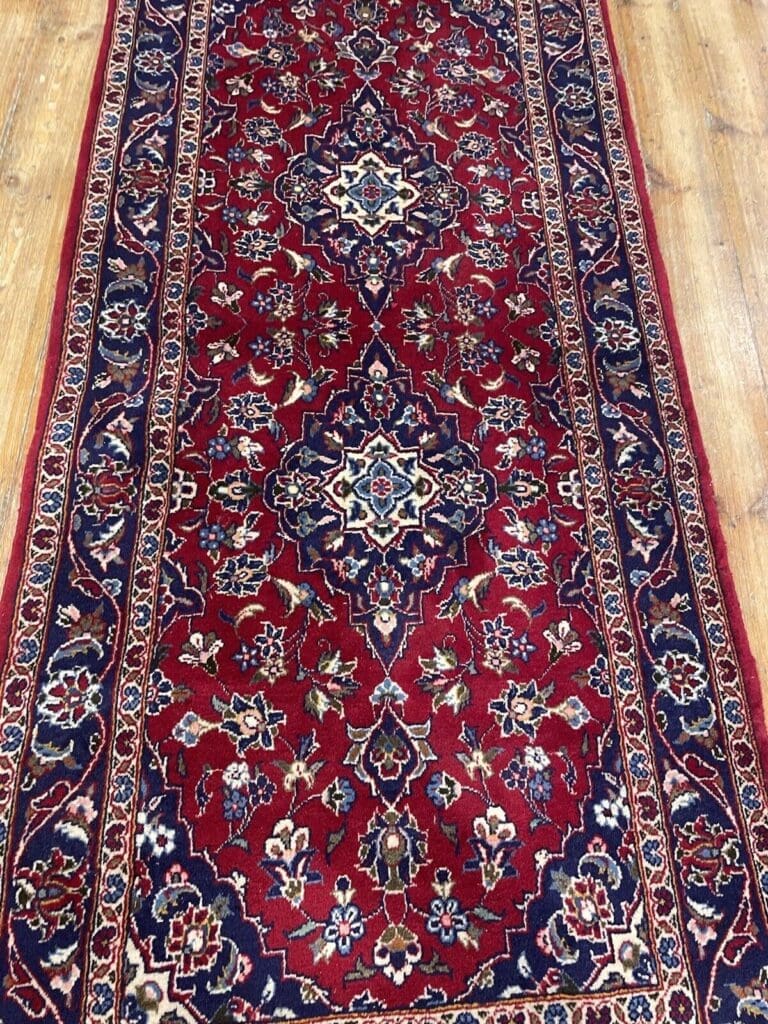
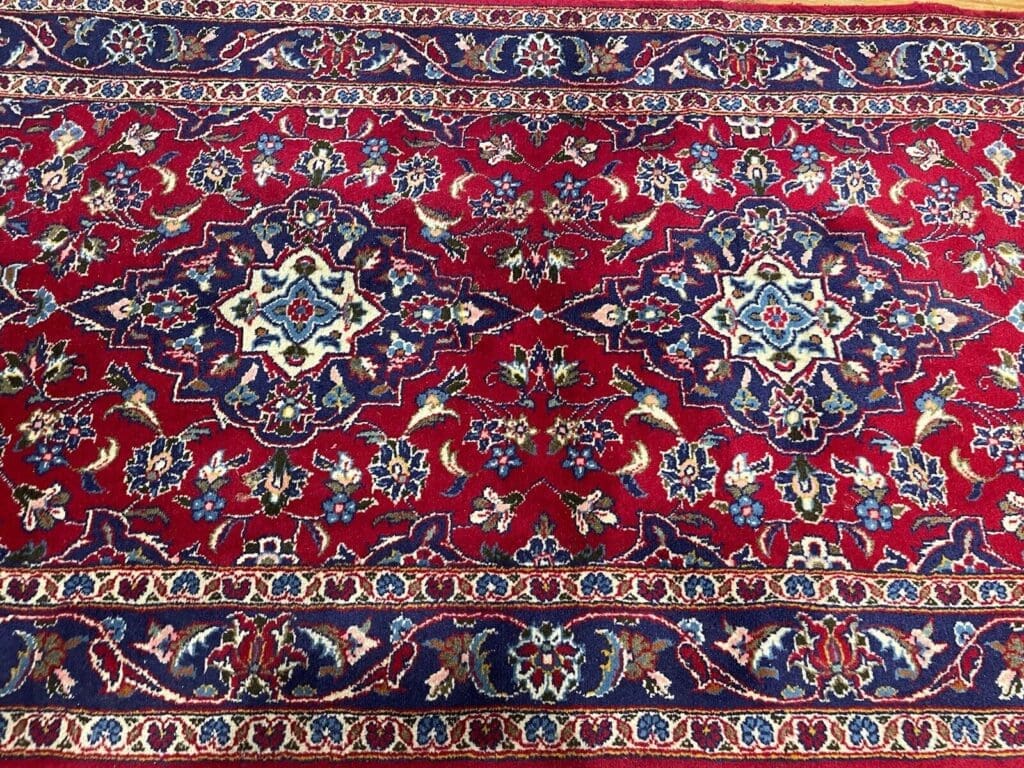
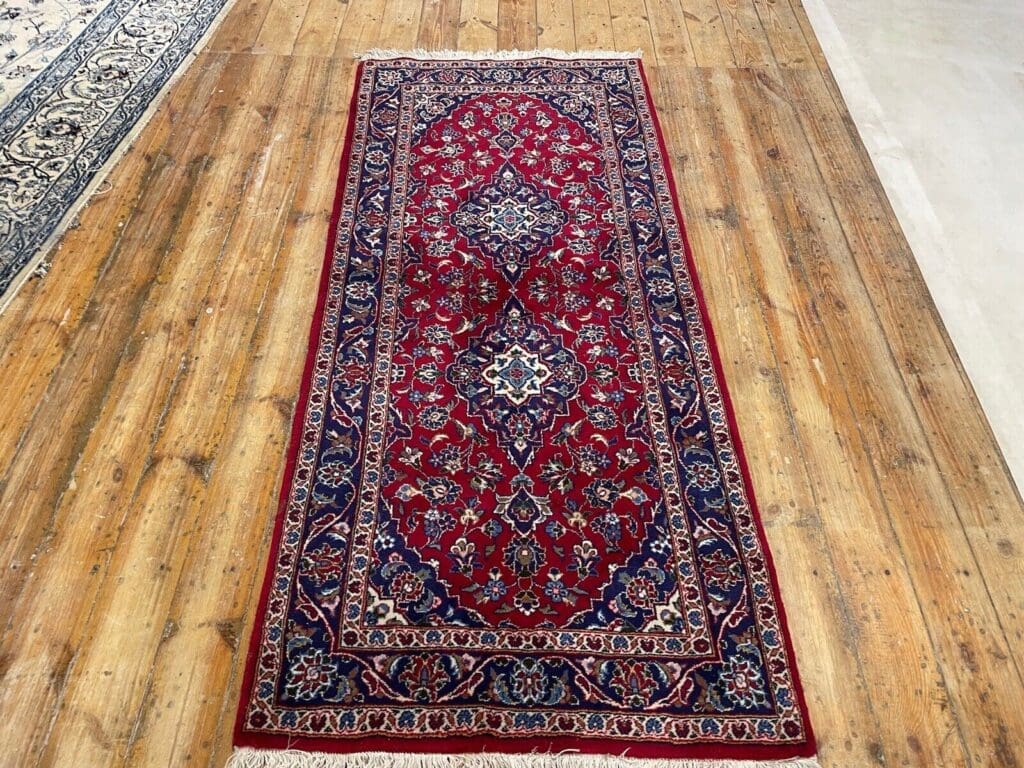
This rug has an elegant red design. The dominant red colouring creates the warm visual character described for the piece, while the design belongs to the decorative vocabulary commonly associated with Kashan. The source also describes a palette in which different shades of red are often combined with accents of gold, blue and beige. These colours can create contrast within the composition while preserving the cohesive appearance of a traditionally arranged Persian rug.
Floral motifs are typical of Kashan rugs and appear in many variations. They may be drawn as blossoms, leaves, stems or more stylised botanical forms, depending on the particular design. In Persian art, floral ornament is frequently connected with the image of a garden of paradise. This reference gives botanical pattern a cultural dimension: the garden can represent order, abundance and an idealised natural world. It is a recurring idea in Persian decorative art, including carpets.
A floral Kashan composition is generally planned rather than random. Motifs are positioned in relation to one another so that the field, borders and smaller details contribute to a balanced whole. Repetition can establish rhythm, while variations in scale and outline prevent the pattern from appearing static. The drawing may be intricate, yet the arrangement remains legible because the colour relationships and placement of the motifs are carefully coordinated.
The red ground and accompanying colour accents give this rug a warm and inviting appearance. Red is a longstanding colour in Persian carpet design and can range from deep, saturated tones to brighter shades. Gold and beige can introduce light into a composition, while blue can provide a cooler counterpoint. The use of several related shades also allows floral details and border elements to remain distinguishable without breaking the unity of the overall design.
The source describes the colours as being achieved with natural dyes. Natural dyeing is an important part of the history of oriental carpets, although the precise plants, minerals or recipes vary between regions and workshops. Traditional dyeing involves preparing the colour, applying it to the fibre and controlling the result so that the chosen palette supports the drawing. In a Kashan context, colour is not separate from design: it helps establish depth, emphasis and the relationship between field and ornament.
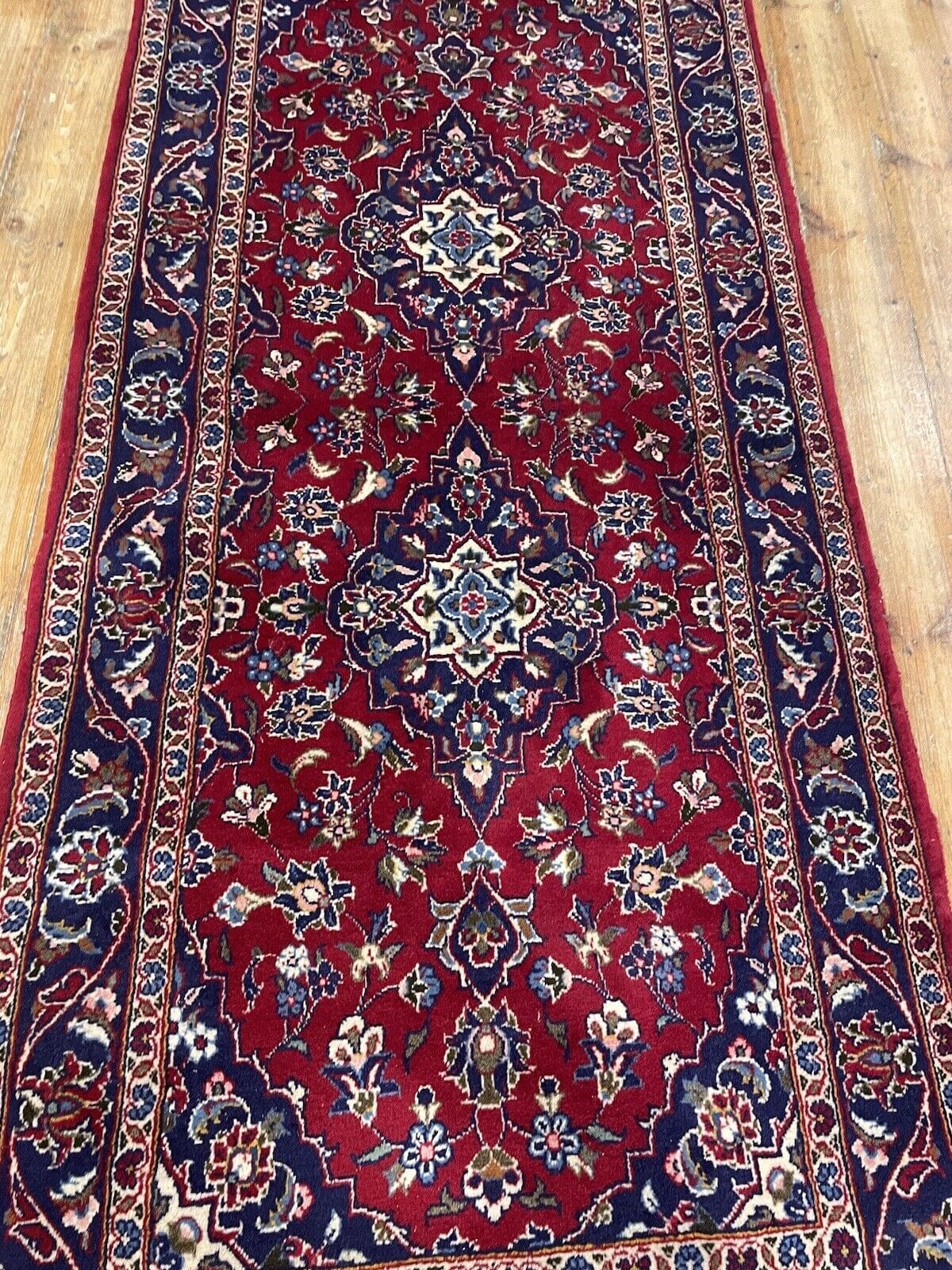
The source also connects the high knot density and careful workmanship with an impressive three-dimensional effect. A detailed pile surface can make outlines, colour transitions and floral elements appear more pronounced as light moves across the rug. This visual relief is part of the rug’s stated design character, while the dense execution is also described as increasing durability. The result is a red Kashan composition in which colour, floral ornament and hand-knotted structure work together.
Special Features
A notable feature of this rug is its suitability for use with underfloor heating. Its pile height is described as providing a comfortable feel underfoot while allowing warmth to be distributed evenly without damaging the rug. This makes the piece relevant to modern living spaces in which a traditional hand-knotted Persian rug is used alongside contemporary heating systems.
The rug is also presented as suitable for both classic and modern interiors. Its red colouring, floral design and Persian origin can make it a defined element within a room, while the established Kashan design vocabulary allows it to be combined with different furnishings and colour schemes. It may be used as a central visual feature or placed in coordination with other elements of the interior.
Care supports the long-term use of a wool rug. Regular vacuuming helps remove dust and loose dirt. If a soiled area needs attention, the care guidance recommends a damp sponge with mild soap. Aggressive chemicals should be avoided, and the rug should be dried thoroughly after treatment to help prevent mould. Stains are best addressed promptly rather than left untreated.
FAQ
How should I clean my Kashan Persian rug?
Vacuum the rug regularly to remove dust and dirt. For soiled areas, use a damp sponge with mild soap. Do not use aggressive chemicals. After cleaning, dry the rug thoroughly so that moisture does not remain and create a risk of mould. Prompt treatment of stains and regular cleaning help preserve the rug’s wool surface and its appearance over time.
Where is the Kashan rug best used?
The rug is suitable for living rooms, dining areas and bedrooms. Its elegant red design and warm colour character can be coordinated with a range of interior styles. It can serve as a central element in a room or be positioned together with furnishings and colours that create a harmonious overall arrangement. Its suitability for underfloor heating also makes it appropriate for modern living spaces with that heating system.
Is the Kashan rug easy to maintain?
The Kashan rug is described as relatively easy to maintain when it is cleaned regularly and stains are treated immediately. Vacuuming removes everyday dust and dirt, while mild soap and a damp sponge can be used for soiled areas. Aggressive chemicals should be avoided and the rug should be dried well after cleaning. Its wool material and careful hand-knotted workmanship also contribute to its robust character.
To provide the best experiences, we use technologies like cookies to store and/or access device information. Consenting to these technologies will allow us to process data such as browsing behavior or unique IDs on this site. Not consenting or withdrawing consent, may adversely affect certain features and functions.
Functional Always active
The technical storage or access is strictly necessary for the legitimate purpose of enabling the use of a specific service explicitly requested by the subscriber or user, or for the sole purpose of carrying out the transmission of a communication over an electronic communications network.
Preferences
The technical storage or access is necessary for the legitimate purpose of storing preferences that are not requested by the subscriber or user.
Statistics
The technical storage or access that is used exclusively for statistical purposes.The technical storage or access that is used exclusively for anonymous statistical purposes. Without a subpoena, voluntary compliance on the part of your Internet Service Provider, or additional records from a third party, information stored or retrieved for this purpose alone cannot usually be used to identify you.
Marketing
The technical storage or access is required to create user profiles to send advertising, or to track the user on a website or across several websites for similar marketing purposes.

 SECURE PAYMENT
 SHIPPING PARTNERS