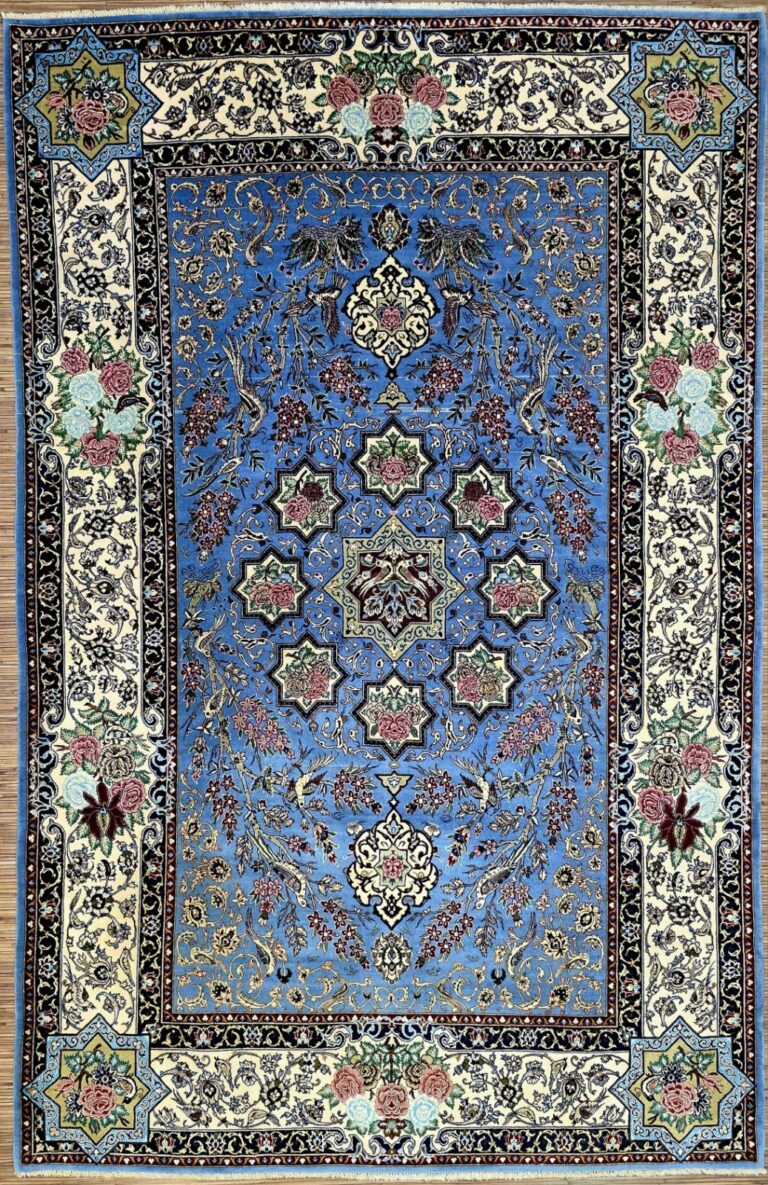
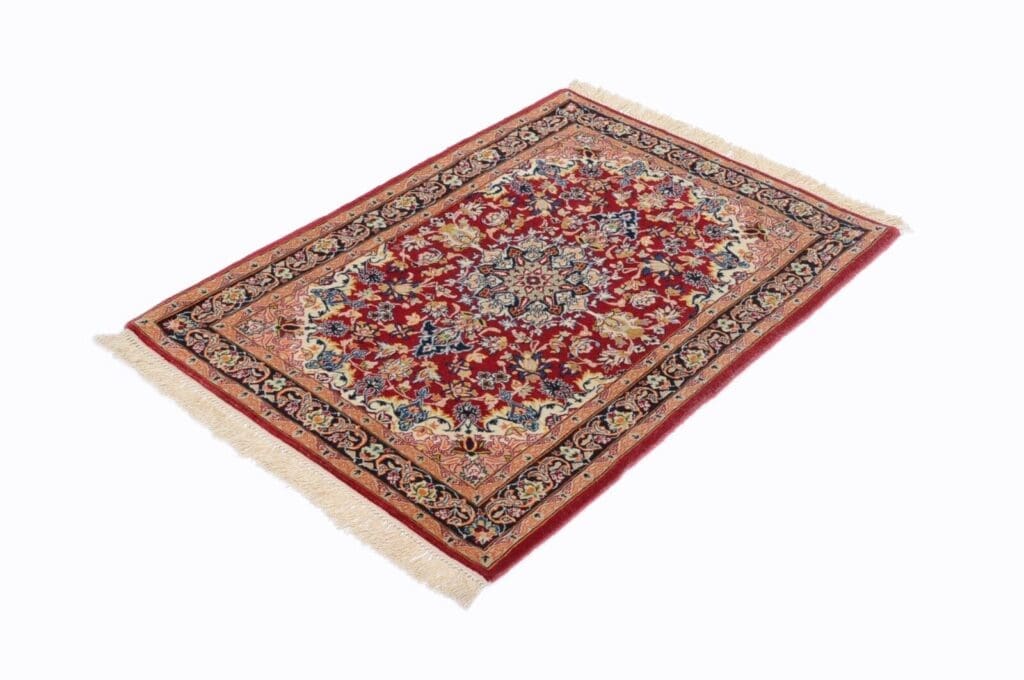
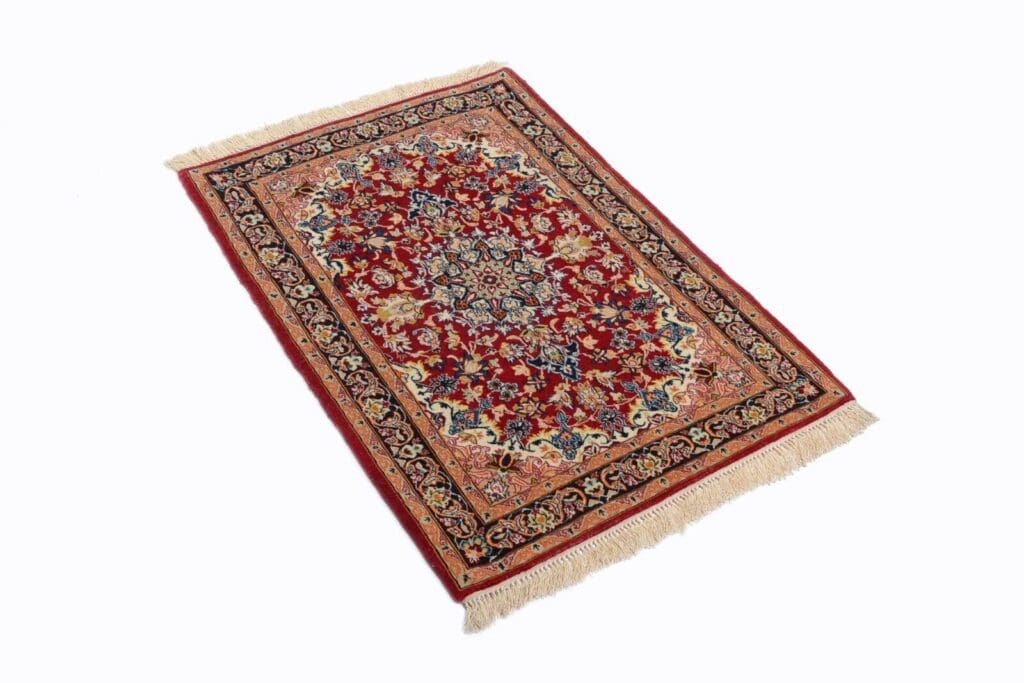
This hand-knotted Persian rug has a pile made from 95% virgin wool and 5% silk. The two fibres contribute different textile qualities. Virgin wool is valued in rug making for its resilience, substantial handle and ability to absorb colour evenly. Its natural structure gives the pile body and helps maintain the definition of drawn ornaments. Wool has therefore been used for generations in rugs intended to provide both a practical surface and a carefully worked decorative field.
Silk has a finer and smoother fibre structure. In hand-knotted rugs, it can be used to distinguish narrow outlines, small details and subtle changes in surface texture. Its restrained sheen changes with the direction of light and may give fine areas greater visual depth. In this rug, silk forms part of the pile, while the stated composition remains predominantly virgin wool. The material information describes the actual fibre combination and does not identify a particular pattern.
Hand knotting is a gradual process in which individual knots are tied around the warp. Rows are built one after another until the textile surface is complete. The pile is then trimmed and the surface is brought into an even form through further finishing work. Depending on the workshop tradition, processes can include alignment, washing, stretching and final inspection. The maker must keep the tension, row structure, colour sequence and outline of the design consistent throughout the work.
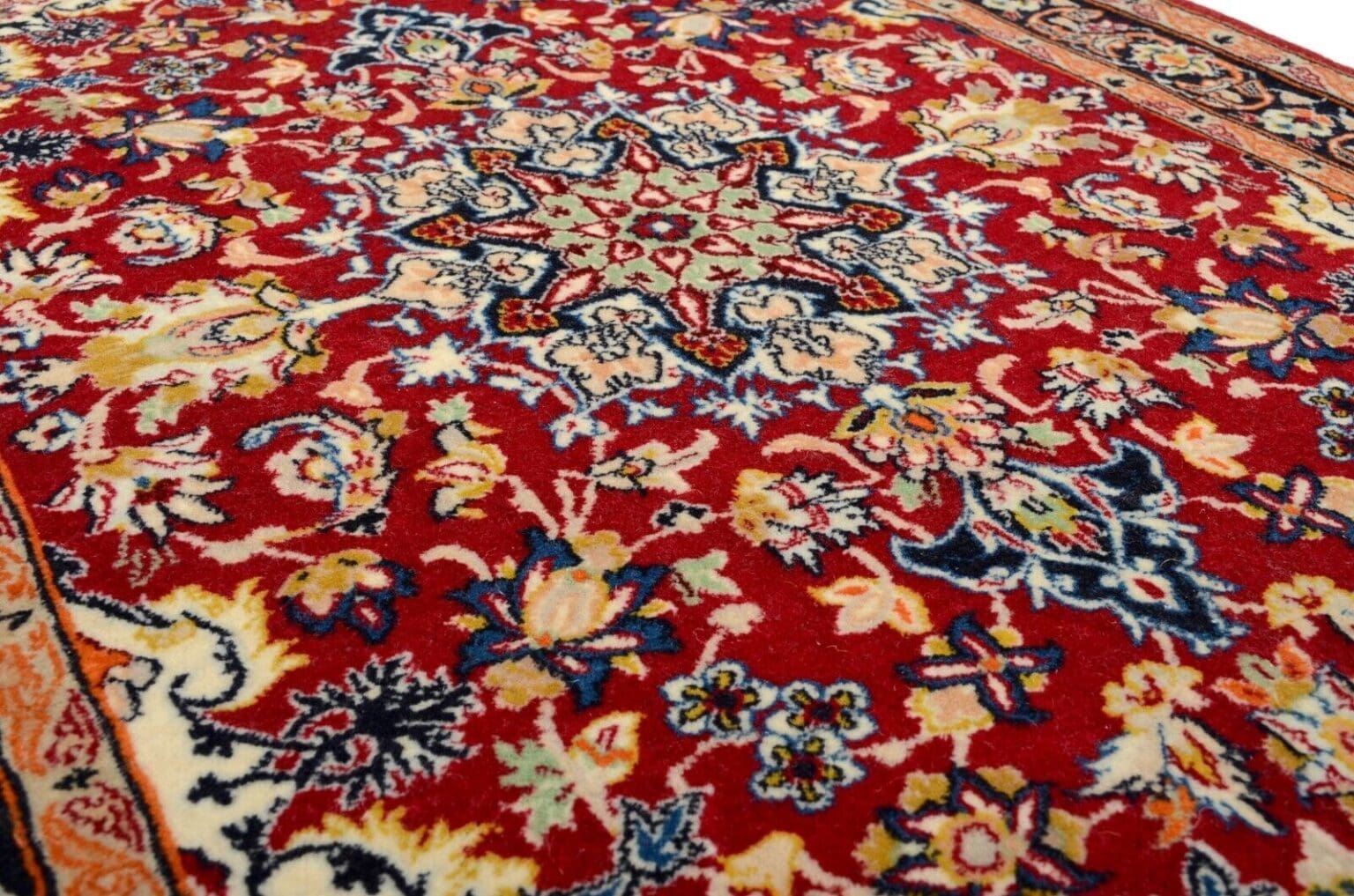
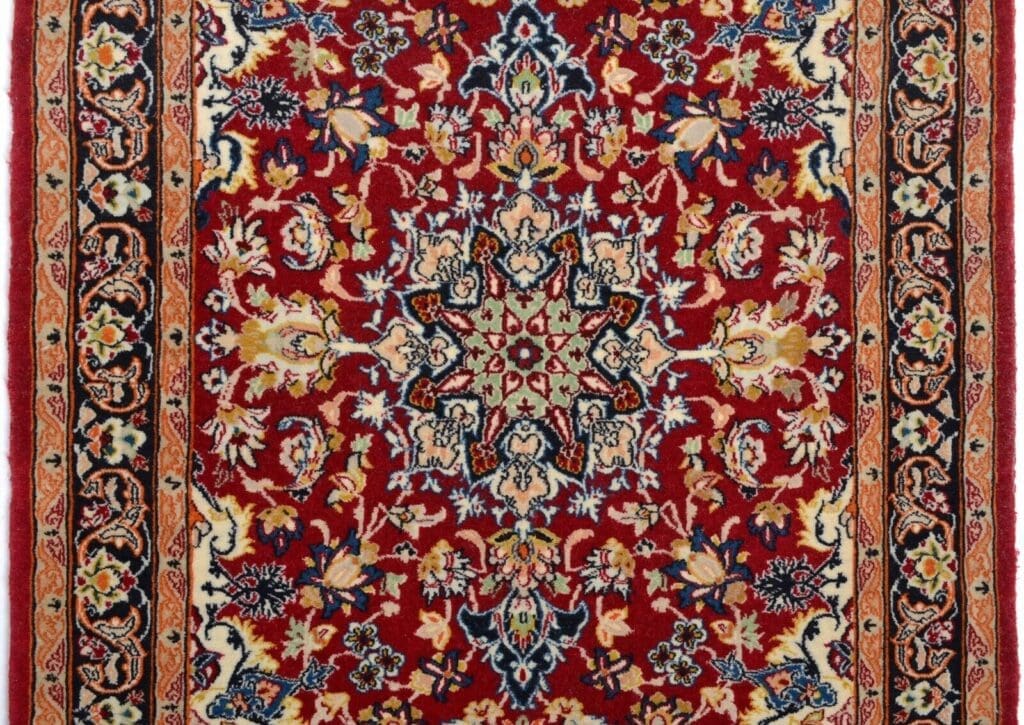
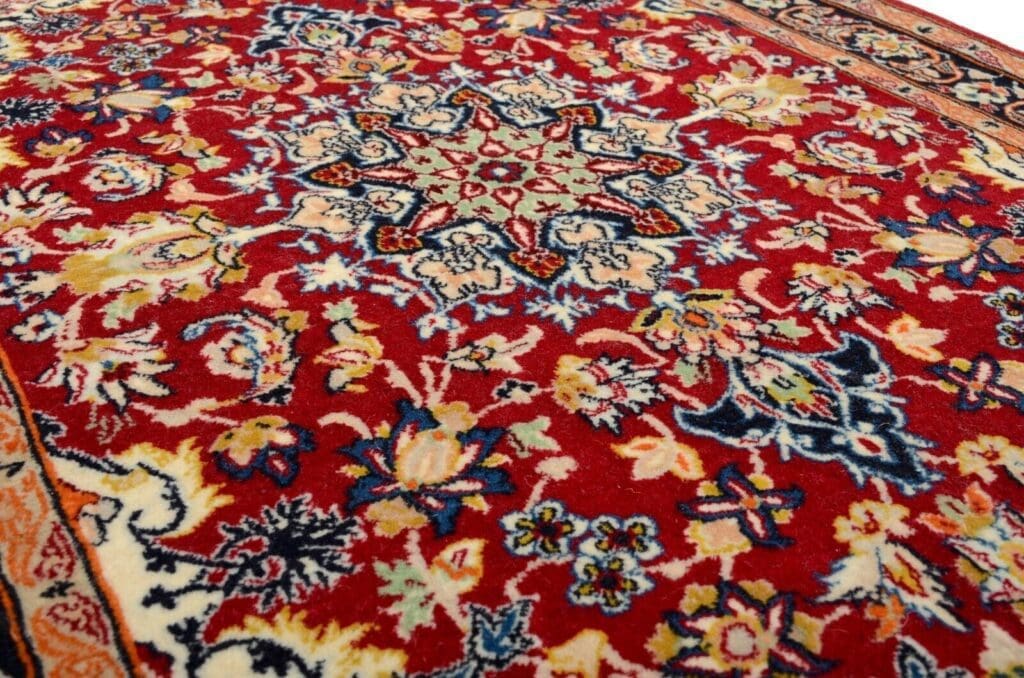
The rug has a knot density of 850,000 knots per square metre. A dense construction generally allows small forms, close lines and carefully graded colour changes to be rendered with precision. Knot density alone does not create a design, however. The result also depends on the pattern plan, fibre quality, colour selection and the execution of the person doing the knotting. The stated pile height is 8 mm. Wool and silk should be cleaned gently so that the pile and its surface qualities are protected.
Origin and Tradition
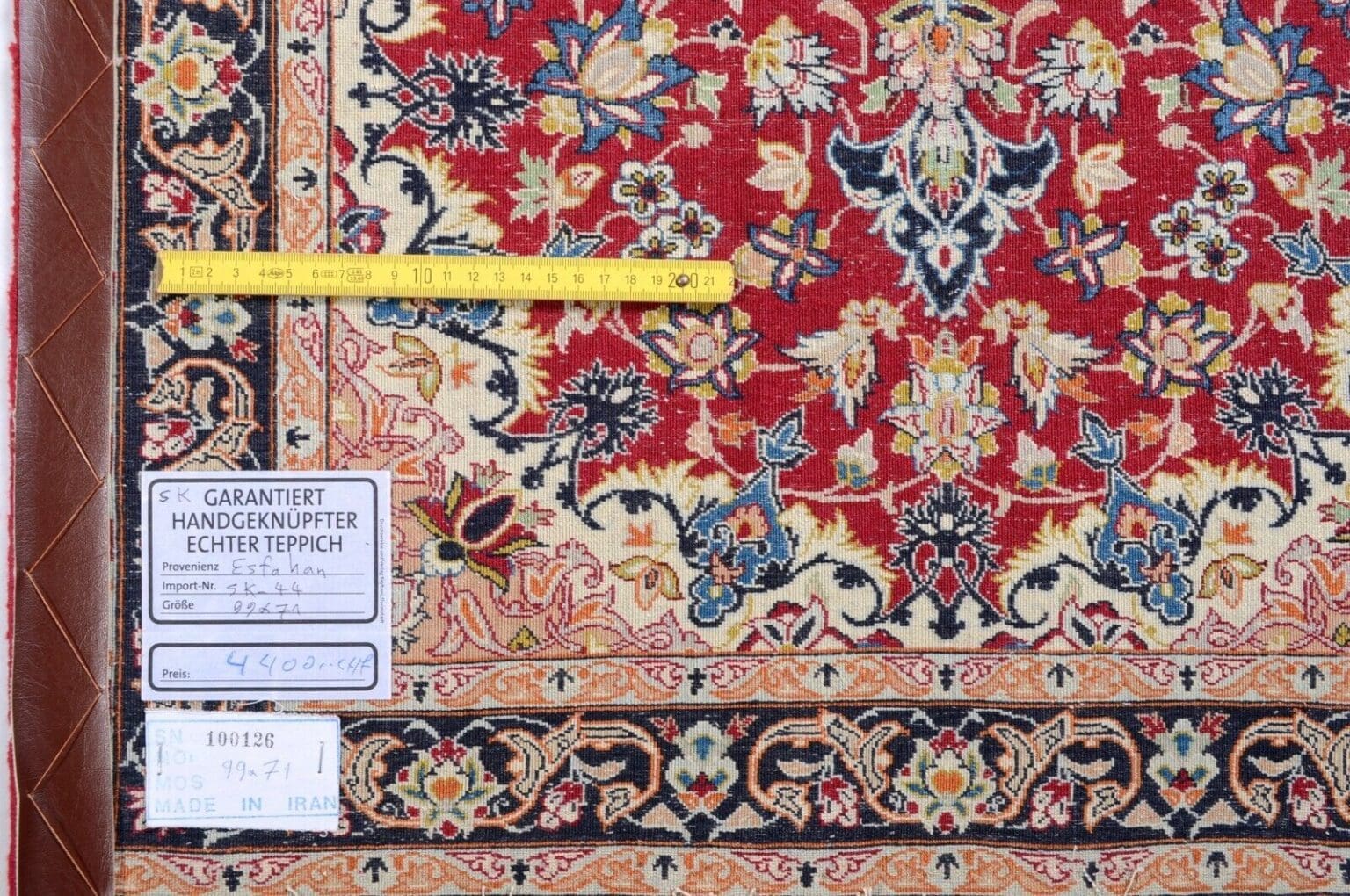
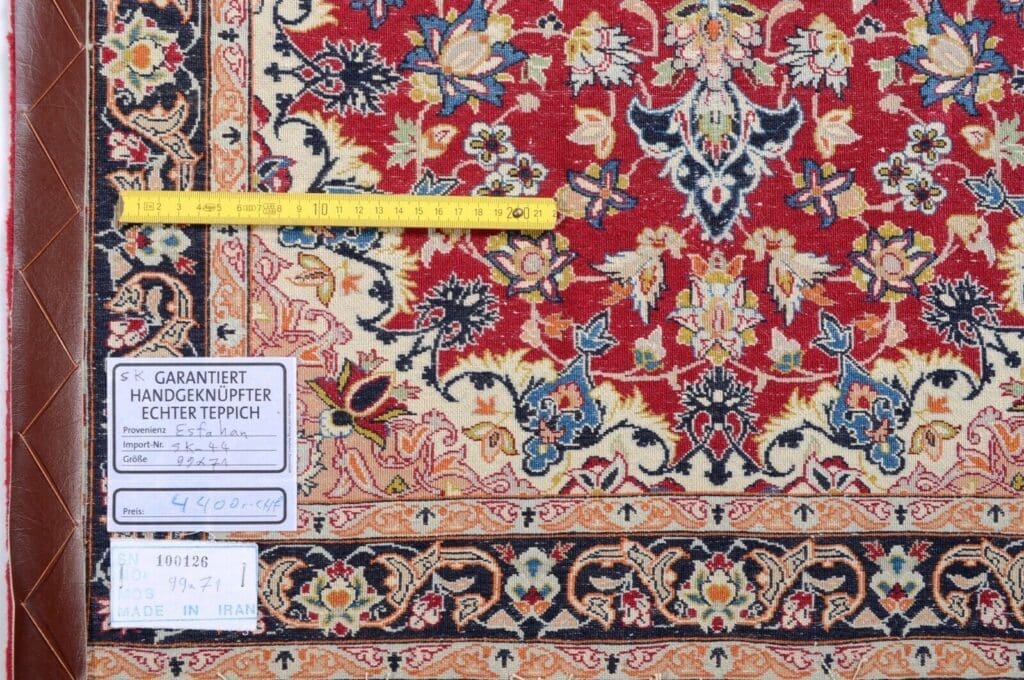
This is described as a Persian rug from Isfahan, with its origin given as Persia or Iran. Isfahan is one of the established centres of Iranian carpet making. Situated in central Iran, the city developed a strong culture of architecture, decorative arts and specialist workshops. Its rug tradition is associated with carefully organised compositions, fine drawing and close attention to detail. The place name therefore identifies a regional context within Persian weaving rather than merely indicating a general oriental appearance.
Iranian carpet making has a long history. Rugs have served as floor coverings, seating textiles, wall hangings and elements of interior furnishing. They could also express a workshop’s skill, a household’s status or the traditions of a particular region. Knowledge of knotting, pattern preparation, colour use and finishing was often passed from one generation to the next. This continuity allowed established forms to remain recognisable while individual workshops and makers developed their own interpretations.
Iran contains many important rug-producing areas. Isfahan, Täbriz and Nain are among the places associated with Persian carpet culture, although each region developed distinctive preferences in composition, drawing, colour and construction. The origin given for this rug is Isfahan. That reference should not be confused with a pattern name or with a broad stylistic label. It places the piece within the Iranian tradition connected with that city.
Isfahan workshops commonly worked from planned compositions. A design plan may establish the relationship between the central field, medallion, side ornaments and surrounding borders. During knotting, the plan is translated into textile form one knot at a time. The maker must follow the arrangement while maintaining proportion, tension and colour sequence. When a design contains very small motifs or narrow curves, a dense knot structure can support a more exact rendering of those elements.
The making of a Persian rug combines design knowledge with practical textile skill. The warp provides the longitudinal foundation, the knots build the pile and the weft helps secure successive rows. Finishing work reveals the drawing and gives the surface its final character. Each stage affects the appearance of the completed rug. This is why regional rug traditions are defined not only by ornament but also by the methods used to prepare, knot and finish the textile.
Isfahan’s tradition is part of a wider Iranian history in which decorative order and detailed craftsmanship often work together. A floral arrangement may be set within a measured border; a central structure may be balanced by repeated motifs at the sides; and changes in colour may distinguish the field from its frame. These are general features of the regional background. They do not add an unrecorded motif to this particular rug, whose documented style is traditional Persian/oriental.
Design and Pattern
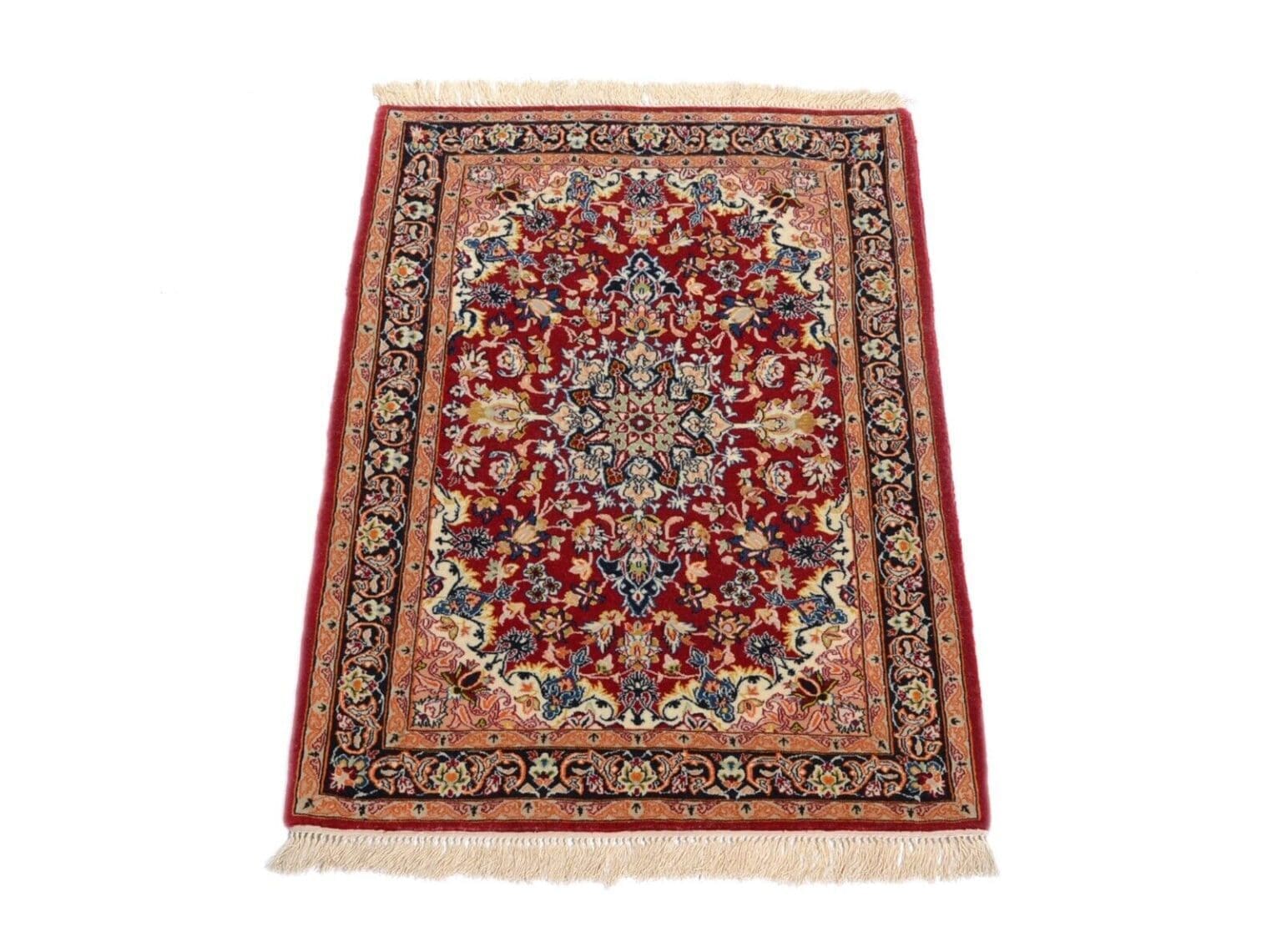
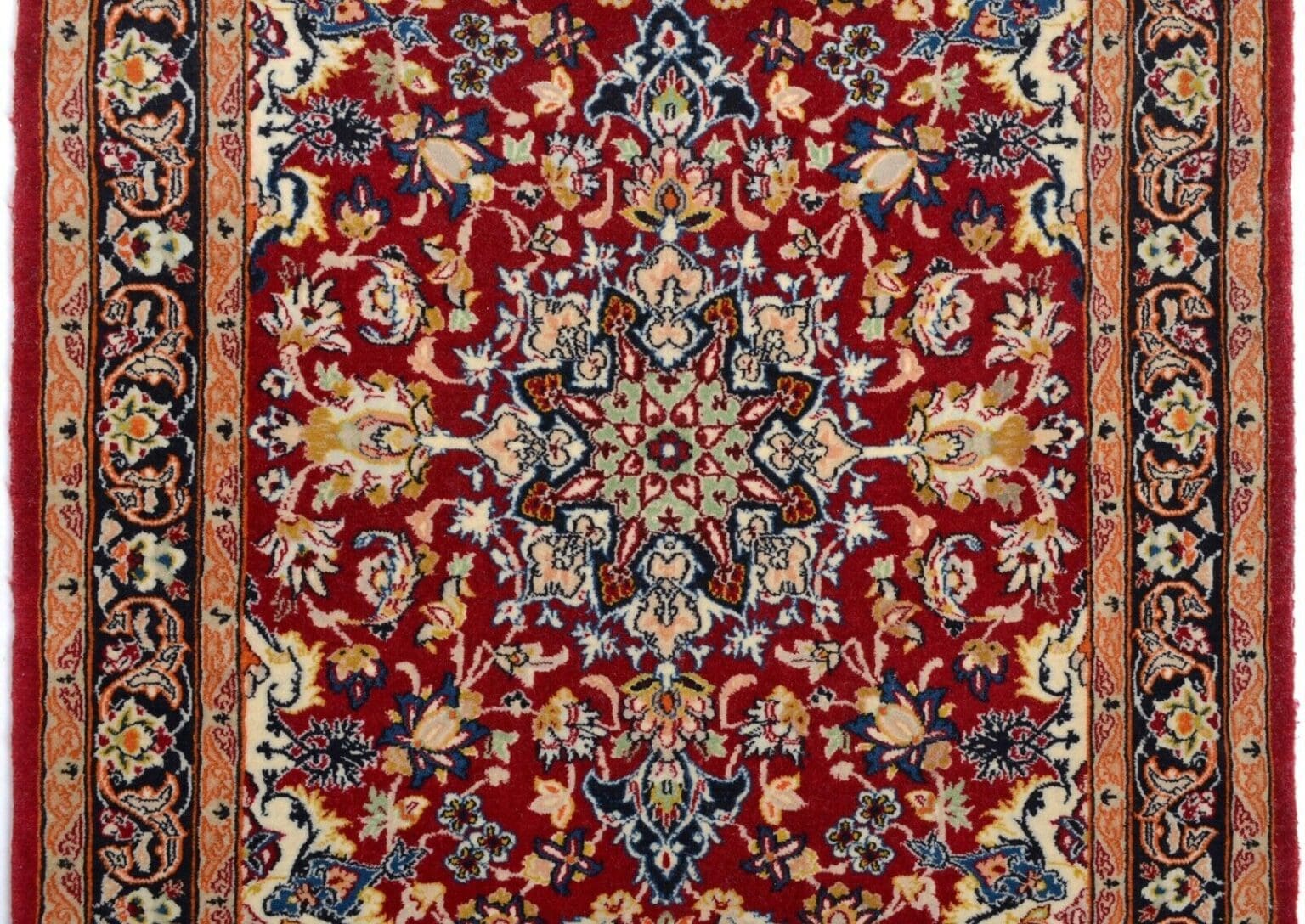
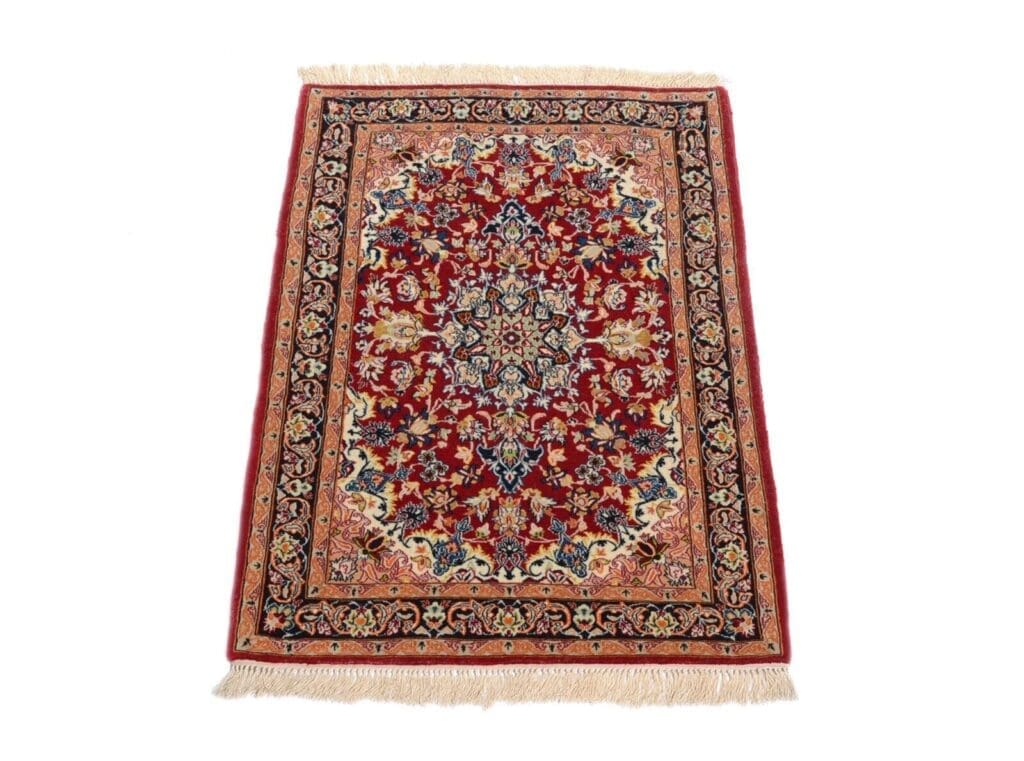
The rug is classified as traditional Persian and oriental in style. This is a broad stylistic description rather than the name of a specific pattern family. Persian rugs may feature a central medallion, a continuously scrolling floral field, a symmetrical arrangement, a geometric composition or a combination of several structural ideas. The general style statement does not establish which of these arrangements appears on this individual piece. It does establish its place within the traditional Persian/oriental design sphere.
Floral drawing is one of the familiar visual languages of Persian rugs. Flowers, leaves, vines and arabesques can be linked into a rhythmic movement across the field. Some compositions concentrate the ornament around a centre, while others distribute it more evenly. Geometric designs rely more heavily on angles, repetition, axes and clearly defined divisions. Both flowing and structured approaches belong to Persian carpet history, and many designs balance curved botanical lines with orderly borders.
A classical rug layout often uses a main field surrounded by one or more borders. The field carries the principal composition, while the borders frame it and create a controlled transition towards the outer edge. A medallion can give the centre particular emphasis. An all-over design spreads the visual activity more evenly across the surface. Secondary borders may reinforce the division between the central area and the edge. These principles explain the construction of many Persian compositions without specifying the exact drawing of this rug.
The high knot density is technically relevant to the rendering of pattern. When many knots are placed within a limited area, fine lines can be positioned close together and small ornaments can be separated more clearly. Gradual colour changes may also be organised with greater control. Density is not the same as design: it describes the construction, while the pattern describes the visible arrangement of forms. The appearance results from the interaction of the design plan, the chosen colours, the wool and silk pile, the knotting and the final finishing.
Persian ornament is often interpreted through ideas of nature, gardens, balance and ordered space. Plant forms may recall cultivated landscapes, while symmetry and repeated units can create a sense of continuity. These associations belong to the cultural background of Persian design. They should not be presented as a claim about a particular symbol unless that symbol is identified in the rug’s description. For this piece, the accurate pattern statement remains the supplied classification as traditional Persian/oriental.
The relationship between movement and order is a recurring principle in Persian carpet aesthetics. Curving stems can be framed by straight borders, and small floral elements can be arranged within a measured field. Colour distribution may emphasise a centre, separate one border from another or clarify the relationship between ornament and ground. The final visual effect is shaped by all of these decisions as well as by the density and precision of the knotting. General design history explains the tradition without adding an unsupported motif, palette or symbolic reading.
Special Features
The rug is in very good condition and is unused. Its documented features include hand knotting, a pile made from 95% virgin wool and 5% silk, a knot density of 850,000 knots per square metre and a pile height of 8 mm. It is suitable for use with underfloor heating. This makes the rug compatible with a contemporary interior where a textile floor covering is placed above an existing heated floor system.
The material balance combines the practical qualities of a predominantly wool pile with the finer surface effect associated with silk. The very good, unused condition describes the preservation of this one-off piece. Gentle maintenance is appropriate for continued use: loose dirt should be removed carefully, moisture should not be allowed to remain in the pile and unsuitable cleaning agents should be avoided. These precautions are particularly relevant when more than one fibre is present in the pile.
FAQ
What is the best way to clean this Persian rug?
Vacuum the rug regularly with a gentle setting to remove loose dust without putting unnecessary strain on the pile. If a spill occurs, blot it promptly with a clean absorbent cloth instead of rubbing the area. Avoid soaking the rug and do not use harsh household cleaners, since virgin wool and silk can react differently to moisture and chemicals. For a complete cleaning, a specialist who works with hand-knotted rugs is recommended. A professional can take the fibres, colours, construction and condition into account when selecting an appropriate method.
Why does a Persian rug involve so much craftsmanship?
A hand-knotted Persian rug is made by placing individual knots rather than by quickly producing a uniform machine-made surface. With a knot density of 850,000 knots per square metre, a very large number of knots must be aligned with consistent spacing and tension. The work also involves preparing the design, selecting and balancing colours, transferring outlines row by row, trimming the pile and checking the finished textile. Virgin wool and silk have different handling characteristics, so their combination requires material awareness as well as patience. Time, fibre quality and manual precision together account for the craft involved.
How long can a Persian rug last?
Longevity depends on use, location, cleaning and general care. Virgin wool is known for resilience and suitability for textile floor coverings, while silk is finer and calls for gentler handling. Even use, protection from prolonged direct sunlight and a suitable underlay can help reduce stress on the textile. Since this rug is unused and in very good condition, its future use does not begin with wear from an earlier setting. With appropriate care, a hand-knotted rug can remain part of an interior for a long time.
To provide the best experiences, we use technologies like cookies to store and/or access device information. Consenting to these technologies will allow us to process data such as browsing behavior or unique IDs on this site. Not consenting or withdrawing consent, may adversely affect certain features and functions.
Functional Always active
The technical storage or access is strictly necessary for the legitimate purpose of enabling the use of a specific service explicitly requested by the subscriber or user, or for the sole purpose of carrying out the transmission of a communication over an electronic communications network.
Preferences
The technical storage or access is necessary for the legitimate purpose of storing preferences that are not requested by the subscriber or user.
Statistics
The technical storage or access that is used exclusively for statistical purposes.The technical storage or access that is used exclusively for anonymous statistical purposes. Without a subpoena, voluntary compliance on the part of your Internet Service Provider, or additional records from a third party, information stored or retrieved for this purpose alone cannot usually be used to identify you.
Marketing
The technical storage or access is required to create user profiles to send advertising, or to track the user on a website or across several websites for similar marketing purposes.

 SECURE PAYMENT
 SHIPPING PARTNERS