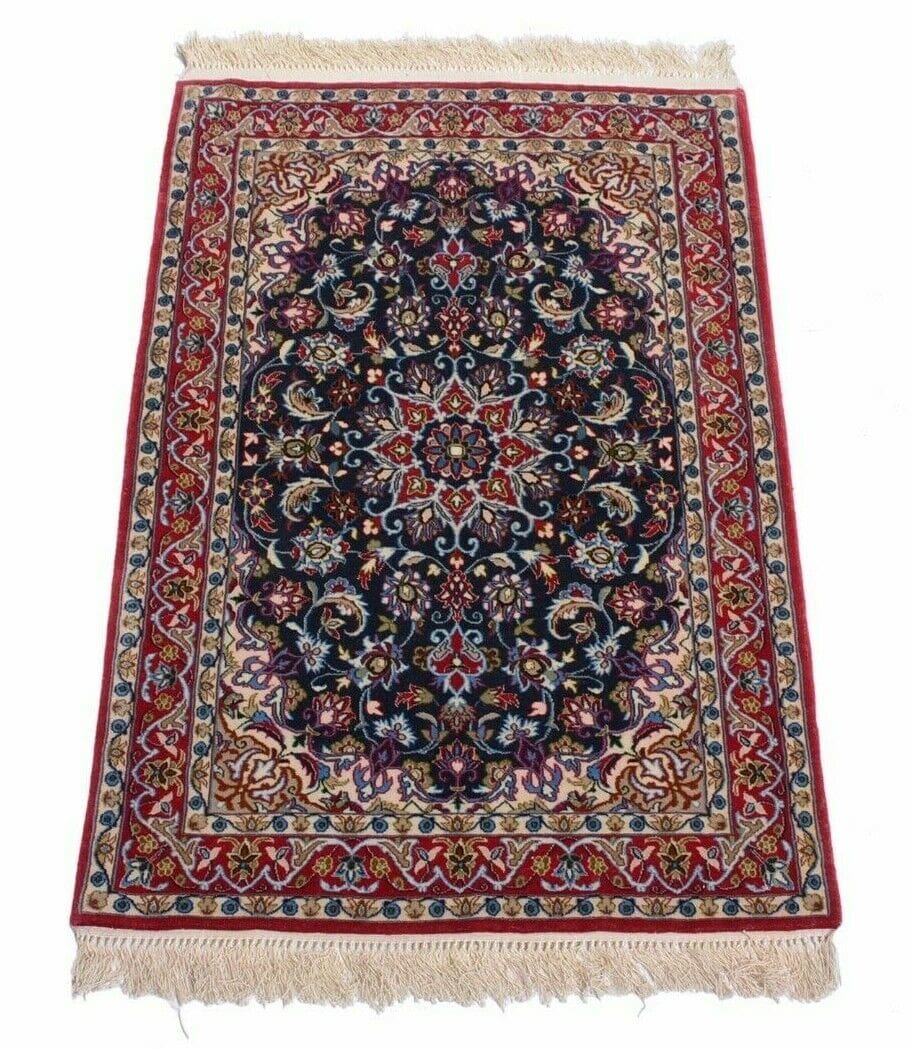
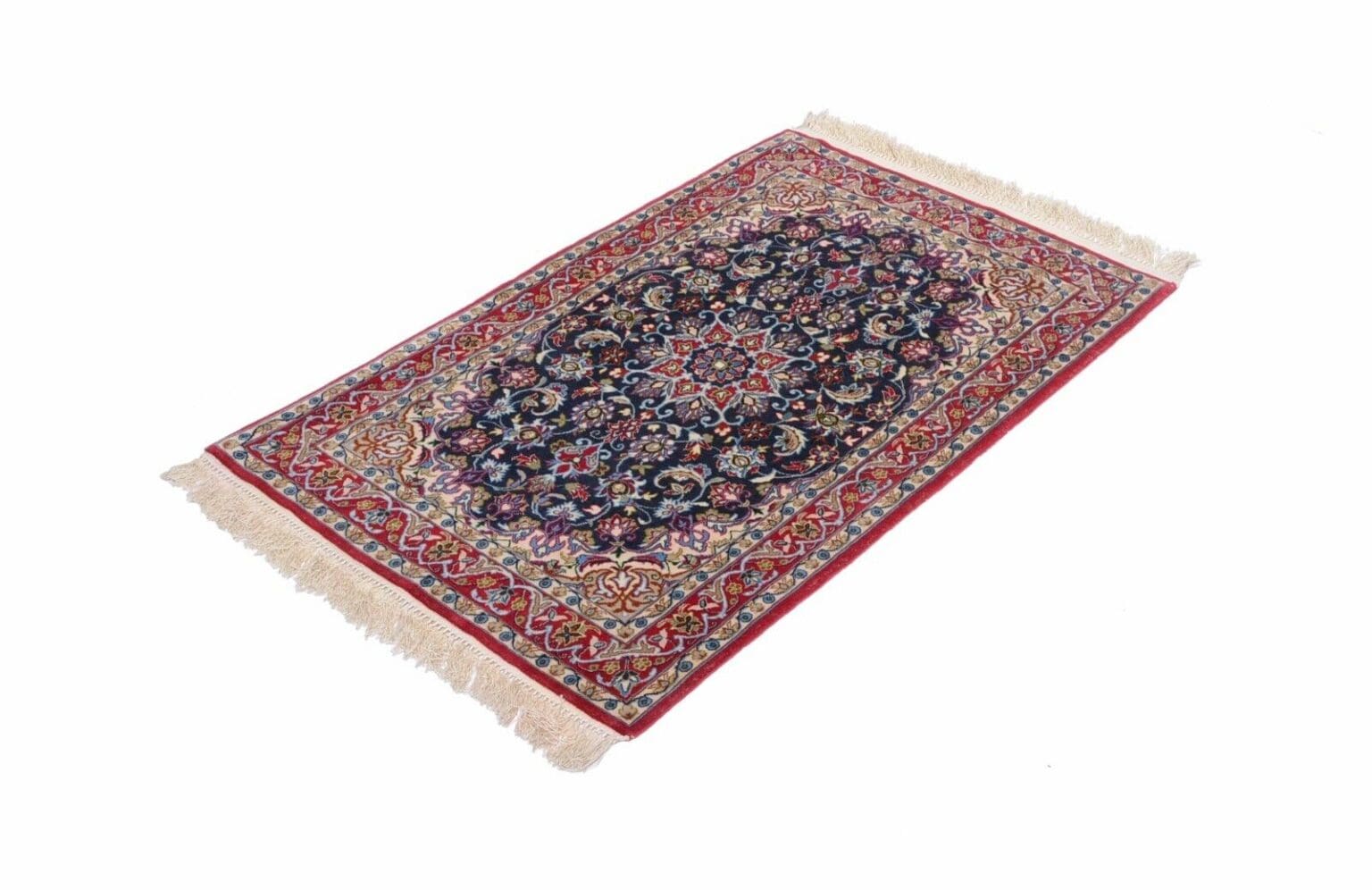
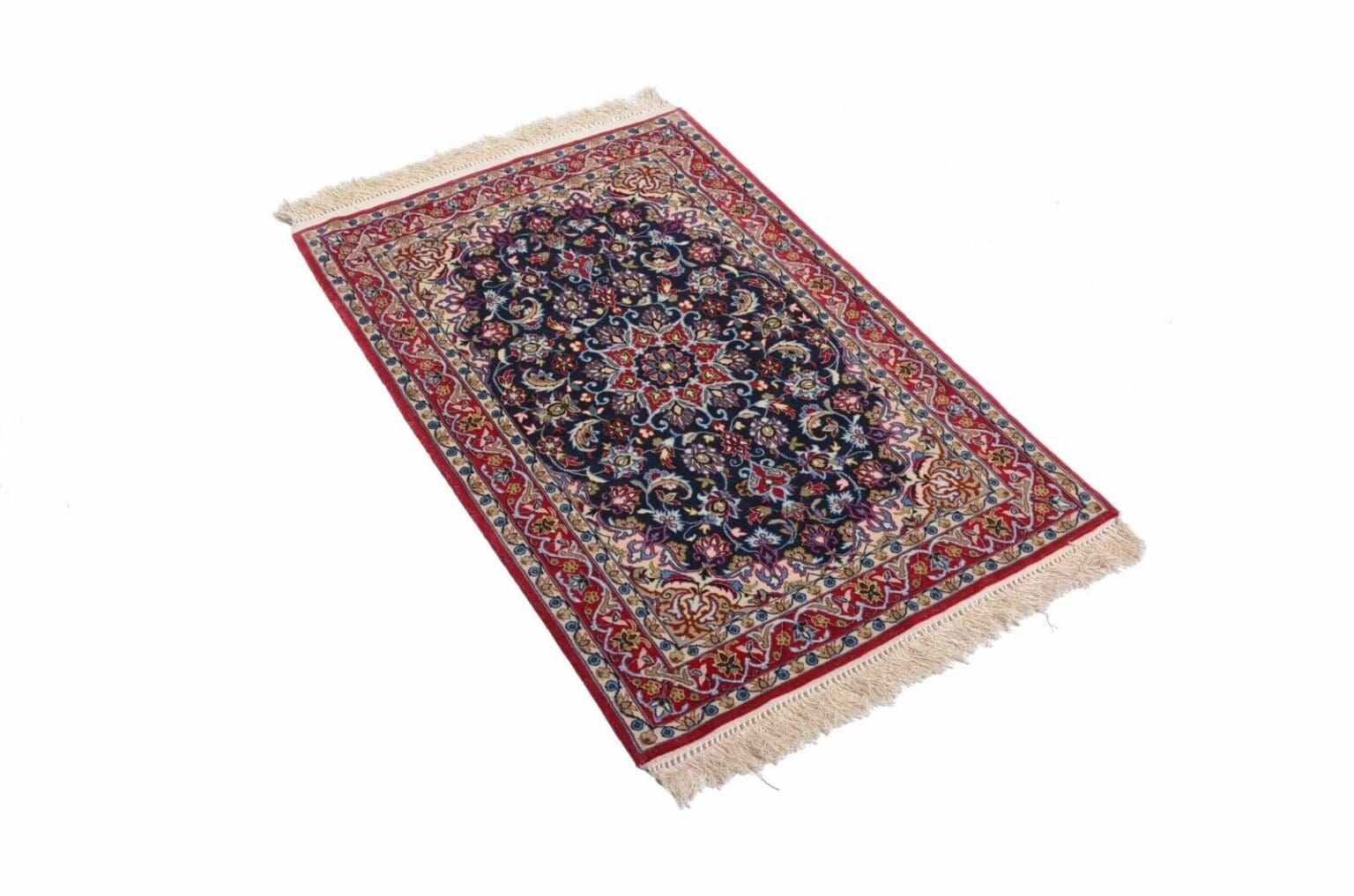
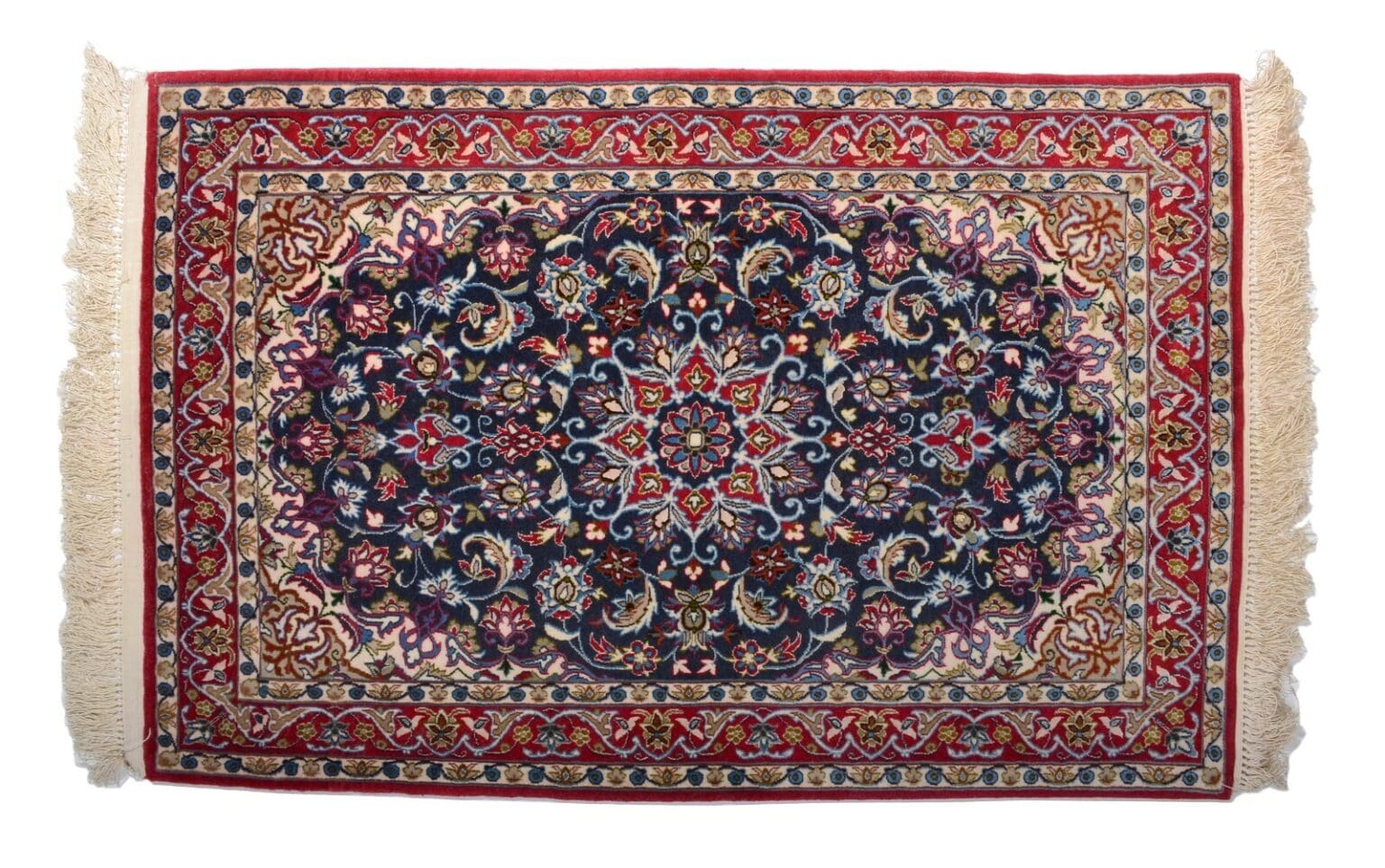
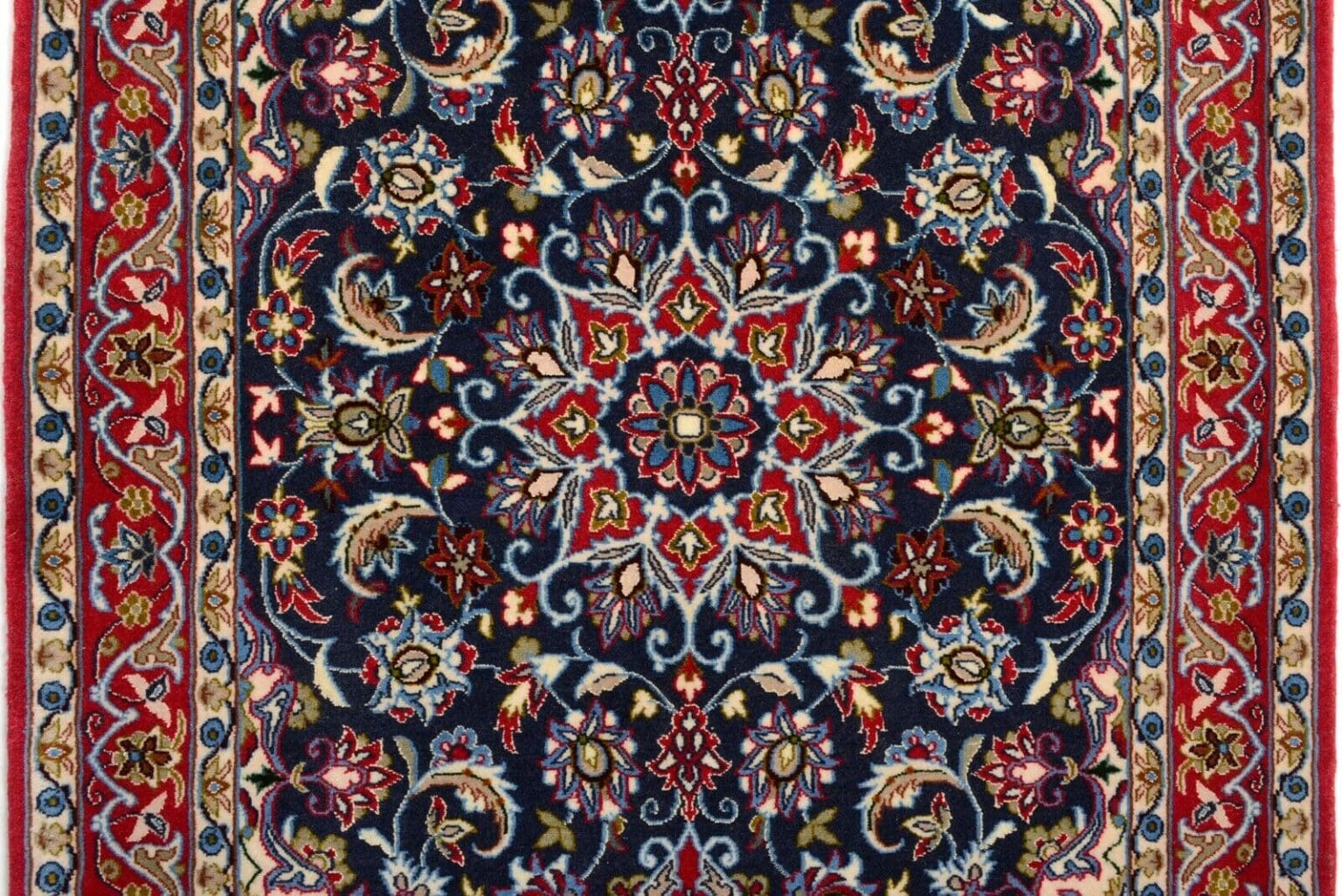
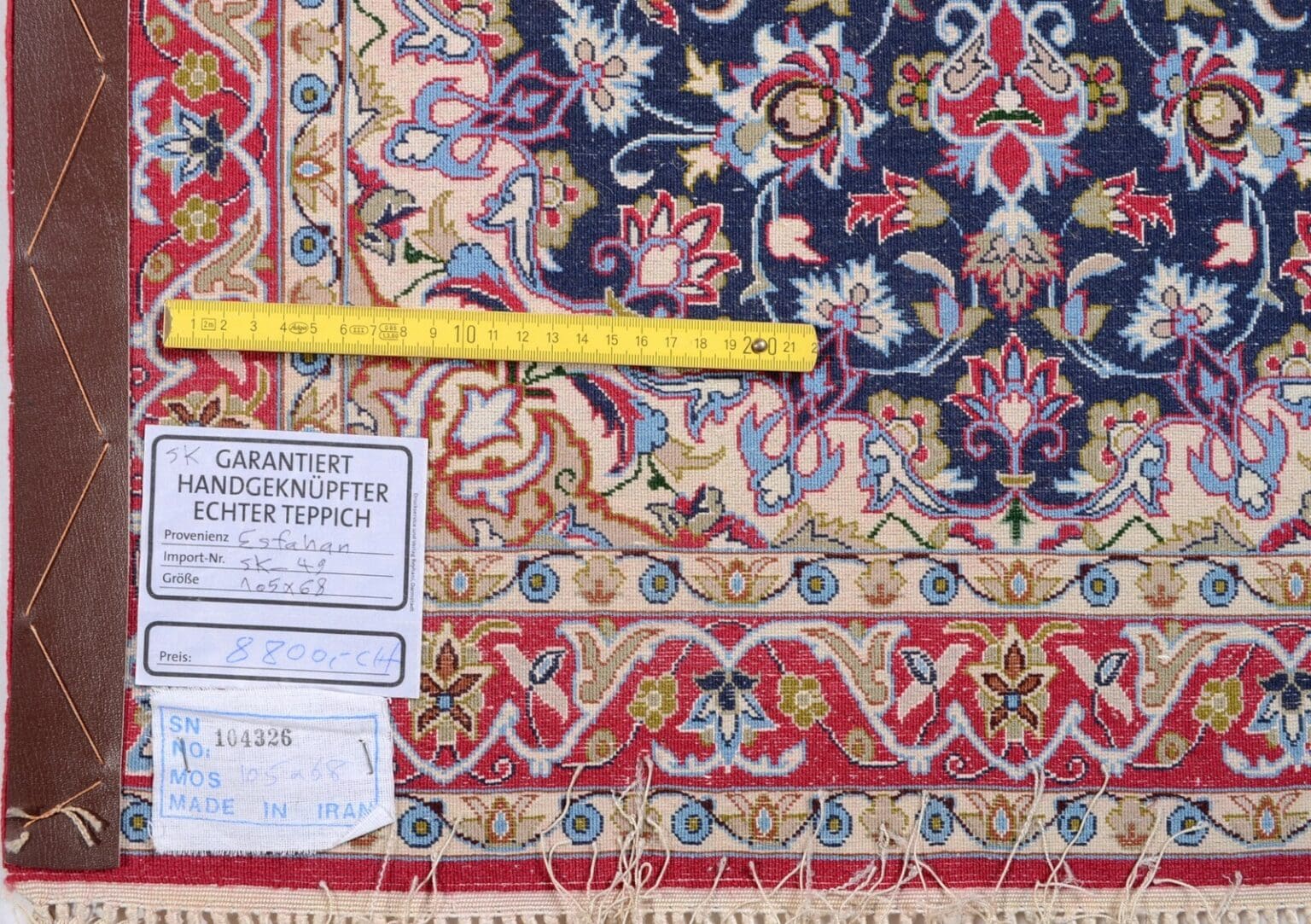

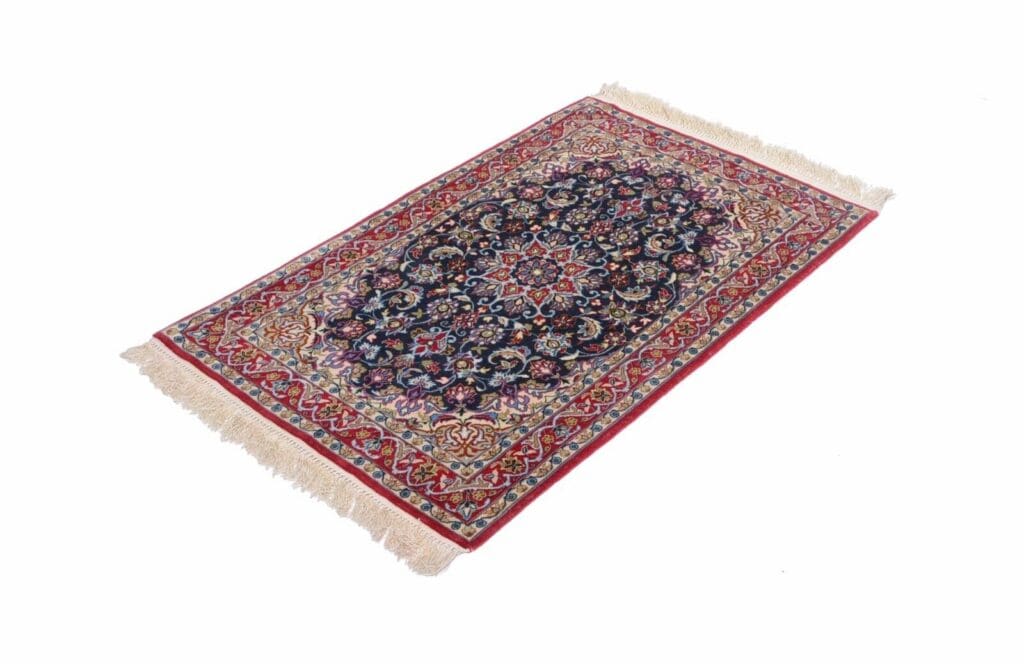
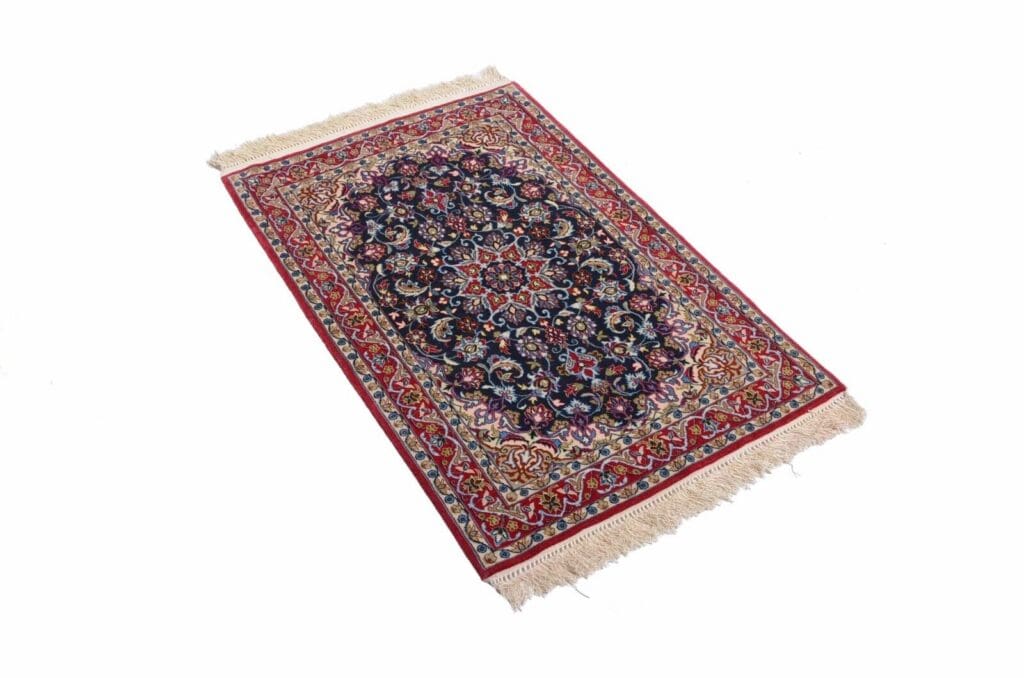
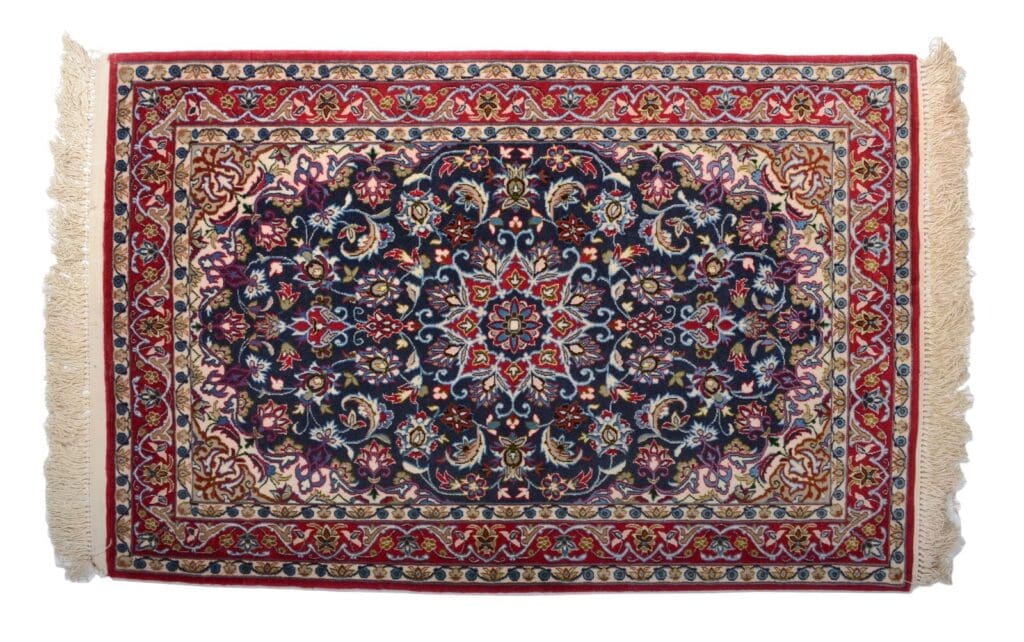
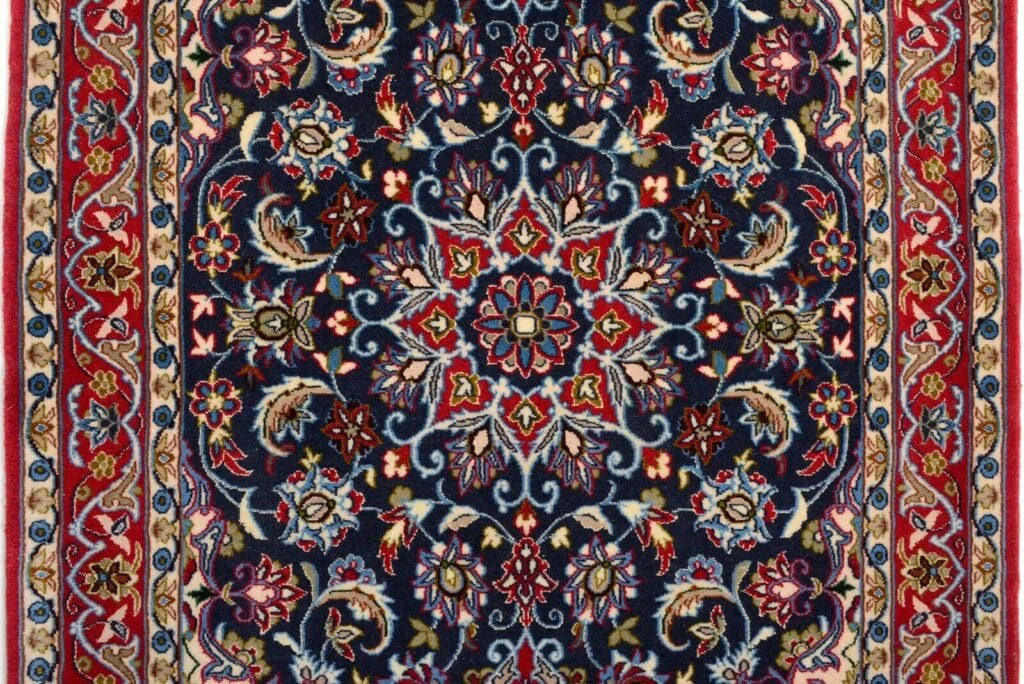
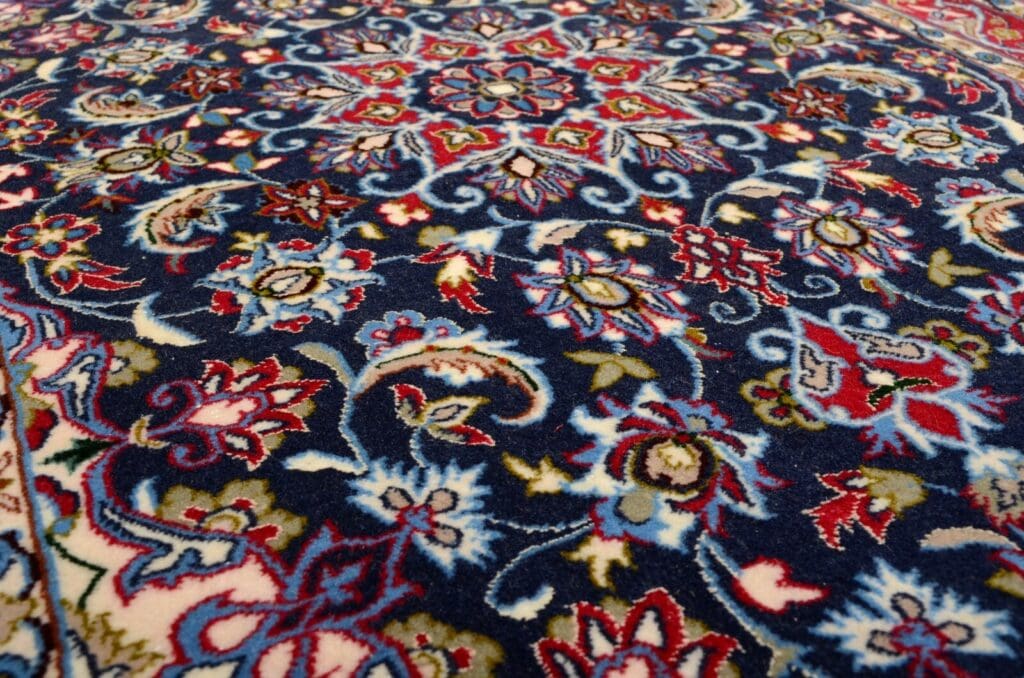
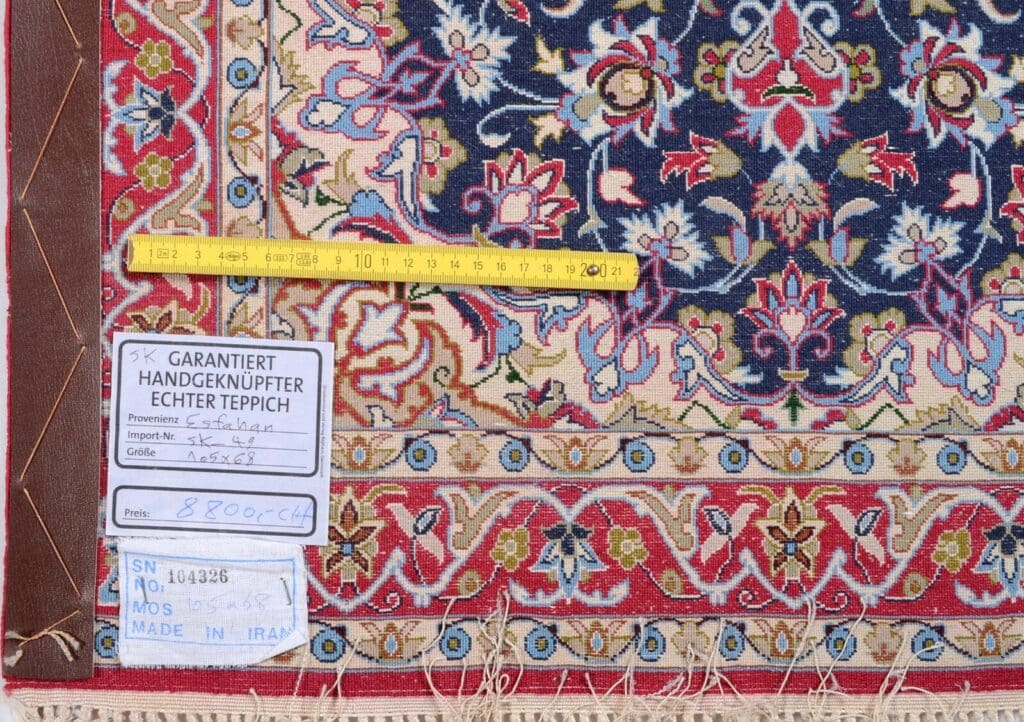
Persian Rug Isfahan 105 x 68 cm Wool Hand-knotted
€ 1406
Hand-knotted Isfahan Persian Rug | Knot density: 850,000 knots/m² | Material: pile 95% virgin wool, 5% silk, warp 100% silk | Size: 105 x 68 cm | Pattern: Oriental | Condition: very good
1 available
- ✓Free Shipping in EU
- ✓2-5 Business Days Delivery
- ✓14-Day Return Policy
- ✓Worldwide Shipping on request
 SECURE PAYMENT
 SHIPPING PARTNERS
Inventory number: E6BF5FA6
Description
Isfahan Persian Rug
Material and Craftsmanship
This hand-knotted Isfahan Persian rug has a pile made of 95% virgin wool and 5% silk. Its warp is 100% silk. The material combination therefore places a wool pile at the centre of the construction, with silk contributing to the pile and forming the entire warp foundation. Wool has long been used in rug making for its resilient structure, comfortable handle and ability to form a durable pile. Silk allows fine work in the pile and provides a smooth foundation for precise knotting.
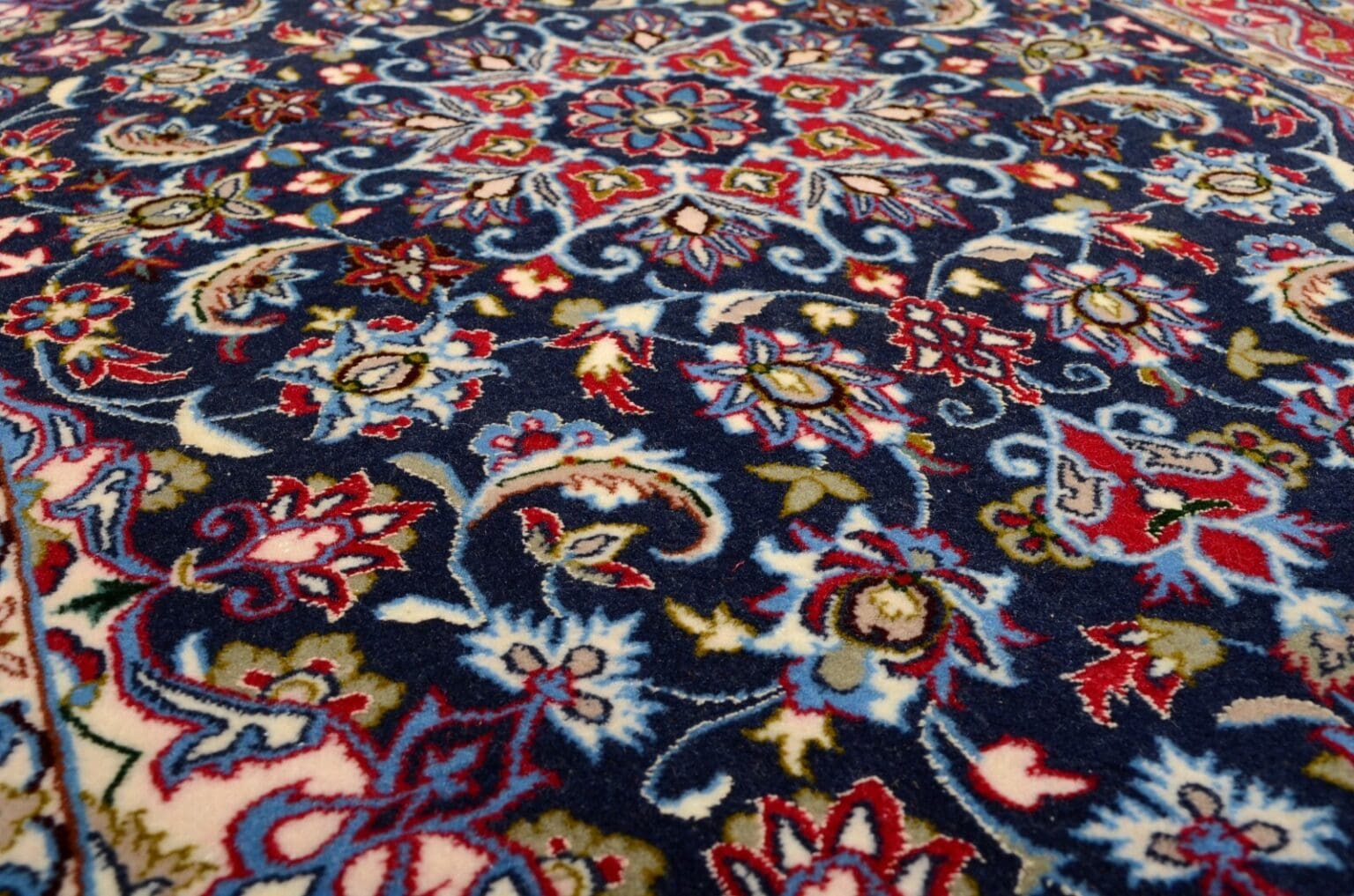
The rug is hand-knotted rather than mechanically produced. Its knot density is 850,000 knots per square metre, representing a very fine construction. At this density, small ornaments, narrow outlines and closely arranged details can be worked into the design. Each knot is inserted individually into the textile structure. The resulting surface is created through the interaction of pile, warp, weft and pattern, rather than through a printed image applied after weaving.
This rug is 10 to 15 years old and unused. Its condition is described as very good. It has a thickness of approximately 8 mm and is suitable for use over underfloor heating. These details belong to this particular piece and describe its material composition, method of manufacture, state of use and intended flooring application.
Origin and Tradition
Isfahan is one of the established centres of Persian rug production. The city is located in Iran and has a long cultural association with architecture, manuscript arts, ceramics, metalwork and textile design. Its importance grew especially during the Safavid period in the sixteenth century, when Isfahan became a major political and cultural centre. Courtly art and skilled workshop production developed alongside one another during this period.
In rug terminology, Isfahan refers not only to a place but also to a recognisable urban tradition of design and workmanship. Rugs associated with the region are commonly linked with carefully organised compositions, fine drawing and a balanced relationship between field and borders. Traditional workshop designs may use a central field, surrounding frames and coordinated ornaments. Individual rugs nevertheless differ, since hand-knotted production reflects the drawing, materials and methods of a particular workshop.
Isfahan’s history as a centre of the arts reaches back many centuries. During the sixteenth century, its role as a royal city helped bring together artists, designers and craftspeople. The expression “half of the world” refers to the city’s former political, economic and cultural standing. The architecture of that era displays a related sense of proportion, with geometry, plant forms and ordered surfaces working together. These same visual principles have influenced the design language of Persian rugs.
Persian rugs are considered through several connected elements: origin, knotting method, materials, colour organisation and drawing. Making a rug requires the warp, weft, pile and design to remain coordinated throughout the work. In a dense construction, the weaver must transfer small elements carefully so that outlines, axes and repeated forms retain their relationship. Isfahan represents an urban workshop tradition in which the drawn design and the manual execution are closely connected.
The name also reflects a wider cultural history in which textiles were part of a broader decorative vocabulary. Floral ornament, geometric order and architectural proportion appear across Persian arts, although their treatment changes from one medium to another. A hand-knotted rug translates these ideas into a durable textile surface. The result is read through both the visible drawing and the structure produced by the knots.
Design and Pattern
The pattern of this rug is described as Oriental. In the broader Isfahan tradition, floral and geometric forms are frequently used together. Flowers, leaves, vines and medallions may be arranged along central axes or integrated into a continuous field. More formal lines, corner solutions and borders can give the composition a clear framework. A field, inner border and outer border may work together to organise the decorative surface.
Floral drawing is one of the recurring visual languages of Persian rugs. Natural forms are often stylised until they become precise ornamental signs. Vines connect separate flowers and create movement between larger and smaller motifs. Leaves fill spaces and establish rhythm. Geometry may remain subtle within the arrangement or become more visible through symmetry, repeated units and carefully aligned borders.
Persian rug design also includes motifs that can carry cultural or symbolic associations. Stars, flowers and stylised animals are among the forms that may appear in a traditional composition. Their meaning cannot automatically be assigned to every individual rug, because interpretation depends on context, workshop practice and the complete drawing. Within the design, such elements organise space, provide accents and guide the eye through repeated shapes. A high knot density supports the rendering of small details and fine transitions.
The traditional Persian and Oriental style combines variety with order. Repetition establishes rhythm, symmetry creates balance, and differences in scale separate primary forms from supporting ornament. In a hand-knotted rug, pattern is not perceived only as a line drawing. The pile structure also influences the appearance, especially where densely covered areas meet more open passages. Light, direction and the touch of the surface can therefore affect how the design is read.
Isfahan compositions are often associated with elegant, detailed arrangements. This does not mean that every rug from the region has the same layout. Rather, the name describes a broad workshop tradition with different designs and interpretations. The stated Oriental pattern places this rug within that wider decorative context without assigning a specific motif that is not identified for the piece.
Special Features
The rug is unused and in very good condition. Its age is given as 10 to 15 years. Its defining features include hand-knotting, a density of 850,000 knots per square metre, a pile of virgin wool and silk, and a warp made entirely of silk. The traditional Persian style and Isfahan origin are further stated characteristics of this individual rug.
At approximately 8 mm thick, it is intended for flooring and is suitable for underfloor heating. Its fine knotting, material composition and Oriental pattern form the main points of distinction. For routine care, regular vacuuming without a rotating brush is recommended. Strong rubbing should be avoided when dealing with marks. More extensive soiling is best handled by a specialist familiar with hand-knotted rugs and mixed wool-and-silk construction. Protection from direct sunlight can help reduce uneven fading over time.
FAQ
How should I clean a hand-knotted Persian rug?
Regular, careful vacuuming is suitable for routine maintenance. A rotating brush should not be used, as it can place unnecessary stress on the pile and on the fine textile structure. Stains should not be treated by vigorous rubbing. For deep soiling or a thorough wash, a professional rug cleaner is the appropriate choice. The cleaning method should take account of the hand-knotted construction, the 95% virgin-wool and 5% silk pile, and the 100% silk warp. It is also advisable to keep the rug out of prolonged direct sunlight so that its colours are less likely to fade unevenly.
Where does the rug come from, and why is Isfahan well known?
The rug comes from Isfahan in Iran. Isfahan has a long-established tradition of producing hand-knotted Persian rugs and became an important cultural centre, particularly during the sixteenth century. The city’s artistic identity was shaped by the interaction of architecture, ornament and skilled craft. Rugs associated with Isfahan are broadly known for carefully drawn floral and geometric compositions, fine outlines and an urban workshop tradition. This historical connection between design and handwork explains why Isfahan remains an important name in Persian rug terminology.
How much does a hand-knotted Persian rug cost?
The price of a hand-knotted Persian rug depends on several factors. Size, knot density, materials, condition, age and the execution of the pattern all play a role. Origin and workmanship can also affect its assessment. For this rug, relevant features include the fine density of 850,000 knots per square metre, a pile containing 95% virgin wool and 5% silk, a 100% silk warp, very good unused condition and Isfahan origin. A precise valuation can only be made in connection with the actual offer and, where required, a professional examination.
Additional information
| Design Style | |
|---|---|
| Color | |
| Size | |
| Shape | |
| Origin | |
| Knot Density | |
| Material |
Related products

Persian Rug Nain 330 x 215 cm Wool Hand-knotted
€ 3600
Persian Rug Rosenbidjar 222 x 131 cm Wool Hand-knotted
€ 1530
Persian Rug Isfahan 250 x 155 cm Silk Hand-knotted
€ 3600
Persian Rug Tabriz 206 x 150 cm Wool Hand-knotted
€ 1830
Persian Rug Kashan 211 x 140 cm Wool Hand-knotted
€ 900
Persian Rug Nain 355 x 252 cm Wool Hand-knotted
€ 4200
Persian Rug Tabriz 290 x 205 cm Wool Hand-knotted
€ 5850
Persian Rug Tabriz 355 x 252 cm Wool Hand-knotted
€ 4890