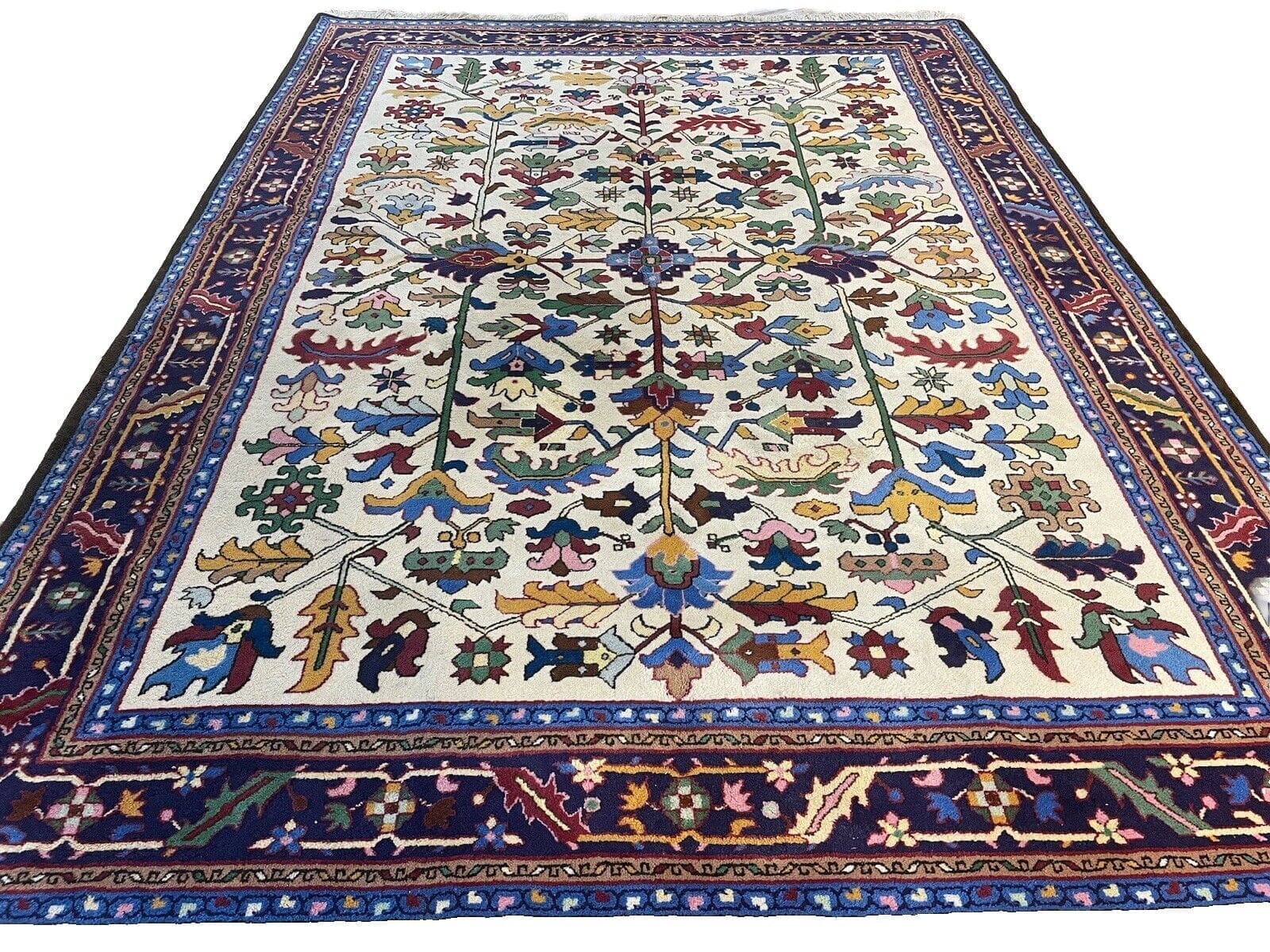
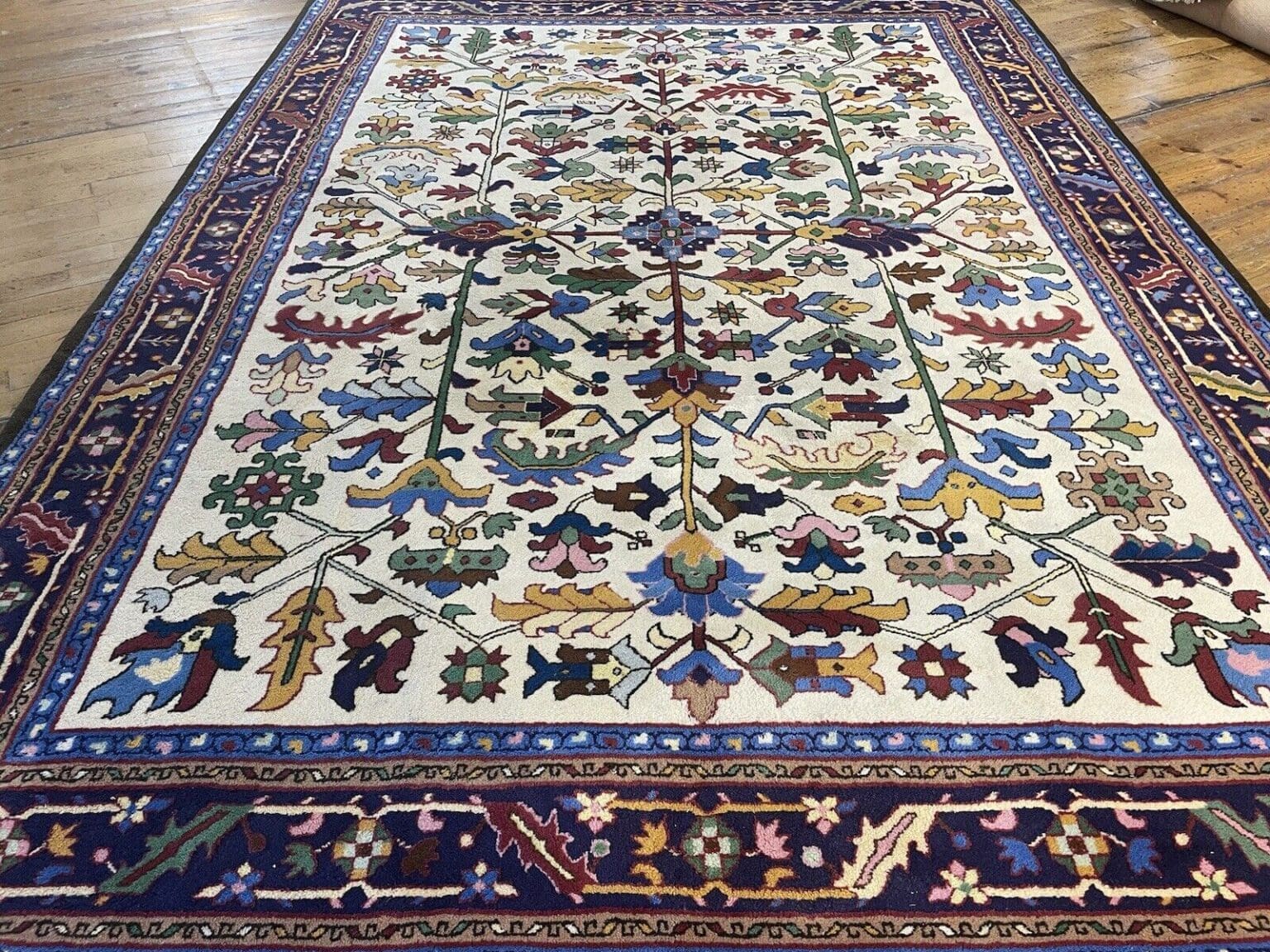
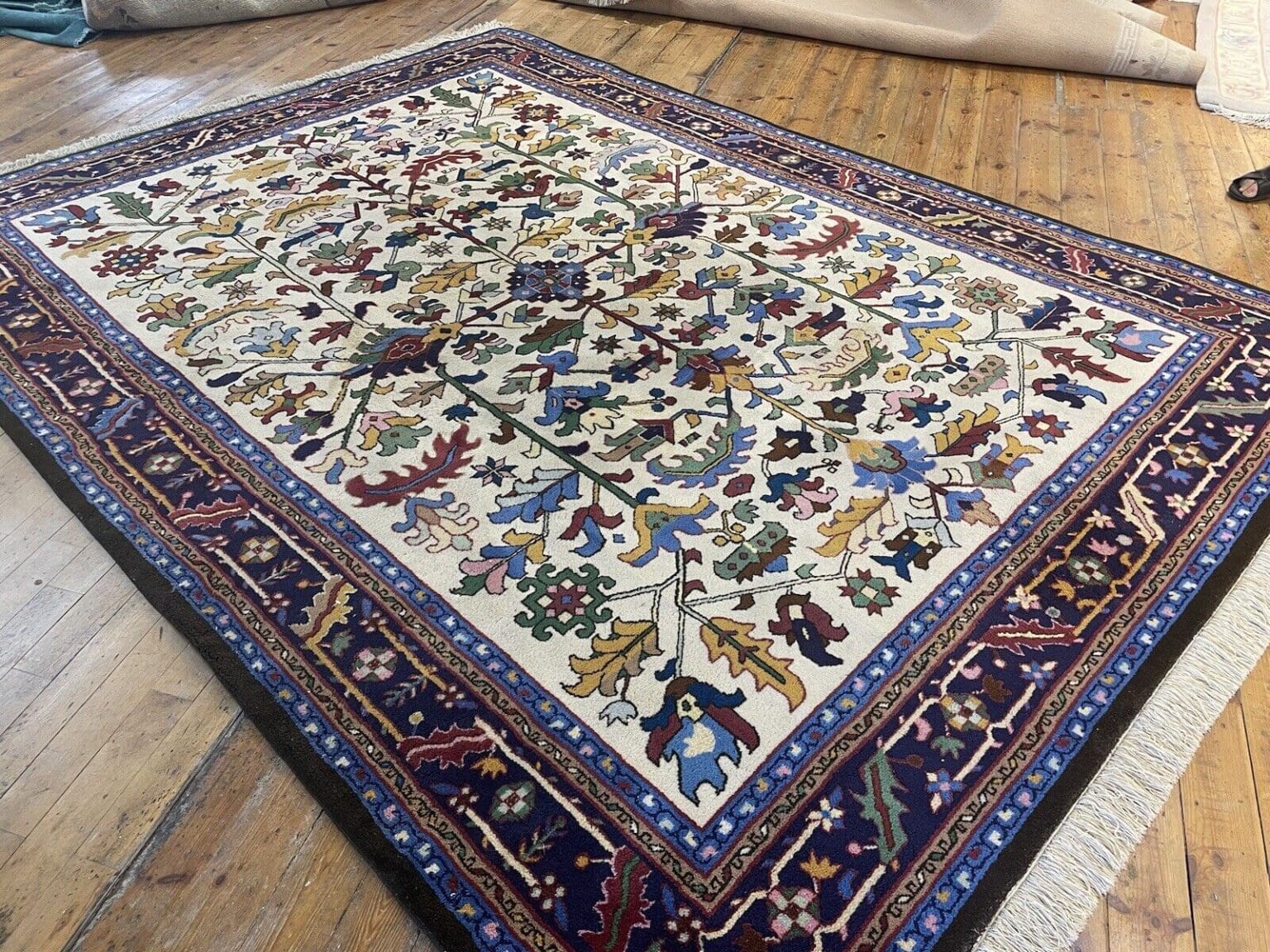
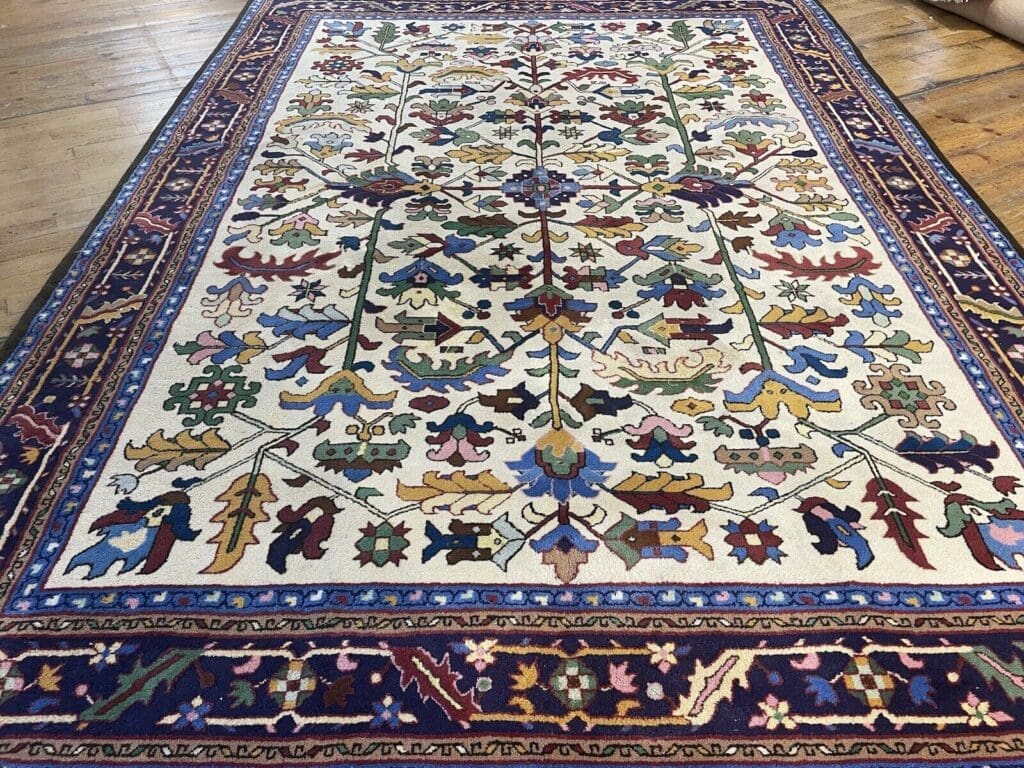
This Heriz Persian Rug is hand-knotted and made of wool. The product description identifies the wool as high quality. Wool is traditionally used in rug making for its pleasant handle, natural warmth and ability to help absorb sound. These characteristics give the pile a tactile surface while also making the material suitable for everyday interiors.
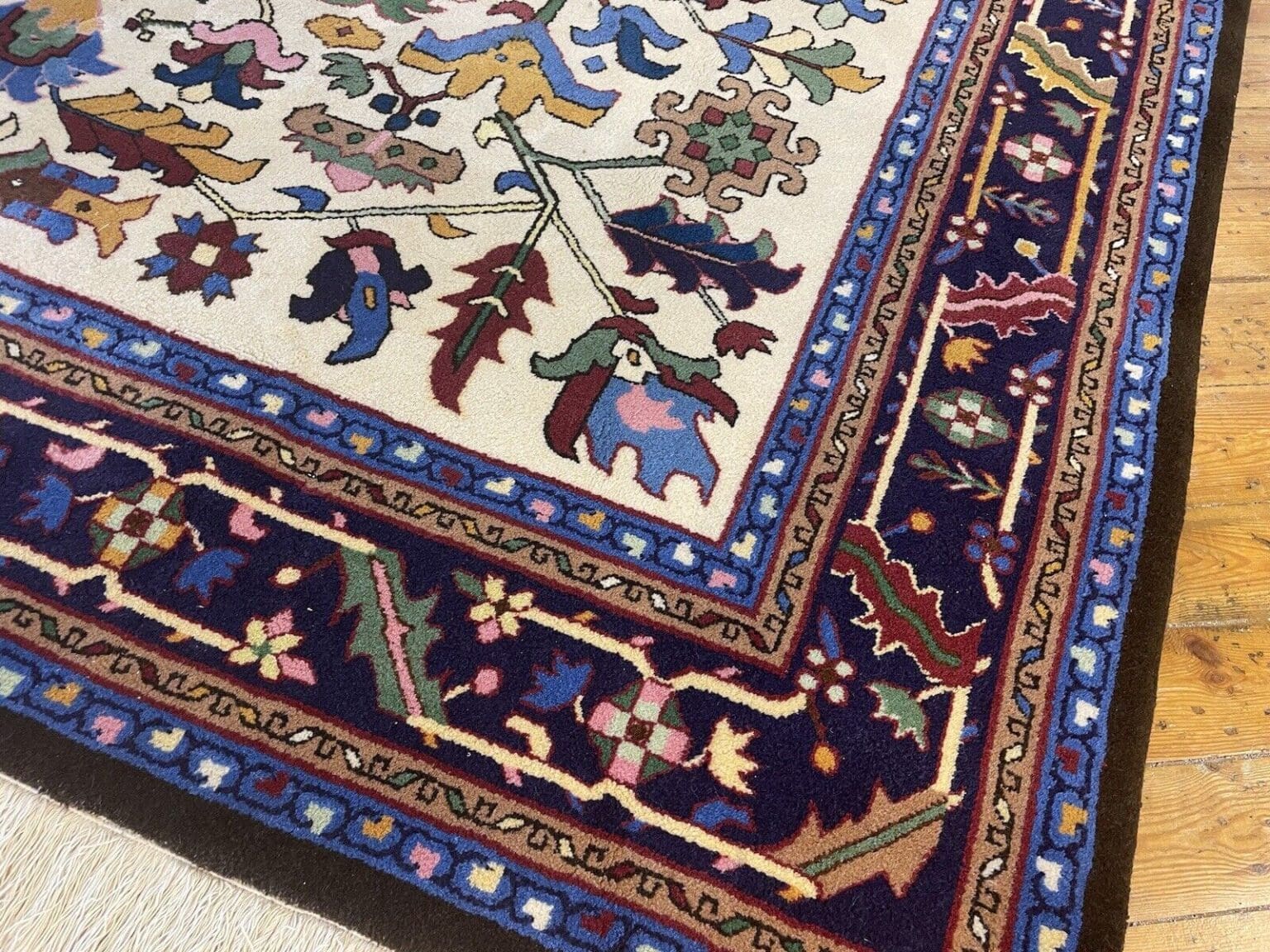
Hand-knotting builds the pile knot by knot. Rather than producing the surface through a machine-made process, the maker creates the structure at the loom through repeated manual work. This technique is associated with Persian rugs and is described here as a basis for strong durability. The source presents the rug as high quality and emphasizes the lasting nature of its construction. Its pile height is given in the product information, but no measurement is repeated in this long description.
Handwork gives each piece an individual character. This rug is described as a one-off, so the making process is part of its identity rather than an invisible production detail. Wool, the hand-knotted technique and the resulting pile work together to define the object. The material provides a comfortable feel, while the description also associates it with warmth and reduced room noise. The craftsmanship is therefore presented in both practical and traditional terms.
Origin and Tradition
The Heriz rug comes from the Heriz region in Iran. Heriz is associated with a distinctive carpet-making tradition in which local artisans passed their knowledge and skills from one generation to the next. The region is described as a former trading centre. Its role in trade helped bring different patterns and colour approaches into contact, which is reflected in the variety associated with the regional tradition.
A Persian rug is more than a floor covering within the history of its craft. It also records the skills and visual language of the place where it was made. In Heriz, this tradition includes the transmission of drawing methods, knotting knowledge and established approaches to colour and ornament. The work is carried out by hand, and experience is needed to translate a design into a coherent field of knots. Regional identity therefore develops through both community practice and the continuity of the craft.
The stated origin in Heriz, Iran, is what places this rug in the category of a Persian Rug. The listing also names Kashmir as the regional design. That is a design reference and does not replace the stated Iranian origin. In the same way, a pattern designation should not be confused with the place where this particular rug was made. Here, Heriz identifies the rug and its origin, while Kashmir is given as an additional design classification.
Heriz has been described as a trading centre as well as a weaving region. Exchange encouraged a broad vocabulary of forms and colours, while local production preserved a recognisable identity. This combination of openness and continuity is important to the history of oriental rugs. Ideas could circulate through trade, but the actual craft remained rooted in the hands of regional makers and in knowledge maintained within families and local communities.
The tradition is also cultural. A hand-knotted rug brings together raw material, technique and visual inheritance. Wool becomes a durable pile, knots establish the structure and the pattern carries a connection to a long-established craft culture. The present rug is described through all of these elements: it is a Heriz rug from Iran, made by hand, associated with the traditional Persian and oriental style, and presented with a design classification referring to Kashmir.
Design and Pattern
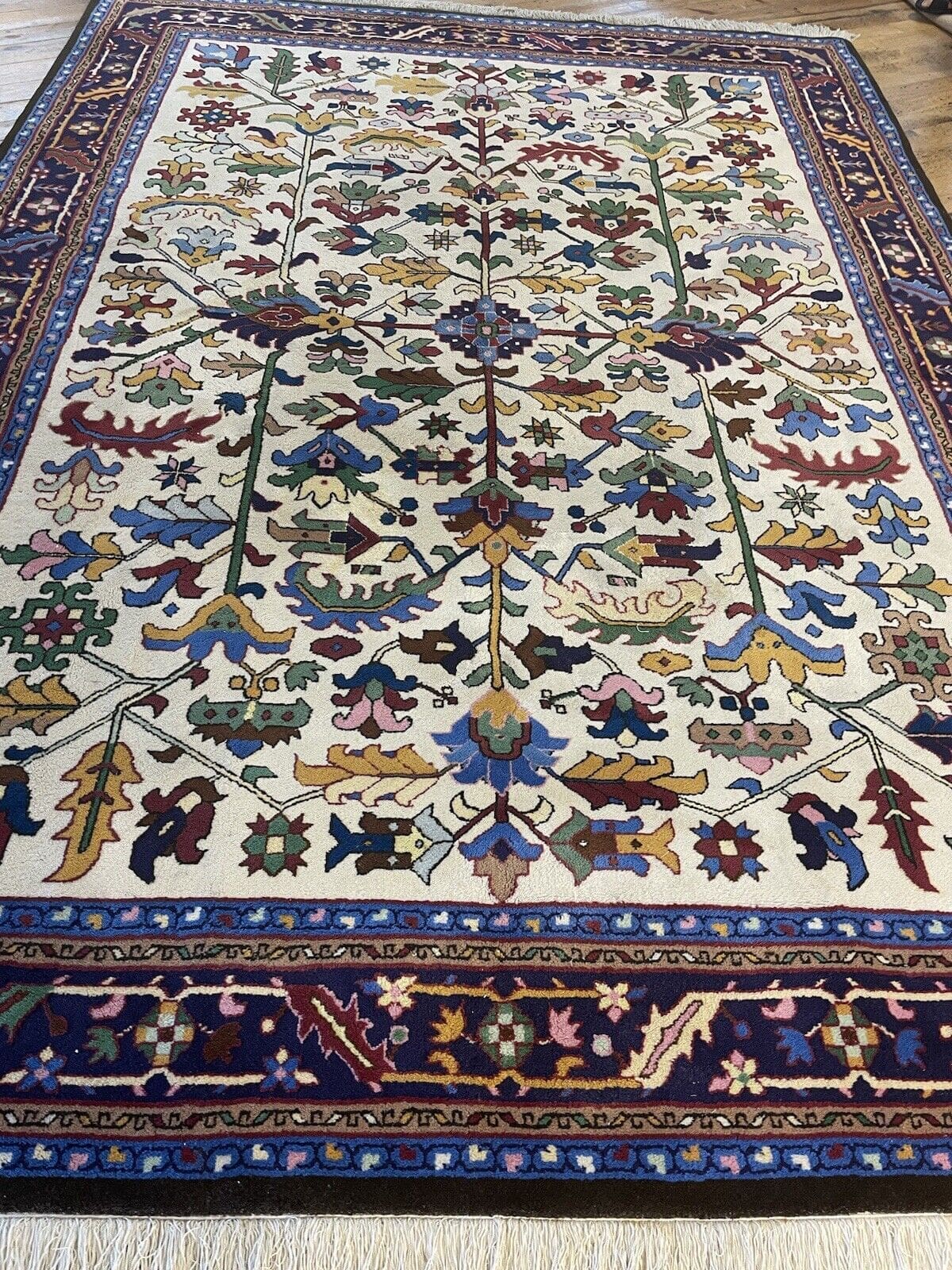
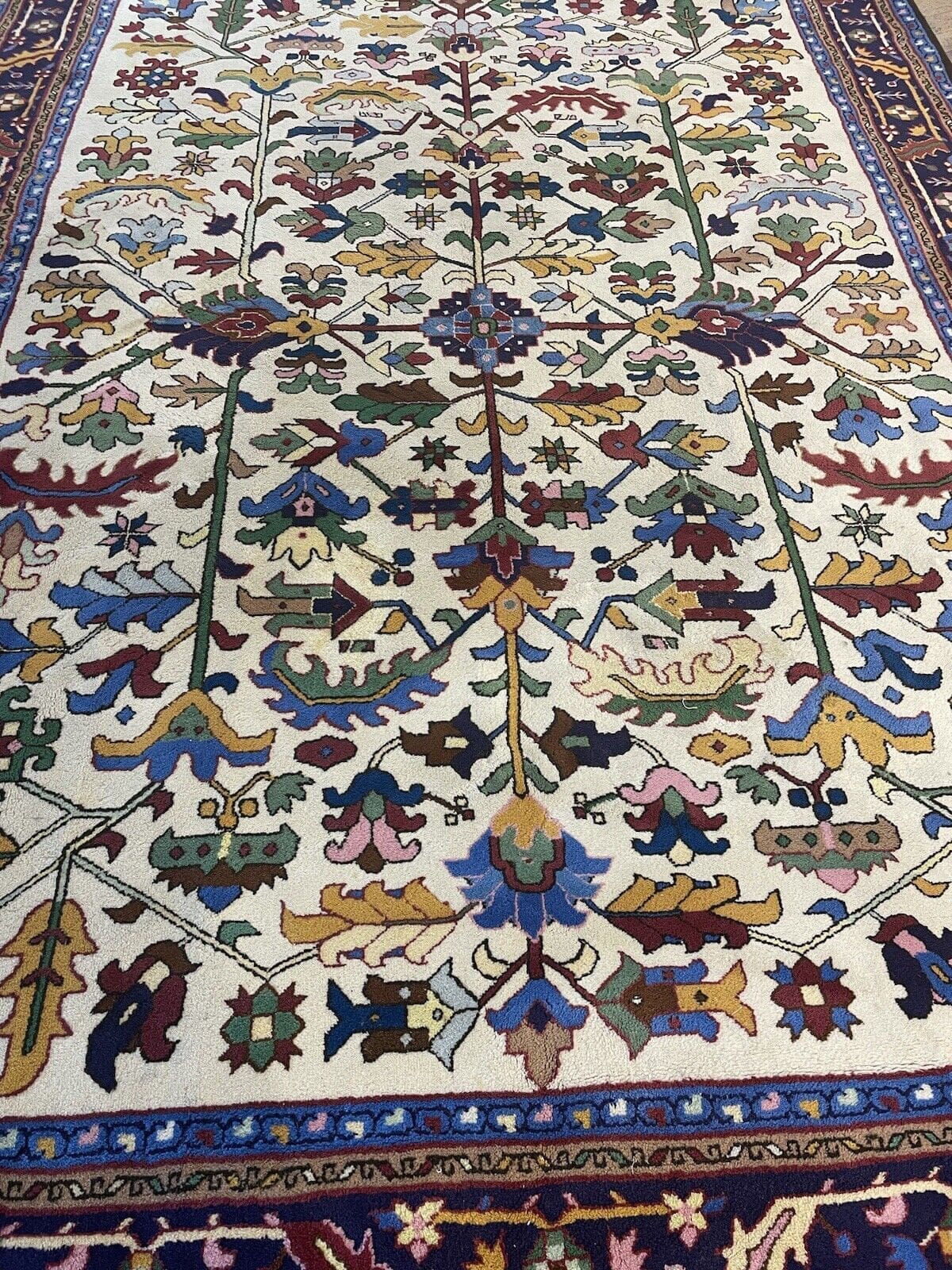
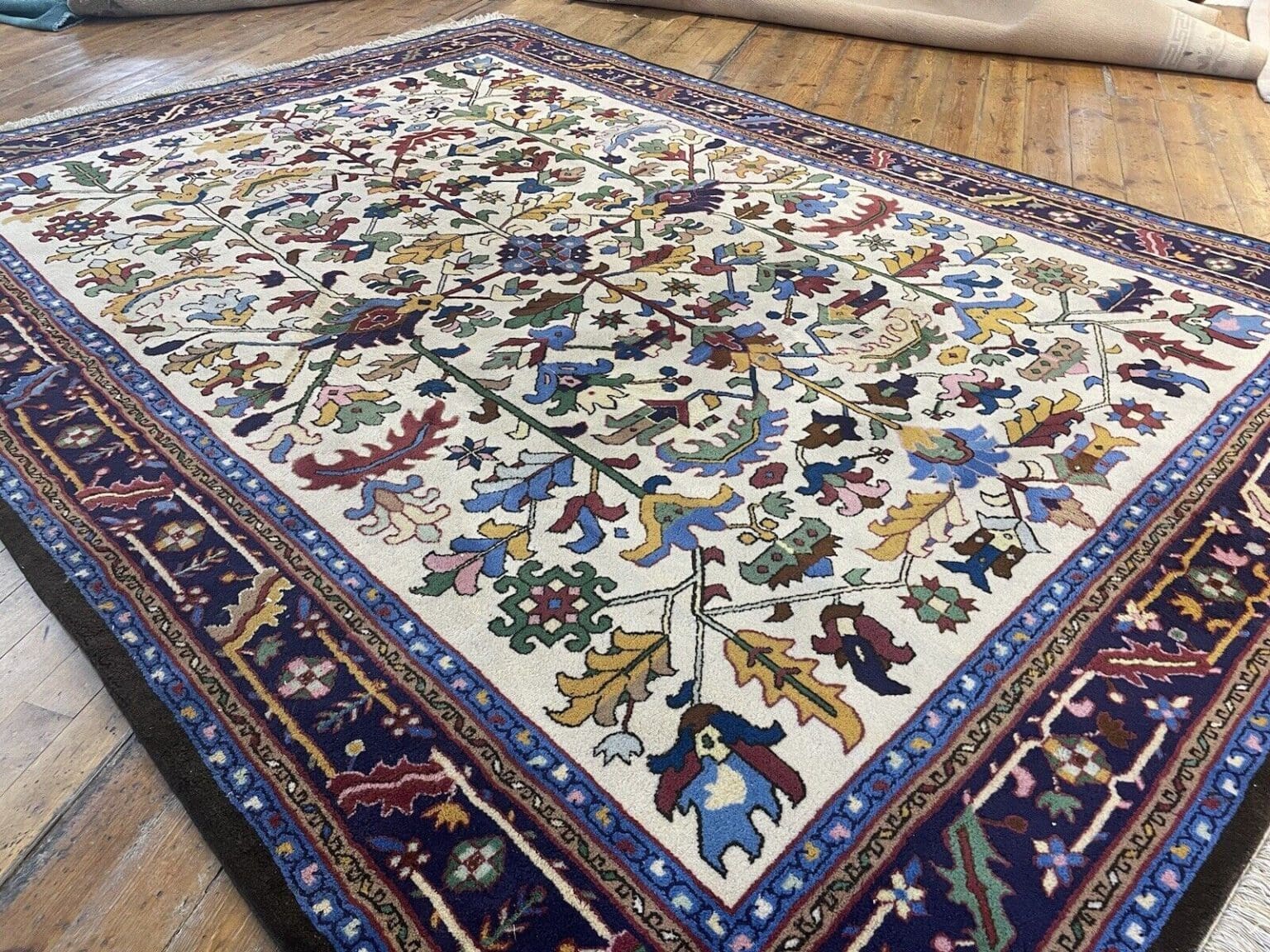
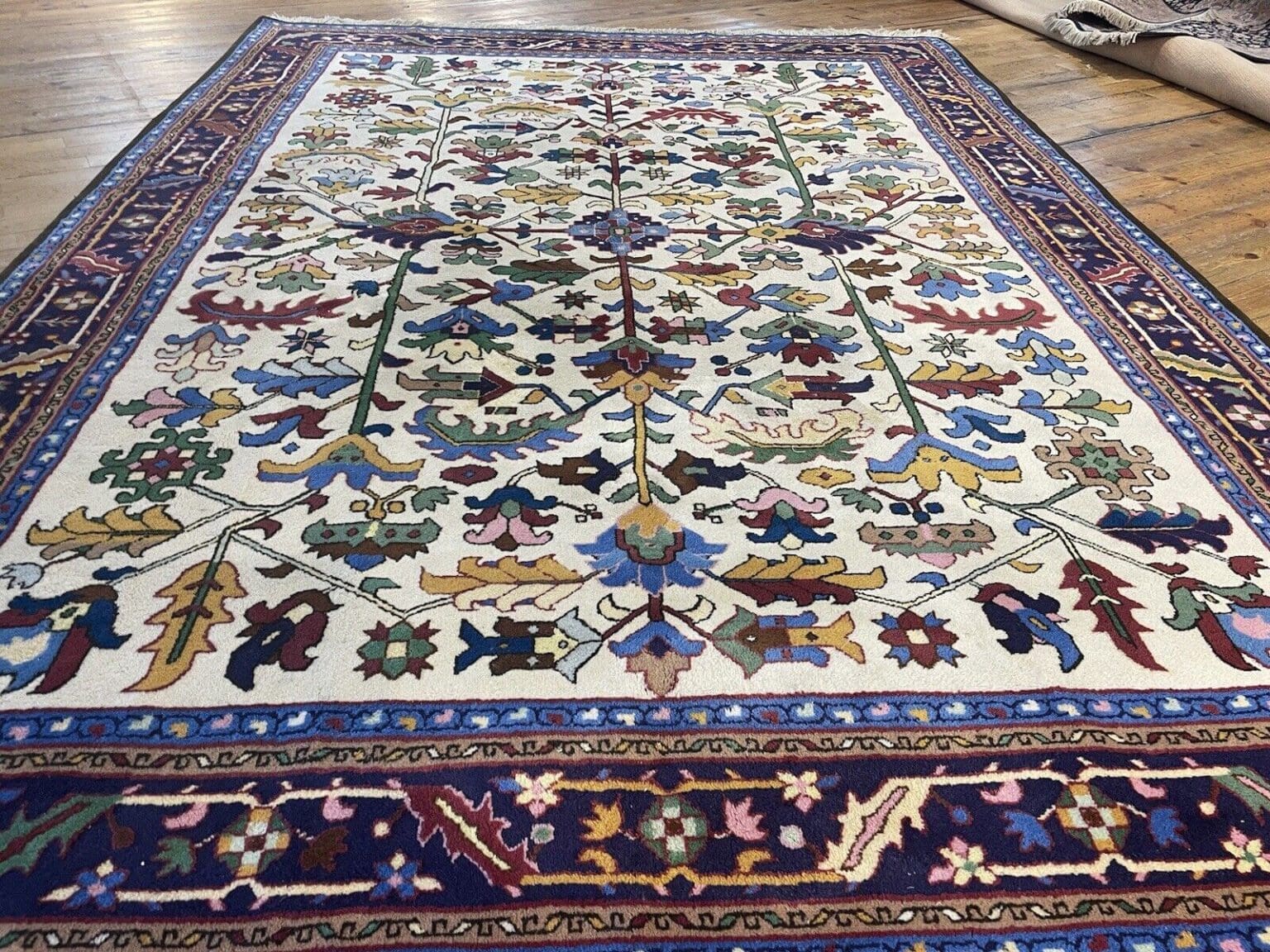
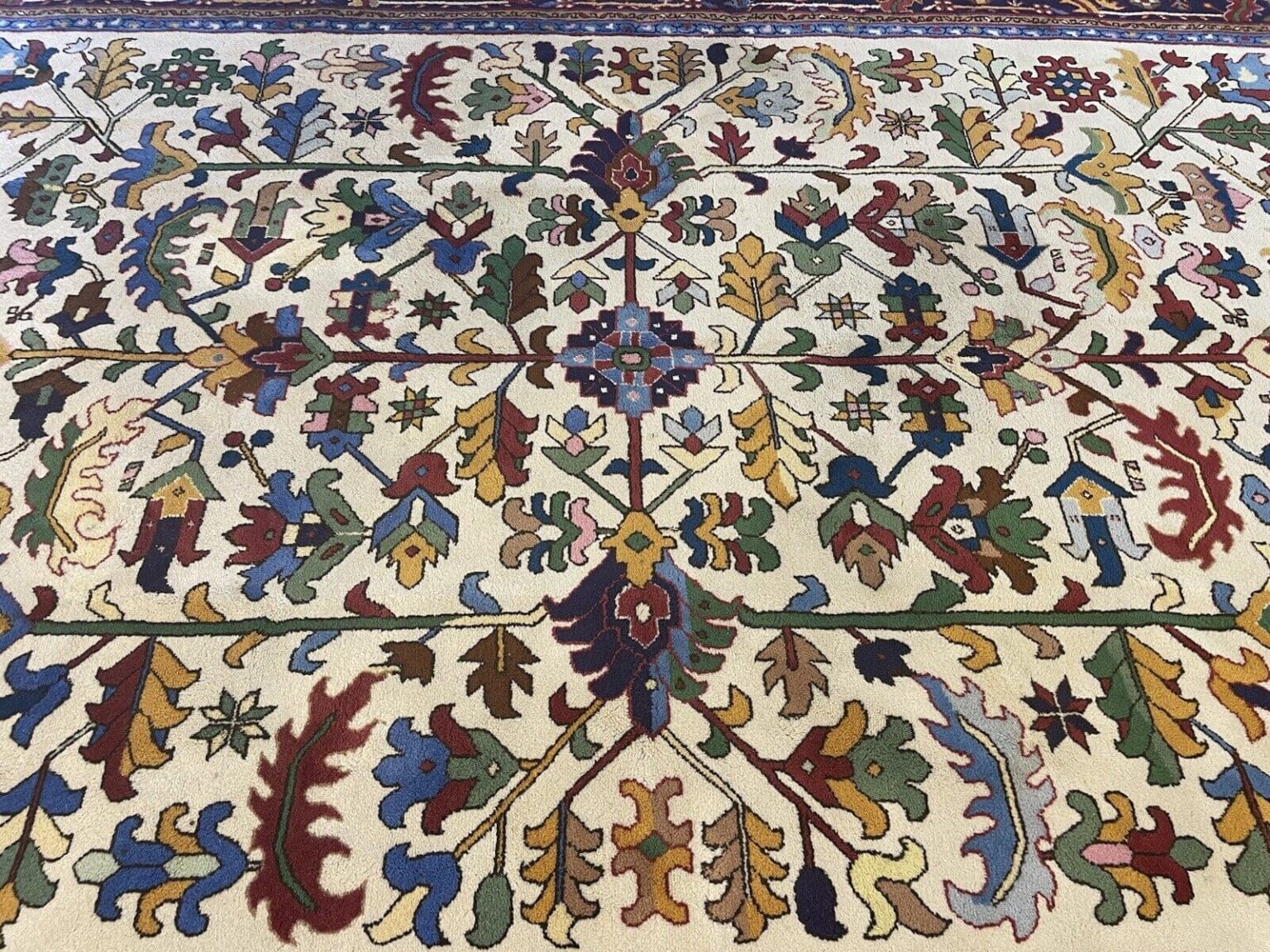
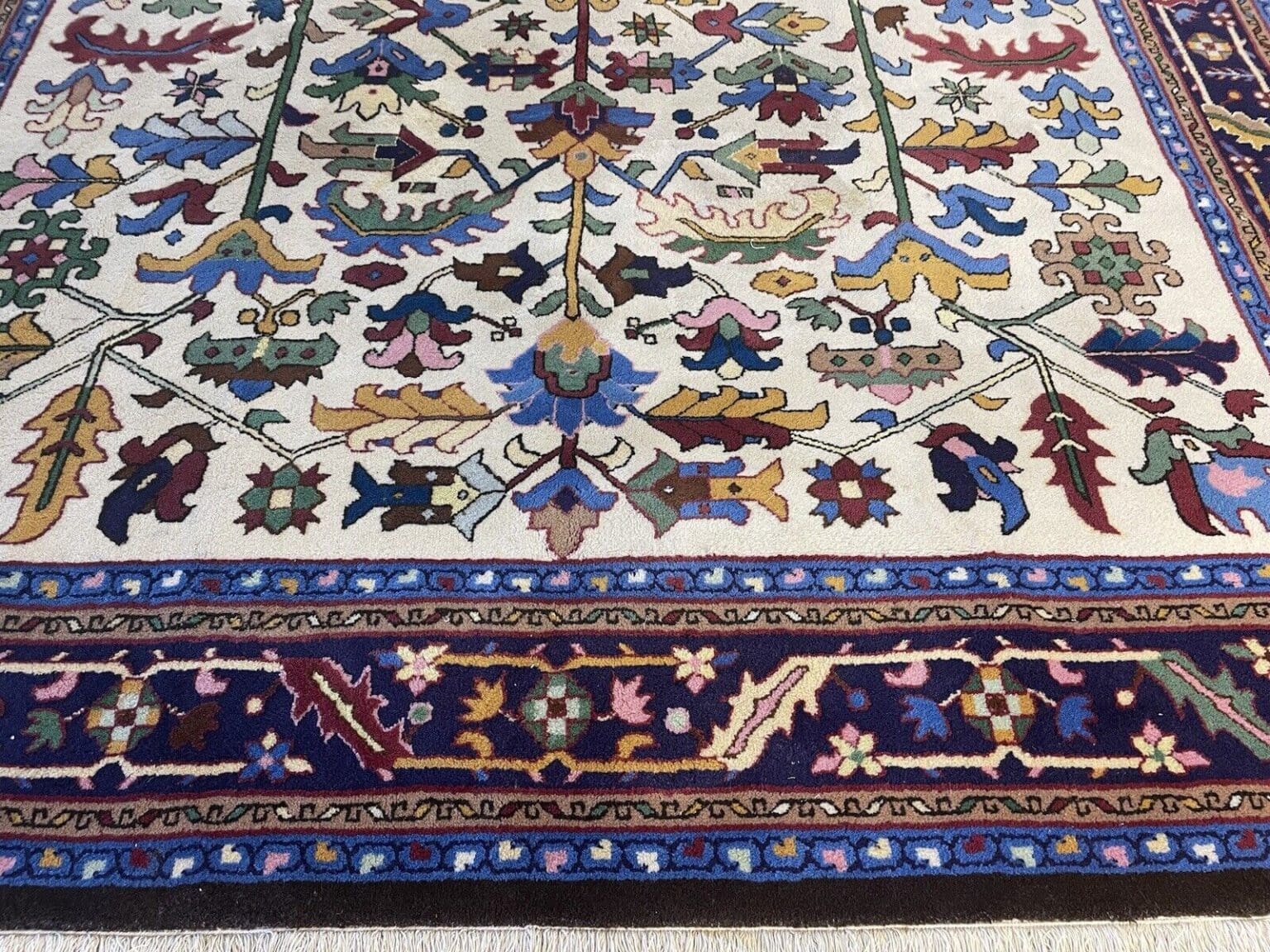
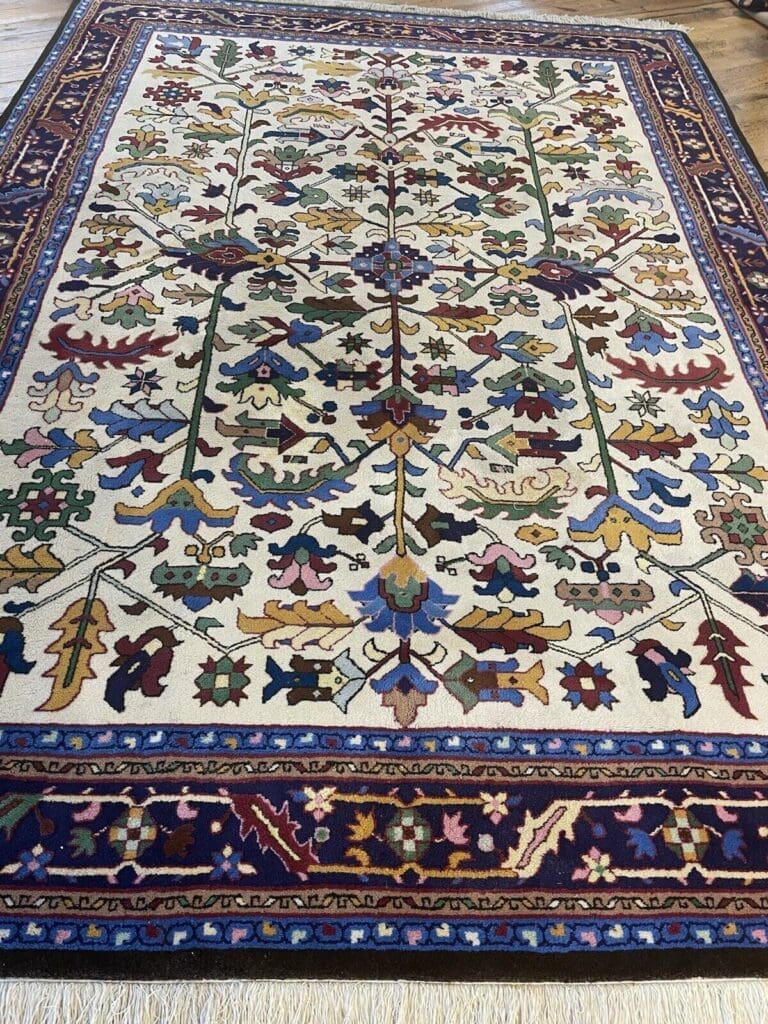
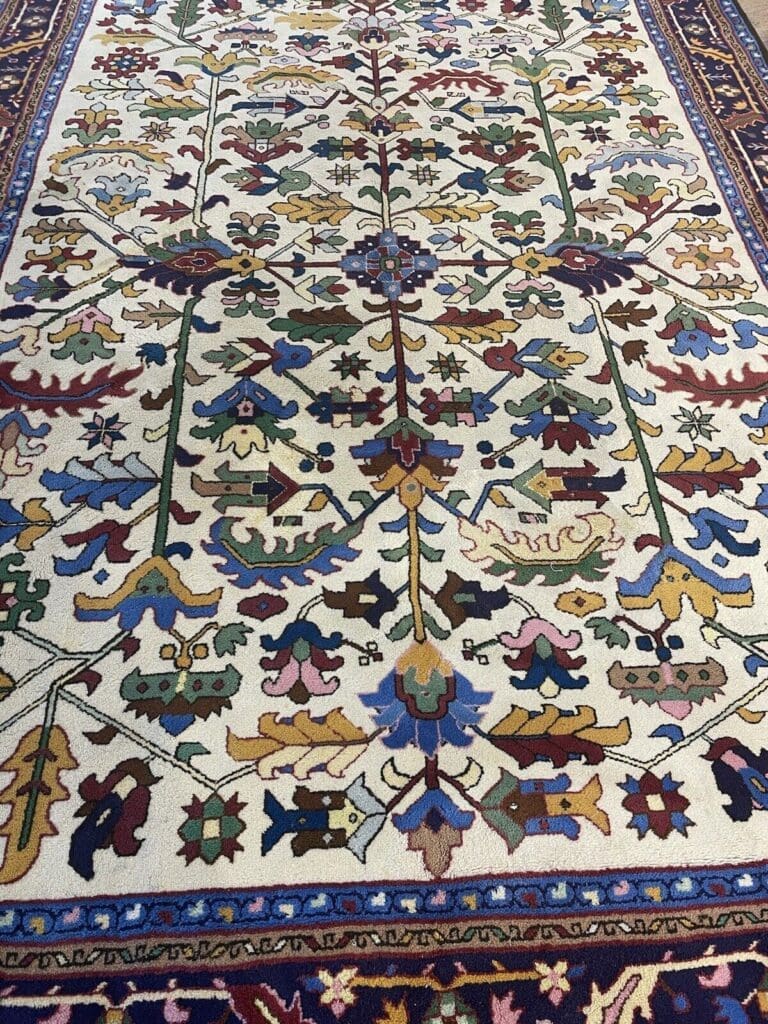
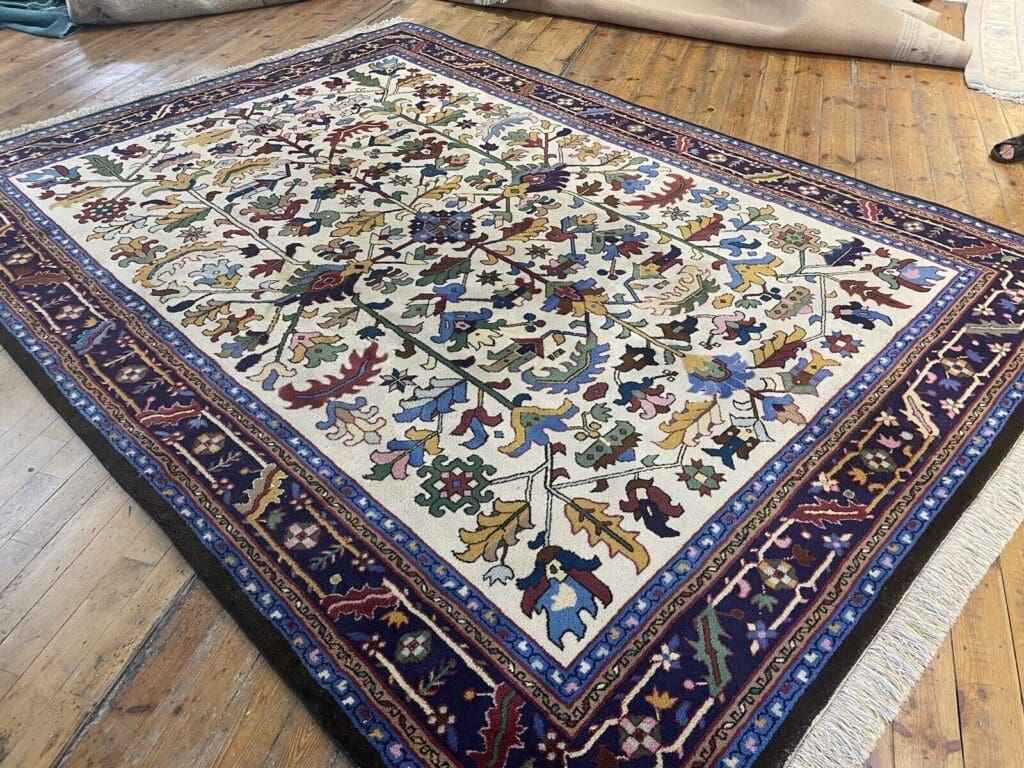
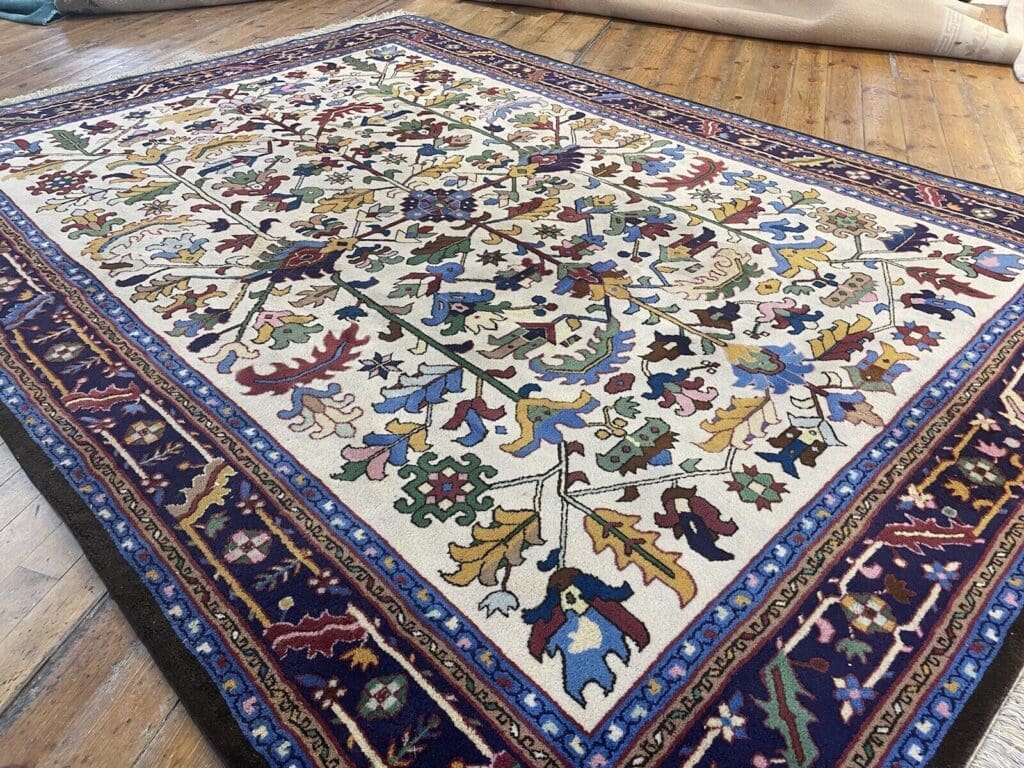
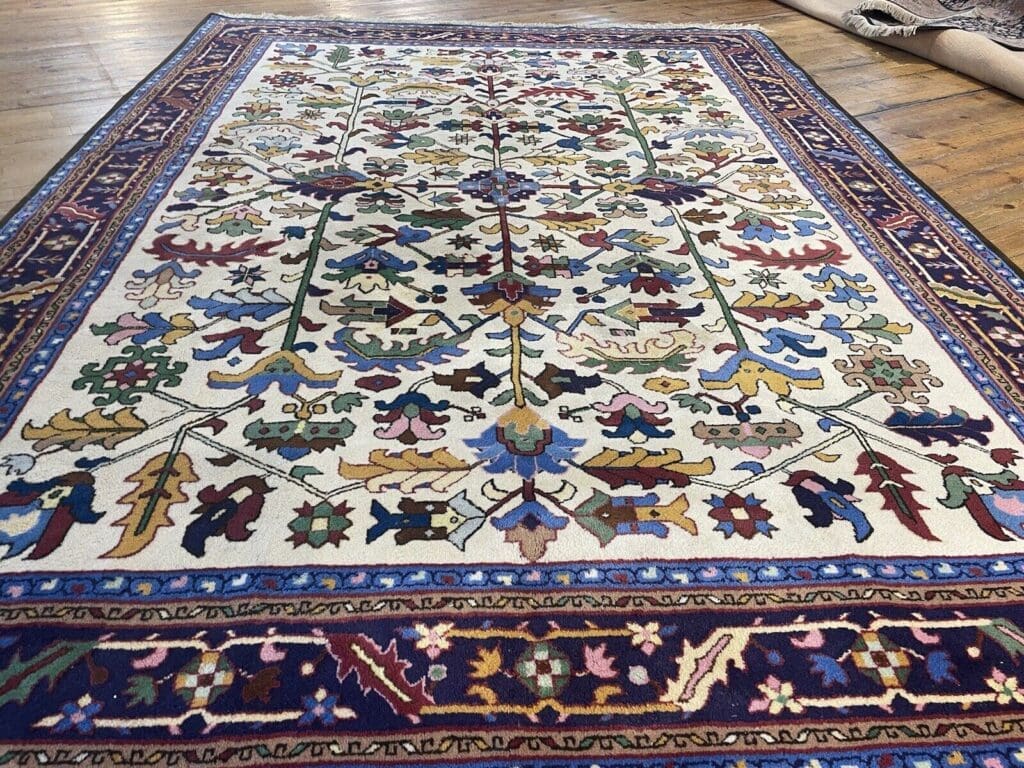
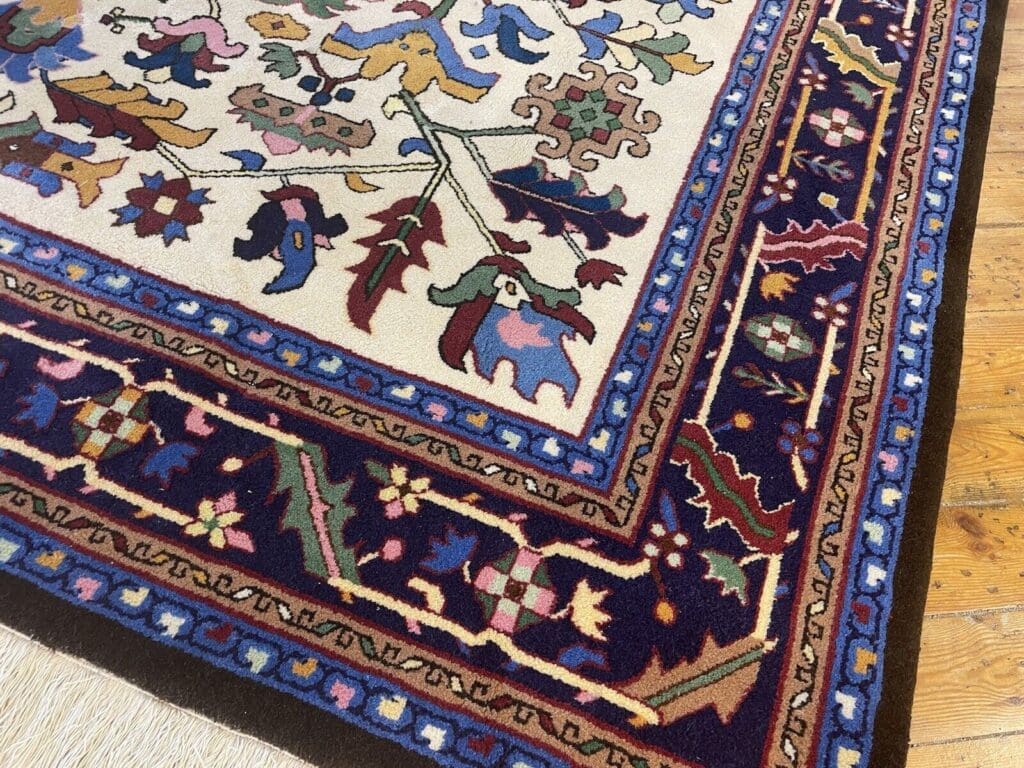
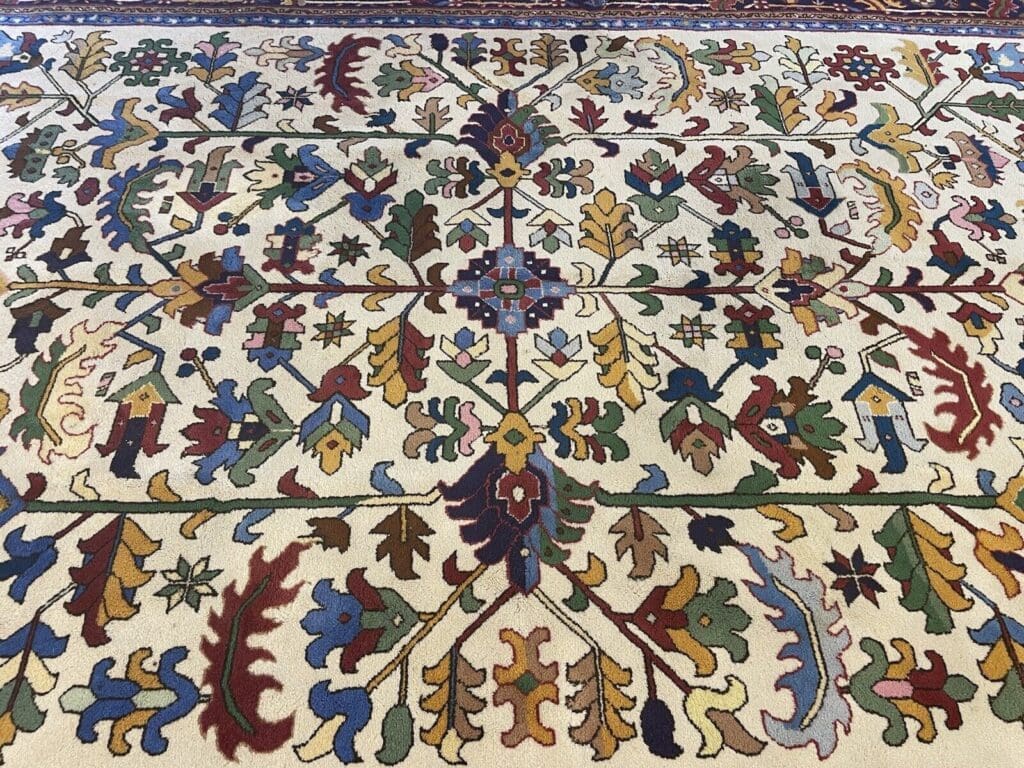
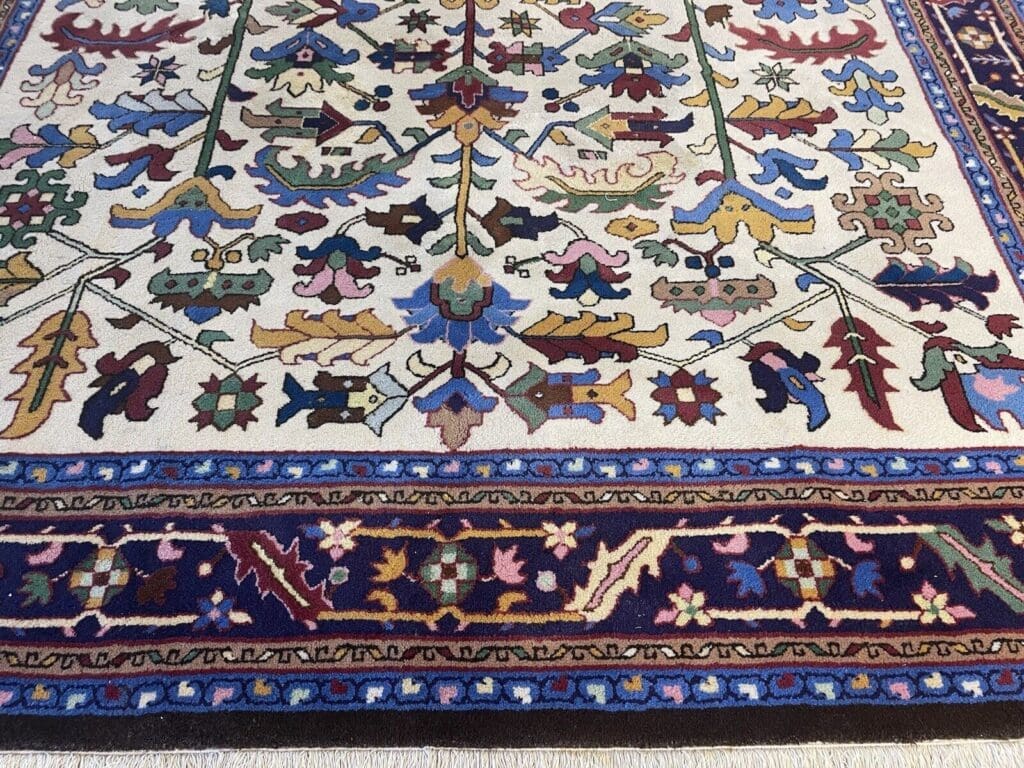
The pattern is named Heriz Furchgemustert in the product information. Heriz designs are associated with strong colours and expressive forms. The description specifically refers to floral and geometric elements. Floral motifs can introduce organic movement, while geometric lines bring order, rhythm and definition to the composition. Their combination creates the characteristic balance between structured drawing and decorative detail.
In a traditional Heriz composition, the visual effect comes from the relationship between the central arrangement, surrounding borders and repeated ornaments. Geometric construction can lead the eye across the surface and give the design a firm framework. Floral details can soften that framework and connect separate areas of the field. The important point here is not one isolated symbol, but the way different forms are arranged into a coherent pattern language.
Oriental rug motifs often carry meanings shaped by cultural history. They may refer to plants, natural forms, inherited signs or an ordered view of the world. The source does not assign a specific symbol or fixed interpretation to this individual rug. It does state that floral and geometric elements are rooted in the culture of the Orient and that rugs of this kind preserve traditions of carpet weaving. The pattern can therefore be discussed as part of a wider cultural vocabulary without adding an unconfirmed reading.
The Kashmir design reference is an additional description of the visual direction. It should be kept separate from origin: this remains a Heriz Persian Rug from Iran. In rug terminology, a design name and a production region do not necessarily identify the same thing. A pattern can draw on a regional style while the rug itself is made elsewhere. That distinction is relevant here because the listing names Heriz as the rug and Kashmir as its regional design.
The traditional Persian and oriental classification allows the rug to work with different interior settings. A clearly structured, expressive pattern can accompany classic furnishings or provide a defined visual element in a simpler room. The source describes the rug as suitable for all rooms. Its use is therefore not limited to one particular area, even though the pattern itself remains the main decorative feature.
Because the design is hand-knotted, its appearance is tied to the making process. The motif is formed through individual knots rather than printed onto a finished surface. This connects the technical foundation with the visual result. The Heriz character is expressed through a firm, decorative composition, strong colours and the interaction of floral and geometric forms, while the handwork gives the one-off piece its individual presence.
Special Features
The rug is listed as new without a label. It is also described as suitable for use over underfloor heating. The heating temperature should not be set too high so that the wool is protected. The listing states that the rug is suitable for all rooms, so its suggested use is not restricted to a living room or bedroom.
Other stated features are the high-quality wool, the hand-knotted construction and the fact that the rug is a one-off. These details describe both the material character and the individual nature of the piece. The rug is classified as traditional Persian and oriental in style and is also described as decorative. Its qualities therefore combine a regional craft identity with a pattern intended to contribute to an interior.
Care is part of practical use. Regular cleaning should be gentle and carried out with a vacuum cleaner without a brush attachment. Stubborn marks should be dabbed promptly with a damp cloth. For a thorough cleaning, the product text recommends using a professional rug-cleaning service. These instructions correspond to the wool pile and the hand-knotted construction described for this Heriz rug.
FAQ
How should I clean the Heriz Persian Rug?
Regular care should be gentle. Vacuum the rug with a cleaner that does not have a brush attachment, so loose dirt can be removed without placing unnecessary strain on the wool pile. Stubborn stains should be dabbed with a damp cloth as soon as possible. Vigorous rubbing is not advisable because it can put extra stress on the affected area. For a complete or specialist cleaning, a professional rug-cleaning service is recommended. This approach is suitable for a hand-knotted wool rug and supports careful everyday maintenance.
Can the rug be used over underfloor heating?
Yes. The Heriz Persian Rug is described as suitable for underfloor heating. The temperature should not be set too high in order to protect the wool. Underfloor heating can add warmth to the room, while the wool rug itself contributes further warmth and comfort underfoot. The listing describes the rug as suitable for all rooms, so this use is not confined to one designated living area or bedroom.
How can I tell whether a Persian rug is authentic?
Authentic Persian rugs are hand-knotted and may show small irregularities. In a handmade piece, these variations reflect individual production rather than a machine-made, perfectly repeated surface. The knotting technique can often be examined on the back of the rug. It is also advisable to buy from a trustworthy dealer who can confirm the rug’s origin. For this piece, the stated origin is the Heriz region in Iran, and its hand-knotted construction is identified as one of its product characteristics.
To provide the best experiences, we use technologies like cookies to store and/or access device information. Consenting to these technologies will allow us to process data such as browsing behavior or unique IDs on this site. Not consenting or withdrawing consent, may adversely affect certain features and functions.
Functional Always active
The technical storage or access is strictly necessary for the legitimate purpose of enabling the use of a specific service explicitly requested by the subscriber or user, or for the sole purpose of carrying out the transmission of a communication over an electronic communications network.
Preferences
The technical storage or access is necessary for the legitimate purpose of storing preferences that are not requested by the subscriber or user.
Statistics
The technical storage or access that is used exclusively for statistical purposes.The technical storage or access that is used exclusively for anonymous statistical purposes. Without a subpoena, voluntary compliance on the part of your Internet Service Provider, or additional records from a third party, information stored or retrieved for this purpose alone cannot usually be used to identify you.
Marketing
The technical storage or access is required to create user profiles to send advertising, or to track the user on a website or across several websites for similar marketing purposes.
 SECURE PAYMENT
 SHIPPING PARTNERS


