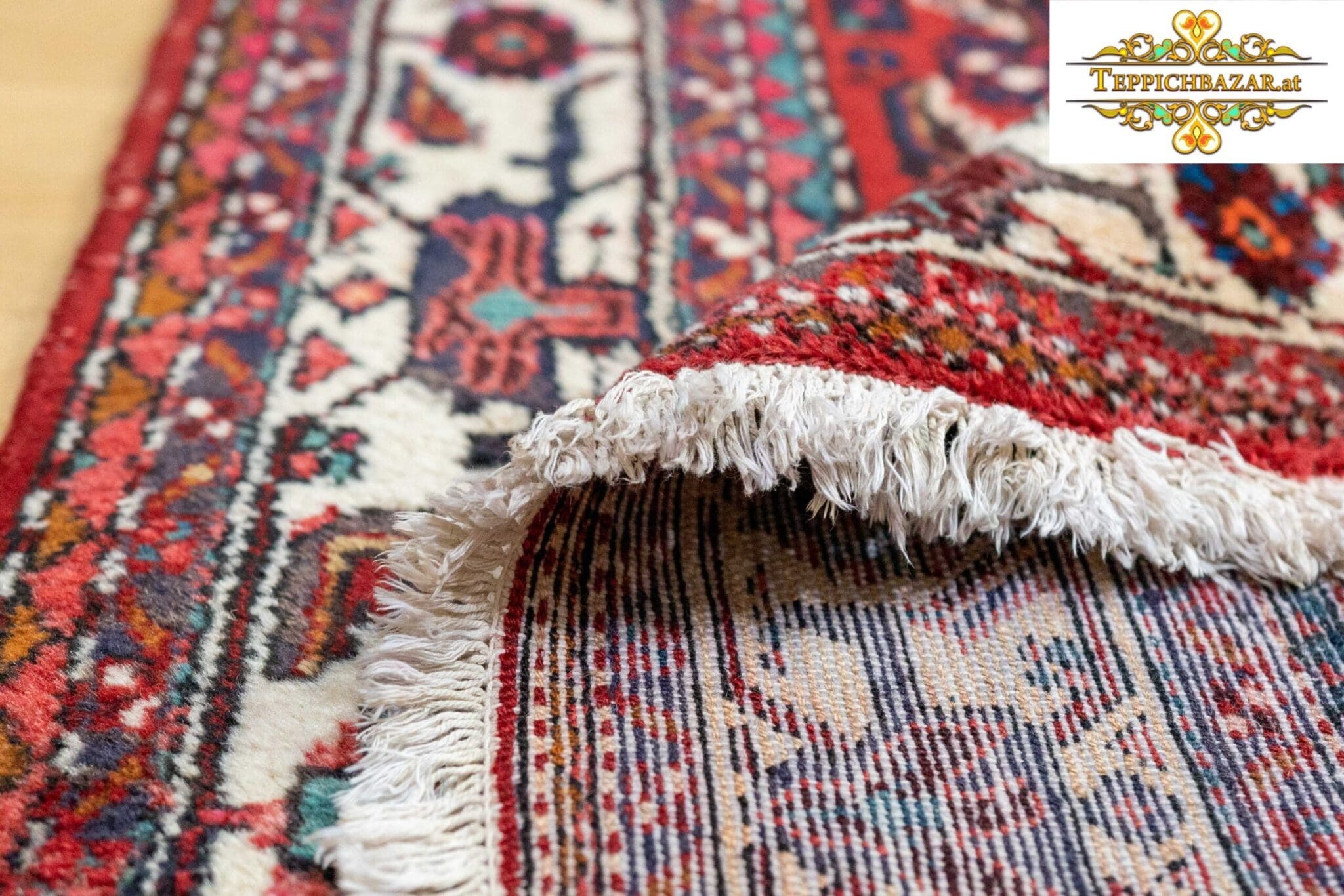
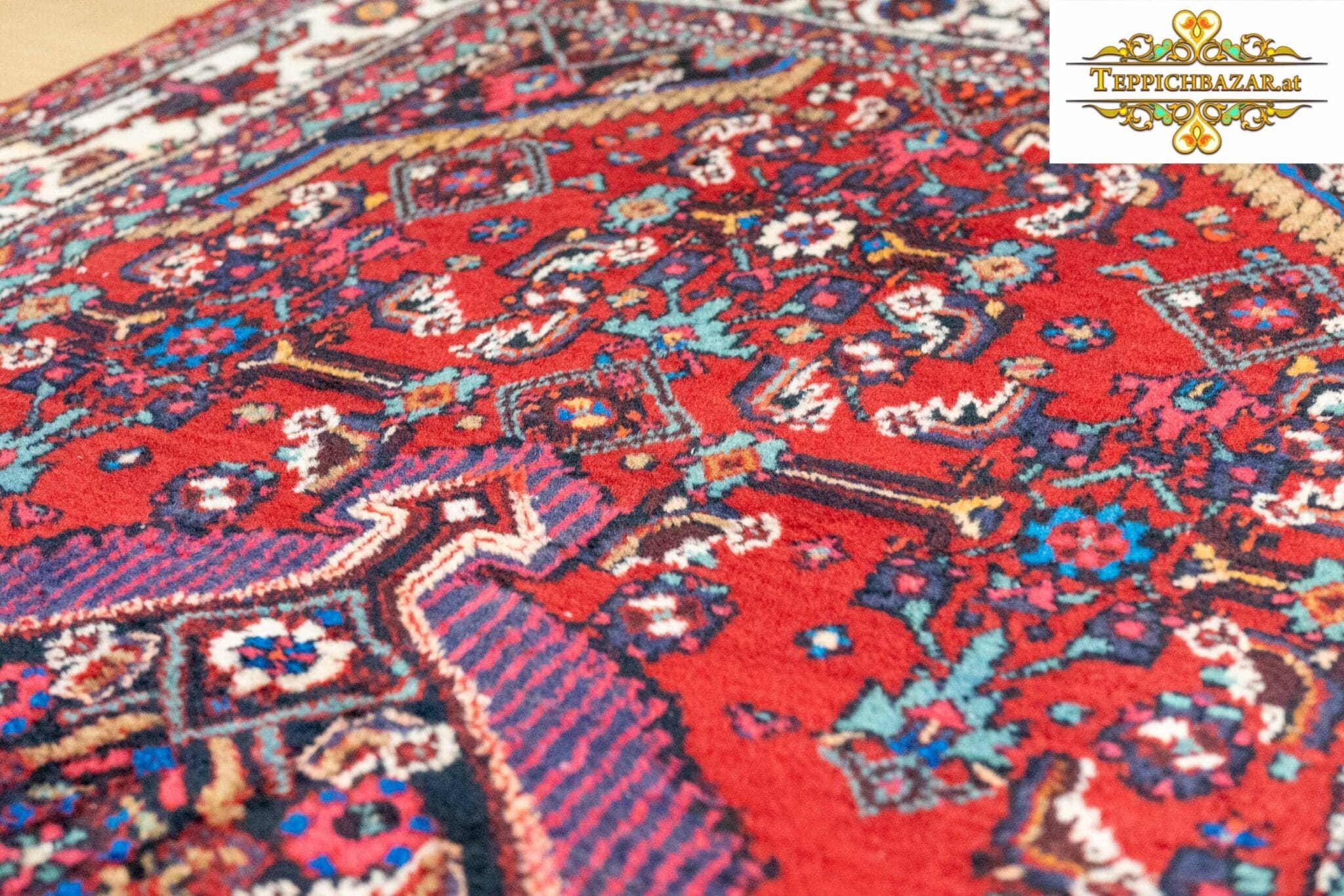
This Hamedan Persian rug is hand-knotted with a pile made from 100% virgin wool and a warp made from 100% cotton. The wool pile is the visible, tactile surface of the rug, while the cotton warp forms part of the underlying structure that supports the rows of knots. These materials are characteristic of the practical construction associated with many Persian rugs, where the choice of fibre serves both the appearance and the everyday function of the finished textile.
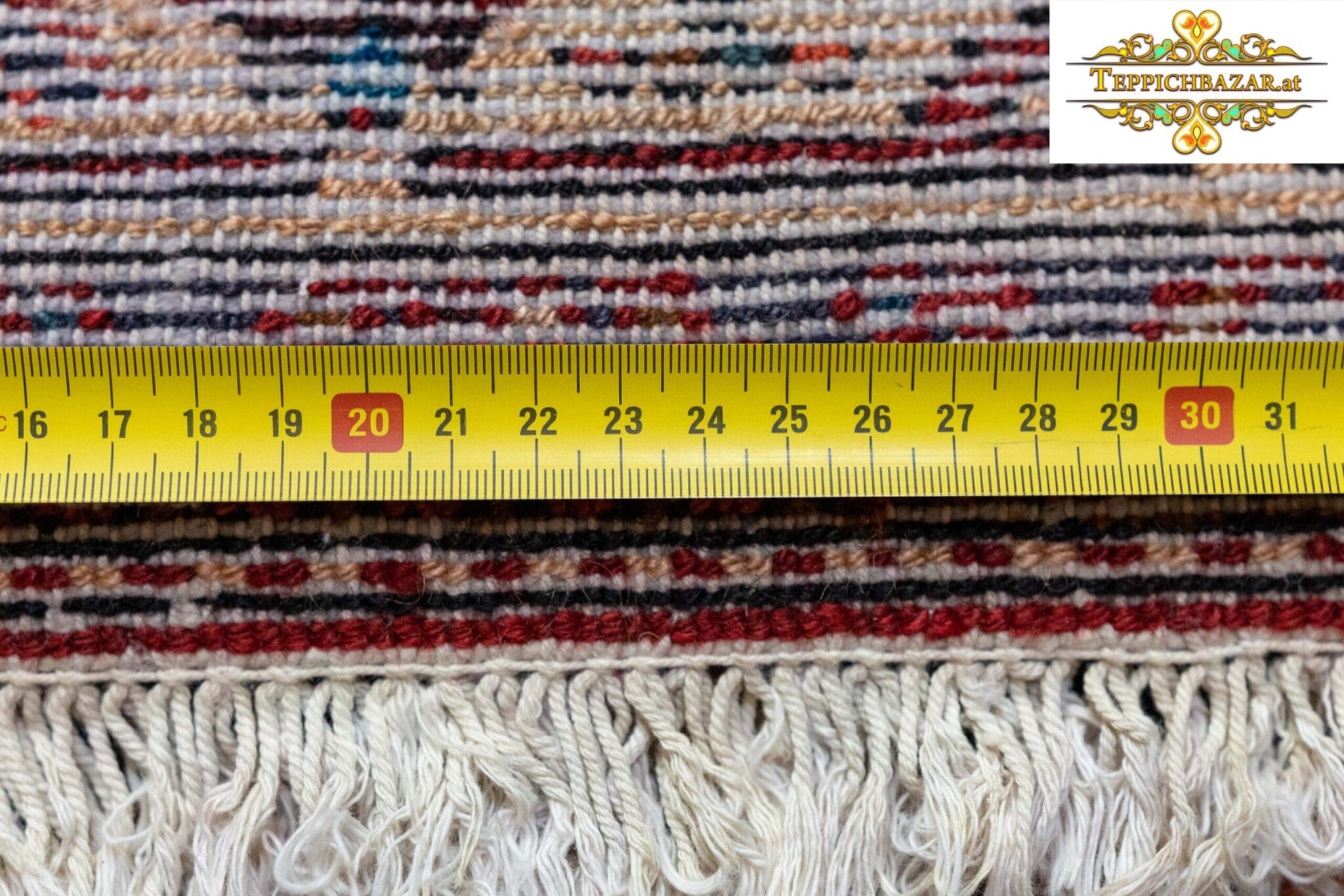
Hand-knotting is a manual process in which individual knots are tied around the warp threads and then secured through successive rows. The weaver builds the surface gradually, following the intended drawing while maintaining the tension of the foundation. This method requires concentration and consistent handling throughout the work. The knot density recorded for this rug is 120000-125000 knots per square metre. It describes the number of knots within a defined area and gives a useful indication of the fineness of the woven structure.
Wool is widely used in Persian rug making because it can be spun into a resilient yarn and worked into a pile with a distinct hand. Virgin wool also provides the natural character associated with a new wool fibre rather than a recycled one. Cotton in the warp offers a stable foundation for the knotted surface. The combination of a wool pile and cotton warp belongs to a long-established approach in which the pile is made for contact and use, while the foundation holds the composition together.
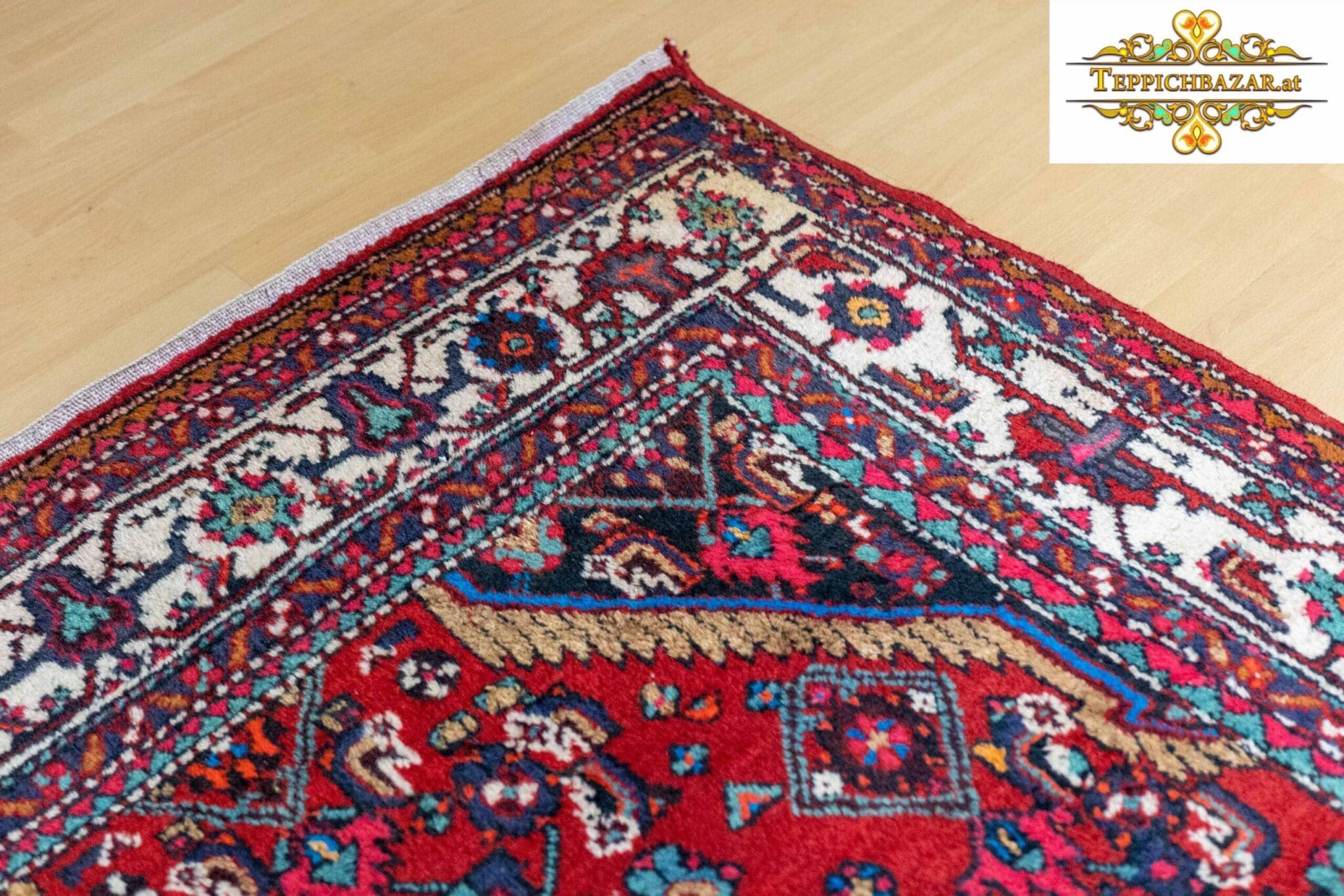
The rug is in very good condition and has been professionally washed. The washing is part of the recorded condition of this individual piece; it is not a claim about every Hamedan rug. Its construction, materials, knot density and condition are therefore described separately: the first concerns how the rug was made, while the last concerns the state in which this one is offered.
Origin and Tradition
The rug comes from Hamedan in Persia. Hamedan is an important historic city and weaving centre in western Persia, and the surrounding area has a long association with the production and trade of hand-knotted rugs. In this regional context, rug making developed as both a practical craft and a form of visual expression. Weavers worked with established methods while adapting compositions, colours and details to local preferences and available materials.
Hamedan rugs are known in the broader Persian rug tradition for their useful, robust character and for the variety found among pieces from the region. The name Hamedan can refer to a wide weaving area rather than to one single drawing. Regional production includes different village and workshop approaches, so Hamedan rugs are not defined by one universal pattern. Instead, their identity is connected to their place within the cultural and commercial landscape of Hamedan and to the continued use of hand-knotting.
Persian carpet weaving has developed through the interaction of courtly, urban, village and tribal traditions. Designs were transmitted through drawing, memory and repeated workshop practice, but they were not fixed in exactly the same way from one generation or locality to the next. This is why a regional name can encompass floral arrangements, geometric structures and medallion compositions. The craft combines a planned design with the individual decisions required while tying each row.
Hamedan’s position within the history of Persia also helps explain the cultural importance assigned to rugs from the area. A hand-knotted rug is a textile object, but it is also the result of accumulated knowledge about fibre preparation, spinning, dyeing, knotting, finishing and pattern construction. Regional traditions preserve this knowledge without making every rug identical. The present piece belongs to that Persian tradition through its Hamedan origin, its wool pile, cotton warp and hand-knotted construction.
Hamedan rugs have also been made in a range of formats, from narrow runners to larger room rugs. This variety reflects the practical needs served by woven floor textiles and the different settings in which they were produced. The existence of varied formats is a general characteristic of Hamedan production and does not add any unstated feature to this particular rug.
Design and Pattern
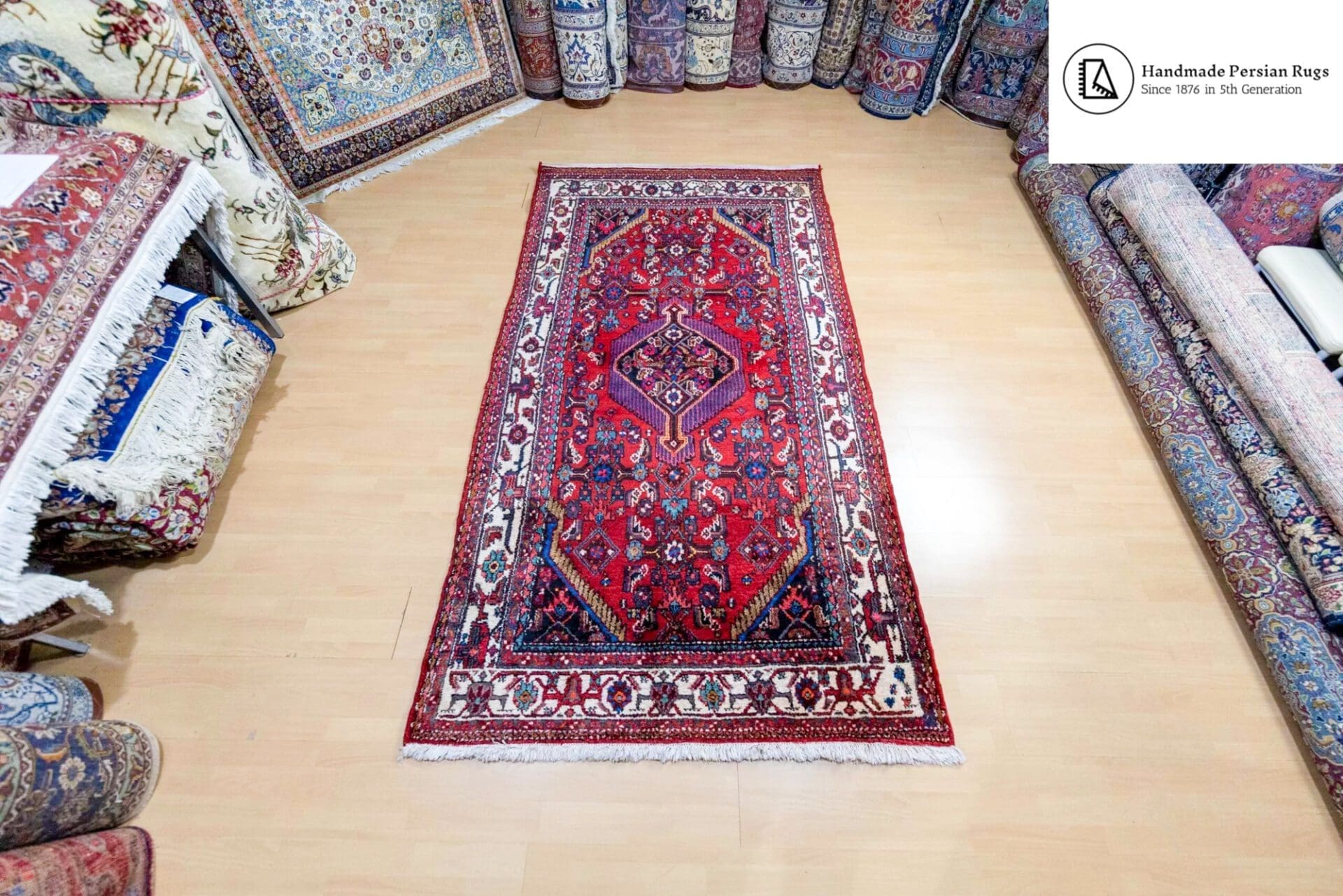
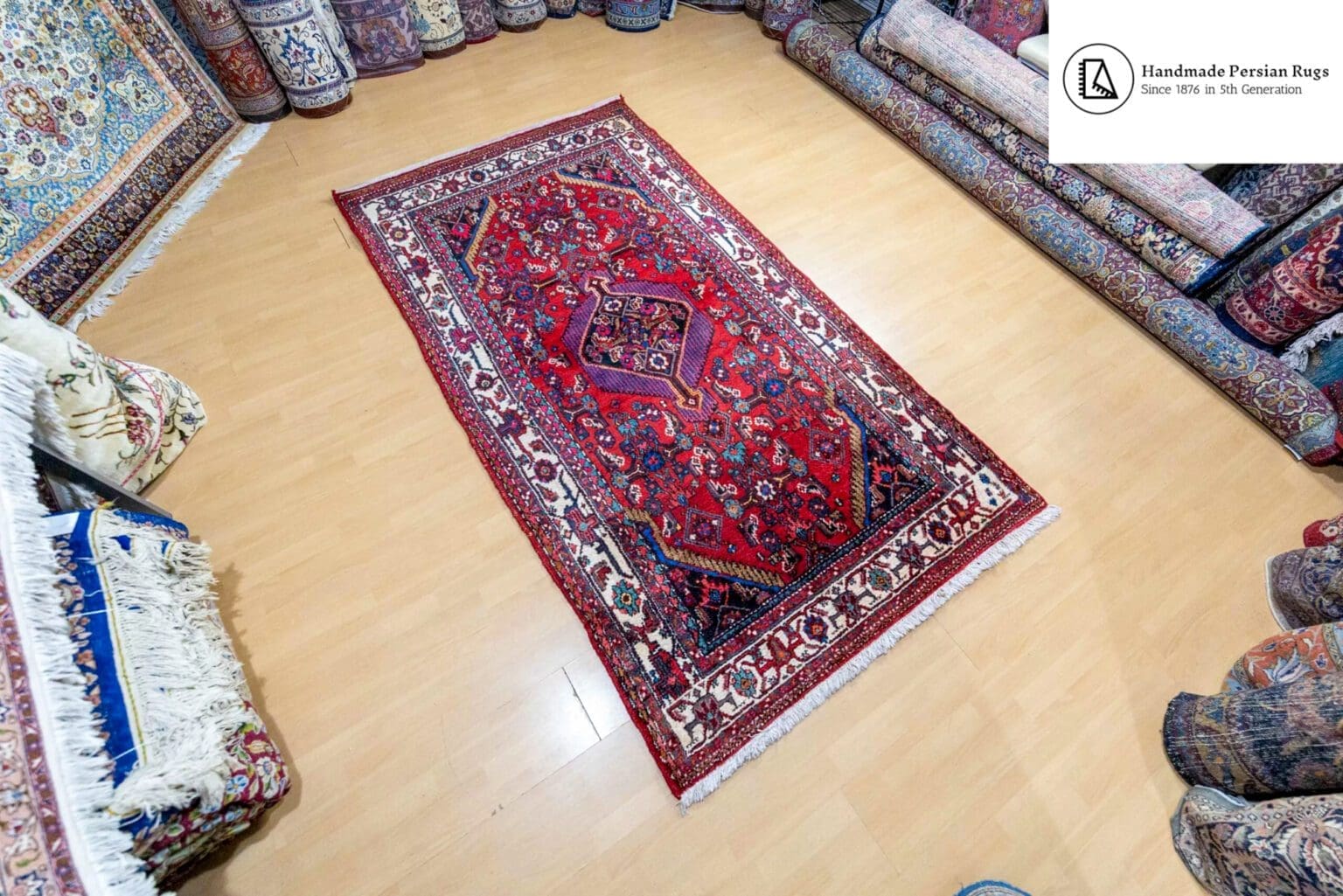
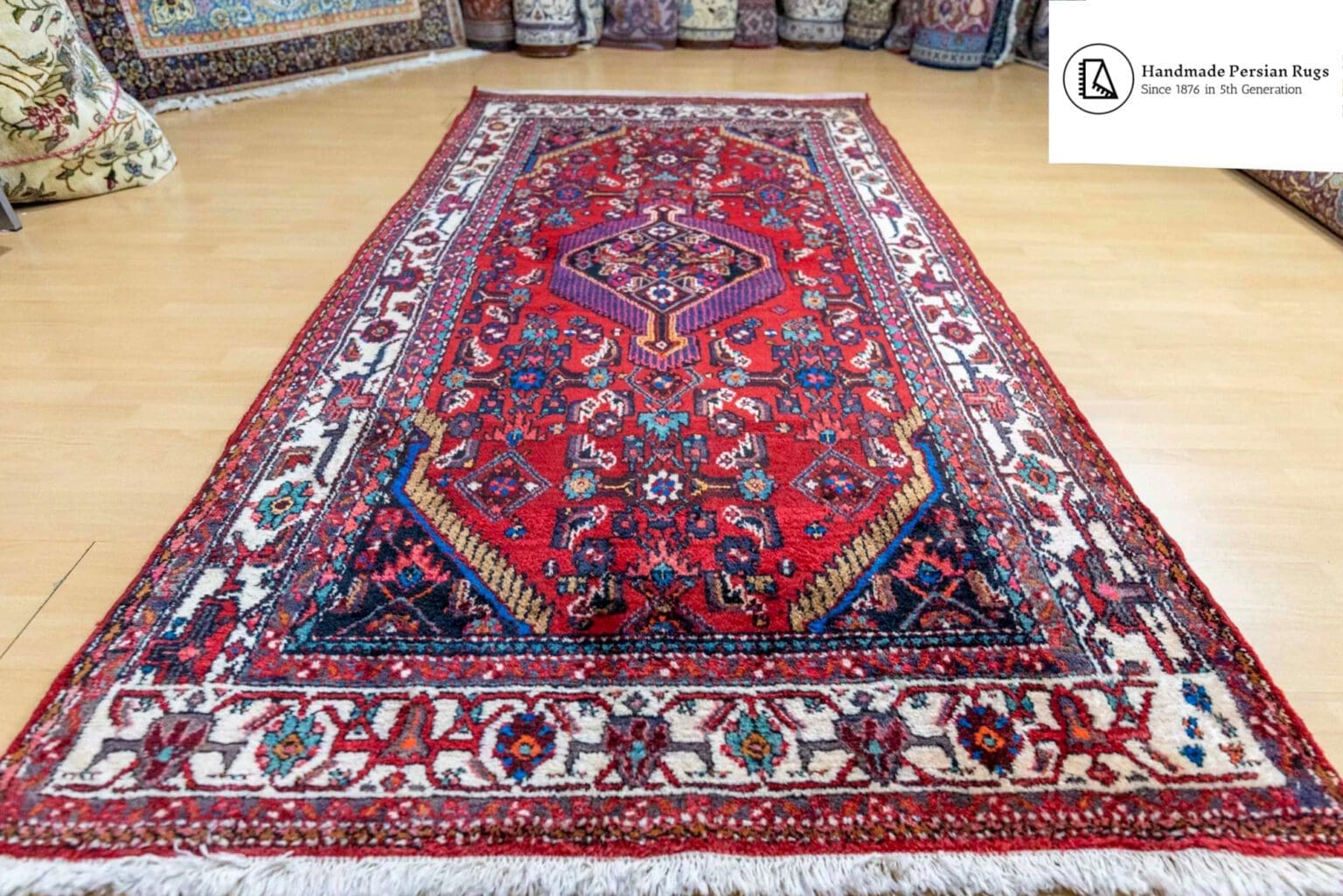
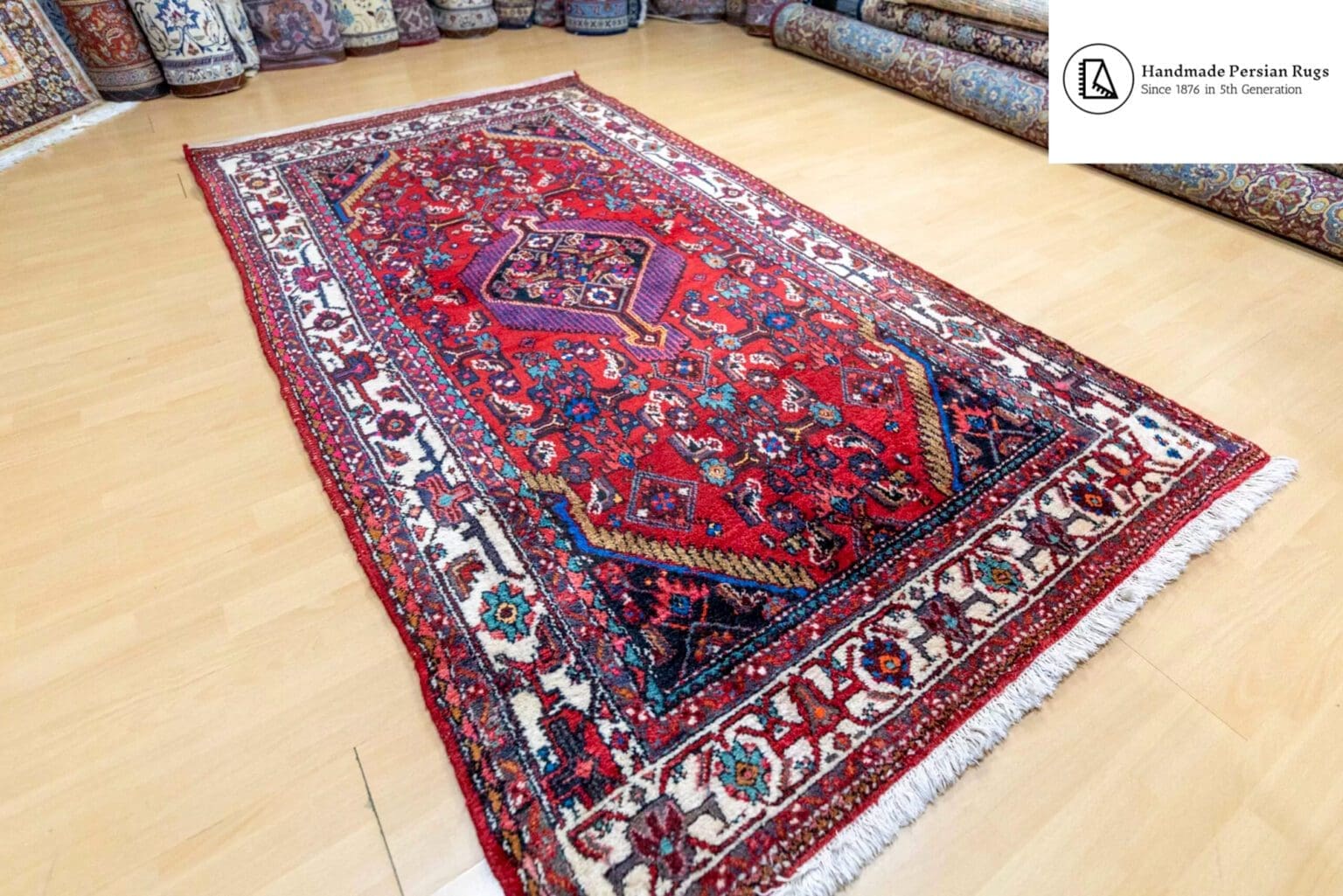
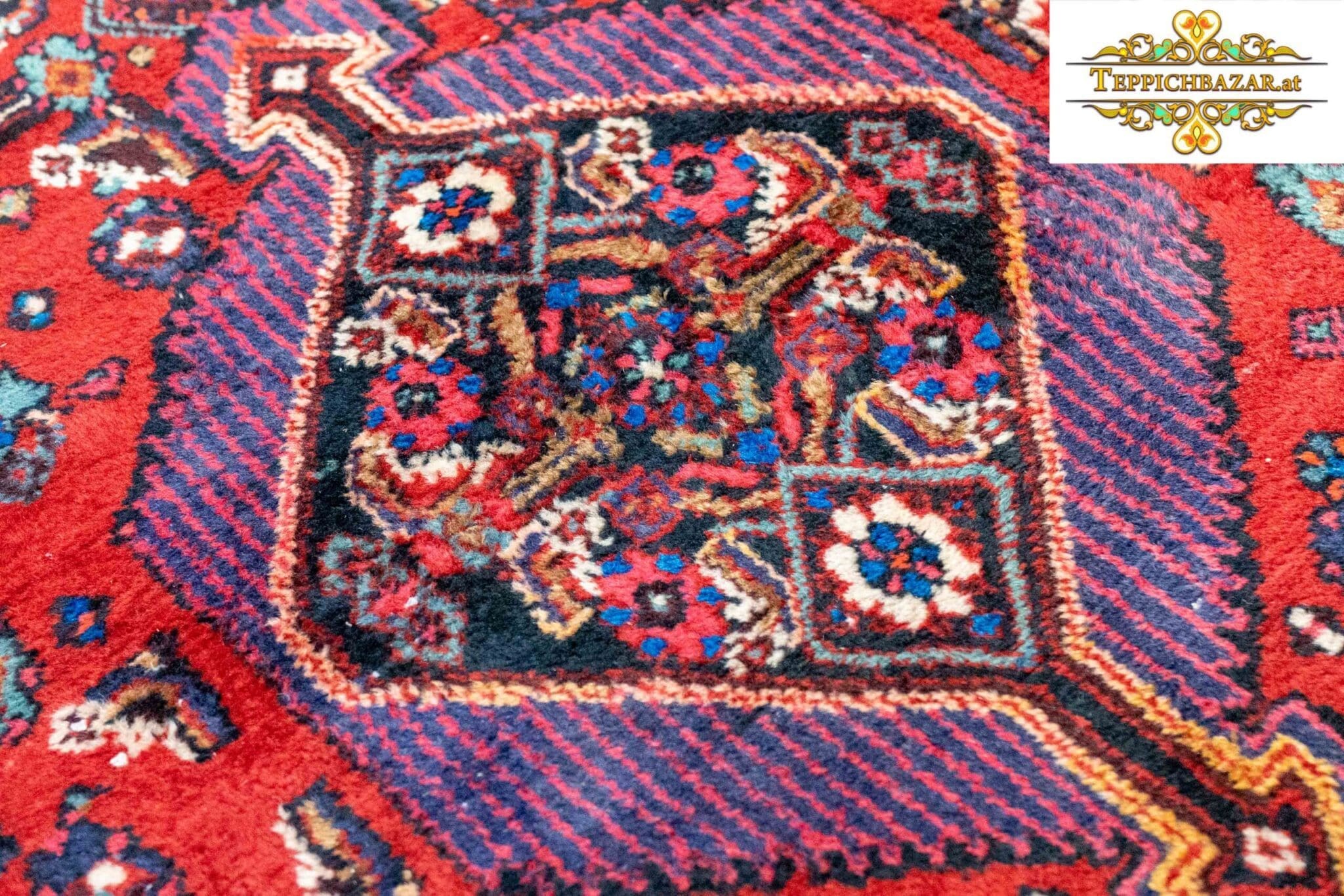
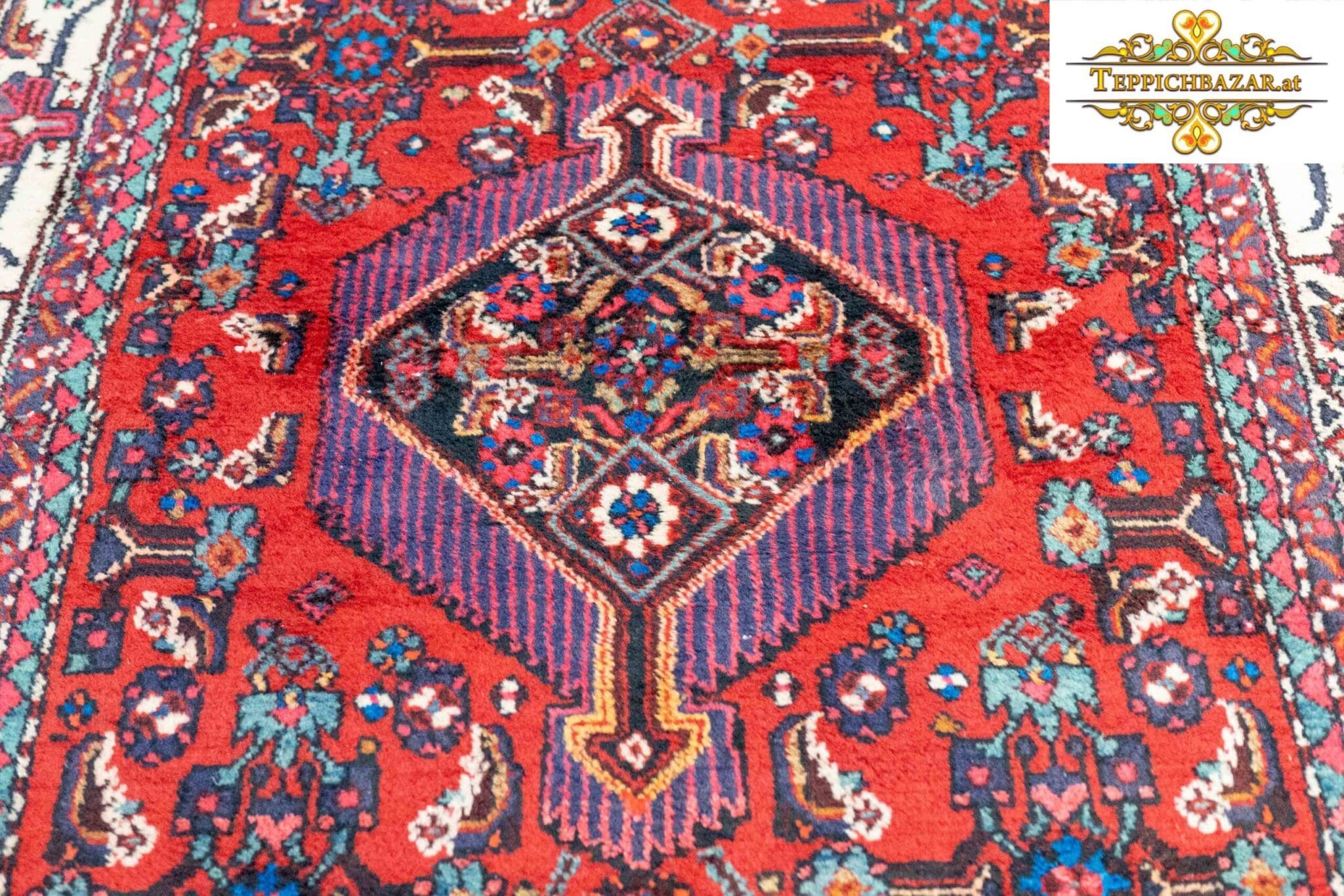
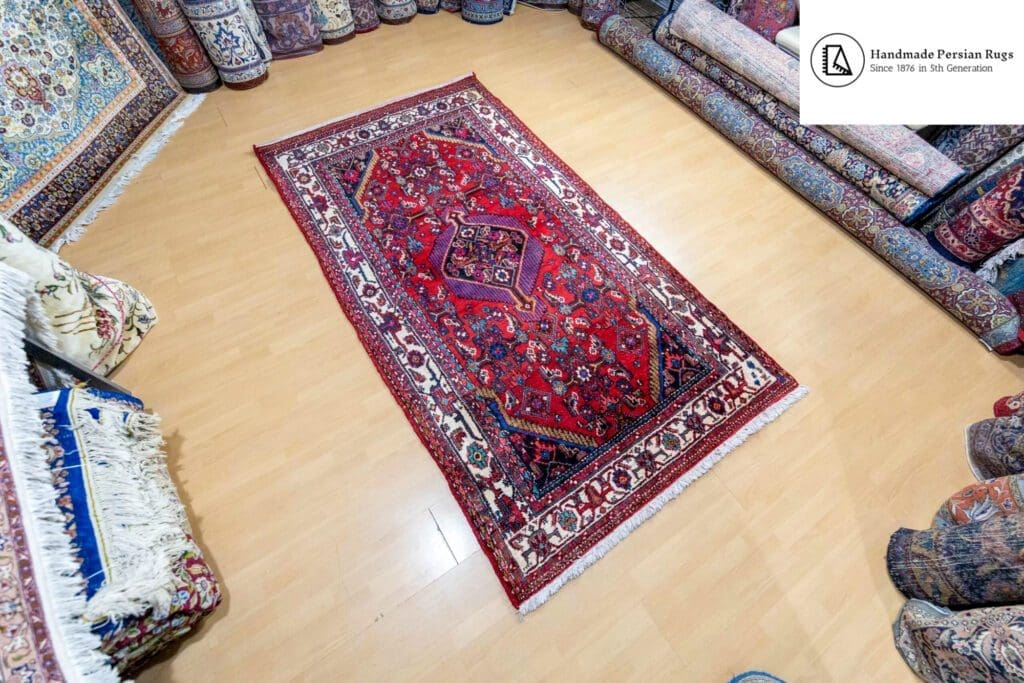
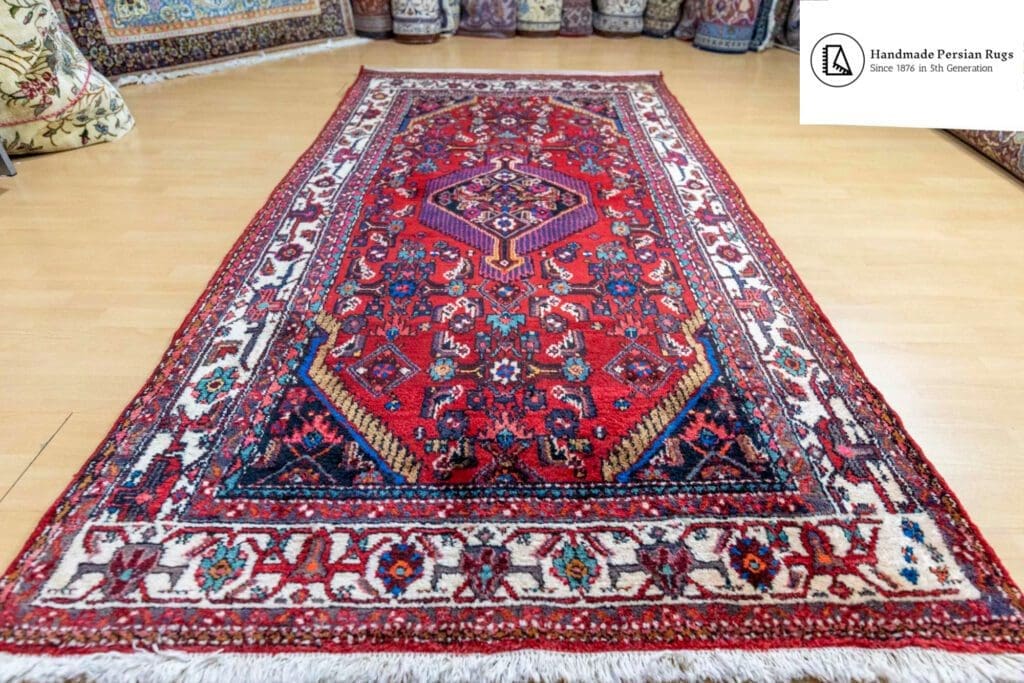
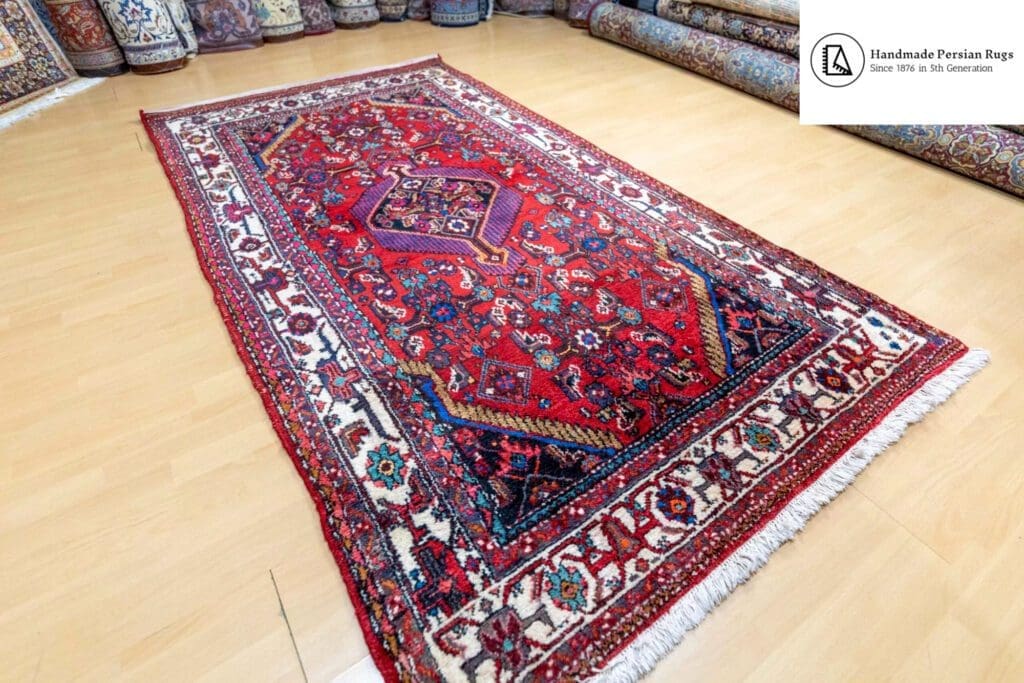
The pattern of this rug is a symmetric floral medallion. A medallion composition places a central ornamental form at the heart of the field, while symmetry gives the arrangement a balanced relationship from one side to the other. Floral decoration introduces leaves, blossoms, stems or related botanical forms into the design language. Together, these elements create a structured pattern in which the central focus and the surrounding ornament are read as parts of one composition.
Symmetry has a long role in Persian carpet design. It can organise the field, clarify the relationship between the centre and the borders, and help the weaver maintain a coherent drawing while working knot by knot. Symmetry does not require every small detail to be mechanically identical. In hand-knotted textiles, repeated forms may show the slight variations that result from manual execution, while the overall balance of the design remains clear.
Floral motifs in Persian rugs are part of a broad decorative vocabulary. They can be highly formalised rather than direct copies of plants, with petals, leaves and scrolling stems arranged according to the needs of the field. A floral medallion may therefore combine recognisable botanical references with geometry and repetition. The design is ornamental, but its structure also serves a technical purpose: repeated units and balanced spacing provide a visual plan for the weaving process.
Medallion rugs are found in several Persian weaving traditions and should not be treated as exclusive to one town. Their appearance can change according to the region, the workshop, the scale of the field, the treatment of the borders and the balance between open ground and ornament. In Hamedan production, as in Persian weaving more generally, regional design knowledge can be interpreted in different ways. The precise description of this rug remains a symmetric floral medallion, without adding a more specific motif or colour scheme that is not stated.
The broader Hamedan design vocabulary is often described as including both geometric and floral forms. This range reflects the exchange between local weaving practices and the wider Persian design tradition. A central medallion gives the composition a clear focal point, while floral elements soften and elaborate the surrounding structure. The result is a design that can be understood through its organisation rather than through an invented colour or border description.
Pattern names are useful because they summarise the visual structure of a rug, but they do not replace its origin. Here, Hamedan identifies the Persian source region and symmetric floral medallion identifies the design. Keeping those two descriptions distinct gives a more accurate account of the piece and of the regional tradition in which it was made.
Special Features
The individual features recorded for this rug are its Hamedan origin in Persia, hand-knotted construction, 100% virgin wool pile, 100% cotton warp, a knot density of 120000-125000 knots per square metre, and a symmetric floral medallion pattern. Its condition is very good, and it has been professionally washed. These details describe the rug as a particular textile rather than as a generic example of Hamedan production.
The combination of a wool pile and cotton warp makes the construction easy to distinguish in material terms. The knot density adds technical information about the compactness of the knotted surface, while the pattern identifies the arrangement visible in the field. Origin, material, construction, condition and design each answer a different question about the rug and should be considered together.
Hamedan rugs are valued within Persian rug culture for the relationship between practical construction and regional design. The present rug expresses that relationship through a manually made surface, a traditional floral medallion arrangement and materials associated with Persian hand-knotting. Its professionally washed, very good condition is part of its current presentation.
FAQ
Where does this Persian rug come from?
This rug comes from Hamedan in Persia. Hamedan is a historic Persian weaving centre with a broad regional tradition rather than one single fixed pattern. Its rugs can include floral and geometric compositions, and the regional name refers to the place of production. The pattern of this individual piece is a symmetric floral medallion, while its origin is Hamedan.
What materials are used in the rug?
The pile is made from 100% virgin wool and the warp is made from 100% cotton. The wool forms the visible knotted surface, while the cotton provides the foundation around which the knots are arranged. The rug is hand-knotted, and its recorded knot density is 120000-125000 knots per square metre.
What is the condition of the rug?
The rug is in very good condition and has been professionally washed. These statements describe the condition of this individual Hamedan Persian rug. Professional washing concerns its preparation and presentation, while the hand-knotted construction, wool pile, cotton warp and floral medallion describe how it was made and designed.
To provide the best experiences, we use technologies like cookies to store and/or access device information. Consenting to these technologies will allow us to process data such as browsing behavior or unique IDs on this site. Not consenting or withdrawing consent, may adversely affect certain features and functions.
Functional Always active
The technical storage or access is strictly necessary for the legitimate purpose of enabling the use of a specific service explicitly requested by the subscriber or user, or for the sole purpose of carrying out the transmission of a communication over an electronic communications network.
Preferences
The technical storage or access is necessary for the legitimate purpose of storing preferences that are not requested by the subscriber or user.
Statistics
The technical storage or access that is used exclusively for statistical purposes.The technical storage or access that is used exclusively for anonymous statistical purposes. Without a subpoena, voluntary compliance on the part of your Internet Service Provider, or additional records from a third party, information stored or retrieved for this purpose alone cannot usually be used to identify you.
Marketing
The technical storage or access is required to create user profiles to send advertising, or to track the user on a website or across several websites for similar marketing purposes.

 SECURE PAYMENT
 SHIPPING PARTNERS


