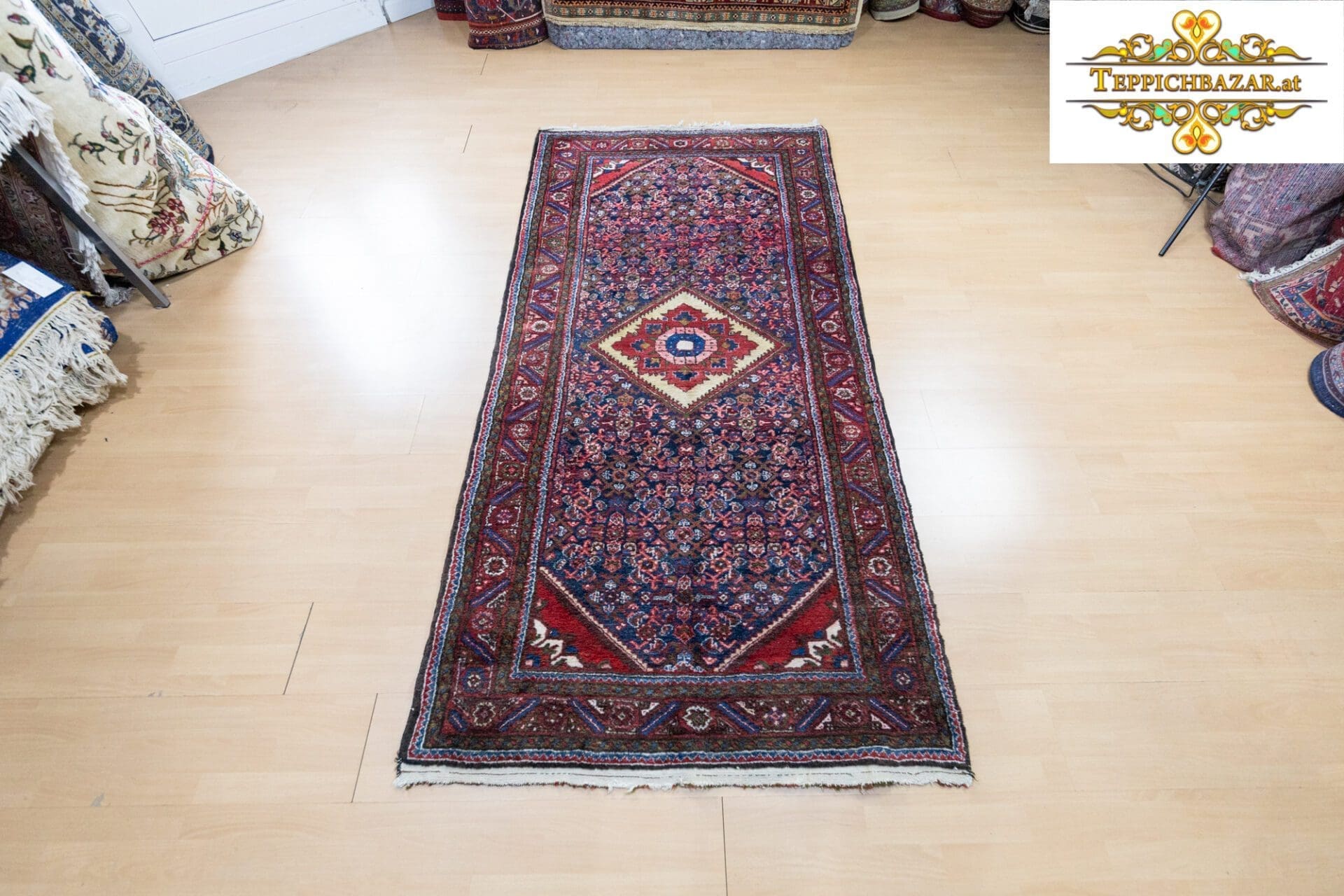
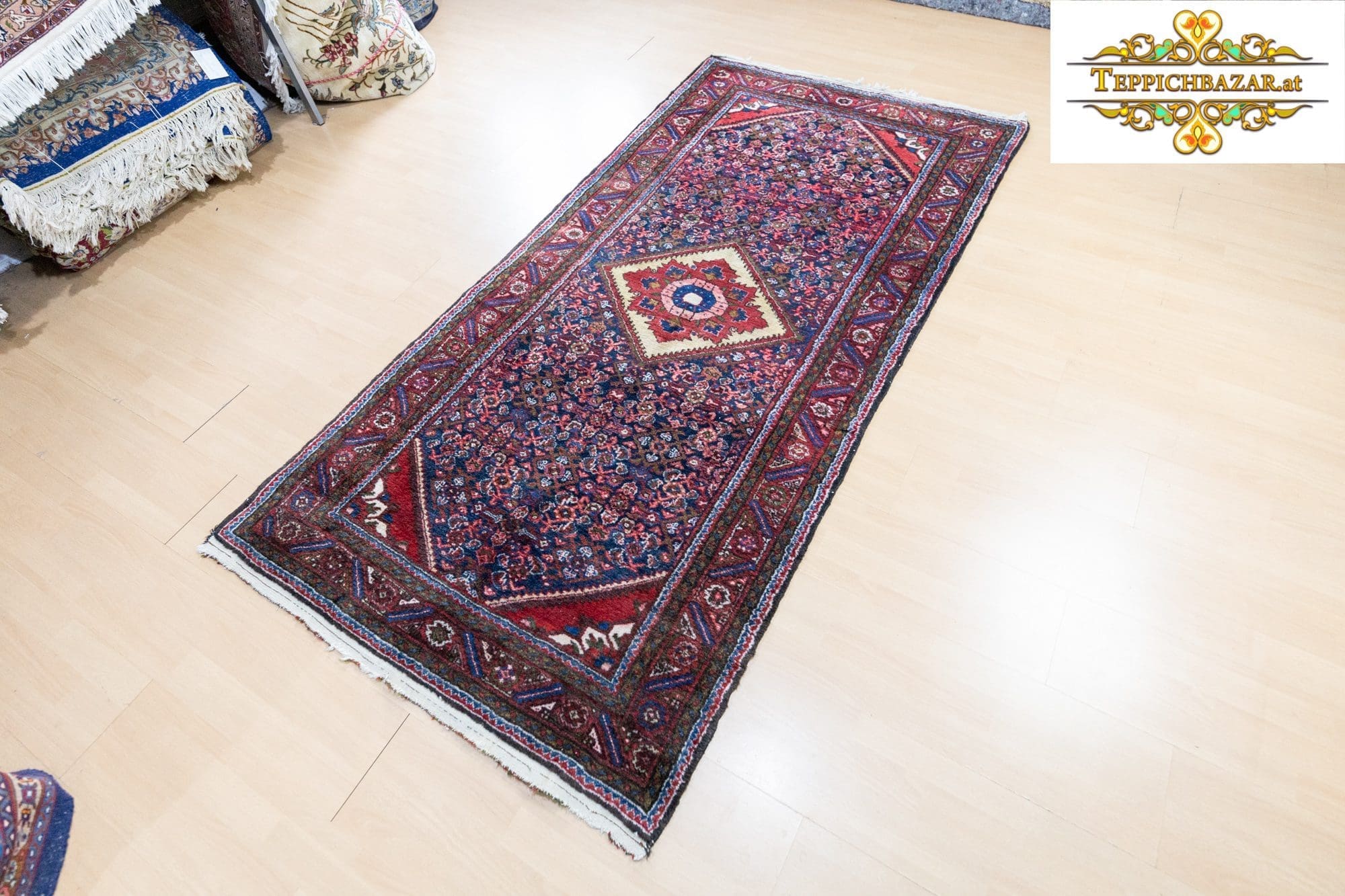
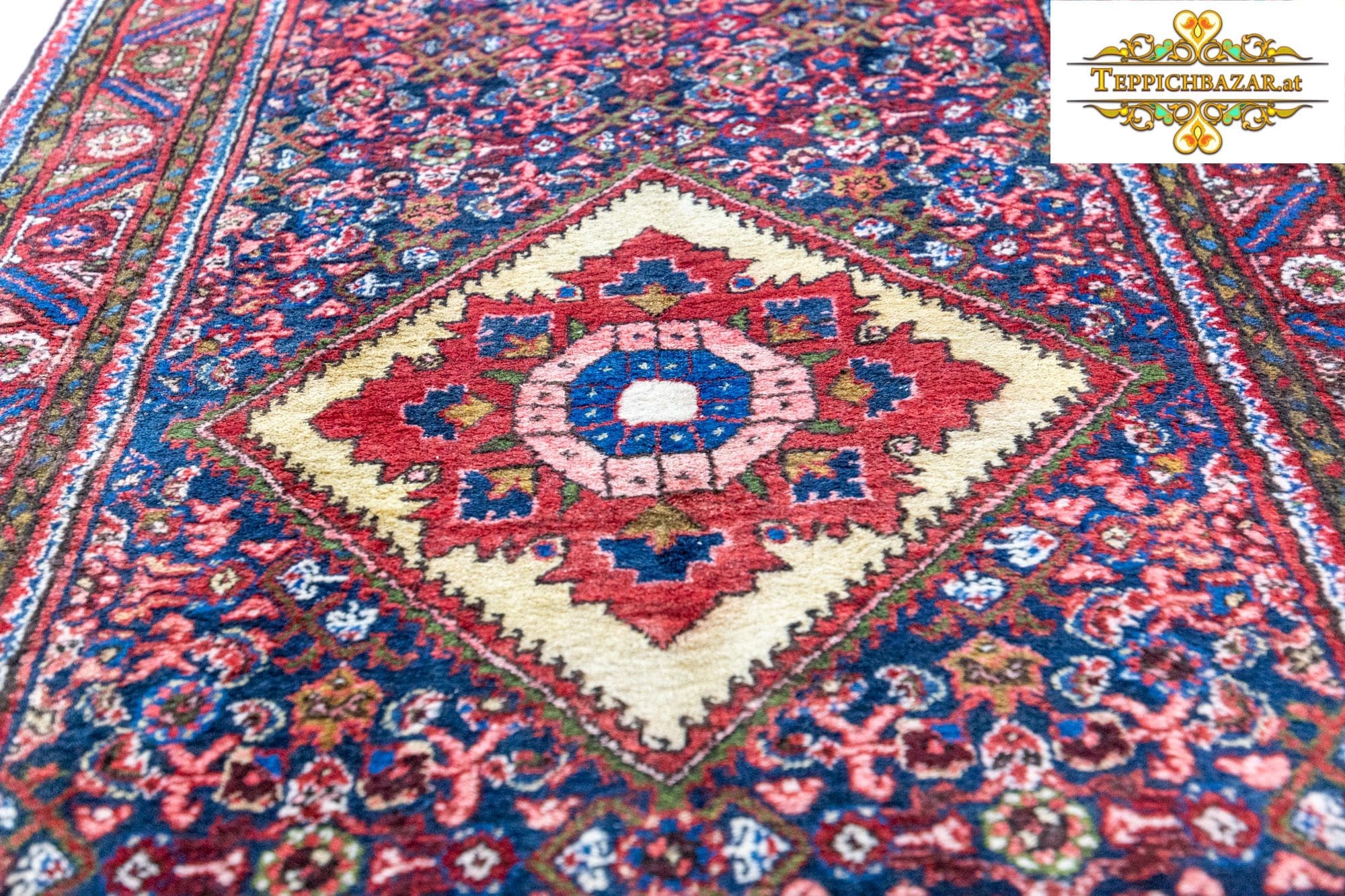
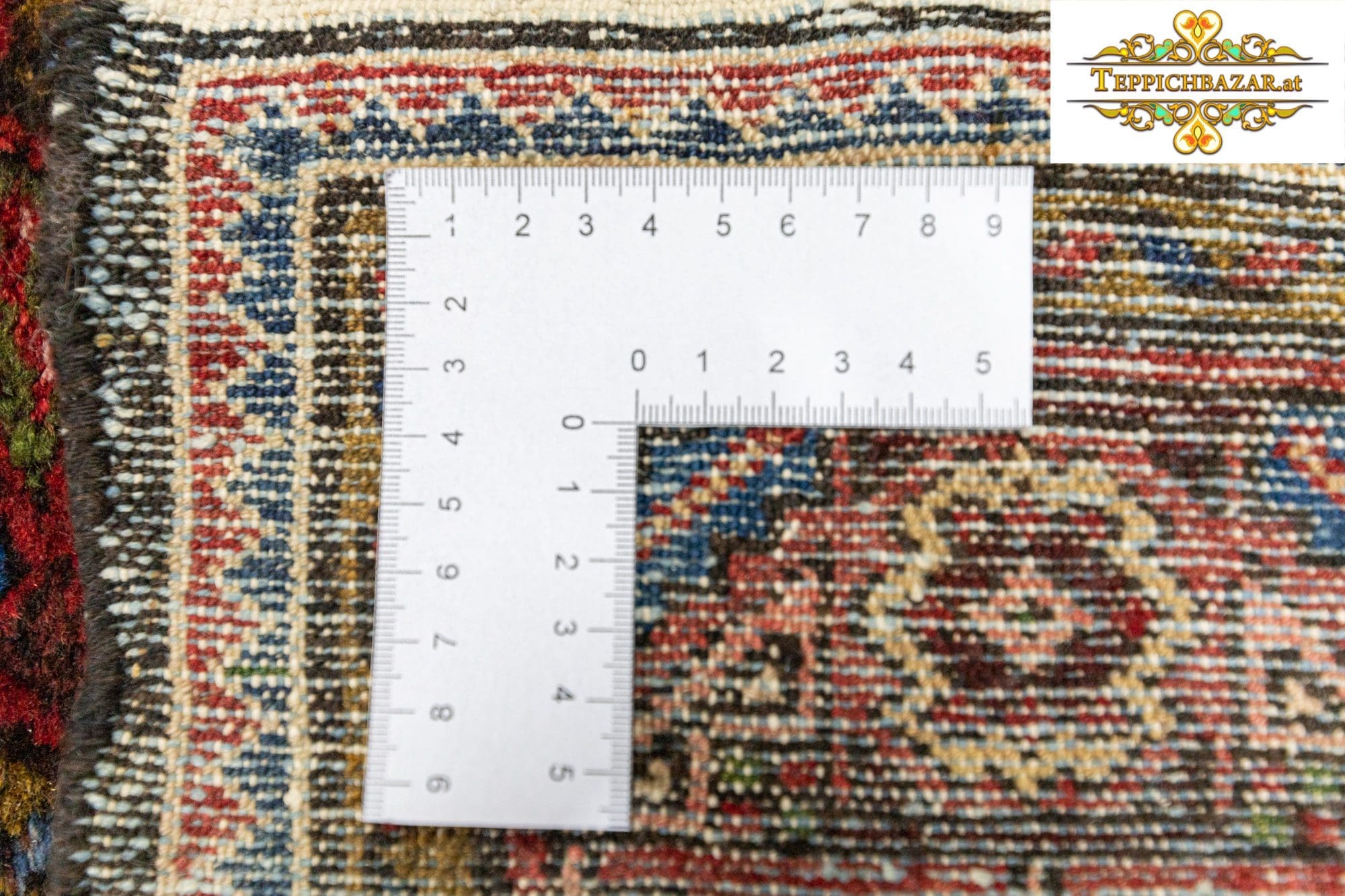
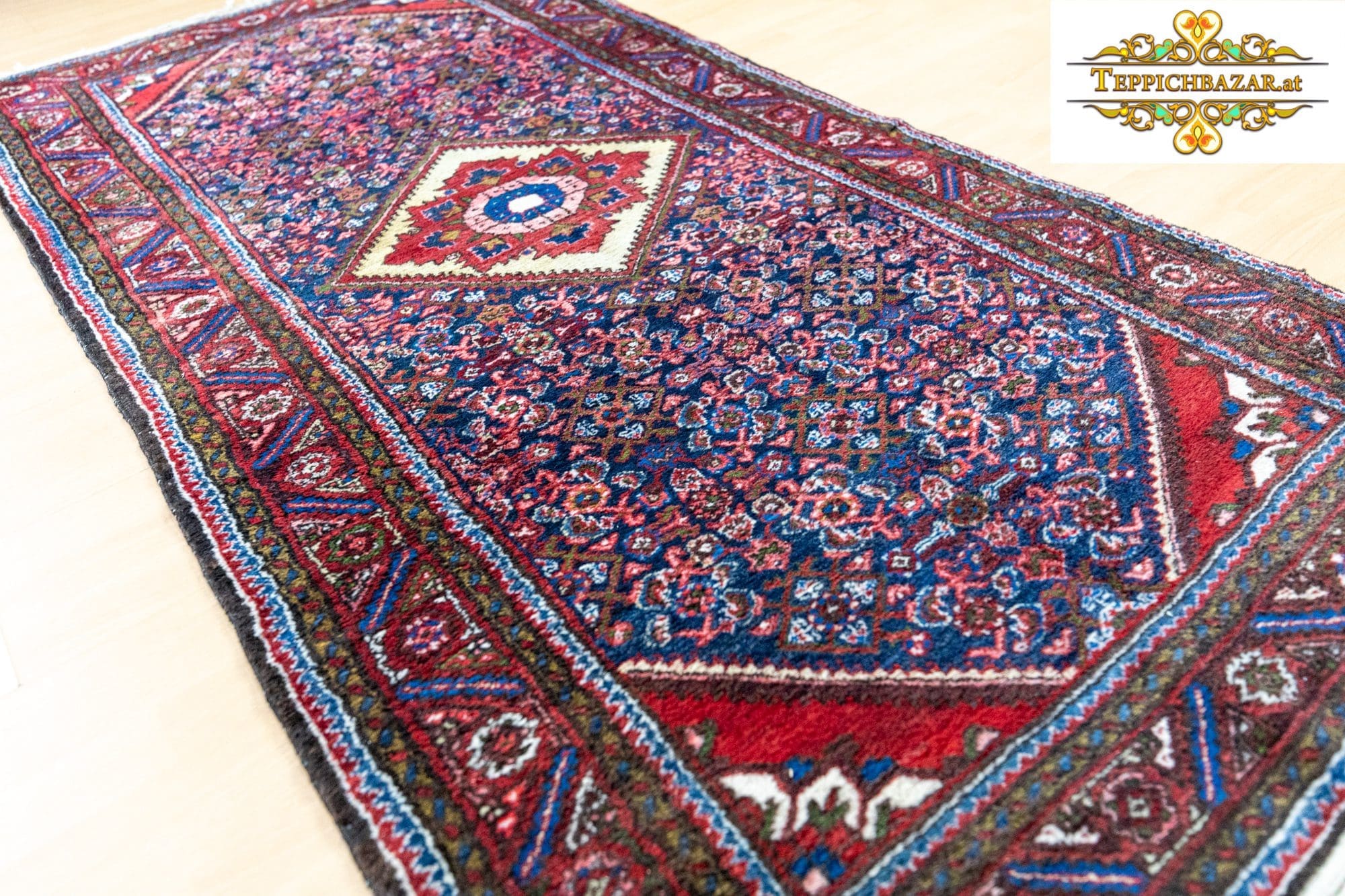
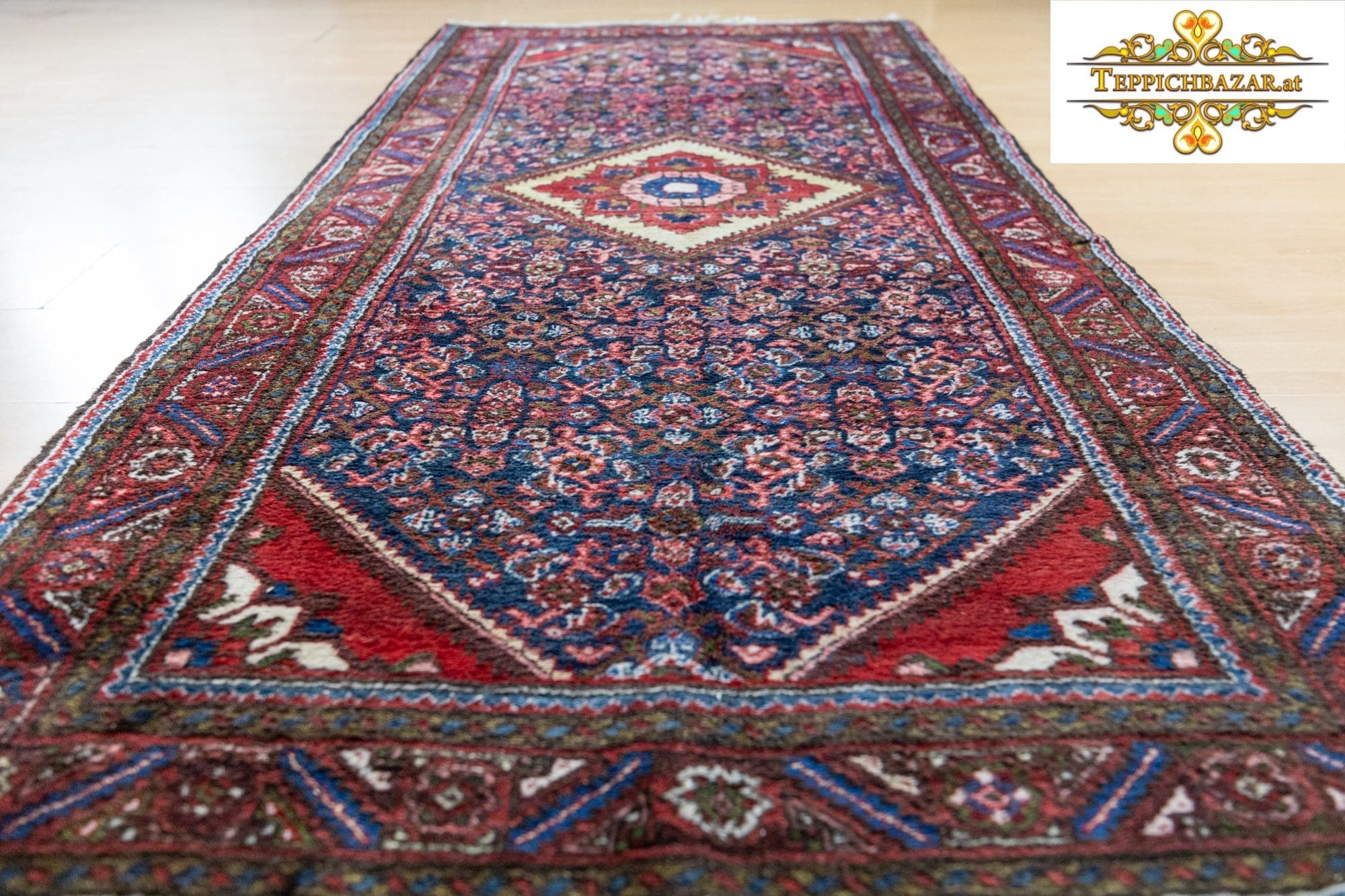
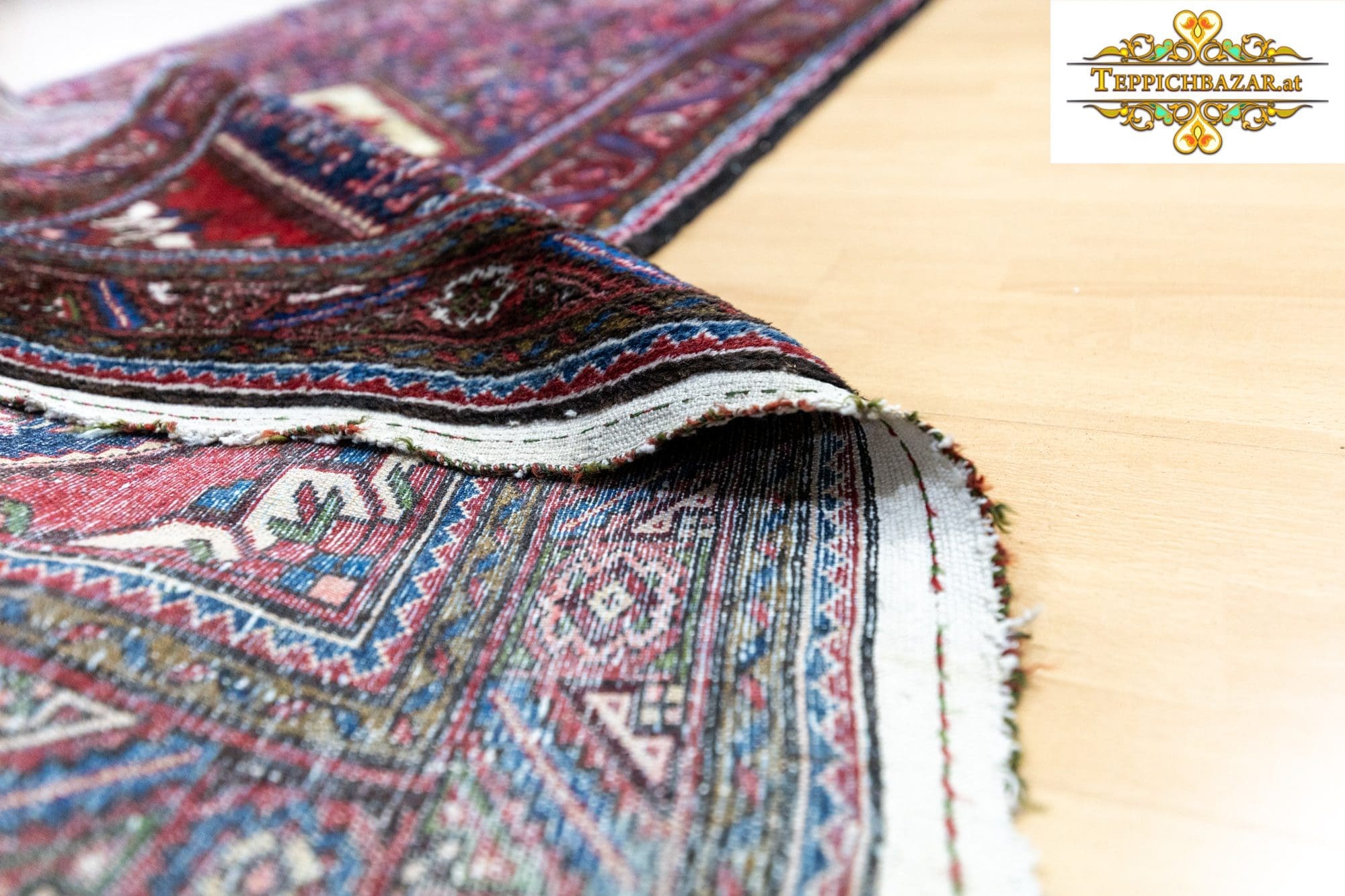
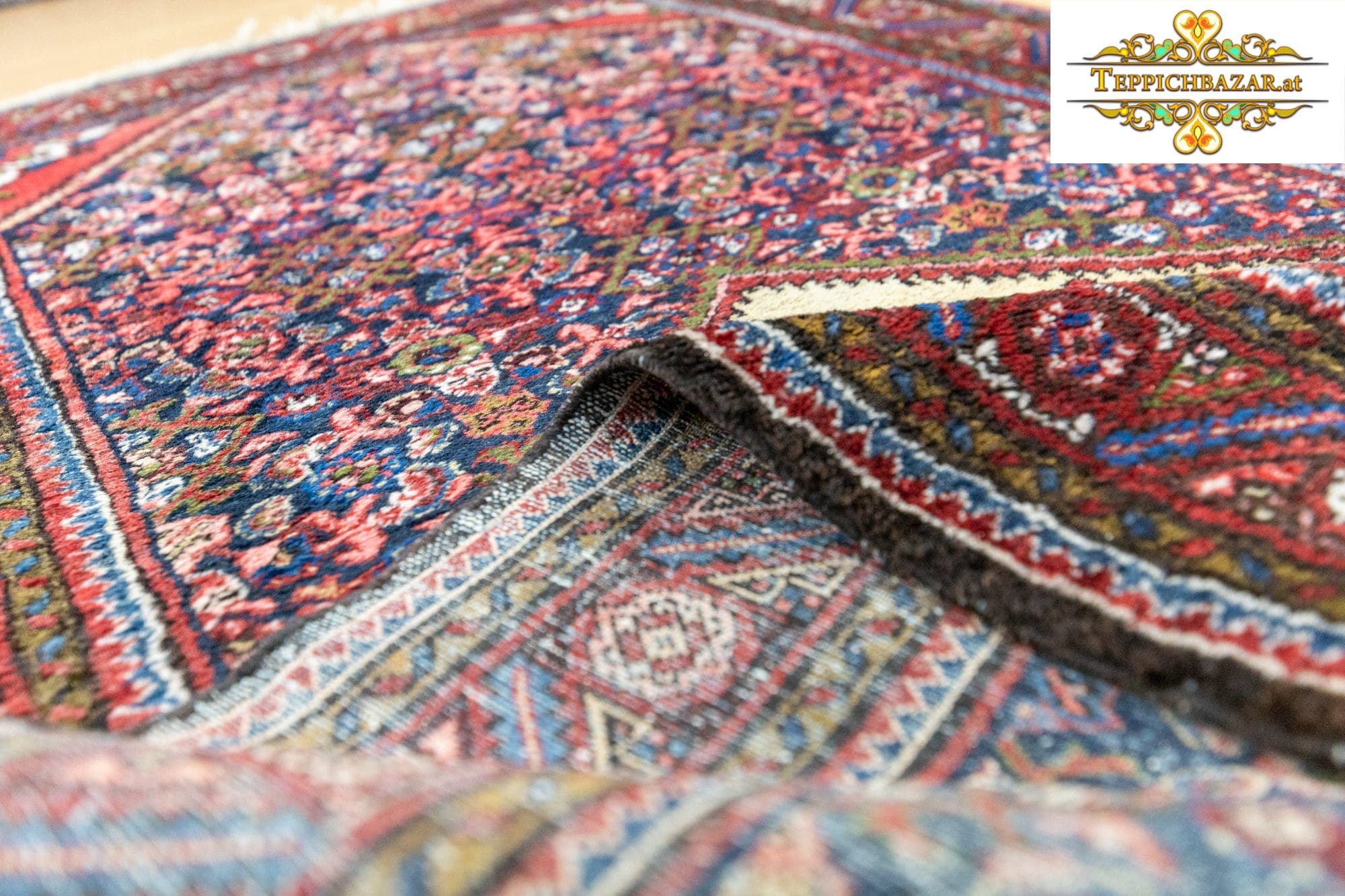
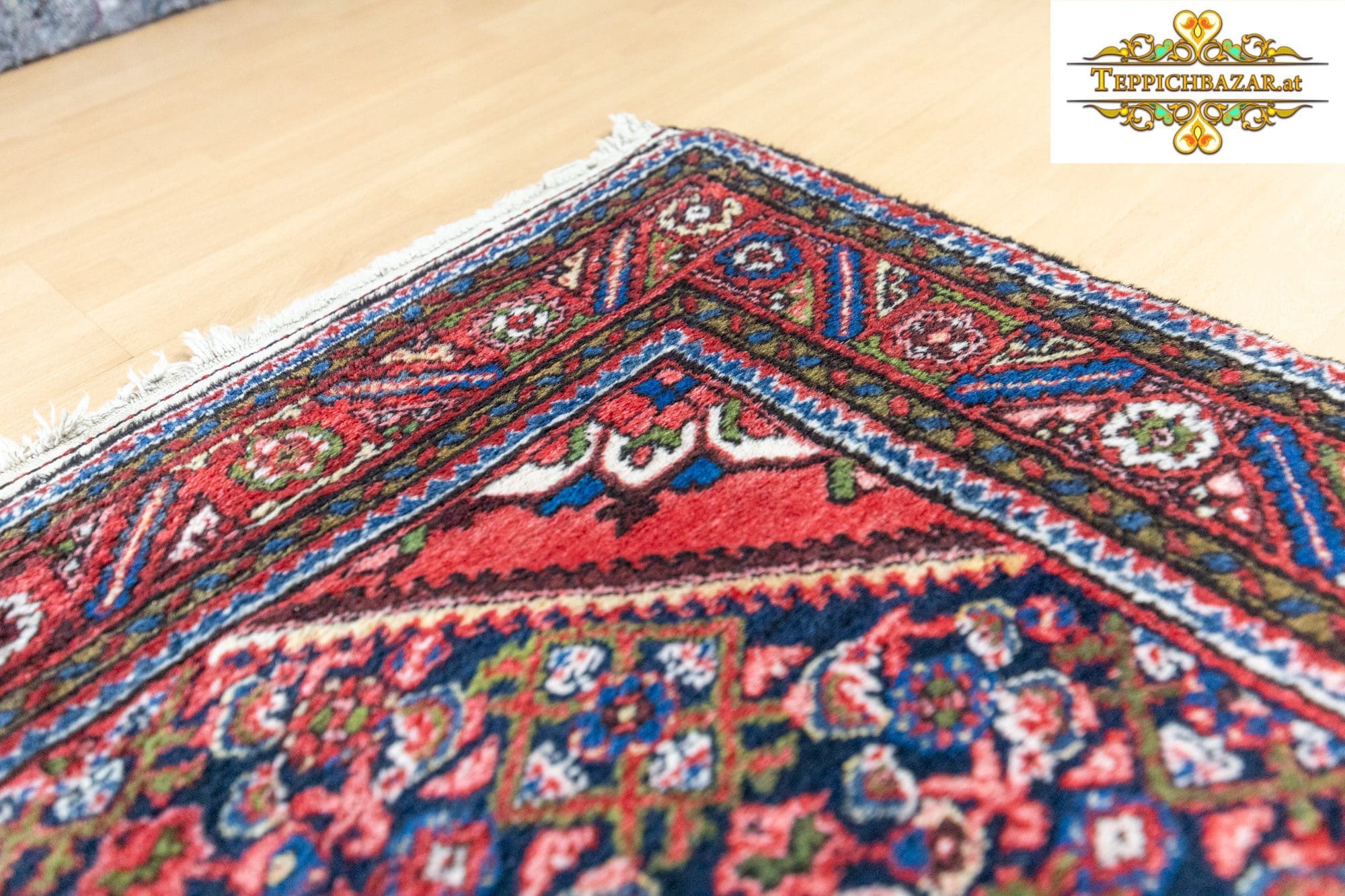
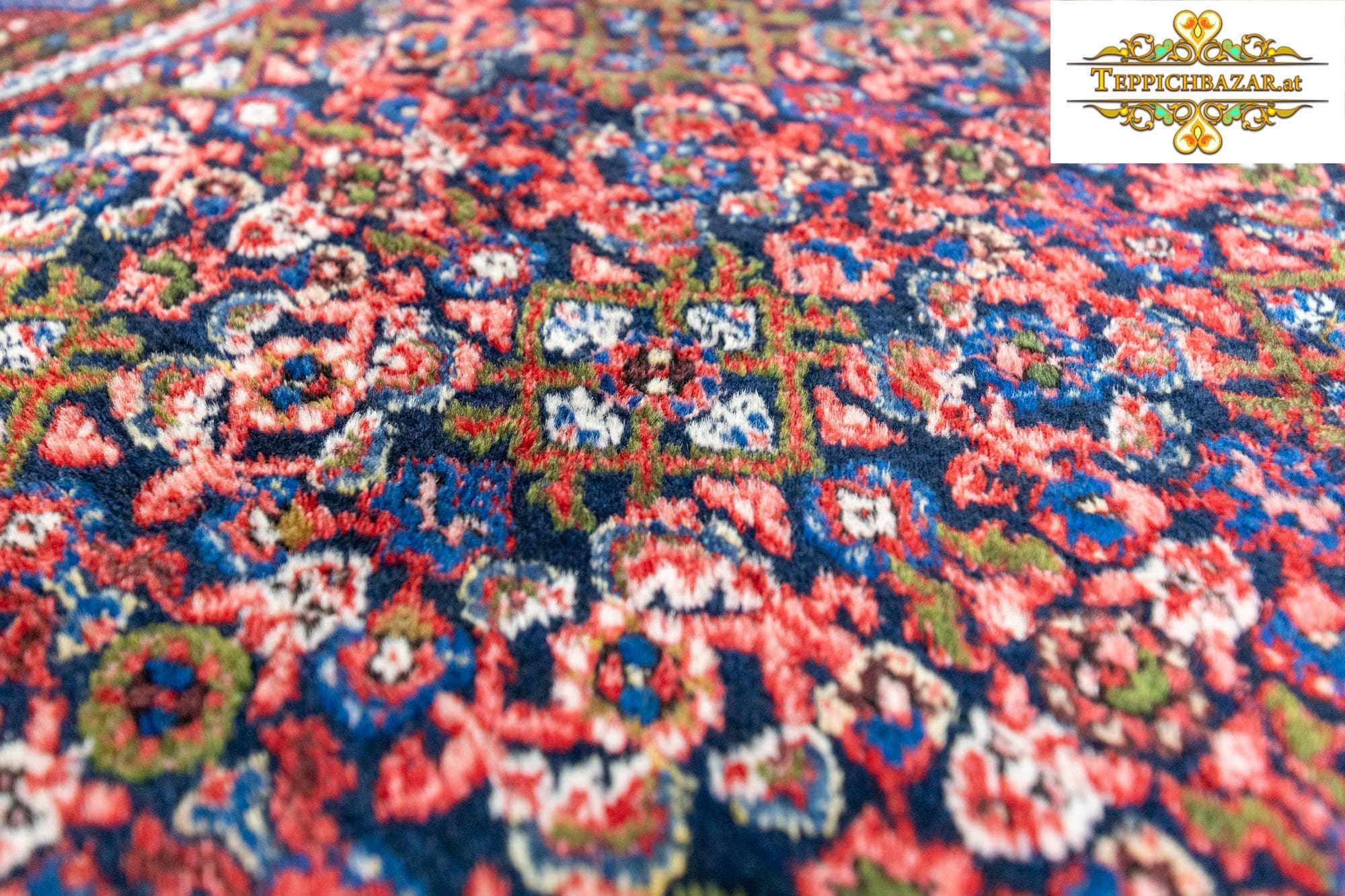
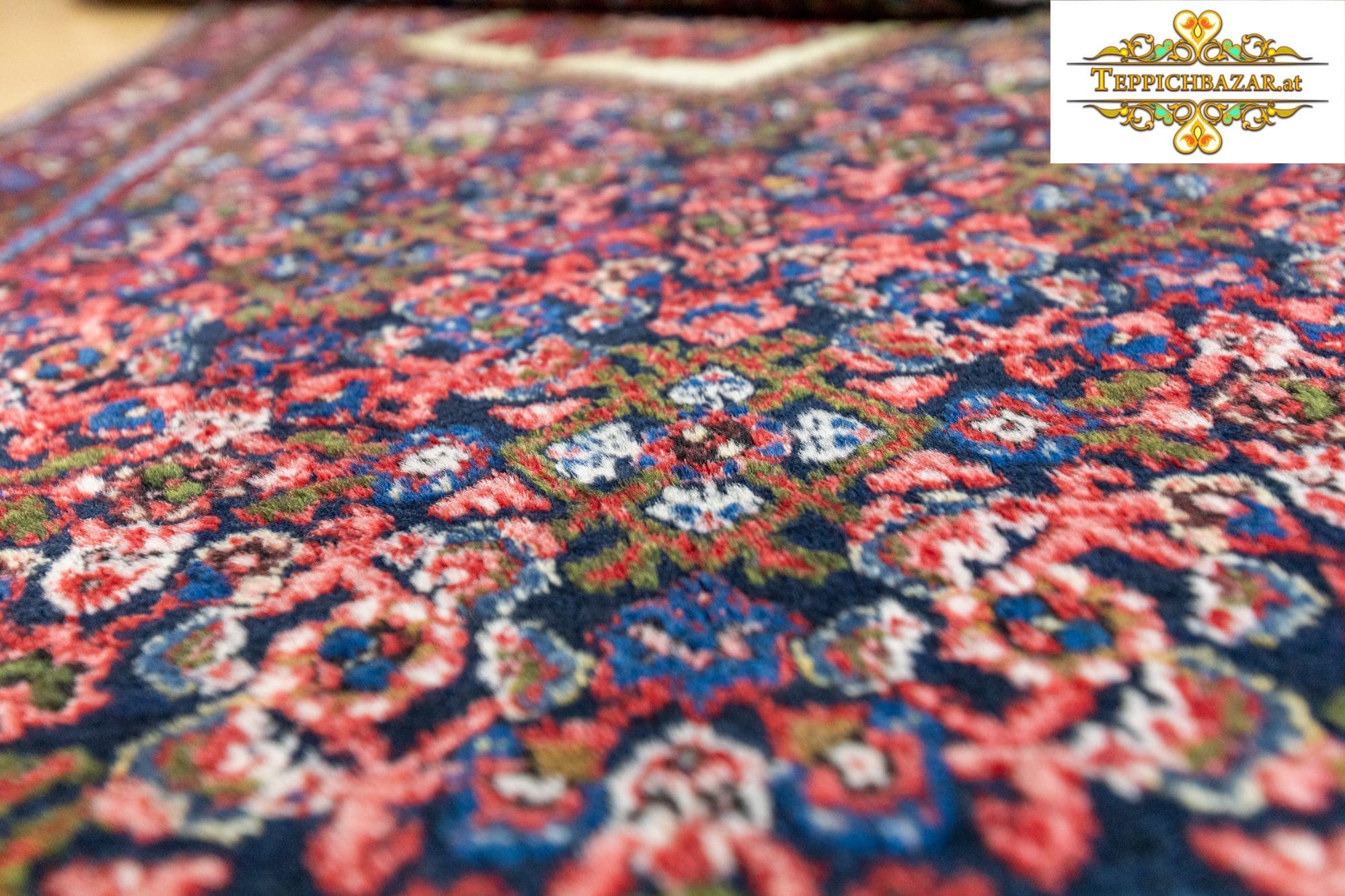
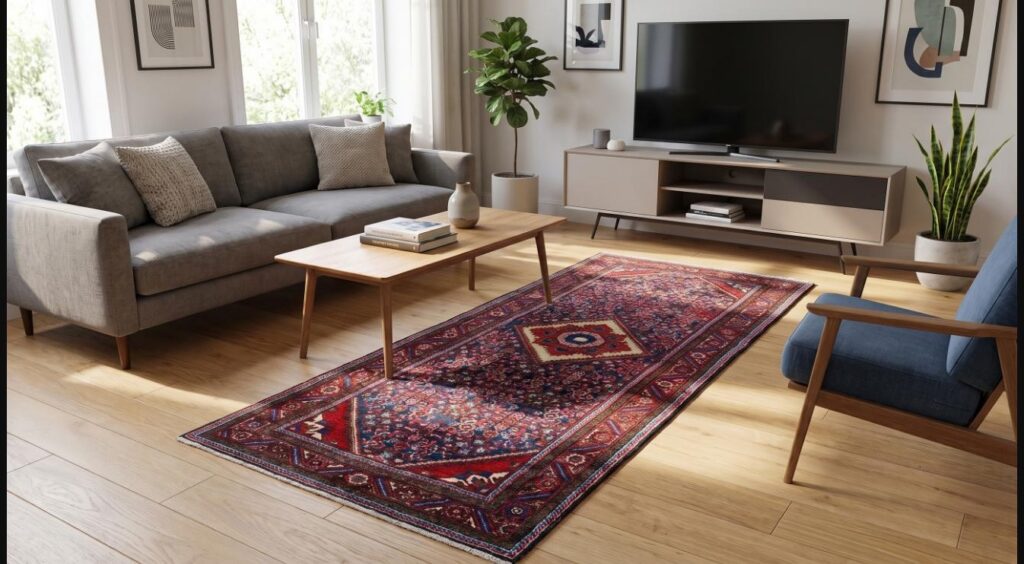
Hand-knotted Hamedan Persian rug | Knot density: 160000/Qm | Material: 100% wool pile, 100% cotton warp | Size: 223 x 112 cm | Pattern: Symmetrical fish in a rare colour | Condition: Very good, patina on the fringes, professionally washed
This Hamedan Persian rug is hand-knotted. Its pile is made from 100% wool, while the warp is made from 100% cotton. These two materials perform different roles within a knotted rug. The warp forms the underlying framework, and the wool is tied into knots to create the visible surface. Wool has long been used in rug making because it offers a resilient fibre with a naturally comfortable handle. Cotton provides the warp with a distinct foundation for the rows of knots and the woven structure that secures them.
The knot density of this rug is 160000/Qm. Hand-knotting is a gradual process in which the design is built one knot at a time on the loom. The weaver must maintain an even relationship between the warp, the weft and the pile while also following the intended drawing. Colour fields, outlines and repeated shapes are formed as the work progresses. This differs from a mechanically reproduced surface: the rug is assembled through a sequence of manual operations, with the pattern developing across the woven foundation.
The wool pile gives the rug its visible textile character, while the cotton warp belongs to the internal construction. Together they represent a traditional material combination in hand-knotted Persian rugs. The stated materials describe this individual piece: the pile is entirely wool and the warp entirely cotton. Its construction is therefore defined by hand-knotting, a wool surface and a cotton foundation rather than by machine production.
Origin and Tradition
The rug comes from Hamedan in Persia. Hamedan is one of the historic centres associated with Persian rug making and is also an old cultural city in western Persia. Its regional position connected urban workshops, village production and the needs of surrounding communities. This setting helped create a varied weaving tradition in which rugs could combine practical use with carefully organised ornament.
Hamedan rug making is rooted in knowledge passed through generations. That knowledge includes preparing the loom, arranging the warp, handling wool, maintaining tension and translating a drawn design into rows of knots. A pattern is not applied to a finished cloth after the fact. It is created during the making of the rug, as each section is added and the relationship between the forms is maintained. The craft therefore requires both manual precision and a continuing understanding of the overall composition.
Hamedan has a long history beyond the weaving of rugs. As a regional centre and a place of trade, it participated in the movement of goods, techniques and visual ideas. Such exchanges helped Persian weaving develop a broad vocabulary rather than a single unchanging style. Hamedan rugs may therefore be associated with geometric structures, floral arrangements and simplified natural forms. The exact drawing can differ from one workshop or village tradition to another, while the broader regional identity remains connected with Hamedan.
The hand-knotted method brings material and design together. Wool becomes the pile that carries the colour and the touch of the finished surface. Cotton forms the warp that supports the construction. The knotting process turns the planned motif into a durable textile object through repeated manual work. This explains why a Hamedan rug can be understood both as a useful floor covering and as an example of regional craft culture. Its origin identifies Hamedan, while its construction reflects the wider Persian tradition of knotting.
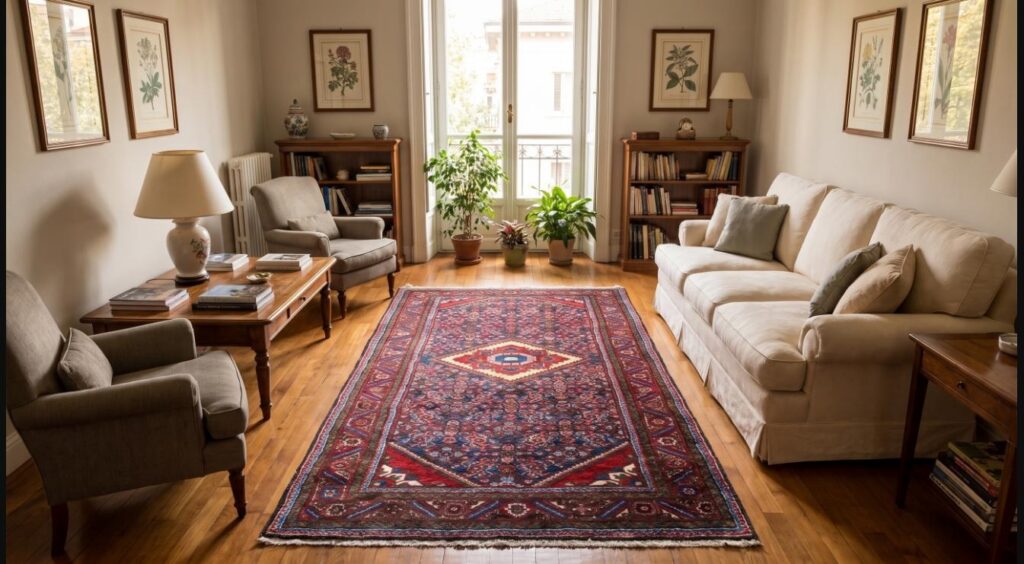
Hamedan rugs are known in a range of formats and with different design arrangements. Some are made for compact areas, while others are intended to occupy a larger part of a room. Regional weaving traditions have consequently developed solutions for varied domestic settings. Colour also differs between individual designs. Warm and earthy palettes are often associated with Hamedan rugs, but the actual appearance depends on the chosen composition and the work of the weaver. This rug is specifically described as having a symmetrical fish pattern in a rare colour.
Design and Pattern
The pattern of this rug is described as a symmetrical fish. Fish forms belong to the group of stylised nature symbols found in Persian and wider Oriental ornament. They are not necessarily intended as naturalistic drawings. On a rug, a recognisable form is reduced to lines, paired contours, hooks and repeated units so that it can function within a woven composition. The fish idea can remain visible while being transformed into a decorative sign suited to the structure of the textile.
Symmetry gives the motif a measured visual order. Related elements may face one another, mirror each other across an axis or appear in balanced pairs. This kind of arrangement gives the eye a point of reference and helps the design retain coherence across the surface. In rug design, symmetry can also connect a central form with surrounding details, borders or repeating intervals. The motif is not separate from the rest of the composition; it is organised so that the surrounding space supports its shape.
Fish imagery in Persian design can carry associations with water, movement, fertility or the life of a garden, depending on the context in which it appears. These are general cultural readings of the motif and do not assign an additional provenance or story to this particular rug. What is specific here is the stated design: the fish is symmetrical, and its colour is described as rare. The wording identifies the visual character without adding a colour name that is not given.
Hamedan design traditions encompass more than one type of ornament. Geometric figures establish edges, divisions and repeated rhythms. Floral forms can appear as blossoms, leaves, vines or simplified clusters. Natural subjects may be reshaped until they work as signs within a pattern rather than as literal pictures. A fish motif belongs to this broader process of translating observations from nature into an ordered textile language. The result is a design in which recognisable imagery and geometry can coexist.
Colour is experienced through relationships between adjacent shapes. A field can make a motif more visible, a border can contain it, and small contrasting details can define its outline. In this rug, the pattern is identified as having a rare colour, which distinguishes its visual impression without requiring an unsupported colour inventory. The regional background explains how colour and ornament are generally used in Hamedan weaving; the description of this piece remains focused on its symmetrical fish design and its stated rare colour.
Special Features
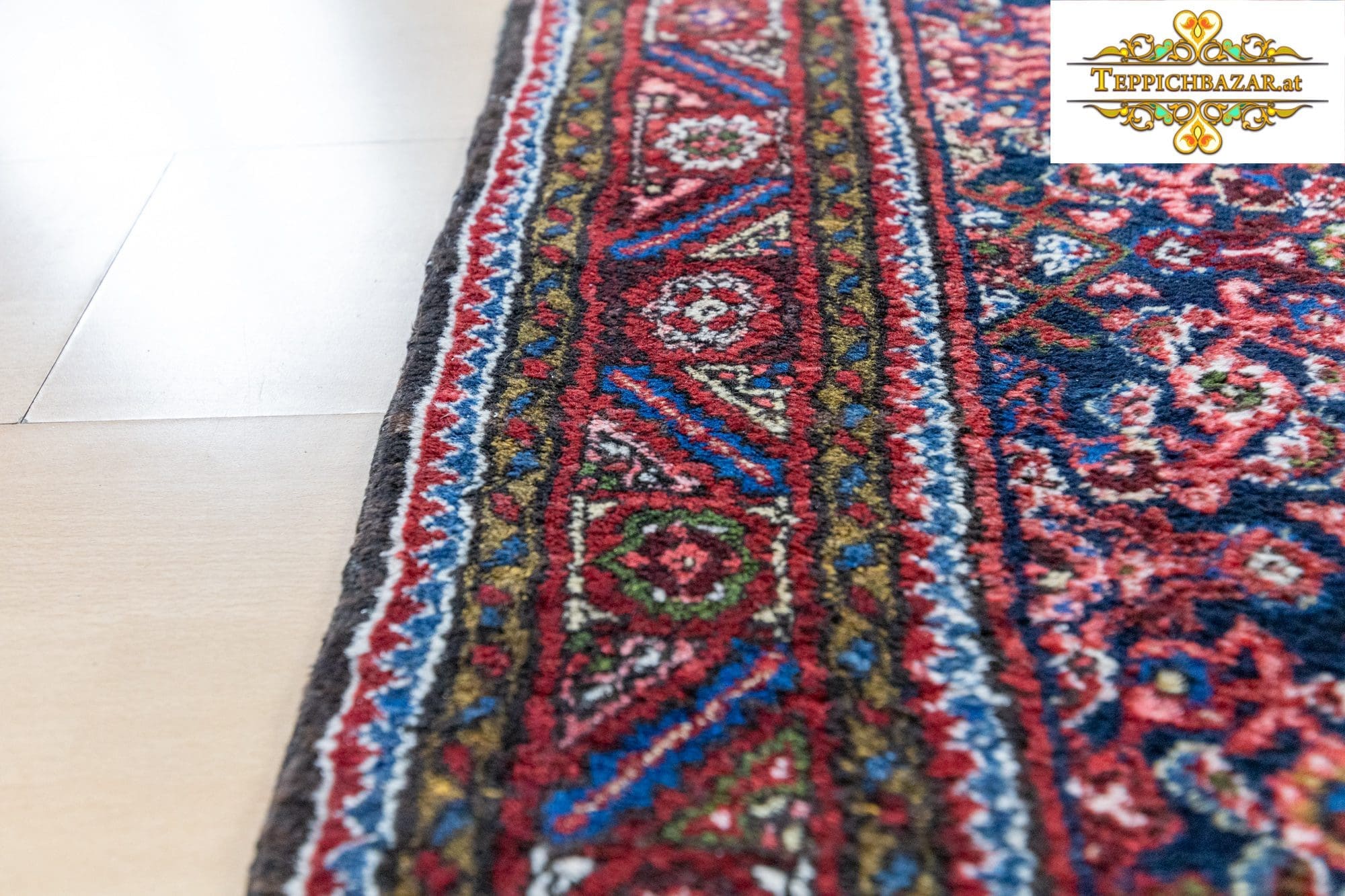
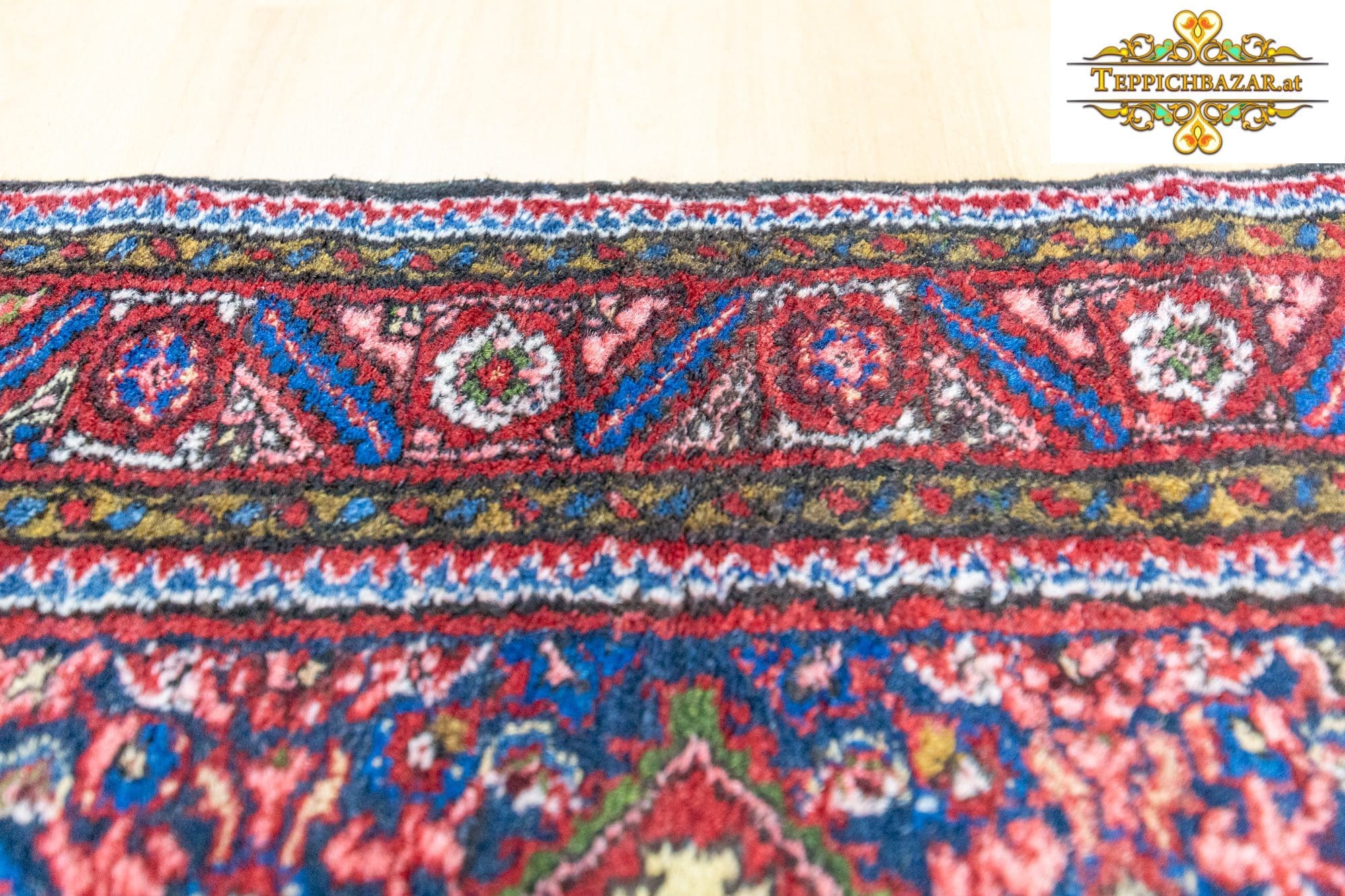
The condition of the rug is described as very good. There is minimal patina on the fringes, and this area is shown in the images. Patina here refers to visible signs of use on a textile, specifically at the fringe area. It should not be turned into a general claim about wear elsewhere on the rug. The fringe is part of the rug’s edge finish and can develop its own surface character through handling, movement and care.
The rug has been professionally washed. Professional washing is carried out with attention to the fibres, colours, pile and structural components of a hand-knotted textile. Cleaning can remove dirt and deposits from the visible pile and from deeper parts of the construction, while the fringe area requires separate care. The combination of very good condition, professional washing and minimal fringe patina states the relevant condition details of this individual rug.
Other defining features are its hand-knotted construction, wool pile, cotton warp and symmetrical fish pattern in a rare colour. These elements work together: the technique creates the structure, the wool forms the visible pile, the cotton supports the foundation and the pattern determines the decorative appearance. No additional condition, age or provenance is assigned beyond these characteristics.
FAQ
Which city is known for producing Hamedan rugs?
Hamedan rugs come from the city of Hamedan in Persia. Hamedan is known for its long history and its tradition of rug making. The region’s craft culture includes hand-knotting, the preparation of textile foundations, the use of wool pile and a broad range of geometric, floral and stylised natural designs. For this rug, Hamedan is the stated origin, not merely the name of a pattern association.
What are typical pattern features of Hamedan rugs?
Hamedan rugs can display varied patterns, including geometric shapes, floral motifs and simplified forms inspired by nature. This rug has a symmetrical fish design and is described as having a rare colour. Symmetry creates balance between corresponding parts, while a natural motif is adapted into a repeatable decorative drawing. Warm and earthy colours are often associated with Hamedan rugs in general, but the individual colour character of this piece is identified specifically as rare.
Why are Hamedan rugs considered an affordable option?
Compared with some other Persian rugs, Hamedan rugs are often regarded as a more affordable option. This does not mean that they lack handcraft, material quality or design variety. The regional tradition includes hand-knotted rugs made in different formats and with different compositions, allowing them to serve a range of interiors and budgets. This individual rug combines that regional positioning with a wool pile, a cotton warp and a hand-knotted construction.
To provide the best experiences, we use technologies like cookies to store and/or access device information. Consenting to these technologies will allow us to process data such as browsing behavior or unique IDs on this site. Not consenting or withdrawing consent, may adversely affect certain features and functions.
Functional Always active
The technical storage or access is strictly necessary for the legitimate purpose of enabling the use of a specific service explicitly requested by the subscriber or user, or for the sole purpose of carrying out the transmission of a communication over an electronic communications network.
Preferences
The technical storage or access is necessary for the legitimate purpose of storing preferences that are not requested by the subscriber or user.
Statistics
The technical storage or access that is used exclusively for statistical purposes.The technical storage or access that is used exclusively for anonymous statistical purposes. Without a subpoena, voluntary compliance on the part of your Internet Service Provider, or additional records from a third party, information stored or retrieved for this purpose alone cannot usually be used to identify you.
Marketing
The technical storage or access is required to create user profiles to send advertising, or to track the user on a website or across several websites for similar marketing purposes.

 SECURE PAYMENT
 SHIPPING PARTNERS


