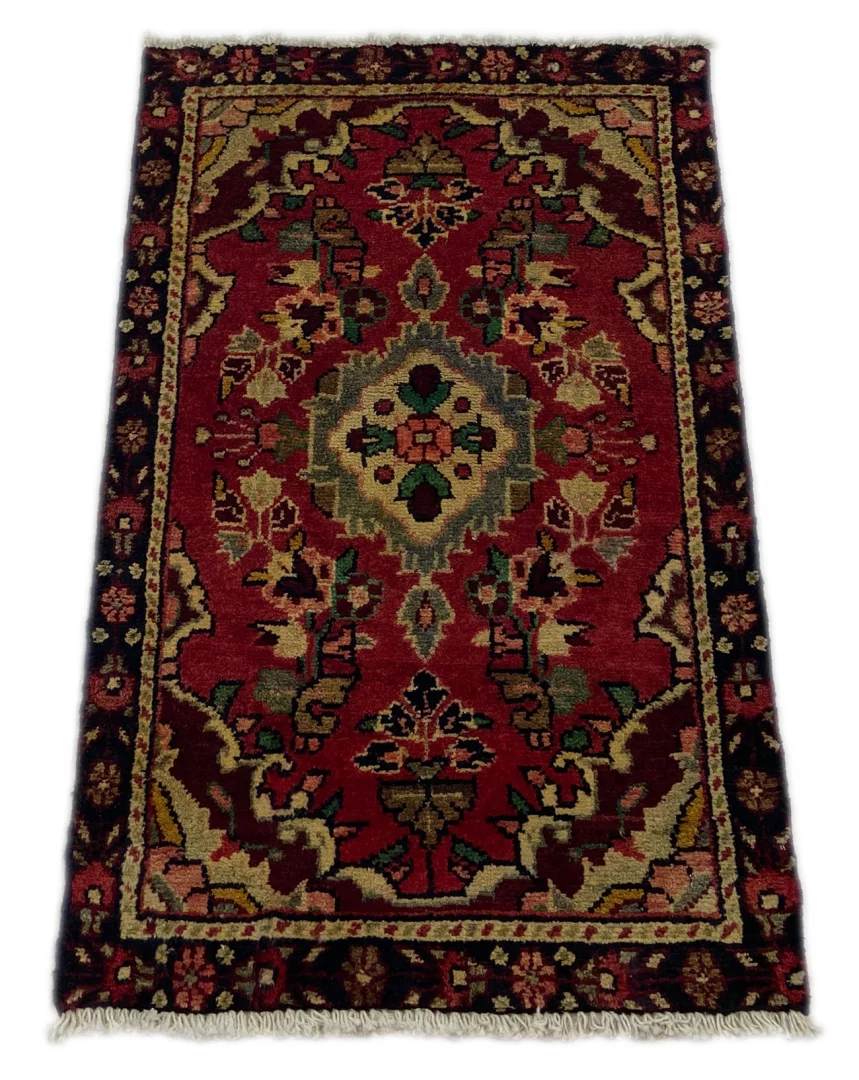
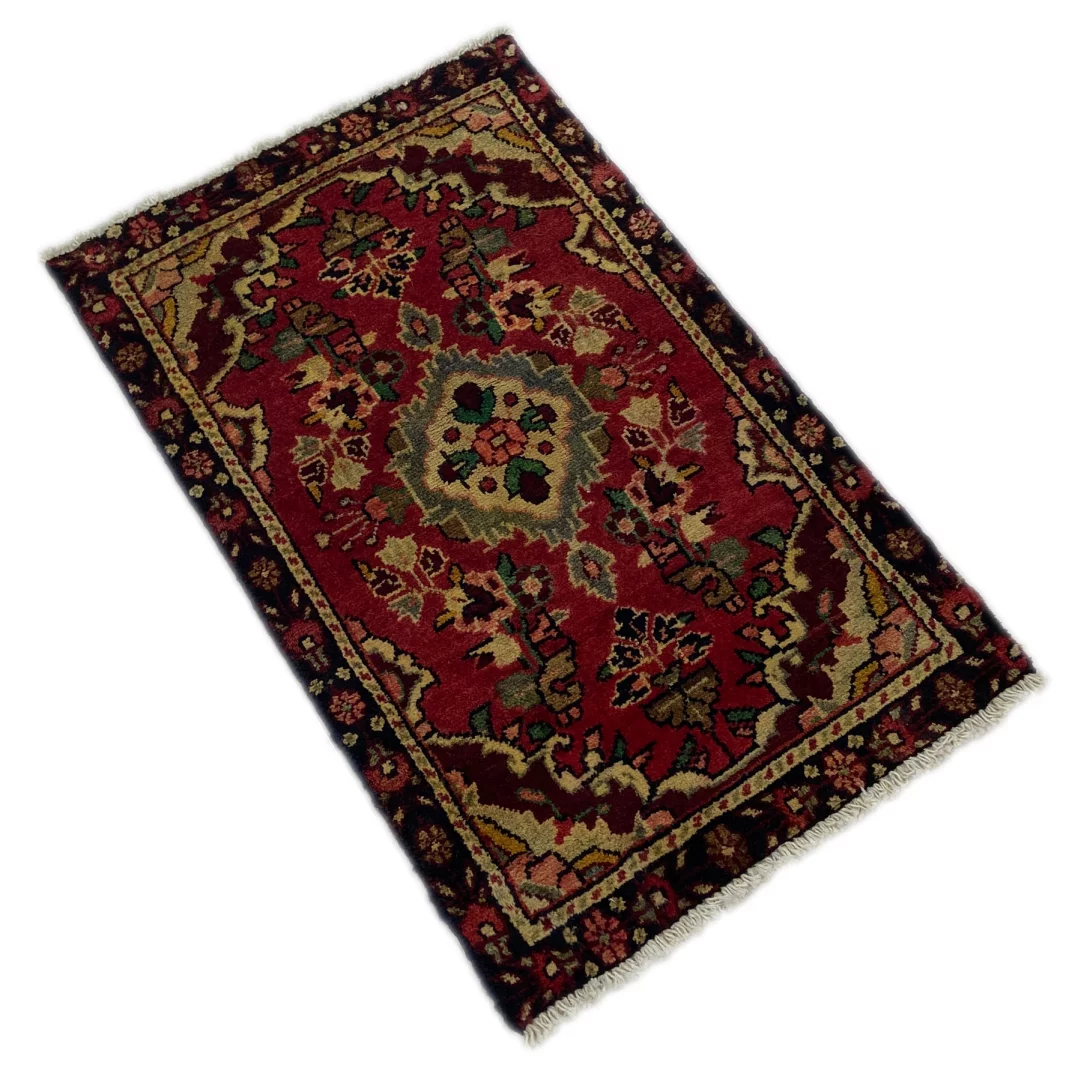
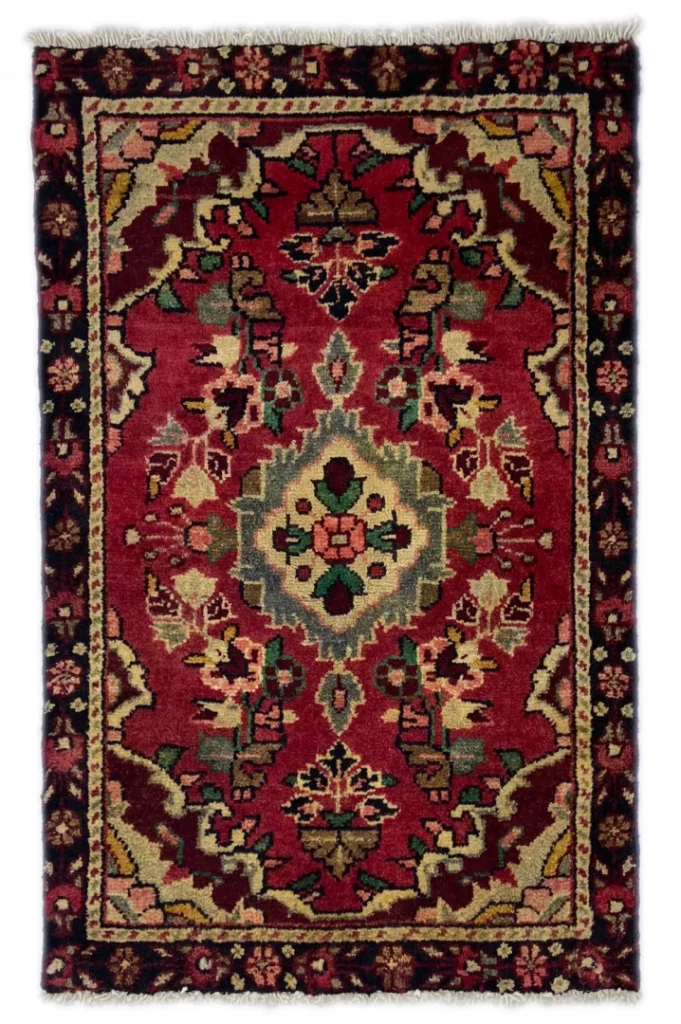
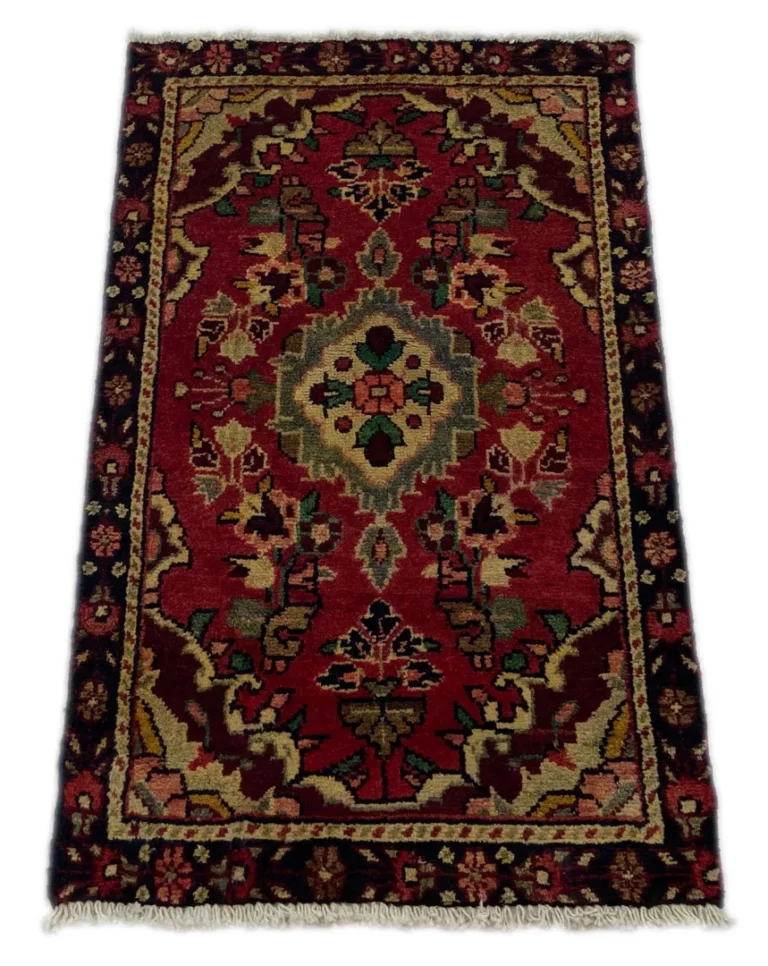
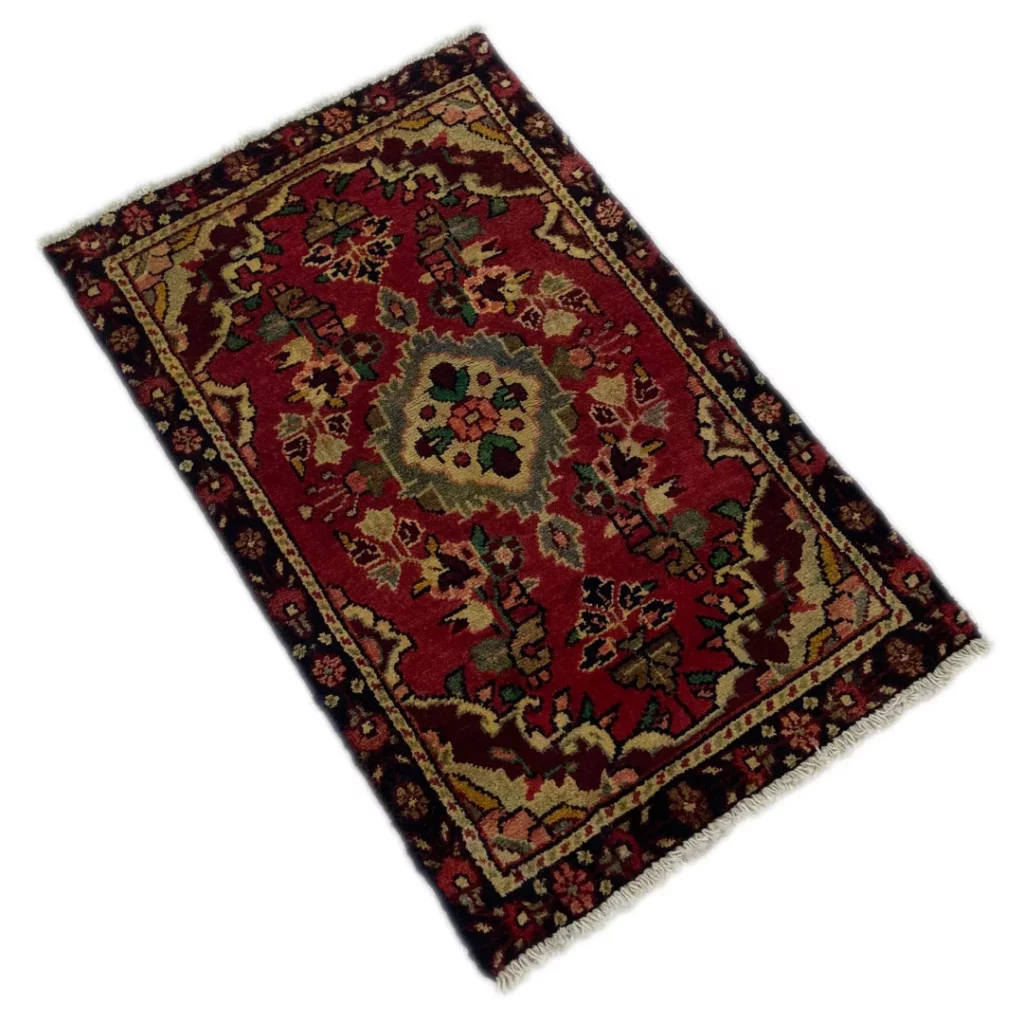
This Hamadan Persian rug is hand-knotted and has a pile made from durable wool. Hand-knotting is one of the defining features of Persian rugs: individual knots are worked into a prepared foundation, building the pile and the pattern together. Rather than being produced as a printed or machine-made surface, the design is formed through many successive stages of manual work. The finished structure therefore brings material, knotting and ornament into a single textile.
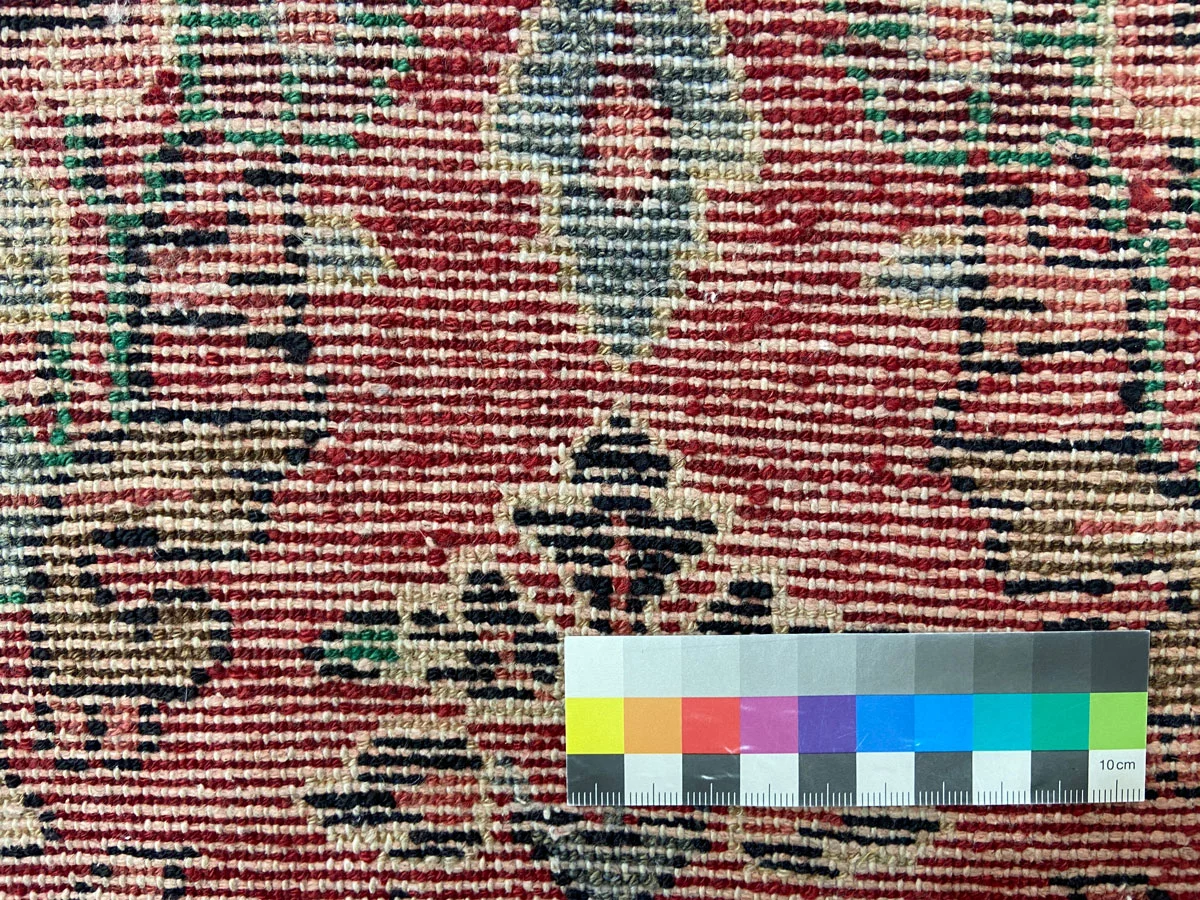
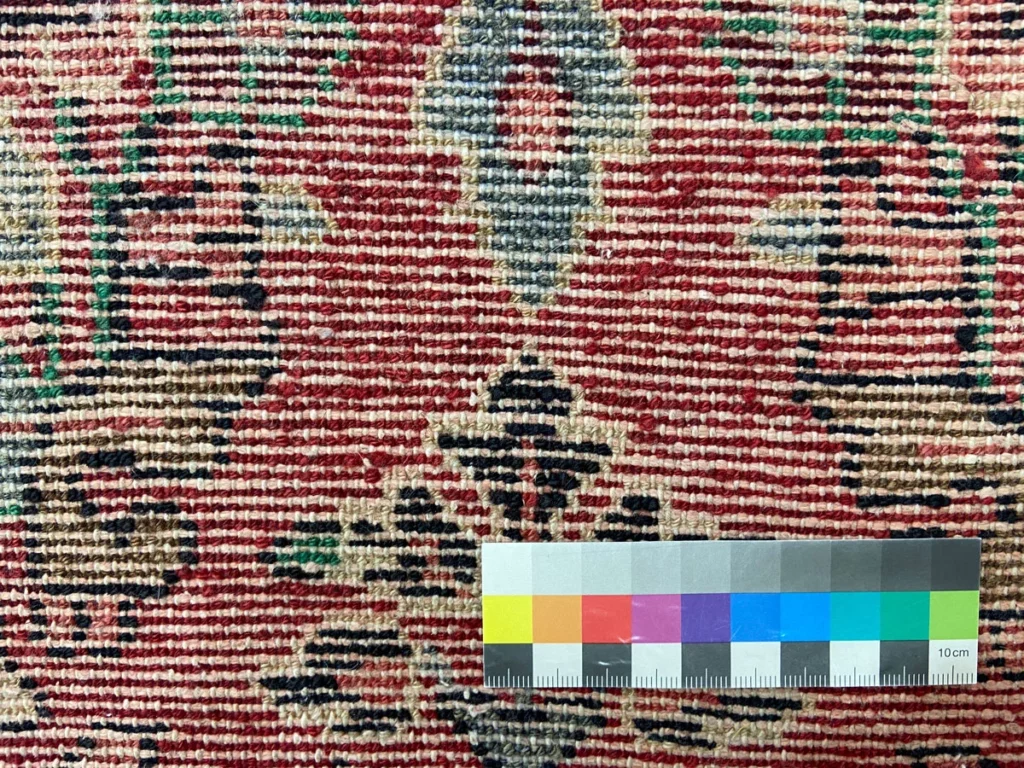
Hamadan rugs are associated with wool that is both sturdy and soft. Wool has long been used in rug making because it can form a dense pile and withstand regular use. Dense knotting also supports a precise rendering of motifs and contributes to the lasting character of the pile surface. The knot density given for this rug is 100,000 to 350,000 knots per square metre. That stated range places the piece within the finely structured work associated with Hamadan production.
The durable wool pile is also described as easy to maintain. Regular vacuuming helps remove loose dust and everyday dirt without placing unnecessary strain on the rug. More thorough treatment should be carried out by a specialist when needed, so that the colours and structure can be preserved. The condition listed for this individual rug is very good. No information is provided about the warp or about additional material components, so no such details are added here.
Origin and Tradition
This rug comes from the Hamadan region in northwestern Persia, in present-day Iran. Hamadan is an important centre of Persian rug production. The name covers the city as well as a wider surrounding area shaped by village and local weaving traditions. For that reason, Hamadan is not limited to one fixed design. The regional name brings together several related approaches to knotting, wool selection, colour and pattern.
Places associated with the region include Assadabad, Khamseh, Maslaghan, Enjelas, Nahawand, Tuyserkan and Mousel. Each local tradition can develop its own treatment of fields, borders and ornaments. Some designs are strongly geometric, while others give greater space to floral details. This local variety is held together by the use of hand craftsmanship, durable wool and an organised pattern structure.
Hamadan rug making developed in a setting where rugs served both everyday needs and the requirements of skilled textile production. This background helps explain the broad range of rugs sold under the Hamadan name. A piece may have a firmly ordered geometric layout or a more botanical arrangement of motifs, while still belonging to the same regional tradition. The origin therefore describes a weaving culture with many local expressions rather than one single prescribed format.
Persian rug making traditionally depends on the close relationship between a design, its colours and the placement of each knot. In Hamadan, this wider Persian practice is combined with a regional reputation for resilient wool and varied designs. The city and its surrounding villages are known for distinctive patterns and quality materials. The regional designation is consequently useful not only as a place name, but also as an indication of the craft history behind the rug.
The northwestern setting is important when Hamadan is compared with other Persian weaving centres. Kerman is associated with detailed floral designs, while Isfahan is known for fine knotting and highly worked compositions. Gabbeh rugs, often linked with the Fars region, are recognised for simpler geometric motifs and natural colours. These traditions illustrate the range of Persian rug production, but they do not alter this rug’s origin. This piece belongs to the Hamadan tradition.
Design and Pattern
Hamadan rugs are known for a wide variety of designs. The range includes traditional geometric patterns as well as floral motifs. Geometric compositions use lines, angles, diamonds, repeated units and balanced arrangements to organise the surface. Floral designs use flowers, leaves and vine-like forms to create a more botanical rhythm. Both approaches can be interpreted locally within Persian rug making, and the two visual languages may also appear together.
In a hand-knotted rug, the pattern is built knot by knot. Outlines, repeated shapes and transitions are therefore part of the pile structure rather than an industrial image applied afterward. In general, a greater knot density can support the rendering of smaller details. Hamadan design remains broad in spite of this technical possibility: the regional tradition includes straightforward, clearly defined geometry as well as more developed floral arrangements.
The colour range commonly described for Hamadan rugs includes warm reds, deep blue and gentle earth tones. These colours can distinguish a central field from its borders and separate individual ornaments within a composition. Red and blue often provide the main contrast in Persian rug design, while earthy shades create continuity between neighbouring forms. Such a palette can clarify the rhythm of geometric shapes and help separate the details of floral motifs.
A rug design is often organised in several layers, such as a central field, a surrounding frame and borders containing repeated ornaments. Geometric layouts gain their character from the repetition and reflection of shapes. Floral layouts divide the surface through blossoms, leaves and curving connections. The balance between these elements depends on the individual regional design. The Hamadan tradition allows for different solutions instead of imposing one fixed arrangement on every rug.
The word Hamadan should not be treated as the name of one particular motif. It identifies a region and its weaving tradition, while the actual decoration can vary from one rug to another. Kerman designs with detailed floral work, Isfahan compositions with fine artistic development and Gabbeh patterns with simple geometric forms belong to different traditions. A Hamadan rug may include geometric or floral elements, but its origin remains the Hamadan region.
Special Features
The notable features of this rug are its hand-knotted construction, its pile of durable wool and its stated knot density. The combination of a dense pile and resilient wool helps explain the traditional suitability of Hamadan rugs for frequently used living spaces. At the same time, the regional variety allows for both geometric and floral visual approaches. The condition of this one-off rug is very good.
Hamadan rugs can be used in both classical and modern interiors. Their placement depends on the relationship between pattern, colour and the surrounding furnishings rather than on one required decorating style. Routine care for a wool rug with a dense pile is straightforward: regular vacuuming and prompt, appropriate treatment of marks help maintain it. Professional cleaning is recommended when more extensive care is necessary.
FAQ
What characterises a Hamadan Persian rug?
A Hamadan Persian rug represents the weaving tradition of the Hamadan region in northwestern Persia. Durable wool and a dense pile are characteristic features of the regional description. The designs are varied, ranging from traditional geometric arrangements to floral motifs. In this individual piece, the hand-knotted construction, wool pile, stated knot density and very good condition are the specific features recorded for the rug.
How should a Hamadan rug be cared for?
Regular vacuuming is suitable for routine care. It removes loose dust and everyday dirt while avoiding unnecessary stress on the pile. If a mark occurs, it should be treated promptly with a damp cloth and mild soap. Professional cleaning is recommended when a deeper treatment is required, because careful specialist work helps preserve the colours and the structure of a hand-knotted wool rug.
What patterns are found in Hamadan rugs?
The Hamadan tradition covers a broad selection of patterns. These include traditional geometric compositions with clear lines and repeated forms, as well as floral designs using flowers, leaves and curving ornaments. The colour impression can also vary; warm reds, deep blue and gentle earth tones are commonly associated with the regional description. The exact pattern depends on the local and individual weaving approach.
To provide the best experiences, we use technologies like cookies to store and/or access device information. Consenting to these technologies will allow us to process data such as browsing behavior or unique IDs on this site. Not consenting or withdrawing consent, may adversely affect certain features and functions.
Functional Always active
The technical storage or access is strictly necessary for the legitimate purpose of enabling the use of a specific service explicitly requested by the subscriber or user, or for the sole purpose of carrying out the transmission of a communication over an electronic communications network.
Preferences
The technical storage or access is necessary for the legitimate purpose of storing preferences that are not requested by the subscriber or user.
Statistics
The technical storage or access that is used exclusively for statistical purposes.The technical storage or access that is used exclusively for anonymous statistical purposes. Without a subpoena, voluntary compliance on the part of your Internet Service Provider, or additional records from a third party, information stored or retrieved for this purpose alone cannot usually be used to identify you.
Marketing
The technical storage or access is required to create user profiles to send advertising, or to track the user on a website or across several websites for similar marketing purposes.

 SECURE PAYMENT
 SHIPPING PARTNERS


