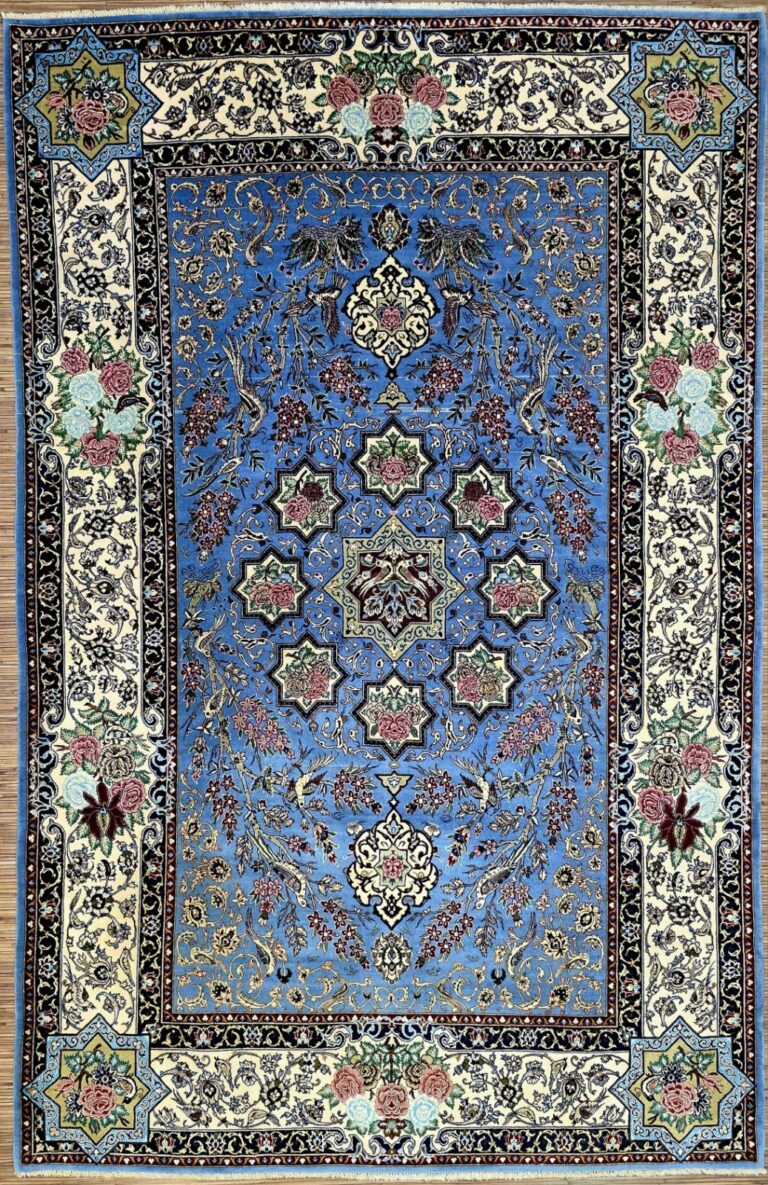
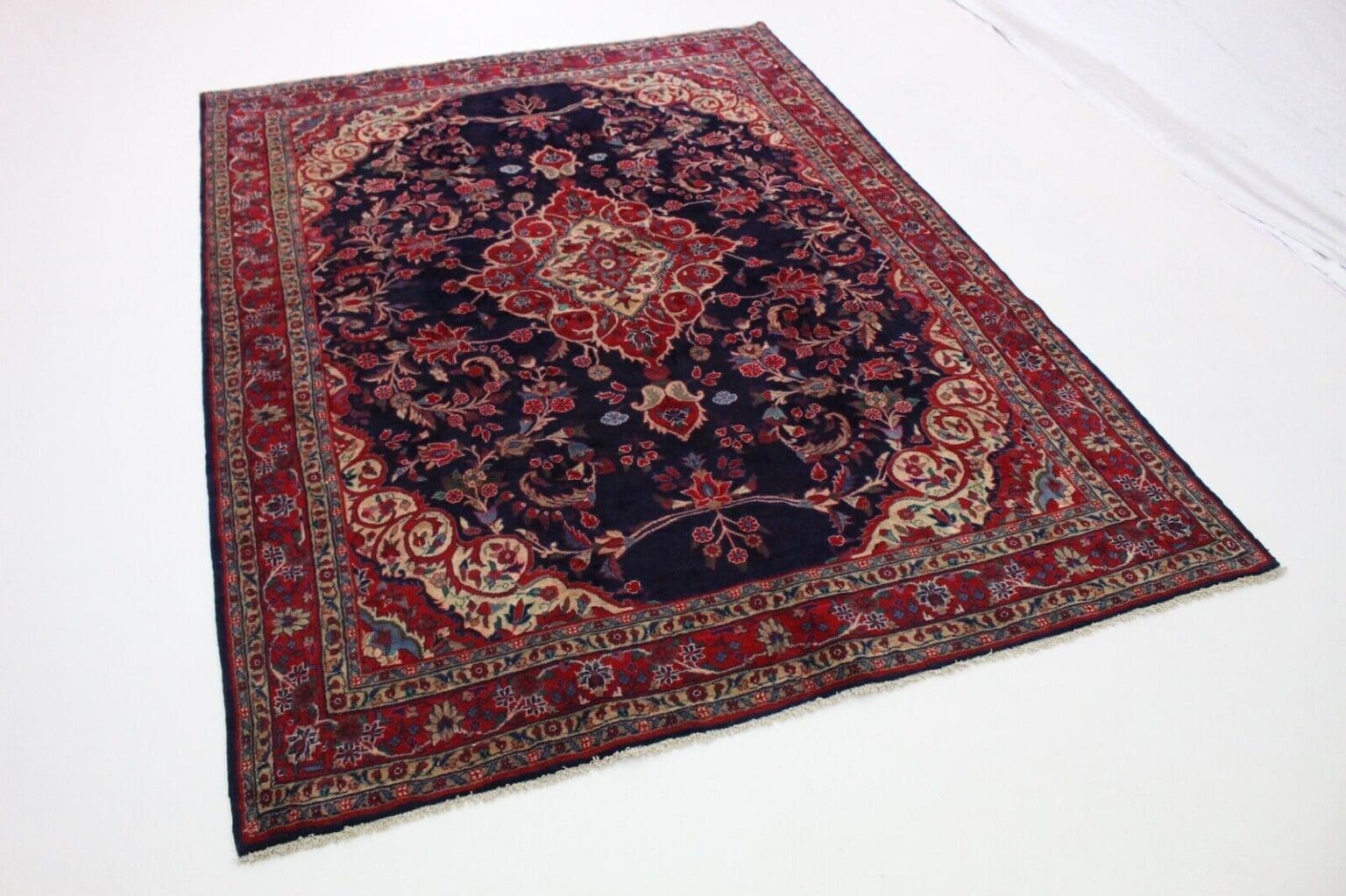
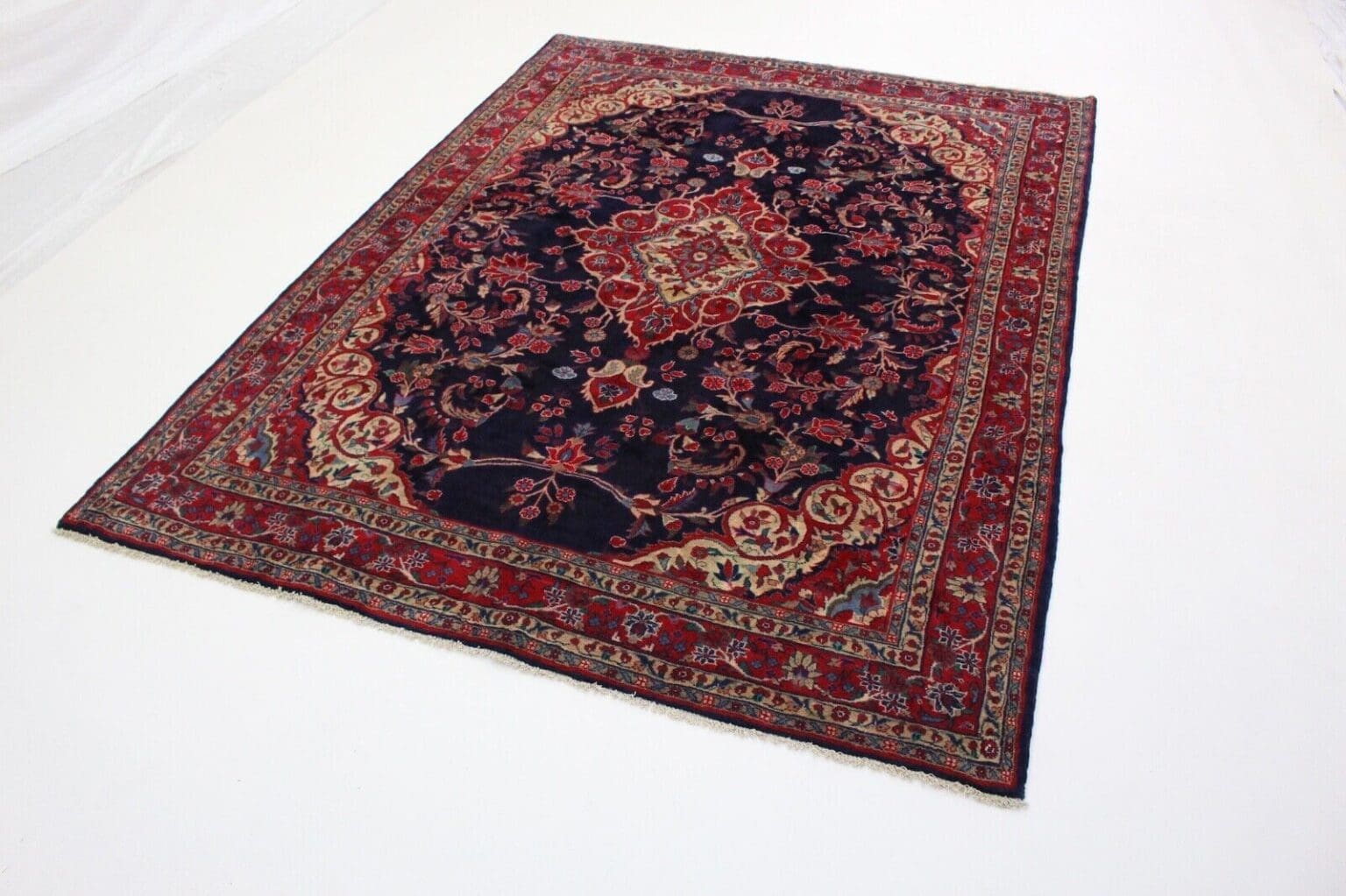
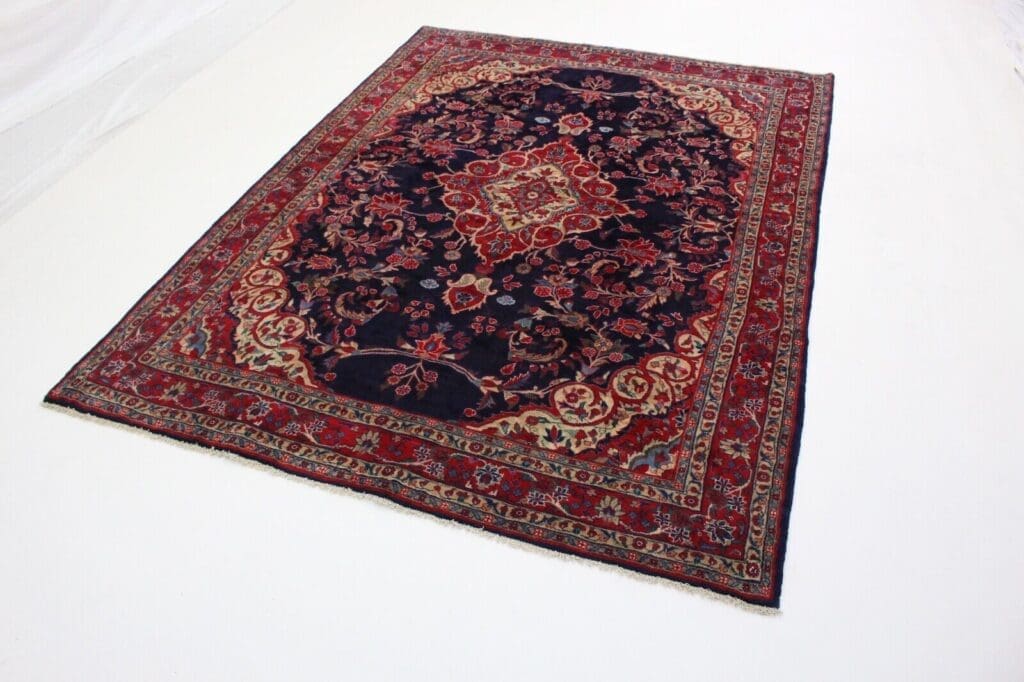
Hand-knotted Hamadan Persian Rug | Knot density: High pile | Material: pile wool, warp cotton | Size: 310×230 cm | Pattern: Medallion | Condition: New with tag
This Hamadan Persian rug is hand-knotted with a pile made of 100% wool. Wool forms the visible surface and gives the rug the soft texture described for this piece. The pile is identified as high pile, creating a clearly tactile textile surface rather than the flat feel of a hand-woven kilim. The material statement concerns the pile itself, while the supporting structure is described separately.
The warp and weft are made of cotton. These threads form the foundation into which the wool knots are worked. In hand-knotting, the pile is built knot by knot on a loom, with each sequence secured before the next one is started. This process gives the surface its individual handmade character and explains why the design is assembled progressively across the field.
Wool has long been used in rug making for its resilient fibre, comfortable handle and ability to carry colour. Cotton provides an even textile foundation for the warp and weft. The combination of a wool pile with a cotton structure is specifically given for this Hamadan rug. Its soft surface and the dense textile character described in the source are therefore connected to both the material choice and the way the rug is made.
Hand-knotting is a distinct production technique, not simply a visual style. The weaver works along the loom and creates the pile through repeated manual actions. Tension, thread and pattern are brought together row by row. The result is a construction with a genuine textile depth and a surface that records the method of its making. The rug is described as hand-knotted throughout.
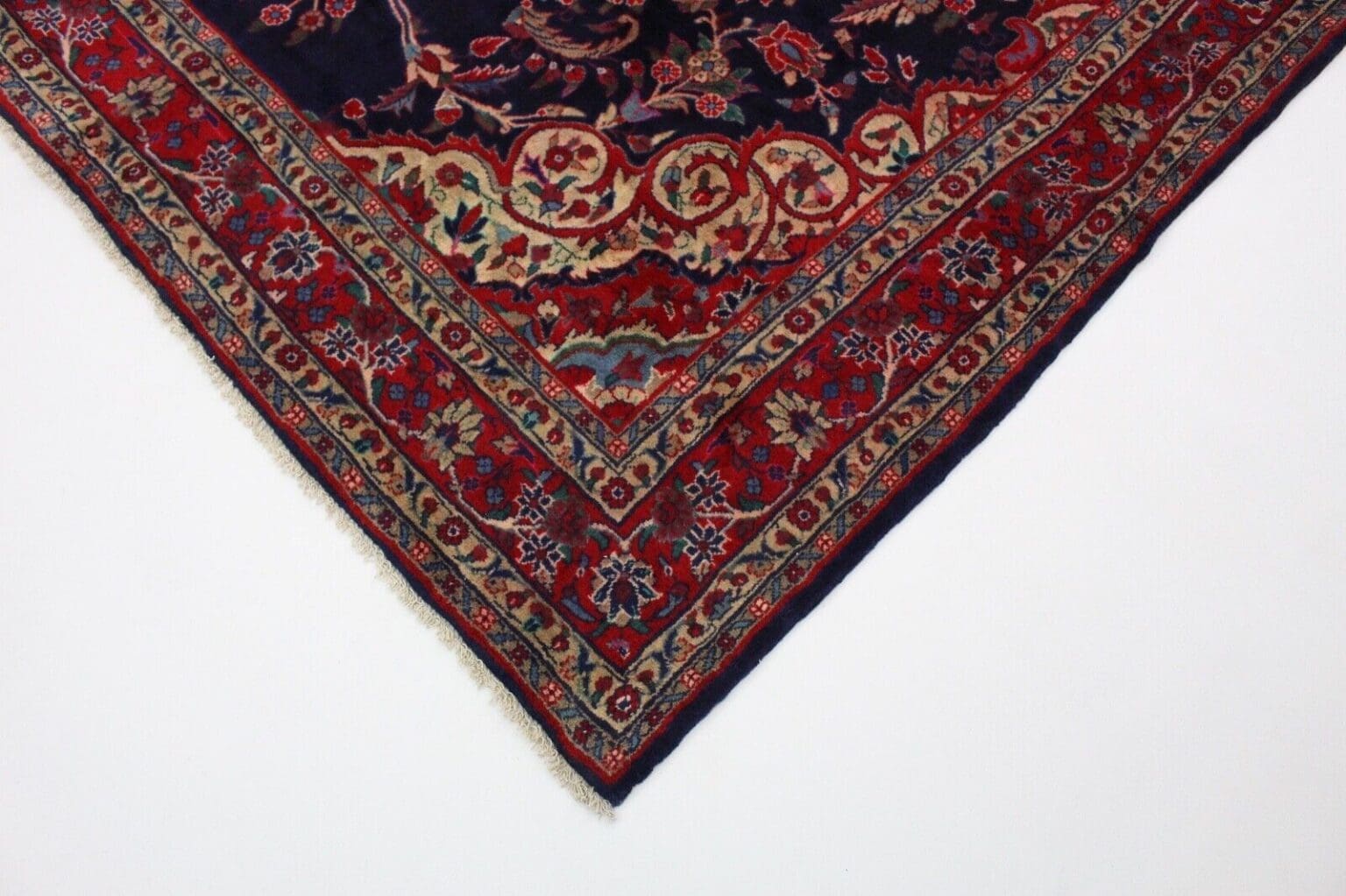
The wool pile also supports the traditional visual treatment of the design. Colour is built into individual knots, so the overall effect develops through the close relationship between fibre, knotting and ornament. The cotton warp and weft remain part of the internal construction, while the wool provides the visible field. These are the material and craftsmanship features stated for this one-off rug.
Origin and Tradition
Hamadan is a city and a broad rug-producing region in western Iran. The name is used for rugs made in the city and in many surrounding villages and weaving communities. Hamadan therefore describes a regional tradition rather than one single, rigid design. Rugs associated with the area can differ in drawing, colour arrangement, construction and scale while still belonging to the same wider Iranian weaving culture.
The region has a long history of domestic and workshop production. Rugs were made for everyday use as well as for trade, and practical weaving developed alongside decorative patterning. Local makers worked with inherited layouts and adapted them to available materials, customer preferences and the needs of their own communities. This history helps explain the variety found under the Hamadan name and the coexistence of geometric compositions with floral ornament.
Iranian rug making is based on a vocabulary of repeated forms. Medallions, borders, vines, flowers, leaves and geometric devices can be arranged in many different ways. Designs may be transmitted through workshop patterns, remembered examples or regional conventions. Each weaver interprets the arrangement through manual work, so a traditional design remains connected to an individual piece rather than becoming a mechanically identical image.
Hamadan rugs are often associated with clearly structured compositions in which geometry and floral detail work together. Lines can define compartments, establish direction or frame an ornament. Floral elements soften the structure and connect separate parts of the field. The balance between these components is part of the regional design language. The rug offered here is identified as originating in Hamadan and as a Persian rug from Iran.
The term Persian rug is appropriate here because the stated origin is Iran. Hamadan should not be replaced by another Iranian rug centre. Bakhtiari, Nain, Kerman, Tabriz and Isfahan each have their own weaving histories and design traditions. They may be useful points of comparison when discussing Iranian rugs, but they are not the origin of this piece. Its regional designation remains Hamadan.
Trade has also shaped the way Hamadan rugs are known outside Iran. Their regional variety, hand production and legible ornament have made them part of the international oriental rug tradition. The cultural background provides a framework for understanding the design, but it does not erase the individuality of a particular rug. A workshop or village tradition supplies recurring forms; the hand-knotted execution gives each finished piece its own arrangement.
Traditional Iranian rugs are often discussed through several layers at once: provenance, construction, material and design. Hamadan contributes the regional context, hand-knotting describes the technique, wool and cotton describe the materials, and the medallion identifies the main composition of this rug. Keeping these terms separate makes the description precise and avoids confusing a motif with an origin.
Design and Pattern
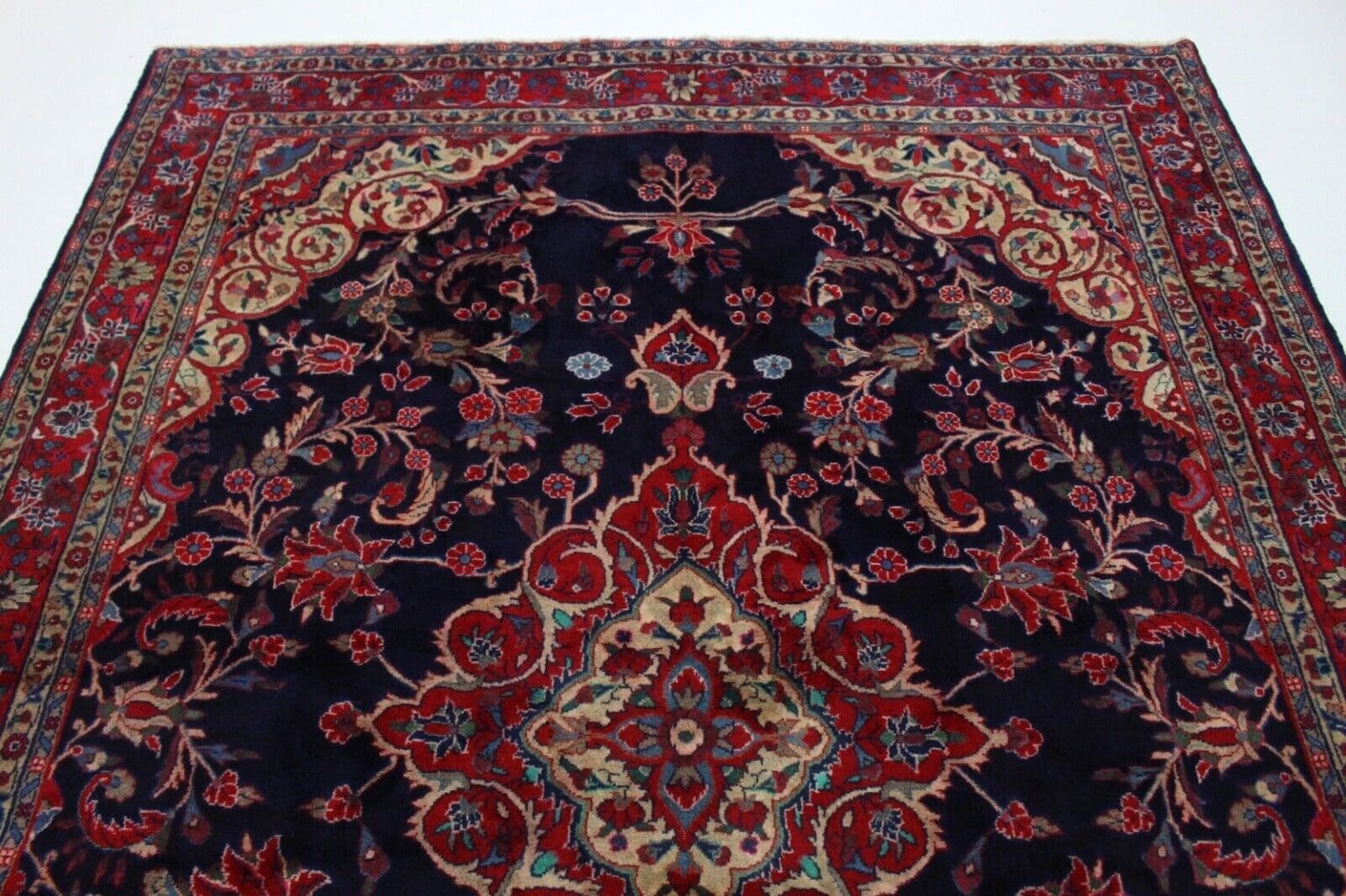
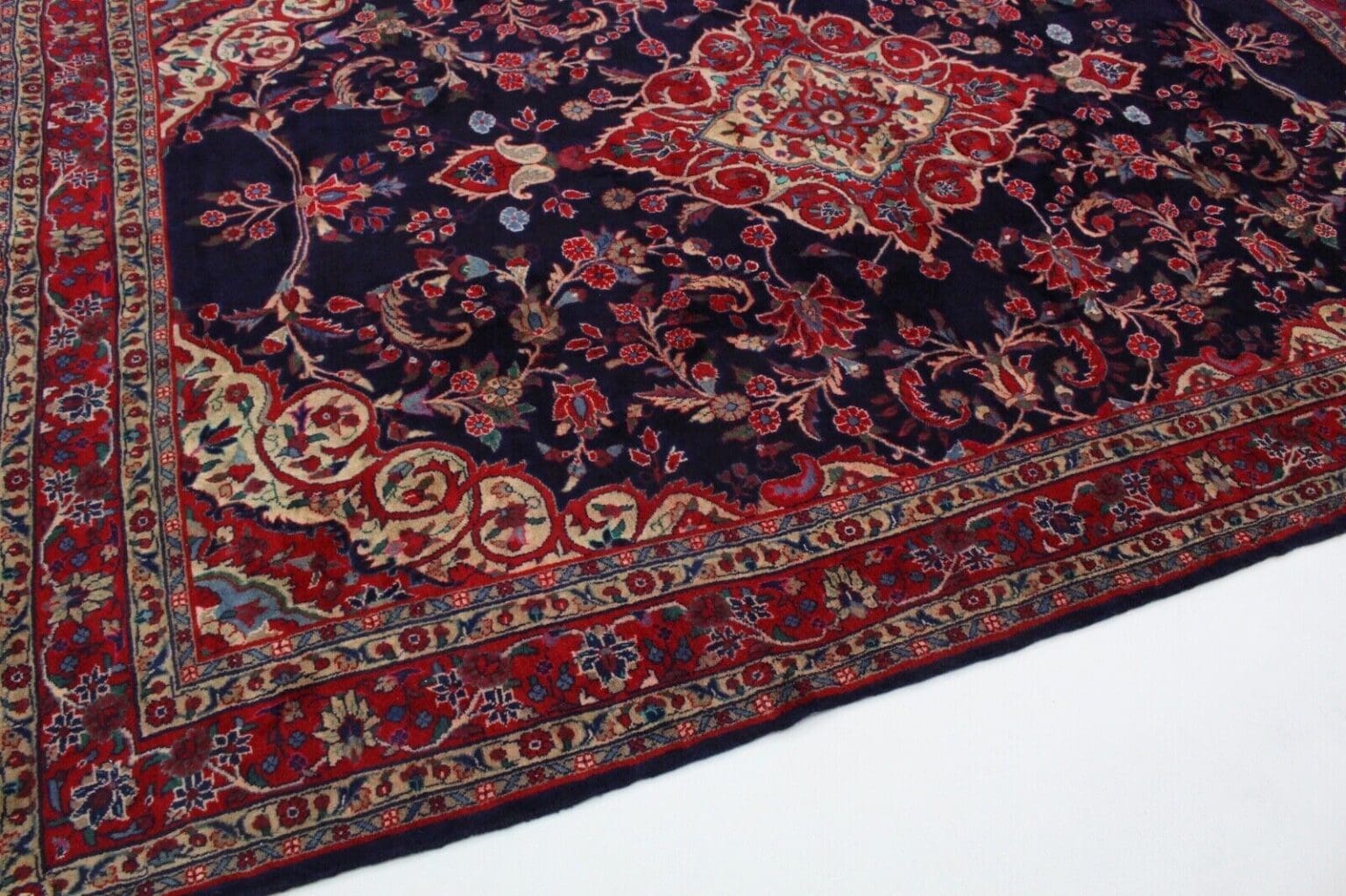
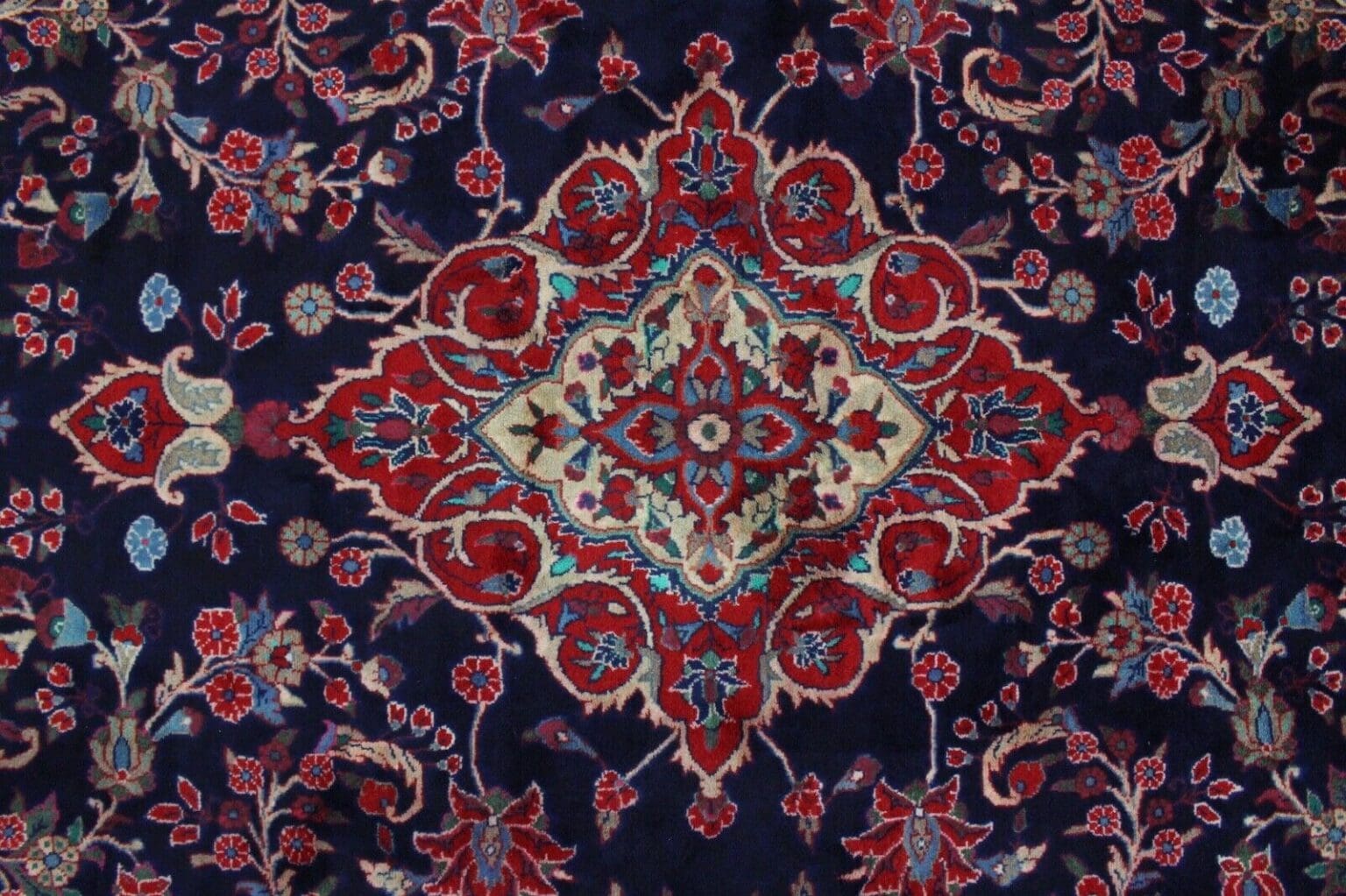
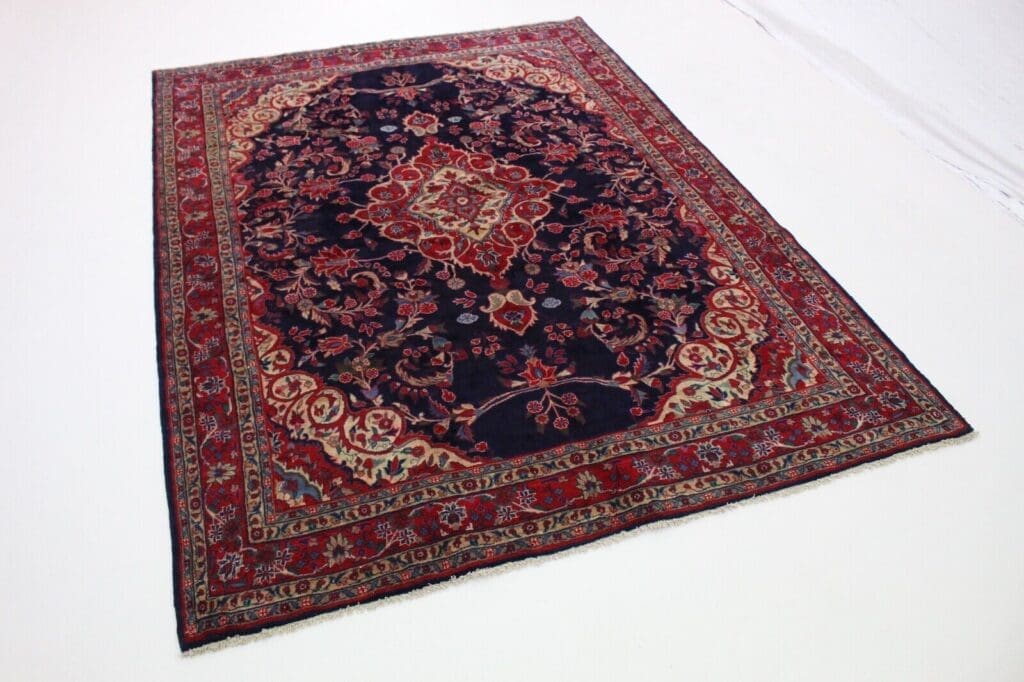
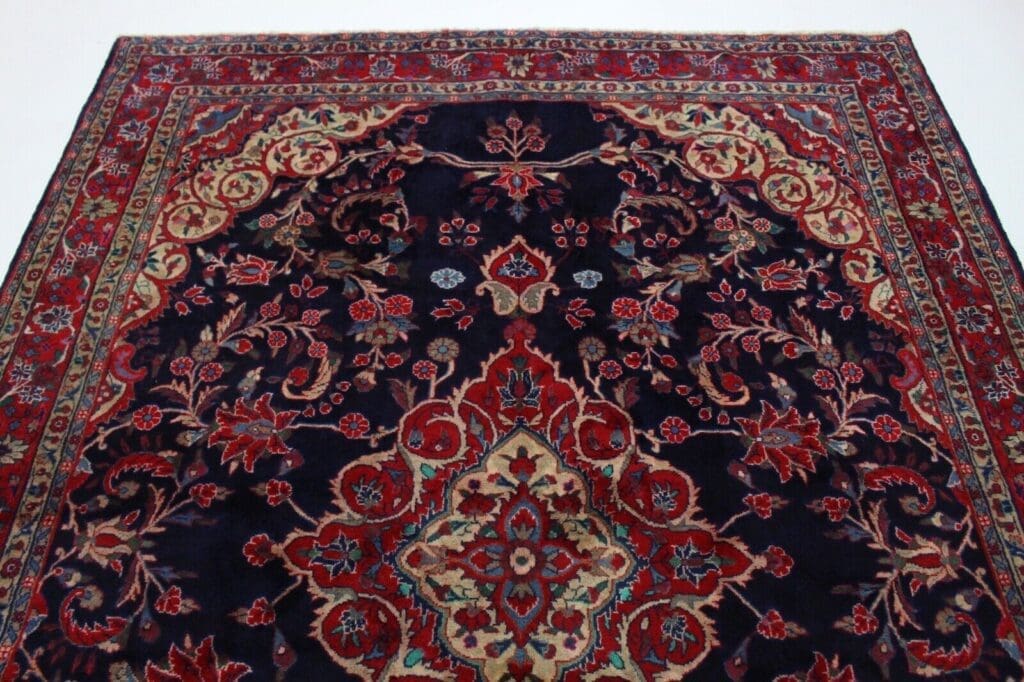
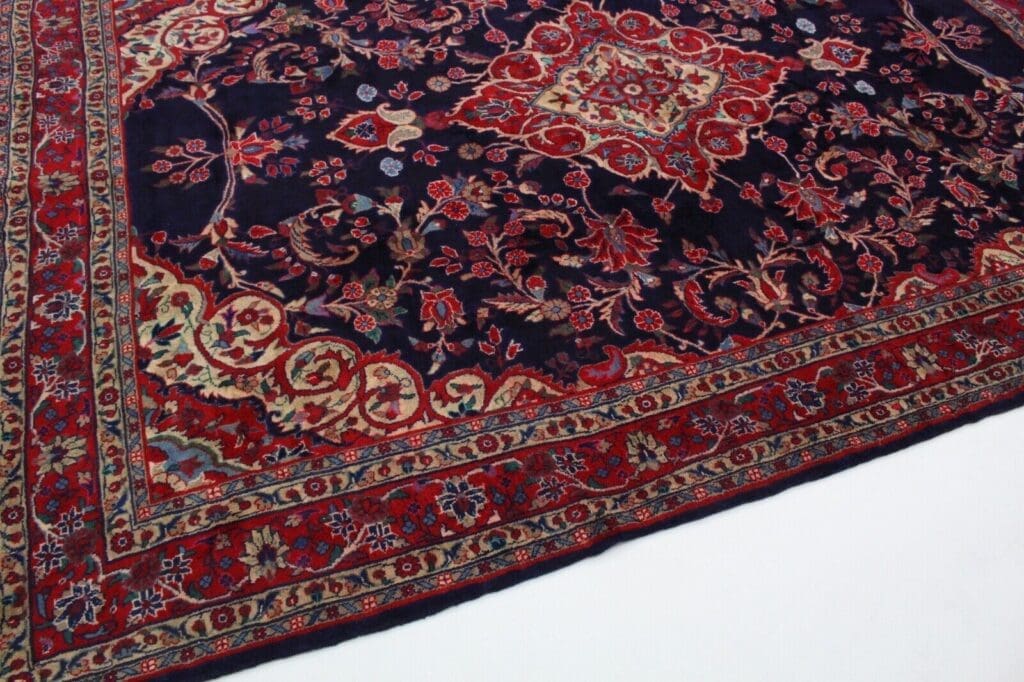
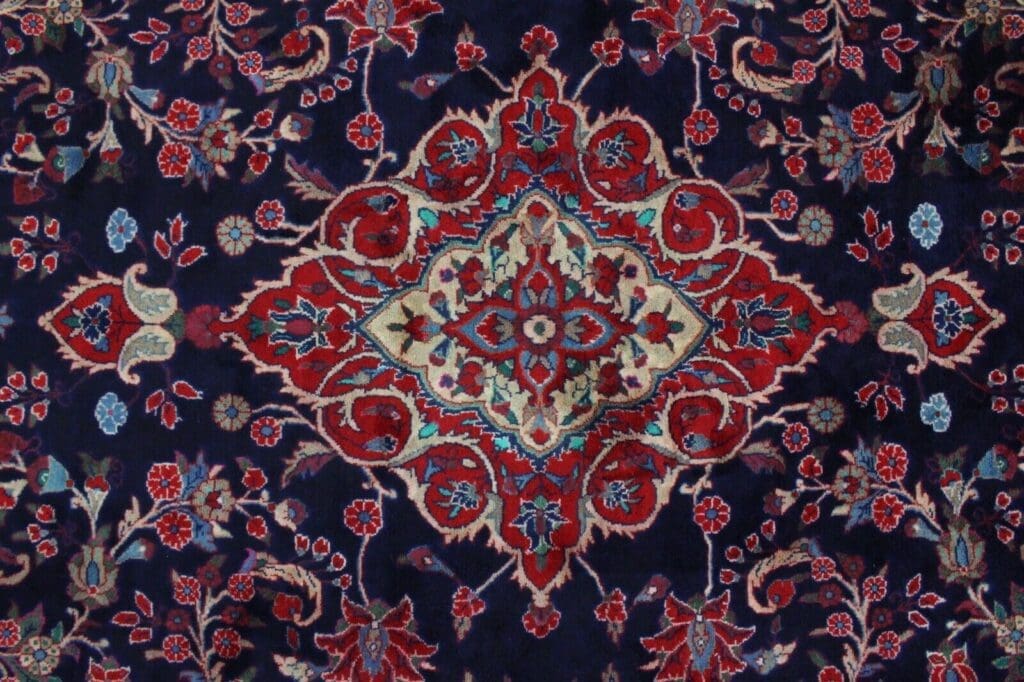
The pattern of this rug is described as a medallion. A medallion places a central form in the middle of the field and gives the composition a clear focus. Surrounding areas may include supporting ornaments, borders, floral details or geometric devices. The term names the arrangement of the design; it does not change the rug’s stated origin. Here, the medallion is presented within the Hamadan tradition.
Regional Hamadan designs are known for the use of geometric shapes and floral motifs. Geometry can establish boundaries, rhythm and proportion across the field. Flowers, leaves and vines introduce organic movement and create links between separate sections of the composition. These elements may be sharply drawn or integrated into a more flowing arrangement. Their relationship creates the characteristic tension between structure and ornament found in many Persian rug designs.
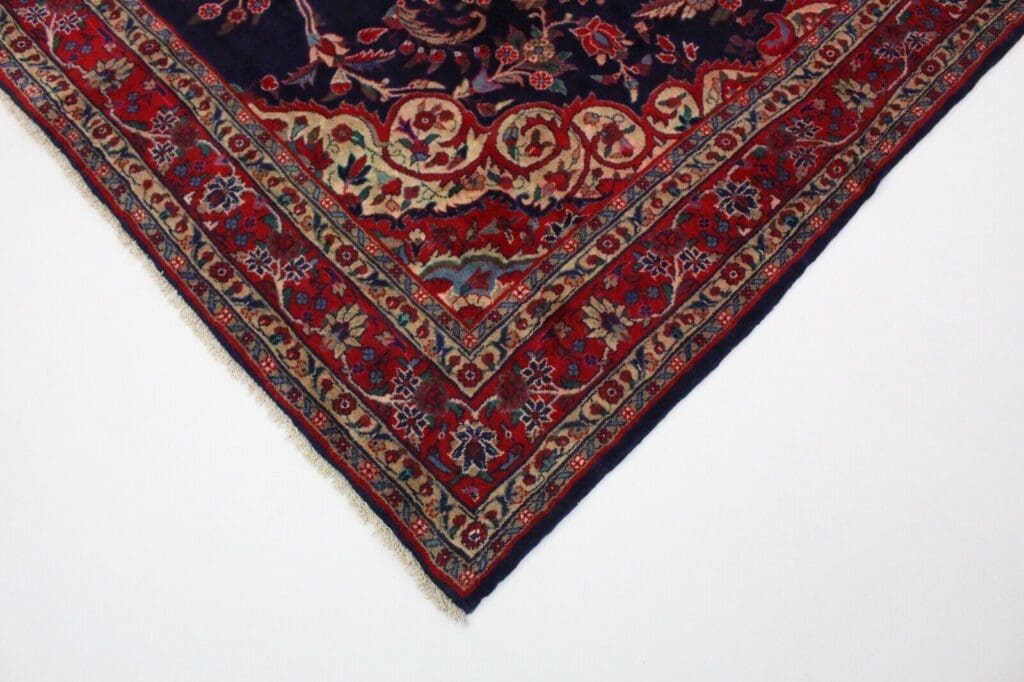
A central medallion organizes the viewer’s attention from the middle outward. Borders can frame the main field and give the composition a visual conclusion, while smaller motifs can connect the centre to the surrounding areas. In Persian rug design, this structure allows a large textile surface to read as a coherent whole. The pattern is decorative, but it is also an ordering system that guides the eye across the woven field.
The source classifies the style as traditional Oriental and Persian. Traditional refers to the use of inherited design forms rather than an exclusively contemporary graphic language. Oriental identifies the wider cultural context of the rug tradition, while Persian is tied to the Iranian origin of Hamadan. These terms describe the design background and provenance together; they do not suggest that the rug comes from another region whose name might appear in a motif.
Colour is an important part of how a medallion composition is read. Contrasts can separate the central form from the surrounding field, and related shades can unite border and interior. The description refers to harmonious colours and a variety of nuances. In a hand-knotted rug, these nuances are formed through many individual knots and viewed across the wool surface. The resulting colour impression depends on the interaction of fibre, pile and pattern.
Geometric and floral motifs can perform different visual functions. A geometric device may define a compartment or provide a measured repetition. A flower may act as a focal ornament, while a vine can lead the eye between motifs. When such elements are arranged around a medallion, they create an ordered field with both regularity and movement. This is the broader design logic behind the regional description of Hamadan patterns.
The stated pattern allows the rug to be read in both traditional and contemporary interiors. The source names the living room, bedroom and hallway as possible settings and describes the style as suitable for traditional through modern furnishing approaches. Those room references concern the intended versatility of the design. The central medallion and regional ornament remain the defining visual features wherever the rug is placed.
Because every hand-knotted rug is assembled manually, a traditional pattern is never merely a printed surface. The drawing is formed through the sequence of knots, and the wool pile gives the ornament a physical depth. The medallion can therefore be considered both as an image and as a construction of coloured fibres. This connection between pattern and technique is central to the character of Persian rug making.
Special Features
The rug is offered in new condition with a tag. It has a hand-knotted construction, a pile of 100% wool and cotton warp and weft. The source also identifies the pile as high pile, the main design as a medallion and the rug as suitable for underfloor heating. These details cover its stated condition, materials, construction, pattern and intended use.
Its Hamadan origin gives the rug a specific regional identity within Iranian carpet culture. The wool pile supplies the visible surface, while the cotton warp and weft provide the stated foundation. The central medallion gives the pattern its principal structure. Together with the new condition and attached tag, these are the distinctive facts recorded for this individual rug.
FAQ
How should I care for my hand-knotted Hamadan Persian rug?
Regular vacuuming is recommended as part of routine care. The surface should be treated gently so that the wool pile and hand-knotted construction are not subjected to unnecessary strain. If a more thorough cleaning is needed, professional rug cleaning is advised. Direct sunlight should be avoided because it can encourage the colours to fade. This approach helps preserve the described colour harmony and the textile character of the pile.
What makes a Hamadan rug distinctive?
Its identity comes from the combination of traditional knotting, quality cotton used for the warp and weft, and the characteristic patterns associated with the region. This rug is hand-knotted, has a pile of 100% wool and uses a medallion design. Hamadan represents a varied Iranian weaving tradition in which geometric forms and floral motifs are important. Regional origin, manual construction and inherited ornament together define the profile described here.
What sizes are available for Hamadan rugs?
Hamadan rugs are available in a range of sizes, allowing them to be selected for different rooms and furnishing situations. The assortment can include narrow runners as well as broad rugs for living areas. This variety is a general feature of the type and does not mean that every individual piece is available in every format. Each one-off rug has its own stated size, while other formats must be checked against the details of the particular piece.
To provide the best experiences, we use technologies like cookies to store and/or access device information. Consenting to these technologies will allow us to process data such as browsing behavior or unique IDs on this site. Not consenting or withdrawing consent, may adversely affect certain features and functions.
Functional Always active
The technical storage or access is strictly necessary for the legitimate purpose of enabling the use of a specific service explicitly requested by the subscriber or user, or for the sole purpose of carrying out the transmission of a communication over an electronic communications network.
Preferences
The technical storage or access is necessary for the legitimate purpose of storing preferences that are not requested by the subscriber or user.
Statistics
The technical storage or access that is used exclusively for statistical purposes.The technical storage or access that is used exclusively for anonymous statistical purposes. Without a subpoena, voluntary compliance on the part of your Internet Service Provider, or additional records from a third party, information stored or retrieved for this purpose alone cannot usually be used to identify you.
Marketing
The technical storage or access is required to create user profiles to send advertising, or to track the user on a website or across several websites for similar marketing purposes.

 SECURE PAYMENT
 SHIPPING PARTNERS