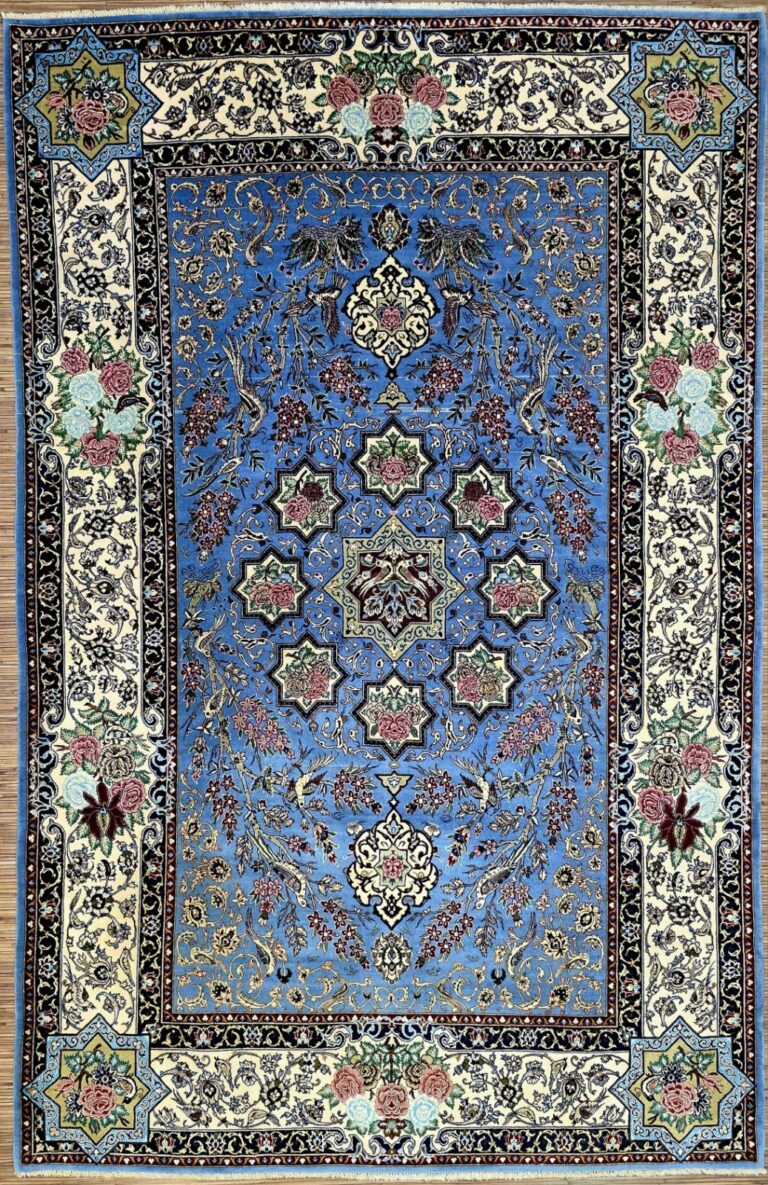
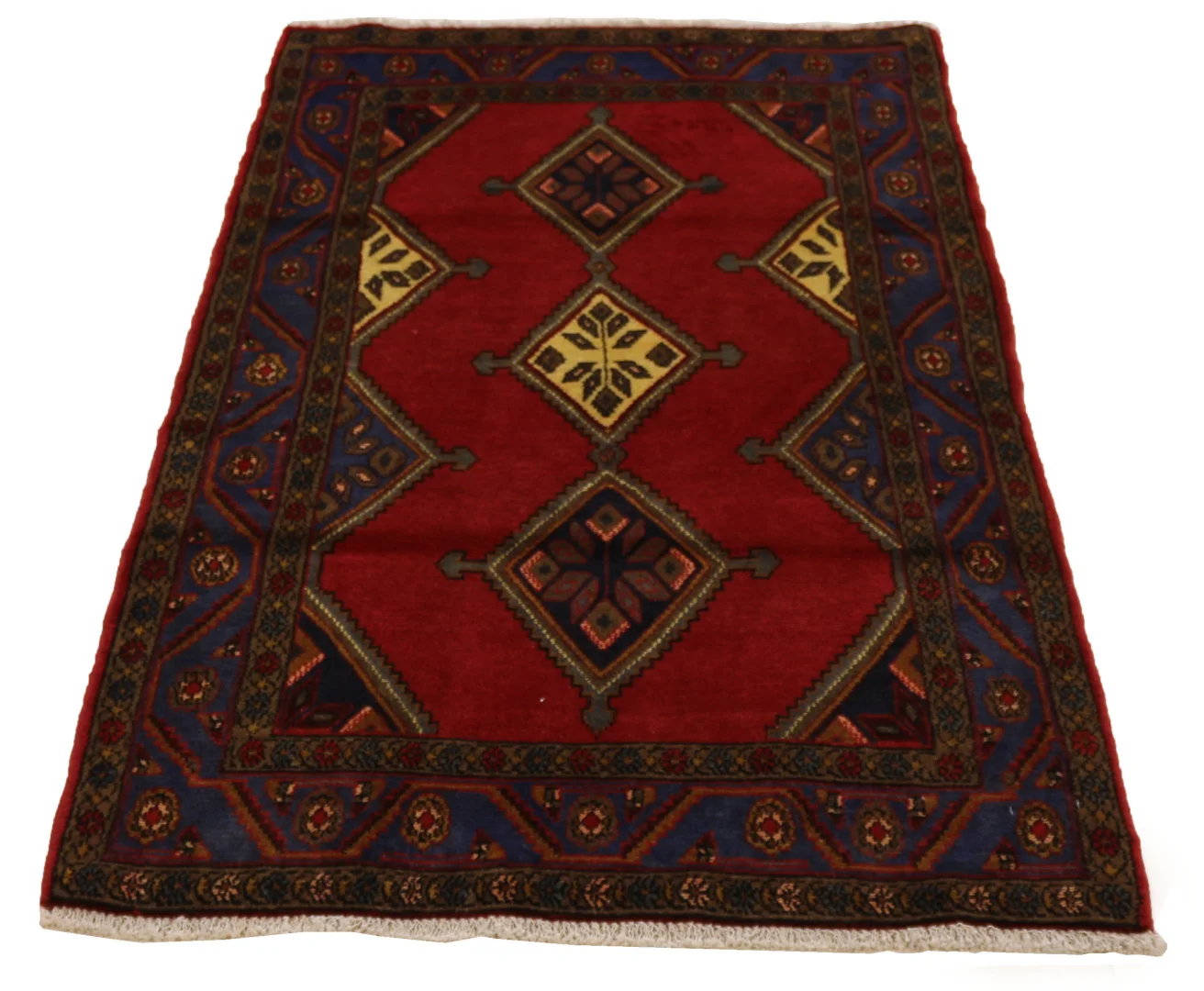
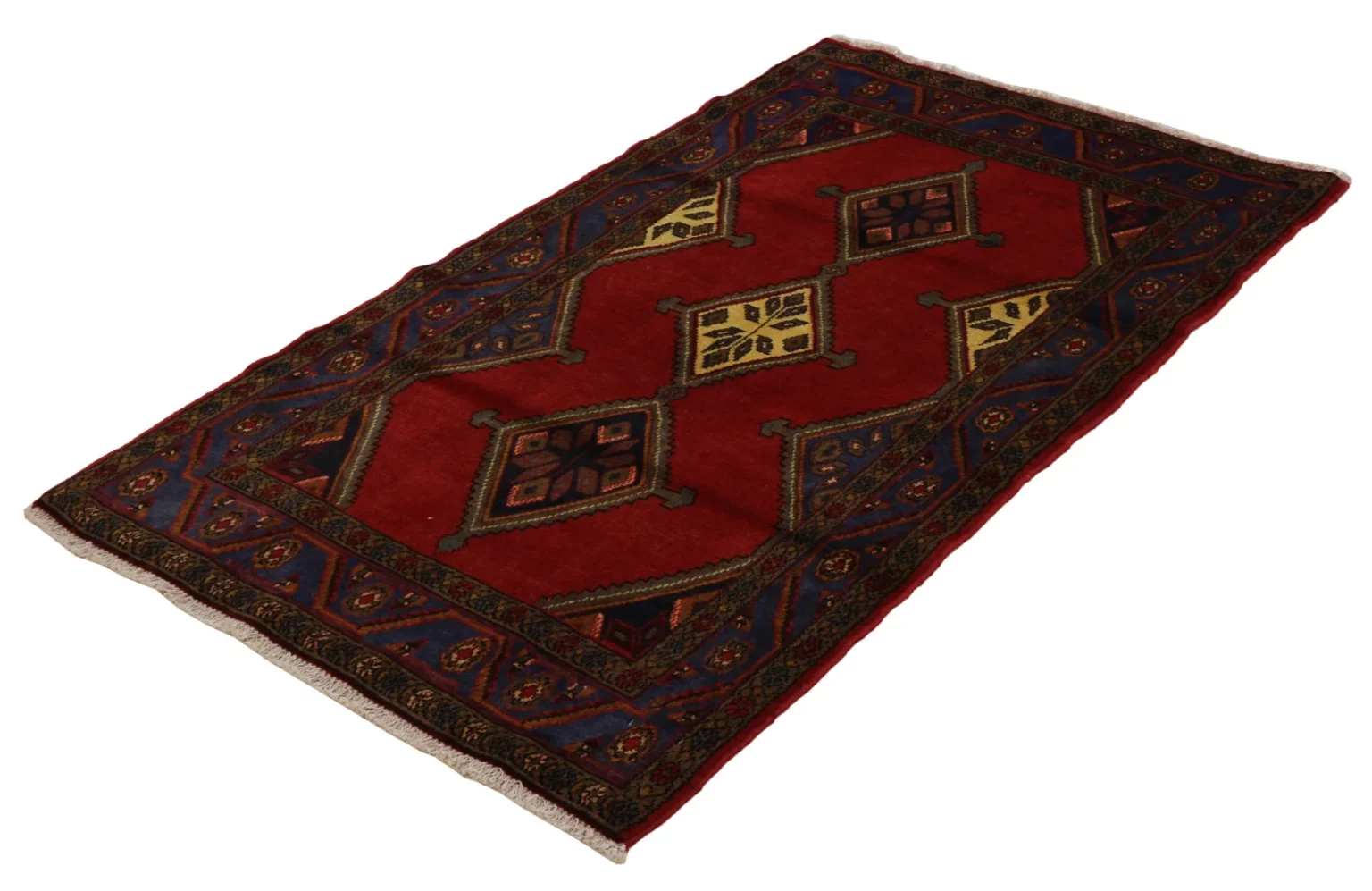
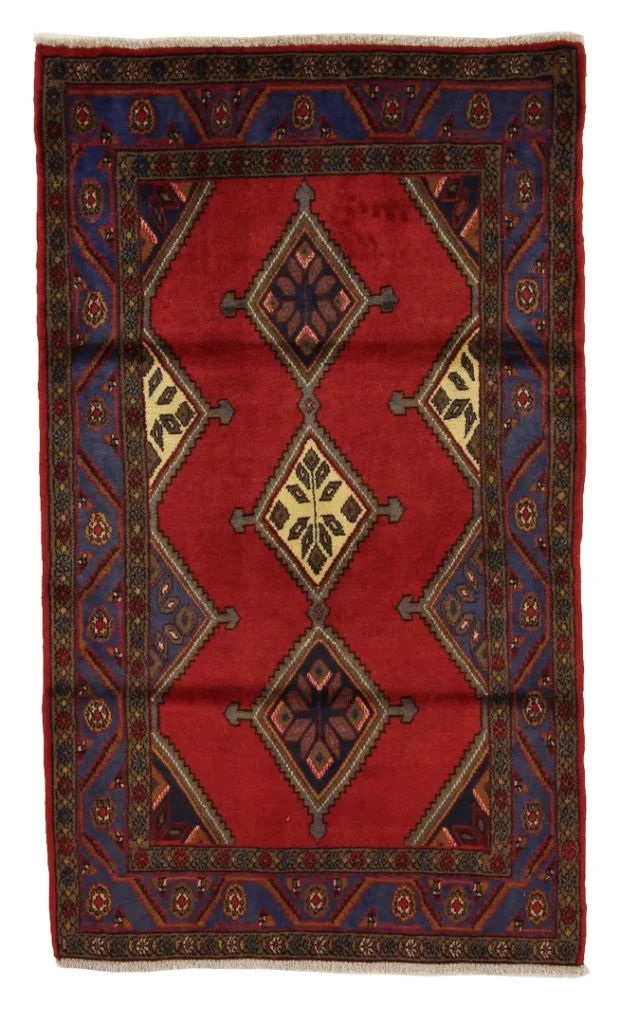
Hand-knotted Hamadan Persian rug | Knot density: 100,000 – 350,000 knots/m² | Material: pile in hard-wearing wool | Size: 161 x 96 cm | Pattern: varied designs in blue and red | Condition: well preserved
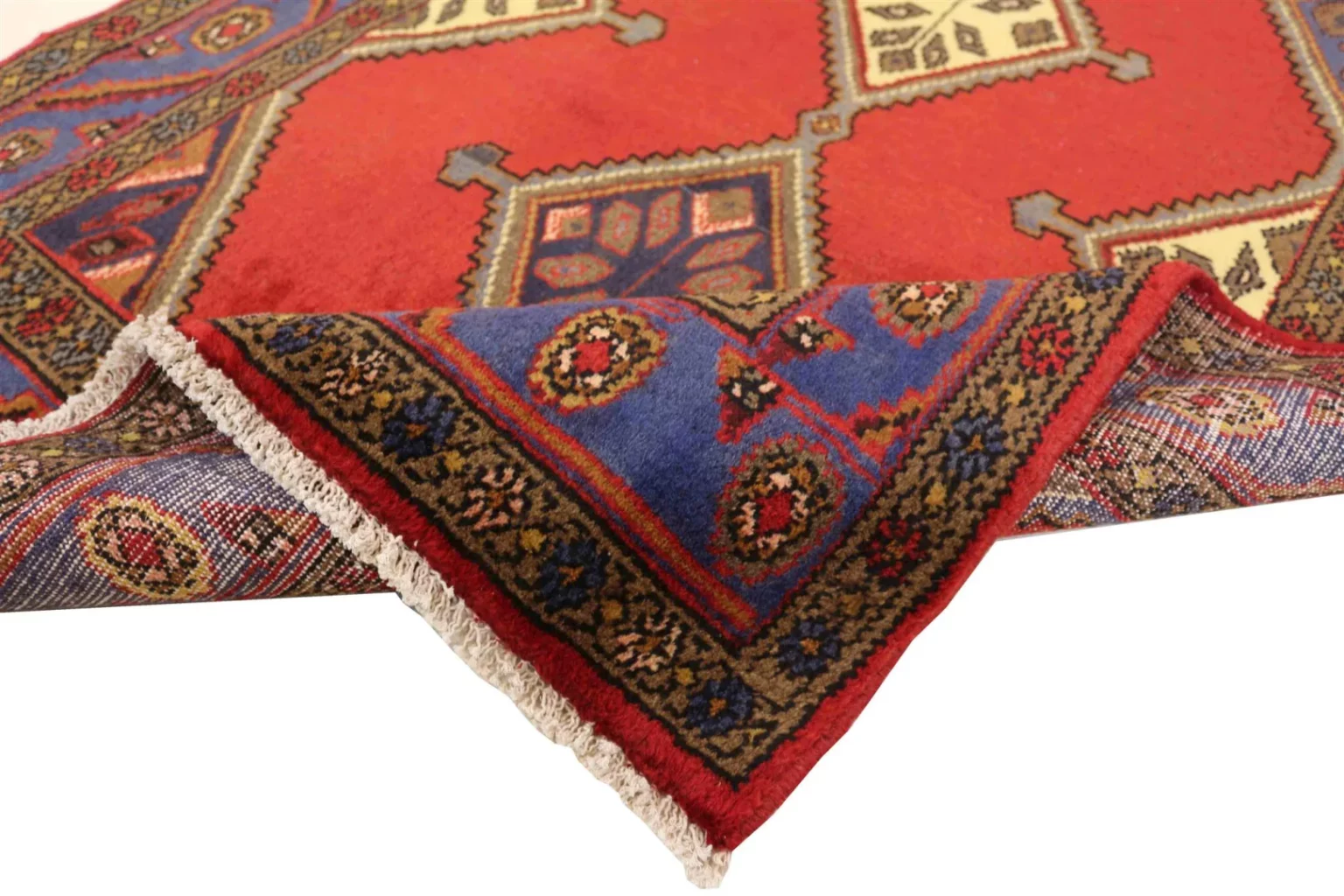
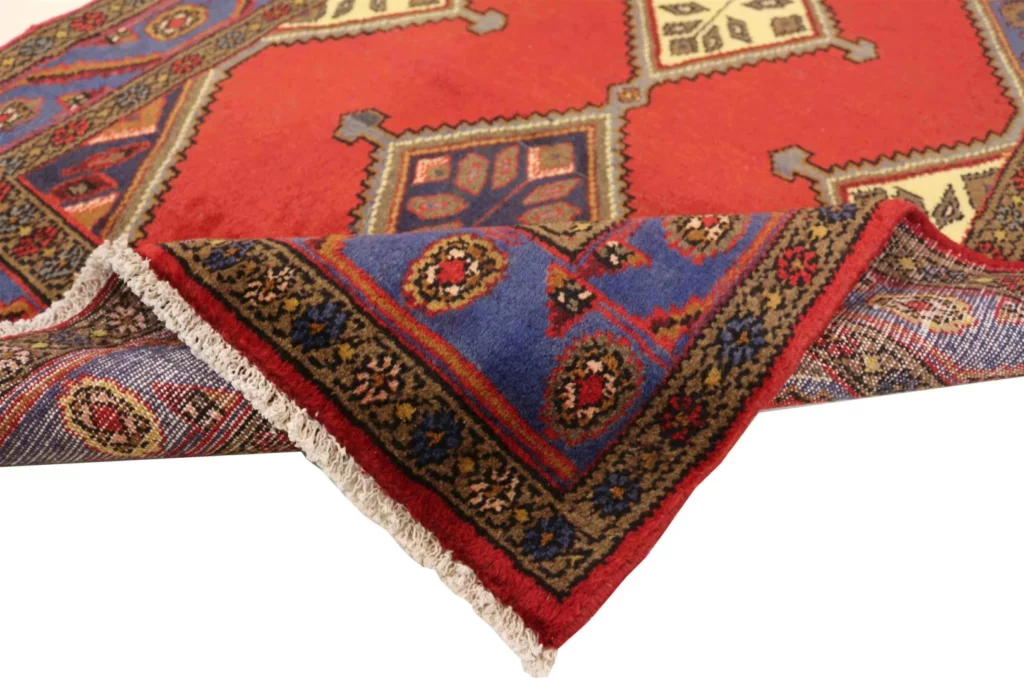
This Hamadan Persian rug is hand-knotted and made from hard-wearing wool. Wool is a traditional pile material in Persian rug making because it combines a pleasant surface with a resilient structure. The pile of this rug is wool. The natural fibre takes colour well, allowing both clear contrasts and nuanced areas of colour. In a hand-knotted rug, the pile is built up knot by knot within the textile foundation. The surface therefore develops together with the construction rather than being added to a finished ground.
The stated knot density ranges from 100,000 to 350,000 knots per square metre. This density supports a differentiated rendering of shapes and colour fields and is associated with the careful execution of traditional Hamadan designs. The hard-wearing wool and the hand-knotting technique provide the material basis of the rug. Wool is not only the carrier of the colours; it also determines the feel and resilience of the pile.
Hand-knotting is one of the established methods of Persian rug production. Unlike an industrial floor covering, the surface is formed gradually through work at the loom. Knot density is expressed as the number of knots per square metre and indicates the fineness of the construction. In Hamadan rugs, different densities occur alongside the region’s broad range of designs. This piece is listed with a density of 100,000 to 350,000 knots per square metre.
Origin and Tradition
The rug comes from Hamadan in Iran. Hamadan is in the north-west of the country and is also the name of an important rug-producing region. Its weaving tradition has been connected with Persian rug making for centuries. Hamadan rugs are known for their variety of designs and colours. The region therefore does not describe one narrowly fixed visual formula, but a group of rugs linked by their origin and by the established weaving traditions of the wider area.
The name Hamadan also covers rugs made in several towns and villages in the surrounding region. The places named in connection with Hamadan production include Assadabad, Khamseh, Hosseinabad, Maslaghan, Enjelas, Nahawand, Tuyserkan and Mousel. Each name belongs to the regional context of the broader Hamadan area. Grouping these places under Hamadan shows how closely the weaving traditions of the surrounding communities are connected with the region as a whole. The origin given for this rug is Hamadan.
Iranian rug making includes many regional expressions. Hamadan is one of the regions where hand-knotting, resilient wool and a wide range of patterns come together. Within these traditions, rugs are recognised not only for their practical role but also for their visual language. Colour, motif and arrangement shape the appearance of a rug, while the knotting technique gives it its textile structure.
The designation Hamadan consequently refers to more than a single locality. It places the rug within an Iranian craft tradition supported by several weaving centres. This tradition helps explain the range of floral, geometric and medallion-like compositions associated with Hamadan. At the same time, every hand-knotted rug remains an individual piece because the relationship between colour, pattern structure and execution differs from one example to another.
Design and Pattern
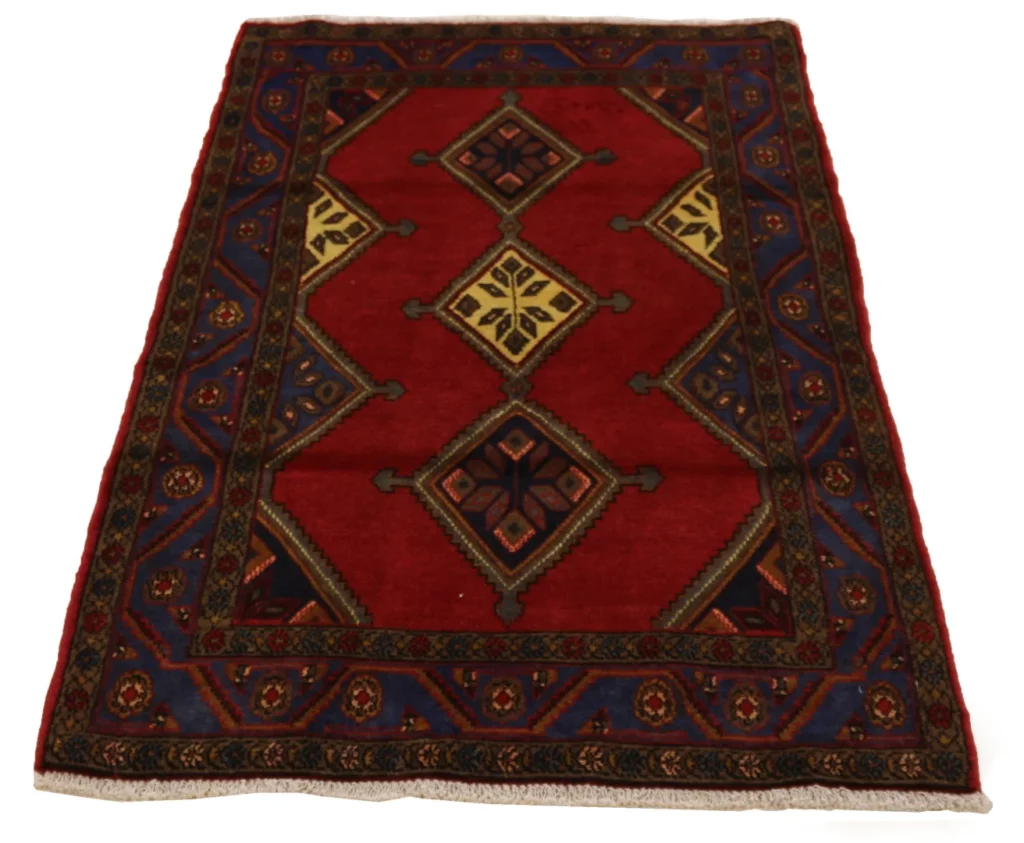
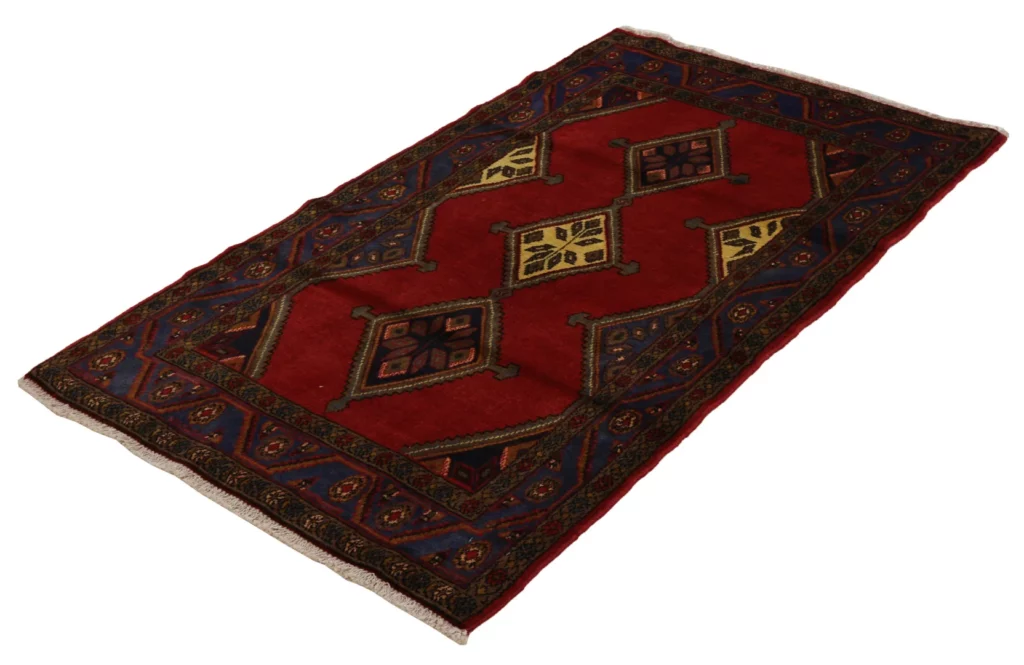
The pattern of this rug is described as a varied design in blue and red. Deep blue and warm red are among the colours most often associated with Hamadan rugs, where they are combined to create lively and balanced colour effects. Blue may provide calm fields or defining outlines, while red adds warmth and visual emphasis. The specific statement for this rug is that it has varied designs in blue and red.
The Hamadan pattern tradition includes floral motifs, geometric forms and traditional medallion-like compositions. Floral designs use stylised blossoms, leaves and vines. Geometric patterns are built from ordered lines, angles and recurring shapes. In a medallion-like design, a central arrangement can serve as the visual focus, accompanied by further ornaments and borders. These three groups illustrate the breadth of the regional design vocabulary associated with Hamadan.
In a hand-knotted rug, the design is not applied to a completed surface afterwards. It is created by the sequence of knots and by changes in the selected colours. Pattern and construction are therefore closely connected. A higher knot density can support finer transitions and smaller details, while the colour palette influences the overall balance of the composition. The stated density and the blue-and-red palette are features recorded for this Hamadan rug.
The variety of regional designs is one reason Hamadan rugs can be used in different rooms and with different interiors. A floral arrangement may appear traditional and flowing, geometric forms can underline the order of the composition, and a medallion can direct attention towards the centre. This describes the design tradition of the region rather than adding an unstated detail to this individual rug. For this example, the recorded pattern is a varied design in blue and red.
Special Features
The listed features are the hard-wearing wool, the hand-knotted construction and the origin in Hamadan, Iran. The knot density of 100,000 to 350,000 knots per square metre adds a technical characteristic to these details. Together, the material, the manual technique and the regional design tradition describe the connection between construction and appearance that is associated with Hamadan Persian rugs.
The rug is well preserved. Its stated size makes it suitable for different residential settings and uses. Hamadan rugs are placed in living rooms, bedrooms or hallways as an accent piece. The combination of traditional craftsmanship with the blue-and-red colour range can create a warm, welcoming effect in a room. No additional condition details or other materials are included in the description.
FAQ
What makes a Hamadan Persian rug distinctive?
This rug combines hard-wearing wool with hand-knotted construction and a knot density of 100,000 to 350,000 knots per square metre. It also reflects the varied traditional patterns of the Hamadan region and the blue-and-red colour palette. Its origin in Hamadan, Iran, places it within a Persian rug tradition that extends back for centuries. The rug is also well preserved.
How should I care for a Hamadan Persian rug?
The rug should be cleaned regularly and protected from direct sunlight. Professional cleaning is recommended when dirt or stains need to be removed. With a hand-knotted wool rug, the cleaning method should take account of the textile structure and the pile. Careful treatment helps preserve the surface, colours and suitability for use over time.
Where can I place a Hamadan Persian rug?
A Hamadan Persian rug can be used in different rooms. Living rooms, bedrooms and hallways are particularly suitable settings, with the rug serving as a decorative element in a hall. Its blue-and-red palette and varied pattern vocabulary allow for different placements. In the chosen room, the traditional design can contribute to a warm and welcoming atmosphere.
To provide the best experiences, we use technologies like cookies to store and/or access device information. Consenting to these technologies will allow us to process data such as browsing behavior or unique IDs on this site. Not consenting or withdrawing consent, may adversely affect certain features and functions.
Functional Always active
The technical storage or access is strictly necessary for the legitimate purpose of enabling the use of a specific service explicitly requested by the subscriber or user, or for the sole purpose of carrying out the transmission of a communication over an electronic communications network.
Preferences
The technical storage or access is necessary for the legitimate purpose of storing preferences that are not requested by the subscriber or user.
Statistics
The technical storage or access that is used exclusively for statistical purposes.The technical storage or access that is used exclusively for anonymous statistical purposes. Without a subpoena, voluntary compliance on the part of your Internet Service Provider, or additional records from a third party, information stored or retrieved for this purpose alone cannot usually be used to identify you.
Marketing
The technical storage or access is required to create user profiles to send advertising, or to track the user on a website or across several websites for similar marketing purposes.

 SECURE PAYMENT
 SHIPPING PARTNERS