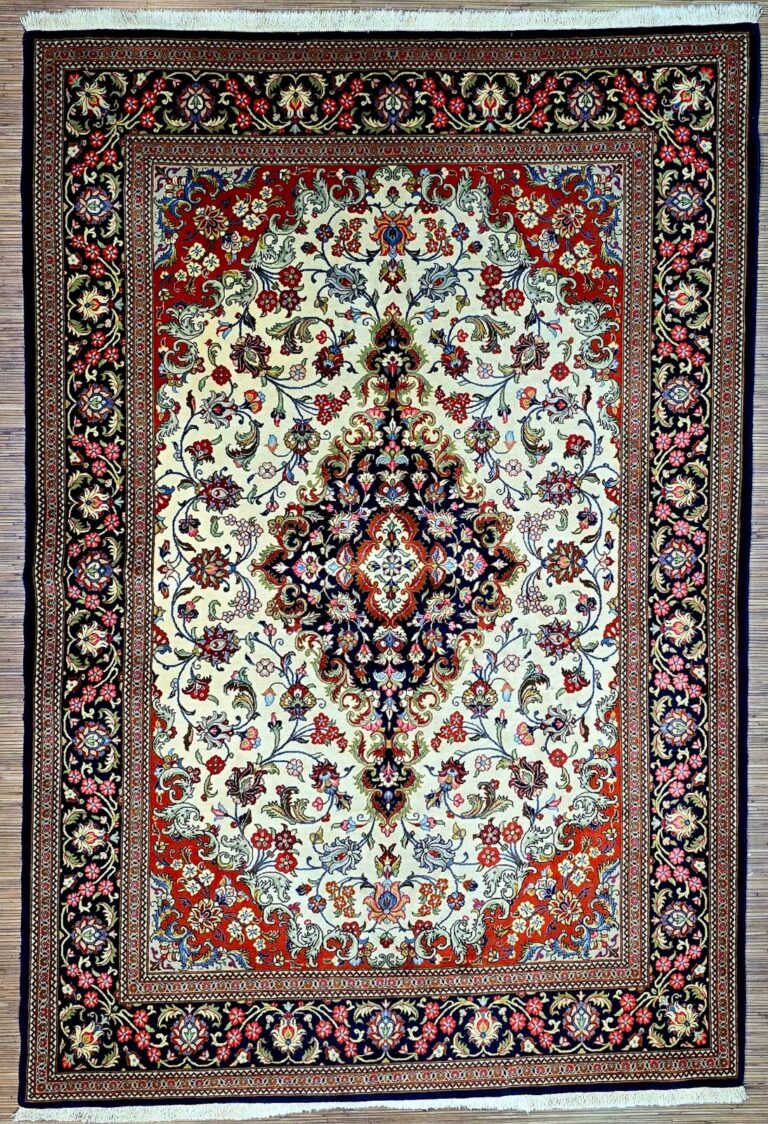
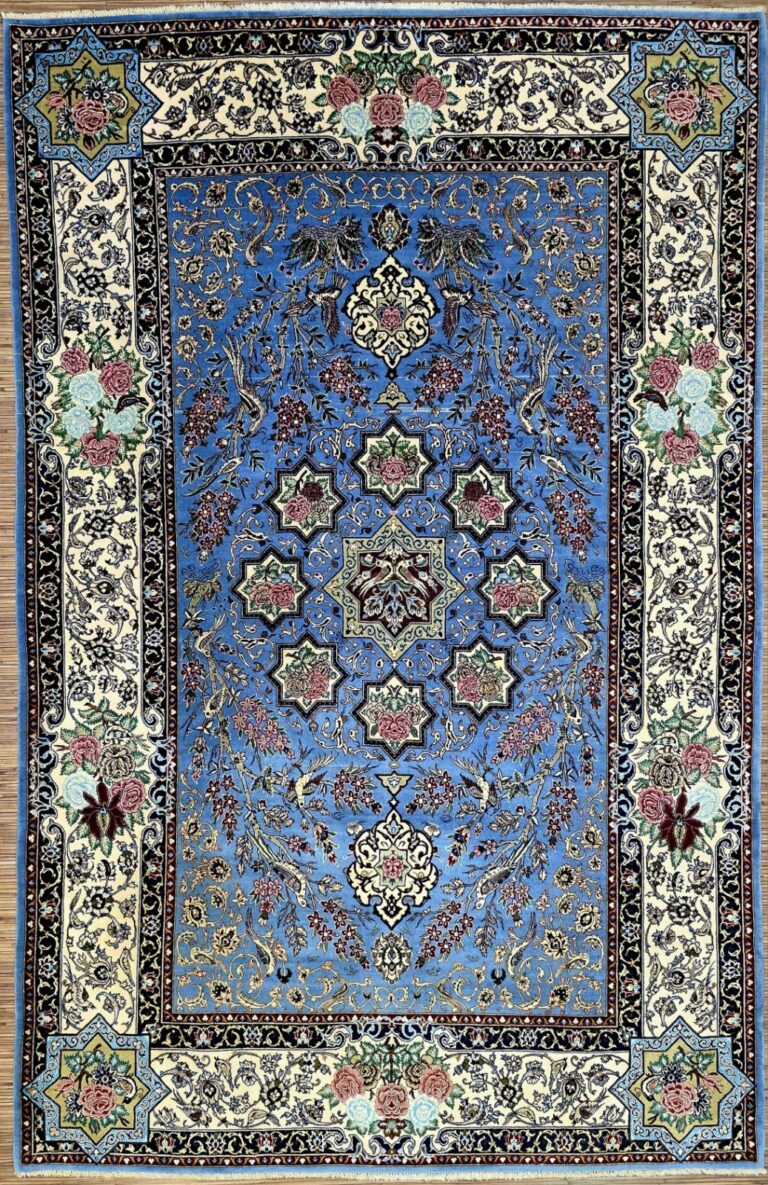
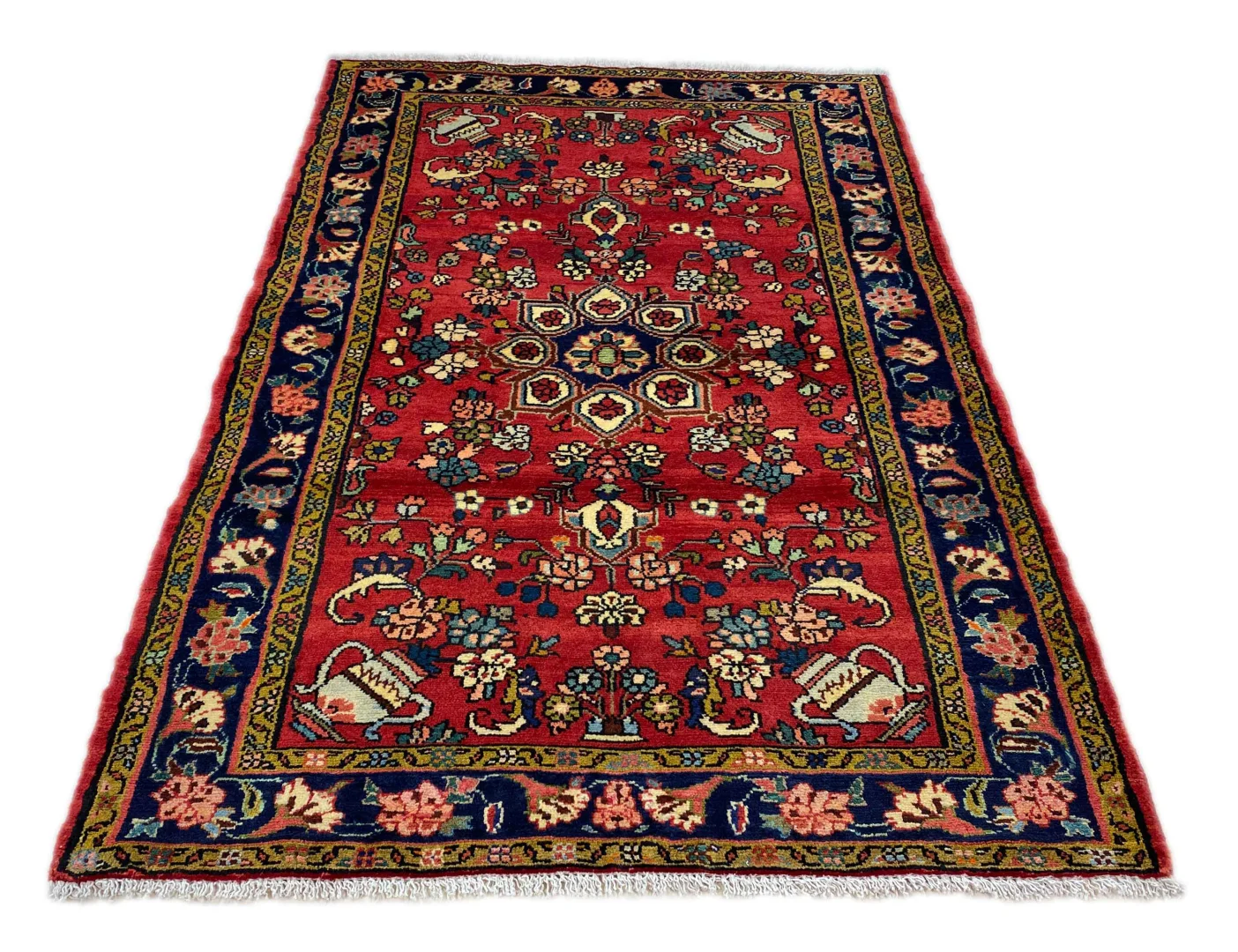
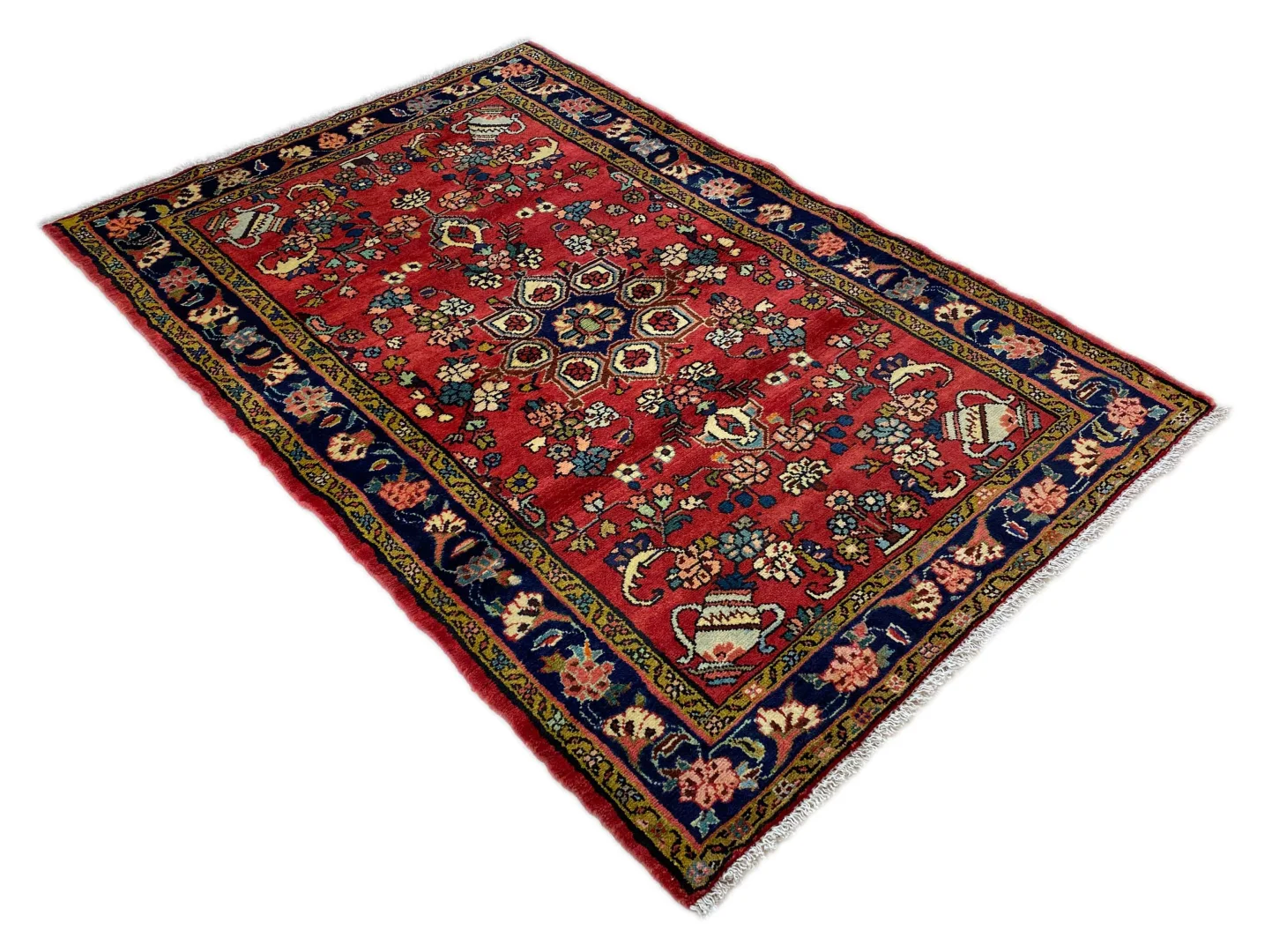
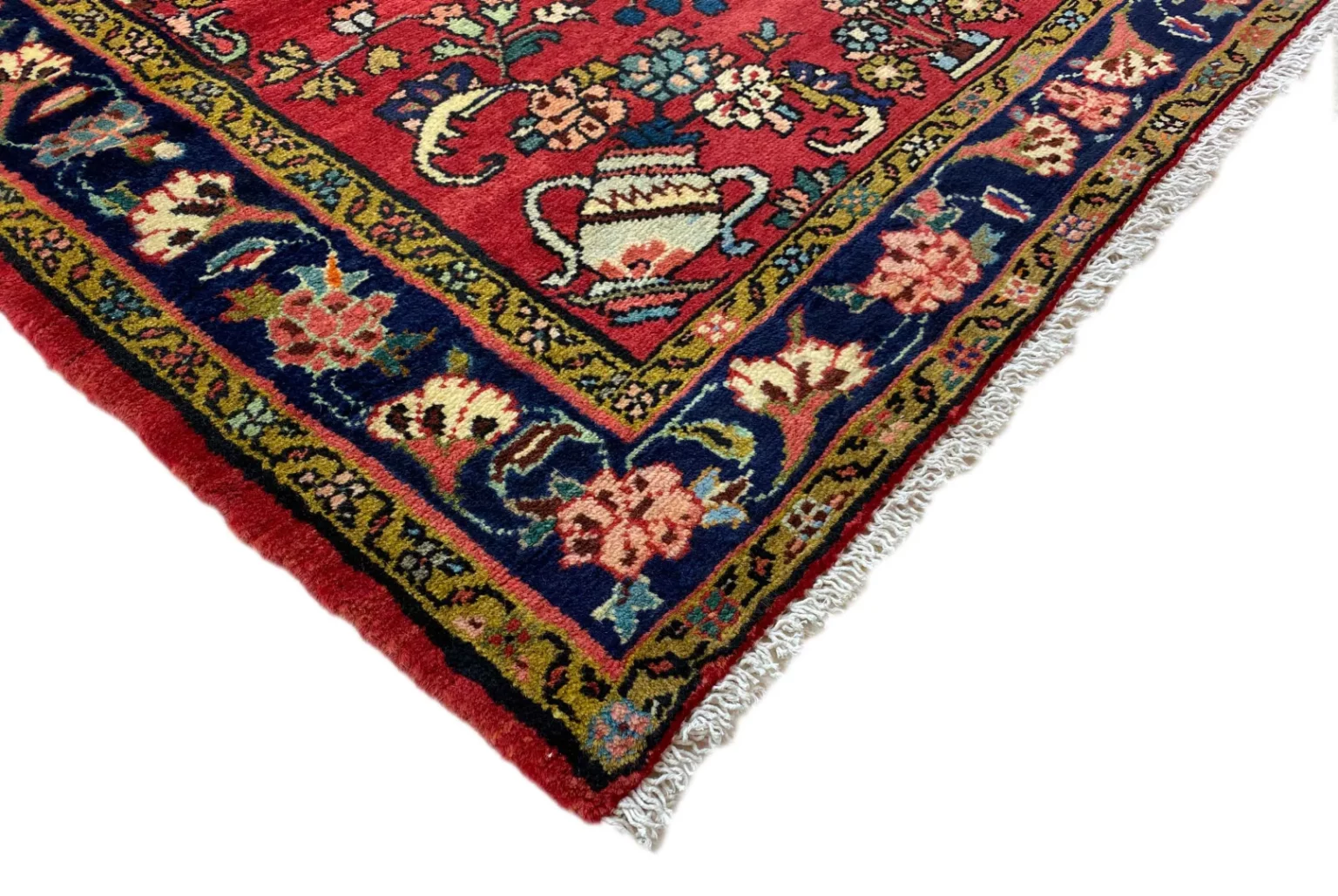
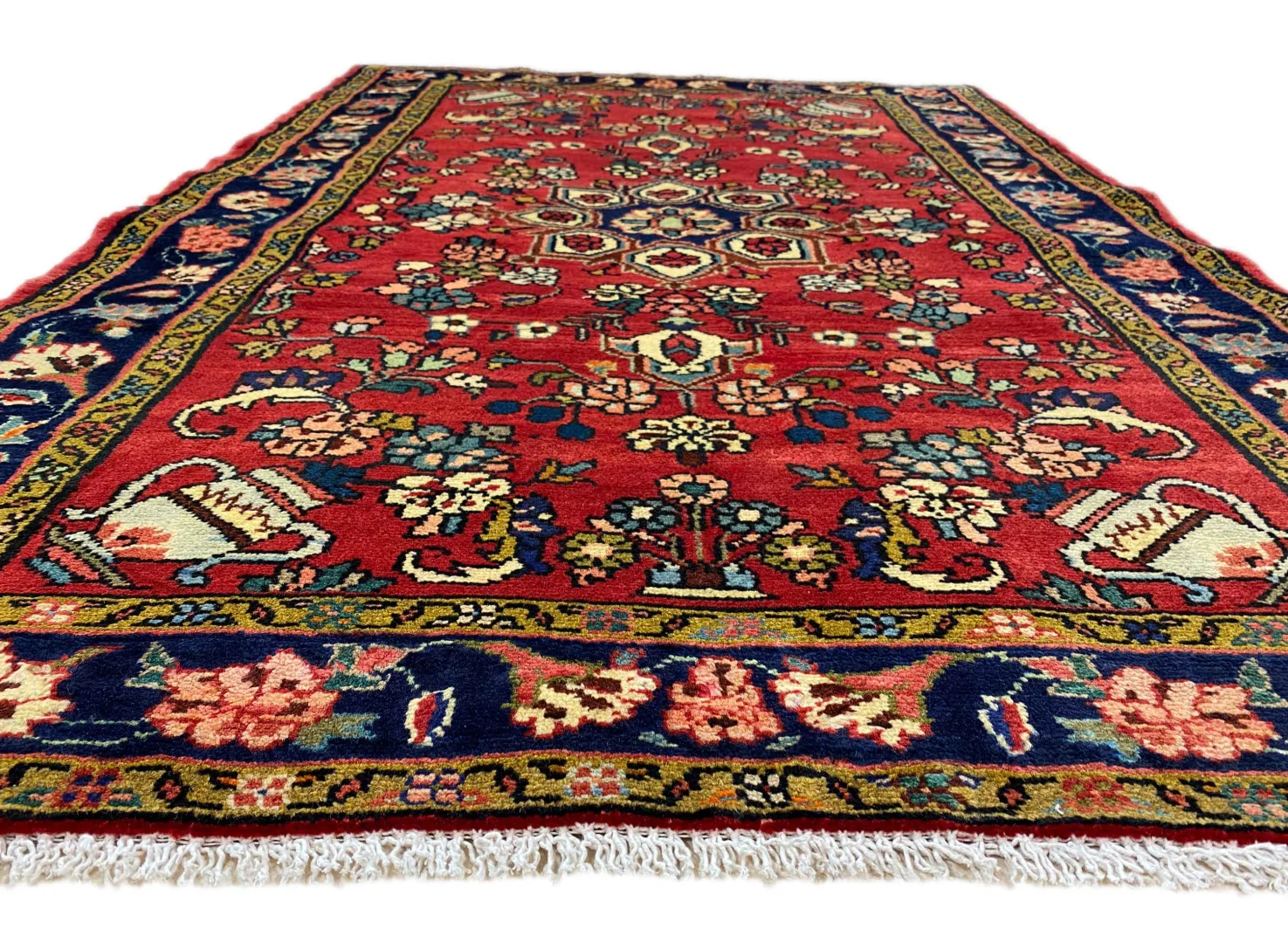
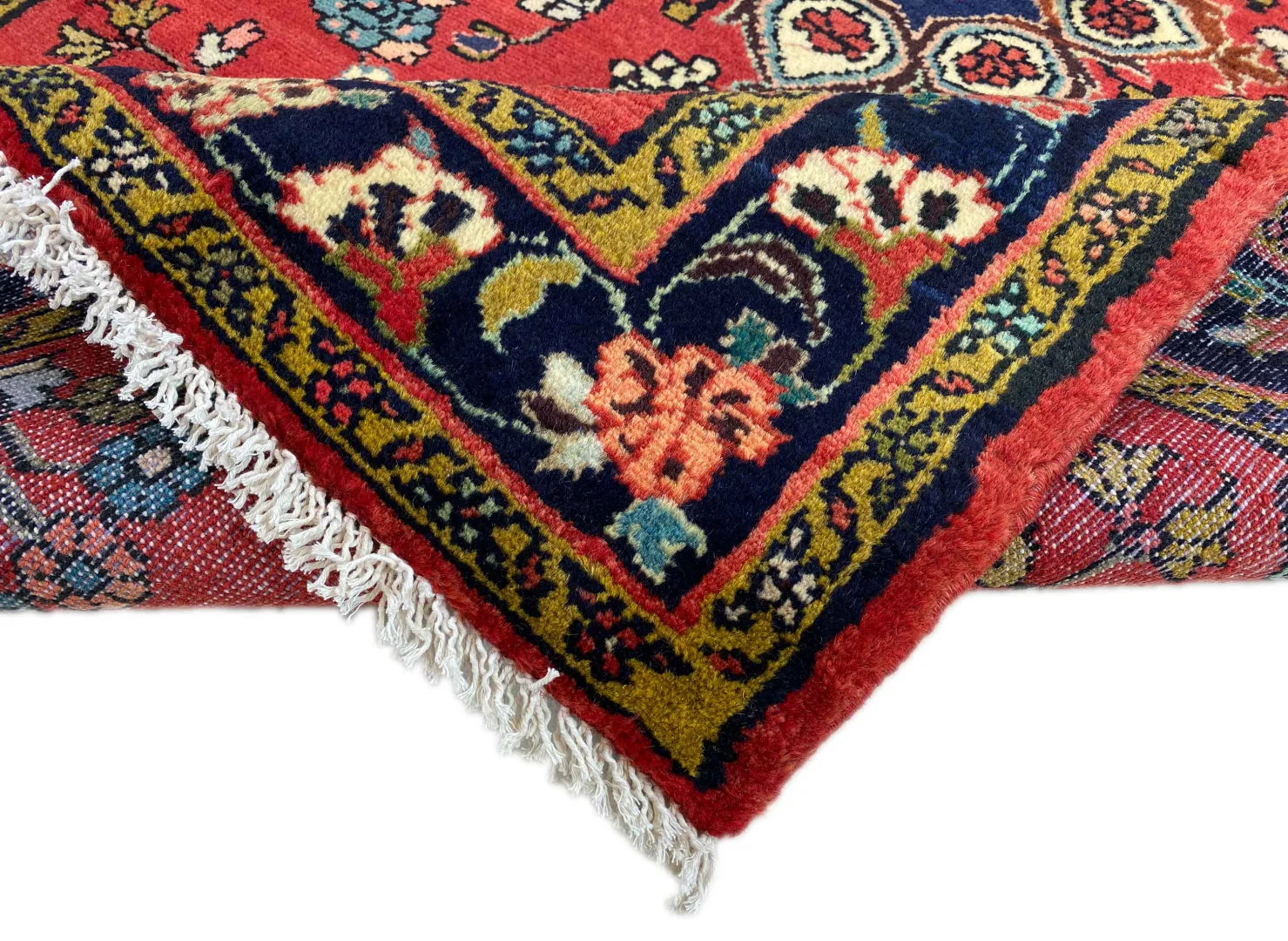
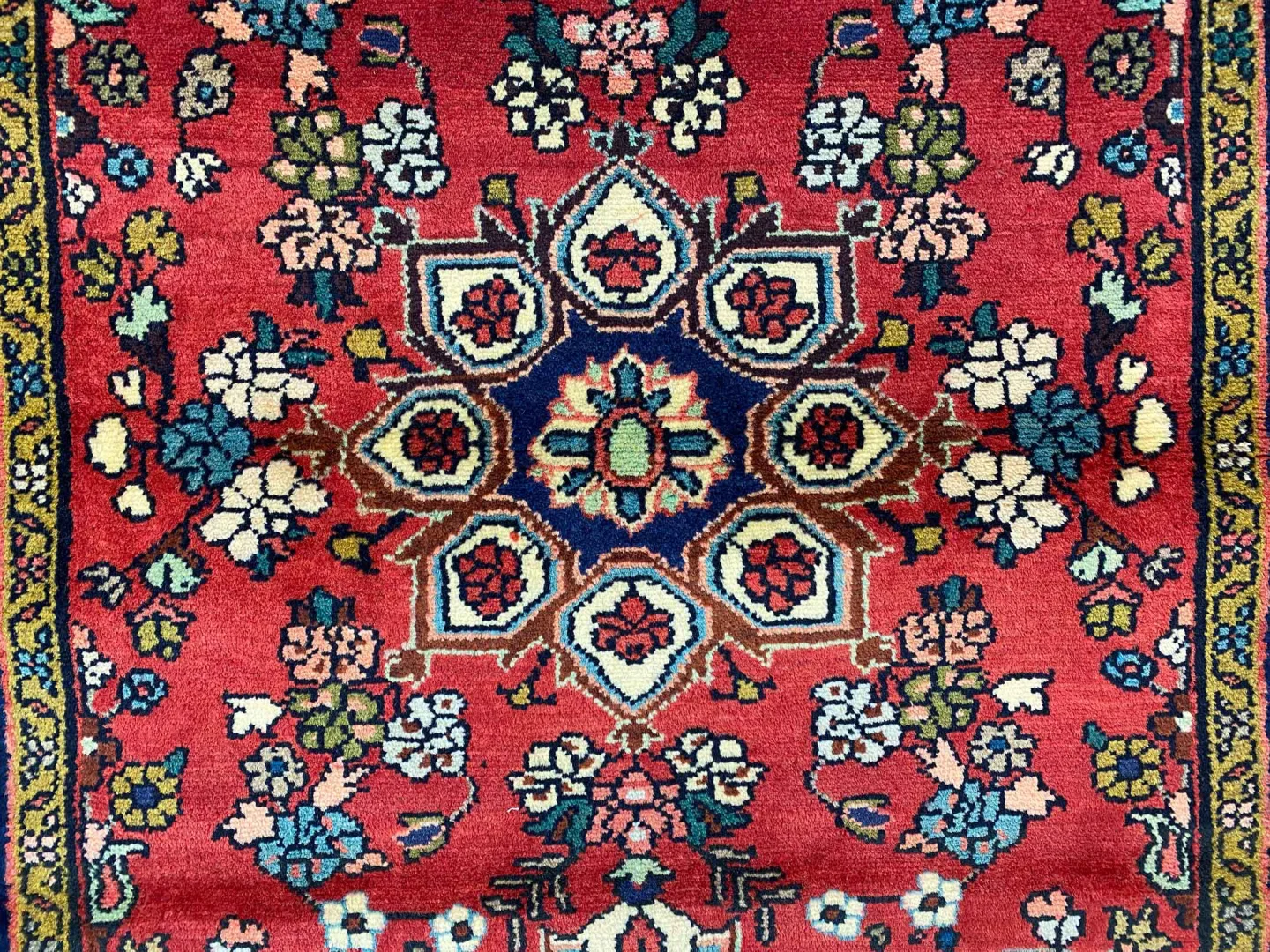
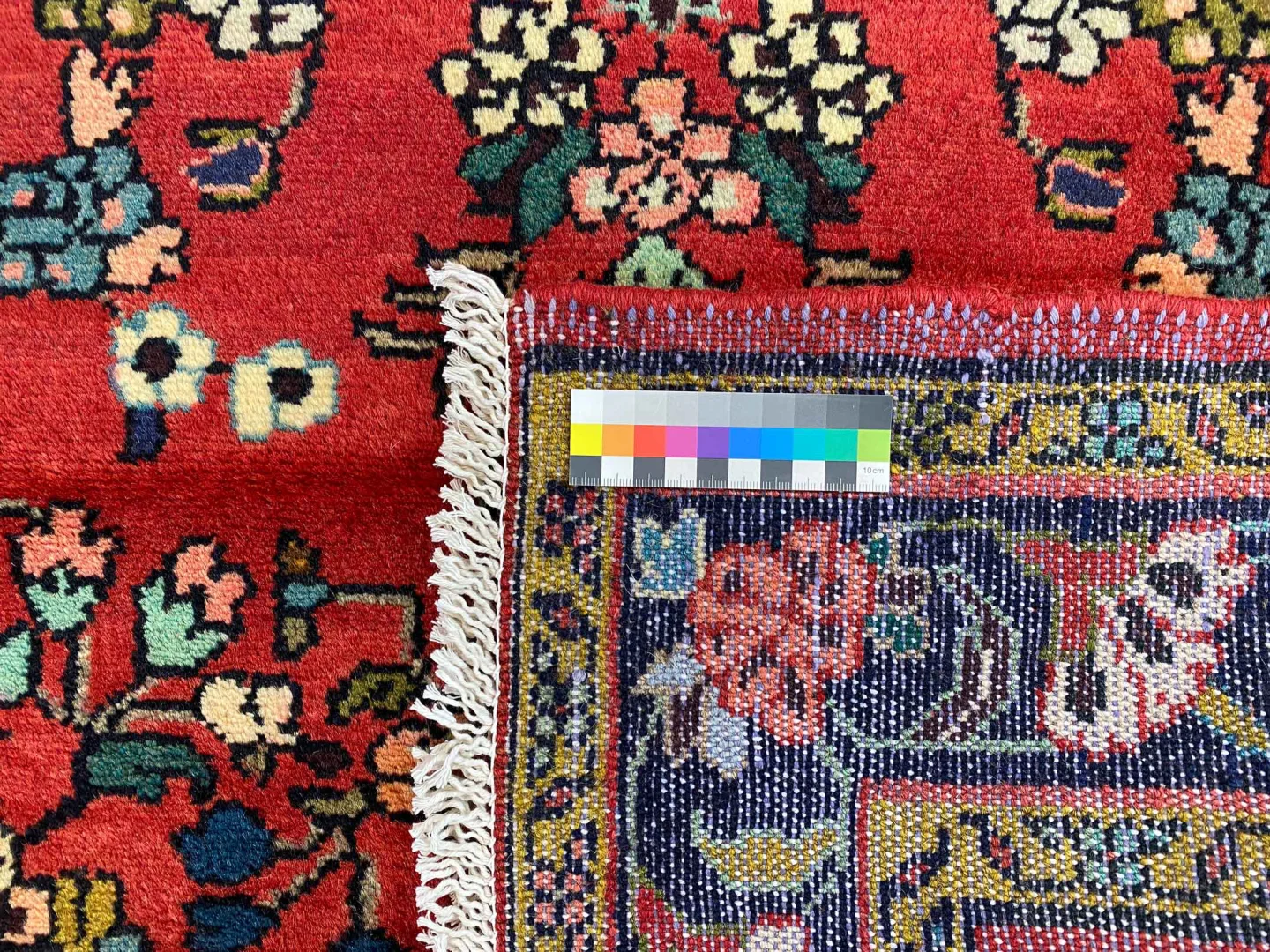
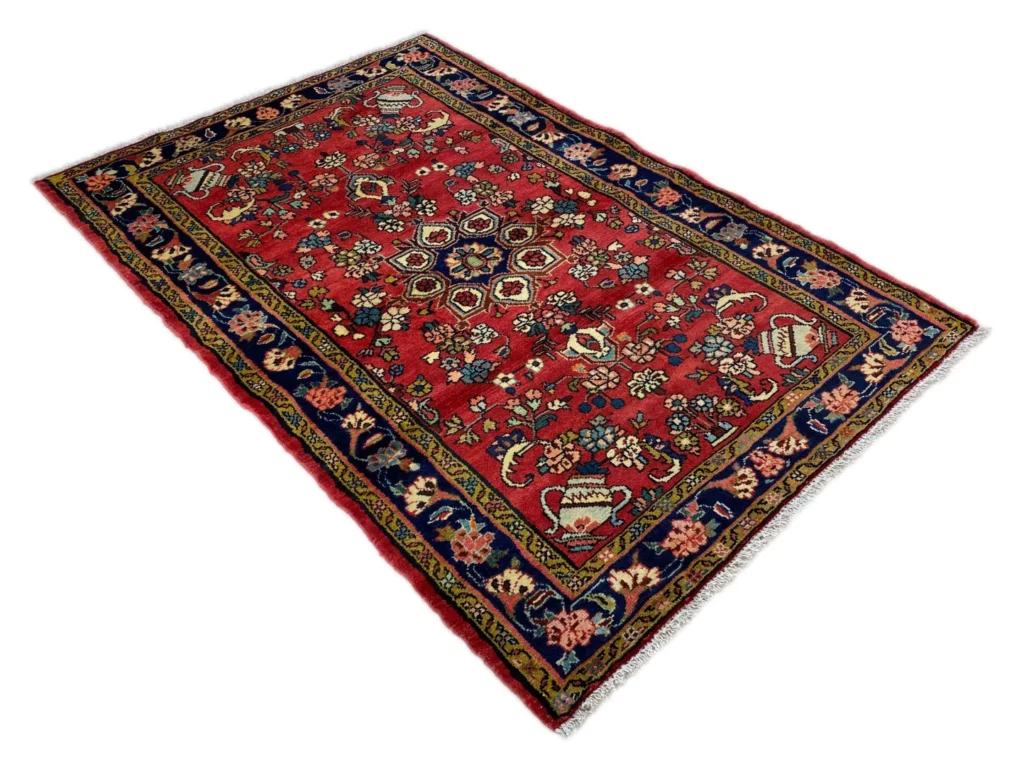
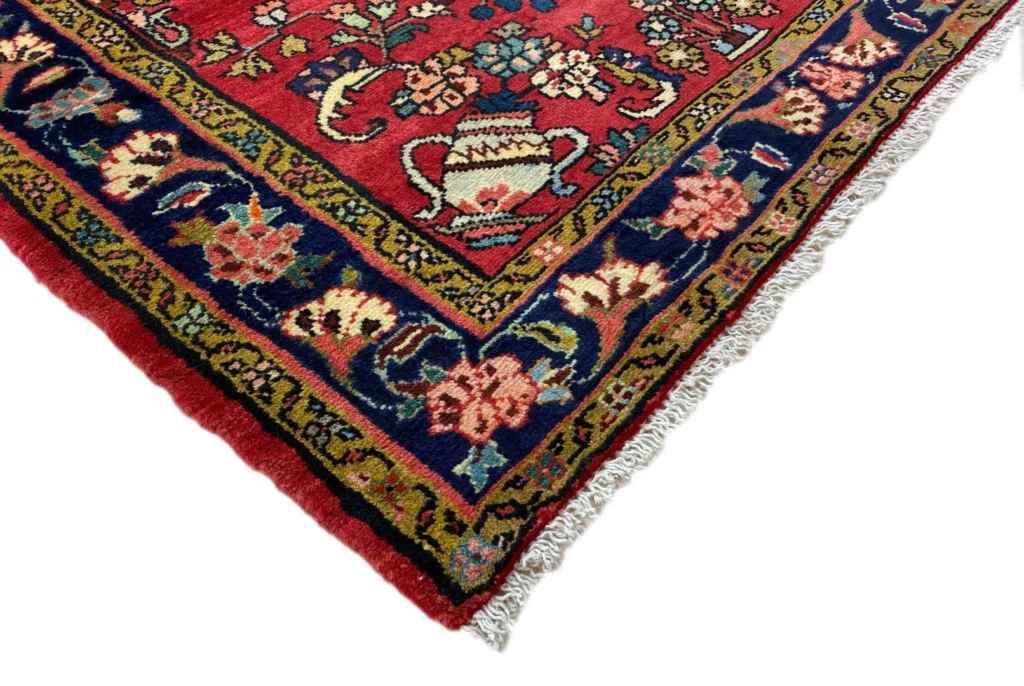
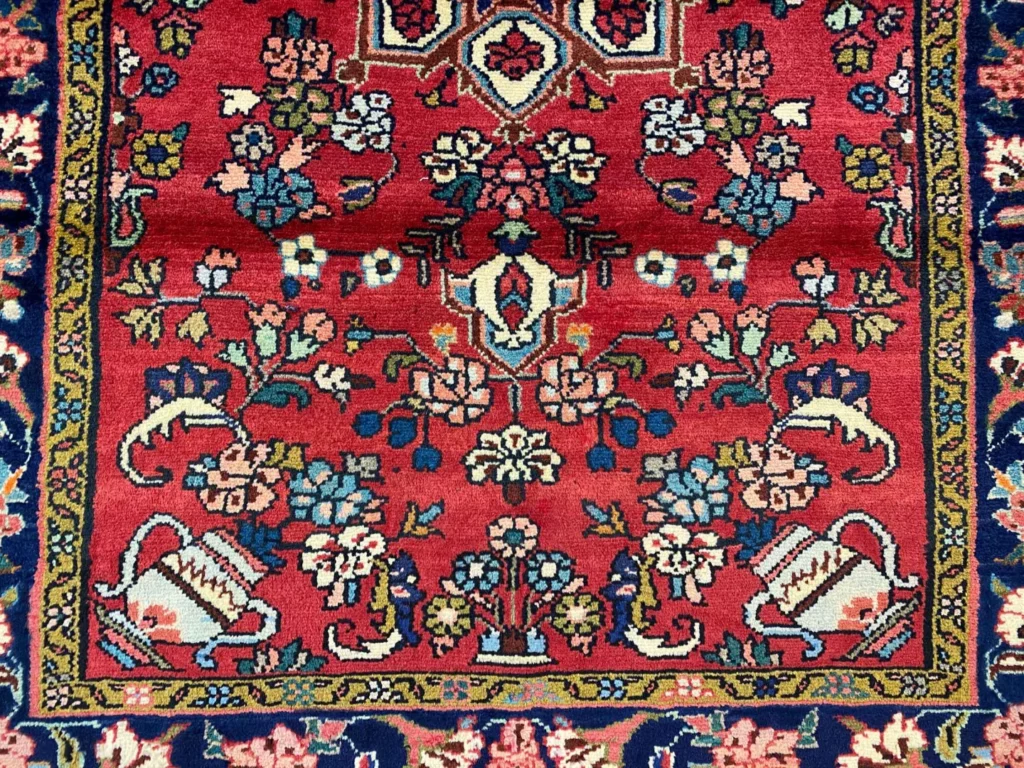
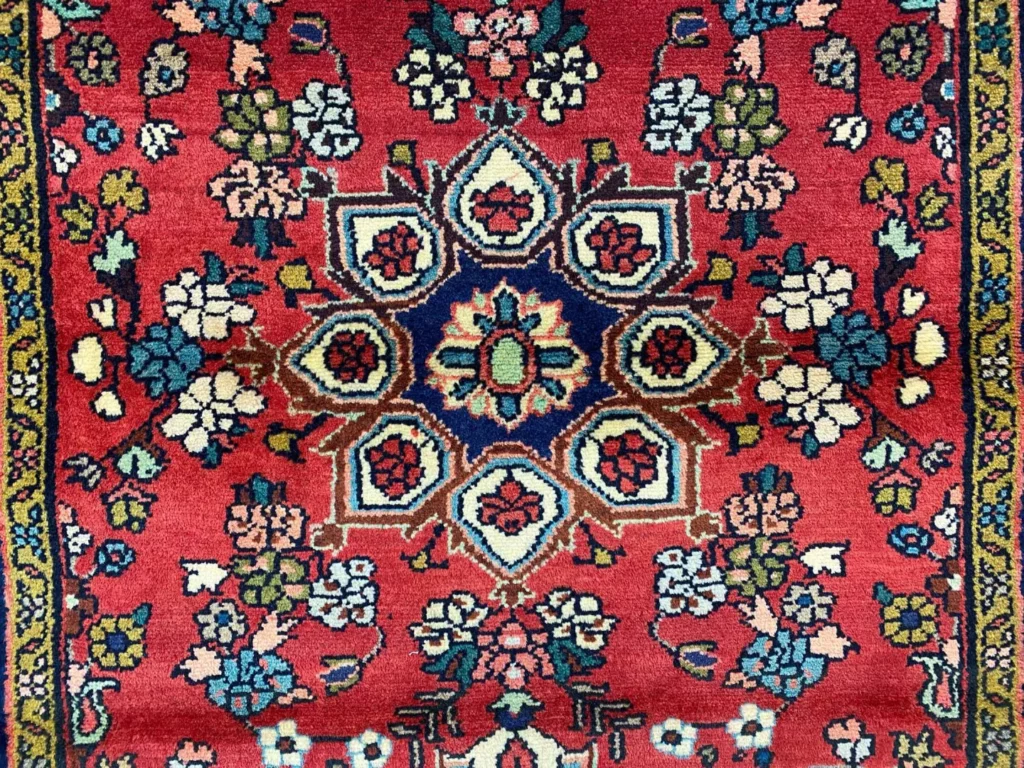
This Hamadan Persian rug is made of wool and is hand-knotted. Wool is a traditional natural fibre used throughout the Iranian rug-making tradition. It gives a rug a substantial surface and is valued for its practical suitability in a floor covering. Depending on the character of the fibre, wool can feel firm yet comfortable underfoot, retain warmth, and show a softly varied texture rather than a completely uniform surface. In a hand-knotted rug, the pile is not printed or mechanically attached. Individual strands are worked into the foundation knot by knot.
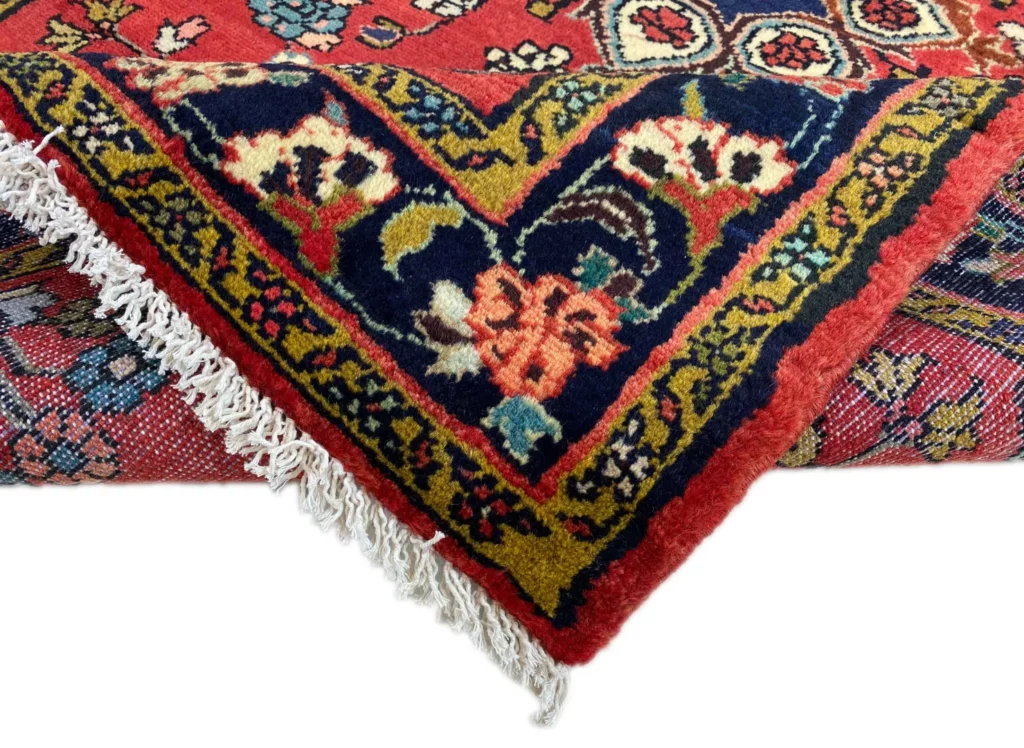
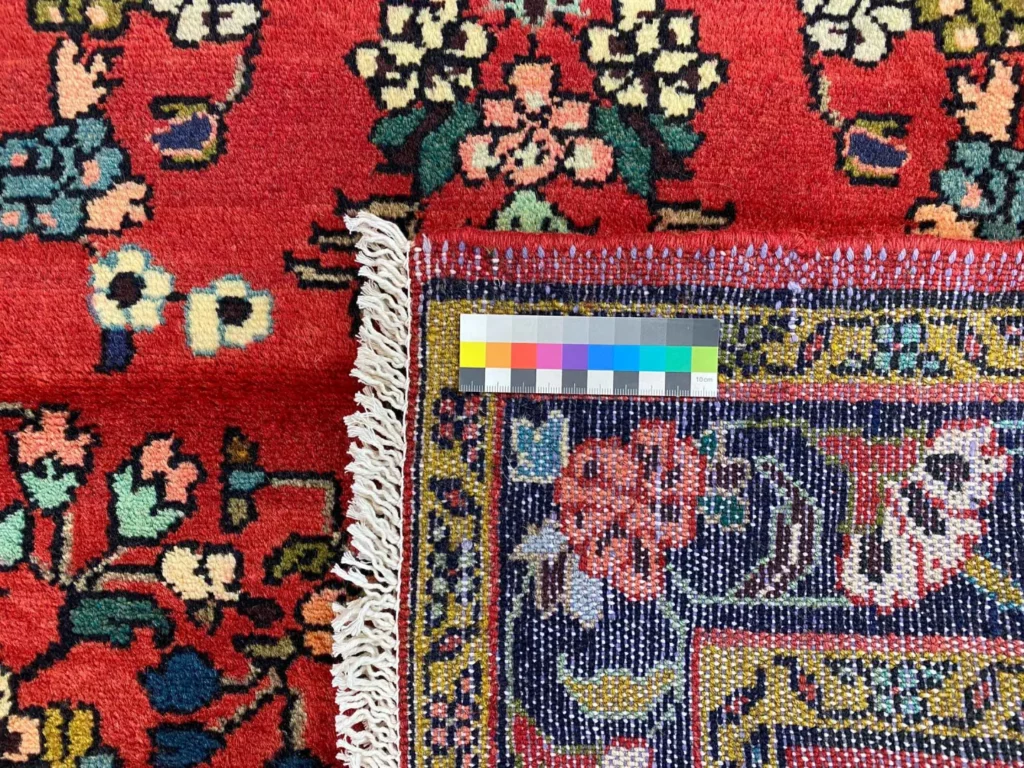
Hand-knotting is a gradual process in which the design is built as the rug progresses. Rows of knots are inserted into the prepared foundation, then secured through the continuing structure of the rug. The knot density of this rug is 200,000 knots per square metre. This figure describes how many knots are contained within a defined area and provides a technical indication of the fineness of the construction. It should not be confused with the pattern itself: knot density concerns the structure, while the design concerns the arrangement of shapes and ornaments on the surface.
The stated pile material is wool; no silk blend or additional pile fibre is specified. Wool is therefore the material to describe for this individual rug. When a hand-knotted rug is assessed, its fibre, the regularity of the knotting, and its condition are considered together. The condition of this rug is described as good. Material, technique, density, and condition are separate characteristics, and each one contributes a different part of the product description.
The source identifies the rug as hand-knotted rather than hand-woven. This distinction matters because a flat-woven rug is formed by interlacing yarns without a knotted pile, whereas a hand-knotted rug has individually tied pile knots. The wool surface and the traditional geometric design are consequently connected through the knotting process. No claim is made here about the warp, weft, dye recipe, finishing method, or a fibre other than the stated wool.
Origin and Tradition
This rug comes from Hamadan in Iran and is therefore a Persian rug. Hamadan refers to both a city and a broader rug-producing area in western Iran. Over many generations, the region developed a varied weaving and knotting culture shaped by urban workshops, village production, and local design habits. The name Hamadan does not describe one single fixed pattern. It identifies a historical production area in which individual rugs may differ in composition while still belonging to the same regional tradition.
Iranian rug making is closely tied to the practical transmission of craft knowledge. Skills such as preparing the foundation, handling wool, maintaining tension, inserting knots, and following a drawn or remembered design have traditionally been learned through direct experience. A hand-knotted rug is built in successive stages rather than completed by one mechanical operation. Each row contributes to both the visual drawing and the stability of the finished surface. The process requires concentration because a small change in the sequence of knots can affect a line, a border, or a repeated shape.
Hamadan is part of a western Iranian landscape with numerous local rug traditions. For that reason, the regional name should be understood as an origin designation and as a reference to an established rug area, not as proof of one prescribed decoration. Geometric compositions are compatible with the region’s broader traditions, but individual rugs can arrange their forms in different ways. This rug is specifically described as having a traditional geometric design. No narrower village name, workshop name, or particular Hamadan subtype is supplied.
Its Iranian origin also separates the rug from products made elsewhere that merely borrow Persian-looking ornament. Iran is expressly given as the origin here, so the correct category is Persian rug. Other well-known Iranian centres include Isfahan, Tabriz, Kashan, and Nain. Each place has its own historical associations and design vocabulary, but one name should not be substituted for another simply because a motif appears familiar. This piece is identified by Hamadan, and that origin remains distinct from the names of other Iranian weaving centres.
Regional rug traditions developed in relation to available materials, local knowledge, working methods, and inherited visual language. Such traditions can preserve recurring approaches to borders, field organisation, and the use of repeated forms without making every rug identical. The hand-knotted process also leaves room for the particular interpretation of the person or workshop producing the piece. This is why origin and individual design need to be stated separately: Hamadan identifies the regional context, while the recorded pattern description identifies the visual character of this rug.
The history of Iranian rugs is often discussed through famous cities and regional names, yet the history is also a history of working communities and repeated technical practice. Wool preparation, foundation building, knotting, clipping, and finishing all influence how a rug is made. These are general features of the craft tradition and should not be turned into unsupported claims about an unrecorded workshop. For this rug, the secure points are its Iranian origin, its Hamadan attribution, its wool pile, and its hand-knotted construction.
Design and Pattern
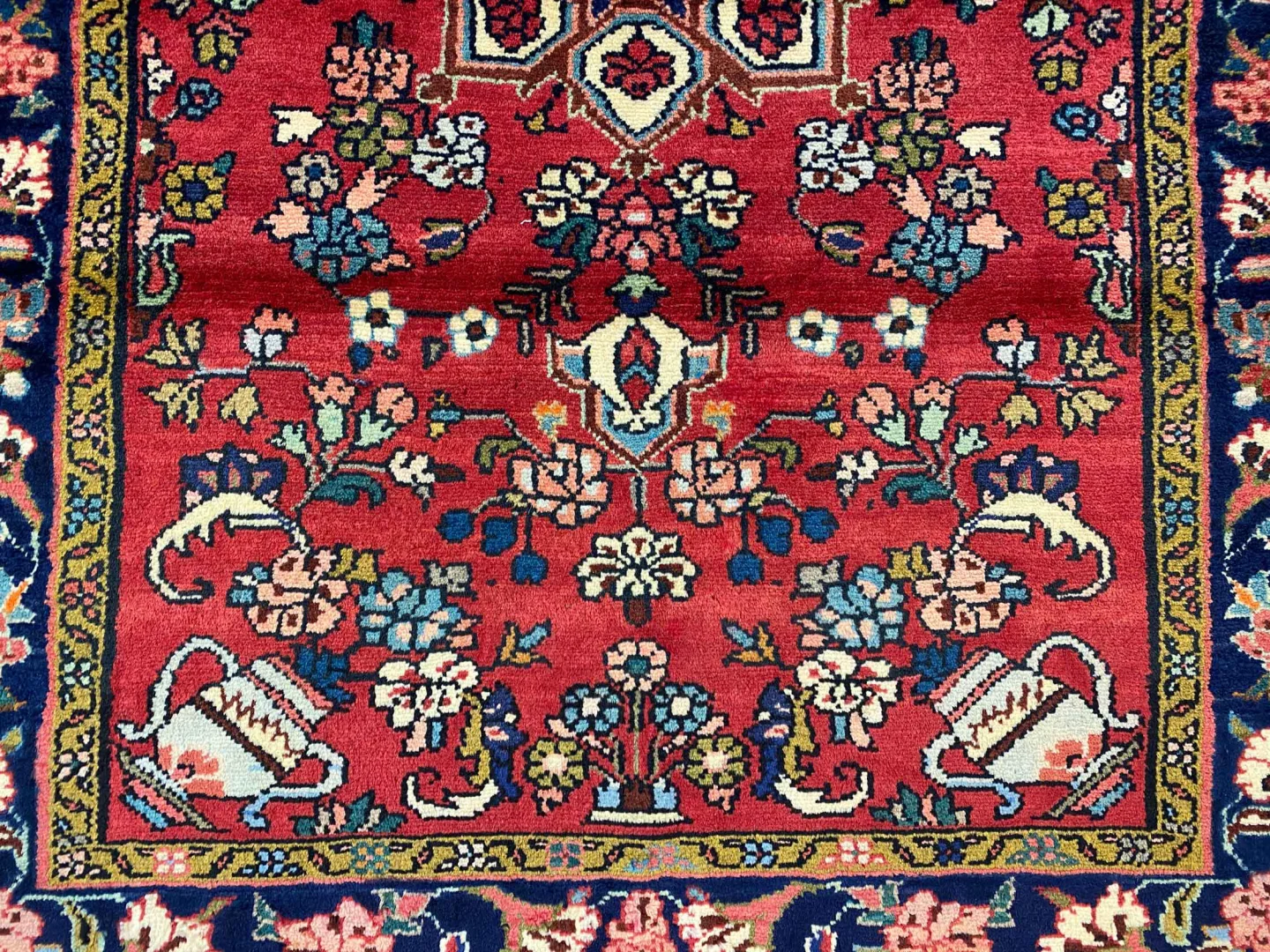
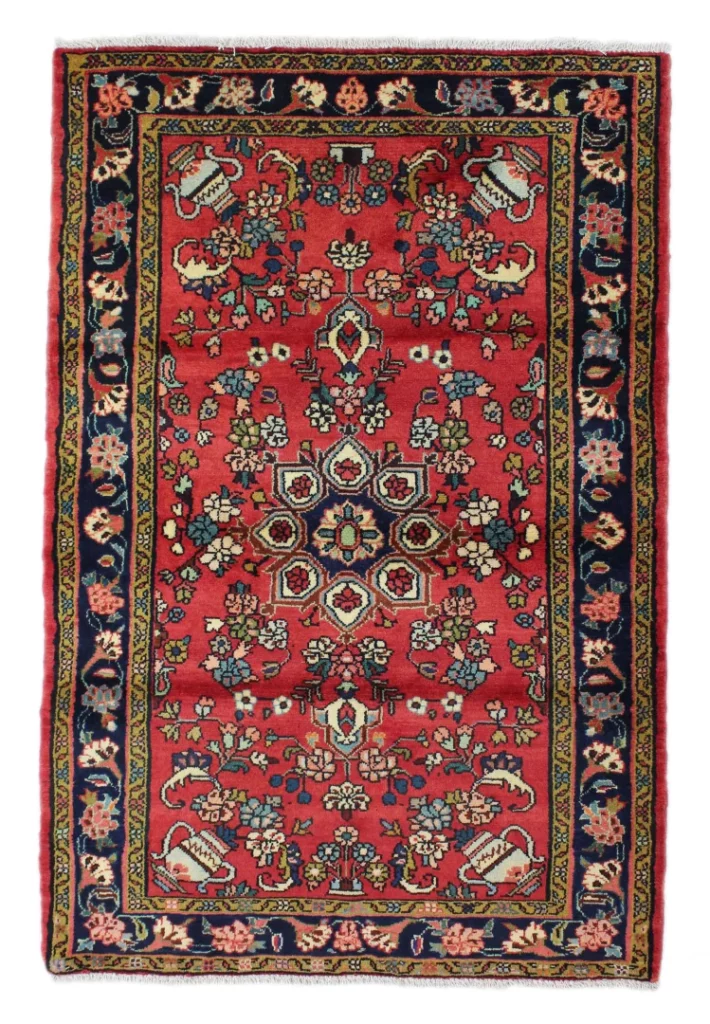
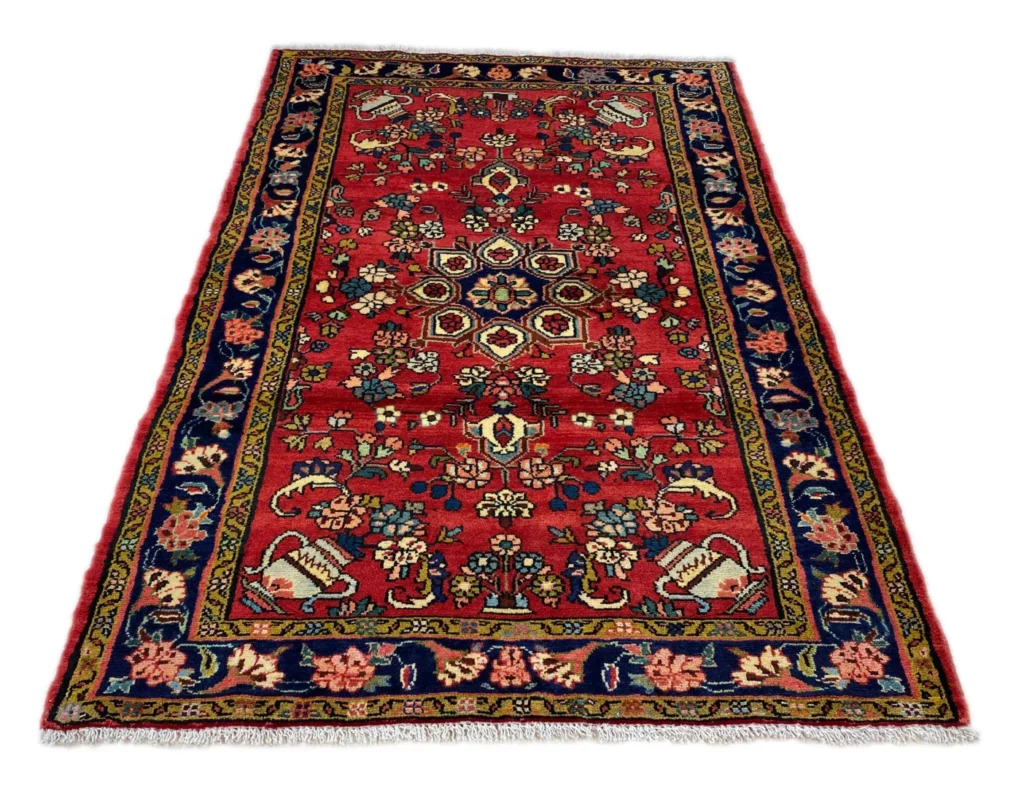
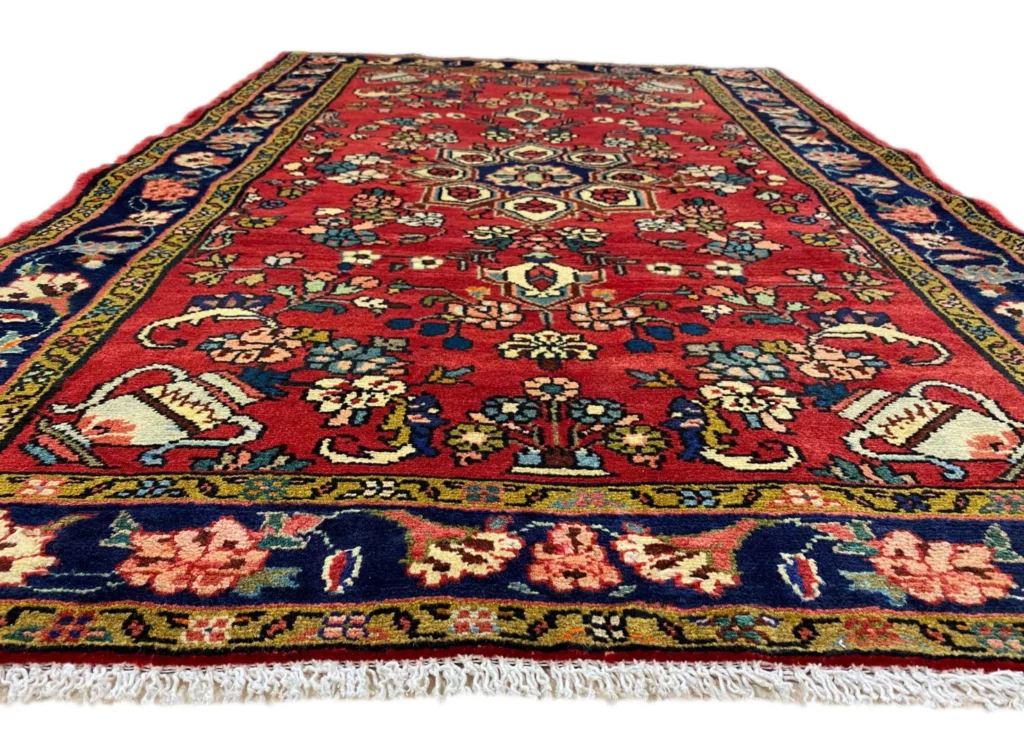
The pattern of this rug is described as a traditional geometric design. Geometric ornament is built from lines, angles, enclosed fields, repeated units, and clearly defined shapes. Its visual order comes from the relationship between these forms and the open areas around them. A geometric composition may use symmetry, a sequence of related motifs, or a larger arrangement made from smaller units. The exact arrangement on this rug is not specified, so no particular medallion, floral figure, border structure, or colour scheme is added to the description.
Geometric language has a long place in Iranian rug design. Flowers, leaves, stars, diamonds, hooks, and branching forms can all be simplified into lines and angular shapes. This makes them suitable for a design that must be translated into rows of knots. The individual symbol is only part of the result; spacing, repetition, scale, and contrast also determine how the composition reads. A line may define the edge of a field, guide a border, or connect separate areas of the ornament into a coherent whole.
Many traditional rug layouts are discussed using terms such as field, border, and repeat. These are general tools for describing composition and are not additional facts about this particular piece. The available description confirms only a traditional geometric design. It does not state whether the rug has a central medallion, an all-over arrangement, floral infill, a wide border, or a specific palette. Keeping those distinctions clear prevents a general account of Iranian pattern traditions from becoming an invented description of the rug for sale.
Geometric designs often create rhythm through recurrence. Related shapes can appear at regular intervals, while small handmade variations keep the surface connected to the process of knotting. The pattern is not simply placed on top of the rug after production; it is formed through the sequence of coloured knots. This gives technique and design a direct relationship. The recorded knot density helps describe the technical construction, but it does not by itself identify a motif, a colour, or a regional subtype.
A Hamadan rug can bring together inherited ornament and the working interpretation of an individual maker. In a geometric composition, the clarity of the outline is especially important because the structure depends on the controlled progression of small forms. Repetition can create continuity across the surface, while changes in scale can establish emphasis. These are characteristics of geometric rug design in general. For this individual rug, the factual design statement remains the narrower one: it has a traditional geometric pattern, without an asserted colour list or named motif.
Pattern names and origin names are not interchangeable. A design may be described with a term associated with another Iranian region, yet that would not change the actual origin of a rug. Likewise, geometric decoration can appear in different rug traditions, including Gabbeh or Kelim, without making their construction or provenance the same. This piece is a hand-knotted Hamadan Persian rug from Iran. Its pattern is traditional and geometric; its origin and technique should be read as separate, equally important parts of its identity.
Special Features
The defining features of this one-off rug are its Iranian origin, its Hamadan attribution, its wool pile, and its hand-knotted construction. The recorded knot density is 200,000 knots per square metre. Its pattern is a traditional geometric design, and its condition is described as good. Together, these points give a precise account of the rug’s material, production method, technical density, regional classification, visual category, and state of preservation.
The combination of wool, hand-knotting, and geometric ornament links practical material with an established Iranian craft tradition. The wool forms the pile, the knots create the surface and build the design, and the Hamadan name places the rug in its stated region of origin. The good condition adds information about its present state. No age, signature, restoration history, warp material, dye composition, or other detail is supplied, so none of those characteristics is attributed to this individual piece.
FAQ
What makes this Hamadan Persian rug distinctive?
Its distinctive features are the specific combination of documented characteristics: it originates in Iran, is attributed to Hamadan, uses wool as its pile material, and is hand-knotted. The rug has a knot density of 200,000 knots per square metre, a traditional geometric design, and a condition described as good. Hamadan identifies the regional origin, while the geometric description identifies the visual organisation. These details provide a clear classification without adding an unstated age, signature, workshop, colour palette, or fibre blend.
How should I care for a hand-knotted wool rug?
A hand-knotted wool rug benefits from regular, gentle vacuuming with an appropriate setting. Avoid pulling forcefully across edges or fringes, since these areas should be treated with care. If a liquid is spilled, absorb it promptly rather than rubbing vigorously into the pile. Professional cleaning is appropriate when a deeper treatment is needed. Strong, direct sunlight should be limited because prolonged exposure can alter colours over time. When a cleaning product or method is uncertain, specialist advice is preferable to testing an unsuitable treatment on the wool surface.
Which interior style works well with a geometric pattern?
A traditional geometric pattern can work in several types of interior. In a classic room, its ordered forms can relate to existing structured furniture and materials. In a modern or restrained setting, the geometry can introduce a defined visual rhythm beside plain surfaces. The best choice depends on the room’s existing colours, proportions, furniture, and lines. No particular colour palette is specified for this rug, so a precise colour recommendation cannot be made. Its geometric organisation does, however, offer a structured alternative to an entirely floral design or a completely plain floor covering.
To provide the best experiences, we use technologies like cookies to store and/or access device information. Consenting to these technologies will allow us to process data such as browsing behavior or unique IDs on this site. Not consenting or withdrawing consent, may adversely affect certain features and functions.
Functional Always active
The technical storage or access is strictly necessary for the legitimate purpose of enabling the use of a specific service explicitly requested by the subscriber or user, or for the sole purpose of carrying out the transmission of a communication over an electronic communications network.
Preferences
The technical storage or access is necessary for the legitimate purpose of storing preferences that are not requested by the subscriber or user.
Statistics
The technical storage or access that is used exclusively for statistical purposes.The technical storage or access that is used exclusively for anonymous statistical purposes. Without a subpoena, voluntary compliance on the part of your Internet Service Provider, or additional records from a third party, information stored or retrieved for this purpose alone cannot usually be used to identify you.
Marketing
The technical storage or access is required to create user profiles to send advertising, or to track the user on a website or across several websites for similar marketing purposes.

 SECURE PAYMENT
 SHIPPING PARTNERS