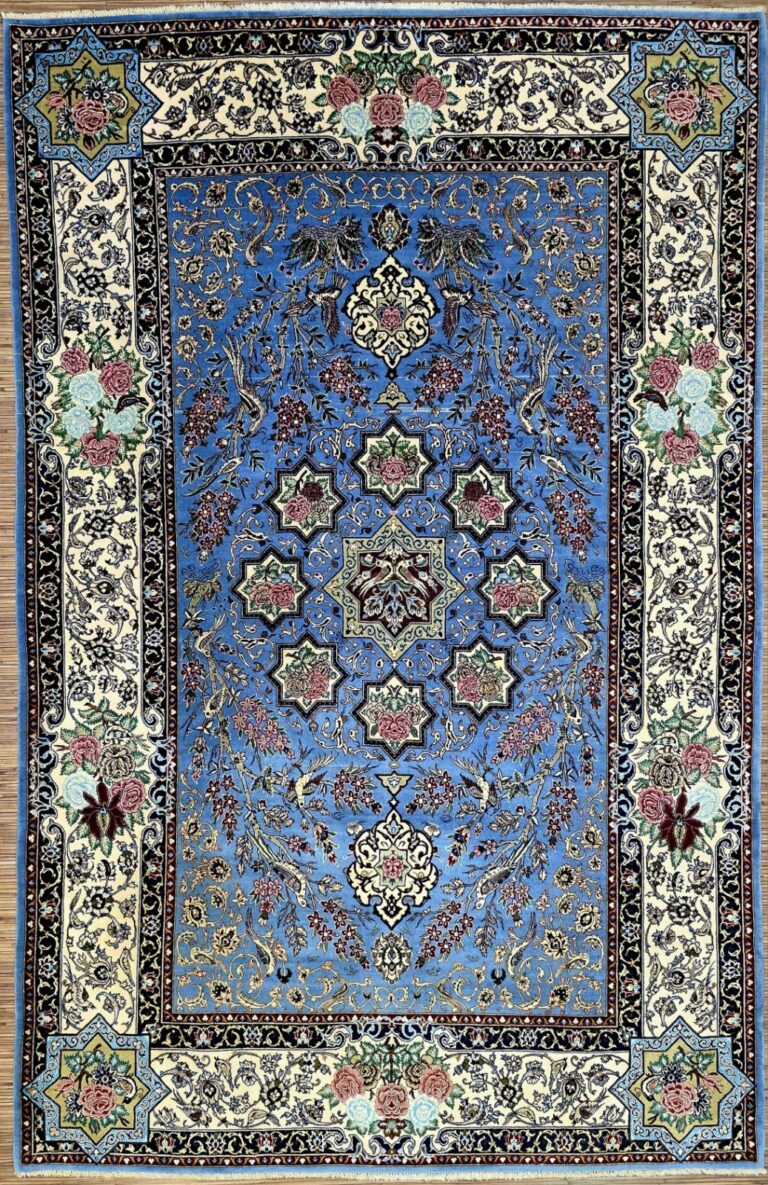
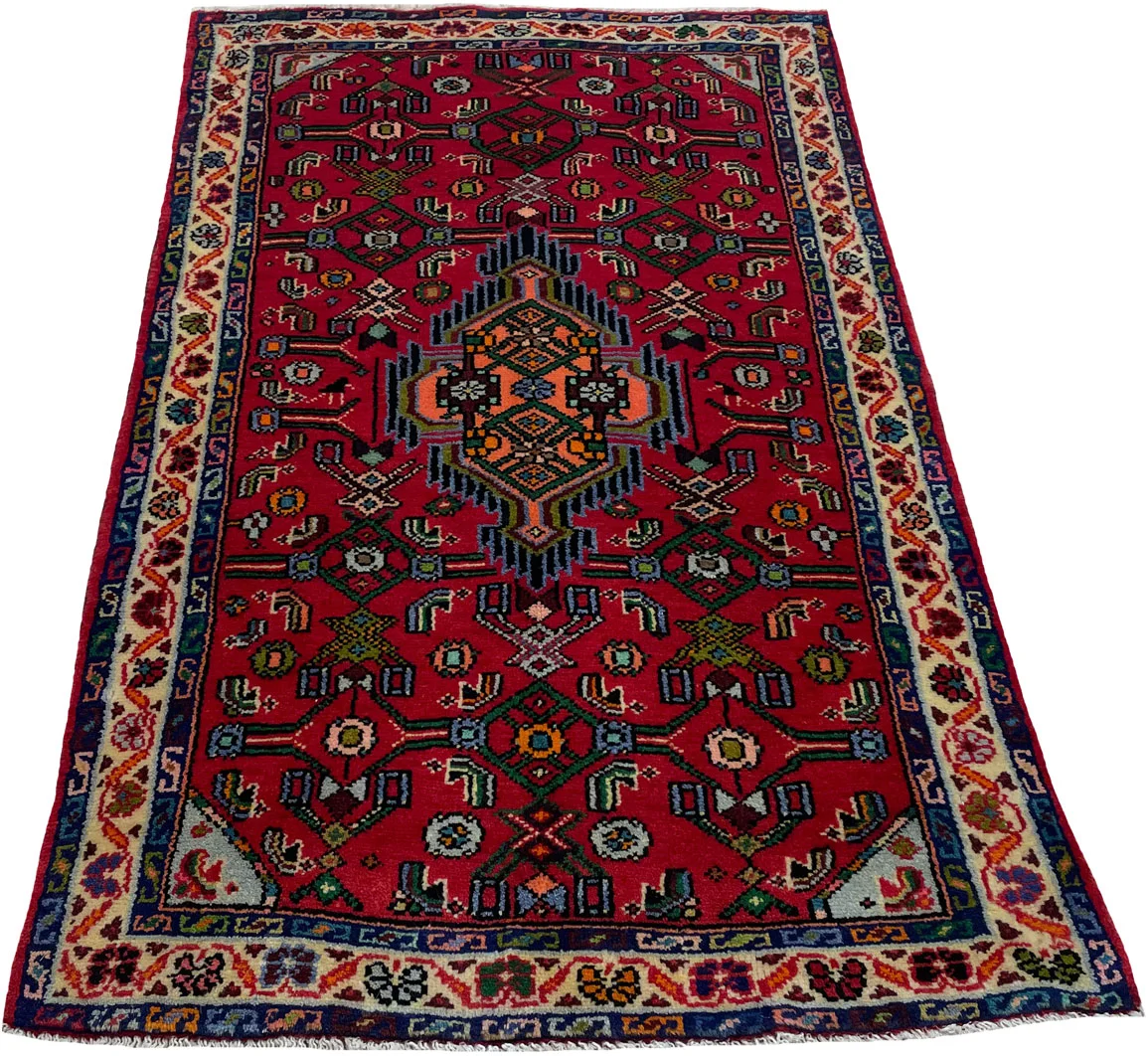
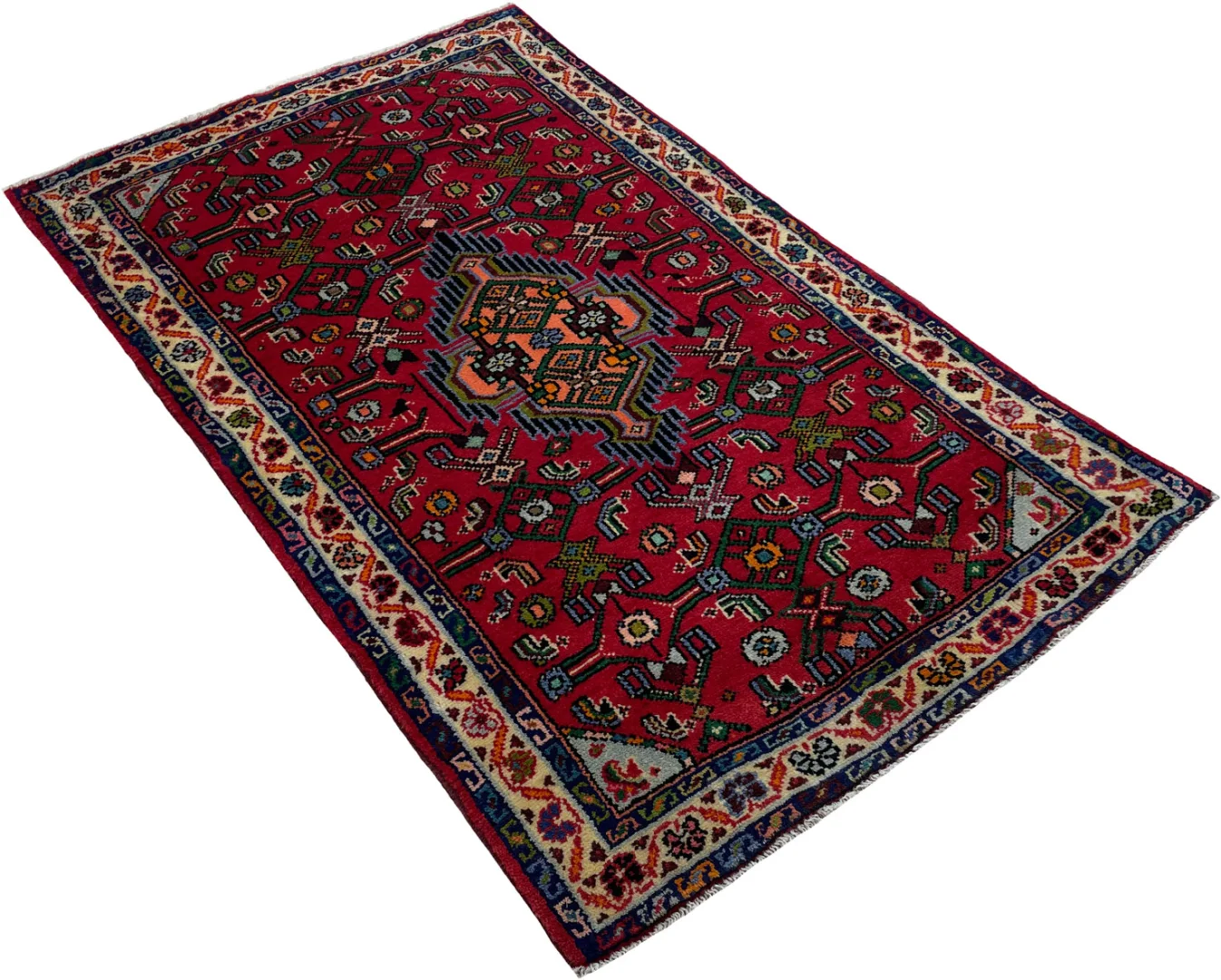
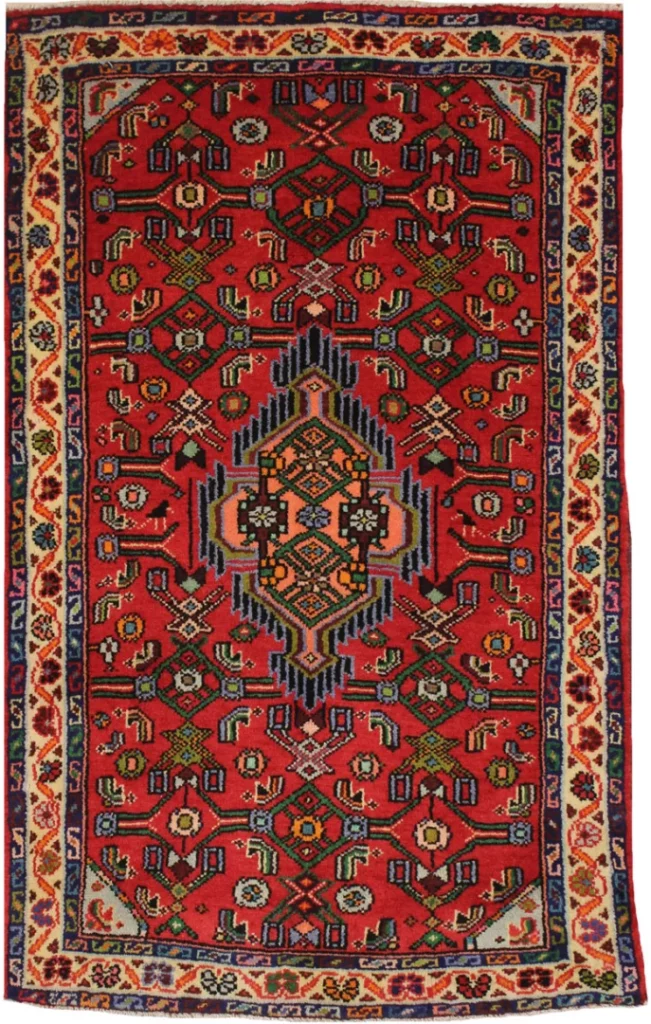
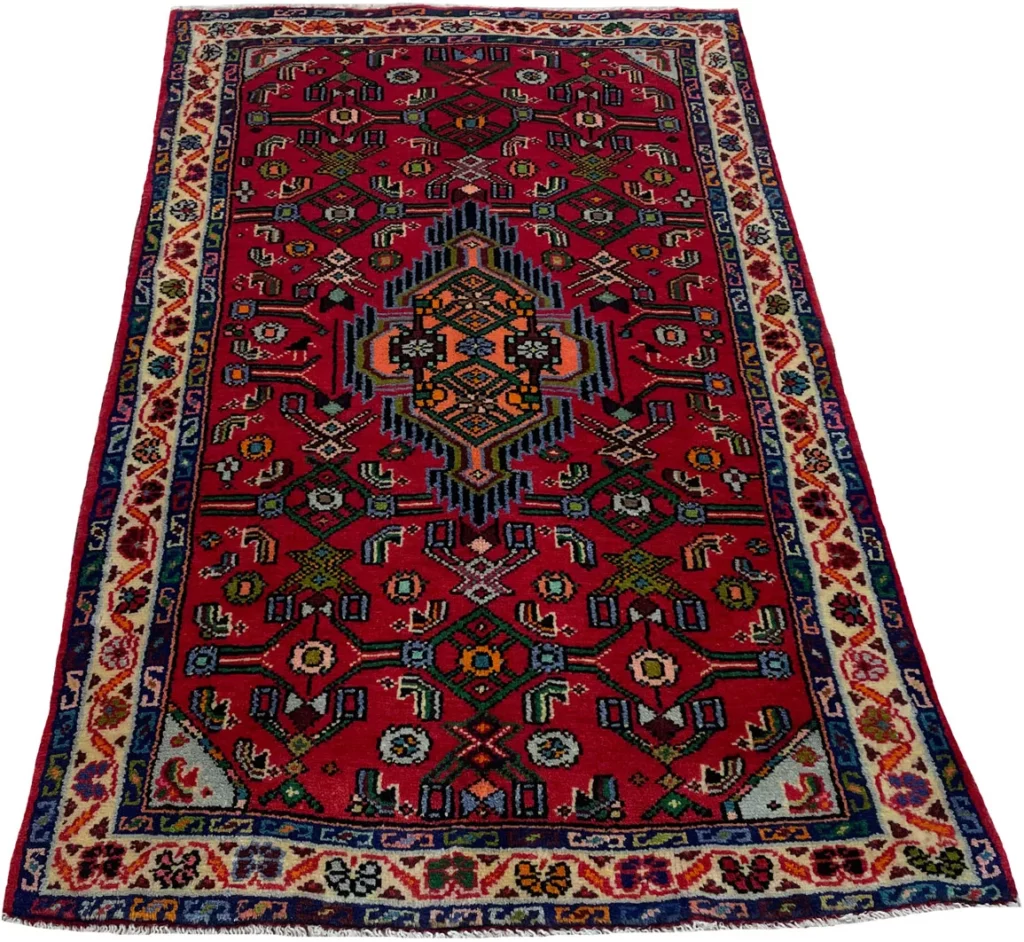
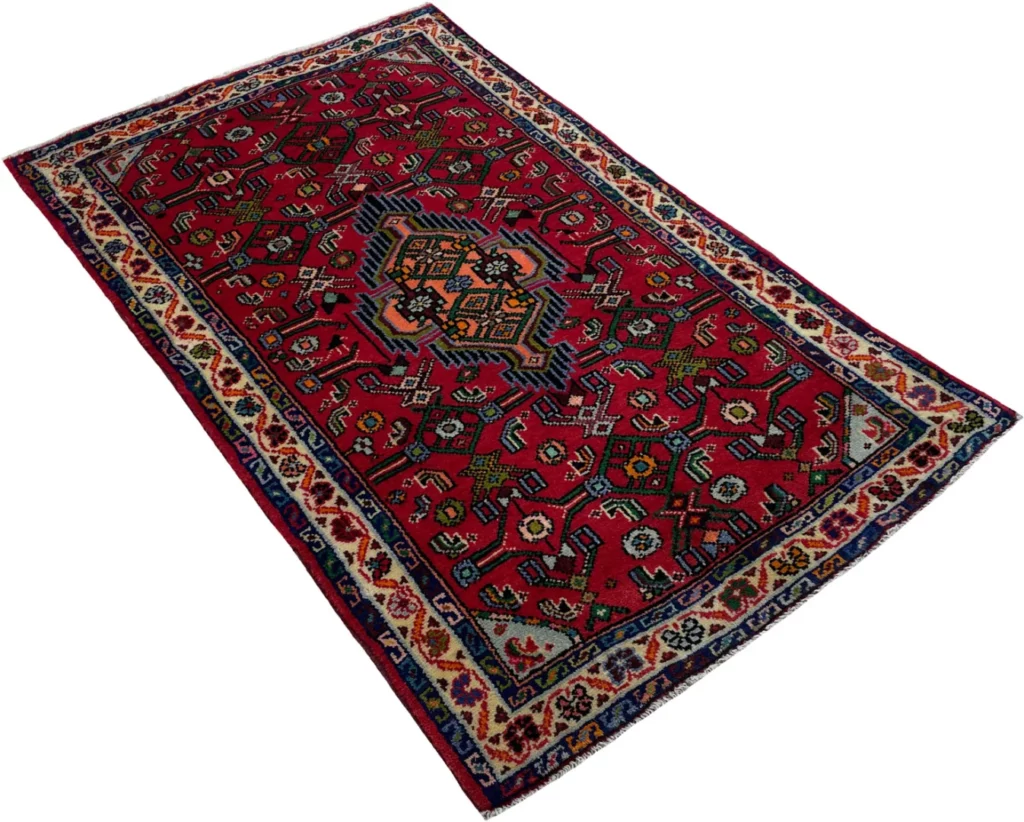
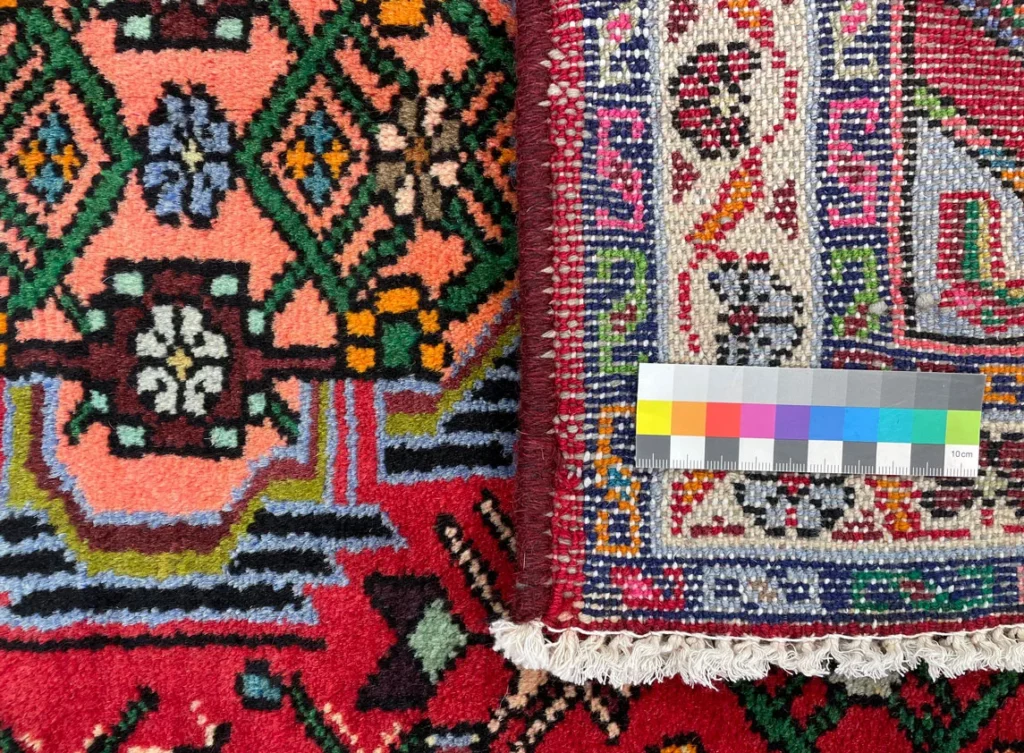
This Hamadan Persian rug is hand-knotted and has a pile made from robust wool. Wool is one of the traditional materials used for Hamadan rugs, combining a hard-wearing surface with a naturally textile feel. In hand-knotting, each knot is inserted individually into the rug structure. The result is a one-off piece whose precise execution is not reproduced through an identical industrial process.
Wool is used for Hamadan rugs because it is practical for everyday use as well as resilient. Its natural fibres can hold dust within the textile surface, allowing it to be removed through regular vacuuming. Wool also gives the pile a distinct tactile character. The condition of this rug is stated as good. Careful use and suitable maintenance help preserve the existing surface and the appearance of its colours.
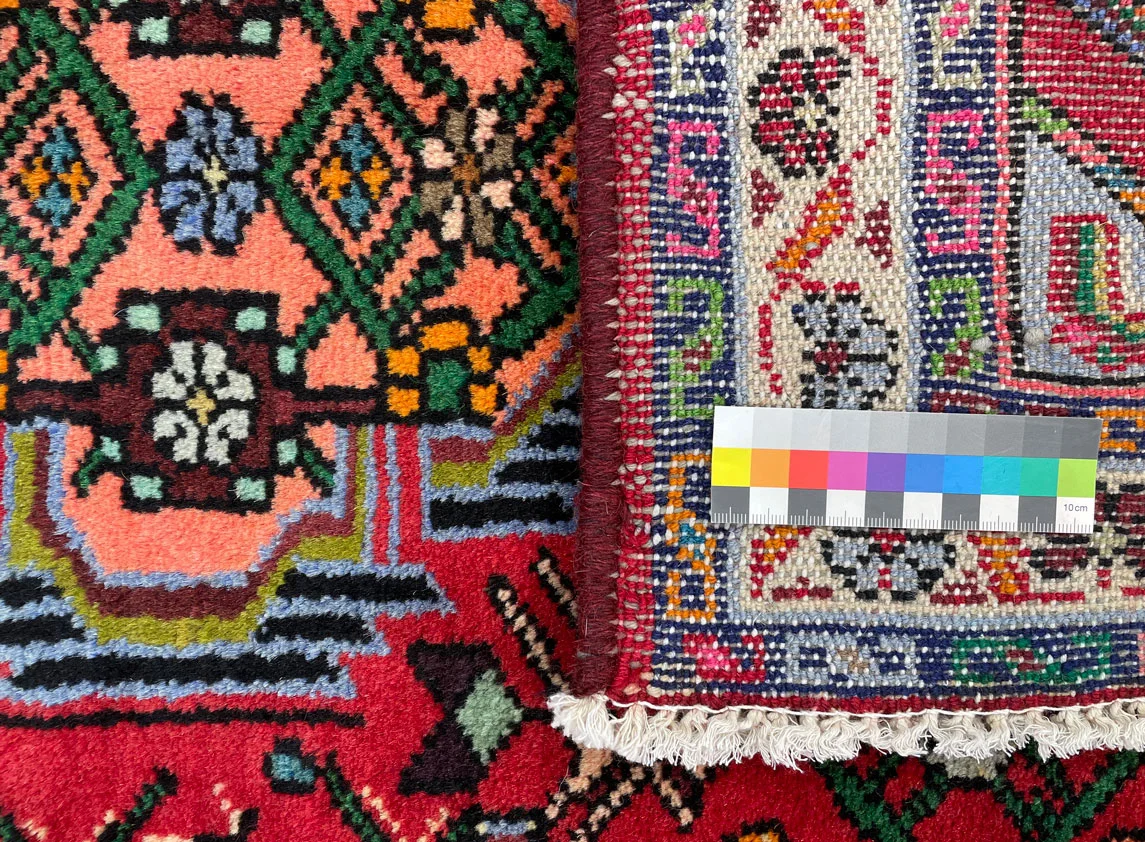
The specified knot density ranges from 100,000 to 350,000 knots per square metre. This range reflects the hand-crafted construction found among Hamadan rugs and the degree of detail that can be achieved in their designs. Knotting, material and pattern work together to form one continuous surface. The robust wool is the visible material foundation of this rug, while the handwork determines its textile structure and individual character.
Origin and Tradition
Hamadan lies in north-western Iran and is one of the productive regions of Persian carpet weaving. The name Hamadan often refers not only to the city but also to a wider surrounding area with many villages. These villages developed their own colours, forms and patterns, which are commonly grouped under the commercial name Hamadan. The term therefore describes a regional family of rugs with considerable design variety rather than one fixed pattern.
Carpet making in the region is closely connected with village-based handwork. Knowledge of spinning, dyeing, preparing the foundation and knotting was passed from one generation to the next. Each stage affects the finished appearance. The choice of wool influences the feel, the dyeing shapes the colour impression, and the drawn design determines how borders relate to the central field. A hand-knotted rug is consequently both a useful textile and an expression of a regional craft tradition.
Hamadan rugs are called Persian rugs because their origin is in Iran. Their regional identity should nevertheless be distinguished from that of neighbouring weaving areas. Several other rug types are made in the wider region, each with its own technical and visual characteristics. Gabbeh rugs are known for simple, modern designs and lively colours. They are often hand-knotted and are associated with a rustic appearance that can work particularly well in minimalist interiors.
Sarough rugs are also produced near Hamadan. They are associated with luxurious designs, high-quality materials, elaborate motifs and fine knotting. Tabriz is another renowned weaving centre in the region. Tabriz rugs are known for high knot densities and intricate compositions, often depicting historical or cultural scenes. These comparisons illustrate the range of north-western Iranian carpet traditions without changing the origin of this particular piece: this is a Hamadan Persian rug.
The regional variety explains why Hamadan rugs appear with many different patterns and formats. Village traditions, local design sources and the transmission of weaving knowledge created a broad spectrum of results. The connection between hand production, wool and regional pattern language remained central throughout this development. Hamadan therefore represents an established regional origin, not a single unchanging template.
Design and Pattern
Hamadan rugs are distinguished by varied design. Their traditions include both geometric patterns and floral motifs. Geometric compositions may be built from clear lines, diamonds, angular forms and repeated fields. Floral designs use stylised flowers, leaves and interlacing shapes. Both approaches belong to the regional design vocabulary and may appear in borders, central fields or smaller ornamental units.
The motifs are not necessarily intended as literal depictions of nature. In Persian carpet design, flowers and leaves are often simplified and arranged within a balanced system. Geometric shapes give the surface structure, while floral elements introduce rhythm and movement. Repeating signs make the overall composition legible even though every detail is formed by hand. The visual order of the rug is therefore inseparable from the craft process that created it.
Deep reds, blues and golden tones are frequently found in Hamadan designs. Within a composition, colours may serve different purposes: a dark ground can bring lighter ornaments forward, red may unite a field or border, and golden nuances can provide accents. Colour and pattern are read together rather than separately. Their relationship divides the surface into related areas and gives the design its overall coherence.
The range of designs is a defining aspect of the Hamadan group. Some compositions are firmly structured, while others place greater emphasis on floral forms. The relationship between the central field and the surrounding border can also vary considerably. Repeated ornaments create order, and small differences resulting from handwork give each rug its own drawing. In a hand-knotted rug, the pattern is therefore always linked to the making of the piece.
The regional comparisons make this variety easier to understand. Gabbeh commonly uses reduced forms and vivid colours. Sarough is associated with elaborate motifs and luxurious arrangements. Tabriz combines high knot density with complex pattern structures and representations of historical or cultural scenes. Within this spectrum, Hamadan denotes a broad selection of geometric and floral designs. The piece described here is characterised by design variety, without assigning it an individual motif that has not been specified.
Special Features
The recorded features of this rug are its hand-knotted construction, pile of robust wool, stated knot density and origin in Hamadan, Iran. Its condition is good. Together, these points provide a clear description of the available characteristics without assuming an age, signature or additional provenance.
Hand production makes each rug a one-off. Knots, colour areas and drawn elements are not duplicated by a fully identical industrial process. Robust wool is suited to regular use, while the regional design tradition offers a broad choice between geometric and floral forms. These characteristics bring together a particular technique, a stated material and the identity of the Hamadan weaving region.
Hamadan rugs are also associated with the practical care properties of wool. Regular vacuuming and professional cleaning when needed are appropriate measures for maintaining the textile. Prolonged direct sunlight should be avoided so that the colours remain as even as possible. These recommendations are intended to help preserve the good condition; they do not replace an assessment of the particular use environment.
FAQ
What defines a Hamadan Persian rug?
A Hamadan Persian rug combines an origin in the Hamadan region of Iran with the broad tradition of hand-knotted carpets made there. The group is associated with wool, a wide selection of geometric and floral designs, and frequent use of deep reds, blues and golden tones. Because the regional designation includes several village traditions, it does not refer to one single pattern. In this piece, the hand-knotted construction, robust wool pile, stated knot density and good condition are also part of the description. As with every hand-knotted rug, individual workmanship makes it a one-off.
How should a Hamadan Persian rug be cared for?
Regular, gentle vacuuming is suitable for routine care. It removes loose dust from the textile without placing unnecessary strain on the pile. If more extensive cleaning is needed, professional rug cleaning should be used so that the treatment can be matched to wool and its dyes. Prolonged direct sunlight should be avoided to reduce the risk of fading. Spilled liquids should not be rubbed vigorously into the surface. Appropriate care supports the preservation of the robust wool pile and the rug’s good condition.
Which rooms suit a Hamadan Persian rug?
Because Hamadan rugs come in varied designs and colours, they can be used in a range of living areas. The regional vocabulary extends from geometric compositions to floral motifs, making different interior approaches possible. Living rooms, bedrooms and hallways are named as suitable settings. In these areas, a hand-knotted wool rug can provide a textile and functional surface. The precise suitability depends on use, traffic and the surrounding furnishings; the variety of Hamadan designs makes the group broadly adaptable to several domestic situations.
To provide the best experiences, we use technologies like cookies to store and/or access device information. Consenting to these technologies will allow us to process data such as browsing behavior or unique IDs on this site. Not consenting or withdrawing consent, may adversely affect certain features and functions.
Functional Always active
The technical storage or access is strictly necessary for the legitimate purpose of enabling the use of a specific service explicitly requested by the subscriber or user, or for the sole purpose of carrying out the transmission of a communication over an electronic communications network.
Preferences
The technical storage or access is necessary for the legitimate purpose of storing preferences that are not requested by the subscriber or user.
Statistics
The technical storage or access that is used exclusively for statistical purposes.The technical storage or access that is used exclusively for anonymous statistical purposes. Without a subpoena, voluntary compliance on the part of your Internet Service Provider, or additional records from a third party, information stored or retrieved for this purpose alone cannot usually be used to identify you.
Marketing
The technical storage or access is required to create user profiles to send advertising, or to track the user on a website or across several websites for similar marketing purposes.

 SECURE PAYMENT
 SHIPPING PARTNERS