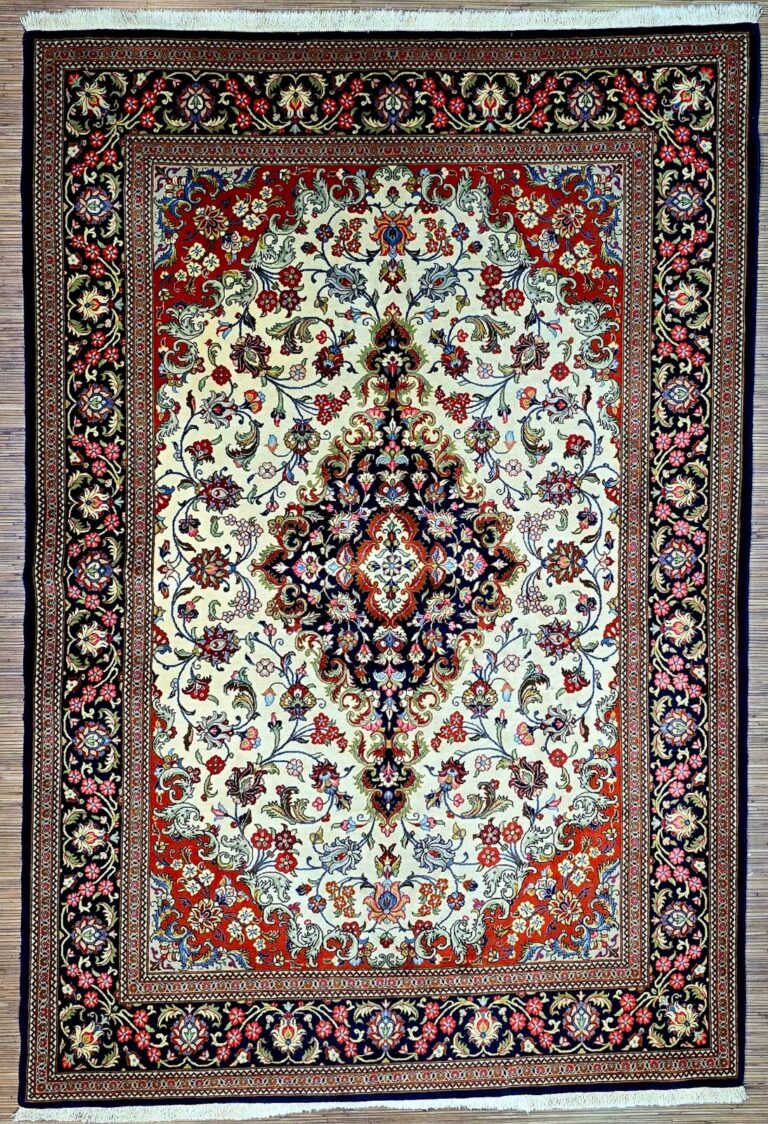
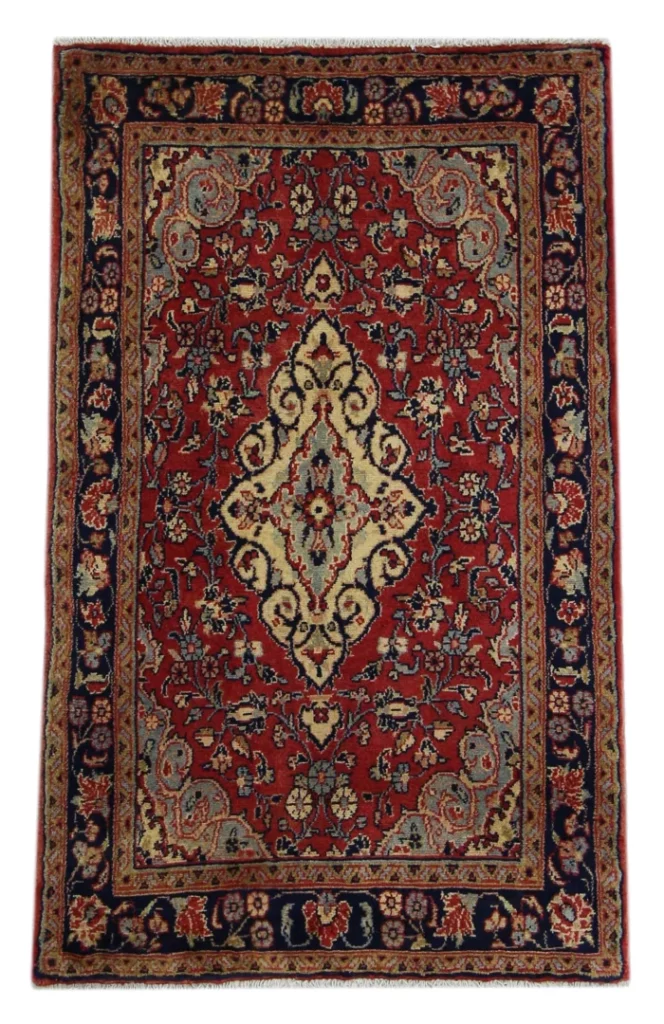
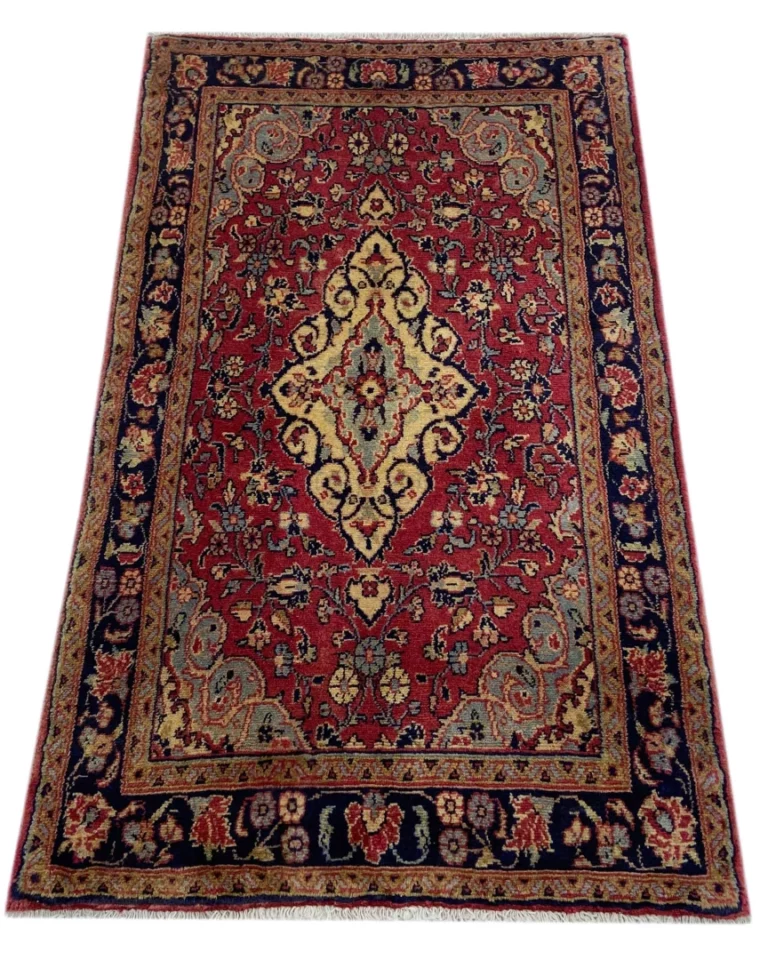
This Persian rug from Hamadan is hand-knotted and made of durable wool. Handwork is built knot by knot on a foundation, with pile threads placed deliberately to create the intended structure. Unlike a machine-made carpet, its design develops through many individual stages of work. Every hand-knotted rug is therefore a single textile object, with small distinctions in drawing and surface that belong to the making process.
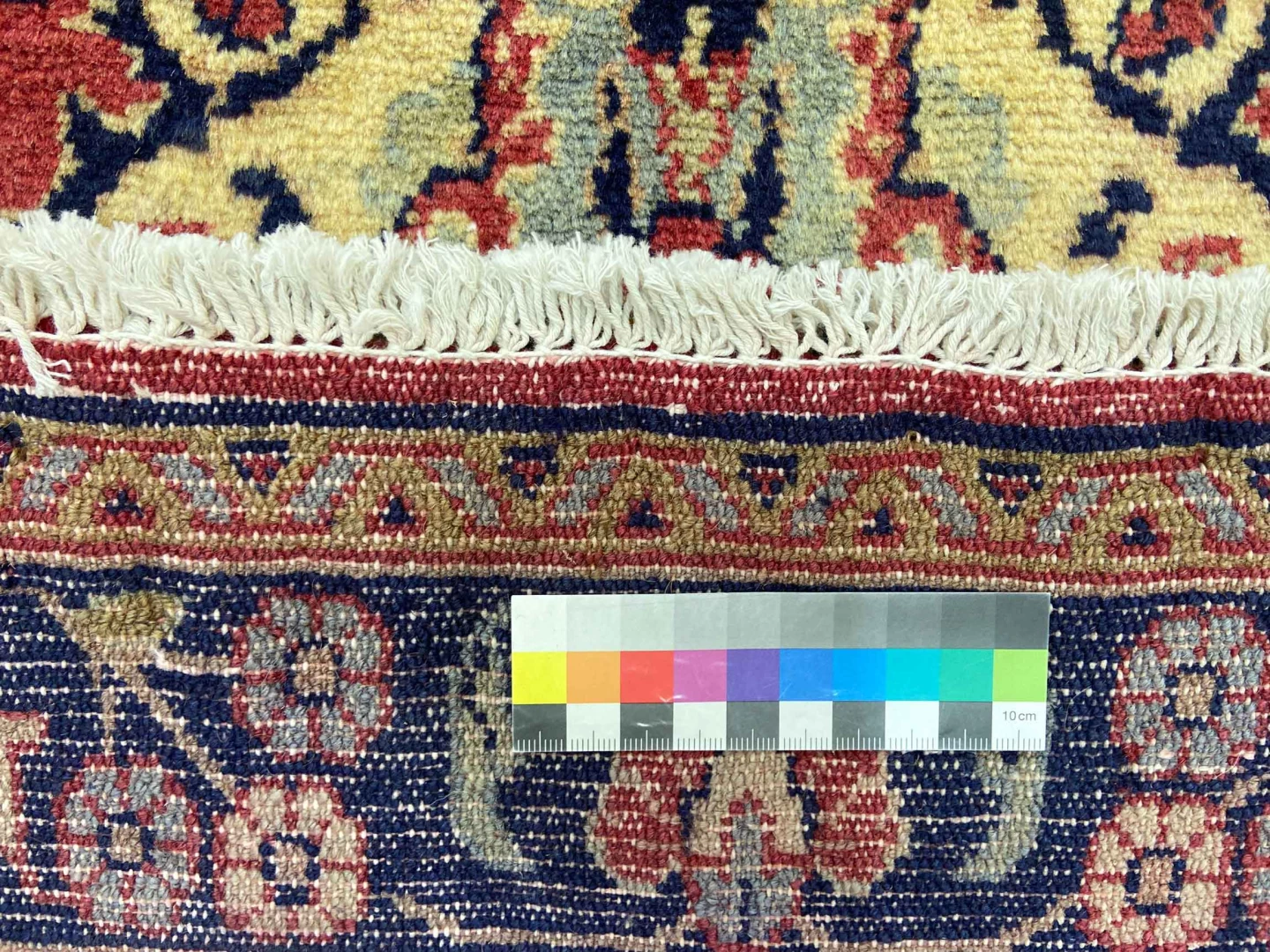
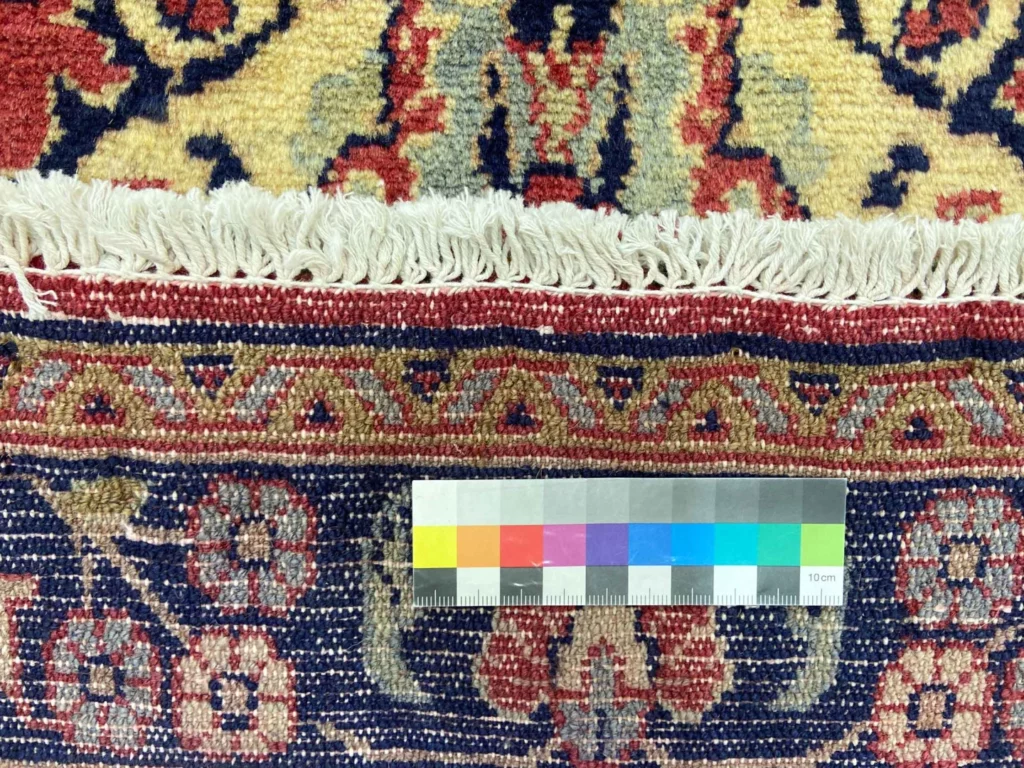
The knot density of this rug is 100,000 – 350,000 knots per square metre. Knot density indicates the number of individual knots placed within a defined area. It is connected with the construction of the pile and with the way a pattern can be worked out. In hand-knotted carpets, knot size, the regularity of the rows and the skill of the knotters all influence the resulting surface.
Wool is a traditional material in oriental carpet making. It can be handled effectively during knotting and creates a resilient pile. Its natural structure gives the surface a distinct tactile quality and supports the durability associated with Hamadan rugs. This rug is described as well preserved. Its material, handmade construction and knot density together define its particular textile structure.
The term hand-knotted refers to a process in which the pattern is not produced by a continuous industrial machine operation. Each section is made by hand. Minor variations are part of this craft character rather than evidence of a standardised factory product. Durable wool is well suited to a rug that functions both as a practical floor covering and as a woven expression of skilled work.
Origin and Tradition
This rug comes from Hamadan in northwestern Iran. Hamadan is an important carpet region with numerous villages and towns where rugs have been knotted for a long time. Its tradition is not limited to one single local design, but includes different workshops and weaving centres. This regional breadth has produced a wide range of compositions, proportions and colour treatments within the Hamadan group.
The places associated with the region include Assadabad, Khamseh, Maslaghan, Enjelas, Nahawand, Tuyserkan and Mousel. These names refer to towns or areas where distinct approaches to carpet making were maintained. Depending on the village, city or workshop, the patterns could differ considerably. Their regional context links them without making their individual designs identical.
Hamadan carpet making is based on knowledge passed from one generation to the next. This knowledge includes working with wool, building the foundation, selecting and arranging colours, and converting geometric or floral ideas into a knotted textile. Craftspeople work within inherited conventions while adapting the execution to the particular pattern and local practice. This helps explain why Hamadan identifies both a place of origin and a varied regional carpet tradition.
As a Persian rug, this piece belongs to Iran’s carpet culture. Iranian rugs are often named after a city, a region or the place where they were made. Such names can point to characteristic pattern families and craft methods, but they do not replace an examination of the individual design. A Hamadan rug can carry traditional regional elements while still having its own composition and interpretation.
Hamadan is one of Iran’s productive carpet regions. The presence of many villages and towns allowed different knotting traditions to develop alongside one another. Assadabad, Khamseh, Maslaghan, Enjelas, Nahawand, Tuyserkan and Mousel illustrate this regional variety. Their work may differ in the arrangement of fields, the treatment of borders and the selection of motifs. What unites them is their place within the carpet history of northwestern Iran.
The identity of Hamadan becomes clearer when it is considered alongside other Iranian carpet regions. Tabriz rugs are known for delicate designs and the use of unusual materials, while Isfahan rugs are often associated with rich colours and elaborate patterns. Nain represents its own combination of style and technique. These are not alternative origins for this rug; they are examples of the broader range of Iranian carpet art alongside Hamadan.
Design and Pattern
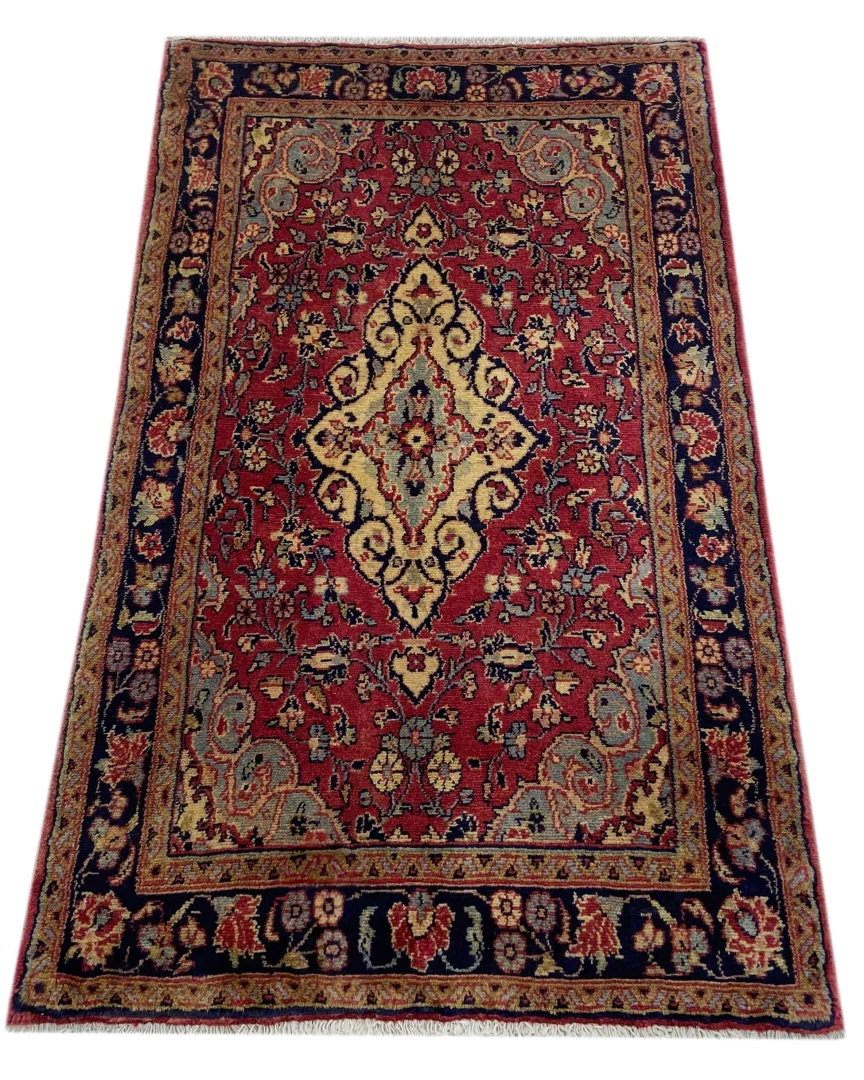
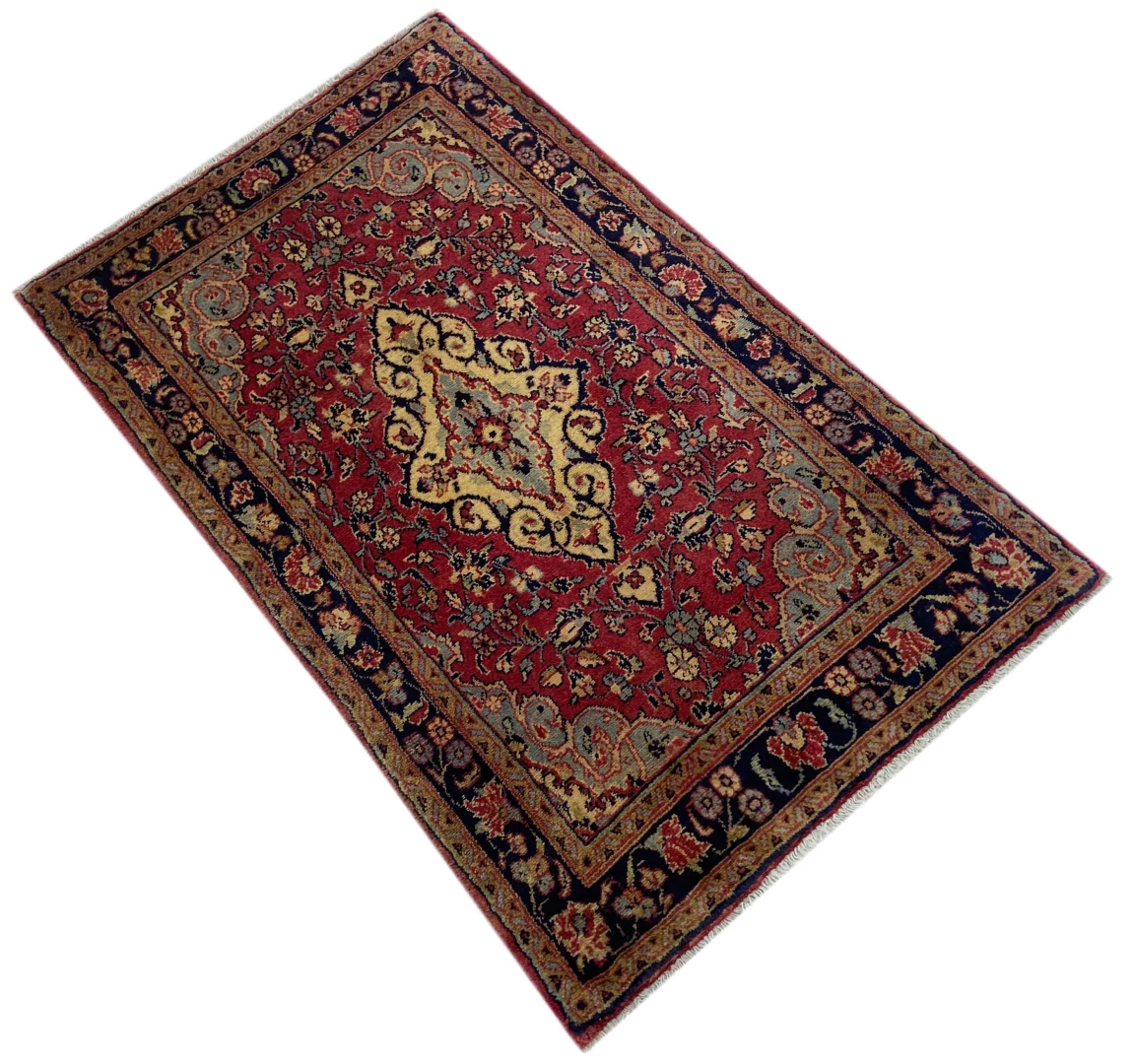
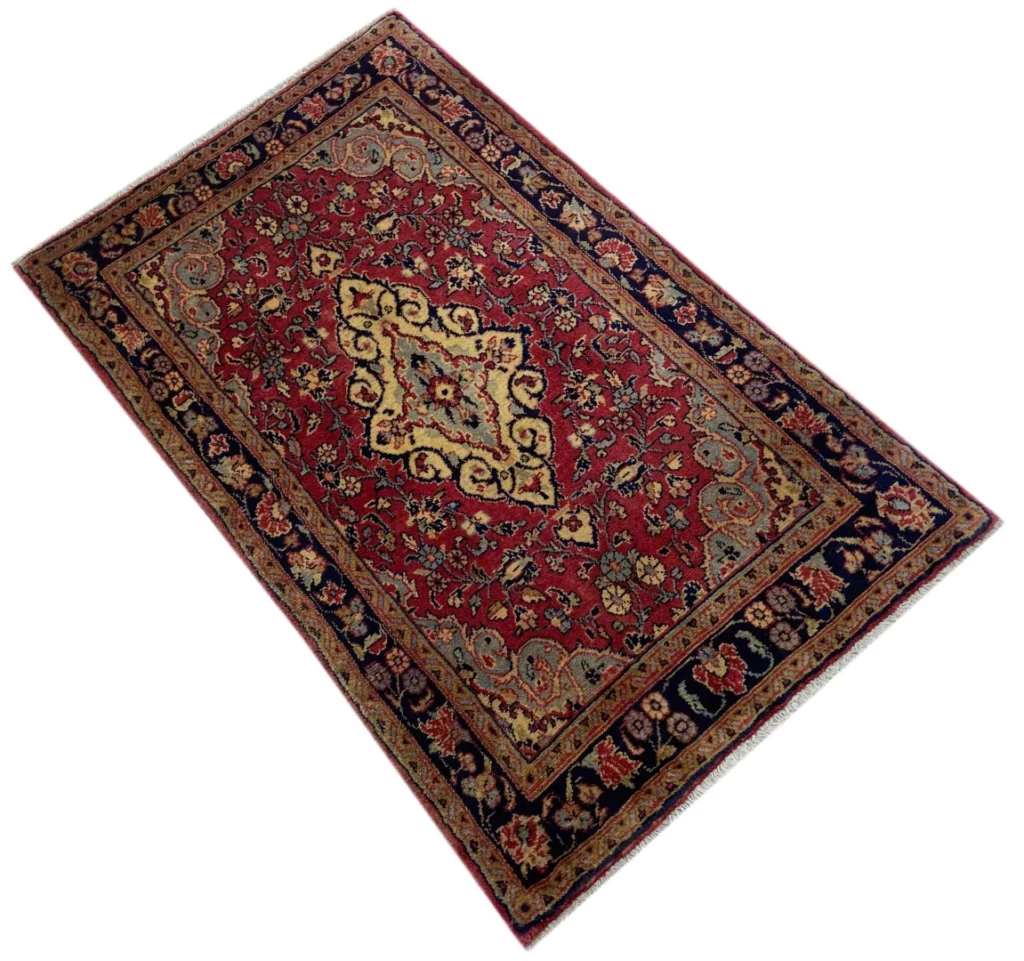
The pattern of this Hamadan rug is described as varied. The regional design tradition includes both traditional geometric forms and floral motifs. Geometric patterns rely on clear lines, angles, diamonds, hooked shapes or repeating fields. Floral designs, by contrast, use flowers, leaves and stylised vines. In hand-knotted carpets, the two visual languages can be combined within one composition.
Geometric drawings may be arranged regularly across a field or repeated in a freer sequence. A central field can be framed by one or more borders, while smaller ornaments occupy the spaces between larger forms. Repetition creates structure without requiring every detail to be perfectly identical. In regional handmade work, the overall effect often comes from the relationship between the main motif, secondary forms and framing elements.
Floral motifs in Hamadan rugs do not have to be naturalistic. Flowers and leaves may be simplified, mirrored or placed in rhythmic rows. This makes them suitable for a textile surface on which the design should remain legible over time. Stylised plant forms can be outlined with geometric contours, producing a pattern that is both clearly organised and decorative.
The colour range associated with Hamadan rugs is varied, extending from strong reds to softer earth tones. Strong reds may define a field or serve as a principal colour within a border. Earth tones can establish a quieter relationship among the surrounding elements. The balance depends on the particular regional and workshop execution. The source describes this rug as having varied designs; it does not assign it one specific colour scheme.
On a hand-knotted rug, the pattern is not merely a surface decoration applied afterward. It is formed through the sequence of knots and integrated into the textile structure. Knot density supports the rendering of lines and smaller ornaments, while wool gives the pile its visible and tactile character. Drawing, material and technique therefore work together as one woven surface.
The variety of Hamadan designs is also linked to production in many villages and towns. Different workshops developed their own preferences for medallions, fields, borders, geometric details and botanical forms. A Hamadan rug can consequently be arranged with a strict structure or with more richly articulated ornament. The origin identifies the regional context, while the pattern description records the open variety of the design found there.
By comparison, Tabriz rugs are often associated with fine designs, and Isfahan rugs with rich colours and elaborate patterns. Nain rugs likewise represent distinct styles and techniques. These differences show that Iranian carpets are not made according to one single visual formula. The rug described here remains a Hamadan Persian rug with varied designs, traditional geometric forms and possible floral references within this regional pattern vocabulary.
Special Features
The clearly identified features of this rug are its origin in Hamadan, Iran, its hand-knotted construction, its durable wool and its knot density of 100,000 – 350,000 knots per square metre. Its condition is also described as well preserved. Together, these details identify the individual piece in terms of origin, making method, material, structure and state of preservation.
The combination of wool and hand-knotting is relevant to the practical use of oriental rugs. This rug is described as durable and long-lasting and can therefore be used in areas with heavier foot traffic. That quality is connected with the material and knot density rather than with industrial uniformity. Care remains important so that its well-preserved condition can be maintained.
A hand-knotted Hamadan rug is both a functional textile and an expression of a regional craft tradition. Its varied designs show how workshops in the region developed geometric and floral patterns in different ways. Each execution combines the Hamadan origin with its own arrangement of forms and colours.
FAQ
How should I care for my Hamadan Persian rug?
Regular cleaning and careful vacuuming help remove dust from the pile. Occasional professional cleaning supports the preservation of the surface. Direct sunlight should be avoided so that the colours do not fade. Wool should be treated gently, without unnecessary moisture or harsh cleaning agents. Professional care is appropriate whenever a more thorough treatment is needed, particularly because it helps preserve the rug’s well-preserved condition.
What design can I expect from Hamadan rugs?
Hamadan rugs offer varied designs. These include traditional geometric patterns as well as floral motifs. A composition may combine clearly structured forms, repeating ornaments and stylised botanical details. The colour range is also diverse, extending from strong reds to soft earth tones. Since Hamadan is a region with many villages and towns, local expressions differ from one another. This individual rug is described as having a varied pattern design.
What makes Hamadan rugs particularly durable?
The durability of Hamadan rugs is associated with the use of durable wool and a high knot density. Wool forms a resilient pile, while the hand-knotted construction and number of knots contribute to a robust textile structure. Hamadan rugs can therefore be used in areas with heavier foot traffic. The rug described here is well preserved. Regular vacuuming, gentle cleaning and protection from direct sunlight help maintain its qualities and colours.
To provide the best experiences, we use technologies like cookies to store and/or access device information. Consenting to these technologies will allow us to process data such as browsing behavior or unique IDs on this site. Not consenting or withdrawing consent, may adversely affect certain features and functions.
Functional Always active
The technical storage or access is strictly necessary for the legitimate purpose of enabling the use of a specific service explicitly requested by the subscriber or user, or for the sole purpose of carrying out the transmission of a communication over an electronic communications network.
Preferences
The technical storage or access is necessary for the legitimate purpose of storing preferences that are not requested by the subscriber or user.
Statistics
The technical storage or access that is used exclusively for statistical purposes.The technical storage or access that is used exclusively for anonymous statistical purposes. Without a subpoena, voluntary compliance on the part of your Internet Service Provider, or additional records from a third party, information stored or retrieved for this purpose alone cannot usually be used to identify you.
Marketing
The technical storage or access is required to create user profiles to send advertising, or to track the user on a website or across several websites for similar marketing purposes.

 SECURE PAYMENT
 SHIPPING PARTNERS