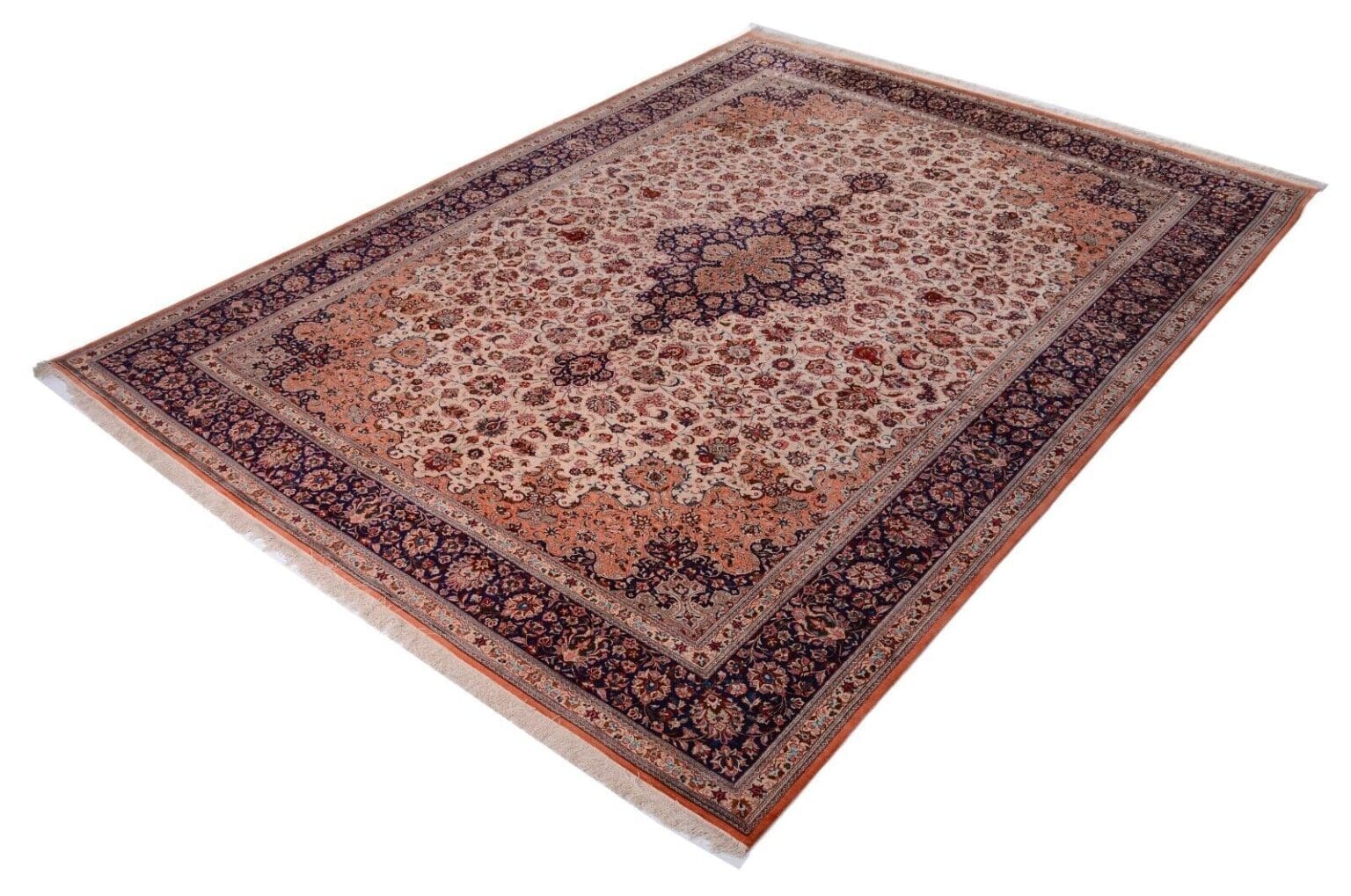
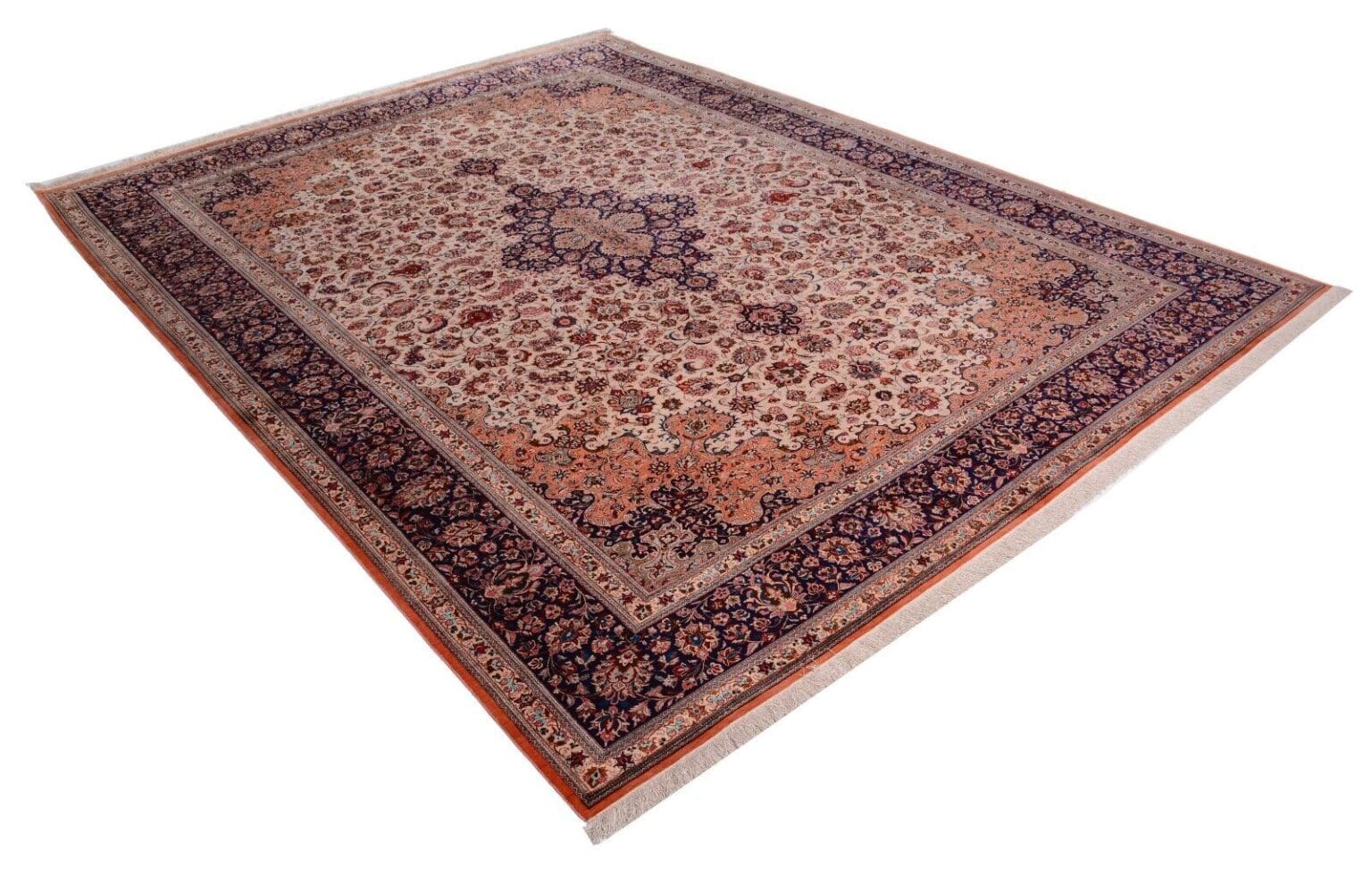
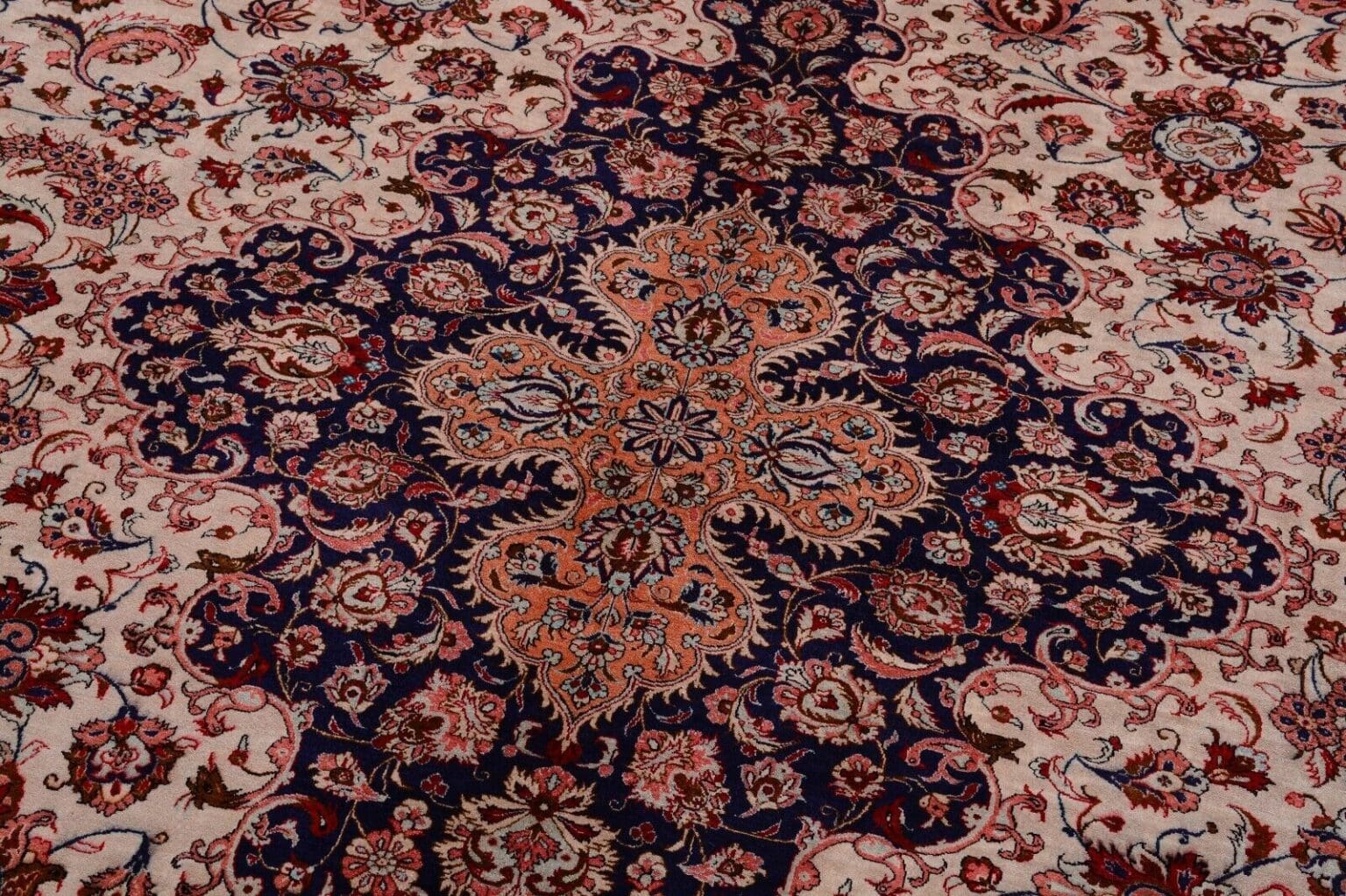
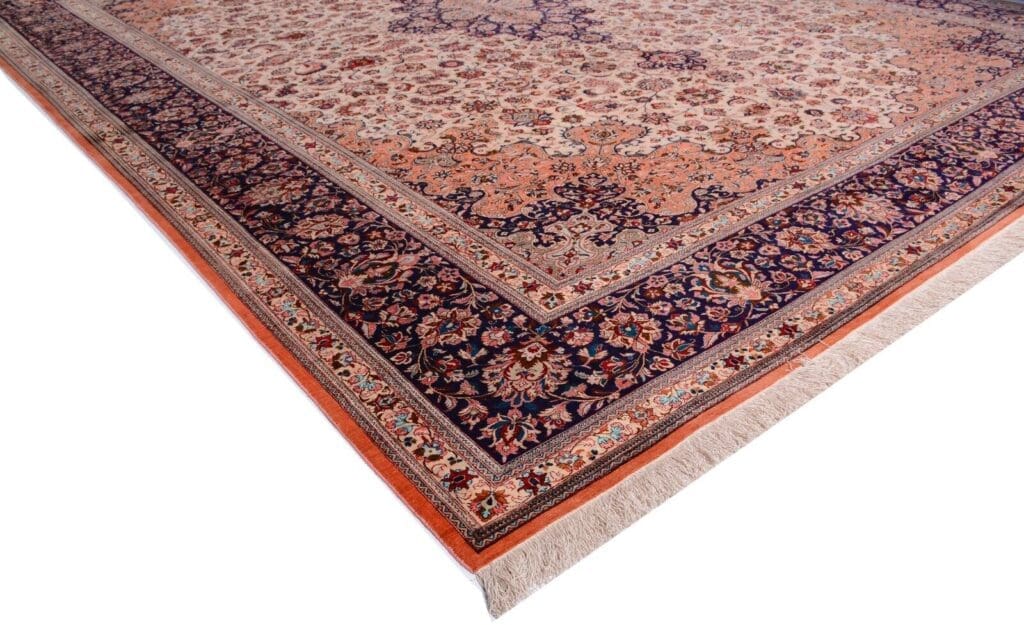
This Ghom Persian rug is hand-knotted and made entirely from natural silk. The material defines both its tactile character and its visual presence. Silk has a fine, soft handle and a distinctive sheen. As the angle of light changes, the surface can appear subtly different because the individual fibres reflect light. Colours also appear clear and lively on silk. This makes the material well suited to floral and oriental designs in which small details and delicate changes of tone are important.
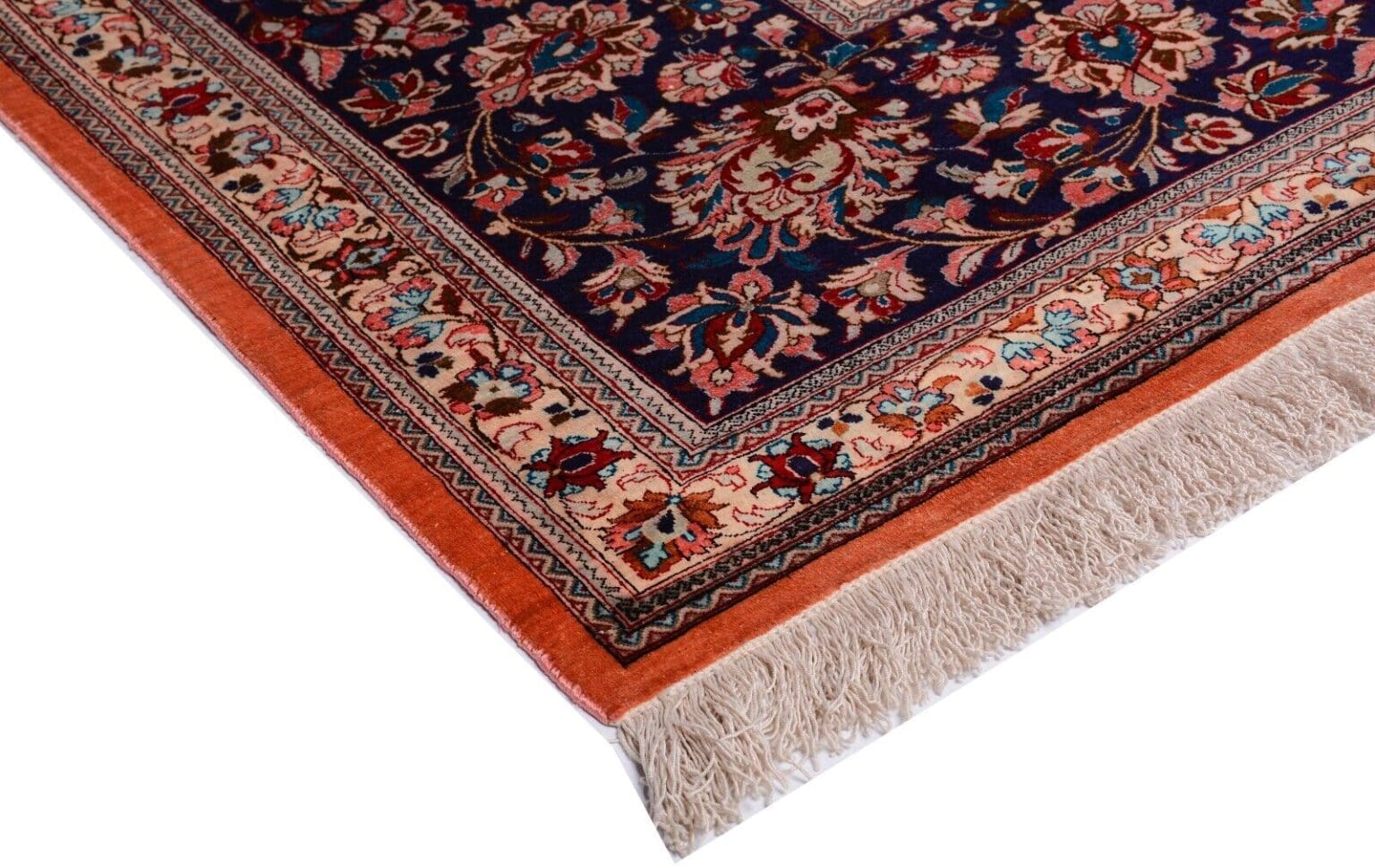
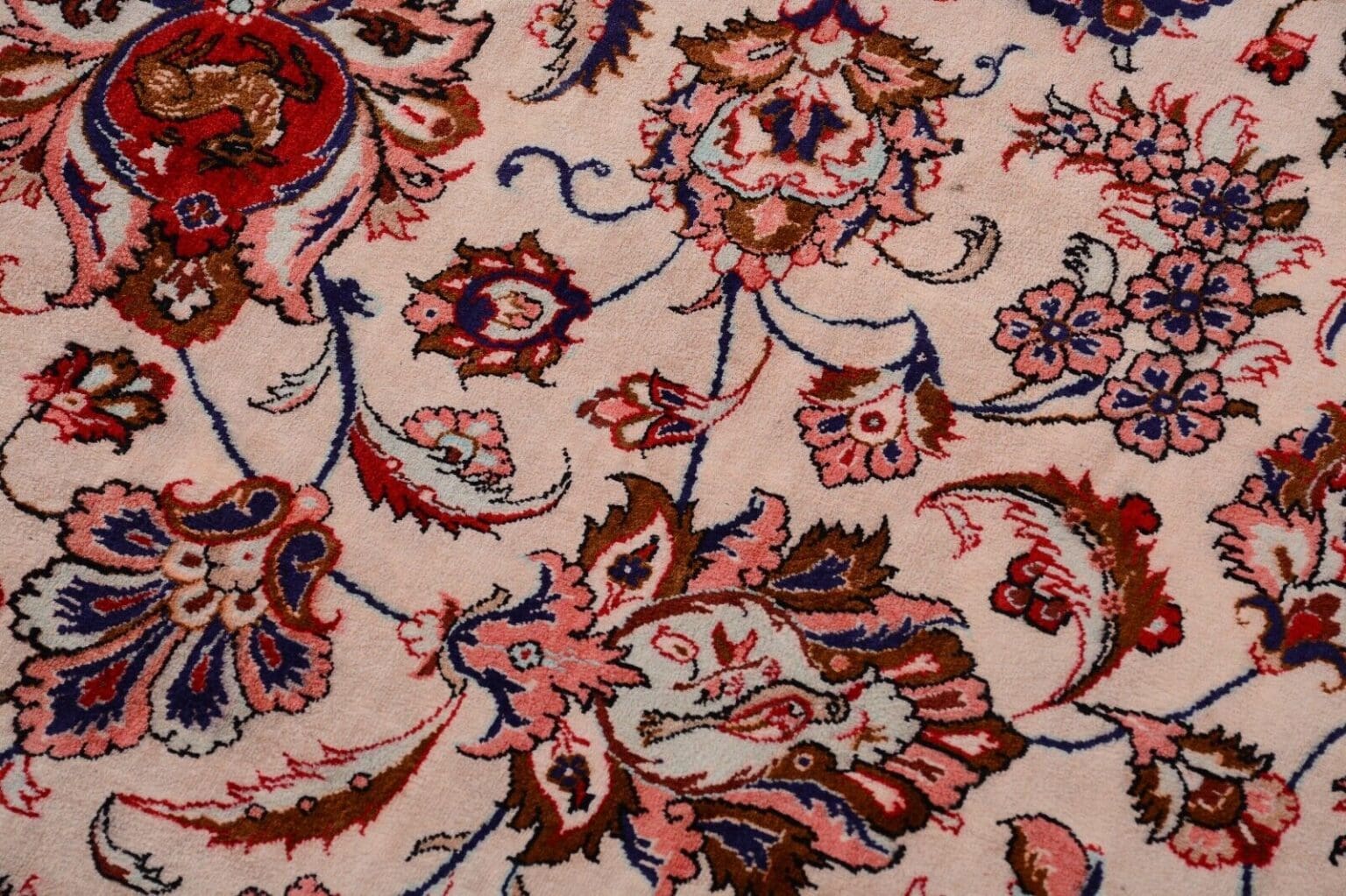
Hand-knotting is a methodical process in which individual knots are placed into the rug’s underlying structure one by one. Each knot contributes to the construction of the pile and to the drawing of the design. With an approximate density of 900,000 knots per square metre, fine lines, small floral forms and winding ornaments can be rendered with considerable precision. Such a dense structure requires patience, concentration and experienced manual work.
In a hand-knotted silk rug, the fibres are prepared and then worked into the foundation knot by knot. The contours and areas of colour are formed by the arrangement of coloured knots, rather than by printing a picture onto a finished surface. This explains the close relationship between the rug’s material, its technique and its pattern. It also allows a detailed design to be built directly into the textile. The rectangular shape follows the organised construction of the woven and knotted field.
Silk is valued in rug making because it can carry fine colour variations and produce a smooth surface. It also calls for careful handling. This rug is new and in very good condition. Its material is specified as 100 percent silk; no separate cotton-warp specification is given. The construction is identified as hand-knotted, combining the refined character of silk with a technique intended to reproduce detailed motifs. The result is a textile whose appearance depends on both the fibre and the work of the knotter.
Origin and Tradition
Ghom, also known as Qom, is one of the important centres of Persian rug making in Iran. The city is particularly associated with the production of silk rugs. Over time, Ghom developed a recognisable tradition in which fine materials, dense knotting and carefully drawn ornament are brought together. The city therefore represents a branch of Persian carpet culture where technical precision and the exact rendering of a design are especially significant.
The history of carpet weaving in Ghom is traced back to the fifteenth century. Knowledge of the craft was passed on through experienced makers and continued through successive generations. As in other established Persian weaving centres, practical knowledge of preparation, foundation building, knotting and finishing exists alongside a developed visual vocabulary. The making of a rug involves many connected tasks, and the final design depends on accuracy at every stage.
Ghom is known not only for silk but also for the range of dyeing techniques used in the regional carpet tradition. Colour is not merely an addition to the surface. It separates the field from the border, clarifies the hierarchy of motifs and gives selected ornaments greater definition. The ability to coordinate shades carefully is part of the workmanship associated with Ghom. On silk, the reflection of the fibres can further alter the way a colour is perceived as the viewer moves around the rug.
Many designs from Ghom are connected with Persian culture and its rich system of imagery. Religious and cultural symbols appear in the history of the region alongside plant forms, geometric structures and arabesque ornament. These elements are arranged according to an inherited design tradition rather than being placed at random. A Ghom rug can consequently be understood as a useful textile, an example of regional craftsmanship and a carrier of a cultural vocabulary at the same time.
Persian rugs are collected and studied around the world because they unite material, drawing and manual skill. In Ghom silk rugs this relationship is especially apparent: the fine fibre permits small forms to be depicted with clarity, while dense knotting establishes the structure of the pattern. The tradition is not limited to historical examples. It remains active and continues to shape contemporary hand-knotted rugs made in the Ghom tradition.
Design and Pattern
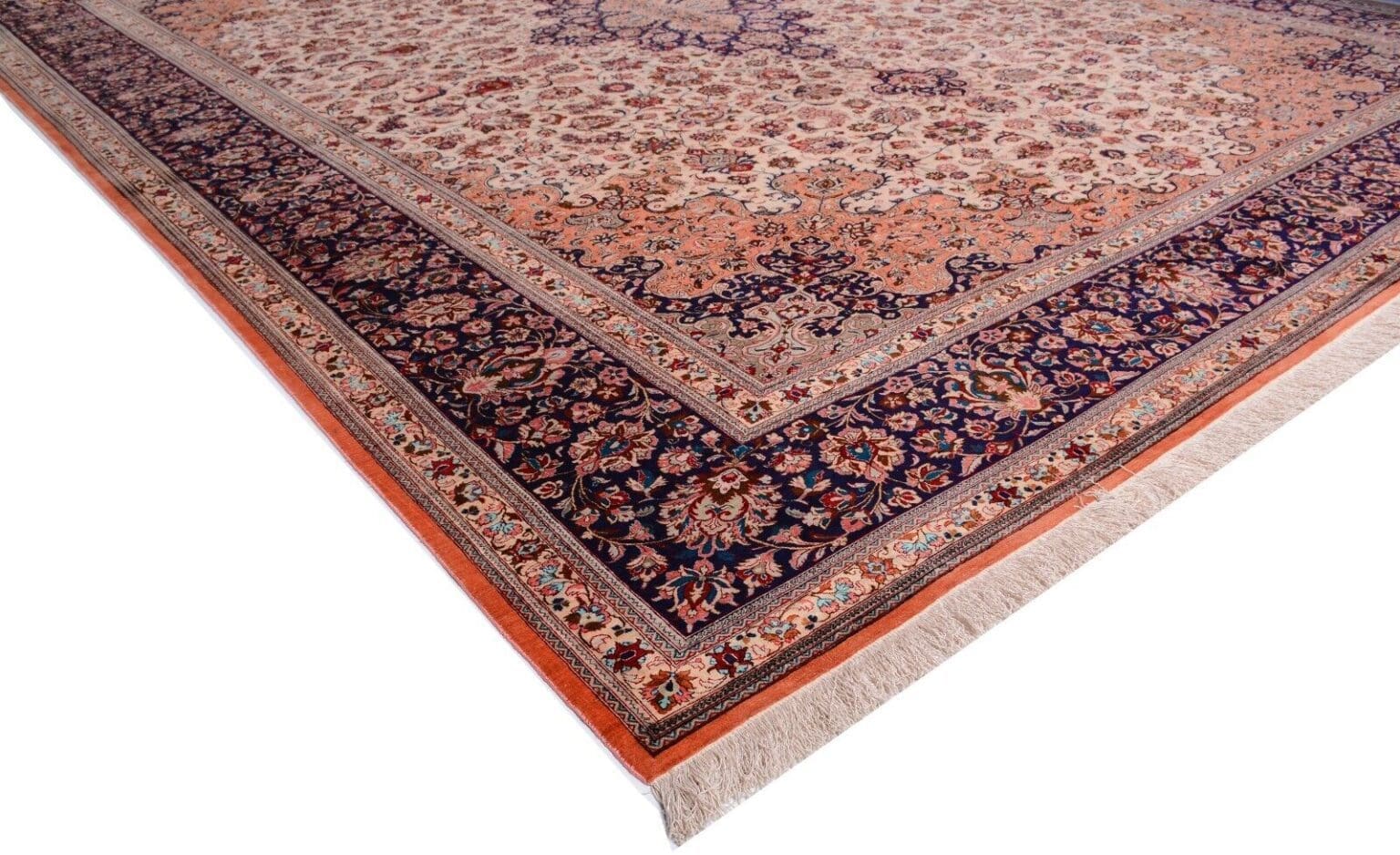
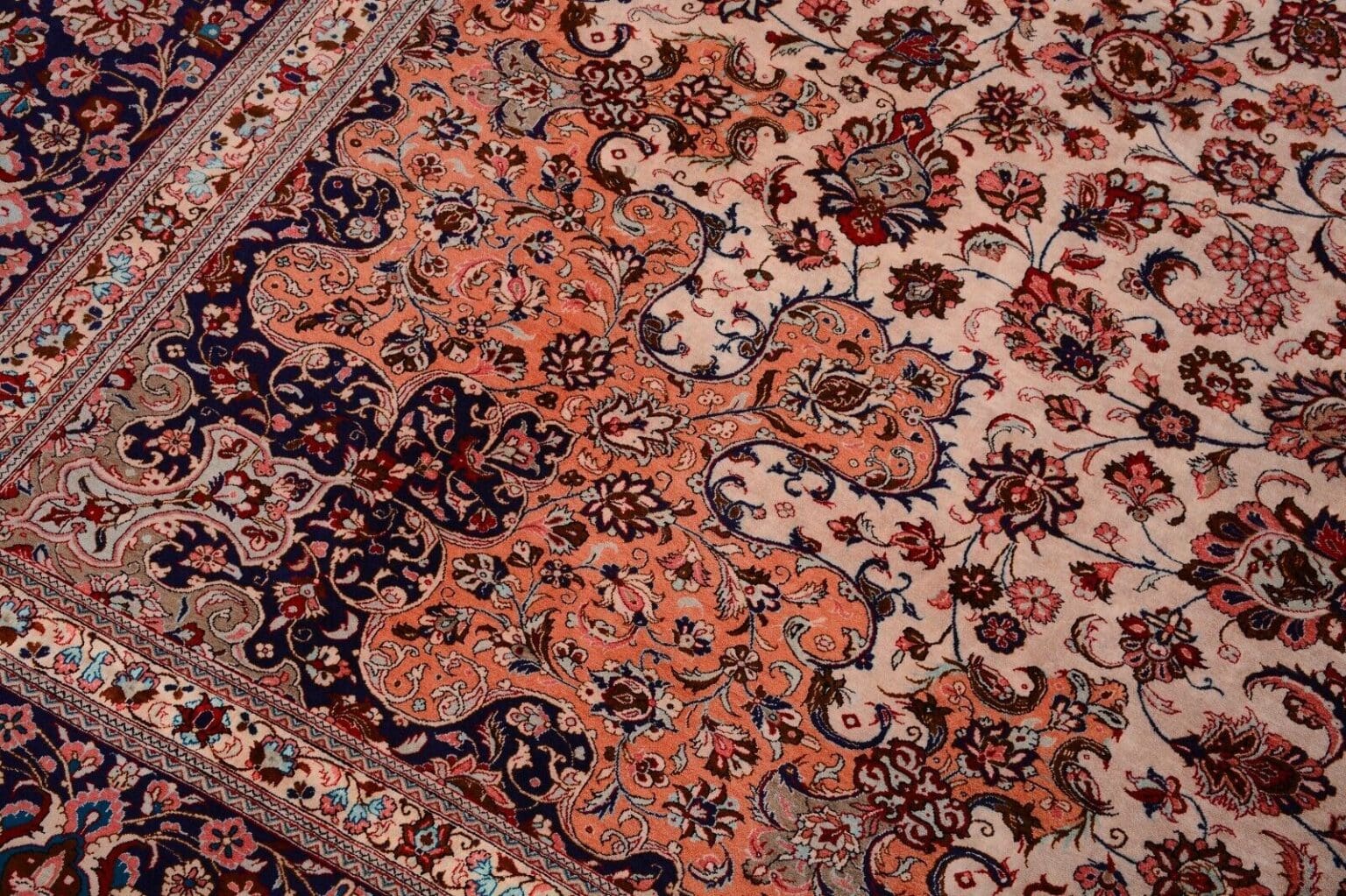
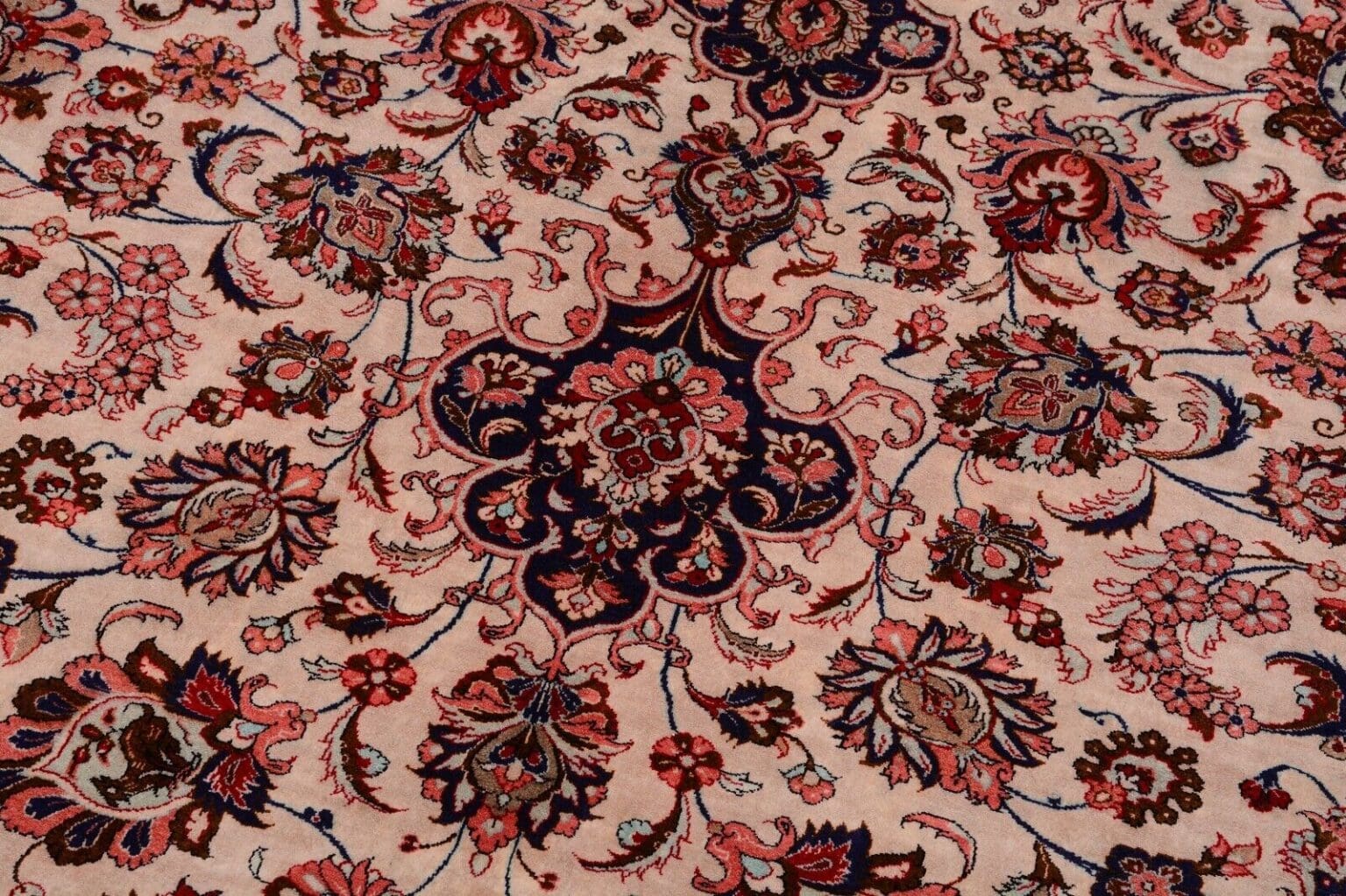
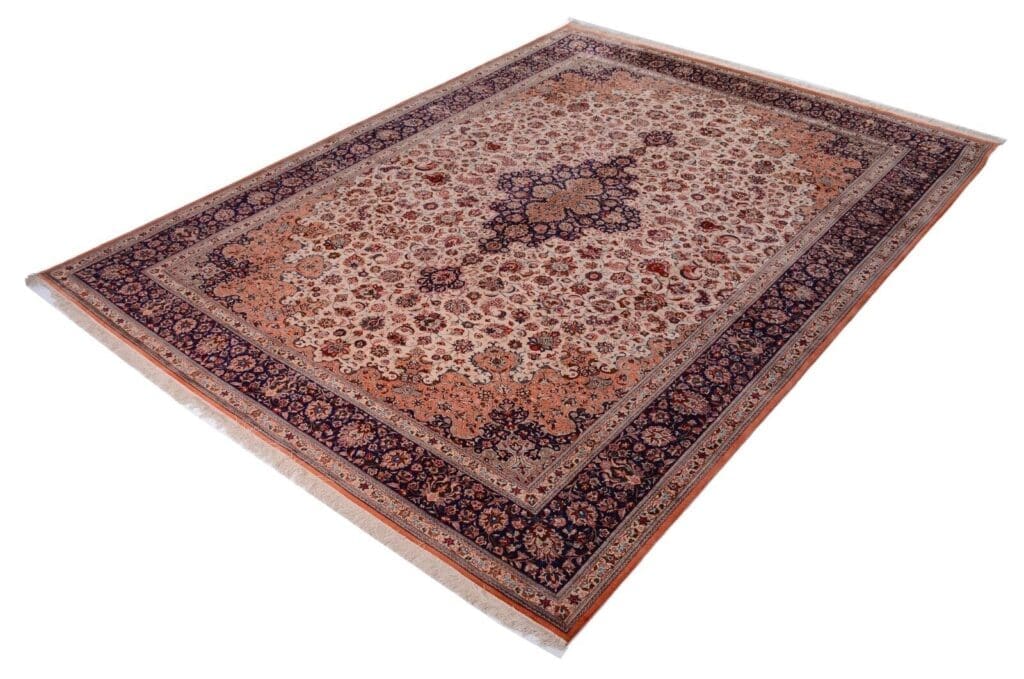
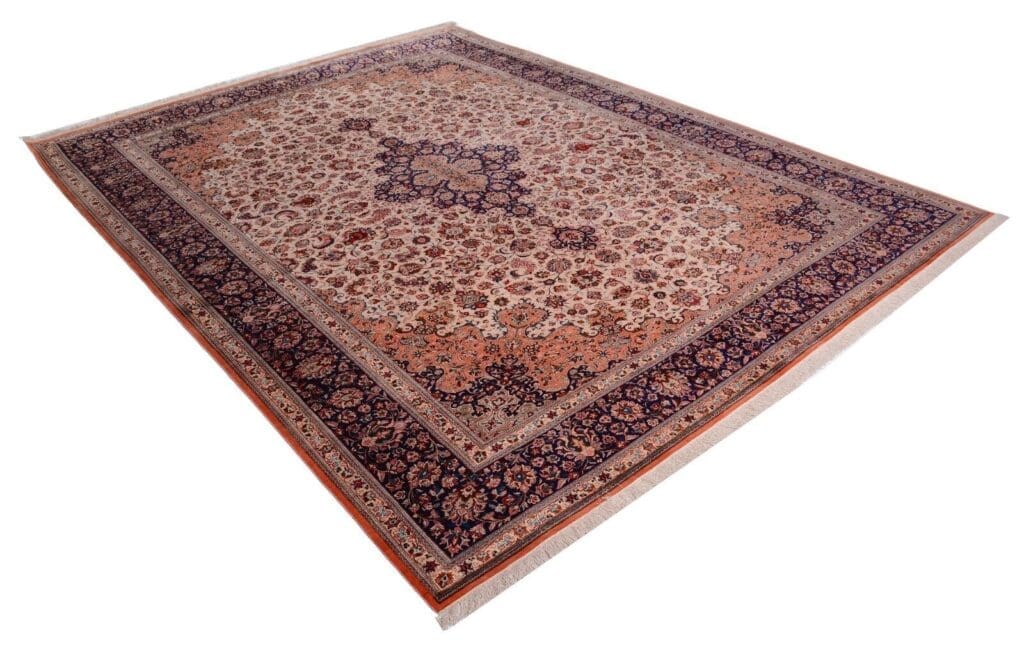
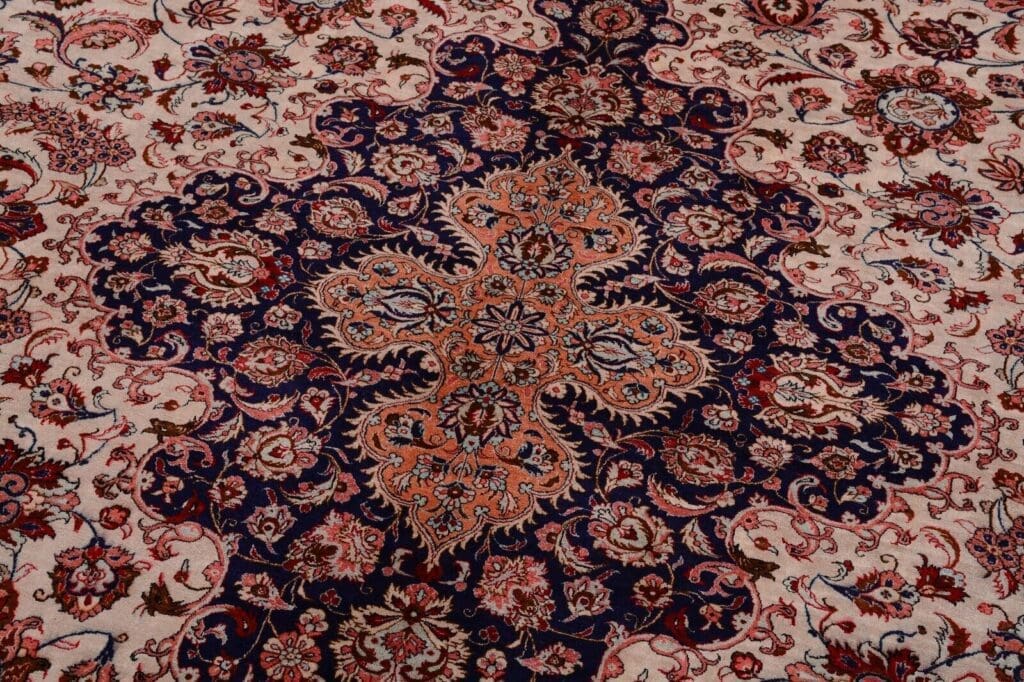
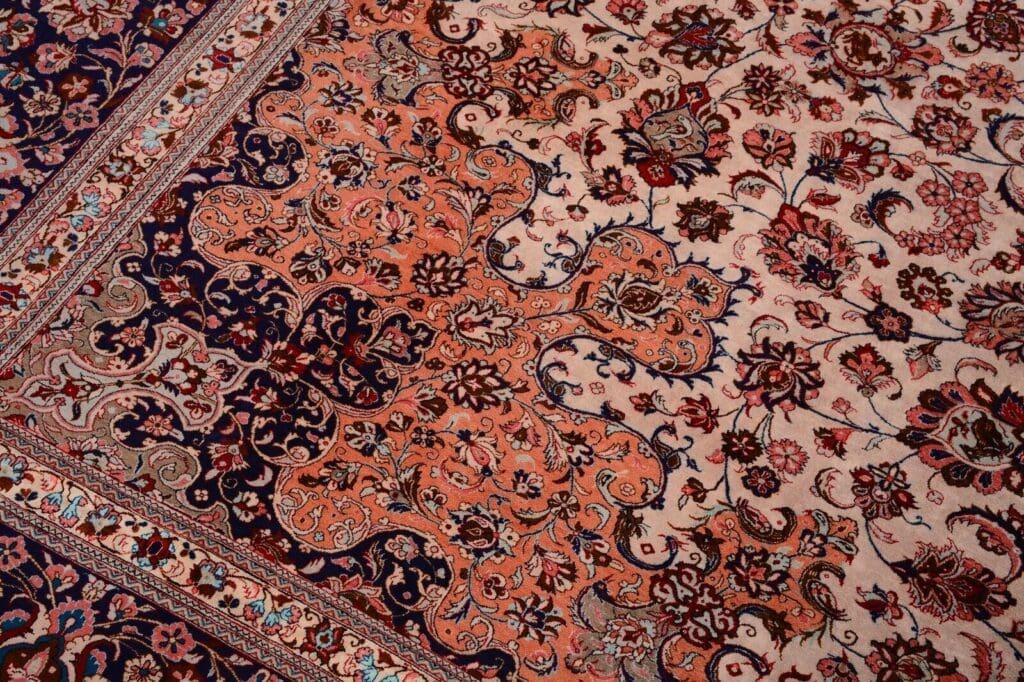
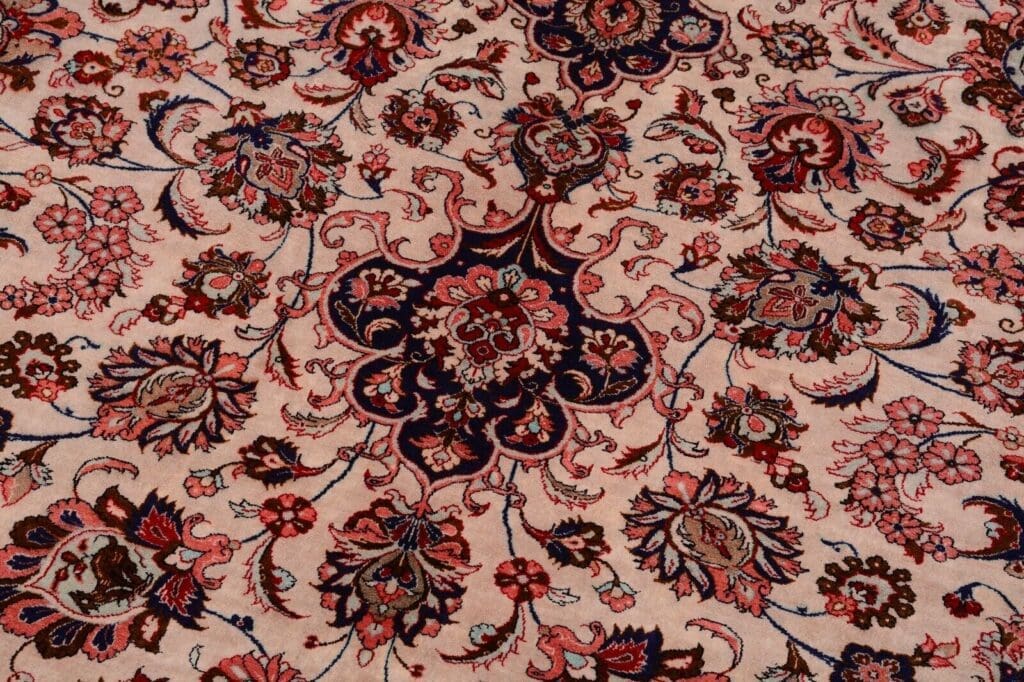
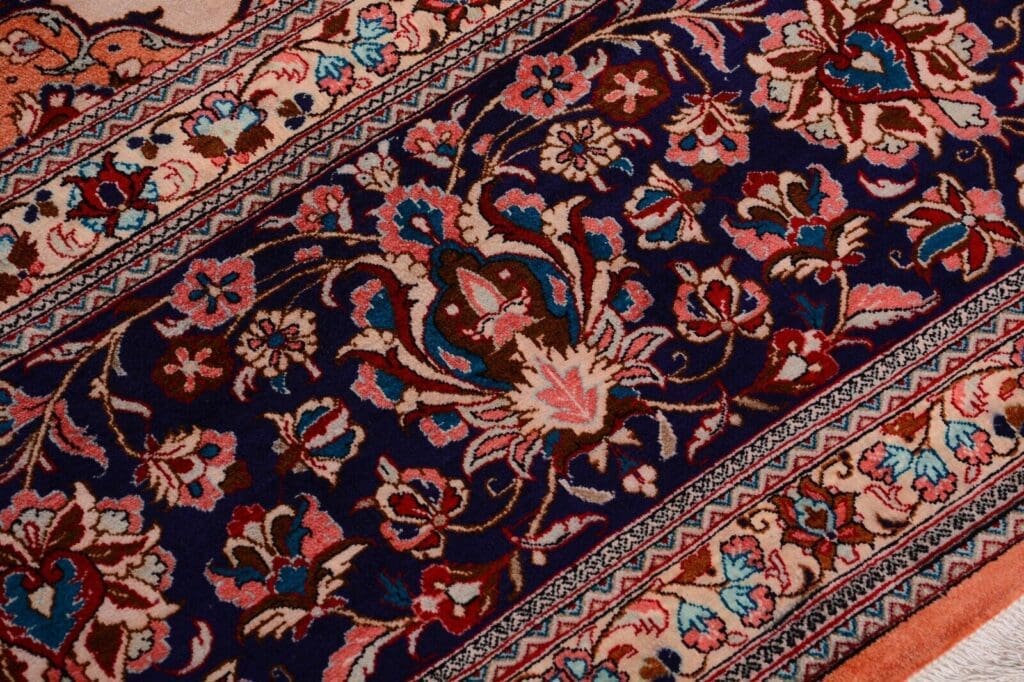
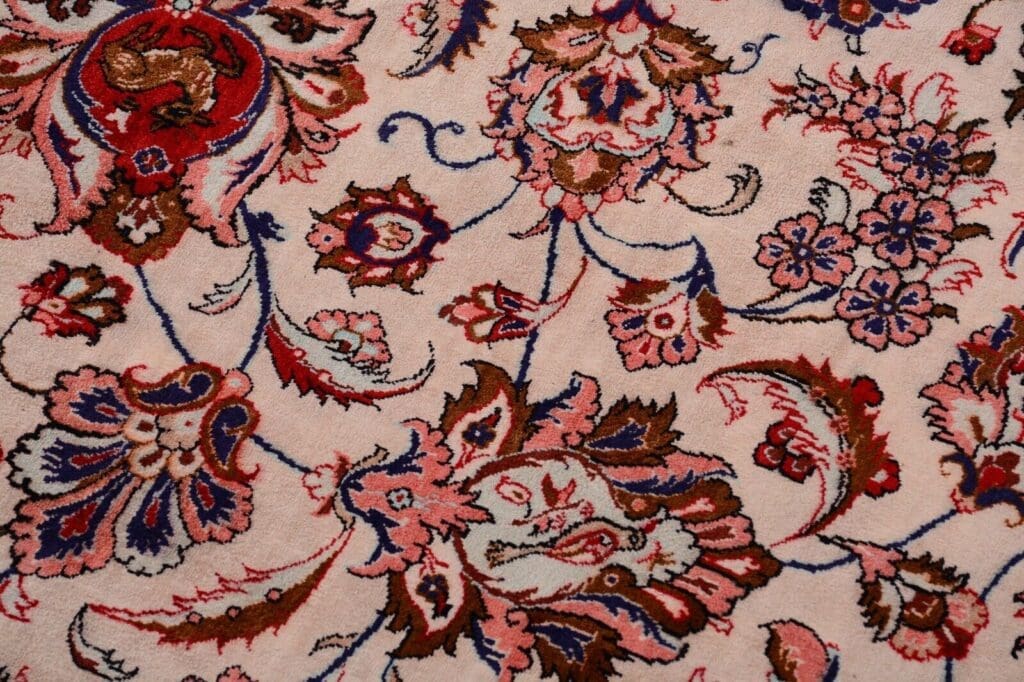
The pattern of this rug is floral and oriental. Floral rug designs may combine blossoms, leaves, stems and scrolling vines so that the elements form a continuous rhythm across the field. Repetition creates visual coherence, while finer variations and narrow lines keep the composition active. A silk surface can make these contours and colour transitions particularly legible. The result is a pattern based on plant forms and arranged within the established vocabulary of Persian and oriental ornament.
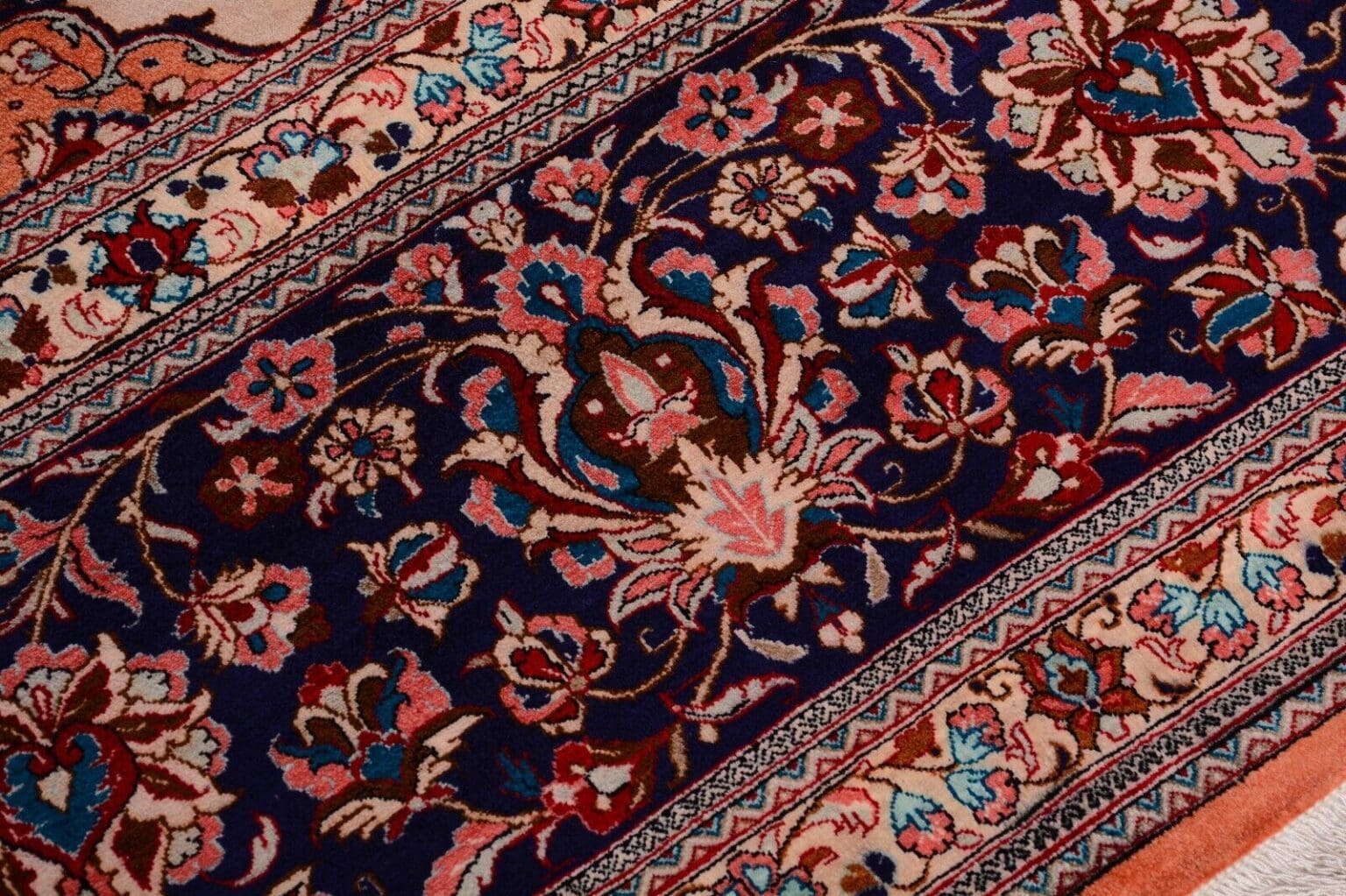
Ghom rugs are known for a varied design language. Alongside floral elements, regional designs can include geometric shapes and intricate arabesques. Geometric structures provide order and can divide a field, frame a border or establish a central arrangement. Arabesque lines lead the eye through the composition with curves and interlacing forms. These approaches can be combined with flowers and foliage, producing a design that is structured without losing the movement associated with botanical ornament.
In Persian carpet art, plants and vines are often used to express a relationship between people and the natural world. This is part of the broader symbolism of the tradition and does not depend on one single motif. Blossoms may suggest beauty and renewal, while an ordered floral field can convey harmony. Traditional Persian symbols are also associated with good fortune, prosperity and balance. The pattern therefore has a decorative purpose as well as a cultural dimension.
The appearance of a floral Ghom rug results from the interaction of drawing, colour, fibre and knotting. Silk allows colours to look luminous and can change their visual effect according to the angle of observation. A high knot density supports the precise execution of small ornaments and close lines. Hand-knotting preserves the textile character of the rug at the same time. The design is not a printed image applied to fabric; it is an ornament constructed from many individual knots.
The traditional Persian and oriental style can be used in both classic and modern interiors because floral patterns can appear orderly while retaining movement. The rectangular form supports a clear organisation of the composition. The defining combination here is the floral oriental pattern, the fine silk and the hand-knotted technique. Rather than depicting one specific narrative, the design draws on a long-established visual language of plant forms, balance and cultural symbolism.
Special Features
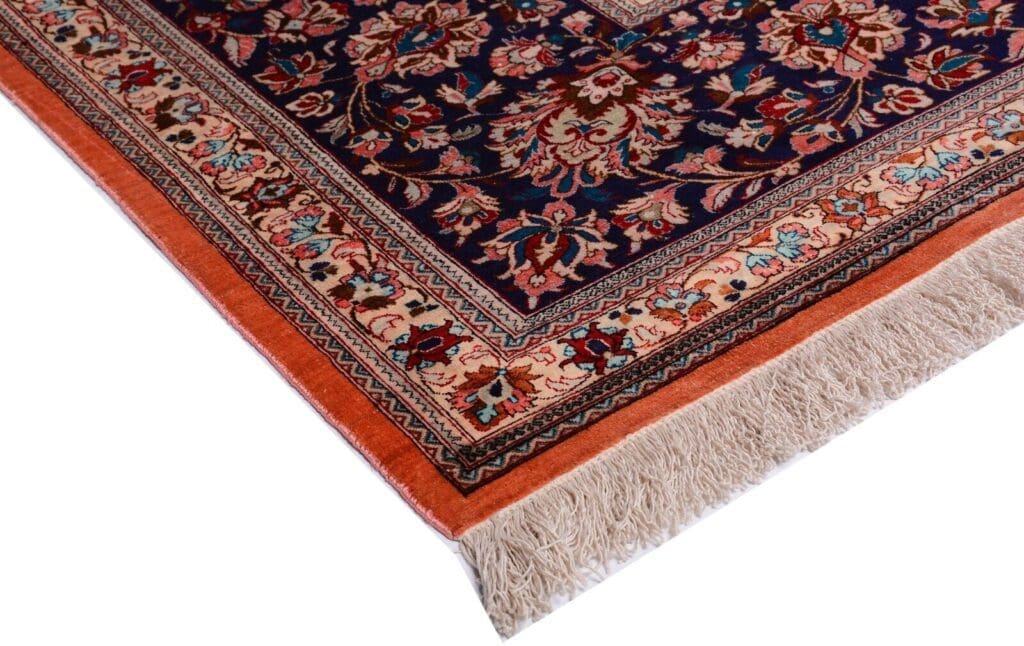
A defining feature of this rug is the combination of natural silk and hand-knotting. From selecting the silk through to placing the individual knots, its production follows a lengthy and concentrated process. The high knot density supports the detailed rendering of the floral design. Silk adds a soft surface and a characteristic lustre, so the material remains an important part of the rug’s appearance rather than serving only as a structural component.
The rug is new and in very good condition. It has a rectangular shape, is approximately six millimetres thick and weighs approximately three kilograms per square metre. It is also described as suitable for allergy-sensitive users. The rug can be used in living rooms, offices or as a collectible textile. Its traditional Persian and oriental style, floral pattern and silk surface allow it to be considered alongside both classic and contemporary furnishings.
FAQ
How should a silk rug be cleaned?
Silk should be cleaned gently so that its fine fibres, colours and surface are not placed under unnecessary strain. Loose dirt can be removed with a vacuum cleaner, but strong suction and aggressive contact with the pile should be avoided. For a spot, a slightly damp cloth may be used carefully on the affected area. Vigorous rubbing can disturb the fibres or affect the appearance of the colours. For a full cleaning, professional rug care is the appropriate choice, since a specialist can take the silk material and hand-knotted construction into account and select a method designed to reduce the risk of damage.
How can I assess the quality of a silk rug?
Several features should be considered when assessing a silk rug. Knot density indicates how finely the foundation has been built and how much detail can be expressed in the pattern. The material and the quality of the workmanship are equally relevant. This rug is specified as having a pile made from 100 percent silk, with an approximate density of 900,000 knots per square metre. Clear contours, carefully executed motifs and an even textile surface are further points to examine. Knot density, material and precision should be considered together rather than treating one feature as the sole measure of quality.
Where is the best place for my Ghom rug?
A Ghom rug can be placed in a range of rooms provided that its fine surface is protected appropriately. In a living room or an elegant study, the floral oriental pattern can act as a clear organising element within the interior. An office or a setting in which the rug is viewed as a collectible textile is also suitable. Direct sunlight should be avoided so that the colours do not fade. It is likewise sensible to protect the rug from excessive dirt and not to place it where the silk pile would be exposed to unusually heavy wear.
To provide the best experiences, we use technologies like cookies to store and/or access device information. Consenting to these technologies will allow us to process data such as browsing behavior or unique IDs on this site. Not consenting or withdrawing consent, may adversely affect certain features and functions.
Functional Always active
The technical storage or access is strictly necessary for the legitimate purpose of enabling the use of a specific service explicitly requested by the subscriber or user, or for the sole purpose of carrying out the transmission of a communication over an electronic communications network.
Preferences
The technical storage or access is necessary for the legitimate purpose of storing preferences that are not requested by the subscriber or user.
Statistics
The technical storage or access that is used exclusively for statistical purposes.The technical storage or access that is used exclusively for anonymous statistical purposes. Without a subpoena, voluntary compliance on the part of your Internet Service Provider, or additional records from a third party, information stored or retrieved for this purpose alone cannot usually be used to identify you.
Marketing
The technical storage or access is required to create user profiles to send advertising, or to track the user on a website or across several websites for similar marketing purposes.

 SECURE PAYMENT
 SHIPPING PARTNERS


