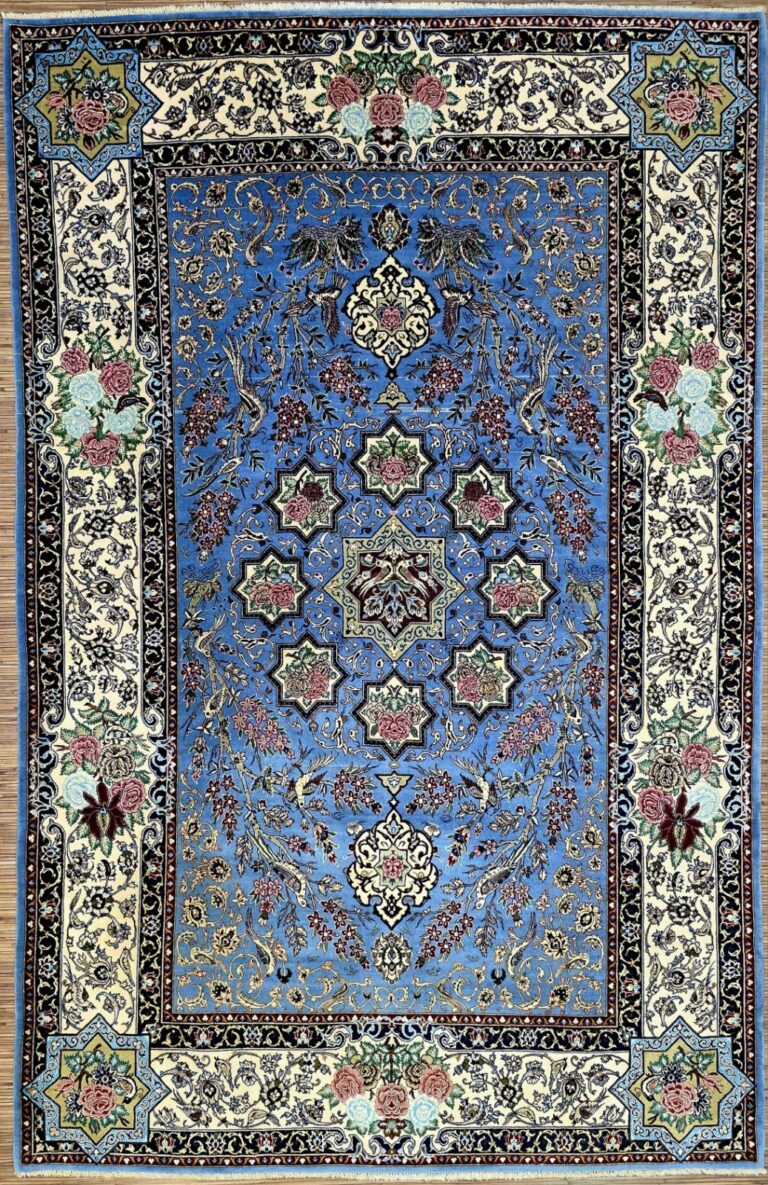
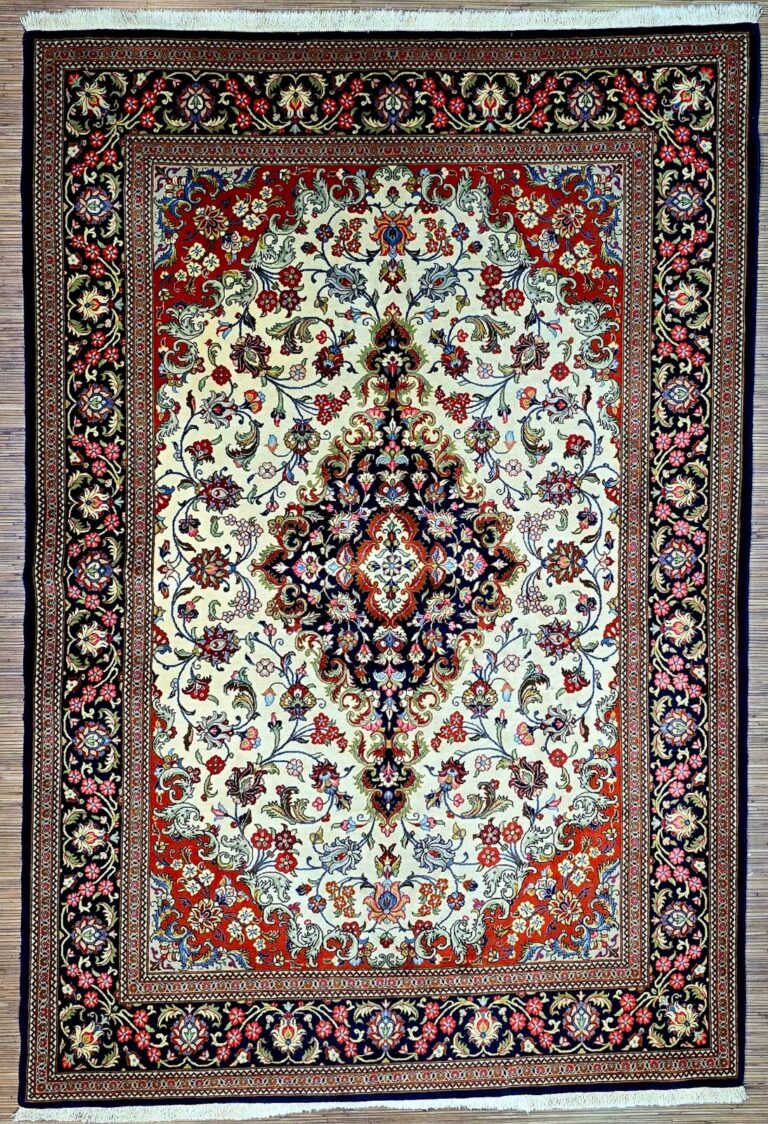
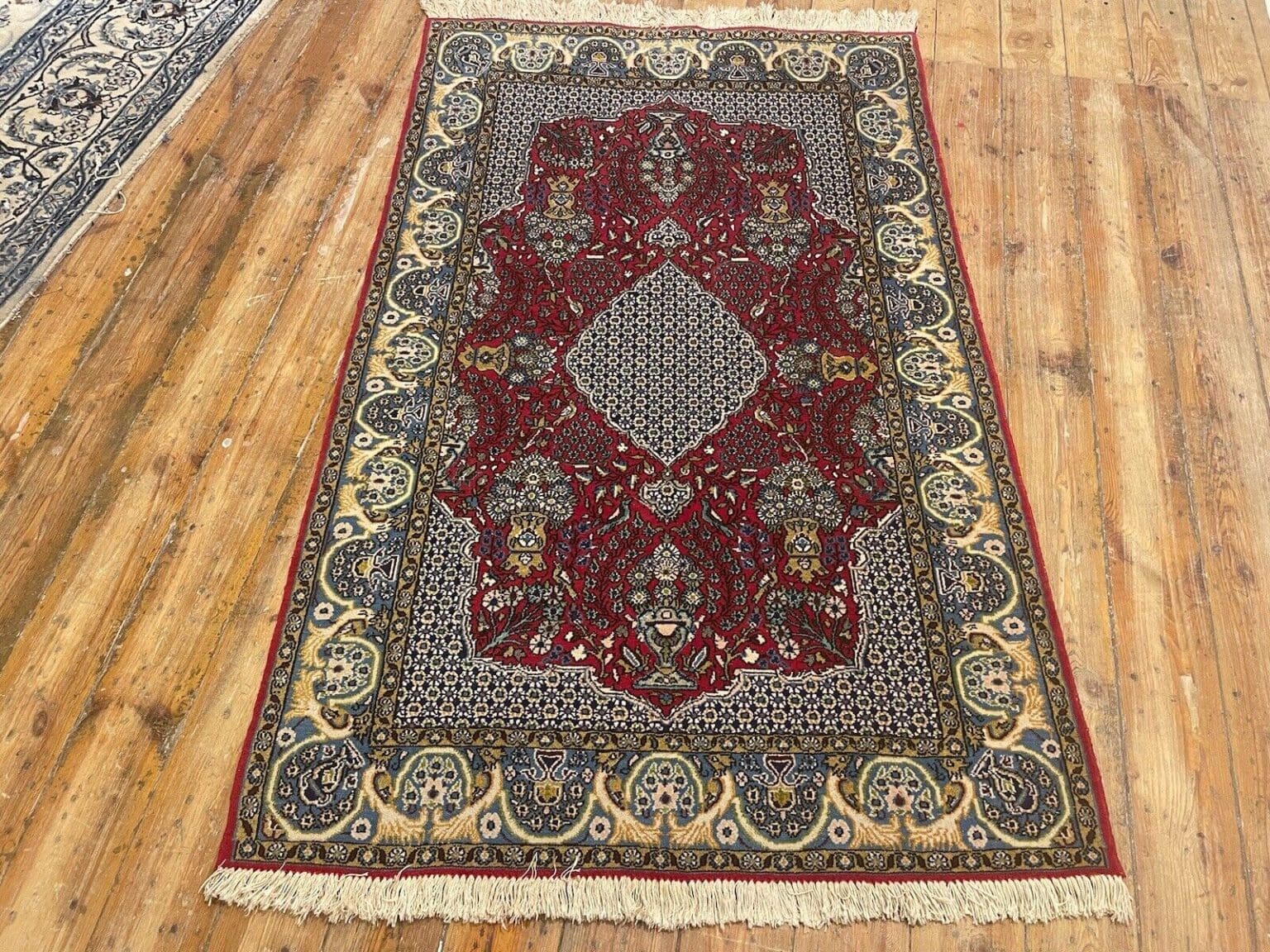
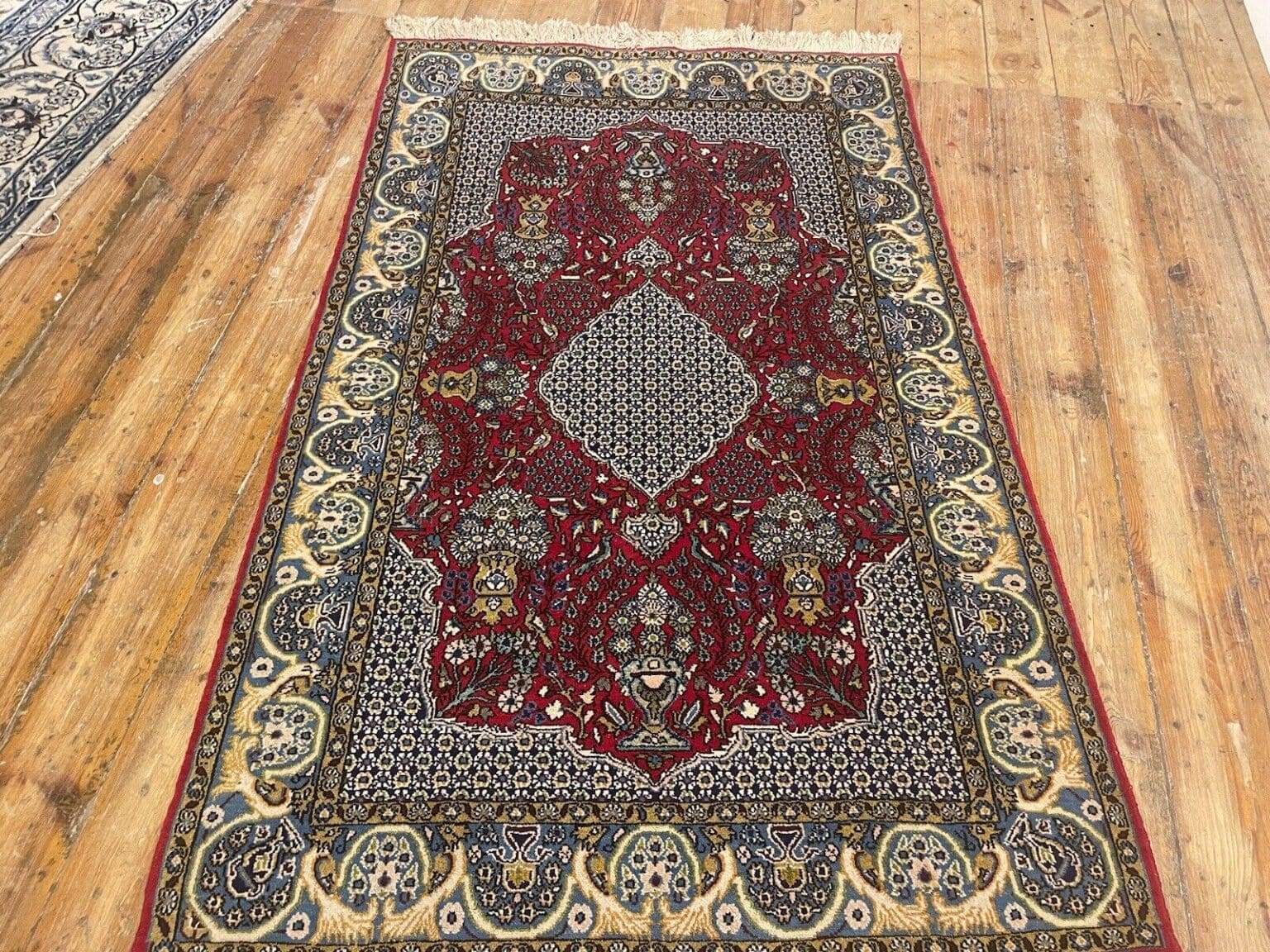
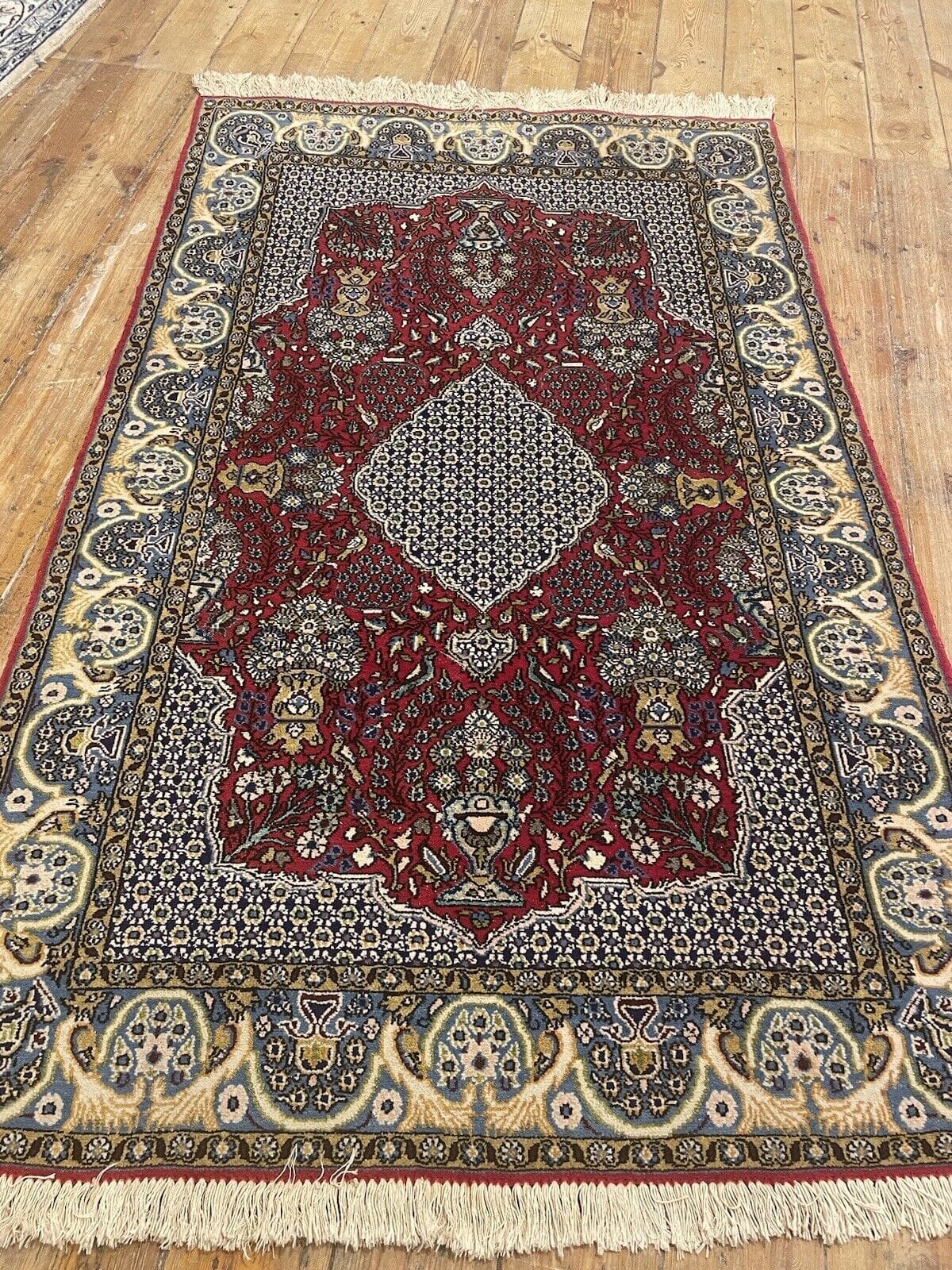
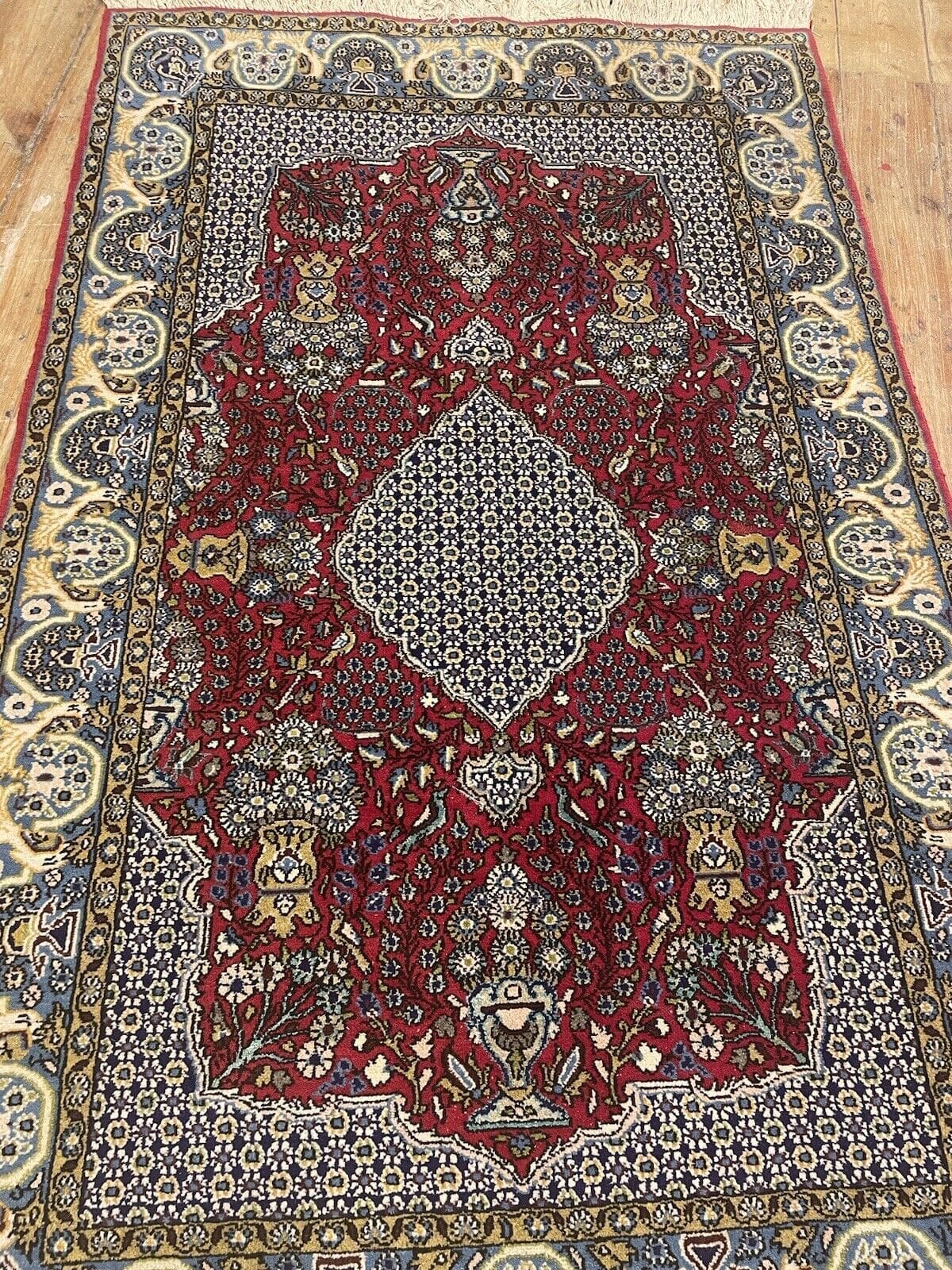
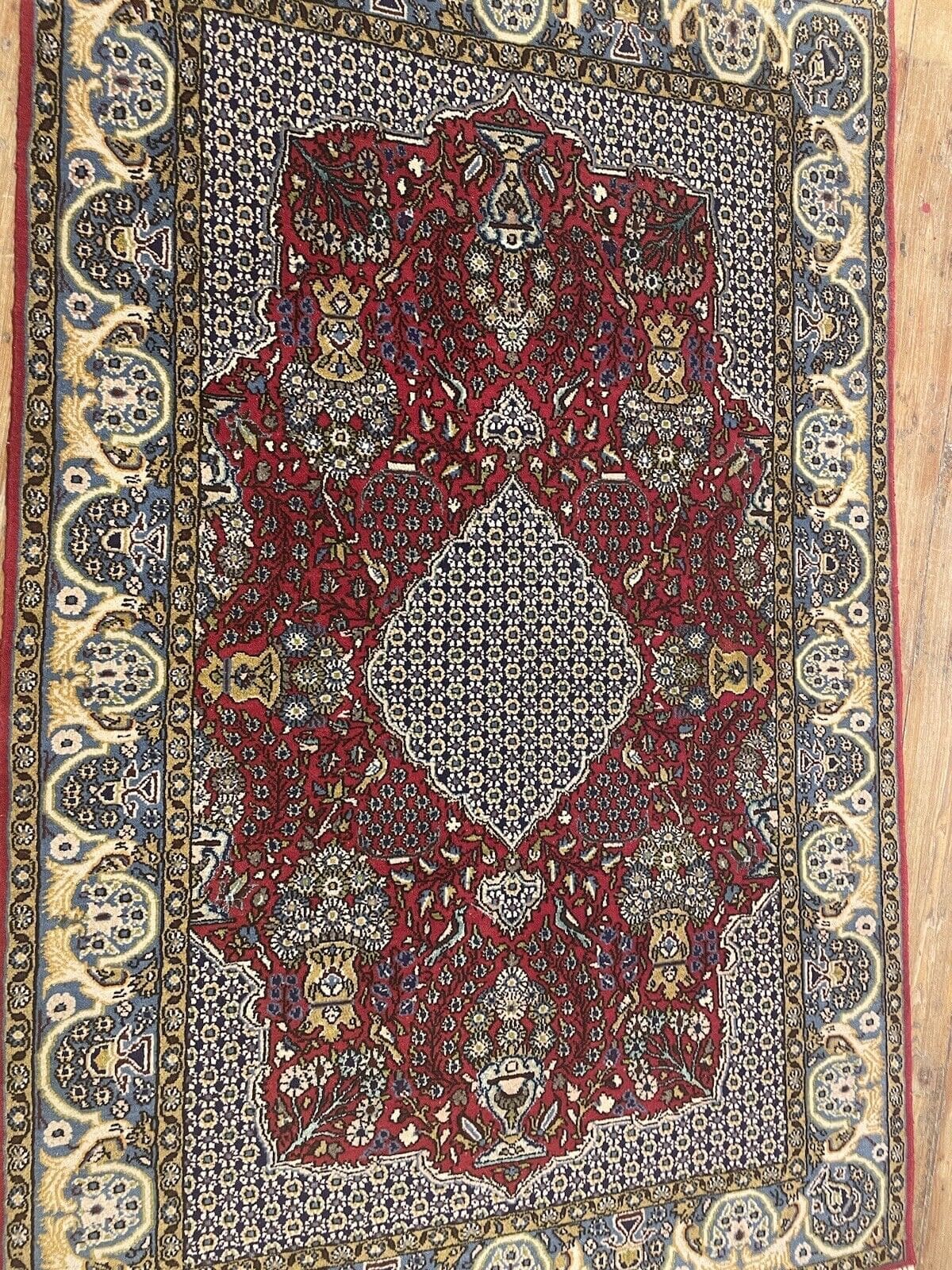
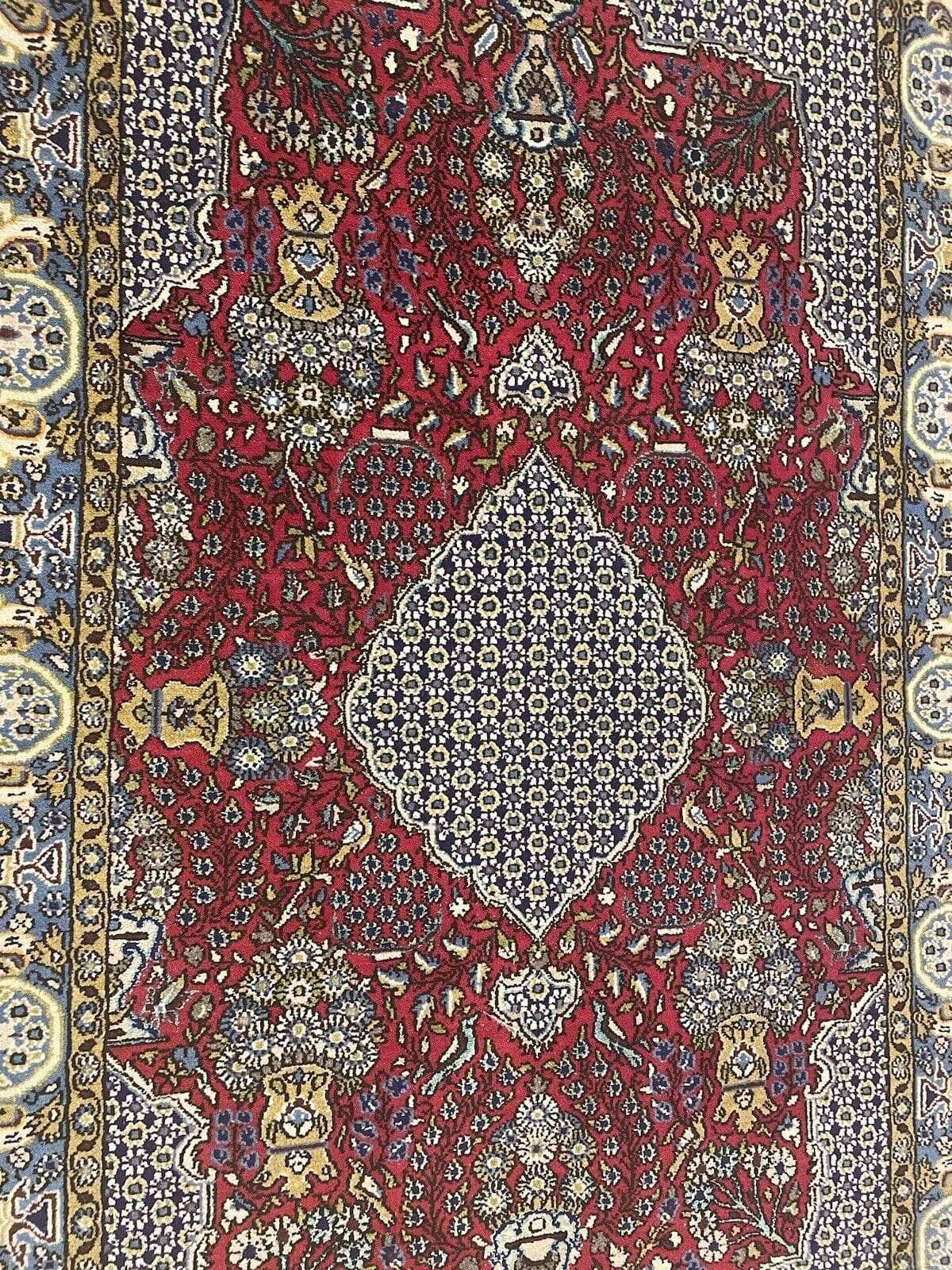
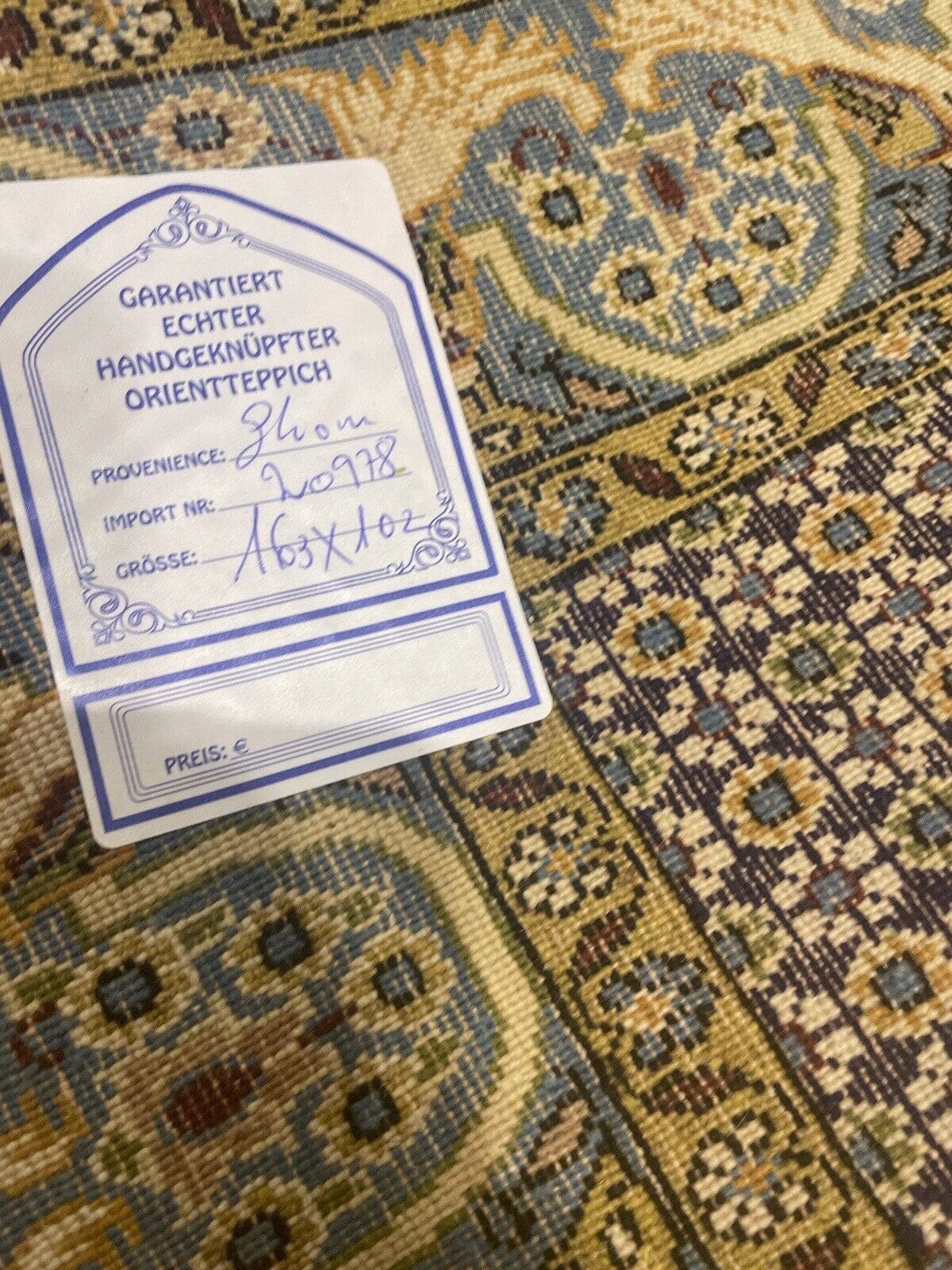
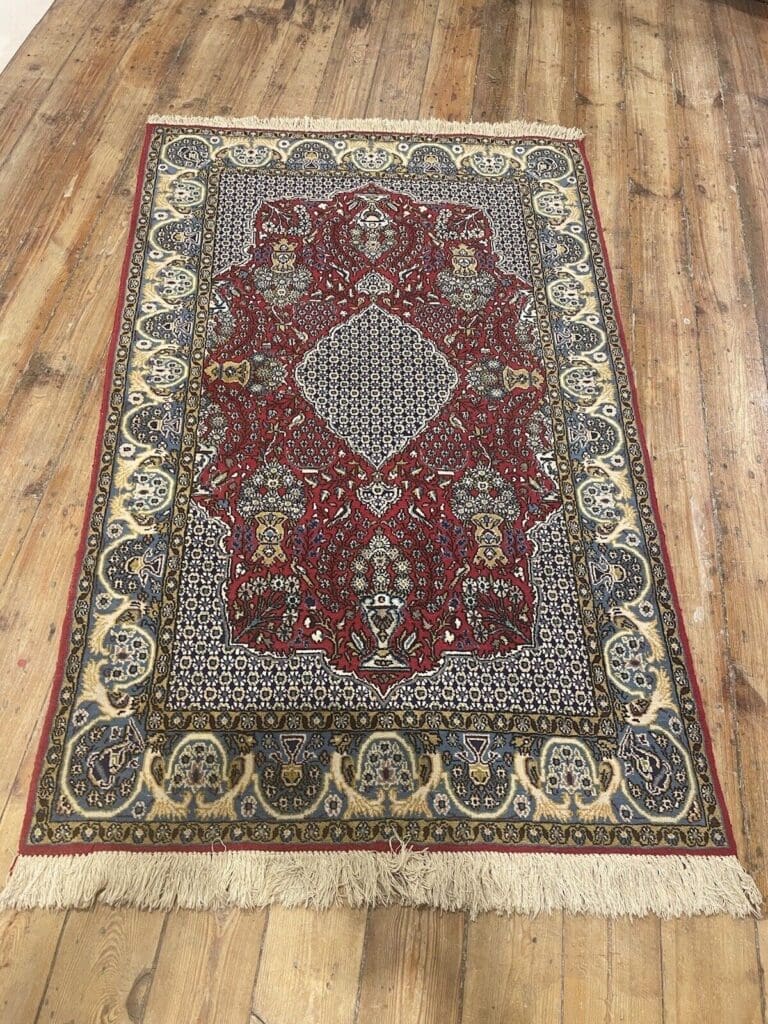
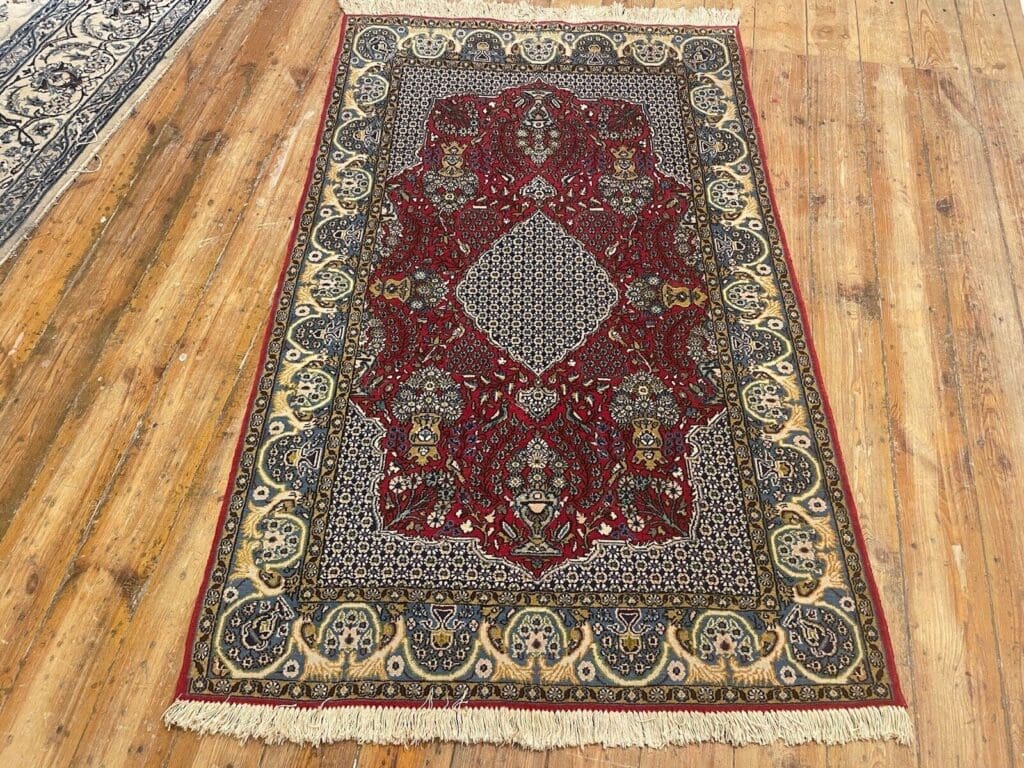
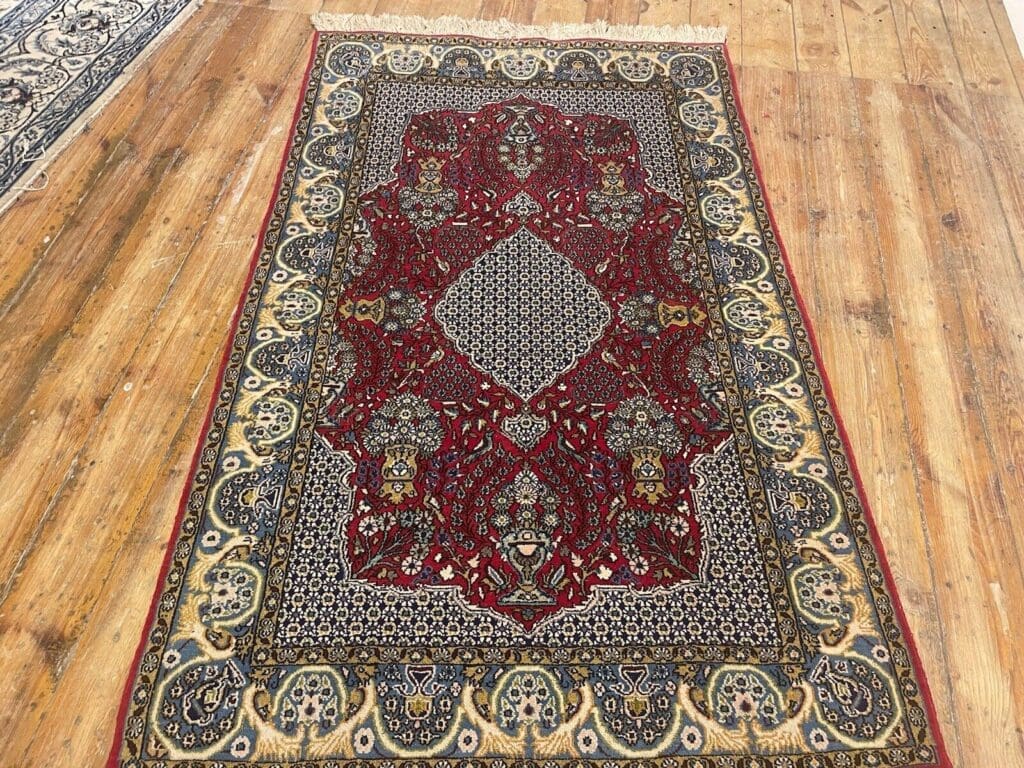
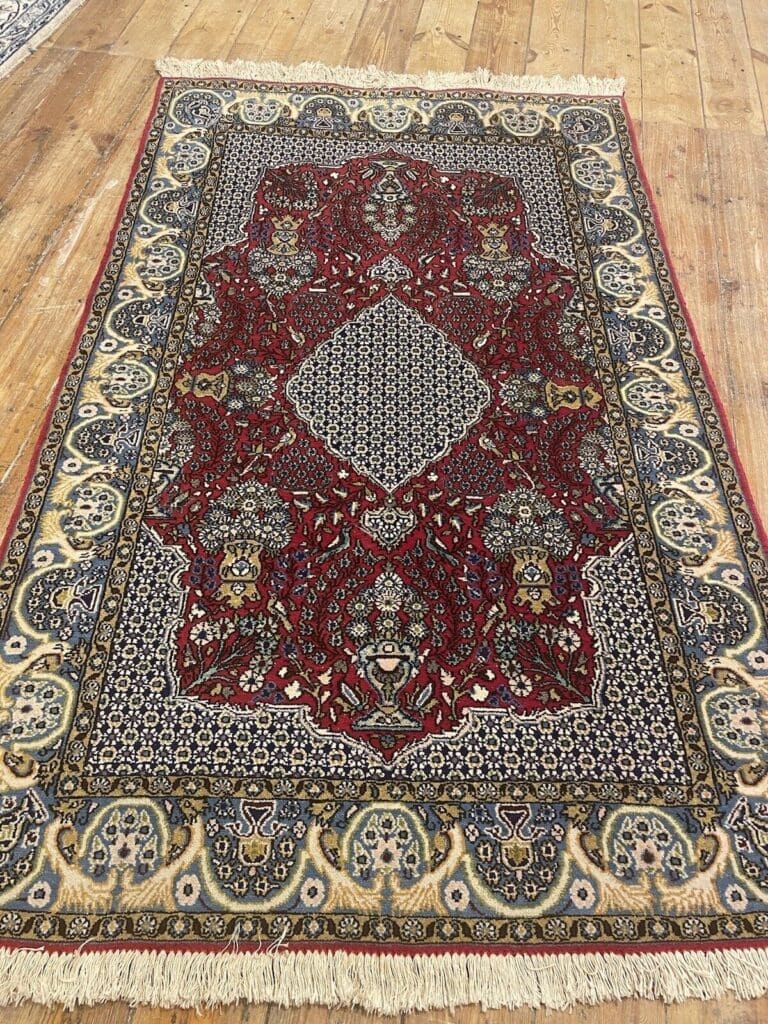
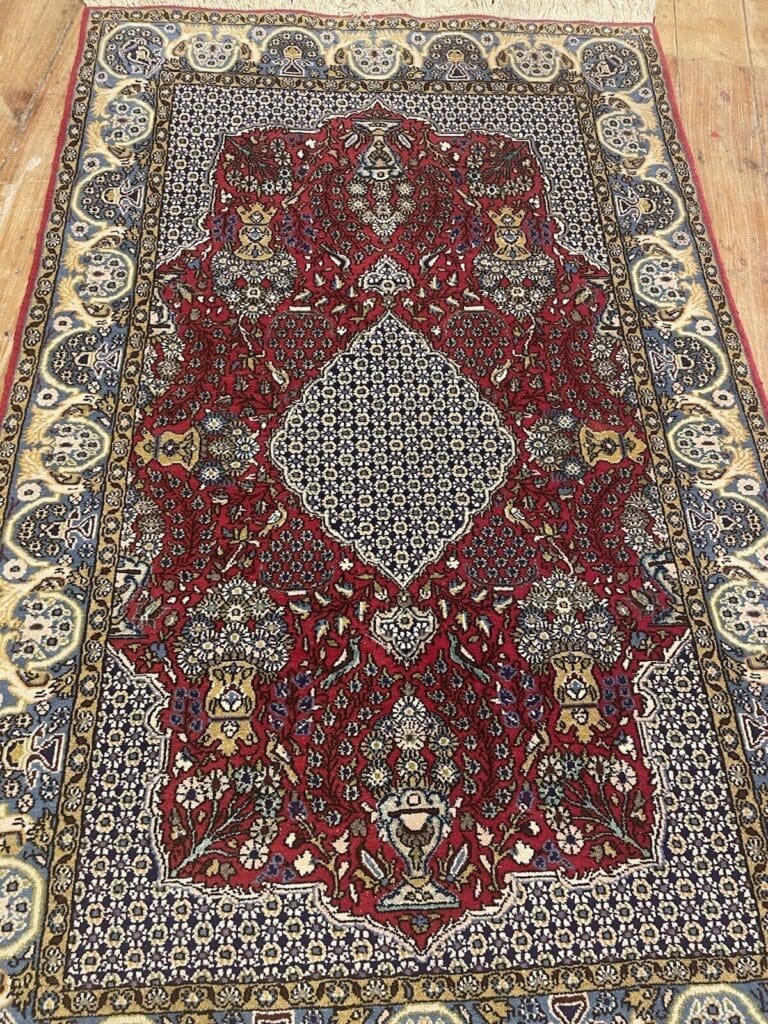
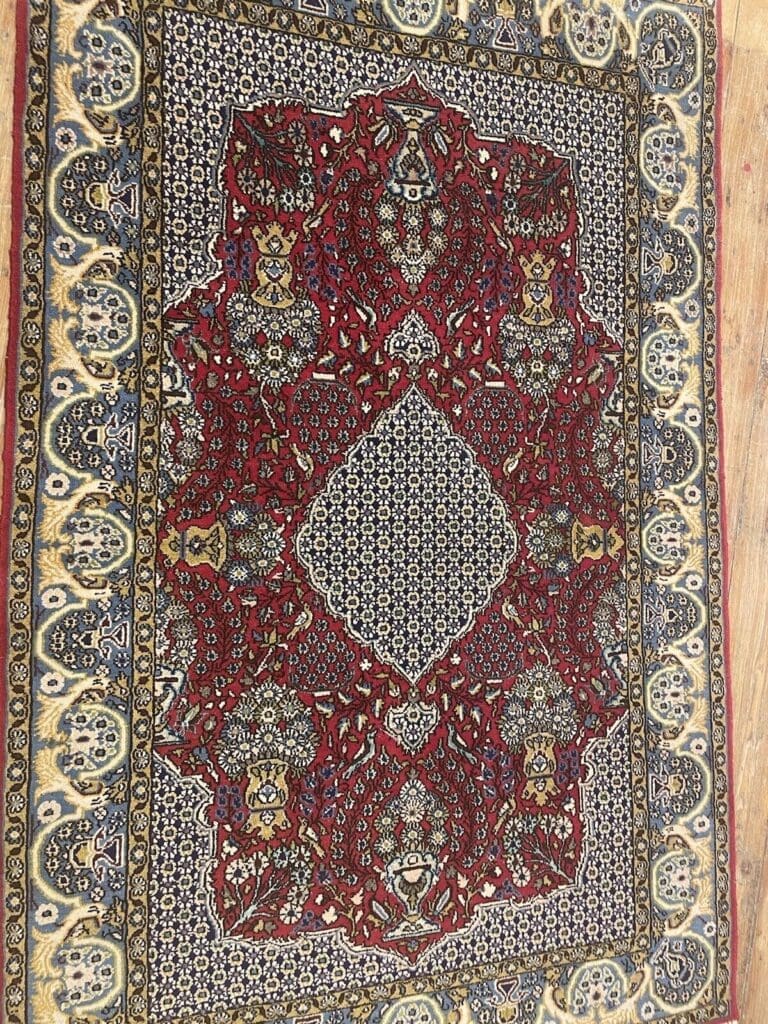
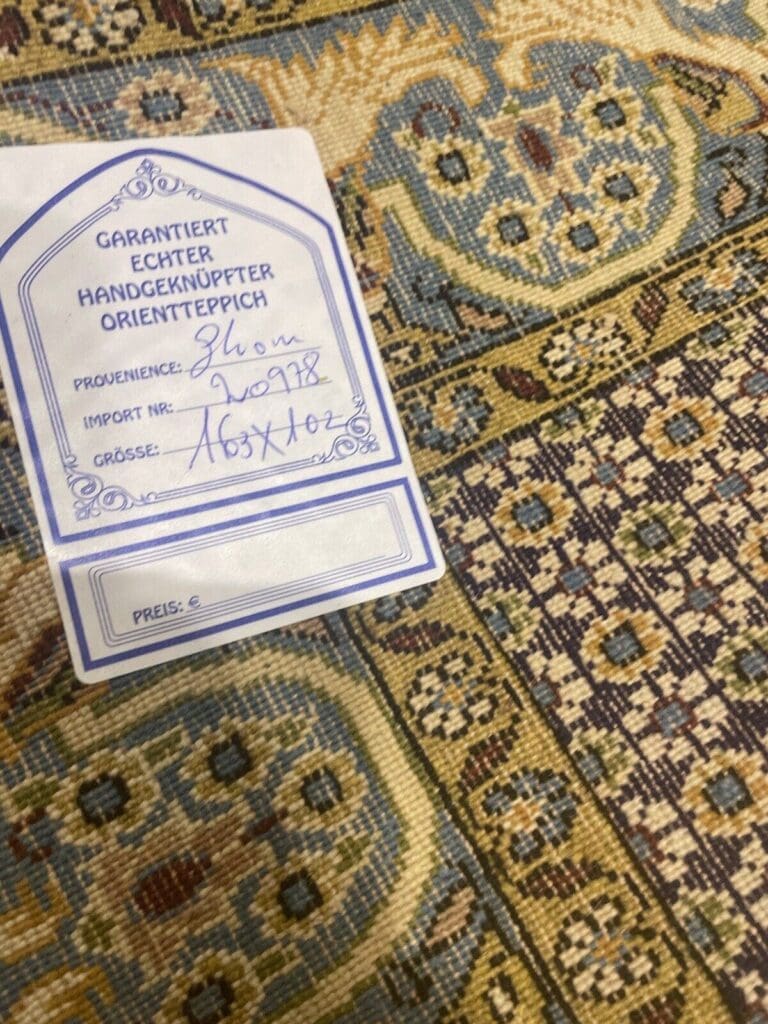
Hand-knotted Ghom Persian rug | Knot density: very fine | Material: pile pure new wool and silk | Size: 155 x 105 cm | Pattern: oriental, multicoloured | Condition: new without label
This Ghom Persian rug is hand-knotted. The listed materials are pure new wool and silk, while the title specifically highlights pure new wool. The description therefore identifies two established textile materials used in Persian rug making. The construction is described as very finely knotted. In a hand-knotted rug, individual knots are tied into the foundation one at a time. This method creates the direct connection between knot work, pile, colour areas and the drawn pattern that distinguishes handmade construction from a mechanically produced surface.
The pile height is specified as 10 to 12 mm. Pile is the visible textile surface formed by the knots. Its height affects the hand and the way colours appear, but it does not by itself define a rug’s fineness. Here, the stated pile, the very fine knot density and the hand-knotted technique belong together as the principal construction details. The rug is therefore made through knotting by hand rather than through machine production.
Pure new wool is a natural fibre commonly used for rug pile because of its resilient structure and soft handle. Silk is also included in the material description. In Persian weaving, silk may be used where a smooth surface and finely separated details are required. No individual material proportions are provided for this rug, and the description does not identify the warp composition. The material statement should therefore be understood as the listed combination of pure new wool and silk, without assigning unreported percentages or structural roles.
The condition is described as new without a label. The rug is also specified as suitable for use with underfloor heating. This is a use-related feature in addition to its hand-knotted construction. Care should be gentle and appropriate for a textile surface so that the pile, colours and knot structure remain protected during normal use.
Origin and Tradition
Ghom, also written Qom, is an Iranian centre of Persian rug production. The city became important for workshop weaving and developed a distinctive place within the country’s rug tradition. Ghom rugs are commonly associated with precise drawing, fine detail and carefully organised compositions. Their designs may combine floral ornament, central arrangements, border systems and repeated small motifs in a manner characteristic of Persian workshop work.
The Ghom tradition belongs to a planned form of weaving. In a workshop setting, a design can be prepared as a drawing or a gridded cartoon before the knotting begins. The weaver then transfers the individual colours and contours into the rug row by row. This makes it possible to reproduce small leaves, petals, curved stems, geometric divisions and narrow outlines with control. The final appearance depends on the relationship between the design plan, the knotting process, the pile finishing and the chosen colour arrangement.
Persian rug culture was shaped over many centuries by courtly, urban, regional and craft traditions. Ghom developed within this wider history as a centre known for refined workshop rugs rather than as a purely nomadic weaving area. Its production is often discussed in connection with delicate patterning and the use of carefully coordinated materials. The regional name refers to the Iranian place of production and its craft tradition; it does not prescribe one single pattern for every Ghom rug.
A Persian rug is identified by more than a place name alone. Construction, design language, material choices and workshop practice all contribute to its classification. Ghom pieces can therefore show different layouts while remaining connected to the same regional tradition. Some designs are organised around a central medallion, others use an all-over field, a prayer-niche arrangement or a more architectural geometry. Floral systems may be combined with borders and repeated motifs, allowing the individual workshop design to vary within a recognisable Persian framework.
Hand knotting requires a loom, a set of foundation threads and successive rows of knots. After a row has been tied, the structure is compacted before the next row is made. The pile is later trimmed to create an even visible surface. Fine knotting permits close control of small design elements, although knot density alone is not a statement about age, authorship or commercial value. For this rug, the knotting is expressly described as very fine, and the condition is recorded as new without a label.
Ghom is consequently both a geographical reference and a marker of a particular Iranian workshop tradition. It places this rug within Persian rather than non-Iranian production. The terms Persian rug and Ghom rug are compatible here: Ghom identifies the Iranian centre, while Persian rug describes the national and cultural weaving context.
Design and Pattern
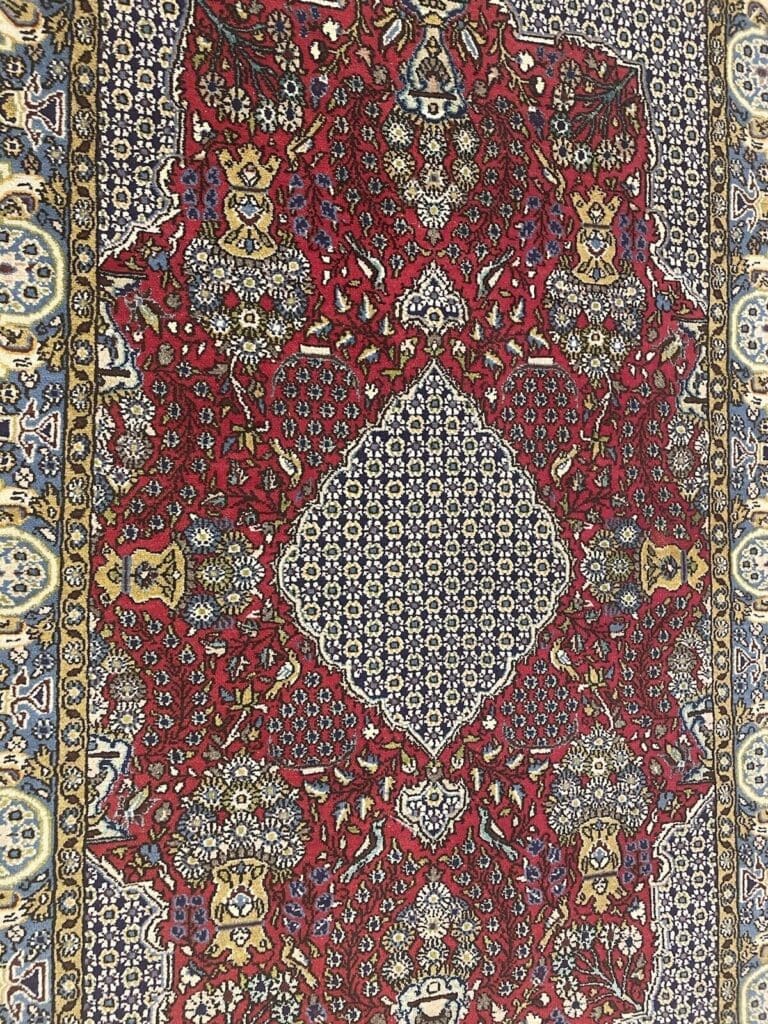
The pattern is described as oriental, and the style is identified as traditional Persian and oriental. The colour scheme is multicoloured. These are the specific design classifications supplied for this rug. They establish a broad visual category without claiming a particular medallion, flower, border arrangement or named pattern that is not separately stated.
Ghom designs often use a deliberate relationship between a central field and its surrounding borders. A medallion may organise the centre, while vines, blossoms and leaves connect the surrounding areas. Other compositions rely on an uninterrupted all-over pattern, a prayer niche or a geometric framework. Floral forms can be drawn with straight axes, repeated intervals and narrow contours. The combination of organic ornament and geometric order is a recurring feature of the wider Persian design vocabulary.
In an oriental rug, the impression of the pattern comes from the way individual motifs are arranged across the whole field. A main border can frame the composition and define the transition between edge and centre. Secondary borders add further lines and may repeat elements of the main design in a reduced form. Small fillers can occupy open areas and create a continuous visual rhythm. These structural principles explain how Persian patterns are composed in general; they do not assign an unreported layout to this particular rug.
Persian ornament frequently uses symmetry, repetition and measured progression. A symmetrical design can establish a clear axis and centre. A repeating rapport can extend one motif across the field without requiring a single focal point. In Ghom weaving, these systems are often paired with fine lines and detailed floral drawing. Very fine knotting is technically suited to rendering small contours and closely spaced elements, and this rug is specifically described as very finely knotted.
A multicoloured palette allows separate parts of a design to be distinguished. Colour can set a border apart, bring attention to a flower or alter the depth suggested by a scrolling vine. In Persian ornament, colour also helps organise foreground and background and gives repeated motifs their rhythm. The source does not list the individual colours used in this rug. It identifies the work as multicoloured and oriental, so no narrower palette should be inferred.
The decorative character of this rug comes from the combination of its traditional Persian and oriental classification, its multicoloured presentation and the fine-drawing tradition associated with Ghom. This makes the design legible within both historically informed and contemporary interiors, while leaving the exact room effect to the surrounding furnishings and light.
Special Features
The stated special features are the very fine knot density, hand-knotted production, a pile height of 10 to 12 mm and suitability for underfloor heating. The rug is described as a high-quality Ghom Persian rug and as new without a label. Its material description names pure new wool and silk, while the title places particular emphasis on pure new wool.
“Without a label” records the condition information and should not be confused with a statement about origin. The origin is identified as Ghom and Persian. No signature, production year, age, restoration history or named provenance is supplied. There is also no exact knots-per-square-metre figure, no warp material and no attribution to a particular master. Those details are therefore not part of the description of this one-off rug.
For use, the rug is specifically marked as suitable for underfloor heating. As with other hand-knotted wool or silk rugs, it should be kept clean with methods suited to its fibres and pile. Loose dust can be removed carefully. Spills should be blotted promptly with a damp cloth rather than rubbed vigorously. More substantial soiling is best handled by a professional cleaner familiar with hand-knotted Persian rugs.
FAQ
How should I care for my Ghom Persian rug?
Regular, careful vacuuming helps remove loose dust and everyday dirt from the pile. The surface should not be subjected to unnecessary abrasion. Strong, direct sunlight is best avoided because prolonged exposure can alter textile colours. If something is spilled, blot it promptly with a damp cloth and avoid aggressive rubbing, which can affect the pile and the appearance of the colours. For a difficult stain or a full clean, use a specialist cleaner experienced with hand-knotted rugs made from wool and silk.
Which rooms are suitable for a Ghom Persian rug?
The rug can be used in living rooms, bedrooms, dining rooms and entrance areas. Its traditional Persian and oriental classification and its multicoloured design can work with both classic and contemporary furnishings. Because it is specified as suitable for underfloor heating, it can also be placed on a floor with that type of heating. The best location still depends on traffic, placement, furniture and the cleaning routine provided. Those practical conditions should be considered alongside the decorative style.
Could this rug cause allergies?
The material description identifies pure new wool and silk. Pure new wool is generally regarded as hypoallergenic, but particularly sensitive people may nevertheless react to dust or textile fibres. Regular, gentle cleaning can help reduce dust and potential allergens in the pile. Anyone with a known or severe allergy should check whether these materials are tolerated before purchase and should seek medical advice where necessary. A product description cannot replace an individual medical assessment.
To provide the best experiences, we use technologies like cookies to store and/or access device information. Consenting to these technologies will allow us to process data such as browsing behavior or unique IDs on this site. Not consenting or withdrawing consent, may adversely affect certain features and functions.
Functional Always active
The technical storage or access is strictly necessary for the legitimate purpose of enabling the use of a specific service explicitly requested by the subscriber or user, or for the sole purpose of carrying out the transmission of a communication over an electronic communications network.
Preferences
The technical storage or access is necessary for the legitimate purpose of storing preferences that are not requested by the subscriber or user.
Statistics
The technical storage or access that is used exclusively for statistical purposes.The technical storage or access that is used exclusively for anonymous statistical purposes. Without a subpoena, voluntary compliance on the part of your Internet Service Provider, or additional records from a third party, information stored or retrieved for this purpose alone cannot usually be used to identify you.
Marketing
The technical storage or access is required to create user profiles to send advertising, or to track the user on a website or across several websites for similar marketing purposes.
 SECURE PAYMENT
 SHIPPING PARTNERS