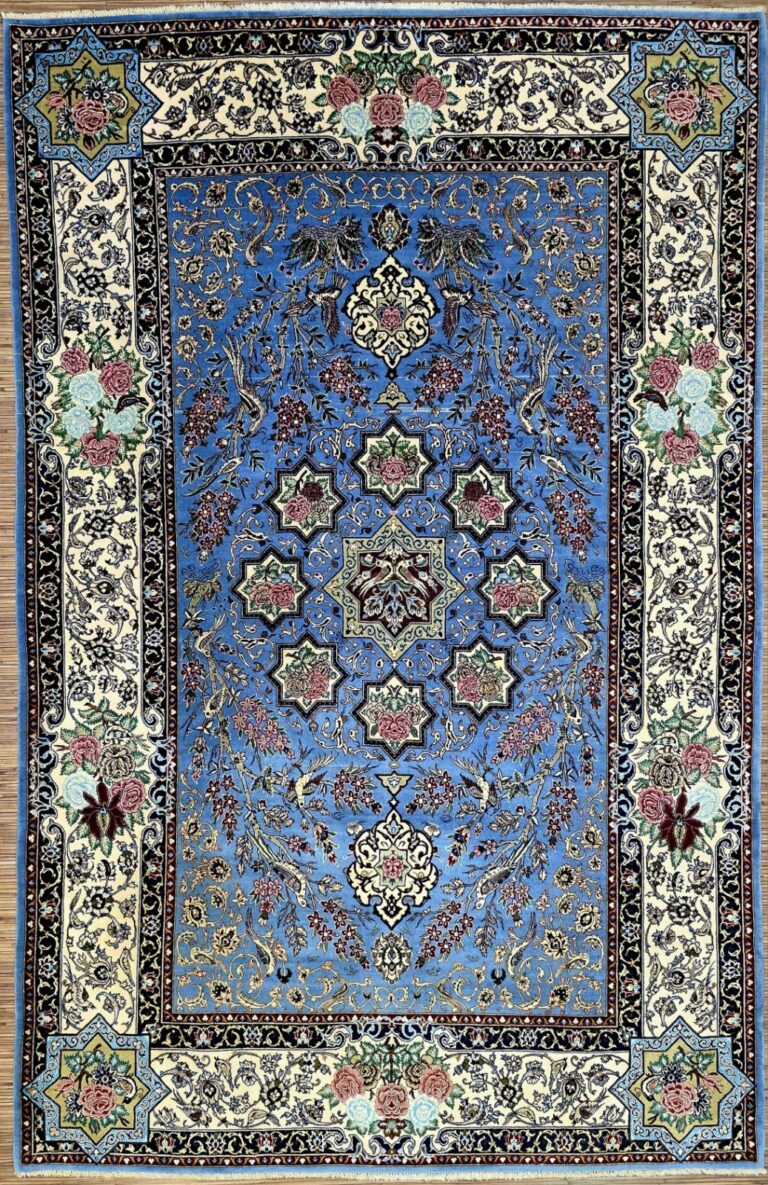
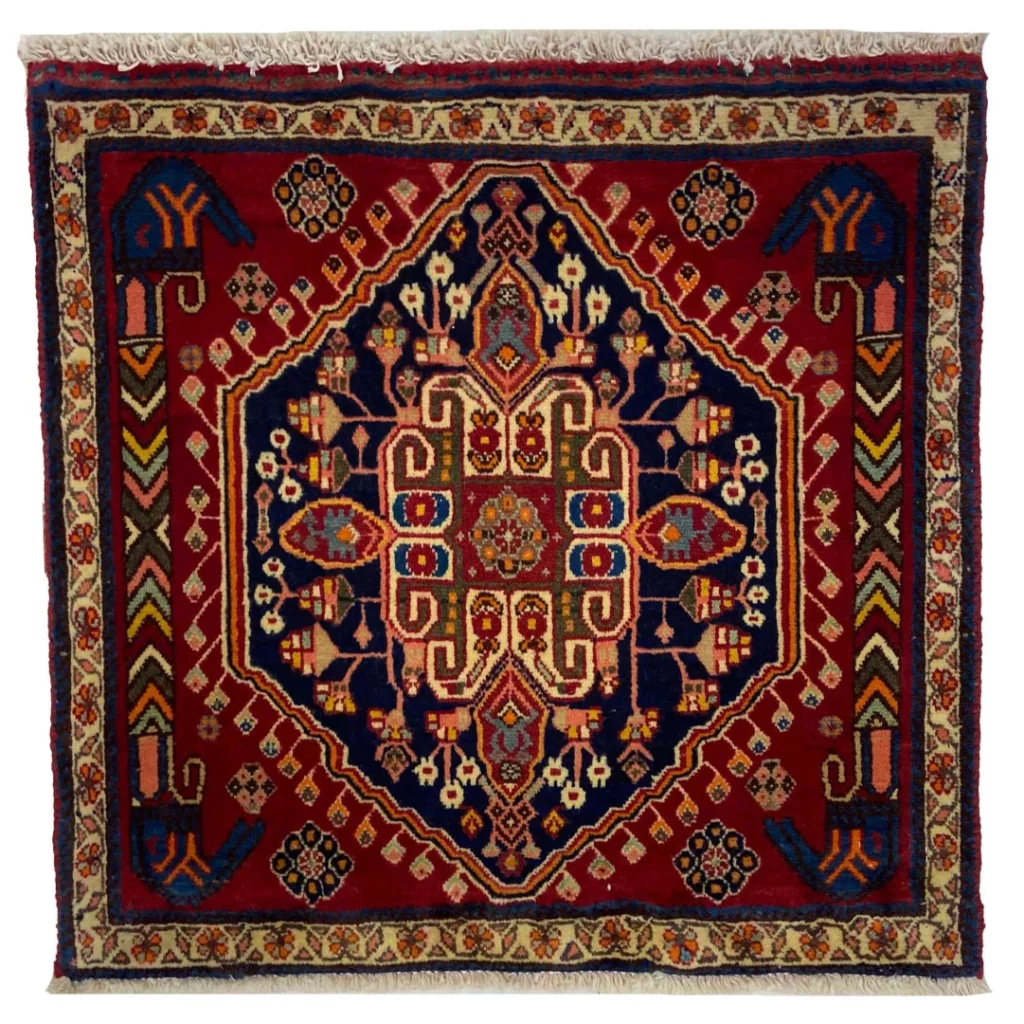
This Ghashghai Persian rug is hand-knotted and has a pile made from natural wool. The use of this natural material belongs to the established rug-making tradition of the Ghashghai region. Its workmanship is described as high quality. The rug therefore combines a natural wool pile with a craft process in which the knots are made by hand rather than produced through an industrial procedure.
The knot density is in the range of 180,000 to 250,000 knots per square metre. This density allows geometric ornaments to be rendered with clearly defined contours and a high level of detail. The central feature is the manual work itself: the design develops through the knotting process and reflects the characteristic execution associated with an individual Ghashghai rug.
Ghashghai rugs are often knotted outdoors and without a preliminary plan. This method connects production closely with the practical and cultural life of the Ghashghai people. A hand-knotted rug is built step by step at the loom. Its pattern is not printed or mechanically embossed onto a finished surface, but formed through the placement of the knots.
Origin and Tradition
This rug comes from the Ghashghai region of southern Persia, in Fars Province. The Ghashghai are associated with a distinct rug-making tradition shaped by the tribes living in the region and by their accumulated craft knowledge. Their rugs represent a form of weaving and knotting in which knowledge of materials, structures and motifs is passed on through experience.
Fars holds an important place in the history of Persian rugs. Southern Persia developed several forms of rug production adapted to the way of life of the communities that made them. Ghashghai work is associated with a direct, strongly handmade approach to design. These rugs were not created solely as decorative objects; they also formed part of everyday use within the communities that produced them.
The practice of knotting outdoors is often linked with the mobile and tribal tradition connected to Ghashghai rugs. A permanent workshop or a fully drawn design is not necessarily the starting point. Instead, the piece takes shape as it is knotted. The experience of the makers guides the arrangement, repetition and joining of the ornaments.
Working without a preliminary plan does not mean that the design lacks structure. Traditional knowledge of forms and colour relationships provides a clear framework for the process. Within that framework, each rug can develop its own expression. The Ghashghai tradition is therefore preserved through recognisable design principles while allowing individual pieces to differ in their execution.
Rugs from Shiraz are also often discussed in connection with the cultural variety of southern Persia. They may share comparable colour palettes and geometric forms, but they are regarded as a separate regional tradition. Tabriz and Kashan rugs are likewise known for their own histories of craftsmanship and for different design approaches. The name Ghashghai identifies this rug with the region and tradition described here, not with those other places of origin.
The history of Ghashghai rug making shows how closely textile art, daily life and regional identity can be connected. Materials, colours, motifs and working methods should not be considered separately. Together they form a textile language transmitted through generations. This rug belongs to that southern Persian context and is presented as a hand-knotted piece from the Ghashghai region.
Design and Pattern
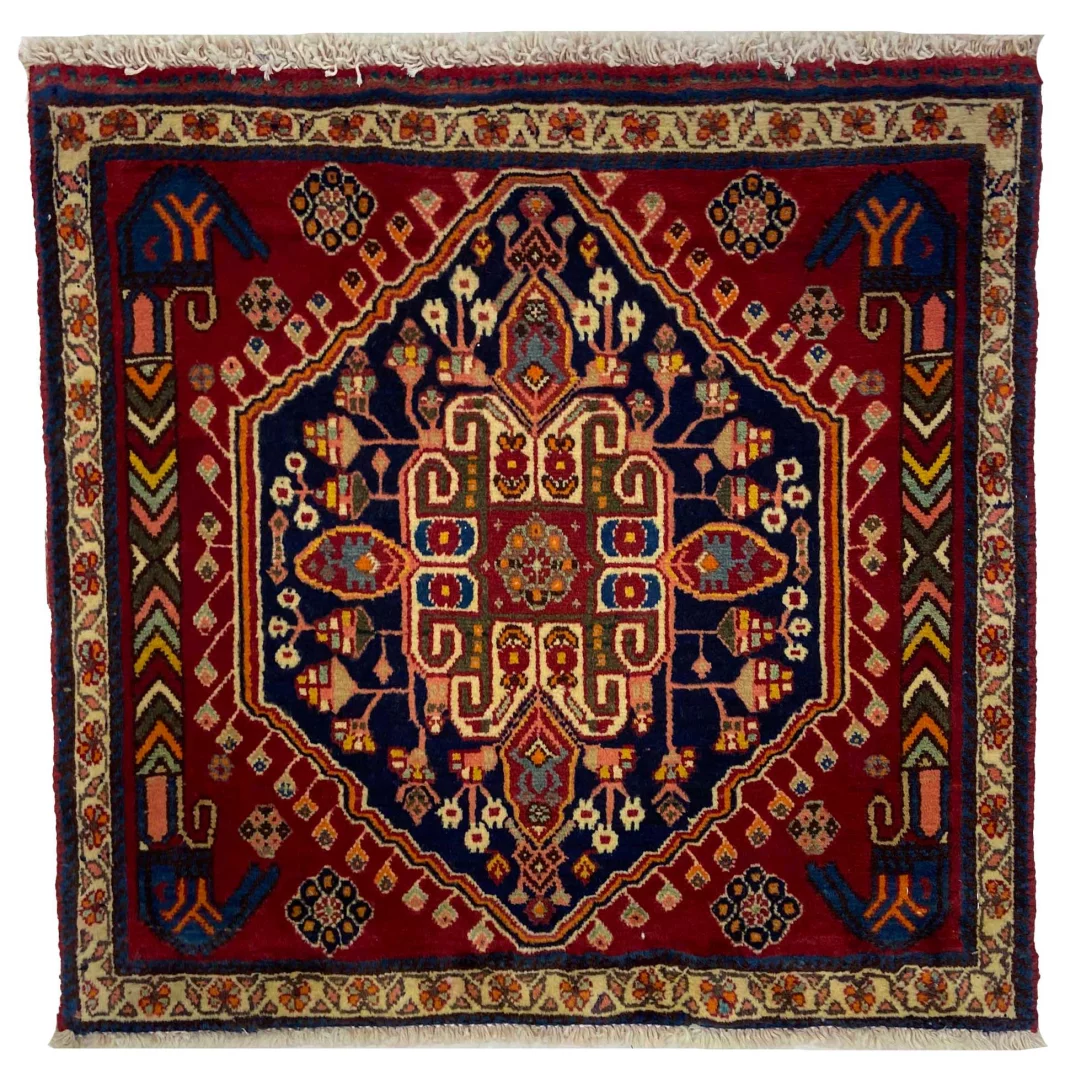
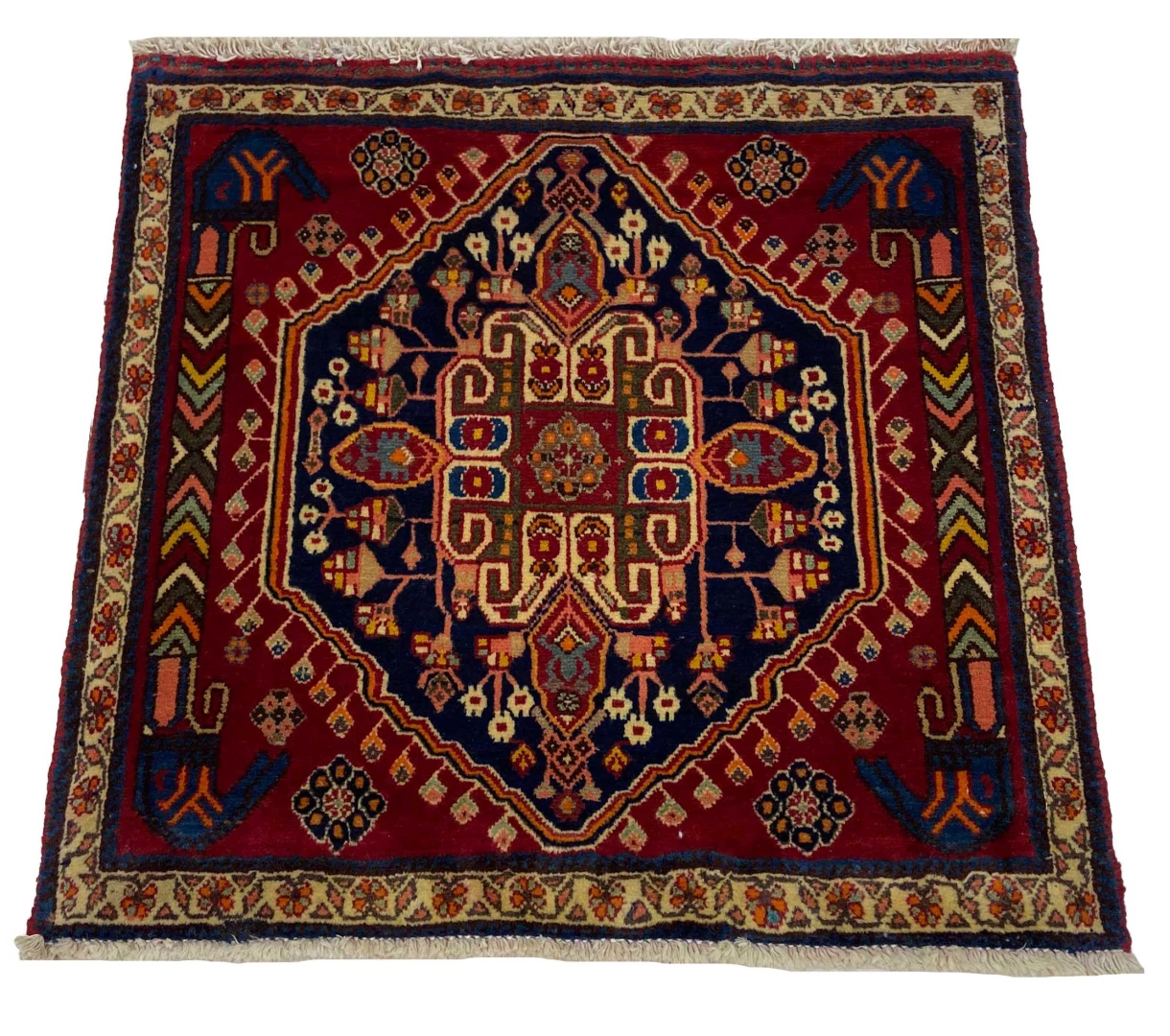
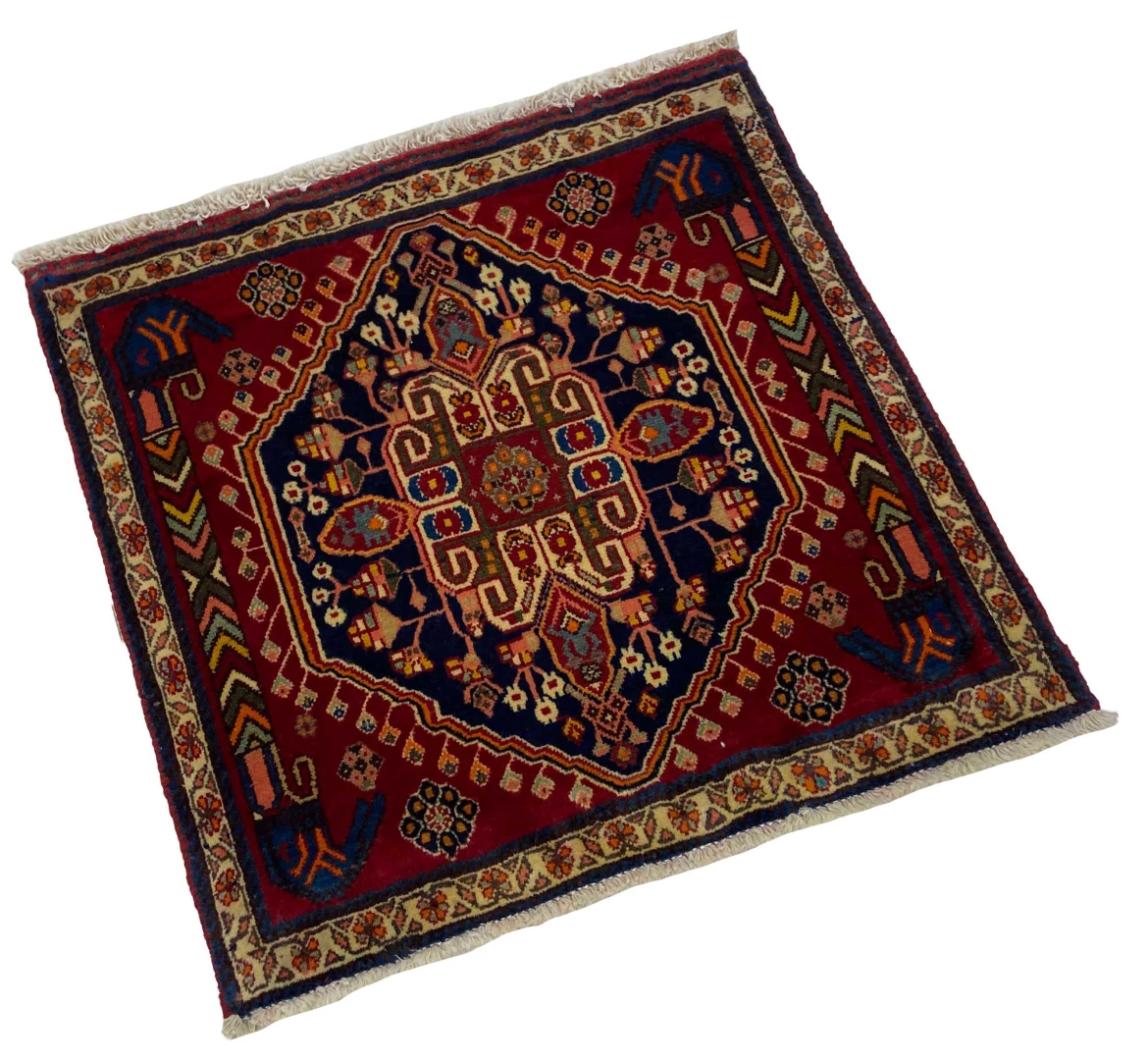
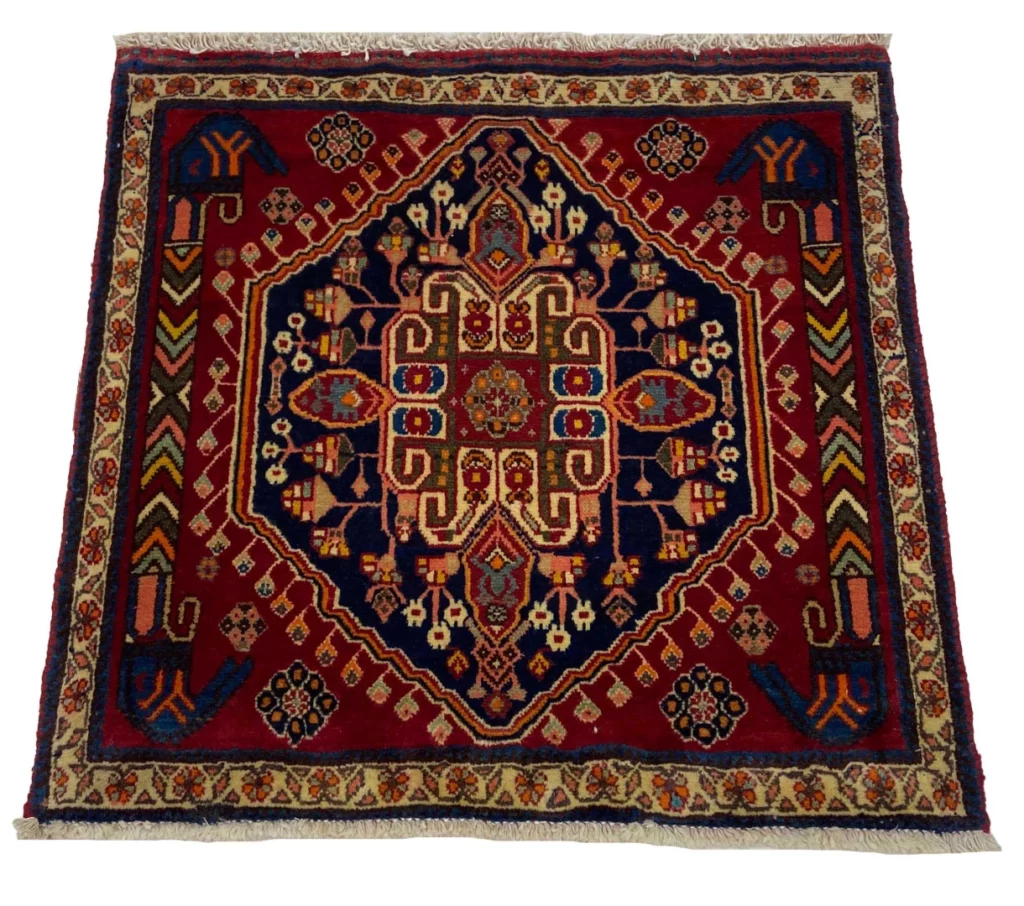
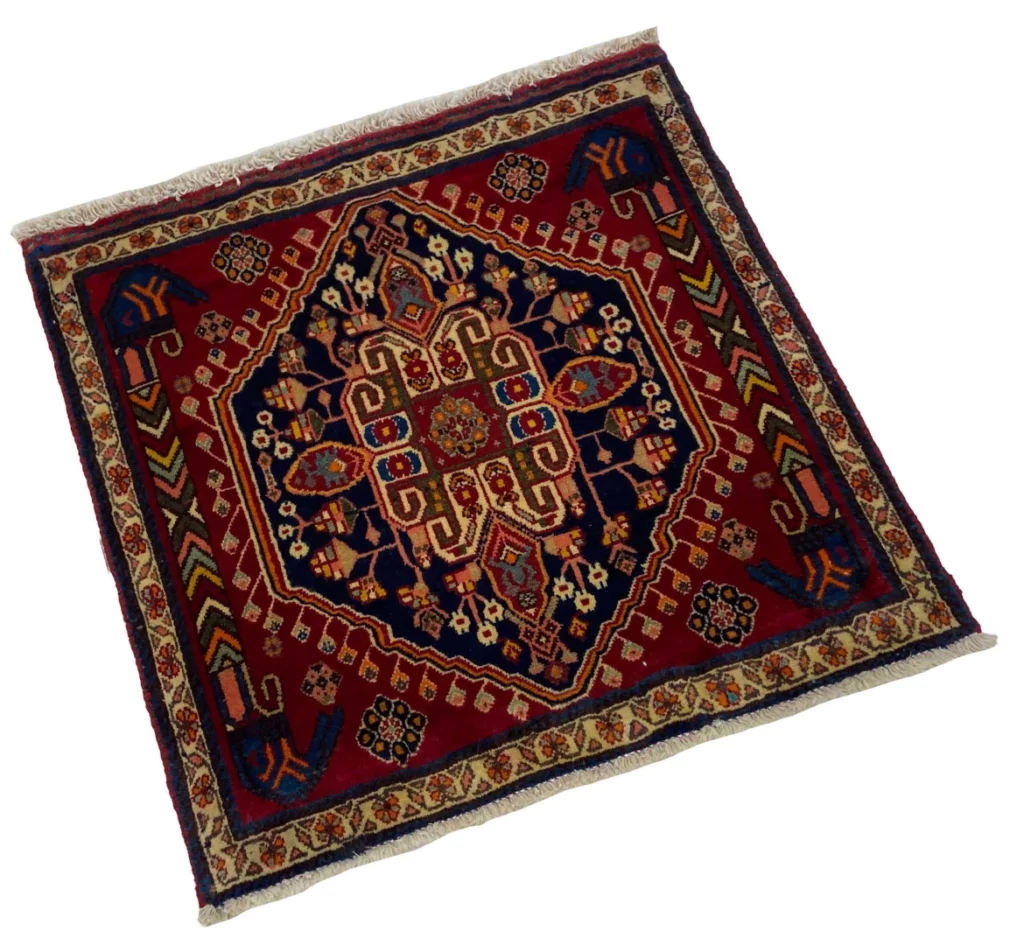
The pattern of this Persian rug consists of geometric ornaments. Geometric design is an important element in many Ghashghai rugs. Lines, angles, diamonds, hooked forms and repeated signs may be combined into a rhythmic overall composition. These forms are not intended as naturalistic depictions, but as stylised ornaments with a clear and repeatable structure.
This geometric vocabulary is particularly suited to knotting without a completely prepared drawing. Individual motifs can be produced from memory and through the maker’s experience. Repetition creates order, while small variations reveal the handmade origin. The result remains rooted in tradition while retaining the individual character of the person or group that made the piece.
Living reds and browns are part of the colour impression associated with Ghashghai rugs. Red may serve as a strong ground or accent colour, while brown adds an earthy connection between the separate ornaments. The relationship between these tones reinforces the clarity of the geometric forms. Colour is not an isolated feature, but part of the composition as a whole.
In a geometric rug, visual tension often comes from the relationship between open areas and ornament. A repeated sign can establish a rhythm, while lines and fields guide the eye through the design. In tribal rugs, the character does not depend on perfectly mechanical symmetry. It emerges from the combination of inherited forms, colour relationships and the decisions made during hand knotting.
Ghashghai patterns differ from the more floral or central-medallion designs associated with some other Persian weaving centres. This does not mean that a Ghashghai rug lacks an underlying order. Its order is created through the repetition of geometric signs, the balance of colours and the distribution of ornaments across the composition.
The ornament can also be understood as part of the cultural variety of Fars. Over time, different tribal groups and regional influences contributed to a wide range of forms. Shared characteristics can exist alongside individual solutions. The name Ghashghai therefore describes a regional and cultural tradition in which several related design expressions are possible.
This piece is defined by the combination of geometric ornaments and lively red and brown tones. These are the design characteristics specified for the Ghashghai rugs described here. No further individual motifs are identified. The relevant features are the clear geometric drawing, the inherited craft tradition and the colour effect associated with southern Persia.
Special Features
A special feature of this rug is the combination of natural wool, hand knotting and geometric ornament. Its knot density is described as high and falls within the stated range. This supports the detailed execution of the pattern. High-quality workmanship is expressly included in the description of this particular piece.
Ghashghai rugs are described as hard-wearing and easy to care for. Their natural wool also provides good insulation. For this reason, they can be used in different climates. The source description names both private and commercial use as possible settings.
As a hand-knotted textile, the rug represents a making process connected with the tradition of the Ghashghai people. Knotting outdoors and without a preliminary plan gives this form of rug making a distinctive handmade character. A Ghashghai rug can therefore function as a practical textile while also reflecting an established regional craft tradition.
FAQ
How should I care for my Ghashghai Persian rug?
Regular vacuuming is recommended as part of routine care. Occasional shampooing is also advised. Direct sunlight should be avoided so that the colours do not fade. These care instructions apply to the rug’s natural wool and hand-knotted construction.
Are Ghashghai rugs suitable for underfloor heating?
Yes. Ghashghai rugs are described as suitable for rooms with underfloor heating because of their natural materials. Their natural wool insulates heat well. The heating system should be operated properly so that the rug and the room climate remain compatible.
Where can I buy an authentic Ghashghai Persian rug?
Authentic Ghashghai Persian rugs can be found at specialist rug dealers or on online platforms that focus on hand-knotted rugs. Information about region, material, technique and pattern can help when making a selection. For this rug, Ghashghai in southern Persia and Fars Province are identified as its origin.
To provide the best experiences, we use technologies like cookies to store and/or access device information. Consenting to these technologies will allow us to process data such as browsing behavior or unique IDs on this site. Not consenting or withdrawing consent, may adversely affect certain features and functions.
Functional Always active
The technical storage or access is strictly necessary for the legitimate purpose of enabling the use of a specific service explicitly requested by the subscriber or user, or for the sole purpose of carrying out the transmission of a communication over an electronic communications network.
Preferences
The technical storage or access is necessary for the legitimate purpose of storing preferences that are not requested by the subscriber or user.
Statistics
The technical storage or access that is used exclusively for statistical purposes.The technical storage or access that is used exclusively for anonymous statistical purposes. Without a subpoena, voluntary compliance on the part of your Internet Service Provider, or additional records from a third party, information stored or retrieved for this purpose alone cannot usually be used to identify you.
Marketing
The technical storage or access is required to create user profiles to send advertising, or to track the user on a website or across several websites for similar marketing purposes.
 SECURE PAYMENT
 SHIPPING PARTNERS