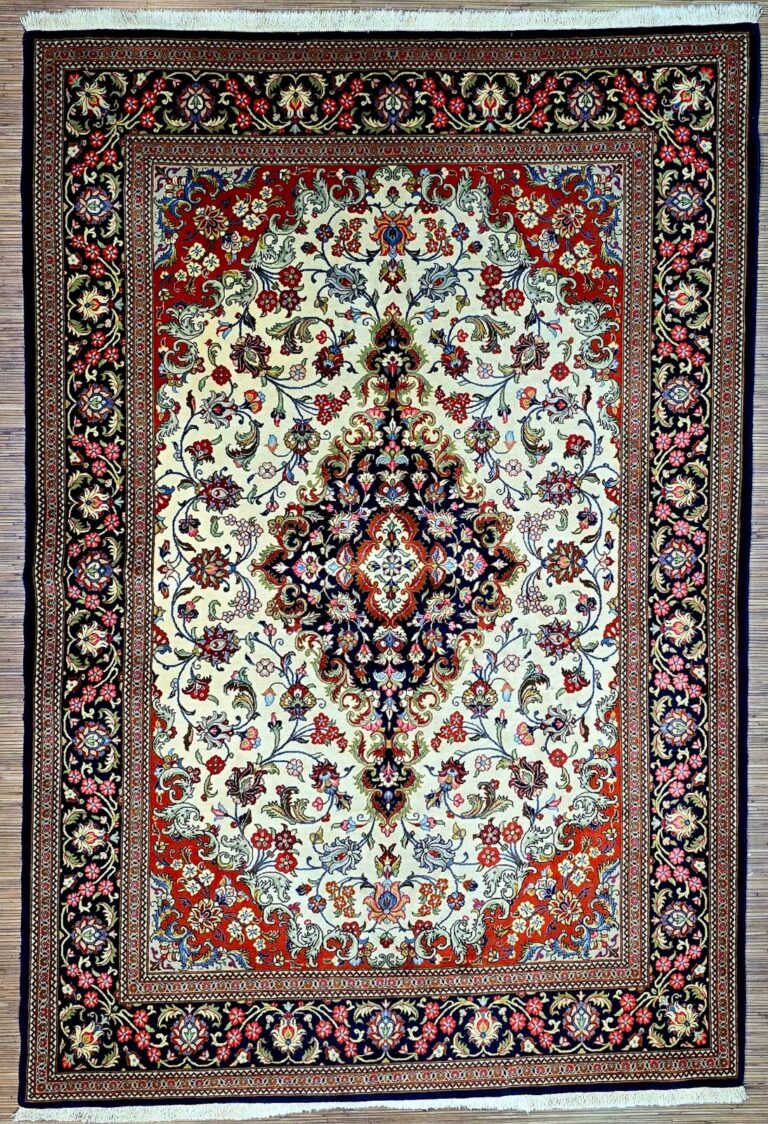
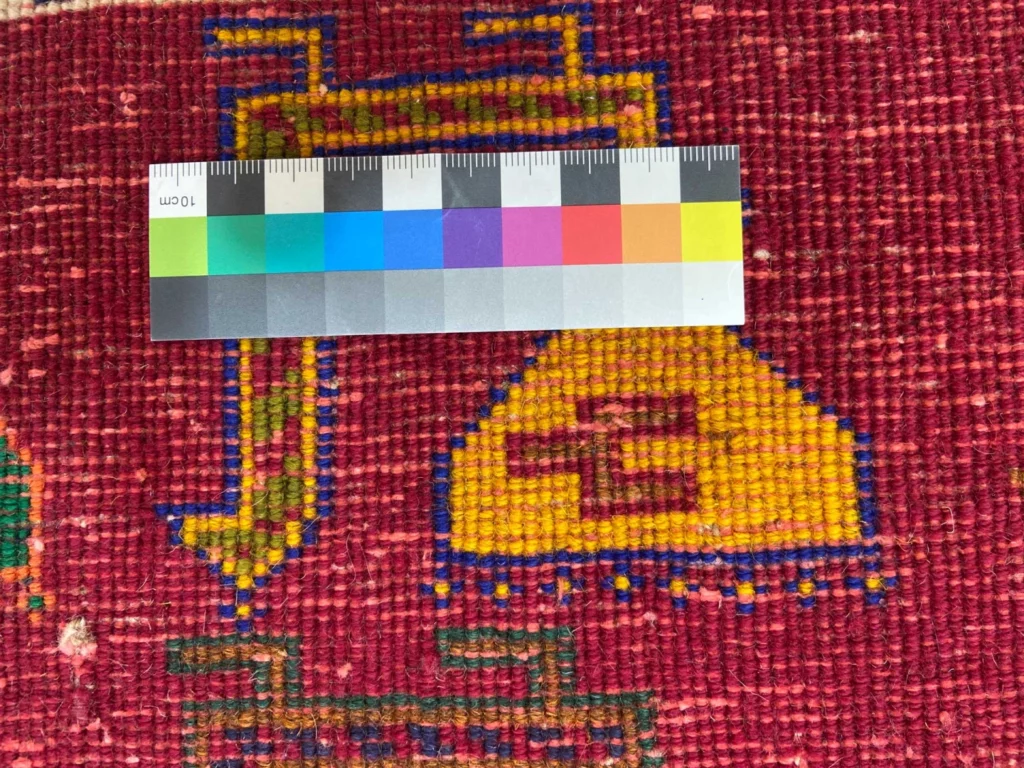
This Ghashghai Persian rug is hand-knotted and made with natural wool. Its workmanship is described as high quality. Natural wool forms the pile material, continuing a practice that has long been central to traditional rug making. In hand-knotting, the surface is built one knot at a time on a prepared foundation. Each knot is inserted by hand and positioned within its row, so the finished design develops gradually through the relationship between knots, wefts, and warp.
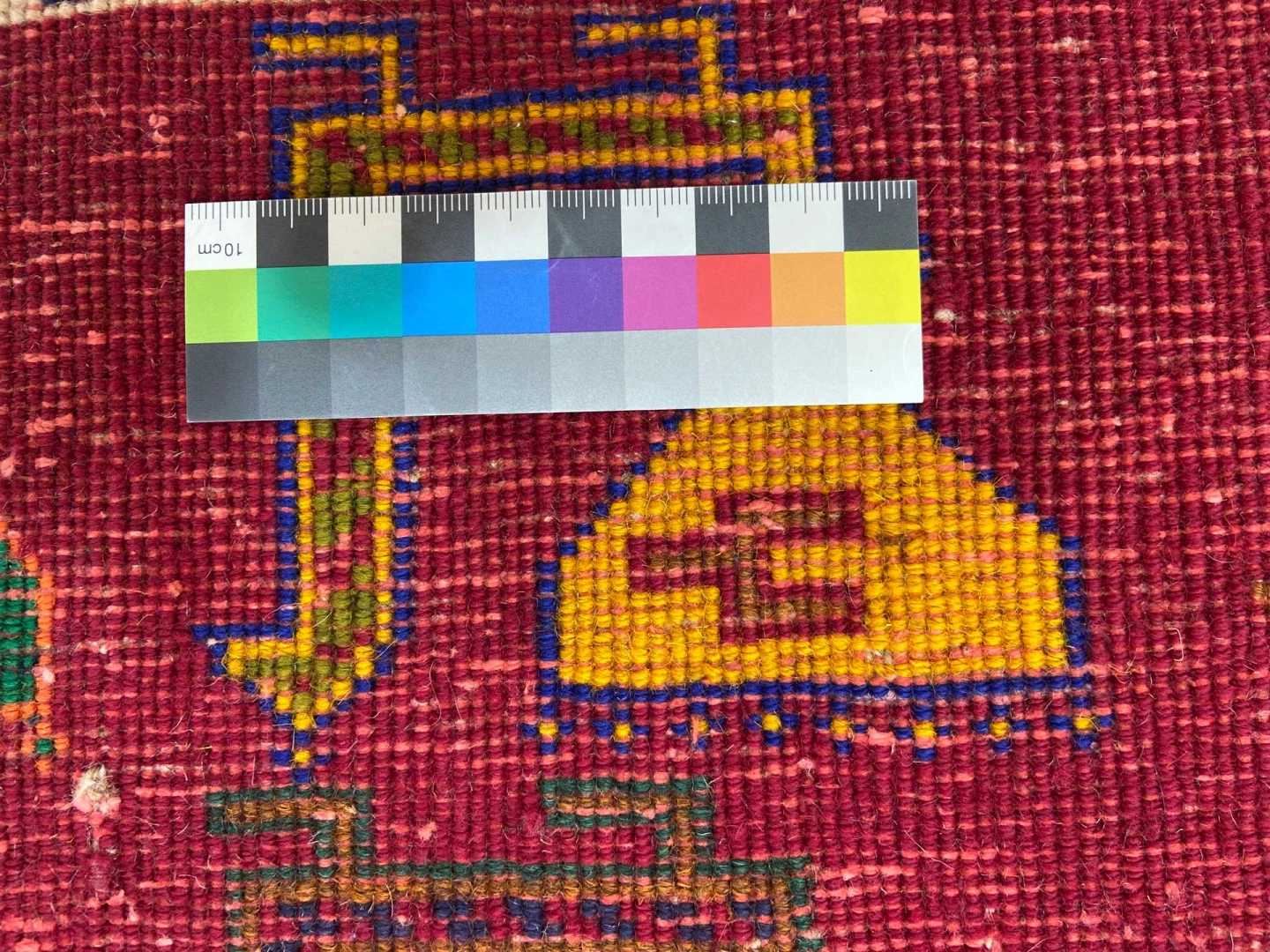
The knot density of this rug is between 180,000 and 250,000 knots per square metre. Knot density is a technical way of describing how many knots occupy a defined area, and it provides a basis for comparing the fineness of knotted work. It is related to the amount of detail that can be represented in a design. In hand-knotted rugs, the regularity of the rows, the experience of the weaver, and the care taken in shaping the outlines also contribute to the visual result.
Natural wool has a long-established place in rug weaving because it can be spun, dyed, and formed into a durable pile. Its tactile structure is part of the characteristic feel of a wool rug. For this individual piece, the documented material is natural wool, the technique is hand-knotting, and the workmanship is described as high quality. Together with the specified knot density, these are the relevant production characteristics.
Origin and Tradition
This rug is associated with the Ghashghai of southern Persia and originates in Fars Province. The Ghashghai are a nomadic community whose textile traditions are closely connected with the landscapes of southern Iran. Their weaving and knotting developed within a culture in which textiles served practical purposes as well as carrying inherited forms of visual expression. Production had to fit a mobile way of life, and knowledge of materials and techniques was maintained within the community.
Fars is a historic rug-producing region in southern Persia. It contains varied landscapes and settlement patterns, and both nomadic and settled approaches to textile making have developed there. The name Ghashghai therefore refers to more than a colour range or a decorative category. It identifies a particular cultural and regional tradition within Persian rug making. The relationship between Fars and the Ghashghai helps explain the importance of strong geometric structures, clearly defined motifs, and an individual approach to execution.
Nomadic rugs from Fars are traditionally made through working methods shaped by practical knowledge and communal experience. Designs may be developed from inherited forms rather than copied from a single industrial template. As a result, rugs within the same tradition can vary in the arrangement, proportions, and interpretation of their ornaments. Such variation is a normal feature of handmade textiles and reflects the way a design is transferred directly into the weaving or knotting process.
Ghashghai rugs form part of a wider group of rug traditions found in Fars. Shiraz rugs are also connected with the region, although they often display less variation in their patterns and frequently have a lower knot density. Qashqai rugs are made by another nomadic people and can likewise feature lively colours and geometric designs, but they are often somewhat simpler in comparison with Ghashghai rugs. These distinctions place the Ghashghai tradition within the broader and varied textile history of Fars.
Rug production in Fars includes household and nomadic practices as well as established workshops. Knowledge of knotting methods, material preparation, and ornamental design is passed on through practice. The regional tradition is consequently not limited to one workshop or one fixed appearance. Its common thread is found in the relationship between origin, craft methods, and a decorative language based on forms that have been maintained and reinterpreted over time.
Design and Pattern
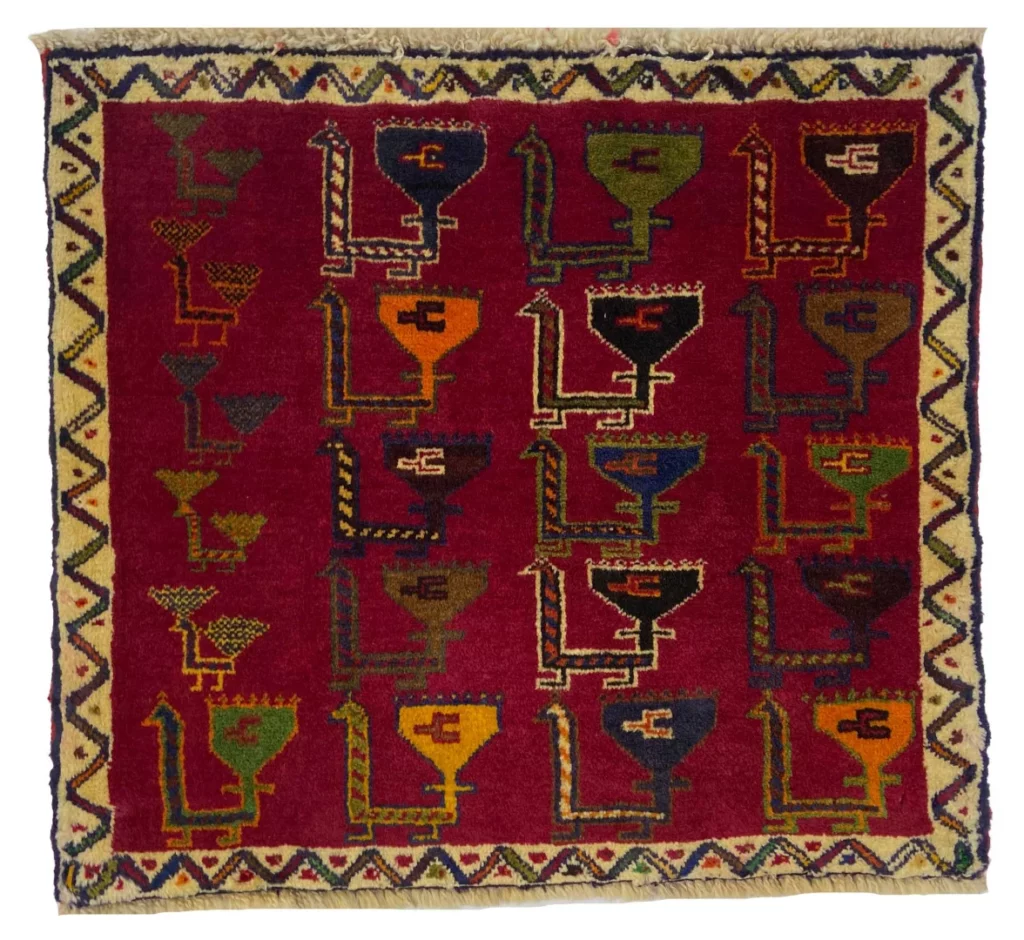
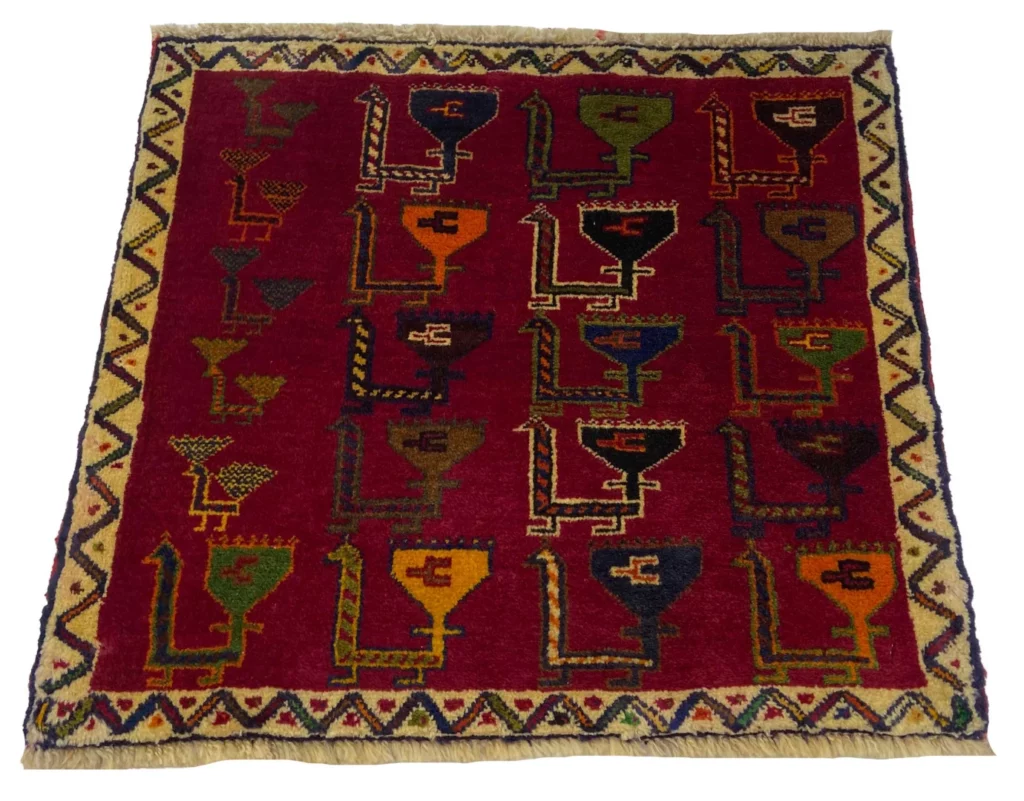
The pattern of this rug is described as geometric ornaments. Geometric design is a significant element of Ghashghai rug tradition. Lines, diamonds, hooked forms, stars, and other stylised signs may be arranged into repeated fields, borders, or central compositions. A design does not need to be perfectly symmetrical to be clearly structured. Its character can come from repeated shapes, firm outlines, and the balance between individual motifs.
In traditional nomadic rug design, motifs are often simplified into recognisable basic forms. A composition can therefore be built from a limited number of strong signs while still creating a complex visual order. Small differences in shape or spacing may occur in handmade work because the design is executed directly during the process. The weaver builds the pattern row by row rather than producing an entirely uniform industrial surface.
Ghashghai rugs are often associated with lively colour effects as well as reds and earthy browns. These colour families are familiar within the traditional design vocabulary of Fars and can set geometric ornaments apart from one another. Red may serve as a dominant ground colour, while brown, darker outlines, and other natural-looking tones help organise the composition. For this individual rug, the documented pattern information is geometric ornaments; the exact distribution of colours should be assessed from the piece itself.
Geometric ornaments can fulfil several compositional roles. A central field may gather the main visual structure, while a border orders the edges and creates a transition toward the surrounding space. Smaller repeated elements can fill intervals and establish a steady rhythm. In nomadic designs, these components are not always placed according to a rigid, mechanically repeated grid. The combination of inherited symbols and individual execution is an important part of the design tradition associated with Fars.
Design and technique are also connected. A higher knot density can generally support finer outlines and a more differentiated rendering of smaller ornaments. The knot density recorded for this rug is between 180,000 and 250,000 knots per square metre, which is relevant to the degree of definition possible in a geometric composition. The pattern remains a visual feature of the rug, while Ghashghai identifies its regional and cultural association rather than naming another provincial origin.
Special Features
The documented features include the association with the Ghashghai of southern Persia, the origin in Fars Province, hand-knotted construction, natural wool, and geometric ornaments. The recorded knot density is between 180,000 and 250,000 knots per square metre. The condition is described through its high-quality workmanship. Together, these details identify the rug through its origin, material, technique, pattern, and stated execution without assigning it to a different rug-producing region.
Ghashghai is an origin and tradition reference connected with the nomadic Ghashghai in Fars. It should be distinguished from a pattern description: geometric ornaments describe the visible design and do not indicate an additional province. Natural wool is a material statement, not a claim about a particular dyeing method, since no specific dyeing process is documented for this rug.
FAQ
How can the quality of a Ghashghai Persian rug be assessed?
Several features are relevant when assessing a Ghashghai Persian rug. Knot density offers a technical indication of the fineness of the construction; for this rug it is between 180,000 and 250,000 knots per square metre. The material should also be considered. The pile of this rug is made from natural wool. The execution of the geometric pattern is another useful point of observation. In hand-knotted rugs, even rows, distinct contours, and careful workmanship are generally important quality criteria. The workmanship of this particular rug is described as high quality.
Where do Ghashghai rugs come from?
Ghashghai rugs come from southern Persia, especially Fars Province. They are associated with the nomadic Ghashghai community, which is known for an independent tradition of geometric designs and hand-made textiles. Fars contains several different rug traditions, so not every rug from the region has the same appearance. In this case, the Ghashghai designation expresses the connection between the region, the community, and the inherited knotting tradition.
What care does a Ghashghai Persian rug require?
A hand-knotted wool rug benefits from regular, gentle vacuuming. The pile should not be subjected to unnecessary mechanical strain during cleaning. For heavier soiling, professional rug cleaning is appropriate because natural wool should be treated by a method suited to the fibre. Strong, direct sunlight can gradually affect colours, so reducing prolonged exposure helps limit that stress. If liquid is spilled, it should be blotted promptly rather than rubbed deeply into the pile. These basic measures support the continued condition of a traditionally made wool rug.
To provide the best experiences, we use technologies like cookies to store and/or access device information. Consenting to these technologies will allow us to process data such as browsing behavior or unique IDs on this site. Not consenting or withdrawing consent, may adversely affect certain features and functions.
Functional Always active
The technical storage or access is strictly necessary for the legitimate purpose of enabling the use of a specific service explicitly requested by the subscriber or user, or for the sole purpose of carrying out the transmission of a communication over an electronic communications network.
Preferences
The technical storage or access is necessary for the legitimate purpose of storing preferences that are not requested by the subscriber or user.
Statistics
The technical storage or access that is used exclusively for statistical purposes.The technical storage or access that is used exclusively for anonymous statistical purposes. Without a subpoena, voluntary compliance on the part of your Internet Service Provider, or additional records from a third party, information stored or retrieved for this purpose alone cannot usually be used to identify you.
Marketing
The technical storage or access is required to create user profiles to send advertising, or to track the user on a website or across several websites for similar marketing purposes.
 SECURE PAYMENT
 SHIPPING PARTNERS