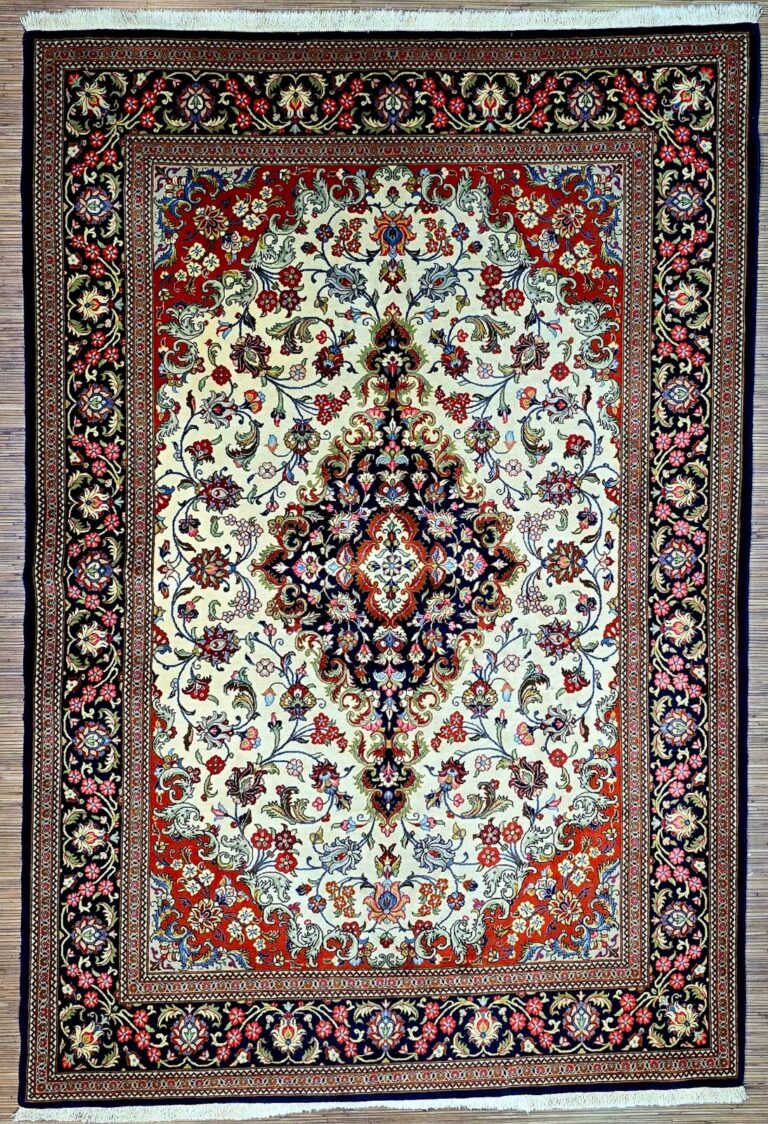
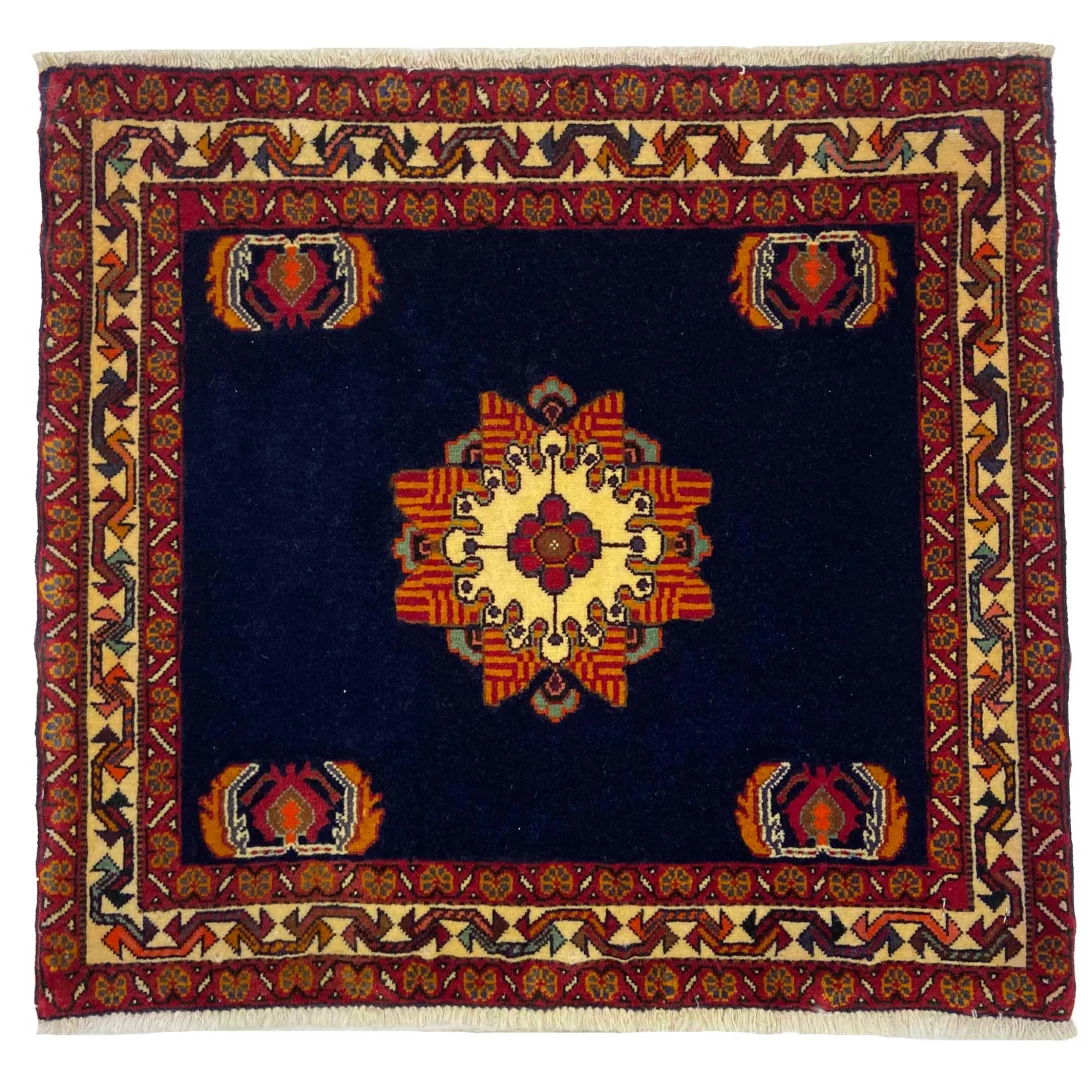
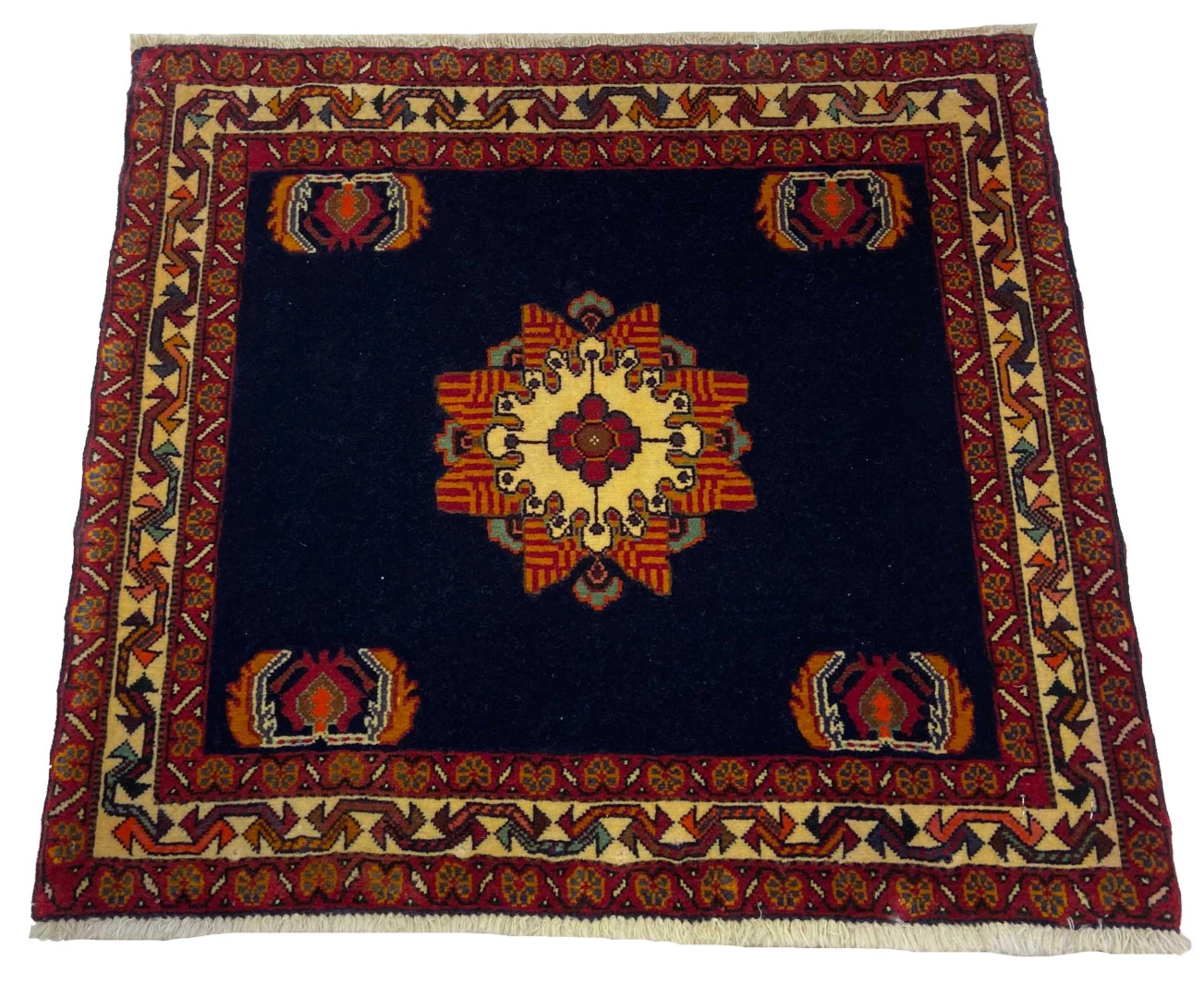
Hand-knotted Fars Persian rug | Knot density: 180,000 – 250,000 knots/m² | Material: pile natural wool | Size: 61 x 66 cm | Pattern: Geometric ornaments | Condition: Very good
This Ghashghai Persian rug is hand-knotted and made of natural wool. Wool forms the pile and is one of the traditional materials used in rug making across southern Persia. In a hand-knotted rug, each knot is inserted by hand into the prepared foundation. The surface is therefore built through the placement of individual knots rather than through a printed design. The technique gives the pattern its textile structure and records the work of the maker in the finished piece.
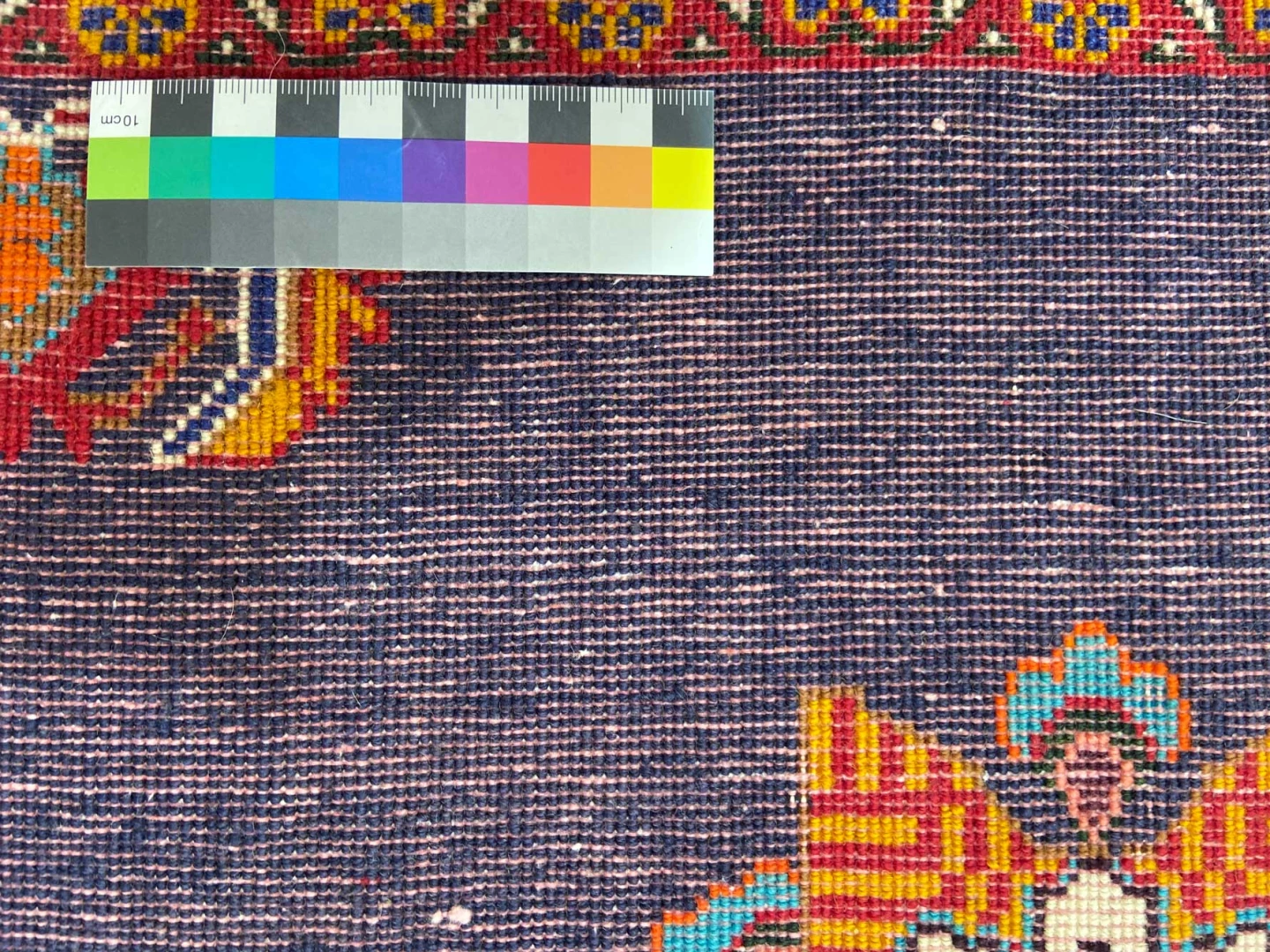
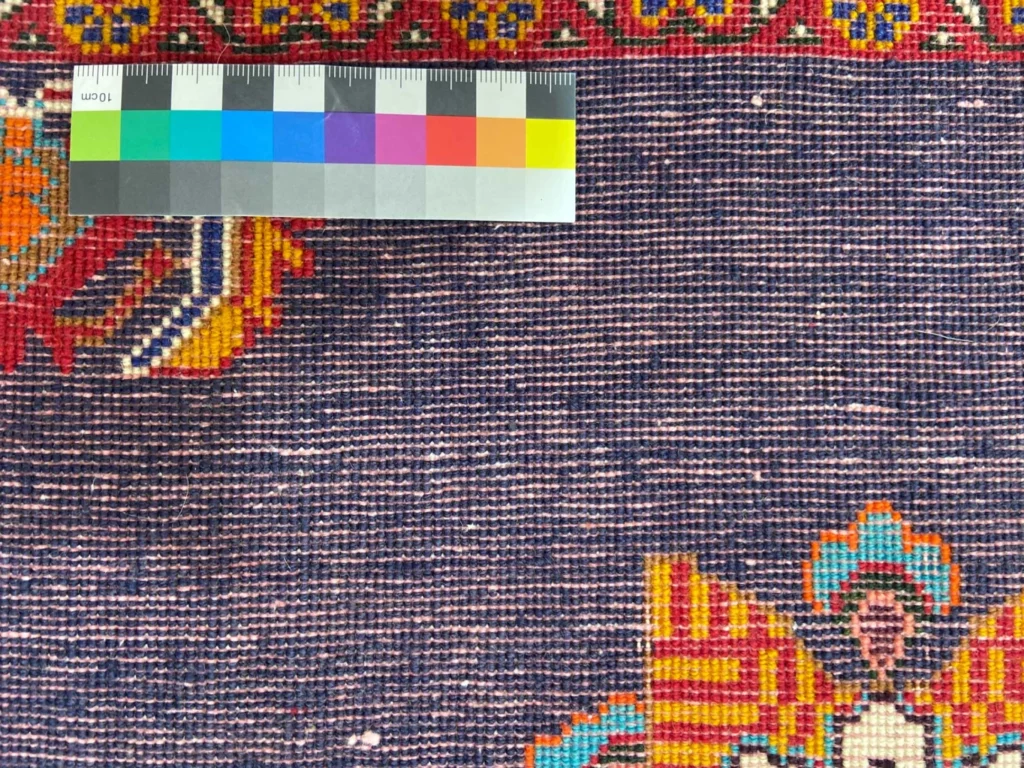
The knot density of this rug is between 180,000 and 250,000 knots per square metre. This density allows ornaments to be separated clearly and smaller geometric elements to be worked with definition. It also indicates a carefully executed form of knotting. In Ghashghai rugs, the technical process is closely connected with a design tradition that grew from the daily life and cultural setting of nomadic communities.
Natural wool is used in oriental rugs because it can be spun, dyed and formed into a practical pile. Preparing the fibre is an important part of traditional rug production, as is the work of tying the knots and organizing the pattern. The relevant material and construction features of this piece are its natural-wool pile, hand-knotted technique and stated knot density. These features describe how the rug is made without adding material claims that are not provided.
Origin and Tradition
This rug comes from Fars in southern Persia. Fars is one of Iran’s historically important rug-producing regions and has long been associated with both settled and nomadic weaving communities. The Ghashghai, also spelled Qashqai, are nomadic tribes from this region. Their textile culture developed in an environment where rugs and other woven objects were connected with movement, domestic life and the transmission of practical knowledge from one generation to the next.
Ghashghai rugs are associated with a distinctive visual language. Their tradition was shaped not only by formal design models, but also by a culture in which motifs, methods and colour knowledge were carried forward through making. The ability to prepare materials, tie knots and arrange ornaments was taught within the community. A Ghashghai rug consequently represents both a regional origin and a nomadic textile tradition.
Fars occupies an important cultural position in the south of Iran. Several forms of rug making developed within and around the province, and these traditions do not all follow the same path. Nomadic work is often recognized for a direct and clearly structured approach to form, while urban workshops may work from more prescribed compositions. This distinction describes the broader history of Persian rug production; it does not claim an additional workshop detail for this individual rug.
The name Ghashghai is significant here because it refers to the tradition of the tribes connected with Fars, rather than merely describing an isolated geometric motif. In rug terminology, a place or group name can sometimes be used for a pattern, but origin and design are not interchangeable. For this rug, the supplied origin is Fars in southern Persia and the supplied attribution is Ghashghai. It can therefore be placed within the Persian weaving culture of southern Iran.
Other Iranian rug traditions developed in nearby or separate regional centres. Shiraz rugs may share geometric features, since patterns can travel between communities and are not always confined to one workshop. Isfahan is widely associated with floral compositions and carefully organized decorative schemes. Tabriz is known for refined knotting traditions and the use of silk. These are distinct regional traditions, however, and their mention does not change this rug’s Ghashghai origin in Fars.
Design and Pattern
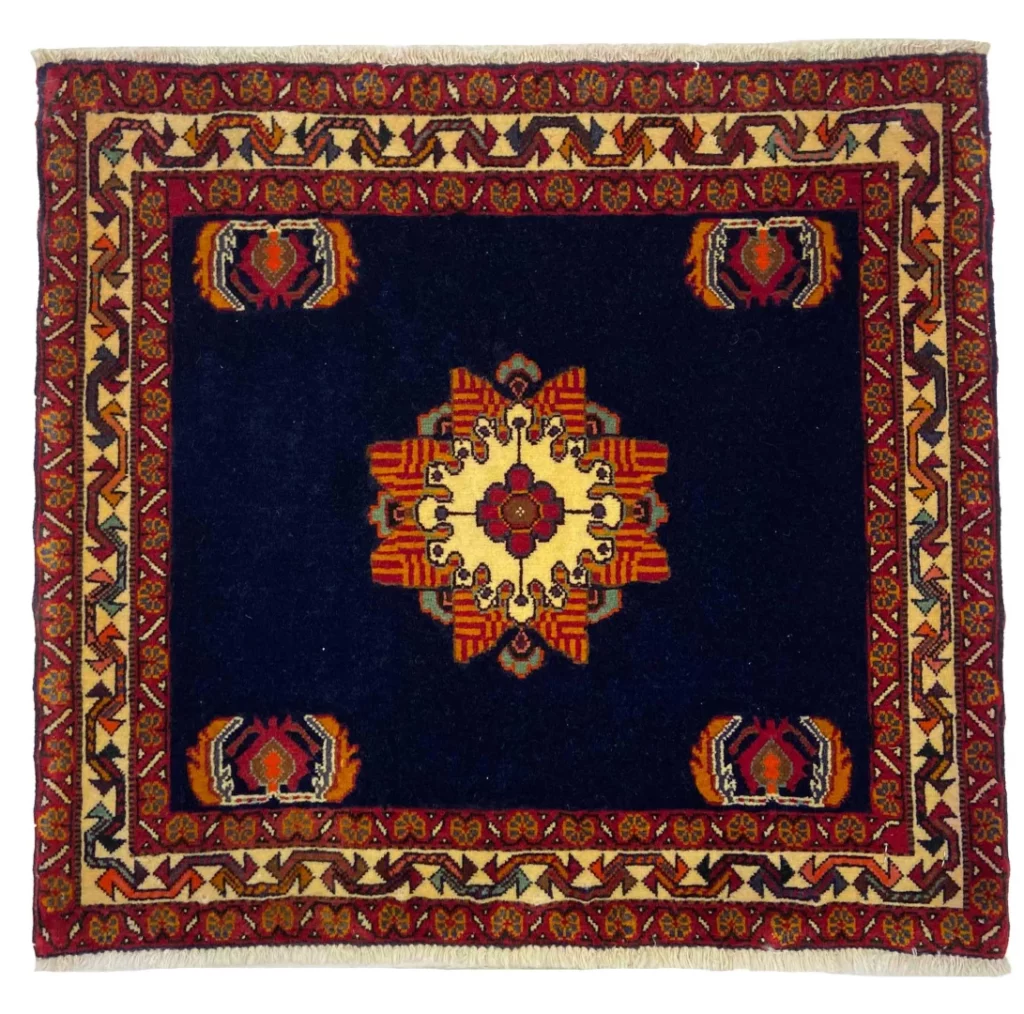
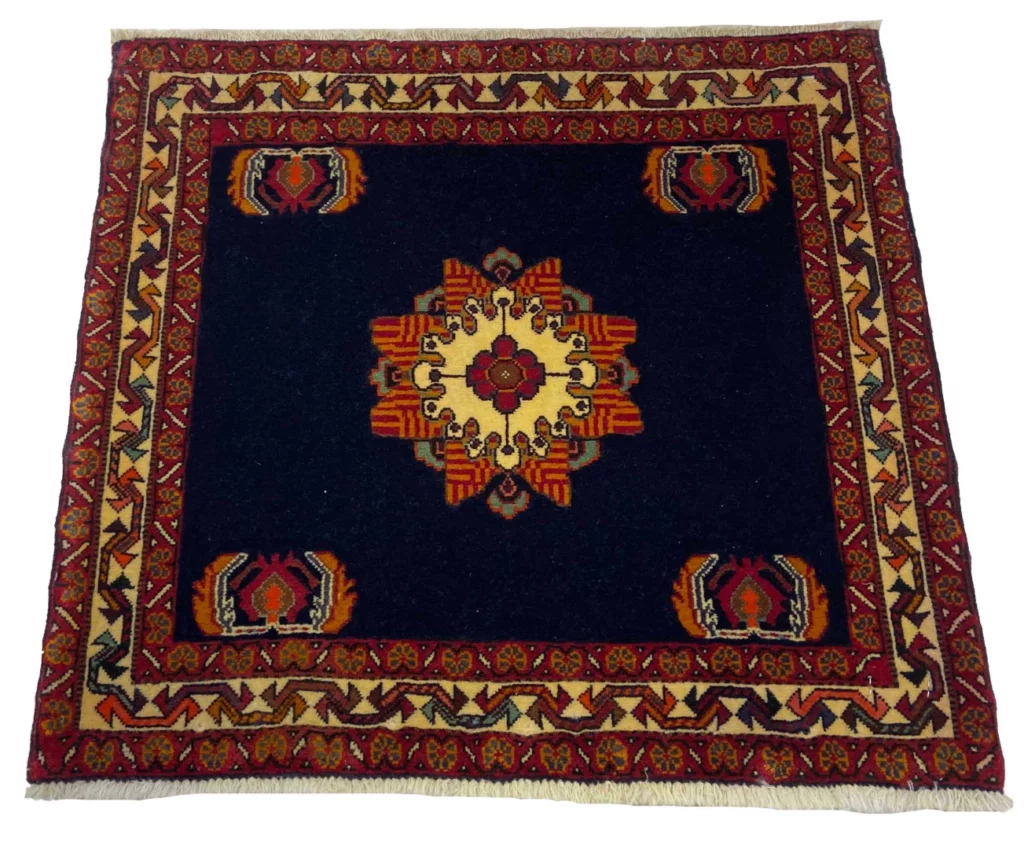
The design of this rug is made up of geometric ornaments. Geometric patterning uses lines, angles, diamonds, repeated fields and other organized forms. Such elements can define a central arrangement, frame the field in a border or appear across the entire surface. In a nomadic design context, these forms often create a strong rhythm, allowing separate signs and motifs to be read as part of one coherent composition.
The Ghashghai design tradition is often connected with nature and nomadic life. These influences do not have to appear as literal pictures. Natural impressions and experiences of everyday life may be reduced to simplified symbols or abstract shapes. The result is a visual language that is both decorative and culturally rooted. Geometry provides order and clarity, while the individual arrangement of the forms gives the composition its particular character.
Red and brown tones are frequently associated with the colour range of Ghashghai rugs. These colours can be combined to divide the field, establish contrast and give the ornaments a distinct outline. Colour in a rug does more than add decoration: it helps distinguish primary motifs from secondary forms and separates borders from the central field. Colour selection is therefore part of the pattern tradition, alongside the shape and repetition of the ornaments.
Geometric designs can be understood through repetition and variation. A basic motif may return in a different scale, be mirrored or be repeated within a border. This creates a measured visual rhythm across the woven surface. Hand-knotting reinforces that structure because every shape is assembled from individual knots rather than reproduced as a printed image. Small changes in the arrangement of forms are part of the character of a hand-made textile.
The pattern tradition of Fars brings function and expression together. Rugs made in nomadic settings were useful objects, but they could also preserve knowledge of motifs and make cultural belonging visible. A geometric ornament is therefore not simply a neutral decoration. Its placement, repetition and colour relationships belong to a regional image language that developed over time and was kept alive through practical textile work.
This Ghashghai design should be distinguished from other Persian styles even where visual similarities occur. Floral compositions associated with Isfahan, the refined pattern traditions of Tabriz and the designs connected with Shiraz each have their own historical setting. For this piece, the decisive design information is geometric ornamentation together with its Fars origin and Ghashghai attribution. A similar shape appearing in another rug would not, by itself, establish the same origin.
Special Features
The defining features of this rug are its Ghashghai attribution, its origin in Fars, its natural-wool material and its hand-knotted construction. The stated knot density is another notable characteristic, allowing the geometric ornaments to be developed with differentiated detail. The condition is described as very good.
Regional origin, nomadic tradition and geometric design come together in this Persian rug. They represent a form of rug culture in which material knowledge, manual work and inherited motifs are closely related. The specific information for this one-off piece is limited to the supplied characteristics: Fars, Ghashghai, natural wool, hand-knotting, geometric ornaments and very good condition.
FAQ
What makes a Ghashghai rug distinctive?
A Ghashghai rug is distinguished by its connection with the nomadic Ghashghai tradition of Fars. Natural wool, hand-knotting and geometric pattern language are commonly associated with this weaving culture. The ornaments may reflect nature and the everyday life of nomadic communities through simplified, abstract forms. In this rug, the supplied features also include its origin in southern Persia and its stated knot density.
How should I care for my Persian rug?
Regular, gentle vacuuming helps prevent dust from remaining in the pile. Direct sunlight should be avoided because prolonged exposure can affect colours over time. If a spill occurs, respond promptly with a damp cloth and a mild cleaning product, taking care not to rub aggressively. When dirt has penetrated more deeply, professional cleaning is the appropriate approach for preserving the textile.
How can I assess the quality of a Persian rug?
The quality of a Persian rug is best assessed through several features together. Knot density, the materials used and the fineness of the knotting technique all provide useful information. The precision of the pattern and the liveliness and stability of the colours are also relevant. For this rug, the supplied details specify natural wool, hand-knotting, a density of 180,000 to 250,000 knots per square metre and very good condition.
To provide the best experiences, we use technologies like cookies to store and/or access device information. Consenting to these technologies will allow us to process data such as browsing behavior or unique IDs on this site. Not consenting or withdrawing consent, may adversely affect certain features and functions.
Functional Always active
The technical storage or access is strictly necessary for the legitimate purpose of enabling the use of a specific service explicitly requested by the subscriber or user, or for the sole purpose of carrying out the transmission of a communication over an electronic communications network.
Preferences
The technical storage or access is necessary for the legitimate purpose of storing preferences that are not requested by the subscriber or user.
Statistics
The technical storage or access that is used exclusively for statistical purposes.The technical storage or access that is used exclusively for anonymous statistical purposes. Without a subpoena, voluntary compliance on the part of your Internet Service Provider, or additional records from a third party, information stored or retrieved for this purpose alone cannot usually be used to identify you.
Marketing
The technical storage or access is required to create user profiles to send advertising, or to track the user on a website or across several websites for similar marketing purposes.
 SECURE PAYMENT
 SHIPPING PARTNERS