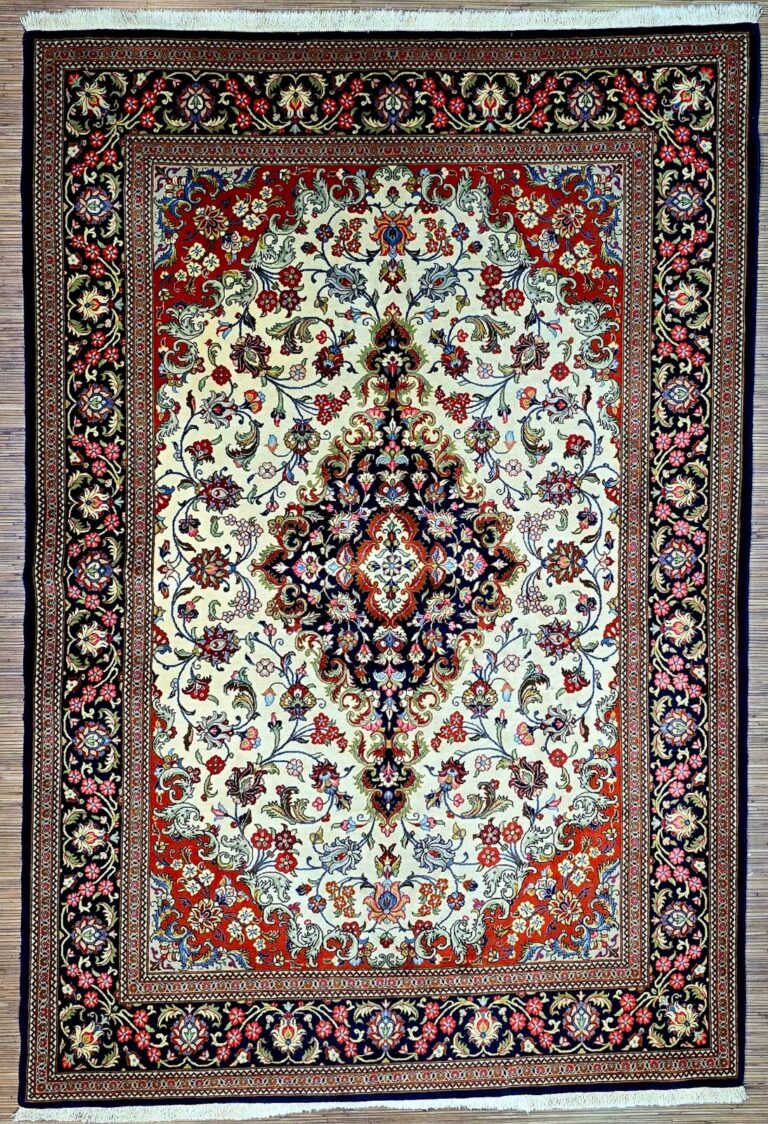
This Ghashghai Persian rug is hand-knotted and made from natural wool. The wool comes from local sheep in the region. The piece therefore combines a traditional natural fibre with a method in which each knot is placed by hand. Its wool surface is described as soft, hard-wearing and easy to care for. These qualities make the rug suitable for living spaces where a comfortable yet resilient floor covering is required.
The rug has a knot density ranging from 180,000 to 250,000 knots per square metre. A density in this range supports clearly defined contours and finer details within a geometric design. In hand-knotting, the pattern is formed by arranging individual knots rather than by applying an industrial print. The completed rug consequently has its own individual character.
High-quality workmanship is a stated feature of this rug. Handcrafted production allows small individual differences in execution and makes the work of the maker visible. Natural wool contributes both to the feel of the surface and to its practical use. The rug thus brings together a traditional craft method and a material suited to everyday interiors.
Regular vacuuming is recommended for care. Spills and marks should be dabbed immediately with a damp cloth rather than rubbed. Professional cleaning at intervals of several years helps preserve the colours and quality. These measures provide appropriate care for a hand-knotted wool rug and help maintain its surface over time.
Origin and Tradition
The rug comes from southern Persia, from Fars Province in Iran. Fars is associated with the Ghashghai people and with a distinct regional carpet tradition. The name Ghashghai therefore identifies the cultural setting of this weaving tradition. As its origin is in Iran, the rug is classified as a Persian rug.
Ghashghai carpets are connected with a craft culture in which textile knowledge has been passed through generations. Knotting is not merely a technical process; it brings together experience with wool, colour and ornament. Regional traditions become visible in the choice of motifs and in the way the field is organised. At the same time, every hand-knotted rug records the individual work of the person who made it.
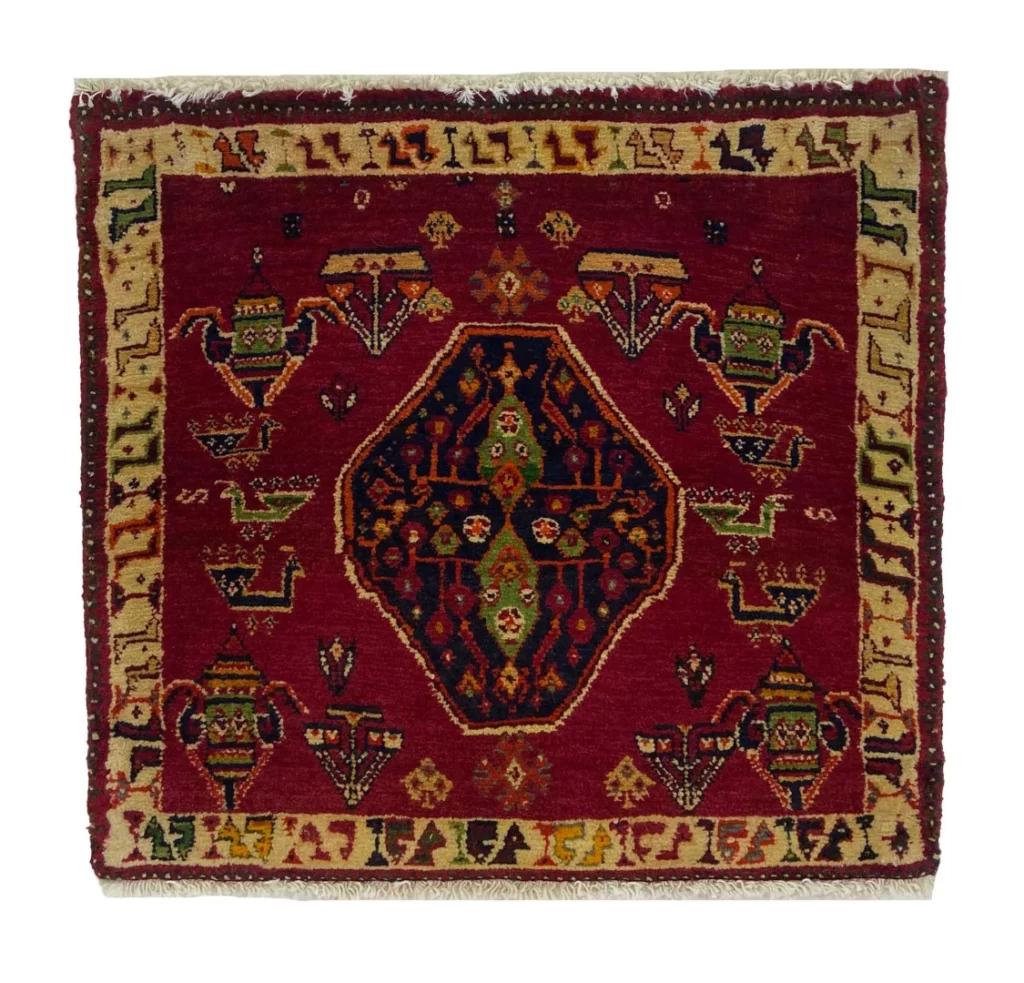
Fars is one of the landscapes of southern Persia with its own textile vocabulary. Ghashghai rugs are commonly associated with distinct geometric compositions and a strong use of colour. These characteristics do not create one rigid template. Instead, they describe a regional tradition capable of producing many different designs. This rug is identified by geometric ornaments and by shades of red and brown.
Persian rugs are produced in many regional forms. Isfahan, for example, is often associated with floral compositions, while Tabriz is frequently linked with fine detail and elegant colour arrangements. Nain is another important Persian carpet tradition. Such place names describe different origins and stylistic contexts. A Ghashghai rug from Fars remains distinct from them, even though all belong to the broader history of Persian carpet weaving.
The transmission of weaving knowledge includes the handling of materials as well as the organisation of a design. Skills in preparing wool, placing knots and arranging motifs are refined within a craft tradition. The individual rug is therefore both a useful textile and a record of regional culture. Its origin in Fars and its Ghashghai attribution provide a clear geographical and historical framework.
Design and Pattern
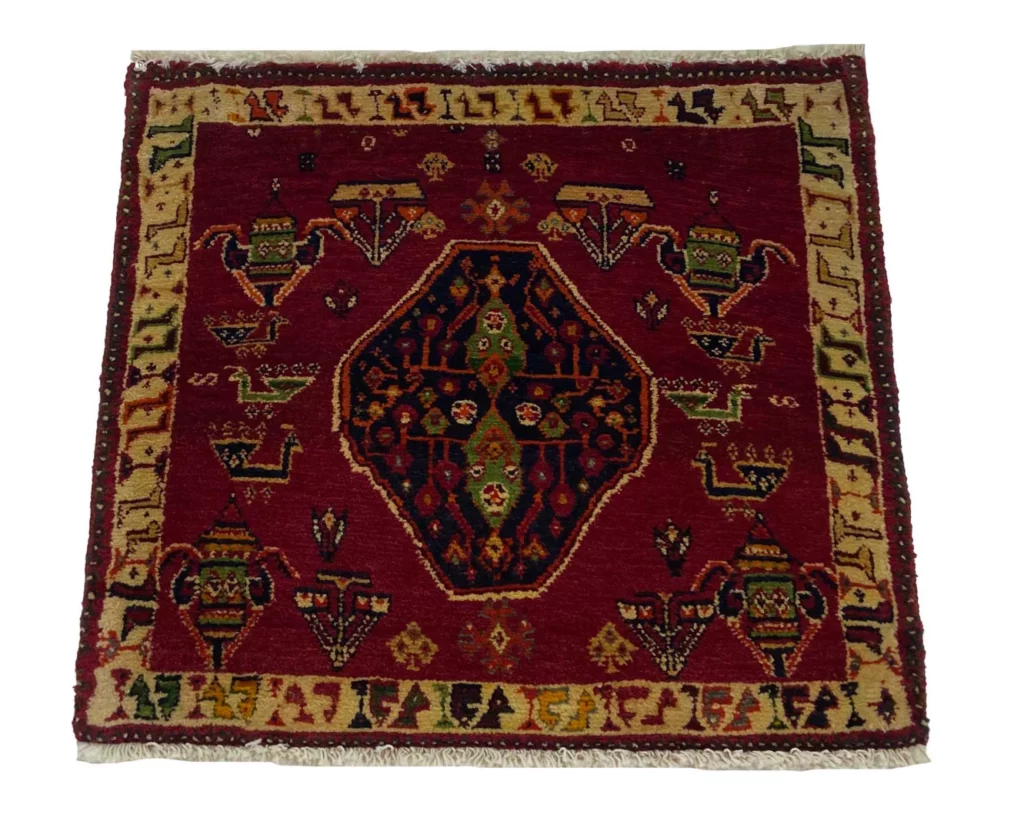
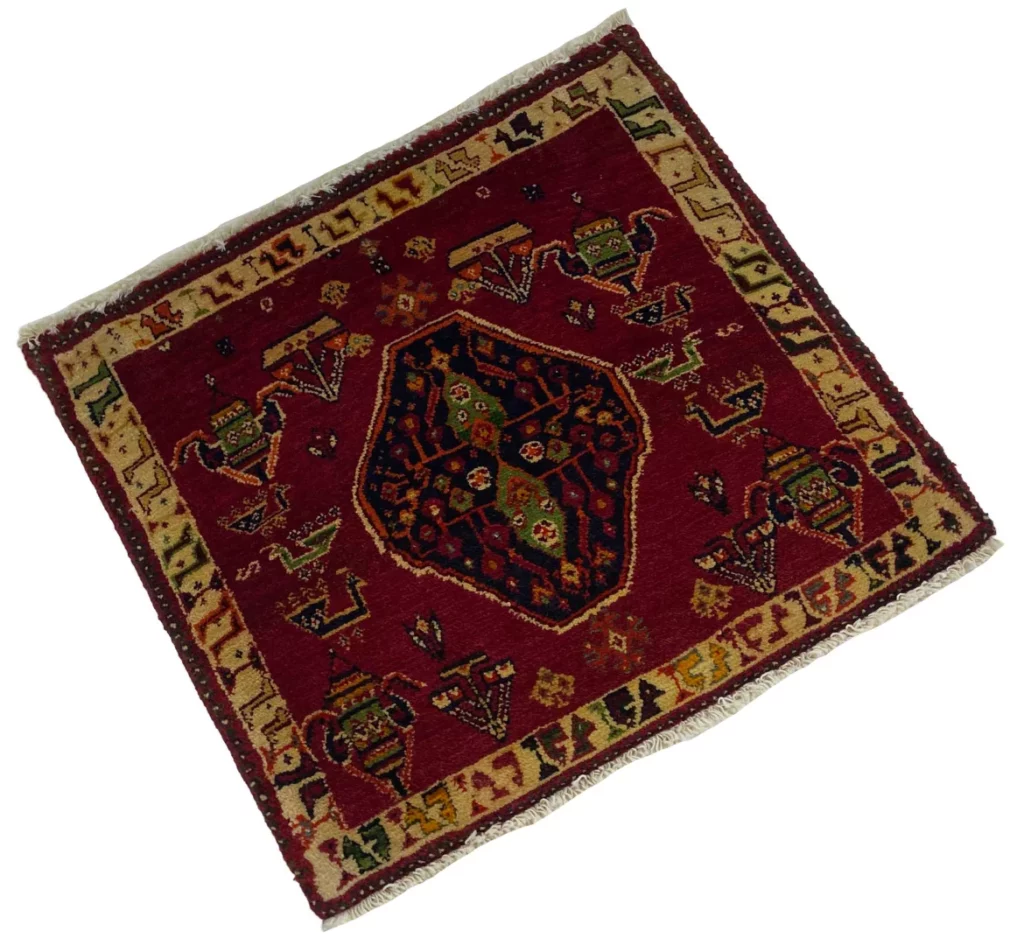
The design of this rug is made up of geometric ornaments. Geometric composition uses lines, angles, fields and repeated forms. This creates a clearly structured surface whose arrangement remains recognisable from a distance. The ornaments give the field definition without relying on floral imagery.
The colour scheme consists of shades of red and brown. In Persian carpet traditions, red may serve as a dominant ground or an accent, while brown brings an earthy, unifying quality. Together these colour areas create a warm and cohesive palette. In the Ghashghai design, the colours work with the geometric ornamentation and reinforce its clearly divided structure.
Geometric patterns are an important part of many nomadic and regional carpet traditions. They may be formed from individual ornaments, rows of repeated shapes or areas arranged around a balanced order. Different relationships between these elements create different visual rhythms and focal points. The effect depends on the relationship between repetition and variation: repeated forms provide order, while hand-knotting gives the image its individual execution.
The high knot density supports the rendering of a differentiated design. Contours can be arranged with greater precision, and smaller elements can remain legible within the overall composition. The result nevertheless remains tied to manual production. Every knot is part of the making process, so the pattern is not an entirely identical machine-produced repetition.
In an interior, geometric ornament can be combined with modern, traditional or rustic styles. The red and brown tones introduce warmth while leaving the rug open to different furnishing concepts. Its clear visual language can act as a structuring accent, while the natural wool adds a tactile textile surface.
Ghashghai rugs are often recognised through the relationship between strong colour and geometric design. Each piece should still be understood as an individual execution. The same regional tradition can produce different sequences of ornaments, proportions and colour relationships. On this rug, the geometric ornaments and the red and brown tones are the defining visible characteristics.
Special Features
The special features of this rug include its origin in Fars in southern Persia, its connection with the Ghashghai tradition, its use of natural wool and its hand-knotted construction. Its high knot density supports the detailed appearance of the geometric pattern. The combination of red and brown tones gives the surface a warm visual effect.
High-quality workmanship and the practical character of the wool surface bring together a handcrafted identity and everyday usability. The rug can be used in living rooms, bedrooms or entrance areas. Its geometric design allows it to work with modern, traditional and rustic interiors. Regular, gentle care, prompt treatment of marks and occasional professional cleaning are recommended to help preserve the wool surface and the quality of the workmanship.
FAQ
What makes a Ghashghai rug special?
A Ghashghai rug is shaped by its connection with Fars Province in southern Persia and with the culture of the Ghashghai people. This example combines natural wool, hand-knotting and a high knot density. Its geometric pattern differs from purely floral designs through its ordered use of lines, angles and recurring ornaments. The red and brown tones provide a warm colour effect. Because every knot is placed by hand, the finished rug has an individual textile character rather than the uniform appearance of a machine-made product.
How should I care for my Persian rug?
The rug should be vacuumed carefully and regularly as part of its routine care. Any liquid or mark should be treated as soon as possible by dabbing with a damp cloth instead of rubbing the wool. This helps handle the surface gently. Professional cleaning every few years is also recommended to support the preservation of the colours and quality. Natural wool should not be exposed unnecessarily to harsh treatment or unsuitable cleaning products. Proper care helps retain the comfortable surface and the quality of the hand-knotted workmanship.
Where can I use a Ghashghai rug?
This Ghashghai rug is suitable for living rooms, bedrooms and entrance areas. In a living room, its geometric ornaments can create a clearly organised textile field. In a bedroom, the natural wool provides a comfortable surface. In an entrance area, the geometric design combines a decorative presence with the stated hard-wearing character. The red and brown palette can be coordinated with modern, traditional or rustic furnishings. Appropriate care remains important so that the wool surface and the quality of the craftsmanship are maintained.
To provide the best experiences, we use technologies like cookies to store and/or access device information. Consenting to these technologies will allow us to process data such as browsing behavior or unique IDs on this site. Not consenting or withdrawing consent, may adversely affect certain features and functions.
Functional Always active
The technical storage or access is strictly necessary for the legitimate purpose of enabling the use of a specific service explicitly requested by the subscriber or user, or for the sole purpose of carrying out the transmission of a communication over an electronic communications network.
Preferences
The technical storage or access is necessary for the legitimate purpose of storing preferences that are not requested by the subscriber or user.
Statistics
The technical storage or access that is used exclusively for statistical purposes.The technical storage or access that is used exclusively for anonymous statistical purposes. Without a subpoena, voluntary compliance on the part of your Internet Service Provider, or additional records from a third party, information stored or retrieved for this purpose alone cannot usually be used to identify you.
Marketing
The technical storage or access is required to create user profiles to send advertising, or to track the user on a website or across several websites for similar marketing purposes.
 SECURE PAYMENT
 SHIPPING PARTNERS