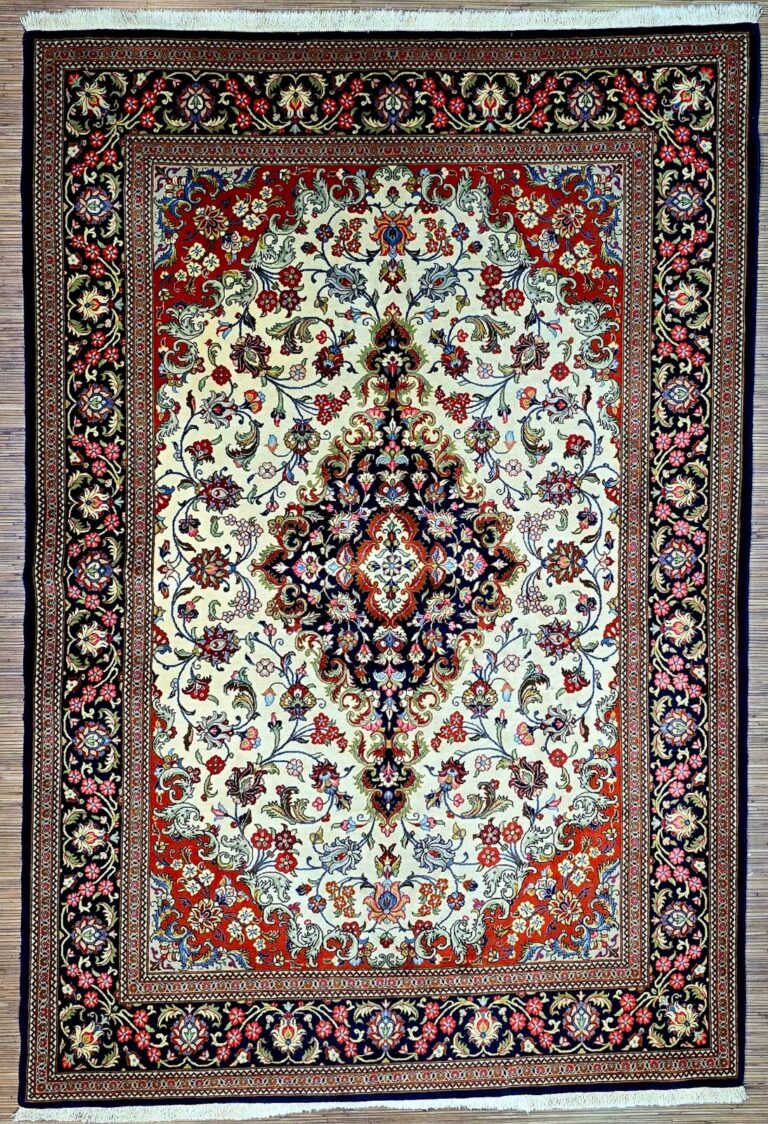
This Ghashghai Persian rug is hand-knotted and made from natural wool. The source description further identifies the wool as pure sheep’s wool. Using this fibre belongs to the established carpet-making traditions of southern Persia. Wool can be spun, dyed and formed into a resilient pile, making it suitable for both detailed drawing and practical floor use. In a hand-knotted rug, individual knots are inserted by hand into the foundation. The pattern therefore develops knot by knot rather than being produced as a mechanically repeated surface.
The stated knot density is 180,000 to 250,000 knots per square metre. This level of density supports a comparatively differentiated rendering of small forms and geometric outlines. It is a technical feature of the construction and stands alongside the material as one of the rug’s defining characteristics. The description associates the high knot count with detail and a hard-wearing execution. The workmanship is described as high quality.
In Ghashghai carpet traditions, wool is valued not only for its pleasant handle. Its natural structure gives the pile a firm surface, while the fibre can absorb colour during dyeing. Traditional preparation often involves working the wool by hand. In the manufacturing context described here, the rug is knotted outdoors and often without a previously fixed plan. This working method combines inherited craft knowledge with the individual character of a handmade one-off piece.
Origin and Tradition
The rug comes from southern Persia, from Fars Province. Fars is one of Iran’s recognised carpet-making regions and is associated with both nomadic and settled ways of life. The name Ghashghai refers to the Ghashghai, a nomadic people of the region. Their rugs belong to a textile tradition in which useful objects also express regional design and practical knowledge. Knotting skills were passed down through generations and are connected with the mobile life of the Ghashghai.
In nomadic textile traditions, production had to rely on available materials and adapt to the conditions of daily life. Wool was a practical fibre because sheep were kept in the region and their fleece could be used for spinning, dyeing and knotting. Making a rug required knowledge of preparing the wool, arranging the foundation and distributing colour. These skills were taught within families and communities. The rug therefore belongs to a regional craft tradition without every piece having to follow one identical, mandatory plan.
Fars is not a single, uniform carpet landscape. Different forms developed in the province and its wider surroundings, varying in structure, colour effect, ornament and knot density. Ghashghai rugs are commonly associated with a lively and distinctive visual language. Their designs may include geometric fields, diamonds, hooked forms, borders and stylised plant motifs. Geometry allows motifs to be arranged clearly on the woven or knotted ground while still leaving room for individual variation.
The region’s history also explains why Ghashghai is more than a decorative label. The name connects a rug with a particular cultural and geographic setting in southern Persia. Shiraz rugs are also known from the broader region and are often associated with colourful patterns and vivid colours. Kerman rugs likewise form part of Persian carpet heritage and are more commonly connected with fine floral designs and high-quality materials. These regional names describe different traditions; they are not interchangeable and are not used here as the origin of this Ghashghai rug.
The production of a hand-knotted rug traditionally demanded time, practice and confident control of the knotting technique. Each section of the design had to be transferred into the growing textile. In a nomadic setting, a weaver could work from familiar examples without copying them in every detail. Small differences and a personal hand are therefore part of the character of many handmade rugs. The origin in Fars and the connection with the Ghashghai provide the cultural framework for this piece.
Design and Pattern
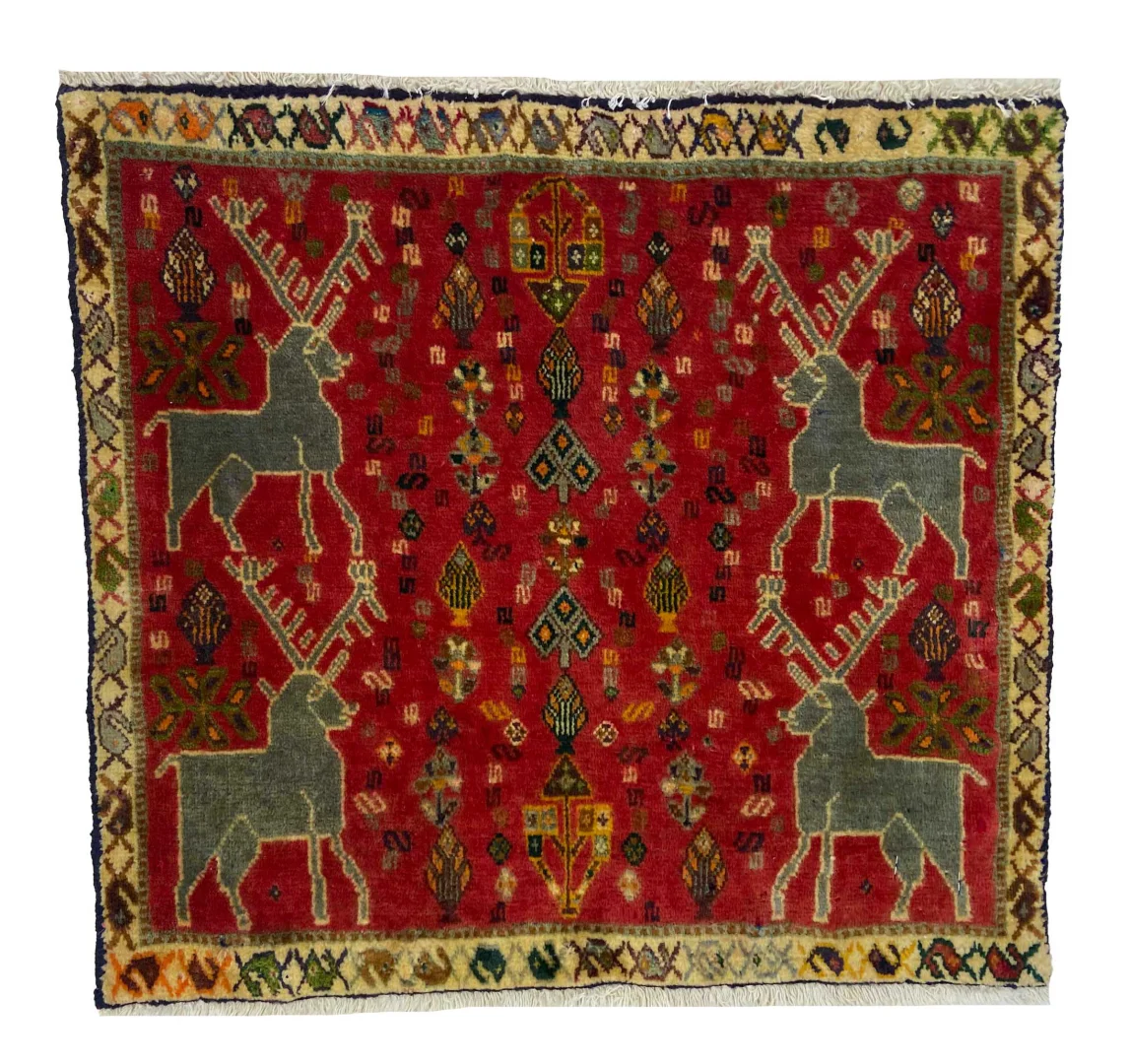
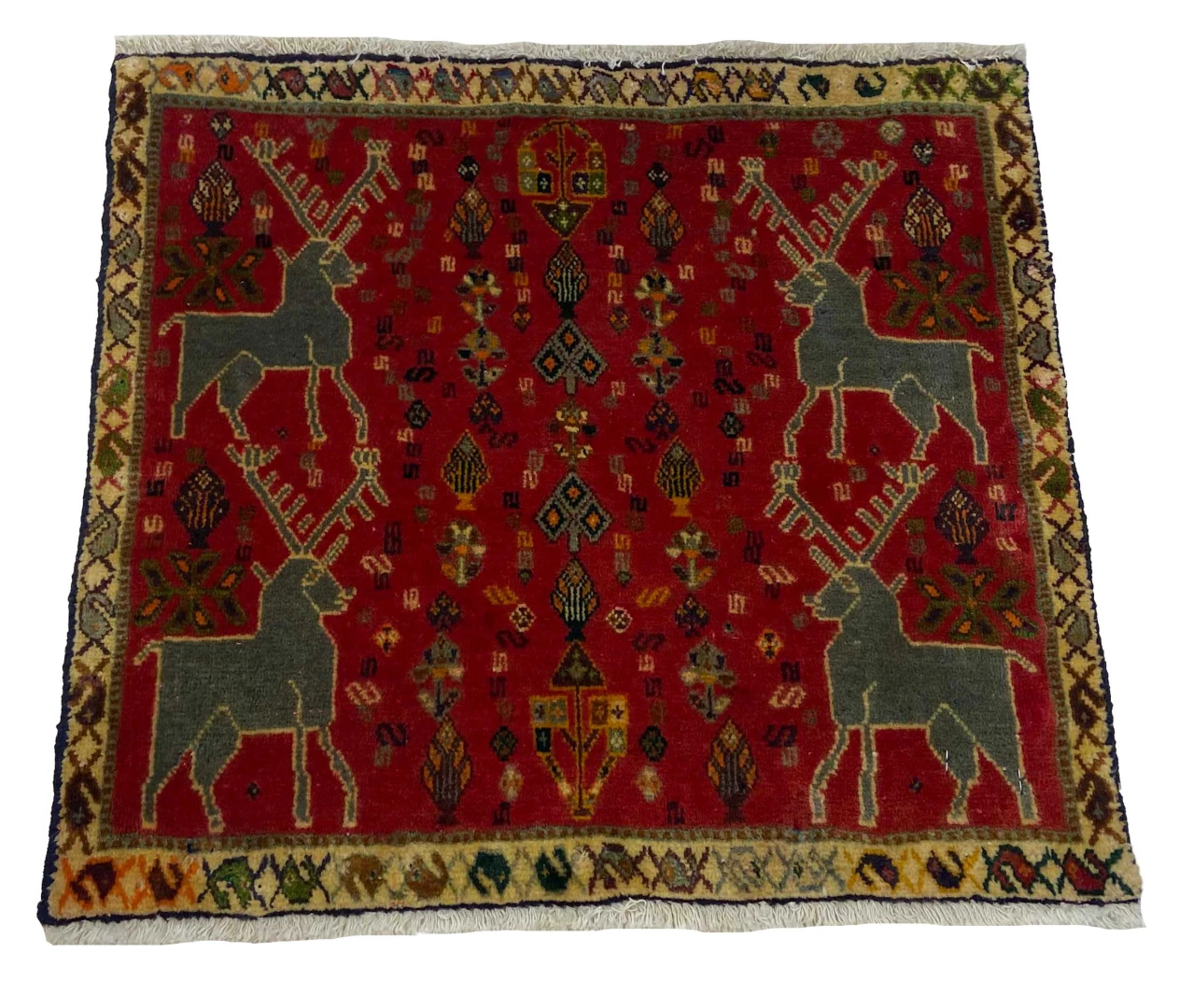
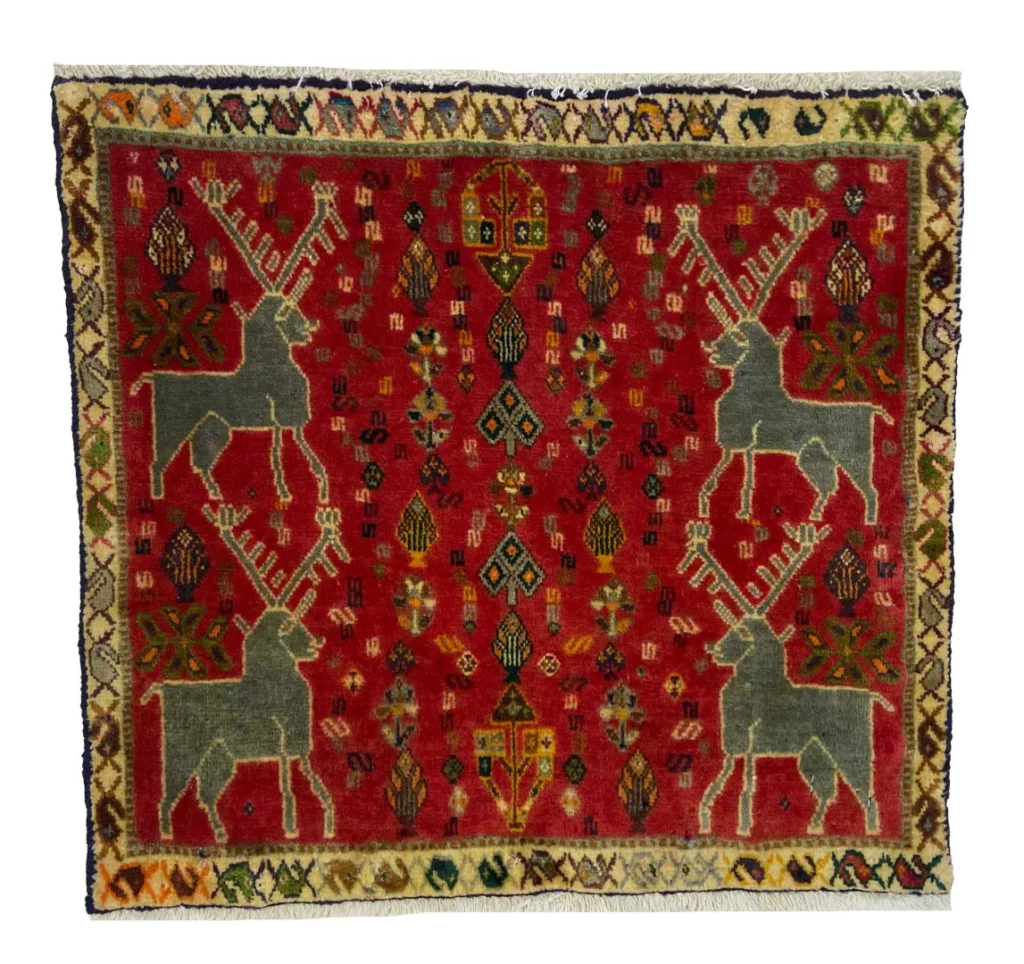
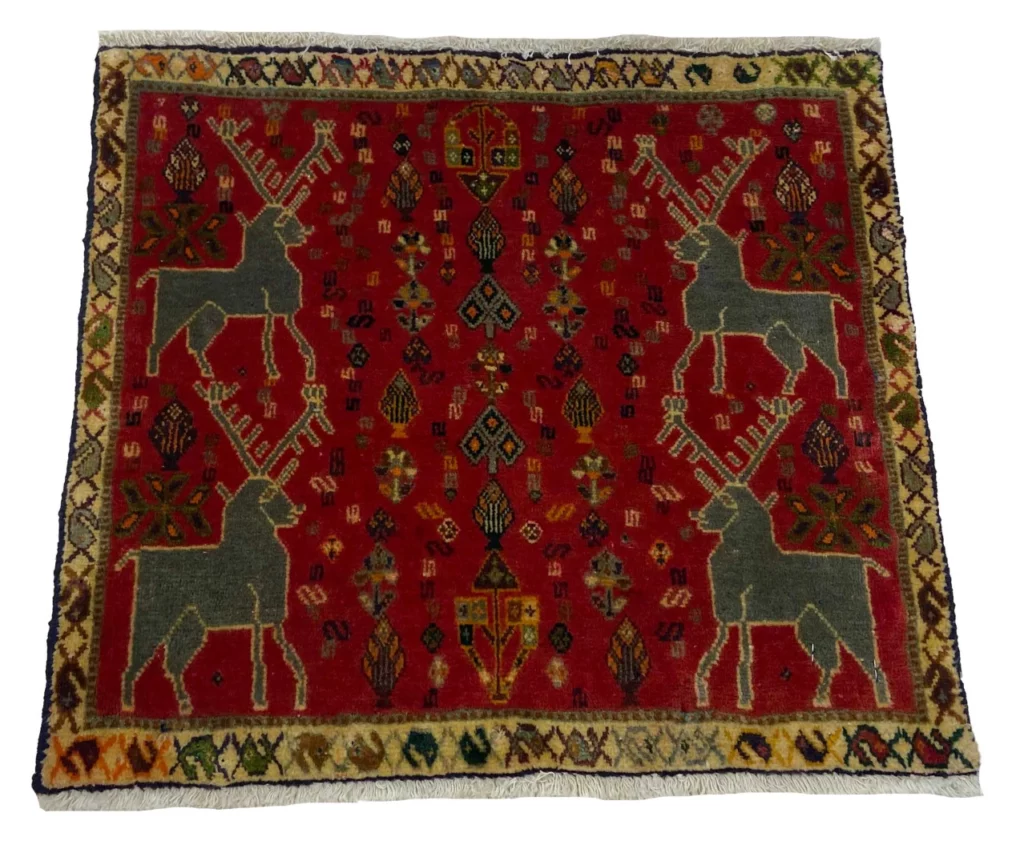
The pattern of this rug consists of geometric ornaments. Geometric design uses clearly defined shapes, repetition and rhythmic arrangement. Diamonds, polygonal fields, stepped lines and hooked forms are among the basic elements frequently found in southern Persian carpet traditions. Such motifs may appear as individual signs, in rows or as parts of a larger repeat. The emphasis is not on a naturalistic image but on the structured translation of a motif into lines and areas of colour.
Ghashghai rugs may organise their pattern around a central field or use a more compact overall composition. A central field is often accompanied by border zones that give the design a visual ending. Borders can be built from repeated ornaments and can reinforce the direction of the composition. Even where a motif is inherited, handwork leaves room for differences in scale, spacing and placement. The geometry is therefore not necessarily rigid; it can take on an individual form within a familiar regional vocabulary.
The lively reds and browns mentioned in the source are associated with the cultural variety and natural surroundings of southern Persia. Red may serve as a principal ground or accent, while brown provides an earthy counterpoint. The effect comes from the relationship between colour fields, outlines and repeated ornaments. Natural dyes are specified for the colouring of the wool. In traditional practice, such dyes may be obtained from plant, mineral or other natural sources, while the exact result depends on the material and the dyeing process.
Geometric ornaments in Persian carpet art are not simply simplified versions of floral images. They can carry signs, memories and regional visual traditions. A motif is often not rendered in perspective or as a literal natural object, but transformed into an abstract form. This allows it to change while remaining recognisable within the tradition. A diamond, for example, may stand alone, form part of a chain or become the centre of a larger ornament. The meaning of an individual sign cannot be established from its geometric shape alone.
The Ghashghai design tradition also reflects the relationship between appearance and use. A rug had to function as a textile while retaining a clear visual order. Repetition could help transmit a pattern during knotting, while free variation made the individual work visible. In a handmade one-off, technical control and personal design therefore operate together. The high stated knot density supports detailed drawing, but it does not turn a geometric handmade design into a mechanically identical pattern.
Unlike Kerman designs, which are often associated with fine floral compositions, this rug places the emphasis on geometric ornaments. Shiraz rugs are likewise described as a distinct regional variant with colourful patterns and vivid colours. The Ghashghai rug nevertheless remains its own classification within the Fars tradition. The regional and cultural name, the geometric ornament and the hand-knotted construction belong together, but they should not be treated as the same design language as that of other Persian carpet regions.
Special Features
The recorded features include an origin in Fars Province in southern Persia, a connection with the Ghashghai, natural wool, hand-knotted construction and a knot density of 180,000 to 250,000 knots per square metre. The pattern is defined by geometric ornaments. The description also mentions lively red and brown tones and natural dyes. The rug is described as having high-quality workmanship and as being resistant to wear. It is therefore presented as suitable for rooms with heavier foot traffic.
Its compact format makes the rug an independent small textile object. Its character comes not only from the ornament but also from the relationship between Fars, Ghashghai tradition, wool and handwork. As with every hand-knotted rug, the combination of these elements produces an individual execution. The size belongs to the product information; the craft discussion centres here on the material, knotting technique and geometric design.
FAQ
How should I care for a Ghashghai Persian rug?
Care begins with regular, gentle vacuuming. For light soiling, the surface can occasionally be treated with a damp cloth. Avoid vigorous rubbing and do not unnecessarily saturate the wool. Direct, strong sunlight should be avoided so that the colours do not fade. For a thorough cleaning, professional rug washing is appropriate because wool and natural dyes require careful treatment.
Where do the materials for a Ghashghai Persian rug come from?
The principal fibre named is natural wool, described as pure sheep’s wool. In connection with Fars, the description notes that this type of wool often comes from local sheep in the region where the Ghashghai live. The fibre is prepared for the pile and then worked by hand. Natural dyes are also specified for colouring. The origin and exact composition of individual dyes can vary with traditional practice; what is established here is the use of natural materials and natural colourants.
How can I recognise an authentic Persian rug?
A hand-knotted Persian rug can be identified in part through its manually made knot structure. The quality of the workmanship, knot density and use of natural materials are also important indicators. This rug is described as hand-knotted, made from natural wool and having 180,000 to 250,000 knots per square metre. An expert examination can additionally assess the execution, foundation, dyeing and pattern tradition. The name Ghashghai refers to the Fars tradition of origin and not to a mechanically produced imitation.
To provide the best experiences, we use technologies like cookies to store and/or access device information. Consenting to these technologies will allow us to process data such as browsing behavior or unique IDs on this site. Not consenting or withdrawing consent, may adversely affect certain features and functions.
Functional Always active
The technical storage or access is strictly necessary for the legitimate purpose of enabling the use of a specific service explicitly requested by the subscriber or user, or for the sole purpose of carrying out the transmission of a communication over an electronic communications network.
Preferences
The technical storage or access is necessary for the legitimate purpose of storing preferences that are not requested by the subscriber or user.
Statistics
The technical storage or access that is used exclusively for statistical purposes.The technical storage or access that is used exclusively for anonymous statistical purposes. Without a subpoena, voluntary compliance on the part of your Internet Service Provider, or additional records from a third party, information stored or retrieved for this purpose alone cannot usually be used to identify you.
Marketing
The technical storage or access is required to create user profiles to send advertising, or to track the user on a website or across several websites for similar marketing purposes.
 SECURE PAYMENT
 SHIPPING PARTNERS