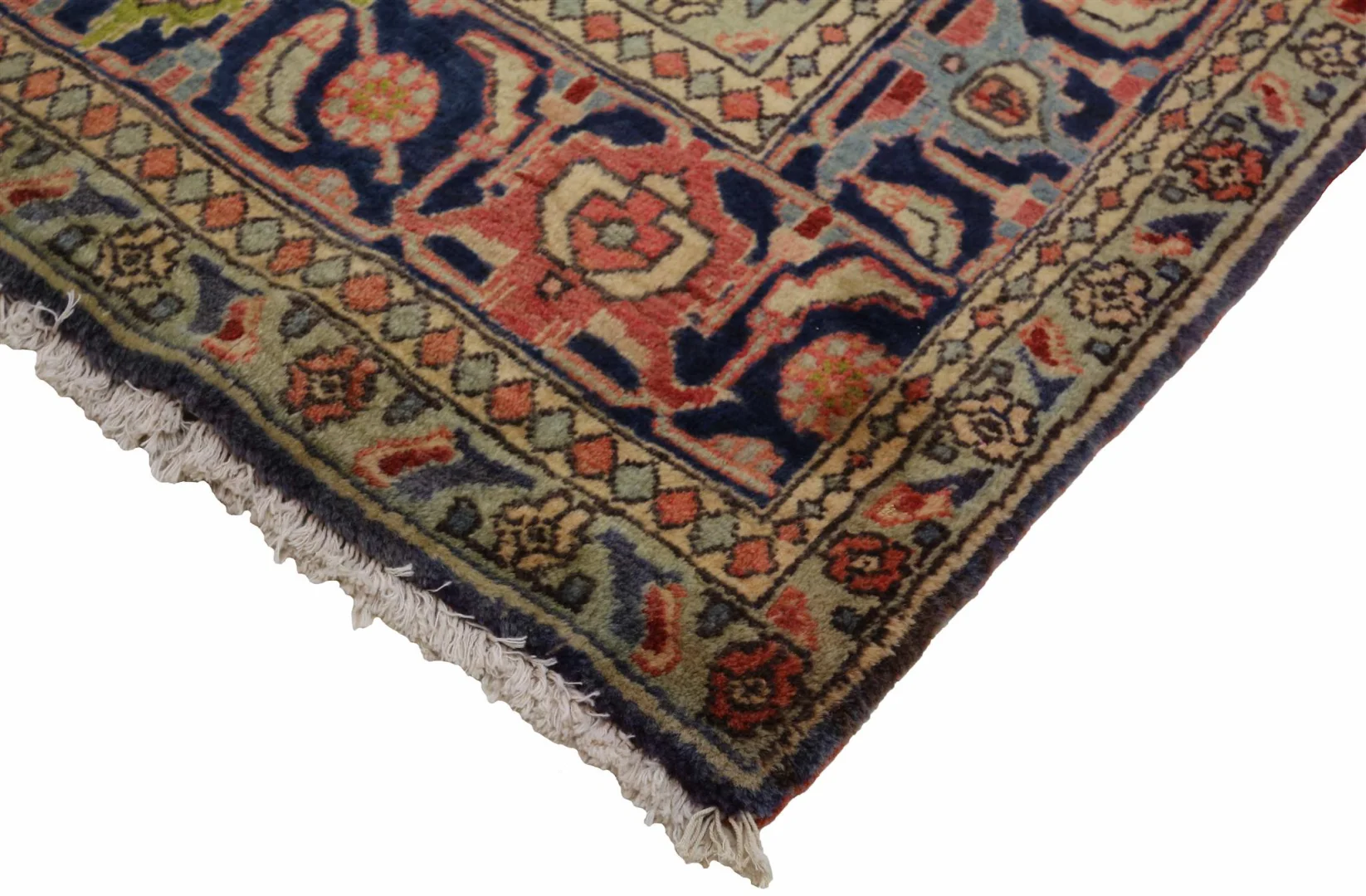
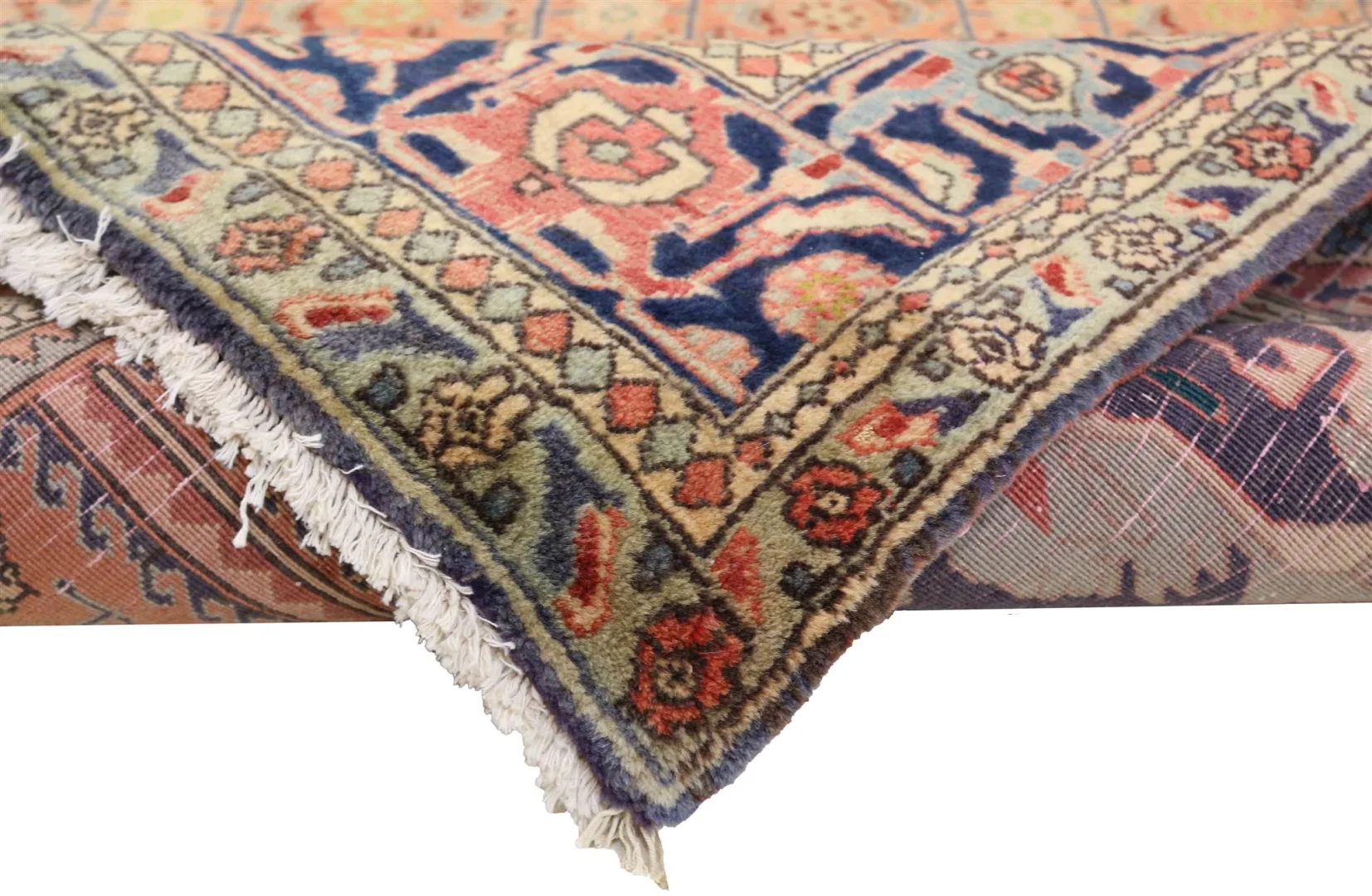
This Bidjar Persian rug has a robust wool pile and is hand-knotted. Wool gives the surface a durable natural fibre structure and has long been used for Oriental rugs because it can be worked into a resilient pile. The material description for this individual rug specifically identifies the wool as robust. Its hand-knotted construction adds the character of a textile made through many individual manual steps rather than through a uniform industrial process.
In hand knotting, each knot is inserted by hand into the foundation, row by row, so that the design gradually takes shape across the rug. The density of this rug is 200,000 to 500,000 knots per square metre. Knot density is an important part of a rug’s construction: it describes how closely the individual knots are placed and helps define the compactness with which the pattern is built. Here, the dense construction accompanies the wool pile and the traditional Bidjar workmanship.
The rug is described as hard-wearing, robust and dirt resistant. These properties make it suitable for areas that receive regular use. Its condition is stated as very good. Together, the wool pile, hand-knotted technique and dense construction describe the material and workmanship of this particular piece without adding details about an unstated foundation, finish or repair history.
Origin and Tradition
This rug comes from Bidjar in Iran. Bidjar is located in western Iran, in the region of Kordestan. The area is known for its rich cultural heritage and for the tradition of its Kurdish population. Carpet making there belongs to a regional textile culture in which practical durability and visual structure are brought together through handwork.
Bidjar rugs are associated with strong construction, resistance to wear and a dense knotting style. Their regional tradition developed forms that can serve a decorative role while remaining suited to everyday use. This connection between appearance and function is an important part of the Bidjar identity. A hand-knotted rug from the area therefore represents both an ornamental design and a method of making in which the structure of the textile matters.
Kordestan is one of the recognised carpet-producing regions of western Iran. Its weaving and knotting traditions include bold colour effects, geometric order and durable materials. Bidjar is one expression of this wider regional culture, with its own established visual language and reputation for resilience. Because every rug is assembled by hand, each example remains an individual object: the placement of knots, the distribution of colour and the small details of the design are not mechanically identical from one piece to another.
Other carpet types from the wider Kordestan region are also known for their own qualities and visual characteristics. Sanandaj rugs are associated with strong colours and geometric patterns. Sarough rugs are often recognised for floral motifs and lively colours. These names describe different traditions and should not be confused with the origin of this rug, which is Bidjar in Iran. They nevertheless show the variety found among the carpets of the region.
Tabriz is another important centre of Persian carpet production. Tabriz rugs are known for fine knotting techniques and artistic designs, often using intricate patterns and a varied palette. Bidjar and Tabriz therefore represent different regional expressions within Persian rug making. Their shared emphasis on skilled craftsmanship does not erase the distinction between their origins, patterns or construction traditions.
The history of Bidjar carpet making is consequently best understood through both place and practice. The place is Bidjar, in Kordestan, Iran. The practice is hand knotting with a dense, robust wool pile. The result is a tradition in which a clear regional identity is expressed through durable materials, a compact textile structure and designs that can range from geometric medallions to floral or all-over compositions.
Design and Pattern
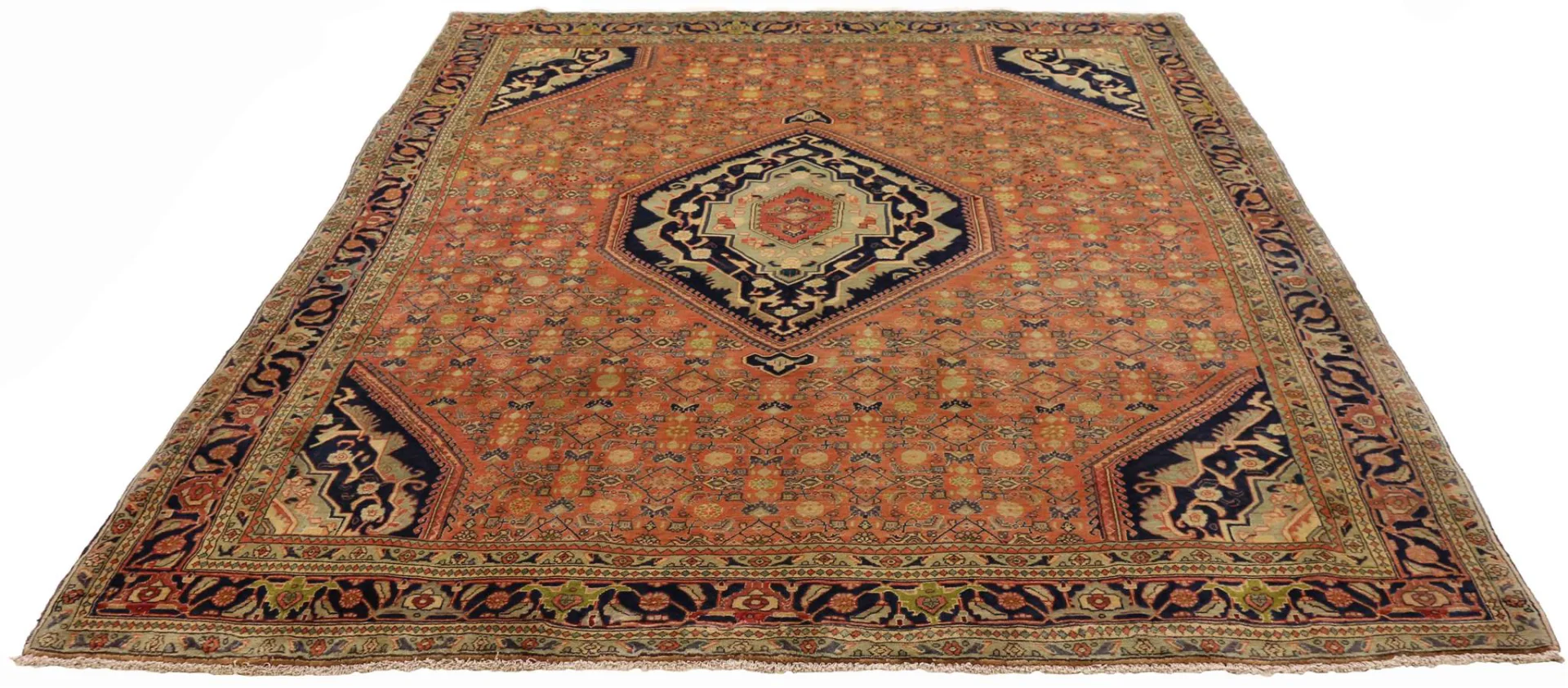
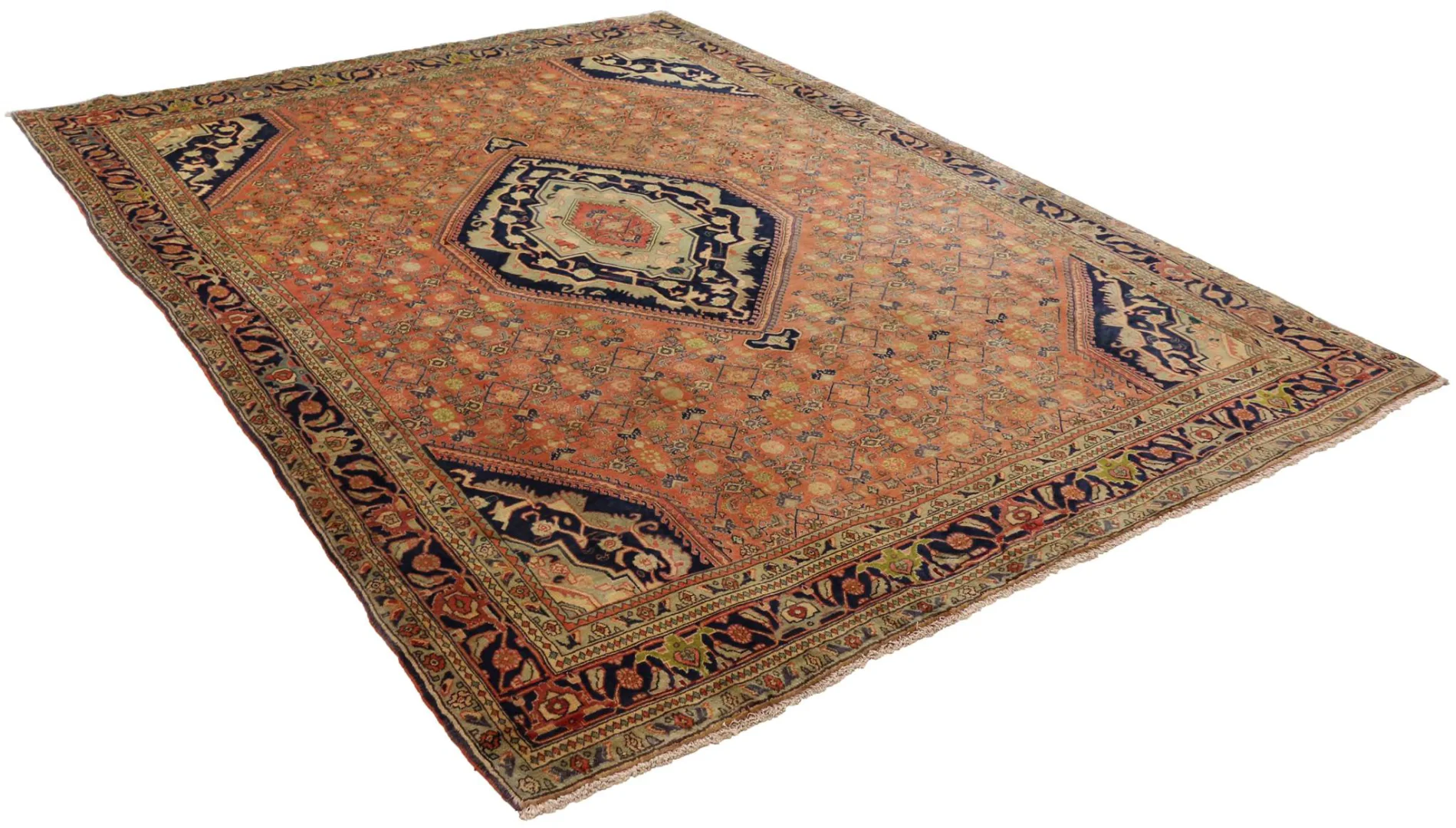
The pattern of this individual rug is described as a diamond-shaped medallion. A medallion organises the composition around a central form, while the diamond gives that centre a distinct angular outline. The eye is guided towards the middle, and the surrounding arrangement is read in relation to this central shape. This creates a design with a clear visual order rather than an entirely dispersed field.
Diamond medallions are a notable geometric device in Persian rug design. Their effect comes from balance, symmetry and the repetition of lines and planes. In a hand-knotted rug, the outline is not drawn as a single continuous machine-made mark. It is built knot by knot, with many small coloured units joining to form the larger diamond. The density of the knotting allows the design to be constructed as a coherent textile surface.
The diamond medallion has been popular in Bidjar rugs since the 1970s. This describes the motif’s place within the development of Bidjar design. Bidjar rugs are also made with floral ornaments and all-over patterns, demonstrating that the regional tradition is not limited to one composition. Floral designs introduce scrolling or botanical forms, while all-over designs distribute ornament across the field instead of concentrating the main emphasis in a single centre.
Traditional Bidjar colour schemes are primarily connected with warm reds and earthy browns. These colours give geometric designs a grounded and clearly structured appearance. Red can emphasise the central ornament, while brown tones provide an earthy counterpoint within the overall palette. The colour tradition is part of the visual identity of Bidjar rugs and works naturally with a diamond medallion whose contours depend on distinct areas of colour.
Geometric and floral approaches can be understood as two related ways of organising ornament. Geometry relies on proportion, repeated angles and a legible central structure. Floral ornament relies more strongly on plant forms and curving decoration. An all-over design creates continuity by repeating motifs across the field. The range of these approaches reflects the creativity of the region’s carpet makers, while the design of this rug remains specifically identified as a diamond-shaped medallion.
The colour and pattern information for this rug therefore belongs together: it has a diamond-shaped medallion and the warm red and earthy brown tones associated with Bidjar tradition. No additional border, field ornament or floral detail is specified for this piece. The design can be described clearly through its central geometric motif and its regional colour language without assigning it features that are not stated.
Special Features
This rug combines several stated characteristics: a robust wool pile, hand-knotted construction, a dense knot structure, hard-wearing quality and dirt resistance. It is in very good condition. These features make the rug suitable for frequently used rooms such as living areas, dining spaces or hallways. The practical qualities are part of its description alongside the diamond medallion and its Bidjar origin.
Wool is also a good temperature insulator, so Bidjar rugs can be used in rooms with underfloor heating. The warmth can be distributed evenly without damaging the rug. For care, regular vacuuming without a brush attachment is recommended. Spills should be dabbed promptly with a damp cloth, and professional cleaning is recommended when the rug is heavily soiled.
FAQ
How should I care for my Bidjar Persian rug?
Vacuum the rug regularly without using a brush attachment. This removes loose dirt while avoiding unnecessary mechanical treatment of the wool pile. Spills should be wiped promptly with a damp cloth. Treating a mark quickly helps prevent it from settling into the pile; avoid more vigorous rubbing than necessary. If the rug is heavily soiled, professional cleaning is recommended. The rug is described as dirt resistant, but that property does not replace timely care or suitable cleaning when a deeper soiling occurs.
Which colours are typical of Bidjar Persian rugs?
Bidjar rugs are traditionally associated mainly with warm reds and earthy browns. This palette supports the strong, grounded character of the region’s designs and works particularly well with geometric compositions. On a diamond medallion, contrasting areas of red and brown can help define the central form. These colours are also described as dirt resistant, which can make everyday maintenance easier. Bidjar designs may also use floral ornaments or all-over arrangements, but this rug is identified by its diamond medallion.
Are Bidjar rugs suitable for underfloor heating?
Yes. Bidjar rugs can be used in rooms with underfloor heating. Wool is a good temperature insulator and allows the warmth to be distributed evenly without damaging the rug. Regular care remains advisable so that dust and dirt do not remain in the pile over time. The suitability described here is connected with the wool material and applies alongside the rug’s stated robust and hard-wearing qualities.
To provide the best experiences, we use technologies like cookies to store and/or access device information. Consenting to these technologies will allow us to process data such as browsing behavior or unique IDs on this site. Not consenting or withdrawing consent, may adversely affect certain features and functions.
Functional Always active
The technical storage or access is strictly necessary for the legitimate purpose of enabling the use of a specific service explicitly requested by the subscriber or user, or for the sole purpose of carrying out the transmission of a communication over an electronic communications network.
Preferences
The technical storage or access is necessary for the legitimate purpose of storing preferences that are not requested by the subscriber or user.
Statistics
The technical storage or access that is used exclusively for statistical purposes.The technical storage or access that is used exclusively for anonymous statistical purposes. Without a subpoena, voluntary compliance on the part of your Internet Service Provider, or additional records from a third party, information stored or retrieved for this purpose alone cannot usually be used to identify you.
Marketing
The technical storage or access is required to create user profiles to send advertising, or to track the user on a website or across several websites for similar marketing purposes.

 SECURE PAYMENT
 SHIPPING PARTNERS


