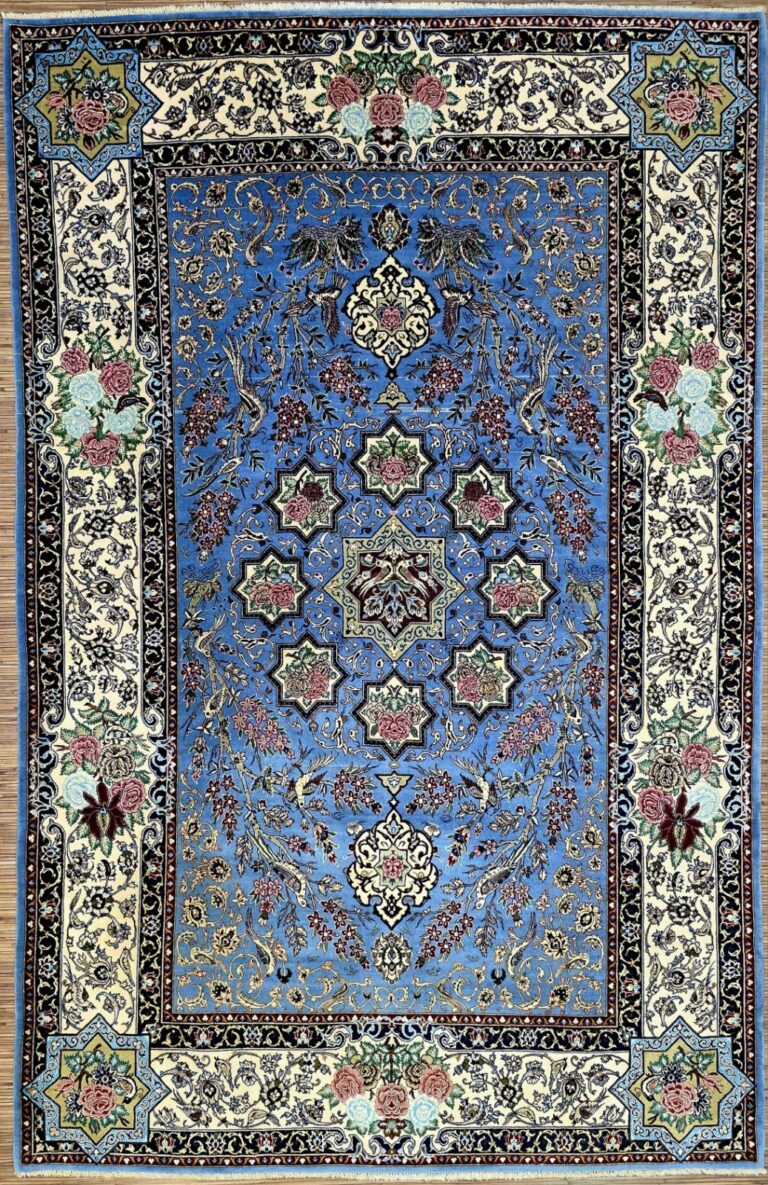
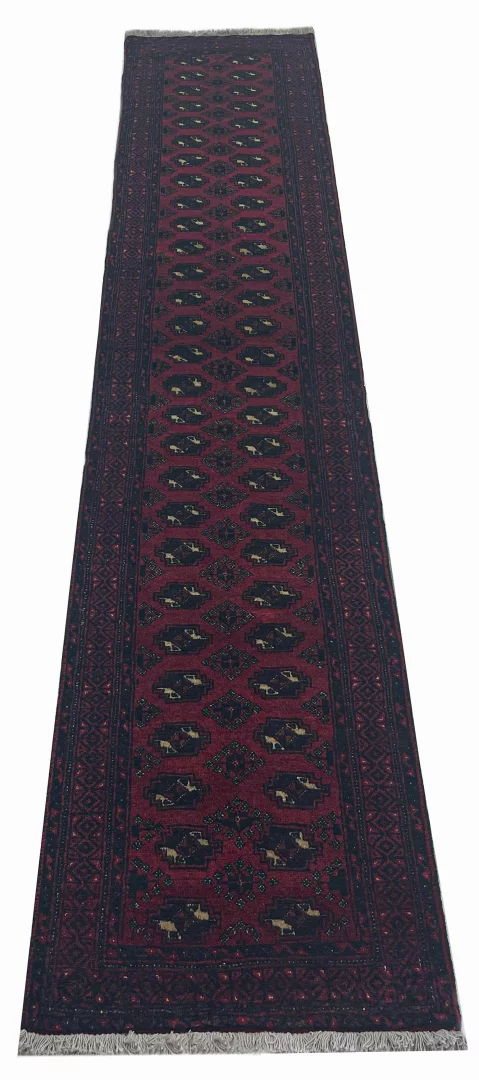
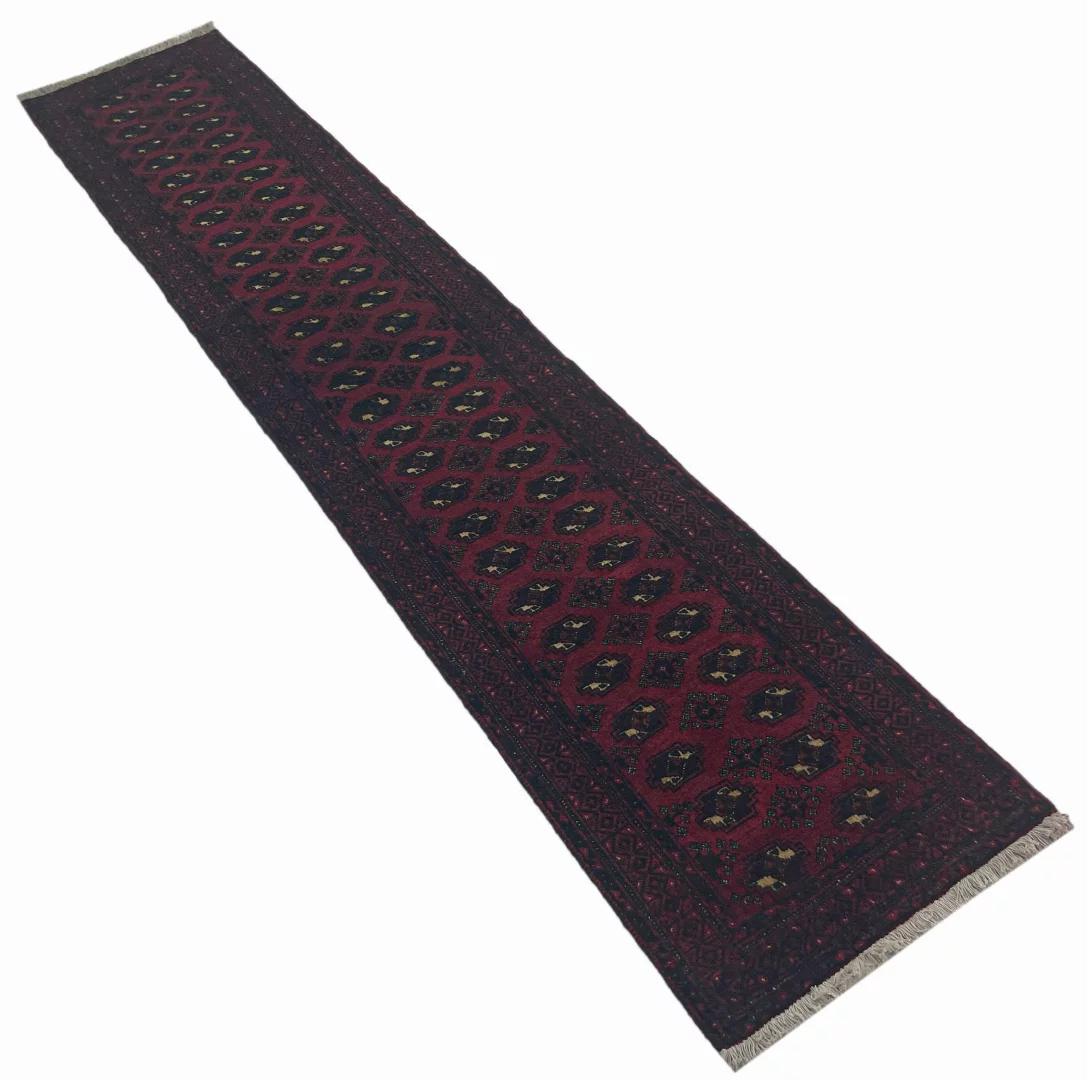
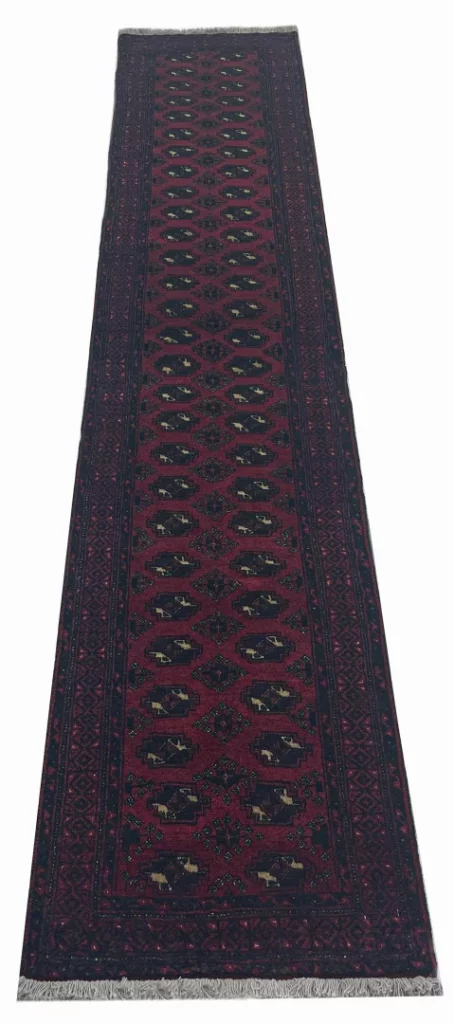
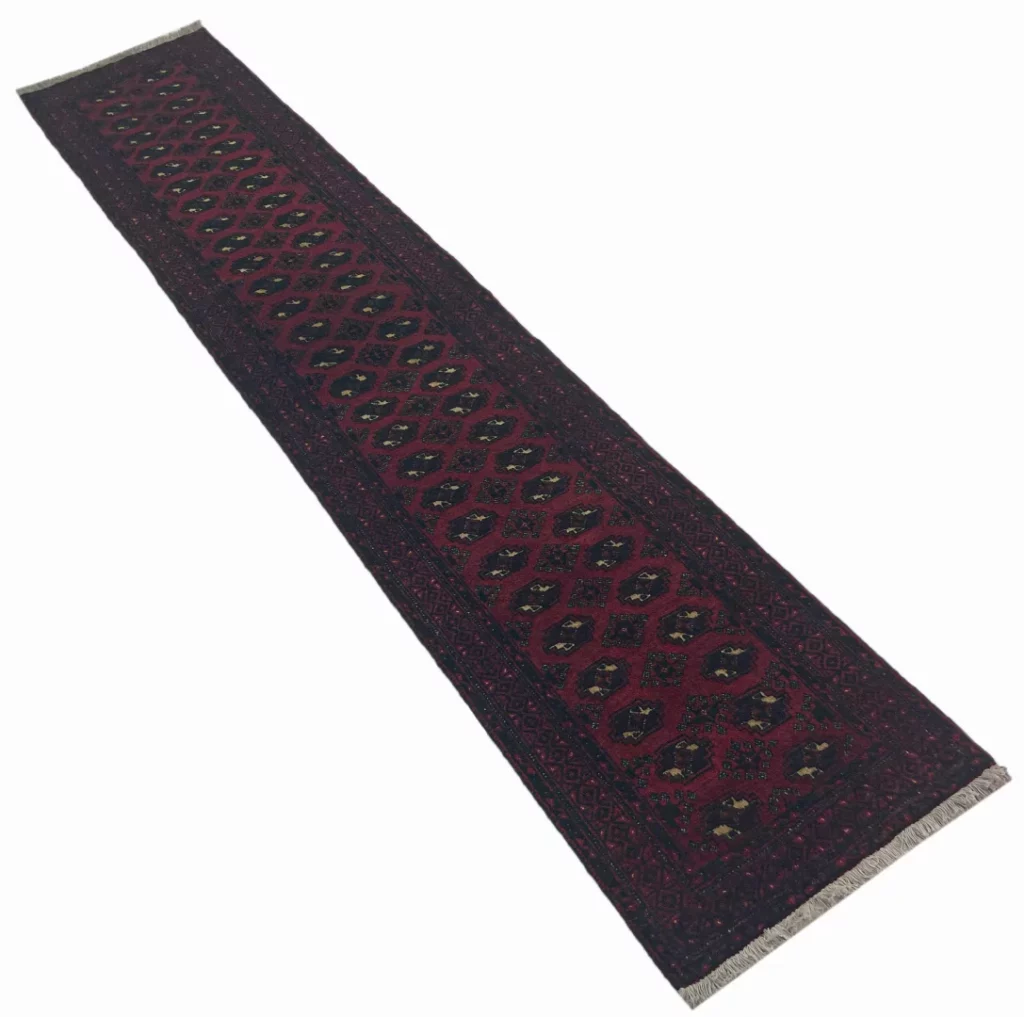
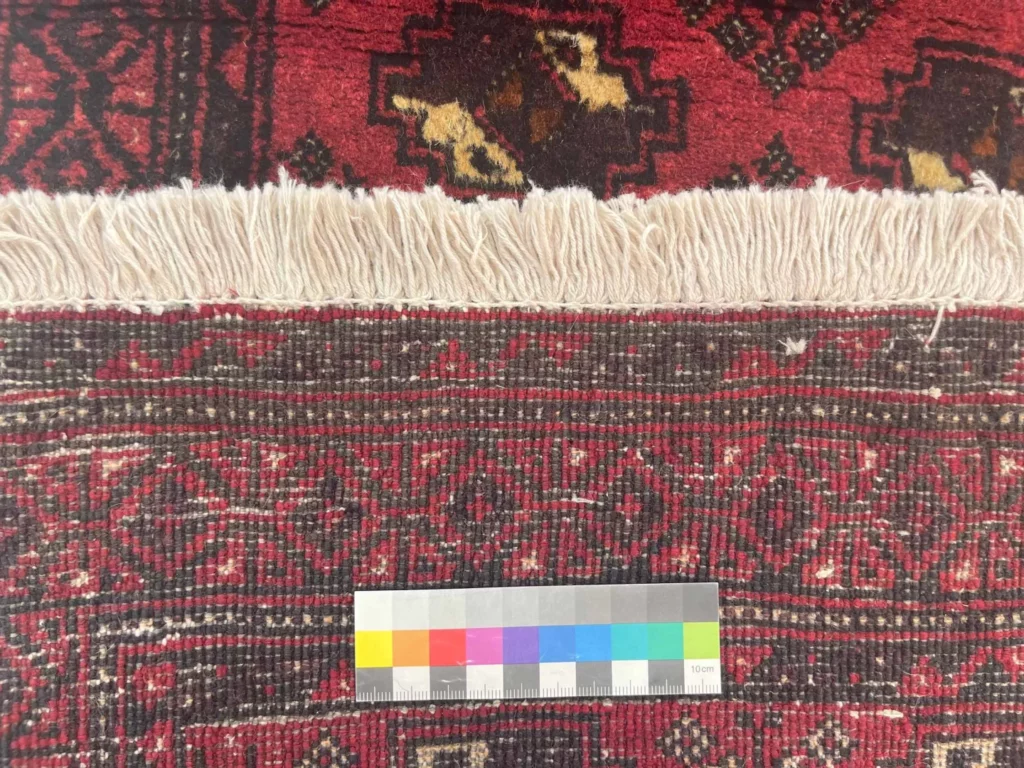
Hand-knotted Belutsch Persian Rug | Knot density: 120,000 – 250,000 knots/m² | Material: pile natural wool from own production | Size: 275 x 52 cm | Condition: Very good | Pattern: traditional Belutsch motifs
This Belutsch Persian rug is hand-knotted and made from natural wool produced in-house. Wool is therefore the defining pile material of the piece. In hand-knotting, each knot is placed individually into the foundation. The surface is built row by row, with the design emerging directly from the arrangement of the knots. This process differs from machine production and makes every hand-knotted rug an individual work. The result depends on the steady coordination of material, knot placement and pattern structure.
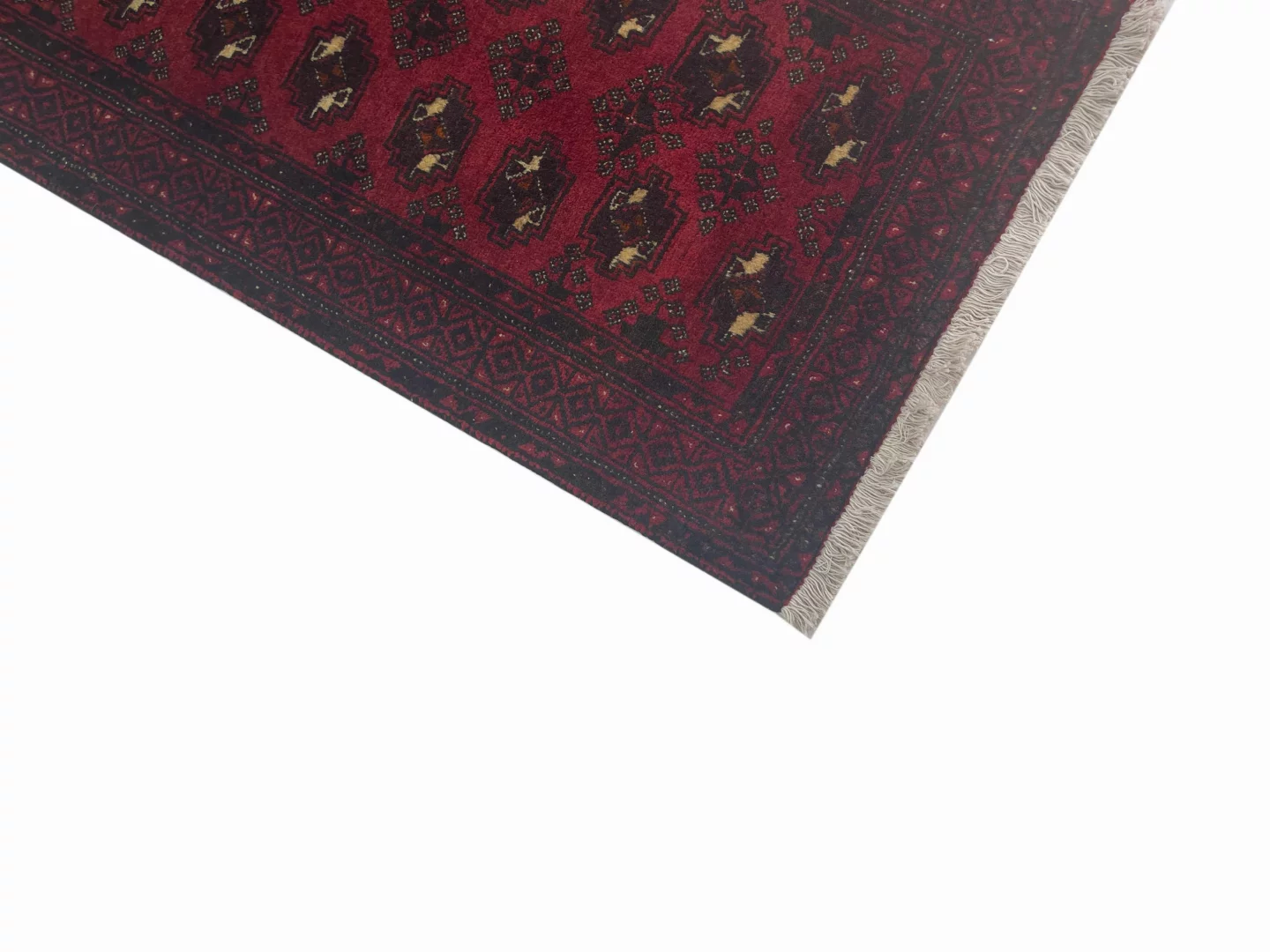
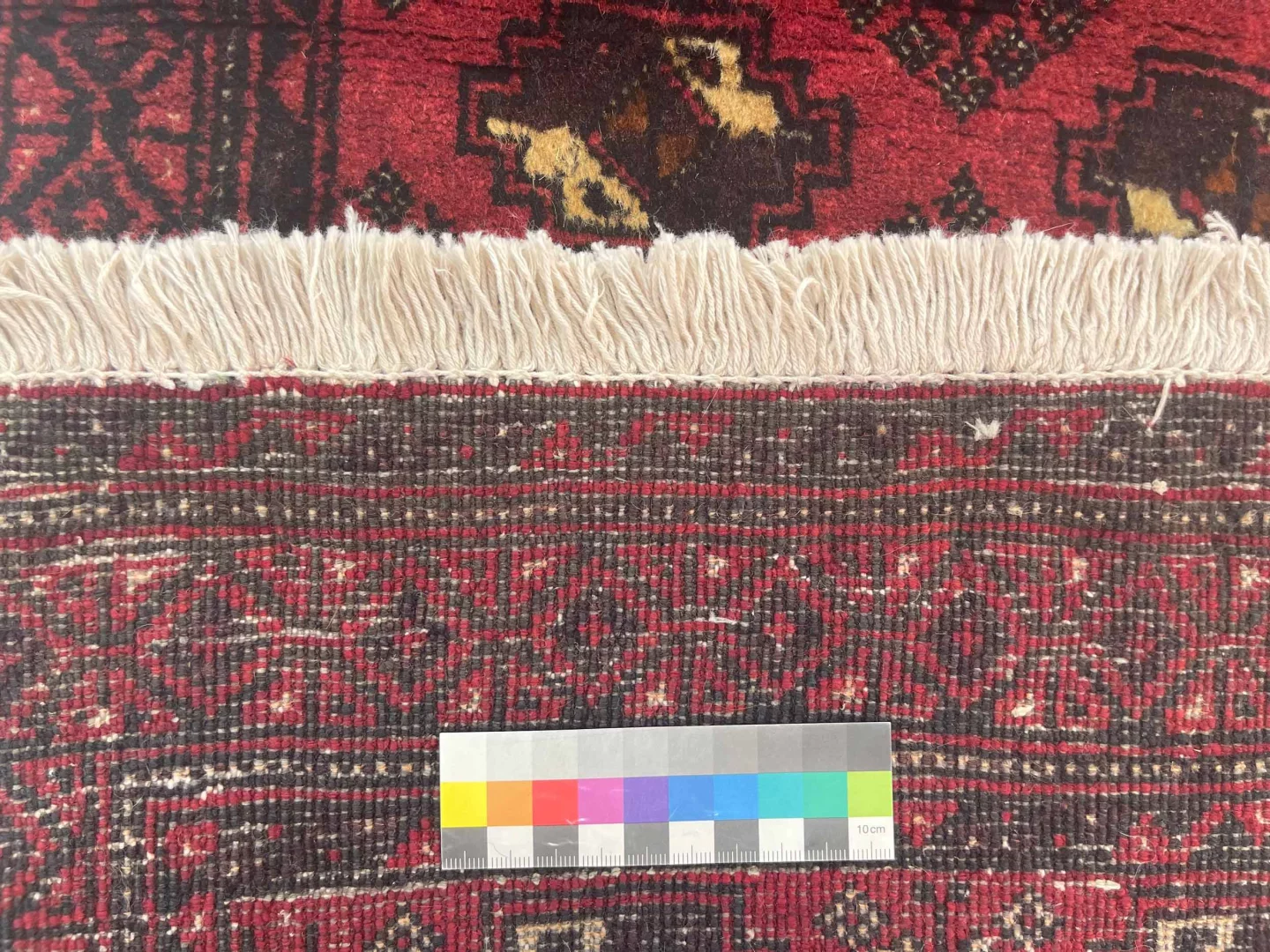
The knot density of this rug is between 120,000 and 250,000 knots per square metre. Knot density records the number of individual knots within a defined area and is closely related to the way detailed forms can be rendered. Small lines, compact geometric units and intricate transitions require a consistent knotting structure. In Belutsch weaving, this technical feature is combined with natural wool from the weavers’ own production.
Natural wool has long been used for hand-knotted rugs because it is suitable for a resilient textile surface. Within the Belutsch tradition, working with wool from the community’s own production forms part of the relationship between material and craft. Wool also has a distinctive natural handle and takes colour in a way that supports the character of traditional rug designs. Preparing the material, maintaining an even foundation and placing the knots in regular rows all require practical knowledge developed through repeated work.
The rug is in very good condition. This condition description completes the information about the individual piece alongside its material and construction. Since a hand-knotted rug is assembled through many separate stages, the wool, the knot density and the preserved condition together provide a concise picture of its documented craftsmanship.
Origin and Tradition
Belutsch rugs belong to the weaving tradition of the Baluch people. The origin given for this rug is the border region where Afghanistan, Persia and Pakistan meet. The Baluch are described as a nomadic people who settled in this broad three-country area. Their rug tradition is therefore connected with a culture in which textile work, mobility and the transmission of practical knowledge have played an important role.
The name Belutsch identifies a regional and cultural weaving context. It refers not only to a visual style, but also to the relationship with the Baluch people and their settlement area. Knowledge of knotting was passed through generations. This knowledge included the preparation of wool, the construction of the rug, the organisation of the pattern and the control of tension while the work progressed. A finished rug consequently represents a sequence of learned manual decisions rather than a single industrial process.
Persian rugs form part of the broader history of Oriental hand-knotting. Persia developed many regional weaving traditions, each with its own balance of materials, patterns and technical practices. Belutsch rugs occupy a distinctive place within this wider Persian context because their identity is tied to the Baluch tradition and to the region between Afghanistan, Persia and Pakistan. The geographical setting helps explain why the Belutsch name carries both regional and cultural meaning.
Hand-knotting builds an image directly into the textile. Unlike a printed surface, the design is formed one knot at a time, with the pattern developing as the rows advance. Geometric fields, stylised plant forms and symbolic signs can be assembled through this gradual process. The tradition therefore preserves more than a method of manufacture: it also preserves a vocabulary of forms and ways of arranging them.
When Persian rugs are compared by region, origin, material and design need to be considered together. Kerman rugs are often associated with fine floral compositions and high knot densities. Tabriz rugs are frequently linked with opulent motifs and bright colours, while Kashan rugs are known for traditional designs and valued materials. These neighbouring traditions demonstrate the breadth of Persian rug culture, but their names should not be treated as interchangeable. The Belutsch designation remains connected to the Baluch weaving tradition.
Design and Pattern
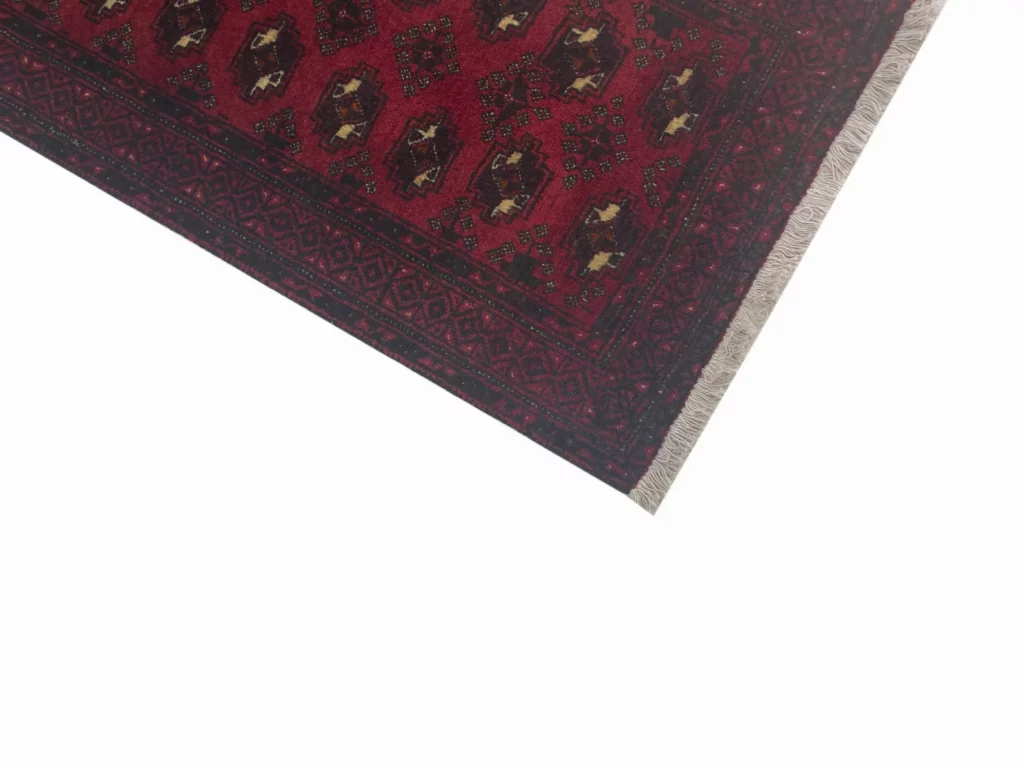
Belutsch rug designs are often inspired by nature and by the everyday life of the Baluch people. Their visual vocabulary includes geometric shapes, floral motifs and symbolic representations. These elements may appear individually or be combined into a repeating arrangement. Through the relationship of central fields, borders and smaller ornaments, the pattern creates a coherent regional character. The designs reflect the culture from which the weaving tradition developed.
Geometric organisation can be created with lines, angles, diamonds, compartments and repeated axes. Such forms may structure a central field, define a border or link separate motifs. Floral details in Oriental rugs are commonly stylised rather than copied as botanical illustrations. Leaves, blossoms and vines are reduced to signs that can be repeated within the knotting rhythm. Their regularity allows the pattern to remain readable while still retaining the character of handwork.
Symbolic representations add another level to the design language. They can refer to stories, experiences and traditions associated with the Baluch people. A symbol does not necessarily function as a literal picture; meaning can arise from the combination of signs, geometry and colour. Repetition, balance and the interaction of the main field with the surrounding border are important to the overall composition.
The colour tradition is also part of the way Belutsch rugs are described. Natural dyes are used for these rugs, producing colours that can be vivid while remaining harmonious. Warm red, deep blue and earthy brown are identified as characteristic directions within the palette. These tones may occupy larger fields, appear as accents or frame the design. Their effect depends on the placement of the motifs and on the contrast between lighter and darker areas.
A high knot density supports the rendering of complex forms. Narrow lines, small geometric units and closely spaced details can be differentiated more precisely when the knotting structure is fine enough to carry them. Knot density is therefore both a construction detail and a feature relevant to the reading of the pattern. In a Belutsch rug, regional symbolism, natural colour practice and the physical structure of hand-knotting work together.
Belutsch designs can be considered alongside other Persian regional styles without being confused with them. Kerman is often associated with floral compositions, Tabriz with more elaborate layouts, and Kashan with traditional ornament. These traditions may share broad elements such as flowers, vines or geometric order, yet each has its own regional expression. The Belutsch style remains distinctive through its connection with the Baluch people and their cultural setting.
Special Features
The individual features of this rug are its hand-knotted construction, natural wool from its own production and a stated knot density of 120,000 to 250,000 knots per square metre. The rug is also described as being in very good condition. Together, these details identify the particular piece offered here and distinguish it from other rugs in the same tradition.
The Belutsch designation links the rug to the Baluch tradition in the border region of Afghanistan, Persia and Pakistan. Its design context includes geometric, floral and symbolic forms. The use of natural dyes is described as a characteristic of Belutsch rugs and relates to the palette of warm reds, deep blues and earthy browns associated with the tradition.
As a runner, this format is generally suited to elongated areas. Its exact placement depends on the surrounding interior. The essential points remain the documented construction, the wool material, the Belutsch design tradition and the very good condition of this one-off hand-knotted rug.
FAQ
How should I care for my Persian rug?
Regular, gentle cleaning helps remove dust and dirt. A vacuum cleaner with a soft brush should be used for this purpose. Direct sunlight should be avoided. Spills and stains should be treated as soon as possible with a damp cloth and a mild cleaning product. A hand-knotted rug made from natural wool benefits from careful handling so that its pile and colours are not unnecessarily stressed. Avoid vigorous rubbing, harsh chemicals and soaking the rug. For a deeper clean, professional rug care is advisable.
Where does the wool for Belutsch rugs come from?
The wool for Belutsch rugs comes from the Baluch people’s own livestock breeding. It is described as high-quality natural wool and is traditionally used to make these rugs. The material is consequently connected with the daily life and craft tradition of the Baluch community. It provides a suitable basis for a resilient textile surface and forms the pile of the hand-knotted rug. For this particular rug, natural wool from its own production is explicitly given as the material.
What makes Belutsch rugs unique?
Belutsch rugs combine a high knot density, natural materials and designs inspired by culture. Their patterns may include geometric shapes, floral motifs and symbolic representations. These elements draw on nature, everyday life and the traditions of the Baluch people. The hand-knotted method adds another defining feature because the design is built knot by knot rather than applied to a finished surface. The origin in the border region of Afghanistan, Persia and Pakistan, the use of wool from the community’s own production and the regional visual language together form the distinctive profile of this rug tradition.
To provide the best experiences, we use technologies like cookies to store and/or access device information. Consenting to these technologies will allow us to process data such as browsing behavior or unique IDs on this site. Not consenting or withdrawing consent, may adversely affect certain features and functions.
Functional Always active
The technical storage or access is strictly necessary for the legitimate purpose of enabling the use of a specific service explicitly requested by the subscriber or user, or for the sole purpose of carrying out the transmission of a communication over an electronic communications network.
Preferences
The technical storage or access is necessary for the legitimate purpose of storing preferences that are not requested by the subscriber or user.
Statistics
The technical storage or access that is used exclusively for statistical purposes.The technical storage or access that is used exclusively for anonymous statistical purposes. Without a subpoena, voluntary compliance on the part of your Internet Service Provider, or additional records from a third party, information stored or retrieved for this purpose alone cannot usually be used to identify you.
Marketing
The technical storage or access is required to create user profiles to send advertising, or to track the user on a website or across several websites for similar marketing purposes.

 SECURE PAYMENT
 SHIPPING PARTNERS