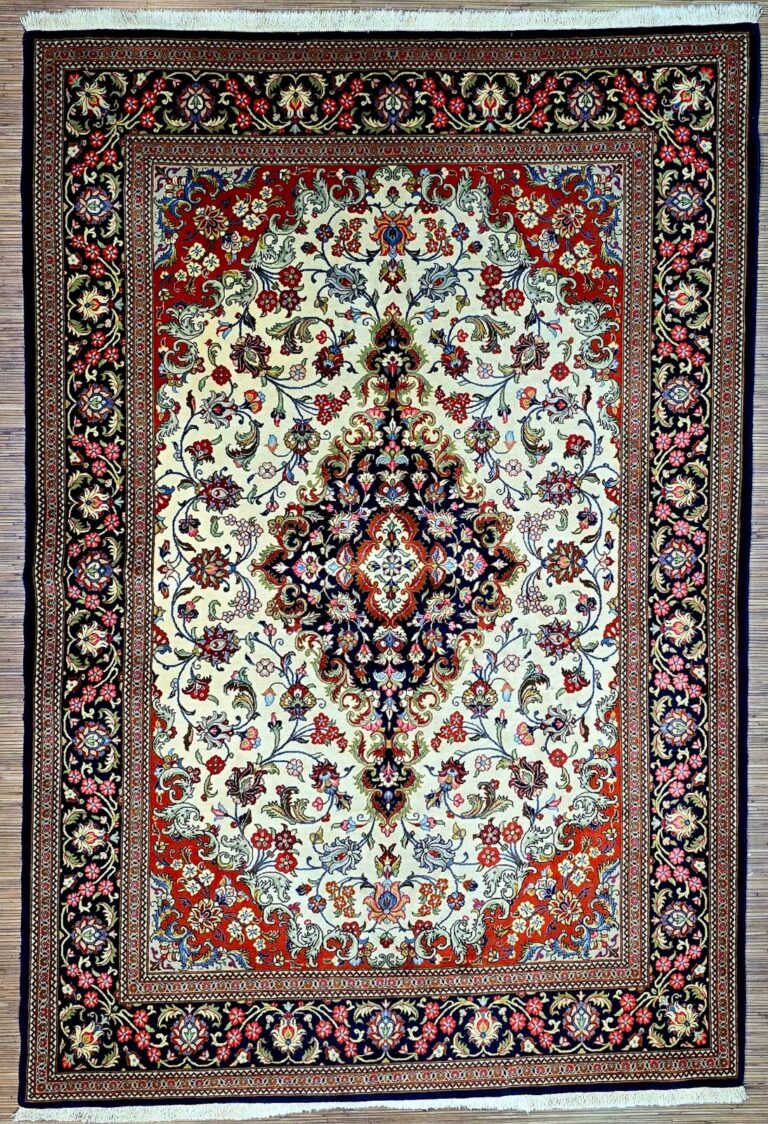
This Bakhtiar Persian rug is hand-knotted with high-quality sheep wool in the pile. Hand knotting is one of the established methods of oriental rug making. The design is built knot by knot on a prepared foundation, so the surface and the pattern develop together. The process requires consistent work and allows separate fields, outlines and ornamental details to be formed directly in the structure of the rug. Sheep wool has long been used for rug piles because it can be spun and knotted into a durable textile with a distinct, tactile surface.
The knot density given for this rug is 150,000 to 350,000 knots per square metre. Knot density indicates how closely the individual knots are arranged across the surface. In a small-field garden design, this technical feature helps the maker define borders, plant shapes and animal motifs with greater differentiation. Density is not an isolated quality: its visual effect works together with the design, the wool and the experience involved in creating the rug.
High-quality sheep wool can give colour areas a substantial appearance and help motifs retain recognisable contours. In Bakhtiar weaving, the use of wool belongs to a regional craft practice shaped by generations of knowledge. The specific details supplied for this rug identify sheep wool as the pile material and hand knotting as the technique. No further fibre or foundation material is stated, so no additional construction details are assigned to this piece.
Origin and Tradition
The Bakhtiar Persian rug comes from western Iran, from the area west of Isfahan and the Zagros Mountains. This region is associated with the Bakhtiar nomadic people and their distinct rug-making tradition. The landscape of the Zagros provides an important cultural setting for the designs, while the practical use of textiles influenced the way rugs were made and passed on. Bakhtiar weaving is therefore connected both with a place and with a community whose knowledge has continued across generations.
Bakhtiar rugs form part of the broader history of Persian carpet weaving. Their appearance is not limited to one workshop or a single fixed formula. Family traditions, regional habits and individual choices can all influence the final arrangement. Knowledge of preparing the foundation, placing the knots, coordinating colours and completing the surface was traditionally learned through repeated practice. Hand production leaves room for individual interpretation while retaining the recognizable regional character.
Isfahan is relevant to the geographical context of this rug. Isfahan is a major Persian weaving centre with a tradition known for carefully developed ornaments and refined compositions. Bakhtiar rugs from the surrounding area are consequently often discussed alongside Isfahan weaving. That association does not change the origin of this piece: it is described as a Bakhtiar Persian rug from western Iran, rather than as an Isfahan rug.
The Zagros Mountains provide more than a location on a map. They form a landscape in which cultivated spaces, vegetation and animals are meaningful subjects for textile imagery. The garden pattern can be understood against this setting, where an ordered garden represents a distinct arrangement within a varied natural environment. The rug is not made by printing a picture onto fabric. Its imagery is formed through the placement of coloured knots, with the design becoming part of the woven structure.
Related Persian rug traditions include Isfahan and Tabriz. Isfahan rugs are associated with fine detail and the use of quality materials, while Tabriz rugs are known for developed patterns and colour arrangements. Kirman is also named among the established manufacturing regions connected with this wider heritage. These comparisons help place Bakhtiar weaving within the diversity of Iranian carpet culture, but they do not replace the specific Bakhtiar designation of this rug.
The connection with a nomadic tradition is also important for understanding Bakhtiar rugs. Nomadic weaving practices have historically combined useful textiles with a strong visual vocabulary. Designs could be adapted to the available materials and to the knowledge maintained within a family or community. As a result, regional tradition does not mean that every Bakhtiar rug has an identical appearance. It means that the technique, motifs and cultural references belong to a recognizable historical environment.
Design and Pattern
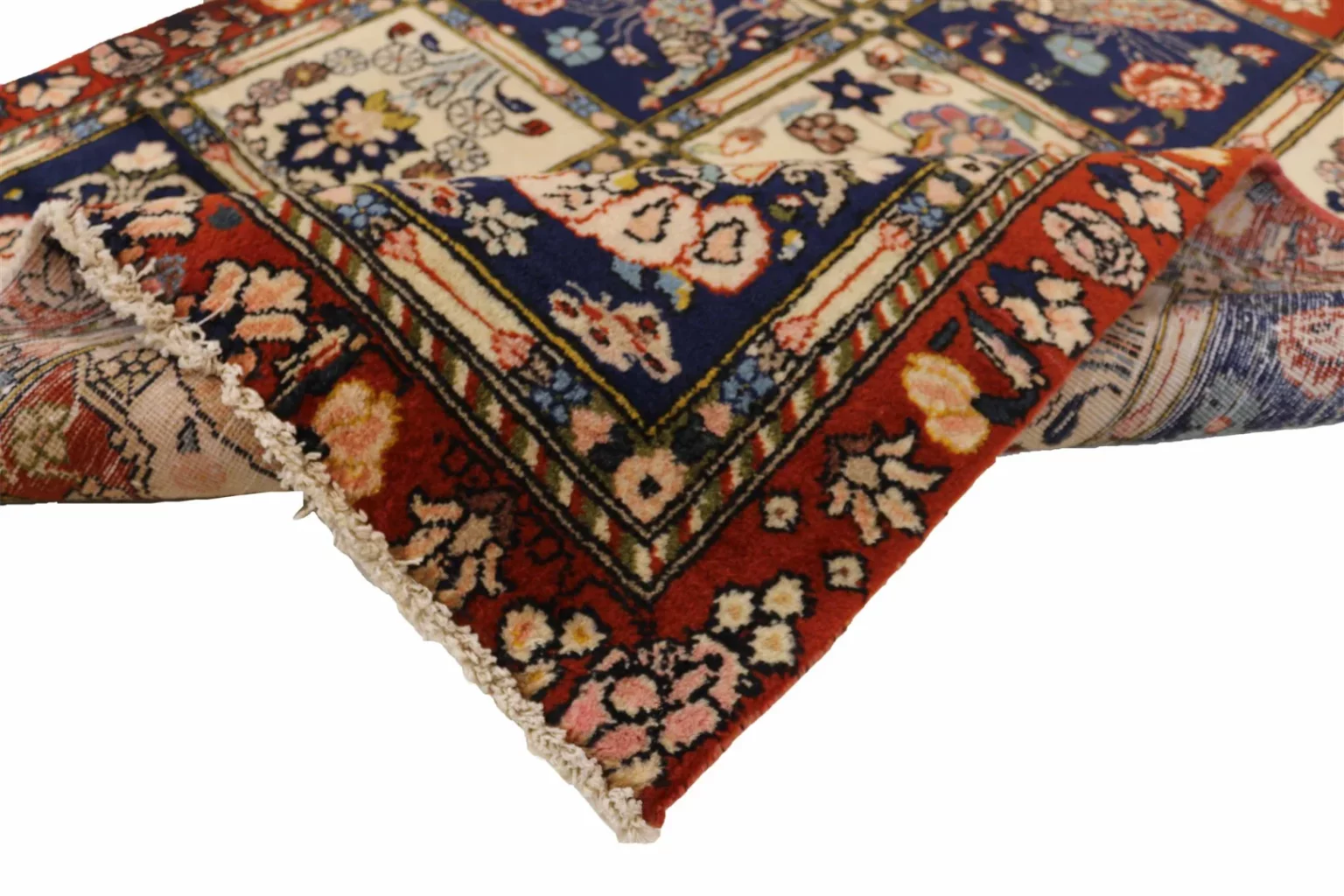
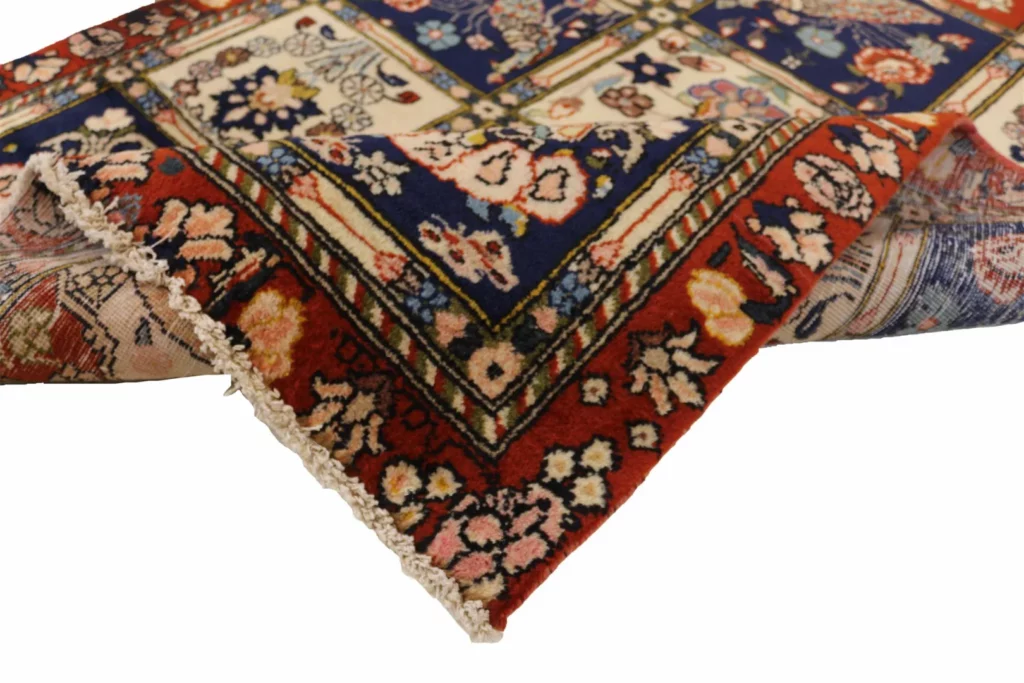
The pattern of this rug is a garden design, also called Kheshti. A Kheshti composition generally divides the field into separate compartments or panels, which can be read as garden plots. Each compartment may contain its own arrangement of vegetation and animals. The repeated division creates an ordered overall structure while allowing the individual sections to carry different details. This combination of regular geometry and natural imagery is the defining visual idea behind the garden pattern.
Plant forms may appear as leaves, blossoms, vines or stylised trees. Animal figures are integrated into the ornamental system rather than necessarily being rendered in a naturalistic manner. In Persian rug design, natural forms are often simplified, mirrored or repeated so that they can be translated into rows of knots. Their recognisable character comes from the balance of outline, colour and position within the field.
A Kheshti design depends not only on the motifs themselves but also on the structure that separates them. Borders between compartments establish a clear rhythm. Repeated elements give the composition continuity, while small variations can reflect the hand-made nature of the work. The knot density specified for this rug supports the differentiated treatment of the garden fields, but the pattern remains based on an orderly division rather than on a single central image.
The palette is described as consisting of natural tones, with red, brown and cream predominating. Red can serve as a strong field or accent colour, brown reinforces the earthy character of the garden theme, and cream provides light contrast around motifs and dividing lines. Together these colours create a traditional, clearly legible palette. The description also identifies natural dyes as the source of the colours, linking the appearance of the rug with long-established dyeing practices.
Garden imagery has a decorative and cultural dimension. A garden can represent an ordered, fertile space filled with plants and living creatures. Such associations belong to the symbolism of regional rug culture, where nature is not merely copied but arranged into a meaningful textile order. On this rug, the plant and animal motifs are specific parts of the Kheshti composition and are connected with the Bakhtiar tradition and its western Iranian setting.
The name Kheshti therefore refers to the compartmental structure as well as to the imagery placed inside it. This differs from a floral design based on one continuous vine or from a composition dominated by one central medallion. In a garden pattern, the eye moves from one field to the next. The separate sections create variety, while their repeated arrangement keeps the composition coherent. The result is a design language in which geometry and natural motifs are inseparable.
Special Features
The specific features of this one-off rug are its hand-knotted construction, high-quality sheep-wool pile, stated knot density and Kheshti garden pattern with plant and animal motifs. Its origin is given as the area west of Isfahan in the Zagros Mountains. The rug is very well preserved. These details identify the piece as a Bakhtiar Persian rug and do not justify assigning it another regional name.
The combination of a compartmental garden design and sheep wool reflects the practical and visual sides of the Bakhtiar tradition described for this rug. Hand knotting makes each piece an individual textile because the knots are placed by hand rather than produced through an industrial printing process. For care, regular vacuuming without a brush attachment is recommended. Occasional beating can help remove dust and dirt. Spills should be treated promptly with water and a mild cleaning agent.
FAQ
How should I care for a Bakhtiar Persian rug?
Vacuum a Bakhtiar Persian rug regularly without using a brush attachment. This removes dust and loose dirt without subjecting the wool surface to a rotating brush. Occasional beating can also help release accumulated dust. If a stain occurs, treat it promptly with water and a mild cleaning agent. Work carefully rather than rubbing aggressively, so the wool and the coloured areas are not subjected to unnecessary stress. For more extensive cleaning, a specialist familiar with hand-knotted rugs is appropriate.
Where does a Bakhtiar Persian rug come from?
Bakhtiar Persian rugs come from western Iran. This rug is more specifically associated with the area west of Isfahan and the Zagros Mountains. The region is connected with the Bakhtiar nomadic people, who maintain a distinctive rug-making tradition. Its geography and inherited craft knowledge form the cultural background of the weaving. The proximity to Isfahan explains the regional relationship, but it does not make this rug an Isfahan rug; its stated designation is Bakhtiar.
What makes a Bakhtiar rug particularly valuable?
The value of a Bakhtiar rug can result from several characteristics: a high knot density, high-quality sheep wool, distinctive hand-knotted patterns and a traditional method of production passed down through generations. This particular rug also has a Kheshti garden pattern with plant and animal motifs. Its very good condition is another concrete feature. Together, the regional tradition, the material, the handwork and the pattern provide the basis for assessing the rug, without replacing an individual examination of the piece.
To provide the best experiences, we use technologies like cookies to store and/or access device information. Consenting to these technologies will allow us to process data such as browsing behavior or unique IDs on this site. Not consenting or withdrawing consent, may adversely affect certain features and functions.
Functional Always active
The technical storage or access is strictly necessary for the legitimate purpose of enabling the use of a specific service explicitly requested by the subscriber or user, or for the sole purpose of carrying out the transmission of a communication over an electronic communications network.
Preferences
The technical storage or access is necessary for the legitimate purpose of storing preferences that are not requested by the subscriber or user.
Statistics
The technical storage or access that is used exclusively for statistical purposes.The technical storage or access that is used exclusively for anonymous statistical purposes. Without a subpoena, voluntary compliance on the part of your Internet Service Provider, or additional records from a third party, information stored or retrieved for this purpose alone cannot usually be used to identify you.
Marketing
The technical storage or access is required to create user profiles to send advertising, or to track the user on a website or across several websites for similar marketing purposes.

 SECURE PAYMENT
 SHIPPING PARTNERS