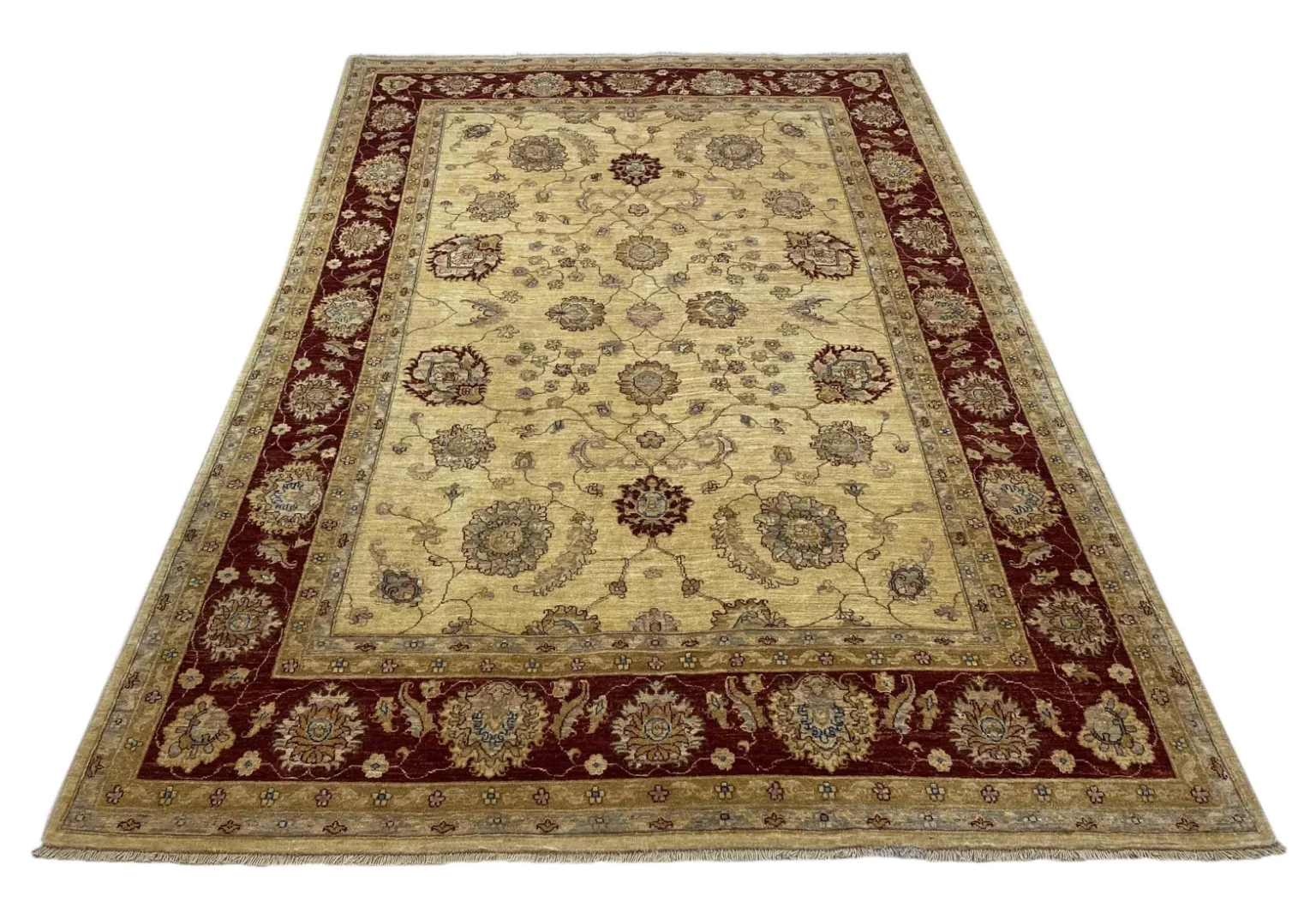
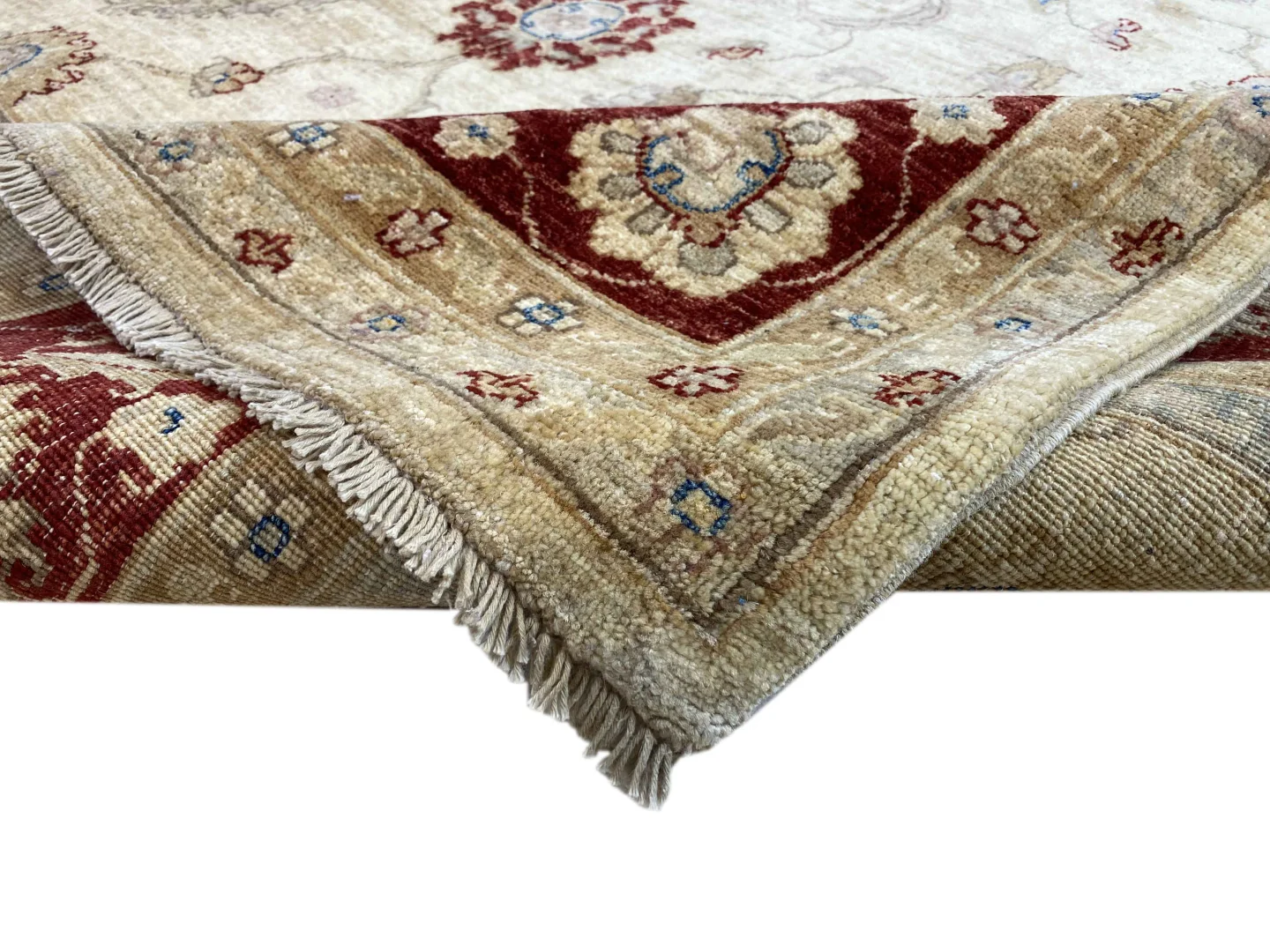
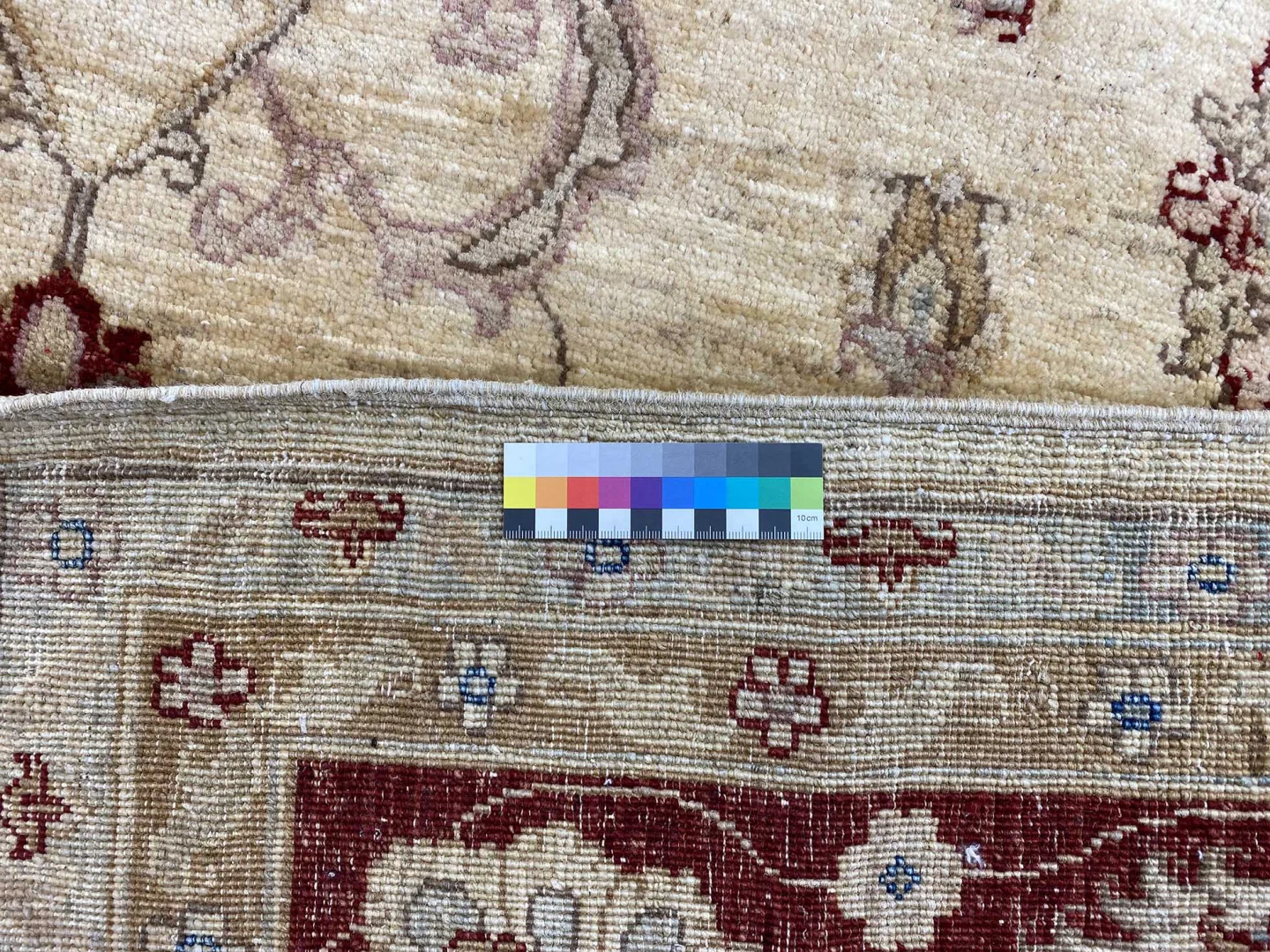
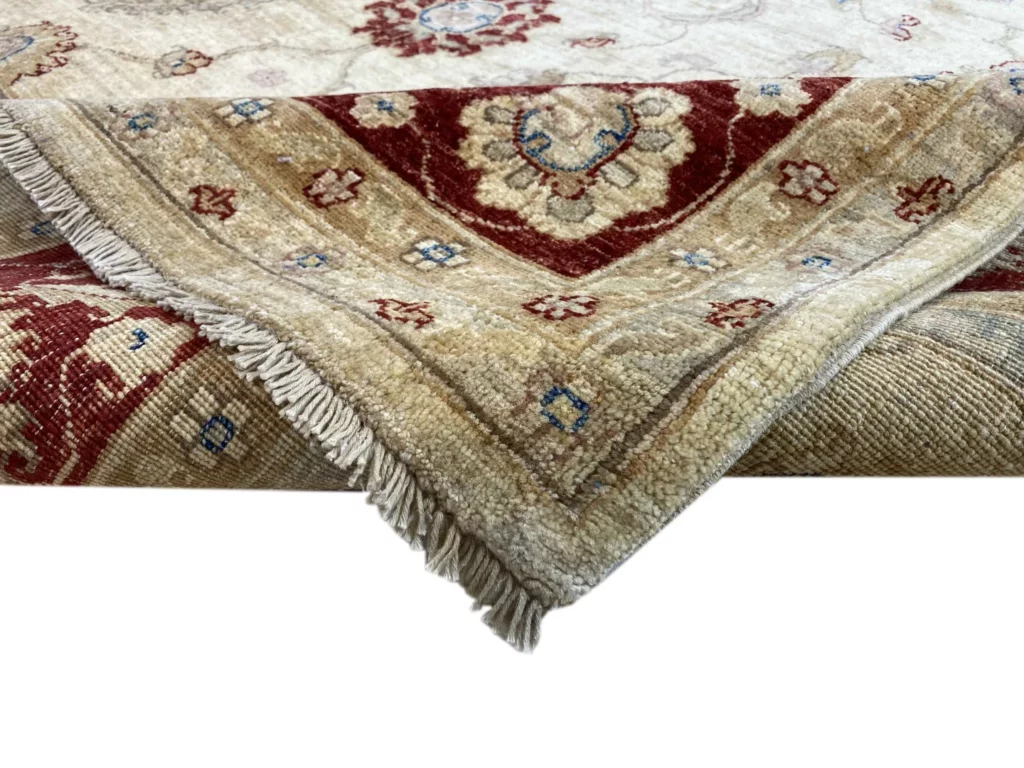
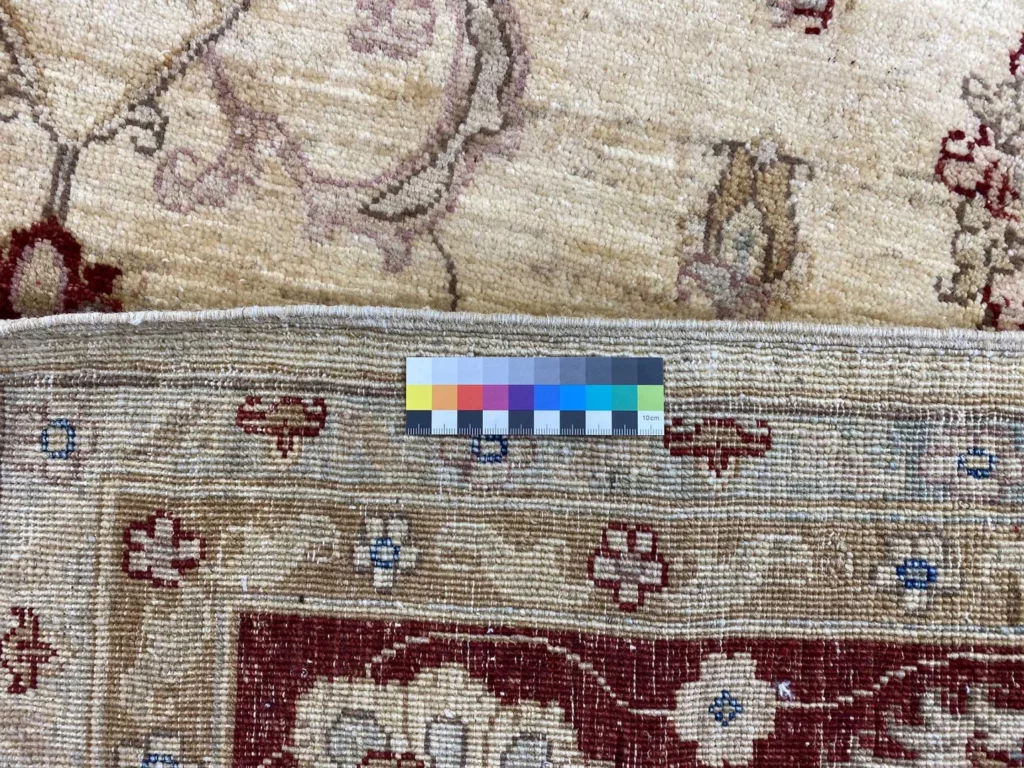
This Ziegler Oriental rug is hand-knotted and has a wool pile. In hand-knotting, individual knots are tied into a prepared foundation one by one. Rows are built up gradually until the textile surface and its design are complete. This method distinguishes a hand-knotted rug from a machine-made floor covering: the finished piece results from many separate manual operations and from the coordinated use of knots, weft and warp.
The listed knot density is approximately 200,000 knots per square metre. Knot density records how many knots are placed within a defined area and provides information about the technical construction of a rug. It is a separate characteristic alongside the wool pile and the hand-knotted method. Wool has long been used in rug making because it can be formed into a resilient pile and accepts colour effectively, allowing the drawn pattern to remain legible across the surface.
The appearance of a hand-knotted Ziegler rug is created through the arrangement of coloured knots rather than through a design printed onto a finished surface. Once the knotting is complete, the pile is aligned and trimmed so that the pattern can be read. The documented construction of this rug consists of a wool pile, hand-knotting and the stated knot density. No further material, such as a cotton foundation or silk, is specified.
Origin and Tradition
The origin given for this Ziegler Oriental rug is Pakistan and Afghanistan. It therefore belongs to the broad tradition of handmade Oriental rugs maintained by workshops and weaving communities across Central and South Asia. The name Ziegler refers to a design tradition known for adapting classical Persian-inspired ideas to a more open and furnishing-friendly visual language. It is not automatically the name of one town and does not replace the stated country of origin.
Historically, Ziegler designs became associated with productions that interpreted established Persian pattern ideas through softer drawing, broader spacing and carefully balanced colour arrangements. Floral scrolls, medallion layouts and flowing vines were often made less rigid than in highly formal court carpets. This helped the style travel across markets and interiors. Ziegler rugs are now produced in several countries, including Pakistan and Afghanistan. For that reason, style, country of manufacture and actual pattern should be kept distinct when describing an individual rug.
Pakistan has a varied rug-making culture in which different workshops use inherited designs, regional skills and changing colour schemes. Designs can be passed through families and weaving communities while being adapted to current formats. Afghanistan also has a long tradition of working with wool and producing handmade rugs. In both countries, the rug represents more than a decorative textile: it brings together the selection of fibre, knowledge of knotting, pattern planning and sustained manual work.
The stated origin in Pakistan and Afghanistan gives this piece its place within Oriental rug production, while the Ziegler name connects its design to a wider international pattern history. Oriental rugs are made in regions with their own preferences for knotting, palette and composition. Ziegler designs are among the forms that combine those regional craft traditions with ornament that can be understood across different furnishing contexts. Hand-knotting remains the technical foundation that links the style to the wider history of handmade rugs.
The history of Ziegler patterns also reflects exchange between weaving cultures. Designs travelled through merchants, workshops and drawn pattern references, and were adjusted for new rooms and new expectations. Scale, colour relationships and ornamental details could all be changed without abandoning the underlying floral or medallion structure. A Ziegler rug from Pakistan or Afghanistan can therefore draw on a transregional design vocabulary while remaining an Oriental rug from the origin stated for the piece.
Design and Pattern
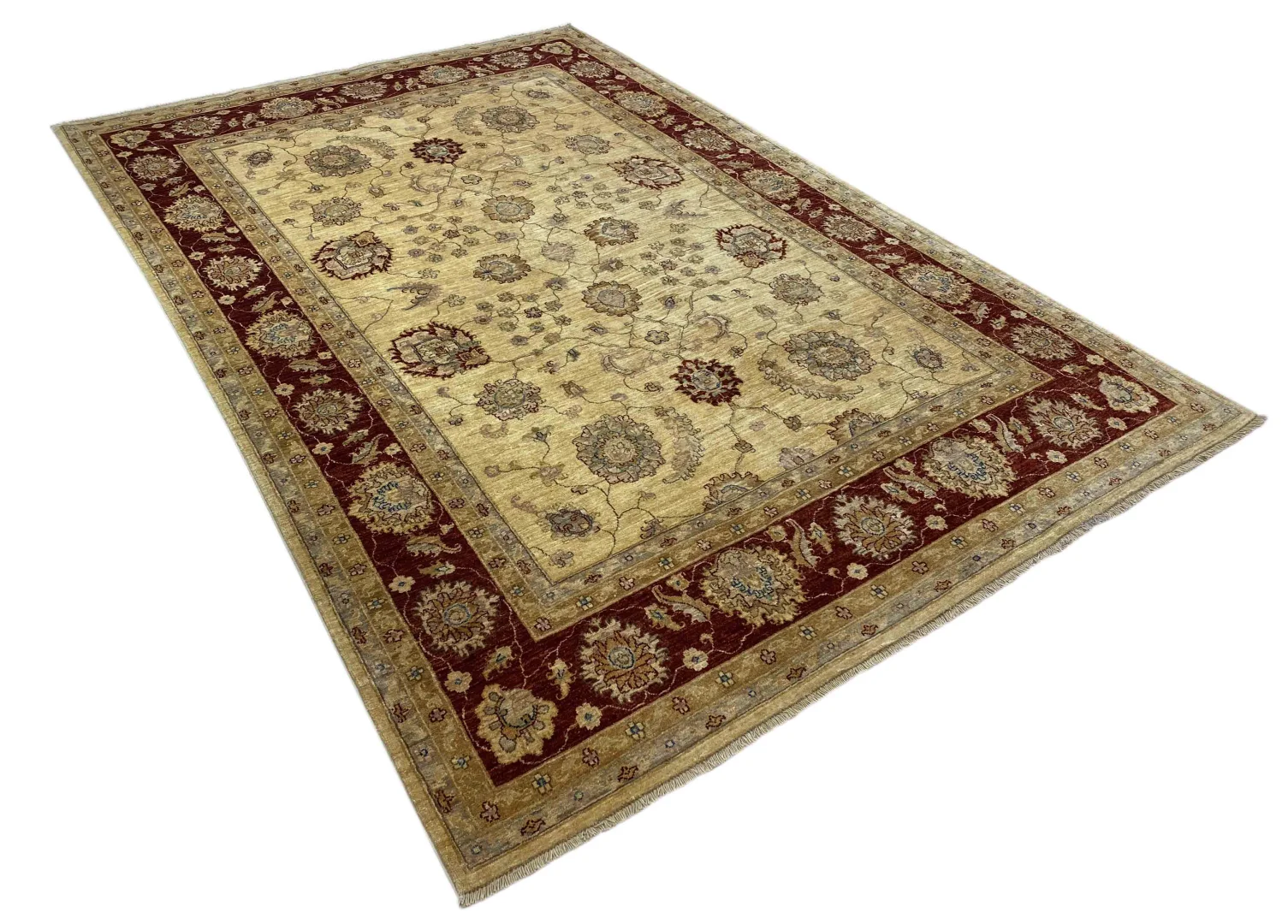
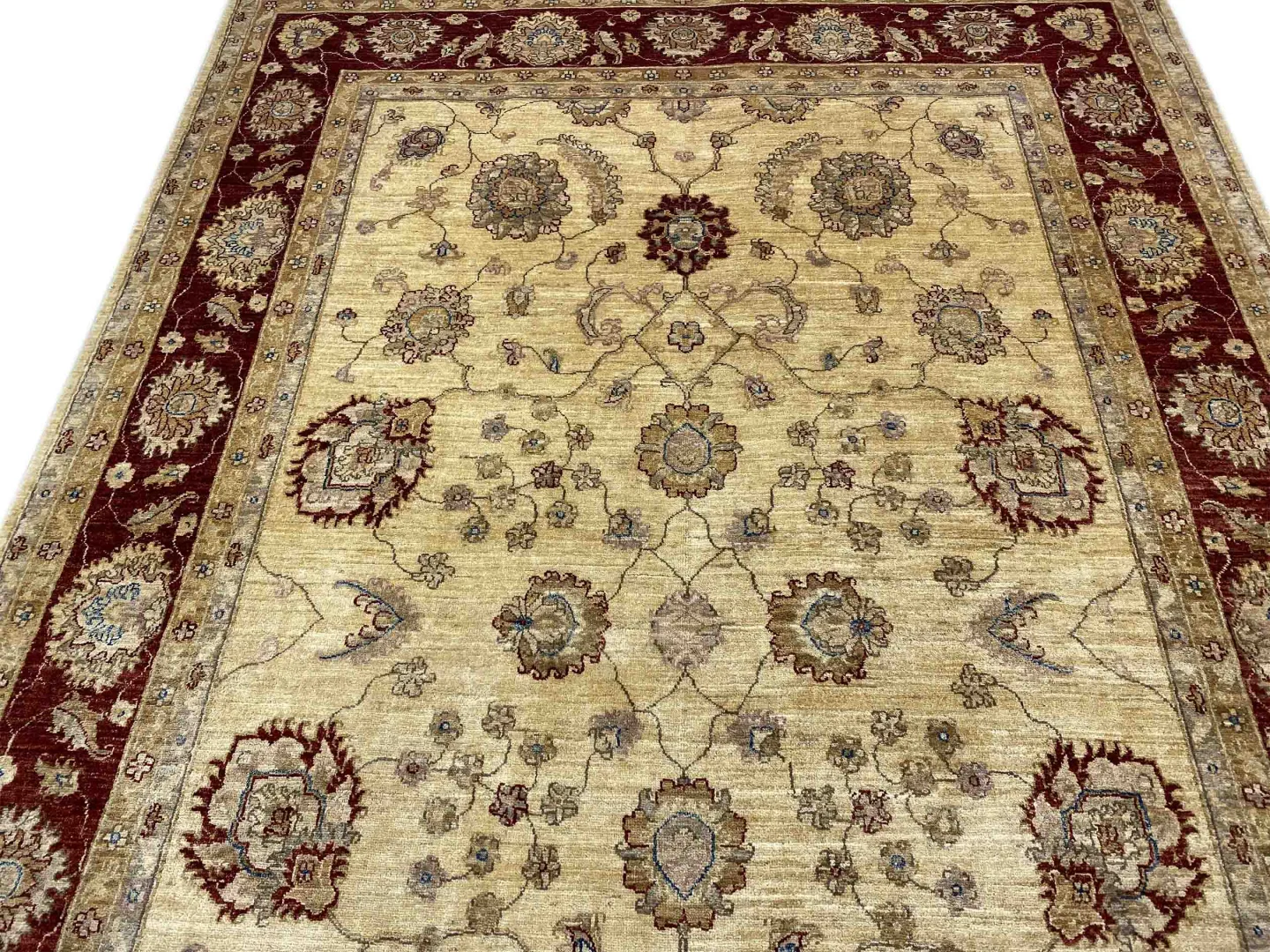
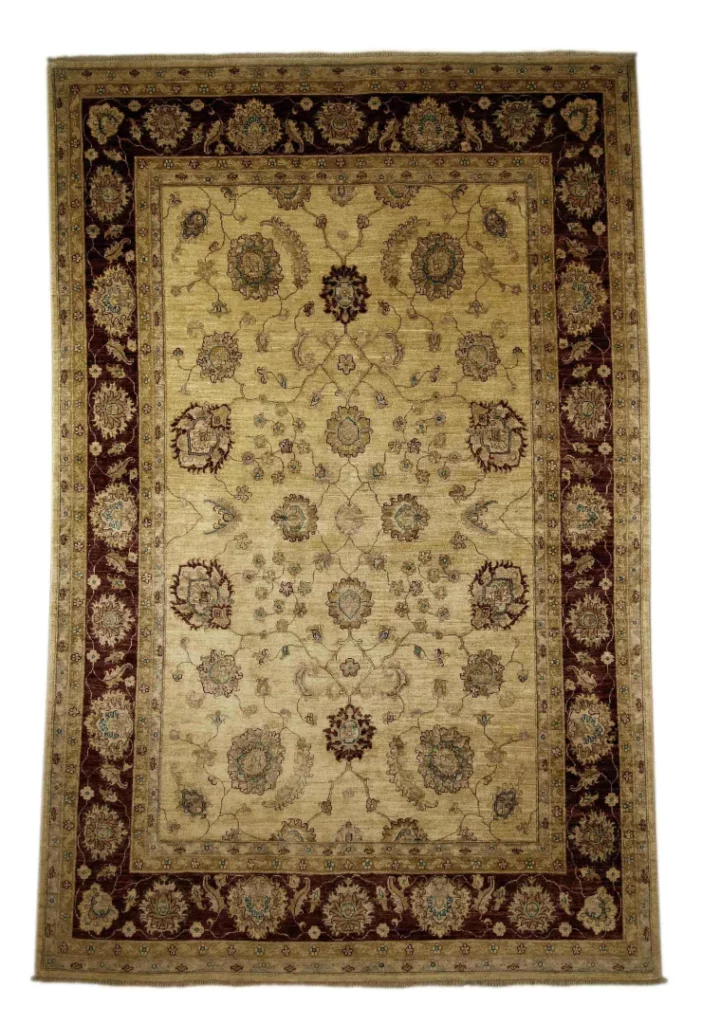
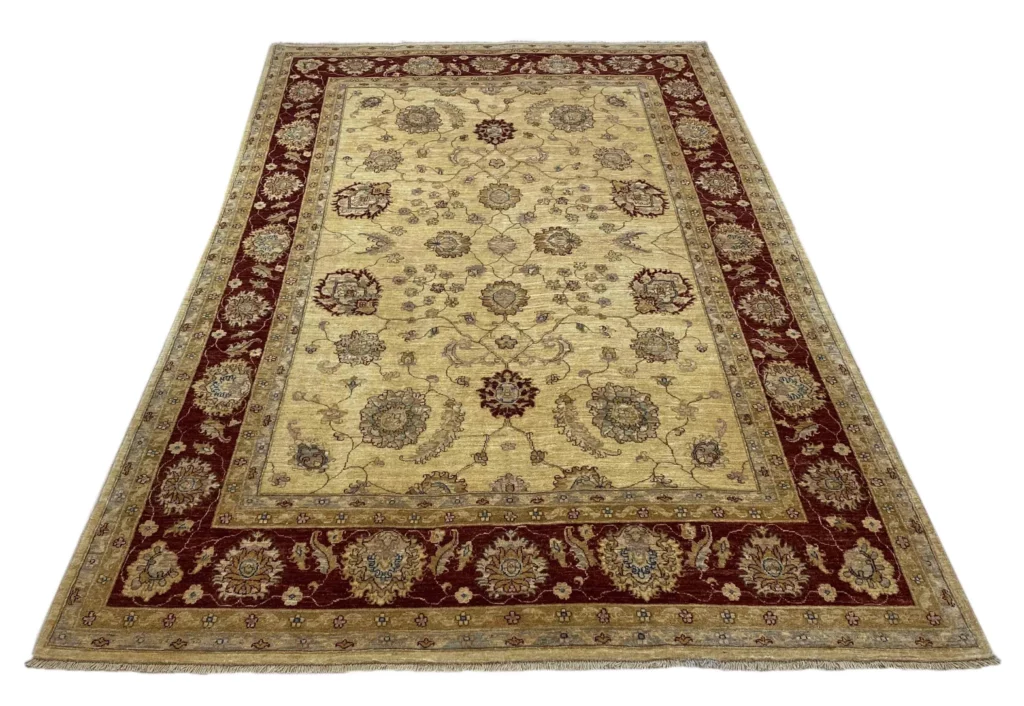
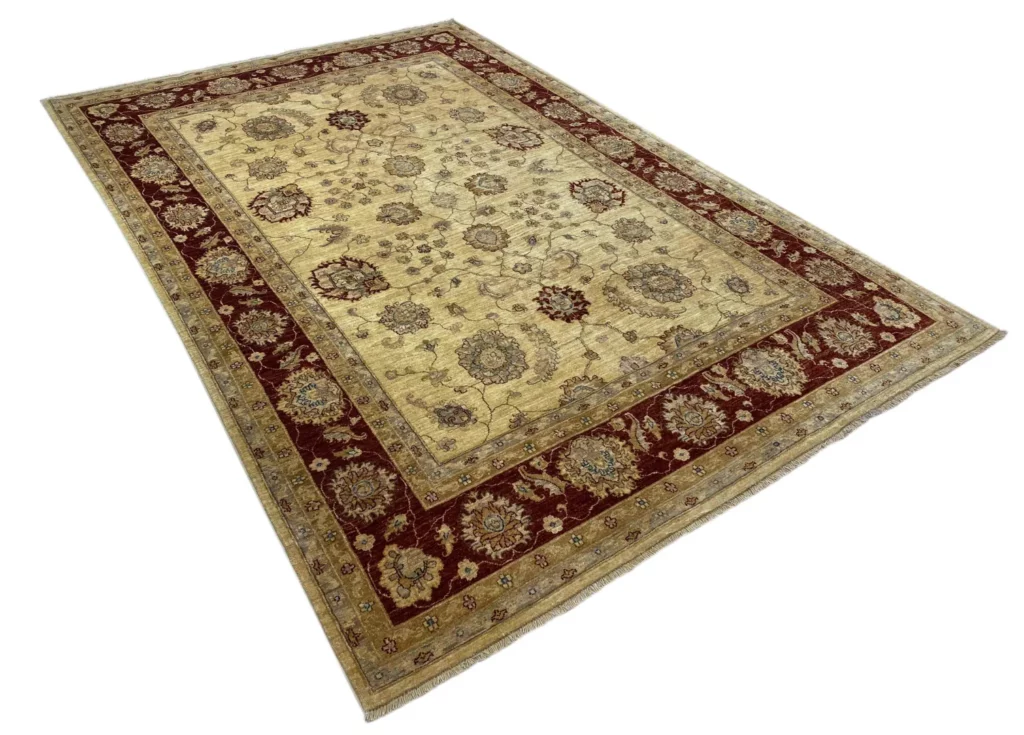
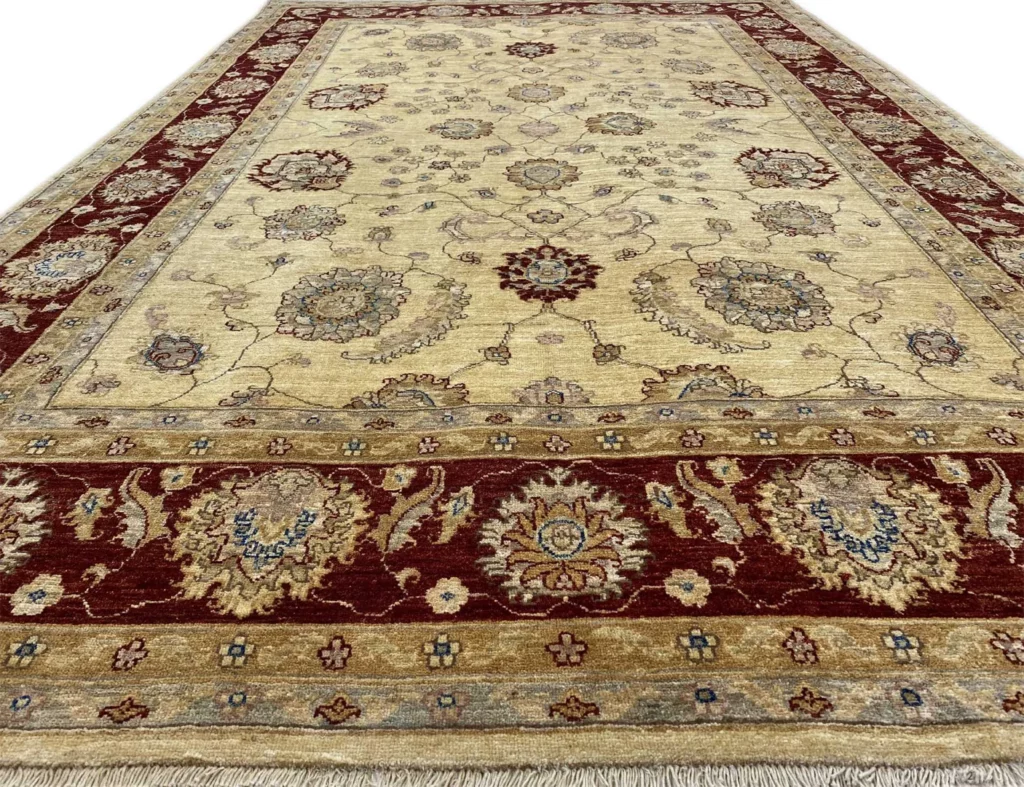
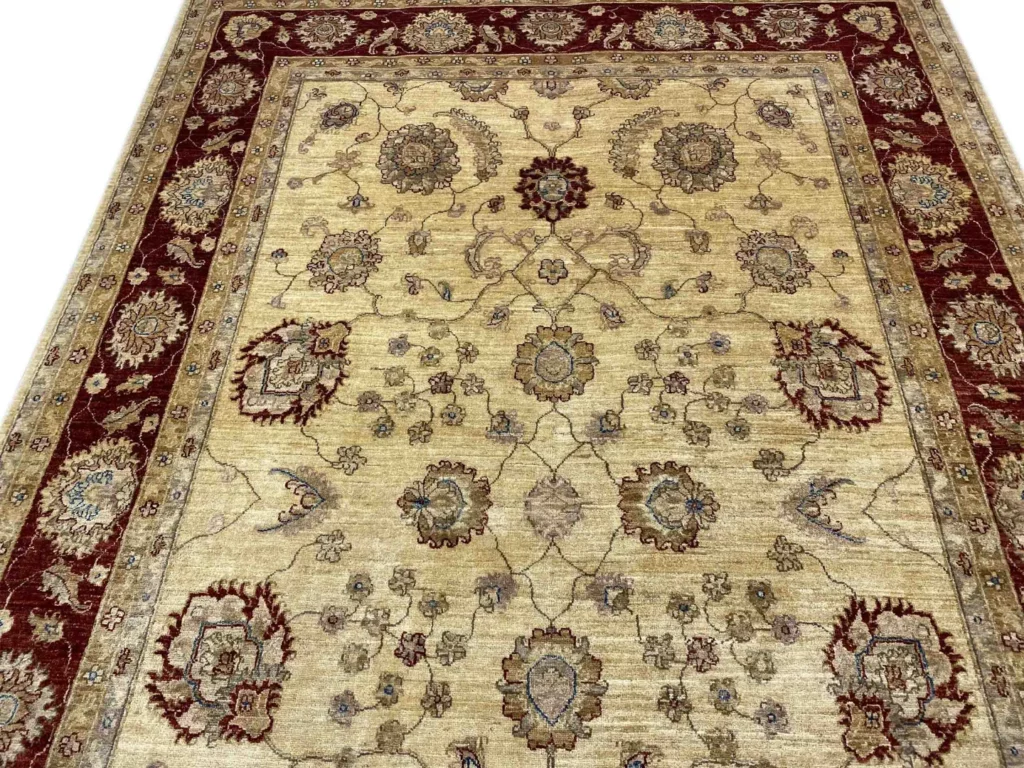
The description identifies varied colours and designs for this rug. Its visual language is therefore not limited to one fixed palette or one single ornament. In rug terminology, Ziegler is often associated with open floral compositions, flowing foliage and balanced layouts. Depending on the design, vines, blossoms, palmettes, leaves, medallions or repeated all-over elements may be arranged together. The precise drawing of this one-off piece is defined by its individual knotting.
A traditional Ziegler composition can be easy to read without relying entirely on strict geometry. A central medallion may organise the field, while vines and floral forms connect the surrounding space. Another design may use an all-over arrangement, repeating a botanical motif across the field instead of concentrating the eye in one centre. These approaches give the surface several points of visual orientation and establish a relationship between the inner field and the border.
Floral ornament has a long history in Persian and Oriental rug design. Flowers, vines, palmettes and leaves are usually stylised rather than intended as exact botanical illustrations. Within a rug, they can be repeated, mirrored, reduced or placed into a symmetrical framework. In many Ziegler-inspired designs, these elements have a flowing character. Geometric accents can appear alongside them, giving the floral structure a clear rhythm and helping define the larger composition.
The varied colours are an expressly stated feature of this rug. In the Ziegler tradition, colours are often arranged so that the pattern remains visible while the complete surface reads as one connected design. Light and dark passages may separate ornaments from the ground. The effect depends on the relationship between the field colour, outlines and internal drawing. Because each rug is knotted individually, even a familiar pattern receives a particular character through its own distribution of colour.
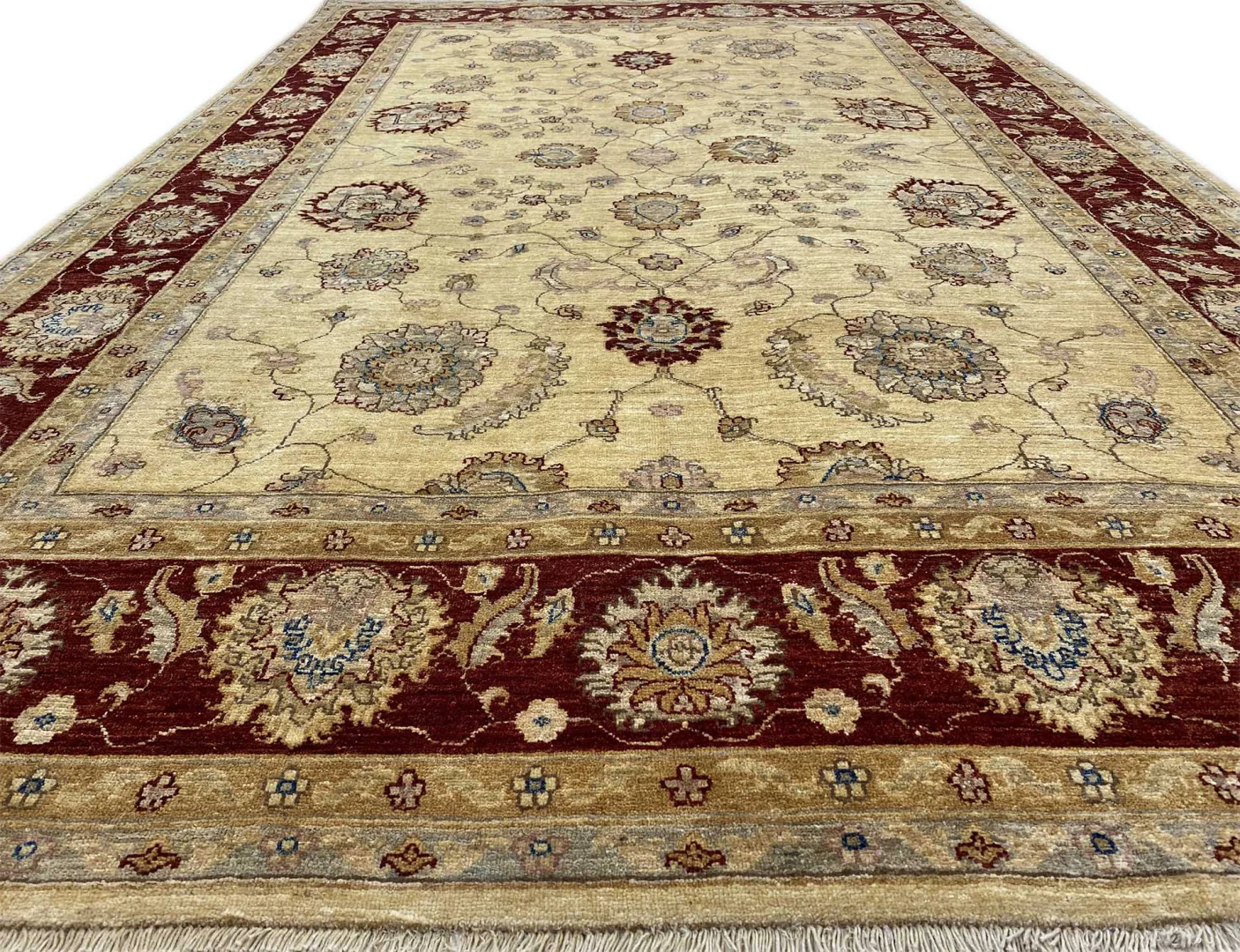
Many Ziegler designs also balance ornament with a relatively generous sense of space. Details may be present without making every part of the field equally dense. Borders frame the central area and create a transition between the middle of the rug and its outer edge. Depending on the design, a border may consist of one broad band or several narrower bands. The source does not define which of these possible arrangements is used on this particular piece.
The design tradition can be discussed alongside other Oriental pattern languages without assigning this rug to a different provenance. Ziegler motifs often draw on older floral and medallion models while changing their scale, spacing and colour effect. The result may combine ornamental detail with a composed overall order. The statement that this rug has varied colours and designs summarises that range without replacing the individual pattern created in its hand-knotted surface.
Special Features
This rug has undergone stone washing. The surface is treated after knotting in order to alter the visual effect of the colours. The documented result is a faded appearance. The colours consequently have a deliberately softened, less-new look and a vintage character. This treatment is a design feature and is separate from both the rug’s knot density and its wool material.
The faded effect is connected with the vintage appearance often associated with Ziegler rugs. Stone washing can change the visual depth of a pattern by reducing strong contrasts and making the palette appear more subdued. The hand-knotted structure remains the basis of the surface. For this piece, the specified special features are the stone wash and the faded effect it creates.
FAQ
What defines a high-quality Ziegler Oriental rug?
Relevant characteristics include hand-knotted construction, the quality of the material and the technical density of the knots. This rug is described as having a wool pile, hand-knotted workmanship and approximately 200,000 knots per square metre. Its stone-washed surface and faded effect also shape its appearance. The Ziegler designation connects the piece with a broad design tradition known for varied colours and designs.
How should I care for a hand-knotted wool rug?
Regular gentle vacuuming helps remove loose dust and dirt from the wool pile. The surface should not be subjected to unnecessary mechanical stress. Spilled liquids should be absorbed carefully rather than rubbed into the fibres. For a deeper clean, a specialist cleaner is advisable, since the hand-knotted construction, wool pile and colour effect created by stone washing should all be taken into account. Harsh detergents and improvised wet cleaning can affect fibres and colour.
Where can I buy an authentic Ziegler Oriental rug?
Suitable sources include specialist rug dealers, established Oriental rug shops and trusted sellers that provide clear product information. When buying, the origin, material, construction, knot density and any surface treatment should be identified plainly. For this one-off piece, Pakistan and Afghanistan are given as the origin, wool as the pile material, along with hand-knotting, approximately 200,000 knots per square metre and stone washing with a faded effect. These details help identify the rug as the specific handmade item being offered.
To provide the best experiences, we use technologies like cookies to store and/or access device information. Consenting to these technologies will allow us to process data such as browsing behavior or unique IDs on this site. Not consenting or withdrawing consent, may adversely affect certain features and functions.
Functional Always active
The technical storage or access is strictly necessary for the legitimate purpose of enabling the use of a specific service explicitly requested by the subscriber or user, or for the sole purpose of carrying out the transmission of a communication over an electronic communications network.
Preferences
The technical storage or access is necessary for the legitimate purpose of storing preferences that are not requested by the subscriber or user.
Statistics
The technical storage or access that is used exclusively for statistical purposes.The technical storage or access that is used exclusively for anonymous statistical purposes. Without a subpoena, voluntary compliance on the part of your Internet Service Provider, or additional records from a third party, information stored or retrieved for this purpose alone cannot usually be used to identify you.
Marketing
The technical storage or access is required to create user profiles to send advertising, or to track the user on a website or across several websites for similar marketing purposes.

 SECURE PAYMENT
 SHIPPING PARTNERS


