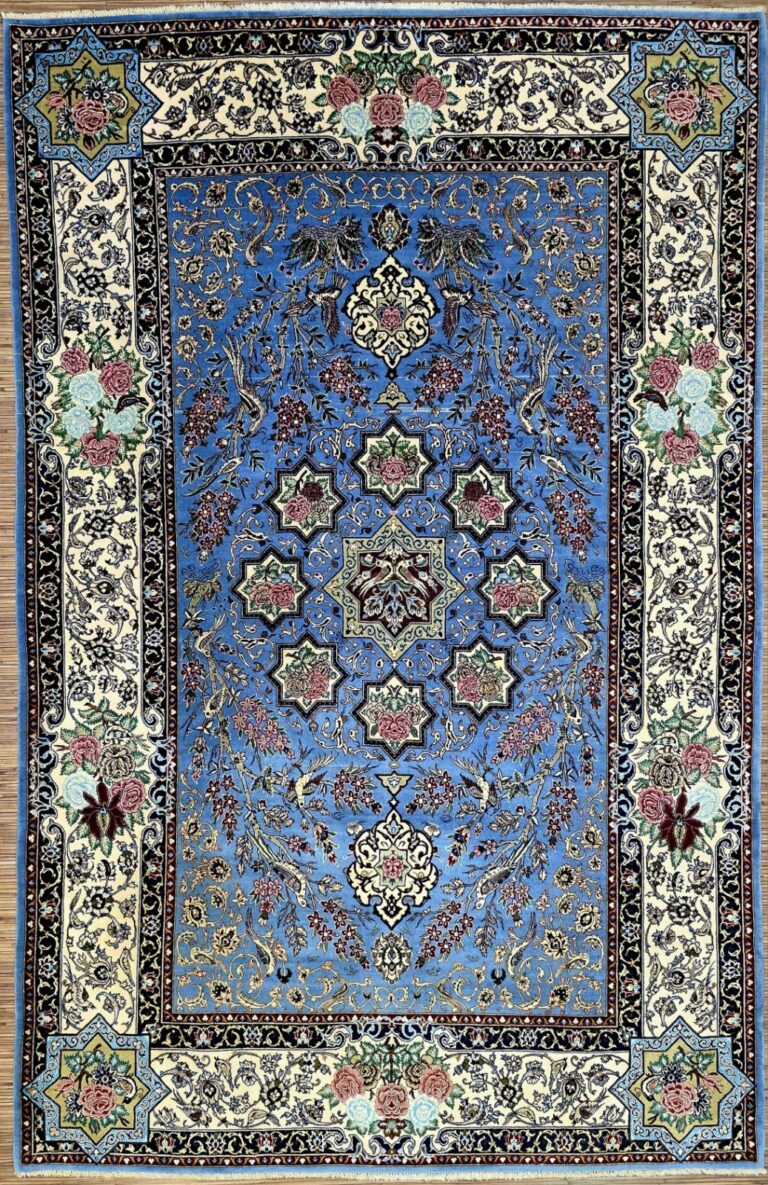
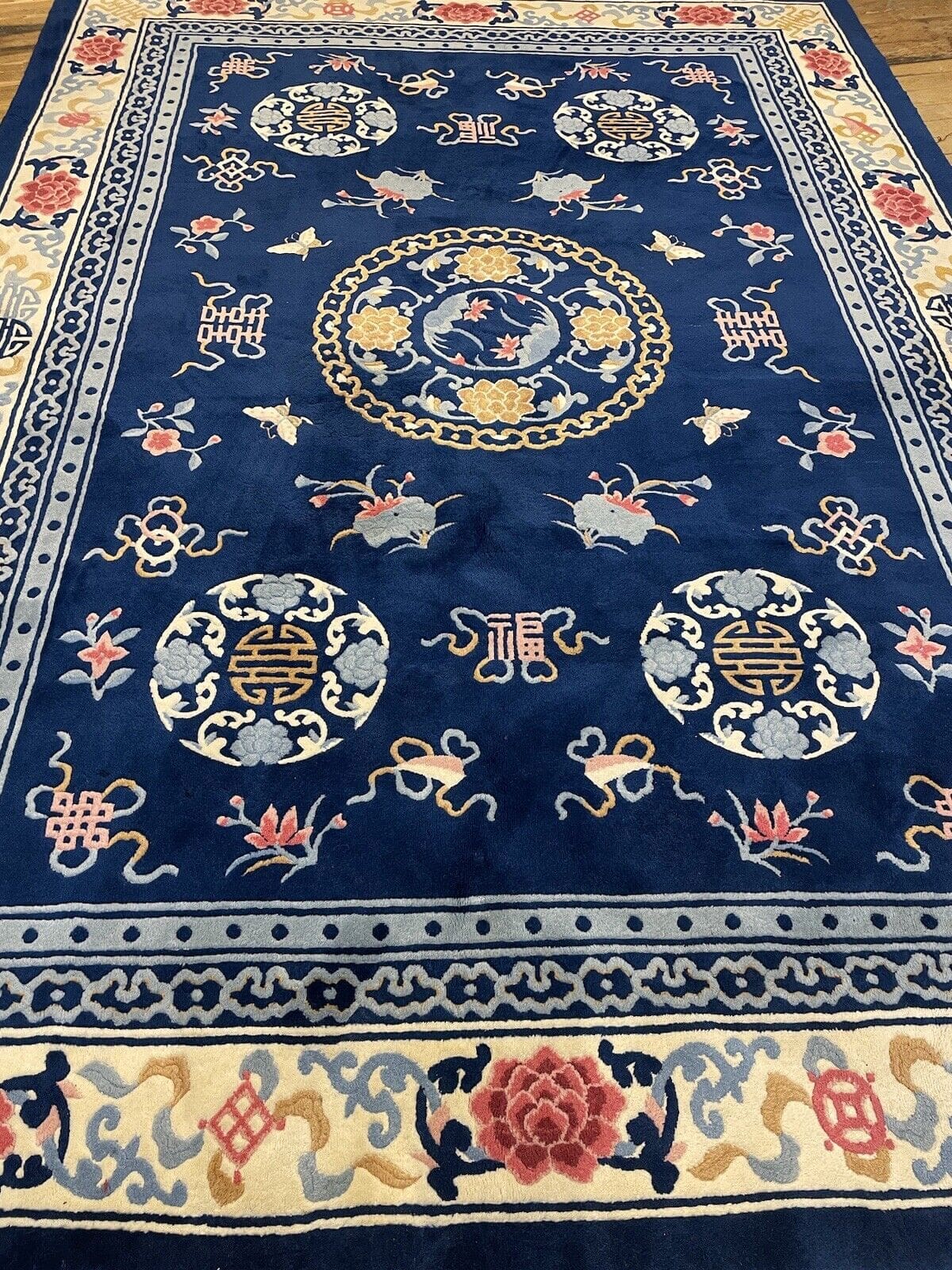
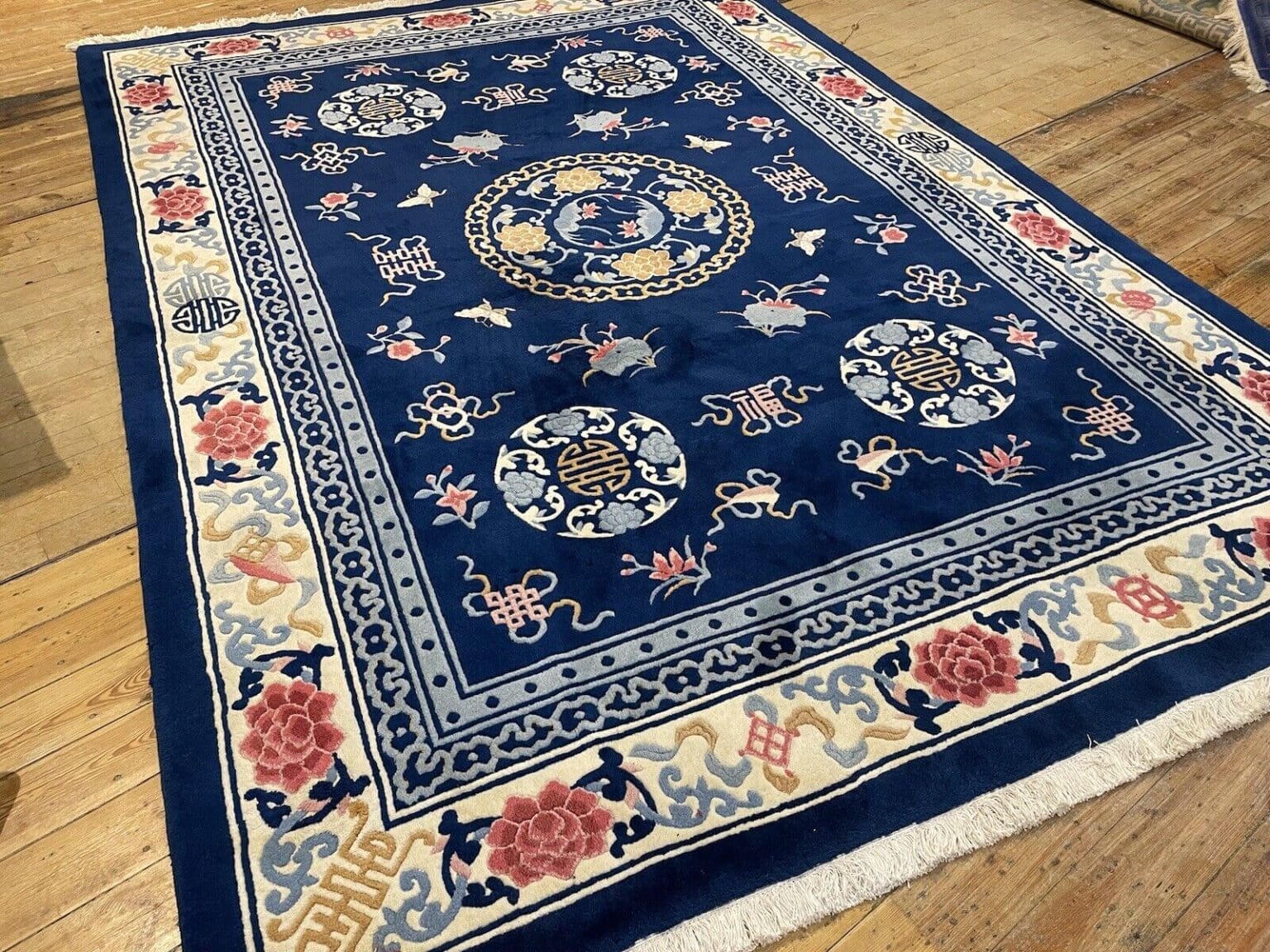
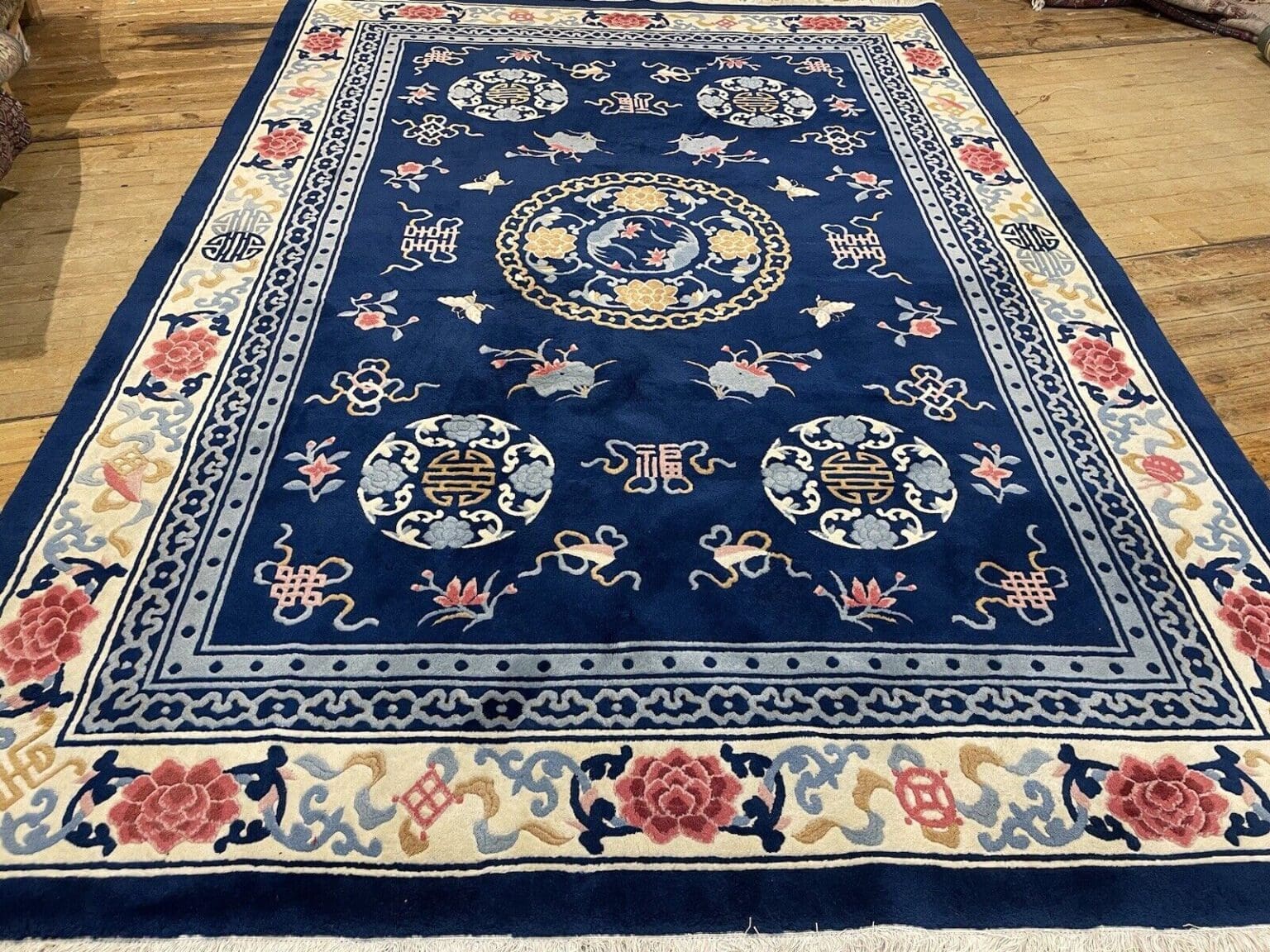
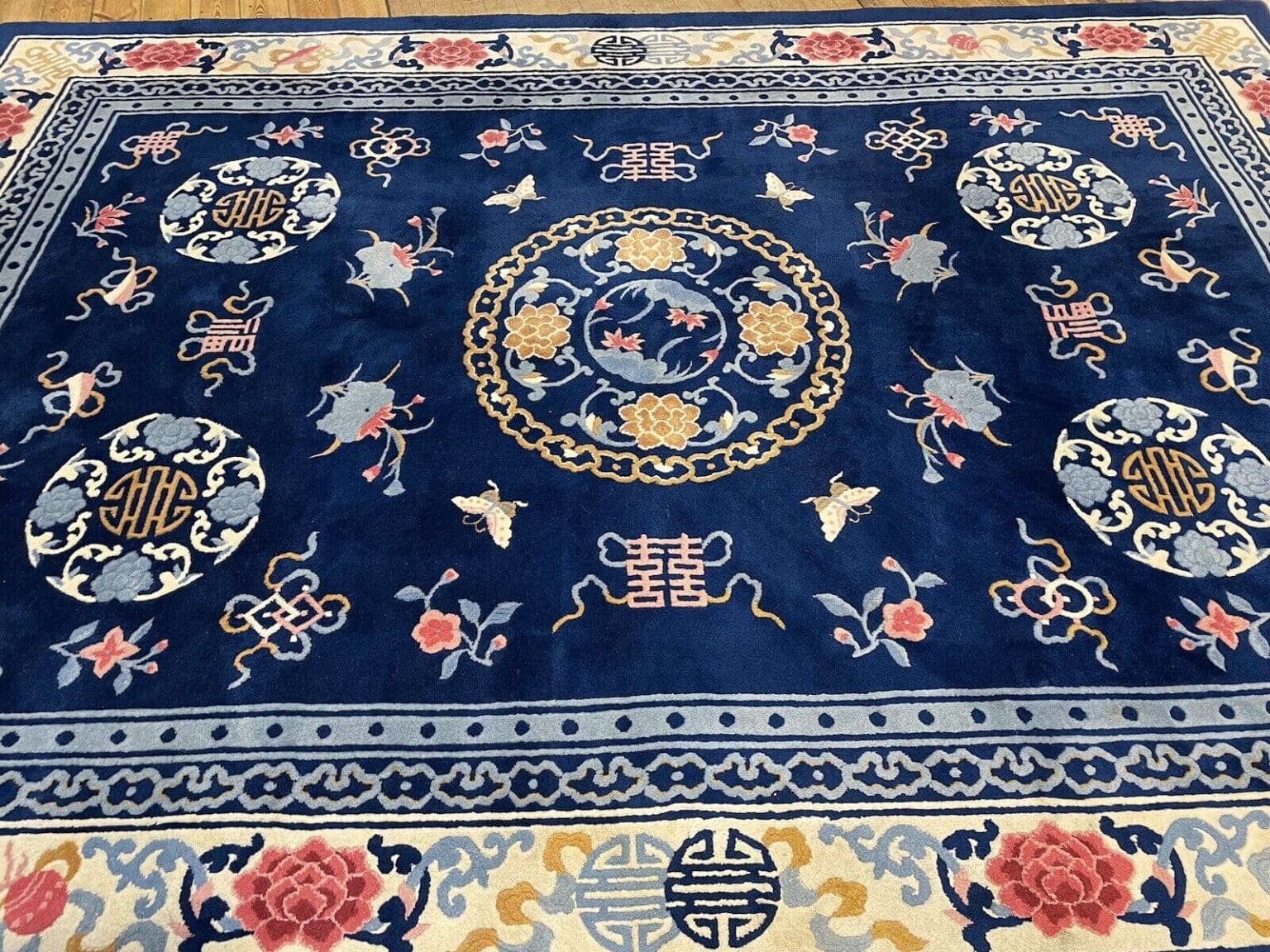
This Peking Oriental rug is hand-knotted. In this traditional method, the textile structure is created through manual work at the loom rather than through an entirely mechanical process. Knots are placed individually by hand, allowing the pattern to develop section by section. Small variations in execution are part of the character of a handmade textile. Hand-knotting is one of the established techniques of rug making and gives the finished piece a distinct relationship to the work of the maker.
The pile is made of wool, while the warp is cotton. Wool is a traditional material for the visible surface of a rug. It has a naturally tactile structure and has been used for centuries in woven and knotted floor coverings. The cotton warp provides the foundation to which the knots are attached. Together, wool pile and cotton warp create a textile surface supported by a separate structural base.
The pile height is described as 7 mm. This gives the rug a clearly defined surface without suggesting an excessively deep pile. The pattern can remain legible across the field while the rug retains the character of a comparatively moderate-pile floor covering. Its materials and technique are therefore clearly identifiable: wool determines the pile, cotton forms the warp, and hand-knotting establishes the structure.
The rug dates from the early twentieth century, specifically the period from 1911 to 1940. It is used and in good condition. With an older hand-knotted rug, evidence of use belongs to the history of the textile. The stated good condition indicates that the piece remains preserved as a usable rug while retaining its classification as a historical work from the early twentieth century.
Origin and Tradition
Peking, now commonly called Beijing, was for centuries an important political and cultural centre of China. In the vocabulary of the rug trade, Peking refers to a Chinese rug tradition with its own approach to decoration and craftsmanship. This rug is therefore classified as Chinese, or Oriental, rather than Persian. The name identifies the Peking tradition and does not indicate an Iranian origin.
Chinese rug making developed within courtly, religious, and domestic settings. Textiles were not limited to practical use; they could also express rank, cultural belonging, and ideas associated with good fortune. Rugs appeared in formal interiors, living spaces, and ceremonial contexts. Their designs drew on the Chinese symbolic world while also meeting the practical requirements of a durable floor covering.
The history of Peking rug making is often discussed as part of a much longer Chinese artistic tradition whose roots reach back to the Tang dynasty. Over the centuries, materials, colour effects, and compositions changed. Certain principles remained recognisable, including a balanced division of the surface, clearly defined ornament, and the combination of decorative form with symbolic meaning. Peking rugs thus represent a regional expression of Chinese textile art rather than a single unchanging formula.
Peking rugs are associated with developed ornament, varied colour arrangements, and an often opulent visual language. Chinese designs may draw on plants, flowers, animals, clouds, medallions, or geometric forms. These elements are not necessarily decorative in a purely formal sense. In Chinese culture, individual signs may suggest happiness, longevity, harmony, or protection. Their meaning depends on the shape, the combination with other symbols, and the cultural setting in which they appear.
Hand-knotting connects this historical tradition with each individual rug. A hand-knotted piece is formed through many separate manual actions and is therefore not simply an identical industrial product repeated without variation. Every surviving example carries the broader tradition forward in its own material form. This rug combines an early twentieth-century period with hand-knotted workmanship and a rare classic design associated with Peking.
Oriental rugs as a wider category preserve practical knowledge and cultural traditions. Their materials, motifs, and methods of production point to the regions in which particular forms developed. Across many cultures, rugs have been treated as valuable household objects as well as works of textile art, and they are often preserved across generations. The Peking rug represents the Chinese contribution to that wider history.
Design and Pattern
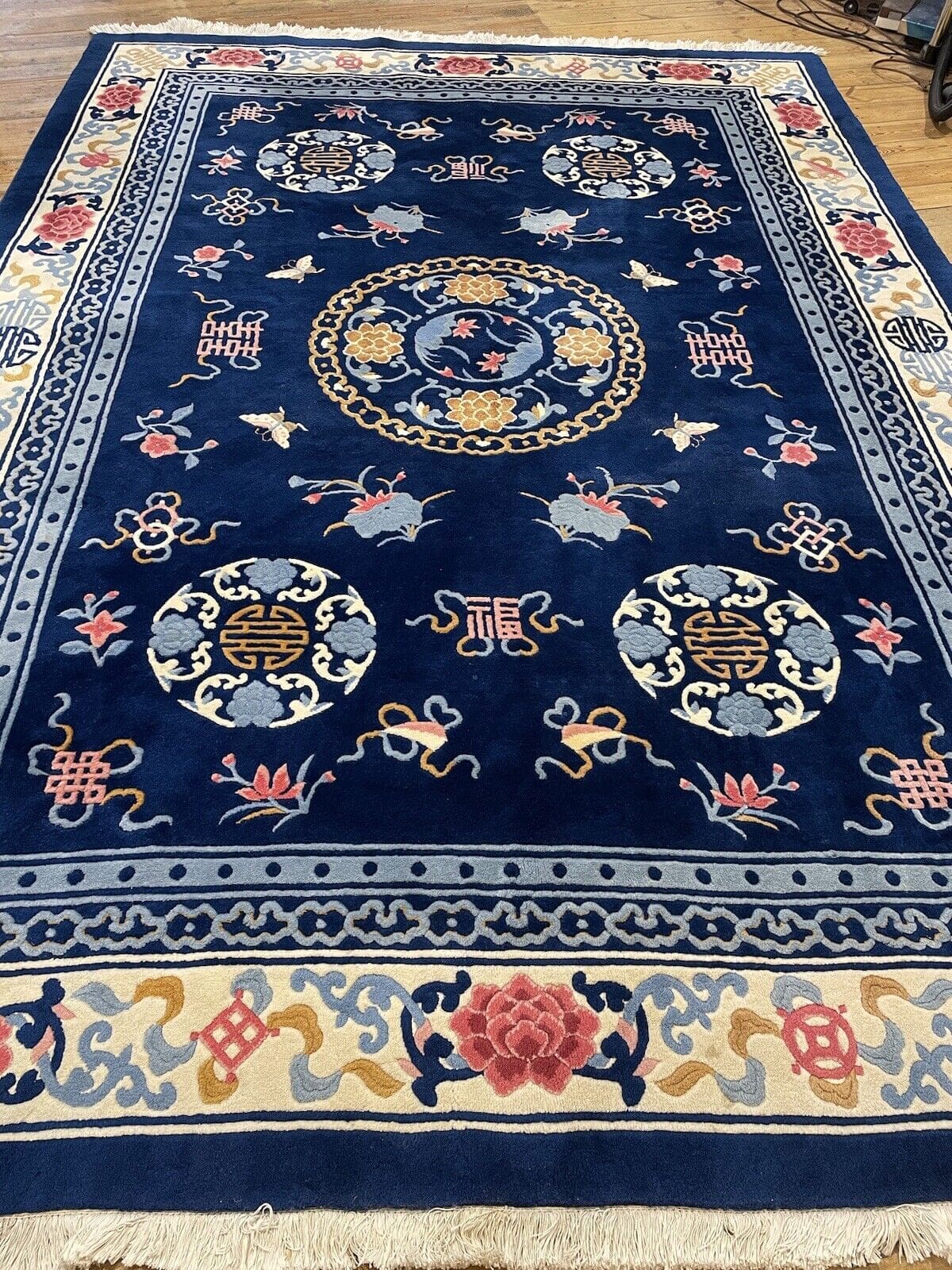
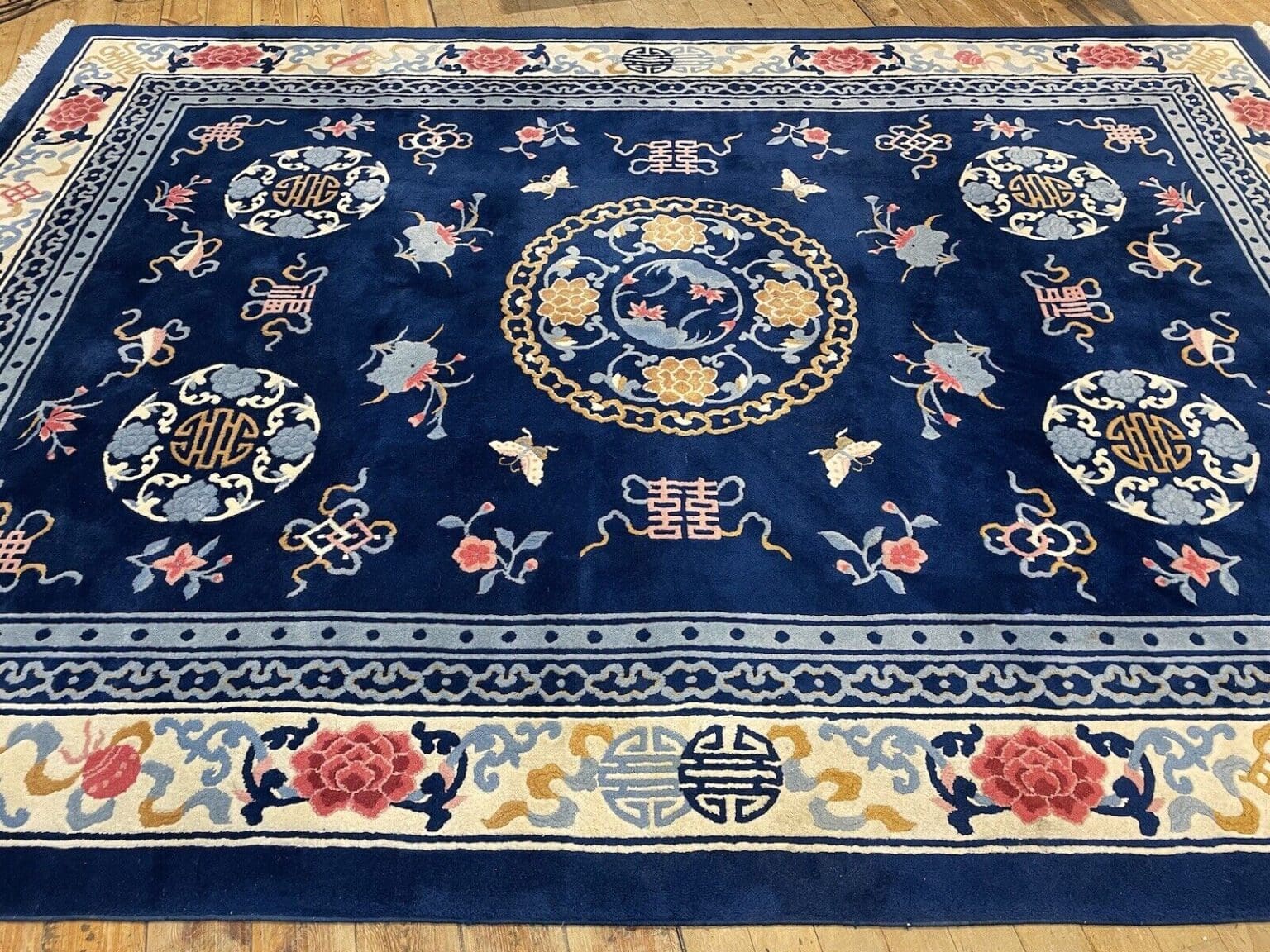
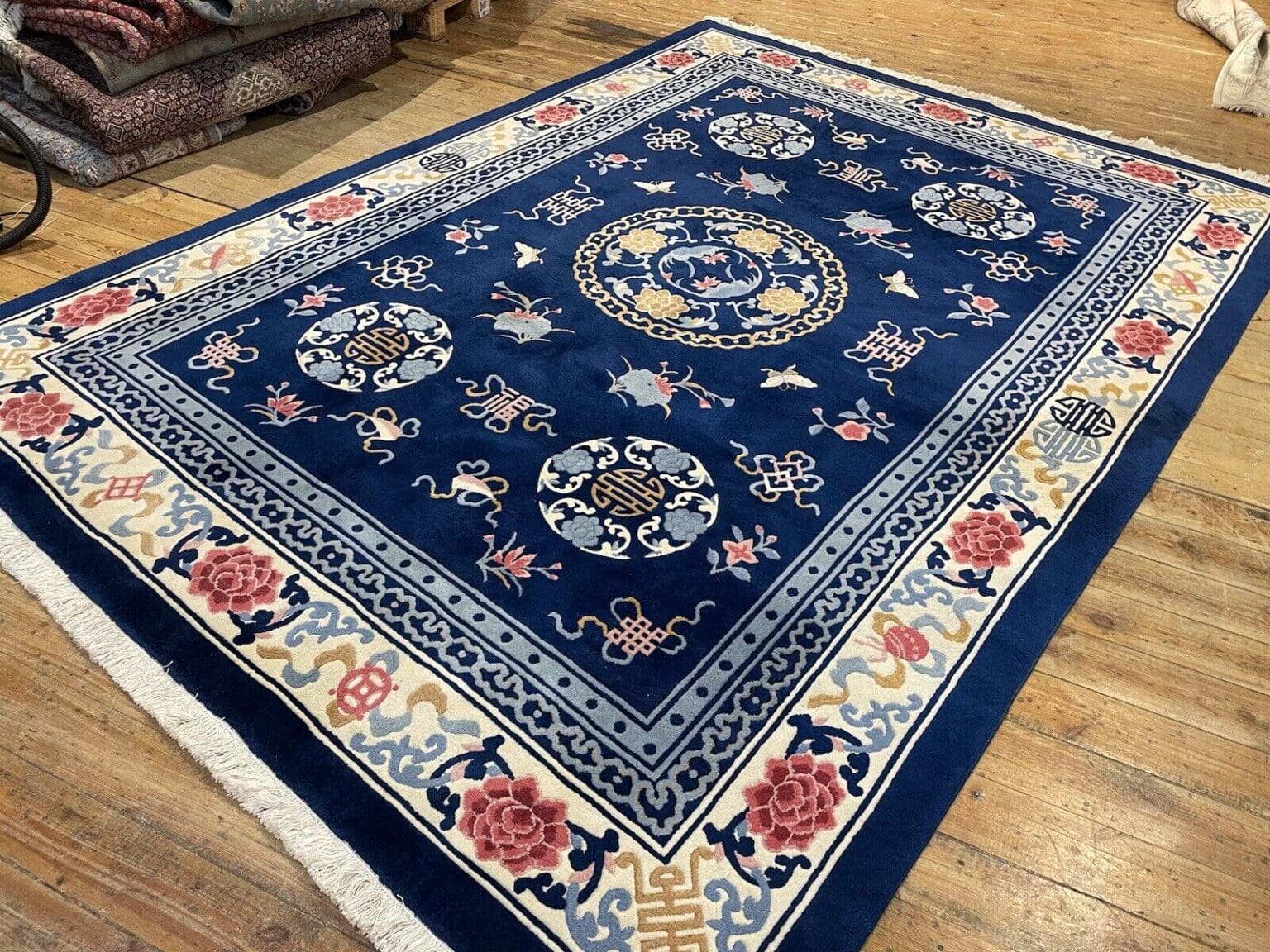
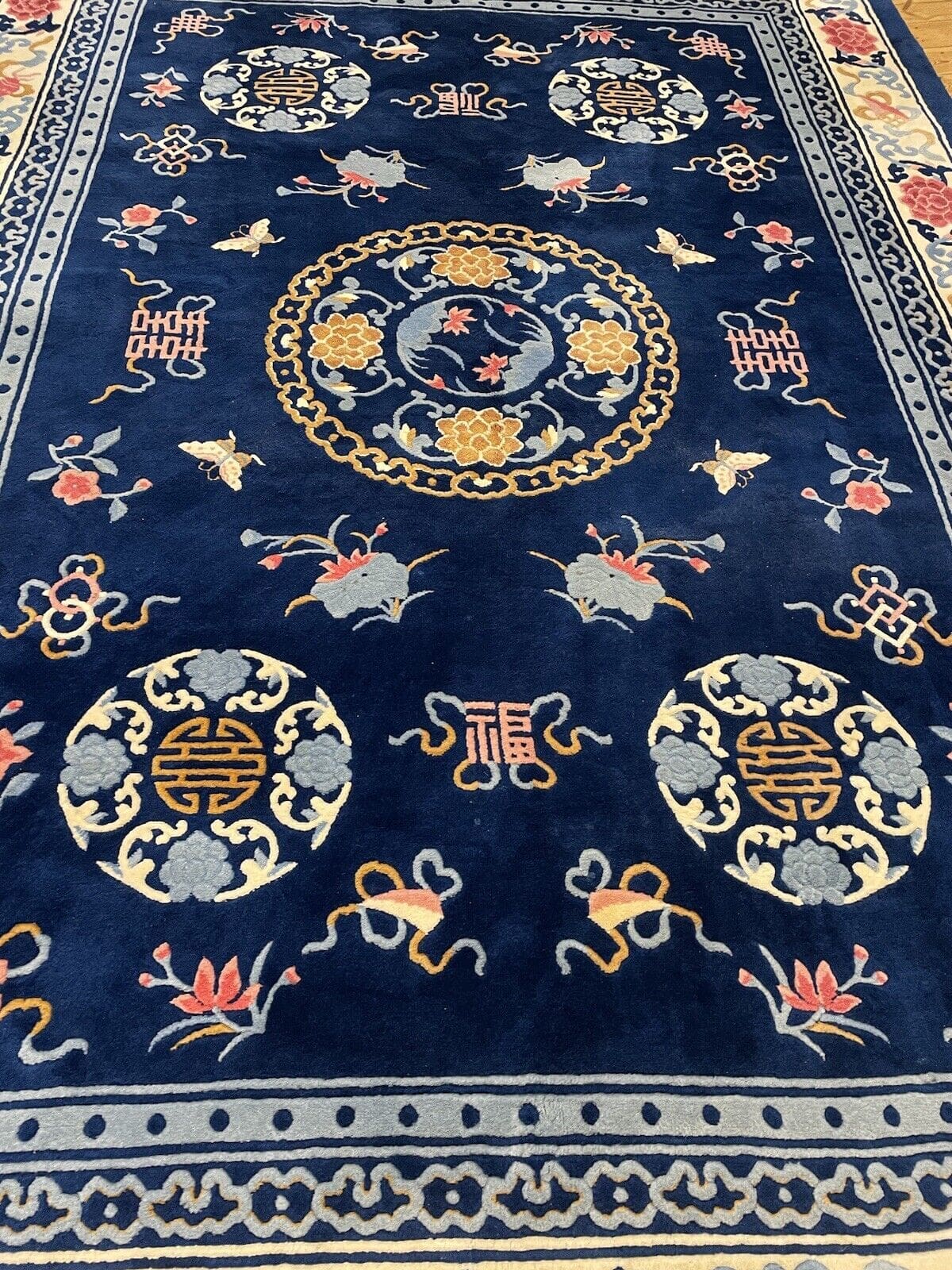
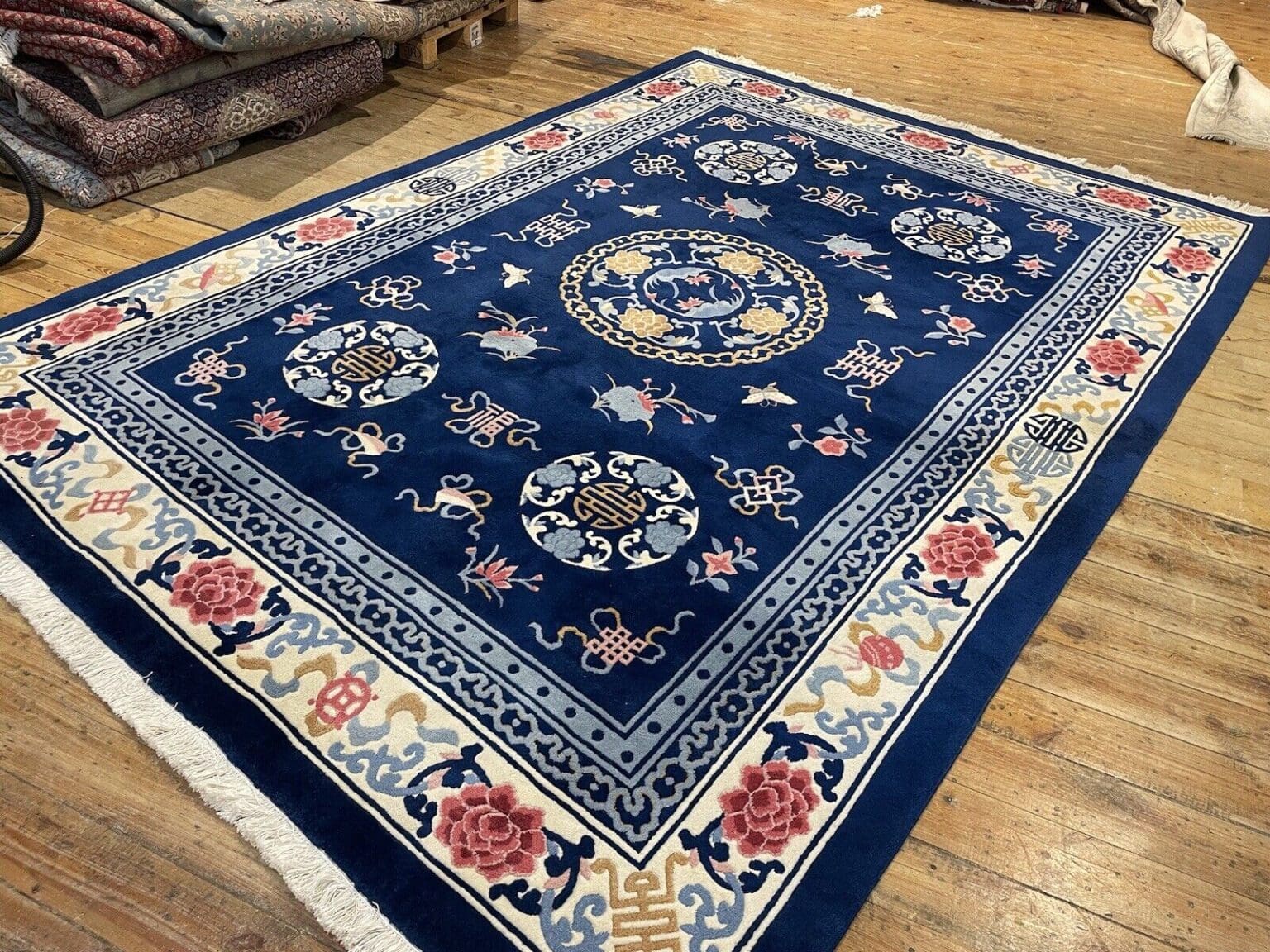
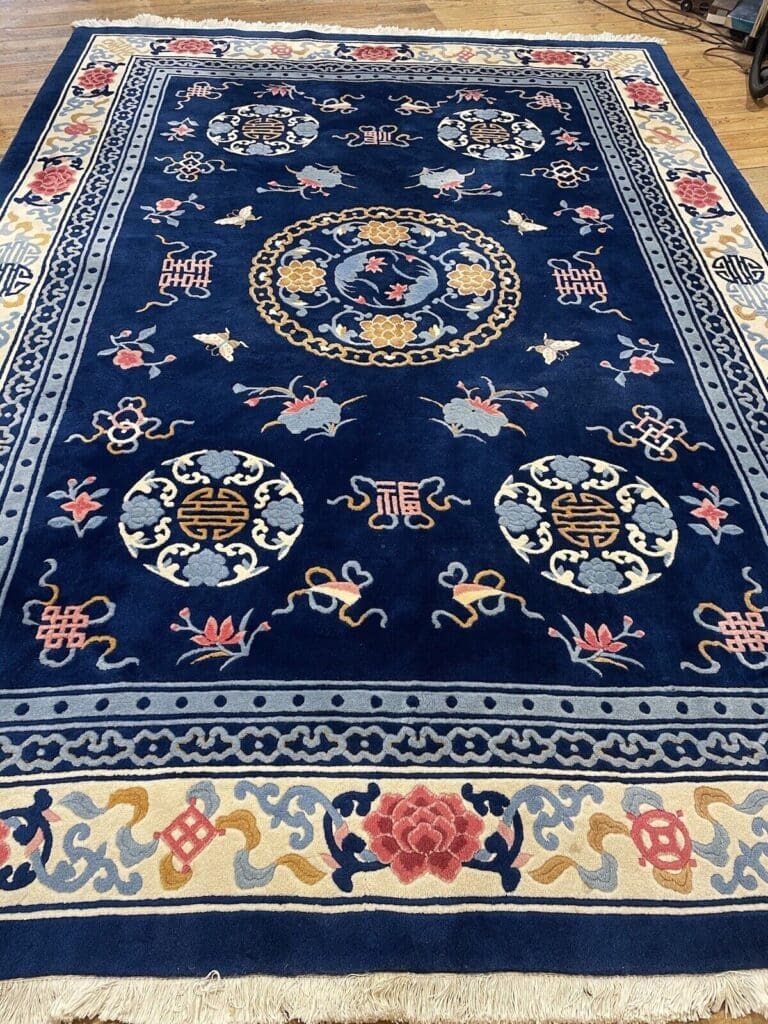
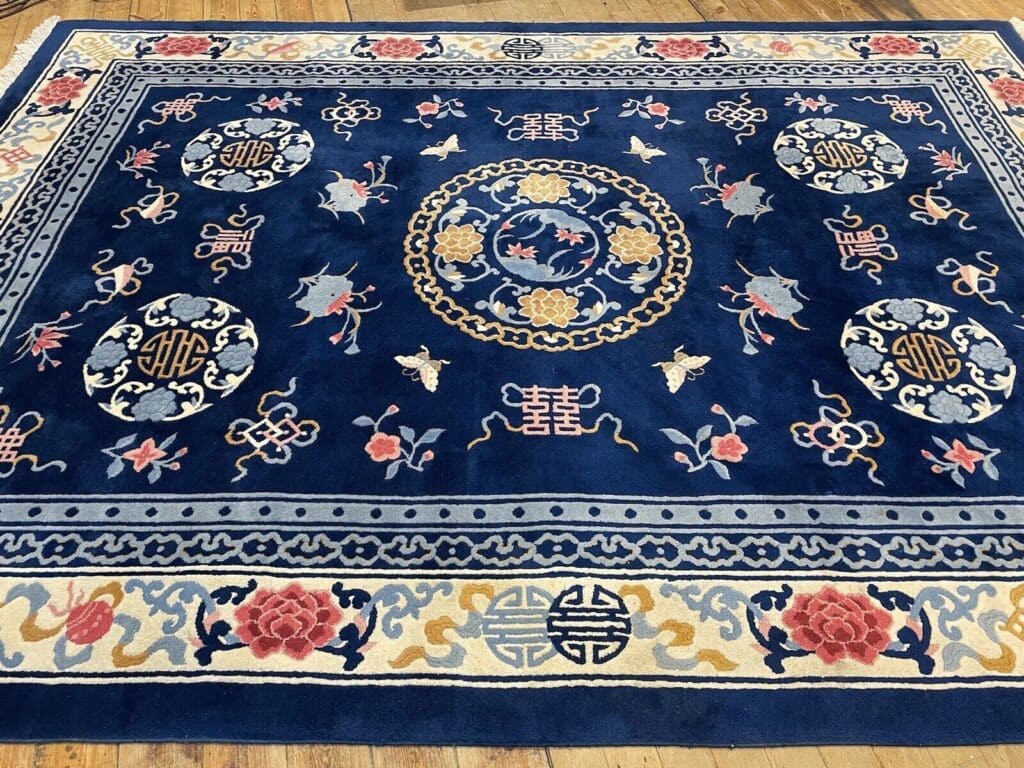
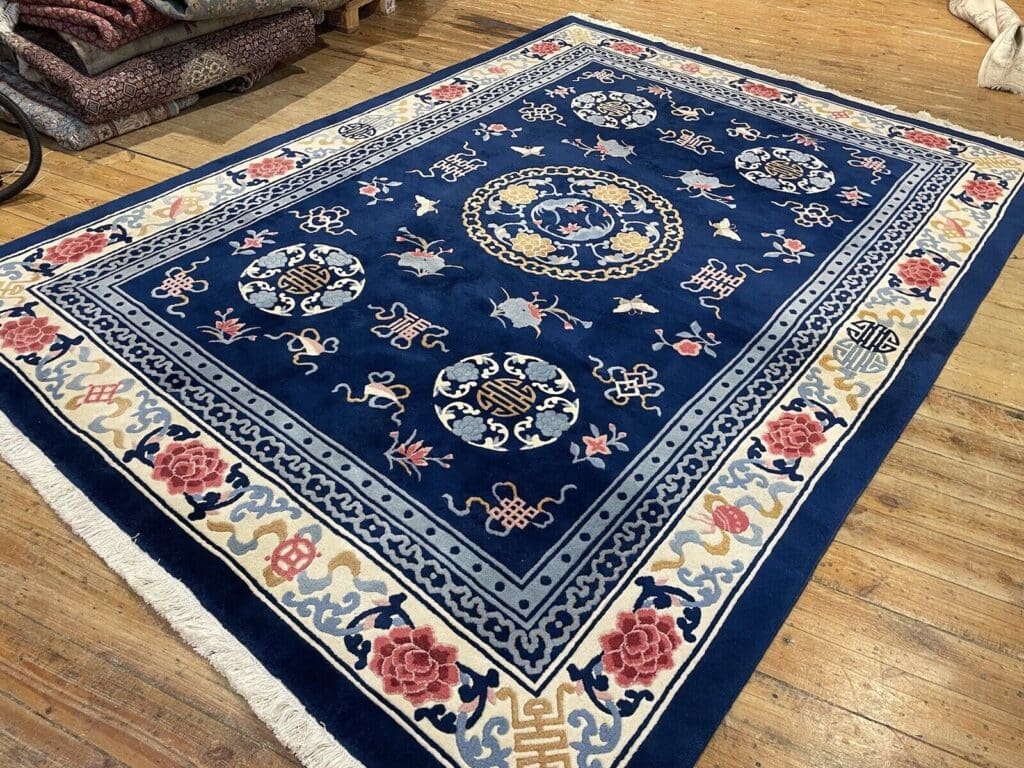
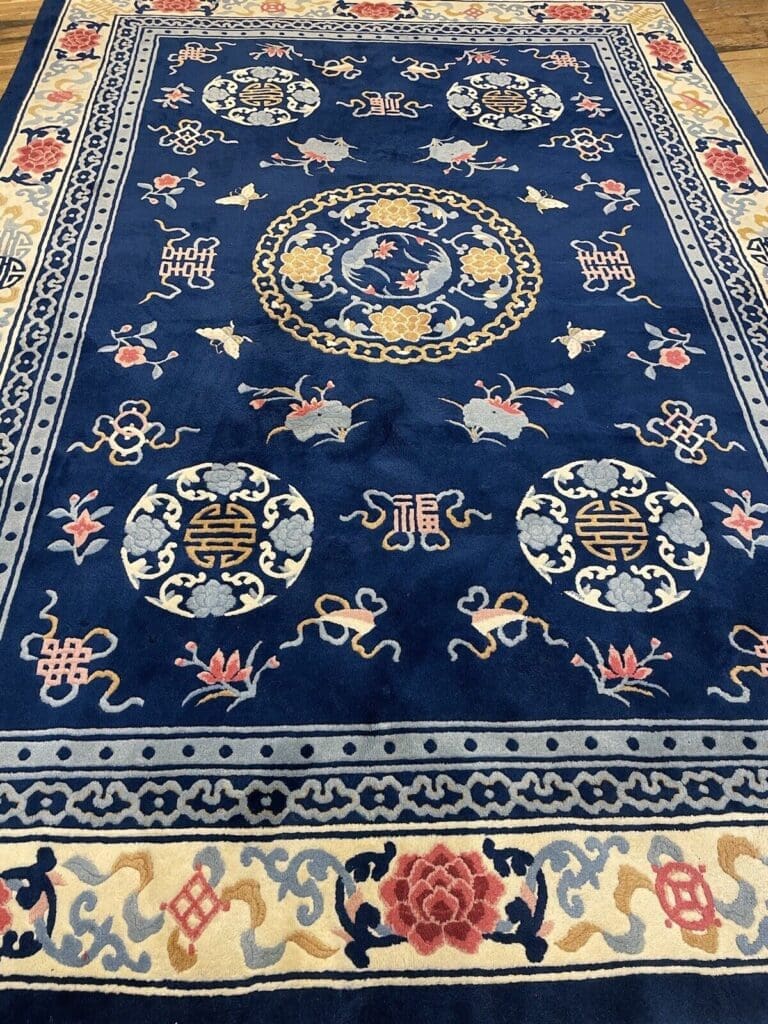
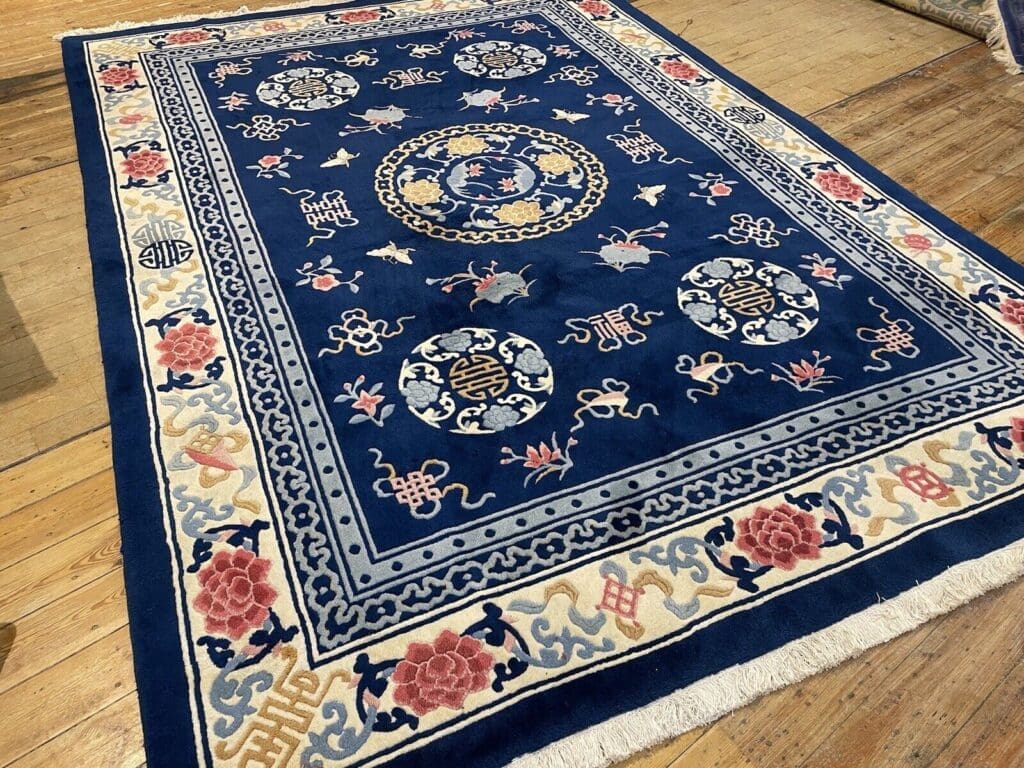
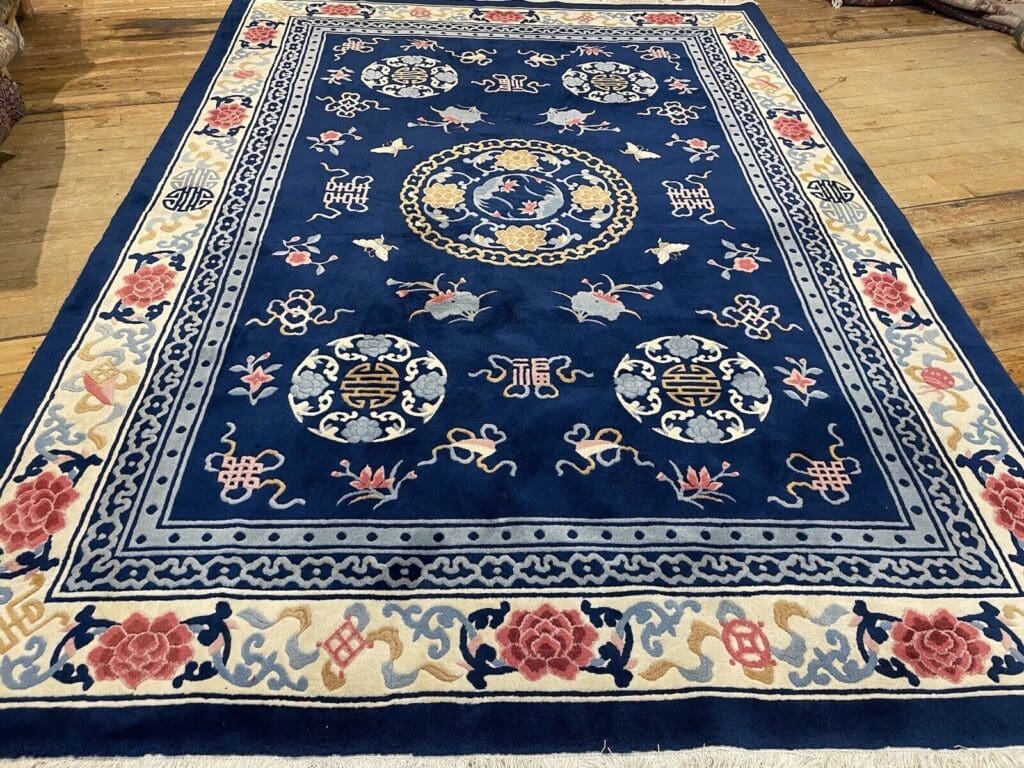
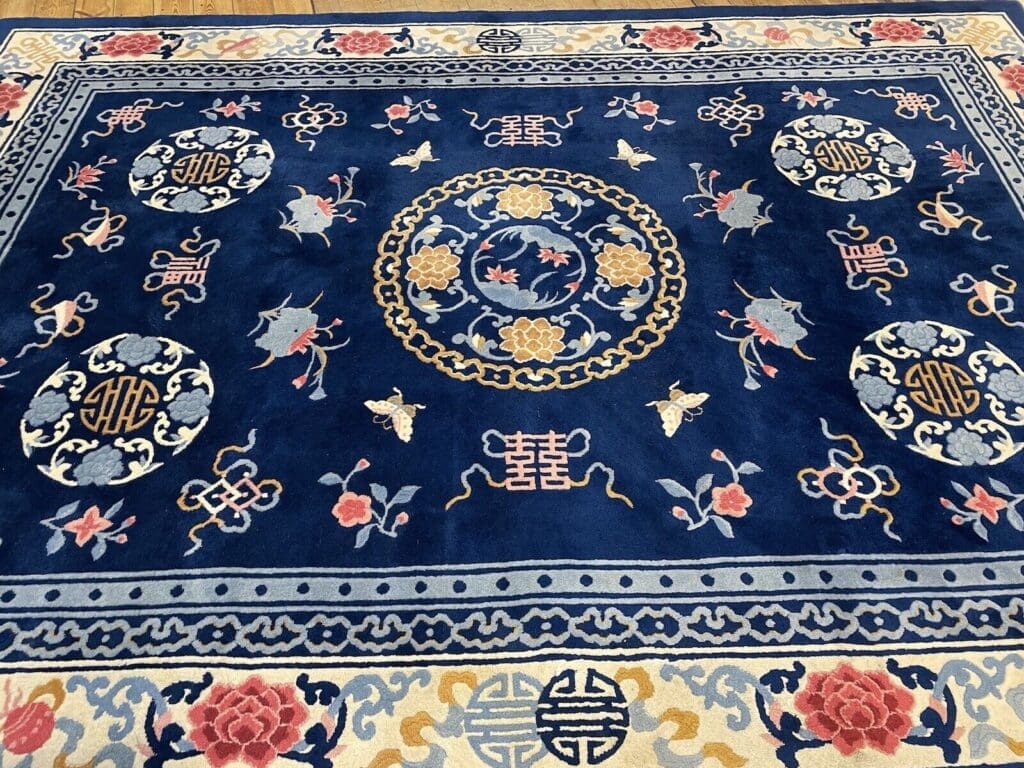
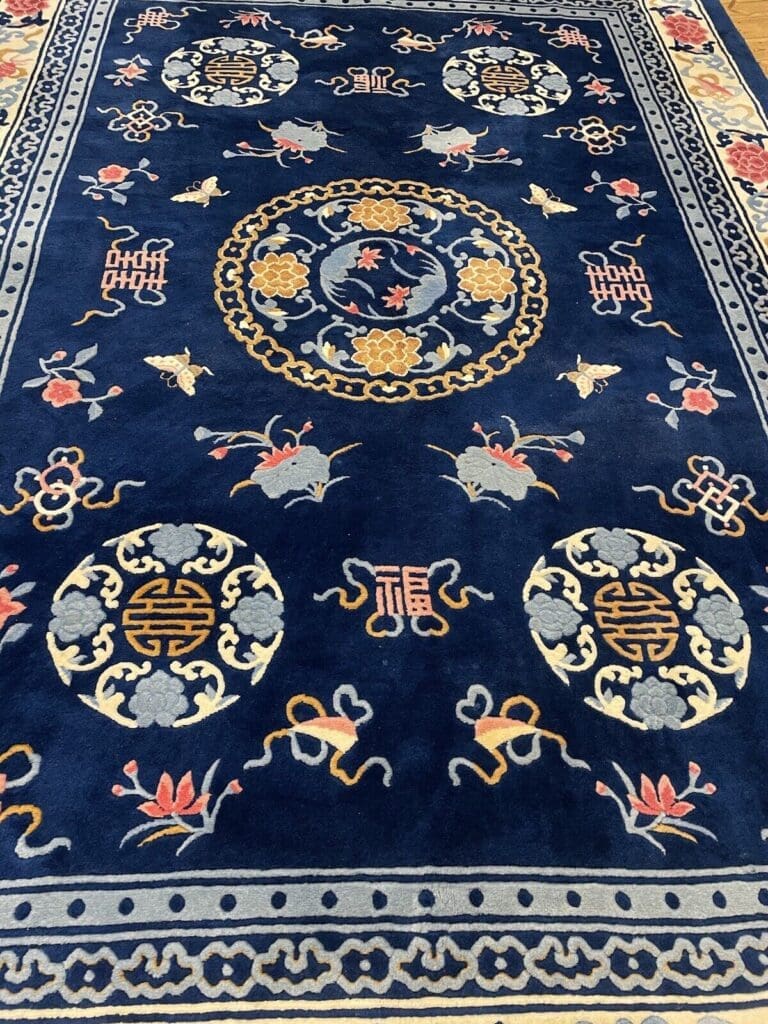
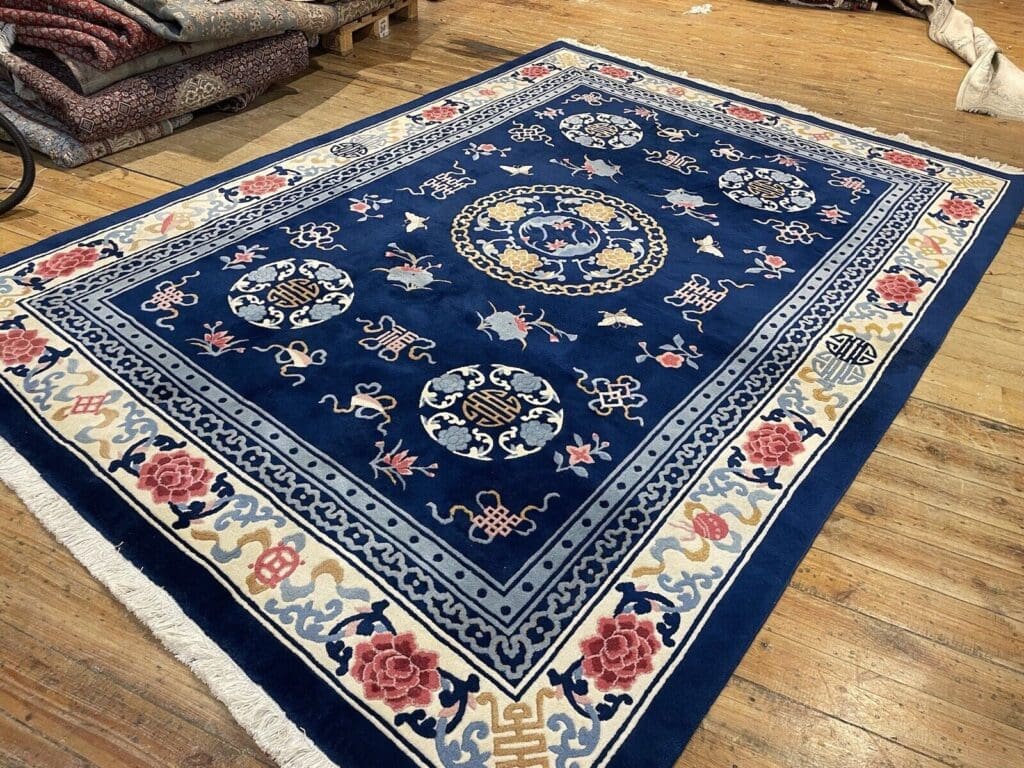
The design of this rug is described as rare and classic. That description points to a composition connected with established forms while being presented as uncommon rather than ordinary or freely interchangeable decoration. The rug is blue. This colour description defines its visible overall impression and forms an important part of how the surface is perceived.
Peking rugs may combine floral motifs, traditional medallions, and geometric shapes. Floral ornaments introduce references to the natural world. Medallions organise a field through a central sign or emphasised middle. Geometric elements create order through lines, axes, and repeated forms. These are possibilities within the broader Peking vocabulary; for this particular rug, the source identifies a rare classic pattern but does not name individual motifs in greater detail.
Chinese decorative language often gives signs a meaning beyond ornament alone. Flowers and plants may refer to growth, purity, or long life. Animals, clouds, and symbolic shapes may suggest good fortune, protection, or a harmonious relationship between the human and cosmic worlds. Historical rugs do not always present these meanings as one clearly readable scene. They can emerge through the relationship between several elements and through their position within the composition.
A classical rug design is often organised through the relationship between field and border. The central field provides space for the principal ornament, while the border frames the surface and establishes the transition to the edge. Repetition and symmetry can create visual calm; small variations can give a hand-made work its individual rhythm. In a hand-knotted rug, the effect comes not only from the motif itself, but also from the way knots, colour areas, and outlines are brought together.
Blue can take different roles in Chinese textile and interior traditions. It may appear cool, quiet, deep, or formal, and it can be set against lighter or darker tonal areas. In this rug, blue is an essential part of its visual identity. Combined with the classic pattern, it allows the piece to relate to traditional interiors as well as more contemporary settings, while its historical character remains visible.
Design and cultural context are closely connected in Oriental rugs. A pattern can organise a surface, define the visual structure of a room, and refer to inherited ideas at the same time. Rugs are therefore often understood as narrative textiles. In this Peking rug, the rare classic design and blue colouring are the stated points of identification. Individual motifs and a precise symbolic interpretation are not specified and are not assigned here.
Special Features
A notable feature of this rug is its description as a rare piece from the early twentieth century. It is hand-knotted and made with a wool pile on a cotton warp. The combination of historical period, manual production, and classic design gives it an individual profile. Its used condition, described as good, is also part of its identity as a preserved older textile.
The rug is suitable for use with underfloor heating. It can therefore be considered for rooms in which this type of heating is installed. The suggested settings are a bedroom, dining room, or living room. Its blue colour and rare classic pattern allow it to be placed within different interior schemes, while the hand-knotted construction keeps its connection to traditional rug making visible.
Historical rugs are often regarded as more than floor coverings: they are textile objects in which material, workmanship, age, design, and condition meet. This piece brings those characteristics together within the Peking tradition. It can serve as a furnishing element and at the same time be kept as an older example of Chinese rug craft.
FAQ
What is a hand-knotted rug?
A hand-knotted rug is made manually, with individual knots inserted by hand into the warp until the pile, pattern, and connected rug surface are formed. Unlike a fully machine-made product, its construction depends on the repeated work of the person at the loom. This means that small individual variations may occur in the execution. Knot arrangement, knot density, and the careful formation of outlines influence how much detail a design can show. In a Peking rug, this technique connects the surface with the Chinese tradition of rug making. This particular rug has a wool pile, a cotton warp, and hand-knotted construction. Those details describe its materials and method of manufacture without claiming additional properties merely because it was made by hand.
How should I care for my Oriental rug?
Regular, gentle cleaning is recommended for an Oriental rug. Dust and loose dirt should be removed without placing unnecessary stress on the surface. Direct sunlight should be avoided so that the colours can remain as even as possible. Care is especially important with an older hand-knotted rug, since wool and its textile construction should not be treated like an arbitrary modern floor covering. If a more thorough cleaning is needed, it should be entrusted to specialists. Professional treatment can take the material and hand-knotted structure into account. Strong cleaning agents or unsuitable methods may damage fibres and colours, so they should not be used without an informed assessment. Care should preserve the rug’s existing condition rather than attempting to make an older textile appear newly manufactured.
How does a Peking rug differ from other Oriental rugs?
Peking rugs belong to the Chinese rug tradition and consequently differ from rugs made in other regions, each of which has developed its own forms, colours, and techniques. Their decoration is often connected with Chinese culture and its symbolic vocabulary. Elaborate compositions, detailed ornament, and a varied use of colour are features commonly associated with Peking rugs. Other Oriental rugs may reflect regional influences from Iran, Central Asia, or other Asian and European rug-producing areas. Their motifs and methods follow different historical paths and may carry different cultural references. This particular rug is assigned to the Chinese Peking tradition because of its Peking designation, blue colour, and rare classic design; it is not classified as Persian.
To provide the best experiences, we use technologies like cookies to store and/or access device information. Consenting to these technologies will allow us to process data such as browsing behavior or unique IDs on this site. Not consenting or withdrawing consent, may adversely affect certain features and functions.
Functional Always active
The technical storage or access is strictly necessary for the legitimate purpose of enabling the use of a specific service explicitly requested by the subscriber or user, or for the sole purpose of carrying out the transmission of a communication over an electronic communications network.
Preferences
The technical storage or access is necessary for the legitimate purpose of storing preferences that are not requested by the subscriber or user.
Statistics
The technical storage or access that is used exclusively for statistical purposes.The technical storage or access that is used exclusively for anonymous statistical purposes. Without a subpoena, voluntary compliance on the part of your Internet Service Provider, or additional records from a third party, information stored or retrieved for this purpose alone cannot usually be used to identify you.
Marketing
The technical storage or access is required to create user profiles to send advertising, or to track the user on a website or across several websites for similar marketing purposes.

 SECURE PAYMENT
 SHIPPING PARTNERS