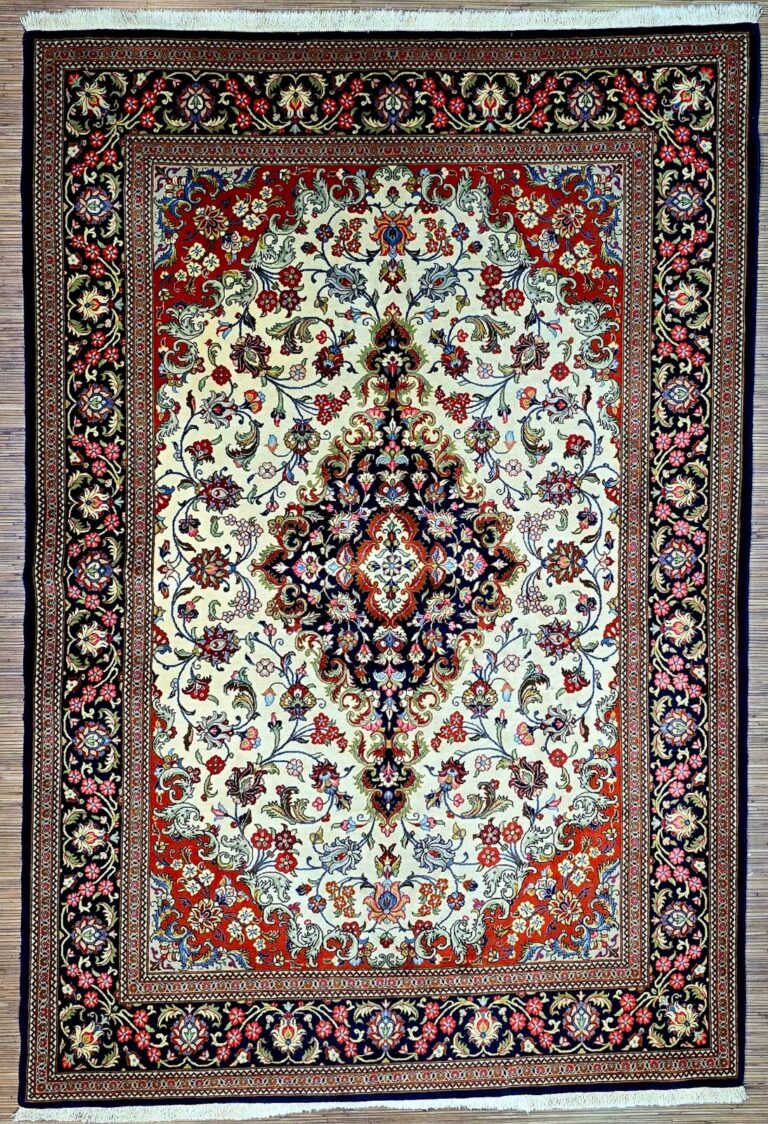
This Keshan rug is hand-knotted and has a pile made from high-quality sheep wool. Cotton is also listed among its materials. Sheep wool is valued in rug making for its resilience, comfortable feel and natural ability to retain warmth. Its fibres create a pleasant surface underfoot and are well suited to a rug intended for regular use in a living space.
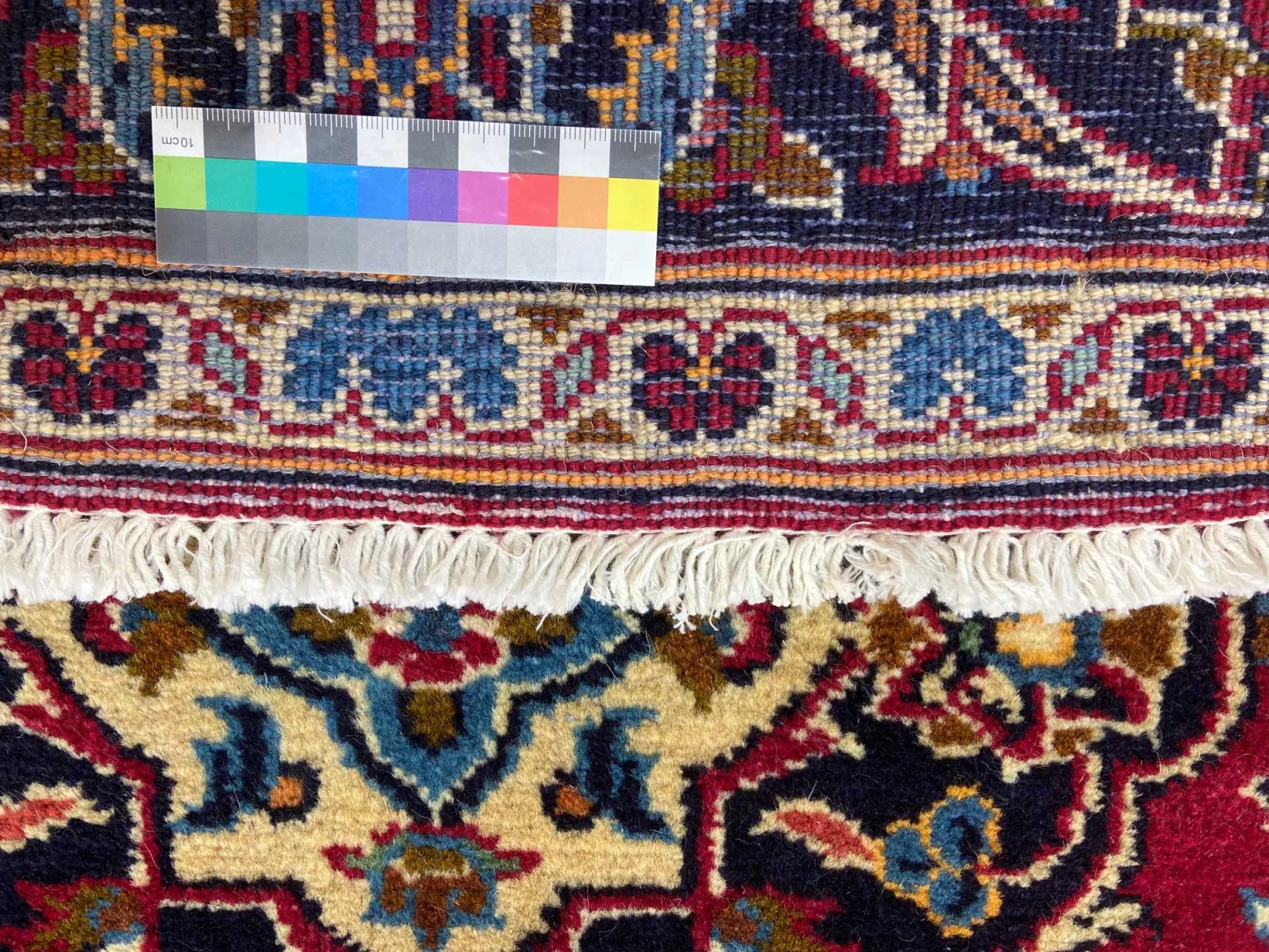
Hand-knotting links the material directly to the way the rug is made. Each knot is placed by hand, row after row, rather than being produced as part of a uniform series process. This gives an individual piece its own surface character. The technique also allows the maker to define small floral details, medallions and geometric shapes with considerable precision.
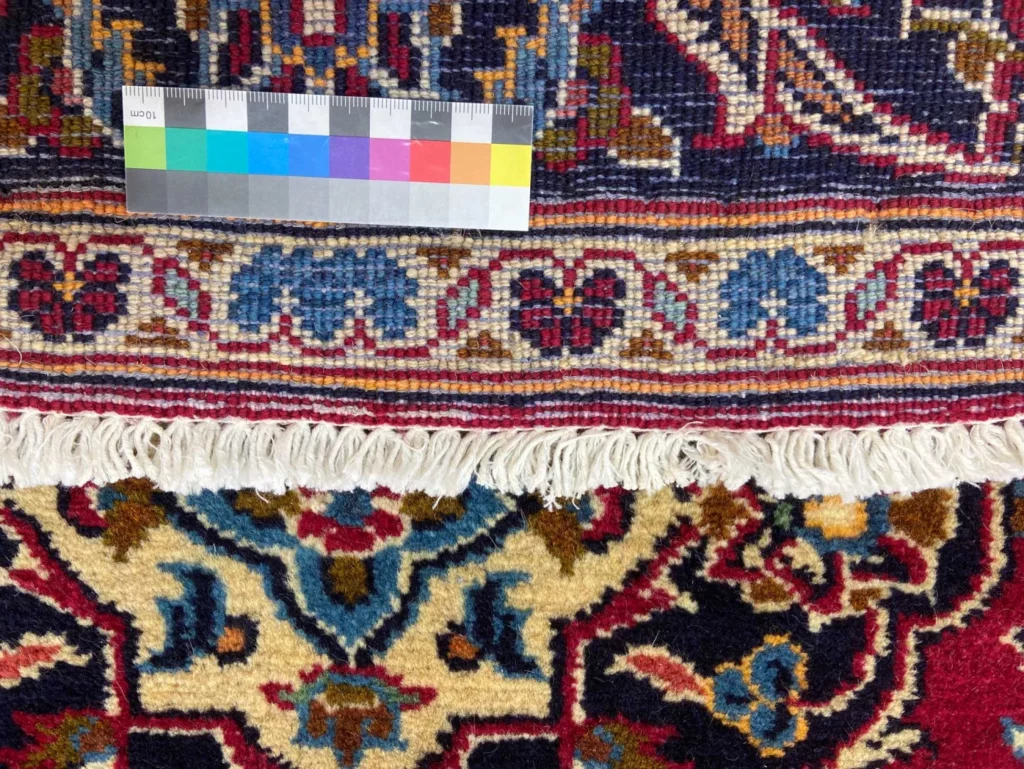
The knot density of this rug is between 150.000 and 300.000 knots per square metre. A dense construction supports the clear rendering of intricate designs and contributes to the resilience of the woven structure. Together, high-quality sheep wool and careful handwork form a construction intended for lasting use. The rug is described as hard-wearing and is in very good condition.
A hand-knotted Keshan rug passes through many stages of work. The design is prepared, individual knots are inserted, and the surface is then finished so that the drawing can be read clearly. The process explains why details, colour areas and outlines can have their own slight character in a handmade rug. It is also part of the wider craft tradition of Persian rug making.
Origin and Tradition
Keshan, also written Kashan, is a city in Iran with a long-established tradition of rug making. Located in central Iran, it has been associated with the production of finely worked rugs for centuries. Keshan rugs are recognised as an important expression of Persian knotting. Their regional tradition brings together precise craftsmanship, balanced ornament and a clearly organised overall composition.
The rug culture of Keshan developed in a city positioned on historic routes linking the Iranian plateau with central areas of Persia. This setting allowed textile methods, design ideas and colour practices to develop over a long period. Skills were passed from one generation to the next. Rugs from Keshan are not all identical, but the regional school is often recognisable through its preference for structured layouts, floral ornament and controlled colour relationships.
Persian rugs are understood through more than their decorative appearance. Their significance also lies in the combination of fibre knowledge, drawing and manual skill. In Keshan, established Persian visual themes are translated into textile form. Flowers, scrolling vines, medallions and geometric elements are arranged to create a coherent field. The makers work within a tradition of proportion, repetition and balance that gives the composition its order.
The Keshan tradition includes both formal rugs and pieces intended for domestic interiors. A floral design may be organised around a symmetrical centre, or it may unfold as an all-over field without a dominant centre. Border bands frequently frame the central area and give the rug a defined edge. These devices belong to the vocabulary of Persian rug design and are not limited to one historical period.
The history of Persian rug making reaches far back. Rugs have served as useful textiles, works of art and carriers of regional design. Keshan has maintained this combination particularly clearly. The city represents a knotting tradition in which fine drawing and a dense construction work together. The continuing appreciation of Keshan rugs therefore relates both to their hand production and to their place within Iranian cultural history.
This rug can be understood as part of a living regional tradition. The name identifies Keshan as a centre of origin and style, while the motifs draw on the broader language of Persian ornament. Origin does not mean that every piece has the same arrangement. Rather, the regional school provides a framework in which drawing, colour and knotting are interpreted individually by the maker.
Design and Pattern
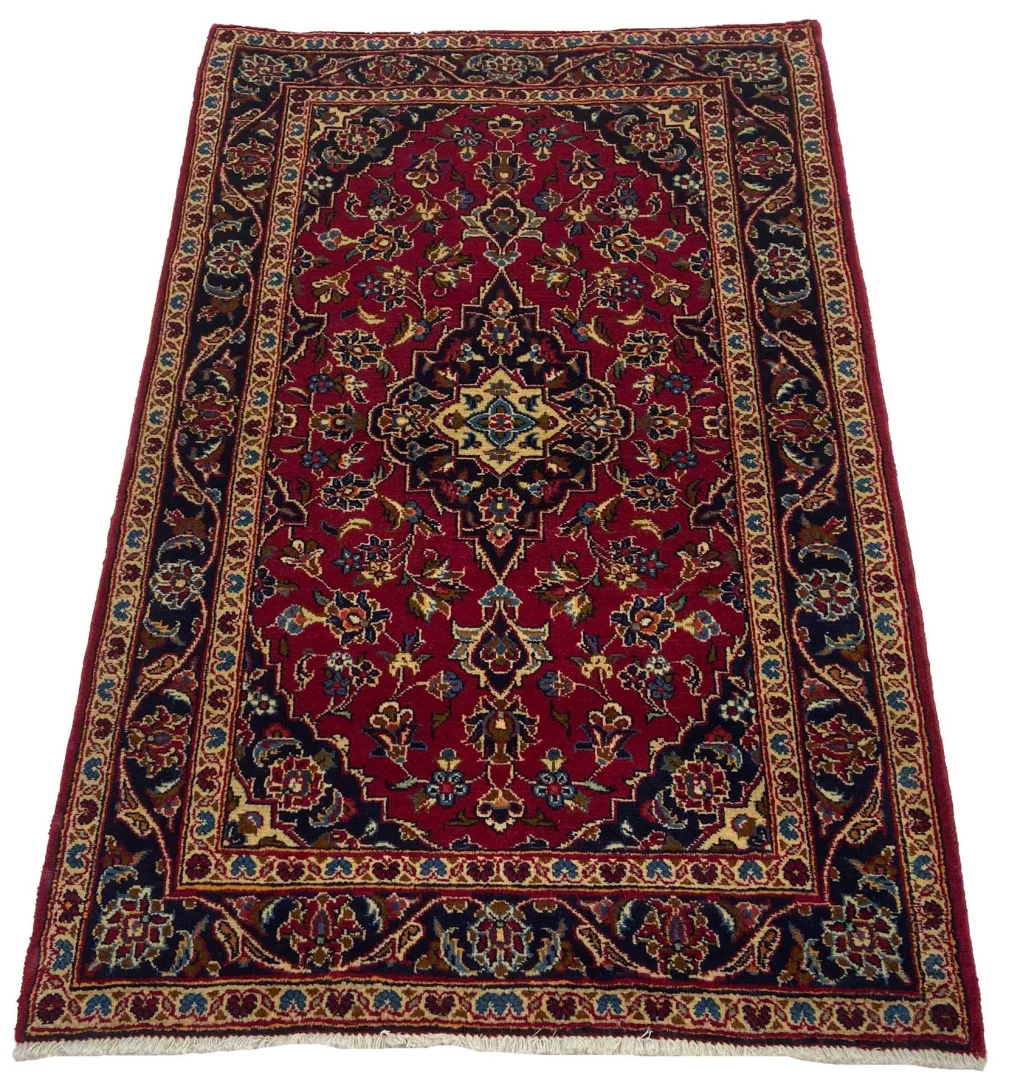
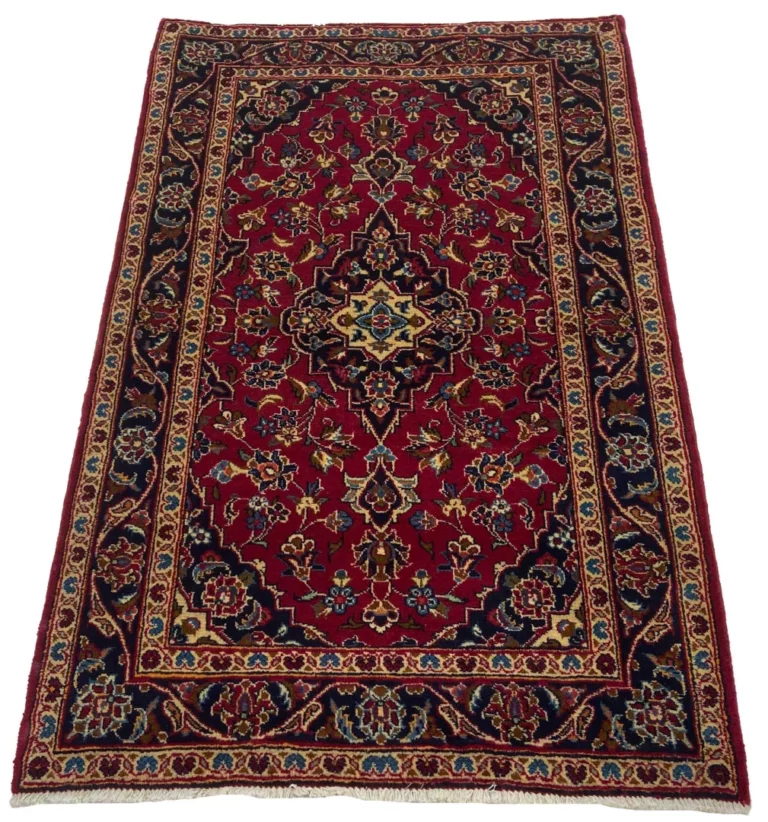
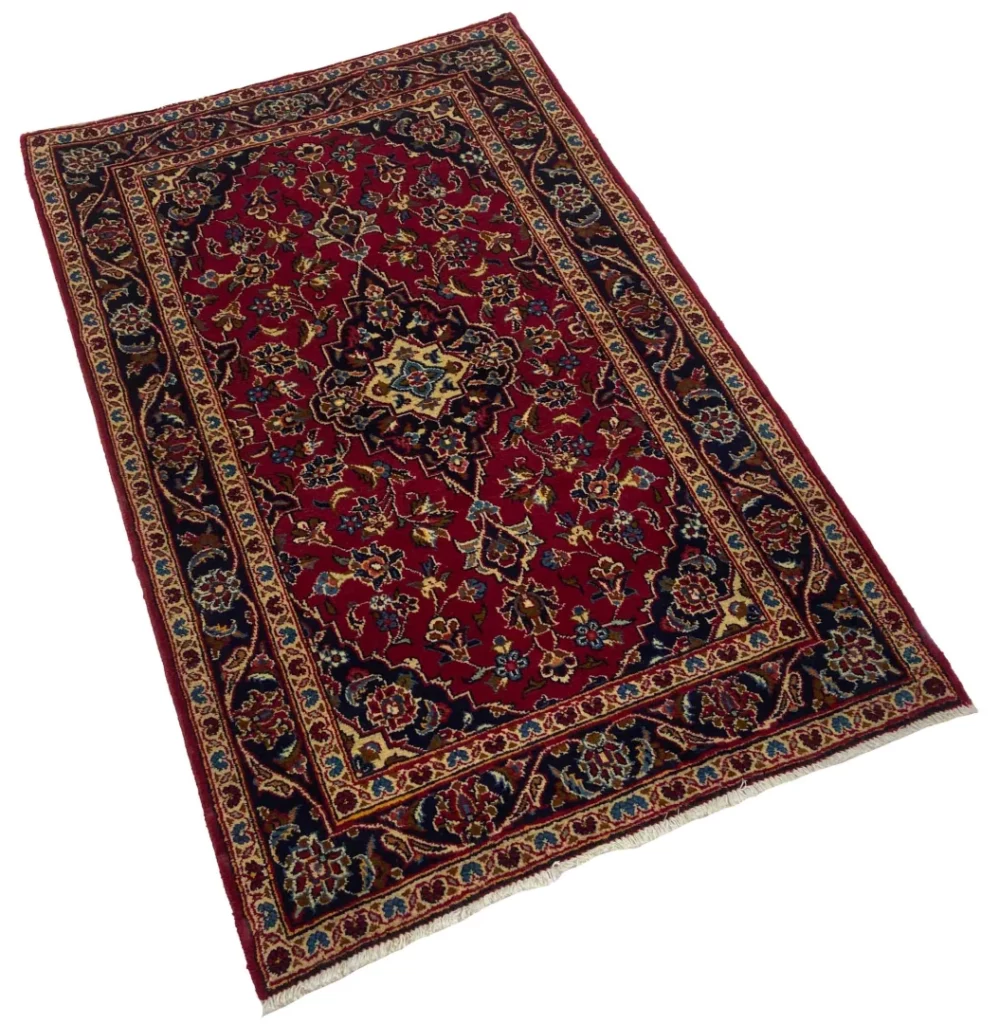
Keshan rugs are especially associated with floral designs. Flowers, leaves and scrolling vines may be combined into dense ornamental fields, while a medallion can establish a clear visual centre. Geometric forms may be used alongside organic lines, separating sections of the design and giving the composition additional structure. Decorative details and the larger arrangement are intended to function together.
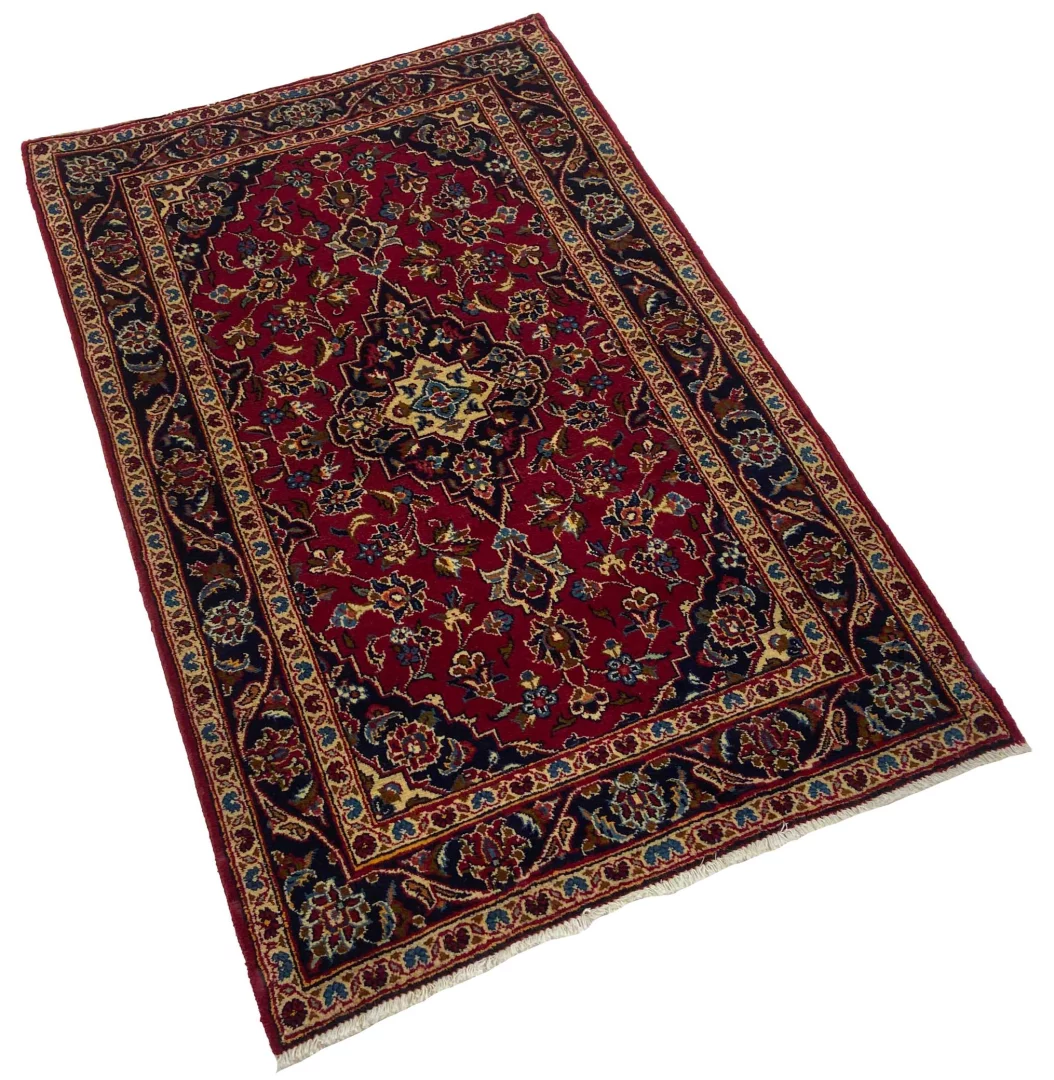
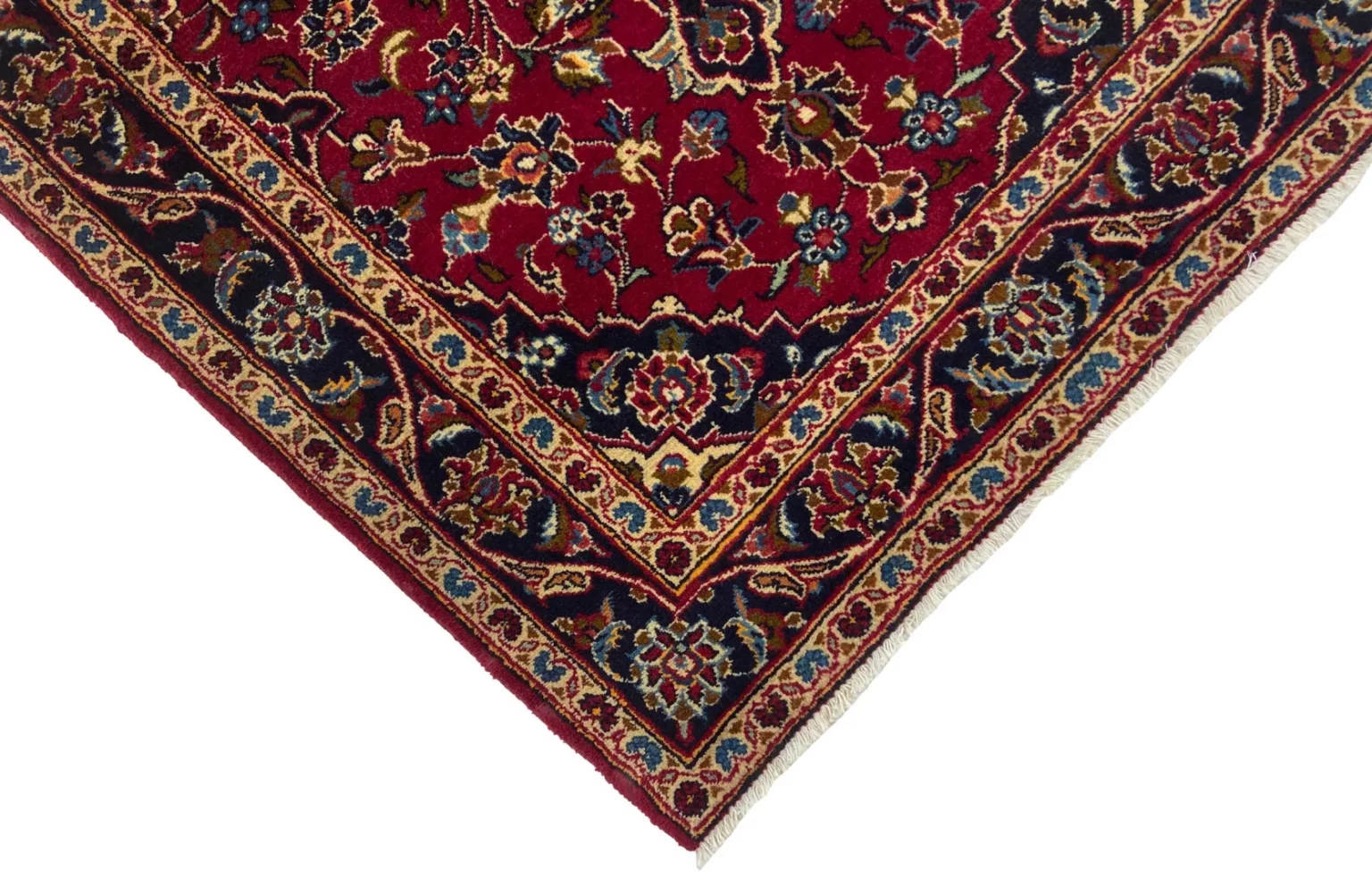
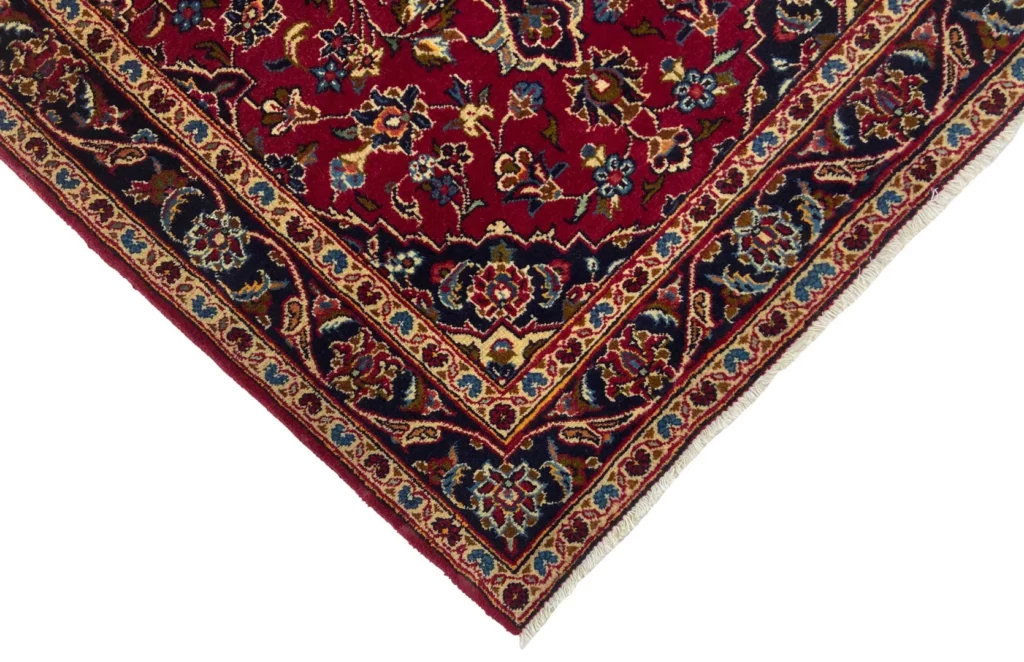
The medallion is a classic element of Persian rug design. It may be placed at the centre and surrounded by floral vines, or it may be balanced by repeated ornament across the field. Keshan compositions can use either a centred arrangement or a continuous pattern. Border bands then frame the interior, sometimes with narrow secondary stripes beside a wider principal border. This layered framing gives the design a distinct beginning and end.
Floral ornament in the Persian tradition is not necessarily a literal depiction of nature. Forms are stylised, repeated rhythmically and adapted to the proportions of the rug. A flower may appear as a recurring sign, while a vine connects separate groups of motifs. Stylisation makes detailed work possible while preserving the unity of the overall pattern.
The colour range associated with Keshan rugs can include deep reds, dark blues and gentle natural shades. Red may provide a warm foundation, blue can introduce a quiet or contrasting note, and natural tones can clarify smaller ornaments and open spaces. Different tonal levels help distinguish flowers, vines and geometric forms. The visual effect comes from the relationship among the colours rather than from any one shade in isolation.
The high knot density supports the rendering of complex motifs. Numerous individual knots make it possible to graduate outlines and keep small ornaments visually separate. This does not mean that every Keshan rug carries the same pattern. The regional design tradition instead offers a vocabulary of medallions, flowers, vines, borders and geometric forms that can be combined in different ways.
A floral composition can appear classical because its ornaments belong to a long Persian design language. At the same time, the same type of structure can work with both traditional and contemporary interiors. The impression depends on the arrangement of forms, the distribution of colour and the contrast between the field and the border. Keshan remains identifiable through its balanced, detailed and ordered ornament.
The motifs do not necessarily tell one specific story. They reflect aesthetic and cultural ideas developed over time within Iranian rug art. Repetition, symmetry and carefully controlled lines give the design its internal structure. As a result, the floral and geometric elements can be viewed separately as details, or together as parts of a unified textile image.
Special Features
The notable features of this Keshan rug are its hand-knotted construction, high-quality sheep wool in the pile and knot density of 150.000 to 300.000 knots per square metre. The dense knotting supports the detailed appearance of its floral designs and contributes to the stated hard-wearing character. The rug is described as being in very good condition.
Regular sweeping and occasional vacuuming are recommended for routine care. If a mark occurs, the affected area should be dabbed promptly with a damp cloth. To help preserve its quality and colours, the rug should be protected from direct sunlight. Professional cleaning every few years is also recommended for maintaining the hand-knotted construction and the appearance of the colours.
Its Iranian origin, dense hand-knotting, sheep wool and classical pattern tradition place it within the Keshan Persian rug tradition. The combination offers a durable construction alongside detailed ornament and allows the rug to be used in traditionally or more contemporarily furnished rooms.
FAQ
How long does a Keshan rug last?
With good care, a Keshan rug can last for several decades. Its hand-knotted construction, high-quality sheep wool and knot density of 150.000 to 300.000 knots per square metre support long-term durability. Actual service life also depends on how heavily the rug is used and whether it receives regular maintenance.
How should I clean my Keshan rug?
For routine cleaning, sweeping and occasional vacuuming are suitable. A spill or mark should be dabbed promptly with a damp cloth rather than being left on the surface. Direct sunlight should be avoided to help retain the rug’s quality and colours. Professional cleaning every few years is additionally recommended.
Where can I buy a Keshan rug?
Keshan rugs are available from specialist rug shops, online platforms and oriental rug fairs. It is advisable to choose a trustworthy dealer when buying one. This is particularly important when the origin, hand-knotted construction and materials need to be described clearly and consistently.
To provide the best experiences, we use technologies like cookies to store and/or access device information. Consenting to these technologies will allow us to process data such as browsing behavior or unique IDs on this site. Not consenting or withdrawing consent, may adversely affect certain features and functions.
Functional Always active
The technical storage or access is strictly necessary for the legitimate purpose of enabling the use of a specific service explicitly requested by the subscriber or user, or for the sole purpose of carrying out the transmission of a communication over an electronic communications network.
Preferences
The technical storage or access is necessary for the legitimate purpose of storing preferences that are not requested by the subscriber or user.
Statistics
The technical storage or access that is used exclusively for statistical purposes.The technical storage or access that is used exclusively for anonymous statistical purposes. Without a subpoena, voluntary compliance on the part of your Internet Service Provider, or additional records from a third party, information stored or retrieved for this purpose alone cannot usually be used to identify you.
Marketing
The technical storage or access is required to create user profiles to send advertising, or to track the user on a website or across several websites for similar marketing purposes.

 SECURE PAYMENT
 SHIPPING PARTNERS