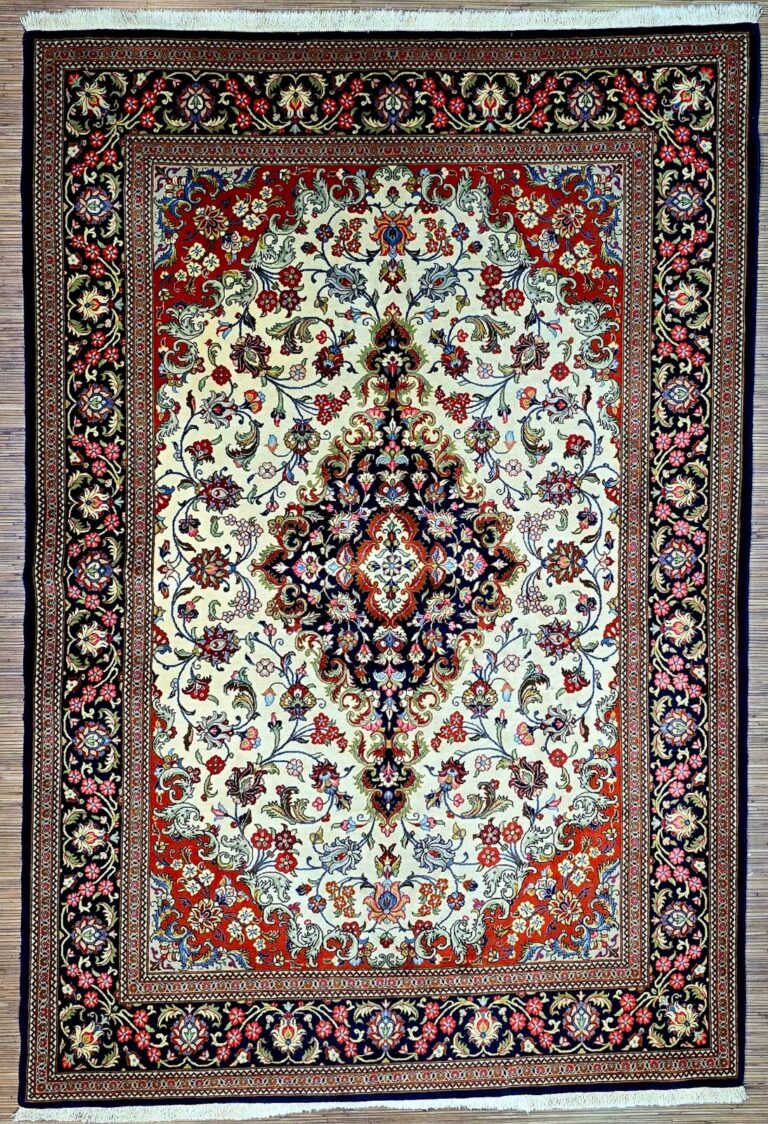
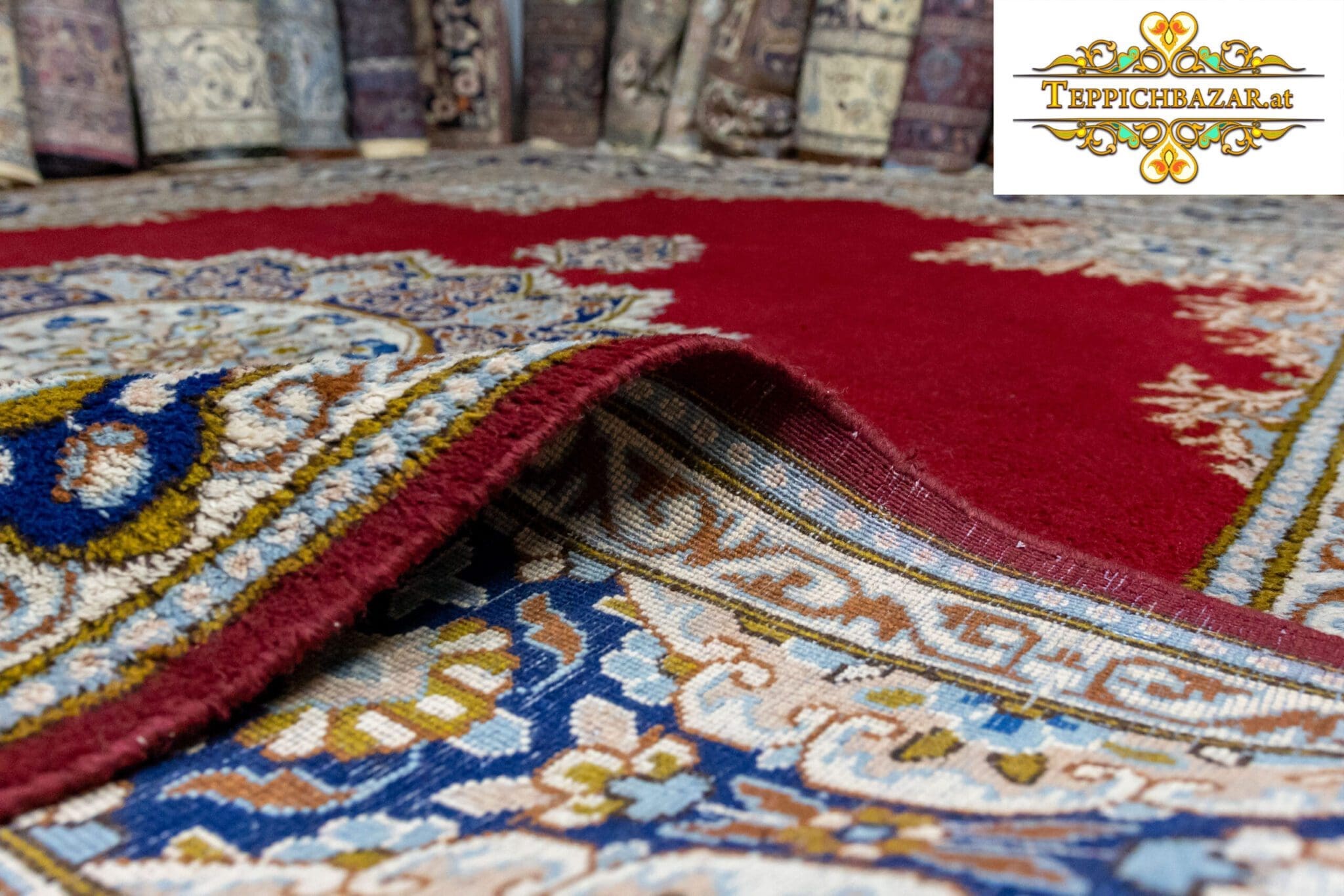
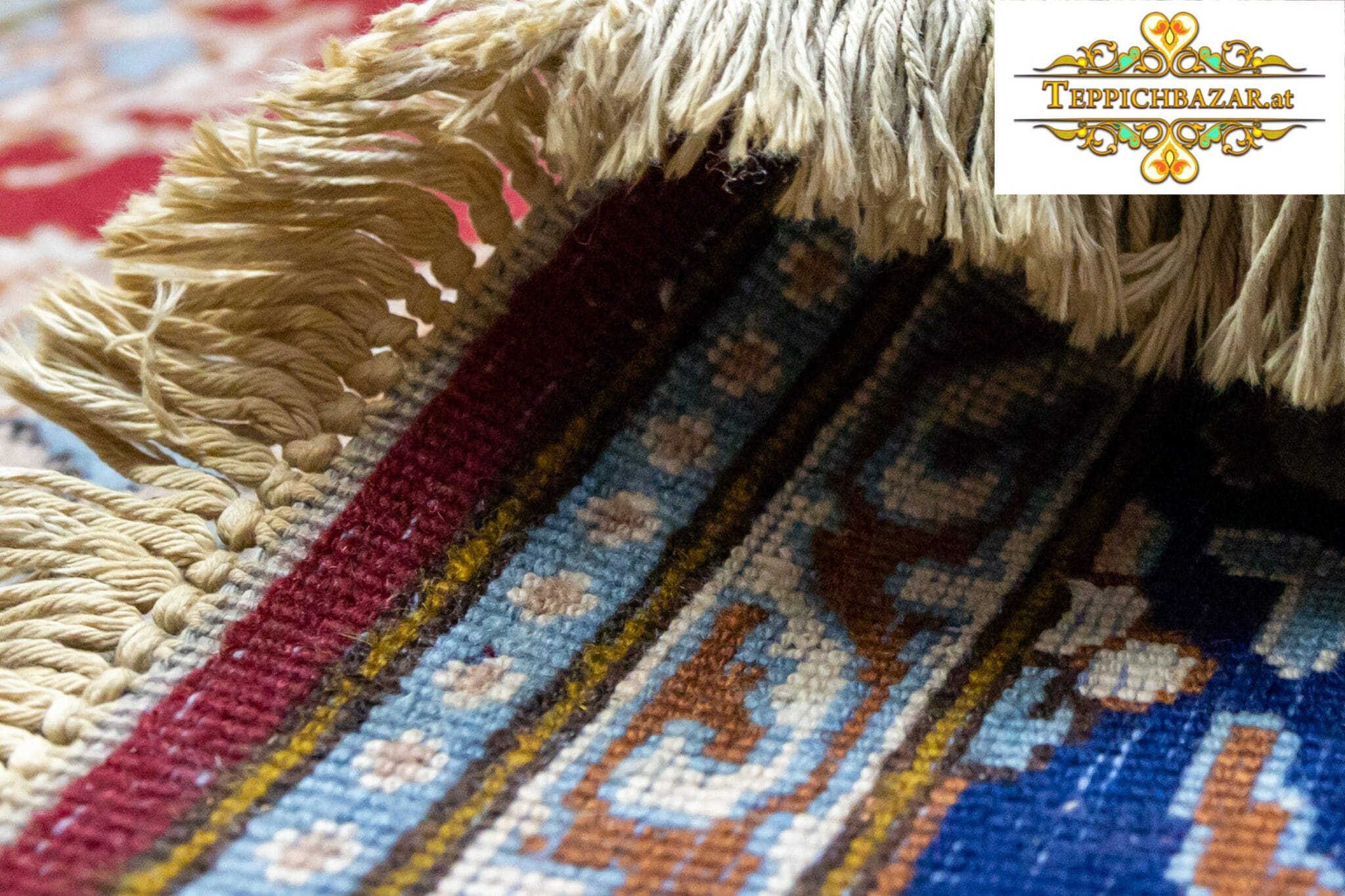
This one-off Oriental rug was made in India and combines Indian manufacture with a Kerman, or Kirman, medallion design. Its pile is 100% virgin wool, while the warp is 100% cotton. These materials define the structure of the rug: wool forms the visible and tactile surface, and cotton provides the ordered foundation into which the knots are tied.
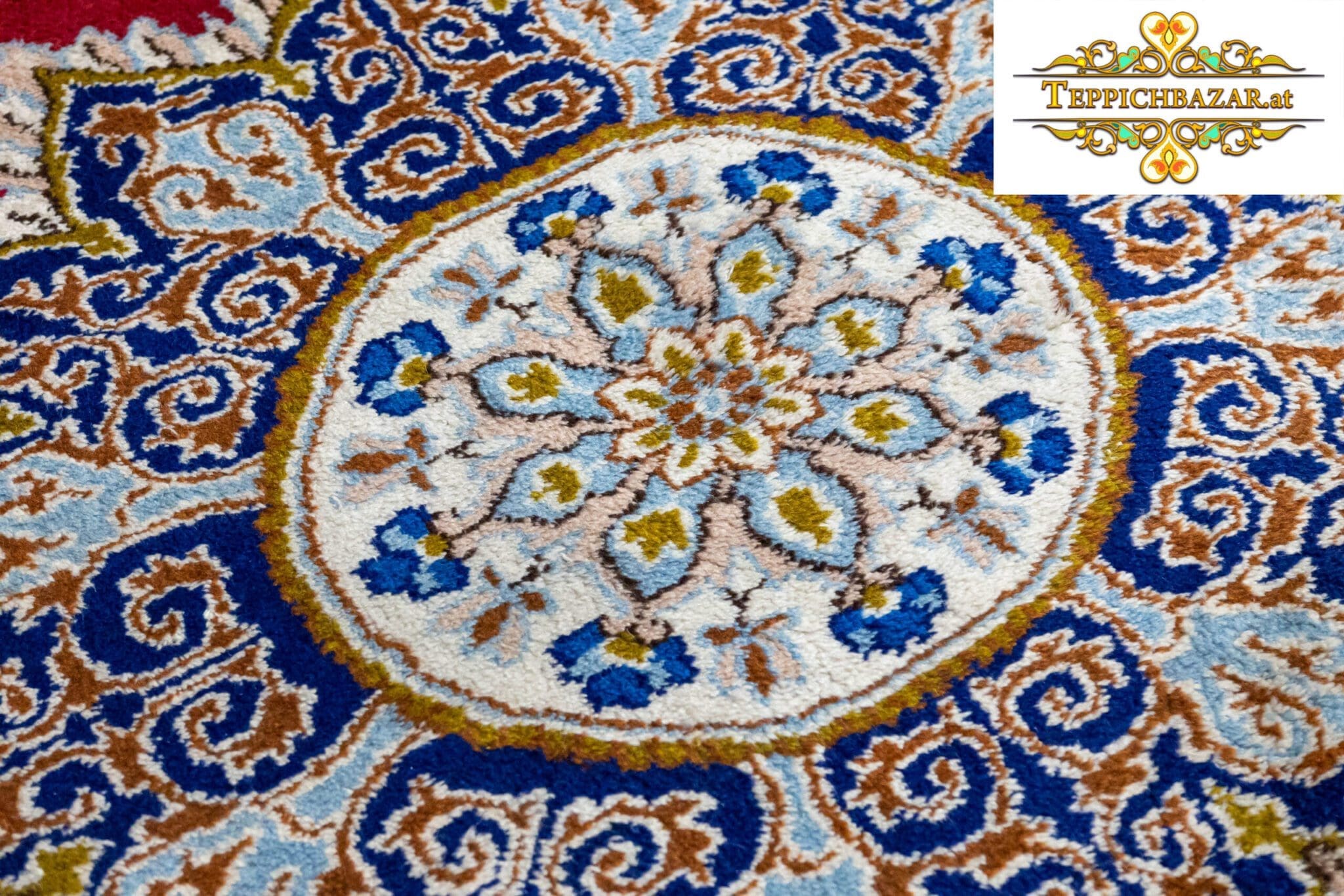
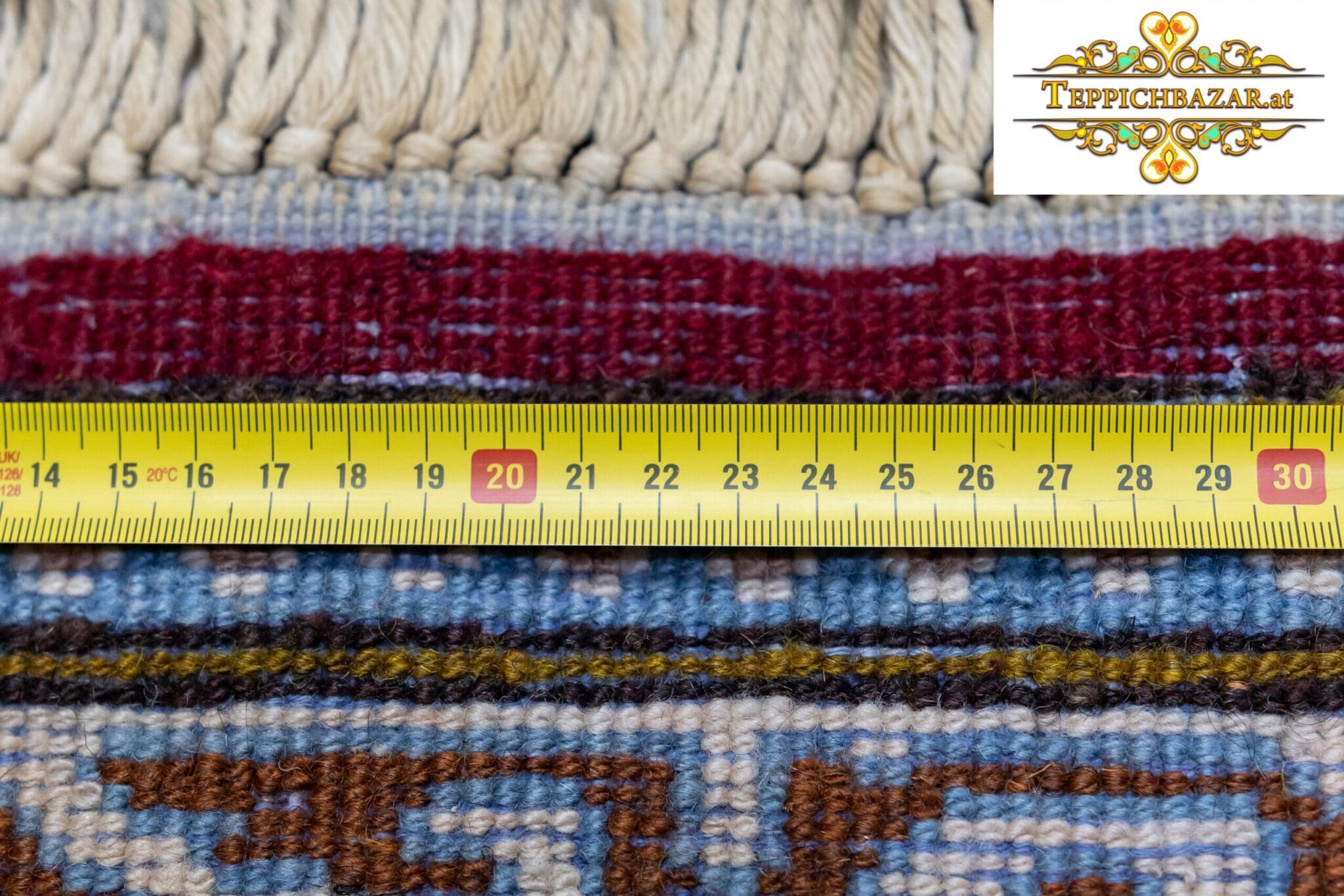
The knot density is approximately 90,000 knots per square metre. A density of this kind supports a finely articulated woven surface on which the outlines of flowers, curving foliage and a central medallion can be rendered with care. In a hand-knotted rug, the design is not printed onto the finished textile. It is created through the placement of individual knots and the interaction of pile, weft and warp.
Virgin wool is the material in which the pattern becomes visible. Its fibres accept colour and help distinguish fields, contours and floral details from one another. The cotton warp gives the structure a regular basis. Together with the hand-knotting, these materials provide the technical foundation for a composition centred on a medallion and surrounded by floral ornament.
The condition of this piece is very good. This is an important part of its description, while no additional claim is made about age, restoration or previous use. The rug is clearly identified as an Indian hand-knotted piece with a virgin-wool pile, cotton warp and a Kerman-inspired floral design.
Origin and Tradition
Kerman, also known as Kirman, is a historic carpet-producing region in southeastern Persia. The city lies in an oasis on the edge of the Dast-e-Lut and was founded in the fourth century. Its position on old trading routes connected it with the exchange between Persia and India over many centuries. A distinct carpet tradition developed in Kerman and in neighbouring villages, and its drawing and colour sensibility remain associated with the name Kerman.
Kerman carpets have been produced since at least the fifteenth century. Their history is shaped by precise drawing, fine knotting and a strong interest in colour. Weavers from the region developed a broad range of compositions, including floral ornament, narrative subjects and pictorial scenes. Kerman therefore refers to more than one fixed layout; it describes a versatile Persian design tradition with several established pattern families.
The visual language of Kerman carpets draws on classical Persian ornament as well as European pictorial and decorative influences. Shah Abbasi medallion-and-corner designs are part of the recognised repertoire, alongside gardens, vases, trees of life, hunting scenes and animals. Boteh and all-over floral arrangements are also traditional, as are striped designs and pictorial carpets. This breadth helps explain why Kerman examples can look very different while sharing a regional design heritage.
Over time, Kerman weaving adapted to changing preferences. Later designs included Aubusson-influenced compositions, Koran medallions and corners, and open fields with less concentrated ornament. The open field is particularly associated with modern Kerman Persian rugs developed largely for Western interiors. Earlier and more densely ornamented arrangements remain part of the same wider tradition, whose defining principles include careful drawing and a balanced relationship between field and border.
Traditional Kerman rugs are associated with Carmania wool, described as particularly strong and lustrous. The weavers of the region gained a reputation for producing fine textiles with careful construction and finish. Kerman carpets were traditionally made on a dense cotton foundation using the asymmetrical Persian knot. Some weavers also employed an unusual construction that created a wavy finish, adding another dimension to the surface of those particular rugs.
Colour is central to the history of Kerman weaving. Strong shades such as magenta, blue and golden saffron are among the colours associated with the tradition, while red, orange and turquoise also appear in established palettes. Modern weavers may favour champagne, light green, blue-grey, pink and beige. Across both stronger and softer schemes, even colour distribution is regarded as a notable characteristic and is linked with distinctive wool-dyeing methods.
Design and Pattern
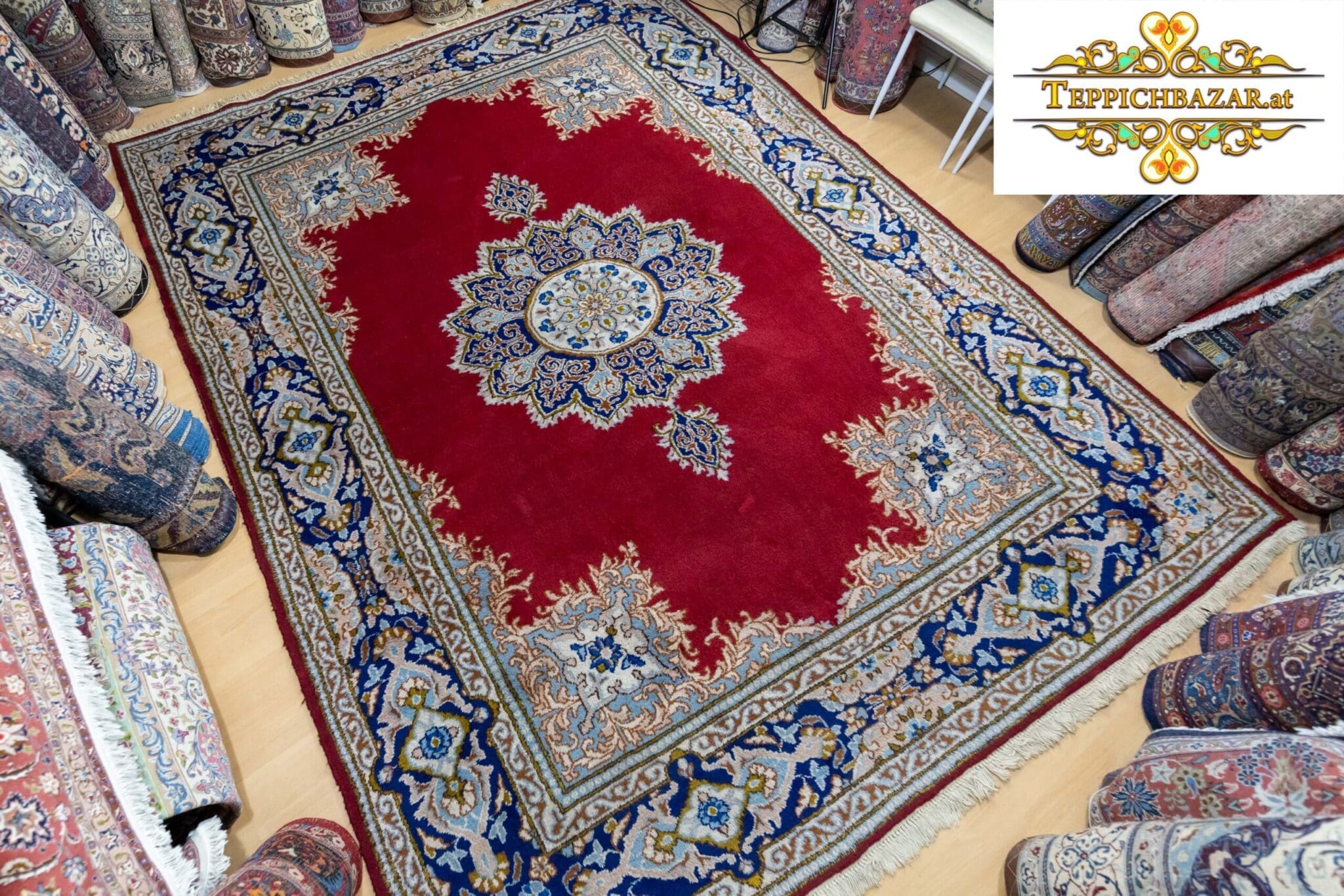
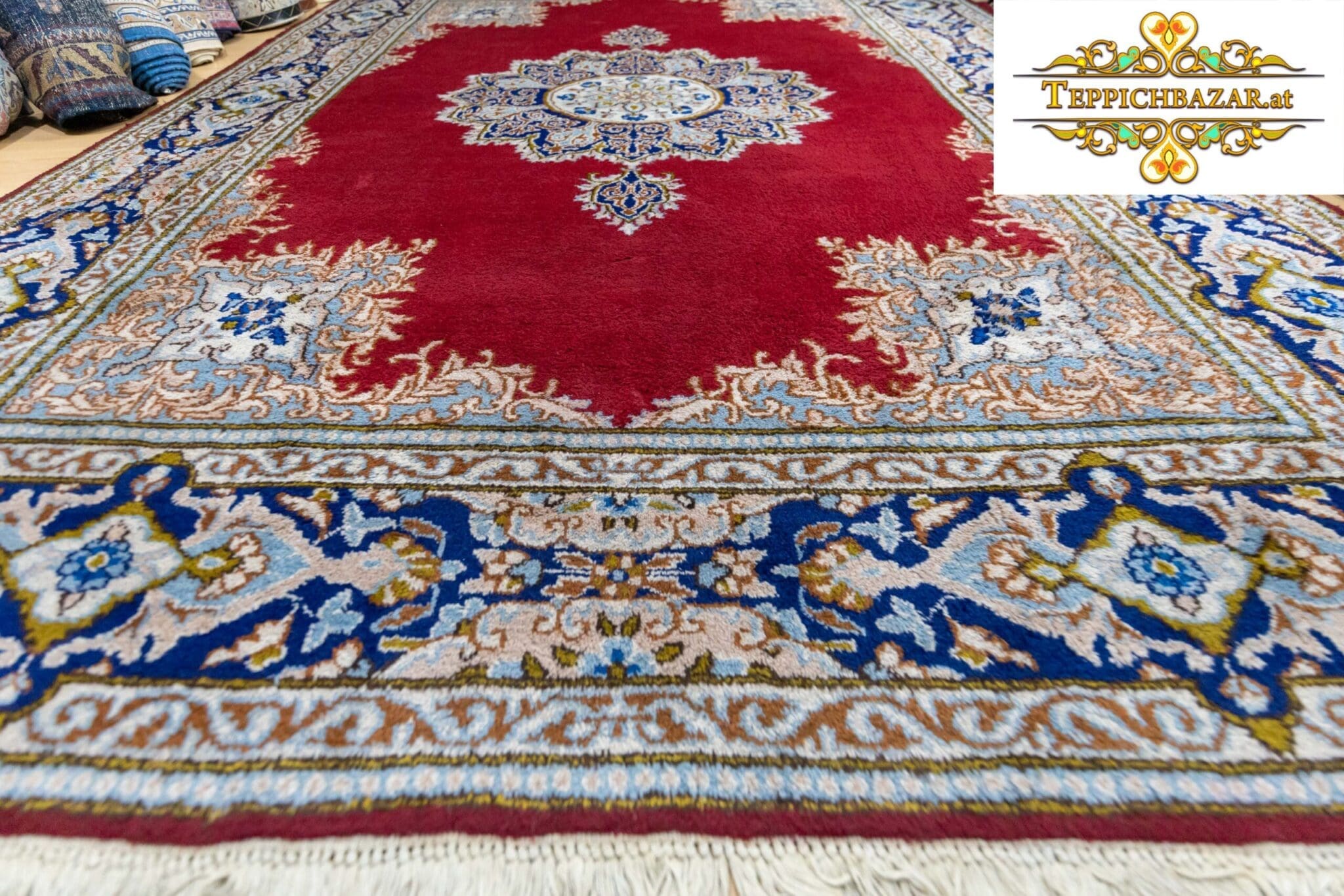
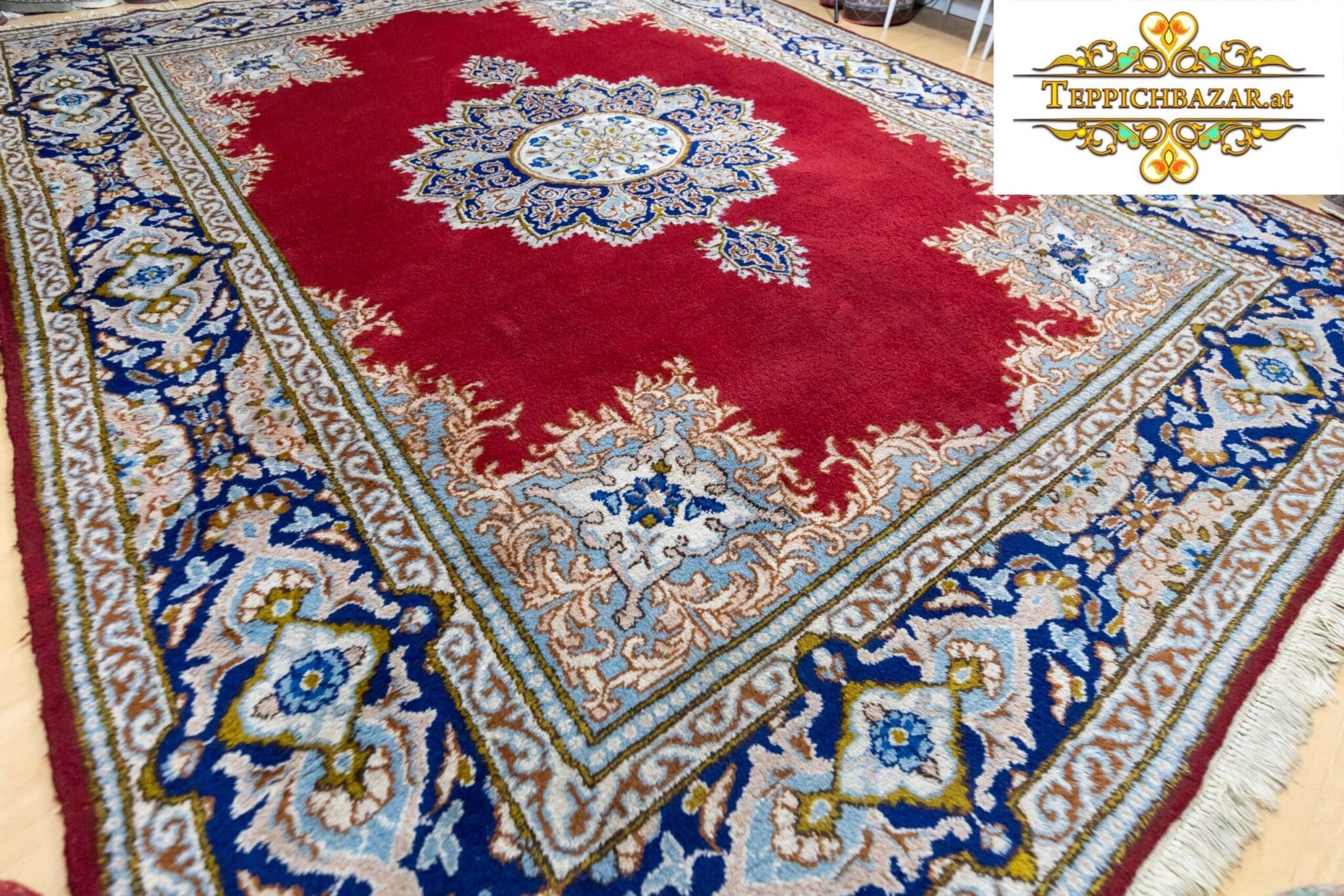
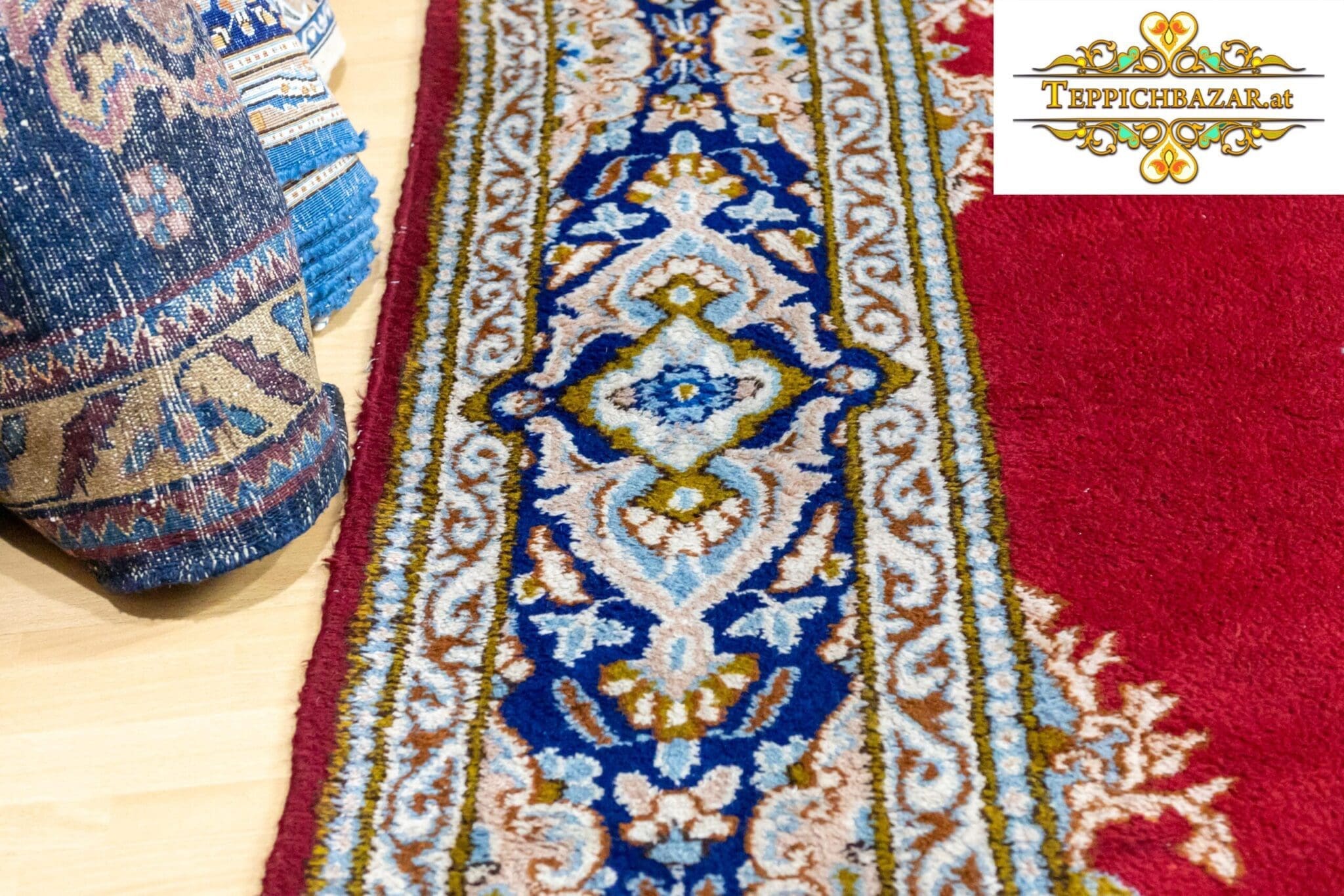
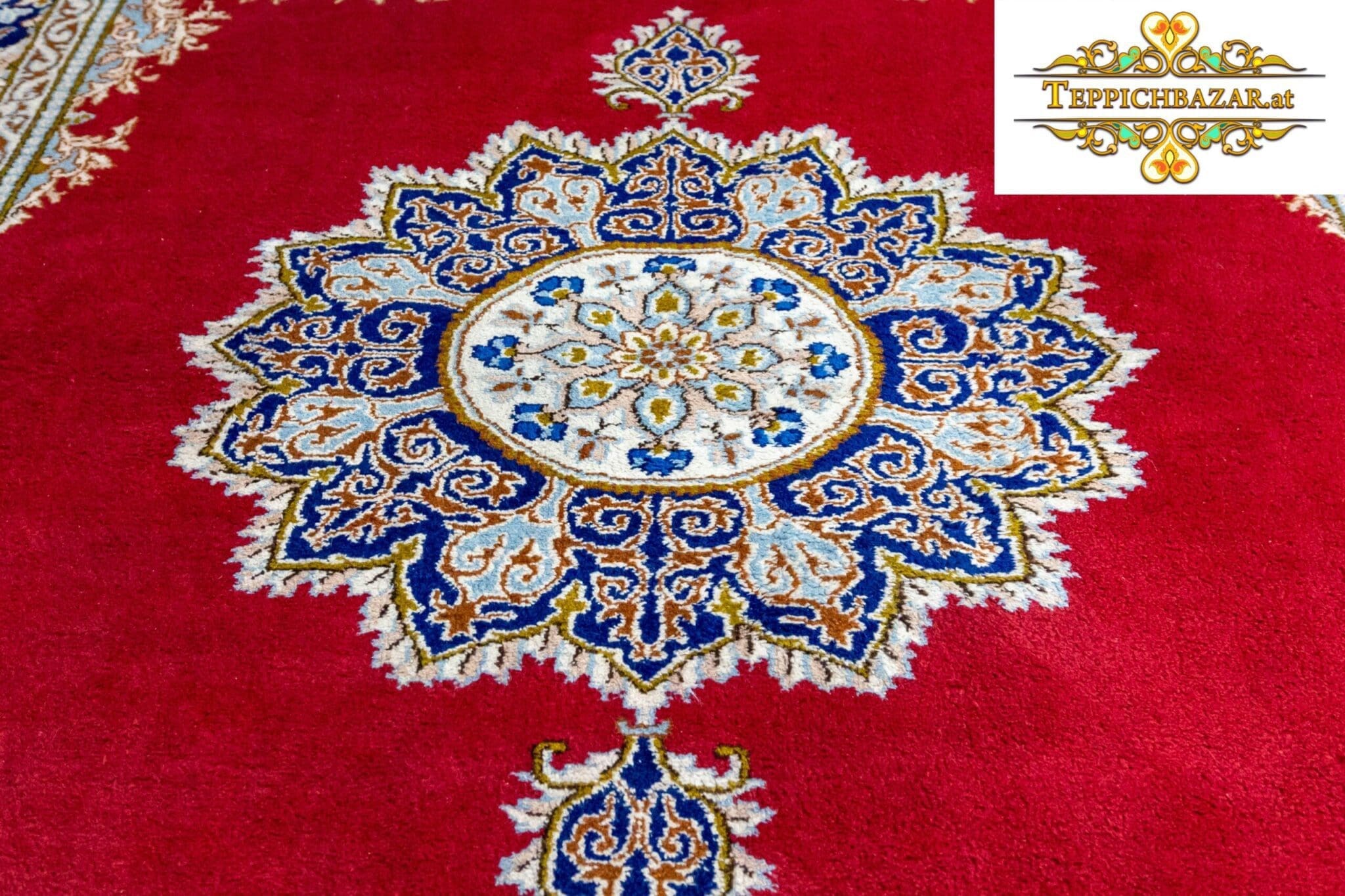
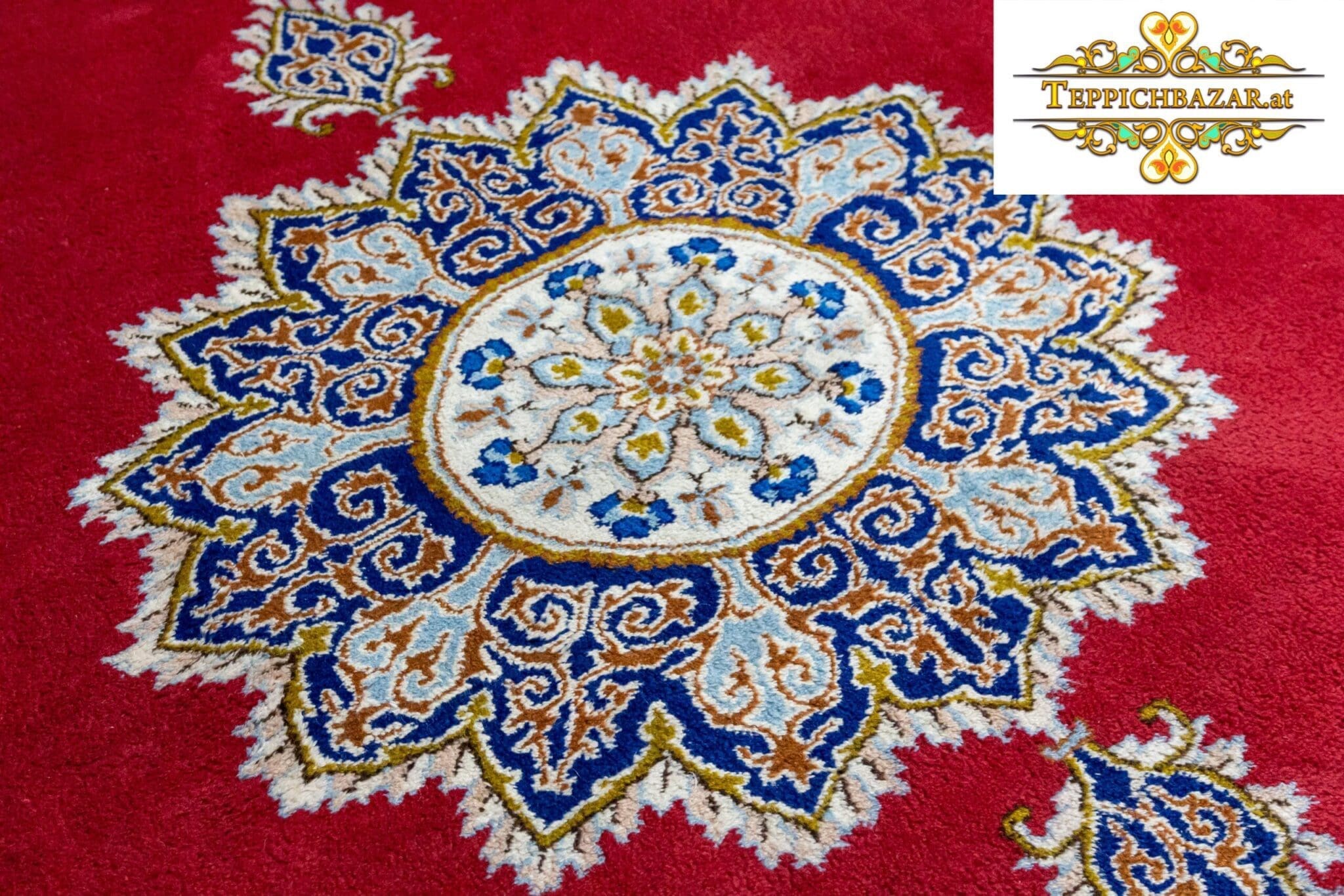
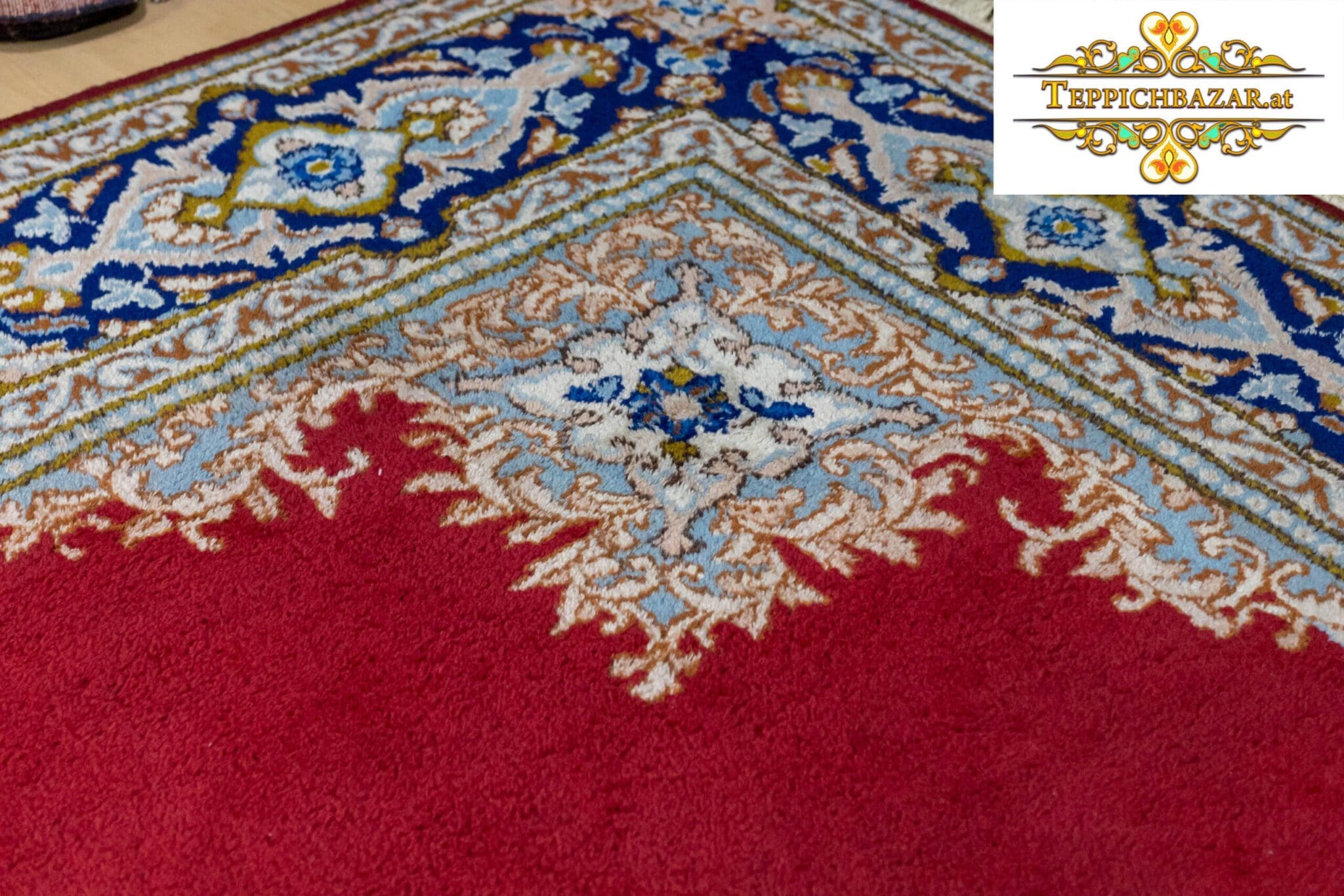
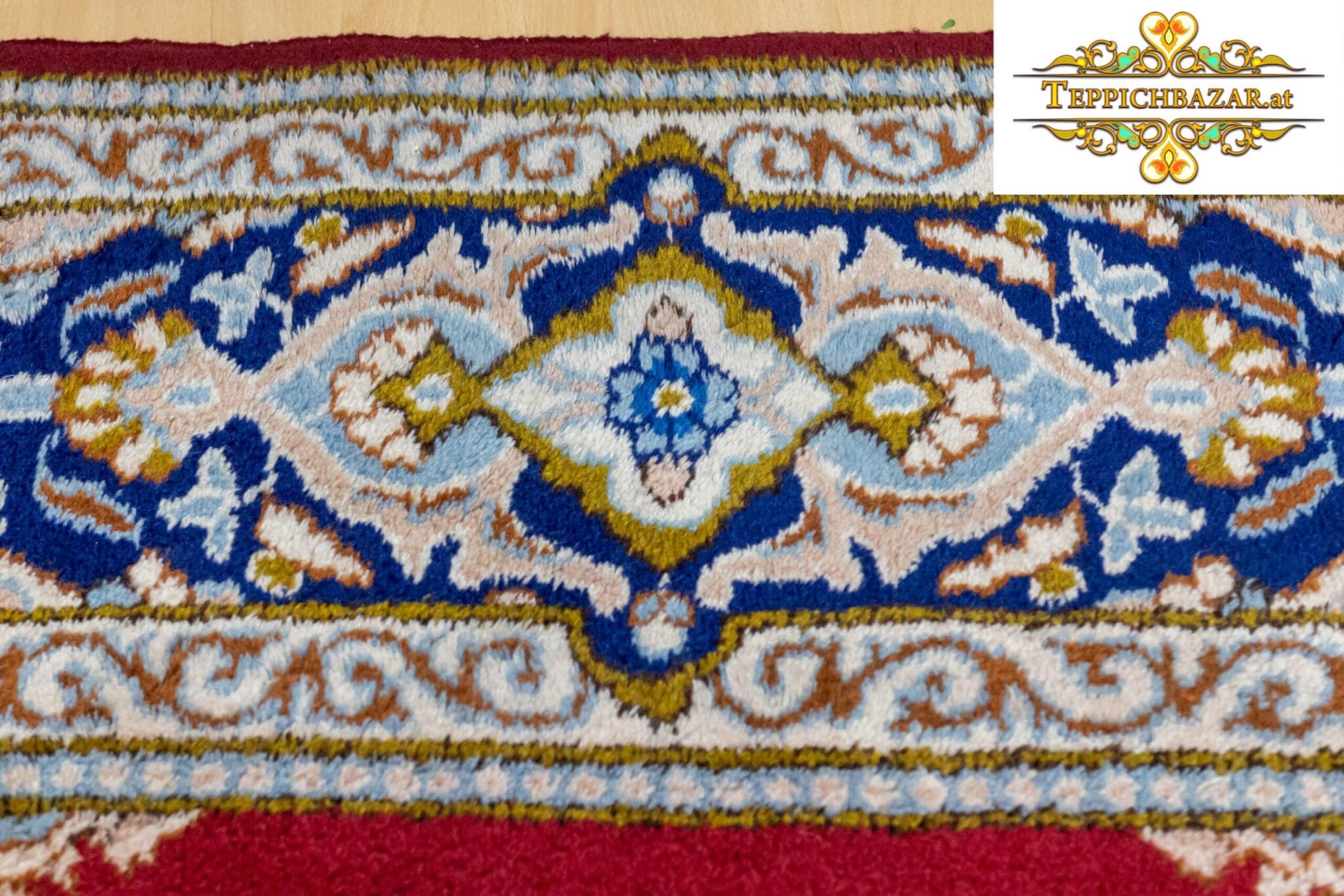
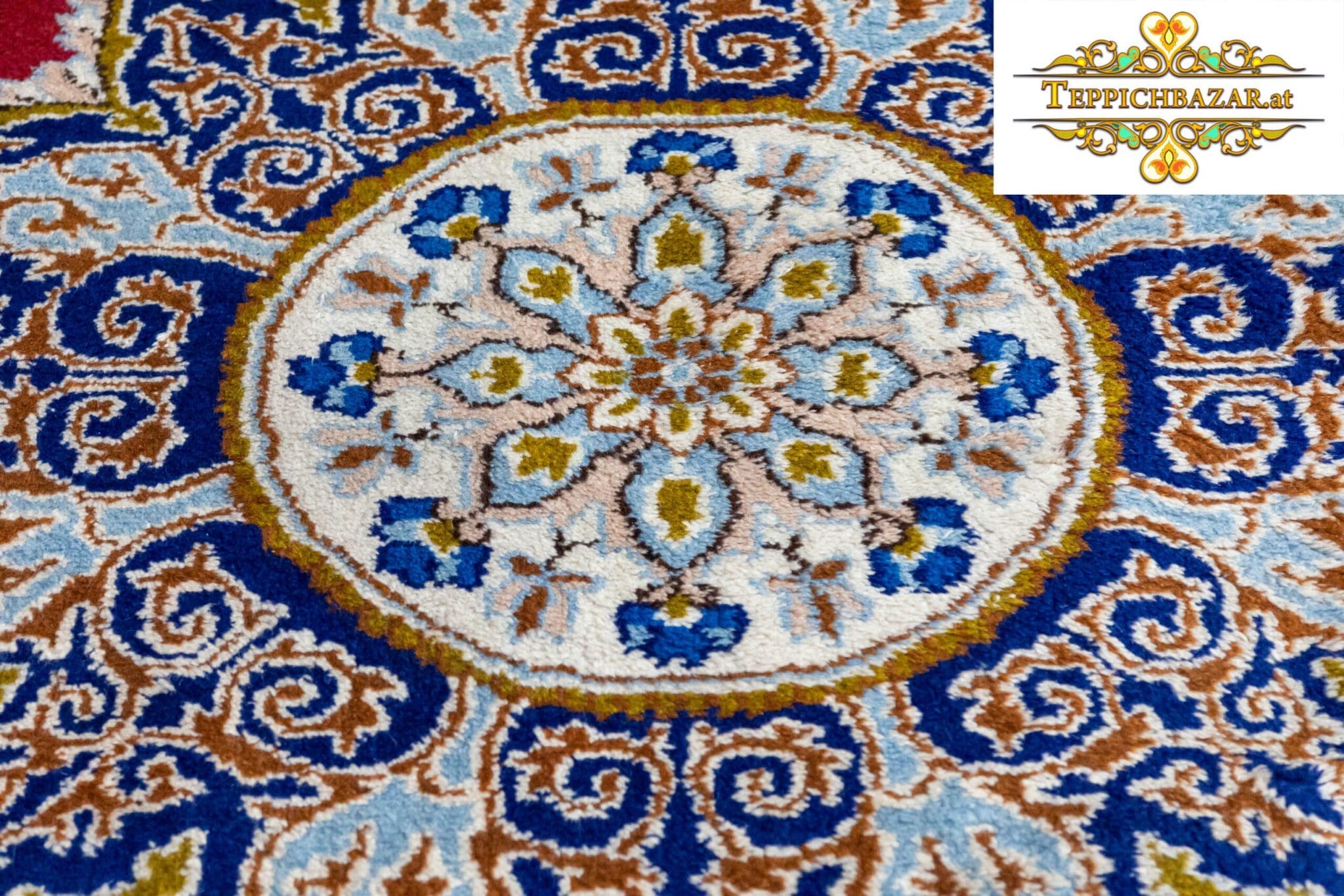
The pattern of this rug is described as a Floral Kirman medallion. Its design is therefore organised around a central medallion accompanied by floral forms and set within a Kerman-inspired composition. Kirman identifies the design tradition and decorative language here. The rug itself is described as made in India, so it is classified as an Indian Oriental rug rather than a Persian rug from Iran.
The medallion is one of the defining layouts in the Kerman tradition. It concentrates the drawing at the centre and establishes a visual point of reference for the surrounding field. Corner pieces may frame the central form, while floral scrolls, blossoms and palmettes can connect the medallion with the border. In this type of arrangement, the centre, field and frame work together as a coherent ornamental structure.
Floral Kerman designs rely on repeated botanical forms. Blossoms, leaves, scrolling stems and palmettes may be linked through flowing lines. Curvilinear drawing is frequently mentioned among the characteristic features of Kerman carpets. It allows the ornament to move across the field and creates internal detail without turning every element into an independent pictorial scene.
The Kerman repertoire extends beyond medallion designs. Vase patterns may distribute flowers and palmettes across a field, while boteh can form a repeated all-over arrangement. Garden compositions divide the surface into organised sections, and tree-of-life, hunting and animal motifs add symbolic or narrative content. Pictorial rugs bring these subjects together as images. These examples provide context for the Kerman tradition; the specific pattern recorded for this rug is the Floral Kirman medallion.
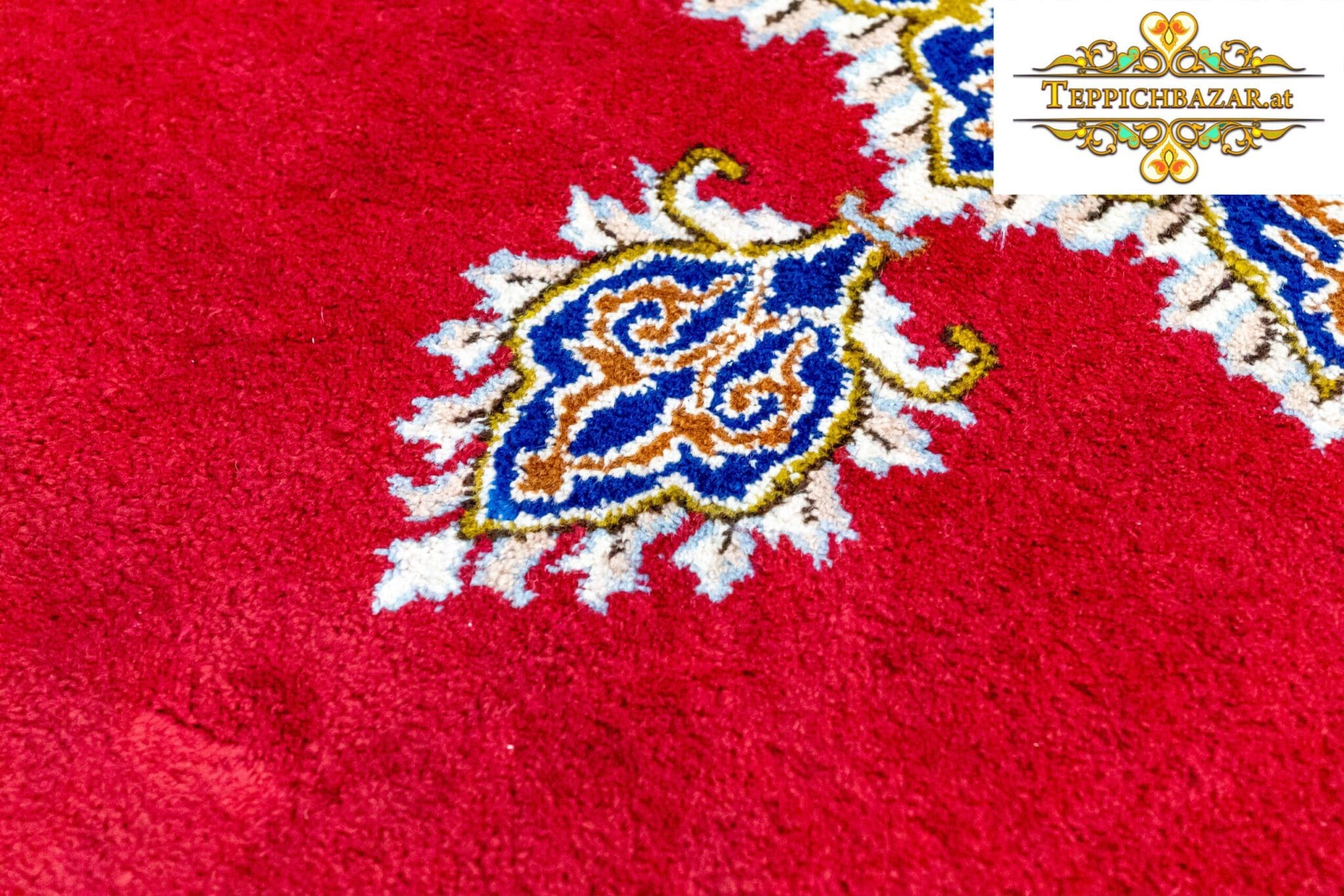
The colour effect of a Kerman-inspired design depends on the relationship between tones as much as on the individual shades. Strong colours can bring flowers, palmettes and outlines into sharp relief, while softer colours create a more open and restrained field. Kerman carpets are known for a rich palette and an even distribution of colour, qualities that help fine floral drawing read as one connected composition.
Older Kerman palettes are often associated with red and blue contrasts and with rich, deep red. Orange and turquoise provide further accents. More modern versions may use pink, beige, blue-grey or light green, and may adopt Aubusson-like layouts or medallion-and-corner compositions with open fields. The Kerman name consequently covers both densely ornamented and more spacious designs, united by controlled drawing and carefully balanced colour.
Special Features
A distinctive feature of this one-off piece is the combination of Indian manufacture with a Floral Kirman medallion. The term Indo Kerman describes the design tradition rather than an origin in the Iranian province of Kerman. The relevant product facts are its Indian origin, hand-knotted construction, virgin-wool pile, cotton warp and floral Kirman medallion.
The rug also has an approximate knot density of 90,000 knots per square metre and is described as being in very good condition. Its fine structure is suited to presenting a central medallion and detailed floral ornament. No statement about a particular age, signature or restoration is included in the description, so none is added here.
Kerman carpets are valued in general for their range of patterns, controlled colour work and hand-crafted construction. Some owners display especially fine examples on walls to protect them from the wear caused by shoes. That is a general tradition connected with delicate Kerman work, not a claim about how this particular rug has previously been used.
FAQ
Where was this Oriental rug made?
This rug was made in India. It is described as Indo Kerman, or Kirman, and carries a Floral Kirman medallion. Kerman refers here to the design heritage and pattern language. The rug is therefore an Indian Oriental rug, not a Persian rug originating in Iran.
What materials are used in the rug?
The pile is 100% virgin wool and the warp is 100% cotton. The rug is hand-knotted and has an approximate density of 90,000 knots per square metre. This construction combines a wool pile with a cotton foundation and supports the detailed rendering of the medallion design.
What is the condition of the rug?
The condition is stated as very good. No further information is given about age, signature, restoration or specific signs of use. The confirmed description is therefore its very good condition, Indian origin, hand-knotted construction and Floral Kirman medallion.
To provide the best experiences, we use technologies like cookies to store and/or access device information. Consenting to these technologies will allow us to process data such as browsing behavior or unique IDs on this site. Not consenting or withdrawing consent, may adversely affect certain features and functions.
Functional Always active
The technical storage or access is strictly necessary for the legitimate purpose of enabling the use of a specific service explicitly requested by the subscriber or user, or for the sole purpose of carrying out the transmission of a communication over an electronic communications network.
Preferences
The technical storage or access is necessary for the legitimate purpose of storing preferences that are not requested by the subscriber or user.
Statistics
The technical storage or access that is used exclusively for statistical purposes.The technical storage or access that is used exclusively for anonymous statistical purposes. Without a subpoena, voluntary compliance on the part of your Internet Service Provider, or additional records from a third party, information stored or retrieved for this purpose alone cannot usually be used to identify you.
Marketing
The technical storage or access is required to create user profiles to send advertising, or to track the user on a website or across several websites for similar marketing purposes.

 SECURE PAYMENT
 SHIPPING PARTNERS