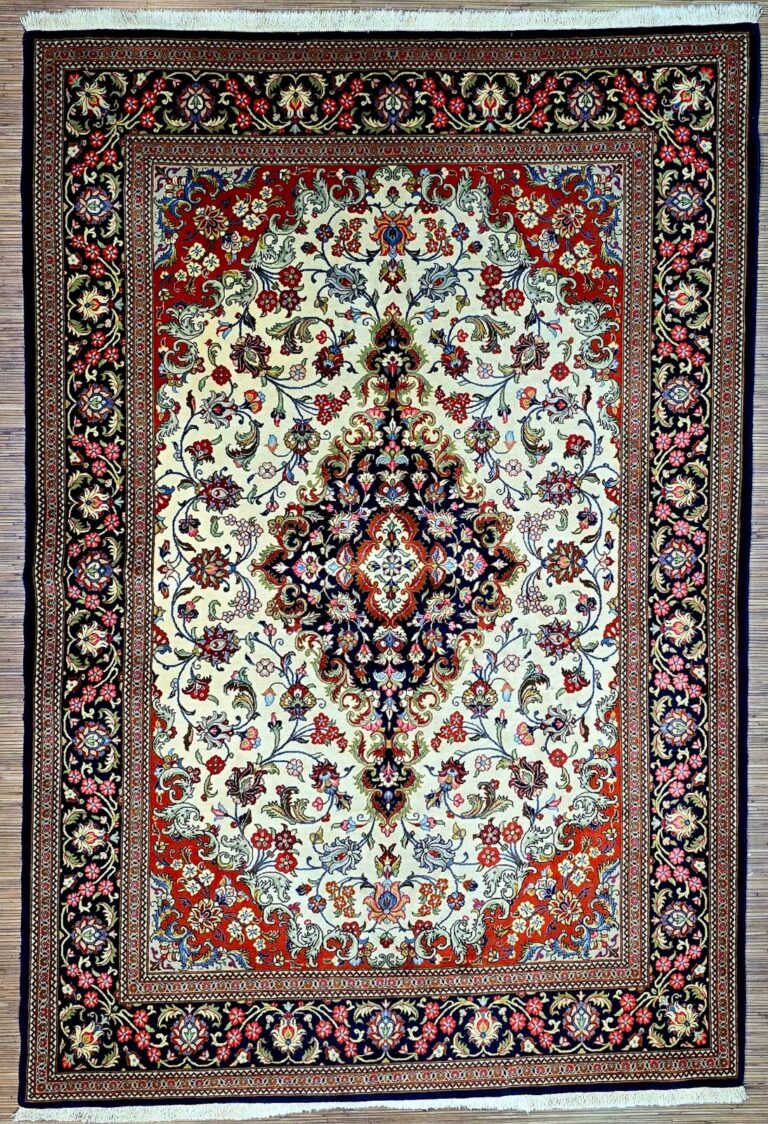
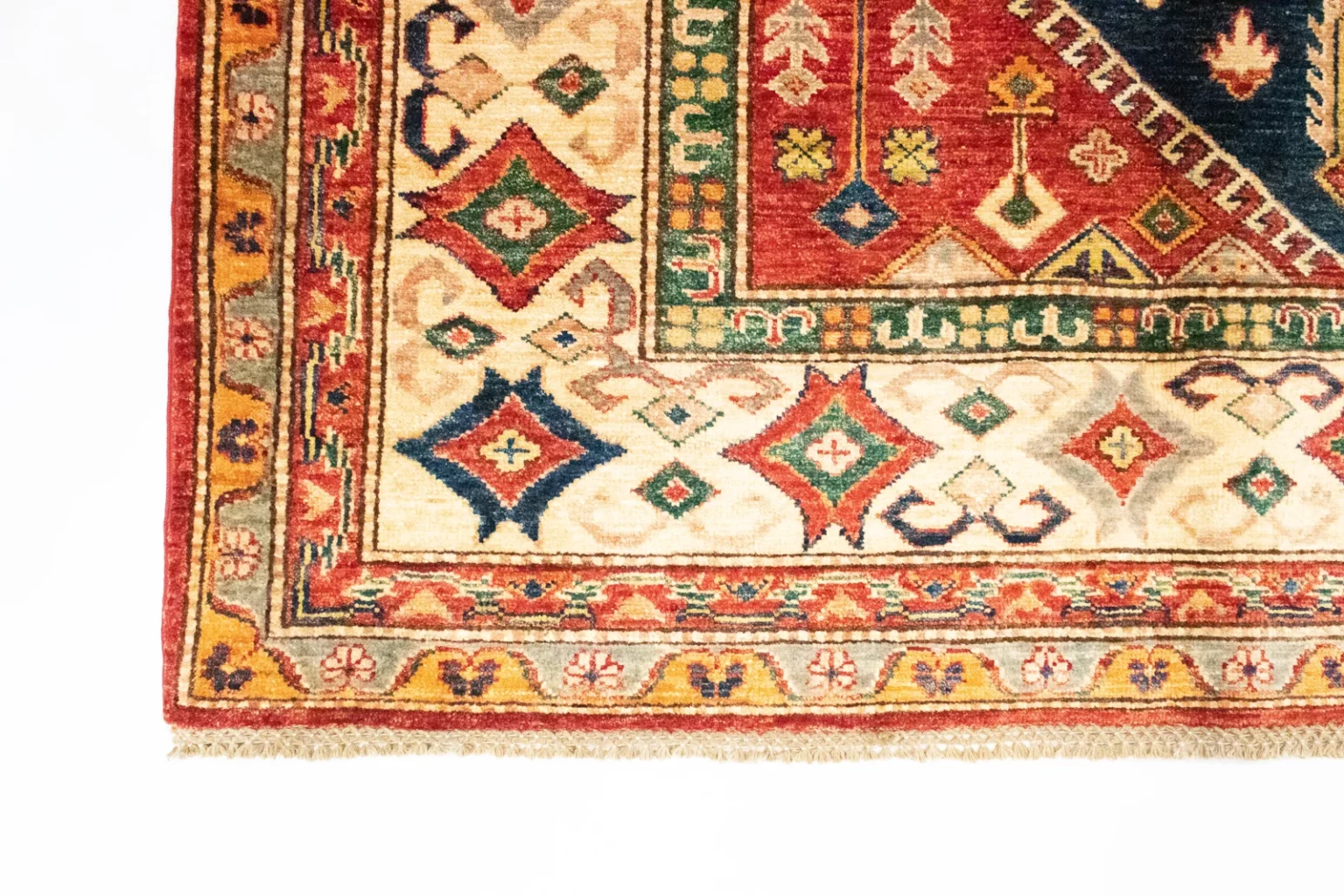
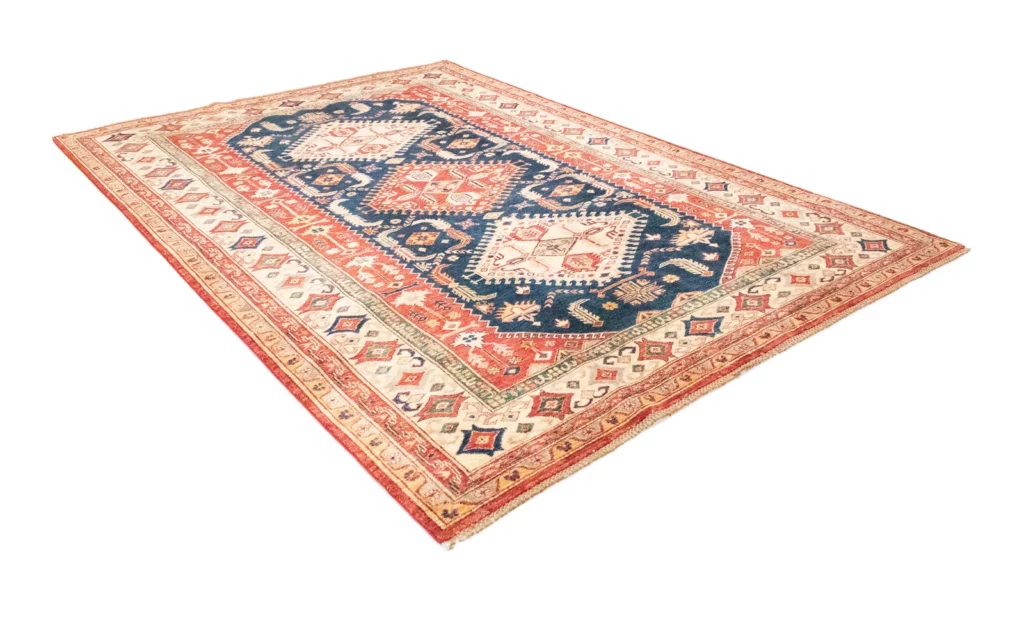
This Kazak Oriental rug is made of wool and is hand-knotted. Wool is the pile material and has long been used in oriental rug making because its fibres are resilient, tactile and suitable for regular use. In a hand-knotted rug, each knot is inserted by hand into the foundation. The rows are then compacted and the pile is worked into an even surface. The pattern is therefore built into the textile structure rather than printed onto it.
The rug has a knot density of 180,000 knots per square metre. Knot density records how many knots are placed within a defined area and gives a clear indication of the rug’s construction. It is also connected with the ability to render lines and smaller shapes in an orderly way. Each colour change is created through the arrangement of knots, so the design remains part of the woven and knotted body of the rug. The stated density should not be confused with a claim about the age or origin of the piece.
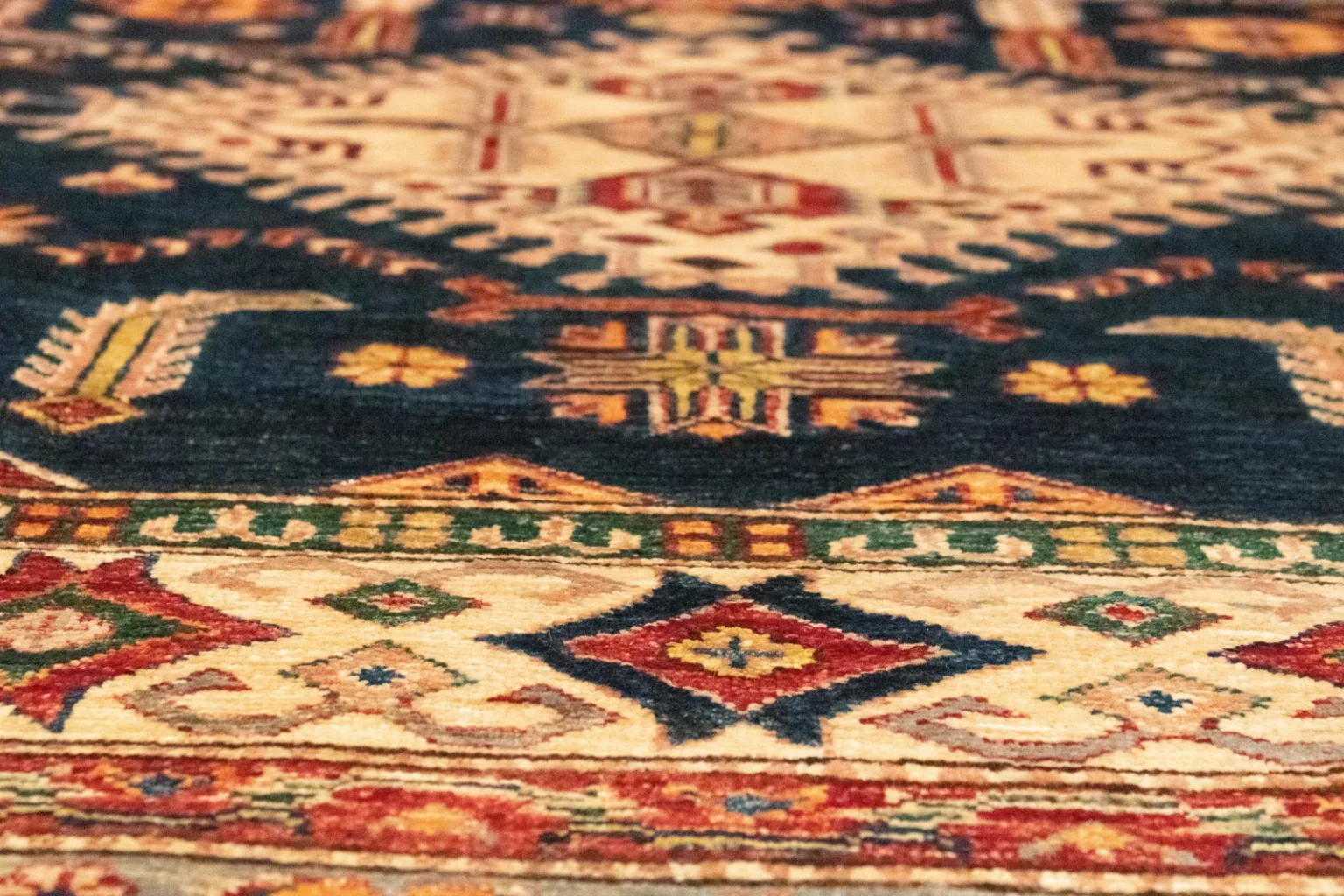
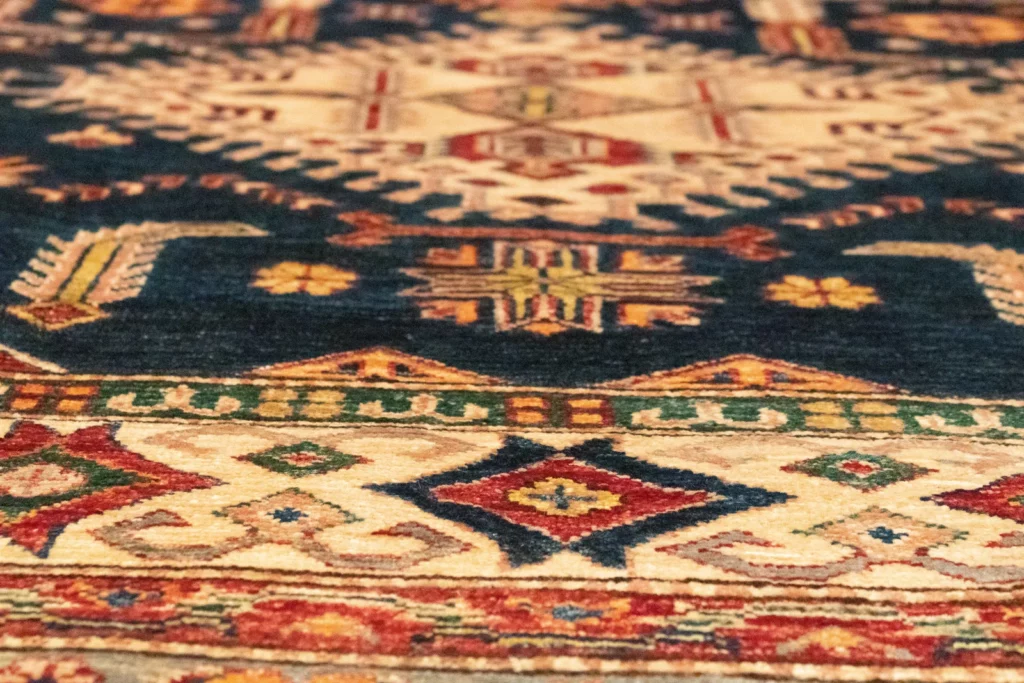
The pile is short. A short pile can keep the outlines of a structured geometric design easy to read and is practical for everyday use. Wool and handwork create a construction intended to withstand regular handling, while the making process remains gradual and manual. Knots are placed, beaten into position and aligned row by row. This distinguishes the rug from a machine-made floor covering, where the surface is produced by an industrial process rather than by individual knotting.
Hand-knotting also means that the finished object records the particular execution of its maker. The essential technique is shared across many oriental rug traditions, but the exact arrangement of knots belongs to this one piece. Its material, short pile and stated knot density can therefore be described directly, without assigning an unstated blend, foundation fibre, workshop or date.
Origin and Tradition
The name Kazak refers to a rug tradition associated with the Caucasus. The Caucasus is a culturally diverse area between the Black Sea and the Caspian Sea, with a long history of textile production. Rug traditions connected with this region are known for clearly articulated ornaments and designs that can be read through lines, angular shapes, repeated motifs and framed fields. A geometric vocabulary is especially suitable for hand-knotting because it can be built from repeated units and carefully defined contours.
This rug is listed with the Caucasus as its origin and was knotted in Pakistan or Afghanistan. These details describe two related but separate aspects of its identity. The Caucasus identifies the regional tradition behind the Kazak designation, while Pakistan or Afghanistan names the places given for its actual manufacture. Workshops in both countries have their own histories of rug production and have also made rugs using design languages associated with other regions. A rug can therefore carry a Kazak design while being made outside the Caucasus.
Names used for oriental rugs may refer to a region, a town, a tribal tradition, a workshop practice or a particular visual language. Such names are useful for discussing a design, but they do not automatically establish where an individual rug was knotted. In this case, Kazak is the design and tradition reference; it is not proof that this rug was made in a specific Caucasian settlement. The manufacturing information remains Pakistan or Afghanistan, as stated for the piece.
This distinction also determines the correct product category. Although the source title uses the word Persian, the stated manufacturing places are Pakistan or Afghanistan and the origin is given as the Caucasus. The rug is consequently an Oriental rug, not an Iranian Persian rug. Its identity is best expressed through the combination of Kazak tradition, Caucasian stylistic reference, the named manufacturing locations and the hand-knotted wool construction.
Regional rug traditions travel through drawings, repeated patterns, teaching and workshop practice. Elements can be retained, simplified or rearranged when a design is made in another country. The characteristic idea of a Kazak composition can remain recognizable even when the actual knotting takes place elsewhere. This does not require an invented provenance. It simply explains how a regional design name and a different manufacturing location can appear together in the description of one oriental rug.
Design and Pattern
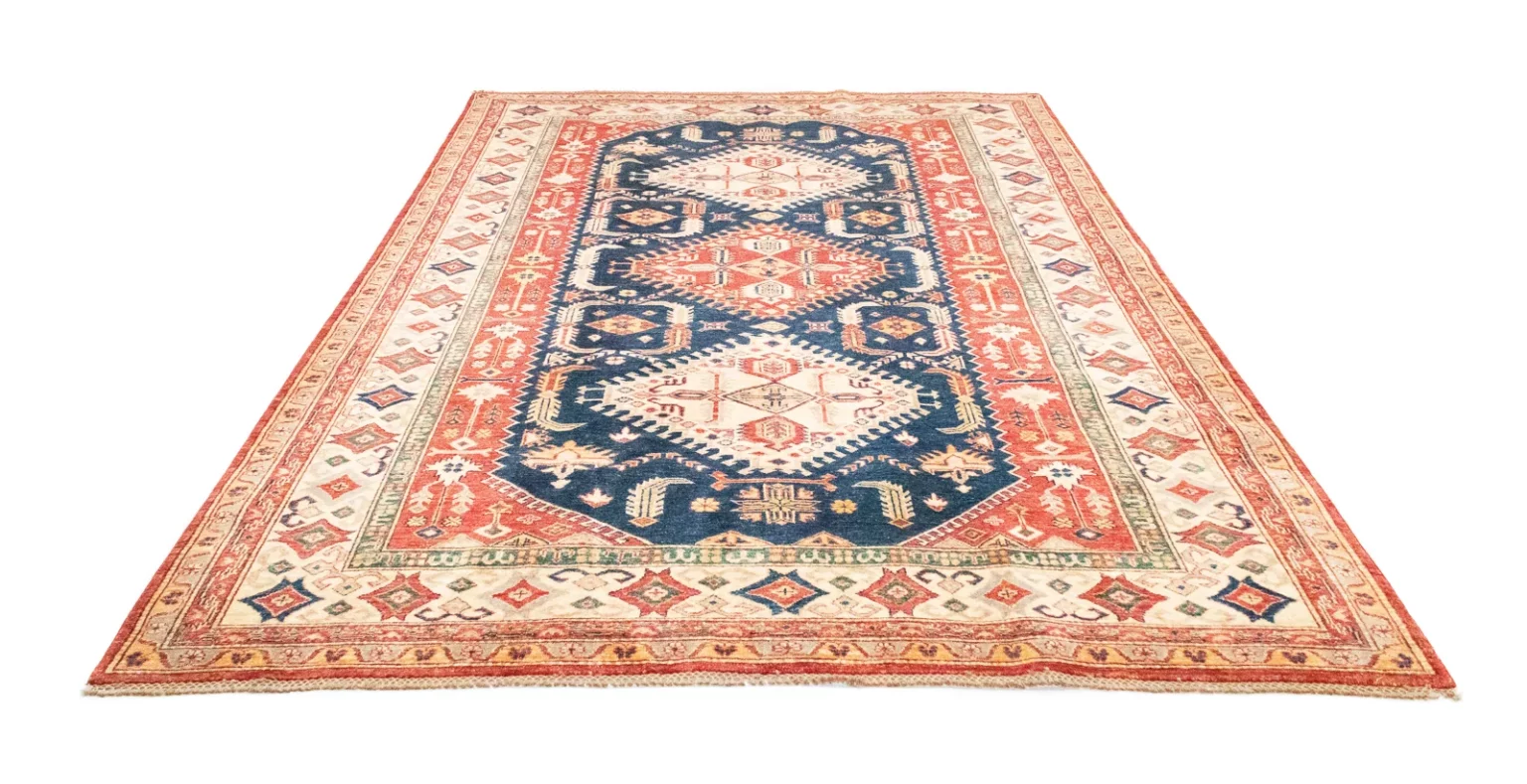
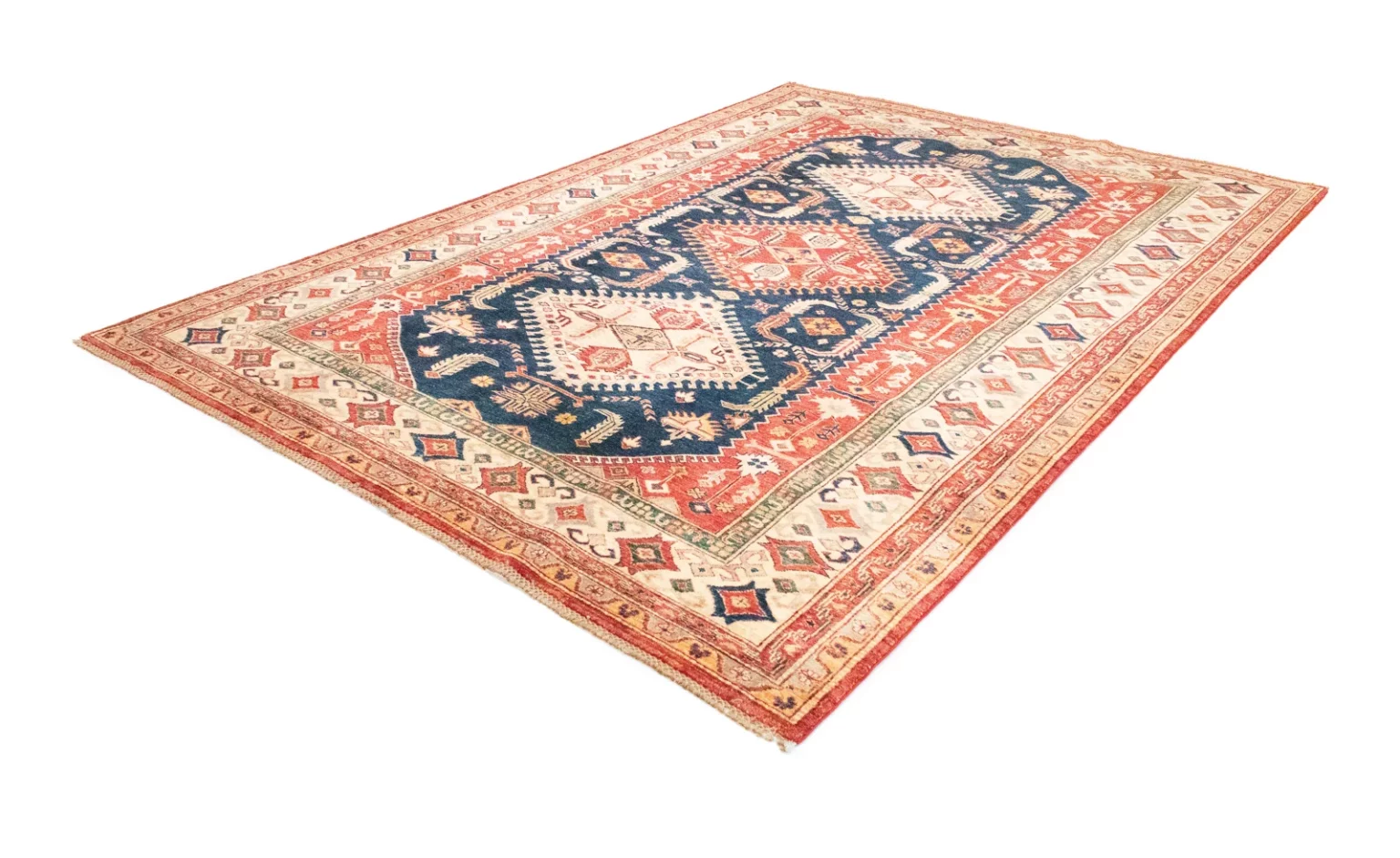
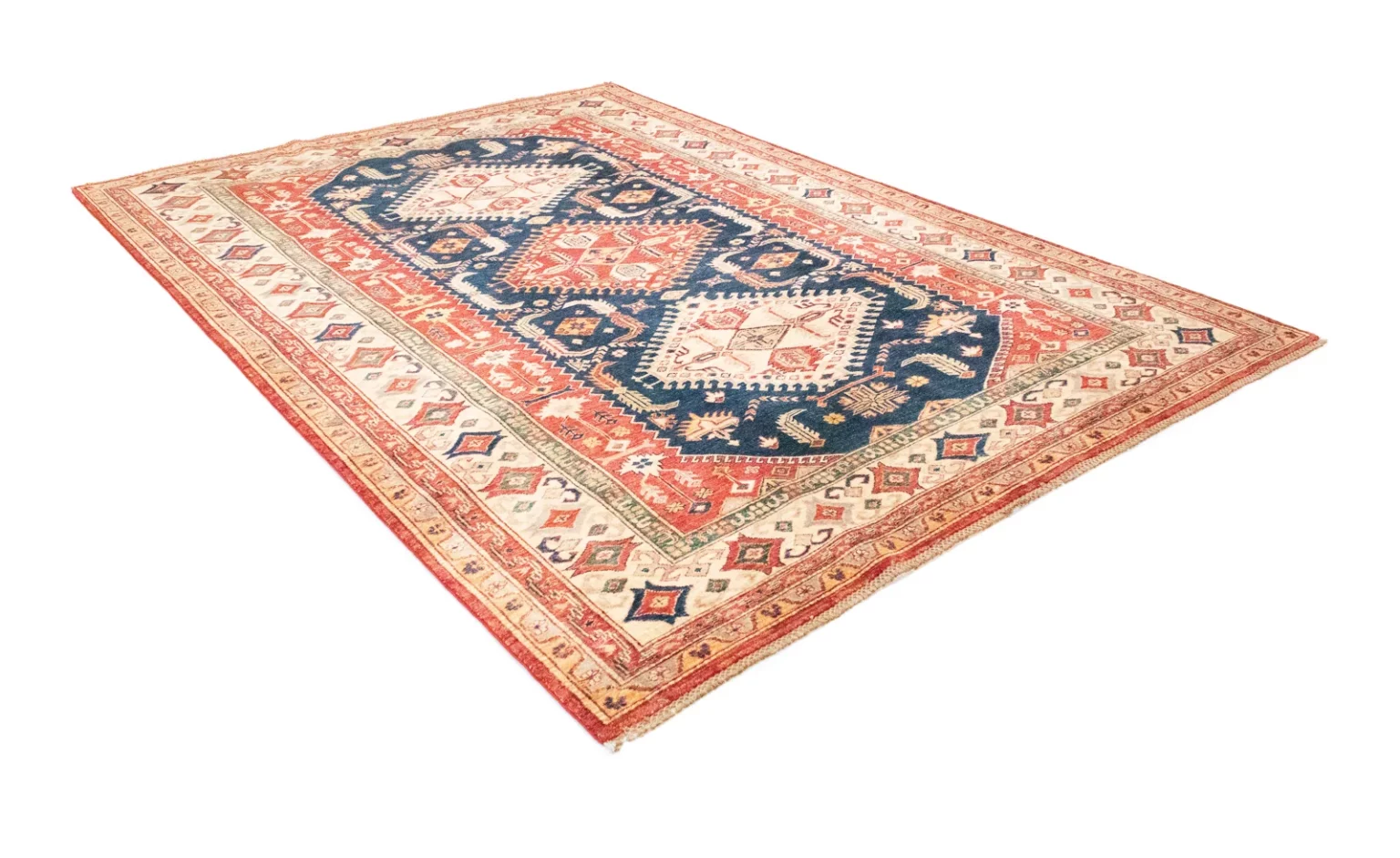
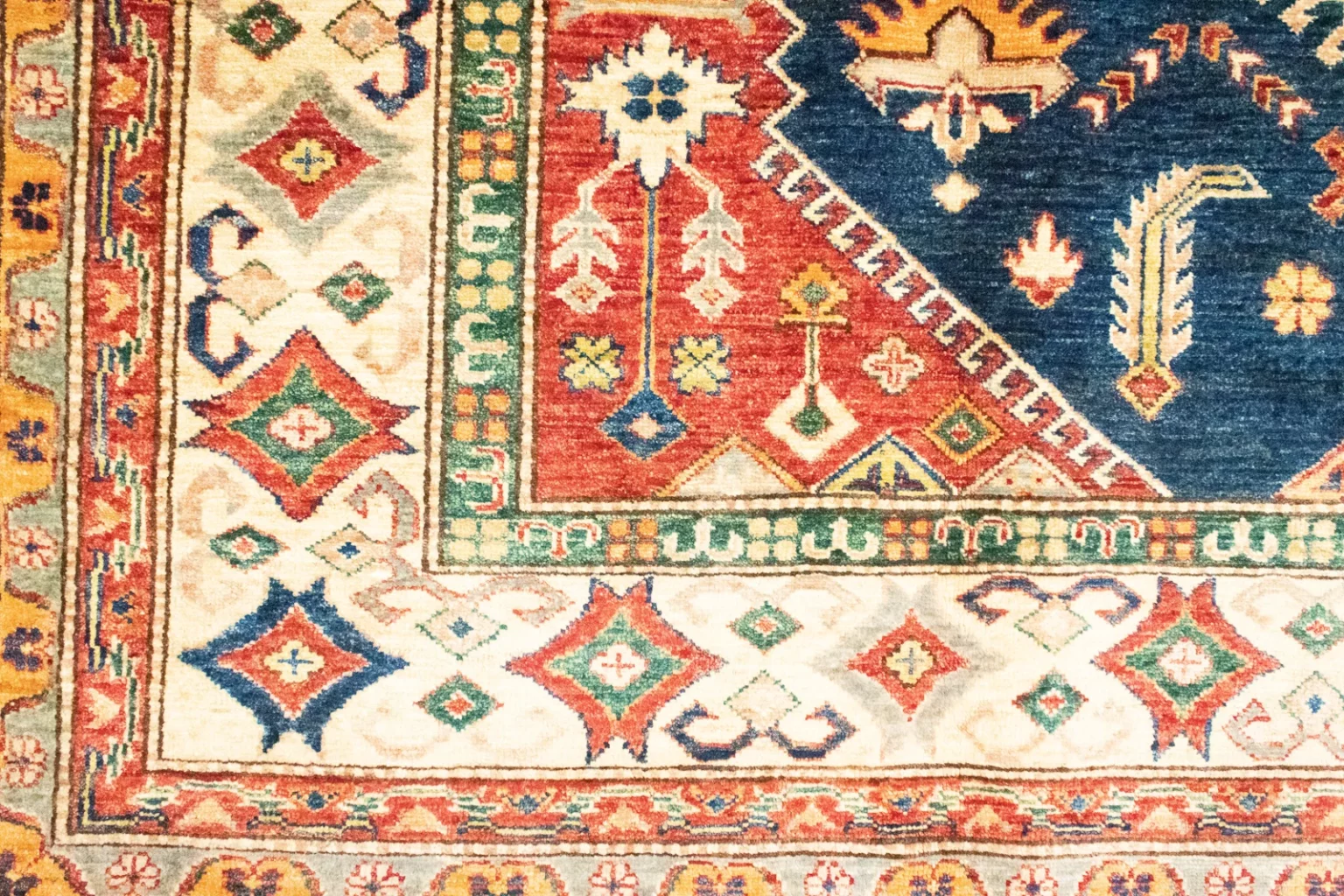
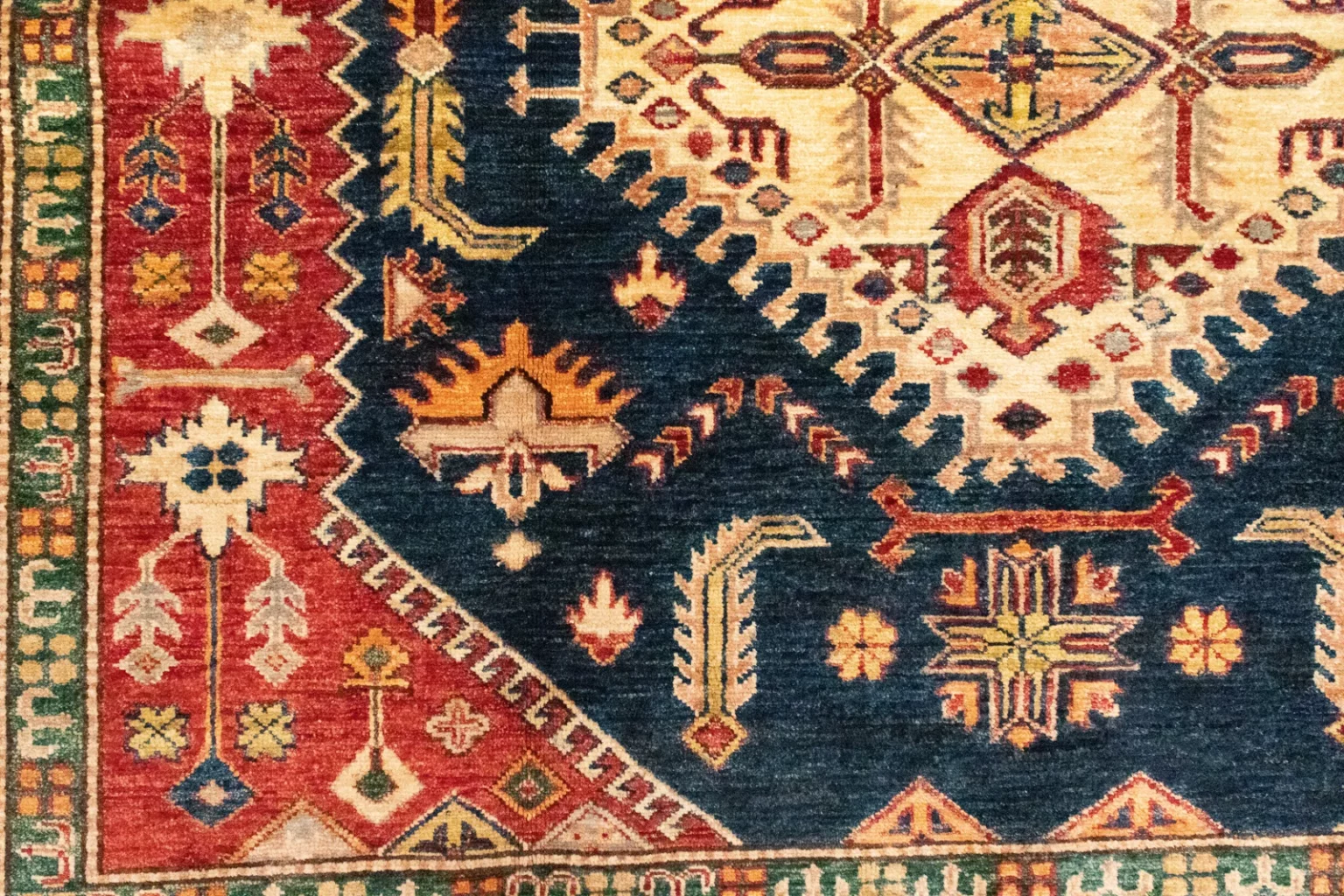
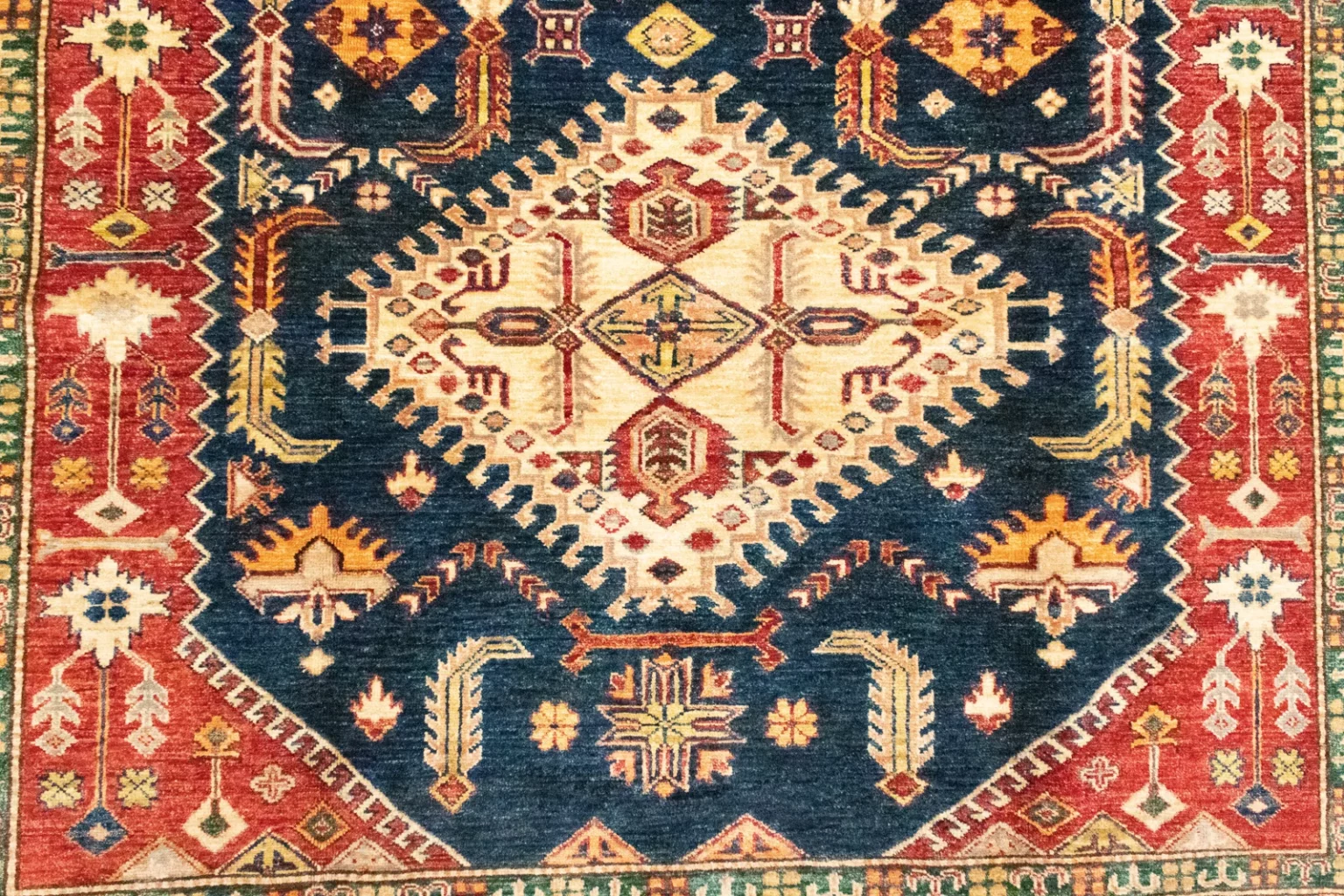
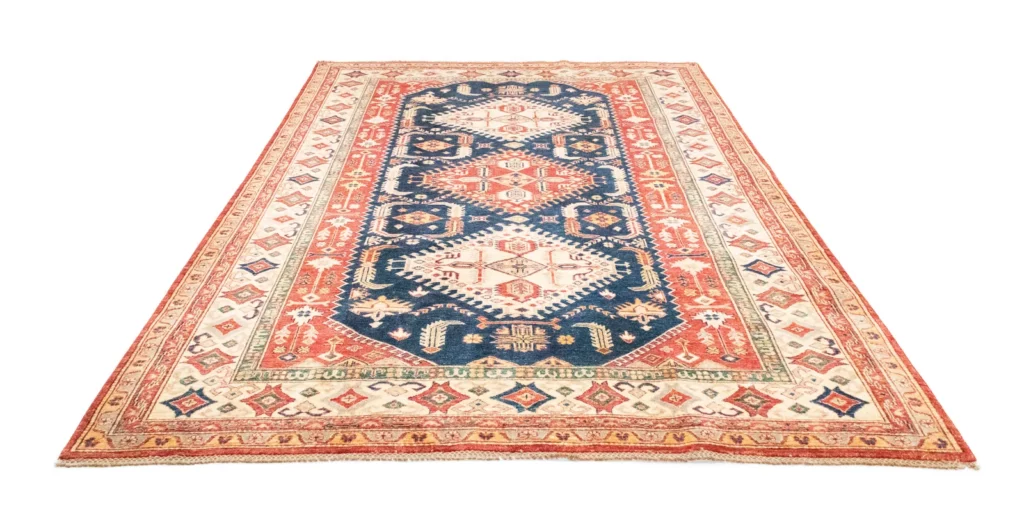
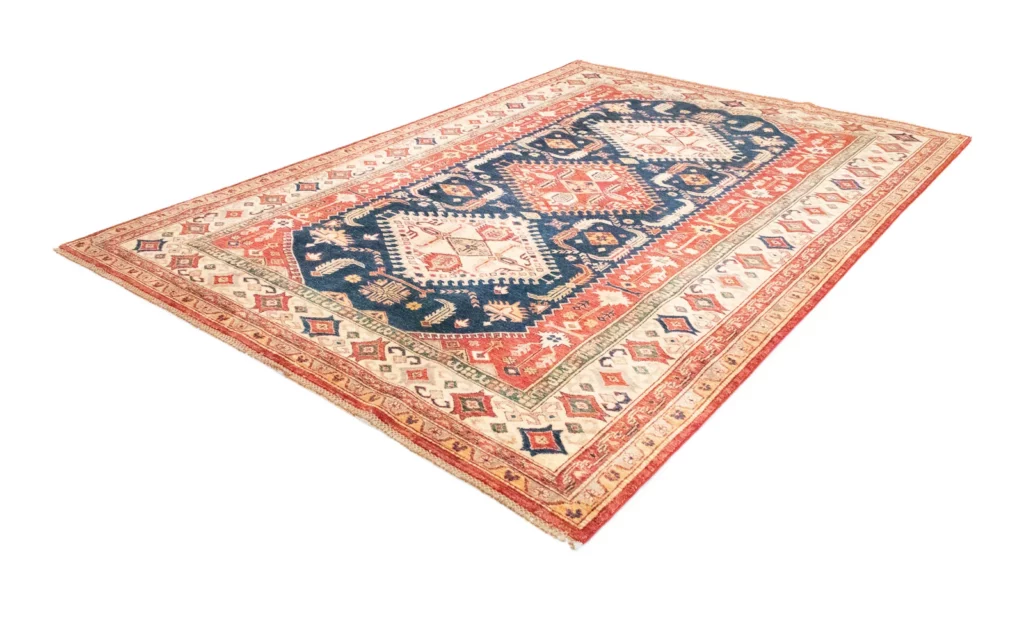
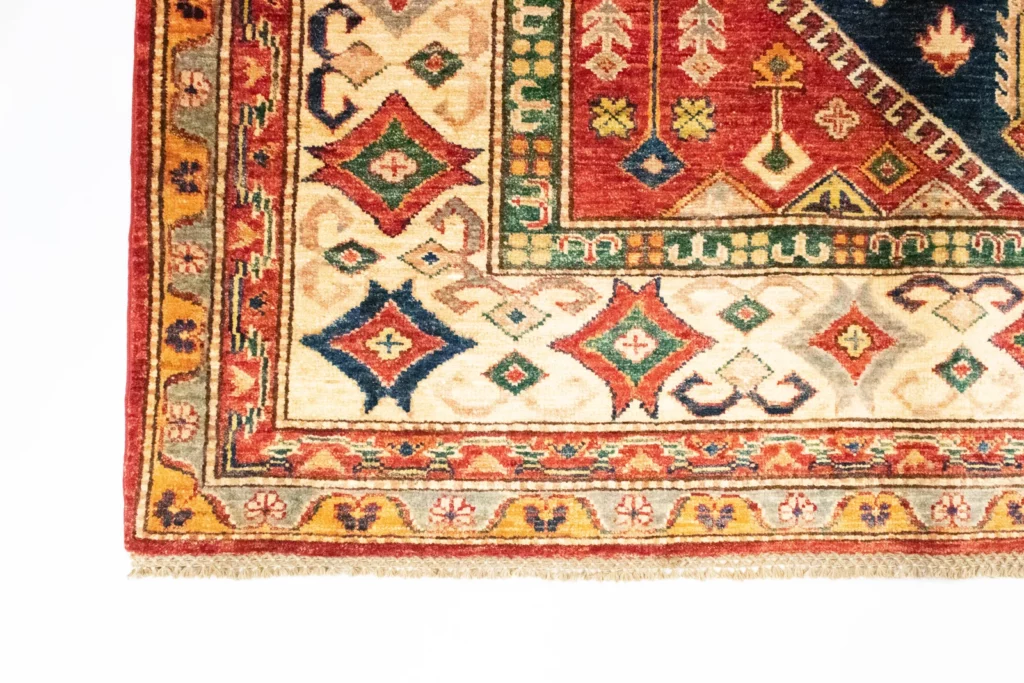
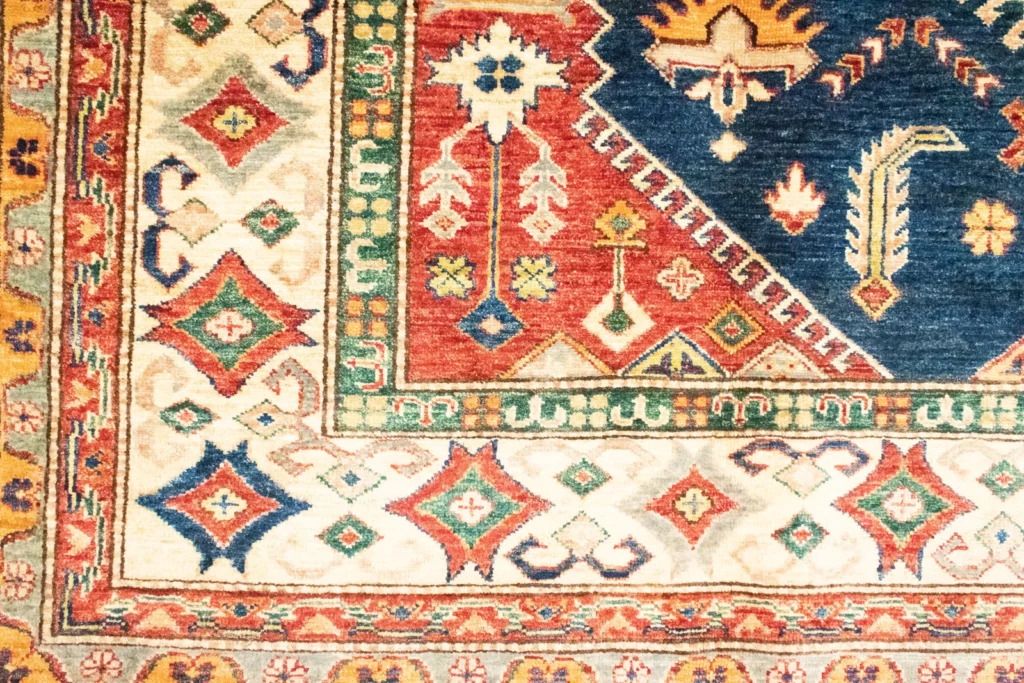
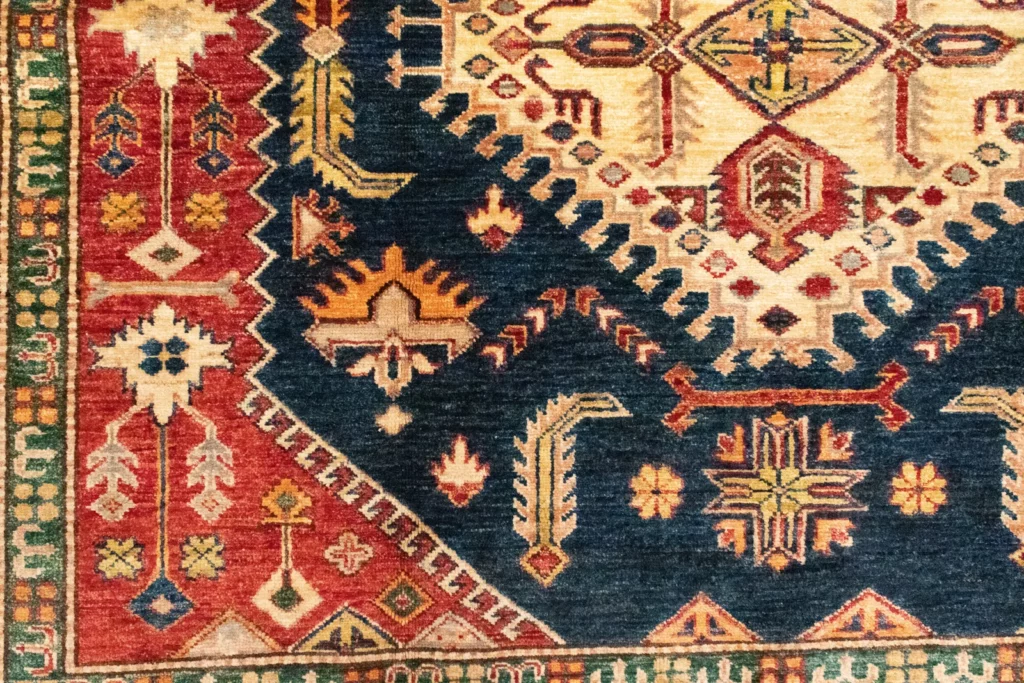
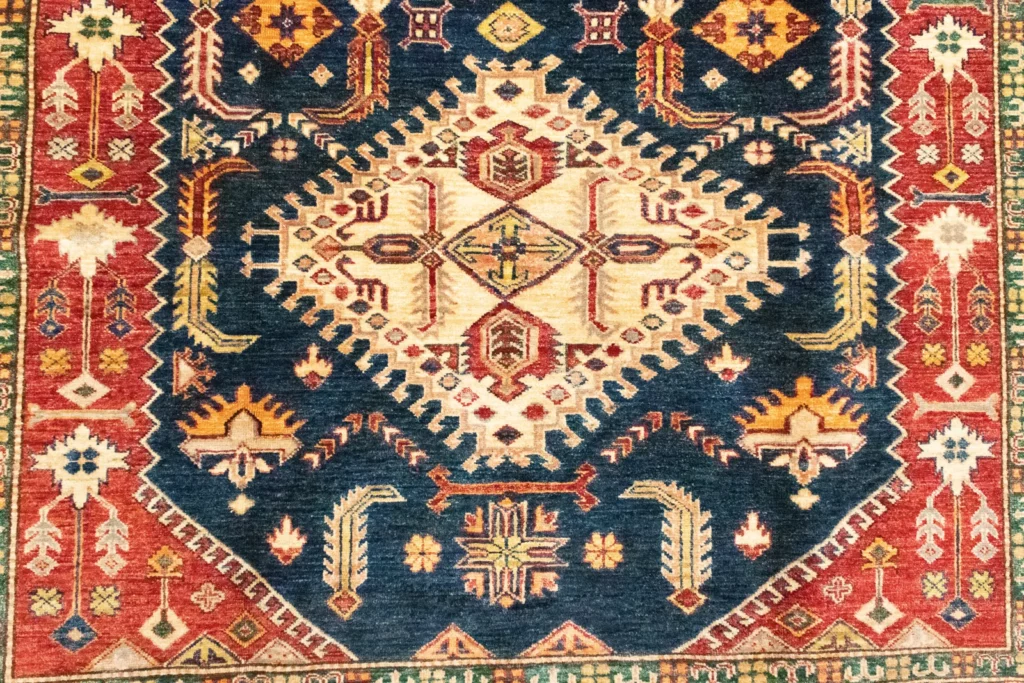
The pattern of this rug is geometric and clearly structured. Geometric designs depend on lines, angles, repeated shapes, enclosed fields and a visible relationship between the central area and its surrounding elements. Rather than imitating a natural scene in detail, they reduce forms to a defined visual vocabulary. Ranks of motifs may be mirrored, repeated or separated into compartments, allowing the composition to be understood through rhythm and order.
Kazak design traditions are commonly associated with strong, legible geometry. A motif may be formed from straight sections, stepped outlines, hooked details or diamond-like shapes. In a wider Caucasian design vocabulary, medallions, stylised plant forms and border ornaments may also appear. These are general features of the tradition, not a claim that every one of them appears on this rug. The specific description of this piece remains limited to a geometric, clearly structured pattern.
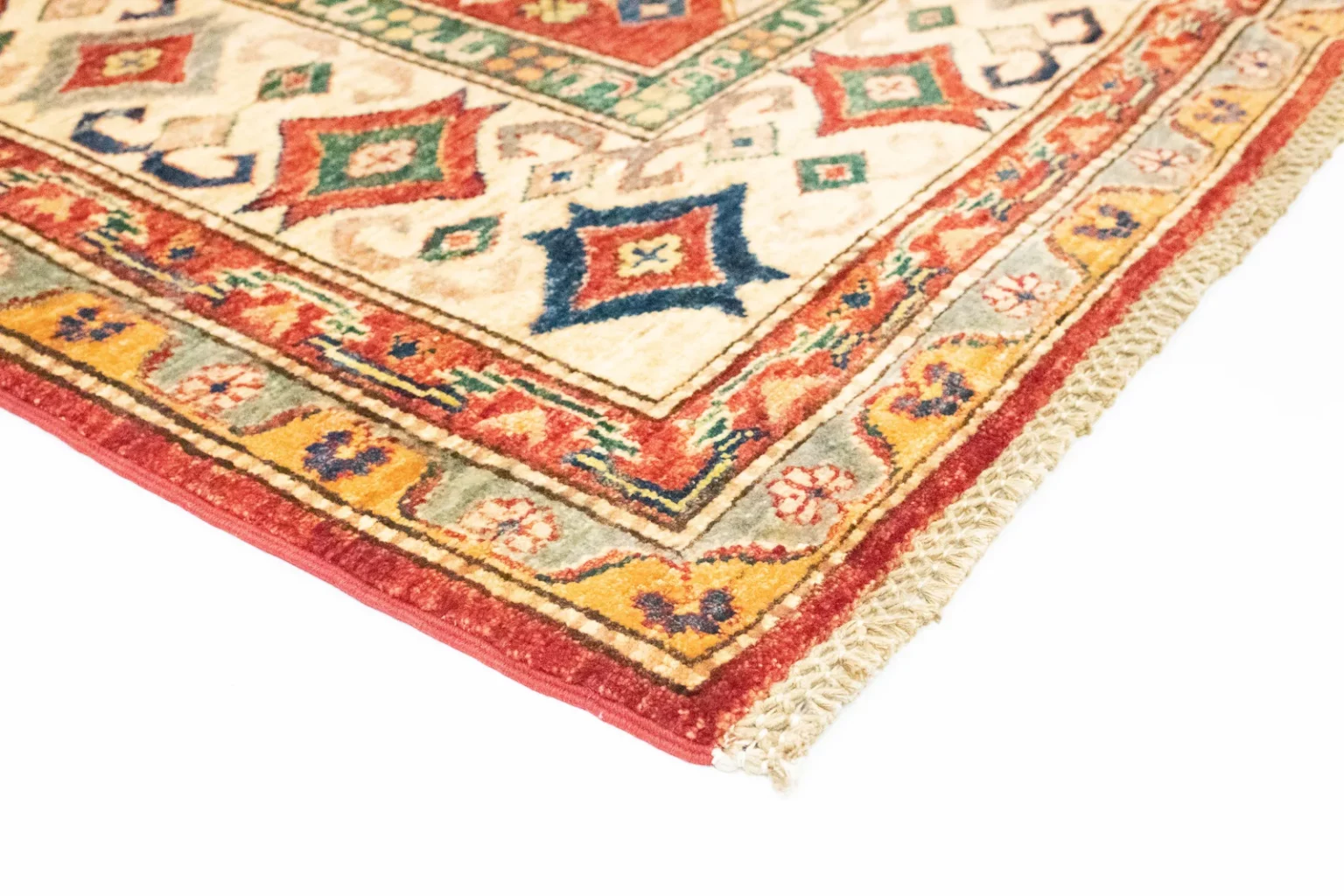
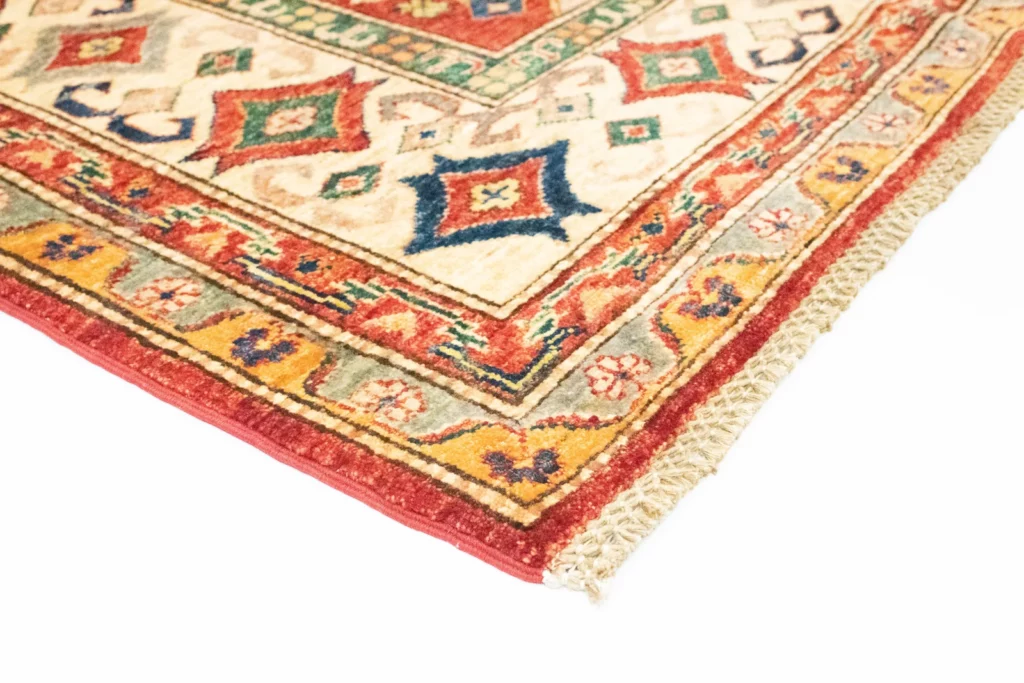
Many geometric rugs use a border to frame the interior field. A border can create a visual transition between the main composition and the edge, while repeated ornaments establish a measured rhythm. Within the field, the balance comes from the relationship of open ground, outlined shapes and recurring details. Hand-knotting translates this arrangement into rows of coloured knots. The clarity of the result depends on the placement of those knots and on the way the contours are maintained across the surface.
Geometric ornament can be decorative without depicting one specific story or scene. Its character comes from repetition, proportion, direction and the contrast between separate shapes. The design may be read from a distance as a structured whole and examined more closely through its individual elements. Knot density supports the technical execution of such forms, but it does not by itself identify a particular motif, village or country.
The word Kazak should therefore be understood carefully in the design context. It names the visual tradition associated with the rug, while the manufacturing information places the knotting in Pakistan or Afghanistan. This separation is important in oriental rug classification: a pattern name can refer to an inherited regional style rather than to the place where the individual rug was produced. The result here is a wool, hand-knotted Oriental rug with a clear geometric Kazak design.
Special Features
The specific features of this rug are its wool construction, hand-knotted technique, short pile and knot density of 180,000 knots per square metre. Its pattern is geometric and clearly structured, and its condition is described as well preserved. These points identify the actual piece without adding an unstated age, signature, workshop or fibre blend.
The origin information combines the Caucasus as the regional reference with Pakistan or Afghanistan as the named manufacturing locations. The rug is accordingly presented as a Kazak Oriental rug rather than as an Iranian Persian rug. Its individual character comes from the way its geometric pattern, wool pile, handwork and preserved condition occur together in one piece.
FAQ
How should I care for this Kazak Oriental rug?
Vacuum the rug regularly so that loose dust and particles do not remain in the short wool pile. It should be protected from direct sunlight, since prolonged exposure can place stress on a rug’s surface and colours. If something is spilled, treat the spot immediately with a damp cloth and mild soapy water. Work carefully rather than rubbing aggressively, as unnecessary friction can affect the pile. For heavier soiling, professional rug cleaning is an appropriate option.
What are the advantages of a hand-knotted rug?
A hand-knotted rug is constructed knot by knot and is therefore different from an industrially produced floor covering. This method creates a robust and durable textile. The density of 180,000 knots per square metre supports the orderly rendering of the geometric lines and forms. Each hand-knotted rug is also a one-off, because the precise execution and arrangement of the knots belong to that individual piece. Here, the handwork is combined with wool, a short pile and a clearly organised Kazak pattern.
How can I identify this rug’s origin?
The pattern name and the manufacturing location need to be considered separately. Kazak refers to the Caucasian design tradition, while this rug was knotted in Pakistan or Afghanistan. It should therefore be classified as an Oriental rug, not as an Iranian Persian rug. Material, technique, knot density and pattern are useful points for describing the piece. A particular village, workshop, age or signature should only be attributed when that information has been expressly documented.
To provide the best experiences, we use technologies like cookies to store and/or access device information. Consenting to these technologies will allow us to process data such as browsing behavior or unique IDs on this site. Not consenting or withdrawing consent, may adversely affect certain features and functions.
Functional Always active
The technical storage or access is strictly necessary for the legitimate purpose of enabling the use of a specific service explicitly requested by the subscriber or user, or for the sole purpose of carrying out the transmission of a communication over an electronic communications network.
Preferences
The technical storage or access is necessary for the legitimate purpose of storing preferences that are not requested by the subscriber or user.
Statistics
The technical storage or access that is used exclusively for statistical purposes.The technical storage or access that is used exclusively for anonymous statistical purposes. Without a subpoena, voluntary compliance on the part of your Internet Service Provider, or additional records from a third party, information stored or retrieved for this purpose alone cannot usually be used to identify you.
Marketing
The technical storage or access is required to create user profiles to send advertising, or to track the user on a website or across several websites for similar marketing purposes.

 SECURE PAYMENT
 SHIPPING PARTNERS