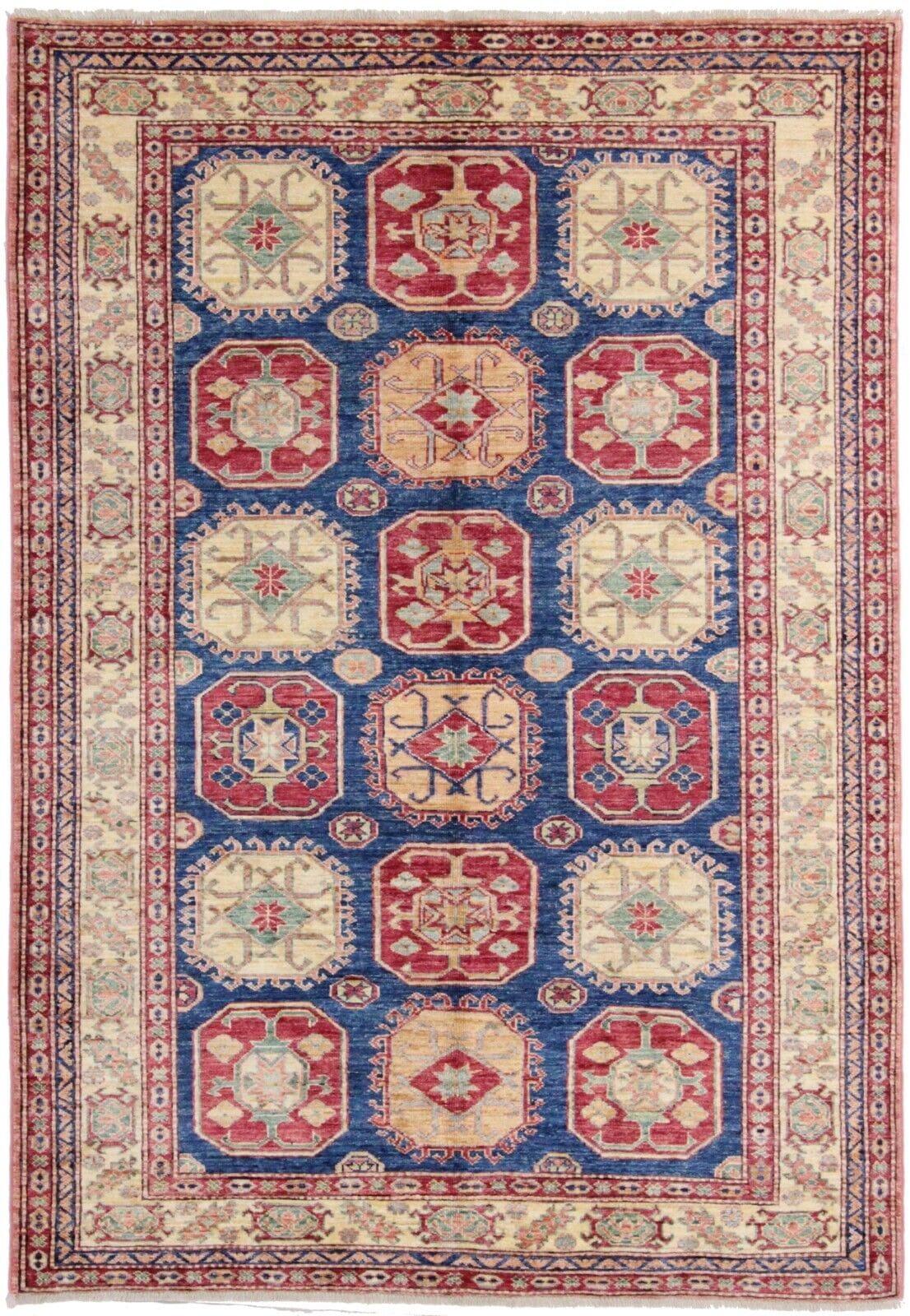
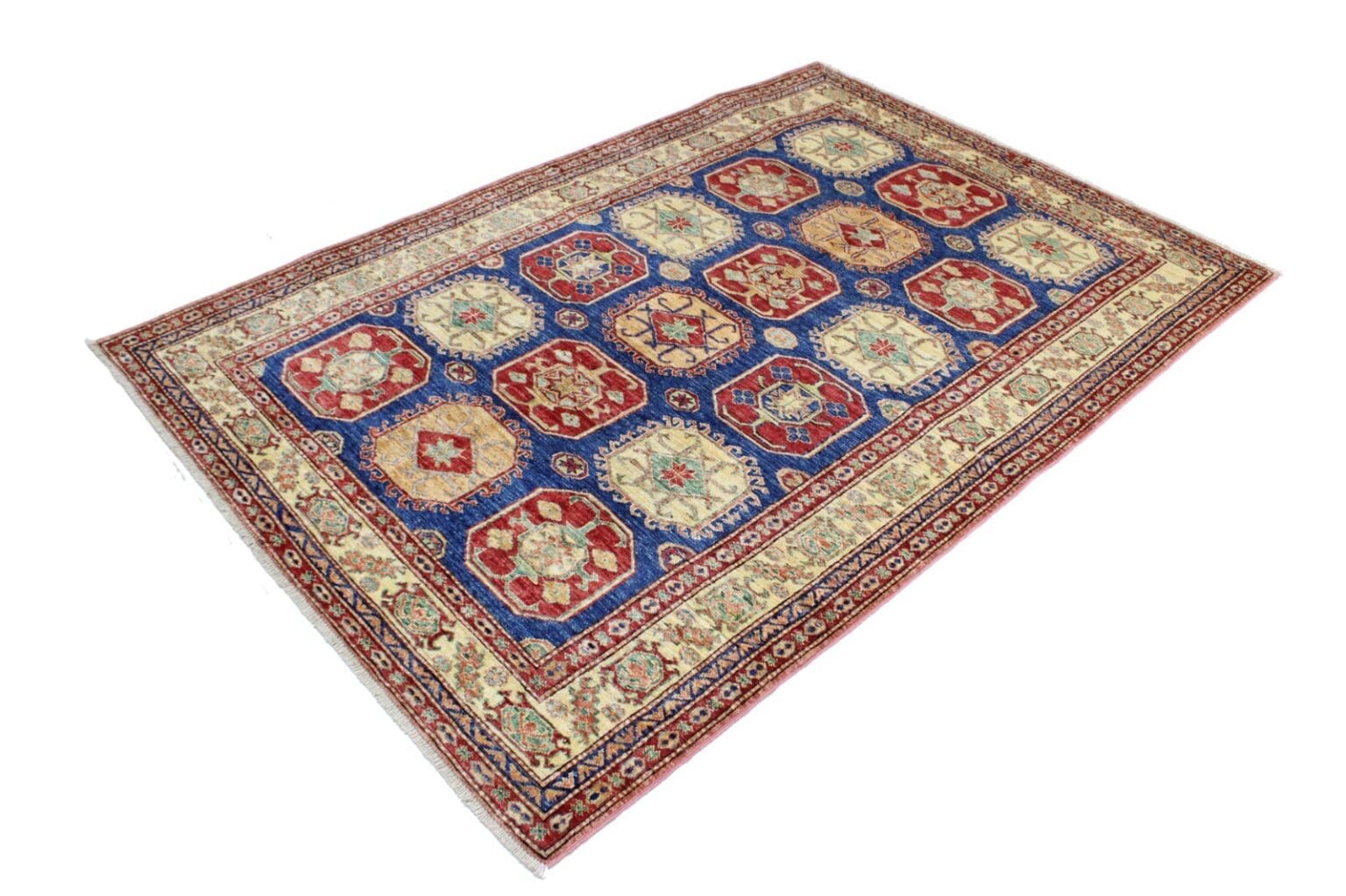
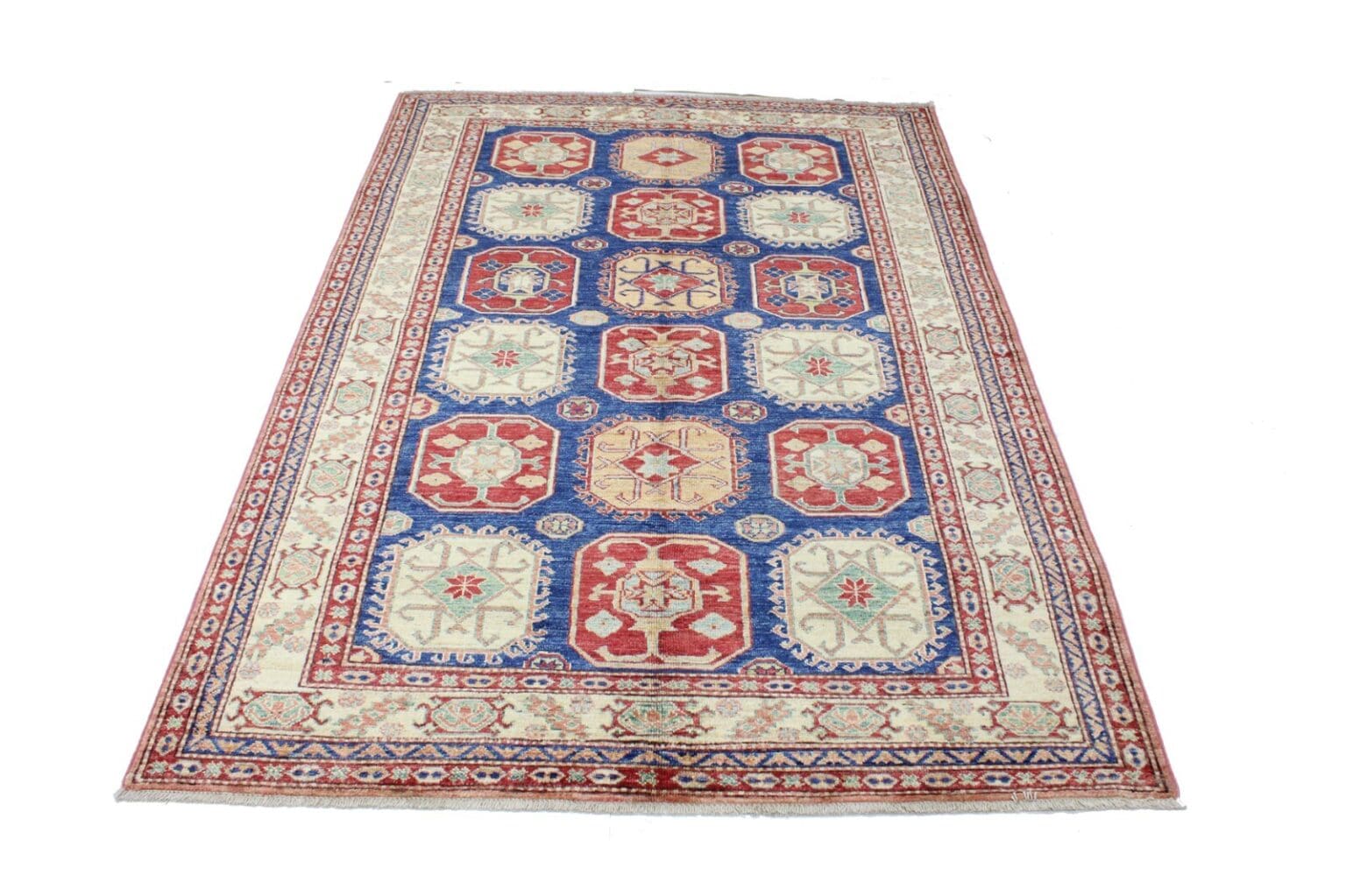
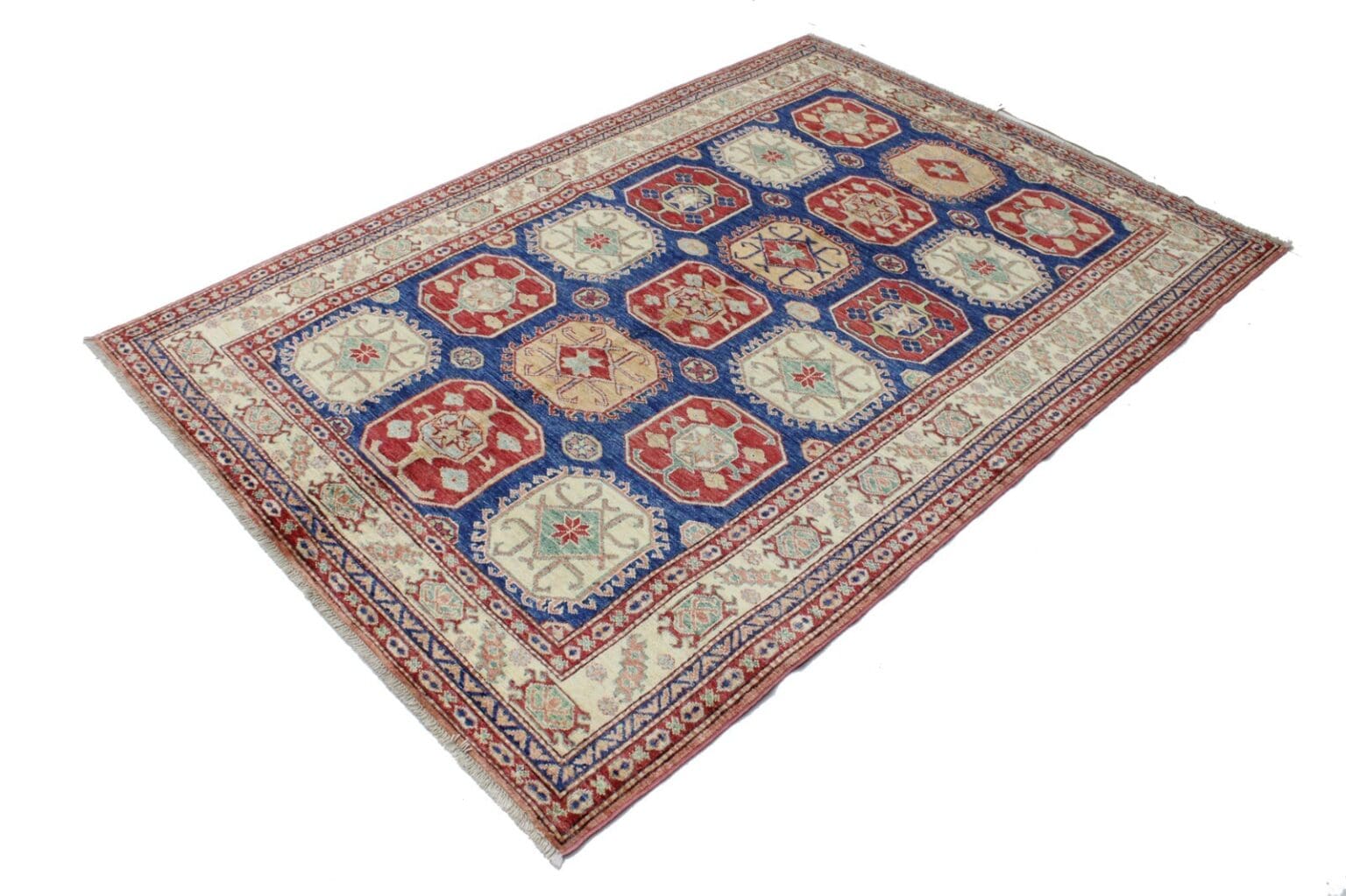
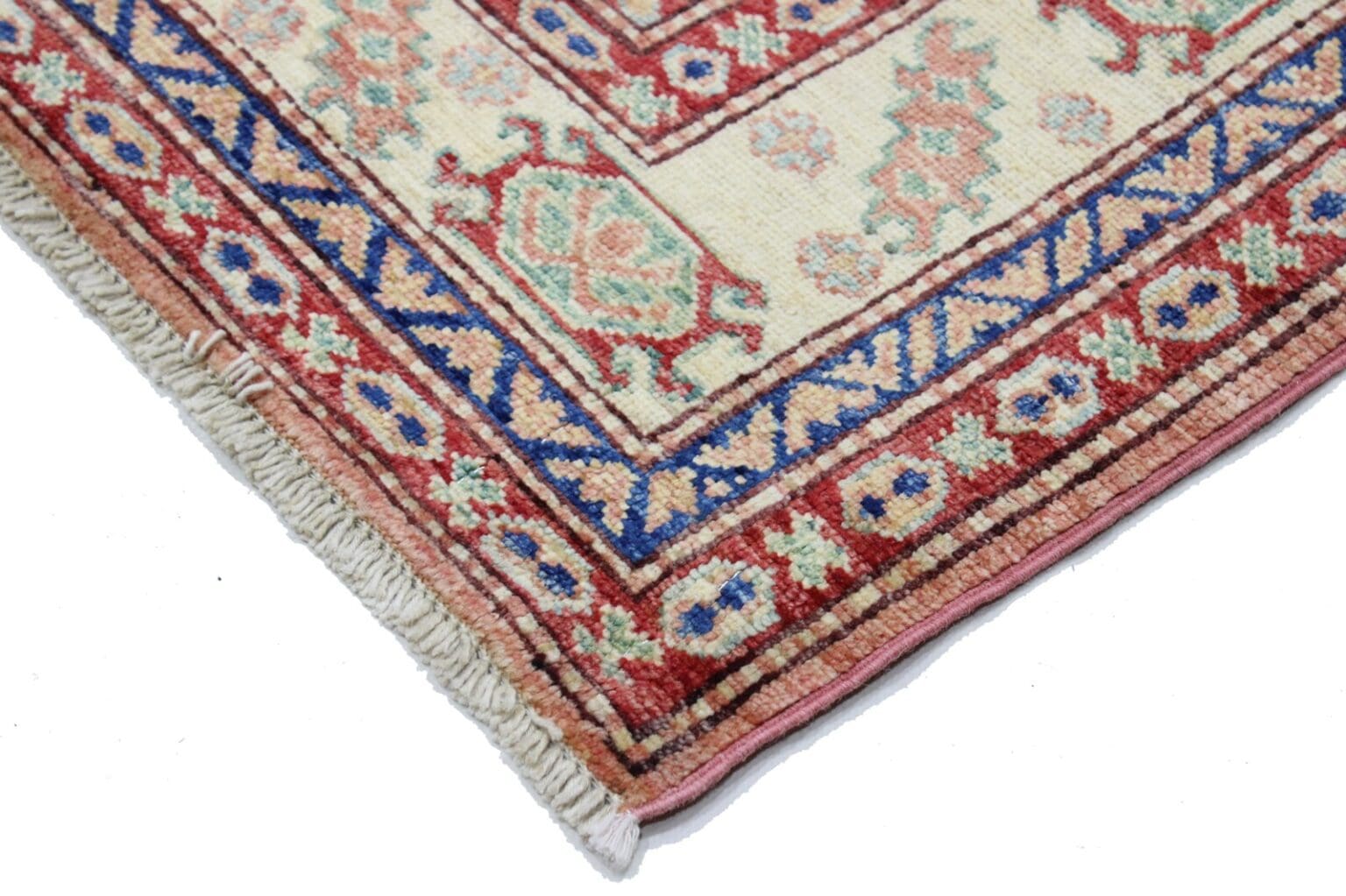
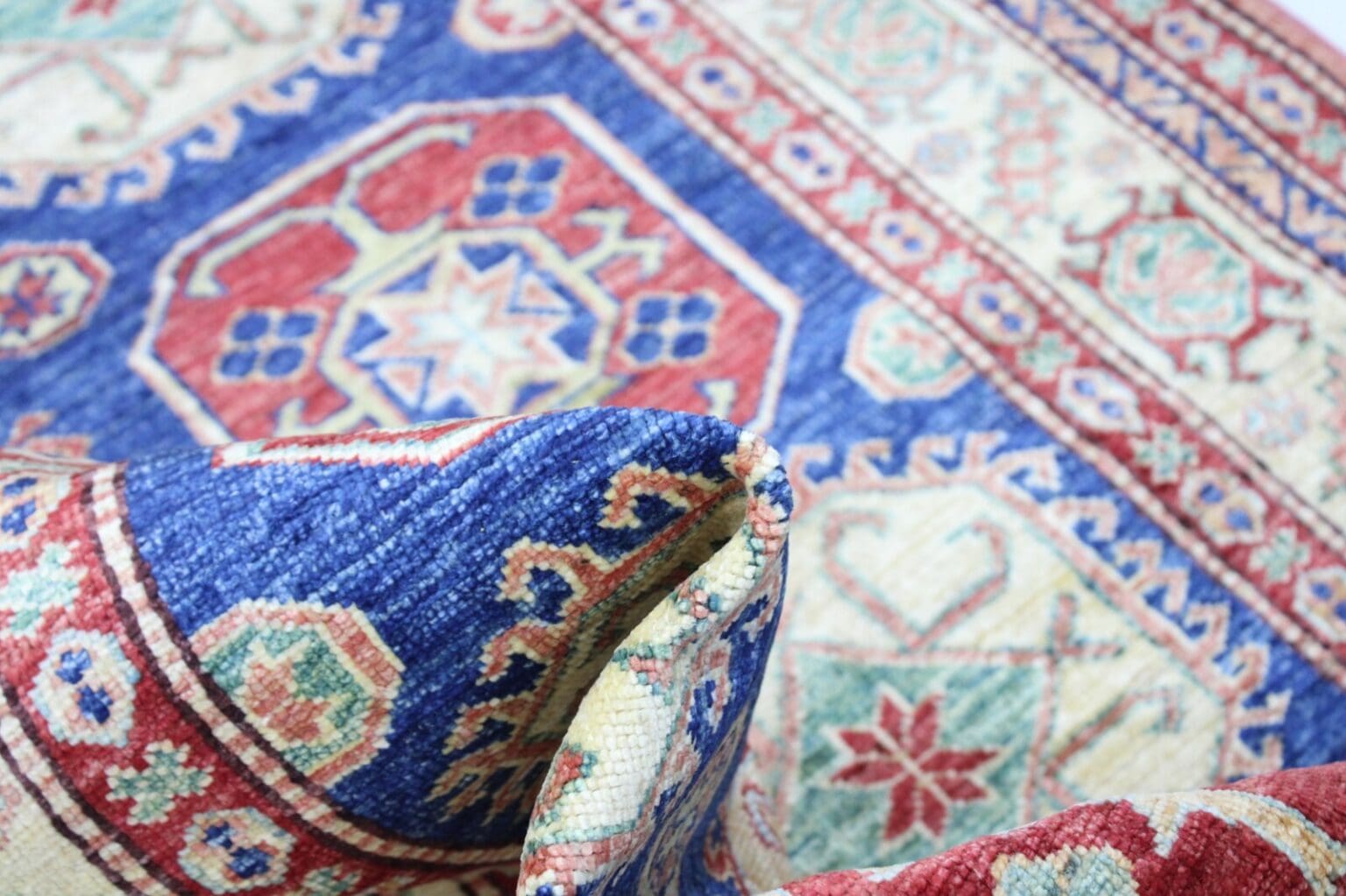
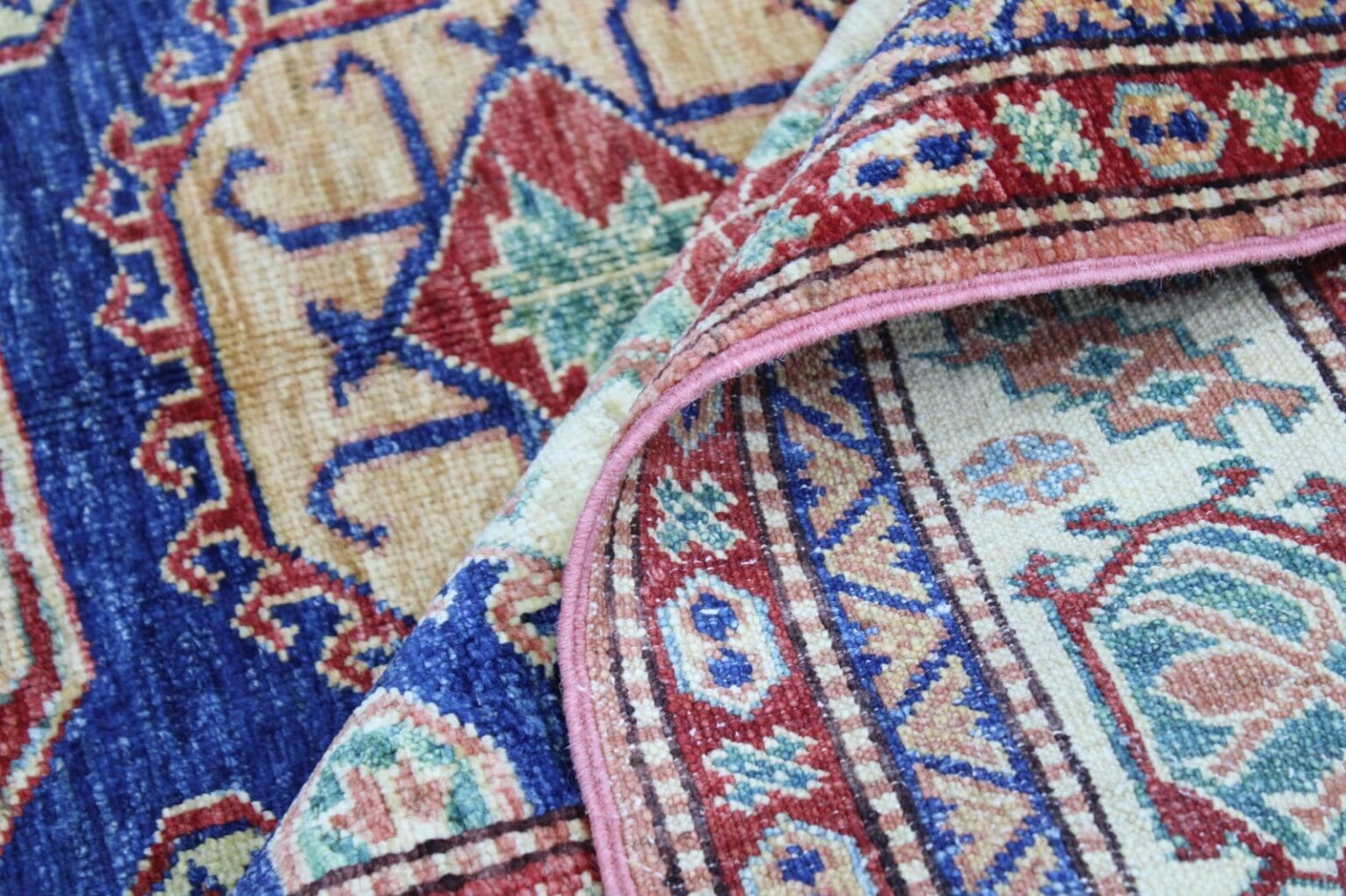
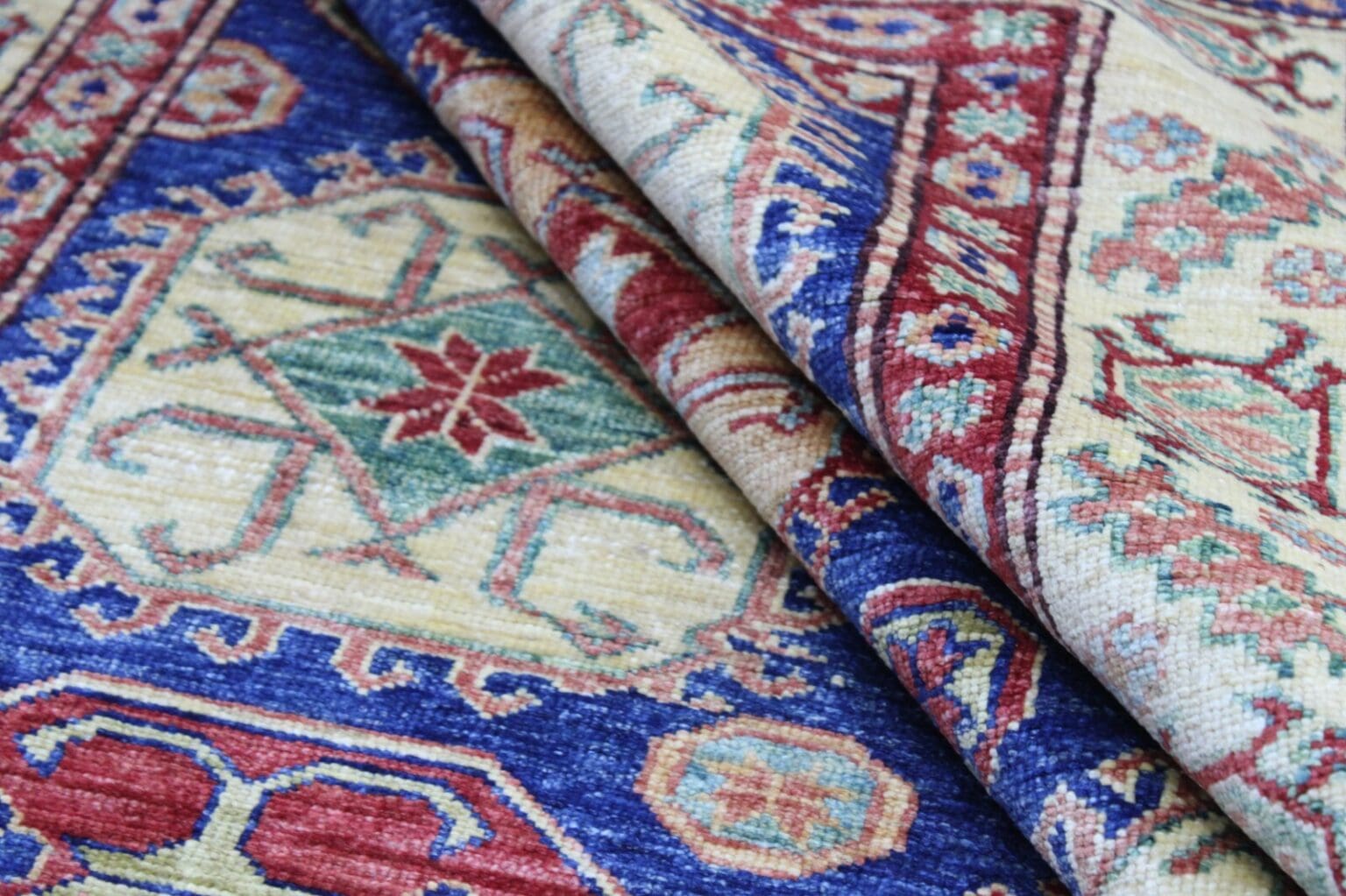
This Kazak Oriental rug is hand-knotted. Its pile is made from 100% highland wool, while the warp is 100% cotton. The wool pile gives the surface a distinct textile handle, and the cotton warp forms the supporting foundation within the construction. Highland wool is used in hand-knotted rugs because its fibres can combine a soft feel with practical resilience. This makes wool suitable for a rug intended to function as a floor covering as well as a textile object.
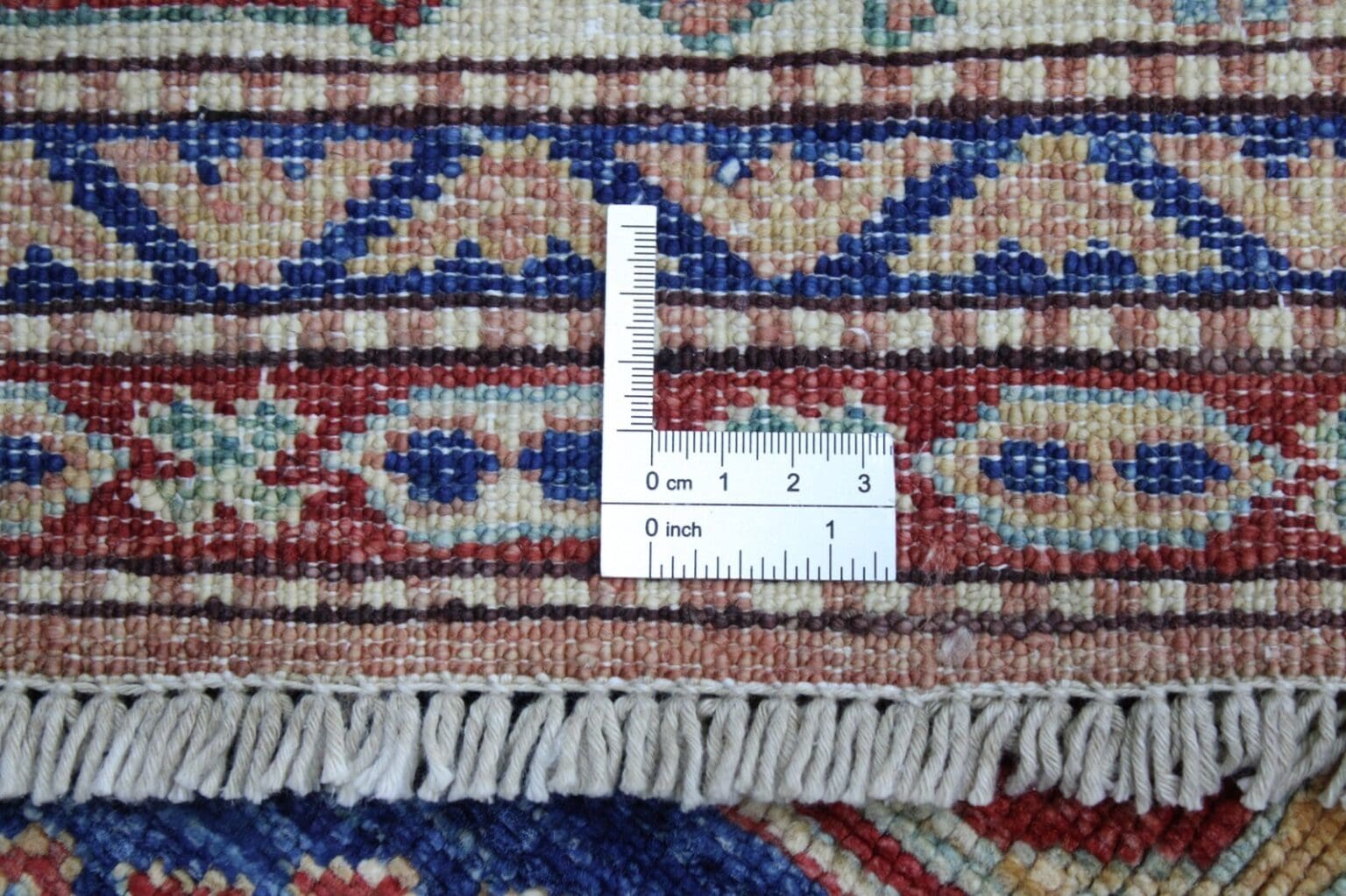
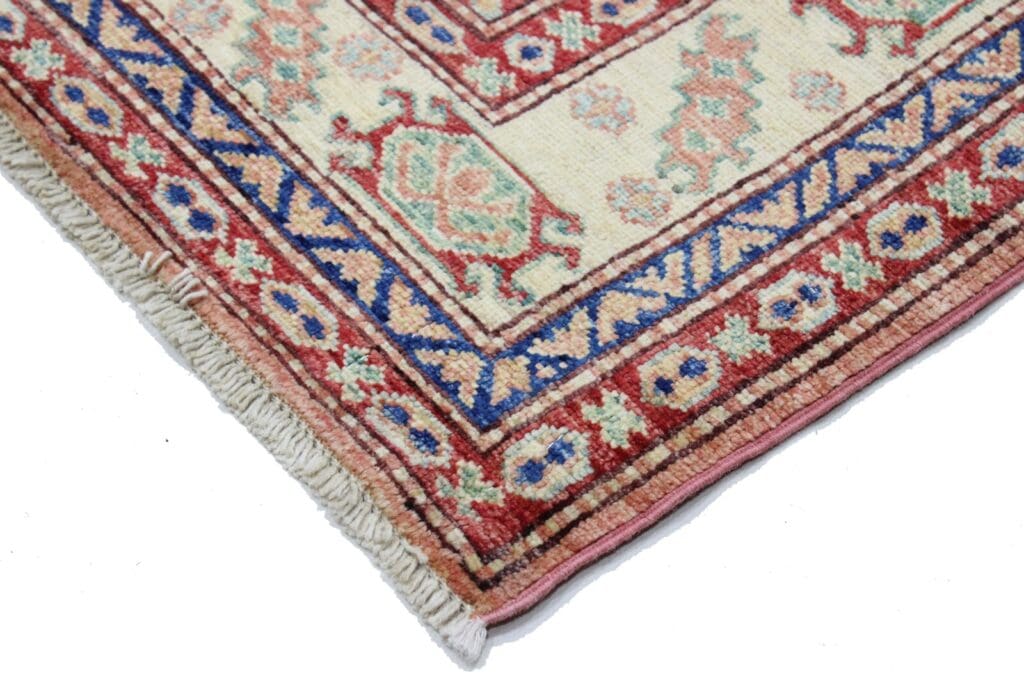
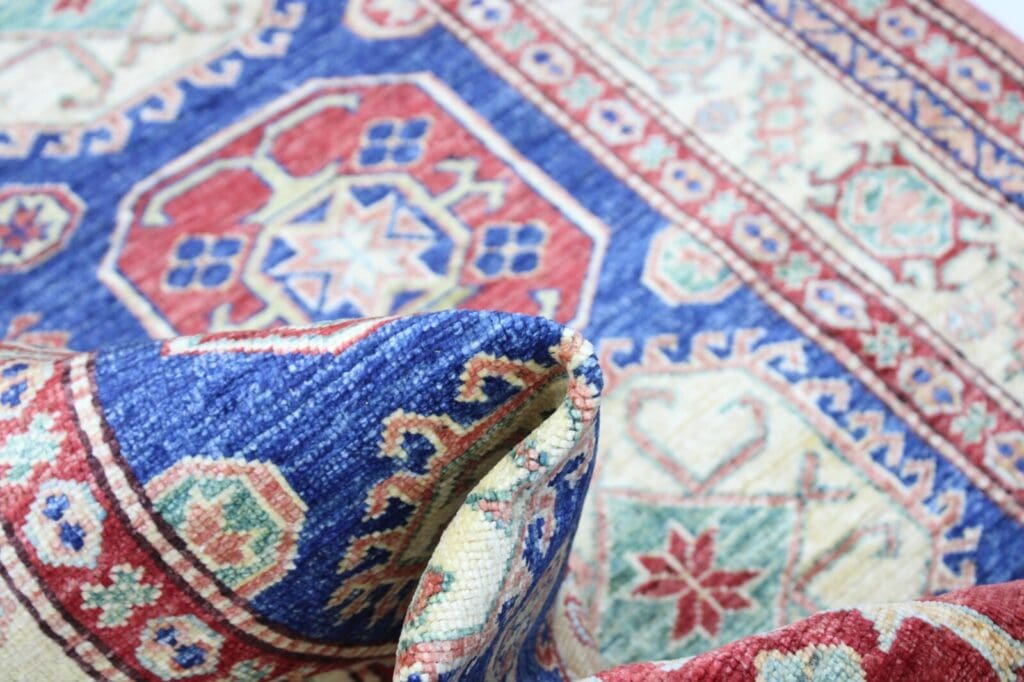
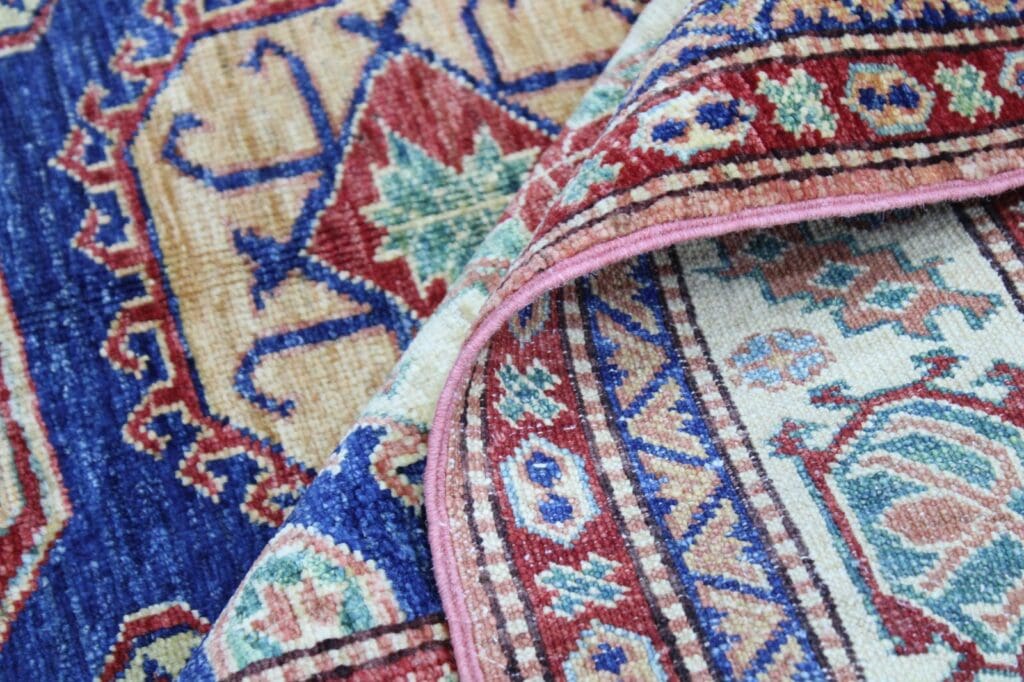
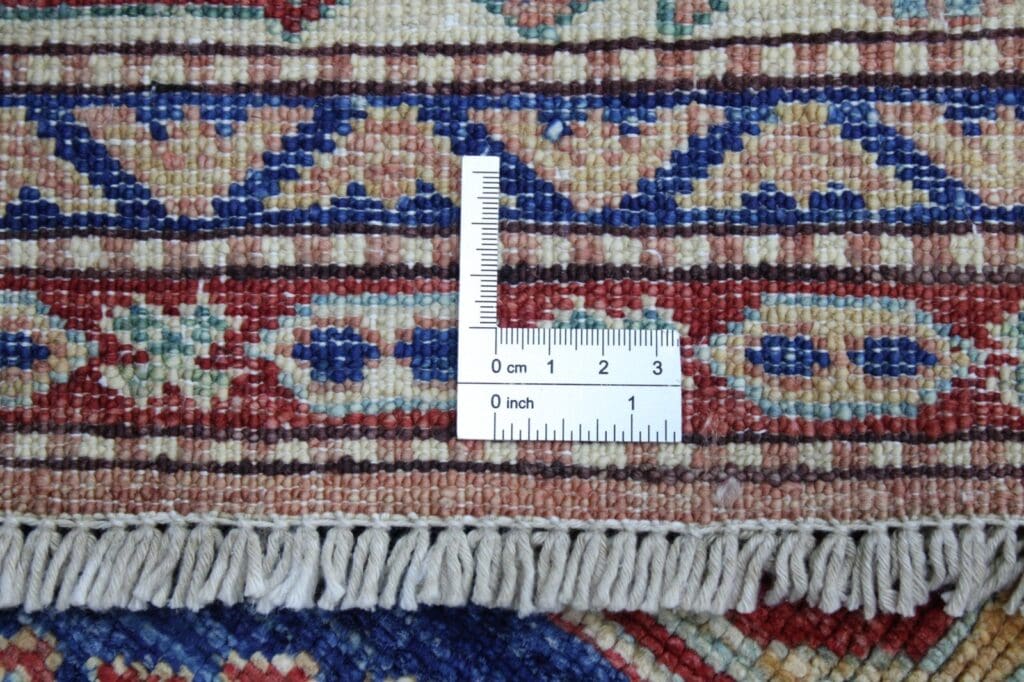
Hand-knotting means that individual knots are tied into the prepared warp one row at a time. Weft threads are inserted between rows and the structure is compacted as the work progresses. This differs from a machine-made floor covering, where the surface and structure are produced by an automated process. A hand-knotted rug may show small variations in its lines and surface because the pattern is built by hand. The listed density of approximately 160,000 to 200,000 knots per square metre indicates a carefully worked construction with scope for detailed forms. Knot density is one quality factor, but it does not by itself describe every aspect of a rug.
The wool is the visible and usable pile material, shaping the texture, touch and appearance of the surface. The cotton warp remains within the foundation and keeps the knots aligned. This distinction between pile and warp is central to the construction of a knotted rug. Rows are built gradually, with the design checked and continued throughout the work. The process requires practical knowledge of tension, spacing and pattern placement. This rug is identified as a one-off piece, and only one is available.
A hand-knotted rug also carries evidence of its making in the relationship between the pattern and the weave. Straight lines are formed by successive rows of knots rather than by a printed surface. Curves and stepped outlines are translated into the vocabulary of individual knots. The choice of highland wool, the cotton foundation and the hand-knotted technique therefore describe both the materials and the way this particular rug was made.
Origin and Tradition
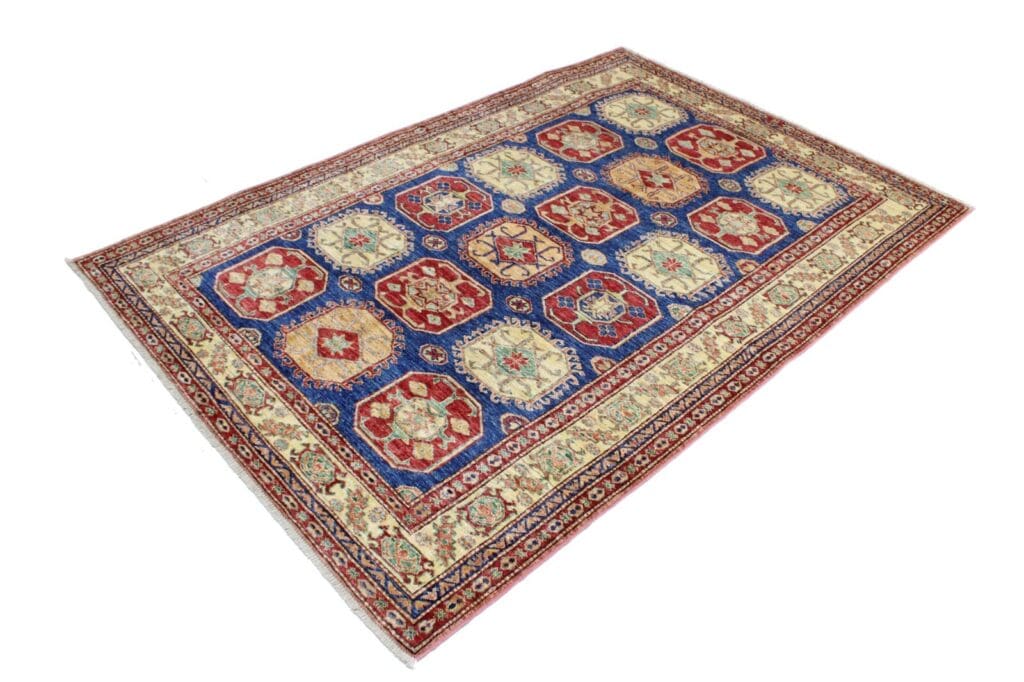
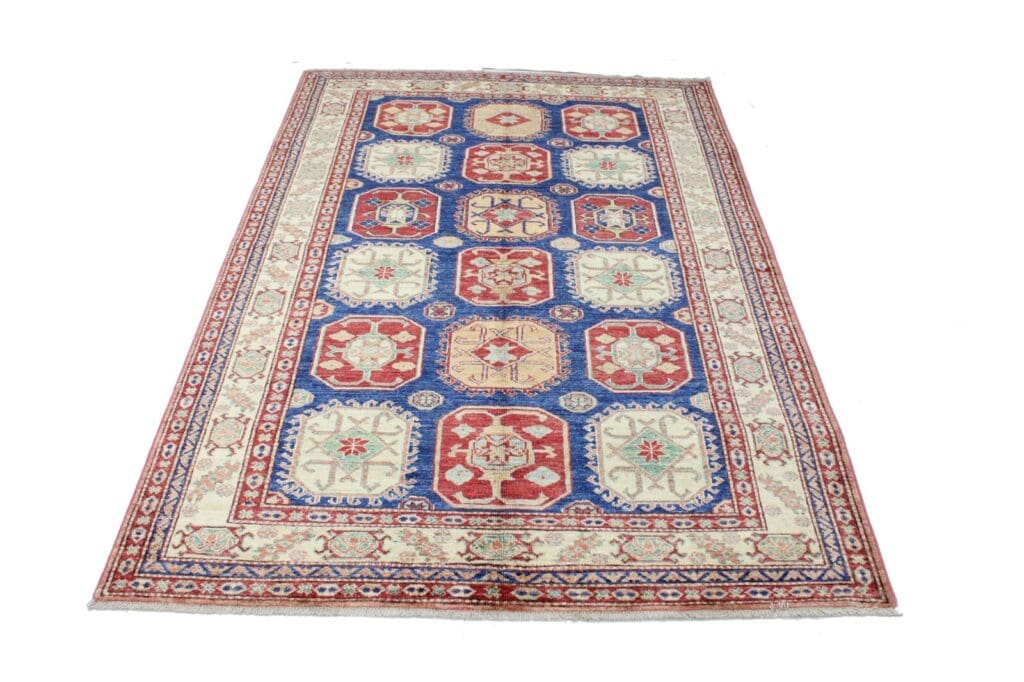
This rug is identified as a Kazak and its origin is Afghanistan. The name Kazak refers to a distinct rug tradition whose historical examples are associated with the Caucasus. Kazak designs are known for strong, clearly organised fields, geometric drawing and an interplay between large motifs and repeated borders. The tradition is not a single fixed pattern, but a broad family of related compositions shaped by regional workshops, travelling weavers and contact between neighbouring areas.
Caucasian Kazak examples are often associated with durable hand-knotted rugs in which the design can be read clearly across the room. Medallions, diamonds, stepped contours, hooked forms and angular floral elements are common parts of this visual vocabulary. Such devices do more than decorate the surface. They divide the field, establish rhythm and guide the eye between the centre and the border. Their angular character can also reflect the practical use of pattern diagrams adapted to the requirements of hand production.
Across rug-making cultures, weaving knowledge has commonly been passed through families, workshops and local communities. A weaver learns how to prepare the foundation, maintain tension, place colours and repeat or modify a motif. This allows a recognisable tradition to continue while leaving room for individual interpretation. Kazak designs therefore show both continuity and variation. Similar geometric signs may appear in several rugs, yet their scale, arrangement and colour relationships can differ.
Historically, rugs in the Caucasus and surrounding regions served everyday purposes as well as decorative ones. They could provide warmth, cover a floor or furnishing, and form part of the textile environment of a dwelling. Their patterns developed within a practical culture of making, using and maintaining textiles. Trade and movement between regions brought techniques and visual ideas into contact. This exchange helps explain why related geometric motifs can appear across different weaving areas without making every rug from those areas identical.
The stated origin of this individual rug is Afghanistan. That fact must be kept separate from the historical Caucasian association of the Kazak design name. Here, Kazak primarily identifies the pattern tradition and stylistic family, while Afghanistan identifies where this particular rug comes from. Afghanistan has its own long-established carpet-making culture and has also absorbed design influences from neighbouring regions. Afghan makers can reinterpret established motifs through their own choice of structure, colour and arrangement.
The tradition of a hand-knotted rug is therefore both regional and personal. Regional vocabulary supplies familiar forms, while the maker determines how those forms are placed in the field and border. The finished textile preserves a connection to older design practices without being a historical artefact itself. Its significance lies in the combination of origin, materials, knotting method and a pattern language that has been transmitted and adapted over time.
Design and Pattern
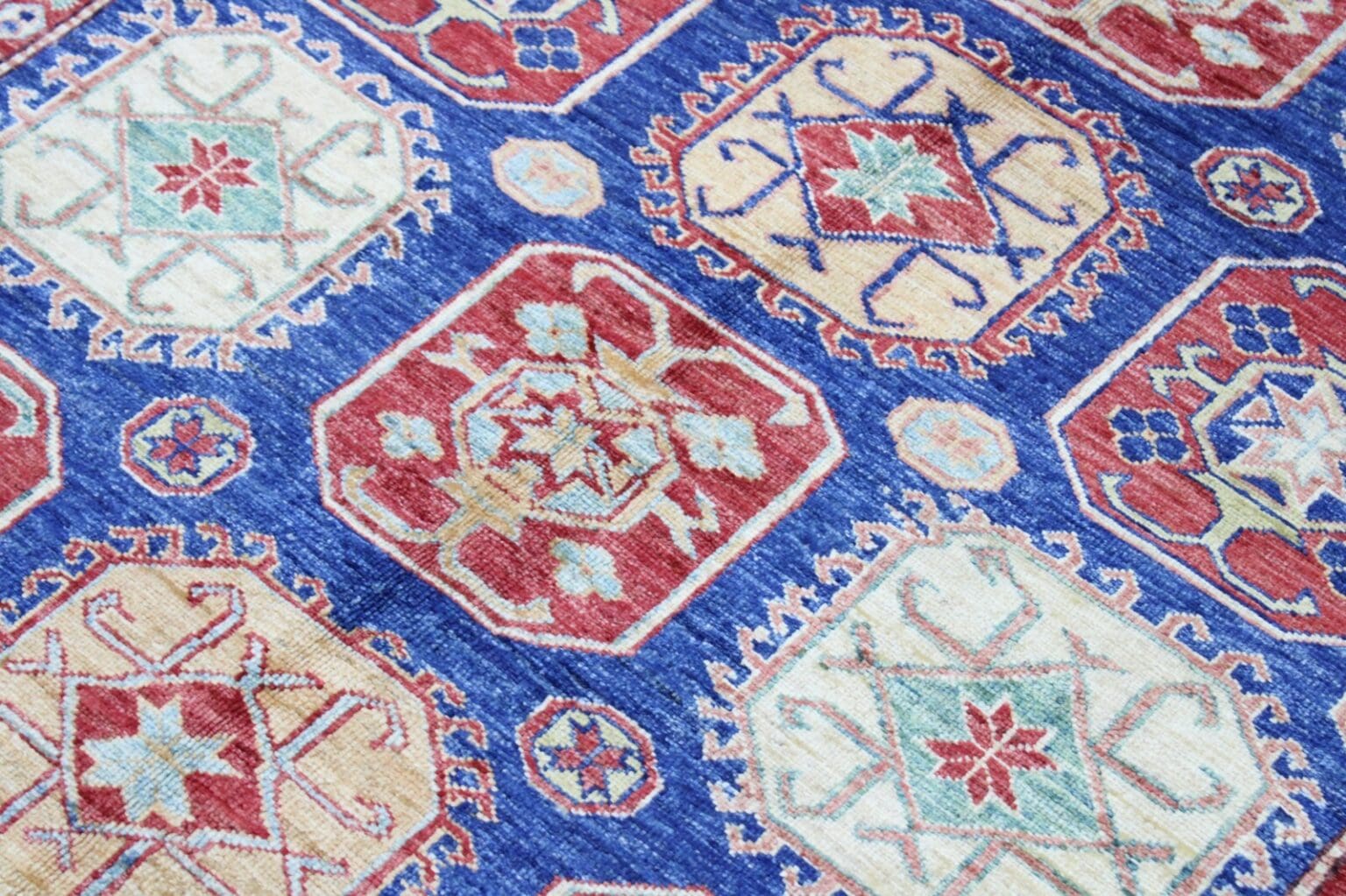
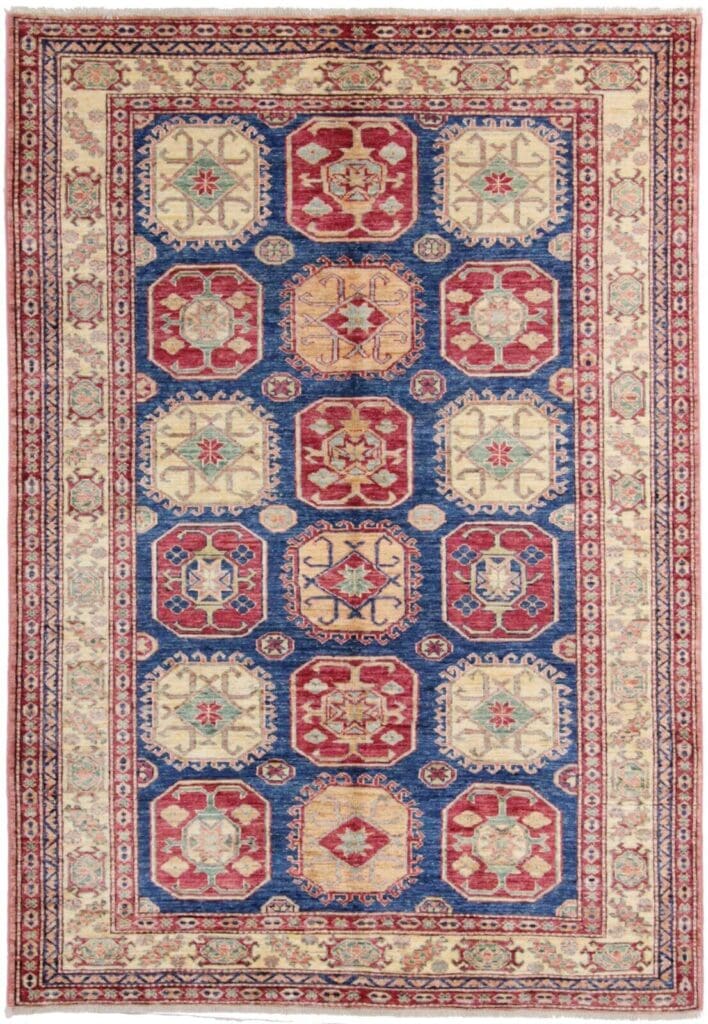
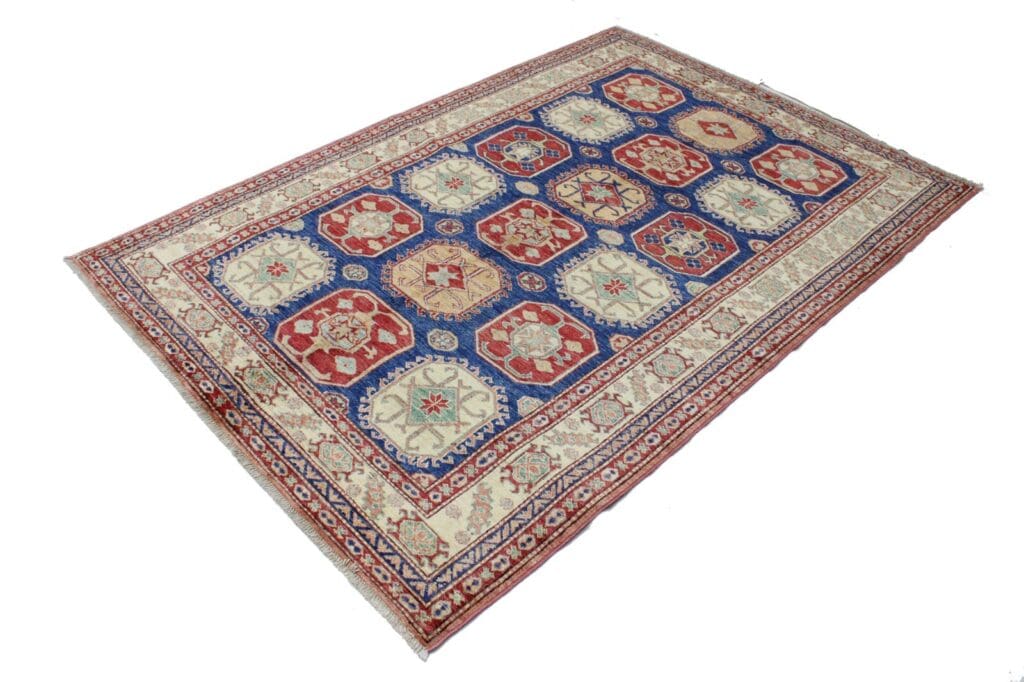
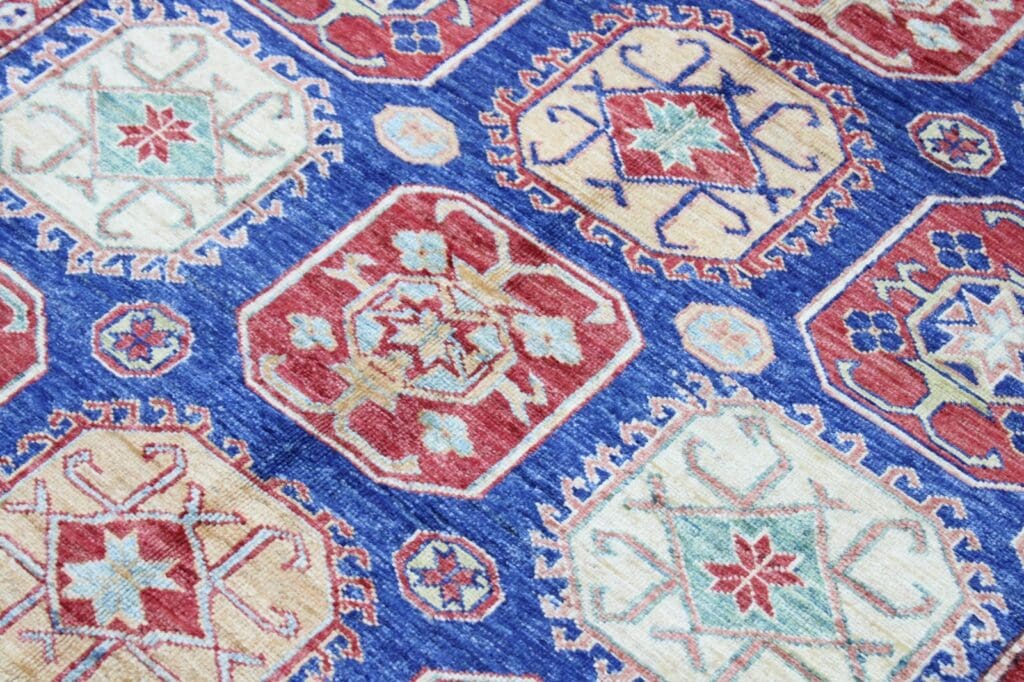
The pattern of this rug is described as Art Deco and geometric. Art Deco design is associated with order, clear outlines, repeated intervals and simplified shapes. In a rug, these features can meet the visual language of traditional Oriental carpets. Geometric drawing works particularly well with hand-knotting because edges, stepped lines and blocks of colour can be built gradually from individual knots. The result is a surface whose design remains connected to its method of production.
Kazak pattern families often use large, legible forms. Diamonds, medallions, stars, hooked shapes, stepped borders and angular floral signs may be combined within one composition. Plant and animal motifs can also be reduced to a few characteristic lines rather than represented naturalistically. This abstraction gives the design a symbolic and ornamental quality. The motifs are not isolated illustrations; they work together as a system of repeated shapes, counter-shapes and directional lines.
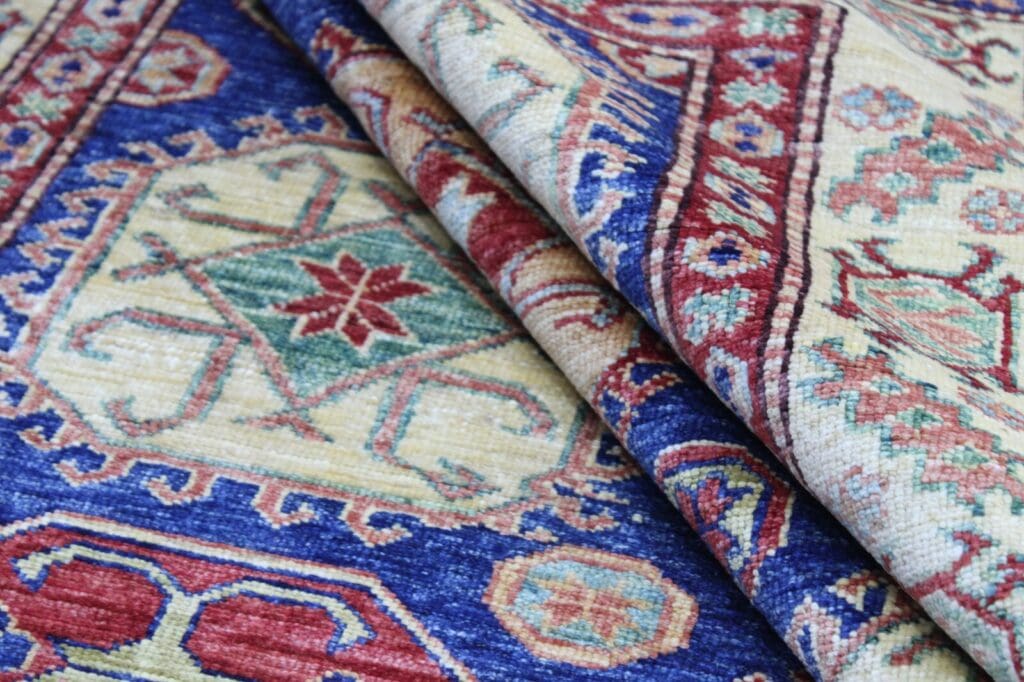
Many Kazak compositions distinguish a central field from one or more surrounding borders. The border creates an edge and gives the central design a frame. Repeated small motifs can produce a measured rhythm, while larger signs may mark intervals or corners. Within the field, forms may be mirrored, aligned around a central axis or arranged in a sequence. These devices provide visual structure while still allowing the small irregularities that belong to hand-made work.
Strong, saturated colours are a recognised feature of the wider Kazak design tradition. Red, blue and yellow shades are frequently used to separate principal forms and establish contrast between field, border and secondary details. Colour does not operate in isolation: a light outline can clarify a dark shape, and adjacent saturated areas can create a stepped sense of movement. The combination of colour and geometry gives the pattern its characteristic clarity without requiring naturalistic imagery.
The Art Deco reference places additional emphasis on proportion, balance and controlled repetition. Angular lines and simplified ornaments can be read as a modern design vocabulary, while the Kazak association anchors the composition in an established Oriental rug tradition. This combination can sit alongside traditional furnishings or more restrained contemporary interiors. The rug may be used on the floor or displayed as a textile wall hanging, allowing the pattern to be viewed as both a functional surface and a woven composition.
Geometric ornament also helps distribute attention over the complete rug rather than concentrating it in one isolated image. Repeated signs create continuity from the centre towards the edges. Because the lines are made from knots, they do not have the perfectly uniform quality of a printed graphic. Their stepped contours reveal the limits and possibilities of the woven structure. That relationship between image and construction is an important part of the Kazak visual tradition.
Special Features
The rug is described as perfect, new and supplied with a label. It is a one-off piece, with only one available. The product information also identifies it as easy to care for and pet-friendly. It is suitable for use in a room with underfloor heating. When used in such a room, the heating should not be set too high in order to avoid unnecessary stress on the material. Its listed thickness is approximately 7 mm; this describes the rug’s construction and does not change its stated Afghan origin or Kazak pattern classification.
The listed knot density supports a finely worked appearance, particularly in a design based on geometric outlines and repeated forms. At the same time, the character of a hand-knotted rug depends on several factors together: pile material, foundation, knotting method, pattern execution, care and use. This piece combines a 100% highland-wool pile with a 100% cotton warp. Its special features therefore include the stated materials, the hand-knotted construction, its new condition, its one-off availability and the specified suitability for everyday interiors.
FAQ
How should I care for my Kazak rug?
Vacuum the rug regularly to remove dust and loose dirt before they settle deeply into the pile. A gentle setting is appropriate so that the surface is not subjected to unnecessary stress. If a more thorough cleaning becomes necessary, professional rug cleaning is recommended. Strong, direct sunlight should be avoided because prolonged exposure can cause colours to fade. Spills should be dealt with promptly and without harsh rubbing or unsuitable chemicals. If the correct treatment is uncertain, a specialist can assess the wool pile and the knotted construction. Regular, careful maintenance helps preserve the rug’s texture and appearance during normal use.
Can I use the Kazak rug in a room with underfloor heating?
Yes. This Kazak rug is suitable for rooms with underfloor heating. The heating should not be set excessively high, so the rug and its materials are not exposed to unnecessary heat. Air circulation around the rug should remain adequate, and moisture should not be allowed to remain in the pile. The rug’s suitability for underfloor heating means it can be used in such a room under normal, controlled conditions. It does not remove the need for regular care or for attention to dirt, spills and the general condition of the wool surface.
Which symbols are common on Kazak rugs?
Kazak rugs commonly feature geometric forms together with floral and animal motifs. Diamonds, medallions, stylised flowers, hooked shapes and simplified animal signs may be incorporated into a field and border arrangement. These motifs are usually abstracted rather than drawn as realistic pictures. They can carry cultural or spiritual associations, including ideas of protecting the home, fertility or prosperity. Meanings are not identical in every workshop or region, so a symbol should be understood in relation to the complete design. Its formal role is also important: repeated signs organise the surface, establish rhythm and connect the central field with the surrounding border. This combination of symbolic possibility and clear geometry is characteristic of the Kazak pattern tradition.
To provide the best experiences, we use technologies like cookies to store and/or access device information. Consenting to these technologies will allow us to process data such as browsing behavior or unique IDs on this site. Not consenting or withdrawing consent, may adversely affect certain features and functions.
Functional Always active
The technical storage or access is strictly necessary for the legitimate purpose of enabling the use of a specific service explicitly requested by the subscriber or user, or for the sole purpose of carrying out the transmission of a communication over an electronic communications network.
Preferences
The technical storage or access is necessary for the legitimate purpose of storing preferences that are not requested by the subscriber or user.
Statistics
The technical storage or access that is used exclusively for statistical purposes.The technical storage or access that is used exclusively for anonymous statistical purposes. Without a subpoena, voluntary compliance on the part of your Internet Service Provider, or additional records from a third party, information stored or retrieved for this purpose alone cannot usually be used to identify you.
Marketing
The technical storage or access is required to create user profiles to send advertising, or to track the user on a website or across several websites for similar marketing purposes.
 SECURE PAYMENT
 SHIPPING PARTNERS