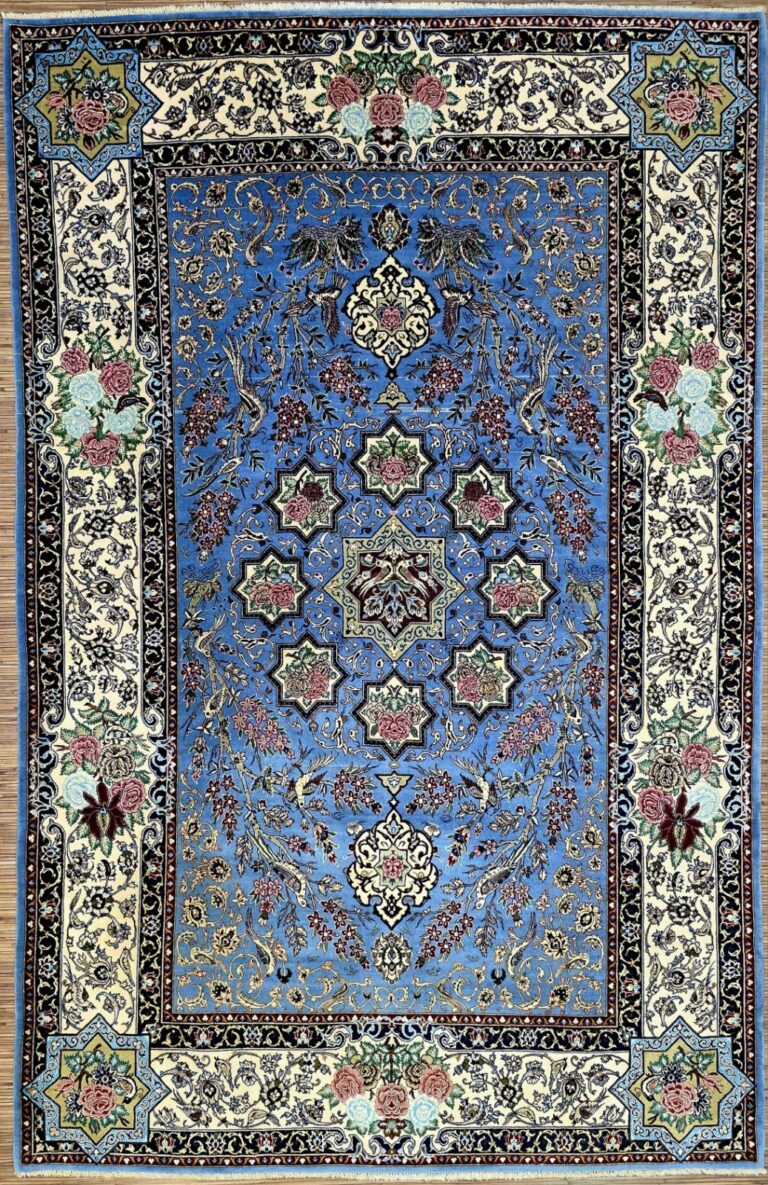
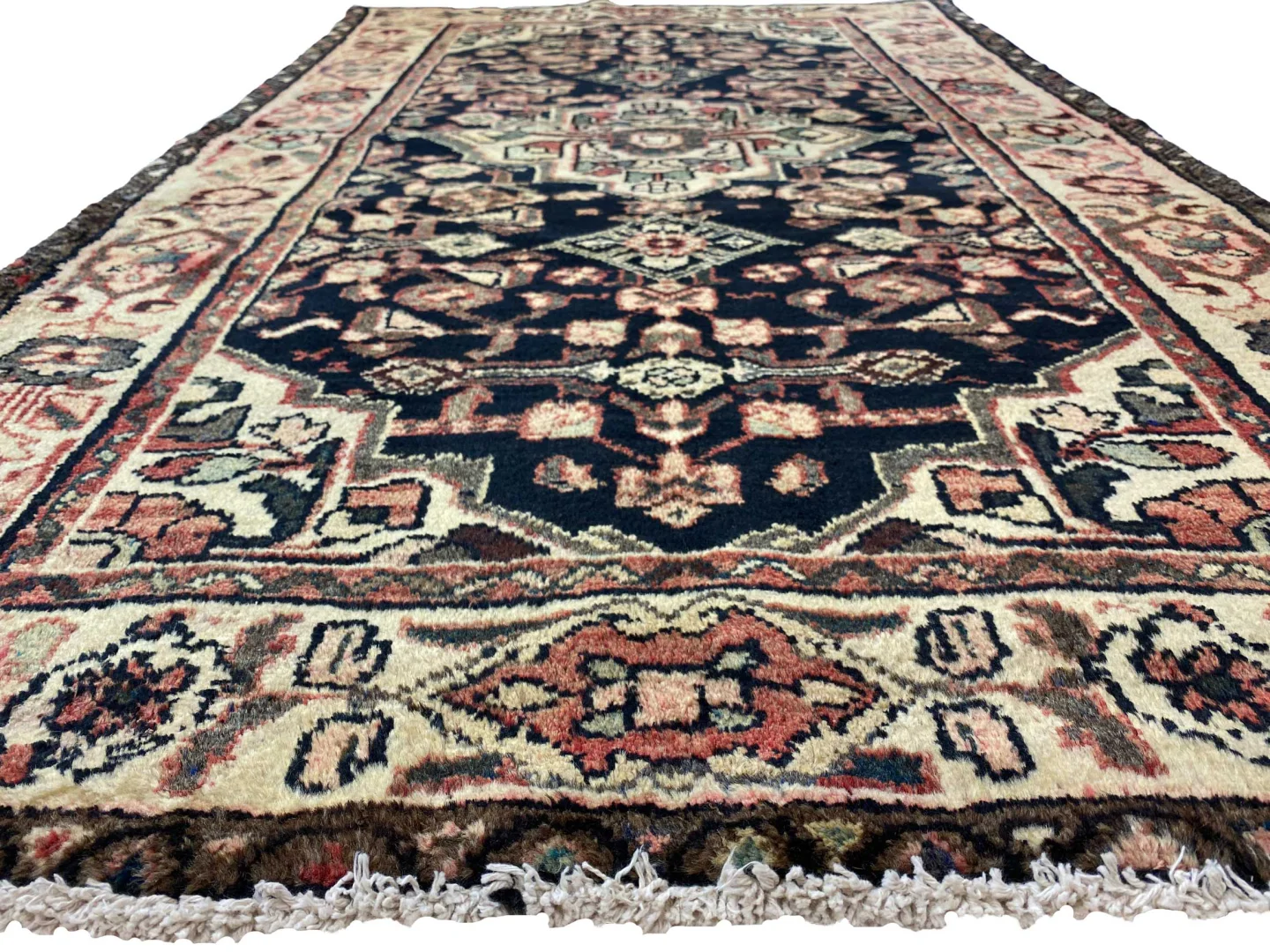
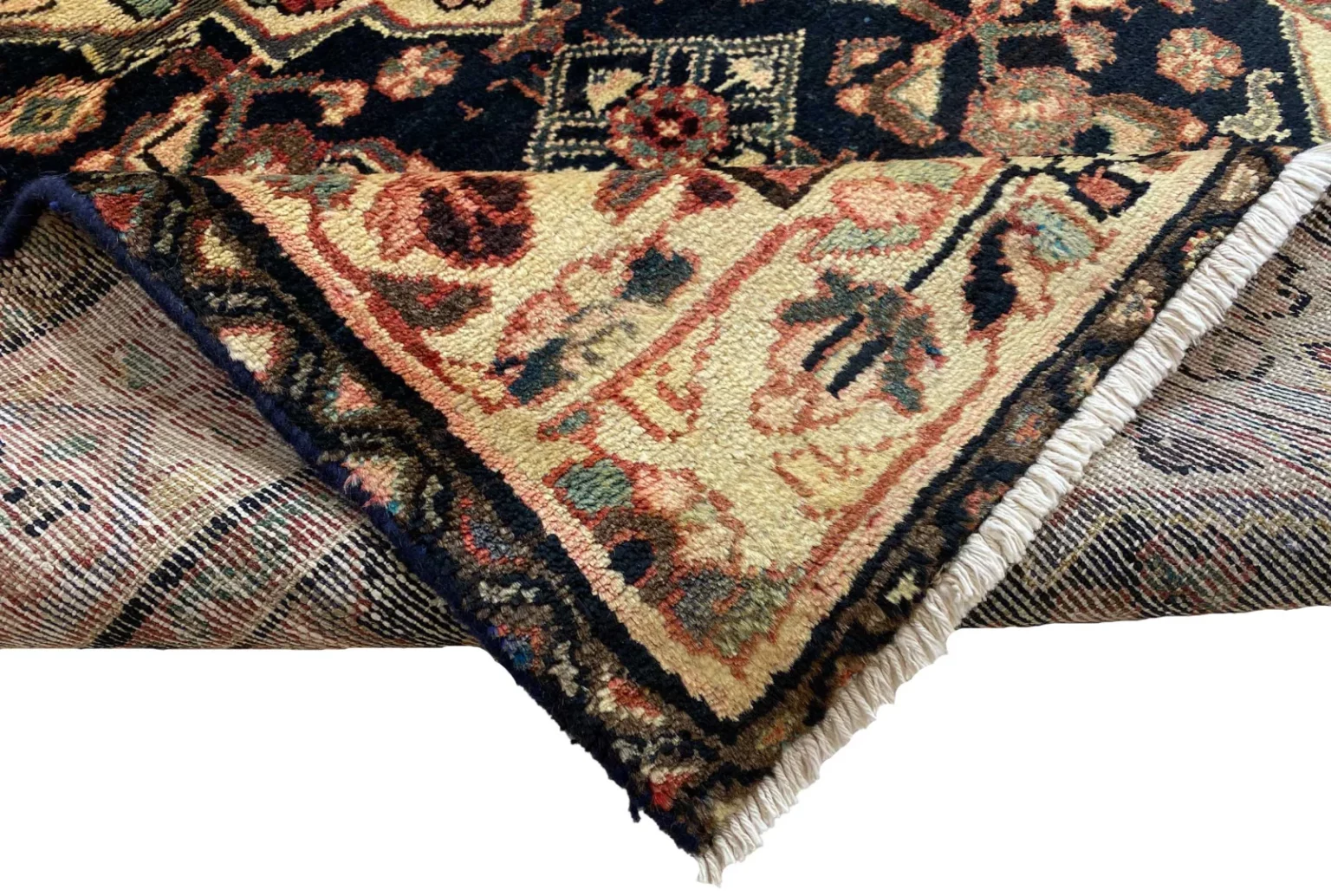
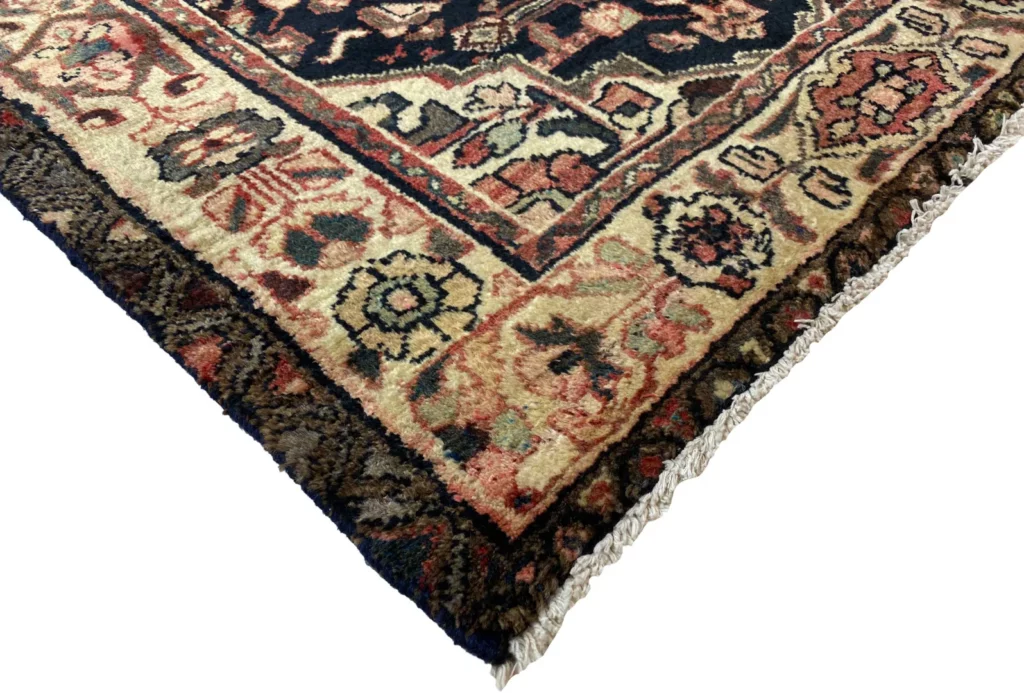
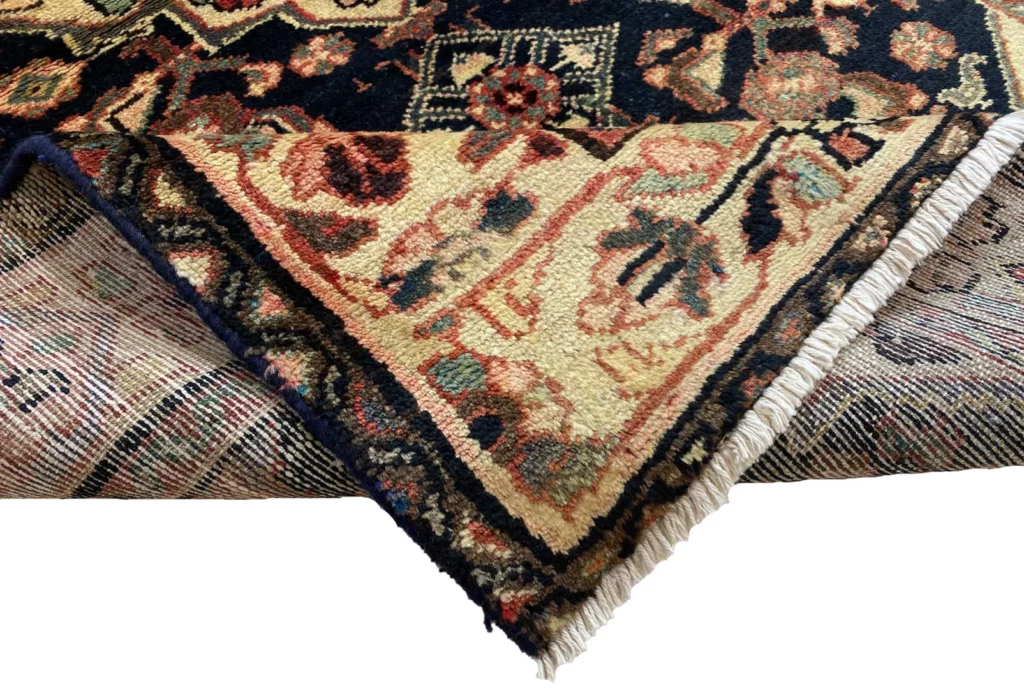
This Hamadan Oriental rug is made of wool and cotton and was hand-knotted. Wool is a traditional material in rug making. Its natural elasticity can contribute to a resilient surface, while its feel gives a rug a characteristic textile softness. Cotton is often used as a complementary textile material in Oriental rugs and supports the construction of the woven foundation. For this piece, wool and cotton are the materials specified.
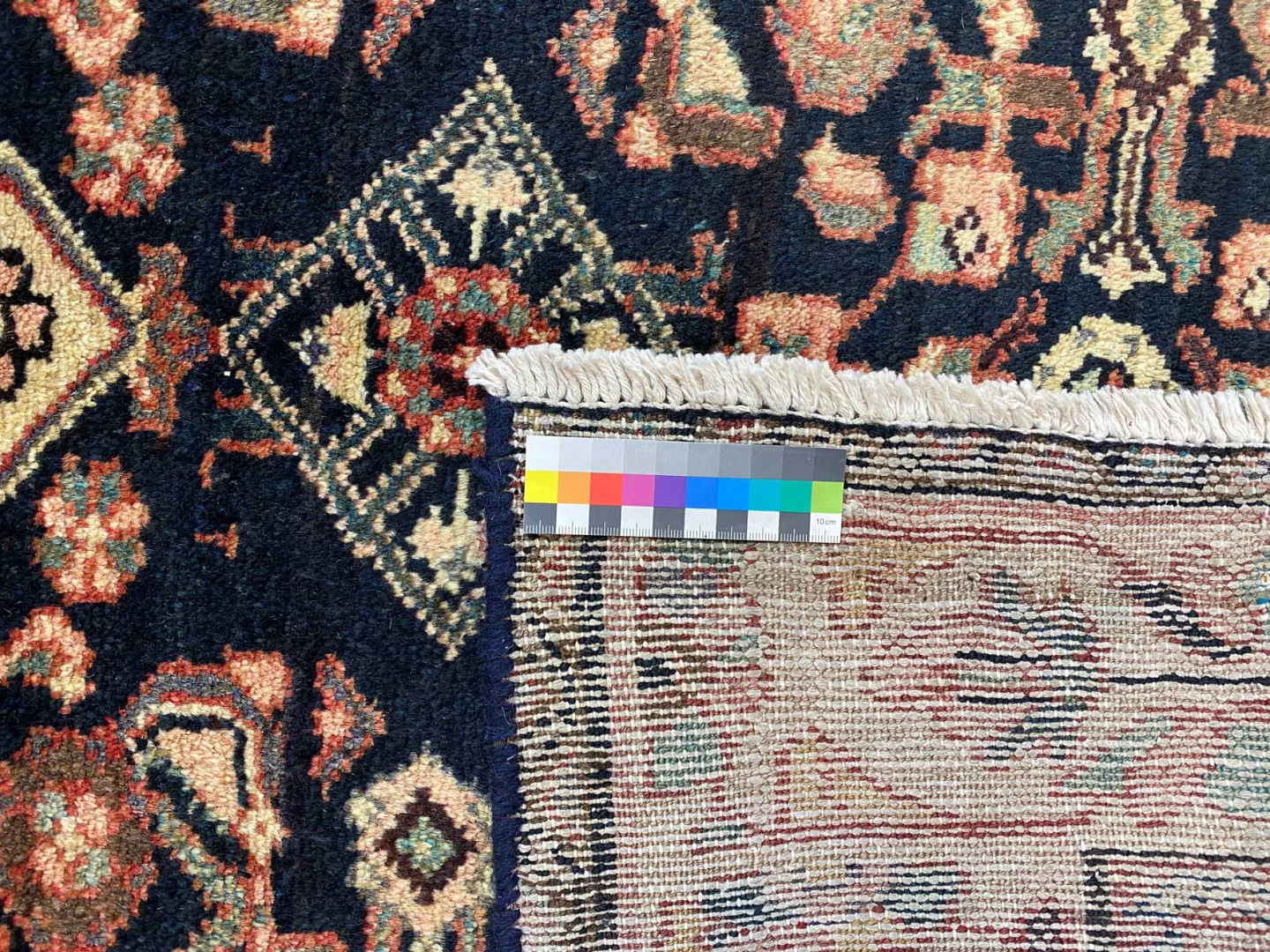
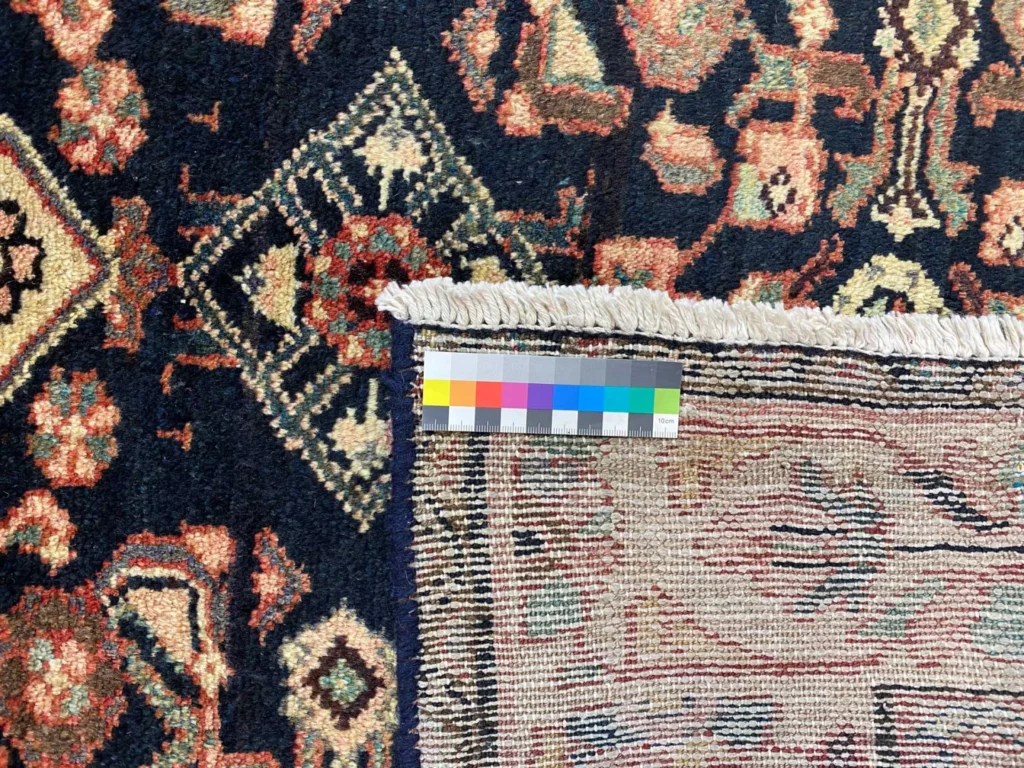
The knot density is 200,000 knots per square metre. This figure describes how many individual knots are placed within a defined area and therefore provides a technical indication of the work involved. A greater number of knots allows lines, outlines and smaller pattern areas to be worked with more differentiation. Knot density is an important measure of the making process, although it does not by itself describe every aspect of a rug’s character.
Hand-knotting builds the surface one step at a time. Each knot is inserted individually into the textile structure and incorporated into the developing row. Unlike machine production, the process is directly shaped by the work of the knotter. This gives each hand-knotted rug its own structure and makes it a one-off piece. The stated density makes the careful, labour-intensive nature of the traditional technique tangible.
The combination of wool and cotton, hand-knotted construction and the recorded knot density defines the principal technical features of this rug. Its condition is well preserved. The piece therefore brings together an established method of making and a clearly described state of preservation.
Origin and Tradition
The rug comes from Hamadan in Iran. Hamadan is one of the country’s old cities and lies in western Iran. The city and its surrounding area have long been associated with hand-knotted rug production. A distinct regional tradition developed there, shaped by varied patterns, colours and textile approaches. Hamadan consequently denotes more than a geographical name: it also identifies an important centre of Iranian rug culture.
The rug-making tradition of Hamadan reaches back to the nineteenth century. Across generations, knowledge of stretching the warps, placing knots, arranging the wefts and building borders was passed on. This work combines practical experience with a design vocabulary inherited over time. A hand-knotted rug from the region therefore belongs to a history in which usefulness and visual order exist together.
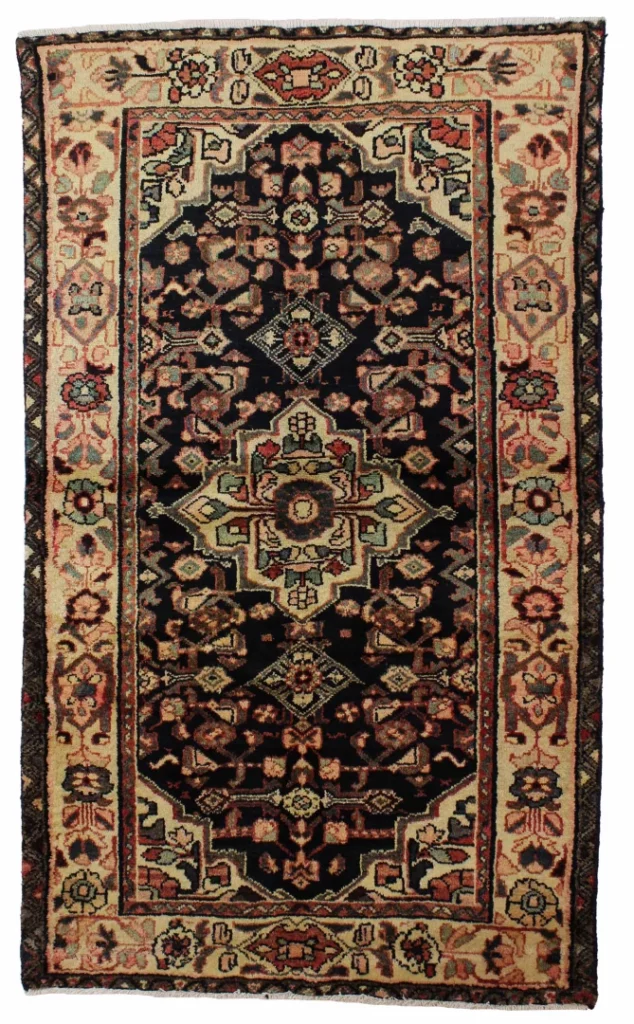
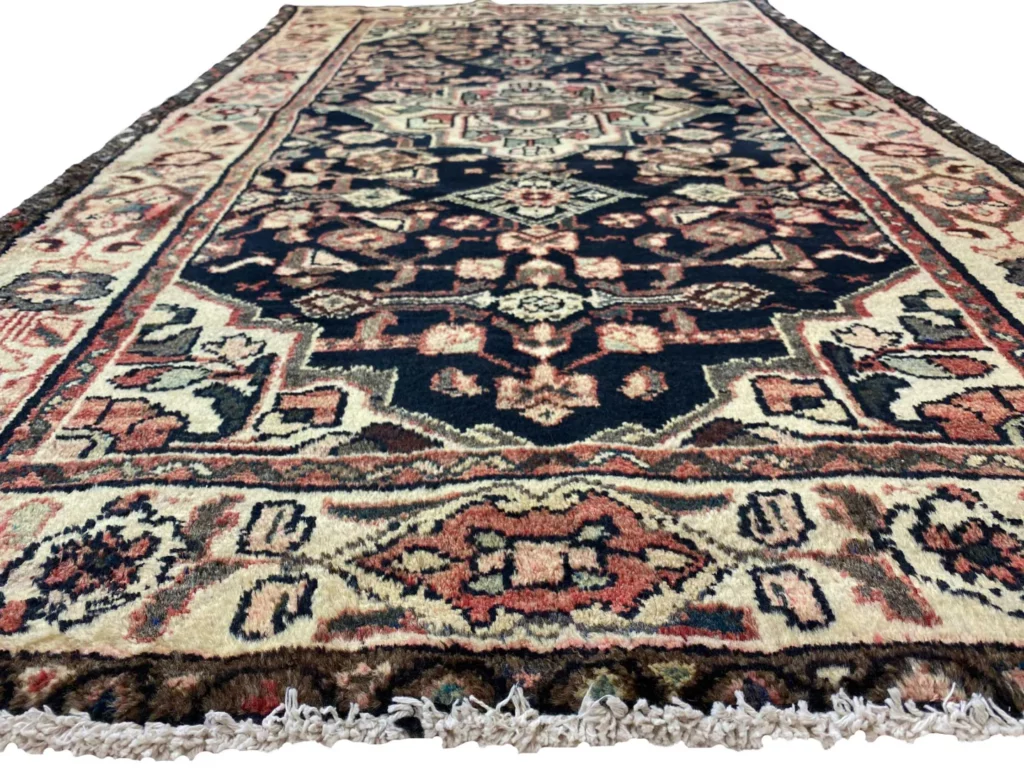
Hamadan rugs are often associated with straightforward, clearly legible designs and lively colours. Regional compositions may combine geometric forms with floral elements. Such designs are built from repeated motifs, defined fields and borders. The clear organisation makes individual pattern areas easy to distinguish, while repetition gives the whole a coherent structure. This rug is described specifically as having a traditional geometric design.
The region’s rug culture is closely connected with the history and culture of Hamadan. Patterns are not merely decorative surfaces; they form part of a visual language developed over long periods. Geometric shapes can express order, repetition and balance. Floral forms in traditional design often establish a link with the natural world. Combining these elements reflects the variety of the regional weaving tradition, without requiring every individual motif to have one fixed interpretation.
Iranian rugs are frequently associated with natural dyes and carefully differentiated colour schemes. In Hamadan, earthy reds are traditionally found alongside deep blues and other strong shades. Colour organises a rug, separates field from border and makes motifs easier to read. Its effect depends on the relationship between dye, knotting and pattern arrangement. In this way, the regional tradition can change from one composition to another while retaining recognisable foundations.
Hamadan’s importance in Iranian rug making therefore rests on the meeting of manual skill, regional design language and inherited knowledge. As a piece from Iran, this rug belongs to that cultural history. The Hamadan designation places it within a particular regional tradition, while its hand-knotted construction points to the central method of production. It can thus be understood both as a usable textile and as an example of a living craft heritage.
Design and Pattern
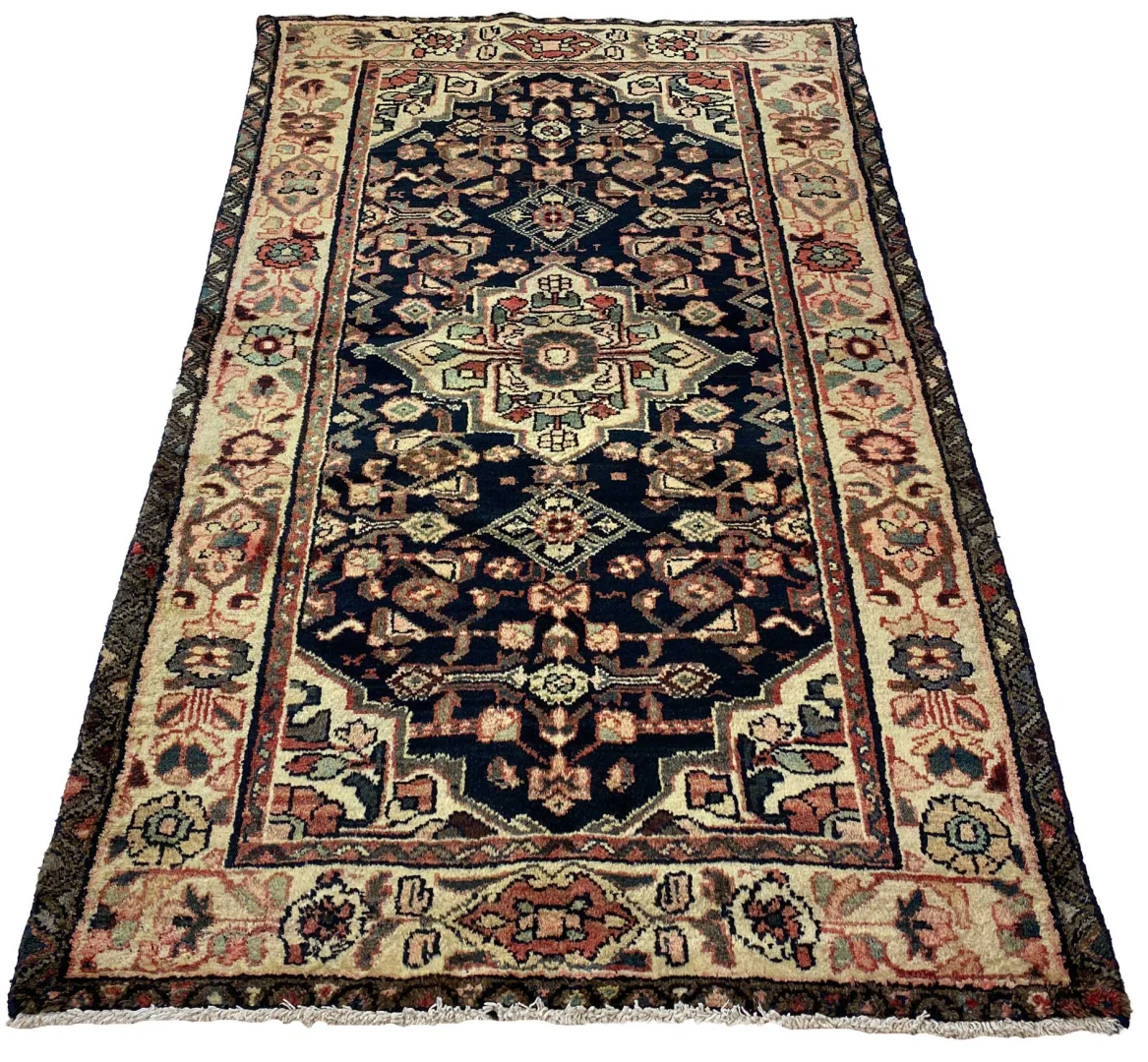
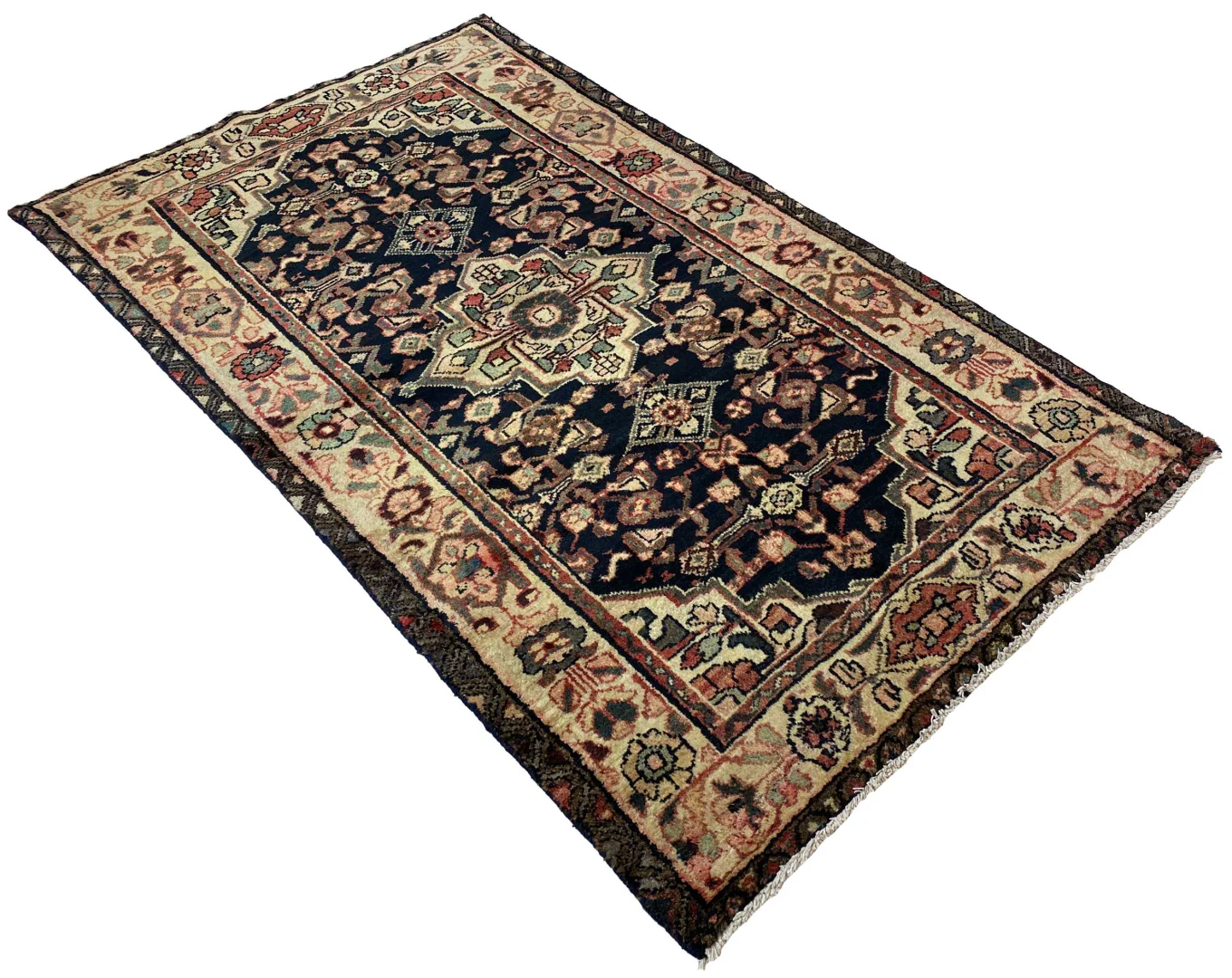
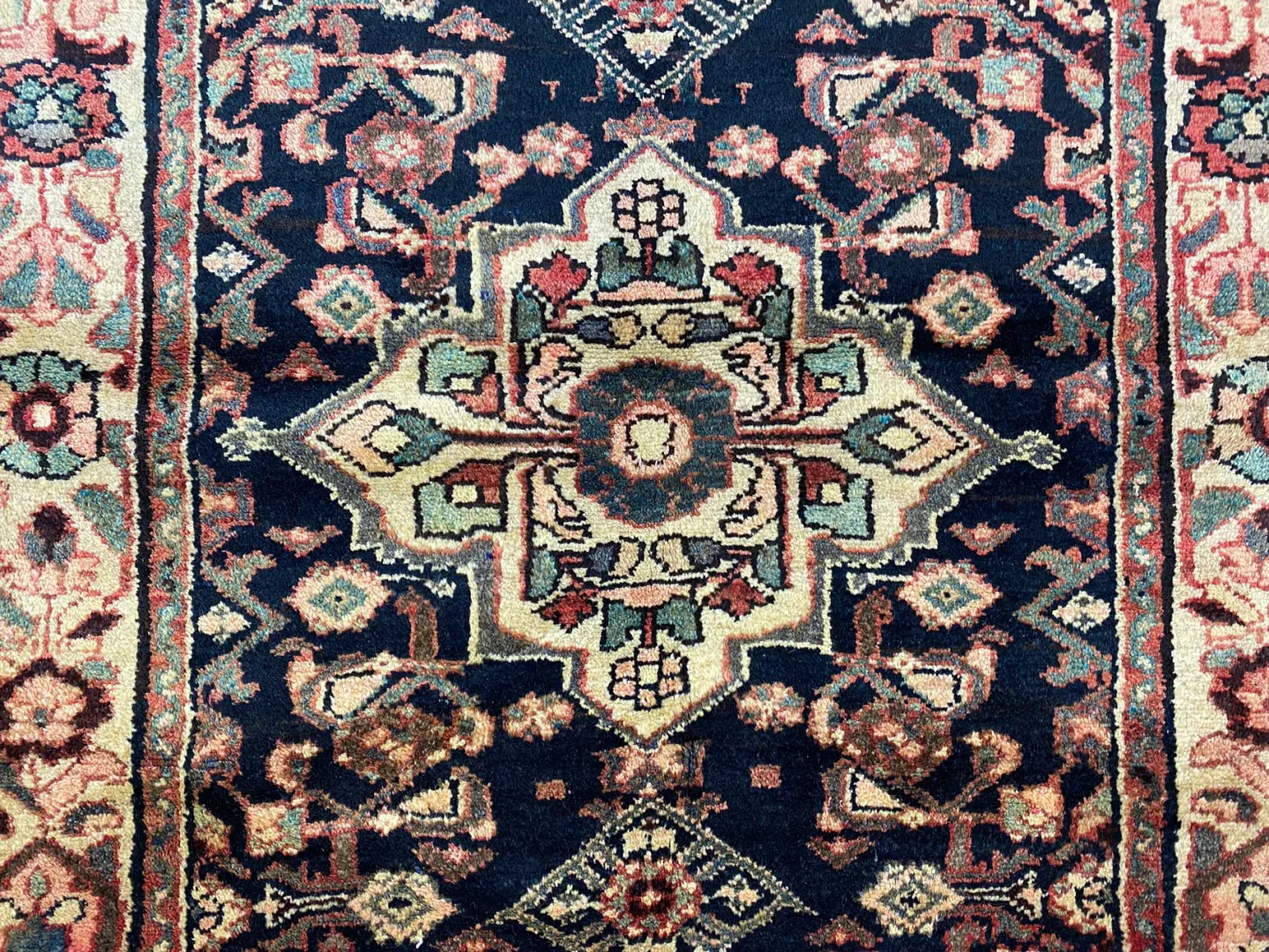
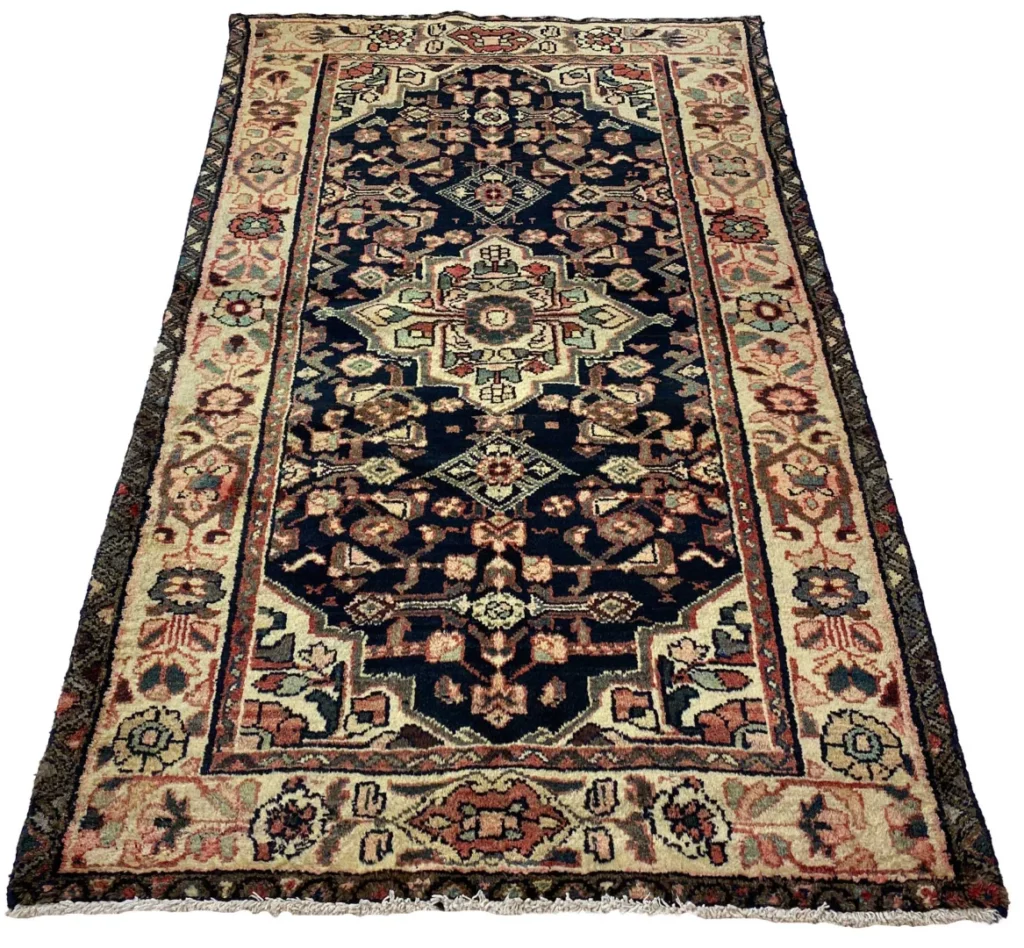
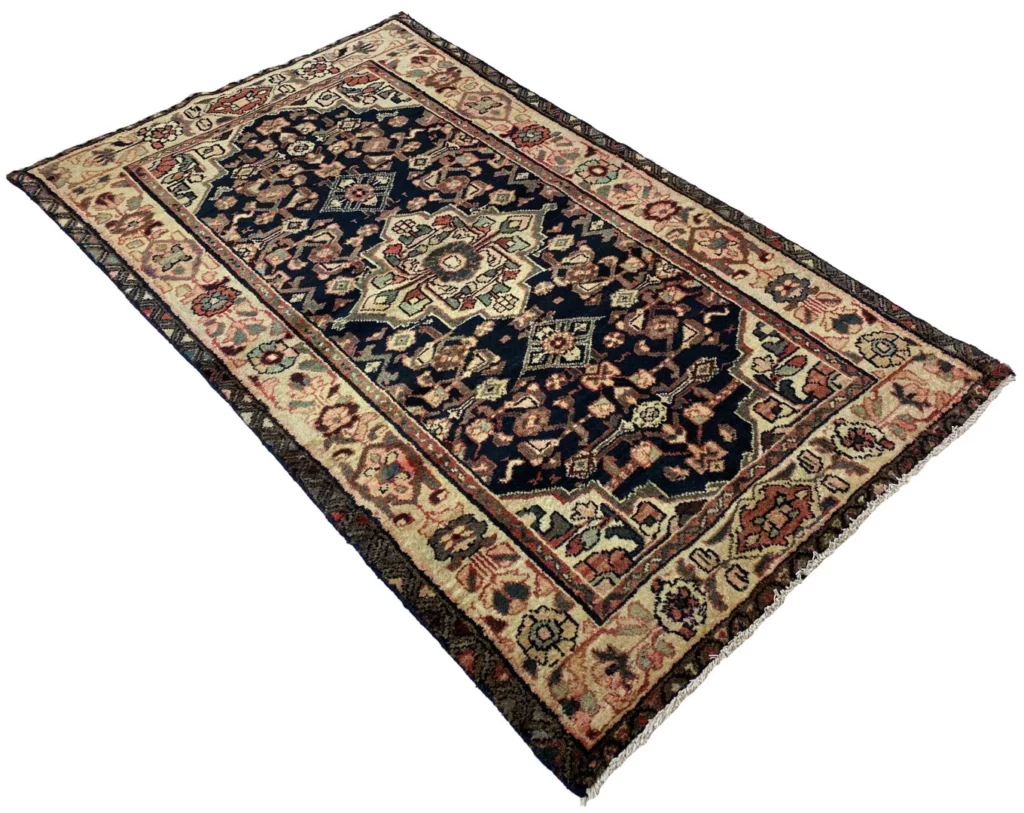
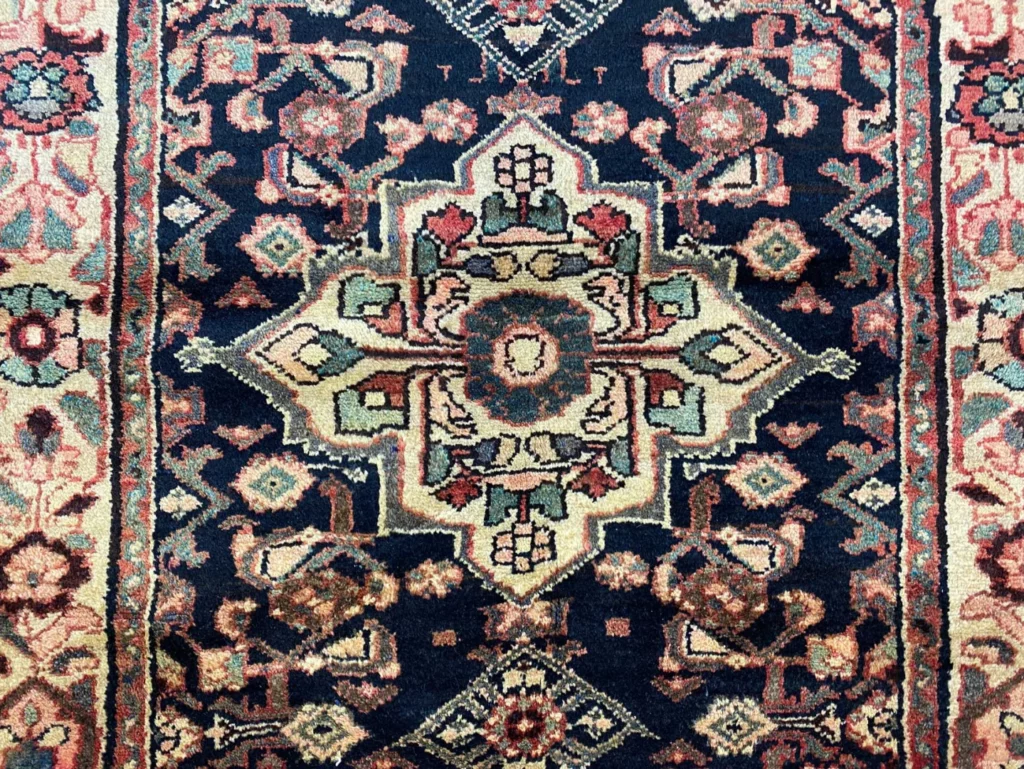
The pattern of this rug is described as a traditional geometric design. Geometric patterns are based on lines, angles, planes and repetition. They can organise a central field, define border areas or connect individual motifs in a regular arrangement. This creates a pattern that is structured and easy to read. Because the rug is hand-knotted, the design is not produced as a perfectly identical industrial repetition, but emerges from many individually placed knots.
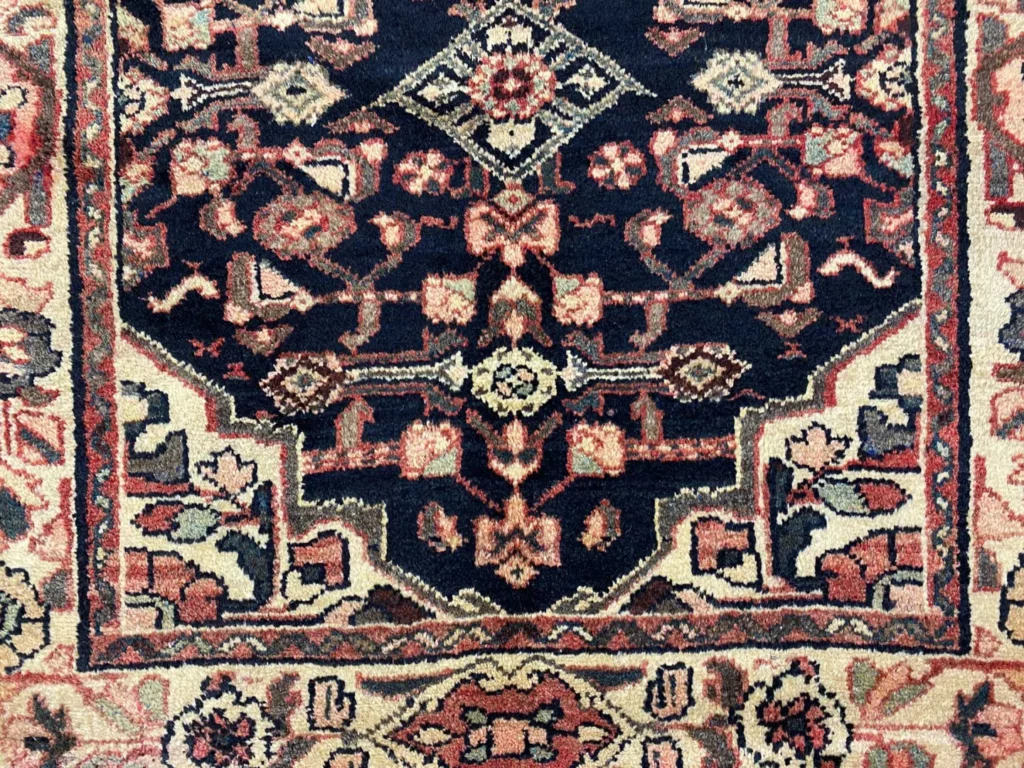
Geometric and floral elements frequently appear together in the Hamadan tradition. Geometric shapes provide a framework, while stylised leaves, flowers or vines can introduce references to natural forms. These elements are often arranged symmetrically or in recurring sequences. Symmetry creates balance, while small variations within handwork preserve the individual character of a one-off rug.
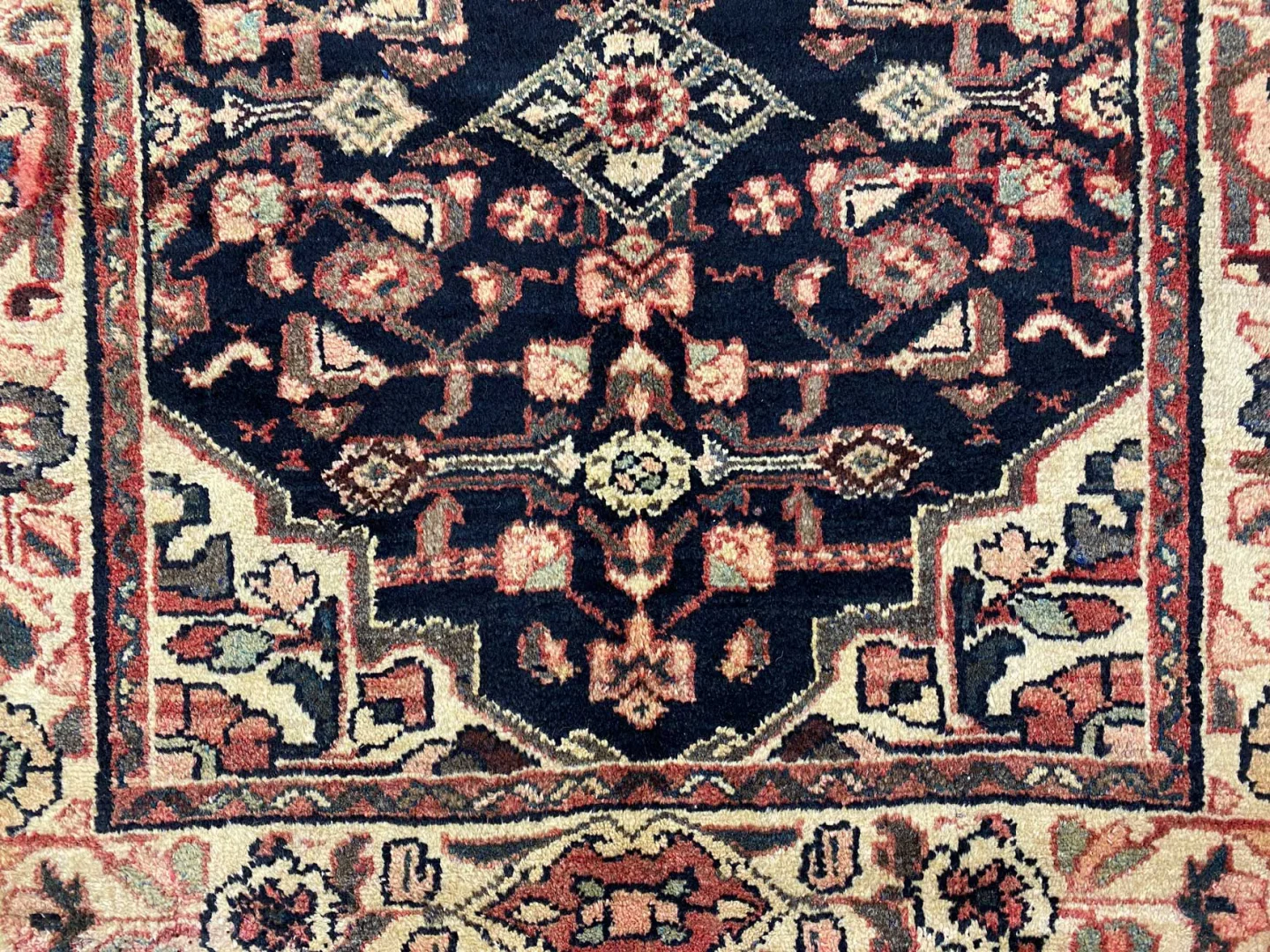
A traditional rug design usually consists of several connected levels. The field carries the central arrangement of motifs. One or more borders frame it and create a transition to the outer edge. Repeated forms can guide the eye across the field, while contrasting colour areas distinguish one zone from another. Even without assigning a specific name to every motif, a geometric design can be understood as an ordered regional language of form.
The colour range associated with Hamadan rugs often extends from earthy reds to deep blues. These colours can combine a warm, grounded presence with clear contrasts. Traditional dyeing frequently makes use of natural colourants. Colour is not only ornamental; it also separates fields, emphasises outlines and supports the hierarchy of the pattern. The result is a design in which colour and structure work together.
Traditional patterns can also carry symbolic ideas. Repeated geometric forms are associated with order and balance, while floral shapes may suggest nature and growth. In the inherited visual language of Iranian rugs, motifs can stand for good fortune, prosperity or a harmonious relationship with the natural world. These meanings belong to the cultural background and do not require every sign to be assigned one definitive interpretation. Their significance lies in the relationship of the forms across the composition.
The design therefore joins regional tradition with a clearly understandable geometric order. It is not defined by an arbitrary arrangement, but by the considered placement of traditional forms. Its effect comes from the relationship between lines, planes, repetition and colour. The composition retains its connection to Hamadan while remaining suitable for reading alongside modern, classic or traditional interiors.
Special Features
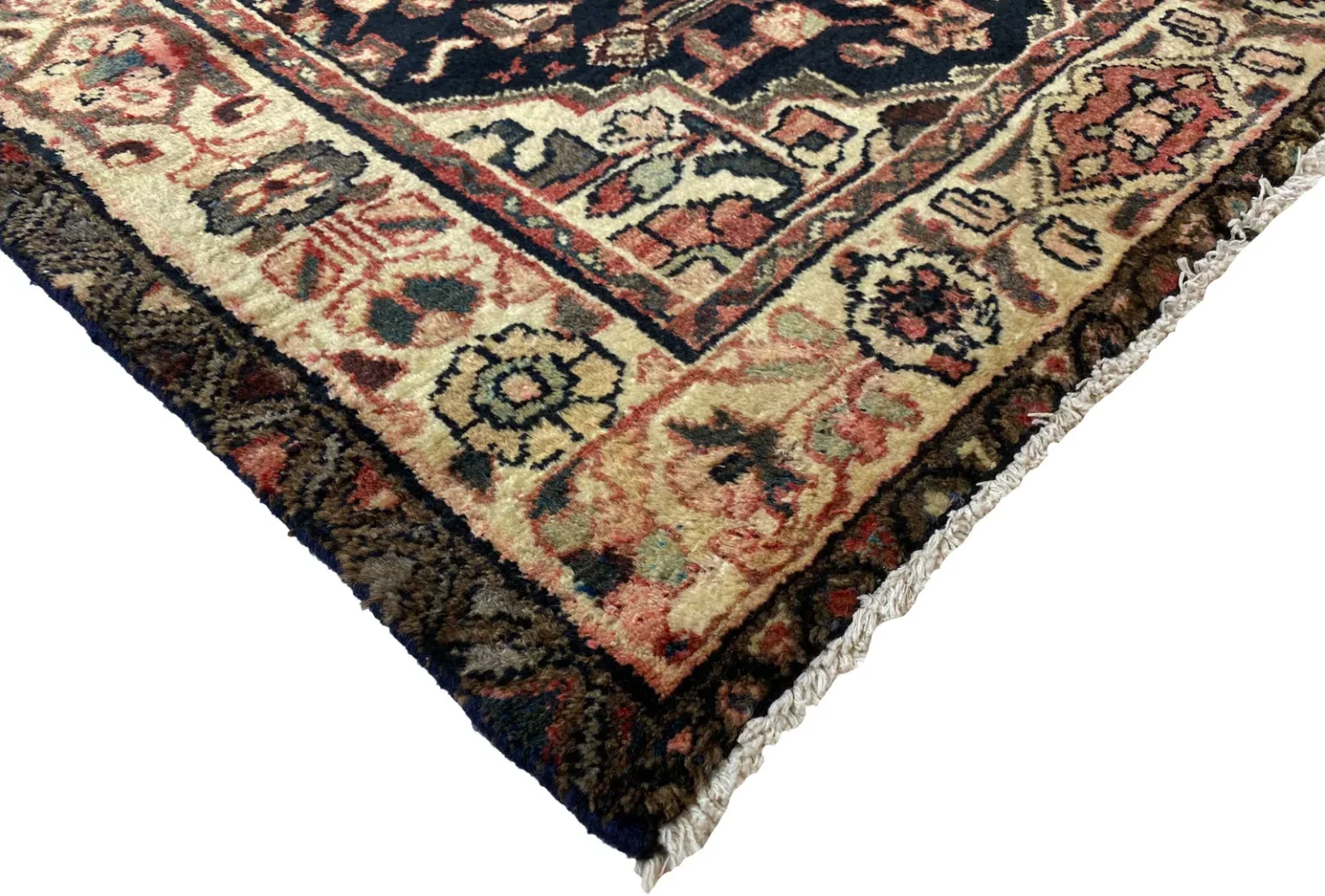
The rug is well preserved and hand-knotted. Its robust character makes it suitable for rooms with frequent use. At the same time, the traditional design can be combined with modern, classic or traditional interior styles. It can therefore complement different room concepts rather than being limited to one particular furnishing approach.
Hand-knotted rugs can gain character over time and develop their appearance over many years. They are not only decorative objects; with careful use and maintenance, they can remain in service for a long period. The combination of Iranian origin, traditional design and manual craftsmanship makes this one-off piece a carrier of regional rug culture.
FAQ
How should I care for my Hamadan Oriental rug?
Vacuum the rug regularly on a low setting so that dirt and dust do not remain in the surface. Avoid direct sunlight, as it can cause colours to fade. Treat spills as soon as possible with a damp cloth and a mild cleaning agent. Professional rug cleaning is recommended for a thorough treatment. Gentle, consistent care helps support the longevity of this hand-knotted rug.
Are hand-knotted rugs suitable for allergy sufferers?
Hand-knotted wool rugs are generally considered suitable for allergy sufferers because wool has natural antiallergic properties and attracts less dust and fewer allergens. The rug should nevertheless be cleaned regularly so that allergens do not accumulate. Suitability can depend on an individual’s sensitivity. Consistent maintenance is therefore important even when the rug is made of wool.
What is the difference between hand-knotted and machine-made rugs?
The main difference is the method of production. In a hand-knotted rug, every knot is placed individually, creating a one-off piece with its own structure and fine detail. Machine-made rugs are produced by industrial processes; their quality can vary according to the particular construction, and they are often less durable. Hand-knotted rugs made from quality materials are also associated with better retention of value.
To provide the best experiences, we use technologies like cookies to store and/or access device information. Consenting to these technologies will allow us to process data such as browsing behavior or unique IDs on this site. Not consenting or withdrawing consent, may adversely affect certain features and functions.
Functional Always active
The technical storage or access is strictly necessary for the legitimate purpose of enabling the use of a specific service explicitly requested by the subscriber or user, or for the sole purpose of carrying out the transmission of a communication over an electronic communications network.
Preferences
The technical storage or access is necessary for the legitimate purpose of storing preferences that are not requested by the subscriber or user.
Statistics
The technical storage or access that is used exclusively for statistical purposes.The technical storage or access that is used exclusively for anonymous statistical purposes. Without a subpoena, voluntary compliance on the part of your Internet Service Provider, or additional records from a third party, information stored or retrieved for this purpose alone cannot usually be used to identify you.
Marketing
The technical storage or access is required to create user profiles to send advertising, or to track the user on a website or across several websites for similar marketing purposes.

 SECURE PAYMENT
 SHIPPING PARTNERS